Asset Accounting
IN SAP ERP SYSTEM
(BAO6714)
Computerised Accounting in
an ERP System
Introduction
• General Ledger Account
• Used to store & Sort Debit and Credit Balances of CO’s Resources
• Permanent & Real Account
• Example:
“Asset is not only to be purchased but also to be
maintained and used after acquisition”
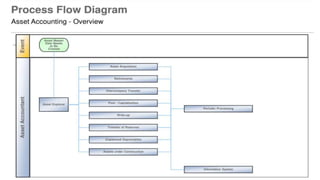
Asset accounting Overview
Purpose :
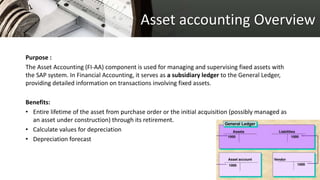
The Asset Accounting (FI-AA) component is used for managing and supervising fixed assets with
the SAP system. In Financial Accounting, it serves as a subsidiary ledger to the General Ledger,
providing detailed information on transactions involving fixed assets.
Benefits:
• Entire lifetime of the asset from purchase order or the initial acquisition (possibly managed as
an asset under construction) through its retirement.
• Calculate values for depreciation
• Depreciation forecast
Key terms
• Chart of Accounts (COA)
• Chart of Depreciation
• Asset Class
• Master Data – Create/Change Asset Master records
• Acquisitions
• Retirements- with Revenue/ without Revenue(scrapped)
• Depreciation
• Write-ups
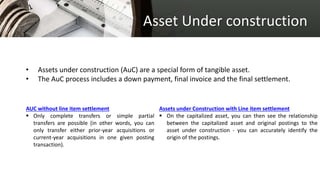
Asset Under construction
• Assets under construction (AuC) are a special form of tangible asset.
• The AuC process includes a down payment, final invoice and the final settlement.
AUC without line item settlement
 Only complete transfers or simple partial
transfers are possible (in other words, you can
only transfer either prior-year acquisitions or
current-year acquisitions in one given posting
transaction).
Assets under Construction with Line item settlement
 On the capitalized asset, you can then see the relationship
between the capitalized asset and original postings to the
asset under construction - you can accurately identify the
origin of the postings.
Integration of Asset Accounting
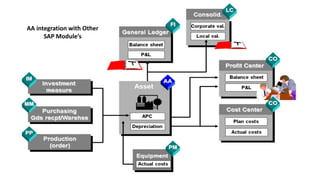
Asset Accounting (FI-AA) transfers data directly to and from other SAP components. For example,
it is possible to post from the Materials Management (MM) component directly to FI-AA. When
an asset is purchased or produced in-house, you can directly post the invoice receipt or goods
receipt, or the withdrawal from the warehouse, to assets in the Asset Accounting component.
Features:
• Traditional asset accounting
• Processing leased assets
• Preparation for consolidation
• Information System
AA integration with Other
SAP Module’s
Standard Asset Reports
• S_ALR_87011963- 70: Asset Balances
• S_ALR_87011979 - 82: Physical Inventory Lists
• S_ALR_87012936: Depreciation on Capitalized Assets (Depn Simulation)
• S_ALR_87012026: Depreciation Current
• S_ALR_87012075: Asset history
Thank you
Chander Rajpurohit
TechTip24
https://techtip24.com/

Asset accounting

  • 1.
    Asset Accounting IN SAPERP SYSTEM (BAO6714) Computerised Accounting in an ERP System
  • 2.
    Introduction • General LedgerAccount • Used to store & Sort Debit and Credit Balances of CO’s Resources • Permanent & Real Account • Example: “Asset is not only to be purchased but also to be maintained and used after acquisition”
  • 3.
    Asset accounting Overview Purpose: The Asset Accounting (FI-AA) component is used for managing and supervising fixed assets with the SAP system. In Financial Accounting, it serves as a subsidiary ledger to the General Ledger, providing detailed information on transactions involving fixed assets. Benefits: • Entire lifetime of the asset from purchase order or the initial acquisition (possibly managed as an asset under construction) through its retirement. • Calculate values for depreciation • Depreciation forecast
  • 4.
    Key terms • Chartof Accounts (COA) • Chart of Depreciation • Asset Class • Master Data – Create/Change Asset Master records • Acquisitions • Retirements- with Revenue/ without Revenue(scrapped) • Depreciation • Write-ups
  • 6.
    Asset Under construction •Assets under construction (AuC) are a special form of tangible asset. • The AuC process includes a down payment, final invoice and the final settlement. AUC without line item settlement  Only complete transfers or simple partial transfers are possible (in other words, you can only transfer either prior-year acquisitions or current-year acquisitions in one given posting transaction). Assets under Construction with Line item settlement  On the capitalized asset, you can then see the relationship between the capitalized asset and original postings to the asset under construction - you can accurately identify the origin of the postings.
  • 7.
    Integration of AssetAccounting Asset Accounting (FI-AA) transfers data directly to and from other SAP components. For example, it is possible to post from the Materials Management (MM) component directly to FI-AA. When an asset is purchased or produced in-house, you can directly post the invoice receipt or goods receipt, or the withdrawal from the warehouse, to assets in the Asset Accounting component. Features: • Traditional asset accounting • Processing leased assets • Preparation for consolidation • Information System
  • 8.
    AA integration withOther SAP Module’s
  • 9.
    Standard Asset Reports •S_ALR_87011963- 70: Asset Balances • S_ALR_87011979 - 82: Physical Inventory Lists • S_ALR_87012936: Depreciation on Capitalized Assets (Depn Simulation) • S_ALR_87012026: Depreciation Current • S_ALR_87012075: Asset history
  • 10.