FI AA
By Muhammad Asif Jaffer
m.asif@khi.iba.edu.pk
IBA Karachi
Fixed Assets Accounting in SAP
ERP
Basic Concepts
Concepts in Fixed Assets Accounting
 Asset as a sub ledger to General Ledger
 Account Determination
 Asset Class
 Depreciation Key
 Depreciation Area
 Chart of Depreciation
 Asset Master Data
 Other features in FI AA
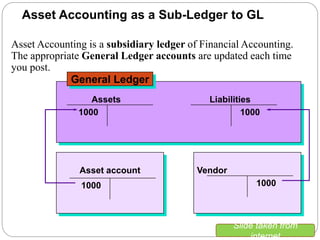
Asset Accounting is a subsidiary ledger of Financial Accounting.
The appropriate General Ledger accounts are updated each time
you post.
Asset Accounting as a Sub-Ledger to GL
Asset account Vendor
Assets Liabilities
General Ledger
1000 1000
1000 1000
Slide taken from
internet
Asset Accounting as a Sub-Ledger
to GL
 For each individual Asset, its master
data first needs to be created (t-code
AS01)
 (Note that creation of master data is
different from acquiring asset)
 However, it is important to understand
some other important concepts before
discussing asset master data
 So we will continue to asset master data
after discussing other key concepts
Account Determination
 Account determination is a group of GL accounts
that can be linked to an asset, but created
independent of an asset
 T-codes are AO90 and AO93 (configuration t-
codes)
 Example: Account determination 03 is configured
with following accounts
 Asset cost to be debited to GL account 120300
 Asset depreciation to be debited to GL account
710300
 Asset’s accumulated depreciation to be credited to
…
 Asset’s disposal settlement GL account …
 Gain on sale of asset to be posted to GL account …
Asset Class
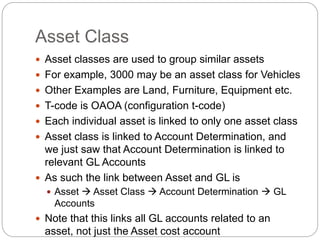
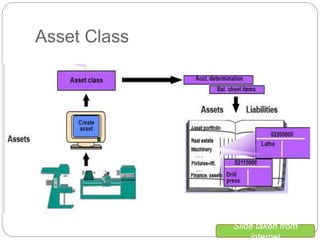
 Asset classes are used to group similar assets
 For example, 3000 may be an asset class for Vehicles
 Other Examples are Land, Furniture, Equipment etc.
 T-code is OAOA (configuration t-code)
 Each individual asset is linked to only one asset class
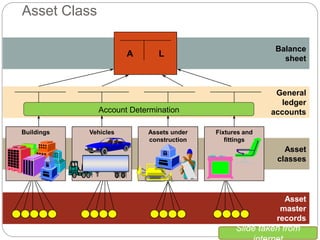
 Asset class is linked to Account Determination, and
we just saw that Account Determination is linked to
relevant GL Accounts
 As such the link between Asset and GL is
 Asset  Asset Class  Account Determination  GL
Accounts
 Note that this links all GL accounts related to an
asset, not just the Asset cost account
Asset Class
General
ledger
accounts
Balance
sheet
Asset
classes
Asset
master
records
A L
Vehicles Fixtures and
fittings
Buildings Assets under
construction
Account Determination
Slide taken from
Asset Class
Slide taken from
internet
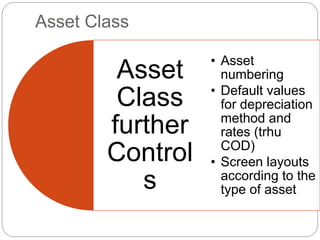
Asset Class
Asset
Class
further
Control
s
• Asset
numbering
• Default values
for depreciation
method and
rates (trhu
COD)
• Screen layouts
according to the
type of asset
Asset Class
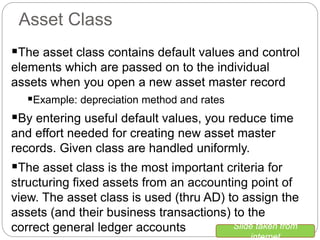
The asset class contains default values and control
elements which are passed on to the individual
assets when you open a new asset master record
Example: depreciation method and rates
By entering useful default values, you reduce time
and effort needed for creating new asset master
records. Given class are handled uniformly.
The asset class is the most important criteria for
structuring fixed assets from an accounting point of
view. The asset class is used (thru AD) to assign the
assets (and their business transactions) to the
correct general ledger accounts Slide taken from
internet
15
Special Asset Class: AuC
Class: Assets u. const.
AuC status
Down payment
16 Down payment carried forward
from previous years
 AuC managed as total
 line item settlement
 capital investment measure
depreciation
areas
deprec.
key
Book dep. 0000
Tax dep. 0000
Cost-acc. LINA
negative values allowed
depreciation is not calculated in
depreciation areas intended for the
balance sheet
Slide taken from
internet
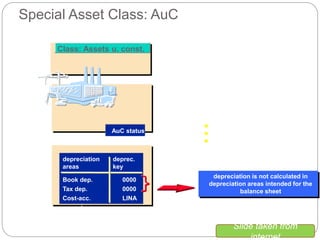
Assets under construction require their own asset
class.
Choosing the depreciation key ‘0000’ ensures that
depreciation is not calculated for the asset under
construction in depreciation areas that are posted to
the balance sheet.
Assets under construction have to be shown
separately in the balance sheet.
The component IM (Investment Management) is
available for managing more extensive asset
investments from a controlling-oriented perspective.
Special Asset Class: AuC
Slide taken from
internet
Depreciation Key
 Depreciation keys are used for depreciation types and
methods
 SAP supports the following types of depreciation:
 Ordinary Depreciation: planned reduction in asset
value due to normal wear and tear.
 Special Depreciation: depreciation that is solely
based on tax regulations.
 Unplanned Depreciation: depreciation resulting
from unusual circumstances, such as damage to
the asset, that lead to a permanent reduction in its
value.
Slide taken from
internet
Depreciation Key
 Depreciation keys are used for depreciation types and
methods
 Depreciation Methods
 The most common two methods are base method (straight
line) and declining balance method
 Each depreciation key is as such combination of
depreciation type and calculation method
 Depreciation keys are entered in asset master
data but they are defaulted from asset class to
which the asset belongs
 Depreciation keys are configured in SPRO
Depreciation Areas
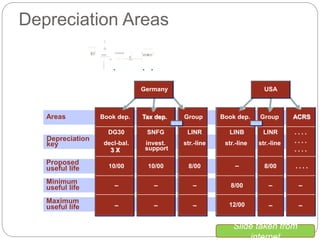
Organizations generally need values for
fixed assets for various business and
legal purposes (for example, book
depreciation, cost-accounting
depreciation, tax depreciation etc.). In FI-
AA, it is possible to manage values in
parallel in as many depreciation areas as
needed
 With depreciation areas, you can
depreciate an asset in parallel with more
than one depreciation methods for
Depreciation Areas
 Each depreciation area contains
relevant depreciation key, useful life
etc.
 An asset can be linked to more than
one depreciation areas, so that
automatically all applicable
depreciations are independently
carried out and assets valued
 Only one depreciation area posts to
Depreciation Areas
The depreciation areas are identified in the
system by a two-character numeric key.
Depreciation areas form the assigned COD
can be assigned in asset class or can be
assigned in asset master record directly
This feature enables you to handle a large
number of different types of valuation in
parallel.
Depreciation Areas
Areas
Depreciation
key
Proposed
useful life
Minimum
useful life
Maximum
useful life
Book dep.
10/00
_
_
DG30
decl-bal.
3 X
Tax dep.
10/00
_
_
SNFG
invest.
support
Group
8/00
_
_
LINR
str.-line
Book dep.
12/00
_
LINB
str.-line
Group
8/00
_
_
LINR
str.-line
ACRS
. . . .
_
_
. . . .
. . . .
. . . .
8/00
. . . . . .
Machines
USAGermany
Slide taken from
internet
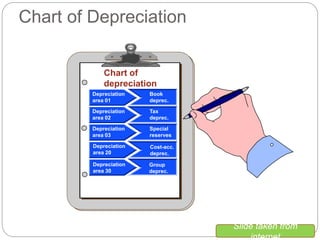
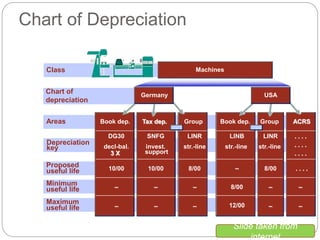
Chart of Depreciation
 Depreciation Areas for Pakistan, for
example, will be different from
depreciation areas for US.
 Different depreciation areas together
form a chart of depreciation, usually on
country basis
 SO that a company code that is in
Pakistan shall be making use of Pak.
chart of depreciation. The Pak COD will
contain depreciation areas applicable in
Chart of Depreciation
Chart of
depreciation
Depreciation
area 01
Depreciation
area 02
Depreciation
area 03
Depreciation
area 20
Book
deprec.
Tax
deprec.
Special
reserves
Cost-acc.
deprec.
Depreciation
area 30
Group
deprec.
Slide taken from
internet
Chart of Depreciation
Areas
Depreciation
key
Proposed
useful life
Minimum
useful life
Maximum
useful life
Book dep.
10/00
_
_
DG30
decl-bal.
3 X
Tax dep.
10/00
_
_
SNFG
invest.
support
Group
8/00
_
_
LINR
str.-line
Book dep.
12/00
_
LINB
str.-line
Group
8/00
_
_
LINR
str.-line
ACRS
. . . .
_
_
. . . .
. . . .
. . . .
8/00
. . . . . .
Class
Chart of
depreciation
Machines
USAGermany
1
Slide taken from
internet
Asset Master Data
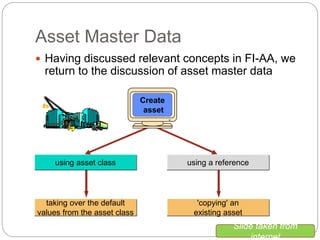
 Having discussed relevant concepts in FI-AA, we
return to the discussion of asset master data
using a referenceusing asset class
taking over the default
values from the asset class
'copying' an
existing asset
Create
asset
Slide taken from
internet
When you create the asset master record, you have two
options:
Use the asset class, to which the asset will belong, to
provide default values. The asset class then supplies the
most important control default parameters in the asset
master record.
Use an existing asset as a reference for creating the
new asset master record.
Some information in the asset master record can be
managed as time-dependent data. This is of particular
significance for cost accounting assignments (for example,
cost center etc.).
Asset Master Data
Other Features in FI AA
Subsequent Acquisitions / Enhancements
 The regular posting of subsequent
acquisitions within the current fiscal year
to an existing asset (due, for example, to
expansion or modernization) is made
just as for standard asset acquisition.
You can either post to the existing asset
master record, thereby increasing the
value, or create an asset sub-number,
where you can manage the subsequent
acquisition separately
http://help.sap.com/saphelp_46c/helpdat
Other Features in FI AA
Post Capitalizations
 you capitalize an asset for a fiscal
year in which the asset was not
originally capitalized. This posting,
however, is to be made for a fiscal
year that is already closed.
http://help.sap.com/saphelp_46c/helpdata
/en/6e/1214619f0411d189b80000e829fbb
d/content.htm?frameset=/en/74/62029726
7811d4b2e40050dadfb01d/frameset.htm&
current_toc=/en/2e/49b7109f0911d189b8
Other Features in FI AA
Use of Asset sub-numbers
For subsequent capital
expenditures
For separable segments of
assets
Other Features in FI AA
Imputed Interest on FA for Cost
Accounting
 Purpose: For cost accounting, you
might have to calculate imputed
interest on the capital tied up in
assets. Therefore, the system
enables you to calculate this
interest per depreciation area, in
addition to the depreciation and/or
valuation types already mentioned
Other Features in FI AA
Other Asset Types
 AUC
 Low Value Assets
 Leased Assets
 Intangible Assets
 Real Estate
 Etc.

4.1 fi aa basic concepts

  • 1.
    FI AA By MuhammadAsif Jaffer m.asif@khi.iba.edu.pk IBA Karachi Fixed Assets Accounting in SAP ERP Basic Concepts
  • 2.
    Concepts in FixedAssets Accounting  Asset as a sub ledger to General Ledger  Account Determination  Asset Class  Depreciation Key  Depreciation Area  Chart of Depreciation  Asset Master Data  Other features in FI AA
  • 3.
    Asset Accounting isa subsidiary ledger of Financial Accounting. The appropriate General Ledger accounts are updated each time you post. Asset Accounting as a Sub-Ledger to GL Asset account Vendor Assets Liabilities General Ledger 1000 1000 1000 1000 Slide taken from internet
  • 4.
    Asset Accounting asa Sub-Ledger to GL  For each individual Asset, its master data first needs to be created (t-code AS01)  (Note that creation of master data is different from acquiring asset)  However, it is important to understand some other important concepts before discussing asset master data  So we will continue to asset master data after discussing other key concepts
  • 5.
    Account Determination  Accountdetermination is a group of GL accounts that can be linked to an asset, but created independent of an asset  T-codes are AO90 and AO93 (configuration t- codes)  Example: Account determination 03 is configured with following accounts  Asset cost to be debited to GL account 120300  Asset depreciation to be debited to GL account 710300  Asset’s accumulated depreciation to be credited to …  Asset’s disposal settlement GL account …  Gain on sale of asset to be posted to GL account …
  • 6.
    Asset Class  Assetclasses are used to group similar assets  For example, 3000 may be an asset class for Vehicles  Other Examples are Land, Furniture, Equipment etc.  T-code is OAOA (configuration t-code)  Each individual asset is linked to only one asset class  Asset class is linked to Account Determination, and we just saw that Account Determination is linked to relevant GL Accounts  As such the link between Asset and GL is  Asset  Asset Class  Account Determination  GL Accounts  Note that this links all GL accounts related to an asset, not just the Asset cost account
  • 7.
    Asset Class General ledger accounts Balance sheet Asset classes Asset master records A L VehiclesFixtures and fittings Buildings Assets under construction Account Determination Slide taken from
  • 8.
  • 9.
    Asset Class Asset Class further Control s • Asset numbering •Default values for depreciation method and rates (trhu COD) • Screen layouts according to the type of asset
  • 10.
    Asset Class The assetclass contains default values and control elements which are passed on to the individual assets when you open a new asset master record Example: depreciation method and rates By entering useful default values, you reduce time and effort needed for creating new asset master records. Given class are handled uniformly. The asset class is the most important criteria for structuring fixed assets from an accounting point of view. The asset class is used (thru AD) to assign the assets (and their business transactions) to the correct general ledger accounts Slide taken from internet
  • 11.
    15 Special Asset Class:AuC Class: Assets u. const. AuC status Down payment 16 Down payment carried forward from previous years  AuC managed as total  line item settlement  capital investment measure depreciation areas deprec. key Book dep. 0000 Tax dep. 0000 Cost-acc. LINA negative values allowed depreciation is not calculated in depreciation areas intended for the balance sheet Slide taken from internet
  • 12.
    Assets under constructionrequire their own asset class. Choosing the depreciation key ‘0000’ ensures that depreciation is not calculated for the asset under construction in depreciation areas that are posted to the balance sheet. Assets under construction have to be shown separately in the balance sheet. The component IM (Investment Management) is available for managing more extensive asset investments from a controlling-oriented perspective. Special Asset Class: AuC Slide taken from internet
  • 13.
    Depreciation Key  Depreciationkeys are used for depreciation types and methods  SAP supports the following types of depreciation:  Ordinary Depreciation: planned reduction in asset value due to normal wear and tear.  Special Depreciation: depreciation that is solely based on tax regulations.  Unplanned Depreciation: depreciation resulting from unusual circumstances, such as damage to the asset, that lead to a permanent reduction in its value. Slide taken from internet
  • 14.
    Depreciation Key  Depreciationkeys are used for depreciation types and methods  Depreciation Methods  The most common two methods are base method (straight line) and declining balance method  Each depreciation key is as such combination of depreciation type and calculation method  Depreciation keys are entered in asset master data but they are defaulted from asset class to which the asset belongs  Depreciation keys are configured in SPRO
  • 15.
    Depreciation Areas Organizations generallyneed values for fixed assets for various business and legal purposes (for example, book depreciation, cost-accounting depreciation, tax depreciation etc.). In FI- AA, it is possible to manage values in parallel in as many depreciation areas as needed  With depreciation areas, you can depreciate an asset in parallel with more than one depreciation methods for
  • 16.
    Depreciation Areas  Eachdepreciation area contains relevant depreciation key, useful life etc.  An asset can be linked to more than one depreciation areas, so that automatically all applicable depreciations are independently carried out and assets valued  Only one depreciation area posts to
  • 17.
    Depreciation Areas The depreciationareas are identified in the system by a two-character numeric key. Depreciation areas form the assigned COD can be assigned in asset class or can be assigned in asset master record directly This feature enables you to handle a large number of different types of valuation in parallel.
  • 18.
    Depreciation Areas Areas Depreciation key Proposed useful life Minimum usefullife Maximum useful life Book dep. 10/00 _ _ DG30 decl-bal. 3 X Tax dep. 10/00 _ _ SNFG invest. support Group 8/00 _ _ LINR str.-line Book dep. 12/00 _ LINB str.-line Group 8/00 _ _ LINR str.-line ACRS . . . . _ _ . . . . . . . . . . . . 8/00 . . . . . . Machines USAGermany Slide taken from internet
  • 19.
    Chart of Depreciation Depreciation Areas for Pakistan, for example, will be different from depreciation areas for US.  Different depreciation areas together form a chart of depreciation, usually on country basis  SO that a company code that is in Pakistan shall be making use of Pak. chart of depreciation. The Pak COD will contain depreciation areas applicable in
  • 20.
    Chart of Depreciation Chartof depreciation Depreciation area 01 Depreciation area 02 Depreciation area 03 Depreciation area 20 Book deprec. Tax deprec. Special reserves Cost-acc. deprec. Depreciation area 30 Group deprec. Slide taken from internet
  • 21.
    Chart of Depreciation Areas Depreciation key Proposed usefullife Minimum useful life Maximum useful life Book dep. 10/00 _ _ DG30 decl-bal. 3 X Tax dep. 10/00 _ _ SNFG invest. support Group 8/00 _ _ LINR str.-line Book dep. 12/00 _ LINB str.-line Group 8/00 _ _ LINR str.-line ACRS . . . . _ _ . . . . . . . . . . . . 8/00 . . . . . . Class Chart of depreciation Machines USAGermany 1 Slide taken from internet
  • 22.
    Asset Master Data Having discussed relevant concepts in FI-AA, we return to the discussion of asset master data using a referenceusing asset class taking over the default values from the asset class 'copying' an existing asset Create asset Slide taken from internet
  • 23.
    When you createthe asset master record, you have two options: Use the asset class, to which the asset will belong, to provide default values. The asset class then supplies the most important control default parameters in the asset master record. Use an existing asset as a reference for creating the new asset master record. Some information in the asset master record can be managed as time-dependent data. This is of particular significance for cost accounting assignments (for example, cost center etc.). Asset Master Data
  • 24.
    Other Features inFI AA Subsequent Acquisitions / Enhancements  The regular posting of subsequent acquisitions within the current fiscal year to an existing asset (due, for example, to expansion or modernization) is made just as for standard asset acquisition. You can either post to the existing asset master record, thereby increasing the value, or create an asset sub-number, where you can manage the subsequent acquisition separately http://help.sap.com/saphelp_46c/helpdat
  • 25.
    Other Features inFI AA Post Capitalizations  you capitalize an asset for a fiscal year in which the asset was not originally capitalized. This posting, however, is to be made for a fiscal year that is already closed. http://help.sap.com/saphelp_46c/helpdata /en/6e/1214619f0411d189b80000e829fbb d/content.htm?frameset=/en/74/62029726 7811d4b2e40050dadfb01d/frameset.htm& current_toc=/en/2e/49b7109f0911d189b8
  • 26.
    Other Features inFI AA Use of Asset sub-numbers For subsequent capital expenditures For separable segments of assets
  • 27.
    Other Features inFI AA Imputed Interest on FA for Cost Accounting  Purpose: For cost accounting, you might have to calculate imputed interest on the capital tied up in assets. Therefore, the system enables you to calculate this interest per depreciation area, in addition to the depreciation and/or valuation types already mentioned
  • 28.
    Other Features inFI AA Other Asset Types  AUC  Low Value Assets  Leased Assets  Intangible Assets  Real Estate  Etc.

Editor's Notes