Assessment in a Constructivist,
technology-Supported Learning
Ed-tech 1
“Complex learning cannot be
assessed or evaluated using any
single measure. We must examine
both the processes and products of
student learning.”
Focus Question:
•Which form of
assessment fits a
constructivist technology-
supported learning
environment?
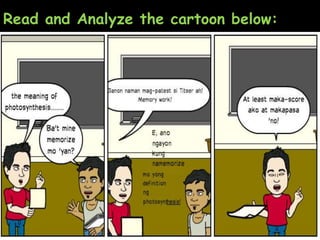
Read and Analyze the cartoon below:
Questions:
1.Do you also memorize when you
prepare for tests?
2.Do you like it?
3.Why do you have to memorize?
4.Would you still memorize even if
teacher’s style of testing changes?
ABSTRACTION
From the conversation we gather that
some students:
•memorize very much for the test
•fit their style of test preparation to the
kind of test &
•study only for passing score & a
passing grade
Questions we raise are:
•“Is it really bad to memorize for the
test?
•“Is it not good to study for a score &
for a grade?
The answer for both is NO!
•It is not bad to memorize for the test.
Examinees even take in “Memory Plus”
food supplement to increase their power
to memorize.
•Neither is it bad to study for scores and
grade.
•However, we should go beyond
memorizing for tests and we should not
study only for passing score or a
passing grade.
Constructivist Classroom
In constructivist classroom, learning
transcends memorization of facts.
It is putting these isolated facts together,
form concept & makes meaning out of them.
It is connecting the integration of these facts
& concepts to daily life.
It is seeing the relevance of these facts &
concept to what we value & treasure in life.
It is higher level form of assessment that
will require the display of basic skills of
writing & speaking, computing & the
more complex skills of applying concepts
learned, analyzing, integrating &
creating, critiquing & evaluating, & the
social skills of working with others. Such,
higher level form of assessment will call
for alternative forms of assessment.
Paper-and-pencil test
The traditional paper-and-
pencil test will prove to be
inadequate to measure basic
skills integrated with higher-
order-thinking skills and socio
skills.
Authentic Assessment
•Is most appropriate for the constructivist
classroom.
•Measures collective abilities, written and oral
expression skills, analytical skills,
manipulative skills, (like computer skills)
integration, creativity, & ability to work
collaboratively.
•Students perform real world tasks, thus the
word “authentic”.
o The Performance is a
reliable measure of
skills learned
o Product is a proof of
the acquisition of
skills.
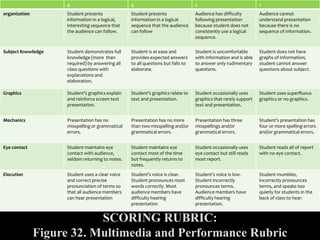
4 3 2 1
organization Student presents
information in a logical,
interesting sequence that
the audience can follow.
Student presents
information in a logical
sequence that the audience
can follow
Audience has difficulty
following presentation
because student does not
consistently use a logical
sequence.
Audience cannot
understand presentation
because there is no
sequence of information.
Subject Knowledge Student demonstrates full
knowledge (more than
required) by answering all
class questions with
explanations and
elaboration.
Student is at ease and
provides expected answers
to all questions but falls to
elaborate.
Student is uncomfortable
with information and is able
to answer only rudimentary
questions.
Student does not have
graphs of information;
student cannot answer
questions about subject.
Graphics Student’s graphics explain
and reinforce screen text
presentation.
Student’s graphics relate to
text and presentation.
Student occasionally uses
graphics that rarely support
text and presentation.
Student uses superfluous
graphics or no graphics.
Mechanics Presentation has no
misspelling or grammatical
errors.
Presentation has no more
than two misspelling and/or
grammatical errors.
Presentation has three
misspellings and/or
grammatical errors.
Student’s presentation has
four or more spelling errors
and/or grammatical errors.
Eye contact Student maintains eye
contact with audience,
seldom returning to notes.
Student maintains eye
contact most of the time
but frequently returns to
notes.
Student occasionally uses
eye contact but still reads
most report.
Student reads all of report
with no eye contact.
Elocution Student uses a clear voice
and correct precise
pronunciation of terms so
that all audience members
can hear presentation
Student’s voice is clear.
Student pronounces most
words correctly. Most
audience members have
difficulty hearing
presentation
Student’s voice is low.
Student incorrectly
pronounces terms.
Audience members have
difficulty hearing
presentation.
Student mumbles,
incorrectly pronounces
terms, and speaks too
quietly for students in the
back of class to hear.
SCORING RUBRIC:
Figure 32. Multimedia and Performance Rubric
You & your students may develop a
rubric. It can be a collaborative effort
for both of you – teacher and students
– in line with the practice of self-
assessment, which is highly favored
and encouraged. In fact, with scoring
rubric, standards are clearly set at the
beginning for you and your students
and with that rubric your students can
assess their own progress.
•In this case, the much of the fear for
tests gets dispelled. Assessment is
accepted as a natural and normal part
of the learning process.
•There are no more secrets on how
students will be tested, what kind of
questions will be asked. The students
themselves know how their progress
gets assessed.
Assessment in a Technology-Supported
Environment
Includes display of skillful &
creative use of technologies, (old &
recent) because that is what
naturally expected of us in the real
world, a technology-dominated
world. In the 21st century, we need
to be computer literate & fluent or
become helpless.
•These technology and integrated
skills are demonstrated by
students present answers they
have found to two or more
assigned problems or present the
group project they have worked
on for a purpose with the use of
various technologies.
Performance –based Assessment or
Product Assessment
- it is a direct assessment.
Integrative skills are
demonstrated when students
present answers they have
found to two or more assigned
problems or present the group
project they have work.
Technology-Supported Classroom
•Maximizes the use of old and new
technology.
•Students are expected to demonstrate
learning with the use of both old and new
technology.
•Students may use transparencies & OHP
to demonstrate the learned skill of topic
presentation or may choose to use power
point presentation.
To assess their
manipulative skill, we
conduct direct
assessment with the
help of a scoring
rubric.
From the eyes of a constructivist
learning is an:
a) active constructive,
b) intentional, authentic and
c) cooperative process,
so should the ways in which we
assess learners and criteria that
we use to evaluate them.
Obviously the traditional
paper-and-pencil that
cannot assess this type
of learning.
“ If we believe that the
ways that we assess
learning should change,
so we need to rethink the
ways that we evaluate
learning, asserts. “
—Jonassen (1999)

Assessment in a constructivist, technology supported learning

  • 1.
    Assessment in aConstructivist, technology-Supported Learning Ed-tech 1
  • 2.
    “Complex learning cannotbe assessed or evaluated using any single measure. We must examine both the processes and products of student learning.”
  • 3.
    Focus Question: •Which formof assessment fits a constructivist technology- supported learning environment?
  • 4.
    Read and Analyzethe cartoon below:
  • 5.
    Questions: 1.Do you alsomemorize when you prepare for tests? 2.Do you like it? 3.Why do you have to memorize? 4.Would you still memorize even if teacher’s style of testing changes?
  • 6.
    ABSTRACTION From the conversationwe gather that some students: •memorize very much for the test •fit their style of test preparation to the kind of test & •study only for passing score & a passing grade
  • 7.
    Questions we raiseare: •“Is it really bad to memorize for the test? •“Is it not good to study for a score & for a grade? The answer for both is NO!
  • 8.
    •It is notbad to memorize for the test. Examinees even take in “Memory Plus” food supplement to increase their power to memorize. •Neither is it bad to study for scores and grade. •However, we should go beyond memorizing for tests and we should not study only for passing score or a passing grade.
  • 9.
    Constructivist Classroom In constructivistclassroom, learning transcends memorization of facts. It is putting these isolated facts together, form concept & makes meaning out of them. It is connecting the integration of these facts & concepts to daily life. It is seeing the relevance of these facts & concept to what we value & treasure in life.
  • 10.
    It is higherlevel form of assessment that will require the display of basic skills of writing & speaking, computing & the more complex skills of applying concepts learned, analyzing, integrating & creating, critiquing & evaluating, & the social skills of working with others. Such, higher level form of assessment will call for alternative forms of assessment.
  • 11.
    Paper-and-pencil test The traditionalpaper-and- pencil test will prove to be inadequate to measure basic skills integrated with higher- order-thinking skills and socio skills.
  • 12.
    Authentic Assessment •Is mostappropriate for the constructivist classroom. •Measures collective abilities, written and oral expression skills, analytical skills, manipulative skills, (like computer skills) integration, creativity, & ability to work collaboratively. •Students perform real world tasks, thus the word “authentic”.
  • 13.
    o The Performanceis a reliable measure of skills learned o Product is a proof of the acquisition of skills.
  • 14.
    4 3 21 organization Student presents information in a logical, interesting sequence that the audience can follow. Student presents information in a logical sequence that the audience can follow Audience has difficulty following presentation because student does not consistently use a logical sequence. Audience cannot understand presentation because there is no sequence of information. Subject Knowledge Student demonstrates full knowledge (more than required) by answering all class questions with explanations and elaboration. Student is at ease and provides expected answers to all questions but falls to elaborate. Student is uncomfortable with information and is able to answer only rudimentary questions. Student does not have graphs of information; student cannot answer questions about subject. Graphics Student’s graphics explain and reinforce screen text presentation. Student’s graphics relate to text and presentation. Student occasionally uses graphics that rarely support text and presentation. Student uses superfluous graphics or no graphics. Mechanics Presentation has no misspelling or grammatical errors. Presentation has no more than two misspelling and/or grammatical errors. Presentation has three misspellings and/or grammatical errors. Student’s presentation has four or more spelling errors and/or grammatical errors. Eye contact Student maintains eye contact with audience, seldom returning to notes. Student maintains eye contact most of the time but frequently returns to notes. Student occasionally uses eye contact but still reads most report. Student reads all of report with no eye contact. Elocution Student uses a clear voice and correct precise pronunciation of terms so that all audience members can hear presentation Student’s voice is clear. Student pronounces most words correctly. Most audience members have difficulty hearing presentation Student’s voice is low. Student incorrectly pronounces terms. Audience members have difficulty hearing presentation. Student mumbles, incorrectly pronounces terms, and speaks too quietly for students in the back of class to hear. SCORING RUBRIC: Figure 32. Multimedia and Performance Rubric
  • 15.
    You & yourstudents may develop a rubric. It can be a collaborative effort for both of you – teacher and students – in line with the practice of self- assessment, which is highly favored and encouraged. In fact, with scoring rubric, standards are clearly set at the beginning for you and your students and with that rubric your students can assess their own progress.
  • 16.
    •In this case,the much of the fear for tests gets dispelled. Assessment is accepted as a natural and normal part of the learning process. •There are no more secrets on how students will be tested, what kind of questions will be asked. The students themselves know how their progress gets assessed.
  • 17.
    Assessment in aTechnology-Supported Environment Includes display of skillful & creative use of technologies, (old & recent) because that is what naturally expected of us in the real world, a technology-dominated world. In the 21st century, we need to be computer literate & fluent or become helpless.
  • 18.
    •These technology andintegrated skills are demonstrated by students present answers they have found to two or more assigned problems or present the group project they have worked on for a purpose with the use of various technologies.
  • 19.
    Performance –based Assessmentor Product Assessment - it is a direct assessment. Integrative skills are demonstrated when students present answers they have found to two or more assigned problems or present the group project they have work.
  • 20.
    Technology-Supported Classroom •Maximizes theuse of old and new technology. •Students are expected to demonstrate learning with the use of both old and new technology. •Students may use transparencies & OHP to demonstrate the learned skill of topic presentation or may choose to use power point presentation.
  • 21.
    To assess their manipulativeskill, we conduct direct assessment with the help of a scoring rubric.
  • 22.
    From the eyesof a constructivist learning is an: a) active constructive, b) intentional, authentic and c) cooperative process, so should the ways in which we assess learners and criteria that we use to evaluate them.
  • 23.
    Obviously the traditional paper-and-pencilthat cannot assess this type of learning.
  • 24.
    “ If webelieve that the ways that we assess learning should change, so we need to rethink the ways that we evaluate learning, asserts. “ —Jonassen (1999)