Equalizing the Playing Field: 
Formative and Summative Assessments 
That Address the Needs of ALL Learners 
MSEA Convention 
Fall 2014
Welcome 
 Rebecca Perosio 
Special Educator, SMCPS 
rjperosio@smcps.org 
 Elizabeth Luce 
Special Educator, HCPS 
Elizabeth.Luce@hcps.org 
 Nicole Zimmerman 
Special Educator, QACPS 
nicole.zimmerman@qacps.org
Outcomes 
Participants will: 
 Demonstrate an understanding of 
the essential elements of formative 
and summative assessments and 
their implications for students with 
disabilities.
Brainstorm 
 What matters most in the assessment 
process? 
 What must teachers know in order to 
assess students effectively? 
 How do we ensure equity for all students 
with assessment?
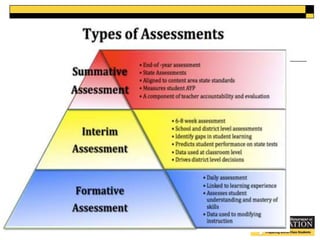
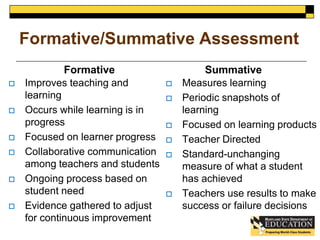
Formative/Summative Assessment 
Formative 
 Improves teaching and 
learning 
 Occurs while learning is in 
progress 
 Focused on learner progress 
 Collaborative communication 
among teachers and students 
 Ongoing process based on 
student need 
 Evidence gathered to adjust 
for continuous improvement 
Summative 
 Measures learning 
 Periodic snapshots of 
learning 
 Focused on learning products 
 Teacher Directed 
 Standard-unchanging 
measure of what a student 
has achieved 
 Teachers use results to make 
success or failure decisions
UDL & Assessment 
 UDL Curriculum Self Check 
 http://udlselfcheck.cast.org 
 Perspectives on UDL and Assessment an 
Interview with Robert Mislevy 
 http://www.udlcenter.org/resource_library/arti 
cles/mislevy
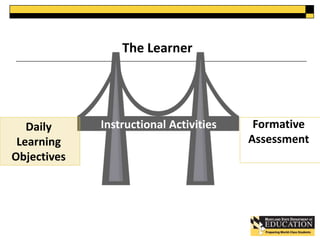
Daily 
Learning 
Objectives 
Formative 
Assessment 
The Learner 
Instructional Activities
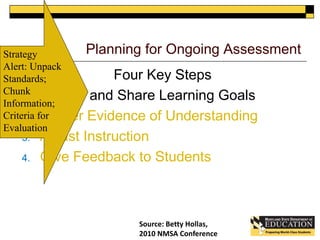
Planning for Ongoing Assessment 
Four Key Steps 
1. Identify and Share Learning Goals 
2. Gather Evidence of Understanding 
3. Adjust Instruction 
4. Give Feedback to Students 
Source: Betty Hollas, 
2010 NMSA Conference 
Strategy 
Alert: Unpack 
Standards; 
Chunk 
Information; 
Criteria for 
Evaluation
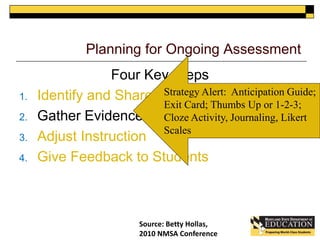
Planning for Ongoing Assessment 
Four Key Steps 
Strategy Alert: Anticipation Guide; 
Exit Card; Thumbs Up or 1-2-3; 
Cloze Activity, Journaling, Likert 
Scales 
1. Identify and Share Learning Goals 
2. Gather Evidence of Understanding 
3. Adjust Instruction 
4. Give Feedback to Students 
Source: Betty Hollas, 
2010 NMSA Conference
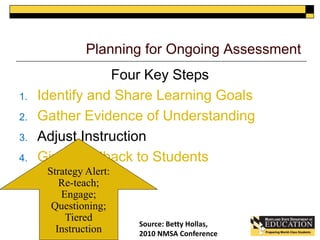
Planning for Ongoing Assessment 
Four Key Steps 
1. Identify and Share Learning Goals 
2. Gather Evidence of Understanding 
3. Adjust Instruction 
4. Give Feedback to Students 
Source: Betty Hollas, 
2010 NMSA Conference 
Strategy Alert: 
Re-teach; 
Engage; 
Questioning; 
Tiered 
Instruction
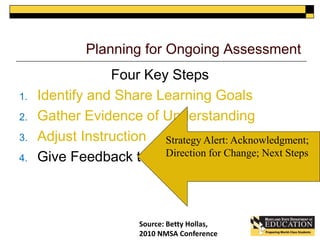
Planning for Ongoing Assessment 
Four Key Steps 
1. Identify and Share Learning Goals 
2. Gather Evidence of Understanding 
3. Adjust Instruction 
Strategy Alert: Acknowledgment; 
Direction for Change; Next Steps 
4. Give Feedback to Students 
Source: Betty Hollas, 
2010 NMSA Conference
THE MAIN GOAL 
“The main goal of classroom testing and 
assessment is to obtain valid, reliable, 
and useful information concerning student 
achievement.” 
LINN & MILLER
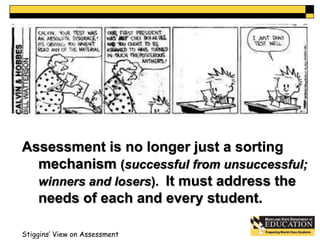
Assessment is no longer just a sorting 
mechanism (successful from unsuccessful; 
winners and losers). It must address the 
needs of each and every student. 
Stiggins’ View on Assessment
Students: 
are informed of their learning needs and 
achievements. 
engage in self monitoring and communicating their 
increase their motivation to do better the next time. 
take responsibility for their own learning. 
MSDE: Division for Leadership Development 
Maryland Principals’ Academy Follow-Up 
PA # 
own learning.
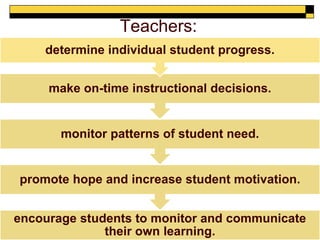
Teachers: 
determine individual student progress. 
make on-time instructional decisions. 
monitor patterns of student need. 
promote hope and increase student motivation. 
encourage students to monitor and communicate 
MSDE: Division for Leadership Development 
Maryland Principals’ Academy Follow-Up 
PA # 
their own learning.
GOALS FOR CLASSROOM 
TEACHERS 
Teachers can create classrooms that are 
information rich by providing multiple and 
targeted opportunities for students to 
show what they know, providing useful 
feedback to both the teacher and the 
students.
FOOD FOR THOUGHT 
The most powerful single modification 
that enhances achievement is 
FEEDBACK! 
J. H.HATTIE (1992), “MEASURING THE EFFECTS OF SCHOOLING” AUSTRALIAN JOURNAL OF EDUCATION.
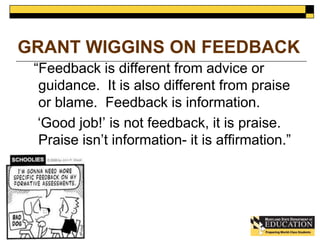
GRANT WIGGINS ON FEEDBACK 
“Feedback is different from advice or 
guidance. It is also different from praise 
or blame. Feedback is information. 
‘Good job!’ is not feedback, it is praise. 
Praise isn’t information- it is affirmation.”
GOOD FEEDBACK IS: 
 TIMELY 
 EXPERT 
 CONSISTENT 
 DESCRIPTIVE 
 HONEST 
 ON-GOING 
 ACCURATE 
 USER-FRIENDLY 
 SPECIFIC 
 CONSTRUCTIVE
GOOD FEEDBACK 
 Provides opportunities to try the activity 
again 
 Includes what learners didn’t do in 
addition to what they did do 
 Uses a shared vocabulary that all can 
understand 
 Relies on mutual trust, the belief that the 
teacher and students are partners in the 
feedback process
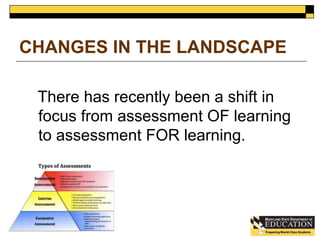
CHANGES IN THE LANDSCAPE 
There has recently been a shift in 
focus from assessment OF learning 
to assessment FOR learning.
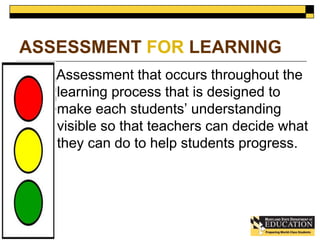
ASSESSMENT FOR LEARNING 
Assessment that occurs throughout the 
learning process that is designed to 
make each students’ understanding 
visible so that teachers can decide what 
they can do to help students progress.
TYPES OF ASSESSMENT FOR 
LEARNING 
 INFORMAL 
formative assessment 
can take place during 
any teacher-student 
interaction 
 Exit ticket 
 4 corners 
 Muddiest point 
 FORMAL 
formative assessment 
includes planned 
activities designed to 
provide evidence about 
student learning. 
 Homework 
 Quiz 
 Rough draft
Formative Assessment 
Take a moment to reflect: 
What formative 
assessments do you 
currently use that 
exemplify assessment 
FOR learning?
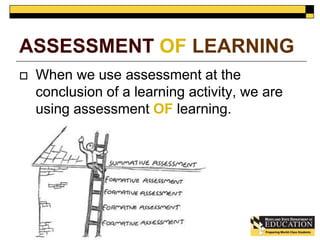
ASSESSMENT OF LEARNING 
 When we use assessment at the 
conclusion of a learning activity, we are 
using assessment OF learning.
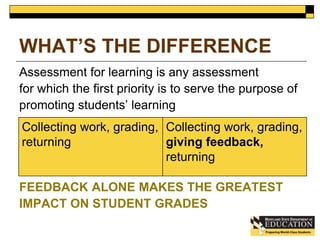
WHAT’S THE DIFFERENCE 
Assessment for learning is any assessment 
for which the first priority is to serve the purpose of 
promoting students’ learning 
Collecting work, grading, 
returning 
Collecting work, grading, 
giving feedback, 
returning 
FEEDBACK ALONE MAKES THE GREATEST 
IMPACT ON STUDENT GRADES
WORDS OF WISDOM 
“You cannot fatten the cattle by 
weighing them more. You have to 
FEED them.” Larry Lezotte
Updates
PARCC Assessment Professional 
Development Module 
 Module #1: PARCC Common Assessments Overview 
 Module #2: Introduction to the PARCC Mid-Year 
Assessment 
 Module #3: Introduction to the PARCC Diagnostic 
Assessment 
 Module #4: Introduction to the PARCC Speaking and Listening 
Assessment 
 Module #5: PARCC Accessibility System
Module 5: PARCC Accessibility System 
This module will provide educators with the following information on 
the Mid-Year, Performance-Based, and End-of-Year Assessments: 
 Accessibility features embedded into the 
delivery platform made available to all 
students; 
 Accommodations embedded into the delivery 
platform made available to students with 
disabilities;
Module 5: PARCC Accessibility System 
This module will provide educators with the following information on 
the Mid-Year, Performance-Based, and End-of-Year Assessments: 
 Accommodations embedded into the delivery 
platform made available to English learners; 
and 
 Resource guide that highlights where to find 
information on administrative guidance, laws, 
alternate assessments, technology support, 
and communications resources.
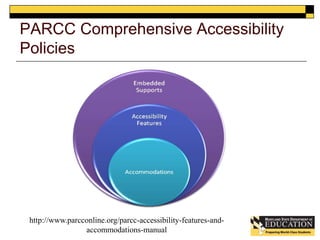
PARCC Comprehensive Accessibility 
Policies 
http://www.parcconline.org/parcc-accessibility-features-and-accommodations- 
manual
Embedded Supports 
• Tool, support, scaffold, or preference that is built into 
the assessment system that can be activated by any 
student, at his or her own discretion. 
• Universal Design features expected to benefit a diverse 
array of students and are available to all students. 
• Provided onscreen, stored in a toolbar, or are 
accessible through a menu or control panel, as needed. 
• During the assessment, students can choose which 
embedded supports they need for specific items. 
Examples include: audio amplification, highlighting, 
pop-up glossary, etc.
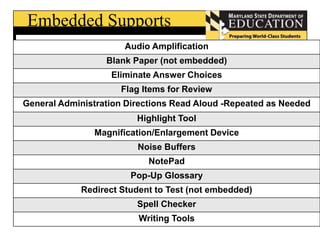
Embedded Supports 
Audio Amplification 
Blank Paper (not embedded) 
Eliminate Answer Choices 
Flag Items for Review 
General Administration Directions Read Aloud -Repeated as Needed 
Highlight Tool 
Magnification/Enlargement Device 
Noise Buffers 
NotePad 
Pop-Up Glossary 
Redirect Student to Test (not embedded) 
Spell Checker 
Writing Tools
Accessibility Features 
 Available to all students (i.e., not limited to students with IEPs, 504 
plans, or ELs), but will be selected and “turned on” by a school-based 
educator prior to the assessment, based on each student’s Personal 
Needs Profile (PNP). 
 Based on each student’s individual needs, a PNP is created for the 
student to ensure that he or she receives appropriate access without 
the distraction of other tools and features that are not required by the 
student. 
 Although a school-based educator will enable specific accessibility 
features for students, the student will decide whether or not to use the 
feature. Accessibility features will be readily available on the 
computer-delivered testing platform.
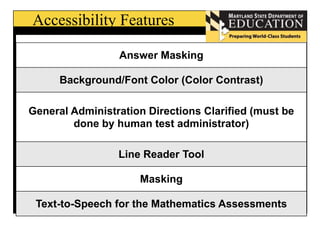
Accessibility Features 
Answer Masking 
Background/Font Color (Color Contrast) 
General Administration Directions Clarified (must be 
done by human test administrator) 
Line Reader Tool 
Masking 
Text-to-Speech for the Mathematics Assessments
Proposed 
Accommodations for 
Students with 
Disabilities (SWD) 
www.parcconline.org
Assistive Technology 
• Some students with disabilities (with IEPs 
or 504 plans) may need to bring assistive 
technology to equitably access the PARCC 
Field Test. 
• For current guidance on assistive 
technology for the PARCC Field Test, 
please refer to the posted guidelines on 
PARCConline.org.
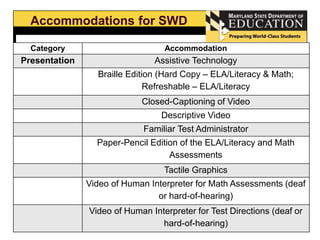
Accommodations for SWD 
Category Accommodation 
Presentation Assistive Technology 
Braille Edition (Hard Copy – ELA/Literacy & Math; 
Refreshable – ELA/Literacy 
Closed-Captioning of Video 
Descriptive Video 
Familiar Test Administrator 
Paper-Pencil Edition of the ELA/Literacy and Math 
Assessments 
Tactile Graphics 
Video of Human Interpreter for Math Assessments (deaf 
or hard-of-hearing) 
Video of Human Interpreter for Test Directions (deaf or 
hard-of-hearing)
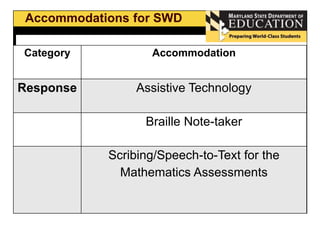
Accommodations for SWD 
Category Accommodation 
Response Assistive Technology 
Braille Note-taker 
Scribing/Speech-to-Text for the 
Mathematics Assessments
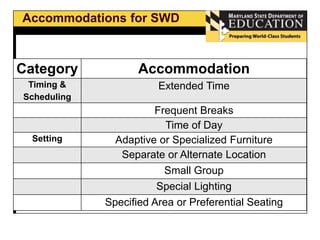
Accommodations for SWD 
Category Accommodation 
Timing & 
Scheduling 
Extended Time 
Frequent Breaks 
Time of Day 
Setting Adaptive or Specialized Furniture 
Separate or Alternate Location 
Small Group 
Special Lighting 
Specified Area or Preferential Seating
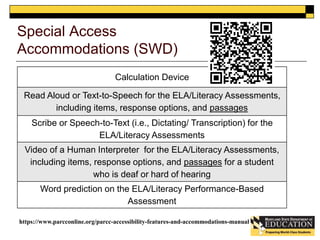
Special Access 
Accommodations (SWD) 
Calculation Device 
Read Aloud or Text-to-Speech for the ELA/Literacy Assessments, 
including items, response options, and passages 
Scribe or Speech-to-Text (i.e., Dictating/ Transcription) for the 
ELA/Literacy Assessments 
Video of a Human Interpreter for the ELA/Literacy Assessments, 
including items, response options, and passages for a student 
who is deaf or hard of hearing 
Word prediction on the ELA/Literacy Performance-Based 
Assessment 
https://www.parcconline.org/parcc-accessibility-features-and-accommodations-manual
Text-to-Speech Monitoring Phase 1 
 State baseline of the appropriate selection of the Text-to- 
Speech or Human Read-Aloud for the ELA/Literacy 
online or paper-based PARCC Assessments, including 
items, response options, and passages. 
 Desk audit 
 No fault year 
 The results will be provided to local school systems to 
use as guidance to develop systemic and/or school 
based professional development to ensure the 
appropriate selection of the text to speech or human 
reader accommodation.
Text-to-Speech Monitoring Phase 1 
Monitoring Sample 
 A random sampling (20%) of students with disabilities 
from selected local school systems who received the 
text to speech, or human reader accommodation during 
the PARCC field test will be selected to have their 
Individualized Education Programs (IEPs) monitored for 
the appropriate documentation of this accommodation 
as outlined in the PARCC guidance. 
 The random sampling will be gathered by the Division of 
Curriculum, Assessment and Accountability.
PARCC Resources: 
For the Field Test and Beyond 
• The guide contains links to a variety of resources about 
the PARCC assessments and 2014 PARCC Field Test. 
• The resources listed here are organized by audience 
and include resources relevant to All Audiences, those 
with specific information for Teachers, and resources 
developed to inform Parents. 
• Refer to PARCC Resources for the Field Test and 
Beyond document. 
www.parcconline.org
Overview
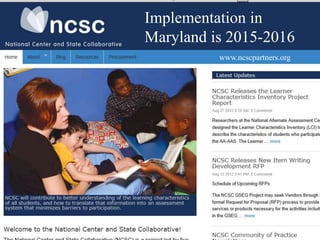
Implementation in 
Maryland is 2015-2016 
www.ncscpartners.org
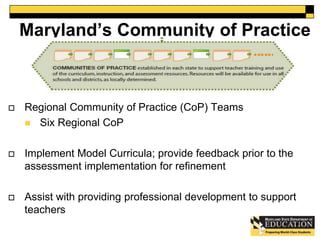
Maryland’s Community of Practice 
 Regional Community of Practice (CoP) Teams 
 Six Regional CoP 
 Implement Model Curricula; provide feedback prior to the 
assessment implementation for refinement 
 Assist with providing professional development to support 
teachers 
50
Maryland Community of Practice Teams 
 Northern* 
 Baltimore City 
 Baltimore County 
 Harford 
 Central* 
 Anne Arundel 
 Howard 
 Montgomery 
 Prince George’s 
 Upper Eastern Shore* 
 Caroline 
 Cecil 
 Kent 
 Queen Anne’s 
 Talbot 
 Lower Eastern Shore 
 Dorchester 
 Somerset 
 Wicomico 
 Worcester 
 Western* 
 Allegany 
 Carroll 
 Frederick 
 Garrett 
 Washington 
 Southern* 
 Calvert 
 Charles 
 St. Mary’s 
51
Community of Practice Teams 
 Alt-MSA Facilitators will Co-Chair a Region 
 Up to 23 CoP Team Members 
 Administrators, Special Educators, General Educators and Related 
Service Providers 
 Speech Pathologist 
 Assistive Technology Specialist 
 OT, PT specialists 
 Teacher of Visually Impaired and Deaf/Hard of Hearing 
 Content Specialist – Reading/ELA, Mathematics 
 Regular and Special Education Teacher 
 Autism Specialist 
 Principal/AP – Comprehensive School and Special School 
 Non-public School Representative 
52
53 
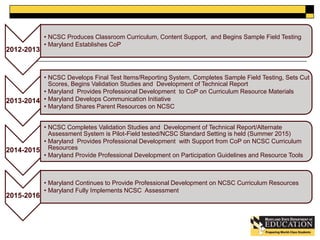
2012-2013 
• NCSC Produces Classroom Curriculum, Content Support, and Begins Sample Field Testing 
• Maryland Establishes CoP 
2013-2014 
• NCSC Develops Final Test Items/Reporting System, Completes Sample Field Testing, Sets Cut 
Scores, Begins Validation Studies and Development of Technical Report 
• Maryland Provides Professional Development to CoP on Curriculum Resource Materials 
• Maryland Develops Communication Initiative 
• Maryland Shares Parent Resources on NCSC 
2014-2015 
• NCSC Completes Validation Studies and Development of Technical Report/Alternate 
Assessment System is Pilot-Field tested/NCSC Standard Setting is held (Summer 2015) 
• Maryland Provides Professional Development with Support from CoP on NCSC Curriculum 
Resources 
• Maryland Provide Professional Development on Participation Guidelines and Resource Tools 
2015-2016 
• Maryland Continues to Provide Professional Development on NCSC Curriculum Resources 
• Maryland Fully Implements NCSC Assessment
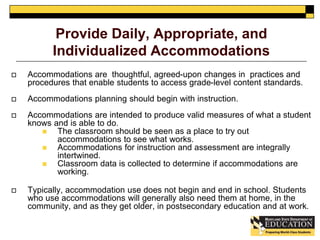
Provide Daily, Appropriate, and 
Individualized Accommodations 
 Accommodations are thoughtful, agreed-upon changes in practices and 
procedures that enable students to access grade-level content standards. 
 Accommodations planning should begin with instruction. 
 Accommodations are intended to produce valid measures of what a student 
knows and is able to do. 
 The classroom should be seen as a place to try out 
accommodations to see what works. 
 Accommodations for instruction and assessment are integrally 
intertwined. 
 Classroom data is collected to determine if accommodations are 
working. 
 Typically, accommodation use does not begin and end in school. Students 
who use accommodations will generally also need them at home, in the 
community, and as they get older, in postsecondary education and at work.
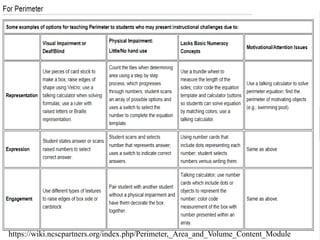
https://wiki.ncscpartners.org/index.php/Perimeter,_Area_and_Volume_Content_Module
FINAL THOUGHTS
Contacts: Division of Special Education/ 
Early Intervention Services 
 Paul Dunford, Branch Chief 
Programmatic Support and Technical Assistance 
pdunford@msde.state.md.us 
 Marsye Kaplan, Section Chief 
mkaplan@msde.state.md.us 
 Karla Marty, Section Chief 
kmarty@msde.state.md.us 
 Fran Sorin, Coordinator of Professional Learning 
fsorin@msde.state.md.us

MSEA: Assessment for ALL Learners

  • 1.
    Equalizing the PlayingField: Formative and Summative Assessments That Address the Needs of ALL Learners MSEA Convention Fall 2014
  • 2.
    Welcome  RebeccaPerosio Special Educator, SMCPS rjperosio@smcps.org  Elizabeth Luce Special Educator, HCPS Elizabeth.Luce@hcps.org  Nicole Zimmerman Special Educator, QACPS nicole.zimmerman@qacps.org
  • 3.
    Outcomes Participants will:  Demonstrate an understanding of the essential elements of formative and summative assessments and their implications for students with disabilities.
  • 5.
    Brainstorm  Whatmatters most in the assessment process?  What must teachers know in order to assess students effectively?  How do we ensure equity for all students with assessment?
  • 6.
    Formative/Summative Assessment Formative  Improves teaching and learning  Occurs while learning is in progress  Focused on learner progress  Collaborative communication among teachers and students  Ongoing process based on student need  Evidence gathered to adjust for continuous improvement Summative  Measures learning  Periodic snapshots of learning  Focused on learning products  Teacher Directed  Standard-unchanging measure of what a student has achieved  Teachers use results to make success or failure decisions
  • 7.
    UDL & Assessment  UDL Curriculum Self Check  http://udlselfcheck.cast.org  Perspectives on UDL and Assessment an Interview with Robert Mislevy  http://www.udlcenter.org/resource_library/arti cles/mislevy
  • 8.
    Daily Learning Objectives Formative Assessment The Learner Instructional Activities
  • 10.
    Planning for OngoingAssessment Four Key Steps 1. Identify and Share Learning Goals 2. Gather Evidence of Understanding 3. Adjust Instruction 4. Give Feedback to Students Source: Betty Hollas, 2010 NMSA Conference Strategy Alert: Unpack Standards; Chunk Information; Criteria for Evaluation
  • 11.
    Planning for OngoingAssessment Four Key Steps Strategy Alert: Anticipation Guide; Exit Card; Thumbs Up or 1-2-3; Cloze Activity, Journaling, Likert Scales 1. Identify and Share Learning Goals 2. Gather Evidence of Understanding 3. Adjust Instruction 4. Give Feedback to Students Source: Betty Hollas, 2010 NMSA Conference
  • 12.
    Planning for OngoingAssessment Four Key Steps 1. Identify and Share Learning Goals 2. Gather Evidence of Understanding 3. Adjust Instruction 4. Give Feedback to Students Source: Betty Hollas, 2010 NMSA Conference Strategy Alert: Re-teach; Engage; Questioning; Tiered Instruction
  • 13.
    Planning for OngoingAssessment Four Key Steps 1. Identify and Share Learning Goals 2. Gather Evidence of Understanding 3. Adjust Instruction Strategy Alert: Acknowledgment; Direction for Change; Next Steps 4. Give Feedback to Students Source: Betty Hollas, 2010 NMSA Conference
  • 14.
    THE MAIN GOAL “The main goal of classroom testing and assessment is to obtain valid, reliable, and useful information concerning student achievement.” LINN & MILLER
  • 15.
    Assessment is nolonger just a sorting mechanism (successful from unsuccessful; winners and losers). It must address the needs of each and every student. Stiggins’ View on Assessment
  • 16.
    Students: are informedof their learning needs and achievements. engage in self monitoring and communicating their increase their motivation to do better the next time. take responsibility for their own learning. MSDE: Division for Leadership Development Maryland Principals’ Academy Follow-Up PA # own learning.
  • 17.
    Teachers: determine individualstudent progress. make on-time instructional decisions. monitor patterns of student need. promote hope and increase student motivation. encourage students to monitor and communicate MSDE: Division for Leadership Development Maryland Principals’ Academy Follow-Up PA # their own learning.
  • 18.
    GOALS FOR CLASSROOM TEACHERS Teachers can create classrooms that are information rich by providing multiple and targeted opportunities for students to show what they know, providing useful feedback to both the teacher and the students.
  • 19.
    FOOD FOR THOUGHT The most powerful single modification that enhances achievement is FEEDBACK! J. H.HATTIE (1992), “MEASURING THE EFFECTS OF SCHOOLING” AUSTRALIAN JOURNAL OF EDUCATION.
  • 20.
    GRANT WIGGINS ONFEEDBACK “Feedback is different from advice or guidance. It is also different from praise or blame. Feedback is information. ‘Good job!’ is not feedback, it is praise. Praise isn’t information- it is affirmation.”
  • 21.
    GOOD FEEDBACK IS:  TIMELY  EXPERT  CONSISTENT  DESCRIPTIVE  HONEST  ON-GOING  ACCURATE  USER-FRIENDLY  SPECIFIC  CONSTRUCTIVE
  • 22.
    GOOD FEEDBACK Provides opportunities to try the activity again  Includes what learners didn’t do in addition to what they did do  Uses a shared vocabulary that all can understand  Relies on mutual trust, the belief that the teacher and students are partners in the feedback process
  • 23.
    CHANGES IN THELANDSCAPE There has recently been a shift in focus from assessment OF learning to assessment FOR learning.
  • 24.
    ASSESSMENT FOR LEARNING Assessment that occurs throughout the learning process that is designed to make each students’ understanding visible so that teachers can decide what they can do to help students progress.
  • 25.
    TYPES OF ASSESSMENTFOR LEARNING  INFORMAL formative assessment can take place during any teacher-student interaction  Exit ticket  4 corners  Muddiest point  FORMAL formative assessment includes planned activities designed to provide evidence about student learning.  Homework  Quiz  Rough draft
  • 26.
    Formative Assessment Takea moment to reflect: What formative assessments do you currently use that exemplify assessment FOR learning?
  • 27.
    ASSESSMENT OF LEARNING  When we use assessment at the conclusion of a learning activity, we are using assessment OF learning.
  • 28.
    WHAT’S THE DIFFERENCE Assessment for learning is any assessment for which the first priority is to serve the purpose of promoting students’ learning Collecting work, grading, returning Collecting work, grading, giving feedback, returning FEEDBACK ALONE MAKES THE GREATEST IMPACT ON STUDENT GRADES
  • 29.
    WORDS OF WISDOM “You cannot fatten the cattle by weighing them more. You have to FEED them.” Larry Lezotte
  • 30.
  • 31.
    PARCC Assessment Professional Development Module  Module #1: PARCC Common Assessments Overview  Module #2: Introduction to the PARCC Mid-Year Assessment  Module #3: Introduction to the PARCC Diagnostic Assessment  Module #4: Introduction to the PARCC Speaking and Listening Assessment  Module #5: PARCC Accessibility System
  • 32.
    Module 5: PARCCAccessibility System This module will provide educators with the following information on the Mid-Year, Performance-Based, and End-of-Year Assessments:  Accessibility features embedded into the delivery platform made available to all students;  Accommodations embedded into the delivery platform made available to students with disabilities;
  • 33.
    Module 5: PARCCAccessibility System This module will provide educators with the following information on the Mid-Year, Performance-Based, and End-of-Year Assessments:  Accommodations embedded into the delivery platform made available to English learners; and  Resource guide that highlights where to find information on administrative guidance, laws, alternate assessments, technology support, and communications resources.
  • 34.
    PARCC Comprehensive Accessibility Policies http://www.parcconline.org/parcc-accessibility-features-and-accommodations- manual
  • 35.
    Embedded Supports •Tool, support, scaffold, or preference that is built into the assessment system that can be activated by any student, at his or her own discretion. • Universal Design features expected to benefit a diverse array of students and are available to all students. • Provided onscreen, stored in a toolbar, or are accessible through a menu or control panel, as needed. • During the assessment, students can choose which embedded supports they need for specific items. Examples include: audio amplification, highlighting, pop-up glossary, etc.
  • 36.
    Embedded Supports AudioAmplification Blank Paper (not embedded) Eliminate Answer Choices Flag Items for Review General Administration Directions Read Aloud -Repeated as Needed Highlight Tool Magnification/Enlargement Device Noise Buffers NotePad Pop-Up Glossary Redirect Student to Test (not embedded) Spell Checker Writing Tools
  • 37.
    Accessibility Features Available to all students (i.e., not limited to students with IEPs, 504 plans, or ELs), but will be selected and “turned on” by a school-based educator prior to the assessment, based on each student’s Personal Needs Profile (PNP).  Based on each student’s individual needs, a PNP is created for the student to ensure that he or she receives appropriate access without the distraction of other tools and features that are not required by the student.  Although a school-based educator will enable specific accessibility features for students, the student will decide whether or not to use the feature. Accessibility features will be readily available on the computer-delivered testing platform.
  • 38.
    Accessibility Features AnswerMasking Background/Font Color (Color Contrast) General Administration Directions Clarified (must be done by human test administrator) Line Reader Tool Masking Text-to-Speech for the Mathematics Assessments
  • 39.
    Proposed Accommodations for Students with Disabilities (SWD) www.parcconline.org
  • 40.
    Assistive Technology •Some students with disabilities (with IEPs or 504 plans) may need to bring assistive technology to equitably access the PARCC Field Test. • For current guidance on assistive technology for the PARCC Field Test, please refer to the posted guidelines on PARCConline.org.
  • 41.
    Accommodations for SWD Category Accommodation Presentation Assistive Technology Braille Edition (Hard Copy – ELA/Literacy & Math; Refreshable – ELA/Literacy Closed-Captioning of Video Descriptive Video Familiar Test Administrator Paper-Pencil Edition of the ELA/Literacy and Math Assessments Tactile Graphics Video of Human Interpreter for Math Assessments (deaf or hard-of-hearing) Video of Human Interpreter for Test Directions (deaf or hard-of-hearing)
  • 42.
    Accommodations for SWD Category Accommodation Response Assistive Technology Braille Note-taker Scribing/Speech-to-Text for the Mathematics Assessments
  • 43.
    Accommodations for SWD Category Accommodation Timing & Scheduling Extended Time Frequent Breaks Time of Day Setting Adaptive or Specialized Furniture Separate or Alternate Location Small Group Special Lighting Specified Area or Preferential Seating
  • 44.
    Special Access Accommodations(SWD) Calculation Device Read Aloud or Text-to-Speech for the ELA/Literacy Assessments, including items, response options, and passages Scribe or Speech-to-Text (i.e., Dictating/ Transcription) for the ELA/Literacy Assessments Video of a Human Interpreter for the ELA/Literacy Assessments, including items, response options, and passages for a student who is deaf or hard of hearing Word prediction on the ELA/Literacy Performance-Based Assessment https://www.parcconline.org/parcc-accessibility-features-and-accommodations-manual
  • 45.
    Text-to-Speech Monitoring Phase1  State baseline of the appropriate selection of the Text-to- Speech or Human Read-Aloud for the ELA/Literacy online or paper-based PARCC Assessments, including items, response options, and passages.  Desk audit  No fault year  The results will be provided to local school systems to use as guidance to develop systemic and/or school based professional development to ensure the appropriate selection of the text to speech or human reader accommodation.
  • 46.
    Text-to-Speech Monitoring Phase1 Monitoring Sample  A random sampling (20%) of students with disabilities from selected local school systems who received the text to speech, or human reader accommodation during the PARCC field test will be selected to have their Individualized Education Programs (IEPs) monitored for the appropriate documentation of this accommodation as outlined in the PARCC guidance.  The random sampling will be gathered by the Division of Curriculum, Assessment and Accountability.
  • 47.
    PARCC Resources: Forthe Field Test and Beyond • The guide contains links to a variety of resources about the PARCC assessments and 2014 PARCC Field Test. • The resources listed here are organized by audience and include resources relevant to All Audiences, those with specific information for Teachers, and resources developed to inform Parents. • Refer to PARCC Resources for the Field Test and Beyond document. www.parcconline.org
  • 48.
  • 49.
    Implementation in Marylandis 2015-2016 www.ncscpartners.org
  • 50.
    Maryland’s Community ofPractice  Regional Community of Practice (CoP) Teams  Six Regional CoP  Implement Model Curricula; provide feedback prior to the assessment implementation for refinement  Assist with providing professional development to support teachers 50
  • 51.
    Maryland Community ofPractice Teams  Northern*  Baltimore City  Baltimore County  Harford  Central*  Anne Arundel  Howard  Montgomery  Prince George’s  Upper Eastern Shore*  Caroline  Cecil  Kent  Queen Anne’s  Talbot  Lower Eastern Shore  Dorchester  Somerset  Wicomico  Worcester  Western*  Allegany  Carroll  Frederick  Garrett  Washington  Southern*  Calvert  Charles  St. Mary’s 51
  • 52.
    Community of PracticeTeams  Alt-MSA Facilitators will Co-Chair a Region  Up to 23 CoP Team Members  Administrators, Special Educators, General Educators and Related Service Providers  Speech Pathologist  Assistive Technology Specialist  OT, PT specialists  Teacher of Visually Impaired and Deaf/Hard of Hearing  Content Specialist – Reading/ELA, Mathematics  Regular and Special Education Teacher  Autism Specialist  Principal/AP – Comprehensive School and Special School  Non-public School Representative 52
  • 53.
    53 2012-2013 •NCSC Produces Classroom Curriculum, Content Support, and Begins Sample Field Testing • Maryland Establishes CoP 2013-2014 • NCSC Develops Final Test Items/Reporting System, Completes Sample Field Testing, Sets Cut Scores, Begins Validation Studies and Development of Technical Report • Maryland Provides Professional Development to CoP on Curriculum Resource Materials • Maryland Develops Communication Initiative • Maryland Shares Parent Resources on NCSC 2014-2015 • NCSC Completes Validation Studies and Development of Technical Report/Alternate Assessment System is Pilot-Field tested/NCSC Standard Setting is held (Summer 2015) • Maryland Provides Professional Development with Support from CoP on NCSC Curriculum Resources • Maryland Provide Professional Development on Participation Guidelines and Resource Tools 2015-2016 • Maryland Continues to Provide Professional Development on NCSC Curriculum Resources • Maryland Fully Implements NCSC Assessment
  • 54.
    Provide Daily, Appropriate,and Individualized Accommodations  Accommodations are thoughtful, agreed-upon changes in practices and procedures that enable students to access grade-level content standards.  Accommodations planning should begin with instruction.  Accommodations are intended to produce valid measures of what a student knows and is able to do.  The classroom should be seen as a place to try out accommodations to see what works.  Accommodations for instruction and assessment are integrally intertwined.  Classroom data is collected to determine if accommodations are working.  Typically, accommodation use does not begin and end in school. Students who use accommodations will generally also need them at home, in the community, and as they get older, in postsecondary education and at work.
  • 55.
  • 56.
  • 57.
    Contacts: Division ofSpecial Education/ Early Intervention Services  Paul Dunford, Branch Chief Programmatic Support and Technical Assistance pdunford@msde.state.md.us  Marsye Kaplan, Section Chief mkaplan@msde.state.md.us  Karla Marty, Section Chief kmarty@msde.state.md.us  Fran Sorin, Coordinator of Professional Learning fsorin@msde.state.md.us