DepartmentofScience and T
echnology
SCI
ENCEEDUCAT
I
ONI
NS
T
I
T
UT
E
SCI
ENCET
EACHERACADEMYFORT
HER
EGI
ONS
Technology - Enhanced
Assessment for Learning
Lalaine Ann F. Manuel
College of Education, CLSU
Inpartnership with:
Central Luzon State University
DepartmentofEducation-RegionI
I
I
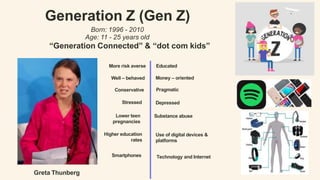
Generation Z (Gen Z)
Born: 1996 - 2010
Age: 11 - 25 years old
“Generation Connected” & “dot com kids”
Educated
Money – oriented
Pragmatic
Depressed
More risk averse
Well – behaved
Conservative
Stressed
Substance abuse
Lower teen
pregnancies
Use of digital devices &
platforms
Higher education
rates
Smartphones Technology and Internet
Greta Thunberg
Decode I t ! “Filinneal” Talks
Fear of missing out
Behind the scene
BTS
FYP
BRB
FR
FTW
TBH
FOMO
GOAT
To be honest
Be right back
For Real
For the win
For you page
HMU
IG
ISTG
MIA
NBD
NGL
Greatest of all time
Hit me up
I guess
I swear to God
Missing in Action
No big deal
Not gonna lie
Join at slido.com
#1745084
What is assessment?
What is assessment & why do i t ?
“Assessment is the systematic collection
of information about student learning, using
the time, knowledge, expertise, and resources
available, in order to inform decisions that
affect student learning.”
Walvoord, 2010
What is assessment & why do i t ?
Classroom Assessment is an integral part of
curriculum implementation. It allows the teachers to
track and measure learners' progress and to adjust
instruction accordingly. Classroom assessment
informs the learners, as well as their parents and
guardians, of their progress.
DepEd Order no. 8 s. 2015
Steps o f Assessment
Walvoord, 2010
What do we want
students to be able to
do when they complete
the course of study?
GOAL
How well are students
achieving these goals,
and what factors
influence their learning?
INFORMATION
How can we use the
information to improve
student learning?
ACTION
Types o f Assessment
FEATURES FORMAL INFORMAL
Definition Formal assessment refers to a
grading system-based evaluation to
monitor students’ knowledge.
Informal assessment refers to a
method of student evaluation that
does not have any standard grading
criteria.
Uses When teachers want to measure
students’ performance based on
specific standards or criteria.
When teachers want to have
immediate feedback on the student’s
knowledge so far.
Examples Tests, quizzes, surveys, and
questionnaires.
observation and oral presentations.
Purpose To know students’ overall
performance at the end of the
learning process.
To track students’ learning progress
and any doubts or difficulties they
face.
Types o f Assessment
FEATURES FORMAL INFORMAL
Advantages • Minimum chances of examiner
bias due to criteria standards.
• Makes students pay more
attention in classes.
• Acts as a pass for students to
move further with the next
learning stages.
• Teachers have better look at
students’ learning abilities.
• They can observe performance at
various learning stages.
• Gives a chance for improvements.
Allows students to approach a subject
from various angles.
Scope • Provides a broader view of
student knowledge.
• Evaluate the performance at
surface level to assign a grade or
score in the end.
• Provides a narrow but detailed view
of student knowledge.
• Focuses on individual student
improvements.
• Teachers can modify their teaching
methods according to students’
performance from time to time.
Types o f Assessment
FEATURES TRADITIONAL ALTERNATIVE
Definition It is a simple approach that generally
utilizes a pen and paper or computer-
based examination method which
constitutes a similar pattern of
questions
It requires the students to be involved
in several tasks that utilize their
analytical, reasoning, and logical
thinking capabilities.
Examples Multiple Choice, true and false, or
matching items.
project work, research and
experimentation
Types o f Assessment
FEATURES TRADITIONAL ALTERNATIVE
Advantages • The teacher gets a preview of a
student’s knowledge
conveniently.
• This approach is overall more
simple, straightforward and time-
saving.
• aids in measuring the proficiency of
the student based on their analytical,
reasoning and logical thinking skills
• Provides the students with a vast set
of resources to learn.
Disadvantages • It limits a student’s potential and
does allow out of the box
thinking.
• Students do not develop
extensive comprehensive skills.
• More efforts demand more time.
• The process becomes rigorous for
the teachers as it is harder to
evaluate.
• It is far less economical, as practical
applications and project work
demand a lot of resources and
investments.
Types o f Assessment
FORMATIVE SUMMATIVE
Evaluate how someone is learning
material throughout a course.
evaluate how much someone has learned
throughout a course.
Often uses qualitative (descriptive) data
to evaluate a current state based on
informal measurement
Often uses quantitative (numerical) data to
apply formal measurement and evaluation
techniques to determine outcomes
Quizzes
Games
Projects
Presentations
Group activities
Tests
Final exams
Reports
Papers
End-of-class projects
Types o f Assessment
What is high quality assessment?
that
“It provides results
demonstrate and
improve targeted student
learning.”
Principles o f Assessment
Clear & Appropriate Learning
Targets
Appropriateness of
Assessment Method
Validity
McMillan, 2003
Reliability
Fairness
Practicality and efficiency
How wouLd one know
the appropriate
assessment method
t o US E ?
How wouLd one know
the appropriate
assessment method
t o CHOOSE?
If the learning requires students to:
Know & Recall
Know & Do
Understand Big
Ideas & Enduring
Understandings
Traditional
Assessments
Traditional and
Performance
Assessments
Performance
Assessments
(Orlando, 2011)
ACTIVITY
Assessment and TechnoLogy
TECHNO LOGY
τέχνη (téchnē)
– art,craft,skill
λογία (logía)
– study of
Technology = Information and
Communication Technology
(ICT)
“Assidere”
(Latin verb)
– to sit with
TECHNOLOGY-ENHANCED ASSESSMENT
Technology-enhanced assessment refers
to innovative assessment practices and
systems that use technology to support the
management and delivery of assessment
(O'Leary et al., 2018).
TECHNOLOGY-ENHANCED ASSESSMENT
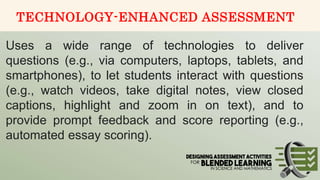
Uses a wide range of technologies to deliver
questions (e.g., via computers, laptops, tablets, and
smartphones), to let students interact with questions
(e.g., watch videos, take digital notes, view closed
captions, highlight and zoom in on text), and to
provide prompt feedback and score reporting (e.g.,
automated essay scoring).
Categories of Technology-Enhanced Assessment
The first stage refers to assessments that simply present
traditional questions
The second stage often present innovative question types to
maximize the amount and the quality of interactions between
students and questions
The last stage, decisions about assessment design, content,
and format are informed by learner models so that we can
provide a more interactive assessment environment for
students.
Design Consideration
Accessibility Arrangements
Carefully designed assessments should be able to provide universal access to
students of all learning and language backgrounds (NAEP, 2018).
Question Types
The Programme for International Student Assessment (or PISA) introduced
collaborative problem-solving questions in PISA 2015
Technology and Security Issues & Solutions
Technology-related issues should be carefully monitored to provide seamless
assessment experiences.
ICT-Based Assessments
Assessment involving the use of information and
communication technologies (ICT) in order to:
1. deliver traditional assessment formats more effectively and
efficiently,
2. to change the way competencies are assessed and
develop formats that facilitate the assessment of
competences that have been difficult to capture with
traditional assessment formats.
Retrieve from: http://www.ibe.unesco.org/en/glossary-curriculum-terminology/e/e-assessmentict-based-assessment
ICT-Based Assessments
Some examples include:
• The OECD Program for International Student Assessment (PISA) (OECD, 2011).
• The International Association for the Evaluation of Educational Achievement (IEA)
Programs – Trends in International Mathematics and Science Study (TIMSS), Progress
in International Reading Literacy Study (PIRLS), and International Computer and
Information Literacy Study (ICILS).
• The Adult Literacy and Lifeskills Survey (ALL).All these programs are aimed to
systematically introduce technology-enhanced assessment, which offers more effective
methods and tools.
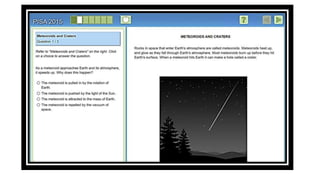
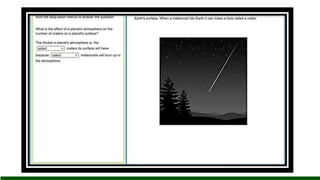
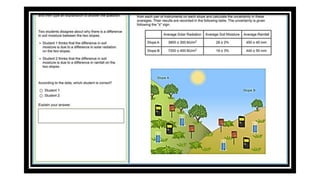
• PISA measures 15-year-olds’ ability to use their
reading, mathematics and science knowledge and
skills to meet real-life challenges.
• Computer-based tests were used, with assessments
lasting a total of two hours for each student.
PISA RESULT
• The Philippines participated in PISA for the first time in 2018, and
came in last place among 79 participating countries and economies
in reading, and second to last place in science and mathematics. The
overwhelming majority of students in the Philippines failed to reach
minimum levels of proficiency across all three PISA subjects, with a
wide gap by socioeconomic status. These results underscore the
urgent need to address quality in basic education in the Philippines.
PISA RESULT
• Some 22% of students in the Philippines attained Level 2 or higher in
science. These students can recognize the correct explanation for
familiar scientific phenomena and can use such knowledge to
identify, in simple cases, whether a conclusion is valid based on the
data provided.
• Almost no student was a top performer in science, meaning that
they were proficient at Level 5 or 6. These students can creatively
and autonomously apply their knowledge of and about science to a
wide variety of situations, including unfamiliar ones.
SCIENCE PROCESS SKILLS ASSESSMENT
• An PISA-based test that measures the students knowledge on
the basic science process skills of student
• Initiated by the Regional Office this School Year to select
schools per Division
Approaches: Adoption o f ICT
 Learning about
 Learning from
 Learning through
 Learning with
Laohajaratsang, T. (2015)
Learning about ICT refers to acquiring knowledge and
understanding of Information and Communication Technology
(ICT) as a subject or a discipline.
Approaches: Adoption o f ICT
Learning from ICT refers to gaining knowledge and skills by
using ICT tools and resources as sources of information and
learning using online tutorials, videos or e-books
Learning through ICT refers to using ICT tools and
resources as a medium or platform for learning. This includes
simulations, virtual labs and educational games.
Approaches: Adoption o f ICT
Learning with ICT refers to collaborative learning where
learners work together to construct knowledge and solve
problems using ICT tools and resources. Includes online
forums and collaborative platforms
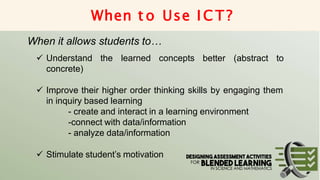
When t o Use I C T ?
better (abstract to
 Improve their higher order thinking skills by engaging them
in inquiry based learning
- create and interact in a learning environment
-connect with data/information
- analyze data/information
 Stimulate student’s motivation
When it allows students to…
 Understand the learned concepts
concrete)
It needs to be about LEARNING, not
the technology. Teachers need to
choose the right tool for the right task.
ICT use must serve a PURPOSE!
Useful ICT Based
Assessment Tools
https://tinyurl.com/useful75
https://phet.colorado.edu/
The criticaL roLe o f feedback
Hepburn, et al., 2021
”Feedback shouldn't be something
that just happens at the end – it
needs to be designed into the whole
teaching experience.”
Feedback
“The best feedback is highly specific,
directly revealing or highly descriptive of what
actually resulted, clear to the performer, and
available or offered in terms of specific targets
and standards.”
Wiggins, Grant. Educative
Assessment, 1998
How can we most effectively
give feedback?
Give the
GOOD NEWS
first.
Give specific
pointers for
improvement
End with a note
of
encouragement
EXPEDITIONARY LEARNING
Expeditionary Learning (EL) is an approach
to education that seeks to engage students in a
way that excites them not only about the subjects
they’re studying, but also about the process of
education.
-Angus Whyte
What is your goal as modern
TEACHER?
Main Goals of a Modern Teacher
ADAPT
- Adapt and adjust continuously to the changes
- Avoid stagnation
Main Goals of a Modern Teacher
ADAPT
- Adapt and adjust continuously to the changes
- Avoid stagnation
- It’s okay to not know everything
Main Goals of a Modern Teacher
ADAPT
- Adapt and adjust continuously to the changes
- Avoid stagnation
- It’s okay to not know everything
On average, every human created at least 1.7 MB of data
per second in 2020 (Tech Jury).
Minimum of 146.88 GB per day
for each person
Source: https://techjury.net/blog/how-much-data-is-created-every-day/#gref
Main Goals of a Modern Teacher
INNOVATE
Source: https://quotefancy.com/media/wallpaper/3840x2160/184344-Robin-S-Sharma-Quote-The-antidote-to-stagnation-is-innovation.jpg
Main Goals of a Modern Teacher
INNOVATE
- Make changes in something established, especially by
introducing new methods, ideas, or products (Oxford
Languages)
- Learn, relearn, retool
- Be open to change and new learning opportunities
Main Goals of a Modern Teacher
FILTER
- Filter through the mass of information available online
AND be able to synthesize all these into something
meaningful and useful.
Source: https://www.txstate.edu/commonexperience/pastsitearchives/2019-2020/stories/blog/2020-03-30-truth-about-fake-news.html
Main Goals of a Modern Teacher
FILTER
- Filter through the mass of information available online
AND be able to synthesize all these into something
meaningful and useful.
- To find the gold nuggets of valuable information
(Accurate information vs. Others)
Source: https://www.txstate.edu/commonexperience/pastsitearchives/2019-2020/stories/blog/2020-03-30-truth-about-fake-news.html
Main Goals of a Modern Teacher
FILTER
- Filter through the mass of information available online
AND be able to synthesize all these into something
meaningful and useful.
- To relay this information in class
Source: https://www.txstate.edu/commonexperience/pastsitearchives/2019-2020/stories/blog/2020-03-30-truth-about-fake-news.html
References
• Çalışkan, H., Kaşıkçı,Y. (2010). The application of traditional and alternative assesment and
evaluation tools by teachers in social studies. Procedia Social and Behavioral Sciences, 2, 4152-
4156.
• Leigh-Anne Hepburn, Madeleine Borthwick, Jane Kerr & Andrey Vasnev (2021) A strategic
framework for delivering ongoing feedback at scale, Assessment & Evaluation in Higher
Education, 47:5, 742-754, DOI: 10.1080/02602938.2021.1959517
• Joughin, G. R. (2009). Assessment, learning and judgement in Higher Education: a critical. In G. R.
Joughin (Eds.), Assessment, Learning and Judgement in Higher Education (pp. 13-27).
Netherlands: Springer.
• McMillan, J. (2003). Classroom Assessment and Practice for Effective Instruction, Boston: Allyn
and Bacon
• Oosterhof, A. (2014). Developing and using classroom assessments. Pearson.
• Walvoord, B. E. (2010). Assessment clear and simple: A practical guide for institutions,
departments, and general education (2 nd ed.). San Francisco: Jossey-Bass.
• Wiggins, G. P. (1998). Educative assessment : designing assessments to inform and improve
student performance. Jossey-Bass
Assessment in Learning: Traditional Assessment
THANK YOU
Assessment in Learning: Traditional Assessment

Technology-Enhanced-Assessment-for-Learning.pptx

  • 1.
    DepartmentofScience and T echnology SCI ENCEEDUCAT I ONI NS T I T UT E SCI ENCET EACHERACADEMYFORT HER EGI ONS Technology- Enhanced Assessment for Learning Lalaine Ann F. Manuel College of Education, CLSU Inpartnership with: Central Luzon State University DepartmentofEducation-RegionI I I
  • 3.
    Generation Z (GenZ) Born: 1996 - 2010 Age: 11 - 25 years old “Generation Connected” & “dot com kids” Educated Money – oriented Pragmatic Depressed More risk averse Well – behaved Conservative Stressed Substance abuse Lower teen pregnancies Use of digital devices & platforms Higher education rates Smartphones Technology and Internet Greta Thunberg
  • 4.
    Decode I t! “Filinneal” Talks
  • 5.
    Fear of missingout Behind the scene BTS FYP BRB FR FTW TBH FOMO GOAT To be honest Be right back For Real For the win For you page HMU IG ISTG MIA NBD NGL Greatest of all time Hit me up I guess I swear to God Missing in Action No big deal Not gonna lie
  • 6.
  • 7.
    What is assessment& why do i t ? “Assessment is the systematic collection of information about student learning, using the time, knowledge, expertise, and resources available, in order to inform decisions that affect student learning.” Walvoord, 2010
  • 8.
    What is assessment& why do i t ? Classroom Assessment is an integral part of curriculum implementation. It allows the teachers to track and measure learners' progress and to adjust instruction accordingly. Classroom assessment informs the learners, as well as their parents and guardians, of their progress. DepEd Order no. 8 s. 2015
  • 9.
    Steps o fAssessment Walvoord, 2010 What do we want students to be able to do when they complete the course of study? GOAL How well are students achieving these goals, and what factors influence their learning? INFORMATION How can we use the information to improve student learning? ACTION
  • 10.
    Types o fAssessment FEATURES FORMAL INFORMAL Definition Formal assessment refers to a grading system-based evaluation to monitor students’ knowledge. Informal assessment refers to a method of student evaluation that does not have any standard grading criteria. Uses When teachers want to measure students’ performance based on specific standards or criteria. When teachers want to have immediate feedback on the student’s knowledge so far. Examples Tests, quizzes, surveys, and questionnaires. observation and oral presentations. Purpose To know students’ overall performance at the end of the learning process. To track students’ learning progress and any doubts or difficulties they face.
  • 11.
    Types o fAssessment FEATURES FORMAL INFORMAL Advantages • Minimum chances of examiner bias due to criteria standards. • Makes students pay more attention in classes. • Acts as a pass for students to move further with the next learning stages. • Teachers have better look at students’ learning abilities. • They can observe performance at various learning stages. • Gives a chance for improvements. Allows students to approach a subject from various angles. Scope • Provides a broader view of student knowledge. • Evaluate the performance at surface level to assign a grade or score in the end. • Provides a narrow but detailed view of student knowledge. • Focuses on individual student improvements. • Teachers can modify their teaching methods according to students’ performance from time to time.
  • 12.
    Types o fAssessment FEATURES TRADITIONAL ALTERNATIVE Definition It is a simple approach that generally utilizes a pen and paper or computer- based examination method which constitutes a similar pattern of questions It requires the students to be involved in several tasks that utilize their analytical, reasoning, and logical thinking capabilities. Examples Multiple Choice, true and false, or matching items. project work, research and experimentation
  • 13.
    Types o fAssessment FEATURES TRADITIONAL ALTERNATIVE Advantages • The teacher gets a preview of a student’s knowledge conveniently. • This approach is overall more simple, straightforward and time- saving. • aids in measuring the proficiency of the student based on their analytical, reasoning and logical thinking skills • Provides the students with a vast set of resources to learn. Disadvantages • It limits a student’s potential and does allow out of the box thinking. • Students do not develop extensive comprehensive skills. • More efforts demand more time. • The process becomes rigorous for the teachers as it is harder to evaluate. • It is far less economical, as practical applications and project work demand a lot of resources and investments.
  • 14.
    Types o fAssessment FORMATIVE SUMMATIVE Evaluate how someone is learning material throughout a course. evaluate how much someone has learned throughout a course. Often uses qualitative (descriptive) data to evaluate a current state based on informal measurement Often uses quantitative (numerical) data to apply formal measurement and evaluation techniques to determine outcomes Quizzes Games Projects Presentations Group activities Tests Final exams Reports Papers End-of-class projects
  • 15.
    Types o fAssessment
  • 16.
    What is highquality assessment? that “It provides results demonstrate and improve targeted student learning.”
  • 17.
    Principles o fAssessment Clear & Appropriate Learning Targets Appropriateness of Assessment Method Validity McMillan, 2003 Reliability Fairness Practicality and efficiency
  • 18.
    How wouLd oneknow the appropriate assessment method t o US E ?
  • 19.
    How wouLd oneknow the appropriate assessment method t o CHOOSE? If the learning requires students to: Know & Recall Know & Do Understand Big Ideas & Enduring Understandings Traditional Assessments Traditional and Performance Assessments Performance Assessments (Orlando, 2011)
  • 20.
  • 21.
    Assessment and TechnoLogy TECHNOLOGY τέχνη (téchnē) – art,craft,skill λογία (logía) – study of Technology = Information and Communication Technology (ICT) “Assidere” (Latin verb) – to sit with
  • 23.
    TECHNOLOGY-ENHANCED ASSESSMENT Technology-enhanced assessmentrefers to innovative assessment practices and systems that use technology to support the management and delivery of assessment (O'Leary et al., 2018).
  • 24.
    TECHNOLOGY-ENHANCED ASSESSMENT Uses awide range of technologies to deliver questions (e.g., via computers, laptops, tablets, and smartphones), to let students interact with questions (e.g., watch videos, take digital notes, view closed captions, highlight and zoom in on text), and to provide prompt feedback and score reporting (e.g., automated essay scoring).
  • 25.
    Categories of Technology-EnhancedAssessment The first stage refers to assessments that simply present traditional questions The second stage often present innovative question types to maximize the amount and the quality of interactions between students and questions The last stage, decisions about assessment design, content, and format are informed by learner models so that we can provide a more interactive assessment environment for students.
  • 26.
    Design Consideration Accessibility Arrangements Carefullydesigned assessments should be able to provide universal access to students of all learning and language backgrounds (NAEP, 2018). Question Types The Programme for International Student Assessment (or PISA) introduced collaborative problem-solving questions in PISA 2015 Technology and Security Issues & Solutions Technology-related issues should be carefully monitored to provide seamless assessment experiences.
  • 27.
    ICT-Based Assessments Assessment involvingthe use of information and communication technologies (ICT) in order to: 1. deliver traditional assessment formats more effectively and efficiently, 2. to change the way competencies are assessed and develop formats that facilitate the assessment of competences that have been difficult to capture with traditional assessment formats. Retrieve from: http://www.ibe.unesco.org/en/glossary-curriculum-terminology/e/e-assessmentict-based-assessment
  • 28.
    ICT-Based Assessments Some examplesinclude: • The OECD Program for International Student Assessment (PISA) (OECD, 2011). • The International Association for the Evaluation of Educational Achievement (IEA) Programs – Trends in International Mathematics and Science Study (TIMSS), Progress in International Reading Literacy Study (PIRLS), and International Computer and Information Literacy Study (ICILS). • The Adult Literacy and Lifeskills Survey (ALL).All these programs are aimed to systematically introduce technology-enhanced assessment, which offers more effective methods and tools.
  • 29.
    • PISA measures15-year-olds’ ability to use their reading, mathematics and science knowledge and skills to meet real-life challenges. • Computer-based tests were used, with assessments lasting a total of two hours for each student.
  • 34.
    PISA RESULT • ThePhilippines participated in PISA for the first time in 2018, and came in last place among 79 participating countries and economies in reading, and second to last place in science and mathematics. The overwhelming majority of students in the Philippines failed to reach minimum levels of proficiency across all three PISA subjects, with a wide gap by socioeconomic status. These results underscore the urgent need to address quality in basic education in the Philippines.
  • 35.
    PISA RESULT • Some22% of students in the Philippines attained Level 2 or higher in science. These students can recognize the correct explanation for familiar scientific phenomena and can use such knowledge to identify, in simple cases, whether a conclusion is valid based on the data provided. • Almost no student was a top performer in science, meaning that they were proficient at Level 5 or 6. These students can creatively and autonomously apply their knowledge of and about science to a wide variety of situations, including unfamiliar ones.
  • 36.
    SCIENCE PROCESS SKILLSASSESSMENT • An PISA-based test that measures the students knowledge on the basic science process skills of student • Initiated by the Regional Office this School Year to select schools per Division
  • 37.
    Approaches: Adoption of ICT  Learning about  Learning from  Learning through  Learning with Laohajaratsang, T. (2015)
  • 38.
    Learning about ICTrefers to acquiring knowledge and understanding of Information and Communication Technology (ICT) as a subject or a discipline. Approaches: Adoption o f ICT Learning from ICT refers to gaining knowledge and skills by using ICT tools and resources as sources of information and learning using online tutorials, videos or e-books
  • 39.
    Learning through ICTrefers to using ICT tools and resources as a medium or platform for learning. This includes simulations, virtual labs and educational games. Approaches: Adoption o f ICT Learning with ICT refers to collaborative learning where learners work together to construct knowledge and solve problems using ICT tools and resources. Includes online forums and collaborative platforms
  • 40.
    When t oUse I C T ? better (abstract to  Improve their higher order thinking skills by engaging them in inquiry based learning - create and interact in a learning environment -connect with data/information - analyze data/information  Stimulate student’s motivation When it allows students to…  Understand the learned concepts concrete)
  • 41.
    It needs tobe about LEARNING, not the technology. Teachers need to choose the right tool for the right task. ICT use must serve a PURPOSE!
  • 42.
  • 44.
  • 45.
  • 46.
    The criticaL roLeo f feedback Hepburn, et al., 2021 ”Feedback shouldn't be something that just happens at the end – it needs to be designed into the whole teaching experience.”
  • 47.
    Feedback “The best feedbackis highly specific, directly revealing or highly descriptive of what actually resulted, clear to the performer, and available or offered in terms of specific targets and standards.” Wiggins, Grant. Educative Assessment, 1998
  • 48.
    How can wemost effectively give feedback? Give the GOOD NEWS first. Give specific pointers for improvement End with a note of encouragement
  • 49.
    EXPEDITIONARY LEARNING Expeditionary Learning(EL) is an approach to education that seeks to engage students in a way that excites them not only about the subjects they’re studying, but also about the process of education. -Angus Whyte
  • 50.
    What is yourgoal as modern TEACHER?
  • 52.
    Main Goals ofa Modern Teacher ADAPT - Adapt and adjust continuously to the changes - Avoid stagnation
  • 53.
    Main Goals ofa Modern Teacher ADAPT - Adapt and adjust continuously to the changes - Avoid stagnation - It’s okay to not know everything
  • 54.
    Main Goals ofa Modern Teacher ADAPT - Adapt and adjust continuously to the changes - Avoid stagnation - It’s okay to not know everything On average, every human created at least 1.7 MB of data per second in 2020 (Tech Jury). Minimum of 146.88 GB per day for each person Source: https://techjury.net/blog/how-much-data-is-created-every-day/#gref
  • 55.
    Main Goals ofa Modern Teacher INNOVATE Source: https://quotefancy.com/media/wallpaper/3840x2160/184344-Robin-S-Sharma-Quote-The-antidote-to-stagnation-is-innovation.jpg
  • 56.
    Main Goals ofa Modern Teacher INNOVATE - Make changes in something established, especially by introducing new methods, ideas, or products (Oxford Languages) - Learn, relearn, retool - Be open to change and new learning opportunities
  • 57.
    Main Goals ofa Modern Teacher FILTER - Filter through the mass of information available online AND be able to synthesize all these into something meaningful and useful. Source: https://www.txstate.edu/commonexperience/pastsitearchives/2019-2020/stories/blog/2020-03-30-truth-about-fake-news.html
  • 58.
    Main Goals ofa Modern Teacher FILTER - Filter through the mass of information available online AND be able to synthesize all these into something meaningful and useful. - To find the gold nuggets of valuable information (Accurate information vs. Others) Source: https://www.txstate.edu/commonexperience/pastsitearchives/2019-2020/stories/blog/2020-03-30-truth-about-fake-news.html
  • 59.
    Main Goals ofa Modern Teacher FILTER - Filter through the mass of information available online AND be able to synthesize all these into something meaningful and useful. - To relay this information in class Source: https://www.txstate.edu/commonexperience/pastsitearchives/2019-2020/stories/blog/2020-03-30-truth-about-fake-news.html
  • 62.
    References • Çalışkan, H.,Kaşıkçı,Y. (2010). The application of traditional and alternative assesment and evaluation tools by teachers in social studies. Procedia Social and Behavioral Sciences, 2, 4152- 4156. • Leigh-Anne Hepburn, Madeleine Borthwick, Jane Kerr & Andrey Vasnev (2021) A strategic framework for delivering ongoing feedback at scale, Assessment & Evaluation in Higher Education, 47:5, 742-754, DOI: 10.1080/02602938.2021.1959517 • Joughin, G. R. (2009). Assessment, learning and judgement in Higher Education: a critical. In G. R. Joughin (Eds.), Assessment, Learning and Judgement in Higher Education (pp. 13-27). Netherlands: Springer. • McMillan, J. (2003). Classroom Assessment and Practice for Effective Instruction, Boston: Allyn and Bacon • Oosterhof, A. (2014). Developing and using classroom assessments. Pearson. • Walvoord, B. E. (2010). Assessment clear and simple: A practical guide for institutions, departments, and general education (2 nd ed.). San Francisco: Jossey-Bass. • Wiggins, G. P. (1998). Educative assessment : designing assessments to inform and improve student performance. Jossey-Bass Assessment in Learning: Traditional Assessment
  • 63.
    THANK YOU Assessment inLearning: Traditional Assessment