Assessing KSA
(Knowledge, Skills and Attitude)
The Taxonomy
Prof. Neilson A. Silva
ASIATECH College
Domain I. Cognitive (Knowledge)
Level 1 Remembering : Recall of previously learned
information
Examples : Recite the multiplication table
• Match the words with the parts of the picture of a
sewing machine
Level 2 Understanding :comprehending the meaning,
translation and interpretation
Examples : Explain in one’s own words the stages in the
life cycle of a butterfly
• Distinguish between he different geometric figures
Level 3 Applying : using what has been learned
into similar new situations
Examples : Use a mathematical formula to solve
an algebra problem
• Correct grammar usage
• Prepare a daily menus for one week for a
family of six
Level 4 : Analyzing : Separating materials or
concept into component parts to understand
the whole
Examples : Differentiate the parts of a tree
• Observe the classroom and understand the
things to be improved
Level 5 Evaluating : judging the value of an idea.
Examples: Defend a research proposal
• Select the most effective solution
• Critique a class demonstration
Level 6 : Creating: Building a pattern or putting
parts together
Examples : write a syllabus for a school subject
• Compile personal records and documents into
a portfolio
Domain II: Psychomotor (Skills)
Simpson
1. Perception : being aware , use sensory cues to
guide motor activity
Examples : Estimate where a ball will land after
it is thrown and move to the correct location
to cath the ball.
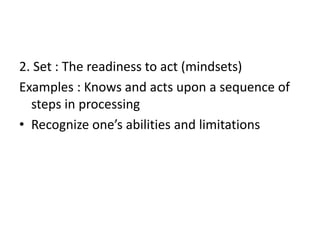
2. Set : The readiness to act (mindsets)
Examples : Knows and acts upon a sequence of
steps in processing
• Recognize one’s abilities and limitations
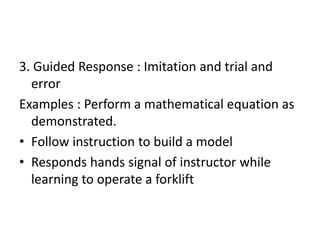
3. Guided Response : Imitation and trial and
error
Examples : Perform a mathematical equation as
demonstrated.
• Follow instruction to build a model
• Responds hands signal of instructor while
learning to operate a forklift
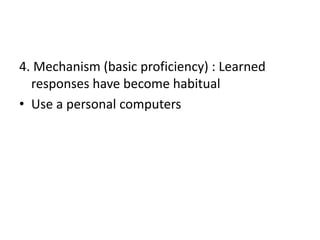
4. Mechanism (basic proficiency) : Learned
responses have become habitual
• Use a personal computers
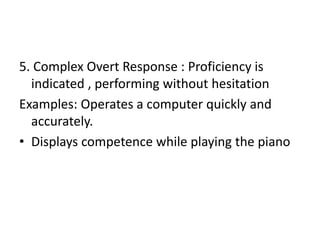
5. Complex Overt Response : Proficiency is
indicated , performing without hesitation
Examples: Operates a computer quickly and
accurately.
• Displays competence while playing the piano
6. Adaptation : Skills are well developed.
Individual can modify movement
Examples : Perform a task with a machine that it
was not originally intended to do.
7. Origination : Creating new movement
patterns to fit particular situation or specific
problem. Emphasizes creativity based upon
highly developed skills
Examples: Create a new gymnastics routine
• Constructs a new theory
Dave taxonomy
1. Imitation : Observing and patterning
behavior after someone else.
Examples: Copying a work of art
2. Manipulation : perform certain actions by
memory or following instructions
• Follows instructions to build a model .
3. Precision : Refining becoming more exact.
• Performing a skill within a high degree of
precision
Examples : Working and reworking so it will be
just right.
• Perform a task without assistance
4. Articulation : Coordinating and adapting a
series of actions to achieve harmony
Examples : Combining a series of skills to
produce a video that involves music, drama,
etc.
• Combining a series of skills to meet a novel
requirement.
5. Naturalization : Mastering a high level
performance until it becomes natural
Examples : Operates a computer quickly and
accurately
• Displays competence while playing the piano.
Harrow 1972
1. Reflex Movements : Reactions that are not
learned (involuntary)
Examples : Instinctive response
2. Fundamental Movements : Basic movements
such as walking or grasping
Examples : perform a simple task
3. Perceptual abilities : Response to stimuli such
as visual, auditory, kinesthetic, tactile
Examples : Track a moving object
• Recognize a pattern
4. Physical abilities : stamina that must be
developed for further development such as
strenghth and agility
Examples : Run a marathon
5. Skilled movements : Advanced learned
movements as in sports or acting
Examples :
Using an advanced series of integrated
movements, , perform a role in stage play
6. Non-discursive communication
Use effective body language such as facial
expressions and gestures .
* Express one’s self by using movements and
gestures.

Assessing KSA: The Learning Taxonomy

  • 1.
    Assessing KSA (Knowledge, Skillsand Attitude) The Taxonomy Prof. Neilson A. Silva ASIATECH College
  • 2.
    Domain I. Cognitive(Knowledge) Level 1 Remembering : Recall of previously learned information Examples : Recite the multiplication table • Match the words with the parts of the picture of a sewing machine Level 2 Understanding :comprehending the meaning, translation and interpretation Examples : Explain in one’s own words the stages in the life cycle of a butterfly • Distinguish between he different geometric figures
  • 3.
    Level 3 Applying: using what has been learned into similar new situations Examples : Use a mathematical formula to solve an algebra problem • Correct grammar usage • Prepare a daily menus for one week for a family of six
  • 4.
    Level 4 :Analyzing : Separating materials or concept into component parts to understand the whole Examples : Differentiate the parts of a tree • Observe the classroom and understand the things to be improved
  • 5.
    Level 5 Evaluating: judging the value of an idea. Examples: Defend a research proposal • Select the most effective solution • Critique a class demonstration
  • 6.
    Level 6 :Creating: Building a pattern or putting parts together Examples : write a syllabus for a school subject • Compile personal records and documents into a portfolio
  • 7.
    Domain II: Psychomotor(Skills) Simpson 1. Perception : being aware , use sensory cues to guide motor activity Examples : Estimate where a ball will land after it is thrown and move to the correct location to cath the ball.
  • 8.
    2. Set :The readiness to act (mindsets) Examples : Knows and acts upon a sequence of steps in processing • Recognize one’s abilities and limitations
  • 9.
    3. Guided Response: Imitation and trial and error Examples : Perform a mathematical equation as demonstrated. • Follow instruction to build a model • Responds hands signal of instructor while learning to operate a forklift
  • 10.
    4. Mechanism (basicproficiency) : Learned responses have become habitual • Use a personal computers
  • 11.
    5. Complex OvertResponse : Proficiency is indicated , performing without hesitation Examples: Operates a computer quickly and accurately. • Displays competence while playing the piano
  • 12.
    6. Adaptation :Skills are well developed. Individual can modify movement Examples : Perform a task with a machine that it was not originally intended to do.
  • 13.
    7. Origination :Creating new movement patterns to fit particular situation or specific problem. Emphasizes creativity based upon highly developed skills Examples: Create a new gymnastics routine • Constructs a new theory
  • 14.
    Dave taxonomy 1. Imitation: Observing and patterning behavior after someone else. Examples: Copying a work of art 2. Manipulation : perform certain actions by memory or following instructions • Follows instructions to build a model .
  • 15.
    3. Precision :Refining becoming more exact. • Performing a skill within a high degree of precision Examples : Working and reworking so it will be just right. • Perform a task without assistance
  • 16.
    4. Articulation :Coordinating and adapting a series of actions to achieve harmony Examples : Combining a series of skills to produce a video that involves music, drama, etc. • Combining a series of skills to meet a novel requirement.
  • 17.
    5. Naturalization :Mastering a high level performance until it becomes natural Examples : Operates a computer quickly and accurately • Displays competence while playing the piano.
  • 18.
    Harrow 1972 1. ReflexMovements : Reactions that are not learned (involuntary) Examples : Instinctive response 2. Fundamental Movements : Basic movements such as walking or grasping Examples : perform a simple task
  • 19.
    3. Perceptual abilities: Response to stimuli such as visual, auditory, kinesthetic, tactile Examples : Track a moving object • Recognize a pattern
  • 20.
    4. Physical abilities: stamina that must be developed for further development such as strenghth and agility Examples : Run a marathon
  • 21.
    5. Skilled movements: Advanced learned movements as in sports or acting Examples : Using an advanced series of integrated movements, , perform a role in stage play
  • 22.
    6. Non-discursive communication Useeffective body language such as facial expressions and gestures . * Express one’s self by using movements and gestures.