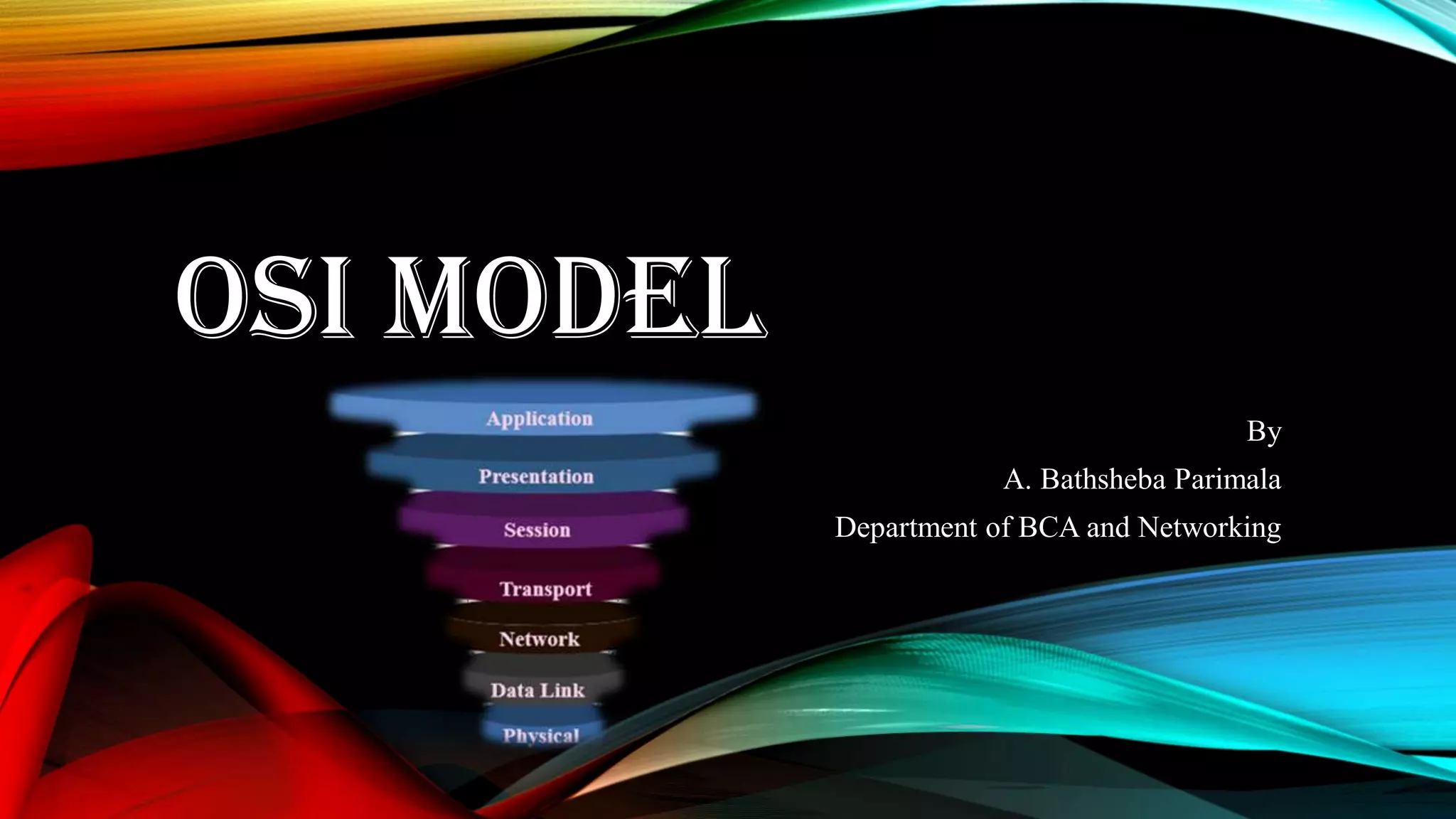
OSI MODEL
By
A. Bathsheba Parimala
Department of BCA and Networking
ISO PROPOSED OSI REFERENCE MODEL
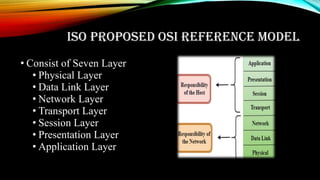
• Consist of Seven Layer
• Physical Layer
• Data Link Layer
• Network Layer
• Transport Layer
• Session Layer
• Presentation Layer
• Application Layer
PHYSICAL LAYER
• Physical connection between network nodes
• Date are converted into bits
• Provides mechanical, electrical functional and procedural
characteristics
DATA LINK LAYER
• Bits are converted into frame
• Data reliability
• Provides tools to establish, maintain and release
• Functions
• Initialization
• Information segmentation
• Error control
• Data synchronization
• Flow control
DATA LINK LAYER PROTOCOL
• Character oriented protocol
• Bit oriented protocol
• HDLC protocol
• Information frame
• Superior frame
• Slide window protocol
NETWORK LAYER
• Frames converted into packet
• Provides service to the transport layer
• Congestion control
• Connecting multiple network
• Routing packet between source and destination
ROUTING PROTOCOLS
• RIP – Routing Information Protocol
• OSPF – Open Shortest Path First
• BGP – Border Gate Way Protocol
TRANSPORT LAYER
•Reliable to transmit the packet
•Efficient
•Cost effective
•End to end connection
TRANSPORT SERVICE
• Class 0: Simple class
• Class 1: Error recovering class
• Class 3: Multiplexing
• Class 4: Error recovering multiplexing class
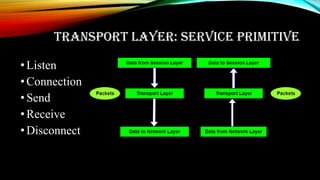
TRANSPORT LAYER: SERVICE PRIMITIVE
•Listen
•Connection
•Send
•Receive
•Disconnect
SESSION LAYER
• Data are transmitted at time interval
• Dialog control
• Token management
• Synchronization
• Half duplex
• Activity management
PRESENTATION LAYER
•Also called as Translation Layer
•Transmit over the network
•Translation – ASCII to EBCDIC
•Encryption / Decryption
•Compression / Decompression
APPLICATION LAYER
• Also called as Desktop layer
• Produce the data to be transferred over the network
• Functions
• Network virtual terminal
• FTAM (File Transfer Access and Management)
• Mail Services
• Directory Services
THANK YOU

Osi model

  • 1.
    OSI MODEL By A. BathshebaParimala Department of BCA and Networking
  • 2.
    ISO PROPOSED OSIREFERENCE MODEL • Consist of Seven Layer • Physical Layer • Data Link Layer • Network Layer • Transport Layer • Session Layer • Presentation Layer • Application Layer
  • 3.
    PHYSICAL LAYER • Physicalconnection between network nodes • Date are converted into bits • Provides mechanical, electrical functional and procedural characteristics
  • 4.
    DATA LINK LAYER •Bits are converted into frame • Data reliability • Provides tools to establish, maintain and release • Functions • Initialization • Information segmentation • Error control • Data synchronization • Flow control
  • 5.
    DATA LINK LAYERPROTOCOL • Character oriented protocol • Bit oriented protocol • HDLC protocol • Information frame • Superior frame • Slide window protocol
  • 6.
    NETWORK LAYER • Framesconverted into packet • Provides service to the transport layer • Congestion control • Connecting multiple network • Routing packet between source and destination
  • 7.
    ROUTING PROTOCOLS • RIP– Routing Information Protocol • OSPF – Open Shortest Path First • BGP – Border Gate Way Protocol
  • 8.
    TRANSPORT LAYER •Reliable totransmit the packet •Efficient •Cost effective •End to end connection
  • 9.
    TRANSPORT SERVICE • Class0: Simple class • Class 1: Error recovering class • Class 3: Multiplexing • Class 4: Error recovering multiplexing class
  • 10.
    TRANSPORT LAYER: SERVICEPRIMITIVE •Listen •Connection •Send •Receive •Disconnect
  • 11.
    SESSION LAYER • Dataare transmitted at time interval • Dialog control • Token management • Synchronization • Half duplex • Activity management
  • 12.
    PRESENTATION LAYER •Also calledas Translation Layer •Transmit over the network •Translation – ASCII to EBCDIC •Encryption / Decryption •Compression / Decompression
  • 13.
    APPLICATION LAYER • Alsocalled as Desktop layer • Produce the data to be transferred over the network • Functions • Network virtual terminal • FTAM (File Transfer Access and Management) • Mail Services • Directory Services
  • 14.