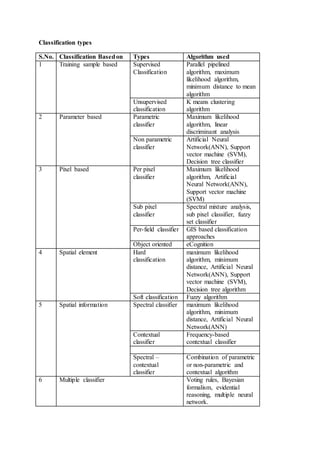
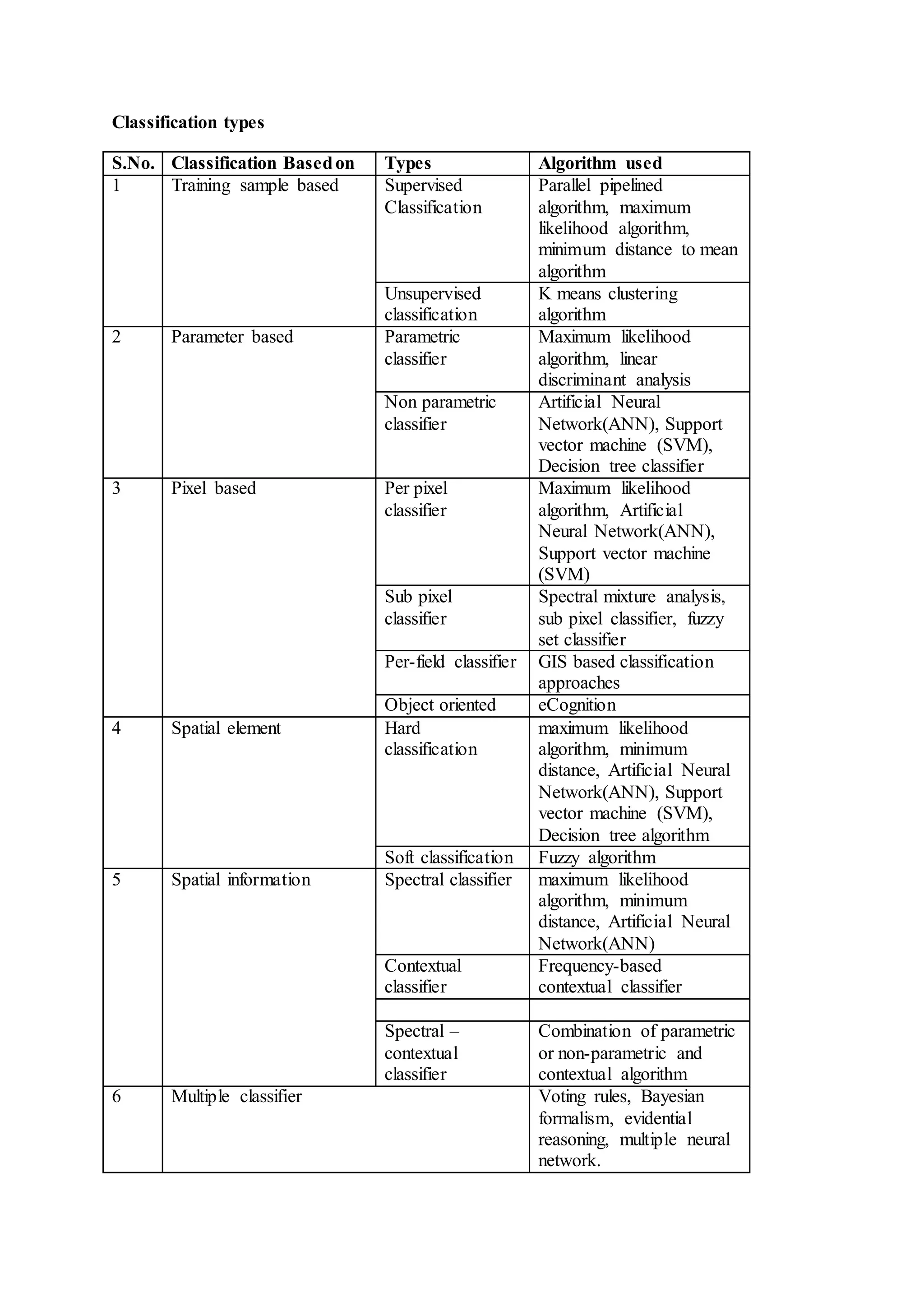
Classification types
S.No. Classification Basedon Types Algorithm used
1 Training sample based Supervised
Classification
Parallel pipelined
algorithm, maximum
likelihood algorithm,
minimum distance to mean
algorithm
Unsupervised
classification
K means clustering
algorithm
2 Parameter based Parametric
classifier
Maximum likelihood
algorithm, linear
discriminant analysis
Non parametric
classifier
Artificial Neural
Network(ANN), Support
vector machine (SVM),
Decision tree classifier
3 Pixel based Per pixel
classifier
Maximum likelihood
algorithm, Artificial
Neural Network(ANN),
Support vector machine
(SVM)
Sub pixel
classifier
Spectral mixture analysis,
sub pixel classifier, fuzzy
set classifier
Per-field classifier GIS based classification
approaches
Object oriented eCognition
4 Spatial element Hard
classification
maximum likelihood
algorithm, minimum
distance, Artificial Neural
Network(ANN), Support
vector machine (SVM),
Decision tree algorithm
Soft classification Fuzzy algorithm
5 Spatial information Spectral classifier maximum likelihood
algorithm, minimum
distance, Artificial Neural
Network(ANN)
Contextual
classifier
Frequency-based
contextual classifier
Spectral –
contextual
classifier
Combination of parametric
or non-parametric and
contextual algorithm
6 Multiple classifier Voting rules, Bayesian
formalism, evidential
reasoning, multiple neural
network.
Classification Techniques
Classification method Description Characteristics
Artificial Neural network ANN is a type of artificial
intelligence that imitates
some functions of the person
mind. ANN has a normal
tendency for storing
experiential knowledge. An
ANN consists of a sequence
of layers, each layer consists
of a set of neurones. All
neurones of every layer are
linked by weighted
connections to all neurones
on the preceding and
succeeding layers
It uses Nonparametric
approach. Performance and
accuracy depends upon the
network structure and
number of inputs
Decision tree DT calculates class
membership by repeatedly
partitioning a dataset into
uniform subsets Hierarchical
classifier permits the
acceptations and rejection of
class labels at each
intermediary stage. This
method consists of 3 parts:
Partitioning the nodes, find
the terminal nodes and
allocation of class label to
terminal nodes
DT are based on hierarchical
rule based method and use
Nonparametric approach.
Support Vector Machine A support vector machine
builds a hyper plane or set of
hyper planes in a high- or
infinite dimensional space,
used for classification. Good
separation is achieved by the
hyper plane that has the
largest distance to the nearest
training data point of any
class (functional margin),
generally larger the margin
lower the generalization error
of the classifier.
SVM uses Nonparametric
with binary classifier
approach and can handle
more input data very
efficiently. Performance and
accuracy depends upon the
hyper plane selection and
kernel parameter.

Segmentation of Machine learning Algorithm

  • 1.
    Classification types S.No. ClassificationBasedon Types Algorithm used 1 Training sample based Supervised Classification Parallel pipelined algorithm, maximum likelihood algorithm, minimum distance to mean algorithm Unsupervised classification K means clustering algorithm 2 Parameter based Parametric classifier Maximum likelihood algorithm, linear discriminant analysis Non parametric classifier Artificial Neural Network(ANN), Support vector machine (SVM), Decision tree classifier 3 Pixel based Per pixel classifier Maximum likelihood algorithm, Artificial Neural Network(ANN), Support vector machine (SVM) Sub pixel classifier Spectral mixture analysis, sub pixel classifier, fuzzy set classifier Per-field classifier GIS based classification approaches Object oriented eCognition 4 Spatial element Hard classification maximum likelihood algorithm, minimum distance, Artificial Neural Network(ANN), Support vector machine (SVM), Decision tree algorithm Soft classification Fuzzy algorithm 5 Spatial information Spectral classifier maximum likelihood algorithm, minimum distance, Artificial Neural Network(ANN) Contextual classifier Frequency-based contextual classifier Spectral – contextual classifier Combination of parametric or non-parametric and contextual algorithm 6 Multiple classifier Voting rules, Bayesian formalism, evidential reasoning, multiple neural network.
  • 2.
    Classification Techniques Classification methodDescription Characteristics Artificial Neural network ANN is a type of artificial intelligence that imitates some functions of the person mind. ANN has a normal tendency for storing experiential knowledge. An ANN consists of a sequence of layers, each layer consists of a set of neurones. All neurones of every layer are linked by weighted connections to all neurones on the preceding and succeeding layers It uses Nonparametric approach. Performance and accuracy depends upon the network structure and number of inputs Decision tree DT calculates class membership by repeatedly partitioning a dataset into uniform subsets Hierarchical classifier permits the acceptations and rejection of class labels at each intermediary stage. This method consists of 3 parts: Partitioning the nodes, find the terminal nodes and allocation of class label to terminal nodes DT are based on hierarchical rule based method and use Nonparametric approach. Support Vector Machine A support vector machine builds a hyper plane or set of hyper planes in a high- or infinite dimensional space, used for classification. Good separation is achieved by the hyper plane that has the largest distance to the nearest training data point of any class (functional margin), generally larger the margin lower the generalization error of the classifier. SVM uses Nonparametric with binary classifier approach and can handle more input data very efficiently. Performance and accuracy depends upon the hyper plane selection and kernel parameter.