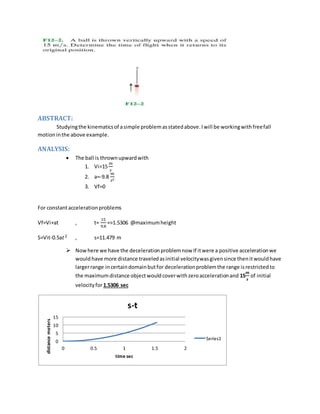
ABSTRACT: 
Studying the kinematics of a simple problem as stated above. I will be working with free fall 
motion in the above example. 
ANALYSIS: 
 The ball is thrown upward with 
1. Vi=15 
푚 
푠 
2. a=-9.8 
푚 
푠2 
3. Vf=0 
For constant acceleration problems 
Vf=Vi+at , t= 
15 
9.8 
=>1.5306 @maximum height 
S=Vit-0.5a푡2 , s=11.479 m 
 Now here we have the deceleration problem now If it were a positive acceleration we 
would have more distance traveled as initial velocity was given since then it would have 
larger range in certain domain but for deceleration problem the range is restricted to 
the maximum distance object would cover with zero acceleration and 15 
풎 
풔 
of initial 
velocity for 1.5306 sec 
15 
10 
5 
0 
s-t 
0 0.5 1 1.5 2 
distance meters 
time sec 
Series1
20 
15 
10 
5 
0 
v-t 
0 0.5 1 1.5 2 
velocity m/s 
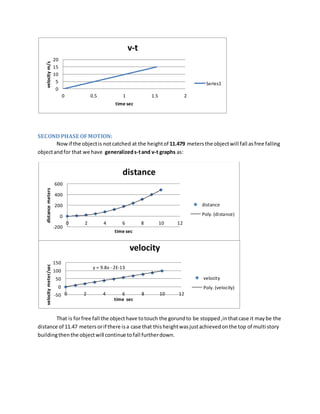
SECOND PHASE OF MOTION: 
time sec 
Series1 
Now if the object is not catched at the height of 11.479 meters the object will fall as free falling 
object and for that we have generalized s-t and v-t graphs as: 
600 
400 
200 
0 
-200 
distance 
0 2 4 6 8 10 12 
time sec 
distance 
Poly. (distance) 
y = 9.8x - 2E-13 
150 
100 
50 
0 
-50 
velocity 
0 2 4 6 8 10 12 
time sec 
velocity 
Poly. (velocity) 
That is for free fall the object have to touch the gorund to be stopped ,in that case it may be the 
distance meters 
velocity meter/sec 
distance of 11.47 meters or if there is a case that this height was just achieved on the top of multi story 
building then the object will continue to fall further down.
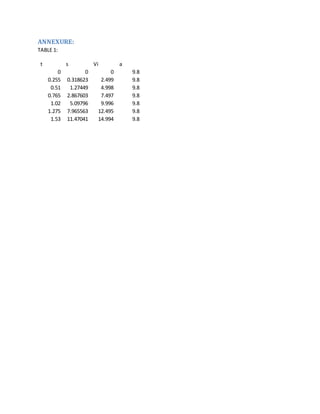
ANNEXURE: 
TABLE 1: 
t s Vi a 
0 0 0 9.8 
0.255 0.318623 2.499 9.8 
0.51 1.27449 4.998 9.8 
0.765 2.867603 7.497 9.8 
1.02 5.09796 9.996 9.8 
1.275 7.965563 12.495 9.8 
1.53 11.47041 14.994 9.8

Ass 1 f12-2 report enigneering dynamics problem

  • 1.
    ABSTRACT: Studying thekinematics of a simple problem as stated above. I will be working with free fall motion in the above example. ANALYSIS:  The ball is thrown upward with 1. Vi=15 푚 푠 2. a=-9.8 푚 푠2 3. Vf=0 For constant acceleration problems Vf=Vi+at , t= 15 9.8 =>1.5306 @maximum height S=Vit-0.5a푡2 , s=11.479 m  Now here we have the deceleration problem now If it were a positive acceleration we would have more distance traveled as initial velocity was given since then it would have larger range in certain domain but for deceleration problem the range is restricted to the maximum distance object would cover with zero acceleration and 15 풎 풔 of initial velocity for 1.5306 sec 15 10 5 0 s-t 0 0.5 1 1.5 2 distance meters time sec Series1
  • 2.
    20 15 10 5 0 v-t 0 0.5 1 1.5 2 velocity m/s SECOND PHASE OF MOTION: time sec Series1 Now if the object is not catched at the height of 11.479 meters the object will fall as free falling object and for that we have generalized s-t and v-t graphs as: 600 400 200 0 -200 distance 0 2 4 6 8 10 12 time sec distance Poly. (distance) y = 9.8x - 2E-13 150 100 50 0 -50 velocity 0 2 4 6 8 10 12 time sec velocity Poly. (velocity) That is for free fall the object have to touch the gorund to be stopped ,in that case it may be the distance meters velocity meter/sec distance of 11.47 meters or if there is a case that this height was just achieved on the top of multi story building then the object will continue to fall further down.
  • 3.
    ANNEXURE: TABLE 1: t s Vi a 0 0 0 9.8 0.255 0.318623 2.499 9.8 0.51 1.27449 4.998 9.8 0.765 2.867603 7.497 9.8 1.02 5.09796 9.996 9.8 1.275 7.965563 12.495 9.8 1.53 11.47041 14.994 9.8