Free Fall and Projectile Motion Lecture and Sample Problems
2.
What are theformulas for the
following quantities?
VELOCITY
SPEED
ACCELERATION
4.
DEFINITION
• Free fallis the motion of a body when only the force
due to gravity is acting on the body.
• The acceleration on an object in free fall is called the
acceleration due to gravity, or free-fall acceleration.
• Free-fall acceleration is the same for all objects,
regardless of mass.
5.
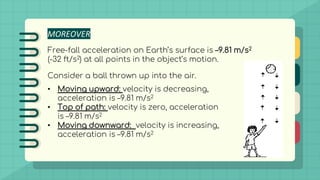
MOREOVER
Free-fall acceleration onEarth’s surface is –9.81 m/s2
(-32 ft/s2) at all points in the object’s motion.
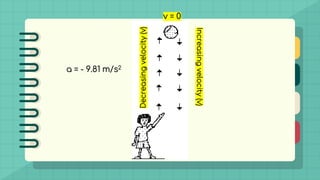
Consider a ball thrown up into the air.
• Moving upward: velocity is decreasing,
acceleration is –9.81 m/s2
• Top of path: velocity is zero, acceleration
is –9.81 m/s2
• Moving downward: velocity is increasing,
acceleration is –9.81 m/s2
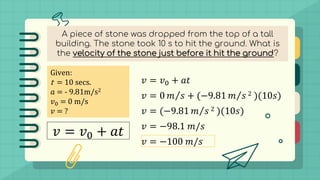
A piece ofstone was dropped from the top of a tall
building. The stone took 10 s to hit the ground. What is
the velocity of the stone just before it hit the ground?
Given:
t = 10 secs.
𝑎 = - 9.81m/s2
𝑣0 = 0 m/s
𝑣 = ?
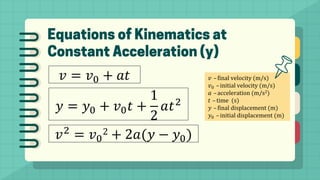
𝑣 = 𝑣0 + 𝑎𝑡
𝑣 = 𝑣0 + 𝑎𝑡
𝑣 = 0 Τ
𝑚 𝑠 + (−9.81 Τ
𝑚 𝑠 2 )(10𝑠)
𝑣 = (−9.81 Τ
𝑚 𝑠 2 )(10𝑠)
𝑣 = −98.1 𝑚/𝑠
𝑣 = −100 𝑚/𝑠
11.
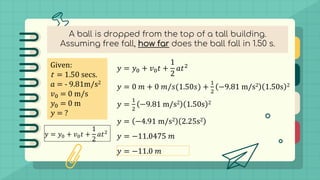
A ball isdropped from the top of a tall building.
Assuming free fall, how far does the ball fall in 1.50 s.
Given:
t = 1.50 secs.
𝑎 = - 9.81m/s2
𝑣0 = 0 m/s
𝑦0 = 0 m
𝑦 = ?
𝑦 = 𝑦0 + 𝑣0𝑡 +
1
2
𝑎𝑡2
𝑦 = 𝑦0 + 𝑣0𝑡 +
1
2
𝑎𝑡2
𝑦 = 0 𝑚 + 0 𝑚/𝑠(1.50𝑠) +
1
2
−9.81 m/s2 1.50s 2
𝑦 =
1
2
−9.81 m/s2 1.50s 2
𝑦 = −4.91 m/s2 2.25s2
𝑦 = −11.0475 𝑚
𝑦 = −11.0 𝑚
12.
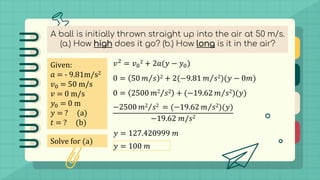
A ball isinitially thrown straight up into the air at 50 m/s.
(a.) How high does it go? (b.) How long is it in the air?
Given:
𝑎 = - 9.81m/s2
𝑣0 = 50 m/s
𝑣 = 0 m/s
𝑦0 = 0 m
𝑦 = ? (a)
𝑡 = ? (b)
Solve for (a)
𝑣2 = 𝑣0
2 + 2𝑎(𝑦 − 𝑦0)
0 = 50 Τ
𝑚 𝑠 2 + 2(−9.81 Τ
𝑚 𝑠2)(𝑦 − 0𝑚)
0 = 2500 Τ
𝑚2 𝑠2 + (−19.62 Τ
𝑚 𝑠2)(𝑦)
−2500 Τ
𝑚2 𝑠2 = (−19.62 Τ
𝑚 𝑠2)(𝑦)
−19.62 𝑚/𝑠2
𝑦 = 127.420999 𝑚
𝑦 = 100 𝑚
13.
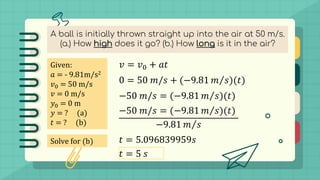
A ball isinitially thrown straight up into the air at 50 m/s.
(a.) How high does it go? (b.) How long is it in the air?
Given:
𝑎 = - 9.81m/s2
𝑣0 = 50 m/s
𝑣 = 0 m/s
𝑦0 = 0 m
𝑦 = ? (a)
𝑡 = ? (b)
Solve for (b)
𝑣 = 𝑣0 + 𝑎𝑡
0 = 50 𝑚/𝑠 + (−9.81 Τ
𝑚 𝑠)(𝑡)
−50 𝑚/𝑠 = (−9.81 Τ
𝑚 𝑠)(𝑡)
−50 𝑚/𝑠 = (−9.81 Τ
𝑚 𝑠)(𝑡)
−9.81 Τ
𝑚 𝑠
𝑡 = 5.096839959𝑠
𝑡 = 5 𝑠