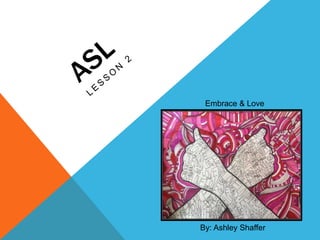
Embrace & Love
By: Ashley Shaffer
DISCUSSION:
H E A D N O D D I N G , S H A K I N G , A N D N O B E - V E R B S
When signing a sentence in ASL you don't
use state of being verbs such as:
• Is
• Am
• Was
• Were
• Are
• Be
• Being
• been...
Examples:
• I am happy would be signed
• I HAPPY (while nodding my
head and smiling.)
• If I wanted to sign “I'm not
happy,” Then I would sign “I
HAPPY” while shaking my head
negatively and frowning a bit or
pursing my lips.
To affirm that a thing or state exists
in ASL you nod your head.
When negating the existence of a
state or thing in ASL you shake
your head.
DISCUSSION CONT…
While ASL doesn't use signs for "be verbs" for everyday communication -- there are signs for
referring to be verbs.
Read that again if you need to. That sentence could get you in trouble with your local teacher.
My is that in ASL "be verb" signs are reserved for situations where you are talking about
English.
For example, a teacher in an English class at a Deaf school might use signs for "is, am, was,
were, be, being, been" and so forth to talk about the English language while teaching an English
class.
But ASL itself doesn't use "be verbs." Most ASL instructors will tell you ASL doesn't use "be verbs"
-- and they are right in that the grammar of ASL doesn't require a "subject + be- verb +
adjective" type of sentence. Instead ASL tends to use a "subject + predicate" type of structure.
("Predicate" is just a fancy word that means "say something about.") You might call that a topic +
comment sentence structure.
Some people say that ASL doesn't use a "Subject-Verb-Object" (SVO) sentence structure. That’s
a load of
ASL uses a variety of sentence types and does indeed make use of SVO sentence structure (in
addition to other structures)
For example:
“I GO STORE” uses a subject-verb-object structure. So,
remember ASL uses many different sentence structures (just like
all other real languages).
Don't let the gloss fool you, ("gloss" is
what you call it when you write one
language in another language.)
Just because I didn't type the words "am"
and "to" doesn't mean that the function of
"am" and "to" aren't being taken care of.
The function of these words is to indicate
affirmation or existence.
The function of the word "am" in that
sentence is replaced by a slight nod of the
head; and "to" is incorporated in the
movement and direction of the sign for GO.
The sign GO actually means, "go to."
There is much more to ASL than can be
easily typed onto a flat screen.
Let's get really clear on this--if someone asks
you, "Does ASL use 'be' verbs?" -- you
should answer "No." If asked on a quiz,
Does ASL have 'be' verbs? you should
answer "No."
But in the back of your head remember that
there are Signed English signs for "BE, WAS,
WERE" -- we just don't use them as verbs in
ASL and when we do use them it is to sign in
English (not ASL) or to talk about English.
1. GIRL-[woman, lady]
2. BOY-[male, man]
3. BROTHER
4. CHILD-[also see variation:
CHILDREN]
5. DAD-[parents] [grandpa]
6. DIVORCE
7. HAVE
8. HEY
9. HOW
10. HOW-MANY-[also see variation:
MANY]
11. MARRIAGE-[husband, wife, marry,
married, spouse]
12. MOM [grandma]
13. SINGLE-[alone, someone, JUST,
ONLY,
SOMETHING]
14. SISTER
15. SLOW
16. SPELL-[fingerspell]
17. WORK
18. Possession: [his/her/its, my, our, their,
yours]
VOCABULARY
Memory Aid: Think of two objects or two people that were
once together as now being apart.
Memory Aid: think of a couple joining hands at their wedding:
Memory Aid: Think of working with a hammer.
POSSESSION
In ASL, personal pronouns (me, she/he, you, us, them) can indicate possession by
changing the handshape from an index finger to a flat hand (a version of a "b" palm).
The palm should face toward the person or thing that is doing the possessing.
• For example, the sign for "you" when done with a "b" palm, fingertips up, palm
toward the person, means "your.“
Other examples:
• mine: "b" palm on chest
• his: "b" palm toward the person
• hers "b" palm toward the person
• theirs "b" palm makes sweeping motion indicating whom is being referred to
your / yours /
belongs to you
their / theirs / belonging
to multiple individualsour / ours
my / mine /
belongs to
me
HIS, HER, and
ITS can all be
indicated by the
same sign:
POSSESSION CONT.…
General possession can be indicated by signing the word "have." To do this, place the fingertips of both "b"
palms on your chest. Your hands should be bent at the knuckles with the fingers straight.
Another way to indicate possession is the order in which you sign something. For example, if you sign: "my
mother dog dead," the order of the signing ("dog" immediately after "mother") would establish that the dog
belonged to your mother.
Question: Can I use the "S" for possession in ASL? Like in "Sara's daughter.“
Response: In general I do not use the possessive "S" to establish possession in ASL. For those of you
who have never seen a possessive "S" -- it is done by adding a slight inward twist to an "S-hand." Think of
someone holding onto a stick of beef jerky and then twisting their hand as they bite off a piece to chew on.
(No, the possessive "S" isn't done near the mouth, it is done in the general signing/fingerspelling space.
But the motion is similar to the twisting motion a person uses to bite a bit of beef jerky.) The possessive "S"
is used quite commonly in Contact Signing (PSE) and or SEE, but not as often in ASL.
Just about the only time I use a possessive "S" in ASL is when I'm fingerspelling a title. For example,
suppose someone asks me what is the name of that delicious pizza place we went to the other night, I
might respond by fingerspelling "A-N-T-O-N-I-O'S," using a possessive "S" at the end of Antonio's.
In ASL, to sign "Sara's daughter," I'd spell "S-A-R-A" and then sign "DAUGHTER." The order of the words
would indicate the relationship. If I needed to be absolutely clear, I'd sign, "S-A-R-A, HER-[aiming the
possessive B-palm toward Sara or the referent-area for Sara] DAUGHTER."

Asl lesson 2.1

  • 1.
    Embrace & Love By:Ashley Shaffer
  • 2.
    DISCUSSION: H E AD N O D D I N G , S H A K I N G , A N D N O B E - V E R B S When signing a sentence in ASL you don't use state of being verbs such as: • Is • Am • Was • Were • Are • Be • Being • been... Examples: • I am happy would be signed • I HAPPY (while nodding my head and smiling.) • If I wanted to sign “I'm not happy,” Then I would sign “I HAPPY” while shaking my head negatively and frowning a bit or pursing my lips. To affirm that a thing or state exists in ASL you nod your head. When negating the existence of a state or thing in ASL you shake your head.
  • 3.
    DISCUSSION CONT… While ASLdoesn't use signs for "be verbs" for everyday communication -- there are signs for referring to be verbs. Read that again if you need to. That sentence could get you in trouble with your local teacher. My is that in ASL "be verb" signs are reserved for situations where you are talking about English. For example, a teacher in an English class at a Deaf school might use signs for "is, am, was, were, be, being, been" and so forth to talk about the English language while teaching an English class. But ASL itself doesn't use "be verbs." Most ASL instructors will tell you ASL doesn't use "be verbs" -- and they are right in that the grammar of ASL doesn't require a "subject + be- verb + adjective" type of sentence. Instead ASL tends to use a "subject + predicate" type of structure. ("Predicate" is just a fancy word that means "say something about.") You might call that a topic + comment sentence structure. Some people say that ASL doesn't use a "Subject-Verb-Object" (SVO) sentence structure. That’s a load of ASL uses a variety of sentence types and does indeed make use of SVO sentence structure (in addition to other structures) For example: “I GO STORE” uses a subject-verb-object structure. So, remember ASL uses many different sentence structures (just like all other real languages).
  • 4.
    Don't let thegloss fool you, ("gloss" is what you call it when you write one language in another language.) Just because I didn't type the words "am" and "to" doesn't mean that the function of "am" and "to" aren't being taken care of. The function of these words is to indicate affirmation or existence. The function of the word "am" in that sentence is replaced by a slight nod of the head; and "to" is incorporated in the movement and direction of the sign for GO. The sign GO actually means, "go to." There is much more to ASL than can be easily typed onto a flat screen. Let's get really clear on this--if someone asks you, "Does ASL use 'be' verbs?" -- you should answer "No." If asked on a quiz, Does ASL have 'be' verbs? you should answer "No." But in the back of your head remember that there are Signed English signs for "BE, WAS, WERE" -- we just don't use them as verbs in ASL and when we do use them it is to sign in English (not ASL) or to talk about English.
  • 5.
    1. GIRL-[woman, lady] 2.BOY-[male, man] 3. BROTHER 4. CHILD-[also see variation: CHILDREN] 5. DAD-[parents] [grandpa] 6. DIVORCE 7. HAVE 8. HEY 9. HOW 10. HOW-MANY-[also see variation: MANY] 11. MARRIAGE-[husband, wife, marry, married, spouse] 12. MOM [grandma] 13. SINGLE-[alone, someone, JUST, ONLY, SOMETHING] 14. SISTER 15. SLOW 16. SPELL-[fingerspell] 17. WORK 18. Possession: [his/her/its, my, our, their, yours] VOCABULARY
  • 11.
    Memory Aid: Thinkof two objects or two people that were once together as now being apart.
  • 17.
    Memory Aid: thinkof a couple joining hands at their wedding:
  • 23.
    Memory Aid: Thinkof working with a hammer.
  • 25.
    POSSESSION In ASL, personalpronouns (me, she/he, you, us, them) can indicate possession by changing the handshape from an index finger to a flat hand (a version of a "b" palm). The palm should face toward the person or thing that is doing the possessing. • For example, the sign for "you" when done with a "b" palm, fingertips up, palm toward the person, means "your.“ Other examples: • mine: "b" palm on chest • his: "b" palm toward the person • hers "b" palm toward the person • theirs "b" palm makes sweeping motion indicating whom is being referred to your / yours / belongs to you their / theirs / belonging to multiple individualsour / ours my / mine / belongs to me HIS, HER, and ITS can all be indicated by the same sign:
  • 26.
    POSSESSION CONT.… General possessioncan be indicated by signing the word "have." To do this, place the fingertips of both "b" palms on your chest. Your hands should be bent at the knuckles with the fingers straight. Another way to indicate possession is the order in which you sign something. For example, if you sign: "my mother dog dead," the order of the signing ("dog" immediately after "mother") would establish that the dog belonged to your mother. Question: Can I use the "S" for possession in ASL? Like in "Sara's daughter.“ Response: In general I do not use the possessive "S" to establish possession in ASL. For those of you who have never seen a possessive "S" -- it is done by adding a slight inward twist to an "S-hand." Think of someone holding onto a stick of beef jerky and then twisting their hand as they bite off a piece to chew on. (No, the possessive "S" isn't done near the mouth, it is done in the general signing/fingerspelling space. But the motion is similar to the twisting motion a person uses to bite a bit of beef jerky.) The possessive "S" is used quite commonly in Contact Signing (PSE) and or SEE, but not as often in ASL. Just about the only time I use a possessive "S" in ASL is when I'm fingerspelling a title. For example, suppose someone asks me what is the name of that delicious pizza place we went to the other night, I might respond by fingerspelling "A-N-T-O-N-I-O'S," using a possessive "S" at the end of Antonio's. In ASL, to sign "Sara's daughter," I'd spell "S-A-R-A" and then sign "DAUGHTER." The order of the words would indicate the relationship. If I needed to be absolutely clear, I'd sign, "S-A-R-A, HER-[aiming the possessive B-palm toward Sara or the referent-area for Sara] DAUGHTER."