contents Trade Insight Vol. 12, No. 2, 2016
MEMBER INSTITUTIONS OF SAWTEE
BANGLADESH 1. Bangladesh Environmental Lawyers’ Association (BELA), Dhaka; 2. Unnayan Shamannay, Dhaka; INDIA 1. Citizen consumer and
civic Action Group (CAG), Chennai; 2. Consumer Unity & Trust Society (CUTS), Jaipur; 3. Development Research and Action Group (DRAG), New
Delhi; NEPAL 1. Society for Legal and Environmental Analysis and Development Research (LEADERS), Kathmandu; 2. Forum for Protection of Public
Interest (Pro Public), Kathmandu; PAKISTAN 1. Journalists for Democracy and Human Rights (JDHR), Islamabad; 2. Sustainable Development Policy
Institute (SDPI), Islamabad; SRI LANKA 1. Institute of Policy Studies (IPS), Colombo; 2. Law & Society Trust (LST), Colombo
Views expressed in Trade Insight are of the authors and do not necessarily reflect the official position of SAWTEE or its member institutions.
COVER FEATURE 14
ACCESS AND BENEFIT SHARING 35
Biopiracy in
Queensland:
A broken record
that needs repair
TRADE AND CLIMATE CHANGE 27
IN THE NEWS 4
VIEWPOINT 8
Can South Asia ‘Make in India’?
INVESTMENT
Trade-investment links
get increasingly intricate 10
Obstacles to South Asia
value chains 21
South Asia ready for
FDI promotion 24
SAARC Industrial Parks
to deepen South Asian
cooperation 30
LESSONS 32
Brexit fallout Trade,
investment and South Asia
BOOK REVIEW 39
Lonely voice
KNOWLEDGE PLATFORM 40
SAARC Arbitration Council
NETWORK NEWS 42
Trade may be bad
news for climate
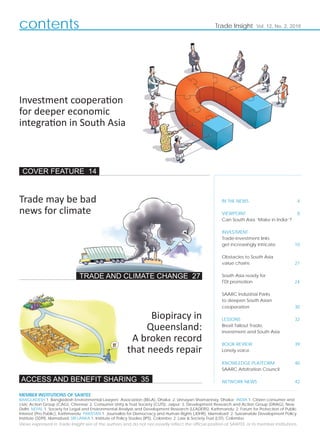
Investment coopera on
for deeper economic
integra on in South Asia
21Trade Insight Vol. 12, No. 2, 2016
Domestic firms establish foreign
production units to overcome
tariff restrictions, obtain cheap inputs
and minimize logistics expenditures.
This helps firms build access big-
ger markets. Countries also want to
make use of practices that give them
comparative advantage in terms of
cost effective production methods and
quality enhancement. Global supply
chains make it possible to use inputs,
production techniques and processes
in different countries. This is termed
as the ‘flying geese’ model.1
A global value chain (GVC), also
involving the distribution aspect,
spreads beyond international borders.
Countries that are engaged in GVC
show enhanced access to the global
economy, better production and em-
ployment levels2
and relatively more
sophisticated technologies3
.
The Organisation for Econom-
ic Co-operation and Development
(OECD) reports that participation in
GVCs brings stability in the perfor-
mance of small and medium enterpris-
es (SMEs) and enhances the develop-
ment of their business.4
Foreign Direct
Investment (FDI) can help SMEs attain
further access to technology, interna-
tional markets and skills. Technolog-
ical improvement and human capital
growth also come as spillovers of
taking part in GVCs.
Value chains mutually benefit
businesses and parties involved in
the process. Rice value chains be-
tween Bangladesh and India have
helped farmers increase their income.5
Similarly, India imports textile and
clothing from Bangladesh, which
are used to manufacture high-end
final goods.6
There are studies that
show that supply chains have helped
the growth of industry e.g. growth
of the fashion industry in Pakistan,
after implementing e-commerce and
Electronic Supply Chain Management
(E-SCM)7
. Others have witnessed sales
growth, on-time order management
and delivery schedule.
Value chains constraints
There are supply-side constraints to
the growth of value chains in South
Asia. Logistic services help in trade
and production expansion and also
assist in developing productive
capacities. However, countries in
South Asia are slow to bring about
innovation in logistics management.
India has performed better in the
World Bank’s Logistic Performance
Index (LPI) compared to other
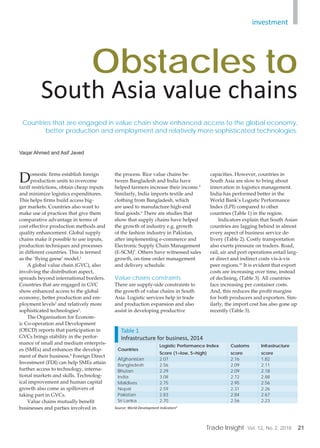
countries (Table 1) in the region.
Indicators explain that South Asian
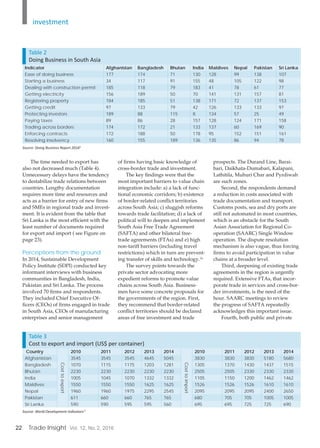
countries are lagging behind in almost
every aspect of business service de-
livery (Table 2). Costly transportation
also exerts pressure on traders. Road,
rail, air and port operations entail larg-
er direct and indirect costs vis-à-vis
peer regions.10
It is evident that export
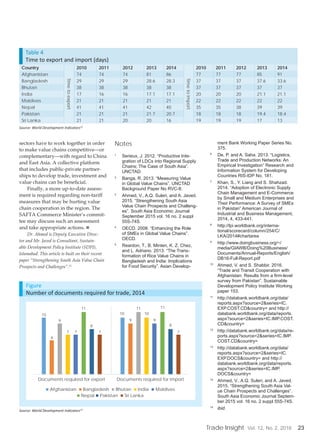
costs are increasing over time, instead
of declining, (Table 3). All countries
face increasing per container costs.
And, this reduces the profit margins
for both producers and exporters. Sim-
ilarly, the import cost has also gone up
recently (Table 3).
South Asia value chains
Countries that are engaged in value chain show enhanced access to the global economy,
better production and employment and relatively more sophisticated technologies.
Vaqar Ahmed and Asif Javed
Countries
Logistic Performance Index
Score (1=low, 5=high)
Customs
score
Infrastructure
score
Afghanistan 2.07 2.16 1.82
Bangladesh 2.56 2.09 2.11
Bhutan 2.29 2.09 2.18
India 3.08 2.72 2.88
Maldives 2.75 2.95 2.56
Nepal 2.59 2.31 2.26
Pakistan 2.83 2.84 2.67
Sri Lanka 2.70 2.56 2.23
Source: World Development Indicators8
Table 1
Infrastructure for business, 2014
Obstacles to
investment
22 Trade Insight Vol. 12, No. 2, 2016
investment
Indicator Afghanistan Bangladesh Bhutan India Maldives Nepal Pakistan Sri Lanka
Ease of doing business 177 174 71 130 128 99 138 107
Starting a business 34 117 91 155 48 105 122 98
Dealing with construction permit 185 118 79 183 41 78 61 77
Getting electricity 156 189 50 70 141 131 157 81
Registering property 184 185 51 138 171 72 137 153
Getting credit 97 133 79 42 126 133 133 97
Protecting investors 189 88 115 8 134 57 25 49
Paying taxes 89 86 28 157 128 124 171 158
Trading across borders 174 172 21 133 137 60 169 90
Enforcing contracts 172 188 50 178 95 152 151 161
Resolving insolvency 160 155 189 136 135 86 94 78
Source: Doing Business Report 20169
Table 2
Doing Business in South Asia
The time needed to export has
also not decreased much (Table 4).
Unnecessary delays have the tendency
to destabilize trade relations between
countries. Lengthy documentation
requires more time and resources and
acts as a barrier for entry of new firms
and SMEs in regional trade and invest-
ment. It is evident from the table that
Sri Lanka is the most efficient with the
least number of documents required
for export and import ( see Figure on
page 23).
Perceptions from the ground
In 2014, Sustainable Development
Policy Institute (SDPI) conducted key
informant interviews with business
communities in Bangladesh, India,
Pakistan and Sri Lanka. The process
involved 70 firms and respondents.
They included Chief Executive Of-
ficers (CEOs) of firms engaged in trade
in South Asia, CEOs of manufacturing
enterprises and senior management
of firms having basic knowledge of
cross-border trade and investment.
The key findings were that the
most important barriers to value chain
integration include: a) a lack of func-
tional economic corridors; b) existence
of border-related conflict territories
across South Asia; c) sluggish reforms
towards trade facilitation; d) a lack of
political will to deepen and implement
South Asia Free Trade Agreement
(SAFTA) and other bilateral free-
trade agreements (FTAs) and e) high
non-tariff barriers (including travel
restrictions) which in turn are prevent-
ing transfer of skills and technology.14
The survey points towards the
private sector advocating more
expedient reforms to promote value
chains across South Asia. Business-
men have some concrete proposals for
the governments of the region. First,
they recommend that border-related
conflict territories should be declared
areas of free investment and trade
prospects. The Durand Line, Barai-
bari, Daikhata-Dumabari, Kalapani,
Lathitila, Muhuri Char and Pyrdiwah
are such zones.
Second, the respondents demand
a reduction in costs associated with
trade documentation and transport.
Customs posts, sea and dry ports are
still not automated in most countries,
which is an obstacle for the South
Asian Association for Regional Co-
operation (SAARC) Single Window
operation. The dispute resolution
mechanism is also vague, thus forcing
firms to avoid participation in value
chains at a broader level.
Third, deepening of existing trade
agreements in the region is urgently
required. Extensive FTAs, that incor-
porate trade in services and cross-bor-
der investments, is the need of the
hour. SAARC meetings to review
the progress of SAFTA repeatedly
acknowledges this important issue.
Fourth, both public and private
Table 3
Cost to export and import (US$ per container)
Country
Costtoexport
2010 2011 2012 2013 2014
Costtoimport
2010 2011 2012 2013 2014
Afghanistan 3545 3545 3545 4645 5045 3830 3830 3830 5180 5680
Bangladesh 1070 1115 1175 1203 1281 1305 1370 1430 1437 1515
Bhutan 2230 2230 2230 2230 2230 2505 2505 2330 2330 2330
India 1005 1045 1070 1332 1332 1105 1150 1200 1462 1462
Maldives 1550 1550 1550 1625 1625 1526 1526 1526 1610 1610
Nepal 1960 1960 1975 2295 2545 2095 2095 2095 2400 2650
Pakistan 611 660 660 765 765 680 705 705 1005 1005
Sri Lanka 590 590 595 595 560 695 695 725 725 690
Source: World Development Indicators11
23Trade Insight Vol. 12, No. 2, 2016
Table 4
Time to export and import (days)
Country Timetoexport 2010 2011 2012 2013 2014
Timetoimport
2010 2011 2012 2013 2014
Afghanistan 74 74 74 81 86 77 77 77 85 91
Bangladesh 29 29 29 28.6 28.3 37 37 37 37.6 33.6
Bhutan 38 38 38 38 38 37 37 37 37 37
India 17 16 16 17.1 17.1 20 20 20 21.1 21.1
Maldives 21 21 21 21 21 22 22 22 22 22
Nepal 41 41 41 42 40 35 35 38 39 39
Pakistan 21 21 21 21.7 20.7 18 18 18 19.4 18.4
Sri Lanka 21 21 20 20 16 19 19 19 17 13
Source: World Development Indicators12
sectors have to work together in order
to make value chains competitive—or
complementary—with regard to China
and East Asia. A collective platform
that includes public-private partner-
ships to develop trade, investment and
value chains can be beneficial.
Finally, a more up-to-date assess-
ment is required regarding non-tariff
measures that may be hurting value
chain cooperation in the region. The
SAFTA Commerce Minister’s commit-
tee may discuss such an assessment
and take appropriate actions.
Dr. Ahmed is Deputy Executive Direc-
tor and Mr. Javed is Consultant, Sustain-
able Development Policy Institute (SDPI),
Islamabad. This article is built on their recent
paper “Strengthening South Asia Value Chain
Prospects and Challenges”.15
Notes
1
Serieux, J. 2012. “Productive Inte-
gration of LDCs into Regional Supply
Chains; The Case of South Asia”.
UNCTAD.
2
Banga, R. 2013. “Measuring Value
in Global Value Chains”. UNCTAD
Background Paper No RVC-8.
3
Ahmed, V., A.Q. Suleri, and A. Javed.
2015. “Strengthening South Asia
Value Chain Prospects and Challeng-
es”. South Asia Economic Journal
September 2015 vol. 16 no. 2 suppl
55S-74S.
4
OECD. 2008. “Enhancing the Role
of SMEs in Global Value Chains”.
OECD.
5
Reardon, T., B. Minten, K. Z. Chez,
and L. Adriano. 2013. “The Trans-
formation of Rice Value Chains in
Bangladesh and India: Implications
for Food Security”. Asian Develop-
ment Bank Working Paper Series No.
375.
6
De, P. and A. Saha. 2013. “Logistics,
Trade and Production Networks: An
Empirical Investigation” Research and
Information System for Developing
Countries RIS-IDP No. 181.
7
Khan, S., Y. Liang and S. Shahzad.
2014. “Adoption of Electronic Supply
Chain Management and E-Commerce
by Small and Medium Enterprises and
Their Performance: A Survey of SMEs
in Pakistan” American Journal of
Industrial and Business Management,
2014, 4, 433-441.
8
http://lpi.worldbank.org/interna-
tional/scorecard/column/254/C/
LKA/2014#chartarea
9
http://www.doingbusiness.org/~/
media/GIAWB/Doing%20Business/
Documents/Annual-Reports/English/
DB16-Full-Report.pdf
10
Ahmed, V. and S. Shabbir. 2016.
“Trade and Transit Cooperation with
Afghanistan: Results from a firm-level
survey from Pakistan”. Sustainable
Development Policy Institute Working
paper 153.
11
http://databank.worldbank.org/data/
reports.aspx?source=2&series=IC.
EXP.COST.CD&country= and http://
databank.worldbank.org/data/reports.
aspx?source=2&series=IC.IMP.COST.
CD&country=
12
http://databank.worldbank.org/data/re-
ports.aspx?source=2&series=IC.IMP.
COST.CD&country=
13
http://databank.worldbank.org/data/
reports.aspx?source=2&series=IC.
EXP.DOCS&country= and http://
databank.worldbank.org/data/reports.
aspx?source=2&series=IC.IMP.
DOCS&country=
14
Ahmed, V., A.Q. Suleri, and A. Javed.
2015. “Strengthening South Asia Val-
ue Chain Prospects and Challenges”.
South Asia Economic Journal Septem-
ber 2015 vol. 16 no. 2 suppl 55S-74S.
15
ibid.Source: World Development Indicators13
Figure
Number of documents required for trade, 2014
Afghanistan Bangladesh Bhutan India Maldives
Nepal Pakistan Sri Lanka
Documents required for export Documents required for import
10
9
6
7 7
11
8
7
10
9
11
10
11
9
8
7
44 Trade Insight Vol. 12, No. 2, 2016
South Asia Watch on Trade,
Economics and Environment
(SAWTEE) is a regional network
that operates through its secre-
tariat in Kathmandu and member
institutions from five South Asian
countries, namely Bangladesh,
India, Nepal, Pakistan and Sri
Lanka. The overall objective of
SAWTEE is to build the capac-
ity of concerned stakeholders
in South Asia in the context of
liberalization and globalization.
www.sawtee.org
Policy Brief: Public Investment in
Agriculture : Policy Issues in South Asia
Author: Krishna Prasad Pant
Publisher: SAWTEE
Research Brief: A study of vegetable and
fruit export from Eastern Region of Nepal
Author: Purushottam Ojha
Publisher: SAWTEE

Asian Value Chains

  • 2.
    contents Trade InsightVol. 12, No. 2, 2016 MEMBER INSTITUTIONS OF SAWTEE BANGLADESH 1. Bangladesh Environmental Lawyers’ Association (BELA), Dhaka; 2. Unnayan Shamannay, Dhaka; INDIA 1. Citizen consumer and civic Action Group (CAG), Chennai; 2. Consumer Unity & Trust Society (CUTS), Jaipur; 3. Development Research and Action Group (DRAG), New Delhi; NEPAL 1. Society for Legal and Environmental Analysis and Development Research (LEADERS), Kathmandu; 2. Forum for Protection of Public Interest (Pro Public), Kathmandu; PAKISTAN 1. Journalists for Democracy and Human Rights (JDHR), Islamabad; 2. Sustainable Development Policy Institute (SDPI), Islamabad; SRI LANKA 1. Institute of Policy Studies (IPS), Colombo; 2. Law & Society Trust (LST), Colombo Views expressed in Trade Insight are of the authors and do not necessarily reflect the official position of SAWTEE or its member institutions. COVER FEATURE 14 ACCESS AND BENEFIT SHARING 35 Biopiracy in Queensland: A broken record that needs repair TRADE AND CLIMATE CHANGE 27 IN THE NEWS 4 VIEWPOINT 8 Can South Asia ‘Make in India’? INVESTMENT Trade-investment links get increasingly intricate 10 Obstacles to South Asia value chains 21 South Asia ready for FDI promotion 24 SAARC Industrial Parks to deepen South Asian cooperation 30 LESSONS 32 Brexit fallout Trade, investment and South Asia BOOK REVIEW 39 Lonely voice KNOWLEDGE PLATFORM 40 SAARC Arbitration Council NETWORK NEWS 42 Trade may be bad news for climate Investment coopera on for deeper economic integra on in South Asia
  • 3.
    21Trade Insight Vol.12, No. 2, 2016 Domestic firms establish foreign production units to overcome tariff restrictions, obtain cheap inputs and minimize logistics expenditures. This helps firms build access big- ger markets. Countries also want to make use of practices that give them comparative advantage in terms of cost effective production methods and quality enhancement. Global supply chains make it possible to use inputs, production techniques and processes in different countries. This is termed as the ‘flying geese’ model.1 A global value chain (GVC), also involving the distribution aspect, spreads beyond international borders. Countries that are engaged in GVC show enhanced access to the global economy, better production and em- ployment levels2 and relatively more sophisticated technologies3 . The Organisation for Econom- ic Co-operation and Development (OECD) reports that participation in GVCs brings stability in the perfor- mance of small and medium enterpris- es (SMEs) and enhances the develop- ment of their business.4 Foreign Direct Investment (FDI) can help SMEs attain further access to technology, interna- tional markets and skills. Technolog- ical improvement and human capital growth also come as spillovers of taking part in GVCs. Value chains mutually benefit businesses and parties involved in the process. Rice value chains be- tween Bangladesh and India have helped farmers increase their income.5 Similarly, India imports textile and clothing from Bangladesh, which are used to manufacture high-end final goods.6 There are studies that show that supply chains have helped the growth of industry e.g. growth of the fashion industry in Pakistan, after implementing e-commerce and Electronic Supply Chain Management (E-SCM)7 . Others have witnessed sales growth, on-time order management and delivery schedule. Value chains constraints There are supply-side constraints to the growth of value chains in South Asia. Logistic services help in trade and production expansion and also assist in developing productive capacities. However, countries in South Asia are slow to bring about innovation in logistics management. India has performed better in the World Bank’s Logistic Performance Index (LPI) compared to other countries (Table 1) in the region. Indicators explain that South Asian countries are lagging behind in almost every aspect of business service de- livery (Table 2). Costly transportation also exerts pressure on traders. Road, rail, air and port operations entail larg- er direct and indirect costs vis-à-vis peer regions.10 It is evident that export costs are increasing over time, instead of declining, (Table 3). All countries face increasing per container costs. And, this reduces the profit margins for both producers and exporters. Sim- ilarly, the import cost has also gone up recently (Table 3). South Asia value chains Countries that are engaged in value chain show enhanced access to the global economy, better production and employment and relatively more sophisticated technologies. Vaqar Ahmed and Asif Javed Countries Logistic Performance Index Score (1=low, 5=high) Customs score Infrastructure score Afghanistan 2.07 2.16 1.82 Bangladesh 2.56 2.09 2.11 Bhutan 2.29 2.09 2.18 India 3.08 2.72 2.88 Maldives 2.75 2.95 2.56 Nepal 2.59 2.31 2.26 Pakistan 2.83 2.84 2.67 Sri Lanka 2.70 2.56 2.23 Source: World Development Indicators8 Table 1 Infrastructure for business, 2014 Obstacles to investment
  • 4.
    22 Trade InsightVol. 12, No. 2, 2016 investment Indicator Afghanistan Bangladesh Bhutan India Maldives Nepal Pakistan Sri Lanka Ease of doing business 177 174 71 130 128 99 138 107 Starting a business 34 117 91 155 48 105 122 98 Dealing with construction permit 185 118 79 183 41 78 61 77 Getting electricity 156 189 50 70 141 131 157 81 Registering property 184 185 51 138 171 72 137 153 Getting credit 97 133 79 42 126 133 133 97 Protecting investors 189 88 115 8 134 57 25 49 Paying taxes 89 86 28 157 128 124 171 158 Trading across borders 174 172 21 133 137 60 169 90 Enforcing contracts 172 188 50 178 95 152 151 161 Resolving insolvency 160 155 189 136 135 86 94 78 Source: Doing Business Report 20169 Table 2 Doing Business in South Asia The time needed to export has also not decreased much (Table 4). Unnecessary delays have the tendency to destabilize trade relations between countries. Lengthy documentation requires more time and resources and acts as a barrier for entry of new firms and SMEs in regional trade and invest- ment. It is evident from the table that Sri Lanka is the most efficient with the least number of documents required for export and import ( see Figure on page 23). Perceptions from the ground In 2014, Sustainable Development Policy Institute (SDPI) conducted key informant interviews with business communities in Bangladesh, India, Pakistan and Sri Lanka. The process involved 70 firms and respondents. They included Chief Executive Of- ficers (CEOs) of firms engaged in trade in South Asia, CEOs of manufacturing enterprises and senior management of firms having basic knowledge of cross-border trade and investment. The key findings were that the most important barriers to value chain integration include: a) a lack of func- tional economic corridors; b) existence of border-related conflict territories across South Asia; c) sluggish reforms towards trade facilitation; d) a lack of political will to deepen and implement South Asia Free Trade Agreement (SAFTA) and other bilateral free- trade agreements (FTAs) and e) high non-tariff barriers (including travel restrictions) which in turn are prevent- ing transfer of skills and technology.14 The survey points towards the private sector advocating more expedient reforms to promote value chains across South Asia. Business- men have some concrete proposals for the governments of the region. First, they recommend that border-related conflict territories should be declared areas of free investment and trade prospects. The Durand Line, Barai- bari, Daikhata-Dumabari, Kalapani, Lathitila, Muhuri Char and Pyrdiwah are such zones. Second, the respondents demand a reduction in costs associated with trade documentation and transport. Customs posts, sea and dry ports are still not automated in most countries, which is an obstacle for the South Asian Association for Regional Co- operation (SAARC) Single Window operation. The dispute resolution mechanism is also vague, thus forcing firms to avoid participation in value chains at a broader level. Third, deepening of existing trade agreements in the region is urgently required. Extensive FTAs, that incor- porate trade in services and cross-bor- der investments, is the need of the hour. SAARC meetings to review the progress of SAFTA repeatedly acknowledges this important issue. Fourth, both public and private Table 3 Cost to export and import (US$ per container) Country Costtoexport 2010 2011 2012 2013 2014 Costtoimport 2010 2011 2012 2013 2014 Afghanistan 3545 3545 3545 4645 5045 3830 3830 3830 5180 5680 Bangladesh 1070 1115 1175 1203 1281 1305 1370 1430 1437 1515 Bhutan 2230 2230 2230 2230 2230 2505 2505 2330 2330 2330 India 1005 1045 1070 1332 1332 1105 1150 1200 1462 1462 Maldives 1550 1550 1550 1625 1625 1526 1526 1526 1610 1610 Nepal 1960 1960 1975 2295 2545 2095 2095 2095 2400 2650 Pakistan 611 660 660 765 765 680 705 705 1005 1005 Sri Lanka 590 590 595 595 560 695 695 725 725 690 Source: World Development Indicators11
  • 5.
    23Trade Insight Vol.12, No. 2, 2016 Table 4 Time to export and import (days) Country Timetoexport 2010 2011 2012 2013 2014 Timetoimport 2010 2011 2012 2013 2014 Afghanistan 74 74 74 81 86 77 77 77 85 91 Bangladesh 29 29 29 28.6 28.3 37 37 37 37.6 33.6 Bhutan 38 38 38 38 38 37 37 37 37 37 India 17 16 16 17.1 17.1 20 20 20 21.1 21.1 Maldives 21 21 21 21 21 22 22 22 22 22 Nepal 41 41 41 42 40 35 35 38 39 39 Pakistan 21 21 21 21.7 20.7 18 18 18 19.4 18.4 Sri Lanka 21 21 20 20 16 19 19 19 17 13 Source: World Development Indicators12 sectors have to work together in order to make value chains competitive—or complementary—with regard to China and East Asia. A collective platform that includes public-private partner- ships to develop trade, investment and value chains can be beneficial. Finally, a more up-to-date assess- ment is required regarding non-tariff measures that may be hurting value chain cooperation in the region. The SAFTA Commerce Minister’s commit- tee may discuss such an assessment and take appropriate actions. Dr. Ahmed is Deputy Executive Direc- tor and Mr. Javed is Consultant, Sustain- able Development Policy Institute (SDPI), Islamabad. This article is built on their recent paper “Strengthening South Asia Value Chain Prospects and Challenges”.15 Notes 1 Serieux, J. 2012. “Productive Inte- gration of LDCs into Regional Supply Chains; The Case of South Asia”. UNCTAD. 2 Banga, R. 2013. “Measuring Value in Global Value Chains”. UNCTAD Background Paper No RVC-8. 3 Ahmed, V., A.Q. Suleri, and A. Javed. 2015. “Strengthening South Asia Value Chain Prospects and Challeng- es”. South Asia Economic Journal September 2015 vol. 16 no. 2 suppl 55S-74S. 4 OECD. 2008. “Enhancing the Role of SMEs in Global Value Chains”. OECD. 5 Reardon, T., B. Minten, K. Z. Chez, and L. Adriano. 2013. “The Trans- formation of Rice Value Chains in Bangladesh and India: Implications for Food Security”. Asian Develop- ment Bank Working Paper Series No. 375. 6 De, P. and A. Saha. 2013. “Logistics, Trade and Production Networks: An Empirical Investigation” Research and Information System for Developing Countries RIS-IDP No. 181. 7 Khan, S., Y. Liang and S. Shahzad. 2014. “Adoption of Electronic Supply Chain Management and E-Commerce by Small and Medium Enterprises and Their Performance: A Survey of SMEs in Pakistan” American Journal of Industrial and Business Management, 2014, 4, 433-441. 8 http://lpi.worldbank.org/interna- tional/scorecard/column/254/C/ LKA/2014#chartarea 9 http://www.doingbusiness.org/~/ media/GIAWB/Doing%20Business/ Documents/Annual-Reports/English/ DB16-Full-Report.pdf 10 Ahmed, V. and S. Shabbir. 2016. “Trade and Transit Cooperation with Afghanistan: Results from a firm-level survey from Pakistan”. Sustainable Development Policy Institute Working paper 153. 11 http://databank.worldbank.org/data/ reports.aspx?source=2&series=IC. EXP.COST.CD&country= and http:// databank.worldbank.org/data/reports. aspx?source=2&series=IC.IMP.COST. CD&country= 12 http://databank.worldbank.org/data/re- ports.aspx?source=2&series=IC.IMP. COST.CD&country= 13 http://databank.worldbank.org/data/ reports.aspx?source=2&series=IC. EXP.DOCS&country= and http:// databank.worldbank.org/data/reports. aspx?source=2&series=IC.IMP. DOCS&country= 14 Ahmed, V., A.Q. Suleri, and A. Javed. 2015. “Strengthening South Asia Val- ue Chain Prospects and Challenges”. South Asia Economic Journal Septem- ber 2015 vol. 16 no. 2 suppl 55S-74S. 15 ibid.Source: World Development Indicators13 Figure Number of documents required for trade, 2014 Afghanistan Bangladesh Bhutan India Maldives Nepal Pakistan Sri Lanka Documents required for export Documents required for import 10 9 6 7 7 11 8 7 10 9 11 10 11 9 8 7
  • 6.
    44 Trade InsightVol. 12, No. 2, 2016 South Asia Watch on Trade, Economics and Environment (SAWTEE) is a regional network that operates through its secre- tariat in Kathmandu and member institutions from five South Asian countries, namely Bangladesh, India, Nepal, Pakistan and Sri Lanka. The overall objective of SAWTEE is to build the capac- ity of concerned stakeholders in South Asia in the context of liberalization and globalization. www.sawtee.org Policy Brief: Public Investment in Agriculture : Policy Issues in South Asia Author: Krishna Prasad Pant Publisher: SAWTEE Research Brief: A study of vegetable and fruit export from Eastern Region of Nepal Author: Purushottam Ojha Publisher: SAWTEE