1
Strengthening Women’s Entrepreneurship in South AsiaStrengthening Women’s Entrepreneurship in South Asia
Marketing and Market BarriersMarketing and Market Barriers
Presented by
Fahmida Khatun, PhD
Research Director
Centre for Policy Dialogue (CPD)
Dhaka, Bangladesh
Presented at
South Asia Women’s Entrepreneurship Symposium
1 April 2014
Dhaka: Westin Hotel
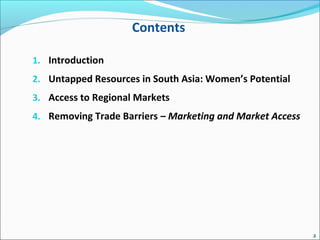
Contents
1. Introduction
2. Untapped Resources in South Asia: Women’s Potential
3. Access to Regional Markets
4. Removing Trade Barriers – Marketing and Market Access
2
1. Introduction
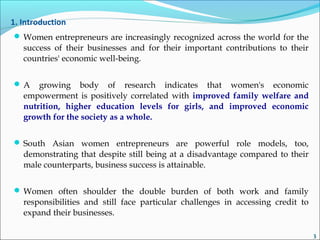
 Women entrepreneurs are increasingly recognized across the world for the
success of their businesses and for their important contributions to their
countries' economic well-being.
 A growing body of research indicates that women's economic
empowerment is positively correlated with improved family welfare and
nutrition, higher education levels for girls, and improved economic
growth for the society as a whole.
 South Asian women entrepreneurs are powerful role models, too,
demonstrating that despite still being at a disadvantage compared to their
male counterparts, business success is attainable.
 Women often shoulder the double burden of both work and family
responsibilities and still face particular challenges in accessing credit to
expand their businesses.
3
2. Untapped Resources in South Asia: Women’s Potential
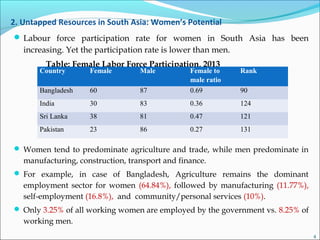
 Labour force participation rate for women in South Asia has been
increasing. Yet the participation rate is lower than men.
Table: Female Labor Force Participation, 2013
 Women tend to predominate agriculture and trade, while men predominate in
manufacturing, construction, transport and finance.
 For example, in case of Bangladesh, Agriculture remains the dominant
employment sector for women (64.84%), followed by manufacturing (11.77%),
self-employment (16.8%), and community/personal services (10%).
 Only 3.25% of all working women are employed by the government vs. 8.25% of
working men.
Country Female Male Female to
male ratio
Rank
Bangladesh 60 87 0.69 90
India 30 83 0.36 124
Sri Lanka 38 81 0.47 121
Pakistan 23 86 0.27 131
4
2. Untapped Resources in South Asia: Women’s Potential
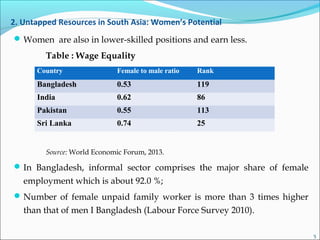
Women are also in lower-skilled positions and earn less.
Table : Wage Equality
Source: World Economic Forum, 2013.
In Bangladesh, informal sector comprises the major share of female
employment which is about 92.0 %;
Number of female unpaid family worker is more than 3 times higher
than that of men I Bangladesh (Labour Force Survey 2010).
Country Female to male ratio Rank
Bangladesh 0.53 119
India 0.62 86
Pakistan 0.55 113
Sri Lanka 0.74 25
5
2. Untapped Resources in South Asia: Women’s Potential
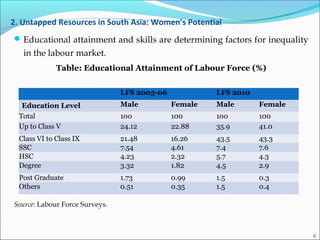
Educational attainment and skills are determining factors for inequality
in the labour market.
Table: Educational Attainment of Labour Force (%)
Source: Labour Force Surveys.
LFS 2005-06 LFS 2010
Education Level Male Female Male Female
Total 100 100 100 100
Up to Class V 24.12 22.88 35.9 41.0
Class VI to Class IX 21.48 16.26 43.5 43.3
SSC 7.54 4.61 7.4 7.6
HSC 4.23 2.32 5.7 4.3
Degree 3.32 1.82 4.5 2.9
Post Graduate 1.73 0.99 1.5 0.3
Others 0.51 0.35 1.5 0.4
6
2. Untapped Resources in South Asia: Women’s Potential
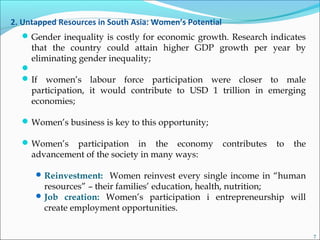
Gender inequality is costly for economic growth. Research indicates
that the country could attain higher GDP growth per year by
eliminating gender inequality;

If women’s labour force participation were closer to male
participation, it would contribute to USD 1 trillion in emerging
economies;
Women’s business is key to this opportunity;
Women’s participation in the economy contributes to the
advancement of the society in many ways:
Reinvestment: Women reinvest every single income in “human
resources” – their families’ education, health, nutrition;
Job creation: Women’s participation i entrepreneurship will
create employment opportunities.
7
2. Untapped Resources in South Asia: Women’s Potential
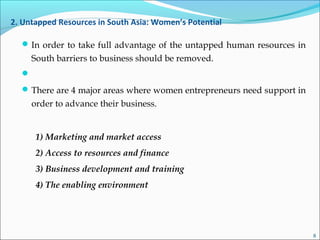
In order to take full advantage of the untapped human resources in
South barriers to business should be removed.

There are 4 major areas where women entrepreneurs need support in
order to advance their business.
1) Marketing and market access
2) Access to resources and finance
3) Business development and training
4) The enabling environment
8
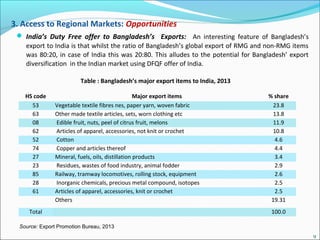
 India’s Duty Free offer to Bangladesh’s Exports: An interesting feature of Bangladesh’s
export to India is that whilst the ratio of Bangladesh’s global export of RMG and non-RMG items
was 80:20, in case of India this was 20:80. This alludes to the potential for Bangladesh’ export
diversification in the Indian market using DFQF offer of India.
3. Access to Regional Markets: Opportunities
Table : Bangladesh’s major export items to India, 2013
HS code Major export items % share
53 Vegetable textile fibres nes, paper yarn, woven fabric 23.8
63 Other made textile articles, sets, worn clothing etc 13.8
08 Edible fruit, nuts, peel of citrus fruit, melons 11.9
62 Articles of apparel, accessories, not knit or crochet 10.8
52 Cotton 4.6
74 Copper and articles thereof 4.4
27 Mineral, fuels, oils, distillation products 3.4
23 Residues, wastes of food industry, animal fodder 2.9
85 Railway, tramway locomotives, rolling stock, equipment 2.6
28 Inorganic chemicals, precious metal compound, isotopes 2.5
61 Articles of apparel, accessories, knit or crochet 2.5
Others 19.31
Total 100.0
Source: Export Promotion Bureau, 2013
9
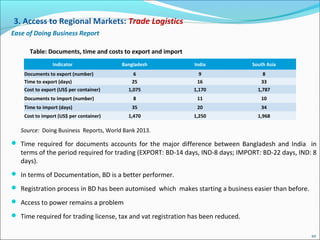
Ease of Doing Business Report
Source: Doing Business Reports, World Bank 2013.
 Time required for documents accounts for the major difference between Bangladesh and India in
terms of the period required for trading (EXPORT: BD-14 days, IND-8 days; IMPORT: BD-22 days, IND: 8
days).
 In terms of Documentation, BD is a better performer.
 Registration process in BD has been automised which makes starting a business easier than before.
 Access to power remains a problem
 Time required for trading license, tax and vat registration has been reduced.
3. Access to Regional Markets: Trade Logistics
Table: Documents, time and costs to export and import
Indicator Bangladesh India South Asia
Documents to export (number) 6 9 8
Time to export (days) 25 16 33
Cost to export (US$ per container) 1,075 1,170 1,787
Documents to import (number) 8 11 10
Time to import (days) 35 20 34
Cost to import (US$ per container) 1,470 1,250 1,968
10
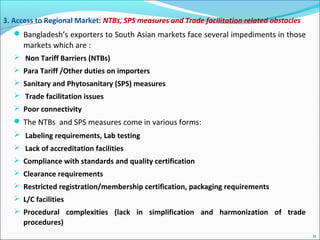
 Bangladesh’s exporters to South Asian markets face several impediments in those
markets which are :
 Non Tariff Barriers (NTBs)
 Para Tariff /Other duties on importers
 Sanitary and Phytosanitary (SPS) measures
 Trade facilitation issues
 Poor connectivity
 The NTBs and SPS measures come in various forms:
 Labeling requirements, Lab testing
 Lack of accreditation facilities
 Compliance with standards and quality certification
 Clearance requirements
 Restricted registration/membership certification, packaging requirements
 L/C facilities
 Procedural complexities (lack in simplification and harmonization of trade
procedures)
3. Access to Regional Market: NTBs, SPS measures and Trade facilitation related obstacles
11
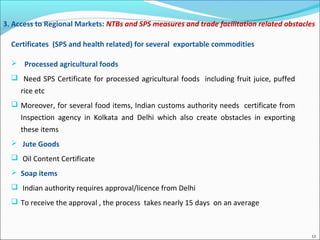
Certificates (SPS and health related) for several exportable commodities
 Processed agricultural foods
 Need SPS Certificate for processed agricultural foods including fruit juice, puffed
rice etc
 Moreover, for several food items, Indian customs authority needs certificate from
Inspection agency in Kolkata and Delhi which also create obstacles in exporting
these items
 Jute Goods
 Oil Content Certificate
 Soap items
 Indian authority requires approval/licence from Delhi
 To receive the approval , the process takes nearly 15 days on an average
3. Access to Regional Markets: NTBs and SPS measures and trade facilitation related obstacles
12
Certificates (SPS and health related) for Several Exportable Commodities
 SAFTA and other certificates (commercial invoice, packing list, bill of entry, vat
registration, certificate of Origin, pay order, company registration etc) : Bangladeshi
exporters need to submit these certificates for every consignment which creates hassle
and increase cost for exporters;
 Certificate related issues in Bangladesh: Exporters need to collect certificate from
several organizations including EPB, MCCI and other organizations which takes time
and increase cost.
 Processing and clearance delay and Congestion
 Lack of roads and railways Lack of train and air service create
 Frequent changes of policies in the importers’ side
 Frequent changes of customs officials
 Non-transparent customs procedures and documentation at the border
3. Access to Regional Markets: NTBs and SPS measures and trade facilitation related obstacles
13
4. Removing Trade Barriers – Marketing and Market Access
There are a range of issues impacting on women’s ability to take
advantage of market opportunities, to meet market needs, and to
reach the market more effectively.
(i) Access to information
Even at the digital age women entrepreneurs still experience
difficulties in obtaining information and gaining effective access to
these markets.
(ii) Cultural and social barriers
Often, cultural and social constraints have an impact upon women’s
ability to travel, and to have physical access to markets outside of
their immediate communities.
Additionally, women’s ability to freely meet, communicate and
negotiate with men (as suppliers, customers and business support
agents) in relation to building their business also act as a key
constraint.
14
4. Removing Trade Barriers – Marketing and Market Access
(iii) Business premises
Access to suitable premises for production and selling purposes is
another barrier. There is a need for safe and secure market
areas where women entrepreneurs would be able to market
their products and services.
(iv) Trade fairs and promotional activities
Trade fairs and other promotional mechanisms for presenting the
products and services of women entrepreneurs are useful.
Business associations should be the primary mechanism for
supporting the development of these types of activities.
International organisations should provide support for trade fairs
as a means of improving market access, and promoting
international lessons and best practices in relation to market
development.
15
4. Removing Trade Barriers – Marketing and Market Access
(v) Networking events
 In terms of supporting women’s knowledge of and access to marketing
opportunities, networking events for women entrepreneurs can be useful.
 This would facilitate shared experience and information exchange, but go further
by presenting opportunities for joint projects and the development of new
products and services.
(vi) Training and support for marketing
 Business development organizations and women entrepreneurs’ associations
should ensure that they offer targeted and high quality marketing support for
women entrepreneurs. Such support should include:
 Facilitating women’s access to domestic and export markets
 Promoting women’s businesses and their products
 Providing a range of training opportunities addressing a number of marketing
issues for women entrepreneurs
 Providing access to information technology and other means of accessing
marketing information.
16
Thank You
17

Fahmida's presentation

  • 1.
    1 Strengthening Women’s Entrepreneurshipin South AsiaStrengthening Women’s Entrepreneurship in South Asia Marketing and Market BarriersMarketing and Market Barriers Presented by Fahmida Khatun, PhD Research Director Centre for Policy Dialogue (CPD) Dhaka, Bangladesh Presented at South Asia Women’s Entrepreneurship Symposium 1 April 2014 Dhaka: Westin Hotel
  • 2.
    Contents 1. Introduction 2. UntappedResources in South Asia: Women’s Potential 3. Access to Regional Markets 4. Removing Trade Barriers – Marketing and Market Access 2
  • 3.
    1. Introduction  Womenentrepreneurs are increasingly recognized across the world for the success of their businesses and for their important contributions to their countries' economic well-being.  A growing body of research indicates that women's economic empowerment is positively correlated with improved family welfare and nutrition, higher education levels for girls, and improved economic growth for the society as a whole.  South Asian women entrepreneurs are powerful role models, too, demonstrating that despite still being at a disadvantage compared to their male counterparts, business success is attainable.  Women often shoulder the double burden of both work and family responsibilities and still face particular challenges in accessing credit to expand their businesses. 3
  • 4.
    2. Untapped Resourcesin South Asia: Women’s Potential  Labour force participation rate for women in South Asia has been increasing. Yet the participation rate is lower than men. Table: Female Labor Force Participation, 2013  Women tend to predominate agriculture and trade, while men predominate in manufacturing, construction, transport and finance.  For example, in case of Bangladesh, Agriculture remains the dominant employment sector for women (64.84%), followed by manufacturing (11.77%), self-employment (16.8%), and community/personal services (10%).  Only 3.25% of all working women are employed by the government vs. 8.25% of working men. Country Female Male Female to male ratio Rank Bangladesh 60 87 0.69 90 India 30 83 0.36 124 Sri Lanka 38 81 0.47 121 Pakistan 23 86 0.27 131 4
  • 5.
    2. Untapped Resourcesin South Asia: Women’s Potential Women are also in lower-skilled positions and earn less. Table : Wage Equality Source: World Economic Forum, 2013. In Bangladesh, informal sector comprises the major share of female employment which is about 92.0 %; Number of female unpaid family worker is more than 3 times higher than that of men I Bangladesh (Labour Force Survey 2010). Country Female to male ratio Rank Bangladesh 0.53 119 India 0.62 86 Pakistan 0.55 113 Sri Lanka 0.74 25 5
  • 6.
    2. Untapped Resourcesin South Asia: Women’s Potential Educational attainment and skills are determining factors for inequality in the labour market. Table: Educational Attainment of Labour Force (%) Source: Labour Force Surveys. LFS 2005-06 LFS 2010 Education Level Male Female Male Female Total 100 100 100 100 Up to Class V 24.12 22.88 35.9 41.0 Class VI to Class IX 21.48 16.26 43.5 43.3 SSC 7.54 4.61 7.4 7.6 HSC 4.23 2.32 5.7 4.3 Degree 3.32 1.82 4.5 2.9 Post Graduate 1.73 0.99 1.5 0.3 Others 0.51 0.35 1.5 0.4 6
  • 7.
    2. Untapped Resourcesin South Asia: Women’s Potential Gender inequality is costly for economic growth. Research indicates that the country could attain higher GDP growth per year by eliminating gender inequality;  If women’s labour force participation were closer to male participation, it would contribute to USD 1 trillion in emerging economies; Women’s business is key to this opportunity; Women’s participation in the economy contributes to the advancement of the society in many ways: Reinvestment: Women reinvest every single income in “human resources” – their families’ education, health, nutrition; Job creation: Women’s participation i entrepreneurship will create employment opportunities. 7
  • 8.
    2. Untapped Resourcesin South Asia: Women’s Potential In order to take full advantage of the untapped human resources in South barriers to business should be removed.  There are 4 major areas where women entrepreneurs need support in order to advance their business. 1) Marketing and market access 2) Access to resources and finance 3) Business development and training 4) The enabling environment 8
  • 9.
     India’s DutyFree offer to Bangladesh’s Exports: An interesting feature of Bangladesh’s export to India is that whilst the ratio of Bangladesh’s global export of RMG and non-RMG items was 80:20, in case of India this was 20:80. This alludes to the potential for Bangladesh’ export diversification in the Indian market using DFQF offer of India. 3. Access to Regional Markets: Opportunities Table : Bangladesh’s major export items to India, 2013 HS code Major export items % share 53 Vegetable textile fibres nes, paper yarn, woven fabric 23.8 63 Other made textile articles, sets, worn clothing etc 13.8 08 Edible fruit, nuts, peel of citrus fruit, melons 11.9 62 Articles of apparel, accessories, not knit or crochet 10.8 52 Cotton 4.6 74 Copper and articles thereof 4.4 27 Mineral, fuels, oils, distillation products 3.4 23 Residues, wastes of food industry, animal fodder 2.9 85 Railway, tramway locomotives, rolling stock, equipment 2.6 28 Inorganic chemicals, precious metal compound, isotopes 2.5 61 Articles of apparel, accessories, knit or crochet 2.5 Others 19.31 Total 100.0 Source: Export Promotion Bureau, 2013 9
  • 10.
    Ease of DoingBusiness Report Source: Doing Business Reports, World Bank 2013.  Time required for documents accounts for the major difference between Bangladesh and India in terms of the period required for trading (EXPORT: BD-14 days, IND-8 days; IMPORT: BD-22 days, IND: 8 days).  In terms of Documentation, BD is a better performer.  Registration process in BD has been automised which makes starting a business easier than before.  Access to power remains a problem  Time required for trading license, tax and vat registration has been reduced. 3. Access to Regional Markets: Trade Logistics Table: Documents, time and costs to export and import Indicator Bangladesh India South Asia Documents to export (number) 6 9 8 Time to export (days) 25 16 33 Cost to export (US$ per container) 1,075 1,170 1,787 Documents to import (number) 8 11 10 Time to import (days) 35 20 34 Cost to import (US$ per container) 1,470 1,250 1,968 10
  • 11.
     Bangladesh’s exportersto South Asian markets face several impediments in those markets which are :  Non Tariff Barriers (NTBs)  Para Tariff /Other duties on importers  Sanitary and Phytosanitary (SPS) measures  Trade facilitation issues  Poor connectivity  The NTBs and SPS measures come in various forms:  Labeling requirements, Lab testing  Lack of accreditation facilities  Compliance with standards and quality certification  Clearance requirements  Restricted registration/membership certification, packaging requirements  L/C facilities  Procedural complexities (lack in simplification and harmonization of trade procedures) 3. Access to Regional Market: NTBs, SPS measures and Trade facilitation related obstacles 11
  • 12.
    Certificates (SPS andhealth related) for several exportable commodities  Processed agricultural foods  Need SPS Certificate for processed agricultural foods including fruit juice, puffed rice etc  Moreover, for several food items, Indian customs authority needs certificate from Inspection agency in Kolkata and Delhi which also create obstacles in exporting these items  Jute Goods  Oil Content Certificate  Soap items  Indian authority requires approval/licence from Delhi  To receive the approval , the process takes nearly 15 days on an average 3. Access to Regional Markets: NTBs and SPS measures and trade facilitation related obstacles 12
  • 13.
    Certificates (SPS andhealth related) for Several Exportable Commodities  SAFTA and other certificates (commercial invoice, packing list, bill of entry, vat registration, certificate of Origin, pay order, company registration etc) : Bangladeshi exporters need to submit these certificates for every consignment which creates hassle and increase cost for exporters;  Certificate related issues in Bangladesh: Exporters need to collect certificate from several organizations including EPB, MCCI and other organizations which takes time and increase cost.  Processing and clearance delay and Congestion  Lack of roads and railways Lack of train and air service create  Frequent changes of policies in the importers’ side  Frequent changes of customs officials  Non-transparent customs procedures and documentation at the border 3. Access to Regional Markets: NTBs and SPS measures and trade facilitation related obstacles 13
  • 14.
    4. Removing TradeBarriers – Marketing and Market Access There are a range of issues impacting on women’s ability to take advantage of market opportunities, to meet market needs, and to reach the market more effectively. (i) Access to information Even at the digital age women entrepreneurs still experience difficulties in obtaining information and gaining effective access to these markets. (ii) Cultural and social barriers Often, cultural and social constraints have an impact upon women’s ability to travel, and to have physical access to markets outside of their immediate communities. Additionally, women’s ability to freely meet, communicate and negotiate with men (as suppliers, customers and business support agents) in relation to building their business also act as a key constraint. 14
  • 15.
    4. Removing TradeBarriers – Marketing and Market Access (iii) Business premises Access to suitable premises for production and selling purposes is another barrier. There is a need for safe and secure market areas where women entrepreneurs would be able to market their products and services. (iv) Trade fairs and promotional activities Trade fairs and other promotional mechanisms for presenting the products and services of women entrepreneurs are useful. Business associations should be the primary mechanism for supporting the development of these types of activities. International organisations should provide support for trade fairs as a means of improving market access, and promoting international lessons and best practices in relation to market development. 15
  • 16.
    4. Removing TradeBarriers – Marketing and Market Access (v) Networking events  In terms of supporting women’s knowledge of and access to marketing opportunities, networking events for women entrepreneurs can be useful.  This would facilitate shared experience and information exchange, but go further by presenting opportunities for joint projects and the development of new products and services. (vi) Training and support for marketing  Business development organizations and women entrepreneurs’ associations should ensure that they offer targeted and high quality marketing support for women entrepreneurs. Such support should include:  Facilitating women’s access to domestic and export markets  Promoting women’s businesses and their products  Providing a range of training opportunities addressing a number of marketing issues for women entrepreneurs  Providing access to information technology and other means of accessing marketing information. 16
  • 17.