Global value chains 
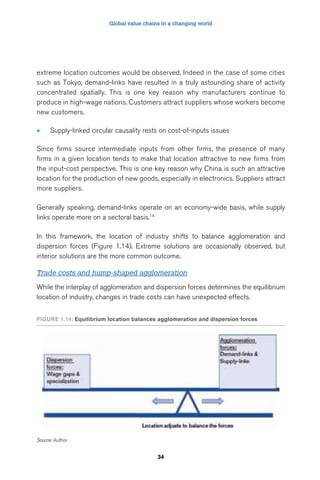
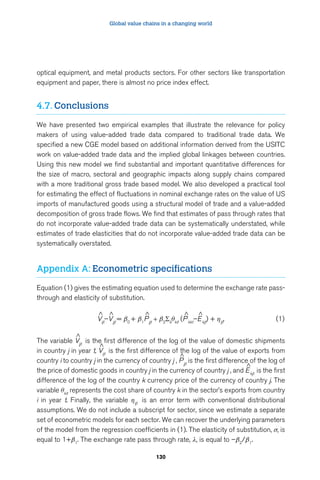
in a changing world Edited by Deborah K. Elms and Patrick Low
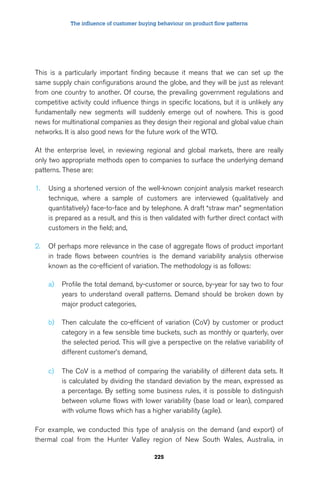
Global value chains in a 
changing world 
Edited by Deborah K. Elms and Patrick Low
Disclaimer 
Opinions expressed in this publication and any errors or omissions therein are the responsibility 
of the authors concerned, and not of the editors. Opinions expressed by the authors and 
the editors are their own personal opinions and should not in any way be attributed to the 
institutions with which they are associated. 
The designations employed and the presentation of the material in this publication do not 
imply the expression of any opinion on the part of the NTU, FGI and WTO concerning the legal 
status of any country, territory, city or area or of its authorities, or concerning the delimitation 
of its frontiers or boundaries. 
Mention of specific companies or products does not imply that they are endorsed or 
recommended by NTU or FGI or WTO or preferred to others that are not mentioned. The 
names of proprietary products are distinguished by initial capital letters. 
All reasonable precautions have been taken by NTU, FGI and WTO to verify the information 
contained in this publication. However, this published material is distributed without warranty 
of any kind, either expressed or implied. Responsibility for the interpretation and use of the 
material lies with the reader. Under no circumstances will NTU or FGI or WTO be liable for 
damages arising from its use. 
© Fung Global Institute (FGI), Nanyang Technological University (NTU), and World Trade Organization 
(WTO), 2013 
Reproduction of material contained in this document may be made only with the written permission 
of the WTO Publications Manager. 
ISBN: 978-92-870-3882-1 
WTO Publications 
World Trade Organization 
154 rue de Lausanne 
CH-1211 Geneva 21 
Switzerland 
Tel: + 41 22 739 52 08 
Fax: + 41 22 739 54 58 
Email: publications@wto.org 
Web site: www.wto.org 
Online WTO bookshop: http://onlinebookshop.wto.org 

Printing by WTO Secretariat, Switzerland, 2013
iii 
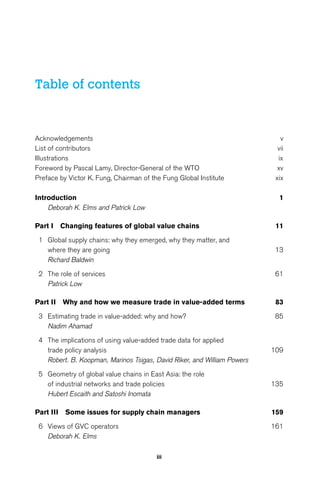
Table of contents 
Acknowledgements v 
List of contributors vii 
Illustrations ix 
Foreword by Pascal Lamy, Director-General of the WTO xv 
Preface by Victor K. Fung, Chairman of the Fung Global Institute xix 
Introduction 1 
Deborah K. Elms and Patrick Low 
Part I Changing features of global value chains 11 
1 Global supply chains: why they emerged, why they matter, and 
where they are going 13 
Richard Baldwin 
2 The role of services 61 
Patrick Low 
Part II Why and how we measure trade in value-added terms 83 
3 Estimating trade in value-added: why and how? 85 
Nadim Ahamad 
4 The implications of using value-added trade data for applied 
trade policy analysis 109 
Robert. B. Koopman, Marinos Tsigas, David Riker, and William Powers 
5 Geometry of global value chains in East Asia: the role 
of industrial networks and trade policies 135 
Hubert Escaith and Satoshi Inomata 
Part III Some issues for supply chain managers 159 
6 Views of GVC operators 161 
Deborah K. Elms
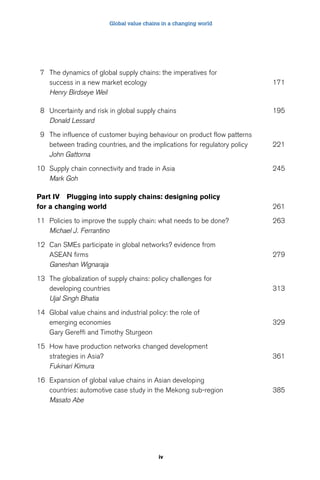
Global value chains in a changing world 
7 The dynamics of global supply chains: the imperatives for 
success in a new market ecology 171 
Henry Birdseye Weil 
8 Uncertainty and risk in global supply chains 195 
iv 
Donald Lessard 
9 The influence of customer buying behaviour on product flow patterns 
between trading countries, and the implications for regulatory policy 221 
John Gattorna 
10 Supply chain connectivity and trade in Asia 245 
Mark Goh 
Part IV Plugging into supply chains: designing policy 
for a changing world 261 
11 Policies to improve the supply chain: what needs to be done? 263 
Michael J. Ferrantino 
12 Can SMEs participate in global networks? evidence from 
ASEAN firms 279 
Ganeshan Wignaraja 
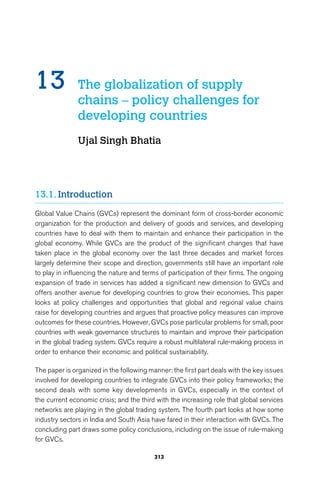
13 The globalization of supply chains: policy challenges for 
developing countries 313 
Ujal Singh Bhatia 
14 Global value chains and industrial policy: the role of 
emerging economies 329 
Gary Gereffi and Timothy Sturgeon 
15 How have production networks changed development 
strategies in Asia? 361 
Fukinari Kimura 
16 Expansion of global value chains in Asian developing 
countries: automotive case study in the Mekong sub-region 385 
Masato Abe
v 
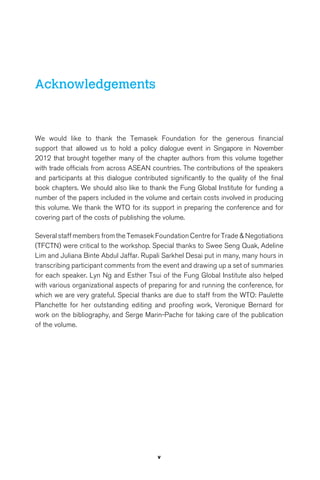
Acknowledgements 
We would like to thank the Temasek Foundation for the generous financial 
support that allowed us to hold a policy dialogue event in Singapore in November 
2012 that brought together many of the chapter authors from this volume together 
with trade officials from across ASEAN countries. The contributions of the speakers 
and participants at this dialogue contributed significantly to the quality of the final 
book chapters. We should also like to thank the Fung Global Institute for funding a 
number of the papers included in the volume and certain costs involved in producing 
this volume. We thank the WTO for its support in preparing the conference and for 
covering part of the costs of publishing the volume. 
Several staff members from the Temasek Foundation Centre for Trade & Negotiations 
(TFCTN) were critical to the workshop. Special thanks to Swee Seng Quak, Adeline 

Lim and Juliana Binte Abdul Jaffar. Rupali Sarkhel Desai put in many, many hours in 
transcribing participant comments from the event and drawing up a set of summaries 
for each speaker. Lyn Ng and Esther Tsui of the Fung Global Institute also helped 
with various organizational aspects of preparing for and running the conference, for 
which we are very grateful. Special thanks are due to staff from the WTO: Paulette 
Planchette for her outstanding editing and proofing work, Veronique Bernard for 
work on the bibliography, and Serge Marin-Pache for taking care of the publication 
of the volume.
vii 
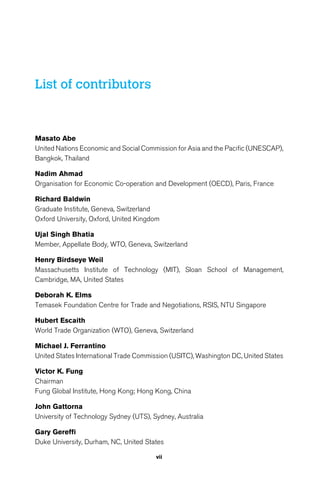
List of contributors 
Masato Abe 
United Nations Economic and Social Commission for Asia and the Pacific (UNESCAP), 
Bangkok, Thailand 
Nadim Ahmad 
Organisation for Economic Co-operation and Development (OECD), Paris, France 
Richard Baldwin 
Graduate Institute, Geneva, Switzerland 
Oxford University, Oxford, United Kingdom 
Ujal Singh Bhatia 
Member, Appellate Body, WTO, Geneva, Switzerland 
Henry Birdseye Weil 
Massachusetts Institute of Technology (MIT), Sloan School of Management, 
Cambridge, MA, United States 
Deborah K. Elms 
Temasek Foundation Centre for Trade and Negotiations, RSIS, NTU Singapore 
Hubert Escaith 
World Trade Organization (WTO), Geneva, Switzerland 
Michael J. Ferrantino 
United States International Trade Commission (USITC), Washington DC, United States 
Victor K. Fung 
Chairman 
Fung Global Institute, Hong Kong; Hong Kong, China 
John Gattorna 
University of Technology Sydney (UTS), Sydney, Australia 
Gary Gereffi 
Duke University, Durham, NC, United States
Global value chains in a changing world 
Mark Goh 
National University of Singapore, NUS Business School, Singapore 
Satoshi Inomata 
Institute of Developing Economies, JETRO (IDE-JETRO), Tokyo, Japan 
Fukunari Kimura 
Faculty of Economics, Keio University, Tokyo, Japan 
Economic Research Institute for ASEAN and East Asia (ERIA), Jakarta, Indonesia 
Robert B. Koopman 
United States International Trade Commission (USITC), Washington DC, United States 
Pascal Lamy 
Director-General 
World Trade Organization (WTO), Geneva, Switzerland 
Donald Lessard 
Massachusetts Institute of Technology (MIT), Sloan School of Management, 
Cambridge, MA, United States 
Patrick Low 
World Trade Organization (WTO), Geneva, Switzerland 
William Powers 
United States International Trade Commission (USITC), Washington DC, United States 
David Riker 
United States International Trade Commission (USITC), Washington DC, United States 
Timothy Sturgeon 
Massachusetts Institute of Technology (MIT), Industrial Performance Center (IPC), 
Cambridge, MA, United States 
Marinos Tsigas 
United States International Trade Commission (USITC), Washington DC, United States 
Ganeshan Wignaraja 
Asian Development Bank Institute, Tokyo, Japan 
viii
ix 
Illustrations 
Tables 
1.1 Per capita industrialization levels, 1750–1913 (United Kingdom 
in 1900 = 100) 14 
1.2 Backward linkage matrix for major supply chain traders, 2007 21 
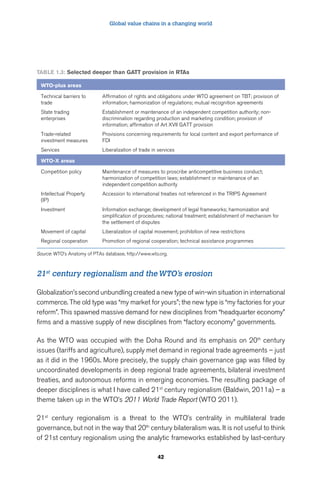
1.3 Selected deeper than GATT provision in RTAs 42 
2.1 Services necessary to the Sandvik Tools supply chain 67 
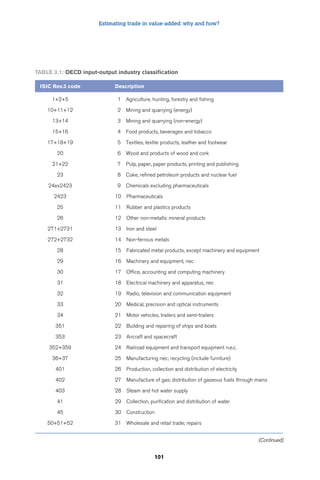
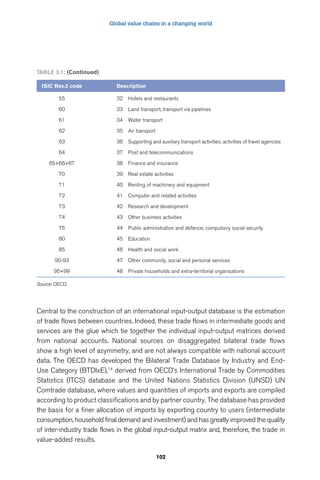
3.1 OECD input-output industry classification 101 
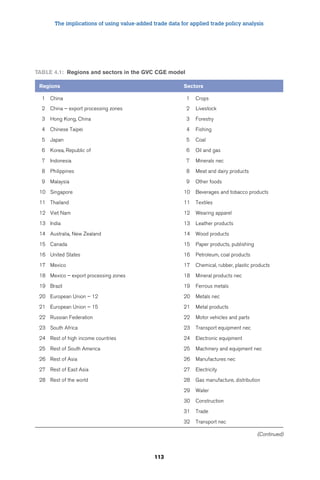
4.1 Regions and sectors in the GVC CGE model 113 
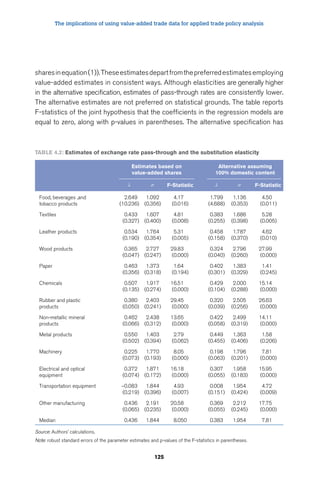
4.2 Estimates of exchange rate pass-through and the substitution 
elasticity 125 
4.3 Numerical examples from the electrical and optical equipment 
sector in 2009 127 
4.4 Average trade elasticity for each exporting country 128 
4.5 Estimated trade elasticity for US imports from China 129 
5.1 Nominal protection and effective protection rates in East Asia 
and the Pacific, 1995–2005 (percentage, ad valorem) 147 
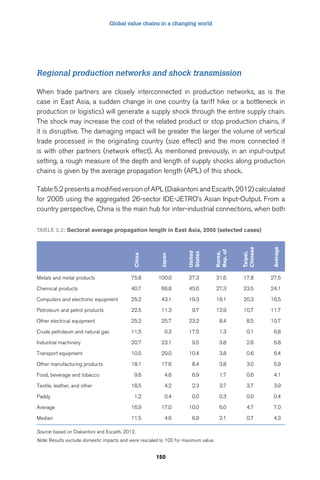
5.2 Sectoral average propagation length in East Asia, 2005 
(selected cases) 150 
8.1 Incidence of supply chain risks relative to capacity to absorb 211 
10.1 Logistics requirements of key industry requirements 249 
10.2 Supply chain infrastructure and location and criticality 251 
10.3 Supply chain connectivity effort by APEC 257 
12.1 Description of variables 287 
12.2 Sample characteristics 289 
12.3 Role of SMEs and large firms in production networks 290 
12.4 T-test on key variables for SMEs in production networks versus 
SMEs outside production networks 294 
12.5 Probit estimates 296 
12.6 Perceived major or severe obstacles to conducting business, 
SME firms (per cent of SME firms) 300
Global value chains in a changing world 
12.7 SME firms’ perception of business and support services 303 
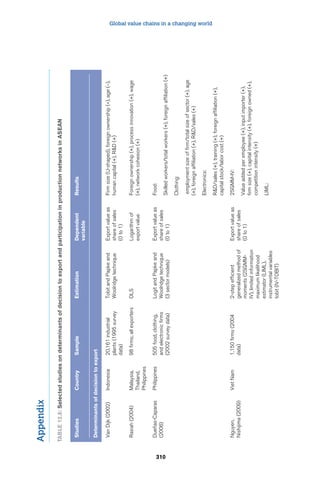
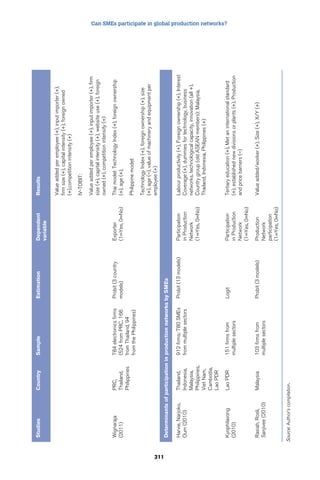
12.8 Selected studies on determinants of decision to export and 
participation in production networks in ASEAN 310 
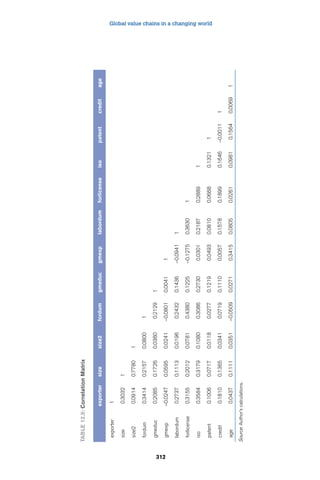
12.9 Correlation Matrix 312 
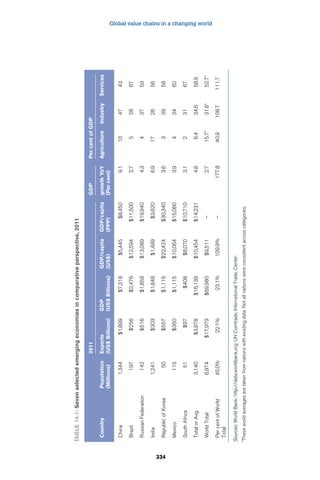
14.1 Seven selected emerging economies in comparative 
perspective, 2011 334 
14.2 Export profile percentages of total exports: 2011 336 
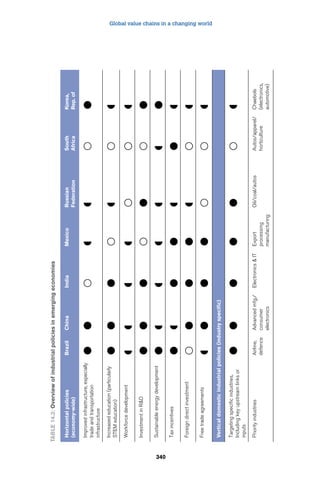
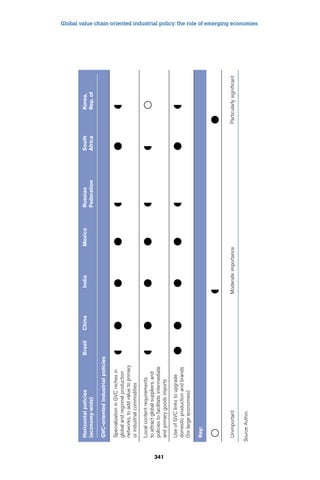
14.3 Overview of industrial policies in emerging economies 340 
14.4 Brazilian electronics exports, imports and production, 2007–2010 
growth rates 346 
14.5 Brazil’s electronics-related industrial policies 348 
14.6 Top global EMS and ODM contract manufacturers in 2011 349 
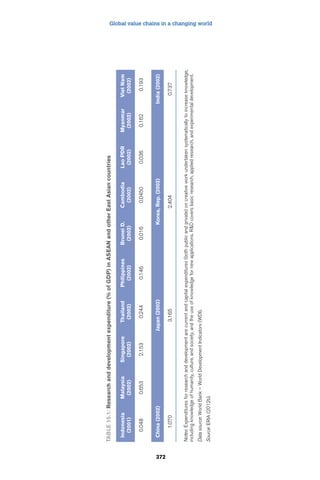
15.1 Research and development expenditure (% of GDP) in ASEAN 
and other East Asian countries 372 
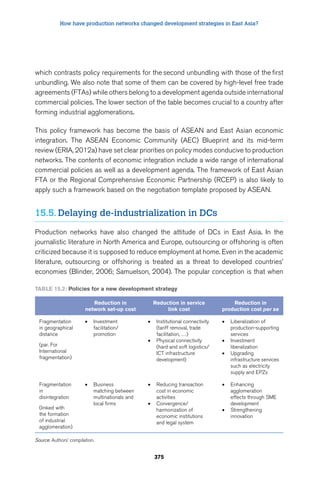
15.2 Policies for a new development strategy 375 
15.3 Changes in domestic operations in the period 1998–2002 and 
2002–2006 by the type of firms, based on the two-year-balanced 
panel data 377 
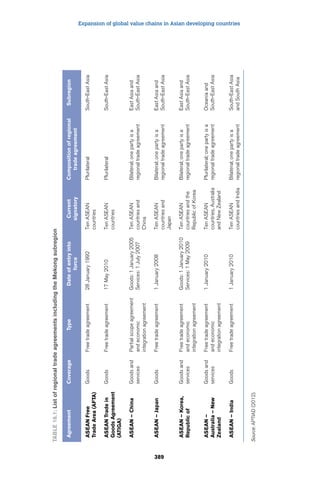
16.1 List of regional trade agreements including the Mekong subregion 389 
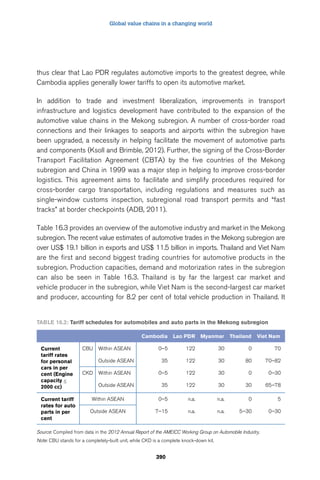
16.2 Tariff schedules for automobiles and auto parts in the 
Mekong subregion 390 
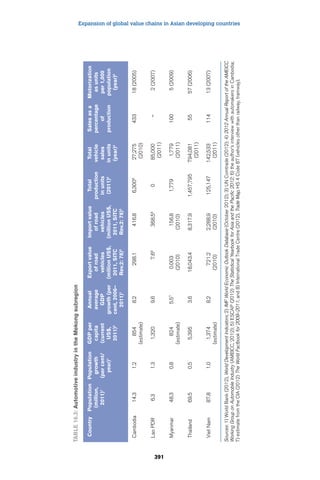
16.3 Automotive industry in the Mekong subregion 391 
16.4 Obstacles to the development of global automotive value 
chains in the Mekong subregion 400 
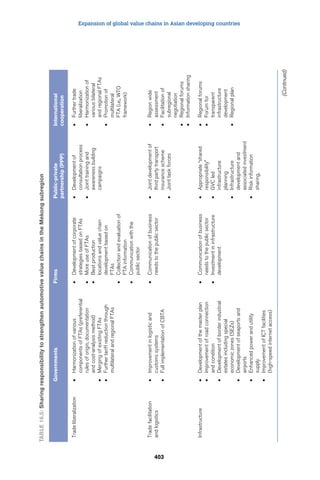
16.5 Sharing responsibility to strengthen automotive value 
chains in the Mekong subregion 403 
x 
Figures 
1.1 Global trade flows and estimated trade costs, 1870–1975 15 
1.2 Schematic illustration of coordination costs and the second unbundling 17 
1.3 Regional measures of 21st century trade, 1967–2007 18 
1.4 Sector measures of 21st century trade, 1967–2005 19 
1.5 Reversal of the big divergence 22 
1.6 Reversal of industrialization/de-industrialization trend 23 
1.7 Unilateral tariff cutting by developing nations, 1988–2009 25 
1.8 Indicators of FDI and 21st century trade disciplines, 1957–2009 26
Illustrations 
1.9 Tasks, occupations, stages and product – the TOSP framework 28 
1.10 Supply chain unbundling: coordination versus information technology 30 
1.11 Wage differences in Factory Asia, Factory North American 
and Factory Europe, 2008 31 
1.12 Education and R&D: ASEANs, China, Republic of Korea, 
United States, Japan and Canada, 2005 32 
1.13 Circular causality and agglomeration forces 33 
1.14 Equilibrium location balances agglomeration and dispersion forces 34 
1.15 Schematic illustration of function and location unbundling interactions 35 
1.16 The smile curve: good and bad stages in the value chain 37 
1.17 Breakdown of the phone’s EUR 546 pre-tax retail price circa 2007 38 
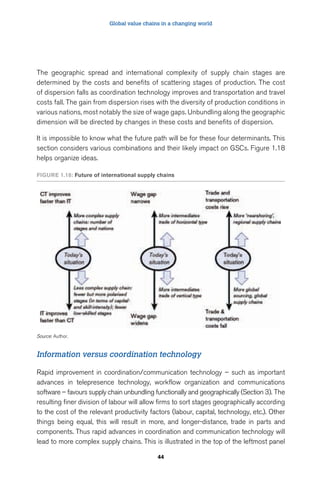
1.18 Future of international supply chains 44 
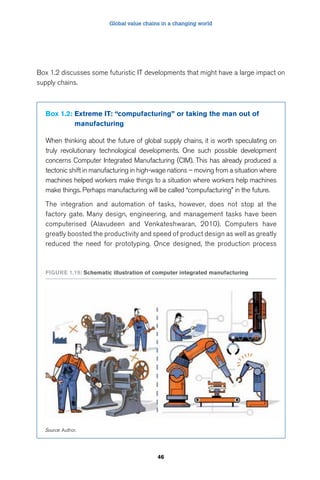
1.19 Schematic illustration of computer integrated manufacturing 46 
1.20 Indicator of supply chain trade North-North versus. North-South 49 
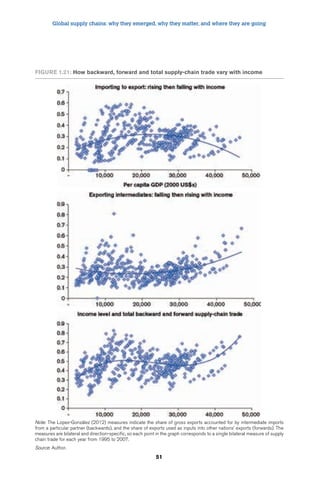
1.21 How backward, forward and total supply-chain trade vary with income 51 
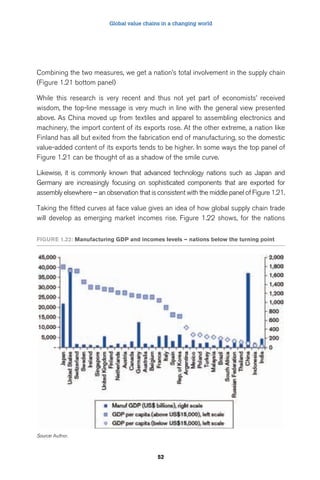
1.22 Manufacturing GDP and incomes levels – nations below the 
turning point 52 
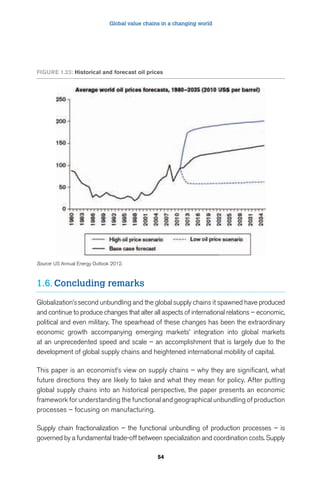
1.23 Historical and forecast oil prices 54 
2.1 Sectoral contribution to total trade, gross and value-added 
measures, 2008 62 
2.2 A suit made in China and sold in the United States 65 
2.3 Stan Shih’s Smile Curve 73 
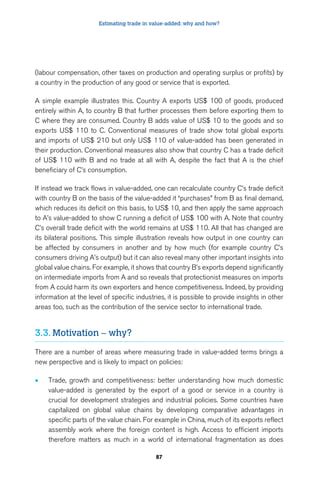
3.1 Trade in value-added 86 
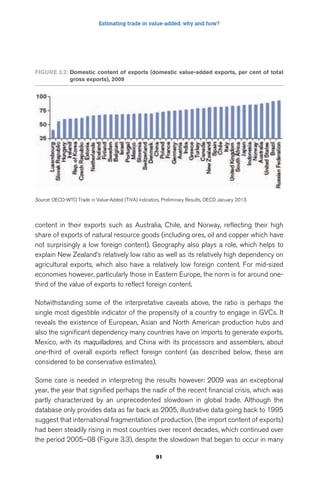
3.2 Domestic content of exports (domestic value-added exports, 
per cent of total gross exports), 2009 91 
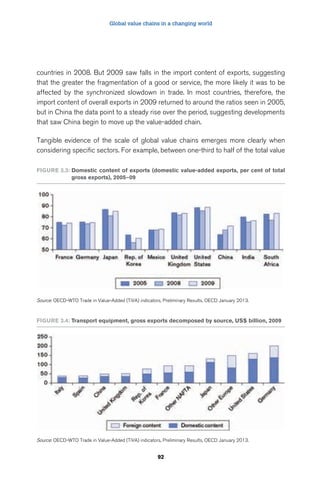
3.3 Domestic content of exports (domestic value-added exports, 
per cent of total gross exports), 2005–09 92 
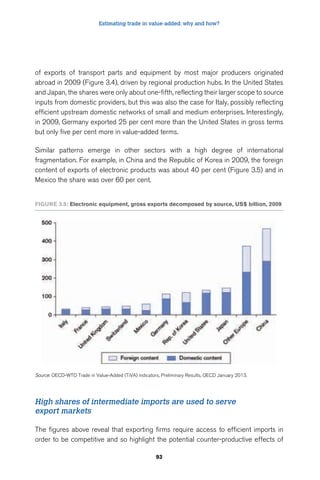
3.4 Transport equipment, gross exports decomposed by source, 
US$ billion, 2009 92 
3.5 Electronic equipment, gross exports decomposed by source, 
US$ billion, 2009 93 
3.6 Intermediate imports embodied in exports, per cent of total 
intermediate imports, 2009 94 
3.7 Services value-added – per cent of total exports, 2009 95 
3.8 Services value-added – per cent of total exports of goods, 2009 96 
3.9 Domestic content of imports – per cent of total intermediate 
imports, 2009 97 
xi
Global value chains in a changing world 
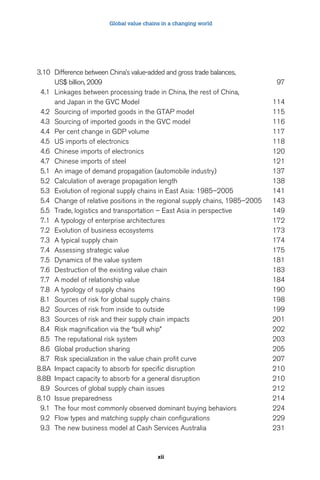
3.10 Difference between China’s value-added and gross trade balances, 
US$ billion, 2009 97 
4.1 Linkages between processing trade in China, the rest of China, 
and Japan in the GVC Model 114 
4.2 Sourcing of imported goods in the GTAP model 115 
4.3 Sourcing of imported goods in the GVC model 116 
4.4 Per cent change in GDP volume 117 
4.5 US imports of electronics 118 
4.6 Chinese imports of electronics 120 
4.7 Chinese imports of steel 121 
5.1 An image of demand propagation (automobile industry) 137 
5.2 Calculation of average propagation length 138 
5.3 Evolution of regional supply chains in East Asia: 1985–2005 141 
5.4 Change of relative positions in the regional supply chains, 1985–2005 143 
5.5 Trade, logistics and transportation – East Asia in perspective 149 
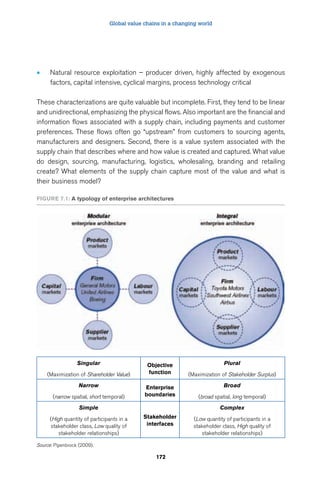
7.1 A typology of enterprise architectures 172 
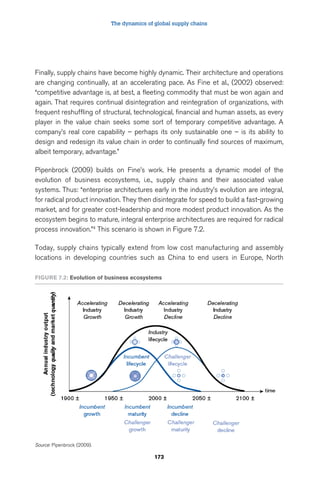
7.2 Evolution of business ecosystems 173 
7.3 A typical supply chain 174 
7.4 Assessing strategic value 175 
7.5 Dynamics of the value system 181 
7.6 Destruction of the existing value chain 183 
7.7 A model of relationship value 184 
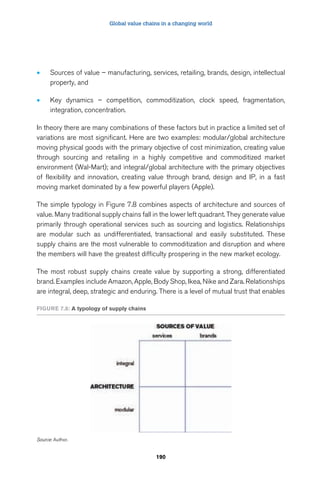
7.8 A typology of supply chains 190 
8.1 Sources of risk for global supply chains 198 
8.2 Sources of risk from inside to outside 199 
8.3 Sources of risk and their supply chain impacts 201 
8.4 Risk magnification via the “bull whip” 202 
8.5 The reputational risk system 203 
8.6 Global production sharing 205 
8.7 Risk specialization in the value chain profit curve 207 
8.8A Impact capacity to absorb for specific disruption 210 
8.8B Impact capacity to absorb for a general disruption 210 
8.9 Sources of global supply chain issues 212 
8.10 Issue preparedness 214 
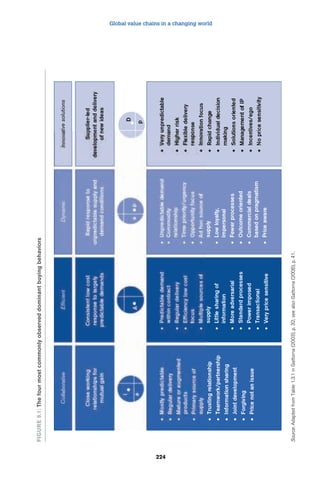
9.1 The four most commonly observed dominant buying behaviors 224 
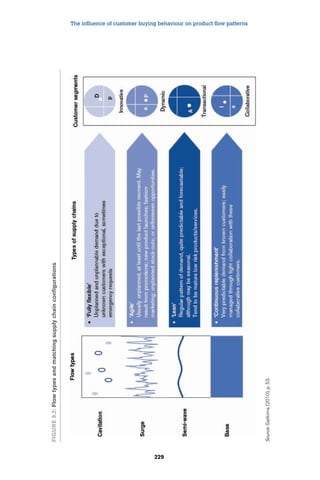
9.2 Flow types and matching supply chain configurations 229 
9.3 The new business model at Cash Services Australia 231 
xii
Illustrations 
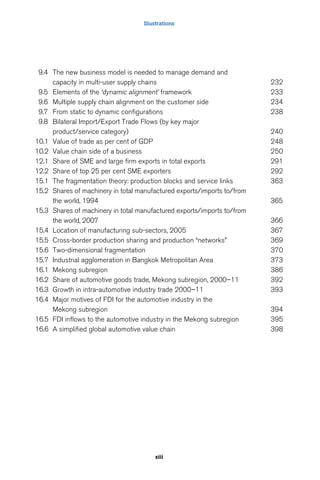
9.4 The new business model is needed to manage demand and 
capacity in multi-user supply chains 232 
9.5 Elements of the ‘dynamic alignment’ framework 233 
9.6 Multiple supply chain alignment on the customer side 234 
9.7 From static to dynamic configurations 238 
9.8 Bilateral Import/Export Trade Flows (by key major 
product/service category) 240 
10.1 Value of trade as per cent of GDP 248 
10.2 Value chain side of a business 250 
12.1 Share of SME and large firm exports in total exports 291 
12.2 Share of top 25 per cent SME exporters 292 
15.1 The fragmentation theory: production blocks and service links 363 
15.2 Shares of machinery in total manufactured exports/imports to/from 
the world, 1994 365 
15.3 Shares of machinery in total manufactured exports/imports to/from 
the world, 2007 366 
15.4 Location of manufacturing sub-sectors, 2005 367 
15.5 Cross-border production sharing and production “networks” 369 
15.6 Two-dimensional fragmentation 370 
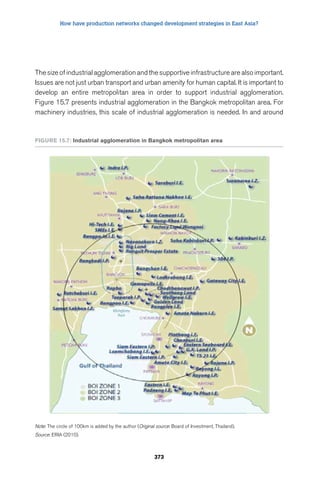
15.7 Industrial agglomeration in Bangkok Metropolitan Area 373 
16.1 Mekong subregion 386 
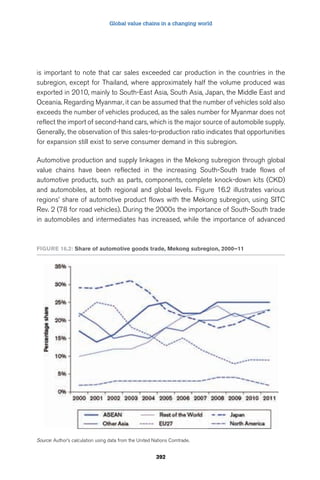
16.2 Share of automotive goods trade, Mekong subregion, 2000–11 392 
16.3 Growth in intra-automotive industry trade 2000–11 393 
16.4 Major motives of FDI for the automotive industry in the 
Mekong subregion 394 
16.5 FDI inflows to the automotive industry in the Mekong subregion 395 
16.6 A simplified global automotive value chain 398 
xiii
xv 
Foreword 
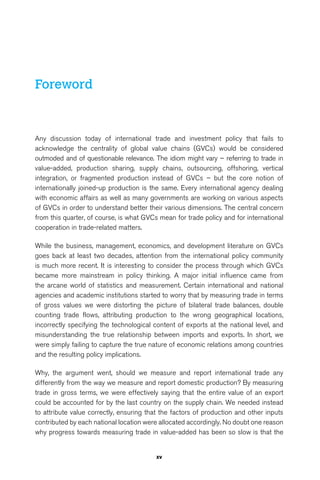
Any discussion today of international trade and investment policy that fails to 
acknowledge the centrality of global value chains (GVCs) would be considered 
outmoded and of questionable relevance. The idiom might vary – referring to trade in 
value-added, production sharing, supply chains, outsourcing, offshoring, vertical 
integration, or fragmented production instead of GVCs – but the core notion of 
internationally joined-up production is the same. Every international agency dealing 
with economic affairs as well as many governments are working on various aspects 
of GVCs in order to understand better their various dimensions. The central concern 
from this quarter, of course, is what GVCs mean for trade policy and for international 
cooperation in trade-related matters. 
While the business, management, economics, and development literature on GVCs 
goes back at least two decades, attention from the international policy community 
is much more recent. It is interesting to consider the process through which GVCs 
became more mainstream in policy thinking. A major initial influence came from 
the arcane world of statistics and measurement. Certain international and national 

agencies and academic institutions started to worry that by measuring trade in terms 
of gross values we were distorting the picture of bilateral trade balances, double 
counting trade flows, attributing production to the wrong geographical locations, 
incorrectly specifying the technological content of exports at the national level, and 
misunderstanding the true relationship between imports and exports. In short, we 
were simply failing to capture the true nature of economic relations among countries 
and the resulting policy implications. 
Why, the argument went, should we measure and report international trade any 
differently from the way we measure and report domestic production? By measuring 
trade in gross terms, we were effectively saying that the entire value of an export 
could be accounted for by the last country on the supply chain. We needed instead 
to attribute value correctly, ensuring that the factors of production and other inputs 
contributed by each national location were allocated accordingly. No doubt one reason 
why progress towards measuring trade in value-added has been so slow is that the
Global value chains in a changing world 
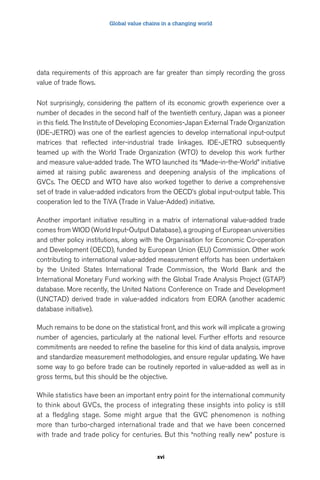
data requirements of this approach are far greater than simply recording the gross 
value of trade flows. 
Not surprisingly, considering the pattern of its economic growth experience over a 
number of decades in the second half of the twentieth century, Japan was a pioneer 
in this field. The Institute of Developing Economies-Japan External Trade Organization 
(IDE-JETRO) was one of the earliest agencies to develop international input-output 
matrices that reflected inter-industrial trade linkages. IDE-JETRO subsequently 
teamed up with the World Trade Organization (WTO) to develop this work further 
and measure value-added trade. The WTO launched its “Made-in-the-World” initiative 
aimed at raising public awareness and deepening analysis of the implications of 
GVCs. The OECD and WTO have also worked together to derive a comprehensive 
set of trade in value-added indicators from the OECD’s global input-output table. This 
cooperation led to the TiVA (Trade in Value-Added) initiative. 
Another important initiative resulting in a matrix of international value-added trade 
comes from WIOD (World Input-Output Database), a grouping of European universities 
and other policy institutions, along with the Organisation for Economic Co-operation 
and Development (OECD), funded by European Union (EU) Commission. Other work 
contributing to international value-added measurement efforts has been undertaken 
by the United States International Trade Commission, the World Bank and the 
International Monetary Fund working with the Global Trade Analysis Project (GTAP) 
database. More recently, the United Nations Conference on Trade and Development 
(UNCTAD) derived trade in value-added indicators from EORA (another academic 
database initiative). 
Much remains to be done on the statistical front, and this work will implicate a growing 
number of agencies, particularly at the national level. Further efforts and resource 
commitments are needed to refine the baseline for this kind of data analysis, improve 
and standardize measurement methodologies, and ensure regular updating. We have 
some way to go before trade can be routinely reported in value-added as well as in 
gross terms, but this should be the objective. 
While statistics have been an important entry point for the international community 
to think about GVCs, the process of integrating these insights into policy is still 
at a fledgling stage. Some might argue that the GVC phenomenon is nothing 
more than turbo-charged international trade and that we have been concerned 
with trade and trade policy for centuries. But this “nothing really new” posture is 
xvi
Foreword 
reductionist and misses the point that as technology has pushed out the frontiers 
of trade and intensified the degree of global interdependency, we need to rethink 
the very nature of cooperation among nations and what this means for policy. The 
“them and us” of much old thinking about trade has increasingly been shunted 
aside by an “us” focus. The politics have yet to catch up as policy strives to master 
the implications of GVCs. 
Several policy-related insights in need of further analysis that will increasingly 
be factored into the decision-making process are particularly worthy of mention. 
First, intensified interdependency in international production relationships through 
GVCs inevitably implies greater mutual policy dependency. Because supply chains 
are integrated networks of production operations and not just a series of across-the- 
border transactions, they implicate multiple policy areas. These include the full 
spectrum of traditional trade policy concerns, investment policy, and a broad range 
of public policy-driven non-tariff measures affecting both goods and services. An 
adequate policy framework for cooperation must take an integrative view of policy 
and break down the compartments into which we still tend to separate different 
policy realms. 
Second, the way supply chains are configured and supplied makes it less relevant 
than it ever was to think of individual markets as independent of one another. Markets 
are complementary and whatever affects supply and demand in one market will 
have ripple effects in other markets. Because trade and investment are increasingly 
interconnected, those relationships tend also to be of a long term nature, where 
stability and transparency are important attributes. This is another dimension of 
policy interdependency that must be taken into account. Third, the internationally 
joined-up nature of GVCs means that the impact of an upstream policy applied by 
one country on the supply chain will be multiplicative as goods and services cross 
successive jurisdictions downstream. This is an important dynamic implication of 
policy interdependency. 
A fourth aspect of GVC-dominated production that has suffered from inadequate 
attention in a policy context is the role of services. Analysis of value-added trade has 
shown that services account for almost half of world trade – considerably more than 
traditionally estimated. The issue is not just quantitative. The nature of the contribution 
of services is also important. It goes beyond providing the glue that holds supply 
chains together. Services are often produced in conjunction with goods and represent 
crucial production components and potential sources of innovation and value-added. 
xvii
Global value chains in a changing world 
We need an analytical framework that adequately embraces and measures the 
contribution of services to production. 
Finally, a preoccupation of many governments is how to acquire as big a part of 
international value-added as possible along GVCs. This is a basic development 
challenge and is not only about the percentage share of value-added on any given 
supply chain. It is also about the quality of participation in terms of the capacity and 
opportunity to diversify into other activities. Much also depends on whether production 
located in a developing country is still owned and controlled by a lead firm, or whether it 
is contracted out to a domestic firm. What all this means for human skills development, 
income-earning opportunities, employment, and accumulation more generally is a 
key dimension for public policy makers. Many factors are crucial here, particularly 
on the supply side, as well as in terms of policy choices that governments might 
opt for to encourage development through engagement with GVCs. More than ever, 
public-private partnership is the backbone of any successful policy, as the nature and 
characteristics of global value chains is constantly evolving and flexibility and reactivity 
are key ingredients to efficient decision making. This partnership should extend 
beyond national borders, as global challenges call for international coordination from 
multiple stakeholders. 
In sum, we face a wide array of challenges in adapting policy to GVC realities and 
using policy to shape those realities. As I have already suggested, policy is not 
devoid of politics and we need to work on the politics as well. Both policy and politics 
are rendered more complex by the speed of change today, fuelled by a continuing 
stream of new technologies and evolving market conditions. I welcome this volume 
for its contribution to deepening our understanding of the issues, and particularly for 
the richness of its eclectic and multi-disciplinary approach, involving supply chain 
practitioners, business and management specialists, economists, and policy analysts. 
I also welcome the institutional cooperation that made this project possible, involving 
the Fung Global Institute, the Temasek Foundation Centre for Trade & Negotiations, 
and the World Trade Organization. 
Pascal Lamy 
Director-General of the World Trade Organization 
xviii
Preface 
Governance through partnership 
in a changing world 
xix 
Victor K. Fung1 
The evolution of global value chains 
In the last three to four decades, government and business have been part of a 
far-reaching economic transformation, made possible by remarkable advances 
in information, communication and transport technologies. The proliferation of 
internationally joined-up production arrangements – that is, global supply chains – has 
changed our economic and political landscape in fundamental ways. 
Advances in technology and an enabling policy environment have allowed businesses 
to internationalize their operations across multiple locations in order to increase 
efficiency, lower costs and speed up production. Businesses today look to add value 
in production where it makes most sense to do so; indeed this has become a key 
element of corporate competitiveness. For their part, some governments – though 
not all – recognize that participating in global value chains will bring value and 
opportunities to their workers and economies; they have thus sought to foster friendly 
policy frameworks. 
For many economies today especially in Asia, imports are increasingly a key complement 
of local production and exports. Our trade figures in East Asia bear this out: intermediate 
goods have comprised over 50 per cent of exports and over 60 per cent of imports in 
Asia, since the year 2000. That is also why it is important to measure trade in value-added 
terms, rather than just looking at the gross figures. We need to know what each 
economy contributes to production at each stage of the supply chain.
Global value chains in a changing world 
When we measure exports in terms of their import content – we can understand 
domestic value-added. It becomes clear that so many products today comprise inputs 
from a number of countries. The reality which is not seen in gross trade statistics is 
that products today are “made in the world”, rather than made in a single country. 
These production relationships embody the interdependence among nations that 
characterizes our world today. But when we look around us, it is not difficult to 
conclude that we should be managing our interdependency better. 
Global value chains in a changing world 
The predominance of supply chains in the economies of many countries calls for a 
careful consideration of where we are headed as a global community. We should 
be thinking about how to influence developments positively where we can, and 
adapt to them where we cannot. In the decades I have spent in business, I have 
learned that nothing stands still for very long. If anything, change today happens 
faster than ever. 
What are some of these changes? Not so long ago it was common to assume that 
production took place in the East for consumption in the West. With the growth 
of the middle class in Asia and more policies to support domestic demand, however, 
the momentum for consumer growth is more likely to be in Asia than in the West. 
Companies must adapt their strategies and supply chains as a result. 
At the same time, relative efficiencies and cost structures are changing, and production 
is becoming more complex – changes in the location of production are underway as 
some new locations open up and others seem less advantageous. These shifts in the 
global distribution of jobs and economic opportunity carry with them many challenges 
for governments, business and society at large. 
When we talk about supply chains, we must remember how varied they can be, 
depending on what they produce, how they produce and where they produce. My 
involvement in supply chains over the years, for example, has mainly – although not 
exclusively – been in mass-market consumer products. Other supply chains involve 
lower turnover and smaller markets, often with a stronger technological component. 
Others still focus on capital goods and are more producer than consumer driven. 
Then there are the agricultural and natural resource supply chains. And we should not 
forget service supply chains. 
xx
Preface 
Each of these varieties of supply chain has quite different characteristics, facing 
different challenges, and requiring different operating and policy environments. The 
variety adds complexity, and needs to be taken fully into account in analytical terms. 
But supply chains also have much in common, especially when we try to understand 
how they are affected by rapid change. Some of the most fundamental aspects of the 
challenges facing business and government decision-makers apply across the board, 
although perhaps to differing degrees. 
I have already mentioned how patterns of consumption and production are changing 
across the globe, and forcing us to rethink old assumptions about the workings of 
supply chains and the shape of public policy. Another driver of change arises from faster 
communication and the spread of knowledge and information through the internet. 
Today consumers can find out the location and conditions in which a good is produced, 
and this power of information can inform their buying decisions. As a result, consumers 
and civil society are placing new demands on business and governments to meet their 
expectations. This makes for a better world, but clearly a more challenging one. 
There will be other challenges as well. Production and consumption is increasing in 
Asia and other parts of the world as living standards rise and populations become 
better off, which is certainly a good thing. However, it also places new demands on 
the environment and depletes natural resources. Clearly, traditional growth models 
and patterns of consuming natural resources may be unsuited for a changing 
world, particularly one which will have 9 billion people by 2050. These issues 
require attention from both business and government. We need to produce and 
consume more sustainably, and foster innovation. Solutions here lie in the design of 
appropriate policies, which are properly administered, and achieve essential public 
aims while still enabling production and value creation in the private sector. 
Sustainability has another important side – that of social inclusion and distributional 
equity. This is essentially about fairness. In terms of global value chains, it is about 
ensuring that those who manufacture and assemble goods share equitably in the 
benefits. It is about creating an environment in which small and medium-sized 
enterprises can participate in supply chains, without being shut out by costly regulation, 
poor administration or exclusionary behaviour. 
More generally, it is about addressing growing inequality within and between societies. 
Governments clearly have a major role in these matters, supported appropriately by 
business. If we are not more successful in ensuring the legitimacy of our production, 
xxi
Global value chains in a changing world 
growth and development models we will be threatened by much bleaker alternatives 
with consequences unwelcome to all. 
A further challenge is how to manage a world with greater risk. As businesses, we face a 
number of risks relating to production models, market uncertainties and unpredictable 
consumer behaviour. But risk can also come from many other directions. Natural risks 
such as the Fukushima tragedy, the Thai floods, and other natural events need to be 
managed adequately through contingency planning and building redundancy into the 
supply chain. 
Political risks such as 9/11 or terrorism call for constant vigilance. Financial risks 
emerge from fragile financial systems and the uncertain costs and availability of 
trade finance. While government or business may be in the front line in respect of 
one or other of these sources of risk, acting on shared responsibilities can make 
much difference to our capacity to prepare for and react to an uncertain environment. 
Technology and technological innovation are fascinating issues, both for policy and 
industry. On the one hand, technology can help us deal with the global challenges we 
face today, such as climate change, resource scarcity or urbanization. Or the search 
for new technologies may simply be about finding the best ways of doing new and old 
things. These are all reasons why far-sighted governments and successful businesses 
devote attention to innovation. 
But on the other hand, technological innovation can have great disruptive power. 
Companies’ processes, production methods, skills and markets may quickly be 
rendered redundant by new technological discoveries. Old jobs may disappear as a 
result of robotics or 3D printing. This has happened throughout history and I suspect 
few would disagree with the view that we are much the better for the change despite 
the disturbance. But disruption means adjustment, and adjustment can be painful 
and punishing for groups within society. Ameliorating the process of adjustment and 
enabling these parties to contribute value to society again, is surely in the interests of 
the public at large and of business. 
The need for common action and 
shared responsibility 
I have ranged quite widely over issues facing global supply chains, and the economic 
and socio-political contexts in which they operate. I do see a natural convergence of 
xxii
Preface 
interests between smart policy, designed and executed in the public interest, and a 
long view taken by businesses reaching beyond next quarter’s bottom line. I believe 
this is a natural partnership in the quest for good governance and a better life for 
people everywhere. 
This brings me to the subject of international cooperation. My remarks about the 
relationship between business and government so far have mostly been about how 
cooperation should work in a national context, for the common interest, between 
policymakers, regulators, administrators and business. 
Turning to a more international perspective, it is worrying to see how little success 
we seem to be having these days in fostering cooperation in which governments can 
advance common policies. We see this, for example, in the stalled Doha negotiations at 
the WTO, in climate change negotiations, and in discussions over a new international 
financial architecture. 
There are many reasons that we have yet to resolve these pressing issues. But the 
longer we postpone needed action in these key areas, the greater the risks are that we 
are missing valuable opportunities and courting deterioration in the global landscape. 
This is not just a matter for a single region; it is the case for the entire world. Nor is 
it just a matter for governments, it is also for civil society and business as well. Ours 
is a world where we all need to recognize our common interests. We have a shared 
responsibility and we need fresh leadership and fresh thinking to galvanize action. 
Much of what I have spoken about here underlies the vision that prompted my brother 
William and I to establish the Fung Global Institute in 2011 as an Asia-based think 
tank dedicated to generating and disseminating innovative thinking and business-relevant 
research on global issues from Asian perspectives. We are grateful for the 
opportunity to partner with the WTO and the Temasek Foundation Centre for Trade 
and Negotiations in this exploration of global value chains. 
xxiii 
Victor K. Fung 
Chairman of the Fung Global Institute 
1 Adapted from the opening remarks by Dr. Victor K. Fung on the occasion of the Singapore 
Dialogue on Global Value Chains, 28 November 2012
Introduction 
Deborah K. Elms and Patrick Low 
Trade and production networks are not new. Firms have been producing items 
with components sourced from around the globe for centuries. Businesses have 
continuously sought out new markets for their products. What have changed, 
however, are the speed, scale, depth and breadth of global interactions. Increasingly, 
new players have become active in what have come to be called global value chains 
or global supply chains. This process of organization has brought entirely new issues 
to the table for consideration. 
As this book highlights, global value chains (GVCs) have been rapidly evolving. As 
our knowledge and experience with different kinds of GVCs accumulates, the kinds 
of policy responses governments develop to encourage supply chain growth will 
need to change. Because GVCs come in all different shapes and types, it may not be 
possible or desirable to create a one-size-fits-all response. The kinds of data used 
to measure and assess changes in economic structures are being modified to better 
suit this new environment. 
While governments may need to adjust policies, supply chain operators and managers 
are not standing still either. Firms operating in a GVC world need to remain nimble. 
They face a range of issues that can change rapidly, including new government 
policies, information technology shifts, consumer behaviour fluctuations, changes in 
logistics and so forth that may dramatically alter the risks that firms face. 
Governments need to think about how to encourage a range of GVCs in order 
to improve prospects for growth and development. As GVCs have evolved, it has 
become easier for some smaller, less developed countries to participate in supply 
chains, provided that the appropriate policies are put into place. Challenges still 
remain for small country participation, however, as they do for small and medium-sized 
enterprises (SMEs). Many Asian economies have led the way in demonstrating 
how governments can create “hard” and “soft” infrastructure necessary for GVC 
1
Global value chains in a changing world 
growth. Looking at specific country experiences highlights some key lessons that 
can benefit both the largest and smallest firms. 
2 
Origins of the project 
This volume is an outcome of a Global Value Chains Policy Dialogue that was 
organized in Singapore on 28–30 November 2012 by the Temasek Foundation 
Centre for Trade & Negotiations in cooperation with the Fung Global Institute and 
the World Trade Organization (WTO). Versions of all but two of the chapters included 
in the volume were presented at the dialogue. 
A primary objective of the dialogue was to engage policymakers from the region in a 
discussion of what the prominence of global value chains in the Asian region means 
for national economies and for national and international policymaking. A further 
objective was to traverse traditional barriers among disciplines in order to provide 
as comprehensive a perspective as possible on the nature and workings of GVCs, 
issues confronting them, the opportunities and challenges of participating in them, the 
interface between GVCs and policies, and future challenges. It was with this objective 
in mind that the resource persons participating in the conference included business 
operators, policymakers, economists, academic management and business specialists, 
political scientists and policy analysts. The varied nature of the perspectives brought 
to the dialogue by these different groups enriched the discussion and illustrated the 
multi-faceted complexity of the GVC phenomenon. 
While some of the 16 chapters in the volume are not specific to the Asian region, 
a number of them are and this distinction has a bearing on how far individual 
contributions contain insights of relevance beyond the Asian region. The four parts of 
the volume look respectively at: (I) changing features of GVCs; (II) the measurement 
of trade in terms of value-added: (III) issues faced by supply chain managers: and (IV) 
aspects of policy design relevant to supply chains. 
Volume summary 
The summary of individual chapters that follows cannot possibly do justice to the 
contents and quality of the individual contributions. There is no substitute for reading 
the chapters. But this set of summaries will give the reader an overview of this broad 
based and wide ranging set of chapters.
Introduction 
In Part I, Richard Baldwin presents a long-term view of what has driven globalization 
over three centuries and what this means for global supply chains. The historical picture 
is dominated by what Baldwin refers to as the two “unbundlings.” The first of these 
was driven by the steam revolution and the second by the revolution in information 
and communications technology (ICT). The first unbundling was characterized by 
industrialization and rapid growth in today’s developed economies, a widening of 
the income divide between North and South, booming trade and migration, and local 
production agglomeration. Key features of the second unbundling included a surge 
towards industrialization in the emerging economies and the reduction in income 
dispersion between these economies and the industrialized ones. GVCs also emerged 
in the second unbundling, with all the complexities involved in networked trade, 
investment, services and innovation. For countries with the necessary infrastructure 
and policy framework, the emergence of supply chains in the second unbundling offers 
a richer menu of options for diversification, industrialization, growth and development. 
The second chapter in Part I, by Patrick Low, addresses the role of services in 
GVCs. Low argues that the role of services in production and trade has been under-estimated 
for a variety of reasons, and this has become a greater problem with the 
growing prominence of GVCs. A range of identification challenges help to explain 
the analytical deficit afflicting services activities compared to goods. The picture 
is complicated by the existence of market complementarities, modularized supply 
arrangements and the growth of service-intensive networks involving different 
technologies, entrepreneurship, and producer-consumer relationships that innovate 
and create value. Developing countries could use services as a means to upgrade 
their involvement in supply chain production. The chapter concludes by considering 
some specific issues related to data problems for services in GVCs. 
Understanding the rapid changes taking place in GVCs requires good data. However, 
the statistics used so far to measure trade are problematic. The chapters in Part II of 
this volume consider the challenges of measuring trade differently using value-added 
methods. 
Nadim Ahmad discusses how trade measured in gross terms has been unable to 
reflect modern trade patterns characterized by increased international fragmentation 
of production. Fragmentation is driven by technology, costs, access to resources and 
markets, and by policy reform. Ahmad discusses the micro and macro approaches 
to understanding trade in value-added terms. The former can only work at a product 
level, and has the limitation that it is difficult to go beyond the contribution of first-tier 
3
Global value chains in a changing world 
suppliers, although it illustrates well the pitfalls of relying on gross measures of 
trade. Recent joint work by the OECD and the WTO has attempted to mainstream 
statistics on trade in value-added through their Trade in Value-Added (TiVA) initiative. 
This perspective helps to improve understanding of what underlies trade, growth 
and development, and to identify the true sources of value addition in production and 
trade. It also establishes a basis for exploring links between trade and the macro-economy; 
trade and employment; and trade and the environment. The chapter goes 
on to explore and draw lessons from early results from the OECD-WTO work. 
Robert Koopman, Marinos Tsigas, David Riker and William Powers use a global 
trade in value-added database in conjunction with USITC data to undertake two 
simulation scenarios – one of a US tariff placed on imports from China designed to 
offset a low exchange rate and another that approximates a renminbi appreciation 
by a similar amount as the US tariff. These results are compared using value-added 
data and traditional measures of trade. A second application of value-added data 
involves an estimation of the degree to which changes in exchange rates and other 
prices are passed through to domestic prices rather than being absorbed. Again, 
these results are compared with outcomes using gross trade data. In all cases 
there are significant differences in results, with analysis based on value-added data 
telling a more convincing story both statistically and intuitively than analysis based 
on gross data. 
Hubert Escaith and Satoshi Inomata focus specifically on East Asian trade. Using 
input-output data to measure value-added, Escaith and Inomata examine the 
contribution of production networks to industrial development. They document the role 
of policy in fostering regional integration and show how reductions in variance among 
tariffs diluted a bias against exports that typically accompanies inwardly-focused 
industrialization strategies based on domestic markets. They also looked at how 
improved logistics and administrative procedures reduced trade costs and facilitated 
the operation of production networks. A key message in this chapter concerns the 
centrality of policy in shaping industrial development based on trade. 
Part III contains five chapters that examine various issues of relevance to supply 
chain managers. Deborah K. Elms summarizes the main points made by various 
representatives of the private sector who did not contribute their own chapters 
but were active in the discussions during the policy dialogue held in Singapore in 
November 2012. The points they focused on are a useful barometer of business 
sentiment about what matters, including issues like inventory management. The 
4
Introduction 
discussion demonstrated the specificities associated with different kinds of supply 
chains. Several factors, including government policy, are important in determining 
how efficiently firms are able to manage this aspect of their operations. A recurrent 
theme was the degree of dependency firms had on trade and the importance of the 
conditions under which trade occurs. Government policy was a key factor. The supply 
chain operators highlighted some examples of improved policy environments, while 
others noted obstacles associated with regulations, standards and other barriers to 
trade. 
The chapter by Henry Birdseye Weil covers a range of issues facing supply chains, 
stressing particularly the need for a dynamic focus of analysis. Changes in the 
landscape facing business that Weil stresses are related to the role of information 
technology, including widely available inexpensive broadband, innovations associated 
with e-commerce, and greater and speedier access to knowledge. Other pressures 
arise from the threat of disintermediation, wage and other cost pressures in a time 
of slackening demand and new market configurations (particularly in the case of 
China). Weil also stresses the importance of trust and brand loyalty in the evolving 
dynamics of supply chains. The author also goes through a range of decision points 
that inevitably confront supply chain operators and makes suggestions for how to 
manage rapid change in an uncertain environment. 
Donald Lessard focuses on the effects of uncertainty and risk on supply chains. 
After considering different analytical perspectives on uncertainty and risk, Lessard 
identifies several types of risk: natural disruptions, man-made disruptions, government 
policy, innovations, external macroeconomic conditions, changes in demand, and risks 
internal to supply chains. He concludes that counteracting risk factors associated 
with diversification and the multiplicative impact of disruptions preclude any prior 
conclusion regarding the association between risk and the length of supply chains. 
Risk management involves processes of identification, analysis and risk mitigation 
strategies. The types of effective responses logically available for managing risk 
will change the probability of disruption, lessen the impact of disruption, or spread 
(diversify) risk. The chapter also makes distinctions among supply chain stakeholders 
in terms of their capacity to absorb risk. 
John Gattorna examines the influence of consumer behaviour on supply chains, 
arguing that adequate responses to the wide array of challenges facing supply 
chains must take account of the particularities of human behaviour. Economic and 
business model analyses are not enough. Gattorna spells out a range of observed 
5
Global value chains in a changing world 
patterns of consumer behaviour. These include the existence of a finite number of 
consumer behaviour patterns in any given market, the fact that the dominant behaviour 
pattern can change temporarily in response to external pressures, more permanent 
changes in consumer behaviour are internal to the consumer, and more than one kind 
of customer behaviour can be observed within single corporate structures. All these 
observations clearly carry implications for supply chain configurations. The chapter 
goes on to identify four kinds of buying behaviour: collaborative, transactional, dynamic 
and innovative. The author suggests different approaches to identifying consumer 
behaviour and ways that it may change, and also breaks down different supply chain 
categories in order to facilitate this task. 
The final chapter in Part III, by Mark Goh, considers the role of logistics in supply chain 
management. Key ingredients of effective logistics include low cost-to-value and time-to- 
value ratios for goods and services along supply chains. Flow efficiency, security in the 
transfer of goods and services, and reliability in delivery are also important ingredients 
of good connectivity. Good connectivity also relies on high quality physical and soft 
infrastructure, which can sometimes be most efficiently ensured through public-private 
partnerships. The regulatory environment is also crucial. The chapter reviews different 
priorities in terms of good connectivity according to industry categories. It also discusses 
the challenges facing Asia Pacific Economic Cooperation (APEC) countries in the Asian 
region, as well as a range of initiatives taken to improve connectivity. 
Papers in Part IV look at how enterprises and countries supported by governments can 
plug into supply chains and discuss a range of challenges involved. Michael Ferrantino 
is concerned with what is required on the policy front to improve the operation of 
supply chains. Ferrantino reviews a wide range of policy areas that matter, including 
infrastructure, transportation, administrative interventions affecting logistics, and 
product standards. He distinguishes between policy areas where reform can be costly 
and will take time, such as improving physical infrastructure, and changes that yield 
rapid results and often cost less. Among the latter are customs reform, transport 
deregulation and market access improvements in such areas as logistics, express 
delivery, telecommunications and retailing. The author emphasizes that reforms 
focusing on “hard” and “soft” areas of action should, as far as possible, be undertaken 
in parallel and not sequentially, notwithstanding differences in cost and the speed 
of results. Some of the most effective changes in terms of costs and effectiveness 
may arise from “soft” options such as customs reform. He also emphasizes that while 
overall a country gains from reducing the costs of trade, entrenched vested interests 
may well seek to impede the reform process. 
6
Introduction 
Ganeshan Wignaraja presents evidence from firm-level data collected in the 
Association of Southeast Asian Nations (ASEAN) region of the extent to which 
small and medium sized enterprises (SMEs) participate in international production 
networks. This issue is important because SMEs account for the majority of firms 
and half the employment in the ASEAN region. The contribution of SMEs to 
supply chains is likely to be underestimated by the exclusion of indirect exports 
in some of the few studies that do exist. Wignaraja’s chapter uses two different 
methodologies – econometric analysis and more qualitatively oriented survey 
analysis of perceptions among SMEs of the difficulties they face. The chapter finds 
that a minority of SMEs in the ASEAN region participate in production networks, 
and that they are generally minor players compared to larger firms, but there are 
important differences among countries. Those SMEs that do participate tend 
to be larger than those that do not, to have higher foreign equity participation, 
are staffed or owned by individuals with higher education attainment levels, and 
are (on average) newer firms. The perception data suggest that impediments to 
participation, especially competitors in the informal sector, smuggling and price 
fixing are important. A trust deficit was found to influence the degree of SME 
participation in production networks. Other prominent constraints include access to 
finance, poor infrastructure, skill bottlenecks and corruption. The author concludes 
that both the econometric and perception data analyses provide useful clues for 
the directions that policy reforms should take. 
Ujal Bhatia Singh analyzes challenges for developing countries in participating 
in GVCs, illustrated with the experiences of the South Asian apparel and Indian 
automotive industries. He emphasizes the need for a holistic appreciation of the 
policy framework that helps to determine participation possibilities and stresses 
the need for strong domestic market integration. Regional value chains and an 
emphasis on services may provide a bridge for more global participation in the future. 
But risk management is a significant challenge. Policies are sometimes crafted to 
give advantage to large countries and dominant lead firms. The policy challenge 
for developing countries is often compounded by the absence of multilaterally-based 
policy coherence and the continuing proliferation of overlapping regional 
arrangements. Governments are clearly interested in the developmental potential 
of GVCs and in finding ways of upgrading along supply chains and ensuring 
adequate income levels and employment opportunities. Meeting these challenges 
requires adequate preparedness on the supply side based on well-integrated 
domestic markets, but external impediments can frustrate these efforts and need 
to be negotiated. 
7
Global value chains in a changing world 
Gary Gereffi and Timothy Sturgeon look at the scope for industrial policy linked to GVC 
participation in emerging economies. Gereffi and Sturgeon argue that the classic debate 
on the role of governments in developing and diversifying their domestic economies 
through industrial policy pre-dated the adoption of GVCs as an organizing framework 
for understanding industrial development. The main difference between the early debate 
and the world of GVCs is that the focus today is more upon vertical specialization and the 
possibility of moving into higher-value niches, rather than nurturing national champions. 
The interface between global and local actors intrinsic to GVC realities means that lead 
foreign firms are less receptive to government policies aimed at involving local suppliers 
in GVC production. Large economies have greater scope for leverage than small ones, 
which gives the emerging economies a distinct advantage. The authors distinguish 
between horizontal and selective policy interventions, the factors that drive these, and 
what makes them more or less feasible. A case study of consumer electronics in Brazil 
is used to illustrate the scope for GVC participation by an emerging economy and the 
associated challenges. The authors argue for a balanced approach to GVC-oriented 
industrial policies, and argue that although some features of GVC-related policies 
may – on the face of it – look like old-fashioned import substitution there are important 
differences relating to the targets and objectives of intervention. 
Fukunari Kimura analyzes how production networks have changed East Asian 
development strategies. Kimura argues that the advanced stage of production network 
development in East Asia has resulted in a situation where, under the Baldwin-defined 
ICT-driven second unbundling, production fragmentation and industrial agglomeration 
are occurring simultaneously. The author discusses how fragmentation characteristics 
of production networks allow countries to jump-start industrialization. Countries that 
have successfully achieved this and attained middle-income status in East Asia and 
aspire to industrial country status can promote this objective through the formation 
of industrial agglomerations. This development contrasts with continued reliance on 
fragmented arrangements in production networks between Mexico and the United 
States, and between Eastern and Western Europe. Kimura explains how the 
development of agglomerations facilitates the participation of local firms in production 
networks. Agglomerations are more stable than fragmented networks and, as long 
as local firms can compete, they are likely to enjoy more opportunities to engage. 
Technology spillovers may also be greater. The author also discusses the different 
policy options available to foster participation in situations of both fragmentation and 
agglomeration. He goes on to discuss options open to developed economies to slow 
down de-industrialization. The chapter concludes with a discussion of risks associated 
with macro shocks transmitted through production networks. 
8
Introduction 
The final chapter in the volume, by Masato Abe, presents the results of firm surveys 
on the automotive sector in the Mekong Subregion. The chapter analyzes the key 
drivers of GVCs in developing and least developed countries, the role of sectoral 
characteristics in facilitating engagement, and the contribution of policy. Surveys 
indicate the intention of firms to expand their operations in countries such as 
Cambodia, Lao PDR and Myanmar. Apart from access to labour, the attraction of 
these countries for lead firms in GVCs is partly influenced by progress made in policy 
areas such as trade opening, trade facilitation, a friendly regulatory environment, 
and the development of logistics. However, the surveys also identified long lists of 
policy improvements that firms would like to see in order to improve the situation. 
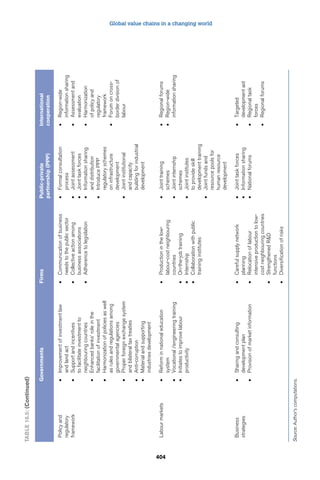
These lists are organized in the chapter under the headings of trade liberalization, 
trade facilitations and logistics, infrastructure, policy and regulatory framework, labour 
market, and business strategies. The author concludes that reforms in these areas 
would be facilitated through collective action among governments in the region and 
public-private partnerships, with support from international agencies. 
9 
Concluding observation 
The chapters in this volume showcase some of the cutting-edge thinking and research 
on GVCs from a variety of different perspectives. Our understanding of what makes 
supply chains work better and more efficiently undoubtedly lags developments on 
the ground. Operators in dynamic regions of the world like Asia are busily creating, 
revising, destroying and rebuilding chains on a daily basis. Sometimes they do so with 
the helpful and active support of government policies. Often, they are forced to work 
around policy challenges. It remains our hope that this volume will contribute to a more 
nuanced discussion of GVCs and the policy dimensions necessary to encourage their 
growth in the future.
Part I 
Changing features of global 
value chains
1 Global supply chains: why they 
emerged, why they matter, and 
where they are going 
Richard Baldwin1 
13 
1.1. Introduction 
Global supply chains have transformed the world. They revolutionized development 
options facing poor nations; now they can join supply chains rather than having 
to invest decades in building their own. The offshoring of labour-intensive 
manufacturing stages and the attendant international mobility of technology 
launched era-defining growth in emerging markets, a change that fosters and is 
fostered by domestic policy reform (Cattaneo et al., 2010 and Baldwin, 2011b). 
This reversal of fortunes constitutes perhaps the most momentous global economic 
change in the last 100 years. 
Global supply chains, however, are themselves rapidly evolving. The change is in 
part due to their own impact (income and wage convergence) and in part due to 
rapid technological innovations in communication technology, computer integrated 
manufacturing and 3D printing. 
This paper looks at why global supply chains (GSCs) matter, the economics of their 
unbundling and their implications for policy. It finishes with a discussion of factors 
affecting the future of global supply chains. The paper begins by putting global supply 
chains into historical perspective. 
1.2. Three centuries of globalization: GSCs in perspective 
Globalization is often viewed as driven by the gradual lowering of natural and man-made 
trade costs. This is a serious misunderstanding.
Global value chains in a changing world 
Advances have driven globalization in two very different types of “connective” 
technologies: transportation and transmission. These have dramatically different 
implications, but understanding why requires some background. 
First unbundling: steam made it possible, scale economies made it 
profitable 
In the pre-globalization world, each village made most of what it consumed. Production 
and consumption were forced together by poor transportation technology. The steam 
revolution, especially railroads and steamships, made it feasible to spatially separate 
production and consumption with this starting from the 1830s and accelerating in the 
1870s (the Trans-America line was completed in 1869). Once feasible, scale economies 
and comparative advantage made separation profitable. This transformed the world. 
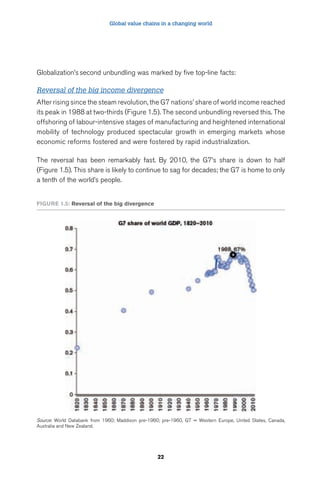
Globalization’s first unbundling was marked by five top-line facts: 
North industrialization and South de-industrialization 
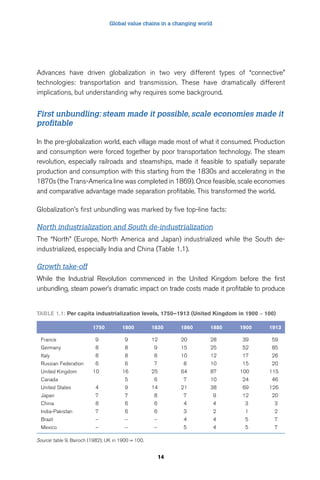
The “North” (Europe, North America and Japan) industrialized while the South de-industrialized, 
especially India and China (Table 1.1). 
Growth take-off 
While the Industrial Revolution commenced in the United Kingdom before the first 
unbundling, steam power’s dramatic impact on trade costs made it profitable to produce 
Table 1.1: Per capita industrialization levels, 1750–1913 (United Kingdom in 1900 = 100) 
1750 1800 1830 1860 1880 1900 1913 
France 9 9 12 20 28 39 59 
Germany 8 8 9 15 25 52 85 
Italy 8 8 8 10 12 17 26 
Russian Federation 6 6 7 8 10 15 20 
United Kingdom 10 16 25 64 87 100 115 
Canada 5 6 7 10 24 46 
United States 4 9 14 21 38 69 126 
Japan 7 7 8 7 9 12 20 
China 8 6 6 4 4 3 3 
India-Pakistan 7 6 6 3 2 1 2 
Brazil - - - 4 4 5 7 
Mexico - - - 5 4 5 7 
14 
Source: table 9, Bairoch (1982); UK in 1900 = 100.
Global supply chains: why they emerged, why they matter, and where they are going 
at vast scales. This triggered modern growth, characterized by a self-sustaining cycle of 
production, innovation and income gains that made further innovation profitable. This 
spread to continental Europe and the United States around the middle of the 19th century.2 
“Big time” international income divergence/convergence 
The first unbundling saw the North’s and South’s incomes diverge massively. 
Innovation, scale and specialization gave Northern industry a powerful cost-advantage 
over industry in the South. In addition to favouring the location of more manufacturing 
in the North, the shift also destroyed incentives for innovation in the South. The higher 
Northern growth – which persisted up till the early 1990s – produced what Pritchett 
(1997) calls income divergence “big time”.3 
International trade and labour migration boomed 
International trade in goods and labour migration exploded during the first unbundling. 
After being shut down by two world wars, a surge of protectionism and the Great 
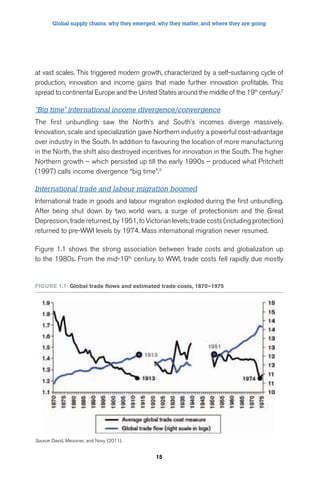
Depression, trade returned, by 1951, to Victorian levels; trade costs (including protection) 
returned to pre-WWI levels by 1974. Mass international migration never resumed. 
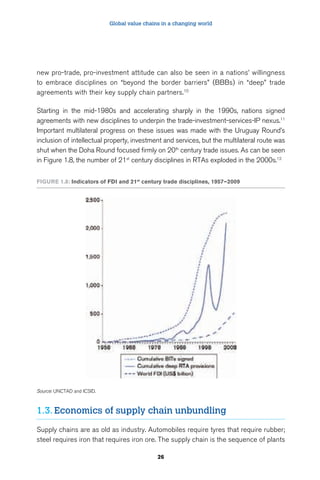
Figure 1.1 shows the strong association between trade costs and globalization up 
to the 1980s. From the mid-19th century to WWI, trade costs fell rapidly due mostly 
FigUre 1.1: global trade flows and estimated trade costs, 1870–1975 
15 
Source: David, Meissner, and Novy (2011).
Global value chains in a changing world 
to lower transportation costs. From 1914 to 1950, trade costs rose erratically but 
substantially due mostly to man-made trade barriers such as the Smoot-Hawley tariff 
and the retaliation it provoked. Finally, during the post-war period, trade costs have 
fallen steadily due mainly to tariff liberalization and better organization of transportation 
(such as containerization). 
Production clustered locally as it dispersed globally 
The first unbundling did not make the world flat. Indeed, it produced the first globalization 
paradox: freer trade led production to cluster locally in factories and industrial districts. 
The world’s economic geography went from homogenous (subsistence agriculture 
everywhere but a few cities) to “spiky” (Florida, 2005). The flat-world musings of 
economists-without-economics-training, like Thomas Friedman and William Greider, 
are about as wrong as can be. 
Globalization’s paradox is resolved with three points: i) cheap transport favours large-scale 
production, ii) such production is complex; and iii) extreme proximity lowers the 
cost of coordinating the complexity. By removing one constraint (transport costs), 
the first unbundling brought forward another – coordination costs. Proximity became 
more important in many ways, not fewer. 
Second unbundling: ICT made it possible, wage differences 
made it profitable 
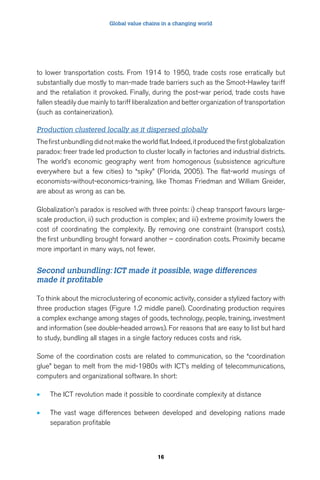
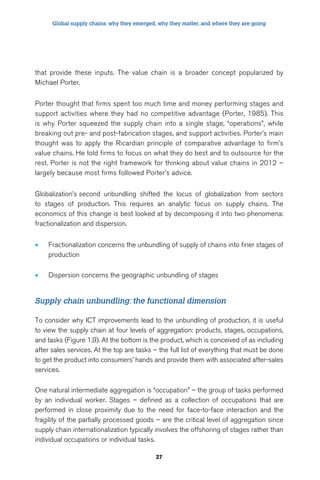
To think about the microclustering of economic activity, consider a stylized factory with 
three production stages (Figure 1.2 middle panel). Coordinating production requires 
a complex exchange among stages of goods, technology, people, training, investment 
and information (see double-headed arrows). For reasons that are easy to list but hard 
to study, bundling all stages in a single factory reduces costs and risk. 
Some of the coordination costs are related to communication, so the “coordination 
glue” began to melt from the mid-1980s with ICT’s melding of telecommunications, 
computers and organizational software. In short: 
• The ICT revolution made it possible to coordinate complexity at distance 
• The vast wage differences between developed and developing nations made 
16 
separation profitable
Global supply chains: why they emerged, why they matter, and where they are going 
This was globalization’s second unbundling – some production stages previously 
performed in close proximity were dispersed geographically (Figure 1.2 right 
panel). 
Importantly, most technology is firm specific, so internationalizing supply chains 
often involves offshoring know-how. While technology transfer is an ancient story 
(gunpowder), ICT facilitated control that reduced the costs and risks of combining 
developed-economy technology with developing-nation labour.4 For this reason, 
technology became more internationally mobile. 
FigUre 1.2: Schematic illustration of coordination costs and the second unbundling 
17 
Source: Derived from Baldwin (2011a). 
Indicators of global supply chains 
Directly measuring the “nexus” or the rise of 21st century trade is difficult; existing 
statistical categories were designed to quantify the first unbundling. 
One measure of supply chain internationalization focuses on products where 
nations are exporting and importing an extraordinary amount. This makes 
little sense from a first unbundling perspective; nations seem to have both a 
comparative advantage (extraordinarily large exports relative to other nations) 
and a comparative disadvantage (extraordinarily large imports relative to other 
nations). From a second unbundling perspective, the extent of such overlapping 
comparative advantage and disadvantage provides a proxy for global supply chains.
Global value chains in a changing world 
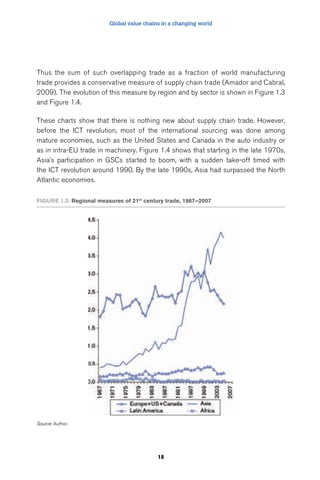
Thus the sum of such overlapping trade as a fraction of world manufacturing 
trade provides a conservative measure of supply chain trade (Amador and Cabral, 
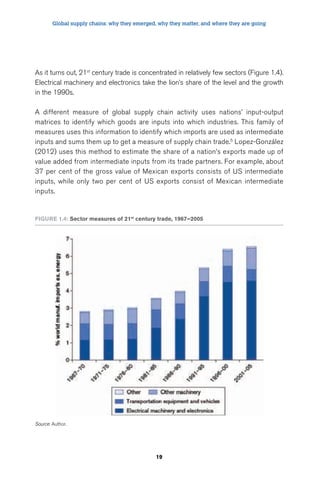
2009). The evolution of this measure by region and by sector is shown in Figure 1.3 
and Figure 1.4. 
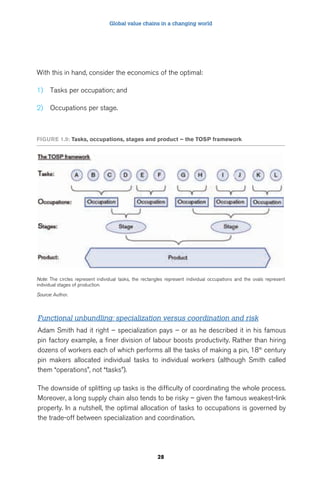
These charts show that there is nothing new about supply chain trade. However, 
before the ICT revolution, most of the international sourcing was done among 
mature economies, such as the United States and Canada in the auto industry or 
as in intra-EU trade in machinery. Figure 1.4 shows that starting in the late 1970s, 
Asia’s participation in GSCs started to boom, with a sudden take-off timed with 
the ICT revolution around 1990. By the late 1990s, Asia had surpassed the North 
Atlantic economies. 
FigUre 1.3: regional measures of 21st century trade, 1967–2007 
18 
Source: Author.
Global supply chains: why they emerged, why they matter, and where they are going 
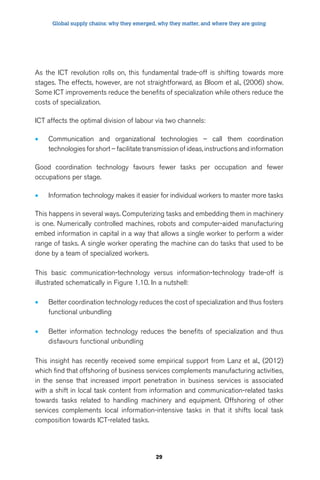
As it turns out, 21st century trade is concentrated in relatively few sectors (Figure 1.4). 
Electrical machinery and electronics take the lion’s share of the level and the growth 
in the 1990s. 
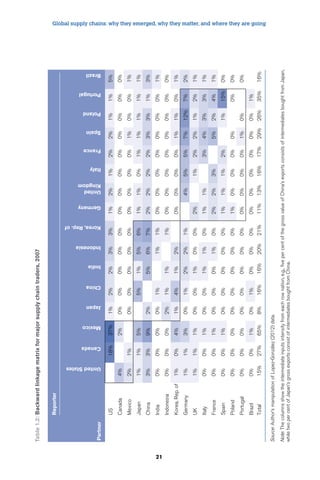
A different measure of global supply chain activity uses nations’ input-output 
matrices to identify which goods are inputs into which industries. This family of 
measures uses this information to identify which imports are used as intermediate 
inputs and sums them up to get a measure of supply chain trade.5 Lopez-González 
(2012) uses this method to estimate the share of a nation’s exports made up of 
value added from intermediate inputs from its trade partners. For example, about 
37 per cent of the gross value of Mexican exports consists of US intermediate 
inputs, while only two per cent of US exports consist of Mexican intermediate 
inputs. 
FigUre 1.4: Sector measures of 21st century trade, 1967–2005 
19 
Source: Author.
Global value chains in a changing world 
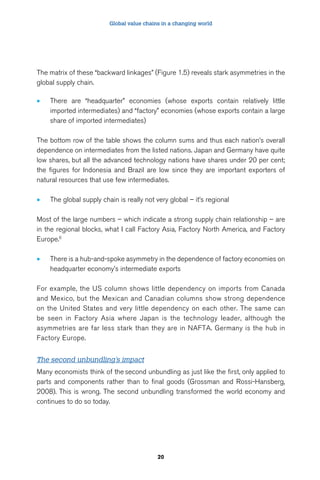
The matrix of these “backward linkages” (Figure 1.5) reveals stark asymmetries in the 
global supply chain. 
• There are “headquarter” economies (whose exports contain relatively little 
imported intermediates) and “factory” economies (whose exports contain a large 
share of imported intermediates) 
The bottom row of the table shows the column sums and thus each nation’s overall 
dependence on intermediates from the listed nations. Japan and Germany have quite 
low shares, but all the advanced technology nations have shares under 20 per cent; 
the figures for Indonesia and Brazil are low since they are important exporters of 
natural resources that use few intermediates. 
• The global supply chain is really not very global – it’s regional 
Most of the large numbers – which indicate a strong supply chain relationship – are 
in the regional blocks, what I call Factory Asia, Factory North America, and Factory 
Europe.6 
• There is a hub-and-spoke asymmetry in the dependence of factory economies on 
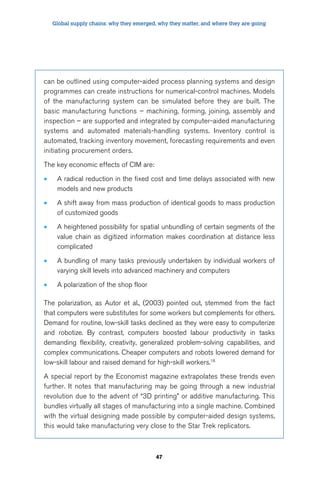
headquarter economy’s intermediate exports 
For example, the US column shows little dependency on imports from Canada 
and Mexico, but the Mexican and Canadian columns show strong dependence 
on the United States and very little dependency on each other. The same can 
be seen in Factory Asia where Japan is the technology leader, although the 
asymmetries are far less stark than they are in NAFTA. Germany is the hub in 
Factory Europe. 
The second unbundling’s impact 
Many economists think of the second unbundling as just like the first, only applied to 
parts and components rather than to final goods (Grossman and Rossi-Hansberg, 
2008). This is wrong. The second unbundling transformed the world economy and 
continues to do so today. 
20
Global supply chains: why they emerged, why they matter, and where they are going 
21 
Table 1.2: Backward linkage matrix for major supply chain traders, 2007 
Reporter 
Partner 
United States 
Canada 
Mexico 
Japan 
China 
India 
Indonesia 
Korea, Rep. of 
Germany 
United 
Kingdom 
Italy 
France 
Spain 
Poland 
Portugal 
Brazil 
US 18% 37% 1% 2% 2% 3% 3% 1% 2% 1% 2% 2% 1% 1% 5% 
Canada 4% 2% 0% 0% 0% 0% 0% 0% 0% 0% 0% 0% 0% 0% 0% 
Mexico 2% 1% 0% 0% 0% 0% 0% 0% 0% 0% 0% 1% 0% 0% 1% 
Japan 1% 1% 5% 5% 1% 5% 6% 1% 1% 0% 1% 1% 1% 1% 1% 
China 3% 3% 9% 2% 5% 6% 7% 2% 2% 2% 2% 3% 3% 1% 3% 
India 0% 0% 0% 0% 1% 1% 1% 0% 0% 0% 0% 0% 0% 0% 1% 
Indonesia 0% 0% 0% 2% 1% 1% 1% 0% 0% 0% 0% 0% 0% 0% 0% 
Korea, Rep. of 1% 0% 4% 1% 4% 1% 2% 0% 0% 0% 0% 1% 1% 0% 1% 
Germany 1% 1% 3% 0% 1% 2% 2% 1% 4% 5% 5% 7% 12% 7% 2% 
UK 1% 1% 1% 0% 0% 1% 0% 0% 2% 1% 2% 2% 1% 2% 1% 
Italy 0% 0% 1% 0% 0% 1% 1% 0% 1% 1% 3% 4% 3% 3% 1% 
France 0% 0% 1% 0% 0% 0% 1% 0% 2% 2% 3% 5% 2% 4% 1% 
Spain 0% 0% 1% 0% 0% 0% 0% 0% 1% 1% 1% 2% 1% 15% 0% 
Poland 0% 0% 0% 0% 0% 0% 0% 0% 1% 0% 0% 0% 0% 0% 0% 
Portugal 0% 0% 0% 0% 0% 0% 0% 0% 0% 0% 0% 0% 1% 0% 0% 
Brazil 0% 0% 1% 0% 1% 0% 0% 0% 0% 0% 0% 0% 0% 0% 1% 
Total 15% 27% 65% 8% 16% 16% 20% 21% 11% 13% 16% 17% 29% 26% 35% 16% 
Source: Author’s manipulation of Lopez-González (2012) data. 
Note: The columns show the intermediate inputs intensity from each row nation, e.g., five per cent of the gross value of China’s exports consists of intermediates bought from Japan, 
while two per cent of Japan’s gross exports consist of intermediates bought from China.
Global value chains in a changing world 
Globalization’s second unbundling was marked by five top-line facts: 
Reversal of the big income divergence 
After rising since the steam revolution, the G7 nations’ share of world income reached 
its peak in 1988 at two-thirds (Figure 1.5). The second unbundling reversed this. The 
offshoring of labour-intensive stages of manufacturing and heightened international 
mobility of technology produced spectacular growth in emerging markets whose 
economic reforms fostered and were fostered by rapid industrialization. 
The reversal has been remarkably fast. By 2010, the G7’s share is down to half 
(Figure 1.5). This share is likely to continue to sag for decades; the G7 is home to only 
a tenth of the world’s people. 
22 
FigUre 1.5: reversal of the big divergence 
Source: World Databank from 1960; Maddison pre-1960; pre-1960, G7 = Western Europe, United States, Canada, 
Australia and New Zealand.
Global supply chains: why they emerged, why they matter, and where they are going 
This reversal of fortunes is perhaps the most momentous change in the last one 
hundred years. It is reshaping every aspect of international relations. The “rocket 
engine” is the rapid industrialization in emerging economies. 
South industrialization and North de-industrialization 
The second unbundling reversed the 19th and 20th century industrialization/ 
de-industrialization trend. Since the early 1970s, with a significant pick up in the 
1990s, the North has de-industrialized and the South industrialized (Figure 1.6). 
De-industrialization is a pervasive trend among developed nations but the South’s 
rapid industrialization has been driven by the excellent performance of just a dozen 
nations – all of them heavily involved in international supply chains and most of them 
in Asia. The performance of Chinese manufacturing alone accounts for much of the 
reversal. 
FigUre 1.6: reversal of industrialization/de-industrialization trend 
23 
Source: Author.
Global value chains in a changing world 
Rise of 21st century trade: the trade-investment-services-IP nexus 
20th century trade meant goods crossing borders. 21st century trade is radically more 
complex for a very simple reason. Internationalizing supply chains also internationalized 
the complex two-way flows that used to take place only within factories. 
This is why it is misleading to view the second unbundling from the perspective of 
the first unbundling. The rise of global supply chains is much more than extra trade in 
parts and components. The heart of 21st century trade is an intertwining of: 
• Trade in goods, especially parts and components 
• International investment in production facilities, training, technology and long-term 
24 
business relationships 
• The use of infrastructure services to coordinate the dispersed production, 
especially services such as telecoms, internet, express parcel delivery, air cargo, 
trade-related finance and customs clearance services 
• Cross-border flows of know-how such as formal intellectual property and more 
tacit forms such as managerial and marketing know-how. 
To stress its interconnectedness, I call this the trade-investment-services-IP nexus.7 
New industrialization path: joining rather than building 
industrial supply chains 
The second unbundling revolutionized development options faced by poor nations. 
Before the rise of global supply chains, nations had to build a deep and wide 
industrial base before becoming competitive. This is the way the United States, 
Germany and Japan did it. After the second unbundling, nations could industrialize 
by joining international supply chains (Baldwin, 2011b). Joining supply chains is 
drastically faster and surer than the old import-substitution route. The developing 
nations that adopted this new strategy are called “emerging market economies”. 
The new join-instead-of-build development paradigm also transformed the political 
economy of policy reform. 
New political economy of liberalization 
Many pro-industrialization policies from the pre-ICT era – import substitution policies, 
FDI and local-content restrictions, state-owned enterprises, etc. – turned out to be
Global supply chains: why they emerged, why they matter, and where they are going 
hindrances to joining supply chains. Many developing nations dropped the old policies 
to attract offshored manufacturing jobs and investment. This revolutionized the world 
of trade and investment policy. 
Before the second unbundling, the political economy of trade liberalization was 
“I’ll open my market if you open yours”.8 After the second unbundling, the political 
economy was mostly unilateral: “I’ll open my borders and adopt pro-nexus reforms to 
attract factories and jobs”. Many emerging economies unilaterally liberalized tariffs, 
embraced pro-business and pro-investor policies. 
The volte-face in the political economy of trade liberalization is most obvious in 
the developing nation’s marked unilateral reduction of tariffs (Figure 1.7).9 The 
FigUre 1.7: Unilateral tariff cutting by developing nations, 1988–2009 
25 
Source: World Databank.
Global value chains in a changing world 
new pro-trade, pro-investment attitude can also be seen in a nations’ willingness 
to embrace disciplines on “beyond the border barriers” (BBBs) in “deep” trade 
agreements with their key supply chain partners.10 
Starting in the mid-1980s and accelerating sharply in the 1990s, nations signed 
agreements with new disciplines to underpin the trade-investment-services-IP nexus.11 
Important multilateral progress on these issues was made with the Uruguay Round’s 
inclusion of intellectual property, investment and services, but the multilateral route was 
shut when the Doha Round focused firmly on 20th century trade issues. As can be seen 
in Figure 1.8, the number of 21st century disciplines in RTAs exploded in the 2000s.12 
FigUre 1.8: indicators of FDi and 21st century trade disciplines, 1957–2009 
26 
Source: UNCTAD and ICSID. 
1.3. Economics of supply chain unbundling 
Supply chains are as old as industry. Automobiles require tyres that require rubber; 
steel requires iron that requires iron ore. The supply chain is the sequence of plants
Global supply chains: why they emerged, why they matter, and where they are going 
that provide these inputs. The value chain is a broader concept popularized by 
Michael Porter. 
Porter thought that firms spent too much time and money performing stages and 
support activities where they had no competitive advantage (Porter, 1985). This 
is why Porter squeezed the supply chain into a single stage, “operations”, while 
breaking out pre- and post-fabrication stages, and support activities. Porter’s main 
thought was to apply the Ricardian principle of comparative advantage to firm’s 
value chains. He told firms to focus on what they do best and to outsource for the 
rest. Porter is not the right framework for thinking about value chains in 2012 – 
largely because most firms followed Porter’s advice. 
Globalization’s second unbundling shifted the locus of globalization from sectors 
to stages of production. This requires an analytic focus on supply chains. The 
economics of this change is best looked at by decomposing it into two phenomena: 
fractionalization and dispersion. 
• Fractionalization concerns the unbundling of supply of chains into finer stages of 
27 
production 
• Dispersion concerns the geographic unbundling of stages 
Supply chain unbundling: the functional dimension 
To consider why ICT improvements lead to the unbundling of production, it is useful 
to view the supply chain at four levels of aggregation: products, stages, occupations, 
and tasks (Figure 1.9). At the bottom is the product, which is conceived of as including 
after sales services. At the top are tasks – the full list of everything that must be done 
to get the product into consumers’ hands and provide them with associated after-sales 
services. 
One natural intermediate aggregation is “occupation” – the group of tasks performed 
by an individual worker. Stages – defined as a collection of occupations that are 
performed in close proximity due to the need for face-to-face interaction and the 
fragility of the partially processed goods – are the critical level of aggregation since 
supply chain internationalization typically involves the offshoring of stages rather than 
individual occupations or individual tasks.
Global value chains in a changing world 
With this in hand, consider the economics of the optimal: 
FigUre 1.9: Tasks, occupations, stages and product – the TOSP framework 
Note: The circles represent individual tasks, the rectangles represent individual occupations and the ovals represent 
individual stages of production. 
Source: Author. 
28 
1) Tasks per occupation; and 
2) Occupations per stage. 
Functional unbundling: specialization versus coordination and risk 
Adam Smith had it right – specialization pays – or as he described it in his famous 
pin factory example, a finer division of labour boosts productivity. Rather than hiring 
dozens of workers each of which performs all the tasks of making a pin, 18th century 
pin makers allocated individual tasks to individual workers (although Smith called 
them “operations”, not “tasks”). 
The downside of splitting up tasks is the difficulty of coordinating the whole process. 
Moreover, a long supply chain also tends to be risky – given the famous weakest-link 
property. In a nutshell, the optimal allocation of tasks to occupations is governed by 
the trade-off between specialization and coordination.
Global supply chains: why they emerged, why they matter, and where they are going 
As the ICT revolution rolls on, this fundamental trade-off is shifting towards more 
stages. The effects, however, are not straightforward, as Bloom et al., (2006) show. 
Some ICT improvements reduce the benefits of specialization while others reduce the 
costs of specialization. 
ICT affects the optimal division of labour via two channels: 
• Communication and organizational technologies – call them coordination 
technologies for short – facilitate transmission of ideas, instructions and information 
Good coordination technology favours fewer tasks per occupation and fewer 
occupations per stage. 
• Information technology makes it easier for individual workers to master more tasks 
This happens in several ways. Computerizing tasks and embedding them in machinery 
is one. Numerically controlled machines, robots and computer-aided manufacturing 
embed information in capital in a way that allows a single worker to perform a wider 
range of tasks. A single worker operating the machine can do tasks that used to be 
done by a team of specialized workers. 
This basic communication-technology versus information-technology trade-off is 
illustrated schematically in Figure 1.10. In a nutshell: 
• Better coordination technology reduces the cost of specialization and thus fosters 
29 
functional unbundling 
• Better information technology reduces the benefits of specialization and thus 
disfavours functional unbundling 
This insight has recently received some empirical support from Lanz et al., (2012) 
which find that offshoring of business services complements manufacturing activities, 
in the sense that increased import penetration in business services is associated 
with a shift in local task content from information and communication-related tasks 
towards tasks related to handling machinery and equipment. Offshoring of other 
services complements local information-intensive tasks in that it shifts local task 
composition towards ICT-related tasks.
Global value chains in a changing world 
FigUre 1.10: Supply chain unbundling: coordination versus information technology 
Geographic unbundling: balancing dispersion and 
agglomeration forces 
Locational decisions have been studied for centuries. The touchstone principle is that 
firms seek to put each stage in the lowest cost location. The cost calculation involves 
a trade-off between direct factor costs and “separation” costs. 
• The direct costs include wages, capital costs and implicit or explicit subsidies 
• The separation costs should be broadly interpreted to include both transmission 
and transportation costs, increased risk and managerial time 
The location decision may also be influenced by local spillovers of various types. 
In some sectors and stages, say fashion clothing, proximity between designers and 
consumers may be critical. In others, product development stages may be made 
cheaper, faster and more effective by co-location with certain fabrication stages. Yet 
other stages and sectors are marked by strong technological spillovers that make 
clustering of producers the natural outcome. 
The mainstream framework for studying the impact of market size on industrial 
location is the so-called New Economic Geography literature launched by Paul 
30 
Source: Author.
Global supply chains: why they emerged, why they matter, and where they are going 
Krugman in the 1990s (Krugman, 1991; Fujita et al., 1999). The New Economic 
Geography perspective views the locational outcome as balancing dispersion forces 
and agglomeration forces. 
Dispersion forces 
Dispersion forces favour the geographic dispersion of stages. There are two prominent 
dispersion forces in the supply chain context: 
• Skilled and unskilled labour wages gaps determine “vertical specialization” 
The offshoring of labour-intensive stages from Japan, the United States and Germany 
to their nearby low-wage neighbours is driven by two wage gaps. Low-skill labour is 
much dearer in the “headquarter” economies such as the United States, Germany 
and Japan than it is in the nearby “factory” economies (Figure 1.11). High-skill 
labour, however, remains relatively abundant and thus relatively cheap in headquarter 
economies (Figure 1.12). The result is a spatial sorting of skill-intensive stages to 
high-wage nations and labour-intensive stages to low-wage nations. This is the key 
to North-to-South offshoring. 
FigUre 1.11: Wage differences in Factory asia, Factory North america and Factory europe, 
31 
2008 
Source: US Bureau of Labor Statistics, International Labor Comparisons.
Global value chains in a changing world 
• Firm-level specialization and excellence determine “horizontal specialization”. 
Factor prices are not the only consideration; as Figure 1.12 shows, international 
supply chains have long existed among high-wage economies. The dispersion here is 
driven by a much more micro gain from specialization. 
For example, when it comes to automobile air conditioners, the Japanese company Denso 
and the French company Valeo dominate their markets through excellence, not through low 
wages. While each could in principle make their own auto air conditioners, scale economies 
mean that it is cheaper for Swedish and German auto firms to source them from France. 
FigUre 1.12: education and r&D: aSeaNs, China, republic of Korea, United States, Japan 
32 
and Canada, 2005 
Source: World Databank online.
Global supply chains: why they emerged, why they matter, and where they are going 
Given the systemic importance of learning-by-doing and the growing role of scale 
economies in an ever more fractionalized supply chain, it is natural that regional 
champions will emerge in particular parts and components. This is the key to the 
“horizontal” internationalization of supply chains among high-wage nations. 
Agglomeration forces 
Agglomeration forces are the opposite of dispersion forces – they encourage 
geographical clustering. Technically, an agglomeration force is said to exist when 
the spatial concentration of economic activity creates forces that encourage further 
spatial concentration. 
There are many agglomeration forces, but some of them only operate on a very local 
scale. These local agglomeration forces, such as knowledge spillovers, help explain why 
firms in the same line of business so often cluster. When it comes to locational unbundling 
of supply chains – a phenomenon that spans the globe in some cases – these are too 
local to provide much explanatory leverage. The most important agglomeration forces 
for global supply chains are supply-side and demand-side linkages.13 
These are subject to what might be called “circular causality” (Figure 1.13): 
• Demand-linked circular causality rests on market-size/demand issues 
If an economy already enjoys the presence of a great deal of economic activity 
(GDP), then doing business in the economy will, all else being equal, be attractive 
to firms seeking to be near their customers. As this attraction draws more firms 
and more economic activity, the cycle continues. Were it not for dispersion forces, 
FigUre 1.13: Circular causality and agglomeration forces 
33 
Source: Author.
Global value chains in a changing world 
extreme location outcomes would be observed. Indeed in the case of some cities 
such as Tokyo, demand-links have resulted in a truly astounding share of activity 
concentrated spatially. This is one key reason why manufacturers continue to 
produce in high-wage nations. Customers attract suppliers whose workers become 
new customers. 
• Supply-linked circular causality rests on cost-of-inputs issues 
Since firms source intermediate inputs from other firms, the presence of many 
firms in a given location tends to make that location attractive to new firms from 
the input-cost perspective. This is one key reason why China is such an attractive 
location for the production of new goods, especially in electronics. Suppliers attract 
more suppliers. 
Generally speaking, demand-links operate on an economy-wide basis, while supply 
links operate more on a sectoral basis.14 
In this framework, the location of industry shifts to balance agglomeration and 
dispersion forces (Figure 1.14). Extreme solutions are occasionally observed, but 
interior solutions are the more common outcome. 
Trade costs and hump-shaped agglomeration 
While the interplay of agglomeration and dispersion forces determines the equilibrium 
location of industry, changes in trade costs can have unexpected effects. 
FigUre 1.14: equilibrium location balances agglomeration and dispersion forces 
34 
Source: Author.
Global supply chains: why they emerged, why they matter, and where they are going 
Lower trade and transportation costs makes distance less of an issue and thus weaken 
both agglomeration and dispersion forces. If the agglomeration forces weaken more 
than the dispersion forces, clustering weakens; if the opposite happens, clustering 
gets more pronounced. 
This logic explains why clustering tends to follow a “hump shaped” pattern as trade 
costs fall. Consider the polar examples: 
• When trade is highly restricted, it is very unprofitable for firms in one region to sell 
to other regions; each region makes their own 
• At the other extreme of perfectly costless trade, location region is immaterial 
In short, agglomeration is not necessary when trade costs are zero; it is not possible 
when trade costs are very high. In between these two extremes, being in a cluster is 
both possible and rewarding. 
This widely known feature of the New Economic Geography logic leads to the 
seemingly contradictory conclusion that lowering trade costs when they are high 
tends to produce a concentration of economic activity (in the North, as history would 
have it). However beyond some threshold level, further trade cost reductions leads 
to dispersion away from the North. This explains how globalization’s first and second 
unbundlings could have diametrically opposed effects on the agglomeration of 
industry and overall economic activity. 
This hump-shaped outcome in global economic activity is shown in Figure 1.15.15 The 
first unbundling fostered agglomeration in the North while the second unbundling 
fosters dispersion. The salient point is that the world today is beyond the crest; 
FigUre 1.15: Schematic illustration of function and location unbundling interactions 
35 
Source: Author.
Global value chains in a changing world 
lower trade costs will almost surely foster greater dispersion of economic activity 
to the South. 
Agglomeration economies and supply chain location 
New economic geography is useful in thinking about the micro, or firm-level, 
determinants of location, but it was originally designed to study the emergence 
of large-scale economic structures spanning regions and nations. The baseline 
here is the observation that economic activity tends to become more concentrated 
as economic integration proceeds (Niepmann and Felbermayr, 2010). 
The obvious application here is China. The vast agglomeration of manufacturing 
capacity that has assembled in China since 1990 will, by itself, continue to attract 
manufacturing activity. As China’s low-wage advantage erodes the new economic 
geography framework predicts a dispersion of activity beyond China – not a 
disappearance. The key work here is Paul Krugman, Tony Venables and their 
students; particularly relevant is the “island hopping” framework introduced by Puga 
and Venables (1996). Starting from a situation where all industry is in one nation, 
they show how productivity/wage growth induces firms to move offshore to a second 
location once a threshold wage is reached. 
The key point is that the spread is not even: the departing industry does not spread 
out evenly, it concentrates in just one new location to benefit from agglomeration 
rents. Moreover, the relocation does not empty out the first location/nation but 
rather slows the growth of new manufacturing activity. As the second location’s 
wages are driven up, a third location/nation emerges for offshoring. This is, in 
essence, the geographical dimension of the “flying geese” pattern whereby one 
East Asian nation after the other benefits from a cluster of industrial activity. 
GSCs and the second unbundling 
Treating the functional and geographical dimensions of unbundling separately 
is convenient analytically but it misses one important interaction. Functionally 
unbundling the supply chain can be done in a way that results in stages that have 
more homogenous skill/technology demands. This is advantageous given the 
vast wage differences (Figure 1.11). In other words, supply chain fractionalization 
may be driven in part by the possibility of offshoring low-skilled stages to low-wage 
nations. This is illustrated in Figure 1.15; a single stage, initially located 
in Japan, is unbundled into two stages so the low-skill tasks – marked by an 
36
Global supply chains: why they emerged, why they matter, and where they are going 
“L” in the circles – can be clustered and offshored to China. The relatively skill-intensive 
stage stays in Japan (the “H” in the circle indicates a high-skilled task). 
FigUre 1.16: The smile curve: good and bad stages in the value chain 
37 
Smile curve economics 
The second unbundling made it feasible to offshore stages of production; some 
stages moved, others did not. Curiously, value added along the value chain seemed to 
shift away from the offshored stages. This observation is known as the “smile curve” 
which shows the value added at each stage of production (Figure 1.16). This curve 
asserts that fabrication – especially final assembly – involves less value creation 
today than it did before the second unbundling – the smile deepened, so to speak. 
Source: Author. 
Nokia N95 example 
The allocation of value added along a value chain can be seen in the decomposition 
of the total retail sales price of the Nokia N95 phone (Ali-Yrkkö et al., 2011). 
Although the phone is mostly “made” in Asia, Figure 1.17 shows that most of the 
value added accrues in Europe. The total value added in Europe depends on where 
the phone is sold (retail margin) and assembled (China or Finland). In the worst of 
cases – an N95 assembled in China and sold in the EU – more than half the value 
added is in Europe; the high-end figure is 68 per cent.
Global value chains in a changing world 
FigUre 1.17: breakdown of the phone’s eUr 546 pre-tax retail price circa 2007 
Source: Author’s own compilation. 
Note: * includes protocols, the operating system, pre-installed software, etc.: ** Nokia outsources only 20 per cent of 
assembly. N95 was assembled in Beijing (China) and Salo (Finland) by Nokia employees. 
Why did the smile deepen? 
A definitive answer to this question will require a great deal more empirical research, 
but simple economics suggests an obvious explanation – cost accounting. When a 
stage’s cost is reduced by offshoring, its share in value added falls since a stage’s 
value added is based on costs. Even if the cost saving is fully passed on to consumers, 
the offshored stage’s share of value added will fall. This basic cost-accounting effect 
can be amplified by: 
38 
• Relative market power 
Offshored tasks tend to be things that can be done in many emerging nations, given 
that most of them are eager to attract such stages. The non-offshored stages, by 
contrast, tend to involve things where firms naturally have market power due to 
product differentiation and branding. In short, offshored tasks become commoditized; 
the onshore tasks do not. 
• Internationally mobile technology
Global supply chains: why they emerged, why they matter, and where they are going 
If the offshoring firm moves its advanced technology to the offshore location, it drives 
down the cost of the offshored task even more. As before, this automatically shifts 
value to the non-offshored tasks. 
Smiles and good jobs 
Smile curve economics suggests that the fabrication stages in manufacturing may not be 
the development panacea as they once were. Global supply chains made industrialization 
faster and easier (the supply chain made industry less lumpy). Industrialization became 
less meaningful for the same reasons. For example, that the Republic of Korea could 
export domestically designed car engines was testimony to its rich-nation status. Now, 
exporting sophisticated manufactured goods is no longer the hallmark of having arrived. 
It may simply reflect a nation’s position in a global supply chain. 
This observation calls for a good deal more thinking on the role of manufacturing in 
development strategies (Baldwin, 2011b). After all, the originator of the smile-curve 
concept used it to argue for a need to diversify away from fabrication. 
As far as the evolution of GSCs is concerned, it is important to note that the pre-and 
post-fabrication stages consist primarily of services rather than goods. As such, 
shifting the location of such stages will have a first-order impact on the pattern 
of transmission, not transportation. Of course a second order impact (location of 
fabrication influenced by location of design) is likely, but determinants of comparative 
advantage in pre- and post-fabrication service are quite different from fabrication, and 
the cost of transmitting these services is quite low. This suggests that shifts in the 
pre- and post-fabrication stages will not have a major impact on supply chain trade 
patterns when it comes to goods. 
1.4. What it means for policy 
As mentioned above, 21st century trade – or more precisely 21st century international 
commerce – is a richer, more complex, more interconnected set of cross-border flows 
of goods, investment, technology, services, technicians, managers and capital. This 
transformed policy making globally, first by creating new supply and new demand 
for deeper disciplines, and second by creating a bond among various strands of 
policymaking, some of which were always viewed as international but many are 
traditionally viewed as domestic policy issues. 
39
Global value chains in a changing world 
This section considers the implications of global supply chains for global economic 
policy; it draws on Baldwin (2012) and Gereffi et al., (2005). 
The nexus: more interconnected policy 
The quantum leap in complexity and interconnectedness has had momentous 
implications for world trade governance – shifting it sharply towards regionalism and 
eroding WTO centrality. Before turning to these points, it is worth pointing out that 
there is nothing really new here. The basic challenge of supply chain trade and the 
basic response of deeper, regional disciplines has been a feature of global governance 
for a half century. 
Before the second unbundling really got going in the late 1980s, most trade was 
simple. It could be governed by simple regulations like the GATT 1947 (less than 
100 pages long). The GATT rules, however, were not sufficient for the cross-border 
relations where supply chains were an issue in the 1960s and 1970s. As Figure 1.13 
shows, some trade relations back then were marked by supply chain trade and so was 
the need for deeper-than-GATT disciplines. In response, North Atlantic nations set up 
deeper disciplines. Since the trade was regional rather than multilateral, the deeper 
disciplines were placed in regional trade agreements. The 1965 US-Canada Auto 
Pact, which regulated trade and investment in the auto sector, is a classic example. 
The Auto Pact was a clear violation of GATT rules (Article XXIV) but US officials 
argued that the Pact “was designed to promote trade and economic efficiency 
within this single industry by bringing about such reallocation of production 
between the two countries as would permit Canada to achieve substantial 
economies of scale on some components and some models, while abandoning 
others.”16 It is hard to think of a clearer statement of the goals of the North-North 
trade-investment nexus. 
The European Economic Community, as the EU was known at the time, simi-larly 
sought much deeper disciplines. This, however, was not aimed at underpin-ning 
existing, complex cross-border activity. It was aimed at creating it. The Euro-pean 
founders viewed an ever-closer economic integration as the only sure-fire 
means of avoiding another European war.17 As Figure 1.15 shows, it worked. 
The history lesson here is simple. Complex cross-border flows demand complex 
rules. Since most complex trade is regional, there is a strong tendency to establish 
40
Global supply chains: why they emerged, why they matter, and where they are going 
the necessary complex rules at a regional rather than multilateral level. Multilateral 
rules would almost surely have been more efficient, but negotiating them in the GATT 
would have been too cumbersome and slow; most GATT members were not involved 
in this type of international commerce. 
Which new disciplines are needed? 
The trade-investment-services-IP nexus creates a need for two new types of 
disciplines. These correspond to the two new elements of the associated international 
commerce. 
• First, supply chain trade often involves producing abroad, either directly or via 
long-term relationships with independent suppliers 
This is basically the investment and intellectual property part – setting up business 
abroad is an essential part of 21st century trade. This means that barriers to doing 
business abroad are now trade barriers. Likewise, much of the internationalization of 
supply chains involves overseas application of a firm’s advanced know-how. A lack of 
intellectual property (IP) protection therefore becomes a barrier to trade. 
• Second, production among the facilities must be coordinated and this involves 
the two-way flow of goods, services, people, capital, and training 
Barriers to these flows are now barriers to trade. Note that traditional trade 
barriers are part of this, but the list is much longer as the cross-border flows are 
more complex (express mail, air cargo, trade financing and insurance, business 
mobility). 
One good source of the necessary disciplines is the deep regional trade agreements 
that have been signed among nations where the trade-investment-services-IP nexus 
trade is important. Following a procedure established by Horn et al., (2009), the WTO 
recently created a database of deeper disciplines in all the RTAs announced to the 
WTO by 2010. While the data covers over 50 measures, few of these occur frequently 
enough to be important. Table 1.3 shows a selection of deeper-than-GATT disciplines 
that appear frequently in modern trade agreements. The term “WTO-plus” applies to 
issues that are covered by WTO discipline but where the RTA involves commitments 
that go further. The “WTO-X” term applies to disciplines that are not mentioned in 
WTO agreements, so the RTA provisions are creating new rules rather than extending 
or deepening existing disciplines. 
41
Global value chains in a changing world 
Table 1.3: Selected deeper than GATT provision in RTAs 
21st century regionalism and the WTO’s erosion 
Globalization’s second unbundling created a new type of win-win situation in international 
commerce. The old type was “my market for yours”; the new type is “my factories for your 
reform”. This spawned massive demand for new disciplines from “headquarter economy” 
firms and a massive supply of new disciplines from “factory economy” governments. 
As the WTO was occupied with the Doha Round and its emphasis on 20th century 
issues (tariffs and agriculture), supply met demand in regional trade agreements – just 
as it did in the 1960s. More precisely, the supply chain governance gap was filled by 
uncoordinated developments in deep regional trade agreements, bilateral investment 
treaties, and autonomous reforms in emerging economies. The resulting package of 
deeper disciplines is what I have called 21st century regionalism (Baldwin, 2011a) – a 
theme taken up in the WTO’s 2011 World Trade Report (WTO 2011). 
21st century regionalism is a threat to the WTO’s centrality in multilateral trade 
governance, but not in the way that 20th century bilateralism was. It is not useful to think 
of 21st century regionalism using the analytic frameworks established by last-century 
42 
WTO-plus areas 
Technical barriers to 
trade 
Affirmation of rights and obligations under WTO agreement on TBT; provision of 
information; harmonization of regulations; mutual recognition agreements 
State trading 
enterprises 
Establishment or maintenance of an independent competition authority; non-discrimination 
regarding production and marketing condition; provision of 
information; affirmation of Art XVII GATT provision 
Trade-related 
investment measures 
Provisions concerning requirements for local content and export performance of 
FDI 
Services Liberalization of trade in services 
WTO-X areas 
Competition policy Maintenance of measures to proscribe anticompetitive business conduct; 
harmonization of competition laws; establishment or maintenance of an 
independent competition authority 
Intellectual Property 
(IP) 
Accession to international treaties not referenced in the TRIPS Agreement 
Investment Information exchange; development of legal frameworks; harmonization and 
simplification of procedures; national treatment; establishment of mechanism for 
the settlement of disputes 
Movement of capital Liberalization of capital movement; prohibition of new restrictions 
Regional cooperation Promotion of regional cooperation; technical assistance programmes 
Source: WTO’s Anatomy of PTAs database, http://www.wto.org.
Global supply chains: why they emerged, why they matter, and where they are going 
thinkers like Jagdish Bhagwati when regionalism was mostly about tariff preferences. 
In fact, 21st century regionalism is not primarily about preferential market access as 
WTO (2011 Chapter B) demonstrates convincingly. Instead, 21st century regionalism 
is about disciplines that underpin the trade-investment-service-IP nexus. Because of 
this, 21st century regionalism is a threat to the WTO’s role as a rule writer, not as a 
tariff cutter. 
Stepping from “what is” towards “what should be”, it is absolutely clear that the optimal 
governance solution for global supply chains would be global, not regional. Indeed 
the firms conducting much of this 21st century trade find themselves faced with a 
spaghetti bowl of disciplines – although this is tamed by the fact that the United 
States, Japan and the EU have established a system of hub-and-spoke bilateral 
agreements that tends to reduce conflicts for firms located in a hub. The real problem 
concerns the spokes such as Mexico that have deep agreements with the EU, Japan 
and the United States. 
43 
1.5. Future of GSCs 
The future of global supply chains will be moulded by the answers to three questions: 
• Will supply chains become more fractionalized? 
• Will stages of production become more polarized in terms of skill, capital and 
technology intensity? 
• Will stages of production be further dispersed and interconnected internationally? 
Fractionalization of the supply chain is determined by the interplay between the 
gains from specialization and cost of coordination and risk (see Section 1.3). The 
specialization gains come from scale economies and learning-by-doing as well as 
from a heightened ability to place each stage in a nation with the most appropriate 
wage structure. Coordination and risk costs come from the extra difficulty and 
expense of managing spatially distributed stages. Unbundling along the functional 
dimension will be directed by changes in these costs and benefits of fractionalization. 
Polarization of stages is determined by the costs and benefits of computerization and 
robotization of manufacturing. Broad advances in information technology will largely 
govern the future course on this issue.
Global value chains in a changing world 
The geographic spread and international complexity of supply chain stages are 
determined by the costs and benefits of scattering stages of production. The cost 
of dispersion falls as coordination technology improves and transportation and travel 
costs fall. The gain from dispersion rises with the diversity of production conditions in 
various nations, most notably the size of wage gaps. Unbundling along the geographic 
dimension will be directed by changes in these costs and benefits of dispersion. 
It is impossible to know what the future path will be for these four determinants. This 
section considers various combinations and their likely impact on GSCs. Figure 1.18 
helps organize ideas. 
FigUre 1.18: Future of international supply chains 
Information versus coordination technology 
Rapid improvement in coordination/communication technology – such as important 
advances in telepresence technology, workflow organization and communications 
software – favours supply chain unbundling functionally and geographically (Section 3). The 
resulting finer division of labour will allow firms to sort stages geographically according 
to the cost of the relevant productivity factors (labour, capital, technology, etc.). Other 
things being equal, this will result in more, and longer-distance, trade in parts and 
components. Thus rapid advances in coordination and communication technology will 
lead to more complex supply chains. This is illustrated in the top of the leftmost panel 
44 
Source: Author.
Global supply chains: why they emerged, why they matter, and where they are going 
of Figure 1.18. Box 1.1 discusses a number of radical technological breakthroughs 
that might have important implications for the future of global supply chains. 
Better information technology, by contrast, favours the bundling of many tasks into the 
ambit of individual workers. This will typically result in broader occupations and few 
separate stages of production. Other things being equal, this would tend to reduce 
international trade in parts and components. 
Better information technology also tends to polarize stages of production. As routine, 
low-skill, and repetitive tasks are easier to computerize and robotize, the information-technology- 
led bundling will typically eliminate occupations that involve such tasks. At the 
same time, the more intensive use of sophisticated production machines will make the 
remaining jobs more skill-, capital- and technology-intensive. This leads to a polarization 
of stages in terms of skill-content. Routine low-skill tasks are bundled into high-skill 
occupations while the remaining low-skill tasks will typically be highly labour-intensive 
but less routine. The resulting, broader stages will involve more capital-intensive, more 
technology-intensive and more skill-intensive processes. This tends to favour production 
in high-wage nations (see the bottom of the leftmost panel in the figure). 
Box 1.1: Extreme CT: telepresence, remote surgery and the 
45 
death of meetings 
Another revolutionary development would radically reduce the need for technicians 
and managers to travel to remote factories. Products such as Cisco’s Telepresence 
already reduce the need for face-to-face meetings in the service sector. If such 
technology were combined with human controlled robots of the type used today 
in operating rooms (e.g., Intuitive Surgical’s da Vinci Surgical System), technicians 
could conduct inspections or undertake repairs from remote locations. 
This is not science fiction. The US military already operates many of its drone 
aircraft in West Asia from bases in the United States. A company called Remote 
Presences does underwater survey, inspection and recovery using Remotely 
Operated Vehicles. And some US hospitals are using remote presence robots 
to leverage the time of doctors across hospitals (see video http://www.youtube. 
com/watch?v=qRx7CdseGsQ). 
The implications of this would be to de-regionalize supply chains, at least to the 
extent that the time-cost of travel was a significant consideration in offshoring 
locations.
Global value chains in a changing world 
Box 1.2 discusses some futuristic IT developments that might have a large impact on 
supply chains. 
Box 1.2: Extreme IT: “compufacturing” or taking the man out of 
46 
manufacturing 
When thinking about the future of global supply chains, it is worth speculating on 
truly revolutionary technological developments. One such possible development 
concerns Computer Integrated Manufacturing (CIM). This has already produced a 
tectonic shift in manufacturing in high-wage nations – moving from a situation where 
machines helped workers make things to a situation where workers help machines 
make things. Perhaps manufacturing will be called “compufacturing” in the future. 
The integration and automation of tasks, however, does not stop at the 
factory gate. Many design, engineering, and management tasks have been 
computerised (Alavudeen and Venkateshwaran, 2010). Computers have 
greatly boosted the productivity and speed of product design as well as greatly 
reduced the need for prototyping. Once designed, the production process 
Figure 1.19: Schematic illustration of computer integrated manufacturing 
Source: Author.
Global supply chains: why they emerged, why they matter, and where they are going 
can be outlined using computer-aided process planning systems and design 
programmes can create instructions for numerical-control machines. Models 
of the manufacturing system can be simulated before they are built. The 
basic manufacturing functions – machining, forming, joining, assembly and 
inspection – are supported and integrated by computer-aided manufacturing 
systems and automated materials-handling systems. Inventory control is 
automated, tracking inventory movement, forecasting requirements and even 
initiating procurement orders. 
The key economic effects of CIM are: 
• A radical reduction in the fixed cost and time delays associated with new 
47 
models and new products 
• A shift away from mass production of identical goods to mass production 
of customized goods 
• A heightened possibility for spatial unbundling of certain segments of the 
value chain as digitized information makes coordination at distance less 
complicated 
• A bundling of many tasks previously undertaken by individual workers of 
varying skill levels into advanced machinery and computers 
• A polarization of the shop floor 
The polarization, as Autor et al., (2003) pointed out, stemmed from the fact 
that computers were substitutes for some workers but complements for others. 
Demand for routine, low-skill tasks declined as they were easy to computerize 
and robotize. By contrast, computers boosted labour productivity in tasks 
demanding flexibility, creativity, generalized problem-solving capabilities, and 
complex communications. Cheaper computers and robots lowered demand for 
low-skill labour and raised demand for high-skill workers.18 
A special report by the Economist magazine extrapolates these trends even 
further. It notes that manufacturing may be going through a new industrial 
revolution due to the advent of “3D printing” or additive manufacturing. This 
bundles virtually all stages of manufacturing into a single machine. Combined 
with the virtual designing made possible by computer-aided design systems, 
this would take manufacturing very close to the Star Trek replicators.
Global value chains in a changing world 
Supply chain unbundling is driven by a fundamental trade-off between the 
gains from specialization and the costs of dispersal. This would be seriously 
undermined by radical advances in the direction of mass customization and 
3D printing by sophisticated machines. Whether these machines end up in 
high-wage, high-skill nations, or they are distributed to be near every large 
customer base, the impact would be a very substantial reduction in supply 
chain trade. 
To put it sharply, transmission of data would substitute for transportation of 
goods. 
Wage gap convergence may increase supply chain trade 
One of the most remarkable trends in recent years has been a narrowing of wage 
differences between developed and developing nations. The implications for this 
trend are illustrated in the middle panel of Figure 1.18. This trend is having, and will 
continue to have, two distinct effects on international supply chains. 
• First, wage convergence changes the nature of trade between the converging nations 
Specifically, developing nations such as China are producing sophisticated intermediate 
goods that previously were imported. 
• Second, as wages rise in China, Mexico, Poland and other countries, the 
geographical extent of supply chains widens to include new low-wage nations 
like Viet Nam. 
The view that global supply chains are driven mainly by large wage gaps is highly 
misleading. The perfect illustration is the US auto industry where there is more US 
offshoring to high-wage Canada than there is to low-wage Mexico. 
As Figure 1.4 shows, supply chain trade was prevalent among nearby high-wage 
nations like Canada and the United States and within Western Europe even before the 
second unbundling and it is still very high today. This is the “horizontal” specialization 
type discussed above – specialization that is based on firm-level excellence rather 
than wage gaps. As such specialization is not generally subject to local clustering 
effects, the result is massive two-way flows in similar goods. 
48
Global supply chains: why they emerged, why they matter, and where they are going 
Figure 1.20 shows a different measure of supply chain trade that is more easily 
calculated for specific bilateral trade flows. The measure – intra-industry trade – gauges 
the overall relationship between imports and exports at a finely defined sectoral level, 
for instance with electrical machinery. This is an imperfect proxy since some of the 
intra-industry trade is in final goods, but a great deal is in intermediate goods. 
The clear messages from these figures are: 
• Despite the second unbundling and the rise of North-South supply chain trade, 
such trade is substantially more prevalent among high-income nations 
• North-South supply chain trade does not seem to be substituting for North-North supply 
chain trade (Japan is an exception as it assembles so much of its final goods in China) 
FigUre 1.20: indicator of supply chain trade North-North versus North-South 
49 
Source: Author.
Global value chains in a changing world 
Both points suggest that income convergence will boost supply chain trade in that 
the extra horizontal specialization will more than compensate any reduction in wage-driven, 
50 
vertical specialization. 
As nations like China experience rapid income growth, the volume of supply 
chain trade may rise to a level more like the level observed between the United 
States and the EU. One of the best-known tenets of the “new trade theory” is that 
countries trade more as they get larger and more similar in size. This suggests that 
the rapid growth of emerging markets will create more trade than it displaces. US-China 
intra-industry trade would have to increase six fold to match the intensity of 
French-German trade. 
The second trend is nothing new. In East Asia, it is known as the flying geese 
pattern. The industrialization of first Japan and then the Republic of Korea; Chinese 
Taipei; Hong Kong, China and Singapore raised local wages that in turn triggered 
offshoring to Thailand, the Philippines, Indonesia, Malaysia and, after 1990, China. 
As wages have begun to rise in this new set of “tigers”, low-skill jobs are increasingly 
offshored to nations such as Bangladesh and Viet Nam. Throughout this process, 
supply chain trade volumes rose rapidly. 
Per capita income and supply chain trade 
The discussion so far has put aside the issue of direction of trade. In a supply 
chain, however, direction matters. Importing intermediates in order to export is quite 
different from exporting parts that help other nations export. Lopez-González (2012) 
calls the former “backward” supply chain trade (buying intermediates from GSCs) 
and the latter “forward” supply chain trade (selling intermediates into GSCs).19 As 
it turns out, there are some clear empirical regularities linking a nation’s level of 
development – as measured by per capita income – and its backwards and forwards 
supply chain trade. 
• As nations get richer, up to a point, they use imported intermediates more 
intensively in their exports. Beyond a threshold – about US$ 25,000 per year per 
person – the intensity then diminishes (Figure 1.21 top panel) 
• For forward supply chain trade – i.e. the supply of intermediates to others – the 
relationship is flipped. It falls for lower income levels but rises beyond a point near 
US$ 15,000 (Figure 1.21 middle panel)
Global supply chains: why they emerged, why they matter, and where they are going 
FigUre 1.21: How backward, forward and total supply-chain trade vary with income 
Note: The Lopez-González (2012) measures indicate the share of gross exports accounted for by intermediate imports 
from a particular partner (backwards), and the share of exports used as inputs into other nations’ exports (forwards). The 
measures are bilateral and direction-specific, so each point in the graph corresponds to a single bilateral measure of supply 
chain trade for each year from 1995 to 2007. 
Source: Author. 
51
Global value chains in a changing world 
Combining the two measures, we get a nation’s total involvement in the supply chain 
(Figure 1.21 bottom panel) 
While this research is very recent and thus not yet part of economists’ received 
wisdom, the top-line message is very much in line with the general view presented 
above. As China moved up from textiles and apparel to assembling electronics and 
machinery, the import content of its exports rose. At the other extreme, a nation like 
Finland has all but exited from the fabrication end of manufacturing, so the domestic 
value-added content of its exports tends to be higher. In some ways the top panel of 
Figure 1.21 can be thought of as a shadow of the smile curve. 
Likewise, it is commonly known that advanced technology nations such as Japan and 
Germany are increasingly focusing on sophisticated components that are exported for 
assembly elsewhere – an observation that is consistent with the middle panel of Figure 1.21. 
Taking the fitted curves at face value gives an idea of how global supply chain trade 
will develop as emerging market incomes rise. Figure 1.22 shows, for the nations 
FigUre 1.22: Manufacturing gDP and incomes levels – nations below the turning point 
52 
Source: Author.
Global supply chains: why they emerged, why they matter, and where they are going 
that account for 90 per cent of global manufacturing GDP, the size of manufacturing 
and the per capita income level. According to Lopez-González (2012), the backwards 
supply chain trade intensity should increase for the nations below the threshold of 
US$ 25,000. The forward trade should decrease for nations below US$ 15,000. The 
numbers show that many important manufacturing nations are below US$ 15,000, 
so further income growth in China and other factory economies will draw them more 
deeply into global supply chains. 
While such calculations are conjectures at best, they suggest that supply chain trade 
is likely to increase at least for China both on the import and export sides. 
Trade barriers and transportation costs 
The last trend to be considered is the cost of moving goods across borders. The 
second unbundling has been accompanied by a remarkable reduction in policy 
barriers to trade in goods such as tariffs, port delays and red tape. This trend is likely 
to continue given the political economy that has driven it (see Section 1.4). Trade 
costs, however, could still rise with oil prices. 
The future course of the price of oil is not known, but many forecasters view oil prices 
rising along with the rise of emerging market incomes, and with those of China, India 
and Brazil in particular. Figure 1.23 shows one mainstream forecast that incorporates 
three scenarios. The first aspect to note is that much of the boom in supply chain 
trade that came with the ICT revolution was aided by a drop in the price of oil as 
well as by a drop in tariffs (Figure 1.23). As tariffs have a lower bound of zero, the 
latter boost will not be repeated going forward. Nor does it seem that oil prices will 
provide as permissive an environment as they did in the past decades. Even the low 
oil price scenarios foresee prices remaining relatively high. The pessimistic scenario 
sees them doubling. 
If oil prices do rise substantially, the geography of supply chains will be affected. 
The nature of the impact is quite obvious – it would favour “nearshoring” or 
even “reshoring” of geographically dispersed production stages. Supply chains 
would be less global and more regional. The actual magnitude of the shift is 
thought to be large by experts in the case of the high-price scenario.20 It is worth 
pointing out, however, that the experts’ calculations see wage and income gaps 
as unaffected by the oil price changes, and so their analyses are rough guesses 
at best. 
53
Global value chains in a changing world 
FigUre 1.23: Historical and forecast oil prices 
54 
Source: US Annual Energy Outlook 2012. 
1.6. Concluding remarks 
Globalization’s second unbundling and the global supply chains it spawned have produced 
and continue to produce changes that alter all aspects of international relations – economic, 
political and even military. The spearhead of these changes has been the extraordinary 
economic growth accompanying emerging markets’ integration into global markets 
at an unprecedented speed and scale – an accomplishment that is largely due to the 
development of global supply chains and heightened international mobility of capital. 
This paper is an economist’s view on supply chains – why they are significant, what 
future directions they are likely to take and what they mean for policy. After putting 
global supply chains into an historical perspective, the paper presents an economic 
framework for understanding the functional and geographical unbundling of production 
processes – focusing on manufacturing. 
Supply chain fractionalization – the functional unbundling of production processes – is 
governed by a fundamental trade-off between specialization and coordination costs. Supply
Global supply chains: why they emerged, why they matter, and where they are going 
chain dispersion – the geographical unbundling of stages of production – is governed 
by a balance between dispersion forces and agglomeration forces. Agglomeration 
forces create attraction to clusters that discourages offshoring – mostly the tendency 
to co-locate with customers and intermediate good supplies. The dispersion forces that 
encourage geographic unbundling include wage gaps (fostering North-South offshoring) 
and firm-level excellence (fostering North-North and South-South offshoring). 
The policy implications stem from the second unbundling’s transformation 
of international commerce. The internationalization of production stages has 
internationalized the complex flows of goods, information, investment, training, 
technology and people that used to occur inside individual factories. The heightened 
complexity of cross-border flows demands deeper disciplines. As the WTO has 
been occupied with 20th century trade issues since its inception in the 1990s, 
the new disciplines have arisen outside the multilateral system. This development 
threatens the WTO’s centrality, but not on the tariff-cutting front as suggested by 
20th century thinking on regionalism by Jagdish Bhagwati and others. Rather, 21st 
century regionalism threatens to undermine the WTO’s role as the world’s rule writer 
and rule keeper. 
The future of global supply chains will be influenced by four key determinants: 
1) improvements in coordination technology that lower the cost of functional and 
geographical unbundling; 2) improvements in computer integrated manufacturing 
that lower the benefits of specialization and shifts stages toward greater skill-, 
capital-, and technology-intensity; 3) narrowing of wage gaps that reduces the 
benefit of North-South offshoring to nations like China; and 4) the price of oil that 
raises the cost of unbundling. 
Two key messages emerge from the analysis. First, convergent wages and income 
level between “factory economies” and “headquarter economies” need not reduce the 
extent of supply chain trade among them. Indeed, the intensity of such trade among 
developed nations exceeds that between developed and emerging nations since the 
gains from specialization driven by firm-level excellence is even more important than 
the gains from specialization due to large wage gaps. A foundational tenet of trade 
theory is that nations trade more – not less – as their economies become larger and 
more similar. Second, narrowing wage gaps between China and developed nations 
are likely to produce a continuation of the old “flying geese” pattern whereby early 
developers move up the value chain and thereby encourage the next low-wage nation 
to step on to the development ladder. 
55
Global value chains in a changing world 
56 
Endnotes 
1 I thank João Amador , Robert Johnson, Javier Gonzalez-Lopez, and Nadia Rocha for assistance 
with data from their excellent papers on related topics. I thank Gary Gereffi, Tim Sturgeon, Patrick 
Low and Simon Evenett for excellent discussion, advice and analysis, and Alen Mulabdic for research 
assistance. This paper was first prepared in July 2012 for the Fung Global Institute’s Global Supply 
Chain Initiative. 
2 The dates suggested by Rostow (1960) are UK 1783–1802, France 1830–60, Belgium 
1833–60, US 1843–60, Germany 1850–73, Sweden 1868–90, Japan 1878–1900, Russia 1890– 
1914 and Canada 1896–1914. 
3 On the theory connecting agglomeration, innovation, growth and income divergence, see 
Baldwin et al., (2001). 
4 This is not the “technology transfer’ of yesteryear. Firms make elaborate efforts to avoid such 
transfers. 
5 See Hummels et al., (1999); Johnson and Noguera (2011); Koopman et al., (2008), and 
González (2012). 
6 See Baldwin (2008) for an analysis of Factory Asia. 
7 See Baldwin (2011a) for details. 
8 It was a game played mostly by rich nations. Developing nations were not required to reciprocate 
under the GATT’s “Special and Differential Treatment” principle. 
9 See Baldwin (2010) for analysis of unilateral tariff liberalization. 
10 Asymmetric in the sense that the agreements required the developing nation to change large 
swaths of laws and regulation but require almost no regulatory reform of the developed nation 
partner. 
11 These include provisions on investment, capital flows, intellectual property protection, 
competition policy, services trade, and industrial standards and regulations; see WTO (2011) for 
detailed analysis. 
12 See Baldwin (2011a) and WTO (2011) for an in depth analyses of 21st century regionalism. 
13 Called, respectively, forward and backward linkages by 20th century writers such as Albert 
Hirschman. 
14 The reason is that a clustering of firms means a clustering of workers and thus a clustering of 
purchasing power. However, the purchasing power tends to get spent on the whole range of goods.
Global supply chains: why they emerged, why they matter, and where they are going 
15 This data, from the economic historian Angus Maddison, differs in the peak year from the more 
modern data series used in Figure 1.7. 
57 
16 Patterson (1966), page 356. 
17 See Chapter 1 of Baldwin and Wyplosz (2012). 
18 Of course, this is not the first time automation has polarized the factory jobs. In the 19th century, 
mechanized looms replaced medium-skilled textile workers with low-skilled, low-wage workers. A 
process immortalized by the machine-wrecking tactics of Luddites. 
19 His actual terminology is “vertical specialization” following a long tradition in this literature. 
20 See Simchi-Levi (2010) and Simchi-Levi et al., (2011). 
References 
Alavudeen, A.; Venkateshwaran, N. 2010. “Computer Integrated Manufacturing”, (New Delhi, 
India, PHI Learning). 
Ali-Yrkkö, J.; Rouvinen, P.; Seppälä, T.; Ylä-Anttila, P. 2011. “Who Captures Value in Global 
Supply Chains? Case Nokia N95 Smartphone” in Journal of Industry, Competition and Trade, 
11(3): 263–278. 
Amador, J.; Cabral, S. 2009. “Vertical Specialization Across the World: A Relative Measure”, 
in The North American Journal of Economics and Finance, Volume 20, Issue 3, December: 
267–280. 
Autor, D.H.; Levy, F.; Murnane, R.J. 2003. “The Skill Content of Recent Technological Change: 
An Empirical Exploration” in Quarterly Journal of Economics, 118(4): 1279–333. 
Baldwin, R.E.; Martin, P.; Ottaviano, G.I.P. 2001. “Global Income Divergence, Trade, and 
Industrialization: The Geography of Growth Take-Offs,” in Journal of Economic Growth, Springer, 
6(1): 5-37. 
Baldwin, R. 2008. “Managing the Noodle Bowl: The Fragility of East Asian Regionalism”, in 
Singapore Economic Review, 53:(3): 449-478. 
Baldwin, R. 2010. “Unilateral Tariff Liberalisation,” NBER Working Paper 16600 (Cambridge 
MA, National Bureau of Economic Research). 
Baldwin, R. 2011a. “21st Century Regionalism: Filling the Gap between 21st Century Trade 
and 20th Century Trade Rules”, CEPR Policy Insight No. 56 (London, UK, Center for Economic 
Policy Research).
Global value chains in a changing world 
Baldwin, R. 2011b. “Trade and Industrialization after Globalization’s 2nd Unbundling: How 
Building and Joining a Supply Chain are Different and Why it Matters”, NBER Working Paper 
17716 (Cambridge MA, National Bureau of Economic Research). 
Baldwin, R. 2012. “WTO 2.0: Global Governance of Supply-Chain Trade”, in CEPR Policy Insight 
No.64, December (London, UK, Centre for Economic Policy Research). 
Baldwin, R.; Wyplosz, C. 2012. “The Economics of European Integration, 4th Edition”, (London, 
UK, McGraw-Hill). 
Bloom, N.; Garicano, L.; Sadun, R.; van Reenen, J.M. 2009. “The Distinct Effects of Information 
Technology and Communication Technology on Firm Organization”, NBER Working Paper No. 
14975 (Cambridge, MA, National Bureau of Economic Research). 
Brülhart, M. 2001. “Evolving Geographical Concentration of European Manufacturing Industries”, 
in Weltwirtschaftliches Archiv, 137(2): 215–243. 
Cattaneo, O.; Gereffi, G.; Staritz, C. 2010. “Global Value Chains in a Post-crisis World: A 
Development Perspective” (Washington, DC, World Bank) 
Economist, The. 2012 “A third industrial revolution”, Economist Magazine Special Report, 21 
April 2012. Available at: http://www.economist.com/node/21552901 
Florida, R. 2005. “The World is Spiky” in The Atlantic Monthly, 296 (3):48–51 
Fujita, M.; Krugman, P.; Venables, A. J. 1999 “The Spatial Economy: Cities, Regions and 
International Trade” (Cambridge MA, MIT Press). 
Gereffi, G.; Humphrey, J.; Timothy Sturgeon, T. 2005. “The Governance of Global Value Chains”, 
in Review of International Political Economy, 12: 1. 
Horn, H.; Mavroidis, P. C.; Sapir, A. 2009. “Beyond the WTO? An Anatomy of EU and US 
Preferential Trade Agreements”, CEPR Discussion Paper No. DP7317 (London, UK, Center 
for Economic Policy Research). 
Hummels, D.; Ishii, J.; and Yi K-M. 1999. "The Nature and Growth of Vertical Specialization in 
World Trade", Staff Reports 72, Federal Reserve Bank of New York. Available at: http://ideas. 
repec.org/p/fip/fednsr/72.html 
Johnson, R.C.; Noguera, G. 2011. “Accounting for Intermediates: Production Sharing and Trade 
in Value Added”, in Journal of International Economics, forthcoming. 
Johnson, R. C.; Nogueraz, G. 2012. “Fragmentation and Trade in Value Added over Four 
Decades”. Available at: www.colorado.edu/Economics/seminars/johnson.pdf 
58
Global supply chains: why they emerged, why they matter, and where they are going 
Koopman, R.; Wang, Z.; Wei, S-J. 2008 “Give Credit where Credit is Due: Tracing Value Added 
in Global Production Chains”, NBER Working Paper 16426 (Cambridge MA, National Bureau 
of Economic Research). 
Krugman, P. 1991 “Increasing Returns and Economic Geography”, in Journal of Political 
Economy, 99: 483–99. 
Lanz, R.; Miroudot, S; Nordås, H.K. 2012. “Does Fragmentation of Production Imply Fragmentation 
of Jobs?”, OECD Trade and Agriculture Directorate working paper. Available at: https://www. 
gtap.agecon.purdue.edu/resources/download/5841.pdf 
Lopez-González, J. 2012. “Vertical Specialisation and New Regionalism”, Thesis PhD, University 
of Sussex, April. 
Niepmann, F.; Felbermayr, G. 2010. “Globalization and the Spatial Concentration of Production”, 
in World Economy, 33(5): 680–709. 
Patterson, G. 1966. “Discrimination in international trade: The policy issues 1945–1965” 
(Princeton NJ, Princeton University Press). 
Porter, M.E. 1985. “Competitive Advantage” (New York, Free Press). 
Pritchett, L. 1997. “Divergence, Big Time”, in Journal of Economic Perspectives, 11: 3. 
Puga, D.; Venables, A.J. 1996. “The Spread of Industry: Spatial Agglomeration in Economic 
Development”, in Journal of the Japanese and International Economies. 10(4): 440–464. 
Simchi-Levi, D. 2010. “Impact of Crude Oil Volatility on Network Design”, online powerpoint. 
Available at: www.scdigest.com/assets/reps/Impact_Oil_Prices_on_Supply_Chain_Network_ 
Design.pdf 
Simchi-Levi, D.; Peruvankal, J.P.; Mulani, N.; Read, B.; Ferreira, J. 2011. “Made in America: Rethinking 
the Future of US Manufacturing”, Available at: www.accenture.com/SiteCollectionDocuments/ 
PDF/Accenture-Made-in-America.pdf. 
Spitz, A. 2004. “Are Skill Requirements in the Workplace Rising? Stylized Facts and Evidence 
on Skill-Biased Technological Change”, ZEW Discussion Paper 04-33. Available at: ftp://ftp. 
zew.de/pub/zew-docs/dp/dp0433.pdf 
WTO. 2011. “The WTO and Reciprocal Preferential Trading Agreements”, World Trade Report 
2011 (Geneva, Switzerland, World Trade Organization). 
59
2 The role of services in global 
61 
value chains 
Patrick Low1 
2.1. Introduction 
The intangibility of services makes them analytically and statistically elusive. 
Systematic efforts to deepen our understanding of the economic role played by 
services – particularly at the international level – have only occurred in the last thirty 
years. These efforts have intensified recently with the increased presence of global 
value chains, where services fulfill a vital and complex role. 
Services have occupied a dominant place in most economies for a long time. According 
to the World Bank’s World Development Indicators (2012), the share of services 
value-added in world gross domestic product (GDP) was 70 per cent in 2010, rising 
fairly steadily from 53 per cent in 1970, 57 per cent in 1990 and 68 per cent in 
2000. Besides reflecting the shift towards service economies in advanced countries, 
the growth in these shares over time will almost certainly have been influenced by 
improvements in statistical methods and techniques. The services share has also risen 
as a result of structural changes in economies that have led to greater segmentation 
and more arms-length transactions, allowing the separate identification of services 
transactions. Notwithstanding national variations in the shares of GDP attributable to 
services, manufacturing, agriculture and mining, in most economies the services share 
is greater than that of the other three components of economic activity combined. 
The story of the share of services in international trade is even more interesting, 
reflecting data limitations that the international community has only just begun to 
address. For many years we have been estimating the share of cross-border services 
transactions in international trade at just over one-fifth of total trade (WTO International 
Trade Statistics, 2012). The recent OECD/WTO work on measuring trade in terms 
of the value added to products by different countries along supply chains, rather than
Global value chains in a changing world 
in gross terms, has yielded a dramatically different picture. In 2008, for example, the 
share of commercial services in world trade was estimated at 23 per cent in gross 
terms and 45 per cent in value-added terms (Figure 2.1).2 
In what follows, Section 2.2 of the paper explores a range of issues relating to 
the role of services on supply chains. The analytical challenges associated with 
complementarity among multiple markets are discussed. Emphasis is placed on the 
ubiquity of services in supply chain production. The concepts of servicification, service 
science and invisible assets are considered in terms of supply chain operations. 
Section 2.3 looks very briefly at the complex issues associated with upgrading and 
value-added attribution along supply chains, and considers where services might 
fit into this debate. Section 2.4 covers data issues relating to the identification, 
classification and measurement of services. Section 2.5 concludes. 
2.2. The role of services along global supply chains 
Services figure in almost every activity in an economy. This is particularly true 
of what are often referred to as producer services – transport, communications, 
Figure 2.1: Sectoral contribution to total trade, gross and value-added measures, 2008 
Source: WTO Secretariat estimates based on OECD-WTO data. 
62
The role of services in global value chains 
finance, distribution and business services. This pervasiveness makes services 
key determinants of competitiveness and the productivity of capital and labour. 
But this is only part of the picture, since numerous other services are involved 
in the production and sale of products, whether the final product is a good or a 
service. 
Services have sometimes been referred to as the glue that holds supply chains 
together and ensures that they function in a fluid manner. This is only one aspect 
of what services do. They are also part of many production and sales processes, 
as we will see below. Modern communication and transport technologies have 
enhanced the tradability of services. This has facilitated their incorporation in 
supply chain production as traded inputs. In addition, what business literature calls 
“modularization”3 has led to the incorporation or bundling of services into composite 
products. This phenomenon is not unlike what the economics literature refers to as 
trade in tasks4, where inputs do not break down readily into the product classification 
and nomenclature systems with which we are more familiar. A typical example of 
this would be “business functions”. 
While in the past productivity growth has been greater in manufacturing than 
in services, emerging literature on the extent of unidentified service activities in 
production raises questions about the accuracy of relative productivity measures. 
Even if the data reflect reality, services may be a growing source of competitiveness. 
This conclusion follows from a new appreciation of how the service economy 
works and of different ways of producing and delivering services as elements of 
aggregated value propositions. 
As discussed below, much of the analysis does not necessarily refer directly to 
services, but rather to invisibles. However, since invisibles are intangible, and the one 
defining feature distinguishing services from goods is intangibility, there is no doubt 
that invisibles include services. 
The consequences of complementary markets 
In terms of their operation, supply chains can be thought of as a series of linked 
markets for goods and services. These markets are interdependent in the sense that 
something happening in one market affects many other markets. This complementarity, 
sometimes referred to as joint demand or derived demand, is associated with negative 
cross-elasticities of demand. This means that if the price of product A increases in 
63
Global value chains in a changing world 
one market, the demand for product B in another will fall. The result is that demand 
for both A and B falls. 
This complementarity links goods and services markets with no distinction in terms of 
economic effects as to whether the products in question are tangible or intangible.5 
Under these multiple-market relationships, changes in conditions in one market – 
including because of a policy intervention – provoke ripple effects in others along 
the whole supply chain, both upstream and downstream. The same logic holds in 
situations where there is modularization or bundling, and inputs are composites of at 
least two products that in principle could be supplied separately. 
While the complementary nature of markets is intuitively obvious and doubtless taken 
into account in many decisions of market agents, this reality does not always seem to 
be fully factored into the expectations of policy-makers in terms of the consequences 
of their actions. A possible explanation for this could be myopia, given that until very 
recently adequate data were unavailable. Policy interventions will affect relative prices 
across different interdependent markets, possibly with unintended consequences.6 
This suggests that policy-making should be an integrated process. 
There are two aspects to this, at the level of measures and policies. When governments 
take measures pursuant upon a policy, they should take into account market 
complementarities and knock-on effects in the particular market situation at hand. 
The impact of such reverberations can be particularly pronounced where policies 
affecting components (goods or services inputs) have a multiplicative or magnification 
effect as they cross more than one frontier along the supply chain.7 
At the policy level, this is about the design of different policies with varying objectives 
and contexts, which in the end come together to affect outcomes beyond the initial 
focus of attention and the objectives of individual policies. Outcome linkages and 
spill-overs call for a holistic approach to policy formulation. Policies formulated 
internationally that also aim to shape outcomes in areas like trade in goods, trade in 
services, investment, intellectual property protection, and competition will affect many 
activities in many markets. Getting policy right in each of these areas is therefore 
essential to the effective overall operation of supply chains. The current approach 
that relies on “silo” agreements in these different areas is short on appreciation 
of the consequences of complementarity. The pattern observed internationally is a 
reflection of how policy is made domestically, suggesting that any new approach 
must begin at home. 
64
The role of services in global value chains 
Identifying services along the supply chain 
In practice it is no easy matter to identify separately all the individual service components 
that make up the full value of a product, not least because of the bundling phenomenon. 
The detailed product breakdown in Figure 2.2, depicting the value chain for a coat, is 
a useful illustration of the difficulties encountered in trying to disaggregate a range of 
different services. 
Of the US$ 425 price tag for the jacket, only 9 per cent of this initial retail price 
is associated with making the jacket, with the remainder attributable to “invisible” 
assets.8 This is the identification problem: what is contained in the invisible assets? 
There will be elements both on the pre-manufacturing upstream part of the process, as 
well as on the post-manufacturing downstream. Upstream sources of value are likely 
to include design, intellectual property, branding, and so on. Downstream elements 
include advertising, marketing and retailing. Disentangling the sources of value, the 
individual services involved, and the implication of policy for these segments of the 
supply chain are formidable tasks. 
One of the most thorough efforts at achieving this is the case study of the Nokia95 
phone undertaken by Ali-Yrkkö et al. (2011). Through meticulous sleuthing, the 
authors managed to produce a detailed breakdown of the value chain for the product. 
Figure 2.2: A suit made in China and sold in the united States 
65 
Source: Fung Global Institute Li & Fung case study.
Global value chains in a changing world 
The parts (including processors, memories, integrated circuits, display and camera) 
accounted for 33 per cent of the product. Assembly only accounted for 2 per cent. 
The remaining two-thirds of the product was accounted for by Nokia’s internal support 
services (31 per cent), licenses (4 per cent), distribution (4 per cent), retailing (11 per 
cent) and operating profit (16 per cent). Despite the relatively fine detail of the breakdown 
of invisibles in this case study, a good deal is still missing in terms of the different services 
that went into production. The missing services problem also applies in the case of the 
manufacturing part of the operation, notwithstanding its small share. 
66 
The notion of “servicification” 
The Swedish National Board of Trade has undertaken some useful work in a number 
of studies in recent years on the servicification of the Swedish economy and of 
Swedish firms operating internationally (Kommerskollegium, 2010a, 2010b, 2012). 
Related work based on the same idea of servicification makes reference to servicizing 
(Reisken et al., 2000) and the “manuservice” economy (Bryson and Daniels, 2010). As 
discussed in Ryu et al. (2012), the term servitization was first used by Vandermerwe 
and Rada (1988). The definition of servification and similar derivatives of the word 
service used to denote the same phenomenon is not very precise but they capture 
important ideas about how the role of services has evolved in recent years. Essentially, 
servicification refers to the increased use of services in manufacturing, both in terms of 
production processes and sales. This phenomenon may in part reflect the separation 
of services functions in manufacturing from core production functions. In Sweden’s 
case (and no doubt elsewhere) this is linked to the development of enterprise 
groups, where manufacturing enterprises comprise different firms, some of which 
are dedicated to service production. Higher productivity growth in manufacturing 
than services and shifting demand and production patterns underlie the decline in 
the share of manufacturing and the rise of services in economies like that of Sweden 
(Kommerskollegium, 2010a). 
A significant feature of servicification is the opportunity it offers for strategic firm 
behaviour designed to move up the value chain. While some of the bundling or 
modularization occurring along supply chains as a result of servicification may be 
occasioned by the exigencies of locational dispersion in production and consumption, 
or by regulatory requirements, these tendencies are also likely to be fed by strategic 
motivations internal to firms (Sundin et al., 2009; Kommerskollegium, 2012). Firms 
may seek to customize their offerings so as to differentiate them in the marketplace 
and earn higher returns or to spread risk by diversifying the output mix.
The role of services in global value chains 
A case study of the Swedish multinational Sandvik Tooling (Kommerskollegium, 
2010b) revealed that in order to manage the supply chain and deliver goods, the firm 
had recourse to 40 discrete services. A further twelve services were required to handle 
customer delivery (Table 2.1). The study does not specify whether these services 
were separately supplied even if they could be separately identified, or whether they 
were packaged (modularized) into composite offerings. 
This wide array of services includes high value-added and low value-added activities. 
Some of the services are tradable, others are not. Some may be produced in-house, 
others at arms-length. Arms-length services could be outsourced or offshored. 
Amongst this large set of services associated with the production of machine tools, 
there would doubtless be opportunities for product differentiation and higher average 
value-added packages – in other words, for repositioning on the supply chain. Some 
of these services could even be provided to customers of rival manufacturing firms in 
the same market, or to rival firms themselves. 
Finally, depending on the product in question, significant scope may exist for the 
provision of after-sales services as an additional source of product differentiation 
and profit. These services can take many forms, including technical assistance and 
training, maintenance, provision of spare parts and repair services, and a range of other 
customer care services (Saccani et al., 2007). The means of delivery of after-sales 
services by a lead firm will vary from direct supply, sub-contracting arrangements, 
agency relationships and franchising. 
Table 2.1: Services necessary to the Sandvik Tools supply chain 
Services for operating the supply chain 
Legal services; Accounting, book-keeping etc.; Taxation services; Medical services; Computer services; Research 
and development; Rental/Leasing; Advertising; Market research; Services incidental to manufacturing; Placement 
of personnel; Maintenance and repair; Security services; Packaging; Printing; Publishing; Design; Building-cleaning 
services; Photographic services; Courier services; Logistic services; Postal services; Telecommunications; 
Audio-Visual services; Educational services; Environmental services; Banking services; Insurances; Health related 
services; Hotels and restaurants; Travel agency services; Maritime transport – freight; Inland waterways – freight; 
Inland waterways – freight; Air transport – freight/passenger; Road transport – freight/passenger; Cargo-handling 
services; Storage and warehouse services; Freight transport agency services; Feeder services; Energy services. 
67 
Services for customer delivery 
Computer services; Research and development; Rental/leasing; Maintenance and repair; Management consulting; 
Technical testing and analysis services; Services incidental to manufacturing; Design; Environmental services; 
Financial services; Logistics; Warehouse services. 
Source: Authors.
Global value chains in a changing world 
Services, networks and value analysis 
In a similar vein to the analysis of complementary markets, joint production and trade 
in tasks discussed above, a new literature is emerging that goes under the broad 
rubric of “service science”. The literature is yet to become mainstream but it strives 
to explain how networks, technology, entrepreneurship and consumers interact to 
generate innovation and create value. The recently published volumes by Maglio et al., 
(2010) and Demirkan et al., (2011) are examples of a burgeoning literature around 
service science. 
A “service-dominant” logic of value creation and exchange (Vargo and Lusch, 
2004) underpins much of the analysis, which focuses on service systems. 
Production is seen more as a dynamic and collaborative interactive process 
among people than as the combination of readily definable fixed and variable 
inputs of capital, labour and components into units of output. The analysis that 
goes under the name of service science bears a resemblance to the notion of 
innovation systems. 
Service science aspires to a high degree of inter-disciplinary or even trans-disciplinary 
thinking. Spohrer (2009) has argued for “an integrated approach that spans not 
only existing discipline-based silos within academic organizations (i.e. marketing, 
operations, and human resource management within a business school) but also 
across academic organizations (i.e. business, engineering and liberal arts).”9 Ng et al., 
(2011) suggest that service science should combine what they describe as a 
prevailing reductionist analytical perspective with a systems perspective as a means 
of establishing a disciplinary base for service science. 
A useful bridge between service science and more conventional analytical 
approaches is provided by Allee (2008) who examines the relationship between 
value and tangible and intangible assets. Intangible assets may be unpriced in 
the market and non-contractual, but nevertheless embody value. Such intangibles 
could include human knowledge, internal structures, working methods, reputation, 
business relationships, trust, social citizenship, environmental responsibility, 
and business values. These intangibles can sometimes command explicit value 
in the market, such as through consultancy contracts or explicit price premia. 
Allee (2008) argues, however, that trying to price these assets in terms of units 
of input is a fool’s errand. Some idea of the worth of the assets can be gleaned 
from the difference between the value of a firm’s assets and its sale value. 
68
The role of services in global value chains 
An imperfect and approximate indicator of this value could be captured by the 
goodwill recorded on a firm’s balance sheet. Some of the value emerges as barter 
relationships among parties to transactions. For the rest, the argument seems to 
be that value analysis requires an understanding of how roles and relationships 
create value. Even unpriced assets can be rendered into negotiable value and a 
systematic analysis of roles, transactions and deliverables must be undertaken in 
value creation analysis. 
The OECD new sources of growth project 
If the Allee (2008) analysis assists in bridging the gap between service science 
and more traditional analytical approaches to understanding markets, the OECD’s 
work (OECD, 2011, 2012) on intangible assets as new sources of growth is a 
further contribution in this direction. The OECD refers to a three-fold definitional 
distinction among the components of invisible assets. These include computerized 
information (software and data), innovation property (R&D, intellectual property), 
and economic competencies (brand equity, human capital specific to firms, 
networks joining people and institutions, organizational know-how, and advertising 
and marketing strategies). 
The economic competencies category is strikingly similar to the essential focus 
of service science. The OECD’s use of terminology has varied over time. Earlier 
references were to intellectual assets, knowledge assets and intellectual capital, 
while in later work the term used has been knowledge-based capital (KBC). All 
these terms refer to invisibles, which are to be contrasted with tangible assets 
such as plant, machinery and buildings. The OECD argues that countries investing 
proportionately more in KBC are doing better via enhanced productivity than those 
investing proportionately less. 
A further useful addition to the OECD’s work in this field is an analysis of the 
implications of policy on investment in, and production of, KBC. Relevant policies 
include tax and regulatory regimes, intellectual property, competition policy, investment 
policy, protection of data, data privacy and policies affecting corporate governance. 
This discussion reinforces the growing conviction that the segregation of policies 
into separately constructed regimes is inimical to coherence at the interface of policy 
and supply chain operations. An integrated approach to policy appears increasingly 
necessary. 
69
Global value chains in a changing world 
2.3. Services and progression up the value chain 
The emphasis so far has been upon understanding both the ubiquity of services 
in supply chain production and the interdependent nature of markets across the 
goods and services spectrum. This focus calls for a brief consideration of a current 
issue for many governments – namely, how to build a more diversified, prosperous 
and dynamic economy through participating in supply chains. In practical terms this 
amounts to the separate but connected questions of how to position a country 
in terms of supply chain participation, and how to acquire higher value-added 
segments of supply chains in which a country is involved or broaden the scope of 
participation. The paper by Gereffi and Sturgeon (2013) in this volume addresses 
these issues in more detail, particularly in relation to emerging economies. While 
emerging economies with large and dynamic domestic markets may have more 
degrees of freedom in terms of their policy options, this matter is no less pressing 
for other developing countries. 
The core emphasis here is on the scope for thinking about invisibles as a vehicle for 
new entry and upgrading. This requires firms to look beyond their core competencies 
to other, less less visible competencies such as networks with suppliers and the 
capability to perform specific tasks that can be replicated. An extensive listing of 
services that might be supplied to a lead firm on a supply chain has been undertaken 
by Gereffi and Fernadez-Stark (2010). The authors have divided services into 
information technology, knowledge processes and business processes. Each of 
these categories is further divided into multiple activities similar to the breakdown 
laid out above in the case of the Sandvik Tools supply chain (Kommerskollegium, 
2010b). In addition, they have approximately ranked the services in terms of value-added, 
with knowledge processes and some information technology services 
embodying high value-added, and business processes tending to involve lower 
value-added content. 
The analysis by Gereffi and Fernandez-Stark (2010) is in fact based on a discussion 
of off-shored services. This suggests the option of plugging into a supply chain 
with activities located elsewhere, relying on cost and skill advantages that allow 
participation in relatively high value-added activities from a distant location. But 
the provision of such services does not have to be on an off-shored basis. They 
could also have been outsourced domestically. Moreover, we often tend to think of 
off-shored and outsourced services being supplied at arms-length by independent 
entities. This is not necessarily the case. Such services could be provided on an 
70
The role of services in global value chains 
in-house basis by the lead firm itself. In both cases the key point is location, as 
what we are interested in here is progression up the value chain from a national 
perspective. 
71 
The process of upgrading 
A wide literature has developed over the last decade or so on the ingredients of 
successful upgrading by firms.10 The essence of successful upgrading resides in 
the capacity to segment markets. It means establishing a competitive position with 
an offering that cannot be replicated, at least in the short-term. This is clearly easier 
for a lead firm to achieve than a secondary supplier. The sources of this market 
advantage could be a technology, a technique, a bottleneck of some description or 
a modularized product. 
Kaplinsky and Morris (2001) distinguish among four kinds of upgrading – process, 
product, functional and chain. Process upgrading involves efficiency gains that 
allow the capture of a part of the chain unreachable at lower levels of competence. 
Product upgrading involves the acquisition of technological capability that permits 
the introduction of a new product or improving an existing one. Functional upgrading 
occurs when a producer manages to move to a different segment of the supply chain 
with higher value-added characteristics. Finally, chain upgrading means participating 
on a different, higher value-added supply chain. 
The extent to which service provision can benefit from upgrading within this framework 
depends in part on how the service is supplied. If services are supplied as individual 
products, the changes in the product itself or its production processes will be the sole 
source of any upgrading gains. If, on the other hand, services are provided as part of 
a modularized task embodying more than one product as inputs, then the services 
components of such a task may play a greater or lesser role in the shift to higher 
value-added activities. 
The role of policy in upgrading: relationships 
between firms and governments 
Part of the upgrading literature is particularly concerned with the question 
of what role governments should play in fostering upgrading.11 The interest of 
governments in this is essentially about social upgrading, which means improving 
workers’ conditions and environmental standards. Industrial upgrading is the
Global value chains in a changing world 
proximate consequence of this objective. The discussion is rooted in the post-war 
industrialization debate. From the earliest versions of industrial development 
policy in developing countries, including import substitution and export-oriented 
industrialization, the debate has moved on to consider the kind of industrial policy 
needed to participate in supply chain operations in a manner that will serve 
national development priorities. The role of the domestic market for final output is 
attenuated for large economies and non-existent for small ones where successful 
participation in a supply chain relies on transforming domestic and imported inputs 
into further elaborated inputs or final goods for export markets. The picture is a little 
different if the supply chain ends in the domestic market. The requisite policy mix 
will be conditioned by the nature of involvement and the source of competitiveness, 
including in the context of upgrading. 
A broad distinction can be made between those policies that aim to create the right 
economy-wide environment for competitiveness and those that seek directly to alter 
the structure of production through sector-specific interventions. The first of these 
approaches focuses on such matters as infrastructure, connectivity, a business-friendly 
and cost-minimizing operating environment, access to credit, innovation and 
macroeconomic stability. The more directed, sector- or activity-specific interventions 
generally involve tariffs, other trade restrictions, fiscal incentives and other subsidies, 
a range of possible regulations such as local content or export performance 
requirements, and exchange restrictions. 
Views differ as to the relative merits of narrow- versus broad-based approaches, 
although they are not mutually exclusive. Much depends on the specific circumstances, 
including the nature of the supply chain, the quality of governance, and various 
aspects of domestic supply conditions. Where do services fit into this picture? 
The relative neglect that services tend to receive in both policy and analysis would 
suggest that this is an obvious place to look for possible upgrading opportunities. As 
illustrated in Gereffi and Fernandez-Stark (2010), scope for participating remotely 
in supply chains exists in a range of services. What is significant about services in 
this context is that the physical infrastructure requirements are less onerous than 
those required for participation in the goods sector, allowing economies and firms 
to do some leapfrogging. On the other hand, good telecommunication connectivity 
is essential. Finally, there is also the question of the role of services in upgrading 
through modularization or servicification/servitization, and how policy can facilitate 
such opportunities. 
72
The role of services in global value chains 
2.4. Data challenges 
The implications of the smile curve for services 
in global value chains 
One of the most commonly reproduced diagrams in discussions on supply chains 
is the smile curve articulated by the founder of Acer, Stan Shih. The smile curve 
illustrates the opportunities that exist on a value chain to produce higher value-added 
components upstream and downstream of manufacturing and assembly (Figure 2.3). 
This was the strategy from which Acer was born, upgrading from assembly to the high 
value-added invisibles on the supply chain for computers. 
Unless interpreted with care, the smile curve can be misleading in terms of understanding 
the role of services on the supply chain. The problem arises from the interpretation of 
what exactly the smile curve depicts. The vertical axis does not show what share of 
value-added each identified activity represents of the total price of the product – in 
other words the identified sources of value are not additive. Even the implied relative 
share of value-added among activities is not established because the position of 
each activity on the curve is determined by the production sequence depicted on the 
horizontal axis. We do not know, for example, whether value-added per unit of output 
on branding is less than the same measure for design. 
73 
Figure 2.3: Stan Shih’s Smile Curve 
Source: Adapted from Business Week Online Extra, May16, 2005.
Global value chains in a changing world 
Another interpretative pitfall relates to whether we think of the smile curve as a 
product, a sector, or an entire economy. This can become particularly troublesome 
if the assumption is made that manufacturing is where the jobs are, in contrast to 
the high-return, capital intensive segments of the production process. If taken to 
represent the whole economy, it is easy to assume there is an inevitable trade-off 
between jobs and higher value-added – in other words that reliance on services 
destroys jobs. In fact, some parts of the upstream or downstream value chain may 
be labour-intensive (such as retailing). Be that as it may, assuming greater capital-intensity 
in higher value-added activities does not necessarily mean a job shortage 
for the economy because the composition of available jobs for the production 
of a single good is not the same as the job requirements for the economy as 
a whole. The job consequences of upgrading depend on the structure of the 
entire economy. It may well be that moving to higher value-added segments on 
a supply chain implies fewer employment opportunities on that chain. But many 
other factors, such as skill levels in the workforce and the functioning of the labour 
market, will determine the employment consequences of upgrading on the economy 
as a whole. 
The imperfect statistical identification of services 
on supply chains 
The only decisive difference between services and goods is tangibility. The intangibility 
of services makes them harder to identify and measure. The difficulty is compounded 
by the heterogeneous (customized) nature of many services transactions and the 
lack of a properly developed and generally accepted nomenclature for services. Other 
challenges arise for the reasons discussed above – services may not be supplied 
separately from one another, or from goods, and they may not even be contracted for 
and priced. 
From a statistical point of view, it also matters whether transactions are arms-length. 
On a supply chain producing goods, any services produced “in-house” – without any 
recorded arms-length transaction – may well appear as goods in both output and 
trade data.12 While this creates no discrepancy between output and trade data, it still 
misrepresents services as goods.13 The degree to which this occurs depends on the 
structure of the economy. As firms grow, and agglomeration effects create external 
economies of scale, the outsourcing or offshoring services previously produced 
internally is likely to increase. This will lessen the degree of statistical confusion 
between goods and services. 
74
The role of services in global value chains 
Another classification issue, however, further militates against precision and 
predictability in distinguishing between goods and services in production. This 
results from reliance on ownership as a criterion for determining whether output 
counts as goods or services. Contract manufacturing arrangements result in 
manufactured output being classified as services output. This is the treatment 
prescribed by the 6th revision of balance of payments statistics and the 2008 
revision of the system of national accounts. As Adlung and Zhang (2012) point out, 
this is not only an accounting matter. In a world where policies applying to goods 
and services are not uniform, different policy treatment can affect investment and 
ownership decisions in the real economy. This means that policy can inadvertently 
distort economic structures. 
Definitional redundancy further complicates analysis 
The concepts of “embodied” and “embedded” services have been widely used to 
describe the role of services in production.14 Embodied services are generally defined 
as a service whose product constitutes an input into the manufacture of a good. 
Examples of embodied services include transport, telecommunications, financial 
services and business services. Embedded services are those that constitute an input 
into the sale of a good, such as retail, after-sales support, and inventory management. 
One problem with the distinction is that it creates a discrete definitional break in 
processes along a supply chain that does not seem to serve any useful analytical 
purpose. From a policy perspective the distinction is not precise enough – the relevant 
policy mix is likely to be very different among services categorized within each group. 
Moreover, the distinction cuts across key service sectors and does not match fully 
with certain kinds of services such as management, administration and back-office 
functions or information technology systems, which might be embodied or embedded. 
The categories therefore overlap. 
Perhaps the most serious drawback is that these categories do not distinguish clearly 
between arms-length and non-arms-length transactions. It is this distinction that determines 
whether services are incorporated in goods (and vice-versa) for statistical purposes. The 
two categories do not, therefore, help us distinguish between statistical (informational) 
shortcomings and structural/organizational factors, both of which are associated 
with identification challenges relating to the contribution of services to supply chain 
production and trade. In short, the key issue for statistical recording is the contractual 
nature of the supply relationship, not embodiment or embedment. 
75
Global value chains in a changing world 
2.5. Summary and conclusions 
Services matter more than one might judge from the paucity of analytical attention 
they have received. They dominate many national economies in terms of their share of 
GDP. They are also a prominent and increasingly important component of international 
trade. They play a crucial role in value chains – a role that is often underestimated and 
poorly understood. 
Part of the challenge of acquiring a clear understanding of services on value chains 
relates to the intangible nature of services, their heterogeneity (even within narrowly 
defined service categories) and the absence of a fully developed and commonly 
agreed product nomenclature. Case study work has revealed how numerous and 
multi-faceted service inputs can be on product-specific supply chains. Case study 
work has also shown how difficult it is in practice to identify the true content of the 
frequently significant share of total value to be accounted for between manufacturing 
costs and the final price of a product. This margin contains upstream and downstream 
inputs along the supply chain, typically of the kind identified by the smile curve analysis 
(plus profits). Another area of complexity relates to post-sales services in the case of 
certain kinds of supply chains. 
Complementarity relationships among markets along supply chains, involving both 
goods and services, also complicate analysis. This is particularly relevant when 
thinking about policy, since the traditional tendency to think about policies and 
regulate markets in unconnected silos can lead to unintended and undesirable results. 
In addition to the complementary nature of discrete markets, in many cases goods 
and services may be bundled or modularized into composite offerings. Reasons for 
this vary, and may include considerations of technical efficiency, responses to the 
regulatory environment, strategic market segmentation, or a policy of upgrading to 
acquire a larger share of value-added. Whatever the motivation, disentangling the 
outcomes with precision is a challenge. 
Recent work, some of it under the rubric of “service science”, seeks to understand 
services networks and the importance of these networks for generating value along 
supply chains. They combine production, technology, entrepreneurship, and consumers 
into a virtuous circle of innovation. Outcomes are complex, and the resulting creation 
of value is not always fully captured in explicit market transactions or prices. This 
branch of analysis is relatively new and in some respects still under development. 
76
The role of services in global value chains 
It is linked to the OECD-driven work on knowledge-based capital, which seeks to 
understand opportunities for generating value through invisible assets. 
This paper contains a very brief discussion of upgrading aspirations – often articulated 
at the national or regional level – that aim to acquire a larger share of value-added 
along supply chains. The emphasis in this paper is on where services might fit in this 
context. The capture of value-added may take the form of breaking into supply chains 
that begin and end elsewhere, or of building a greater source of domestic value on 
commodity-based chains that begin at home. The policy mix pursued for this purpose 
is a subject of debate, and depends on questions such as the size of the domestic 
market, the state of domestic infrastructure, and the quality of governance. 
A key distinction in thinking about policy is whether the focus is on enabling competitive 
production at greater levels of sophistication or seeking to alter the economic 
structure by applying policies more narrowly to particular sectors or activities. Broadly, 
the first approach is akin to a horizontal orientation, while the latter is industrial policy 
proper. They are not mutually exclusive. Opportunities for upgrading through services 
have arguably been neglected. They include the possibility of limiting the need for 
infrastructure to good information and communications networks, and a range of 
possibilities through modularization. 
In light of the nature and potential complexity of engaging in supply chain production 
through services, not to mention the challenges of mastering the intrinsically elusive 
nature of services, it is unsurprising that complete services data are difficult to acquire. 
Important issues are how services are counted in terms of ownership relationships and 
whether transactions are arms-length. Where services are clustered or modularized into 
composite offerings, measurement complications also arise. The paper argues that from 
a statistical and conceptual perspective, one should be careful about how the smile 
curve is interpreted. It was also argued that the notions of embodied and embedded 
services, as frequently used in the literature, are not very helpful in analytical terms. 
In sum, the paper has attempted to identify some of the major issues and challenges 
confronting efforts to understand the role of services in supply chains. An obvious 
take-away is that more research is required in order to understand the nature of 
services that form part of supply chains, and to forge optimal policies accordingly. A 
less obvious one is that armed with an adequate appreciation of the realities, pragmatic 
ways should be found for dealing with them, rather than exerting efforts in pursuit of 
spurious precision that will ultimately be subject to challenge. 
77
Global value chains in a changing world 
78 
Endnotes 
1 The author is a member of the staff of the WTO Secretariat, a Senior Fellow at the Fung 
Global Institute and an Adjunct Professor at the Graduate Institute of International and Development 
Studies. The views expressed in this paper are those of the author and should not be attributed in any 
way to the institutions with which he is associated or to the membership of the WTO. The author is 
grateful for comments from Hubert Escaith, Gaurav Nayyar, Albert Park, Julia Tijaja and Rocky Tung 
on an earlier draft. None of them bear responsibility for any remaining errors. 
2 See also Francois and Manchin (2011) for calculations of the services value-added content of trade. 
3 Modularization arises from arrangements whereby the offering of a value chain supplier is 
a packaged combination of products, be they goods and/or services. Such offerings may reflect 
cost minimization considerations or they may be strategically put together as a means of market 
segmentation (customization) that provides higher returns for the supplier. 
4 For the seminal economics paper on this that brings together a previous literature on offshoring 
and the workings of supply chains, see Grossman and Rossi-Hansburg (2008). 
5 In practice, however, the fact that goods, unlike services, are storable and can be held as 
inventory may influence the complementarity relationships between goods and services. 
6 The possibly apocryphal tale of Victorian rat catchers who raised more rats than they killed 
in order to increase their incomes as rat exterminators is a simple example of how policies taken in 
isolation of any thought of their knock-on effects can have unintended consequences. 
7 See, for example, Ferrantino (2012) for an explanation of how this works. The magnification 
effect is not unlike the bullwhip effect discussed in the business literature on supply chains. 
8 Since this is a product from the fashion industry, it is likely that the initial retail price would 
be discounted in order to avoid the problem of managing inventories in an industry where fashions 
change quickly. Nevertheless, the invisible assets still represent a major part of the product’s value. 
9 Cited in Ng et al. (2011). P.15 
10 Among the major early contributions to this literature are Gereffi and Kaplinsky (2001), 
Kaplinsky and Morris (2001) and Gereffi (2002). 
11 The main lines of argument in this debate is summarized in Gereffi and Sturgeon (2013). 
Another recent contribution is Milberg et al. (2013). 
12 Modern national accounting survey techniques attempt to adjust for this. 
13 The same can happen with respect to goods on a services supply chain, but probably occurs 
less frequently. 
14 See, for example, Drake-Brockman and Stephenson (2012).
The role of services in global value chains 
79 
References 
Adlung, R.; Zhang, W. 2012. “Trade disciplines with a trapdoor: contract manufacturing”, 
WTO Working Paper, ERSD-2012-11. Electronic access: http://www.wto.org/english/res_e/ 
reser_e/ersd201211_e.pdf 
Ali-Yrkkö, J., Rouvinen, P., Seppälä, T.; Ylä-Anttila, P. 2011. “Who Captures Value in Global 
Supply Chains? Case Nokia N95 Smartphone”, in Journal of Industry, Competition and Trade, 
September, Volume 11:3, 263–278. 
Allee, V. 2008 “Value Network Analysis and value conversion of tangible and intangible assets”, 
Journal of Intellectual Capital, 9(1): 5–24. 
Bryson, J.R.,; Daniels, P. W. 2010. “Service Worlds: The ‘Services Duality’ and the Rise of the 
‘Manuservice’ Economy” in Maglio, P.P., Kieliszewski, C. A. and Spohrer, J.C. (eds.) Handbook of 
Service Science, Springer, New York. 
Demirkan, H.; Spohrer, J.C.; Krishna, V. (eds). 2011. The Science of Service Systems, Springer, 
New York. 
Drake-Brockman, J.; Stephenson, S. 2012. “Implications for 21st Century Trade and 
Development of the Emergence of Services Value Chains”, Electronic access: http://ictsd. 
org/downloads/2012/11/implications-for-21st-century-trade-and-development-of-the-emergence- 
of-services-value-chains.pdf 
Ferrantino, M. J. 2102. “Using Supply Chain Analysis to Examine the Costs of Non-Tariff 
Measures (NTMs) and the Benefits of Trade Facilitation”, WTO Working Paper, ERSD-2012- 
02. Electronic access: http://www.wto.org/english/res_e/reser_e/ersd201202_e.pdf 
Francois, J.; Manchin, M. 2011. “Services Linkages and the Value Added Content of Trade”. 
Electronic access: http://siteresources.worldbank.org/INTRANETTRADE/Resources/Internal- 
Training/287823-1256848879189/6526508-1283456658475/7370147-1308070299728/ 
7997263-1308070314933/PAPER_7_Francois_Manchin.pdf 
Gereffi, G.; Kaplinsky, R. (eds.). 2001. “The Value of Value Chains: Spreading the Gains from 
Globalisation”, IDS Bulletin 32(3). 
Gereffi, G. (ed). 2002. Who Gets Ahead in the Global Economy? Industrial Upgrading, Theory and 
Practice, New York: Johns Hopkins Press. 
Gereffi,G; Fernadez-Stark, K. 2010. “The Offshore Services Global Value Chain”, Mimeo, 
(Center on Globalization, Governance and Competitiveness, Duke University).
Global value chains in a changing world 
Gereffi, G.; Sturgeon, T. 2013. “Global Value Chain-Oriented Industrial Policy: The Role of 
Emerging Economies”, in D. Elms and P. Low (eds): Global Value Chains in a Changing World 
(Geneva, World Trade Organization). 
Grossman, G. M. and Rossi-Hansburg, E. (2008) “Trading Tasks: A Simple Theory of Offshoring”, 
in American Economic Review, 98(5): 1978–1997. 
Kaplinsky, R.; Morris, M. 2001. A Handbook for Value Chain Research. Electronic access: http:// 
www.srp-guinee.org/download/valuechain-handbook.pdf 
Kommerskollegium 2010a. Servicification of Swedish Manufacturing, Stockholm. 
Kommerskollegium. 2010b. At Your Service: The Importance of Services for Manufacturing 
Companies and Possible Trade Policy Implications, Stockholm. 
Kommerskollegium. 2012. Everybody is in Services – The Impact of Servicification in Manufacturing 
on Trade and Trade Policy, Stockholm. 
Maglio, P.P.; Kieliszewski, C. A.; Spohrer, J.C. (eds): 2010. Handbook of Service Science, 
Springer, New York. 
Milberg, W.; Xiao, J,; Gereffi, G. 2013. “Industrial Policy in the Era of Vertically Specialized 
Industrialization”, Mimeo. 
Ng, I.; Maull, R.; Smith, L. 2011. “Embedding the New Discipline of Service Science” in Demirkan, 
H., Spohrer, J.C. and Krishna, V. (eds.) The Science of Service Systems, Springer, New York. 
OECD. 2011. “New sources of growth: intangible assets”. Electronic access: http://www.oecd. 
org/sti/inno/46349020.pdf 
OECD. 2012. “New Sources of Growth: Knowledge-Based Capital Driving Investment and 
Productivity in the 21st Century”, Interim Project Findings. Electronic access: http://www.oecd. 
org/sti/50498841.pdf 
Reisken, E.D.; Johnson, J.K.; Votta, T. J. 2000. “Servicizing the Chemical Supply Chain”, Journal 
of Industrial Ecology, 3(2) & 3(3): 19–3. 
Ryu, J,; Hosun, R,; Park, K,; Kim, H. 2012. “A Framework for Servitization of Manufacturing 
Companies” in Mangal, V,; Karmakar, U. (eds.) 2012. The UCLA Anderson Business and 
Information Technologies (BIT) Project: A Global Study of Business Practice, Singapore: World 
Scientific Publishing Company. 
Saccani, N.; Johansson, P.; Perona, M. (2007) “Configuring the after-sales service supply chain: 
A multiple case study”, International Journal of Production Economics, 110: 52–69. 
80
The role of services in global value chains 
Spohrer, J. C. 2009. “Welcome to our declaration of interdependence”, Service Science, IBM. 
Sundin, E., Lindahl, M., Comstock, M., Sakao,, T,; Shimomura, Y. 2009. “Achieving mass 
customization through servicification”, Journal of Internet Manufacturing and Services, 2: 56–75. 
Vandermerwe, S.; Rada, J. 1988. “Servitization of Business: Adding Value by Adding Services”, 
in European Management Journal 6(4): 314–324. 
Vargo, S. L.; Lusch, R. L. 2004. “Evolving to a new dominant logic for marketing”, Journal of 
Marketing, 68: 1–17. 
World Bank. 2012. World Development Indicators, (Washington DC, World Bank). 
WTO 2012. International Trade Statistics, (Geneva, World Trade Organization). 
81
Part II 
Why and how we measure trade 
in value-added terms
3 Estimating trade in value-added: 
85 
why and how? 
Nadim Ahmad 
3.1. Introduction 
Global value chains (GVCs) have become a dominant feature of today’s global 
economy. This growing process of international fragmentation of production, driven 
by technological progress, cost, access to resources and markets and trade policy 
reforms has challenged our conventional wisdom on how we look at and interpret 
trade and, in particular, the policies that we develop around it. Indeed, traditional 
measures of trade that record gross flows of goods and services each and every time 
they cross borders, alone, may lead to misguided decisions being taken. 
In practice, two main approaches (micro and macro) have been used to shed light on 
this issue. The former is perhaps best characterized by the well known Apple iPod 
example (Dedrick et al., 2010), which showed that of the US$ 144 (Chinese) factory-gate 
price of an iPod, less than ten per cent contributed to Chinese value-added, with 
the bulk of the components (about US$ 100) being imported from Japan and much 
of the rest coming from the United States and the Republic of Korea. 
This stylized approach, however, can generally only be conducted for specific 
products and, even then, only reveals part of the story related to who benefits from 
trade and how global value chains work as it is typically unable to reveal how the 
intermediate parts are created. For example, the message would be significantly 
different if, for sake of argument, the imported parts from Japan used to make the 
iPod required significant Chinese content. To deal with the bigger picture and also 
to capture all of the upstream effects, a number of studies have adopted a macro 
approach based on the construction of inter-country or world input-output (I-O) 
tables (Hummels et al., 2001; Daudin et al., 2006; 2009), Johnson and Noguera, 
2011 and Koopman et al., 2011). A number of pioneering initiatives, such as those 
of GTAP, the WTO with IDE-JETRO and the WIOD (World Input-Output Database),
Global value chains in a changing world 
have helped accelerate improvements in the underlying statistics used to construct 
the results. 
These studies and initiatives have generally been one-off in nature and often require 
the use of non-official statistical data. What has been lacking thus far has been a 
systematic attempt to mainstream the development of statistics in this area. In 
response to this need, on 15 March 2012, the OECD and WTO joined forces to 
develop a database of Trade in Value-Added (TiVA) indicators and to mainstream 
their production within the international statistics system. The first preliminary results 
from this initiative were released on 16 January 2013. 
While the literature on trade in value-added is quite technical, it has attracted a lot of 
attention from policymakers. What initially seemed a concern for trade statisticians is 
now understood as a key issue for the policy debate. For example, WTO Director-General 
Pascal Lamy noted, “the statistical bias created by attributing commercial value to the last 
country of origin perverts the true economic dimension of the bilateral trade imbalances. 
This affects the political debate, and leads to misguided perceptions”.1 Recently, the 
French Senate devoted a special seminar to the related statistical and policy issues.2 
The remainder of this section describes the motivation for this initiative and the 
underlying methodology and assumptions used to estimate trade in value-added, as 
well as future avenues of research. 
3.2. What is trade in value-added? 
The Trade in Value-Added initiative addresses the double counting implicit in current 
gross flows of trade, and instead measures flows related to the value that is added 
86 
Figure 3.1: Trade in value-added 
Source: Author.
Estimating trade in value-added: why and how? 
(labour compensation, other taxes on production and operating surplus or profits) by 
a country in the production of any good or service that is exported. 
A simple example illustrates this. Country A exports US$ 100 of goods, produced 
entirely within A, to country B that further processes them before exporting them to 
C where they are consumed. Country B adds value of US$ 10 to the goods and so 
exports US$ 110 to C. Conventional measures of trade show total global exports 
and imports of US$ 210 but only US$ 110 of value-added has been generated in 
their production. Conventional measures also show that country C has a trade deficit 
of US$ 110 with B and no trade at all with A, despite the fact that A is the chief 
beneficiary of C’s consumption. 
If instead we track flows in value-added, one can recalculate country C’s trade deficit 
with country B on the basis of the value-added it “purchases” from B as final demand, 
which reduces its deficit on this basis, to US$ 10, and then apply the same approach 
to A’s value-added to show C running a deficit of US$ 100 with A. Note that country 
C’s overall trade deficit with the world remains at US$ 110. All that has changed are 
its bilateral positions. This simple illustration reveals how output in one country can 
be affected by consumers in another and by how much (for example country C’s 
consumers driving A’s output) but it can also reveal many other important insights into 
global value chains. For example, it shows that country B’s exports depend significantly 
on intermediate imports from A and so reveals that protectionist measures on imports 
from A could harm its own exporters and hence competitiveness. Indeed, by providing 
information at the level of specific industries, it is possible to provide insights in other 
areas too, such as the contribution of the service sector to international trade. 
87 
3.3. Motivation – why? 
There are a number of areas where measuring trade in value-added terms brings a 
new perspective and is likely to impact on policies: 
• Trade, growth and competitiveness: better understanding how much domestic 
value-added is generated by the export of a good or service in a country is 
crucial for development strategies and industrial policies. Some countries have 
capitalized on global value chains by developing comparative advantages in 
specific parts of the value chain. For example in China, much of its exports reflect 
assembly work where the foreign content is high. Access to efficient imports 
therefore matters as much in a world of international fragmentation as does
Global value chains in a changing world 
access to markets. Conventional gross trade statistics, however, are not able 
to reveal the foreign content of exports and so there is a risk that policies to 
protect industries where gross statistics reveal a comparative advantage may 
decrease the competitiveness of those very same domestic industries, and so 
mercantilist-styled “beggar-thy-neighbour” strategies can turn out to be “beggar 
thyself” miscalculations. 
• In addition, domestic value-added is not only found in exports but also in imports: 
goods and services produced in one domestic industry are intermediates shipped 
abroad whose value comes back to the domestic economy embodied in the 
imports of other, and often the same, industries. As a consequence tariffs, non-tariff 
barriers and trade measures – such as anti-dumping rights – can also 
impact on the competitiveness of domestic upstream producers (as well as the 
competitiveness of downstream producers as mentioned above) in addition to 
foreign producers. For example, a study of the Swedish National Board of Trade 
on the European shoe industry highlights that shoes “manufactured in Asia” 
incorporate between 50 per cent and 80 per cent of European Union value-added. 
In 2006, the European Commission introduced anti-dumping rights on shoes 
imported from China and Viet Nam. An analysis in value-added terms would have 
revealed that EU value-added was in fact subject to the anti-dumping rights.3 
• Looking at trade from a value-added perspective is also able to better reveal how 
upstream domestic industries contribute to exports, even if those same industries 
have little direct international exposure. Gross trade statistics, for example, reveal 
that less than one-quarter of total global trade is in services, but in value-added 
terms the share is significantly higher. Goods industries require significant 
intermediate inputs of services (both from foreign and domestic suppliers). 
Looking at trade in value-added terms therefore can reveal that policies to 
encourage services trade liberalization and more foreign direct investment, and 
so policies designed to improve access to more efficient services, can improve 
the export competitiveness of goods industries. 
• Global imbalances: accounting for trade in value-added (specifically accounting 
for trade in intermediate parts and components) and taking into account “trade 
in tasks” does not change the overall trade balance of a country with the rest of 
the world – it redistributes the surpluses and deficits across partner countries. 
When bilateral trade balances are measured in gross terms, the deficit with final 
goods producers (or the surplus of exporters of final products) is exaggerated 
88
Estimating trade in value-added: why and how? 
because it incorporates the value of foreign inputs. The underlying imbalance is 
in fact with the countries that supplied inputs to the final producer. As pressure 
for rebalancing increases in the context of persistent deficits, there is a risk of 
protectionist responses that target countries at the end of global value chains 
on the basis of an inaccurate perception of the origin of trade imbalances. As 
shown below, the preliminary results from the OECD-WTO database point to 
significant changes. 
• The impact of macro-economic shocks: the 2008–09 financial crisis was 
characterized by a synchronized trade collapse in all economies. Authors have 
discussed the role of global supply chains in the transmission of what was initially 
a shock on demand in markets affected by a credit shortage. In particular, the 
literature has emphasized the “bullwhip effect” of global value chains.4 When there 
is a sudden drop in demand, firms delay orders and run down inventories with the 
consequence that the fall in demand is amplified along the supply chain and can 
translate into a standstill for companies located upstream. A better understanding 
of value-added trade flows would provide tools for policymakers to anticipate 
the impact of macroeconomic shocks and adopt the right policy responses. Any 
analysis of the impact of trade on short-term demand is likely to be biased when 
looking only at gross trade flows. This was again more recently demonstrated in 
the aftermath of the natural disaster that hit Japan in March, 2011.5 
• Trade and employment: several studies on the impact of trade liberalization 
on labour markets try to estimate the “job content” of trade. Such analysis is 
only relevant if one looks at the value-added of trade. What the value-added 
figures can tell us is where exactly jobs are created. Decomposing the value of 
imports into the contribution of each economy (including the domestic one) can 
give an idea of who benefits from trade. The EU shoe industry example given 
above can be interpreted in terms of jobs. Traditional thinking in gross terms 
would regard imports of shoes manufactured in China and Viet Nam by EU shoe 
retailers as EU jobs lost and transferred to these countries. But in value-added 
terms, one would have to account for the EU value-added and while workers 
may have indeed lost their jobs in the EU at the assembly stage, value-added-based 
measures would have highlighted the important contribution made by 
those working in the research, development, design and marketing activities that 
exist because of trade (and the fact that this fragmented production process 
keeps costs low and EU companies competitive). When comparative advantages 
apply to “tasks” rather than to “final products”, the skill composition of labour 
89
Global value chains in a changing world 
imbedded in the domestic content of exports reflects the relative development 
level of participating countries. Industrialized countries tend to specialize in 
high-skill tasks, which are better paid and capture a larger share of the total 
value-added. A WTO and IDE-JETRO study on global value chains in East Asia 
shows that China specializes in low-skill types of jobs. Japan, on the contrary, has 
been focusing on export activities intensive in medium and high-skill labour, while 
importing goods produced by low-skilled workers. The study also shows that the 
Republic of Korea was adopting a middle-of-the-ground position (in 2006), but 
was also moving closer to the pattern found in Japan.6 
• Trade and the environment: another area where the measurement of trade flows 
in value-added terms would support policymaking is in the assessment of the 
environmental impact of trade. For example, concerns over greenhouse gas 
emissions and their potential role in climate change have triggered research on 
how trade openness affects CO2 emissions. The unbundling of production and 
consumption and the international fragmentation of production require a value-added 
view of trade to understand where imported goods are produced, and 
hence where CO2 is produced as a consequence of trade. Various OECD studies 
note that the relocation of industrial activities can have a significant impact 
on differences in consumption-based and production-based measures of CO2 
emissions (Ahmad et al., 2003 and Nakano et al., 2009). 
3.4. Early evidence from the OECD-WTO database7 
At the time of writing the database is based on a global input-output table that brings 
together national input-output tables for 57 economies, combined with bilateral trade 
data on goods and services, with a breakdown into 37 industries (see below). The 
following provides an overview of the key messages provided by the data. 
90 
Exports require imports 
The data reveal that the import content of exports, or the share of value-added by the 
export of a given product that originates abroad is significant in all countries for which 
data is presented (40 at the time of writing including all 34 OECD countries, Brazil, 
China, India, Indonesia, the Russian Federation and South Africa). See Figure 3.2. 
Typically, the larger a country the lower the overall foreign content, reflecting in 
part scale and cost. A number of smaller economies also have relatively low foreign
Estimating trade in value-added: why and how? 
Figure 3.2: Domestic content of exports (domestic value-added exports, per cent of total 
content in their exports such as Australia, Chile, and Norway, reflecting their high 
share of exports of natural resource goods (including ores, oil and copper which have 
not surprisingly a low foreign content). Geography also plays a role, which helps to 
explain New Zealand’s relatively low ratio as well as its relatively high dependency on 
agricultural exports, which also have a relatively low foreign content. For mid-sized 
economies however, particularly those in Eastern Europe, the norm is for around one-third 
of the value of exports to reflect foreign content. 
Notwithstanding some of the interpretative caveats above, the ratio is perhaps the 
single most digestible indicator of the propensity of a country to engage in GVCs. It 
reveals the existence of European, Asian and North American production hubs and 
also the significant dependency many countries have on imports to generate exports. 
Mexico, with its maquilladores, and China with its processors and assemblers, about 
one-third of overall exports reflect foreign content (as described below, these are 
considered to be conservative estimates). 
Some care is needed in interpreting the results however: 2009 was an exceptional 
year, the year that signified perhaps the nadir of the recent financial crisis, which was 
partly characterized by an unprecedented slowdown in global trade. Although the 
database only provides data as far back as 2005, illustrative data going back to 1995 
suggest that international fragmentation of production, (the import content of exports) 
had been steadily rising in most countries over recent decades, which continued over 
the period 2005–08 (Figure 3.3), despite the slowdown that began to occur in many 
91 
gross exports), 2009 
Source: OECD-WTO Trade in Value-Added (TiVA) indicators, Preliminary Results, OECD January 2013.
Global value chains in a changing world 
countries in 2008. But 2009 saw falls in the import content of exports, suggesting 
that the greater the fragmentation of a good or service, the more likely it was to be 
affected by the synchronized slowdown in trade. In most countries, therefore, the 
import content of overall exports in 2009 returned to around the ratios seen in 2005, 
but in China the data point to a steady rise over the period, suggesting developments 
that saw China begin to move up the value-added chain. 
Tangible evidence of the scale of global value chains emerges more clearly when 
considering specific sectors. For example, between one-third to half of the total value 
Figure 3.3: Domestic content of exports (domestic value-added exports, per cent of total 
92 
gross exports), 2005–09 
Source: OECD-WTO Trade in Value-Added (TiVA) indicators, Preliminary Results, OECD January 2013. 
Figure 3.4: Transport equipment, gross exports decomposed by source, uS$ billion, 2009 
Source: OECD-WTO Trade in Value-Added (TiVA) indicators, Preliminary Results, OECD January 2013.
Estimating trade in value-added: why and how? 
of exports of transport parts and equipment by most major producers originated 
abroad in 2009 (Figure 3.4), driven by regional production hubs. In the United States 
and Japan, the shares were only about one-fifth, reflecting their larger scope to source 
inputs from domestic providers, but this was also the case for Italy, possibly reflecting 
efficient upstream domestic networks of small and medium enterprises. Interestingly, 
in 2009, Germany exported 25 per cent more than the United States in gross terms 
but only five per cent more in value-added terms. 
Similar patterns emerge in other sectors with a high degree of international 
fragmentation. For example, in China and the Republic of Korea in 2009, the foreign 
content of exports of electronic products was about 40 per cent (Figure 3.5) and in 
Mexico the share was over 60 per cent. 
Figure 3.5: electronic equipment, gross exports decomposed by source, uS$ billion, 2009 
Source: OECD-WTO Trade in Value-Added (TiVA) indicators, Preliminary Results, OECD January 2013. 
High shares of intermediate imports are used to serve 
export markets 
The figures above reveal that exporting firms require access to efficient imports in 
order to be competitive and so highlight the potential counter-productive effects of 
93
Global value chains in a changing world 
protectionist measures. An alternative way of indicating the adverse effects of such 
policies can be seen when looking at the overall share of intermediate imports that 
are used to serve export markets. 
In most economies, around one-third of intermediate imports are destined for the export 
market. Typically, the smaller the economy the higher the share, but even in the United 
States and Japan these shares are 15 per cent and 20 per cent respectively, at the 
total economy level with a higher incidence of intermediate imports in some highly 
integrated industries (Figure 3.6). In Japan, for example, nearly 40 per cent of all 
intermediate imports of transport equipment end up in exports. 
In many other countries, the share of intermediate imports embodied in exports is 
significantly higher. In Hungary, two-thirds of all intermediate imports are destined 
for the export market after further processing, with the share reaching 90 per cent for 
electronic intermediate imports. In China, the Republic of Korea and Mexico around 
three-quarters of all intermediate imports of electronics are embodied in exports. The 
database also shows that close to 85 per cent of China’s intermediate imports of 
textile products end up in exports. 
Figure 3.6: intermediate imports embodied in exports, per cent of total intermediate 
94 
imports, 2009 
Source: OECD-WTO Trade in Value-Added (TiVA) indicators, Preliminary Results, OECD January 2013. 
3.5. Open and efficient services markets matter 
Services comprise about two-thirds of GDP in most developed economies. However, 
based on gross terms, trade in services typically account for less than one-quarter
Estimating trade in value-added: why and how? 
of total trade in most countries. This partly reflects the fact that significant shares of 
services output are generally not tradable, as with government services, many 
personal services and imputations such as those made in GDP calculations to 
reflect the rent homeowners are assumed to pay themselves (between six and 
ten per cent of GDP in most developed economies). It also reflects the fact that 
the services sector provides significant intermediate inputs to domestic goods 
manufacturers. 
Accounting for the value-added produced by the services sector in the production 
of goods shows that the service content of total gross exports is over 50 per cent 
in most OECD economies, approaching two-thirds of the total in the United Kingdom 
(Figure 3.7). Canada, with significant exports of natural resources, which have typically 
low services content, has the lowest services content of its exports in the G7 but even 
here the share is close to 40 per cent. 
Typically, emerging economies and other large exporters of natural assets, such as 
Australia, Chile and Norway, have the lowest shares of services. In India, however, over 
half of the value of its gross exports originates in the services sector. Indonesia has 
the lowest share of the 40 countries in the database at around 20 per cent. 
Figure 3.7: Services value-added – per cent of total exports, 2009 
Source: OECD-WTO Trade in Value-Added (TiVA) indicators, Preliminary Results, OECD January 2013. 
95
Global value chains in a changing world 
Part of the explanation for the difference between OECD countries and emerging 
economies lies in the relatively higher degree of largely domestic outsourcing of 
services by manufacturers in OECD countries in recent decades, suggesting that 
a similar process could lead to improvements in the competitiveness of emerging 
economy manufacturers. Figure 3.7 also reveals a not insignificant contribution to 
exports coming from foreign service providers. 
Perhaps a clearer way of illustrating the importance of services to exports is to 
consider the services content of specific exports in goods-producing sectors. Figure 
3.8, which takes an average of all 40 countries in the database, shows that services 
make a significant contribution (typically one-third) across all manufacturing sectors, 
with significant shares provided by both foreign and domestic services providers. For 
individual sectors in specific countries the importance of the services sector is often 
starker. In France, for example, the data reveal that over half of the domestic value-added 
generated in producing transport equipment originates in the French services sector. 
Figure 3.8: Services value-added – per cent of total exports of goods, 2009 
Source: OECD-WTO Trade in Value-Added (TiVA) indicators, Preliminary Results, OECD January 2013. 
Intermediate imports often embody a country's own returned 
domestic value-added 
Imports can also contain “returned” value-added that originated in the importing 
country. Preliminary and conservative estimates show that in the United States nearly 
96
Estimating trade in value-added: why and how? 
five per cent of the total value of imported intermediate goods reflects US value-added 
(Figure 3.9) and in China the equivalent share is close to seven per cent. For electronic 
goods, Chinese intermediate imports contain over 12 per cent of “returned” Chinese 
domestic value-added, and the Republic of Korea’s intermediate imports contain close 
to five percent of “returned” the Republic of Korea’s domestic value-added. 
Figure 3.9: Domestic content of imports – per cent of total intermediate imports, 2009 
Source: OECD-WTO Trade in Value-Added (TiVA) indicators, Preliminary Results, OECD January 2013. 
Figure 3.10: Difference between China’s value-added and gross trade balances, uS$ billion, 2009 
Source: OECD-WTO Trade in Value-Added (TiVA) indicators, Preliminary Results, OECD January 2013. 
3.6. What you see is not what you get: trade patterns 
97 
change 
Bilateral trade balance positions can change significantly when measured in value-added 
terms, although the total trade balance is unaffected. China’s bilateral trade
Global value chains in a changing world 
surplus with the United States was over US$ 40 billion, or 25 per cent smaller in 
value-added terms in 2009 and 30 per cent smaller in 2005. This partly reflects 
the higher share of US value-added imports in Chinese final demand but also the 
fact that a significant share (one-third) of China’s exports reflect foreign content – 
the “factory asia” phenomenon. The data illustrate that significant exports of 
value-added from the Republic of Korea and Japan pass through China on their 
way to final consumers, resulting in significantly smaller Chinese trade deficits with 
these countries but also typically higher Japanese and the Republic of Korea’s trade 
surpluses with other countries. Similarly, the database shows that the Republic of 
Korea’s significant trade deficit with Japan in gross terms almost disappears when 
measured in value-added terms 
3.7. Estimating trade in value-added – how? 
As mentioned above, several initiatives and efforts have tried to address the issue 
of the measurement of trade flows in the context of the fragmentation of world 
production.8 The most commonly used approach to develop a macro picture is based 
on global input-output tables, using simple standard Leontief inverses, and more detail 
can be found in OECD-WTO (2012).9 
Constructing the global table is the hardest task. Constructing such a table is a data-intensive 
process and presents numerous challenges. This section describes in simple 
terms the work undertaken at the OECD to harmonize single-country input-output 
tables that form the basis of the construction of an international input-output database 
that can be used to estimate trade in value-added terms. 
The key challenge is to identify and create links between exports in one country and the 
purchasing industries (as intermediate consumption) or final demand consumers in 
the importing country. In this respect it is important to note that the data issues faced 
by the OECD are similar to those confronted by other initiatives such as IDE-JETRO 
(Asian Input-Output Tables) or the World Input Output Database project, with whom 
(as well as the US-ITC) the OECD and WTO have been coordinating actively in order 
to share experiences and derive a set of best practices. 
The data sources at OECD are harmonized input-output tables and bilateral trade 
coefficients in goods and services, derived from official sources.10 The model 
specification and estimation procedures can be summarized as follows: 
98
Estimating trade in value-added: why and how? 
• Preparation of I-O tables for reference years using the latest published data sources 
such as supply and use tables (SUTs), national accounts and trade statistics 
• Preparation of bilateral merchandise data by end-use categories for reference 
years. The published trade statistics are adjusted for analytical purposes, such 
as confidential flows, re-exports, waste and scrap products and valuables. Trade 
coefficients of utility services are estimated based on cross-border energy 
transfers. Other trade coefficients of services sectors are based on OECD trade 
in services and UN service trade statistics. However, many missing flows are 
currently estimated using econometric model estimates 
• Conversion of c.i.f. price-based import figures to f.o.b. price-based imports 
to reduce the inconsistency issues of mirror trade (because of asymmetry in 
reporting exports and imports in national trade statistics, imports of country A 
from B often differ significantly from the exports reported from B to A). In an 
international I-O system, trade flows need to be perfectly symmetric (the bilateral 
trade flows should be consistent at the highest relevant level of disaggregation) 
and consistent with the supply-utilization tables trade data 
99 
• Creation of import matrices 
• Total adjustment (as per missing sectors and trade with rest of the world) and 
minimization of discrepancy columns using bi-proportional methods 
The OECD has been updating and maintaining harmonized I-O tables, splitting 
intermediate flows into tables of domestic origin and imports, since the mid-1990s – 
usually following the rhythm of national releases of benchmark I-O tables. The first 
edition of the OECD I-O database dates back to 1995 and covered ten OECD 
countries with I-O tables spanning the period from the early 1970s to the early 1990s. 
The first updated edition of this database, released in 2002, increased the country 
coverage to 18 OECD countries, China and Brazil and introduced harmonized tables 
for the mid-1990s. The database now includes national I-O tables for 57 economies:11 
Australia, Austria, Belgium, Canada, Chile, Czech Republic, Denmark, Estonia, Finland, 
France, Germany, Greece, Hungary, Iceland, Ireland, Israel, Italy, Japan, Republic of 
Korea, Luxembourg, Mexico, Netherlands, New Zealand, Norway, Poland, Portugal, 
Slovak Republic, Slovenia, Spain, Sweden, Switzerland, Turkey, United Kingdom, 
United States, Argentina, Brazil, China, Chinese Taipei, Cyprus, India, Indonesia, Latvia, 
Lithuania, Malaysia, Malta, Romania, Russian Federation, Singapore, South Africa, 
Thailand and Viet Nam.
Global value chains in a changing world 
The I-O tables show transactions between domestic industries, but supplementary 
tables, which break down total imports by user (industry and category of final demand), 
are included. Some countries provide these import tables in conjunction with their I-O 
tables, but in some cases they are derived by the OECD. 
The main assumption used in creating these import matrices is the “proportionality” 
assumption, which assumes that the share of imports in any product consumed directly 
as intermediate consumption or final demand (except exports) is the same for all users. 
Indeed, this is also an assumption that is widely used by national statistics offices in 
constructing tables. This hypothesis is acceptable for industrialized countries, where 
there is little product differentiation between what is produced for export and what 
is produced for the domestic market.12 It is less convincing, however, for developing 
countries as the import content of exports is usually higher (and much higher for 
processing) than the import content of products destined for domestic consumption. 
Improving the way that imports are allocated to users will form a central part of the 
future work of the OECD and WTO as well as the international statistical system, as 
stated in the Global Forum on Trade Statistics, in Geneva in February 2011.13 Indeed, 
the tables included for China capture this heterogeneity by breaking each industry 
into three categories: firms that provide goods and services for domestic markets only, 
processing firms and other exporters. 
Measuring trade in value-added relates to industries' activity rather than to 
products, as in conventional trade statistics. The OECD's input-output tables are 
based on an industry-by-industry basis reflecting the fact that the underlying 
source data measures the activities and production of industries, which means 
that the relationships between value-added and industrial output are unaffected 
by statistical manipulations that will be required to build product-by-product-based 
input-output tables. The industry classification used in the current version 
of the OECD’s I-O database is based on ISIC Rev.3 (Table 3.1), meaning that 
it is compatible with other industry-based analytical data sets and in particular 
with the OECD bilateral trade in goods by industry dataset which is derived from 
merchandise trade statistics via standard harmonized system to ISIC conversion 
keys. The system, by necessity (to maximize cross country comparability), is 
relatively aggregated. Differentiating between types of companies within a given 
sector is essential, however, to improve the quality of trade in value-added results 
(particularly in the context of exporting and non-exporting companies). Thus, part 
of future work will be to explore ways, using microdata, which could improve the 
quality of results. See Ahmad and Araujo (2011) and below. 
100
Estimating trade in value-added: why and how? 
Table 3.1: OECD input-output industry classification 
101 
ISIC Rev.3 code Description 
1+2+5 1 Agriculture, hunting, forestry and fishing 
10+11+12 2 Mining and quarrying (energy) 
13+14 3 Mining and quarrying (non-energy) 
15+16 4 Food products, beverages and tobacco 
17+18+19 5 Textiles, textile products, leather and footwear 
20 6 Wood and products of wood and cork 
21+22 7 Pulp, paper, paper products, printing and publishing 
23 8 Coke, refined petroleum products and nuclear fuel 
24ex2423 9 Chemicals excluding pharmaceuticals 
2423 10 Pharmaceuticals 
25 11 Rubber and plastics products 
26 12 Other non-metallic mineral products 
271+2731 13 Iron and steel 
272+2732 14 Non-ferrous metals 
28 15 Fabricated metal products, except machinery and equipment 
29 16 Machinery and equipment, nec 
30 17 Office, accounting and computing machinery 
31 18 Electrical machinery and apparatus, nec 
32 19 Radio, television and communication equipment 
33 20 Medical, precision and optical instruments 
34 21 Motor vehicles, trailers and semi-trailers 
351 22 Building and repairing of ships and boats 
353 23 Aircraft and spacecraft 
352+359 24 Railroad equipment and transport equipment n.e.c. 
36+37 25 Manufacturing nec; recycling (include furniture) 
401 26 Production, collection and distribution of electricity 
402 27 Manufacture of gas; distribution of gaseous fuels through mains 
403 28 Steam and hot water supply 
41 29 Collection, purification and distribution of water 
45 30 Construction 
50+51+52 31 Wholesale and retail trade; repairs 
(Continued)
Global value chains in a changing world 
102 
Table 3.1: (Continued) 
ISIC Rev.3 code Description 
55 32 Hotels and restaurants 
60 33 Land transport; transport via pipelines 
61 34 Water transport 
62 35 Air transport 
63 36 Supporting and auxiliary transport activities; activities of travel agencies 
64 37 Post and telecommunications 
65+66+67 38 Finance and insurance 
70 39 Real estate activities 
71 40 Renting of machinery and equipment 
72 41 Computer and related activities 
73 42 Research and development 
74 43 Other business activities 
75 44 Public administration and defence; compulsory social security 
80 45 Education 
85 46 Health and social work 
90-93 47 Other community, social and personal services 
95+99 48 Private households and extra-territorial organisations 
Source: OECD. 
Central to the construction of an international input-output database is the estimation 
of trade flows between countries. Indeed, these trade flows in intermediate goods and 
services are the glue which tie together the individual input-output matrices derived 
from national accounts. National sources on disaggregated bilateral trade flows 
show a high level of asymmetry, and are not always compatible with national account 
data. The OECD has developed the Bilateral Trade Database by Industry and End- 
Use Category (BTDIxE),14 derived from OECD’s International Trade by Commodities 
Statistics (ITCS) database and the United Nations Statistics Division (UNSD) UN 
Comtrade database, where values and quantities of imports and exports are compiled 
according to product classifications and by partner country. The database has provided 
the basis for a finer allocation of imports by exporting country to users (intermediate 
consumption, household final demand and investment) and has greatly improved the quality 
of inter-industry trade flows in the global input-output matrix and, therefore, the trade in 
value-added results.
Estimating trade in value-added: why and how? 
It is important to stress that the indicators shown in the database are estimates. Official 
gross statistics on international trade produced by national statistics institutions result 
in inconsistent figures for total global exports and total global imports – inconsistencies 
which are magnified when bilateral partner country positions are considered. The global 
input-output tables from which trade in value-added indicators are derived, necessarily 
eliminate these inconsistencies such as those that reflect different national treatments 
of re-exports and transit trade (as through hubs such as the Netherlands and Hong 
Kong, China) to achieve a coherent picture of global trade. For the countries for which 
data is presented, total exports and imports are consistent with official national accounts 
estimates. But bilateral trade positions presented in the database (based on gross 
flows) and those published by national statistics institutions may differ. Work is ongoing 
within the international statistics community to achieve coherence in international trade 
flows, particularly in the area of trade in services, where significant differences exist 
when comparing national statistics. In addition, it is useful to put the two key underlying 
assumptions used to derive indicators into a broader content: 
• Production assumption – indicators created via input-output techniques are limited 
by the degree of industry disaggregation provided by the tables. As shown above, 
the national input-output tables used by the OECD are based on a harmonized 
set of 37 industries. Any given indicator, therefore, assumes that all consumers of 
a given industry’s output purchase exactly the same shares of products produced 
by all of the firms allocated to that industry. This boils down in practice (but is not 
the same thing) to assuming that there exists only one single production technique 
for all of the firms and all of the products in the industry grouping. We know that 
this is not true and that different firms, even those producing the same products, 
will have different production techniques and technical coefficients, and we also 
know that different firms produce different products and that these products will 
be destined for different types of consumers and markets. A chief concern in this 
respect is the evidence that points to exports having very different coefficients to 
goods and services produced for domestic markets, particularly when the exports 
(typically intermediate) are produced by foreign-owned affiliates in a global value 
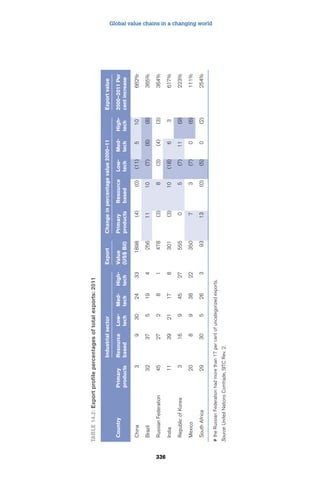
chain. Because exporting firms are generally more integrated into value-added 
chains, they will typically have higher foreign content ratios, particularly when 
they are foreign owned. As such, the estimates provided in this version should be 
considered as prudent. Generally, they will point to lower shares of foreign content 
than might be recorded if more detailed input-output tables were available with 
consequences for all other indicators presented. One important innovation in 
the indicators presented here is to use specially constructed input-output tables 
103
Global value chains in a changing world 
for China that differentiate between processing firms, other exporting firms and 
those that produce goods and services only for domestic consumption. Because 
of China’s importance to trade this significantly improves the quality of the results. 
• Proportionality assumption: on its own, this assumption is not expected to have a 
significant impact on total economy estimates but it will affect the import content of 
various industries and, by extension, bilateral trade estimates of trade in value-added. 
The results, however, are not expected to be biased in any particular direction. 
3.8. Concluding remarks: challenges ahead 
The OECD and the WTO have been closely cooperating with other stakeholders involved 
or interested in the issue of producing estimates of trade in value-added. However, as 
shown above, many statistical issues remain to be resolved. More generally, best practices 
need to be established when trade and national accounts divergences cannot be resolved 
simply and diverging sources need to be arbitraged. Given the importance of the subject, 
the OECD and the WTO will be looking to engage more closely with their networks of 
official statistics institutes and other international organizations in the coming years in 
order to attempt to mainstream the production of trade in value-added statistics, such 
that their quality can be considered in the same light as other official statistics. 
Clearly, the key technical challenges in the immediate future concern the quality 
of trade statistics and the assumptions made to allocate imports to users, be they 
industries or consumers. In addition, there are a number of issues that arise from 
the recent revision to the System of National Accounts (2008 SNA) and Balance of 
Payments Manual (BPM6) which provide the underlying basis for international trade 
transactions and indeed those recorded in input-output tables. Chief among these 
concerns are changes made to the recording of “goods sent abroad for processing” 
and “merchanting”. Other important changes have been made, such as the recognition 
that research and development expenditures should be recorded as investment, which 
directly changes value-added. Indeed, the recognition of R&D as investment shines 
a spotlight on other intellectual property products and on the importance of flows of 
income as opposed to only value-added. 
Additionally, work will begin on looking at a corollary to trade in value-added, namely 
trade in jobs. Other areas include the contribution made by capital more generally. 
Because of the way capital (gross fixed capital formation) is recorded in the 
accounting system, the goods content of services is generally low but in theory this 
104
Estimating trade in value-added: why and how? 
value is captured in the services sector’s operating surplus. Capturing these flows 
is also important, particularly for those countries with high exports of capital goods. 
Work will also begin to look at the benefits to the wholesale and retail sector of selling 
imported goods to final consumers. Again, the institutional networks of the OECD and 
its partner organizations in the international statistics community are well placed to 
provide an umbrella for these issues to be further developed. 
105 
Endnotes 
1 Financial Times, 24 January 2011. 
2 WTO and Commission des Finances du Sénat, (2011). 
3 “Adding value to the European Economy. How anti-dumping can damage the supply of 
globalised European companies. Five case studies from the shoe industry”, Kommerskollegium, 
National Board of Trade, Stockholm, 2007. 
4 See Escaith et al., (2010) and Lee et al., (1997). 
5 See an application of international IO on “Japan’s earthquake and tsunami: International trade 
and global supply chain impacts”, VoxEU, April 2011. Available at: http://www.voxeu.org/index. 
php?q=node/6430 
6 See WTO and IDE-JETRO (2011). 
7 For more information on the database see www.oecd.org/trade/valueadded. 
8 An OECD-World Bank workshop, “new metrics for global value chains”, was organized on 
21 September 2010. WTO hosted a Global Forum on Trade Statistics on 2–4 February 2011, in 
collaboration with Eurostat, UNSD and UNCTAD. 
9 OECD-WTO, 2012. 
10 Some research-oriented initiatives have been using the GTAP data base for international input-output 
data. This is not however based on official sources of statistics. 
11 For more details, see also www.oecd.org/sti/inputoutput. 
12 The results of parallel projects at the OECD and EUROSTAT on micro-data bases linking trade 
statistics and business registers will help characterizing better the profile of export-oriented firms. 
13 Global Forum “Measuring Global Trade — Do we have the right numbers?” 2–4 February 
2011, jointly organized by the United Nations Statistics Division (UNSD), the Statistical Office of the 
European Communities (Eurostat) with the World Trade Organization (WTO) and the United Nations 
Conference on Trade and Development (UNCTAD). 
14 For more details, see www.oecd.org/sti/btd.
Global value chains in a changing world 
106 
References 
Ahmad, N.; Wyckoff, A. 2003. “Carbon Dioxide Emissions Embodied in International Trade of 
Goods”, OECD Science, Technology and Industry Working Papers 2003/15 (Paris, France, 
Organization for Economic Co-operation and Development). 
Ahmad, N; Araujo, S. 2011. “Measuring Trade in Value-Added and Income using Firm-Level 
data”. Available at: http://siteresources.worldbank.org/INTRANETTRADE/Resources/Internal- 
Training/287823-1256848879189/6526508-1283456658475/7370147-1308070299 
728/7997263-1308070314933/PAPER_8_Ahmad_Araujo.pdf 
Ali-Yrkkö, J.; Rouvinen, P.; Seppälä, T.; Ylä-Anttila, P. 2011. “Who Captures Value in Global 
Supply 
Daudin, G.; Monperrus-Veroni, P.; Rifflart, C.; Schweisguth, D. 2006. “Le commerce extérieur en 
valeur ajoutée” Revue de l’OFCE, 98:129–165. 
Daudin, G.; Rifflart, C.; Schweisguth, D. 2009. “Who produces for Whom in the World Economy?”, 
Dedrick, J.; Kraemer, K.L.; Linden, G. 2010. “Who Profits from Innovation in Global Value 
Chains?: A Study of the iPod and notebook PCs”, in Industrial and Corporate Change 19(1), 
81–116. 
Escaith, H. 2008. “Nouvelle économie industrielle, commerce international et valeur ajoutée: 
implications statistiques et comptables”, Actes du 12e colloque de l’Association de comptabilité 
nationale in INSEE-Méthodes, 225-251. 
Escaith, H.; Lindenberg, N.; Miroudot, S. 2010. “International Supply Chains and Trade Elasticity 
in Time of Global Crisis”, WTO Staff Working Paper ERSD-2010-08 (Geneva, Switzerland, 
World Trade Organization). 
Escaith, H.; Keck, A.; Nee, C.; Teh, R. 2011. «Japan’s Earthquake and Tsunami: International 
Trade and Global Supply Chain Impacts», in VoxEU, 28 April. Available at: http://www.voxeu. 
org/article/japans-earthquake-and-tsunami-global-supply-chain-impacts 
Hummels, D.; Ishii, J.; Kei-Mu, Y. 2001. “The nature and growth of vertical specialization in world 
trade,” in Journal of International Economics, 54(1): 75–96. 
Johnson, R.C.; Noguera, G. 2011. “Accounting for Intermediates: Production Sharing and Trade 
in Value-Added” in Journal of International Economics, forthcoming. 
Jones, R.; Kierzkowski, H. 2001. “A Framework for Fragmentation”, in S. Arndt and 
H. Kierzkowski (eds):
Estimating trade in value-added: why and how? 
Hayakawa, K. 2007. “Growth of Intermediate Goods Trade in East Asia” in Pacific Economic 
Review 12(4), 511–523. 
Koopman, R.; Wang, Z.; Wei, S.-J. 2008. “How Much Chinese Exports is Really Made in China – 
Assessing Foreign and Domestic Value-Added in Gross Exports”, NBER Working Paper No. 
14109 (Cambridge MA, National Bureau of Economic Research). 
Koopman, R.; Powers, W.; Wang, Z.; Wei, S.-J. 2011. “Give Credit to Where Credit is Due: Tracing 
Value Added in Global Production Chains”, NBER Working Paper No. 16426, September 2010, 
revised September 2011 (Cambridge MA, National Bureau of Economic Research). 
Lanz, R.; Miroudot, S.; Ragoussis, A. 2009. “Trade in Intermediate Goods and Services”, OECD 
Trade Policy Working Paper No. 93 (Paris, France, Organization for Economic Co-operation 
and Development). 
Lee, H.L.; Padmanabhan, V.; Whang, S. 1997. “The Bullwhip Effect in Supply Chains” in Sloan 
Management Review, 38(3), 93–102. 
Leontief, W.; Strout, A. 1963. “Multiregional Input-Output Analysis”, in: T. Barna (ed.): Structural 
Interdependence and Economic Development, (New York, St-Martin’s Press), 119–150. 
Linden, G.; Kraemer, K. L.; Dedrick, J. 2009. “Who Captures Value in a Global Innovation 
Network? The Case of Apple’s iPod”, in Communications of the ACM 52(3), 140–144. 
Linden, G.; Kraemer, K. L.; Dedrick, J. 2011. “Who Captures Value in the Apple iPad?”, in mimeo, March. 
Maurer, A.; Degain, C. 2010. “Globalization and Trade Flows: What You See is not What You 
Get!”, WTO, Staff Working Paper N° ERSD-2010-12 (Geneva, Switzerland, World Trade 
Organization). 
Meng, B.; Yamano, N.; Webb, C. 2010. “Application of Factor Decomposition Techniques to 
Vertical Specialisation Measurements”, IDE-JETRO Discussion Paper No. 276 (Tokyo, Japan, 
Institute for Developing Economies-Japan External Trade Organization). 
Nakano, S.; Okamura, A.; Sakurai, N.; Suzuki, M.; Tojo, T.; Yamano, N. 2009. “The Measurement 
of CO2 Embodiments in International Trade. Evidence from Harmonised Input-Output and 
Bilateral Trade Database”, OECD Science, Technology and Industry Working Papers 2009/3 
(Paris, France, Organization for Economic Co-operation and Development). 
OECD. 2012. “New Sources of Growth: Knowledge-Based Capital Driving Investment and 
Productivity in the 21st Century”, Interim Project Findings. Electronic access: http://www.oecd. 
org/sti/50498841.pdf. 
107
Global value chains in a changing world 
Parikh, A. 1979. “Forecasts of Input-Output Tables using the RAS Method”, in Review of 
Economics and Statistics 61 (3), 477–481. 
Sanyal, K.; Jones, R. 1982. “The Theory of Trade in Middle Products”, in American Economic 
Review 72(1), 16–31. 
Walmsley, T. L.; Lakatos, C. 2008. “Regional Input-Output Data”, in B. Narayanan and T.L. Walmsley 
(eds): Global Trade, Assistance, and Production: The GTAP 7 Data Base, (West Lafayette, IN, 
Center for Global Trade Analysis, Purdue University). 
WTO; Senate Finance Commission. 2011. Conference Proceedings “Globalization of Industrial 
Production Chains and Measurement of Trade in Value Added” (Geneva). Available at: http:// 
www.ceibs.edu/knowledge/papers/images/20060317/2847. pdf 
WTO; IDE-JETRO. 2011. “Trade Patterns and Global Value Chains in East Asia: from Trade in 
Goods to Trade in Tasks” (Geneva, Switzerland, World Trade Organization and Tokyo, Japan, 
Institute for Developing Economies-Japan External Trade Organization). 
Xing, Y.; Detert, N. 2010. “How the iPhone Widens the United States Trade Deficit with 
the People’s Republic of China”, ADBI Working Paper Series No. 257 (Tokyo, Japan, Asian 
Development Bank Institute). 
108
4 The implications of using 
value-added trade data for applied 
trade policy analysis1 
Robert B. Koopman, Marinos Tsigas, 
David Riker and William Powers 
109 
4.1. Introduction 
Recent efforts to examine trade data from a value-added perspective, and linking that 
work to global value and supply chains, has largely been driven by the recognition 
that traditional data on imports and exports may be masking the increasingly cross-border 
nature of global production networks. In this paper we examine how using 
new data sets on value-added trade in two traditional empirical models, a trade-based 
computable general equilibrium model and an econometric estimation of exchange 
rate pass through, generate new and useful insights. Our results suggest that the new 
data sets could improve empirical information used to support policy making. 
The two empirical exercises we undertake aim to capture features of the increasing 
fragmentation of production in international trade. Early efforts to explain and 
measure this fragmentation include papers such as Feenstra (1998; 2000) and Hummels 
et al., (1999), which focused largely on factor content and/or vertical specialization 
measures. Later papers by Koopman et al., (2010), Koopman et al., (2012b) and 
Johnson and Noguera (2012) extended this work in country specific and global 
settings by explicitly focusing on value-added in trade and aimed to explain and 
measure the links between standard trade data measured in gross terms and trade 
measured in value-added terms. Papers by Grossman and Rossi-Hansberg (2008) 
and Baldwin (2011) are among those that develop conceptual explanations as to why 
fragmentation in trade occurs. 
The growing body of work on measuring trade in value-added is largely aimed at 
providing empirical estimates of trade data that are consistent with measures of gross
Global value chains in a changing world 
domestic product (GDP), purging double counting of intermediates and tracing the 
global value chain more precisely through countries’ domestic production, exports and 
imports (see, for example, Timmer, 2012 regarding the World Input Output Database 
(WIOD), OECD/WTO, 2013, USITC, 2011).2 These new databases tell a rich and 
consistent story of how production in many countries is dependent on imports, and 
that imports are often further transformed and exported. Thus we now have global 
databases of value-added trade at the broad sectoral level, consistent with global 
macro variables for GDP that also clearly capture empirically the stories widely 
circulated about value chains in specific products such as the iPod, iPad, iPhone, 
notebook computers and Barbie Dolls.3 One of the iPhone calculations illustrates that 
a US$ 179 import from China contains approximately US$ 7 of Chinese value-added, 
and that the iPhone imported from China probably contains more US value-added 
than Chinese value-added.4 
These databases are important because they provide a more accurate and nuanced 
understanding of trade flows that are often masked by the traditional trade data. For 
instance, policy debates around the US–China bilateral trade imbalance often propose 
policies to offset what are described as the artificially low renminbi–dollar exchange 
rate, unfair subsidies and trading practices of the Chinese Government and the inability 
to compete with exceptionally low Chinese wages. Policy prescriptions typically call 
for the Chinese to substantially appreciate the renminbi or for the US to place a tariff 
on imports from China to offset the perceived undervaluation. The value-added trade 
databases illustrate clearly at a more macro level the iPhone story. The WTO/OECD 
value-added estimates of the US-China merchandise trade balance for 2010 is 
US$ 131 billion, compared to the traditional trade data’s balance of US$ 176 billion, while 
US deficits with Japan, the Republic of Korea and other Asian countries grow.5 Koopman 
et al., (2010) show that Chinese value-added by sector varies widely, with electronic 
products and many other products produced in Chinese export processing zones 
containing relatively low levels of Chinese value-added, while products such as steel, 
textiles and clothing contain relatively high levels of Chinese value-added. Thus policy 
responses to concerns over gross trade imbalances are likely to have unexpected 
and unintended consequences that are specific to the policy response. A unilateral 
appreciation of the renminbi will have a bigger impact on the importing country prices 
of goods produced by Chinese sectors containing substantial Chinese value-added, 
such as steel and textiles. However, unilateral renminbi appreciation is likely to have 
smaller impacts on the importing country prices for those products exported from 
China using substantial amounts of imported components, such as those produced in 
export processing zones, for example electronic goods.6 These effects suggest that 
110
The implications of using value-added trade data for applied trade policy analysis 
standard, bilateral macro level comparisons of exchange rate effects on a country’s 
exports could be very misleading. 
Obviously China is not the only country affected by such factors. De La Cruz et al., 
(2010) illustrate that Mexican exports to the US have less domestic value-added 
than Chinese exports to the US. The efforts to create global databases such 
as (1) WIOD, (2) Global Trade Analysis Project (GTAP) based databases (used by 
Koopman et al., and Johnson and Noguera, among others), and (3) the WTO-OECD 
database demonstrate clearly that all countries participate in global value chains and 
the extent and depth to which they participate can be masked when using databases 
based on traditional gross trade statistics. These new databases suggest that 
traditional economic models that use databases built using simplifying assumptions 
about import uses in consumption, investment and export production in the domestic 
economy may not accurately capture the value chain impacts across countries.7 
In the remainder of this paper we examine the effect of using the new value-added 
trade databases on two important empirical applications. First, we build a version 
of the now standard computable general equilibrium (CGE) trade model, using a 
GTAP based database and a model that uses information derived from the USITC 
global value chains work instead of traditional trade data and examine the impact 
of two scenarios – a US tariff placed on Chinese imports aimed at offsetting a 
low exchange rate and a second scenario approximating an appreciation of the 
renminbi by a similar amount as the US tariff. We then compare the results of 
this global value chains (GVC) based model with results from a model based on 
traditional data and find that the GVC trade model has quite important differences 
that more clearly illustrate how global value and supply chains work through the 
global economy, and how they can cause some unexpected and unintended effects 
within and across economies. 
The second application is to use the WIOD value-added trade database to empirically 
estimate exchange rate and other price change pass-through, and compare the 
results of those estimations from the same data but using gross trade data instead of 
value-added trade. There is a broad literature, which we describe later in this paper, 
that examines a long-running question on why exchange rates and other global 
price changes have less than perfect pass through to domestic prices. Again we find 
substantial differences between the estimates, with the value-added-based estimates 
providing a statistically superior fit and intuitively more appealing results than those 
based on the literature. 
111
Global value chains in a changing world 
4.2. Value-added trade data and CGE experiments of two 
hypothetical US-Asia rebalancing scenarios8 
In this section we examine the potential effects of two US-Asia rebalancing scenarios 
using two different CGE models and databases. We compare selected results from 
the GTAP global trade CGE model (Hertel, 1997; Narayanan et al., 2012) with results 
from a CGE global trade model based on the global value chain (GVC) data discussed 
thus far (this model is discussed in detail in Koopman et al., 2013). The economic 
theory of the GVC model is similar to the theory of the GTAP model except for two 
differences that are discussed below. 
We run two hypothetical comparative-static experiments to illustrate two alternative 
mechanisms that could result in a rebalancing in US-Asia trade flows using the 
GTAP model and the GVC model. The first hypothetical scenario is a decline in real 
savings in China by about 17 per cent. The second hypothetical scenario is the US 
applies additional duties on imports from China at the rate of 27.5 per cent. These two 
experiments are not calibrated to produce the same effect for any particular variable; 
thus differences in a particular effect across the two experiments do not imply that 
one change is more effective than the other change. 
112 
4.3. CGE models and data 
The data sets for both the GTAP model and the GVC model have essentially the 
same regions and sectors. Both data sets focus on the United States and China as 
well as their top trade partners. Table 4.1 shows the 26 regions and 41 production 
sectors in each region that are specified to represent the world economy. The first 
difference between the GTAP and the GVC model is that in the GVC model China 
and Mexico have export processing zones and these zones are modelled as separate 
economies. Thus the total number of economies in the GVC model is 28. Figure 4.1 
illustrates the GVC model linkages between the processing trade economy in China, 
the rest of China and a third economy, Japan. Figure 4.1 shows that there is two-way 
trade between Japan and the two Chinese economies; Japanese products enter the 
Chinese processing zone duty free; the rest of the Chinese economy exports products 
to its processing zone but does not import any products from it; finally, it is assumed 
that labour and capital can move freely between the Chinese export processing zone 
and the rest of the economy in China. The same linkages apply to Mexico and its 
processing zone in the GVC model. In the standard GTAP model trade is only specified
The implications of using value-added trade data for applied trade policy analysis 
Table 4.1: Regions and sectors in the GVC CGE model 
Regions Sectors 
1 China 1 Crops 
2 China – export processing zones 2 Livestock 
3 Hong Kong, China 3 Forestry 
4 Chinese Taipei 4 Fishing 
5 Japan 5 Coal 
6 Korea, Republic of 6 Oil and gas 
7 Indonesia 7 Minerals nec 
8 Philippines 8 Meat and dairy products 
9 Malaysia 9 Other foods 
10 Singapore 10 Beverages and tobacco products 
11 Thailand 11 Textiles 
12 Viet Nam 12 Wearing apparel 
13 India 13 Leather products 
14 Australia, New Zealand 14 Wood products 
15 Canada 15 Paper products, publishing 
16 United States 16 Petroleum, coal products 
17 Mexico 17 Chemical, rubber, plastic products 
18 Mexico – export processing zones 18 Mineral products nec 
19 Brazil 19 Ferrous metals 
20 European Union – 12 20 Metals nec 
21 European Union – 15 21 Metal products 
22 Russian Federation 22 Motor vehicles and parts 
23 South Africa 23 Transport equipment nec 
24 Rest of high income countries 24 Electronic equipment 
25 Rest of South America 25 Machinery and equipment nec 
26 Rest of Asia 26 Manufactures nec 
27 Rest of East Asia 27 Electricity 
28 Rest of the world 28 Gas manufacture, distribution 
113 
29 Water 
30 Construction 
31 Trade 
32 Transport nec 
(Continued)
Global value chains in a changing world 
Table 4.1: (Continued) 
Regions Sectors 
FiGuRe 4.1: linkages between processing trade in China, the rest of China, and Japan in 
114 
the GVC Model 
Source: Authors. 
33 Water transport 
34 Air transport 
35 Communication 
36 Financial services nec 
37 Insurance 
38 Business services nec 
39 Recreational and other services 
40 Public Admin., Defense, Educ., Health 
41 Dwellings 
Source: Authors. 
bilaterally between Japan and China, as China processing is subsumed in China, and 
similarly with respect to the Mexico component. 
Trade flows in both models are represented by gross trade figures. The global value 
chain aspect of current international trade is reflected in the GVC model via the 
Armington specification. In both the GTAP and the GVC model, commodities (and
The implications of using value-added trade data for applied trade policy analysis 
services) are assumed to be differentiated by their region of origin, i.e., the Armington 
specification is applied (Armington 1969a; 1969b). The two models, however, 
implement the Armington assumption in different ways. 
Because of the lack of necessary data, the Armington assumption is implemented 
in two levels in the GTAP model: producers and consumers distinguish the domestic 
variety of a good from its imported variety without regard to the country of origin of the 
imported input; the sourcing of imported goods is placed at the border of an economy. 
Figure 4.2 illustrates the implementation of the Armington specification in the GTAP 
model. The left-hand side of Figure 4.2 sketches substitution possibilities in the 
production process of a particular sector. At the top level, valued-added, a composite 
of labour and capital, can be substituted with intermediate inputs. At the second level, 
the domestic variety of a particular intermediate input can be substituted with its 
imported variety; this is the first component of the Armington assumption. The GTAP 
model incorporates similar substitution possibilities for household demands. The left-hand 
side of Figure 4.2 shows that the sourcing of imported goods, for instance how 
much to import from particular countries, is modelled for the economy as a whole; 
FiGuRe 4.2: Sourcing of imported goods in the GTaP model 
115 
Source: Authors.
Global value chains in a changing world 
this is the second component of the Armington assumption. We can visualize the 
economic mechanisms incorporated in Figure 4.2 as follows: for each economy and 
for each good, there is an importing firm which imports the good from other countries; 
the sourcing of imports changes as the relative prices change. This importing firm 
blends the country varieties of the particular good and supplies the blended imported 
good to producers and consumers. 
Because of additional data work done for the development of the GVC data, it is 
possible to place the sourcing of imports in the GVC model at the agent level as 
shown in Figure 4.3. This is the second difference between the GTAP model and the 
GVC model. Figure 4.3 shows that in the GVC model, a particular producer decides 
not only how much to import of a particular good, but also from where to source these 
imports from. Thus in the GVC model we have potentially established tighter linkages 
between sectors located in different economies than the linkages contained in the 
GTAP model. We have also substituted an aggregate mechanism that determines 
bilateral trade, i.e., sourcing of imports for the economy as a whole in the GTAP model, 
with a micro-based mechanism of bilateral trade, such as the sourcing of imports at 
the agent level. 
In Figure 4.4 we present GDP results from the two rebalancing scenarios 
in the GTAP and GVC models. We can see that country level GDP effects 
FiGuRe 4.3: Sourcing of imported goods in the GVC model 
116 
Source: Authors.
The implications of using value-added trade data for applied trade policy analysis 
FiGuRe 4.4: Per cent change in GDP volume 
117 
Source: Authors’ calculations.
Global value chains in a changing world 
are sensitive to the model chosen, despite identical parameterization and 
experimental shocks. In the savings experiment, the GVC model produces a 
smaller impact on China’s GDP than in the traditional model, while many other 
countries experience larger GDP effects. In the tariff experiment, the GDP 
effects on China are muted in the GVC model compared to the GTAP model, and 
the other countries experience large differences in impacts with particularly big 
differences for Mexico, Malaysia, Singapore, Thailand, Chinese Taipei and Viet 
Nam. Clearly, at the GDP level in the models, the GVC model produces quite 
FiGuRe 4.5: united States’ imports of electronics 
118 
Source: Authors’ calculations.
The implications of using value-added trade data for applied trade policy analysis 
different results from the traditional GTAP model. GDP is a much-aggregated 
measure of model impacts and can be complicated to explain the various factors 
driving its change. Thus we now turn to some sectoral examples that highlight 
more clearly the impact of a GVC based model compared to a traditional GTAP 
model. 
Figure 4.5 presents the change in US imports of electronic equipment in the 
two savings-rate experiments. The two experiments show almost exactly 
the same decline in imports from China (-15 per cent), but results for other 
suppliers differ widely depending on their roles in the electronics value chain. 
For example, Mexico experiences the largest export gain because its exports 
of electronics to the United States contain very little Chinese content. In fact, 
China had a lower market penetration in Mexico for imported intermediate inputs 
in 2007 than it did in any other country in our data set. Hence, when Chinese 
exchange rates rise, driving up the cost of Chinese intermediate inputs, prices 
of electronics from Mexico rise less than electronics from its competitors. 
Viet Nam has a very different role in the electronics supply chain. In 2007, Viet Nam 
was largely an assembler of Chinese intermediates, with little production of its 
own intermediates. Hence, it is quite negatively affected by the rise in price 
of Chinese intermediates. For other countries, the two models showed much 
smaller differences. Particularly for East Asia, results are similar because these 
countries are both upstream and downstream, exporting intermediates to China 
and receiving intermediates from it. 
Figure 4.6 presents Chinese imports of electronic equipment in the two 
experiments. The GVC model shows substantial deviations from the standard 
GTAP model, particularly for countries outside of East Asia. In many cases, 
countries have higher exports in the GVC experiment. In both models, the 
resulting rise in China’s real exchange rate causes substitution away from 
Chinese sourcing of electronics inputs. Only the GVC model, however, 
captures the important differences between Chinese processing and non-processing 
imports. In this model, Chinese non-processing imports rise, but 
Chinese processing imports fall. Even though these imports fall by 10–20 
per cent for many countries, processing zones become relatively less reliant 
on domestic sourcing because of the even greater (42 per cent) decline in 
domestic inputs. Hence, the overall change in Chinese imports from a particular 
source depends on how involved that source is in Chinese processing trade. 
For many countries in East Asia, the declines in processing imports dominate 
119
Global value chains in a changing world 
the rise in non-processing imports, and so overall Chinese imports from these 
sources decline. 
Figure 4.7 presents Chinese imports of iron and steel in the two experiments. As 
with Chinese imports of electronics, the two experiments present different pictures 
of the results of a rise in the real Chinese exchange rate. In Figure 4.7, however, 
the deviation is more consistent across countries, with higher imports in the GVC 
experiment for 19 of 26 countries. As with electronics, the exchange rate rise 
causes substitution away from Chinese sourcing, with a rise in processing imports 
and a fall in non-process imports. Results are more uniformly positive for the GVC 
experiment because export suppliers are much less involved in processing trade 
120 
FiGuRe 4.6: Chinese imports of electronics 
Source: Authors’ calculations.
The implications of using value-added trade data for applied trade policy analysis 
for steel. In 2007, processing trade constituted 90 per cent of overall electronics 
imports but only 17 per cent of iron and steel imports. Processing trade for iron 
and steel come mostly from specific East Asian suppliers (for example, Chinese 
Taipei, Japan, the Republic of Korea) which were the most negatively affected 
suppliers in Figure 4.7. 
These experimental results illustrate that a CGE model specified in such a 
way as to better reflect the trade linkages found in modern global supply and 
value chains can produce substantial differences in macro-level impacts and 
also reflect the realities of specific product chain relationships. Focusing on 
development of better model specification and database development may 
result in more realistic and accurate experiment results that could improve 
advice provided to policy makers. 
121 
FiGuRe 4.7: Chinese imports of steel 
Source: Authors’ calculations.
Global value chains in a changing world 
4.4. Value-added trade data and estimation of exchange 
rate and price pass through effects9 
We now examine the impact of using value-added trade data compared to traditional 
gross trade data to examine exchange rate pass-through. Fluctuations in exchange 
rates can have significant effects on the competitiveness of foreign producers who 
export to the US market. As long as there are rigidities in nominal wages and prices, 
reductions in the nominal value of an exporter’s currency will lower its relative costs of 
production and the relative price of its exports. The magnitude of the resulting change 
in the demand for US imports will depend on the substitutability of imports from 
other countries and on the currency denomination of the costs of these international 
competitors. 
There is a sizeable empirical and theoretical literature that investigates the pass-through 
of nominal exchange rate fluctuations into import prices and the resulting 
change in international trade flows. Goldberg and Knetter (1997) provide a broad 
review of the literature on exchange rate pass-through. Marazzi et al., (2005) 
and Brun-Aguerre et al., (2012) are important recent contributions. A common 
assumption in empirical studies of exchange rate pass through is that each exporter’s 
entire marginal cost of product is denominated in the exporter’s domestic currency. 
However, if some of the exporter’s intermediate inputs are imported, and these 
costs are not denominated in the exporter’s domestic currency, then the exporter’s 
marginal costs of production will only be partly exposed to fluctuations in the value of 
its currency. In this more realistic case, the effect of the exchange rate changes will 
depend on the share of domestic value-added in marginal costs. 
This limitation — the unrealistic representation of the currency exposure of 
production costs — is often recognized in the literature as a caveat, but it is difficult 
to resolve because there is often only limited information on costs of production. 
More realistic modelling of costs requires information about value-added shares 
in the exporting country, but it also requires information about the currency 
denomination of the marginal costs of all of the other countries that compete in the 
same destination market. For example, an appreciation of the renminbi will affect 
the marginal costs (and prices) of exporters from China, according to the domestic 
share of the value-added in their exports, but it will also affect the marginal costs 
(and prices) of any exporters in Mexico or other countries whose products include 
value-added from China. Thus the recent developments in the estimation of value-added 
trade flows provide the needed information in a form that is easy to use and 
122
The implications of using value-added trade data for applied trade policy analysis 
we can then compare empirical results using this new data with results estimated 
using traditional trade data.10 
To examine the effect of the alternative data sets we estimate a set of econometric models 
of exchange rate pass through and the link between exchange rates and trade flows 
using data on the value-added content of trade. Our analysis focuses on trade in non-petroleum 
manufactured goods for final use over the last decade, as recorded in WIOD. 
We translate our parameter estimates into pass-through rates and Armington 
elasticities, and then ultimately into trade elasticities (defined here as the change in 
export value resulting from a change in the nominal exchange rate). We find evidence 
that value-added trade data can significantly improve estimates of exchange rate 
pass-through rates and trade elasticities by more fully accounting for the effects of a 
reduction in the value of an exporter’s currency on its own costs and the costs of its 
international competitors. 
Two important differences between our methodology and other recent studies of 
exchange rate pass through are the level of product aggregation and the use of trade 
values rather than price data. Recent contributions to the exchange rate pass through 
literature often use price data for narrow products and estimate a correlation between 
import prices and nominal exchange rates. In contrast, we use the fairly aggregated 
WIOD sectors and estimate a correlation between the value of trade flows and 
nominal exchange rates. Our method is constrained by the level of aggregation in the 
WIOD data and by the absence of prices in the WIOD data. Despite these limitations, 
our methodology makes two important contributions. First, it utilizes the value-added 
shares to calculate a more realistic measure of the currency denomination of the 
exporters’ costs. Second, it generates estimates of trade elasticities in addition to 
pass through rates. 
123 
4.5. Econometric estimates 
Our econometric analysis is derived from an import demand specification for goods. 
Its theoretical underpinnings are similar to those of the gravity model of international 
trade.11 All variables in the model are derived and estimated as a percentage change 
over time. For each sector, the model examines the determinants of the percentage 
change over time in the value of bilateral exports from exporter i to importer j.12 It 
explains the export value change in terms of an export price change measured using 
the information on the global sources of value-added in goods exported by country 
i.13 For each country adding value to this flow, the country’s value-added share is
Global value chains in a changing world 
combined with information on price changes in that country and nominal exchange 
rate changes that the country had with the importing country j. Thus, rather than 
explaining the change in export values with only the final exporter i ’s price and 
exchange rate information, the model uses the price and exchange rate changes of 
all countries adding value to i ’s exports, weighted by the share of value each of these 
countries contributes. Appendix A specifies the estimating equation and shows how 
the exchange-rate pass-through (λ) and elasticity of substitution (σ) are calculated 
from the regression coefficients. 
For our econometric estimation we use data from WIOD.14 The estimate of value-added 
shares relies on a transformation from the direct input-output table provided by 
WIOD into the Leontief inverse matrix, which describes all inputs, direct and indirect, 
used in the provision of final goods.15 For our estimates, the WIOD database provides 
the required data on sectoral trade, domestic expenditure, and, after transformation, the 
value-added shares. We estimate the model using OLS and a panel of log-first-differences 
from 2000 to 2009 for 13 non-petroleum manufacturing sectors in 28 of 
the largest countries in the WIOD dataset. 
Table 4.2 presents the estimates of the exchange rate pass-through rate (λ) and the 
substitution elasticity (σ) for each sector. Overall, the estimated pass-through rates 
are sensible and precisely estimated in our preferred specification (the first three 
columns of the table). In eight of the 13 sectors, estimates are bounded between zero 
and one at the 95 per cent significance level, and only two sectors (transportation 
equipment and food, beverages and tobacco) have point estimates outside this range. 
Thus for most sectors, we can strongly reject the hypothesis that there is complete 
pass through of nominal exchange rate fluctuations. The median pass-through 
estimate is 0.44. Estimated pass-through rates of this magnitude are consistent with 
the finding of incomplete pass-through in the prior studies cited above. The estimates 
for substitution elasticity for our preferred specification in table 4.1 are also precisely 
estimated. The point estimates are all greater than one and significantly different 
from one in nine sectors at the 95 per cent significance level. The median elasticity 
is 1.84. For comparison, we are not aware of any estimates employing the current 
methodology or WIOD data, but elasticities in the GTAP model may be the closest 
available estimates at a similar level of aggregation. The median elasticity in the 15 
non-food, non-petroleum manufacturing sectors in the GTAP model is 3.75, twice the 
median estimate in this study. 
Table 4.2 also presents estimates employing an alternative specification that assumes 
that exports contain 100 per cent domestic content (a constraint on the value-added 
124
The implications of using value-added trade data for applied trade policy analysis 
shares in equation (1)). These estimates depart from the preferred estimates employing 
value-added estimates in consistent ways. Although elasticities are generally higher 
in the alternative specification, estimates of pass-through rates are consistently lower. 
The alternative estimates are not preferred on statistical grounds. The table reports 
F-statistics of the joint hypothesis that the coefficients in the regression models are 
equal to zero, along with p-values in parentheses. The alternative specification has 
Table 4.2: Estimates of exchange rate pass-through and the substitution elasticity 
Estimates based on 
value-added shares 
125 
Alternative assuming 
100% domestic content 
F-Statistic F-Statistic 
Food, beverages ,and 
tobacco products 
2.649 
(10.236) 
1.092 
(0.356) 
4.17 
(0.016) 
1.799 
(4.688) 
1.136 
(0.353) 
4.50 
(0.011) 
Textiles 0.433 
(0.327) 
1.607 
(0.400) 
4.81 
(0.008) 
0.383 
(0.255) 
1.686 
(0.398) 
5.28 
(0.005) 
Leather products 0.534 
(0.190) 
1.764 
(0.354) 
5.31 
(0.005) 
0.458 
(0.158) 
1.787 
(0.370) 
4.62 
(0.010) 
Wood products 0.365 
(0.047) 
2.727 
(0.247) 
29.83 
(0.000) 
0.324 
(0.040) 
2.796 
(0.260) 
27.99 
(0.000) 
Paper 0.463 
(0.356) 
1.373 
(0.318) 
1.64 
(0.194) 
0.402 
(0.301) 
1.383 
(0.329) 
1.41 
(0.245) 
Chemicals 0.507 
(0.135) 
1.917 
(0.274) 
16.51 
(0.000) 
0.429 
(0.104) 
2.000 
(0.288) 
15.14 
(0.000) 
Rubber and plastic 
products 
0.380 
(0.050) 
2.403 
(0.241) 
29.45 
(0.000) 
0.320 
(0.039) 
2.505 
(0.256) 
26.63 
(0.000) 
Non-metallic mineral 
products 
0.462 
(0.066) 
2.438 
(0.312) 
13.65 
(0.000) 
0.422 
(0.058) 
2.499 
(0.319) 
14.11 
(0.000) 
Metal products 0.550 
(0.502) 
1.403 
(0.394) 
2.79 
(0.062) 
0.449 
(0.455) 
1.363 
(0.406) 
1.58 
(0.206) 
Machinery 0.225 
(0.073) 
1.770 
(0.193) 
8.05 
(0.000) 
0.198 
(0.063) 
1.796 
(0.201) 
7.81 
(0.000) 
Electrical and optical 
equipment 
0.372 
(0.074) 
1.871 
(0.172) 
16.18 
(0.000) 
0.307 
(0.055) 
1.958 
(0.183) 
15.95 
(0.000) 
Transportation equipment -0.083 
(0.219) 
1.844 
(0.396) 
4.93 
(0.007) 
0.008 
(0.151) 
1.954 
(0.424) 
4.72 
(0.009) 
Other manufacturing 0.436 
(0.065) 
2.191 
(0.235) 
20.58 
(0.000) 
0.369 
(0.055) 
2.212 
(0.245) 
17.75 
(0.000) 
Median 0.436 1.844 8.050 0.383 1.954 7.81 
Source: Authors’ calculations. 
Note: robust standard errors of the parameter estimates and p-values of the F-statistics in parentheses.
Global value chains in a changing world 
a lower F-statistic in 10 of the 13 sectors than the preferred specification. Thus the 
model based on value-added shares performs better than the simpler model that 
ignores this information. 
126 
4.6. Trade elasticities 
The trade elasticity TEijtis defined as the percentage change in the value of exports 
from country i to country j for every one percent increase in the value of the exporter’s 
currency.16 
The trade elasticity consists of two parts: an own-price effect and a price-index effect. 
For country i, the own-price effect is determined by the share of i ’s value-added in its 
own exports, while the price-index effect depends on the share of i ’s value-added used 
by all competing exporters. Appendix A gives the expression for the trade elasticity 
based on value-added shares, export shares and the pass-through and elasticity of 
substitution values given in Table 4.2. 
To illustrate the model, we have calculated trade elasticity estimates for exports 
to the United States in 2009. We use WIOD data for all countries in 2009 to 
calculate the value-added shares and US expenditure shares of exports from 27 
countries in 13 manufacturing sectors.17 We also use our econometric estimates 
of λ and σ from Table 4.2. Table 4.3 provides specific examples for exports of 
electrical and optical equipment in 2009 from three different countries to the 
United States. The table reports the two sets of trade elasticity estimates, and 
it reports the value-added shares measures that underlie the differences in the 
estimates across the four countries. For example, the China column indicates that 
a 10 per cent increase in the renminbi price of a US dollar (a 10 per cent renminbi 
depreciation relative to the US dollar) will increase the value of China’s exports 
to the US in this sector by 2.039 per cent (if the value-added trade data are not 
used in the estimate) or by 1.373 per cent (in our preferred specification using 
value-added trade data). The latter is almost a third lower. The trade elasticity that 
uses the value-added trade data is a combination of a positive 2.156 per cent 
own-price effect and a negative 0.783 percent price-index effect that offsets 
some of the own price effect. 
The trade elasticity estimates for exports from Brazil are much larger than their 
counterparts for China, reflecting Brazil’s relatively small share of US imports, its
The implications of using value-added trade data for applied trade policy analysis 
relatively large domestic value-added share in its exports and its relatively small 
value-added share in competing exporters like Mexico. These factors also imply that 
there is a small — in fact negligible — price index effect for the imports of electrical 
and optical equipment from Brazil. The third column reports estimates for Hungary; a 
large difference in the two trade elasticities reflects the country’s unusually low value-added 
share in its exports of electrical and optical equipment to the United States. 
Like Brazil, the price index effect is negligible and the trade elasticity is determined 
almost entirely by the own price effect. 
Table 4.4 reports simple averages of the sector-specific trade elasticity estimates 
for 27 exporting countries. The final column reports the ratio of these averages. For 
each country, this ratio is less than one, indicating that the inclusion of the value-added 
data reduces the estimate of the trade elasticity. The ratios of these average 
trade elasticities range from 0.5974 to 0.9630. The lowest are for Ireland, Hungary, 
the Czech Republic and Chinese Taipei. The highest are for the Russian Federation, 
Brazil, Japan and Australia. 
Table 4.3: Numerical examples from the electrical and optical equipment sector in 2009 
127 
Brazil China Hungary 
Trade elasticity without value-added trade data 0.2936 
(0.0610) 
0.2039 
(0.0424) 
0.2934 
(0.0610) 
Trade elasticity with value-added trade data 0.2648 
(0.0548) 
0.1373 
(0.0284) 
0.1273 
(0.0264) 
Own price effect 0.2662 
(0.0551) 
0.2156 
(0.0446) 
0.1278 
(0.0265) 
Price index effect -0.0014 
(0.0003 
-0.0783 
(0.0162) 
-0.0005 
(0.0001) 
Ratio of the two trade elasticities 0.9019 0.6734 0.4339 
Ratio of the price index effect to the own price effects -0.0053 -0.3632 -0.0039 
Components of the value-added elasticity estimate - - - 
Domestic share of the value-added in the country’s 
0.821 0.665 0.394 
exports 
The country’s value-added share in the u.s. import 
price index 
0.006 0.395 0.002 
Source: Authors’ calculations. 
Note: robust standard errors in parentheses.
Global value chains in a changing world 
Table 4.4: Average trade elasticity for each exporting country 
128 
Exporting country Trade elasticity 
with value-added 
data 
Trade elasticity 
without value-added 
data 
Ratio of trade 
elasticity 
estimates 
Australia 0.2925 0.3236 0.9038 
Austria 0.2495 0.3239 0.7704 
Belgium 0.2109 0.3234 0.6522 
Brazil 0.3109 0.3235 0.9613 
Canada 0.2602 0.3147 0.8269 
China 0.2176 0.2637 0.8253 
Czech Republic 0.2235 0.3242 0.6894 
Denmark 0.2531 0.3239 0.7815 
Finland 0.2606 0.3242 0.8039 
France 0.2890 0.3392 0.8522 
Germany 0.2607 0.3201 0.8144 
United Kingdom 0.2741 0.3217 0.8519 
Hungary 0.2064 0.3242 0.6366 
India 0.2708 0.3112 0.8704 
Ireland 0.1932 0.3234 0.5974 
Italy 0.2739 0.3198 0.8565 
Japan 0.2992 0.3212 0.9315 
Korea, Republic of 0.2348 0.3231 0.7267 
Mexico 0.2663 0.3177 0.8384 
Netherlands 0.2317 0.3238 0.7154 
Poland 0.2513 0.3239 0.7758 
Portugal 0.2566 0.3240 0.7920 
Russian Federation 0.3123 0.3243 0.9630 
Spain 0.2733 0.3235 0.8449 
Sweden 0.2415 0.3209 0.7526 
Chinese Taipei 0.2252 0.3224 0.6984 
Turkey 0.2691 0.3239 0.8308 
Source: Authors’ calculations.
The implications of using value-added trade data for applied trade policy analysis 
Table 4.5 reports sector-specific estimates for US imports from China. For each of the 
sectors, the trade elasticity estimate based on the value-added data is less than 
the alternative estimate that assumes 100 per cent domestic content. The largest 
reduction (in percentage terms) is for the electrical and optical equipment sector. The 
smallest reduction is for the food products sector. The final column reports the ratio 
of the price index effect to the own price effect for the trade elasticity based on the 
value-added data. For some of the sectors, there is a large price index effect that 
offsets much of the own price effect. This is the case for the textiles, electrical and 
Table 4.5: Estimated trade elasticity for United States imports from China 
Sector Trade elasticity 
without value-added 
129 
data 
Trade elasticity 
with value-added 
data 
Ratio of price index 
effect to own price 
effect 
Food, beverages and 
tobacco products 
0.2421 
(0.0812) 
0.2103 
(0.0731) 
-0.0273 
Textiles 0.1817 
(0.0644) 
0.1358 
(0.0502) 
-0.3836 
Leather 0.1313 
(0.0432) 
0.1203 
(0.0369) 
-0.6494 
Wood products 0.5157 
(0.0773) 
0.4546 
(0.0664) 
-0.1318 
Paper 0.1533 
(0.0936) 
0.1348 
(0.0760) 
-0.0239 
Chemicals 0.4197 
(0.0767) 
0.3327 
(0.0584) 
-0.0484 
Rubber and chemical 
products 
0.3969 
(0.0550) 
0.3196 
(0.0421) 
-0.2038 
Non-metallic mineral 
products 
0.5435 
(0.1044) 
0.4616 
(0.0904) 
-0.1577 
Metal products 0.1094 
(0.0617) 
0.1047 
(0.0444) 
-0.3491 
Machinery 0.1376 
(0.0552) 
0.1090 
(0.0425) 
-0.1596 
Electrical and optical 
equipment 
0.2039 
(0.0424) 
0.1373 
(0.0284) 
-0.3632 
Transportation equipment 0.0071 
(0.1448) 
-0.0496 
(0.1155) 
-0.0552 
Other manufacturing 0.3855 
(0.0661) 
0.3577 
(0.0567) 
-0.1846 
Sources: Authors calculations. 
Note: robust standard errors in parentheses.
Global value chains in a changing world 
optical equipment, and metal products sectors. For other sectors like transportation 
equipment and paper, there is almost no price index effect. 
^ 
jjt is the first difference of the log of the value of domestic shipments 
^ 
ijt is the first difference of the log of the value of exports from 
130 
4.7. Conclusions 
We have presented two empirical examples that illustrate the relevance for policy 
makers of using value-added trade data compared to traditional trade data. We 
specified a new CGE model based on additional information derived from the USITC 
work on value-added trade data and the implied global linkages between countries. 
Using this new model we find substantial and important quantitative differences for 
the size of macro, sectoral and geographic impacts along supply chains compared 
with a more traditional gross trade based model. We also developed a practical tool 
for estimating the effect of fluctuations in nominal exchange rates on the value of US 
imports of manufactured goods using a structural model of trade and a value-added 
decomposition of gross trade flows. We find that estimates of pass through rates that 
do not incorporate value-added trade data can be systematically understated, while 
estimates of trade elasticities that do not incorporate value-added trade data can be 
systematically overstated. 
Appendix A: Econometric specifications 
Equation (1) gives the estimating equation used to determine the exchange rate pass-through 
and elasticity of substitution. 
^ 
ijt–V 
V 
^ 
jjt = β0 + β1P 
^ 
jjt + β2Σkθkit (P 
^ 
kkt–E 
^ 
kjt) + ηijt. (1) 
The variable V 
in country j in year t, V 
^ 
jjt is the first difference of the log of 
country i to country j in the currency of country j , P 
^ 
kjt is the first 
the price of domestic goods in country j in the currency of country j , and E 
difference of the log of the country k currency price of the currency of country j. The 
variable θkit represents the cost share of country k in the sector’s exports from country 
i in year t. Finally, the variable ηijt is an error term with conventional distributional 
assumptions. We do not include a subscript for sector, since we estimate a separate 
set of econometric models for each sector. We can recover the underlying parameters 
of the model from the regression coefficients in (1). The elasticity of substitution, σ, is 
equal to 1+β1. The exchange rate pass through rate, λ, is equal to –β2/β1.
The implications of using value-added trade data for applied trade policy analysis 
The trade elasticity TEijt is defined as the percentage change in the value of exports from 
country i to country j for every one percent increase in the value of the exporter’s currency. 
TEijt= (1–σ) λ (–θiit) + (1–σ) λ Σkθikt γkjt (2) 
131 
} 
} 
own price effect price index effect 
The variable γkjt denotes the share of exports from country k to country j in the total 
expenditures (in the sector) of country k in year t. 
Endnotes 
1 The authors are economists at the International Trade Commission. This paper reflects solely 
the views of the authors and is not meant to represent the views of the US International Trade 
Commission or any of its Commissioners. We thank Zhi Wang for his valuable contributions and 
discussions, but all remaining errors are ours. 
2 For an excellent overview of the OECD-WTO database see OECD – WTO (2013), which can be 
found at http://www.oecd.org/sti/industryandglobalisation/49894138.pdf. For the WIOD database 
overview see Timmer (2012) which can be found at http://www.wiod.org/publications/papers/ 
wiod10.pdf. For the GTAP based database see Koopman et al., (2012) which can be found at http:// 
www.nber.org/papers/w18579. 
3 For example Kraemer and Dedrick (2002); Linden et al., (2009); Xing and Detert (2010), 
Tempest (1996). 
4 Xing and Detart (2010). 
5 OECD-WTO Database on Trade in Value-Added: First Estimates:16 January 2013, found at http:// 
www.oecd.org/sti/industryandglobalisation/TIVA_stats_2013OECD_WTO_final_11_01_2013.pdf. 
6 See Amold (2008). 
7 See for example Escaith et al., (2011). 
8 This section draws from Koopman et al., (2013). 
9 This section draws on Riker and Powers (2013). 
10 There is a burgeoning literature examining the sources of value-added in final goods traded and 
consumed internationally. Examples include Johnson and Noguera (2012); Koopman et al., (2012b); 
Powers (2012); Stehrer (2012); and Timmer et al., (2012). 
11 Powers and Riker (2013) derive this econometric specification from a CES model of international 
trade. 
12 The change in export value is measured relative to the change in the importing country’s 
domestic shipments in this sector.
Global value chains in a changing world 
13 As with export value, the exporter’s price change is measured relative to the importer’s price 
change in this sector. 
14 The database contains data on the international sourcing of intermediate inputs and final goods 
in 35 sectors among 40 countries (27 EU plus 13 other major countries) for 1995–2009. We also 
use local-currency deflators from the IMF to measure local prices. 
15 See Timmer et al., (2012) for a discussion of the Leontief inverse. We thank Zhi Wang for the 
provision of these inverses. 
16 Powers and Riker (2013) derives this formula and discusses these two effects in more detail. 
17 The exporters include all countries in the estimation sample except for the United States. 
132 
References 
Armington, P.S. 1969a, “A theory of Demand for Products Distinguished by Place of Production,” 
IMF Staff Papers 16(1): 159–178. 
Armington, P.S. 1969b, “The Geographic Pattern of Trade and the Effects of Price Effects,” IMF 
Staff Papers 16(2): 179–201. 
Arnold, B. 2008. “How Changes in the Value of the Chinese Currency Affect U.S. Imports.” 
Congressional Budget Office, Congress of the United States, Washington, DC. Available at: 
http://www.cbo.gov/sites/default/files/cbofiles/ftpdocs/95xx/doc9506/07-17-chinatrade.pdf 
Baldwin, R. 2011. “Trade and Industrialisation after Globalisation’s 2nd Unbundling: How 
building and Joining a Supply Chain are Different and Why it Matters”, NBER Working Paper 
No. 17716, December (Cambridge, MA, National Bureau of Economic Research). 
Brun-Aguerre, R.; Fuertes, A.M.; Phylaktis, K. 2012. “Exchange Rate Pass-Through into Import 
Prices Revisited: What Drives It?” in Journal of International Money and Finance 31: 818–844. 
Dedrick, J., Kraemer, K.L.; Linden, G. 2010. “Who Profits from Innovation in Global Value Chains?: 
A Study of the iPod and Notebook PCs”, in Industrial and Corporate Change 19(1): 81–116. 
De La Cruz, J.; Koopman, R.; Wang, Z.; Wei, S.J. 2011. “Estimating Foreign Value-Added in 
Mexico’s Manufacturing Exports” USITC Office of Economics Working Paper No. 2011-4A 
(Washington, DC, United States International Trade Commission). 
Escaith, H.; Teh, R.; Keck, A.; Nee, C. 2011. “Japan’s Earthquake and Tsunami: International 
Trade and Global Supply Chain Impacts” VOXEU, April 28. Available at: http://www.voxeu.org/ 
article/japans-earthquake-and-tsunami-global-supply-chain-impacts 
Feenstra, R. C. 1998. “Integration of Trade and Disintegration of Production in the Global 
Economy,” in Journal of Economic Perspectives, 31–50.
The implications of using value-added trade data for applied trade policy analysis 
Feenstra, R. C.; Hanson, G. H. 2000. “Aggregation Bias in the Factor Content of Trade: Evidence 
from U.S. Manufacturing,” in American Economic Review, Papers and Proceedings, 90(2): 155–160. 
Goldberg, P. K.; Knetter, M. M. 1997. “Goods Prices and Exchange Rates: What Have We 
Learned?” in Journal of Economic Literature 35: 1243–1272. 
Grossman G. M.; Rossi-Hansberg, E. 2008. “Trading Tasks: A Simple Theory of Offshoring,” in 
American Economic Review, American Economic Association, December, 98(5): 1978–97. 
Hertel, T. 1997. “Global Trade Analysis: Modeling and Applications”, (Cambridge, UK, Cambridge 
University Press). 
Hummels, D., Ishii, J.; Yi K-M. 1999. “The Nature and Growth of Vertical Specialization in World 
Trade,” Staff Reports No. 72, (New York, NY, Federal Reserve Bank of New York). 
Johnson, R. C.; Noguera, G. 2012. “Accounting for Intermediates: Production Sharing and Trade 
in Value-Added,” in Journal of International Economics 86(2): 224–236. 
Koopman, R,;Powers, W.M.;Wang, Z.; Wei, S.J. 2010. “Give Credit where Credit is Due: Tracing 
Value-Added in Global Productions Networks”, NBER Working Paper No. W16426 (Cambridge, 
MA, National Bureau of Economic Research). 
Koopman, R.; Wang, Z.; Wei, S-J. 2012a. “Gross Exports Accounting and Global Value Chain” 
PowerPoint presentation at MOFCOM-WTO-UNCTAD-OECD joint conference on “Global Value 
Chain in the 21st Century: Policy Implications on Trade, Investment, Statistics and Developing 
Countries” September 19–20. 
Koopman, R.; Wang, Z.; Wei, S-J. 2012b. “Tracing Value-added and Double Counting in Gross 
Exports.” NBER Working Paper No. 18579 (Cambridge, MA, National Bureau of Economic 
Research). 
Koopman, R., Tsigas, M.; Wang, Z.; Li, X. 2012. “U.S.-Asia Trade: Dynamic General Equilibrium 
Linkages,” USITC Working Paper 2013-01-X (Washington, DC, United States International 
Trade Commission). 
Koopman, R.; Tsigas, M.; Wang, Z. 2013. “Potential Rebalancing of U.S.-Asia Trade: Dynamic 
General Equilibrium Linkages and the Implications of Global Value Chains”, USITC Unpublished 
Manuscript (Washington, DC, United States International Trade Commission). 
Kraemer, K.; Dedrick, J. 2002. “Dell Computer: Organization of a Global Production Network”, 
Unpublished Manuscript, (Irvine, CA, Personal Computing Industry Center, University of 
California Irvine). 
Linden, G.; Kraemer, K.; Dedrick, J. 2009. “Who Captures Value in a Global Innovation Network?” 
The Case of Apple’s iPod, Communications of the ACM, 52(3): 140-144. 
133
Global value chains in a changing world 
Marazzi, M.; Sheets, N.; Vigfusson, R.; Faust, J.; Gagnon, J.; Marquez, J.; Martin, R.; Reeve, T. 
Rogers, J. 2005. “Exchange Rate Pass-through to U.S. Import Prices: Some New Evidence.” 
Board of Governors of the Federal Reserve System, International Finance Discussion Paper 
833. Available at: http://www.federalreserve.gov/pubs/ifdp/2005/833/ifdp833.pdf 
Narayanan, B.; Aguiar, A.; McDougall, R. 2012. “Global Trade, Assistance, and Production: The 
GTAP 8 Data Base”, Center for Global Trade Analysis, Purdue University. Available at: https:// 
www.gtap.agecon.purdue.edu/resources/res_display.asp?RecordID=3772. 
OECD-WTO. 2013. “Trade in Value-Added: Concepts, Methodologies and Challenges”. Joint OECD-WTO 
Note, January. Available at: http://www.oecd.org/sti/industryandglobalisation/49894138.pdf. 
Powers, W. 2012. “The Value of Value-Added: Measuring Global Engagement with Gross and 
Value-Added Trade” in World Economics 13(4): 19–38. 
Powers, W. Riker, D. 2013. “Value-Added Trade and Exchange Rate Analysis” USITC, Office of 
Economics, Working Paper 2013-01-X (Washington, DC, U.S. International Trade Commission). 
Stehrer, R. 2012. “Trade in Value-Added and the Value-Added in Trade” WIOD Working 
Paper 8. World Input-Output Database, April. Available at: http://www.wiod.org/publications/ 
papers/wiod8.pdf 
Tempest, R. 1996. “Barbie and the World Economy”, Los Angeles Times, 22 September. 
Available at: http://articles.latimes.com/1996-09-22/news/mn-46610_1_hong-kong 
Timmer, M. P.; Los, B.; Stehrer, R.; de Vries, G. 2012. “Fragmentation, Incomes and Jobs: An 
Analysis of European Competitiveness” WIOD Working Paper 9. World Input-Output Database, 
November. Available at: http://www.wiod.org/publications/papers/wiod9.pdf 
Timmer, M. 2012. “The World Input-Output Database (WIOD): Contents, Sources and Methods.” 
April 2012, Version 0.9. Available at: http://www.wiod.org/publications/source_docs/WIOD_ 
sources.pdf. 
United States International Trade Commission (USITC). 2011. “The Economic Effects of 
Significant U.S. Import Restraints: Seventh Update”, Investigation No.332-325, USITC 
Publication 4253, August. (Washington, DC, U.S. International Trade Commission). 
WTO; IDE-JETRO. 2011. “Trade Patterns and Global Value Chains in East Asia: From Trade in 
Goods to Trade in Tasks” (Geneva, Switzerland, World Trade Organization and Tokyo, Japan, 
Institute for Developing Economies Economies-Japan External Trade Organization). 
Xing, Y.; Detert, R. 2010. “How the iPhone Widens the United States Trade Deficit with the 
People’s Republic of China”, ADBI Working Paper No. 257 (Tokyo, Japan, Asian Development 
Bank Institute). Available: http://www.adbi.org/working-paper/2010/12/14/4236.iphone. 
widens.us.trade.deficit.prc/ 
134
5 Geometry of global value chains 
in East Asia: the role of industrial 
networks and trade policies 
Hubert Escaith and Satoshi Inomata 
135 
5.1. Introduction 
East Asia is one of the best-known examples of a regional economic integration 
process that was initially driven by deepening industrial relations, rather than by 
political agreements, among countries of the region. The institutional or legal aspects 
of regional integration came only afterwards, in a typical “bottom-up” way. The situation 
differs from what has occurred in North America, where the ratification of the North 
America Free Trade Agreement (NAFTA) was a catalyst for the build-up of the US-Mexico 
economic ties. 
What is important about East Asian integration, however, is that the deepening 
economic interdependency was not just a spontaneous phenomenon but it has 
been carefully aided and facilitated by the series of policies implemented by national 
governments. It is this interactive dimension of Asian integration, between industrial 
dynamics on the one hand and institutional development on the other, which presents 
the focus of this study. 
In this line, the paper is structured as follows. The first part will show the evolution of 
regional supply chains in East Asia, using the information derived from international 
input-output (I-O) tables in order to map the dynamics of industrial linkages. The 
second part will demonstrate how trade and trade facilitation policies reduced the cost 
of doing business in the region and opened the way for further economic integration. 
The third part will conclude the discussion.
Global value chains in a changing world 
5.2. Evolution of regional supply chains in East Asia 
In the modern production system, goods and services are processed through the 
progressive commitment of various industries in which a product of one industry is 
used as an intermediate input of others. 
Input-output models and supply chains analyses 
The conventional input-output approach to supply chains generally focuses on 
measuring interconnectedness, or “strength” of linkages among industries, based on 
the traditional demand-pull or cost-push impact models. Now, in addition to the strength 
of linkages, the increasing complexity of production networks due to the participation 
of the variety of industries requires measuring the “length” of linkages for mapping the 
geometry of supply chains. The strength of an input-output table, and what makes 
it special, is indeed its information of production linkages that are derived from 
supply-use relations between industries, which is totally absent in other types of 
data such as industrial statistics or foreign trade statistics. 
Suppose that there is an increase in the demand for cars by JPY 10 billion 
(Figure 5.1). The output expansion of cars brings about the secondary repercussion 
on the production of other products. Apparently, it increases the demand for car 
parts and accessories such as chassis, engines, front glass and tyres. The increase 
in production of these goods, however, further induces the demand for, and hence 
the supply of, their sub-parts and materials such as steel, paints and rubber. A 
change that occurs in one industry (say, an increase in demand for cars) will be 
amplified through the complex production networks and bring about a larger and 
wider impact on the rest of the economy. 
The length is estimated using the concept of average propagation length (APL) 
developed in Dietzenbacher et al., (2005). As an illustrative example, consider the 
following hypothetical supply chains in Figure 5.2. If we want to measure the length 
of supply chains between Industry A and Industry E, we should look at the number of 
production stages of every branch of the supply chains. In this illustrative example, 
there are four paths leading from Industry A to Industry E. The path on the top involves 
two production stages. The second one has four stages, the third has three stages 
and the last one at the bottom has four stages. 
136
Geometry of global value chains in East Asia: the role of industrial networks and trade policies 
137 Figure 5.1: An image of demand propagation (automobile industry) 
Source: Calculated and drawn by the authors.
Global value chains in a changing world 
Now, when the shares of a delivered impact for each path are calculated as given in 
parentheses at the ends of branches, the APL between Industry A and Industry E is 
derived as: 
APL (A-E) = 1 × 0% + 2 × 50% + 3 × 30% + 4 x (10 + 10)% + 5 × 0% + … = 2.7. 
That is, APL is formulated as a weighted average of the number of production 
stages that an impact from Industry A to Industry E goes through, using the share 
of an impact at each stage as a weight.1 It represents the average number of 
production stages lining up in every branch of all the given supply chains, or, in 
short, an industry’s level of fragmentation. (For a formal description of the APL, see 
Technical Note.) 
Figure 5.2: Calculation of average propagation length 
138 
Source: Drawn by the authors. 
Motivations and previous studies 
As already mentioned, the traditional input-output approach to supply chain analysis 
generally centred on the issue of measuring interconnectedness or “strength” of 
linkages among industries. Adding the “length” dimension of supply chains to the
Geometry of global value chains in East Asia: the role of industrial networks and trade policies 
analysis of international production sharing basically responds to the following 
three motivations. 
(1) As has just been demonstrated, it measures the degree of technological 
fragmentation and sophistication of particular supply chains. 
(2) APL can be measured both in forward-looking and backward-looking ways. So, 
by comparing the lengths between the two for cross-national supply chains, we 
can identify the relative position of a country in the global production networks. 
(3) If the production process is fragmented and shared among different countries, 
it increases the impact of trade policies on the volume and direction of 
international trade. 
The relevance of the APL model to the issue of fragmentation was already suggested 
in the seminal paper of Dietzenbacher et al., (2005), although the paper did not 
explicitly used the term.2 The APL model was applied at the international level in 
Dietzenbacher and Romero (2007), in which international linkage was analysed for 
major European economies using the international input-output table of 1985. The 
paper also employed the hypothetical extraction method to evaluate the influence of a 
single country on the APL of the chosen regional system, with the result of Germany 
being most influential. The international application of the APL model was brought 
into the Asian context by Inomata (2008a) with an extension to a time-series analysis 
using the Asian International Input-Output Table of 1990, 1995 and 2000. In particular, 
the paper proposed an index of geographical fragmentation based on the APL and 
compared its relative strength and weakness vis-à-vis the traditional measurements 
such as trade shares of intermediate products or the index of vertical specialization. 
For the second motivation, Inomata (2008b) calculated the values of country’s APL, 
again using the Asian International Input-Output Tables, in both forward and backward 
directions and by comparing these two values over time it elucidated the change in 
the relative positions of East Asian countries within the regional value chains. The 
idea was later extended in De Backer and Miroudot (2012) in a slightly different 
framework using the model of Fally (2011), which developed an index of “distance 
to final demand” based on the OECD’s global input-output database covering 56 
countries for the years 1995, 2000 and 2005. 
The third point, the implication of the APL model for trade policies, was discussed in 
Diakantoni and Escaith (2012). As the production process is fragmented and shared 
139
Global value chains in a changing world 
by more countries, the intermediate products cross national borders more frequently, 
and hence the volume of traded products become more sensitive to the change in 
a country’s trade policies. The detrimental effect of protectionist measures in an 
international production network becomes much larger than when the production 
process was relatively simple and taking place in a limited number of countries. 
140 
Analytical results 
The diagram in Figure 5.3 traces the evolution of production networks in the Asia- 
US region over the last two decades. The visualization of the calculation results is 
based on the method presented in Dietzenbacher et al., (2005) with some graphical 
elaboration developed in Inomata (2008b). Arrows represent selected supply chains 
among the countries of the region with the direction of the arrows corresponding 
to the flow of intermediate products. Each arrow has two features: thickness and 
length. The thickness indicates the strength of linkages between industries, while 
the length, as measured against the ripple in the background, is given by APL. The 
number of rings that an arrow crosses represents the rounded value of APL, the 
average number of production stages, and thus indicates the level of technological 
fragmentation and sophistication of that particular supply chain.3 
The analysis uses the Asian International Input-Output Tables for the reference years 
of 1985, 1990, 1995, 2000 and 2005, constructed by the Institute of Developing 
Economies, JETRO.4 While conventional input-output analysis is usually concerned by 
a single country, the treatment is similar for international matrices. The table combines 
the national I-O tables of ten economies: China(C), Indonesia (I), Japan (J), Republic 
of Korea (K), Malaysia (M), Philippines (P), Singapore (S), Thailand (T), Chinese Taipei 
(N) and United States (U). 
In 1985, there were only four key players in the region: Indonesia (I), Japan (J), 
Malaysia (M) and Singapore (S). The basic structure of the production network was 
that Japan built up supply chains from resource-rich countries like Indonesia and 
Malaysia. In this initial phase of regional development, Japan drew on a substantial 
amount of productive resources and natural resources from neighbouring countries to 
feed to its domestic industries. 
By 1990 the number of key players had increased. In addition to the four countries 
already mentioned, Japan had extended its supply chains of intermediate products 
to the Republic of Korea (K), Chinese Taipei (N) and Thailand (T). While still relying
Geometry of global value chains in East Asia: the role of industrial networks and trade policies 
Figure 5.3: evolution of regional supply chains in east Asia: 1985–2005 
C: China, I: Indonesia, J: Japan, K: Rep. of Korea, M: Malaysia, N: Chinese Taipei, 
P: Philippines, S: Singapore, T: Thailand, U: United States 
Source: Authors’ calculation on the basis of IDE-JETRO Asian input-output matrix. 
141
Global value chains in a changing world 
on the productive resources of Indonesia and Malaysia, Japan also started to supply 
products to other East Asian economies, especially to the group known as the Newly 
Industrialized Economies (NIEs). This is the phase when the relocation of Japanese 
production bases to neighbouring countries was accelerating, triggered by the Plaza 
Accord in 1985. It saw the building of strong linkages between core parts’ suppliers 
in Japan and their foreign subsidiaries. 
Then in 1995, the United States (U) came into the picture. It drew on two key supply 
chains originating in Japan, one via Malaysia and the other via Singapore. These two 
countries came to bridge the supply chains between East Asia and the United States. 
Also to be noted is the length of the arrows between Malaysia and Singapore. Compared 
to others, their shortness indicates that the supply chains involve fewer production 
stages, suggesting that the degree of processing is relatively low. It is considered that 
the product flows between these countries are distributional rather than value-adding. 
In the year 2000, on the eve of its accession to the WTO, China began to emerge as 
the third regional giant. The country entered the arena with strong production linkages 
to the Republic of Korea and Chinese Taipei. It then gained access to Japanese 
supply chains through the latter. The United States also brought a new supply chain 
from Philippines (P). So the basic structure of the tri-polar production network in the 
Asia-US region was thus completed. 
The regional production networks thereafter showed dramatic development. By 
2005, the centre of the network had completely shifted to China, pushing the United 
States and Japan to the periphery. China became the core market for the products 
of the region from which final consumption goods were produced for export to 
the US and European markets. Also of note is the nature of the supply chains that 
China developed with others. The notable length of the arrows surrounding China 
indicates that the supply chains towards China are characterized by a high degree 
of fragmentation and sophistication, incorporating substantial amounts of value 
added from each country involved in the production networks. The competitiveness of 
Chinese exports, therefore, is not only attributable to its cheap labour force but also 
to the sophisticated intermediate products that the country receives from other East 
Asian economies, as embedded in goods labelled “Made in China”. 
The APL method can be used to measure separately the upstream and downstream 
length of average production linkages. Updating the methodology proposed by 
Inomata (2008b), Figure 5.4 presents the changes between 1985 and 2005 in the 
relative position of countries in Eastern Asia supply chains with respect to forward 
and backward APL. 
142
Geometry of global value chains in East Asia: the role of industrial networks and trade policies 
The southwest-northeast diagonal presents the average length of supply chains that 
each country participates in. Most economies have moved towards the northeast corner, 
which means that they increased the length of supply chain linkages between 1985 and 
2005. The exceptions to this trend are the United States and Chinese Taipei, while, Japan 
almost did not change; on the contrary, China demonstrates an outstanding increase in 
the length of supply chains. It is considered that inter-linking of its domestic supply chains 
with overseas production networks was accelerated by the country’s accession to the 
WTO in 2001, as suggested by the big leap of the value from 1985 to 2005. 
The northwest-southeast diagonal draws the relative position of each economy within 
the regional supply chains, as determined by the ratio of forward and backward APL. 
The United States and Japan, the most advanced economies in the region, are located 
Figure 5.4: Change of relative positions in the regional supply chains, 1985–2005 
Source: Based on Inomata (2008b) methodology and IDE-JETRO Asian input-output matrix. 
143
Global value chains in a changing world 
in the upstream position, though the United States moved downwards during the period 
and swapped its position with the Republic of Korea. China stays in the downstream 
segment of the regional supply chains, which reflects the country’s position as a “final 
assembler” of the regional products. The other economies more or less remain in the 
middle range spectrum, though the notable change is that Thailand went downstream 
to a large extent, and Chinese Taipei moved up into the middle cluster. 
5.3. Tariffs, transport and trade facilitation 
As shown above, international input-output matrices can be useful in revealing 
the topological characteristics of inter-industrial networks and their evolution. The 
present section aims at underlining some empirical characteristics of the bilateral 
trade “distance” that have a particular relevance from a network perspective. To quote 
Waldo Tobler: “everything is related to everything else, but near things are more 
related than distant things” (De Benedictis and Taglioni, 2011). 
Understanding what defines the associativity between industrial sectors from a 
network perspective (or, symmetrically, the “distance” that lessens the possibility of 
interactions) would imply taking into consideration not only the bilateral relationship, 
but also associate it with the rest of the cluster of industries and countries that 
conforms the supply chain (Abbate et al., 2012). In the traditional trade perspective, 
transaction costs, including border costs and the cost of transporting goods from 
producers to users affects the volume, direction and pattern of trade. In a global value 
chain perspective, trade costs are part of the competitiveness of firms and determine 
in part their ability to participate in production networks. 
More fundamentally, when trade takes place within a production network, the traditional 
bilateral approach to the role of transaction costs has to be abandoned to adopt a 
holistic method, where the intensity of bilateral trade depends also of the strength of 
the “trade-investment” nexus with all other network participants.5 Connectedness with 
other trade partners becomes a central feature for explaining bilateral trade from a 
network perspective: bilateral “trade in tasks” depends not only, from the positive side, 
on the traditional attractors of industrial supply and demand between two countries, 
but also on the number of partners they have in common. At the extreme, no physical 
flow may appear between two closely-interconnected partners, A and B, because all 
trade in value-added transits through a third country, C, playing the role of a hub in 
the network. 
144
Geometry of global value chains in East Asia: the role of industrial networks and trade policies 
Cascading transaction costs in production networks 
The limited evidence available highlights very marked non-linearity in the way in which 
transaction costs negatively affect trade-flows in a trade in task perspective, where 
goods have to travel through several nodes before reaching their final destination. Yi 
(2003) shows that a small decrease in tariffs can induce a tipping point at which vertical 
specialization (trade in tasks) kicks in, while it was previously non-existent. When tariffs 
decrease below this threshold, there is a large and non-linear increase in international 
trade. The cascading and non-linear impact of tariff duties when countries are vertically 
integrated can be extended to other components of the transaction cost. When supply 
chains require that semi-finished goods cross international borders more than once, 
the effect of a marginal variation in trade costs everywhere in the supply chain is much 
larger than would be the case if there were a single international transaction. 
Ferrantino (2012) shows that, when trade costs apply in proportion to the value of 
the good, the total cost of delivering the product to the final consumer increases 
exponentially with the number of production stages.6 For example, if the average ad 
valorem transaction cost is ten per cent, accumulated transaction costs in a five-stage 
supply chain lead to an ad valorem tariff equivalent of 34 per cent. Doubling the 
number of stages by slicing up the supply chain more than doubles the total delivery 
costs, as the tariff equivalent is 75 per cent. All this indicates the critical role of low 
transaction costs including tariff duties and non-tariff measures in facilitating trade in 
a “trade in tasks” perspective. 
Moreover, as we shall see, some features of these transaction costs such as tariff 
schedule escalating in function of the processing stage may be particularly harmful to 
trade in tasks. It is therefore necessary for a supply chain strategy to be successful, 
as was the case in East Asia, so that these transaction costs both physical and 
government-induced be minimized.7 Reducing these costs from a regional perspective 
is particularly important, as many supply chains are regionally-based, as is observed 
in North America, Europe or in East Asia. The following sections will review how they 
have changed across time in order to accommodate and facilitate the development of 
regional production networks. 
Tariff duties and effective rate of protection 
Among all cross-border transaction costs, nominal tariffs are certainly the most 
visible. Tariff duties increase the domestic price of tradable goods by adding a tax 
145
Global value chains in a changing world 
to their international, or free market price. From a “trade in tasks” perspective, not 
only the value of nominal tariffs, but also their distribution between unprocessed and 
processed goods – a feature of nominal schedules known as tariff escalation – have 
a particular importance. By increasing the domestic prices of finished goods more 
than intermediary ones, tariff escalation creates a significant anti-export bias when 
value-added is the traded “commodity”, as is made clear when looking at effective 
protection rates (EPRs). 
Effective protection compares the nominal protection received on one unit of output 
produced by an industry and sold on the domestic market (at a price higher than 
the free market because of the duty charged on competitive imports) with the 
additional production cost the producer had to pay because of the tariff charged on 
the importable inputs required for producing this unit of output. Note that the value of 
one unit of output minus the value of the intermediate inputs required is equal to the 
rate of value added at domestic prices. 
Tariff duties do influence the domestic price of all inputs, including domestically 
produced ones. Domestic suppliers of tradable goods will be able to raise their own 
prices up to the level of the international price plus the tariff duty, without running the 
risk of being displaced by imports. If the tariff schedule is flat (all tariffs are equal), 
the effective protection on the value added is equal to the nominal protection. In the 
presence of tariff escalation, downstream industries producing final goods will benefit 
from a higher effective protection. Upstream industries producing inputs will have, on 
the contrary, a lower protection and possibly a negative one if the sum of duty taxes 
paid on the inputs is higher than the taxes collected on the output. 
As shown in Appendix 5.2, EPR is a ratio comparing the value added per unit of 
output at domestic prices – tariffs applying on both output and inputs – with the value 
added the industry would have gained if operating at international prices (without 
tariff duties). It has been known for years that high EPRs discourage benefiting 
firms from exporting their output. This anti-export bias is even more relevant when 
analysing trade policy from a “trade in value added” perspective (Diakantoni and 
Escaith, 2012). 
One option chosen by countries suffering from high and differentiated tariff 
schedules has been to establish duty-free export processing zones (EPZs). Another 
option is to implement draw-back schemes where domestic firms can have the duty 
taxes paid on inputs reimbursed when they export their products. Nevertheless, as 
146
Geometry of global value chains in East Asia: the role of industrial networks and trade policies 
we shall see, this mitigating strategy is clearly insufficient in the case of fragmented 
production network. 
It is easy to show (Appendix 5.2) that EPZs or duty draw-back schemes will benefit 
the lead exporting firm only if it uses imported inputs, and will price out domestic ones. 
The national suppliers of these firms, because they sell on their own market, will not 
be able to draw back the duties they had to pay on their own inputs. Even if they were 
able to do so, through a somewhat complicated administrative mechanism, domestic 
suppliers using non-imported inputs would still be put at a disadvantage because 
nominal protection raised the domestic price of all tradable products, be they actually 
imported or not. 
In other words, high EPRs lower the competitiveness of domestic suppliers by 
increasing the “country cost” in the same way as an overvalued exchange rate does. 
Countries willing to actively participate in global value chains should therefore pursue 
tariff policies aimed at: (i) lowering nominal tariffs, in order to reduce transaction costs 
below the tipping point at which vertical specialization is profitable, as mentioned in 
Yi (2003), and (ii) reducing tariff escalation and effective protection rates in order to 
reduce the anti-export bias of the tariff schedule and its inflationary impact on the 
“country costs”. 
East Asian developing countries did follow the expected policy, as shown in Table 5.1. 
Not only did nominal protection drop, but the dispersion of duties – the main source 
Table 5.1: Nominal protection and effective protection rates in East Asia and the Pacific, 
1995–2005 (percentage, ad valorem) 
Developing countries Developed countries 
Agriculture Manufacture Agriculture Manufacture 
1995 2005 1995 2005 1995 2005 1995 2005 
Nominal Protection 
– Median 6.5 3.9 9.2 6.2 1.3 1.9 2.3 1.3 
– Average 27.2 11.9 15.9 7.8 2.0 2.1 4.0 2.9 
Effective Protection 
– Median 4.9 2.6 14.7 10.6 0.9 3.1 3.5 1.8 
– Average 29.6 15.5 26.3 16.6 1.1 3.9 8.3 5.8 
Source: Diakantoni and Escaith (2012) based on ten countries IDE-JETRO Asian input-output matrix and WTO tariff data. 
Note: NP: nominal protection; EPR or effective protection rate. 
147
Global value chains in a changing world 
of variance in EPRs – was also lower as can be observed from the steeper drop in 
the NP average than in the median. As a result, EPRs decreased in both agriculture 
and manufacture sectors. In developed countries which had already low tariffs in 
1995, the reduction in the protection of domestic manufacture was less impressive in 
absolute value but still important in relative terms. On the contrary, nominal protection 
of agriculture remained stable or even increased when weighted for trade flows. As 
the protection on industrial inputs purchased by farmers decreased, they benefited 
from higher EPRs. 
148 
Transport and trade facilitation 
As for tariffs, costs incurred for transport and customs procedures are magnified 
in international supply chains, because goods for processing cross several borders 
and these costs have to be paid twice, first on the imported component and then on 
the processed good. The social cost is much higher than the monetary implications 
of maintaining large inventories and immobilizing transport equipment for long 
periods of time. The cumulative effect of such barriers creates delays in delivery and 
uncertainty that may entirely disqualify domestic firms from competing for the higher 
value-added portion of the value chain, where flexibility, reactivity and just-in-time 
delivery are a prerequisite. Leaving aside inspection and certification requirements 
related to technical and safety standards, this section focuses on transport and 
administrative procedures. 
To advance their export-led growth agenda, East Asian countries invested 
in improving transport infrastructure. They also put in place schemes aimed at 
alleviating administrative burdens and encouraging processing trade in order to 
take full advantage of GVCs. As shown in Duval and Utoktham (2011), the non-tariff 
cost of trade in goods was 53 per cent of the value of goods for intraregional trade 
among South-East Asian countries in 2007, compared to a prohibitive 282 per 
cent within South and Central Asia. These authors show that natural factors linked 
to geographical characteristics were only partially to blame for these additional 
transaction costs. Distinguishing between natural and non-tariff policy-related 
trade costs, they rank Malaysia, followed by the United States, China, Republic of 
Korea and Thailand as the top five trade facilitators. Singapore and Hong Kong, 
China could not be included in the ranking but would have probably been among 
the top performer.8 Similarly, WTO and IDE-JETRO (2011) highlight the role of 
transport and logistics in fostering the development of GVCs in the East Asia
Geometry of global value chains in East Asia: the role of industrial networks and trade policies 
region by stating that, in 2009, of the top ten leading world ports in terms of 
container traffic, five were located in China and one each in Hong Kong, China; 
Republic of Korea and Singapore. These four economies represent 38 per cent of 
the world’s container port traffic. 
Figure 5.5 shows that, despite the high efficiency of the Asian hubs (Singapore 
ranks second after Germany on the World Bank’s logistics index, while Japan is 7th 
and Hong Kong, China 13th, all ahead of the United States and Canada), there is still 
room for improvement in most of the region’s countries. In particular, the region is 
still far from having the best practices in customs procedures found in high-income 
countries. Unlike with improving trade and transport-related infrastructure, which 
requires costly investment in ports, railroads, roads and information technology, 
improving efficiency in customs procedures is a relatively cost-free matter of 
introducing administrative reform. 
Figure 5.5: Trade, logistics and transportation – east Asia in perspective 
Source: Elaborated on the basis of World Bank LPI, 2012. 
Note: Logistics Performance Index (LPI), weighted average on the six key dimensions. 
149
Global value chains in a changing world 
Regional production networks and shock transmission 
When trade partners are closely interconnected in production networks, as is the 
case in East Asia, a sudden change in one country (a tariff hike or a bottleneck in 
production or logistics) will generate a supply shock through the entire supply chain. 
The shock may increase the cost of the related product or stop production chains, if 
it is disruptive. The damaging impact will be greater the larger the volume of vertical 
trade processed in the originating country (size effect) and the more connected it 
is with other partners (network effect). As mentioned previously, in an input-output 
setting, a rough measure of the depth and length of supply shocks along production 
chains is given by the average propagation length (APL) of this shock. 
Table 5.2 presents a modified version of APL (Diakantoni and Escaith, 2012) calculated 
for 2005 using the aggregated 26-sector IDE-JETRO’s Asian Input-Output. From a 
country perspective, China is the main hub for inter-industrial connections, when both 
Table 5.2: Sectoral average propagation length in East Asia, 2005 (selected cases) 
150 
China 
Japan 
United 
States 
Korea, 
Rep. of 
Taipei, 
Chinese 
Average 
Metals and metal products 75.8 100.0 27.3 31.6 17.8 27.5 
Chemical products 40.7 66.8 45.0 27.3 23.5 24.1 
Computers and electronic equipment 25.2 43.1 19.3 18.1 20.3 16.5 
Petroleum and petrol products 22.5 11.3 9.7 12.9 10.7 11.7 
Other electrical equipment 25.2 25.7 23.2 8.4 8.5 10.7 
Crude petroleum and natural gas 11.5 0.3 17.5 1.3 0.1 6.8 
Industrial machinery 20.7 23.1 9.5 3.8 2.6 6.8 
Transport equipment 10.5 29.0 10.4 3.8 0.6 6.4 
Other manufacturing products 18.1 17.6 8.4 3.8 3.0 5.9 
Food, beverage and tobacco 9.6 4.6 6.9 1.7 0.6 4.1 
Textile, leather, and other 18.5 4.2 2.3 3.7 3.7 3.9 
Paddy 1.2 0.4 0.0 0.3 0.0 0.4 
Average 16.9 17.0 10.0 6.0 4.7 7.0 
Median 11.5 4.6 6.9 2.1 0.7 4.3 
Source: based on Diakantoni and Escaith, 2012. 
Note: Results exclude domestic impacts and were rescaled to 100 for maximum value.
Geometry of global value chains in East Asia: the role of industrial networks and trade policies 
intensity and length are pondered. Japan comes a close second in terms of average 
APL indexes due to the high value of some sectors (metals, chemical products and 
computers). The United States comes in third. From a sectoral perspective, chemical 
products and metals and metal products are by far the sectors generating most of the 
depth in inter-industrial connections, Computers and electronic equipment are also 
highly interconnected. 
151 
5.4. Conclusions 
Understanding trade in the global value chain perspective is greatly enhanced by 
adapting analytical tools derived from network economics and the study of inter-industry 
or inter-country relationships. Analysing the bilateral relationship between 
two nodes of a production network requires understanding the complementarity 
between them as well as with other partners in the network, as well as the factors that 
may explain the strength of the edges between them. International input-output (IIO) 
matrices are an effective way of describing and modelling the development of inter-industrial 
relationships in such a transnational context. 
Thanks to a close relationship between input-output analysis and graph theory, 
diachronic IIOs serve also to map and visualize the evolution of productive networks 
and identify their main clusters. Applying these topological properties to the East 
Asian and Pacific context, we show that the inter-industry network moved from a 
simple hub and spokes cluster, centered on Japan in 1995, to a much more complex 
structure in 2005 with the emergence of China but also the specialization of several 
countries, such as Singapore or Malaysia, as secondary pivots. 
The rise of “factory Asia” and its present topology were determined by specific 
policies. The densification of production networks in East Asia resulted from the 
coincidence of business strategies, linked to the widespread adoption of international 
supply chain management by lead firms in Japan and the United States, with the 
promotion of export-led growth strategies from developing East Asian countries. 
These countries applied a series of trade facilitation policies that lowered not only 
tariff duties, but also reduced other transaction costs. 
We show that tariff escalation was greatly reduced in developing East Asia between 
1995 and 2005, reducing the dissuasive anti-export bias attached to high effective 
protection rates and improving in the process the competitiveness of second-tier 
national suppliers. The other axis of trade facilitation focused on improving logistics
Global value chains in a changing world 
services and cross-border procedures. While the East Asia region is well ahead of 
the rest of developing Asia in this respect, there is still a wide margin of progress 
in order to close the gap with best international practices, particularly in terms of 
administrative arrangements. 
Appendix 5.1. Technical note on average 
propagation length 
Suppose an n-industrial sector economy with a production structure defined by the 
input coefficient matrix A shown in Figure a. Input coefficients aij are calculated from 
an input-output table by dividing input values of goods and services used in each 
industry by the industry’s corresponding total output, i.e. aij = zij / Xj where zij is a 
value of good/service i purchased for the production in industry j, and Xj is the total 
output of industry j. So, the coefficients represent the direct requirement of inputs for 
producing just one unit of output of industry j. 
Figure a An input Coefficient Matrix Figure b Impact delivery paths 
152 
A = 
a a a a 
a a a a 
a a a a 
n 
n 
n 
11 12 13 1 
21 22 23 2 
31 32 33 3 
a n 1 a n a 2 n 
3 
an 


 n 


1 step path 
Ind 3 
a13 Ind 1 
2 step paths 
Ind 3 
a23 Ind 2 
a12 Ind 1 
Ind 3 
a33 Ind 2 
a13 Ind 1 
. . . 
. . . 
and so on. 
The vertical sequence of demand propagation can be depicted as follows. Let us 
consider the impact of demand for 100 units in industry 3 upon the output of industry 
1. The simplest form of all is given by the direct linkage [3→1], which is calculated 
as a product of multiplying 100 units by input coefficient a13. This is because a13, 
by definition of an input coefficient, represents an immediate amount of products of 
industry 1 required for producing just one unit of products of industry 3. Alternatively, 
there is a two-step path going through another industry, say, [3→2→1]. This is derived 
by two-stage multiplication, i.e. 100 units by a23, and then by a12. There can also be a 
two-step path going through the same industry, such as [3→3→1] or [3→1→1] which 
would be derived respectively as “100 × a33 × a13” and “100 × a13 × a11” (see Figure b).
Geometry of global value chains in East Asia: the role of industrial networks and trade policies 
The exercise reveals that the impact of any two-step path, whatever the sequence 
of industries, can be given by feeding back a set of direct impacts, A, into the input 
coefficient matrix, i.e. A × A = A2. Similarly, the impact of three-step paths is given by 
A × A2 = A3, that of four-step paths by A × A3 = A4 and so on, which is evident from 
[A2]ij=Σkaikakh, [A3]ij=ΣkΣhaikakhahj, etc. The amount of impacts shown in each layer of Aks 
(k=1, 2, 3,...,) is a result of the initial demand injection passing through all k-step paths. 
It captures the effect of every direct and indirect linkage that undergoes exactly the 
k-round steps/stages of the production process. 
Meanwhile, it is mathematically known that the Leontief inverse matrix L, which shows 
the total amount of goods and services required for the production of one unit of 
output, can be expanded as an arithmetic series, i.e. L = (I – A)–1 = I + A + A2 + A3 + 
A4 + ..., where I is an identity matrix (with “1” in diagonal elements and “0” elsewhere). 
From what we saw above, it is immediately clear that the equation represents the 
decomposition of the total impact on output into its constituent layers according 
to the number of production stages involved. Matrix I corresponds to an initial (unit) 
demand injection and the following Aks are regarded as progressive impacts of the 
initial demand when supply chains are sliced at the kth stage of the production process. 
With this preliminary understanding, Average Propagation Lengths are specified as: 
APL(j-i) = 1*aij / (lij – δij)+ 2*[A2]ij / (lij – δij) + 3*[A3]ij / (lij – δij)+ ... 
  
A A 
153 
=  


k k 


= ij 
= 
k 
k 1 k 1 
ij 
[2] 
where A is an input coefficient matrix, aij is its elements, lij is Leontief inverse 
coefficients, δij is a Kronecker delta which is δij=1 if i=j and δij=0 otherwise, and k 
is a number of production stages along the path. We also define APL(j-i)=0 when 
(lij – δij) =0. 
The first term in the right-hand side of the upper equation shows that the impact 
delivered through one-step paths (k=1), i.e. direct impact, amounts to aij / (lij – δij) 
share of the total impact given by the Leontief inverse coefficients (less unity for 
diagonal elements). Similarly, two-step paths (k=2) contribute [A2]ij / (lij – δij) share, 
and three-step paths (k=3) give [A3]ij/ (lij – δij) share of the total impact. This is evident 
from L = I + A + A2 + A3 + ... which is rearranged as L – I = A + A2 + A3 + ..., and hence 
(L – I)ij = (lij – δij) = Aij+ [A2]ij+ [A3]ij+ ....
Global value chains in a changing world 
That is, Average Propagation Lengths is formulated as a weighted average of the 
number of production stages which an impact from industry j goes through until it 
ultimately reaches industry i, using the share of an impact at each stage as a weight. 
Appendix 5.2. Effective protection rates and anti-export 
j i i ij 
  
( )+ ( ) 
j i i 
f 
ij i i 
. . 
154 
bias 
EPR for sector “j” is the difference between the nominal protection enjoyed on the 
output minus the weighted average of tariff paid on the required inputs. 
It is given by: 
EPR 
t t a 
j a 
i ij 
= 
− 
− 
 
 
( ) 
1 
. 
[3] 
With aij : elements of the matrix A of technical coefficients in an input-output matrix, 
tj : nominal tariff on sector “j”, 
ti : nominal tariff on inputs purchased from sector “i”. “i” can be equal to “j” when a firm 
purchases inputs from other firms of the same sector of activity. In an inter-country 
framework, “i” includes also the partner dimension [c] as inputs from sector “i” might 
be domestic or imported. 
Note that [1 - Σiaij ] is the rate of sectoral value added per unit of output when there is 
no tariff and the domestic prices of tradable goods are similar to the international ones 
(free trade). Therefore, EPRs are the ratio of the value added obtained considering 
the given (applied) tariff schedules compared to a situation of free trade and no tariff. 
It can be negative when firms pay a high tariff on their inputs but have a low nominal 
protection on their output. 
Tariff duties influence the domestic price of all inputs, including domestically produced. 
Domestic suppliers of tradable goods will be able to raise their own prices up to the 
level of the international price plus the tariff duty, without running the risk of being 
displaced by imports. Distinguishing between domestic and foreign inputs, EPR can 
therefore be written as: 
EPR 
t ta t a 
j a 
h 
ij 
i ij 
= 
− 
 
− 
 
1 
[4]
Geometry of global value chains in East Asia: the role of industrial networks and trade policies 
t a t a 
a 
a ta 
a 
155 
With af 
ij and ah 
ij the intermediate consumption “i” from, respectively, foreign and home 
country required to produce one unit of output “j”. 
From a “trade in tasks” perspective, we can deduce two important conclusions from 
equation [4]: 
(i) A high positive EPR reduces protected sectors’ incentive to export, as their rate 
of return on the domestic market is higher than what they can expect on the 
international one. Similarly, an exporting firm will be in an inferior position vis à 
vis a foreign competitor operating in a free trade environment, as its value-added 
when selling at world price is lower than its free-trade competitor, as shown in [5]. 
1 ( )+ ( ) 
1 
1 
. . − 
 
− 


i i 
f 
ij i i 
h 
ij 
i ij 
[5] 
(ii) When duty draw-backs or tariff exemption (as in export processing zones) correct 
for this bias and allow domestic producers to purchase inputs at international 
prices, export-oriented firms still have a disincentive to purchase inputs internally 
as their second-tier domestic suppliers won’t be able to benefit from the duty 
exemption (see [6]).9 
1 + ( ) 
1 
1 
. − 
 
− 


i 
f 
ij i i 
h 
ij 
i ij 
[6] 
While the anti-export bias [5] is a well-known result from a traditional trade in final 
goods perspective, new corollary [6] is relevant only from a vertical specialization 
perspective, where a “buy” decision arising from a “make or buy” assessment implies 
arbitraging between domestic and foreign suppliers. 
Endnotes 
1 The reason for using the impact shares as weights is as follows. If a calculated share is small, this 
implies that the corresponding path has a small contribution to the overall circuit of impact delivery; 
so this path is considered relatively insignificant in the supply chains and hence the number of 
production stages it has should be weighted less. 
2 A more extensive analysis was carried out in Romero et al. (2009), in which the effects of 
fragmentation on the complexity of the Chicago economy were studied from a set of input-output 
tables estimated for the period 1978–2014.
Global value chains in a changing world 
3 For a detailed explanation of the visualization method, see Annex of WTO – IDE JETRO (2011). 
= n + i  = where C(n) : total cost of delivering the product as a proportion of the 
156 
4 The 2005 table is a preliminary table. 
5 In a gravity model, bilateral trade is proportional to the size of the attractors – supply and demand – 
and inversely related to their economic distance (transaction and transportation costs). The influence 
of the ‘distance’ to other trade partners – or multilateral resistance – has been acknowledged in 
traditional trade analysis, but mainly as a statistical issue when estimating gravity model. Analysing 
complex interdependence in trade relations is still in its infancy. For a review, see Abbate et al (2012) 
and Noguera (2012) for an application to the case of trade in value-added. 
6 More formally, the total cost of delivering the product to the final consumer after (n) production 
1 
stage is: C( ) 
n 1 (1 ) 
i t 
n 
production cost, t : ad valorem transaction cost at each stage, N: number of stages in the supply chain. 
7 Transaction costs – besides tariff duties and non-tariff measures – are usually defined as 
function of the geographical features of the respective countries, infrastructure and transportation 
services (including their regulatory regime and competition policies), custom procedures and other 
cross-border formalities, technological innovations and fuel costs. 
8 Bilateral “natural” trade costs between trade partners are found to account for nearly one third of 
non-tariff trade costs explained by the authors. While significant, this incompressible share leaves a 
lot of space for transport and trade facilitation policies. 
9 Unless firms substitute high-tariff domestic inputs for lower ones (negative correlation between 
changes in tand ah 
) but Diakantoni and Escaith (2012) show that almost no substitution took place 
i ijin East Asia. 
Bibliography 
Abbate, A.; De Benedictis, L.; Fagiolo, G.; Tajoli, L. 2012. “The International Trade Network in 
Space and Time”, LEM Working Paper Series 2012/17 (Pisa, Italy, Laboratory of Economics 
and Management). 
De Backer, K.; Miroudot, S. 2012. “Mapping Global Value Chains”, World Input Output Database 
(WIOD) Conference Paper, available at: http://www.wiod.org/conferences/ . 
De Benedictis L.; Taglioni, D. 2011. “The Gravity Model in International Trade”, in L. De Benedictis 
and L. Salvatici (eds): The Trade Impact of European Union Preferential Policies (Berlin, Germany, 
Springer-Verlag). 
Diakantoni, A.; Escaith, H. 2012. “Reassessing Effective Protection Rates in a Trade in Tasks 
Perspective: Evolution of trade policy in Factory Asia”. WTO Staff Working Paper ERSD- 
2012–11 (Geneva, Switzerland, World Trade Organization).
Geometry of global value chains in East Asia: the role of industrial networks and trade policies 
Dietzenbacher, E.; Romero, I. 2007. “Production Chains in an Interregional Framework: 
Identification by Means of Average Propagation Lengths”, in International Regional Science 
Review, 30: 362. 
Dietzenbacher, E.; Romero, I.; Bosma, N.S. 2005. “Using Average Propagation Lengths to 
Identify Production Chains in the Andalusian Economy”, in Estudios de Economia Aplicada 23: 
405–422. 
Duval, Y.; Utoktham, C. 2011. “Trade Facilitation in Asia and the Pacific: Which Policies 
and Measures affect Trade Costs the Most?”. Asia-Pacific ARTNeT Working Paper No. 94 
(Bangkok, Thailand, Asia-Pacific Research Training Network on Trade). 
Fally, T. 2011. “On the Fragmentation of Production in the US”, presentation (Boulder, CO, 
University of Colorado-Boulder, July). 
Ferrantino, M. 2012. “Using Supply Chain Analysis to Examine the Costs of Non-Tariff Measures 
(NTMs) and the Benefits of Trade Facilitation”. WTO Staff Working Paper ERSD-2012-02 
(Geneva, Switzerland, World Trade Organization). 
Inomata, S. 2008a. “A New Measurement for International Fragmentation of the Production 
Process: An International Input-Output Approach”. IDE Discussion Paper No. 175 (Tokyo, 
Japan, Institute of Developing Economies, JETRO). 
Inomata, S. 2008b. “Average Propagation Lengths: A New Concept of the “Distance” between 
industries, with an Application to the Asia-Pacific Region”. in Sangyo-Renkan Vol.16–1 (in 
Japanese), (Japan, Pan-Pacific Association of Input-Output Studies). 
Noguera, G. 2012. “Trade Costs and Gravity for Gross and Value Added Trade”, (Berkeley, CA, 
UC Berkeley and New York, NY, Columbia University.). 
Romero, I.; Dietzenbacher, E.; Hewings, G. 2009. “Fragmentation and Complexity: Analysing 
Structural Change in the Chicago Regional Economy”, in Revista de Economía Mundial 23: 
263–282 
WTO; IDE-JETRO. 2011. “Trade patterns and global value chains in East Asia: From Trade in 
Goods to Trade in Tasks” (Geneva, Switzerland, World Trade Organization and Tokyo, Japan, 
IDE-JETRO). 
Yi, K-M. 2003. “Can Vertical Specialization Explain the Growth in World Trade?” in Journal of 
Political Economy 111: 52–102. 
157
Part III 
Some issues for supply chain 
managers
6 Views of GVC operators 
161 
Deborah K. Elms 
The chapters in this volume discuss different types and configurations of global 
value chains (GVCs). Authors have covered issues of scale and scope, risk, size and 
proliferation of supply chains — particularly in Asia. Many of these broader concerns 
look quite different viewed up close to business leaders operating in the thick of specific 
GVCs. This chapter, by contrast, focuses attention on some key points of interest in 
supply chains as seen from the perspective of business.1 
This chapter highlights the key roles of imports, managing inventory, moving products 
across borders, and outsourcing. It considers the pressures within the supply chain 
industry for consolidation and future innovation. Finally, it concludes by highlighting 
some government policies that are especially harmful for the development of global 
value chains from the viewpoint of supply chain operators and lead business firms. 
6.1. Different types of chains 
Not every supply chain is the same, of course. Nor is every company involved in supply 
chains active across the same sets of activities. For example, Li  Fung manages 
15,000 suppliers across a wide range of industries in over 40 countries. YCH Group 
handles not only manufacturing components, but also spare parts for ATM networks 
in India. Savant Infocomm runs cold storage supply chains for perishable items in India 
alongside a traditional system that does not require refrigeration and such careful 
attention to temperature details. All of these diverse tasks require different sets of 
skills and management activities. 
What unites big players, however, is expertise in managing systems, making investments 
in the individuals who operate these systems, and building up the capacity to explore 
new options and opportunities for expansion.
Global value chains in a changing world 
162 
6.2. Managing inventory 
One of the most important roles for many manufacturing supply chain operators is 
managing inventory. Because lead companies are increasingly pressing their vendors 
to manage inventory, this task now falls to suppliers or to the last rungs of the value 
chain. Keeping inventory low and located at different levels of the chain dramatically 
increases the flexibility and agility of the supply chain. It also lowers the costs because 
carrying inventory no longer appears on the company’s bottom line. Supply chain 
operators help by managing inventory flow to ensure that the goods arrive at the right 
place at exactly the right time. 
As an example, YCH Group produces computer kits for assembly into Dell Computers. 
Approximately 50 different suppliers produce the components that all need to be 
put together for the production line. When they began this task, it took the company 
eight hours to pull the stock and put the kits together. However, the time soon fell to 
four hours. Now, when an order is received, YCH can deliver the kit components to 
the line for assembly by Dell in just 45 minutes. 
However, this requires very precise timing. If any one of the 50 suppliers is late on 
a delivery, the entire line comes to a halt. Because most of the components are 
coming from different countries, it requires very close coordination across multiple 
countries and tight communication with customs officials to be able to deliver on 
time. 
It also requires YCH to provide help in setting up resilience for the supply chain 
network to ensure that companies have more than one source for critical supplies. 
This means that if some disaster knocks out a part of the chain, the rest of the network 
of distribution facilities can take over from elsewhere in the region. 
Managing inventory requires a delicate balance between carrying just enough 
expensive stock to avoid running out, but not too much to burden the balance sheet. 
There is one other aspect to carrying low inventory, however, that is important to 
note — it quickly uncovers problems elsewhere in the system. Any internal inefficiency 
that could be disguised under conditions of high inventory is rapidly exposed with low 
stocks. If orders are being received late, for instance, it might not be too noticeable 
when ample items are already sitting on the shelves. If the cupboard is bare, a late 
order will be glaringly obvious.
Views of GVC operators 
6.3. Shifting products across borders 
Globally competitive firms like Dow Chemical literally use the world as their platform. 
They source raw materials from everywhere. Imported components — nearly 70 per cent 
of their total inventory — are vital to creating the final products. Of the remaining 
30 per cent of products that are produced domestically, many also include some 
imported components or raw materials as well. Without imports, it is not possible to 
create products for the domestic market or to manufacture exports. 
Wind energy provides an excellent example of this kind of globally sourced product. To 
create huge wind blades, one of Dow’s customers requires a specialty product created 
by Dow. The supply chain for this chemical starts with an oil well somewhere in the 
North Sea, which is shipped to a refinery in Amsterdam. From there the raw material is 
shipped to the Dow manufacturing facility in Germany. Afterwards, some is shipped 
to the Republic of Korea where they do a relatively high distillation process. Then this 
product is sent to China for formulation where it is packed into small drums and sent 
to the customer for manufacture into wind blades. 
In fact, a major manufacturer like Dow now spends more money on logistics and services 
than on manufacturing. This is particularly true considering that costs in logistics are not 
simply the costs of the tankers and trucks, but also the inventory costs, service costs, 
government requirements, reporting requirements, import duty tariffs, and issues like 
labeling, materials safety, managing inventory, and so forth. 
As a result, a huge payoff for business comes from standardization and optimization 
in logistics. How can the cycle be shortened? How can inventory be pushed around 
better and faster? For businesses, it is easier to shift products from one location to 
another through various operations and touch points while maintaining consistency 
and standardization in terms of reporting in terms of values, duty, tariffs and so forth. 
Anything that can be done to reduce costs and improve efficiency in transferring 
goods across borders would be extremely helpful and welcome. 
6.4. The role of outsourcing 
One risk for supply chain operators is disintermediation — the possibility that lead firms 
might decide to cut out the middle man and do things themselves at some point. For 
instance, Dell Computer could opt to bundle their own computer kits and not rely on 
163
Global value chains in a changing world 
YCH any longer. However, this does already happen in some cases. Carter’s, a children’s 
clothing company, does not outsource the entire production of OshKosh B’Gosh clothing 
to Li  Fung. Instead, only certain aspects of logistics are handed over to Li  Fung. 
What pushes a firm to decide when to outsource and when to hang on to production 
internally? In part it comes down to core competencies. If there is some aspect of the job 
that is either viewed as a critical competency for the firm to handle in-house or, if the firm 
believes it can do this aspect better and more cost effectively internally, it will not outsource. 
If, however, neither condition holds, the task can be handed off to another firm. 
The same thing is true for the supply chain operators themselves. If they do not have 
a core competency for a task, they should also outsource the task to some other 
firm with better, lower cost options for completing it. It is, after all, just as important 
for supply chain operators and big manufacturers to be nimble and keep their own 
costs down. Their shareholders and Wall Street analysts are seeking high returns on 
investment, which requires them to avoid diverting company performance by insisting 
on performing non-key tasks in-house. 
One aspect that bigger supply chain operators bring to the task, however, is 
specialized knowledge of markets. For example, Li  Fung work with suppliers not 
only in well-known parts of China, but increasingly in more distant places. Building 
up knowledge requires a commitment on the part of the firm to form relationships 
with firms, local government officials, regional actors and other stakeholders. Such 
an investment may not be something that lead firms want to make, but rather to 
outsource to their supply chain operators instead. 
6.5. Pressures for consolidation 
Building these relationships can be costly and time consuming. As a result, it can be 
hard for smaller players to invest in such resources. Even within supply chain and 
logistics operators, there is an increasing push towards consolidation into larger firms. 
Not everyone can handle the pressure for lower margins, higher costs and higher 
demands for service. Many have gone out of business. Li  Fung bought one company 
every three weeks in 2011, on average, because they found so many opportunities 
for expansion. 
These pressures are also magnified by the needs of some of the largest lead firms. 
Since it is difficult and costly for them to constantly search for the best firms to work 
164
Views of GVC operators 
with on each contract, they prefer to go into partnership with a few large firms that can 
handle all aspects of their business. Such a strategic partner has incentives to make 
future investments in making sure both parties are at the forefront of technology and 
industry. A reliable partner is also more likely to know and understand the needs of 
the lead firm and to create solutions. 
Even with strong partnerships, some of the largest lead firms will struggle to stay 
competitive. Global competition can be brutal, with significant turnover among firms. 
New players are emerging all the time, especially now from developing countries. 
The pressures for expansion and consolidation throughout the supply chain industry, 
though, are also being offset to some extent by the entrance of larger numbers of 
e-commerce players. The barriers to entry in e-commerce are quite low and the 
industry is set to grow strongly in the future. 
6.6. The role of transportation 
Global business relies on efficient means of transportation. The exact method of 
transport depends on the business model. Many of the leading companies use multiple 
methods — air, rail, road and ships. 
For some companies, such as Zara, nearly all shipments are via air. This includes 
sourcing some products from Asia, shipping via air back to Spain, then returning 
finished goods via air back to Asia for consumers. Despite expensive shipping costs, 
Zara remains one of the most profitable clothing retailers in the world. Why do they 
use air freight every day? Because their business model is all about limited fashion. 
The time of conceptualization to appearance in the retail store is about six weeks 
and such a compressed schedule requires products to move via air. For this company 
though, their obsolescence is nearly zero given their quick response and the fact that 
they carry almost no inventory costs at all. 
If, however, another company were to try to follow a similar model and air freight 
all their goods without being properly geared up for that, they would be bound to 
fail. Their logistics costs will be sky high. So, it is important to pick the right transport 
model for the overall business model. 
Express delivery by air freight is frequently used for fast-moving consumer electronics, 
medical devices and pharmaceutical products, and precision instruments. It is also used 
165
Global value chains in a changing world 
for critical replacement and repair parts, and for samples and late orders. In addition to 
speed, firms are increasingly using express companies because they can rely on door-to- 
door delivery systems with careful tracking and monitoring of packages along the way. 
However, one challenge that some companies and logistics firms face in using multiple 
transportation modes is that the management of transportation within government falls 
to different agencies. As a result, the rules regarding use of road, rail, ship, and air for 
freight are complex, fragmented, and vary tremendously across different countries. 
For example, the World Bank Logistics Index 2012 notes that lead time for imports in 
Asia alone can vary from 1–4 days, time processing at the border similarly varies from 
1–4 days, and physical inspection rates for cargo shipments could be as little as one per cent 
manual inspection to as high as 35 per cent in India and 31 per cent in Indonesia. 
For exports, the same report notes 1–3 days lead time for processing a 40 foot container 
from point of origin to port of loading. The costs, including agents fees, port, airport or other 
charges, range from US$ 178 in Singapore to US$ 310 in Viet Nam to US$ 918 in India. 
For companies like UPS, managing these differences can be challenging.2 The daily 
delivery volume for the company is 16.3 million documents and packages, with 2012 
revenue of US$ 54.1 billion. More than two per cent of global GDP moves around the 
world in UPS trucks and planes and, if it were independent, the company would have 
the world’s 9th largest airline. 
166 
6.7. Innovation 
Supply chain operators are grappling with labour challenges. Getting sufficient 
workers with the right set of skills is proving to be difficult. As a result, more of the 
process is being automated with a higher reliance on information technology. 
Singapore is trying to create something new in a “supply chain city.” This is a dedicated, 
highly automated facility designed by YCH Group for up to 10,000 supply chain 
experts, professionals and practitioners. It has been designed from the beginning 
to allow for very flexible operations. For example, it allows firms to manufacture on 
the spot, change designs, test products, and prepare to scale up if things go well. 
It also includes a huge automated storage and retrieval system for inventory. The 
facility encourages the clustering of suppliers in one place. Singapore’s Economic 
Development Board has strongly backed the project.
Views of GVC operators 
UPS is also moving into offering supply chain solutions where UPS employees 
increasingly perform warehousing and manufacturing operations for global companies. 
As an example, in Singapore, UPS provides repair and servicing of hard disk drives as 
part of a client firm’s worldwide warranty operations. The facility takes advantage of 
the transportation links already in place for UPS to quickly and smoothly move goods 
in and out to customers as rapidly as possible. 
6.8. Harmful government policies 
All of the logistics operators spoke warmly of specific measures taken by some 
countries to speed up the processing of goods. One such example is bonded logistics 
parks (BLPs). China makes particularly good use of BLPs. Among other benefits, they 
allow an on-the-spot refund of taxes due for exports. (Although BLPs are different 
in different parts of the world — those in India are not the same as those in China.) 
But some countries have implemented policies that make it difficult for companies 
to locate inventory domestically. To return to the example of the Dell computer 
assembly for a moment, although most of the components are delivered just-in-time 
for assembly, it can be critical to have some inventory on hand, as well as spare parts. 
But a variety of policies can make it impossible for Dell or YCH to locate such a facility 
in some domestic jurisdictions. 
Equally problematic can be policies that create extra challenges to servicing equipment. 
In many places, domestic rules make it too costly to allow a proper third-party repair 
hub to operate outside the country and allow products to flow easily across borders. 
This means that firms must set up suboptimal domestic repair operations, resulting in 
higher servicing costs for consumers and firms. 
Other rules can make it hard for firms to operate in value chains. For example, lead firms 
may start operating in a market as a joint venture. If the business is successful, the lead 
firm may decide to take over the business from the joint venture partner. Even if the 
transition is entirely amicable between firms, government regulations could turn this into 
a nightmare. Customs officials may now regard the company as a “non-trusted company” 
in the same category as a new importer and subject to 100 per cent inspections, higher 
guarantees, and so forth. 
Other problematic rules conflict with the value chain pressures to push inventory to 
suppliers. Lead firms may want suppliers to hold inventory. But in many territories, 
167
Global value chains in a changing world 
suppliers cannot hold inventory unless they are resident companies, as there are 
no provisions for non-resident importers. This could require suppliers to do all sorts 
of contortions to satisfy the domestic requirements that are not desirable from the 
perspective of a global value chain. 
YCH has had to develop a creative solution to this problem in India. They are now 
allowed to represent suppliers that do not have a physical presence in India. The 
company underwrites the inventory, takes part of the license, brings the shipments 
into the country, and transfers the product to the manufacturer on a just-in-time basis. 
Global value chains have been promoted as one way that countries can pursue 
economic development. This is especially true since most developing countries rely 
heavily on small and medium enterprises (SMEs), rather than on large firms. SMEs, 
even from developing countries, are often seen as important actors in a global supply 
chain in providing parts and components, for example. 
However, one particular challenge for SME participation comes from the pressures 
of lead firms to push inventory costs down on the suppliers. For larger firms or those 
with secure financing, the costs of holding inventory might be manageable. For SMEs, 
these costs are prohibitive. 
Imagine that you are being asked to hold a US$ 1 million in inventory. This has to be 
held for a full month, plus the time it takes for the order to be delivered. It could also 
take another 60–75 days to be paid for this delivery. This leaves the company with 
no cash flow for several months and several million tied up in inventory. Solving this 
problem requires some creative thinking on the part of governments and financial 
institutions. 
Another set of business obstacles comes from incompatible regulations and standards. 
Distribution centers currently need to carry two different sets of pallets — one for Europe 
and one standard size. If you want to ship products from Asia to the Russian Federation and 
on to Europe via rail, it needs to change cargos three times. Why? Because the rail width 
is different. Each change adds significantly to the cost and complexity of moving goods. 
One bright spot is the creation of data messaging protocols for air freight. This will 
allow any airline transporting cargo to know exactly what data has been transmitted 
and ensure the quality of that data. It will also help secure the supply chain by limiting 
the handoffs or touch points along the chain. The buy-in for the program so far has 
168
Views of GVC operators 
been limited, particularly to countries that are technologically savvy. But, should the 
program spread in the future, the benefits could be significant. 
6.9. The importance of global free trade 
Not surprisingly, top supply chain and lead manufacturing firms believe passionately 
in the importance of maintaining free and open trade. The dream for many is to have 
the ability to source, ship and sell products in the most efficient locations, and to do 
so as seamlessly as possible. Falling transport and communications costs have made 
it easier than ever for companies to participate in a global economy. 
Supply chain operators can be extremely creative, inventive problem solvers. They 
manage to bring together suppliers and lead firms from far-flung regions across the 
globe. Many persevere in the face of difficult obstacles, including a wide variety of 
policies that stand in the way of the smooth movement of goods. 
One important lesson business leaders recognize is the need for continuous engagement 
with government policymakers. Without regular feedback and conversations with the 
policy community, neither side may be entirely aware of the obstacles faced by the other. 
Dialogues on global value chains can be one important mechanism for getting diverse 
groups to talk openly about key issues — and lead to better policy results. 
169 
Endnotes 
1 These points were raised during the conference held in Singapore, November 28–30, 2012. The 
key business contributors were: Dr. Victor Fung, Chairman, Fung Global Institute; Patrick Ho, Dow 
Chemical; Joseph Phi, President LF Logistics; Gopinath Pillai, Executive Chairman, Savant Infocomm; 
and Robert Yap, Chairman and CEO, YCH Group. Additional comments were raised by other 
participants at the conference, sponsored by the Temasek Foundation, the World Trade Organization 
and the Fung Global Institute. For further information on the conference itself, see www.tfctn.org. 
2 UPS information from Shiumei Lin, Director, Public Affairs, UPS Singapore, February 21, 2013.
7 The dynamics of global supply 
chains 
The imperatives for success in a 
new market ecology 
Henry Birdseye Weil 
7.1. A dynamic perspective is essential 
Supply chains define the flow of goods and services from basic raw materials to 
finished products and solutions for end users. They have been characterized in 
terms of both their architecture and objectives. Fine (2005) and Pipenbrock (2009) 
differentiate between modular and integral supply chains. They state: “modular supply 
chains consist of relatively flexible and interchangeable relationships among suppliers, 
customers, and partners. By contrast, integral architectures typically link subsystems 
with tightly coordinated relationships and distinctive or unique features that cannot be 
easily connected to other systems.”1 This typology is illustrated in Figure 7.1. 
A typology of supply chains also can be based on their strategic objective. In other 
words: “in market strategy space this can be thought of as Michael Porter’s generic 
strategies of differentiation and cost leadership. We refer to these distinctions as either 
‘Higher, Faster, Farther’ (which refer to competition based on product performance) 
and ‘Better, Faster, Cheaper’ (which refer to competition on the basis of quality, 
delivery, and cost).”2 Supply chain objectives include:3 
• Cost minimization – buyer-driven, high volume of consumer goods, intense cost/ 
price competition, tight margins, low technology 
• Mass customization – buyer-driven, high volume but higher margins, cost/price 
competition but elements of market segmentation, higher technology 
• Product differentiation – producer-driven, lower volume, higher margins, speed 
less important, technology and proprietary knowledge key for segmentation, and 
171
Global value chains in a changing world 
• Natural resource exploitation – producer driven, highly affected by exogenous 
factors, capital intensive, cyclical margins, process technology critical 
These characterizations are quite valuable but incomplete. First, they tend to be linear 
and unidirectional, emphasizing the physical flows. Also important are the financial and 
information flows associated with a supply chain, including payments and customer 
preferences. These flows often go “upstream” from customers to sourcing agents, 
manufacturers and designers. Second, there is a value system associated with the 
supply chain that describes where and how value is created and captured. What value 
do design, sourcing, manufacturing, logistics, wholesaling, branding and retailing 
create? What elements of the supply chain capture most of the value and what is 
their business model? 
Figure 7.1: A typology of enterprise architectures 
172 
Singular 
(Maximization of Shareholder Value) 
Objective 
function 
Plural 
(Maximization of Stakeholder Surplus) 
Narrow 
(narrow spatial, short temporal) 
Enterprise 
boundaries 
Broad 
(broad spatial, long temporal) 
Simple 
(High quantity of participants in a 
stakeholder class, Low quality of 
stakeholder relationships) 
Stakeholder 
interfaces 
Complex 
(Low quantity of participants in a 
stakeholder class, High quality of 
stakeholder relationships) 
Source: Pipenbrock (2009).
The dynamics of global supply chains 
Finally, supply chains have become highly dynamic. Their architecture and operations 
are changing continually, at an accelerating pace. As Fine et al., (2002) observed: 
“competitive advantage is, at best, a fleeting commodity that must be won again and 
again. That requires continual disintegration and reintegration of organizations, with 
frequent reshuffling of structural, technological, financial and human assets, as every 
player in the value chain seeks some sort of temporary competitive advantage. A 
company’s real core capability – perhaps its only sustainable one – is its ability to 
design and redesign its value chain in order to continually find sources of maximum, 
albeit temporary, advantage.” 
Pipenbrock (2009) builds on Fine’s work. He presents a dynamic model of the 
evolution of business ecosystems, i.e., supply chains and their associated value 
systems. Thus: “enterprise architectures early in the industry’s evolution are integral, 
for radical product innovation. They then disintegrate for speed to build a fast-growing 
market, and for greater cost-leadership and more modest product innovation. As the 
ecosystem begins to mature, integral enterprise architectures are required for radical 
process innovation.”4 This scenario is shown in Figure 7.2. 
Today, supply chains typically extend from low cost manufacturing and assembly 
locations in developing countries such as China to end users in Europe, North 
Figure 7.2: Evolution of business ecosystems 
173 
Source: Pipenbrock (2009).
Global value chains in a changing world 
America and the Pacific Rim. Some are bi-directional with sophisticated high-value 
components manufactured in a developed country and sent to a low-cost locale 
for assembly. A simplified diagram of the principal elements is shown in Figure 7.3. 
The “sweet spot” in a supply chain is the set of activities where a significant amount of 
value is created and captured, Fine et al., (2002) provide a very useful framework for 
identifying and managing these activities, stating “to complement the traditional tool of 
economic value-added (EVA) analysis, which provides a quantitative financial value, we 
developed a strategic value assessment (SVA) model that adds a qualitative component 
to the evaluation and decision-making process. Combining the economic and strategic 
value analyses enables us to classify key elements of the value chain as having both 
high economic and strategic value (likely insourcing candidates); both low economic and 
strategic value (likely outsourcing candidates); high economic and low strategic value 
(potential to harvest assets); or high strategic but low economic value (potential for 
future leverage).”5 Their model is presented in Figure 7.4. 
174 
Figure 7.3: A typical supply chain 
Source: Author.
The dynamics of global supply chains 
Sourcing once was the sweet spot. This is an agency business where intermediaries such 
as Li and Fung orchestrate the supply chain to link suppliers with distributors and retailers. 
Their objective is a blend of cost minimization and mass customization. But sourcing is 
becoming commoditized. It is moving into the upper left quadrant of the matrix in Figure 7.4. 
Sourcing may anchor an intermediary’s relationship with clients but now the strategic 
objective is to leverage sourcing to provide additional services with greater economic and 
strategic value-added. The sweet spots in the value system have become design, 
retailing, and brands. They fall in the upper right quadrant. Some supply chain 
members who specialized in sourcing are expanding aggressively in those areas. 
Thus, “in today’s business environment organizations whose supply chain efforts are 
only confined to operating cost reduction are likely to be left behind the competition.”6 
While the sweet spots in the value system are changing, it is essential to recognize 
that products and services play differentiated roles in a customer relationship. 
• Magnetic – attracts the customer 
• Anchor – holds the customer 
• Profit engine – makes the relationship pay, and 
• Spice – supports the brand, the customer experience 
175 
Figure 7.4: Assessing strategic value 
Source: Fine et al., (2002).
Global value chains in a changing world 
The differentiated roles can be seen in retail banking. Mortgages tend to be the 
magnetic product. Customers are most likely to change banks in order to get a good 
deal on a mortgage. The banking relationship is anchored by the current account. 
Unsecured lending, as with an overdraft or debit card balance, is the profit engine. 
Further, mobile banking supports a bank’s image as an innovator and provides 
opportunities for differentiation. 
The same differentiated roles exist in supply chains. Often sourcing brings new clients 
to an intermediary and sourcing plus logistics anchor the relationship. “Onshore” 
services such as distribution, wholesaling and retailing have become the principal 
sources of value and growth, while product design and development are the spice. 
In the future, deep market knowledge of China and India will attract new clients. 
Managing supply chain sustainability and integrity is likely to be an important relationship 
anchor. Finance and e-commerce platforms will be key profit engines, while brands and 
risk management will be fertile ground for innovation. 
Requiring each element of supply chain service to justify itself as a profit centre is a 
dangerous oversimplification. The customer relationship should be the profit centre. 
The services that play the key roles change over time as the relationship matures 
and the customer’s situation evolves. Customers, in the context of relationships, 
determine the value of individual services. 
Dramatic changes in supply chain architectures and objectives and their associated 
value systems are underway. Possible future architectures include: 
• Changes in the Chinese supply base, e.g., far more sophisticated and sustainable 
• Manufacture in Asia to sell in Asia, e.g., China is a huge domestic market 
• Nearshoring, e.g., manufacturing in Mexico for the US market 
• Manufacture to order, e.g., very flexible and rapid supply chains, and 
• Adding value close to customers, e.g., final assembly and finishing. 
Government policies and regulations are a very significant part of the business landscape 
and will influence future supply chain architectures and objectives. Inconsistencies 
across jurisdictions incentivize regulatory arbitrage. Government policies clearly impact 
the magnitude and accessibility of market opportunities as through barriers to entry, 
176
The dynamics of global supply chains 
regulation of competition, procurement practices and the advocacy of particular 
technologies. Government policies affect the dynamics of product, service and business 
model innovation. As observed by Klepper and Graddy (1990), Lyneis (1993) and 
Milling (1996), governments can drive the virtuous dynamics by reducing the risks 
for other participants, such as through the establishment of standards, protection of 
intellectual property, being a lead user of innovative technology, tax incentives for risky 
investments and making markets more open, transparent and efficient. 
There is a circular relationship between government policies and regulations 
and market conditions. Sometimes regulations shape the market but often they 
respond, e.g., to incidents regarding product or process safety, personal privacy, and 
environmental impact. Grösser (2011) found that building codes formalized what 
already was standard practice for energy efficiency. 
7.2. The business landscape is changing 
The business landscape is changing rapidly and, in many respects, discontinuously. Supply 
chains face significant disruptions in the markets where they operate and an inflection 
point for the sources of value and growth. Many factors are combining to reshape 
supply chains and their associated value systems. These dynamics are connected. They 
reinforce and accelerate one another. The principal drivers of change are: 
• Adoption and commoditization of broadband 
• Innovations in media and e-commerce 
177 
• Increased market transparency 
• Deconstruction of integrated value chains 
• A discontinuity in consumer aspirations and use of technology 
• The Foxconn effect, and 
• China becoming a vibrant domestic market 
Ubiquitous, very-low-cost broadband connectivity is disrupting and reshaping how 
products and services are packaged, marketed, delivered and used. It changes the 
social dynamics of markets, creates the new economics of information, enables
Global value chains in a changing world 
deconstruction of integrated value chains, stimulates innovation and accelerates the 
commoditization of many products and services. It offers exciting new opportunities 
to established companies while posing major threats to their strategies, business 
models and cultures. 
The new economics of information are changing the way content is generated and 
distributed and the way supply chain members communicate with one another.7 
Traditionally, the economics of information were based on several simple laws. The 
first law was the tradeoff between reach and richness. You could reach a huge 
audience with a simple, undifferentiated message such as a television advertisement, 
or you could deliver a complex, personalized message to a very small audience, as in 
a salesman talking one-on-one to a potential customer. The Internet eliminates this 
tradeoff. Rich messages can be sent in a highly personalized form to large audiences. 
Many small audiences are as good a one large audience, maybe better. 
The second law was economies of scale in broadcasting. The larger the audience 
reached, the lower the cost per message. That, too, has been changed by the Internet. 
Now the cost per message can be constant, and very low, independent of the size of 
the audience reached. Thus, “...the more end-users a network has, the more valuable the 
network becomes to the users. Metcalf’s Law, named after the founder of 3Com and 
father of Ethernet, states that the potential value of a network is proportional to the 
square of the number of connections.”8 
The third law was diminishing returns to scale. Unit costs would not decline 
indefinitely with size. Beyond a certain point they would become constant or even 
rise because of bureaucracy and complexity. In the world of digital media and 
e-commerce, the cost per transaction can be essentially zero. Instead of driving 
up costs and reducing the profitability of a relationship, today the rule has become 
the more transactions you have with a customer, the better. Very frequent contacts 
are essential for building brand value, customer satisfaction, trust and sticky 
relationships. The world is changing, as “...web services are breaking down barriers 
between disparate systems, organizations and creating webs of new relationships. 
Value chains are today being ‘blown to bits’ as Phil Evans of the Boston Consulting 
Group described in his book by that title.”9 
The shift from closed proprietary networks to the Internet is a very important 
development. The Internet is the antithesis of walled garden systems where customers 
are restricted to a pre–determined range of products and services. It inevitably leads 
to greater customer independence. Some supply chain functions like sourcing are 
178
The dynamics of global supply chains 
vulnerable to disintermediation. E-commerce makes it easy for customers to deal 
directly with manufacturers, markets, and one another. Other functions such as 
retailing face intermediation by aggregators such as Google and Baidu who challenge 
them for the customer relationship. These developments are disrupting established 
patterns of influence, control, value creation, and value capture in supply chains. 
The next wave of disruptive innovations includes mobile broadband, smart phones 
like the Apple iPhone and “web 2.0”. What is happening in media shows the future 
of retailing. Both markets are shifting from a traditional hub-and-spoke structure 
to a much more complex decentralized grid architecture. Much of the innovation is 
occurring in the peer-to-peer (P2P) context, as with Facebook, Groupon, Svpply, Vent 
Priveé and Gilt Groupe. An increasing amount of the innovative software is open 
source, e.g., Android. Applications and content are becoming web-based rather than 
residing on “fat” clients such as PCs and local servers. 
This new environment must be thought of as more than a technological phenomenon. 
It also is a major social phenomenon characterized by an explosion of self-expression 
and viral content, cloud computing and large-scale piracy of intellectual property (IP). The 
emergence of personal media, social networks and virtual communities is especially 
significant. It will be increasingly difficult to maintain control over IP. Forward-thinking 
companies are considering where to go “open source.” The new social ecosystems 
have powerful network effects. They can drive the emergence of dominant standards 
and for next-generation platforms and supply chains. 
Increasing market openness and the new economics of information create a very 
different ecology. It is far more transparent, competitive and unforgiving. An ever-greater 
number of customers will find out who has the best service, technology and prices, who 
treats customers well and who does not. If you are not one of the best, you will find it 
more and more difficult to attract and retain high-value customers. The competition will 
be intense and unavoidable. As they say in the US: “you can run but you can’t hide!” 
7.3. The changes are disruptive 
Each of the drivers of change is quite significant. The combination is highly disruptive. 
The situation at Foxconn put the global spotlight on workplace conditions in China 
and other low-cost manufacturing locations. The effect is unfolding in three waves – 
immediate, near term, and mid term. It already has precipitated rapid increases in 
unit labour costs that are spreading from China to other countries. This produced 
179
Global value chains in a changing world 
strong pressures to improve productivity and/or relocate factories. In the mid term, 
the resulting surge in disposable income and consumption will offer exciting new 
opportunities for retailers, brands and supply chain members. 
Innovations in media and e-commerce have dramatically increased market 
transparency. News travels quickly through blogs, social networks and Twitter. There 
is no place to hide when something goes wrong. BP’s incident in the Gulf of Mexico 
wiped 55 per cent off its market capitalization in a matter of weeks and badly damaged 
its reputation. Foxconn has made sustainability a priority issue among consumers, 
retailers and brand owners. They, and inescapably supply chain members, face much 
greater reputational risk and financial liability with respect to product safety. 
A holistic, end-to-end approach to supply chain sustainability is essential. It is clear 
that “some leading companies have already suffered reputational and brand damage 
when problems have been uncovered, even if they are not contracted to the offending 
supplier. Consumers will not understand the contractual complexities, only that a 
brand is associated with unethical practices.”10 
Increased market transparency also intensifies competition. Innovative information 
aggregators like RedLaser and GoodGuide facilitate comparison shopping by both 
B2C and B2B buyers. Others like Panjiva make it easier for retailers to connect 
directly with manufacturers. The risks of disintermediation, of retailers going direct to 
manufacturers and manufacturers going direct to consumers, are significant. Greater 
transparency enables deconstruction of the value chain and entry of new competitors 
who attack the sweet spot and commoditize it. 
The most likely result is margin squeeze for intermediaries and commoditization of 
traditional sourcing services based on the agency business model. Intermediaries 
are caught between higher product costs and customers facing weak markets who are 
unwilling to accept cost increases. Greater customer power, with Wal-Mart as 
the extreme example, amplifies this problem. The sweet spot in the value chain is 
shifting toward the customers to wholesale, retail and brands. 
A generational discontinuity, especially in China, is reshaping the business landscape. 
The “under-30s” are dramatically different from their parents in their aspirations, 
attitudes toward consumption and use of technology. They are always connected to 
their friends and acquaintances through mobile phones, Twitter and Facebook. They 
have a voracious appetite for digital media. They are driving the explosion of social 
networks, media, and commerce through companies like YouTube, Groupon, Vent 
180
The dynamics of global supply chains 
Privée and Gilt Group. These young people expect to have a much better life than 
their parents and want the material trappings of success as soon as possible. 
China is in many respects the biggest and most elusive prize. The country is 
transitioning from primarily a centre of low cost export manufacturing to a large and 
rapidly growing domestic market. Asian investors are acquiring high-end western 
brands such as Jaguar, Hickey Freeman, MCM, Pringle, Hardy Amies and Gieves  
Hawkes, in large part to address this emerging opportunity. The next step will be to 
develop global products, brands, and creative leaders in China. But China needs to turn 
“made in China” from a negative into a plus. The problem is similar to “made in Japan” 
50 years ago – perceptions and reality of low quality, oppressive “sweat shops”, 
endless product safety scandals and rampant forgery of brands. 
7.4. Value systems are dynamic 
Supply chains and their associated value systems will be complex and defy simple 
descriptions. They will be simultaneously concentrated (at the manufacturing level and 
for buyer power and brands), fragmented (many new types of channels, intermediaries, 
and segments) and integrated (in terms of markets, products, customer relationships, and 
e-commerce platforms). And as described by Fine (1998) the balance among 
concentration, fragmentation, and integration is dynamic. In the short term, integrated value 
chains will be unbundled, attacked and commoditized. Then a new wave of innovations 
will drive re-bundling and de-commoditization. These dynamics are shown in Figure 7.5. 
181 
Figure 7.5: Dynamics of the value system 
Source: Author.
Global value chains in a changing world 
Value systems tend to cycle between vertical and horizontal integration and between 
concentration and fragmentation. The period of these cycles depends on the “clock 
speed” of change in a particular market or industry.11 Utterback (1994) and Weil and 
Utterback (2005) link the dynamics to the evolution of a generation of technology 
or business models. The entry of firms into a market and the subsequent exit of many or 
most competitors are central to the dynamics of innovation. In fact, “the advent of the 
dominant design marks a shakeout period which will see a greatly reduced number 
of firms and product variants. This condition will generally persist until the next 
technological discontinuity.”12 
There are two immediate consequences of the dynamics. The most profitable 
elements of the value system are exposed to competitive attack and new forms of 
intermediation and aggregation are challenging established relationships. The most 
profitable elements of the value chain are being attacked in several ways. Major 
players in adjacent industries, including large logistics companies such as FedEx, 
see the opportunities and target them. New entrants like Alibaba also focus on these 
particularly attractive elements of the value chain. Fragmentation of the value chain 
stimulates new forms of intermediation and aggregation, which further decompose it 
and add complexity. 
182 
Consider what is happening in retailing: 
• Aggregators use the buying power of a large group of customers, e.g., Groupon 
• Infomediaries help customers find the best products and prices, e.g., RedLaser, 
GoodGuide 
• Exchanges bring buyers and sellers together, e.g., eBay, Alibaba. 
• Integrators link products, services, and content into a complete solution, e.g., Gilt 
Group, Net-a-Porter. 
As shown in Figure 7.6 the combination of value system fragmentation, targeting the 
traditionally profitable elements, and new forms of intermediation are having profound 
impacts: shifting power to consumers and their agents and accelerating commoditization 
of the value chain. 
Basic supply chain functions, and in particular sourcing and distribution, risk becoming 
completely commoditized. Innovative product, service and content integration, the
The dynamics of global supply chains 
use of information and relationship models have become the principal sources of 
differentiation and value added. It is clear that “extracting value from IT requires 
innovations in business practices. Companies that mechanically insert IT into their 
businesses without changing their practices for exploiting the new capabilities will 
only destroy IT’s economic value.”13 
Commoditization is often the unintended result of intense competition. But it also can 
be a deliberate strategy. There is nothing new about this. Gillette priced its razors 
very cheaply in order to lock in customers to its blades, which were highly profitable. 
Kodak did the same with cameras in order to sell film and processing. HP follows a 
similar strategy with printers, as do Sony with DVD players and Apple with the iPad. 
The hardware is a platform for selling other products, content and applications. This 
strategy requires a supply chain that can deliver the hardware at a very low cost 
because of significant economies of scale. 
Sometimes elements of service are commoditized in order to eliminate barriers to entry 
and sell complementary, highly value-added services. Google monetizes free search 
through advertising fees, Ryanair charges very low fares for transport and makes its 
profits from other services and Alibaba commoditizes sourcing while providing high-margin 
finance. Market intelligence may be used to acquire and anchor customers for 
other supply chain services. 
In this ecology the quick will defeat the big. The ultimate winners will be the few 
companies capable of moving quickly. It will be necessary to travel light – the less 
Figure 7.6: Destruction of the existing value chain 
183 
Source: Author.
Global value chains in a changing world 
legacy baggage, the better. Rapid decision making will be essential. There will be 
no time for elegant, optimal decisions. Fast but good decisions must be accepted. 
Thus winners will be determined by corporate culture, internal business processes 
and organizational structure. In other words, “every company will face a confluence of 
internal and external forces, often unanticipated, that will conspire to make an existing 
business strategy unviable.”14 
7.5. Trust is central in the new ecology 
Trust plays a central role in the dynamics of supply chains. It determines what you 
can do with information, i.e., observe, capture, analyse and use it to create value. 
Customer information becomes the most valuable asset, especially in commoditized 
markets. Trust is the essential prerequisite for the customer to reveal sensitive 
information, authorize use of this information and welcome the results. In the 
absence of sufficient trust, likely customer behaviours are deliberate deception, 
holding back and fending off. 
Trust is built through serving customers better as with segmenting the market, 
personalizing relationships and customizing solutions. Customer information 
management drives a dynamic model of relationship value. The model involves extremely 
powerful self-reinforcing mechanisms, which can be either virtuous or vicious. Growing 
satisfaction and trust leads the customer to be more open regarding values and needs 
and more willing to empower the provider. As an empowered agent the provider can 
search, evaluate, advise and implement on behalf of the customer. This “learn more, 
serve better” model is shown in Figure 7.7. It is central to value creation in content 
markets. Trust is built over time through a series of great customer experiences. 
Proactively demonstrating trustworthiness and accelerating development of trust-based 
relationships are top priority for a service provider. In an article on customer 
184 
Figure 7.7: A model of relationship value 
Source: Author.
The dynamics of global supply chains 
relationship management Weil and Weil (2001) argue quite emphatically that trust 
is the prerequisite to empowerment. Customers must empower a service provider in 
order for the provider to serve them better and build more value in the relationship for 
both parties. Being proactive accelerates the creation and realization of this value. The 
specifics of the journey will be different across the customer segments. The principal 
issues pertain to privacy and security of sensitive information. 
Trust, empowerment, and “win-win” with the customer should be at the heart of a 
supply chain strategy. While any participant in a supply chain could take the initiative 
to build trust-based relationships, intermediaries are usually best placed to do so. 
They need to win the trust of both their customers, i.e., retailers and brand owners, 
and the factories that supply them. A high level of mutual trust is a key aspect of 
the integral supply chain architecture described above. A trusted intermediary can 
orchestrate a complex ecosystem of manufacturers, service providers, retailers and 
brand owners, but in many instances their customers define the objectives of the 
supply chain. Power and influence have shifted to retailers, brands and owners of IP. 
It will be a challenging ecology for consumers, too. Most will have fragmented 
relationships with product and service providers, creating a major opportunity for 
intermediaries to put the pieces together into a complete picture and make sense 
of it. They will face new dangers of theft, fraud, misuse of personal information and 
invasion of privacy. Consumers will have to contend with overwhelming choice and they, 
not providers, will define quality, relevance and value. Trust will be essential; brand will 
be key. 
The winners in the new ecology will manage relationships to build trust and intimacy, 
and use customer information to provide solutions which are relevant, welcome, 
valued and acted on. Sustainable competitive advantage will come from intangible 
factors, including customer insights, special skills and capabilities, brands, reputation, 
relationships with suppliers and customers, trust and the “customer experience.”15 
Achieving a unified approach to and relationship with customers is essential. 
The successful companies will understand how to build relationships with Internet-fluent, 
frustrated, cynical and mistrustful people. These companies will be trusted 
because the agency relationship will be unambiguous: they work for the customer. 
The winners will exploit their major competitors’ most vulnerable “loose bricks,” i.e., 
where they are behaving in insensitive, condescending, self-serving and exploitative 
ways – or worse. Their emotional appeal and relationship proposition will be their 
key differentiators. 
185
Global value chains in a changing world 
7.6. The need for change is imminent 
Supply chain members must contend with a set of complex, interrelated strategic 
issues: 
• Greater bi-directionality as in bringing products to developing markets, handling 
e-commerce returns, recycling products at the end of their lives 
• Serving domestic markets as well as exports, addressing the explosive demand 
for goods and services in China, India, and other markets 
• Major changes in where and how value is created and captured as through 
product design, development of powerful brands, and e-commerce 
• Where innovation occurs and its character, for example: China becoming a 
hotbed of creativity, innovation around customer experiences and other 
intangibles 
• Integrated versus specialist business models – anticipating cycles in supply chain 
architectures and their associated value system 
• Off-shoring versus near-shoring as with increased importance of regional supply 
chains, emphasis on adding value close to customers 
• Achieving and maintaining supply chain integrity such as building trust, turning 
“made in China” from a negative into a plus, and 
• New business models including close follower to demand trends, produce to 
order, rapid production scale-up and integrated end-to-end solutions 
The imperatives for success in this new market ecology begin with greater coordination 
among supply chain members. There are many opportunities to create value through 
collaboration and information sharing and to combine capabilities and information in 
ways that serve customers better. This will require relationships within supply chains 
to become far more “integral” as defined by Fine (2005) and Pipenbrock (2009). 
The culture of most supply chains is distinctly entrepreneurial. An entrepreneurial 
culture is inherently competitive for opportunities, resources, recognition and rewards. 
Entrepreneurs must be convinced that collaboration and sharing generate greater value 
and that they will get a fair share. The key is quick wins with clear financial payoffs. 
186
The dynamics of global supply chains 
A survey of chief supply chain officers explored the importance of various supply 
chain levers. It found: “...supply chain executives have been using multiple levers 
to help support value creation. Information visibility is a means for companies to 
coordinate their supply chain activities to increase efficiency, reduce waste, and 
improve response time reliability. Hence information visibility becomes the foundation 
for all other levers.”16 
The sources of value and growth are shifting significantly. Principal businesses such 
as wholesaling, retailing, brands and financial services are more capital intensive than 
sourcing based on the agency model. With more capital at risk customer information 
and market intelligence have become critically important. The next stage is to develop 
a portfolio of third-generation value-added services for suppliers, retailers and brand 
owners. In addition to product design and development, these services could include 
market intelligence, hosted platforms and applications, managing sustainability 
and advice regarding best practices in manufacturing, doing business in China, 
sustainability and supply chain integrity, and e-commerce solutions. 
These services are “third-generation” because they are significantly more dependent 
on technology and formal intellectual property, as with databases, software and 
models, than the first-generation agency services and second-generation principal 
businesses. The future is in value-added services and customer experiences based on 
innovative use of information and sophisticated analytics. This will require investments 
in IT platforms, intellectual property and people with new skills and capabilities.17 
Supply chain members must decide when to develop these assets internally and when 
to buy them through acquisitions and venture investments. Roberts and Liu (2001) 
conclude that a company should use, in a timely and appropriate way, a broad range 
of business development strategies, including alliances, joint ventures, licensing, 
equity investments and mergers and acquisitions, in order to perform optimally over its 
underlying technology life cycle. 
The lead time for building revenues and profits from third-generation services 
is significant and the successful business models are unclear, but think of retail 
merchandise managers using a portal for market analysis, sourcing, procurement, 
supply chain optimization, inventory control and multi-channel fulfilment. The 
immediate challenge is to start and accelerate the learning process regarding 
which services customers and suppliers want and need, how to demonstrate their 
value, the right business models to monetize them and how to defend them from 
commoditization. 
187
Global value chains in a changing world 
As noted above, managing supply chain sustainability and its associated risks 
have become high priority issues. Locke et al., (2009) undertook groundbreaking 
research into the effectiveness of compliance and commitment-based approaches to 
sustainability. They concluded that the compliance model rests on misguided theoretical 
and empirical assumptions: “In contrast, ...a more commitment-oriented approach to 
improving labour standards coexists and, in many of the same factories, complements 
the traditional compliance model. This commitment-oriented approach, based on joint 
problem solving, information exchange, and the diffusion of best practices, is often 
obscured by the debates over traditional compliance programmes but exists in myriad 
factories throughout the world and has led to sustained improvements in working 
conditions and labor rights at these workplaces.” 
Plambeck et al., (2012) focus on the challenges in China in the following passage: 
“Given how much of the world’s manufacturing takes place in China and the 
damage it has wrought on that country’s environment, most analysts expect that 
multinational brands’ supply chains will face increasing scrutiny in the coming 
years.” The authors highlight the limitations and counter-productive effects of 
an audit and enforcement approach to health, safety, environment and labour 
practices. They present a series of activities for getting to know your supply chain 
and then acting effectively based on that knowledge. “Any sustainability effort in 
China must start by creating a context that facilitates identification and visibility 
into the supply chain,” they conclude. 
Innovation is a key element of a successful response to the changing business 
landscape. But innovation is not easy. Large, mature companies often lack the 
capabilities to be successful with a disruptive product or service innovation.18 There 
are significant obstacles that should be reduced or eliminated. Successful innovation is 
a journey defined by the lessons learned from a series of quick, low-cost experiments. 
The willingness to experiment and ability to learn are critical success factors.19 
The imperative now should be to get started quickly, simply and inexpensively. The 
objective of these experiments is to demonstrate an idea and its value by making 
the innovation tangible. Quick wins reinforce the commitment to innovation and 
accelerate the virtuous dynamics of learning and value creation. Research has 
highlighted critical success factors for innovation initiatives. 
• Experiment inexpensively and often – overcome the bias toward doing things on 
a large scale and the aversion to anything “quick and dirty” 
188
The dynamics of global supply chains 
• Prototype early – expect this to be an iterative process, assume you won’t get it 
right the first time, and show the prototype to customers 
• Empower managers two to three levels from the top to approve and fund 
experiments – most of the time this can be business unit leaders 
• Expect failures – encourage people to try and enable them to “fail soft” without 
189 
career damage 
• Involve customers – listen to them, learn from them and recognize that often they 
are the source of innovation 
• Use social networks to encourage and reward sharing – the business benefits 
must come first, then the personal satisfaction 
• Create much more value from existing assets – make innovative use of current 
capabilities, information and relationships 
• Establish mechanisms for internalizing new technologies – eliminate the obstacles 
to collaboration with smaller ventures and outside vendors, and 
• Show the payoff in practical terms – measure the effect on customer satisfaction 
and retention, staff turnover and productivity, revenues and profits 
E-commerce is developing rapidly in all markets. It is a strategic priority and major 
source of growth for existing customers. And the pure plays such as Amazon offer a 
wide range of new opportunities like private label programmes. Supply chain members 
need to get ahead of customers regarding e-commerce. Many still are racing to catch-up. 
The current lack of e-commerce understanding and capabilities and the obstacles 
to effective collaboration with small ventures and other sources of e-commerce 
technology are very serious problems. Bold action is required to deal with them. 
Differences among supply chains are important for how we think about change and 
policy impacts. The following typology recognizes differences along four dimensions: 
• Architecture – modular versus integral relationships, global versus regional, 
physical flows versus digital 
• Objectives – cost, quality, speed, flexibility, innovation, resilience, policy benefits
Global value chains in a changing world 
• Sources of value – manufacturing, services, retailing, brands, design, intellectual 
190 
property, and 
• Key dynamics – competition, commoditization, clock speed, fragmentation, 
integration, concentration. 
In theory there are many combinations of these factors but in practice a limited set of 
variations are most significant. Here are two examples: modular/global architecture 
moving physical goods with the primary objective of cost minimization, creating value 
through sourcing and retailing in a highly competitive and commoditized market 
environment (Wal-Mart); and integral/global architecture with the primary objectives 
of flexibility and innovation, creating value through brand, design and IP, in a fast 
moving market dominated by a few powerful players (Apple). 
The simple typology in Figure 7.8 combines aspects of architecture and sources of 
value. Many traditional supply chains fall in the lower left quadrant. They generate value 
primarily through operational services such as sourcing and logistics. Relationships 
are modular such as undifferentiated, transactional and easily substituted. These 
supply chains are the most vulnerable to commoditization and disruption and where 
the members will have the greatest difficulty prospering in the new market ecology. 
The most robust supply chains create value by supporting a strong, differentiated 
brand. Examples include Amazon, Apple, Body Shop, Ikea, Nike and Zara. Relationships 
are integral, deep, strategic and enduring. There is a level of mutual trust that enables 
Figure 7.8: A typology of supply chains 
Source: Author.
The dynamics of global supply chains 
information sharing among supply chain members and thus collaborative problem 
solving, learning and performance improvement. These supply chains are the most 
flexible and adaptive. 
The major challenge facing supply chain members is to prepare for a very different 
business landscape, sooner than most expect. Some understand the need for change 
and the changes that are needed, but others do not. Many are thinking incrementally and 
seem over-confident, even complacent. They say: “we understand what is happening 
and already are responding. We have plenty of time. Don’t worry, everything is under 
control.” These words have been heard many times before, for example, from leaders of 
the major telecom groups when the Internet, broadband, mobile, and wifi were turning 
their world upside-down. It is what Sull (1999) calls active inertia. The capabilities, 
culture and beliefs that made a company successful become constraints that cause 
insufficient and ineffective responses to market disruptions. 
Our understanding of the dynamics that are reshaping global supply chains is 
incomplete. The influences of government extend beyond trade policies, taxation and 
market regulation. They can include proactive collaboration with the private sector 
to create enabling infrastructure and resources. How do these initiatives affect the 
objectives, architecture and sources of value and key dynamics of supply chains? 
Much of the literature on supply chains focuses on products. Services, including 
finance, healthcare, education, and entertainment have their supply chains, too. How 
do service supply chains differ from those for products? What are the implications 
of the digitalization and virtualization of services? These are very fertile areas for 
research. 
191 
Endnotes 
1 Fine (2005). 
2 Pipenbrock (2009). 
3 Gonzales and Low (2012). 
4 Pipenbrock (2009). 
5 Fine et al., (2002). 
6 Lee and O’Marah (2011).
Global value chains in a changing world 
192 
7 Evans and Wurster (2000). 
8 Lee (2003). 
9 Miles (2003). 
10 Financial Times (2012). 
11 Fine (1998). 
12 Weil (2012). 
13 Brown and Hagel (2003). 
14 Grove (1998). 
15 Pine and Gilmore (1998). 
16 Lee and O’Marah (2011). 
17 Gawer and Cusumano (2002). 
18 Christensen and Overdorf (2000). 
19 Henderson and Clark (1990); Roberts and Liu (2001); Munir and Phillips (2002); Christensen, 
et al., (1998). 
References 
Abernathy, W.; Utterback, J. M. 1978. “Patterns of Industrial Innovation,” in Technology Review, 
80: 40–7. 
Afuah, A. N.; Utterback, J .M. 1997. “Responding to Structural Industry Changes: A Technological 
Evolution Perspective,” in Industrial and Corporate Change, 6(1):183–202. 
Brown, J. S.; Hagel III, J. 2003. “Letters to the Editor,” in Harvard Business Review, July-August 
(109–112). 
Christensen, C. M.; Overdorf, M. 2000. “Meeting the Challenge of Disruptive Change,” in Harvard 
Business Review, March-April (66-76); reprint no. R00202. 
Christensen, C. M.; Suarez, F. F.; Utterback, J. M. 1998. “Strategies for Survival in Fast-Changing 
Industries,” in Management Science, December 44(12): 207–S220, Part 2 of 2. 
Evans, P.; Wurster, T.S. 2000. “Blown to Bits: How the New Economics of Information Transforms 
Strategy”, (Boston, MA, Harvard Business School Press). 
Fine, C. H. 2005. “Are you Modular or Integral? Be Sure your Supply Chain Knows”, in Strategy + 
Business, Summer Issue 39: 1–8.
The dynamics of global supply chains 
Fine, C. H.; Vardan, R.; Pethick, R.; El-Hout, J. 2002. “Rapid-Response Capability in Value Chain 
Design,” in MIT Sloan Management Review, Winter (69–75). 
Fine, C. H. 1998. “Clockspeed: Winning Industry Control in the Age of Temporary Advantage”, 
(Reading, MA, Perseus Publishing). 
Financial Times, 19 March 2012. http://www.ft.com/intl/cms/s/0/56b594be-6d23-11e1- 
b6ff-00144feab494.html#axzz2RGoQAjMo 
Gawer, A.; Cusumano, M. 2002. “Platform Leadership: How Intel, Microsoft and Cisco Drive 
Industry Innovation,” (Boston, MA, Harvard Business School Press). 
Gonzalez, A.; Low, P. 2012. “Trade and Value-Added: What Implications of Recent Studies for 
the Design of Trade Policy?”, WTO, Geneva, Switzerland, 9 March. 
Grösser, S. N. 2011. “Co-Evolution of Standards: The Case of Voluntary and Legal Building 
Codes in the Swiss Residential Sector,” Doctoral Dissertation, USG, Graduate School of 
Business Administration, July (St. Gallen, Switzerland, University of St. Gallen). 
Grove, A. S. 1998. “Only the Paranoid Survive” (London, UK, Profile Books). 
Gutwald, P. M. 1996. “A Strategic Sourcing Model for Concurrent Product, Process and 
Supply-Chain Design”, Master’s Thesis, MIT Sloan School of Management (Cambridge, MA, 
Massachusetts Institute of Technology). 
Henderson, R. M.; Clark, K. B. 1990. “Architectural Innovation: The Reconfiguration of Existing 
Product Technologies and the Failure of Established Firms,” in Administrative Science Quarterly, 
35(1990): 9–30. 
Jeanrenaud, P. 2004. “The Dynamics and Architecture of Value Networks – The Case of the 
Medical Imaging Industry”, Master of Science in the Management of Technology Thesis, MIT 
Sloan School of Management (Cambridge, MA, Massachusetts Institute of Technology). 
Klepper, S.; Graddy, E. 1990. “The Evolution of New Industries and the Determinants of Market 
Structure,” in Rand Journal of Economics, 21(1): 27–43. 
Lee, H.; O’Marah, K. 2011. “The Chief Supply Chain Officer Report 2011”, (London, UK, SCM 
World, a RaptureWorld Company). 
Lee, W. C-L. 2003. “Clash of the Titans: Impact of Convergence and Divergence on Digital 
Media”, Master of Science in the Management of Technology Thesis, MIT Sloan School of 
Management (Cambridge, MA, Massachusetts Institute of Technology). 
Locke, R.; Amengual, M.; Mangla, A. 2009. “Virtue out of Necessity? Compliance, Commitment, 
and the Improvement of Labor Conditions in Global Supply Chains,” in Politics  Society, 37(3): 
319–351. 
Lyneis, J. M. 1993. “A Dynamic Model of Technology Diffusion,” in Proceedings of the 1993 
International System Dynamics Conference, System Dynamics Society (Cancún, Mexico). 
193
Global value chains in a changing world 
Miles, S. B. 2003. “Web Services Strategy”, Master of Science in the Management of Technology 
Thesis, MIT Sloan School of Management (Cambridge, MA, Massachusetts Institute of 
Technology). 
Milling, P. M. 1996. “Modeling Innovation Processes for Decision Support and Management 
Simulation,” in System Dynamics Review, 12(3): 221–234, Fall. 
Munir, K. A.; Phillips, N. 2002. “The Concept of Industry and the Case of Radical Technological 
Change,” in The Journal of High Technology Management Research, 13(2002): 279–297. 
Piepenbrock, T. F. 2009. “Toward a Theory of the Evolution of Business Ecosystems: Enterprise 
Architectures, Competitive Dynamics, Firm Performance  Industrial Co-Evolution”, PhD 
Dissertation, MIT Engineering Systems Division (Cambridge, MA, Massachusetts Institute of 
Technology). 
Pine, B. J. II; Gilmore, J. H. 1998. “Welcome to the Experience Economy,” in Harvard Business 
Review, July-August. 
Plambeck, Erica; Lee, H. L.; Yatsko, P. 2012. “Improving Environmental Performance in Your 
Chinese Supply Chain,” in Sloan Management Review, 53(2): 43–51, Winter. 
Roberts, E. B.; Liu, K. W. 2001. “Ally or Acquire? How Technology Leaders Decide,” in Sloan 
Management Review, 43(1): 26–34, Fall, reprint no. 4312. 
Soh, P. H.; Roberts, E. B. 1998. “The Patterns of Inter-organizational Networks in the Development 
of Data Communication Technologies,” MIT Sloan School of Management Working Paper WP 
4010–98 (Cambridge, MA, Massachusetts Institute of Technology). 
Sull, D. N. 1999. Why good companies go bad. Harvard Bussiness Review (july – August): 
42–48, 50, 52. 
Utterback, J. M. 1994. “Mastering the Dynamics of Innovation”, (Cambridge, MA, Harvard 
Business School Press). 
Weil, H. B. 2012. “Turning Innovation into Value,” in S. Grösser and R. Zeier (eds): Systemic 
Management for Intelligent Organizations (New York, NY, Springer-Verlag Berlin Heidelberg). 
Weil, H. B.; Utterback, J. M. 2005. “The Dynamics of Innovative Industries,” in Proceedings of 
the 23rd International System Dynamics Conference, System Dynamics Society (Boston, MA). 
Weil, H. B.; Weil, E. E. 2001. “The Road from Dependency to Empowerment: The Destination 
is Worth the Journey,” Sloan School of Management Working Paper No. 4102, August 1999 
(Cambridge, MA, Massachusetts Institute of Technology). 
194
8 Uncertainty and risk in global 
195 
supply chains 
Donald Lessard1 
8.1. Overview 
Many discussions of supply chain risk begin with graphic depictions of situations 
where small disruptions lead to a large impact. Sheffi (2005) describes the sequence 
of events beginning with a lighting strike to a Philips factory in New Mexico that led to 
the disruption of a generation of cell phones, with Nokia successfully overcoming the 
disruption through proactive management while Ericsson lost out. 
Such examples serve as illustrations of today’s highly interdependent supply chains 
and the risks inherent in their geographic dispersion and organizational fragmentation. 
However, which stories are told depends on whose perspective is taken. The principal 
focus of the global supply chain literature is on the consequences to corporations 
that are supply chain owners, orchestrators or customers from variations in product 
demand (Lee, 2002) and potential disruptions in the supply chain (Sheffi, 2005; 
Simchi-Levi, 2010) 
In contrast, the international labour and global production system literature2 focus on 
the risks to workers engaged in the global production system from factory relocations 
and closings, highly variable working hours and unsafe working conditions. A sampling 
of stories from this perspective over the last year includes Adidas closing its last 
Chinese plant, the Bangladesh factory fire that killed 112 workers and the Foxconn 
labour protests over pay and working conditions. These risks to workers also circle 
back to the corporations that control and use the supply chains via reputation and, 
perhaps, legal action, as with the suits brought against Samsung by three French 
rights groups. Li Qiang, head of China Labour Watch, said: “we’ve never found any 
Foxconn factory where overtime reaches 186 hours a month. But we found that in 
one of Samsung’s factories.”3
Global value chains in a changing world 
A third focus is on the risks faced by firms and entrepreneurs who comprise the supply 
chains as the result of macroeconomic or product volatility and competitive dynamics. 
In the short run, many of these firms encounter significant swings in demand from 
individual customers whom they must accommodate. In the longer run, they face the 
uncertainty as to whether they will survive to see another day. This aspect is a central 
focus of the general industrial development literature focusing on “upgrading”. 
Finally, the regions and nations whose workers and firms make up the supply chain 
are also exposed to disruptions, volatility and shifting competitiveness and their impact 
on local incomes, structural change and the environment. 
This chapter focuses on all four of these perspectives on the risk of globalized supply, 
production and value chains.4 In doing so, we take a multidisciplinary perspective, 
combining insights from international business (economics and strategy), finance 
and operations. 
This chapter is organized in eight parts. Part 2 defines uncertainty and risk in the supply 
chain and identifies the layers of risk that affect the supply chain. Part 3 examines 
the relationship between globalization and risk. Part 4 addresses the different forms 
of mitigation appropriate to different types of risk. Part 5 introduces the concept of 
comparative advantage in bearing risk. Part 6 assesses the incidence of supply chain 
risk versus the capacity to bear risk for a set of stylized supply chain stakeholders. 
Part 7 discusses global risk pressure points and priorities. Part 8 concludes with a 
brief discussion of which supply chain risks can be relatively successfully managed 
by individual actors versus those that require concerted efforts by groups of suppliers, by 
policymakers or by the two groups working together. 
8.2. Defining uncertainty and risk in the supply chain 
Definitions of uncertainty and risk vary by discipline as well as by perspective so 
that there are many, often contradictory, framings. Economists by and large use the 
definition introduced by Knight that uncertainty refers to situations where many 
outcomes are possible but specific probabilities are not assigned, while risk refers 
to situations where specific probabilities can be attached. Financial economists, by 
contrast, tend to lump together uncertainties and volatilities and define risk as the 
product of a distribution of state-specific outcomes and a position or exposure, as 
in value at risk (VAR). Supply chain specialists coming from an operations research 
tradition typically focus on product demand volatilities and specific events that 
196
Uncertainty and risk in global supply chains 
disrupt the supply chain. Juttner et al., (2003) provide a succinct definition: “In simple 
terms, supply chain risks refer to the possibility and effect of a mismatch between 
supply and demand. ‘Risk sources’ are the environmental, organizational or supply 
chain-related variables which cannot be predicted with certainty and which impact 
on the supply chain outcome variables. Risk consequences are the focused supply 
chain outcome variables such as costs or quality, i.e., the different forms in which the 
variance becomes manifest.” 
In this case, the terms “risk sources” and “uncertainties” are interchangeable, whereas 
risk consequences are defined as “impacts on supply chain outcome variables” of 
particular risk events or outcomes. 
In this chapter, we define sources of risk as variables whose future values are not 
known with certainty, either because of a lack of information regarding the underlying 
process, because they are the result of social, economic or political interactions that 
cannot be fully predicted, or both. We define risk events or outcomes as specific 
realizations of these uncertainties, for example a fire in a factory or a trade dispute 
between the United States and China. Finally, we define risk consequences as the 
potential impact of realizations of these variables on the value(s) of the relevant 
objective function(s): cost, timeliness, safety or reputation for corporations that “are 
supplied”; variations in working hours and wages and safety hazards for workers; 
variations in short- or long-run profits for suppliers; and variations in overall income as 
well as other economic, social and environmental impacts for regions 
197 
Risk sources 
The Fung Global Institute has identified five main sources of risk affecting supply chains 
in today’s integrated global economy: state (national) factors, consumer dynamics, natural 
disruptions, man-made disruptions and innovation. I have added a sixth set, macroeconomic 
dynamics that overlap the state and consumer dynamics, as shown in Figure 8.1. 
Each of these sources of risk has consequences for the four sets of actors we have 
identified: corporations that are “supplied”, workers that produce, firms that comprise 
a part of, and regions that embody. 
I find it informative to array these sources of risk from inside to outside by the “extent” 
of the system in which they are generated as depicted in Figure 8.2 for the apparel 
supply chain.5
Global value chains in a changing world 
The overall global system exhibits abrupt shifts and cycles as the result of shocks 
to some parts of the system, changes in the rules and architecture of the system 
and systemic risk from its inner workings. Markets focus and transmit these effects 
as prices vary to reflect changes in demand and supply. National economies, which 
remain a focal point of institutionalized interests and policy interventions, both create 
and ameliorate risk. Within this system, firms produce, source and sell competitively, 
responding to exogenous cycles but also introducing their own cycles through product 
introductions and other mechanisms aimed at garnering consumer attention and, 
perhaps, setting off fads or waves of adoption. Of course, the cross-border operations 
that make up the supply chain are themselves exposed to disruptions, which in turn 
are shocks to the whole system. 
With globalization, determining whether a particular risk emanates from the 
national system, the industry or the global system is increasingly complex as these 
levels merge and overlap. Nevertheless, it remains useful to think of the overall 
system as a nested one, with global regimes representing the largest system, 
the global macro-economy and global markets (e.g., commodities, interest rates) 
FIgure 8.1: Sources of risk for global supply chains 
Customer dynamics 
• local tastes 
• disposable income levels 
• attitudes toward social/ 
environmental impact 
198 
Man-made disruptions 
• armed conflict 
• labor unrest 
• terrorism 
Innovation 
• technology 
• organization 
• business model 
Natural disruptions 
• earthquakes 
• ash clouds 
• flooding 
State 
• trade policy 
• regulation 
• fiscal policy 
• financial policy 
Macroeconomics 
• business cycles 
• financial crises 
• demographic shifts 
• limits to growth 
• commodities 
• environment 
Endogenous 
• commoditisation 
• compliance/ 
reputation 
• inventory 
• financial 
Source: FGI Supply Chain Study.
Uncertainty and risk in global supply chains 
199 
FIgure 8.2: Sources of risk from inside to outside 
Source: FGI Supply Chain Study.
Global value chains in a changing world 
the next system, and so on through industry and consumer dynamics and finally 
to supply chains, all operating above or at least across national systems. Supplier 
firms, due to their physical locations, are nested in national institutions, though 
some through multinationality are able to transcend or arbitrage some of these 
national forces. 
This classification has important implications for who can intervene in ways to reduce 
these risks by “shaping the sources of risk” and by mitigating their consequences 
conditional on a particular outcome. In general, risks resulting from inside sources are 
more controllable through management interventions, whereas outside risks resulting 
from outside sources are more amenable to hedging via financial markets.6 With 
the globalization and fragmentation of supply chains, however, some risks that are 
ostensibly ”inside” are no longer controllable by a single firm, and thus become (supply 
chain) system-level governance risks. 
Risk consequences in relation to stages in 
the supply chain 
Each risk source-event-consequence chain interacts with specific elements of the 
supply chain. Macroeconomic fluctuations and customer dynamics drive product 
demand; innovation both derives from the resulting customer dynamics and influences 
them. Capacity and relative cost dynamics, as well as costs of trade restrictions 
and transport, affect the competitiveness of different manufacturing sites. Natural and 
man-made risks in the logistics system feed back into the timeliness of delivery as 
well as to the competitiveness of different manufacturing sources. This is illustrated 
in Figure 8.3.7 
A key point that can be taken from this diagram is that (managing) risk at any point in 
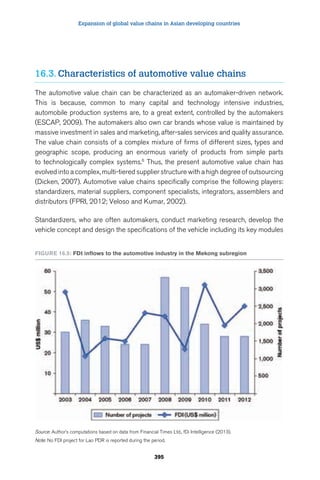
the chain requires a focus on numerous sources of risk. Sourcing and distribution are 
particularly complex as they stand at the intersection of global, national, industry, and 
“local to the product” sources of risk. 
200 
System level risks 
So far, our discussion has focused primarily on individual source-event-consequence 
chains, but supply chains are characterized by system-level risks 
as well. Classic among these is the so-called bullwhip effect where, due to the 
multiple stages in the chain coupled with lags in responses, a small initial demand
Uncertainty and risk in global supply chains 
201 FIgure 8.3: Sources of risk and their supply chain impacts 
Source: Author and Weil (2013).
Global value chains in a changing world 
shock can trigger much larger variations in demand further back into the chain (Lee 
et al., 1997). Figure 8.4 shows this for an electronics manufacturing chain. Note 
that the volatility of supplier shipment to the Original Equipment Manafactured 
(OEM) is many times greater than the channel sell-through. 
An even more complex system risk is reputational risk, where “unacceptable 
behaviour” such as the use of child labour, food contamination or environmental 
abuses in any stage of the supply chain may interact with increasing public attention 
to particular dimensions of performance and changes in the thresholds of what is 
deemed acceptable. Changes in any element can set off an escalating dynamic. 
Figure 8.5 illustrates some of the feedbacks involved in reputational risk. It is important 
to note that while reputational risk is best understood as a consequence rather than 
a source of risk, it is the result of a complex set of system interactions.8 As such, it is 
important to manage the sources of such risks rather than merely engage in damage 
control to reduce the consequences.9 
FIgure 8.4: risk magnification via the “bull whip” 
202 
Source: Kaipia et al. (2006) cited by Samel (2012).
Uncertainty and risk in global supply chains 
The most serious, of course, are “systemic risks” where the supply chain system as 
a whole grinds to a halt, perhaps due to the cascading effect of reductions in trade 
financing10 or to escalating national reactions to trade imbalances or perceived abuses. 
As the volume of gross flows increases relative to net flows, the consequences of 
such systemic failures also increase. 
The OECD supply chain study (OECD, 2012) prominently discusses systemic 
risks in the globalized supply chain, citing as examples the “great trade drop” 
of 2008–09 and the aftermath of the 2011 Japan tsunami and the associated 
nuclear disaster. While much of the discussion is about how global supply chains 
transmit shocks from one economy to another, it must also be recognized that 
due to their own complexity and layering and their dependence on a fragile 
systems of international cooperation and finance, they can be a source of system 
shocks as well. While systemic risk in the financial system has received the most 
attention, it also looms large in the global supply chain and is probably even less 
well understood in this context. 
203 
FIgure 8.5: The reputational risk system 
Source: FGI Supply Chain Study.
Global value chains in a changing world 
8.3. Global integration and risk 
Globalization, as defined as the increasing interdependence of national societies and 
economies, has two counteracting impacts on risk. On the one hand, it enables greater 
diversification of risk resulting from some sources of risk, particularly macro and product-level 
variations in demand. On the other, it enhances the potential for propagation 
of shocks from one nation to another. Ghemawat (2011) provides two contrasting 
examples, food and finance, where he argues that the benefits of “openness” outweigh 
the costs in the case of food security, but not for short-term capital flows. 
In the case of supply chains, the same is true. A primary risk benefit of a global supply 
chain that serves multiple demands11 (regions, products or customers) is the potential 
to reduce risk through pooling. This is an economy of scope that complements the 
scale economies and comparative advantage that motivate the creation of such 
chains. An offsetting risk-increasing impact results from the interconnection of 
geographically and institutional distant activities and includes, among other things, 
the risk of disruptions due to changes in trade policy, physical events, and man-made 
(careless or malicious) events, as well as the system risks resulting from the loss of 
direct control and the added complexity. 
Global supply chains entail both physical and informational/reputational risk propagation 
mechanisms. With globalization, firms with recognized brands live in a “goldfish bowl” 
and lapses in any location can easily reach other locations. Further, a firm can quickly 
get into a vicious circle of attention as documented by Locke et al., (2007) and others. 
As Ghemawat notes, fear (or outrage) travels faster than fundamentals. 
With increased integration, gross flows increase much more rapidly than net flows – 
within a single supply chain, product category, industry or the economy as a whole – as 
the benefits of scale, specialization and pooling increasingly outweigh trade and 
transportation costs, as illustrated in Figure 8.6. Risks of disruptions, of course, apply 
to the gross rather than the net flows. 
This grossing up implies more trade and transport, thus increasing the overall 
production system’s exposure to disruptions. Since the two effects – diversification 
and propagation – are offsetting, it is not possible to state as a general matter that 
risk favours the lengthening or shortening of supply chains. 
8.4. Risk management responses 
Risk management in operations, including supply chains, is typically described as comprising 
three steps – identify, characterize and mitigate.12 We broaden the definition of mitigation 
to include three complementary sets of activities: reduce (mitigate), pool and transfer. 
204
205 
FIgure 8.6: global production sharing 
Global production sharing is the 
norm, not the exception 
Source: FGI Supply Chain Study. 
Intra-regional and major inter-regional imports of 
intermediate goods, 2008 (in billions) of USS)
Global value chains in a changing world 
Regardless of the type of risk driver or consequence, there are only a small number of 
fundamental types of possible response, either before or after the fact. These include 
responses that: 1) have the potential to change the probability distribution of outcomes – 
what we refer to as shaping risks – and thus change the stand-alone cash flows from the 
operations in question; 2) those that have the potential to improve the consequences of the 
affected operations conditional on the realization of the risk outcome – real options and real 
pooling; and 3) those that redistribute risk without affecting the stand-alone distributions of 
outcomes and consequences – financial diversification, hedging and insurance – and thus 
alter the risk of portfolios of assets held by firms or investors. 
Some source-outcome-consequence chains are amenable to only one type of 
management intervention, whereas different actors may be able to respond in multiple 
ways to others. In general, there is a “pecking order” of risk management responses 
for risks involving “things that break,” “things that vary”, and “regimes that change.”13 
“Things that break” correspond to operational failures such as delays or gaps in quality or 
to disruption due to man-made or natural hazards. In most instances, these are “inside” 
risks at the supplier or supply chain level and are best addressed by building effective 
organizations with properly aligned incentives and commitment of its employees as 
well as an overlay of compliance and security. Diversification or pooling does not alter 
the expected losses associated with these errors, and insurance will be expensive 
(relative to the expected losses) due to the moral hazard involved. Multiple or flexible 
sourcing will mitigate the impacts of supply interruptions, but not of product quality. 
“Things that vary” correspond to fluctuations in product and macro demand and to 
commodity and financial prices. Strategic risks associated with irreversibly committing 
resources in the face of cost or demand uncertainties – by firms, by workers or by 
regions – often can be addressed by creating options to allow a greater range of 
responses in line with future outcomes. These real options, though, are costly, so 
only some of them will add value. A variant of the real option is pooling, whereby a 
firm is able to employ a specific fixed capacity to serve a variety of different product 
or national market demands, thus enhancing the expected cash flows for this set 
of activities while reducing their volatility. This is different from and more effective 
than financial diversification that simply reduces portfolio variance by mixing different 
distributions without altering their expected values. On the other hand, pooling requires 
standardization and specialization, and it may limit the ability of firms to integrate 
forward or backward in the chain and is subject to diminishing returns as the number 
of “demands” that are pooled increases. This standardization and specialization, in 
turn, benefits from regional agglomeration that allows the co-specialization of firms 
and provides a barrier to entry benefiting relatively few locations. 
When “things that vary” are traded in markets, such as exchange rates or commodity 
prices, it also is possible to shift these risks through hedging in financial markets. 
206
Uncertainty and risk in global supply chains 
“Regimes that change”, e.g., global or meso-level (national or state/local institutional/ 
policy) risks are often ill-defined as they depend on the decisions of governments, 
or regulators. Transforming them through influence, however, is sometimes possible. 
Further, flexiblity and diversification can ameliorate their impact on any given supply 
chain actor. 
8.5. Comparative advantage in risk taking 
While individuals, firms and countries are generally risk averse, it does not necessarily 
follow that they all should seek to avoid risk or transfer it to others. A form of comparative 
advantage exists whereby risks should be taken on by those actors with: 1) the greatest 
knowledge about them, 2) the greatest ability to mitigate or shape them, and 3) the 
greatest ability to withstand the residual impacts remaining after these two stages 
through diversification and resilience.14 
Samel (2012) notes that a key aspect of the “division of labour” is the issue of who 
bears and deals with various uncertainties and risks inherent in meeting unpredictable 
macro and product demand through a distributed and fragmented supply chain and 
illustrates this with a set of electronics assemblers located in Penang, Malaysia. 
Located in the bottom of the “smile curve” as shown in Figure 8.7, and hence 
FIgure 8.7: risk specialization in the value chain profit curve 
Source: Samel (2012) drawing on Cisco, inspired by Stan Shih. 
207
Global value chains in a changing world 
presumably commoditized and earning low margins, some Penang assemblers in the 
electronics supply chain have succeeded in commanding both relatively high wages 
for their workers and relatively high margins for themselves by specializing in bearing 
volatility in product demand. 
They do so on the basis of accommodating labour regulations and institutions 
(including an ample pool of immigrant labour), a broad set of relationships with 
design and end-product firms that allow them address extreme fluctuations in 
product demand, with surges in production requirements from 250 per cent to 500 
per cent within a year and cut backs of up to two-thirds within the same time frame, 
through to the pooling of production and relatively simple technologies that can be 
reconfigured quickly, as in changing the number of assembly lines. The volatilities 
of orders for each product or relationship act as a barrier to entry, since it is costly 
for new entrants to match the scale and organizational and managerial capabilities 
required for pooling and pliability. This risk is partly transformed by pooling and 
partly transferred to workers through volatile hours. Samel concludes that these 
firms’ abilities to take on volatility limits their incentive and ability to “upgrade” 
technologically. I would take the argument a step further: “upgrading” should be 
redefined to include higher levels of production technology, greater innovation and 
greater ability to withstand and profit from volatility. 
Hon Hai (Foxconn) also appears to gain much of its advantage from its ability to quickly 
scale production to meet demand. This is particularly important given the “winner take 
all” nature of network effect consumer electronic products that is exacerbated by the 
fact that product demand is “pulsed” to build a self-reinforcing wave of sales. 
The inherent volatility of demand in supply chains at the macro and product level, in 
fact, appears to be one of the key barriers of entry to the supply chain and access to 
higher value added (Buckley, 2009). 
8.6. Supply chain risk and the capacity to absorb risk 
Supply chain stakeholders differ in their exposure to particular risks, in their capacity 
to absorb these impacts and in their ability to mitigate or hedge those risks. The 
key concern from an extended view of the supply chain that includes labour and 
small and medium sized enterprises (SMEs) is the extent to which different supply 
chain actors have greater or lesser scope to manage a particular set of risks and 
208
Uncertainty and risk in global supply chains 
to what extent mitigating risk requires concerted action by local, national or global 
communities versus individual firms, by policymakers or perhaps by coordinated 
action by both groups. A related issue is to determine which risks within specific 
supply chains can be relatively successfully managed by individual actors versus 
those that require concerted efforts by groups of suppliers, by policymakers or by 
the two groups working together 
A disruption in a particular source, whether due to a natural calamity, a man-made 
error or a malicious act at that source or a disruption to another stage, will result in 
the failure of the supply chain to deliver the promised products on a timely basis. It 
may also entail a significant loss of income for labour and a loss in capacity utilization 
and income for the factory owner that will be exacerbated by any investment in raw 
materials or work in process that it has undertaken. The orchestrator typically will lose 
proportionally on its throughput, unless of course it has another source of supply. The 
brand owner may or may not lose depending on whether it (or its orchestrator) has an 
alternative source of supply and, if not, whether the ultimate product is a freestanding 
product or a component of a more complex system, as well as whether or not it faces 
close substitutes in the marketplace. 
If the disruption is systemic to the supplier country or region, as with a natural disaster 
such as Fukushima, a transport shutdown, or a policy “embargo,” then the supplier 
country will suffer a similar proportional impact, or perhaps even larger, due to the 
social capital and infrastructure involved. 
This is illustrated in Figure 8.8 for a disruption in the supply chain, in panel “A” for 
a disruption that is specific to a single product or facility (e.g., the lightning strike to 
Philips’ factory) and in panel “B” for one that applies to all activities in a particular 
location (e.g., Fukushima). 
An SME factory owner is very exposed to specific disruptions relative to its capacity 
to absorb for two reasons. First, a factory typically has fairly high fixed costs and 
therefore the impact of disruption is “leveraged.” Second, the owners often own one 
or a few business assets and thus have a substantial proportion of their wealth at 
risk. Larger, more diversified suppliers are in a better position, which implies that a 
“hazardous” world is particularly so for SMEs. 
Labour is highly exposed because wages depend on continuity of operations, and 
household income typically is even less diversified than that of the SME factory owner. 
209
Global value chains in a changing world 
The supplier community or economy is typically sufficiently diversified that a single 
disruption has only a very small overall impact. 
FIgure 8.8a: Impact capacity to absorb for specific disruption 
FIgure 8.8b: Impact capacity to absorb for a general disruption 
210 
Source: Author.
Uncertainty and risk in global supply chains 
The big difference between Figures 8.8A and 8.8B is the exposure of the supplier 
community. With a general disruption, it sustains losses or outages in many different 
activities, reducing fiscal income, putting pressure on social safety nets and, if the 
disruption persists, it suffers an erosion of the value of infrastructure and social capital 
that underpins its long-term competitiveness. 
As a general matter, the exposure or vulnerability of a particular stage in the 
supply chain to a given risk depends on its operating leverage, its competitive or 
contractual position that determines the extent to which it can pass on or must 
absorb the impact, and its flexibility in adjusting to the impact within the activity. Its 
ability to absorb the impact depends on its diversification, its financial strength and 
its flexibility across activities. 
The exposure of labour will depend on the employment terms which determine 
how these impacts are shared with the employer, with the greatest exposure 
corresponding to situations with piecework pay and no premium for or constraints on 
overtime as opposed to one with a greater salary base and premiums for constraints 
on overtime. Foxconn and Apple’s recent voluntary steps to avoid excessive overtime 
(Bradsher and Duhigg, 2012 and the Economist, 2012) represent one step toward 
rebalancing this exposure. However, as noted by Locke et al., (2007), regulatory 
standards will be necessary as well. 
Table 8.1 illustrates the impact relative to the capacity to bear risk for these five 
stylized stakeholder groups for a variety of different risk outcomes. Of course, 
the rankings depend on more dimensions than it is possible to represent in a 
Table 8.1: Incidence of supply chain risks relative to capacity to absorb 
211 
Risk type 
Risk impact 
Specific 
disruption 
General 
disruption 
Cost shock (e.g., 
exchange rates) 
Product 
safety 
Commoditization, 
shift in tastes 
Extremely 
high 
Factory, brand 
owner15 
Factory, brand 
owner16, supplier 
community 
Factory, supplier 
community 
Brand Factory owner 
Brand 
High Labour Labour17 Labour, supplier 
community 
Labour Labour 
Moderate Brand owner18, 
supplier 
community 
Brand Supplier 
community, 
Orchestrator 
Orchestrator 
Low Orchestrator Orchestrator Orchestrator 
Source: Author.
Global value chains in a changing world 
single diagram, but the point that comes through is that factory owners, because 
of their high operating leverage, and labour, because of their limited diversification, 
are typically highly exposed. Factory owners can diversify their activities across 
products, brands and regions to increase their capacity to absorb risk, whereas 
labour only has access to this risk spreading if it occurs with a single factory. Brand 
owners are very highly exposed to reputational and system impacts but less so to 
cost impacts. 
8.7. Global pressure points and priorities 
There are many issues with global supply chains. Some are unique to specific 
stakeholders, while others cut across all actors. While not all involve elements of 
uncertainty and risk, most do. A recent McKinsey survey of CEOs (Mckinsey, 2010), 
shown in Figure 8.9, highlights the importance of “things that vary” (the volatility 
of consumer demand, commodity prices, financial systems and the difficulty of 
finding labour to match demand) and “regimes that change” (regulatory concerns, 
FIgure 8.9: Sources of global supply chain issues 
212 
Source: McKinsey (2010).
Uncertainty and risk in global supply chains 
environmental concerns). This is different from the reactions of supply chain managers 
that are much more focused on “things that break.” 
These responses map closely to the five key pressure points identified by the Fung 
Global Institute Supply Chain Study. These include: 
a) Changing patterns of production costs and demand resulting from higher incomes 
and consumption levels in emerging economies, as well as new demands and 
expectations from consumers (changes that reconfigure supply chains and value-added 
213 
attribution); 
b) Changing risk profiles (operational risks, customer and consumer dynamics, 
political and geo-political risks, natural and man-made disasters, policy instability); 
c) New social and environmental pressures and realities; 
d) New technologies and innovation (in manufacturing, services provision, IT-driven 
opportunities); 
e) The policy scene (policy is not just a risk factor on account of changeability, but 
also a disruptor in its own right). 
These five also match up closely with executives’ responses regarding their firms’ 
preparedness to address various global supply chain issues. As shown in Figure 8.10, 
they consider their firms quite capable of addressing competition and customer demand 
but not exposure to volatile exchange rates, commodity prices, regulatory requirements 
or geopolitical instability. 
Brand owners,19 especially in food or health-sensitive chains, are concerned with 
their reputation as supply chains extend across firm and national boundaries. Firms 
whose products are integrated into sensitive systems, such as IT, Internet, electrical 
power or commercial aircraft and engines, are very concerned with quality as a 
failure in one component can have system-wide impact. The sources of risk of these 
potential outcomes are mostly man-made and involve both careless and malicious 
behaviour. Risk management is not a zero sum game among the stakeholders in a 
given chain, as the concern with quality makes the chain sticky and tends to align 
the interests of all parties in the chain. 
These risks are also of concern to labour, facility owners and supplier communities since 
they raise the cost of “long” chains and favour “near-shoring”, other being things equal.
Global value chains in a changing world 
In the wake of disasters such as Fukushima, continuing threats of terrorism and 
increased frequency and severity of protectionist moves by major-destination 
countries, brand owners and customers have a heightened concern with potential 
disruptions of existing supply chains. While important for all supply chains, reliability 
of supply is the most highly valued as a function of two dimensions: 1) criticality 
of continuity in supply as with medicines, food and energy, and 2) criticality of the 
supplied product as a component in larger integrated systems. 
Brand owners, and the factory owners who supply them, are also increasingly 
concerned with the perceived sustainability of their operations, both in human and 
environmental terms. 
214 
FIgure 8.10: Issue preparedness 
Source: McKinsey (2010).
Uncertainty and risk in global supply chains 
Customer communities, including but not limited to government, are concerned with 
continued to access to supplies, as well as to maintaining or regaining a “fair share“ 
of value added. 
“Near-shoring”, which is seen by many as a way to reduce supply chain risks, will 
reduce disruption risk and product risk in the form of stale inventories held in the 
supply chain, but it will increase product demand volatility in terms of employment and 
factory loading as it limits the spreading and pooling of this volatility across regions. 
Finally, all actors have an interest in policy disruptions, but some have more than 
others since typically they have the greatest impact on the longest chains. 
215 
8.8. Conclusion 
The globalization and fragmentation of supply chains creates risk through inter-linkages 
and interdependencies. However, their global scope also has the potential 
to reduce the impact of risk associated with macroeconomic and product volatility 
by allowing the pooling of diverse demands. This trade-off is central to the current 
discussion of “near-shoring” as a potential solution to supply chain risk. While “near-shoring” 
would reduce the risk of cross-border disruptions, it also would limit the 
ability of suppliers and workers to pool diverse demands. Further, unless matched 
by the creation of redundant supply and logistics links within each region, “near-shoring” 
would not eliminate the risks of supply chain disruptions and might even 
make them greater. That said, steps can be taken to reduce the risks associated with 
global supply chains and better distribute them among consumers, brand owners, 
orchestrators and providers of logistics and other supply chain services, SME and 
large-scale factory owners, and workers. In considering these steps, it is important to 
recognize the underlying sources of risk as well as the risk events themselves and the 
comparative advantage of different parties in affecting and absorbing various risks. 
Much of this risk reduction and redistribution will result from the self-interested 
and self-organizing actions of the private firms that comprise global supply chains. 
Sophisticated firms that can successfully orchestrate complex supply chains will 
increase their ability to absorb volatility and work around disruptions through increased 
resilience, and they appear confident that they can do so. This often will require 
basing deep capabilities in multiple locations. Similarly, SMEs, whether by choice or 
evolutionary selection, will increasingly group themselves in deep clusters that provide 
this resilience at a systemic level.
Global value chains in a changing world 
Risks associated with consumer safety such as food safety or counterfeit drugs, by 
contrast, will require concerted actions including government regulation. In the case 
of product contamination in the food chain, the immediate cause lies in the incentives 
for cutting corners by producers competing anonymously in commoditized markets. At 
a higher level, the issue lies in the absence of a direct connection between producers 
and consumers, something that could be restored to some extent by a stronger 
reliance on brands. However, while large, sophisticated firms can to a large extent 
address these risks through internal controls and branding, experience suggests that 
a combination of legally mandated and “brand-based” self-regulation is most effective. 
Further, purely “brand-based” regulation would tend to reduce the role of SMEs in 
these chains. Risks emanating from other forms of malicious behaviour, particularly 
involve similar arguments as well as the recognition that they often cross over into the 
realm of security that inevitably involves nations. 
Risks to workers emanating from volatility and the incessant cost pressures of global 
supply chains are another area where some form of concerted action and regulation is 
necessary. In the case of excessive overtime or worker safety violations, for example, 
the immediate causes are choices made by factory owners and managers and often 
also failures in the existing compliance systems. At a deeper level, as argued by 
Locke and Samel (2012), the causes lie in the cost and timing demands placed on 
production units by the brand owner. These demands may result from volatility that 
is beyond their control, but they may also result from volatility that they impose as 
part of their business model or because of imperfect responses to external volatility. 
Voluntary leadership by these firms can improve things, but it is likely that some form 
of regulation is required, especially in highly competitive low margin segments. 
Finally, risks emanating from uncertainty regarding changes in global regimes are 
costly to all yet lie beyond the scope of private actors in supply chains. In the case of 
trade frictions and the imposition of selective trade barriers, the immediate cause is 
the action of nation states themselves. However, at a deeper level these are driven to 
at least some extent by the very distorted picture of trade imbalances, especially with 
respect to China, provided by the current system of trade accounting. 
Re-establishment of a vibrant multilateral trading regime would appear to be the ideal 
outcome, though it is not clear that it is feasible in the near term. A smaller step that 
might lead to a reduced risk would be a new set of WTO rules whereby “retaliatory” 
actions by one nation against another would take the form of across-the-board 
increases in tariffs rather than that of penalties imposed on specific products. This, 
216
Uncertainty and risk in global supply chains 
along with continued pressure against non-tariff barriers, would increase the fluidity 
of the trading system and avoid sudden sharp shifts that impose severe costs on 
suppliers, especially SMEs, and on workers. 
In sum, risk management in the context of global supply chains involves much more 
than mitigating the impact of outside risks such as swings in aggregate demand 
or exchange rates on individual elements of the chain. It also requires systematic 
management of risks that are generated within each link in the chain and, more 
importantly, in the interfaces among links in order to limit disruptions and their 
propagation throughout the system. This requires risk awareness and responsibility in 
every activity as well as active intervention by orchestrators with a system-wide view. 
It also requires careful redesign and management of the soft and hard infrastructure 
that supports the system. 
While the self-interested behaviour of individual supply chain actors can be counted 
on for many of these aspects of risk management, the geographic dispersion and 
organizational fragmentation of supply chains, and the incidence of supply chain risks 
on important groups beyond the corporations who are customers and orchestrators – 
workers, SMEs and ultimately regions and nations – also imply a need for concerted action 
at the industry, national and global levels. It will be necessary to create “scaffoldings” of 
effective product safety and workplace standards and trade and finance regimes so as to 
allow this distribution system to function as an effective whole. It requires a global village. 
217 
Endnotes 
1 I thank Retsef Levi, Patrick Low, Albert Park, Hiram Samel, Andrew Sheng and Henry Weil 
for their comments. This paper was prepared for the Fung Global Institute’s Global Supply Chain 
Initiative. 
2 See e.g., Coe et al., (2008), Gereffi and Memedovic (2003), Locke and Samel (2012), and 
Sturgeon (2008). 
3 Mundy (2013). 
4 The use of all three terms is deliberate, signalling the different perspectives of these literatures: 
supply chains (SC) focusing on the ability to match supply and demand, global production networks 
(GPN) on the division of labour and governance in the chain, and global value chains (GVC) on the 
roles of various actors in the chain and their ability to capture value/rents). 
5 For earlier versions of this diagram, see Lessard (1996), Lessard and Lucea (2009), Lessard 
and Miller (2012). Christopher and Peck (2004) propose a similar three-level classification: risks
Global value chains in a changing world 
internal to the firm, risks external to the firm but internal to the supply chain network and risks external 
to the supply chain network. Simchi-Levi, D. (2010). Operations Rules: Delivering Value Through 
Flexible Operations. Cambridge, MA, The MIT Press, ibid. presents a taxonomy that combines the 
“inside-out” and “known-unknown” dimensions. 
6 In order for a financial market to be developed for a risk: 1) the risk must be outside of the 
control of any of the potential market participants (to avoid moral hazard) and 2) it must affect many 
economic actors with a degree of balance among positive and negative exposures. 
7 While the supply chain typically is depicted as a linear flow, Li and Fung defines it as an open 
circle beginning and ending with the customer. We use Weil’s depiction that combines these two by 
explicitly incorporating information and financial flows along with physical product flows. 
8 This depiction of reputational risk is based on conversations with Henry Weil and was initially 
sketched by him. 
9 This is consistent with the distinction between commitment and compliance drawn by 
Locke, et al., (2007) in reference to the management of reputational risk arising from labour 
conditions in the supply chain. 
10 Sheng (2009) traces the 1997 Asian financial crisis to just such a cascade. 
11 The same argument could be applied to in-bound logistics, assembly, or distribution assets that 
are specific to the product or source. 
12 In contrast, in finance risk management is typically viewed as characterizing risk (variances and 
co-variances or more complex measures of volatility), then selecting a portfolio or structure of hedges 
(to complement the “portfolio” inherent in the business) to best distribute those risks. 
13 Referring to Figure 8.2 that depicts risks from inside to outside, things that break correspond 
to firm-level and supply chain level risk; things that vary to customer, competitive, and global market 
dynamics; and regimes that change to changes in meso-level (national, state/provincial/ local) 
institutions and global regimes. 
14 See Lessard (1996) for the initial development of this concept. 
218 
15 If integral element of complex system 
16 If integral element of complex system 
17 Perhaps higher due loss of alternative employment, social safety net 
18 If a free-standing product 
19 The term “brand owners” is shorthand for firms that use their brand to capture (some of) the 
value they create through innovation, integration, and quality. These firms typically create customer 
solutions and experiences in contrast to just delivering products or services.
Uncertainty and risk in global supply chains 
219 
References 
Baldwin, R. 2012. “Global Supply Chains: Why They Emerged, Why They Matter, and Where 
they are Going?”, The Fund Global Institute Working Paper Series FGI-2012-1 (Hong Kong, 
Hong Kong, China; The Fung Global Institute). 
Bradsher, K.; Duhigg, C. 2012. “Signs of Changes Taking Hold in Electronics Factories in 
China”, in The New York Times, NY, 26 December. 
Buckley, P. J. 2009. “The Impact of the Global Factory on Economic Development,” in The 
Journal of World Business, 44(2): 131–143. 
Christopher, M.;Peck, H. 2004. “Building the Resilient Supply Chain,” in International Journal of 
Logistics Management, 15(2): 1–13. 
Coe, N. M.; Dicken, P.; Hess, M. 2008. “Global Production Networks: Realizing the Potential,” in 
Journal of Economic Geography 8(1): 271–295. 
Economist, The. 2012. “When Factory Workers Dream of Life Beyond the Factory Gates”, in 
The Economist, 405: 63–64. 
Gereffi, G.; Memedovic, O. 2003. “The Global Apparel Value Chain: What Prospects for Upgrading 
by Developing Countries?”, (Vienna, Austria, United Nations Industrial Development Organization, 
UNIDO). 
Ghemawat, P. 2011. “Globalization 3.0: Global Prosperity and How to Achieve It”, (Boston, MA, 
Harvard Business Review Press). 
Juttner, U.; Peck, H.; Christopher, M. 2003. “Supply Chain Risk Management: Outlining an 
Agenda for Future Research,” in International Journal of Logistics: Research  Applications, 
6(4): 197–210. 
Lee, H. 2002. “Aligning Supply Chain Strategies with Product Uncertainties,” in California 
Management Review, 44(3): 105–119. 
Lee, H.; Padmanabhan, V.; Whang, S. 1997. “Information Distortion in a Supply Chain: The 
Bullwhip Effect,” in Management Science 43: 546–558. 
Lessard, D. 1996. “Incorporating Country Risk in the Valuation of Offshore Projects,” in Journal 
of Applied Corporate Finance, 9(3): 52–63, Fall. 
Lessard, D.; Lucea, R. 2009. “Embracing Risk as a Core Competence: The Case of CEMEX,” in 
Journal of International Management 15: 296–305.
Global value chains in a changing world 
Lessard, D.; Miller, R. 2013. “The Shaping of Large Engineering Projects” (Cambridge, MA, 
Massachusetts Institute of Technology). 
Locke, R. M.; Qin, F.; Brause, A. 2007. “Does Monitoring Improve Labor Standards – Lessons 
from Nike,” in Industrial and Labor Relations Review 61(3). 
Locke, R. M.; Samel, H. 2012. “Looking in the Wrong Places?: Labor Standards and Upstream 
Business Practices in the Global Electronics Industry”, MIT Political Science Department 
Research Paper No. 2012-18 (Cambridge, MA, Massachusetts Institute of Technology). 
Available at: http://ssrn.com/abstract=2102634 
McKinsey. 2010. “The Challenges Ahead for Global Supply Chains” McKinsey Global Survey 
Results, McKinsey and Company. Available at: http://www.mckinseyquarterly.com/The_ 
challenges_ahead_for_supply_chains_McKinsey_Global_Survey_results_2706 
Mundy, S. 2013. “Samsung Code of Conduct Put to Test” in The Financial Times London. 
Organization for Economic Co-operation and Development (OECD). 2012. “Global Value Chains: 
Managing Risks”, in Draft Synthesis Report on Global Value Chains, Chapter 7. (Paris, France, 
OECD, Directorate for Science, Technology and Industry, Committee on Industry, Innovation, 
and Entrepreneurship). 
Park, A. 2012. “Note on Risk and Supply Chains”, (Hong Kong, Hong Kong, China; The Fung 
Global Institute). 
Samel, H. 2012. “Upgrading Under Volatility in a Global Economy”, MIT Sloan School Working 
Paper, June 20. (Cambridge, MA, Massachusetts Institute of Technology Sloan School). 
Available at: http://ssrn.com/abstract=2102643 
Sheffi, Y. 2005. “The Resilient Enterprise: Overcoming Vulnerability for Competitive Advantage” 
(Cambridge, MA, The Massachusetts Institute of Technology Press). 
Sheng, A. 2009. “From Asian to Global Financial Crisis: An Asian Regulator’s View of Unfettered 
Finance in the 1990s and 2000s” (Cambridge UK, Cambridge University Press). 
Simchi-Levi, D. 2010. “Operations Rules: Delivering Value Through Flexible Operations” 
(Cambridge, MA, The Massachusetts Institute of Technology Press). 
Sturgeon, T. J. 2008. “From Commodity Chains to Value Chains: Interdisciplinary Theory Building 
in an Age of Globalization”, in J. Bair (ed.): Frontiers Of Commodity Chain Research, (Palo Alto, 
CA, Stanford University Press). 
Weil, H. 2012. “The Dynamics of Global Supply Chains: The Imperatives for Success in A New 
Market Ecology.” 
220
9 The influence of customer buying 
behaviour on product flow patterns 
between trading countries, and the 
implications for regulatory policy 
John Gattorna 
221 
9.1. Introduction 
This paper is designed to provide a more granular perspective than the traditional 
aggregate view that economists take of supply chains. In particular, I want to add 
a behavioural dimension, and introduce a more dynamic methodology, capable 
of addressing the increasingly volatile operating environments that are likely to 
pervade future trading conditions within and between countries, whether developed 
or developing. 
The objective of this paper is to develop a toolbox of creative methodologies that will 
add insight to what we already know about supply chains and point the way towards 
improved navigation of the cross-border movement of trade flows. 
From the outset, let us deal with some of the terminology issues. In my view, there is 
no difference between the terms supply chain and value chain, because supply chains 
done well equals value chains. 
Regarding the term networks, these develop from local to regional to global, with 
correspondingly increasing complexity. The important thing to realize is that you 
should attack this growing complexity from the outside in, not from inside out as per 
conventional practice. Of course, the ultimate solution selected will be a combination 
of both. 
Fundamentally, people, their respective behaviours, and the decisions they make 
in particular circumstances propel products and services along supply chains, so
Global value chains in a changing world 
it is vital that human behaviour is factored into all future value chain designs. This 
is non-negotiable if the objective is to achieve a finer alignment between buyers 
and sellers and a necessary precondition if we are to take operational and financial 
performance to the required next level. Understanding human behaviour is the 
elephant in the room but, unfortunately, too many executives are in denial about its 
pivotal influence, presumably because they do not know how to factor it into the 
performance equation. 
And people are spread out along supply chains, in the form of customers, 
intermediaries, staff and management inside suppliers and the enterprise itself. The 
optimal result is obtained when all parties (including outside influences such as 
government) along specific supply chains, approach a degree of “alignment” in the 
way they think and act. 
Thus, looking at the operation of supply chains through the narrow prism of economics 
is not sufficient. Human behaviour must be factored in, just as the eminent economist, 
Robert J. Shiller, Professor of Economics at Yale University commented in the 
aftermath of the 2008 global financial crisis. He was acknowledging the human effect 
on the economy. See Shiller (2009). 
Indeed, simply observing macro-flows of goods and services across or within country 
borders, hides the important detail beneath, and blunts the search for more predictive 
supply chain business models. In such situations, the emphasis is on reactivity, but 
there is a limit to reactive designs because of the premium cost attached to this 
modus operandi. 
If we are going to work from the outside-in, we need a meaningful way of grouping 
customers into economically viable segments and then reverse engineering back into 
the enterprise from there. Most, if not all, conventional methods of segmentation used 
by the marketing discipline are flawed when used for the purpose of supply chain 
design. The only method that will adequately inform supply chain design is behavioural 
segmentation, grouping customers, consumers and users with similar buying values 
(and corresponding behaviours) according to the product and service category under 
consideration. 
Through our empirical work in companies drawn from many industries, and across 
numerous geographies in the period 1989–2012, we have found discernible 
patterns in the way customers project their demand for products and services. These 
conclusions are summarized as follows. See Gattorna (2010). 
222
The influence of customer buying behaviour on product flow patterns 
1. Customers always exhibit a small but finite number of dominant buying behaviours 
for any given product or service category, usually no more than three, but four at 
most (to give an 80 per cent fit to the market). 
2. The preferred dominant behaviours exhibited by customers can change 
temporarily under the pressure of changing (operating) conditions such as 
lifestyle changes, government regulatory action, or the product life cycle itself. 
But behaviours usually return to the preferred position when conditions return to 
“normal”. 
3. Where there is a permanent change observed, it is usually associated with a 
change in the customer’s own internal decision-making group. 
4. Finally, it is not unusual to observe more than one kind of buying behaviour 
inside a large corporate customer, where different groups are involved in buying 
different product or service categories. 
These observations explain two phenomena: 
1. That customers can exhibit more than one buying behaviour, under varying 
conditions, and hence more than a single supply chain configuration is required 
to cope with this plurality; and, 
2. That such changes can be brought about for many reasons, including government 
regulatory actions – this is the connection between supply chain designs based 
on customer behaviour, and the impact of different government policies (such as 
tariffs, customs duties, wages, and development incentives) which can either help 
or hinder product and service flows. 
We can now say with some confidence, that the most common buying behaviours 
and behavioural segments observed in the marketplace are the following four types: 
Collaborative, transactional, dynamic and innovative solutions, the characteristics of 
each of these is described in the Figure 9.1 below. 
What is also very significant is that as we look at how customers buy certain products and 
services in different countries across the world, the only thing that changes is the mix of 
the originally-identified buying behaviours. We put this down to the influence of national 
cultures superimposed on individual or business unit buyers, see Gattorna (2010). 
223
Global value chains in a changing world 
224 
FIGURE 9.1: The four most commonly observed dominant buying behaviors 
Source: Adapted from Table 1.3.1 in Gattorna (2003), p. 32; see also Gattorna (2006), p. 41.
The influence of customer buying behaviour on product flow patterns 
This is a particularly important finding because it means that we can set up the 
same supply chain configurations around the globe, and they will be just as relevant 
from one country to another. Of course, the prevailing government regulations and 
competitive activity could influence things in specific locations, but it is unlikely any 
fundamentally new segments will suddenly emerge out of nowhere. This is good 
news for multinational companies as they design their regional and global value chain 
networks. It is also good news for the future work of the WTO. 
At the enterprise level, in reviewing regional and global markets, there are really 
only two appropriate methods open to companies to surface the underlying demand 
patterns. These are: 
1. Using a shortened version of the well-known conjoint analysis market research 
technique, where a sample of customers are interviewed (qualitatively and 
quantitatively) face-to-face and by telephone. A draft “straw man” segmentation 
is prepared as a result, and this is then validated with further direct contact with 
customers in the field; and, 
2. Of perhaps more relevance in the case of aggregate flows of product important 
in trade flows between countries is the demand variability analysis otherwise 
known as the co-efficient of variation. The methodology is as follows: 
a) Profile the total demand, by-customer or source, by-year for say two to four 
years to understand overall patterns. Demand should be broken down by 
major product categories, 
b) Then calculate the co-efficient of variation (CoV) by customer or product 
category in a few sensible time buckets, such as monthly or quarterly, over 
the selected period. This will give a perspective on the relative variability of 
different customer’s demand, 
c) The CoV is a method of comparing the variability of different data sets. It 
is calculated by dividing the standard deviation by the mean, expressed as 
a percentage. By setting some business rules, it is possible to distinguish 
between volume flows with lower variability (base load or lean), compared 
with volume flows which has a higher variability (agile). 
For example, we conducted this type of analysis on the demand (and export) of 
thermal coal from the Hunter Valley region of New South Wales, Australia, in 
225
Global value chains in a changing world 
the four-year period, 2003–06. Congestion was occurring at the loading Port of 
Newcastle, and at one stage there were 75 Cape size ore carriers in a queue out to 
sea, waiting to be loaded. The business rules we applied to the demand side were 
as follows: 
1. Any one customer included in the analysis had to take at least 1 metric ton (MT) 
226 
in any of the given years; and, 
2. The CoV for each customer was calculated, and any customer with a CoV equal 
to or less than 50 per cent by month, or less than 33 per cent by quarter would be 
considered base-load demand, with all the implications for a lean style of supply 
chain configuration, 
3. Anything above these numbers would be regarded as volatile, with all the 
implications for an agile style of supply chain configuration. 
Based on our analysis in 2007, for a total demand of 100 MT per year along the coal 
chain and embarking port, 60 per cent of the volume was found to be base-load, and 
40 per cent to be volatile, requiring two entirely different supply chain configurations 
or pathways, lean and agile, working in tandem, but managed separately. But if the two 
demand patterns are mixed together, no analysis is possible, and things degenerate 
into guesswork and opinion. This is very relevant to the way we look at trade flows 
between countries as the same problem applies. 
9.2. Resolving rising complexity 
The term “supply chain” was first coined by Keith Oliver at Booz Allen1 in 1982. 
I have long been uncomfortable with this term but have chosen instead to continually 
redefine its scope over time, rather than introduce new terminology, which in turn just 
adds to the semantic confusion. 
Indeed, the more accurate term these days would be value networks, as argued in my 
book, Dynamic Supply Chains, see Gattorna (2010). And networks they are, spreading 
from local to domestic national trading environments, becoming regional as more 
countries are involved in strategic sourcing and/or distribution strategy, and ultimately, 
global. The complexity of these “networks-of-networks” increases exponentially as 
the geographic scope widens, and the number of links (both transport and electronic 
transactions) and nodes (facilities of all types and activities within) increases.
The influence of customer buying behaviour on product flow patterns 
During the last two decades we have seen an explosion in the size and complexity 
of value networks as companies embraced global sourcing, offshoring of production 
and jobs, and dispersed manufacturing. In some cases these trends have already 
been reversed or are in the process of changing as conditions have changed. Indeed 
the reallocation of global manufacturing will become more pronounced over the 
next five years, especially as companies face decisions about where to add future 
capacity. The best companies will undertake a “product-by-product analysis of their 
global supply networks” taking multiple factors into account, both directly related 
to production cost, and others of a more indirect nature, such as cross-border 
inefficiencies, see Sirkin et al., (2011). 
As the economics of production change because of escalating labour costs and 
availability (as is now the case in China), the impact of carbon footprint, and the 
corresponding thrust towards a more sustainable world, these value networks are 
again being reshaped. And this evolutionary process will continue indefinitely, spurred 
on by the new “Age of Digitization” that we are just entering. See Friedrich et al., (2012) 
and El-Darwiche et al., (2012). This digitization will facilitate different pathways for the 
physical product and corresponding financials and make revenue recognition for tax 
purposes more difficult. The same can also be said for the true country of origin on 
the label, as there are likely to be several involved as the product progresses towards 
its final form. 
One thing we can say with certainty is that the increased degree of complexity posed 
by extensive global value networks opened up through multi-country trading activities 
will never be resolved by conventional means such as bilateral agreements and 
centrally devised and administered regulations. We need to borrow ideas from Ashby’s 
Law of Requisite Variety, (Ashby, 1954; 1956) and seek out fundamentally new and 
sophisticated solutions to this growing problem. In short, we need completely new 
business models to make any sort of impression on the inexorable rise in complexity. 
To paraphrase, Ashby says that as systems become more complex through increased 
variety, then the complexity-reduction devices we deploy must necessarily become 
correspondingly more sophisticated to match this complexity. In effect, to manage complexity 
in supply chains – and supply chains are after all living organic systems – we have to absorb 
variety, otherwise the whole system is likely to become brittle, unstable and prone to 
collapse, perhaps catastrophically, see Gattorna (2010). 
Unfortunately, the modern obsession with enterprise resource planning (transactional) 
systems has in part unwittingly contributed to the increased complexity too. 
227
Global value chains in a changing world 
Paradoxically, company executives, thinking that more standardization of processes 
and underlying systems would reduce the complexity they face, have in fact made 
things worse as the new [more rigid] systems installed have further reduced the 
degree of natural “alignment” with customers, and in so doing led to more exceptions, 
increased cost-to-serve, and more (rather than less) complexity. This is a good 
example of what happens when attempting to fix a problem from the inside out. 
At the country level, complexity has arisen simply because of the rate of growth 
that has occurred in the process swamping existing capabilities. China is a good 
example of this. India is another example that is in an even worse situation because 
of its poor infrastructure. At least China has made giant advances in this particular 
area. Yet both countries lag in finding solutions to smooth the flow of trade 
through their inbound and outbound supply chains as evidenced by their low 
standing in the Ease of Doing Business Index referred to later in this paper. See 
Lawrence et al., (2012). 
Fortunately, we now have at our disposal network optimization modelling techniques 
that have the potential to cut through complexity and allow us to in effect find 
the lowest cost pathways through nominated networks, from the supply base to 
customers, anywhere in the world. These mixed integer mathematical models have 
been available for the last few decades, but it has taken the hardware on which 
they run time to catch up and achieve the required higher processing speeds. The 
best models currently available are designed by Solvoyo (Boston) and Llamasoft 
(Ann Arbor). 
In addition, instead of running the models against some arbitrary objective function, 
we can link them to the behavioural segmentation mentioned above and in the 
process find out what the possible pathways and corresponding cost-to-serve are 
for any given product-market combinations, under particular operating conditions, 
including government taxes or incentives, tariffs and carbon footprint. Indeed, there 
is practically no scenario that we cannot model these days, and the result is a whole 
new level of more informed decision-making by executives and government officials. 
These new Decision Support Systems (DSS) are likely to provide a bright new avenue 
for exploring government policy options in the future, especially where constraints 
are placed on trading flows across borders. The core concern is to be in a position 
to make more informed decisions, and for confirmation of this you only have to look 
around the world at the winning sporting teams who benefit by making better, faster 
and more timely decisions than their opponents in the heat of competition. 
228
The influence of customer buying behaviour on product flow patterns 
229 
FIGURE 9.2: Flow types and matching supply chain configurations 
Source: Gattorna (2010), p. 53.
Global value chains in a changing world 
Based on my work and that of colleagues inside multinational companies, I expect that 
we will find ways of fast-tracking certain product flows, by embedding agile processes 
along certain preferred pathways, albeit at a premium cost, and for the residual, less 
volatile flows, I expect it will be possible to design lean pathways that carry flows on a 
more regular, predictable basis, at lowest delivered cost. 
The key is to separate the two flow-types and treat them completely differently. Once 
this is achieved, overall costs will fall, as will complexity, and more certainty in trade 
relationships will return. The trick is to eliminate both the over and under-servicing and 
reallocate resources to achieve a finer-grained alignment between the supply base 
and the corresponding target customer base. 
The main supply chain flows we are interested in are depicted in Figure 9.2, and 
in particular the combined steady-state flow made up of lean and continuous 
replenishment components, which are largely predictable and have low variability. 
9.3. Infomediary capability2 
There is one other enhancement to the network optimization modelling approach 
suggested above, and that is to form an infomediary in key industries to pool and 
aggregate data in order to better manage trade flows. Specifically, the term refers to 
an organization designed to allow information to be gathered from multiple parties and 
used productively while protecting the confidentiality of other contributors. Prashant 
Yadav of MIT and the University of Michigan have already used this approach in 
attempting to improve the forecasting of essential medications in developing countries. 
See Levine et al., (2008). 
Yadav conceived the idea of a global health infomediary, which collects information 
from funding agencies, procurement agents, national buyers and other parties who 
have a wealth of information available but do not necessarily share it. 
My colleague, Deborah Ellis, and I found a similar business model working in Australia 
at Cash Services Australia (CSA). This company is jointly owned by Australia’s four 
biggest banks. It gathers information on the individual and joint cash requirements 
of these banks (both inbound and outbound), and uses this information to direct 
pick up and delivery of cash from and to strategic locations, spreading the physical 
task across several armoured car companies.3 See Gattorna (2010) and Figure 9.3 
of this chapter. 
230
The influence of customer buying behaviour on product flow patterns 
At the enterprise level, the equivalent is the control tower, which companies 
such as Unilever are building to more tightly manage the flow of their products 
to markets using asset-heavy third party logistics providers (3PLs) to undertake 
all the physical movements. The forerunner of this application was the Fourth 
Party Logistics (4PL) model, developed originally by Andersen Consulting (now 
Accenture). See Gattorna (1998). 
Another potential case is Port Waratah Coal Service (PWCS), which is the operator 
of the Hunter Valley Coal Chain, referred to earlier, 150 km north of Sydney. Over 
100 MT of thermal coal per annum is exported to 75 global customers from this 
region, which involves 17 coal producers, 27 load points and 39 mines, three rail 
track owners, two rolling stock operators, one port authority and one terminal 
operator. As you can imagine, the mix of conflicting objectives and priorities among 
these disparate parties makes it very difficult to achieve a smooth flow of product 
FIGURE 9.3: The new business model at Cash Services Australia 
231 
Source: Gattorna (2010), p. 369.
Global value chains in a changing world 
along the shared infrastructure and ship-loaders at the port. It is in fact a microcosm 
of what happens in inter-country trade flows. For PWCS, we have suggested an 
“infomediary” style of arrangement to ensure improved collaboration and efficiency.4 
See also Gattorna (2010). 
The broad principles embedded in an “infomediary” are depicted in Figure 9.4. 
The point of suggesting this type of info-sharing vehicle is that it would not be difficult 
to replicate the arrangement for major product-industry categories in producing 
countries. This would have the effect of improving demand forecasts and smoothing 
cross-border product flows along key supply chains to export customers. 
9.4. Introducing an over-arching fully-integrated 
end-to-end supply chain business model 
Part of the problem that we face is that today there does not exist a unifying business 
concept to describe the B2B or B2C phenomena that links suppliers, enterprises, 
FIGURE 9.4: The new business model is needed to manage demand and capacity in multi-user 
232 
supply chains 
Source: Gattorna (2010), p. 373.
The influence of customer buying behaviour on product flow patterns 
customers and users, either within or between countries. And what we do have is very 
fragmented, generally along functional lines. 
Functional specialism still rules supreme, and the only problem with that is that 
customers are inevitably buying at 90 degrees (horizontal) to the way we manage our 
enterprises and public authorities (vertical). This has been an enduring problem faced 
by supply chain designers over the last few decades as e-commerce has overtaken 
us and it has highlighted the deficiencies in the conventional method of managing our 
companies and government authorities. 
Somewhat fortuitously in 1989, several co-researchers and I began the task of 
re-conceptualizing how logistics systems worked in a corporate context, and this 
eventually “morphed” into how the broader concept of enterprise supply chains 
functioned in the firm. We started with the working hypothesis that if we could better 
align a company’s internal culture and leadership style with its marketplace through 
appropriate operational strategies, this would inexorably lead to improved, more 
sustainable operational and financial performance, and so it emerged. Figure 9.5 
depicts the original concept. 
FIGURE 9.5: Elements of the ‘dynamic alignment’ framework 
Source: Adapted from Figure 1.2 in Gattorna (2003), p. xiii; also Gattorna (1998), p. 5; and Gattorna (2006), p. 16. 
233
Global value chains in a changing world 
We initially focused on ways to understand and reinterpret the marketplace as 
discussed earlier, and this proved to be a masterstroke, as we ultimately discovered 
underlying demand patterns in product-markets as diverse as dairy ingredients, 
thermal coal and electronic high tech (EHT). 
What it told us is that contrary to conventional wisdom, humans are more similar than 
dissimilar, and that we could always identify three to four dominant buying behaviours 
(or behavioural segments as described earlier in this paper), out of a possible 16, that 
explained over 80 per cent of the demand in a given product-market situation. This was 
the breakthrough that we had been looking for, because it immediately informed us just 
how many supply chain configurations we needed to replace the previous outmoded 
notion of a “one size fits all” supply chain. We have continued our work for the last two 
decades, applying this thinking to many new and diverse product and service industries, 
and the evidence has continued to mount in support our original thesis. 
On this basis we are able to reorient the above conceptual diagram (Figure 9.5) to 
represent the horizontal product and information flows found in enterprise supply 
chains as depicted in Figure 9.6 below. These show the four supply chain types that 
FIGURE 9.6: Multiple supply chain alignment on the customer side 
Source: Adapted from Figure 4.3.2 in Gattorna (2003), p. 459; see also Gattorna (2006) Figure 2.1, p. 40. 
234
The influence of customer buying behaviour on product flow patterns 
we very commonly see flowing through organizations, in parallel, all with their own 
particular operating characteristics and supporting capabilities. 
9.5. Potential policy implications 
It is clear that among the biggest challenges facing trading countries are the border 
processes, specifically, import and export clearance. Import is typically more of an 
issue unless there is some manufacturing value-add involved, in which case import 
taxes and duties are offset or refunded through the subsequent re-export activity. 
China is a good example of the latter. It has in place special export zones (SEZs) 
where goods can be brought in under a bonded system, and then transferred to 
approved manufacturing locations, and later re-exported. If however, the goods are 
instead consumed locally, declaration follows and appropriate taxes are paid. 
Nevertheless, there is a lot of reconciliation and bureaucracy involved as goods move 
through the various touch points, and this attracts costs and delays in what should 
otherwise be an ideal trade facilitation process. 
India is a good example where the process does not work well at all. Agreements are 
made at senior levels of government but are not implemented on the ground. Worse 
still, some agreements are reversed on a retroactive basis, so uncertainty reigns 
among importers and exporters alike. Just recently, new free trade warehouse zones 
(FTWZs) have been established by Arshiya International in Mumbai and New Delhi, 
with more to come in other locations such as Kolkata, Chennai and Mangalore, all 
connected by rail corridors serviced by privately-owned rolling stock. This new model 
will greatly improve the movement of products around India. But there is still a long 
way to go. 
So, it is clear that there are still issues related to trade practices at borders, even 
though high-level frameworks may be in place. Consistent implementation on a day-to- 
day basis of import and export clearances remains flawed, so fixing this situation 
235 
is a priority. 
If, using some of the techniques already described, we are able to understand the 
various types of flow patterns present, we can find a better way to manage them, as 
with continuous replenishment and lean flows which are largely predictable, then they 
could be managed at export and import points on a post-clearance basis. Instead
Global value chains in a changing world 
of more government regulation, a government can appoint an auditor to review the 
transactions retroactively and ensure the correct taxes are paid. Something similar is 
already done with personal taxes in some countries, where people self-assess and 
pay their taxes, and these transactions are audited later to check for compliance. 
In the same way, companies could be asked to self-assess their customs duties, 
and these would be subject to possible audit at any time. The efficiency of the 
transaction would increase significantly, and this could become the basis of a new 
trade facilitation model in which all parties would benefit. 
Likewise, for the more volatile/agile component of cross-border flows, although in 
these cases government agencies would perhaps look more closely at the flows 
because they represent a risk of revenue leakage to participating governments. 
Another possible model is that now in operation with US Customs. After 9/11, all sea-borne 
containers entering the United States have to be inspected by customs, and 
this naturally slows commerce down. The US Customs and Border Protection (CBP) 
agency has introduced the Container Security Initiative (CSI) at foreign ports to pre-screen 
containers before they are placed on vessels bound for the US. The three core 
elements of CSI are described below and in the corresponding web link.5 
• Identify high-risk containers. CBP uses automated targeting tools to identify 
containers that pose a potential risk for terrorism, based on advance information 
and strategic intelligence 
• Pre-screen and evaluate containers before they are shipped. Containers are 
screened as early in the supply chain as possible, generally at port of departure 
• Use technology to pre-screen high-risk containers to ensure that the screening 
can be done rapidly without slowing down the movement of trade. This technology 
includes large-scale X-ray and gamma ray machines and radiation detection devices 
The CSI program is now operational at ports in North America, Europe, Asia, Africa 
and the Middle East, and in Latin and Central America. Indeed, CBP’s 58 operational 
CSI ports now pre-screen over 80 per cent of all maritime cargo imported into the 
United States. 
A similar program is being piloted for air cargo by the US Customs and Border 
Protection agency; this is known as the Air Cargo Advance Screening programme, 
and is still in a voluntary stage at the time of writing. 
236
The influence of customer buying behaviour on product flow patterns 
Both programmes are designed to ensure that containers shipped from foreign ports 
will not need further inspection on arrival in the US port of destination. US Customs 
officers are implanted in foreign ports to ensure compliance to strict procedures. The 
overall result is a significant reduction in lead times between origin and destination. 
In summary, border clearance for too long has involved minute checking and scrutiny 
of goods at time of arrival, which has had the effect of inhibiting flows and causing 
costly delays to both shippers and customers. If we adopt a completely new supply-chain- 
based global trade flow approach, many of the costs and inefficiencies will 
disappear overnight. Some of the above-mentioned ideas, and others, are consistent 
with the direction of many governments that are now actively seeking to reduce 
regulation and improve the ease of doing business for corporations engaged in their 
respective countries. Indeed, an index has been created by the World Bank and is 
regularly published. The index uses several parameters including the trade across 
borders, the number of documents, cost and time necessary to export and import. 
Research by the World Bank has found that the effect of reducing regulations on 
economic growth is strongly positive.6 
It is significant that the 2012 rankings show Singapore as No. 1, Hong Kong, China No. 2, 
New Zealand No. 3, US No. 4, Australia No. 15, China No. 91 and India No. 132. Clearly, the 
latter two countries have a lot of work to do. The equivalent index produced by the World 
Economic Forum confirms Singapore in the No. 1 spot, and Hong Kong, China No. 2, but 
the next best Asian country is Australia at No. 17. China is No. 56 and India No. 100, and 
both countries seem to be slipping in the rankings. See Lawrence et al., (2012). 
In summary, we are moving from a static supply chain design that did not previously 
explicitly include the procurement function, to a more dynamic supply chain design 
that incorporates the supply side, and is constituted as several different types of 
supply chain configuration – all focusing on different buying and selling behaviours. 
The result is a genuine end-to-end integrative supply chain model as depicted in 
Figure 9.7. 
The top half of Figure 9.7 indicates the status quo in many companies, where logistics 
strategies at the demand end, and procurement strategies at the supply end are 
refined down to a single combination of perceived best practices and relentlessly 
pursued. 
The bottom half of the diagram is where we want to go, where different behavioural 
segments are recognized in both the demand and supply markets, and discrete supply 
237
Global value chains in a changing world 
238 FIGURE 9.7: From static to dynamic configurations 
Source: Gattorna (2012) (previously unpublished).
The influence of customer buying behaviour on product flow patterns 
chain configurations are designed to run horizontally through the otherwise vertical 
organization, managed by separate clusters or teams of managers drawn from the 
vertical functions. 
9.6. Bringing it all together in a research design 
Given the various insights discussed above, it is now time to bring all the pieces 
together and devise a possible supplementary methodology to map and manage 
major trade flows between countries for a specific number of mainstream product 
categories. The answers from these analyses will provide pointers to appropriate 
policy formulation discussions with national governments. Refer to Figure 9.8 below 
when reading the proposed methodology: 
1. Select a number of countries from whose perspective we will view trade flows: 
Australia, Brazil, China, France, Japan, India, Republic of Korea, Germany, 
Singapore and the United States. 
2. Select several mainstream product categories, both in-bound and outbound from 
the countries nominated in 1. above: e.g., coal, apparel, EHT, automobiles, medical 
equipment, grains, iron ore, machinery, financial services and tourism. 
3. Build a network model of the selected flows in and out of the nominated countries, 
and place ABC costs on all the feasible links and facilities (including labour). 
4. Test a range of scenarios in each network, incorporating constraints such as 
capacity at certain points; different lead-times; government customs duties 
and tariffs; government subsidies/incentives; account for any bilateral trade 
agreements in existence; where certain functions are carried out along specific 
supply chains; impact of production/logistics clusters; carbon footprint and 
sustainability; and other similar considerations. Then test the same scenarios 
without these constraints present, and note the difference in lead-times and cost. 
5. The aim is to understand what the cost/unit is along various supply chain network 
pathways, under varying conditions and to seek the optimal solution for the total 
network under review. 
6. At the same time these flows of products can be analysed using coefficient of 
variation (CoV) techniques to reveal if there are any layers of identifiably different 
volatility and if so, how this impacts on the cost of each network flow under review. 
239
Global value chains in a changing world 
240 
FIGURE 9.8: Bilateral import/export trade flows (by key major product/service category) 
Source: Gattorna (2012) (previously unpublished).
The influence of customer buying behaviour on product flow patterns 
7. The outcomes of this research will likely reveal preferred pathways for certain 
product-origin-destination combinations, and using sensitivity analyses, how 
these are impacted by different regulatory conditions imposed by respective 
governments. It is suggested that the best and worst countries on the Employment 
Trends Index (ETI) Index are compared and contrasted. 
8. Finally, taking all the above analyses into account, new business models can 
be devised that rely less on external regulation, and more on self-regulation 
combined with compliance audits. 
9.7. Recommended policy changes 
As a result of the above analyses, it will be possible to develop and recommend a new 
range of policies that the WTO can initiate among the top 20 trading countries, in the 
first instance and beyond as these policies are phased-in and are seen to work in a 
positive way to support more efficient trade flows between trading countries. 
1. Recommend self-assessment or fast-track import procedures involving customs 
duties for those destination country-product category combinations where the 
flows are consistently predictable, year-by-year, eg. thermal coal from Australia 
to Japan; the taxes from these flows should also be quite consistent. 
2. Recommend customs focus more on the “irregular” imports to ensure revenue is 
not lost. However, these will often involve short lead times, so additional personnel 
manning may be necessary to avoid delays; both 1. and 2. Will be subject to 
compliance audits. 
3. Recommend a range of productivity initiatives to destination countries which are 
low-rated countries on the “ease of doing business” index, eg., China and India. 
4. Recommend ways to increase and expand the United States CSI initiative beyond 
the 58 global ports currently participating. In particular, a similar initiative could be 
started between pairs of non-US ports around the world. The aim should be to 
smooth the passage of containers to 80 per cent of trading nations. 
5. Recommend to major trading countries such as India and Brazil, and to certain 
African countries, exactly what priorities in terms of infrastructure investment 
would have the most positive impact on their respective economies. 
241
Global value chains in a changing world 
6. Recommend to the top 20 pairs of origin-destination trading nations to introduce 
a common method of measuring and taxing carbon footprint that they are 
individually and jointly responsible for. 
7. Recommend to the laggards in the top 20 trading countries, tax reform that will 
speed up trade-flows across their borders and within (across state borders). 
8. Recommend that the WTO undertake research at the company level aimed at 
influencing multinational companies to change their internal organization designs 
to better facilitate the horizontal flow of goods and services along the supply 
chains that they are part of. This recommendation is based on the contention 
that change must take place inside trading companies as well as countries if 
many of the ideas outlined in this paper are to be realized on the ground. The 
mantra is: “there will be no change unless there is pressure for change”, and 
the WTO has the means to apply such pressure. 
242 
9.8. A final word 
In the end, because we now live in such an inter-connected world, the best solution 
to freeing up complex supply chain and trading networks around the world will likely 
involve a mix of new and modified regulations plus a range of completely new and 
innovative non-regulatory initiatives. Getting that balance right is the challenge that 
lies ahead for the WTO. The lessons to learn from the content of this paper are 
that we must break down the aggregate numbers involved in trade flows, and better 
understand why they are and what they are. After all, it is the decisions of personnel 
along enterprise supply chains that in aggregate underpin these numbers. 
A finer alignment with customers and other influential stakeholders will drive productivity 
improvements at every point. In addition, tax revenue collection will also be more 
targeted and therefore more efficient, and lead times more competitive for shippers – 
a win-win for all parties involved in global, regional and national supply chains. 
Endnotes 
1 Keith Oliver, Booz  Company. He first used the term in public in an interview with Arnold 
Kransdorff of the Financial Times, 4 June, 1982. 
2 The term ‘Infomediary’ was first coined by John Hagel and Marc Singer in their book, NetWorth, 
Harvard Business School Press, 1999.
The influence of customer buying behaviour on product flow patterns 
3 For more detailed information of this unique case, refer to Gattorna (2010). 
243 
4 Further details available in Gattorna (2010). 
5 http://www.cbp.gov/xp/cgov/trade/cargo security/csi/csiinbrief.xml 
6 ‘Doing Business report series- World Bank Group’. Available at: www.doingbusiness.org/ 
documents/growthpaper_03_17.pdf. 
References 
Ashby, W.R. 1956 “An Introduction to Cybernetics”, (London, UK, Chapman  Hall). 
Ashby, W.R. 1954 “Design for a Brain”, 2nd edition, (New York, NY, John Wiley). 
Friedrich, R.; Le Merle, M.; Peterson, M. 2012 “The Next Wave of the Digital Economy”, in 
Strategy and Business Autumn 2012. Available at: http://digitaledition.strategy-business.com/ 
display_article.php?id=1139903 
El-Darwiche, B.; Singh, M.; Ganediwalla, S. 2012, “Digitization and Prosperity”, in Strategy and 
Business, Autumn 2012. Available at: http://digitaledition.strategy-business.com/article/ 
Digitization+And+Prosperity/1139914/121556/article.html 
Gattorna, J. 2010 “Dynamic Supply Chains: Delivering Value through People”, 2nd edition, (Harlow, 
UK, FT Prentice Hall). 
Gattorna, J. 2006 “Living Supply Chains: Low to Mobilize the Enterprise Around Delivering What 
Your Customers Want ” (Harlow, UK, FT Prentice Hall). 
Gattorna, J. (ed.) 2003 “Gower Handbook of Supply Chain Management ”, 5th edition, (Aldershot, 
UK, Gower Publishing). 
Gattorna, J.(ed.) 1998 “Fourth Party Logistics; en route to breakthrough performance in the 
supply chain”, in Strategic Supply Chain Alignment: best practice in Supply chain management, 
27:425–445. 
Lawrence, R.; Hanouz, Z.; Drzeniek, M.; Doherty, S. (eds.) 2012 “Reducing Supply Chain Barriers”, 
The Global Enabling Trade Report 2012, (Geneva, Switzerland, World Economic Forum, WEF). 
Levine, R.; Pickett, J.; Sekhri, N.; Prashant, Y. 2008 “Demand Forecasting for Essential Medical 
Technologies” in American Journal of Law  Medicine, 34:225–255. See also Section B, “Create 
a Global Health Infomediary”, 294–295.
Global value chains in a changing world 
Shiller, R.J. 2009 “in an interview with Leigh Sales on ABC Lateline, 4 February, 2009” Available 
at: http://www.abc.net.au/lateline/content/2008/s2482535.htm 
Sirkin, H.L.; Zinser, M.; Hohner, D. 2011 “Made in America, Again: Why Manufacturing will 
Return to the USA”, The Boston Consulting Group Report. Available at: http://www.bcg.com/ 
expertise_impact/publications/publicationdetails.aspx?id=tcm:12–84591 
244
10 Supply chain connectivity and 
trade in Asia 
Mark Goh 
245 
10.1. Introduction 
The term logistics is an ancient one. Historically, the military has been lauded as the 
key underpinning example for good logistics practices, given their emphasis on good 
movement practices and operational excellence. Good logistics practice can be taken 
to denote the set of activities undertaken to ensure the smooth passage of goods 
and services from one location to another, relying on supply liaison officers to provide 
the necessary connection between stakeholders in a convoy. Indeed, it is the very 
adept use of logistics (both hard and soft) that has provided certain military forces 
with superior competitive advantage, the result of which is well documented in history. 
Today, the realm of logistics has been expanded well beyond the simple movement and 
control of a convoy. We have replaced the term “logistics” with the more fashionable 
term “supply chain management”, though it is of no less importance. To many an 
experienced participant, the supply chain is perceived as an integrated and inter-connected 
process through activities, nodes and actors to transport and facilitate 
the trade of goods and services for both enterprise and economy. There is a growing 
acceptance of the need to view the supply chain holistically and on an end-to-end 
basis, including the returns. There are obvious reasons for doing so, which we will 
elaborate later. 
The role of supply chain management is simply to manage the supply line, now 
interconnected as a chain, from source to destination and back. Given the nature and 
speed of trade today, there is an attendant need to focus on the cost-to-serve and the 
time-to-value for goods and services. In this regard, improving trade logistics naturally 
involves ways and means to improve the flow efficiency through either reducing costs 
along the chain or improving the timelines of delivery (APEC 2009). There are also
Global value chains in a changing world 
other imperatives for contemporary supply chains, given the recent developments 
in this arena. First is that of making the supply chain more secure through better 
protocols for goods transfer. Second is about guaranteeing the reliability of delivery 
by reducing the uncertainty factor in either supply or demand risk. Both of these 
considerations naturally require some form of reasonable connectivity between the 
stakeholders to communicate or ensure safe passage during transit, and we will 
return to this area later. According to an article by LaLonde (2003), connectivity ought 
to be a core principle of supply chain management, other than those of collaboration, 
synchronization, leverage and scalability. 
In the context of global production networks and global value chains, which is 
another province of study in itself, the notion and practice of connectivity is indeed an 
important principle. Berenbeim and Shakya (2011) note that as global production 
networks advance under the effects of globalization, the transnational enterprises 
are increasingly engaging central and regional governments on the performance and 
availability of the “at the border and beyond the border” aspects of their supply chain 
notably on the issues related to logistics infrastructure, connectivity and regulatory 
environment. Today, these global buyers and producers of goods and services are 
no longer passive beneficiaries but are very active partners in all stages of industrial 
development which include the identification of industrial operations bottlenecks, 
formulation of policy measures to address them and collaboration in taking remedial 
action. However, in the developing countries, challenges still exist for the export 
shippers and producers of goods more than for the firms that import goods into the 
country. There is already a keen awareness that good supply chain management 
practice and seamlessness throughout the chain is a source of firm competitiveness. 
Hence, there is a growing reliance on benchmarking transport and logistics cost and 
time, given the increase in global production sharing and the shortening of product 
lifecycles. Good connectivity should eradicate any unnecessary informal cost and 
non-value time. 
10.2. Brief overview of work on supply chain 
246 
connectivity 
Much of the traditional literature on supply chain management has sought to focus 
on the integration effort within the various functions of the firm (Turkulainen, 2011) 
or to focus on the integration of different enterprises within a supply chain (Frolich 
and Westbrook, 2002). The existing literature is replete with studies that indicate that
Supply chain connectivity and trade in Asia 
collaboration between firms leads to improved operational performance (Lockström 
et al., 2011). More recently, there has been a renewed focus on upstream and 
downstream collaboration with customers and suppliers, especially for those who 
operate internationally where the barriers to trade are imposed. This shift came about 
as a result of the greater awareness of the impact of logistics on trade (trade logistics) 
and the growing acceptance of the global value chain concept. 
Connectivity, in itself, has also been studied in the academic literature, albeit scantily. 
Hoffman and Hellström (2008) have investigated the connectivity construct in 
the supply chain management literature. Specifically, they identify the connectivity 
construct as being informed by information and technology, and it can occur at two 
levels – in the organization and in the logistics system. Our interest in this paper 
is focused on the logistics systems level. There is some literature available on 
articulating the benefits of good supply chain connectivity such as Holloway and 
Rae (2012) who found that expediting the delivery of imports into a country through 
the exemption of goods with value of under US$ 200 from customs duties (and 
hopefully with no inspections needed) can yield US$ 5.9 billion in revenue for the 
economy through faster commerce. This is equivalent to 0.086 per cent of the GDP 
of APEC (Holloway and Rae, 2012). At the same time, Holloway and Rae (2012) also 
provide a timely reminder that the greatest beneficiaries are the small and medium 
enterprises (SMEs) that face more challenges in completing customs formalities. 
This agrees with Hummels (2001) who has noted that simplifying import procedures 
can help to ensure timely inbound shipments to an enterprise’s market. These SMEs 
do not have the time, money and dedicated business units for customs clearance and 
value tax reporting. 
10.3. Trade and growth nexus in Asia 
According to the estimates provided by APEC (CIE, 2009), a one per cent increase in 
the ratio of trade to GDP would lead to a 2 to 3 per cent increase in per capita income. 
Further, the World Bank has reported that improving trade-related transparency can 
increase trade by 7.5 per cent or US$ 148 billion. In short, growing uninterrupted 
trade is beneficial to any economy or country. For Asia, and APEC in particular, this 
is of special importance given the current economic climate in Europe and North 
America. Many countries in Asia are already recognizing this finding (see Figure 10.1) 
and are focusing on liberalizing their trade regimes to provide for greater economic 
sustainability. 
247
Global value chains in a changing world 
Much of the trade in APEC is focused on components and parts, high-tech electronics 
and automotives (Athukorala, 2010). Indeed, as stated in the literature, many of 
the APEC countries provide a strong and dense network of trade either in parts, 
components or finished goods for these three industrial sectors. For the smaller and 
open economies such as Hong Kong, China and Singapore, where trade forms close 
to 400 per cent of GDP, good connectivity is essential. 
10.4. Supply chain trade nexus 
There is increasing recognition today that a strong link exists between supply chain 
connectivity and international trade. Indeed, the better the connectivity within the 
supply chain and between supply chains, the higher the prospects for enlarged global 
trade. With globalization and the emphasis of the WTO on a freer and more open 
economy, the supply chain will become truly global and with this comes an attendant 
challenge. The challenge is that of providing reliable, efficient and robust connectivity 
within and between supply chains to ensure a seamless and smoother passage of 
goods and services. 
On this aspect of supply chain connectivity, it is worth noting that there are many 
different supply chains operating from Asia, in Asia and throughout Asia, serving the 
industries for intermediate and finished goods. Each industry’s supply chain would 
Figure 10.1: Value of trade as per cent of gDP 
248 
Source: Penn World Tables (2011).
Supply chain connectivity and trade in Asia 
have its unique logistical requirements, be it in packaging, customs declaration or 
shelf life. Table 10.1 presents a general description of the logistical requirements of 
key industries in Asia (Serafica et al., 2009). 
In fact, for many enterprises and industries, ensuring resilient and reliable supply chain 
connectivity is critical to the flow for goods and services and hence trade. A product 
may originate in one country, travel to other countries in a region for value adding (see 
Global Value Chains) and then back to the original country for final touch-ups before 
being sold to a destination market, which can be global or regional at the same time, 
in the event of a new product launch. Figure 10.2 shows an example of such a flow 
for an electronics product. Clearly, any unnecessary dwell time (measured in terms of 
the time spent at a node or transit country) has an obvious impact on the enterprise’s 
potential earnings. Supply chain connectivity is thus critical for firm performance, even 
within a single country 
Take the case of India. There, it has been reported that vehicles are slowed down 
or stopped even at state border crossings. Crossing from one state to another is 
a regulatory event, consuming up to 15 per cent of all transport time and adding 
15–20 per cent to the total cost. Even though value-added tax has been established, 
border permits are still required. This has obviously impeded the flow of goods and 
Table 10.1: Logistics requirements of key industry requirements 
Industry Characteristics Logistics requirements 
249 
High-tech 
(including 
electronics) 
Short product life, fast time to market, 
high trade in components (intra-industry 
trade) 
Faster mode of transport, less bulky packaging, 
faster clearance for next assembling or production, 
geographical fragmentation of production process 
requires highly reliable transport 
Apparel Seasonal, high obsolescence, prone 
to theft 
Fast response to market, good IT system to 
connect to manufacturers and customers, 
intermediate storage facilities and security for 
high-value items 
Automotive Large supplier base in Asia, fragmented 
system of communicating, much 
outsourcing, many smaller tier-three 
SMEs, form lifeblood of some countries 
such as Thailand and Indonesia. 
Good network to move parts around, mutual 
recognition of commodities or parts, standardized 
bills of lading 
Food Quality, perishables, reliability of supply Security, safety, RFID tagging, coolport technology 
Chemicals Highly transport intensive, large 
supply base in Asia (China, Thailand, 
Singapore) 
Reliable and secure ocean transport, good 
understanding of dangerous goods management 
during transit 
Source: Serafica et al. (2009).
Global value chains in a changing world 
250 Figure 10.2: Value chain side of a business 
Source: SIMTech and own creation.
Supply chain connectivity and trade in Asia 
services and is a clear obstacle to connectivity. The net outcome from a commercial 
perspective is a much slower rate of travel of 30 km per hour and higher freight costs 
for producers and customers (Berenbeim and Shakya, 2011). Thus, trade logistics 
costs are much higher than desired and India’s LPI standing is diminished. Hufbauer 
and Wong (2011) report that the de minimis threshold is a good indicator of logistics 
performance, as determined by the World Bank’s Logistics Performance Index (LPI). 
Put simply, the better the de minimis level, the better the LPI score, and hence the 
better the connectivity. 
10.5. Supply chain connectivity in Asia and APEC 
So what exactly is supply chain connectivity and how should connectivity feature in 
the context of the end-to-end supply chain? In simple terms, connectivity pertains 
to the sustained ability to link different actors and arcs or trade flows in the supply 
chain to ensure that goods and services can flow freely from one location to another, 
either within a country, regional or internationally. Connectivity is clearly critical to 
supply chain performance not just in terms of cost and time but also regarding safety. 
We provide another example here. 
In the food supply chain, Hoyos (2011) has reported that connectivity between supply 
chains is difficult to achieve given the need to develop better connections between 
suppliers and buyers who reside in developing and developed countries. Now, food is 
a peculiar product. First, the longer the time food products take to get to market, the 
greater the likelihood of perishability and also of contamination if improperly handled, 
especially for refrigerated products which must conform to a strict temperature 
regime during distribution (Asthana, 2009). A 10 per cent reduction in delivery lead 
Table 10.2: Supply chain infrastructure and location and criticality 
Supply chain infrastructure 
Hard (physical) Soft (policy, systems) 
251 
Behind the 
border 
Roads, warehouses ERP, SAP systems 
At the border Ports (sea and air) EDI, TradeNet, customs compliance 
Behind the 
border 
CFS, FTZ, bonded logistics parks Licensing and regulations of trade and transport 
Source: Serafica et al. (2009) and author’s own creation.
Global value chains in a changing world 
time can help to expand the exports of these time-sensitive products by more than 
four per cent. This is important for countries which are developing economies and 
highly reliant on food as their source of income. Likewise, for countries that are 
dependent on food for sustenance, it is also critical to ensure timely connectivity so 
that consumers do not have to bear the burden of unnecessary wastages and factor-production 
inefficiencies along the chain. 
In this regard, when one speaks of connectivity, the usual reference is to infrastructure. 
Serifica et al., (2009) embrace a deeper notion of connectivity and its relation to 
logistics performance. Infrastructure can be hard or soft, and it has its own degree of 
criticality depending on where it is located along the supply chain. For this purpose, 
we will highlight the sort of infrastructure, behind the border, at the border and 
immediately beyond the border. 
10.6. Challenges to connectivity in Asia 
Typically, when one refers to hard infrastructure, it usually pertains to the assets of 
high fixed cost such as large distribution warehouses and ports to store, buffer or 
transhipped stock to manage any supply or demand uncertainty. At the border, this 
can represent seaports and airports such as in many Asian countries. However, 
this physical infrastructure may require significant public-funding support and 
warrant some private-public partnership arrangements. For the less-developed 
countries, this presents a challenge. In addition, connectivity at the border also 
includes other assetized equipment such as gantry cranes for terminal handling 
at the port, airfreight handling equipment including different temperature-control 
regimes ranging from -28C to 18C, and joint container pallet loaders. Beyond 
the border, this could take the form of traditional container freight stations where 
cargo needs to be de-bulked and on-shipped to its final destination. Some of 
the infrastructure requires heavy commitment and development cost that poorer 
countries find difficult to afford. 
All this equipment naturally carries a cost. For physical infrastructure, determining 
the right amount and right type of facilities to be used (as for ambient versus cool 
temperature) and locating them at the right place is important to serve business 
and trade. Regarding soft infrastructure, there is a mix of public and private sector 
collaboration in some Asian countries to ensure smooth supply chain connectivity. 
One prime example is that of the “National Single Window” which is supposed to 
reduce unnecessary dwell time at the border and expedite cargo clearance through 
252
Supply chain connectivity and trade in Asia 
a green-lane mechanism. Related to this is the implementation of IATA’s e-freight 
initiative which serves to reduce the cost of data entry and verification and also to 
minimize the time goods spend in the supply chain system through the efficient re-use 
of data. Soft infrastructure in the form of systems connectivity, harmonization 
of standards and government regulations could possibly be more critical to ensure 
smooth and seamless goods passage. The challenge is for governments and their 
key agencies to agree on the right data to capture and house for tax and revenue 
collection purposes, without unduly slowing the system. Thus, focusing on improving 
soft infrastructure could possibly reduce the need for excessive hard infrastructure 
before the border, at the border and behind the border. It has been suggested that 
a 10 per cent improvement in flow efficiency in across-the-border operations can 
boost the GDP of the APEC economies by as much as US$ 21 billion annually (CIE, 
2009). Further, additional jobs would be created to manage the systems once it 
was in place. 
The typical flow of a finished car from an automotive factory in Chongqing (a major 
manufacturing and transportation hub) to the international port of Shanghai involves a 
distance of about 2,150 km along the Yangtze River and requires 8 to 11 days barging 
downstream (see www.dci-logistics.com). A dwell time of one to two days at Shanghai 
port and then a transpacific sailing time of 20 days on APL Hyundai Hong Kong before 
reaching Long Beach on the West Coast of the United States would mean a month 
would be needed for door-to-door transit. This obviously has implications for the cost of 
capital tied up in the supply chain. Clearly, saving just one day amounts to a three 
per cent improvement for the China-US West Coast trade lane. Thus, poor connectivity 
can reduce the choice set of potential factory locations in China. 
However, supply chain connectivity concerns all modes of transport, especially in 
the case of Asia, a continent with landlocked countries, islands and with increasing 
reliance on inter-modal transport. Good supply chain connectivity thus concerns 
road network connectivity, air freight connectivity for commercial airlines and cargo 
freighters, ocean-faring ships and regional lines feeders, inter-island connections and 
sailings and the hand-off points for the various modes of transport. Yet there still 
remains one critical element of supply chain connectivity worthy of much attention. 
This regards the ease of transiting through borders and customs at international and 
regional gateways. 
A 2009 APEC report on supply chain connectivity identified 20 to 30 chokepoints 
that give rise to supply chain connectivity issues. Two of them can help us to better 
253
Global value chains in a changing world 
understand the challenge to improving connectivity and building the necessary 
capacity for such (CIE, 2009): 
1. The lack of physical capacity or poorly maintained infrastructure: in many parts 
of Asia there are still countries that lack the physical capacity to provide good 
air, sea and land freight connectivity. This lack of capacity as evidenced by the 
lack of proper warehousing or temperature-controlled environment for storage 
can effectively lengthen a cargo’s dwell time and overall transit time. Poorly 
maintained infrastructure also creates angst for many shippers or logistics 
providers with old and slow equipment used to move containers and bonded 
warehouses in dire need of retrofitting with modern technology for better 
security, screening and safety. 
2. Poor, numerous and cumbersome regulations: a report commissioned by the 
ASEAN secretariat found that there were far too many regulatory requirements 
(de Souza et al., 2007). This limits the efficiency of clearance and connectivity. 
The cost of facilitating connectivity at the border has often been alluded to in 
regional and international forums. There is a need to simplify customs documents 
and reduce the amount of burdensome inspection due to unfamiliarity with or 
unclear declaration of goods. This in particular affects the SMEs that form the 
bulk of all enterprises in Asian countries. 
While most of the challenges to connectivity have been addressed with the help of 
international and regional organizations such as IATA’s e-freight programme and the 
National Single Window initiative promoted and supported by the World Bank and 
others, the road to seamless connectivity is still a long one. 
In this instance, we recall the situation of product returns management. In the 
interest of environmental sustainability, product returns for the purpose of repairs, 
remanufacturing and recycling have become an increasingly important part of the end-to- 
end supply chain. In Asia, there is good growth potential for this line of business. 
However, placing product repair points in low-cost labour locations such as India and 
China does not help the cause of connectivity. This is due to policies that countries 
like China have adopted in an effort to protect themselves from economic dumping, 
and these policies tend to scrutinize the flow of returned products more carefully and 
thus delay the repair process. For these product returns, the time back to market 
and economic serviceability are of the utmost importance to the mining and high-tech 
industries. Failing to stick to tight timelines can result in a severe commercial 
254
Supply chain connectivity and trade in Asia 
penalty for the enterprise. The challenge for supply chain connectivity is therefore 
the ability to craft regulations that allow for the smooth passage of a genuine return, 
from a product intended for dumping in a developing country. Asian countries need 
to work around these regulations, given their high degree of involvement in the global 
production network and the proportion of closed-loop supply chain activities. 
10.7. State of progress on the supply chain connectivity 
255 
initiative in APEC 
According to its charter, APEC aims to strengthen regional economic integration by 
removing impediments to trade and investment “at the border”, enhancing supply 
chain connectivity “across the border” and improving the business environment 
“behind the border”. It endeavours to improve the operating environment for business 
by reducing the cost of cross-border trade, improving access to trade information 
and simplifying regulatory and administrative processes (see www.dfait-maeci.gc.ca/ 
apec/index.apec?view=id). We note that connectivity first came to the fore of the 
APEC agenda in 2001. 
We recall the earlier statement that a ten per cent efficiency gain in across-the-border 
supply chain connectivity would generate jobs for APEC countries and raise 
the GDP by US$ 21 billion annually. At the company level, trade reports have shown 
that a five per cent reduction in the logistics spend (presumably through human 
resources to manage complex processes, transport and border clearance) has a 
similar impact on the bottom line as a 25-30 per cent increase in sales (see www. 
supplychainconnection.com). Besides, a one-day loss in exports can lead to a loss 
in export value of one per cent. Clearly, in a global environment rife with uncertainty, 
improving cross-border connectivity is a big first step for economic growth both in a 
region and for an individual country. At the policy level, the APEC trade facilitation 
principles were agreed upon in close partnership with the business community 
in 2002 and then in 2006. The less ambitious objective then was to reduce the 
transaction cost by 5 per cent by 2016, taken over two five-year time frames. 
At a recent APEC workshop held on improving supply chain connectivity across 
economies through open and competitive services, several key points were raised 
and discussed among the business, academic and policy communities (APEC 2010). 
Particular issues such as regulatory impediments and their cost to supply chain 
connectivity were highlighted and deliberated upon. These actions serve to highlight
Global value chains in a changing world 
the importance of connectivity to trade, even for services. Clearly, good supply chain 
connectivity facilitates the trade in goods and services and it has a regional impact. 
More importantly, it has an indirect influence on growth and development. 
To date, 13 of the 21 APEC economies have implemented single-window systems for 
customs declarations and clearance. Another five APEC members have systems 
under development. It is worth noting that this progress has been aided by the political 
will of the governments concerned who are keen to see greater liberalization in trade 
and services and also fewer impediments to the passage of goods and services at 
the border. The business community, through the ABAC (APEC’s Business Advisory 
Council), has also helped to project a meaningful and impactful agenda for action. In 
fact, ABAC has accelerated APEC’s supply chain work plan to integrate the supply 
chain regionally. Leveraging new technologies, ABAC is also responsible for initiating 
the move of APEC’s Single Window concept to a cloud-computing platform. This 
has helped to defray the cost of operations particularly in implementation and ICT 
infrastructure, to improve systems inter-operability, to increase ease of access in 
terms of any time, any place and through any device, to afford greater flexibility to 
logistics service providers and shippers to do their declarations and also to improve 
scalability and deployment. 
10.8. Some lessons learned 
Improving supply chain connectivity for better trade is a journey to be taken with 
perseverance and patience, as shown by the APEC case. Table 10.3 contains the 
chronological details of this journey. Some of the key takeaways include: (i) the need 
and willingness to better share information through the National Single Window 
mechanisms, (ii) to improve the collection of data, (iii) to accelerate the harmonization 
of procedures and regulatory requirements particularly customs, and (iv) to spur 
proactive effort to remove non-tariff barriers. The recipe for success is a tripartite 
effort involving governmental cooperation, multi-agency cooperation and vested 
commercial interests. 
256 
10.9. Moving forward 
We have thus far covered the case of APEC, which hopefully is representative of the 
situation in Asia. The transit of goods across national and international borders will 
always be a work in progress for shippers, logistics service providers and regulatory
Supply chain connectivity and trade in Asia 
bodies. The key intent is to manage the flow as seamlessly as possible, keep costs 
down and make the process as painless as possible. We have seen how connectivity 
involves the elements of infrastructure – both hard and soft – and the primary roles of 
each stakeholder in the specific areas of transport services, warehousing, distribution, 
and data and information management. Speed to market is necessary to ensure timely 
consumption of the goods and services that are intended for the destination market. In 
an age of growing globalization, the supply chain lines and linkages will only become 
more pervasive. Leaving goods to dwell at a certain node for too long without any 
value creation or addition does not help the business cause. Policy decision makers 
must share the same view as business so that trade growth will not be impeded by 
supply chain glitches arising from poor connectivity issues. The connectivity of the 
poorer countries needs to be brought up to par with the better-connected countries 
so that everyone can clearly see and appreciate the benefits of good supply chain 
connectivity. The imperative is to examine the supply chain issues related to the 
Table 10.3: Supply chain connectivity effort by APEC 
Program Start Target Intended outcome Challenge 
Trade facilitation 2001 2020 Free open trade and investment in 
257 
Asia-Pacific 
There exist inefficiencies in 
every link of the supply chain 
TFAP (Trade 
Facilitation 
Action Plan) I 
2002 2006 Reduce transaction costs across AP 
by five per cent 
Not all economies on same 
level of growth and hence 
responsiveness. 
TFAP II 2006 2011 Focus on first TFAP with a 
special view to customs and other 
administrative procedures that 
hinder (excessive paperwork), delay 
(burdensome inspection practices) 
or increase the cost of moving goods 
across international borders (informal 
facilitation). 
Limited to at-the-border 
crossing issues. The facilitating 
issues of the actual movement 
of goods to and from the 
border (logistics issues) were 
missing. 
Single Window 2007 Design, build and implement single-window 
system for APEC members. 
By 2010, 13 of 21 countries 
had single-window and five were 
developing single-window systems. 
Single-Window Implementation 
Guide endorsed only in August 
2009 (three years is too long 
for business) 
SCCFAP 
(Supply Chain 
Connectivity 
Framework 
Action Plan) or 
CTI 
2009 2015 Considered as next generation trade 
improvement, the focus is on logistics 
specific issues such transport, 
communications, and regulatory 
barriers that affect behind the border 
costs. Target: ten per cent in supply 
chain performance by 2015 
Results yet to be determined 
as Phase I (2010–2013) is 
due in June 2013 for mid-term 
assessment. 
Source: Author’s own creation.
Global value chains in a changing world 
movement of goods not just at the border but also from source to destination and 
return. A de minimis regime as suggested by Holloway and Rae (2012) which provides 
for streamlined border clearance and exemption from customs duties and other taxes 
clearly helps in ensuring supply chain connectivity at the border. 
258 
10.10. Concluding remarks 
This paper seeks to highlight the importance of supply chain connectivity on trade 
particularly for growing economies in the context of Asia. No doubt some progress has 
been made, but more work lies ahead especially in the tripartite engagement between 
governments, the business community and international development agencies such 
as the World Trade Organization, the World Customs Organization and the Asian 
Development Bank in order to promote greater freedom in the movement of goods 
and services between, across and beyond borders. We need a more logistics-friendly 
and business-enabling environment for faster trade flows and greater economic 
growth. 
References 
Asia-Pacific Economic Co-operation (APEC). 2010. “Improving Supply Chain Connectivity 
through Open and Competitive Services”, Workshop on 27–29 September (Hanoi, Vietnam). 
Asia-Pacific Economic Co-operation (APEC), 2009. “A Results-oriented approach to APEC’s 
Supply Chain Connectivity Initiative”, APEC Report N° 209-SE-01.11 (APEC Policy Support Unit). 
Asthana, S. 2009. “Supply Chain Connectivity and Food Distribution”, paper presented at the 
Agro Enterprise without Borders, Singapore, assessed on 11 January 2013. 
Athukorala, P.C. 2010. “Production Networks and Trade Patterns in East Asia: Regionalization or 
Globalization?, in ADB Working Paper Series on Regional Economic Integration, No. 56, August. 
Berenbeim, R. E.; Shakya, M. 2011. “Integration of Developing Countries in the Global Supply 
Chain: A Global Buyers’ and Producers’ Perspective”, in The Conference Board, New York. 
The CIE (The Centre for International Economics). 2009. “Supply-Chain Connectivity across APEC: 
Improving Trade Logistics”, paper prepared for the APEC Committee for Trade and Investment. 
De Souza, R.; Goh, M.; Gupta, S.; Lei, L. 2007. “An investigation into the Measures Affecting 
the Integration of ASEAN’s Priority Sectors, Phase 2: the Case of Logistics”, REPSF Project 
N° 06/001d.
Supply chain connectivity and trade in Asia 
Frohlich, M.T.; Westbrook, R. 2002. “Arcs of Integration: An International Study of Supply Chain 
Strategies”, in Journal of Operations Management, 19(2)185–200. 
Hoffman, K.; Hellström, D. 2008. “Connectivity in Logistics and Supply Chain Management: A 
Framework”, Proceedings of the Logistics Network Conference, 10–12 September, University 
of Liverpool Management School. 
Holloway, S.; Rae, J. 2012. “De minimis thresholds in APEC”, in World Customs Journal, 6(1)31–62. 
Hoyos, J. 2011. “Connectivity in the Food Supply Chain”, in International Trade Forum, issue 2, 
pp. 37–38. 
Hufbauer, G.C.; Wong, Y. 2011. “Logistics Reform for Low-Value Shipments”, in Policy Brief No. 
PB 11–7, June, (Washington, DC, Peterson Institute for International Economics). 
Hummels, D. 2001. “Time as a Trade Barrier”, GTAP Working Paper, No. 18, Centre for Global 
Trade Analysis, Department of Agricultural Economics, (Lafayette, IN, Purdue University). 
Jacobi, S. 2012. “Promoting Supply Chain Connectivity – Can APEC Deliver”, paper presented 
at Customs Brokers and Freight Forwarders Conference, Auckland, 10 May (New Zealand 
International Business Forum). 
LaLonde, B. 2003. “Five Principles of Supply Chain Management: Connectivity, Collaboration, 
Synchronization, Leverage and Scalability as the Core Supply Chain Principles”, in Supply Chain 
Management Review, May 1. 
Lockström, M.; Harrison, N.; Moser, R.; Malhotra, M.; Schadel, J. 2011. “Supplier Integration 
in the Automotive Industry”, in B. B. Flynn, M. Morita and J. Machuca (eds): Managing Global 
Supply Chain Relationships: Operations, Strategies and Practices (Hershey, PA, IGI Global). 
Policy Support Unit (PSU). 2010. “Reducing Trade Transaction Costs in APEC Economies 
by 5%: Progress with Achieving the Goals of TFAP II” in interim assessment of TFAP II 
(Asia-Pacific Economic Cooperation Secretariat, Singapore). 
Serafica, R. B.; Hao, J.; Hredzak, T. L. 2009. “A Results-Oriented Approach to APEC’s Supply 
Chain Connectivity Initiative”, report of the Asia-Pacific Economic Cooperation (APEC) Policy 
Support Unit, 16 Oct. 
Turkulainen, V. 2011. “Internal Supply Chain Integration: Effective Integration Strategies in the 
Global Context”, in B. B. Flynn, M. Morita and J. Machuca (eds): Managing Global Supply Chain 
Relationships: Operations, Strategies and Practices (Hershey, PA, IGI Global). 
259
Part IV 
Plugging into supply chains: 
designing policy for a 
changing world
11 Policies to improve the supply 
chain: what needs to be done?1 
Michael J. Ferrantino 
263 
11.1. Introduction 
As the agenda of trade facilitation achieves more prominence on the international 
stage, the prioritization of interventions takes on increasing importance. Discussions 
of trade facilitation often take in anything that might promote trade other than tariff 
reduction. In its broadest sense, trade facilitation can include both eliminating non-tariff 
measures (NTMs), often defined as policies other than tariffs that impede trade 
(compare UNCTAD, 2010), reforms to customs and border measures, improvements 
in transformation and communications infrastructure, regulatory issues, and broader 
improvements in transparency and accountability that could impact trade. From 
the business standpoint, the classification of methods of trade facilitation is not as 
important as taking action that will in fact promote trade. 
Given both limited governmental resources and, perhaps more importantly, limits of 
attention in the policymaking process, it is therefore vital to set priorities. We need to 
know what types of interventions deserve the most attention and resources. In order 
to determine this, we would require a catalogue of possible issues and interventions 
in order to find out what is in the choice set. Different issues of policy, technology, 
and private practice come up at every stage of the movement of goods, from the 
initial movement from the factory to the port, through port logistics (both seaport and 
airport, including land border crossings), international transport, customs clearance, to 
distribution in the importing country including wholesaling and retailing (Ferrantino, 
2012). The metrics appropriate to assessing policy interventions in each of these 
areas include costs, time, uncertainty, and by extension, the impact of changes in each 
on actual trade flows and on broader measures such as GDP and welfare. Moreover, 
the possibility of interaction effects should be taken into account, since improvements 
in one area without accompanying improvements in other areas might have little effect.
Global value chains in a changing world 
This chapter attempts to survey the types of interventions whose effects should 
be compared in order to make informed policy choices as well as the quality of 
evidence that is available at present. The discussion follows the approximate order 
in which goods move along the supply chain from the producer to the consumer, 
with a bit of backtracking. It will also touch on the relative ease or difficulty of 
making different interventions, and the reasons for this. This approach is meant to 
be suggestive rather than exhaustive. Important contributions in many areas will 
either be overlooked, due to author ignorance, or set aside due to lack of space. 
However, the aim is that the reader will gain at least a clearer idea of what might 
be done, and what we do or do not know about the effects of action. In addition, 
I hope to at least raise some questions about the sources of inaction. Which 
measures to improve the supply chain are costly in financial terms? Which are 
technically complex? Which are impeded by rent seekers who benefit from the 
status quo? 
11.2. Infrastructure versus border measures – which is 
264 
more important? 
One issue that has regularly come up in policy discussions of trade facilitation 
is whether “hard” or “soft” trade facilitation is more important for improving trade 
performance. Hard trade facilitation is usually used to signify improvement to 
roads, seaports and airports – or overall transportation infrastructure – and also 
sometimes to telecommunications infrastructure. Soft trade facilitation refers 
to improvements in customs procedures, such as single windows and trusted-trader 
programmes, as well as measures to improve transparency and reduce corruption. 
The WTO trade facilitation agenda mainly focuses on soft trade facilitation, and 
much of the WTO debate so far centers on whom will pay to implement reforms, 
and whether any financial contributions made by wealthy countries can be used 
to support physical infrastructure as well as customs modernization (Washington 
Trade Daily, 2012). One thing we would like to know is whether hard or soft trade 
facilitation has a bigger “bang for the buck,” as determined by some appropriate metric. 
Another is how much each costs. It is generally believed that hard trade facilitation 
is much more expensive than soft, although there are certainly costs associated 
with soft trade facilitation such as automation and training. One area we would 
like to focus on is to identify the costs of each and to find an appropriate metric 
to measure whether soft or hard trade facilitation has a “bigger bang for the 
buck”.
Policies to improve the supply chain: what needs to be done? 
In principle, we would like to know the marginal contribution to the lowering of trade 
costs for each additional dollar spent on each type of trade facilitation, not only regarding 
“hard” versus “soft” but also subcategories within each (roads versus ports and airports, 
programmes for authorized operators versus advanced rulings versus processing 
zones, training versus automation, and so on.) Ideally, these would be measured in 
a series of randomized field trials, as is sometimes done for localized anti-poverty 
interventions in developing countries.2 It is difficult to imagine implementing (or not) 
large projects like road building or customs reform by random assignment. This 
leaves the effects of different patterns of intervention on a cross-country basis to be 
determined by econometric or survey methods. Depending on one’s methodological 
stance, good econometrics is either a perfectly serviceable method for randomized 
trials (Angrist and Pischke, 2009) or hopelessly misleading (Manzi, 2012). 
An example of the type of information arising from econometrics is provided by Wilson 
et al., (2005). Using trade data for 2000 and 2001, they estimate the potential gains 
in merchandise trade if all countries with below-average performance were to improve 
the level of four indicators halfway to the global median. The resulting gains break down 
as follows: port efficiency (airports and seaports) US $107 billion, service infrastructure 
(internet) US $154 billion, customs US $33 billion, and regulatory environment 
(transparency and corruption) US $83 billion. If we group port efficiency and service 
infrastructure as “hard” trade facilitation and the rest as “soft,” that gives US $261 billion 
of potential gains from “hard” policies and US $116 billion from “soft.” However, it is not 
quite so simple – some of the gains from improving transparency and reducing corruption 
are no doubt economy-wide and not trade facilitation per se, and some improvements in 
port efficiency might be achieved by “soft” policies such as privatization. 
By comparison, a 2012 survey (World Economic Forum, 2013) asked respondents in 
the retail and manufacturing industries which trade facilitation issues added the most 
to the c.i.f. price of goods they were familiar with. The cost increases were attributed 
34 per cent to transport and communications infrastructure, 25 per cent to border 
administration, 21 per cent to the business environment – including the regulatory 
environment, investment policy, security, and related issues – and 20 per cent to 
market access, which includes not only tariffs, but NTMs, SPS/TBT requirements, 
quotas, licenses, rules of origin and related issues. While these results are based on a 
small sample size ( 100), and pose similar definitional questions as the econometric 
results just presented, they also suggest that infrastructure issues weigh larger 
than border administration issues, although in terms of cost reductions per unit of 
expenditure, improvements in customs administration might still be a bargain. 
265
Global value chains in a changing world 
A third metric, related to time, can be obtained from the World Bank’s Doing Business 
Report, (2013). Of the total time involved in exporting from Sub-Saharan Africa in 
2012, approximately 20 days are accounted for by document preparation, customs 
clearance and technical control (soft issues), while about 10 days are accounted 
for by port and terminal handling and inland transport (hard issues). Similar splits 
are observed for importing, and for other developing regions – although for Eastern 
Europe and Central Asia, including a number of remote and landlocked countries, the 
average time associated with hard issues is about half the total. The same source also 
reports that since 2006, most of the observed time savings has come from reforms 
in document preparation. 
Casual observation suggests that some aspects of trade-related infrastructure in 
developing countries have improved more rapidly than others. The diffusion of cell 
phones and the Internet in the last decade has been dramatic, while physical conditions 
in roads and ports are unlikely to have improved as much. Some evidence suggests that 
the impact of improvements in trade costs on communication infrastructure is larger for 
rich countries than for poor countries, while improvements in transport infrastructure 
are relatively more important for poor countries, with transport and communications 
being of approximately equal importance for a country such as Malaysia (Zhai, 2010). 
If this were true, the implication would be that while everybody’s trade costs have been 
reduced, the reductions have been disproportionately greater for high and upper-middle 
income countries. This is a point worth further examination, as it may lead to 
a stronger argument for the relative importance of physical infrastructure for trade. 
These results and others like them, taken together, are by no means dispositive, and 
suggest that we need to know more. But in broad terms, it can be said that the 
difficulties created by inadequacies in hard infrastructure are still quite large, but that 
the potential gains from improving border administration measures may be cheaper 
and easier to achieve and are still significant. 
11.3. Movement to and from the port 
The first step in the journey of goods in international trade is the move from the original 
farm or factory to the port or seaport to which they must travel. The measurement of 
land transport times in the Doing Business Report gives some idea of the long periods 
of time necessary to move goods to port, particularly for landlocked countries. But 
point estimates only tell part of the story. Just as important, if not more so, is the 
uncertainty involved in land transport under difficult conditions, leading to a “long tail” 
266
Policies to improve the supply chain: what needs to be done? 
of adverse outcomes. That is, if the average time to traverse a particular land route 
is four days, the distribution of travel times is highly skewed, so that transit times 
exceeding 10 or even 20 days occur with significant probability (Arvis et al., 2012). 
The road from the border of Burkina Faso to the port at Tema may take two days to 
transit under ideal conditions, and might take six hours if it were paved and maintained 
according to OECD standards. Random occurrences might include a flooded bridge, a 
broken axle (requiring a repair crew which may also take several days to arrive, even 
if the driver has a cell phone) or an unauthorized checkpoint for bribes. 
This unpredictability may affect the linkage of land transport to the port (Christ and 
Ferrantino, 2011). If a truck arrives too late, it may miss a scheduled ship departure. If 
it arrives too early, this causes a waiting period which could cause perishable cargo to 
spoil or, in the absence of adequate warehousing facilities, non-perishable cargo to be 
stolen. It could even cause disruption in stages of the production process that have to 
be timed closely relative to the departure of the truck. For example, the de-greening 
of pineapples must take place a certain number of days before harvest, with truck 
loading following immediately thereafter. 
Since analysts have been able to derive a value for the cost of time in trade 
(Hummels and Schaur, 2012), the value of reducing such time can be compared to a 
tariff reduction, albeit the value of reducing uncertainty is more challenging. Such 
a value could be compared to the costs of reducing transit time for movement to 
port. It might be assumed that the costs of paving roads are very high. However, not 
all costs associated with movement to port are directly linked to road quality. The 
actual price of trucking services in remote developed countries often substantially 
exceeds the marginal cost of providing such services due to the presence of 
trucking cartels (Arvis et al., 2012). This suggests that land transport may not be so 
unlike customs in that there may be “soft” low-cost interventions that lower its cost. 
There may also be some endogeneity between road quality and trucking prices. 
That is, the challenges involved in driving on very bad roads create an implicit 
barrier to entry, which may facilitate cartelization among the small number of firms 
willing to drive on such roads. Anecdotal observation suggests that repairing roads 
induces complimentary investments in vehicles, because a new vehicle is less likely 
to break down on a good road. Thus, road repairs might also promote competitive 
entry into trucking services. 
Impediments to the road system also affect domestic distribution systems at the 
other end of the supply chain, and interfere with the movement of both imported and 
267
Global value chains in a changing world 
domestic goods. A recent study of India’s agricultural trade (USITC, 2009) examined 
the road system, and found again a mixture of “hard” and “soft” issues leading to 
long and unreliable transit times. Many roads are in poor condition and consist of 
mixed traffic (freight trucks, private cars, bicycles and animal-drawn carts), with few 
having limited access – an expensive infrastructure issue. On the other hand, trucks 
are compelled to stop at state borders due to differing state regulations on weight, 
emissions and safety, as well as to collect entry taxes. Such issues in principle could 
be addressed without any new road building. 
11.4. Ports, airports and connectivity 
A number of studies identify differences in port efficiency and maritime services 
across countries as significant determinants of the volume and the costs of trade. 
For seaborne trade, both the efficiency of the port and the cost of international 
transportation services are relevant. The improvement of ports is in part an 
infrastructure issue – road access to the port and adequacy of warehousing space 
are important. But some significant cost differences in ports and in maritime 
transport can be traced to policy, implying that gains can be achieved by “soft” 
measures. Port services are more expensive when shippers are required to pay 
for mandatory port services, such as a fee for use of the gantry crane even when 
the ship’s own crane is actually used. The presence of organized crime is also a 
significant determinant of port costs (Clark et al., 2004). Governance of seaports is 
also a significant determinant of port efficiency. The government may own the port 
and operate services (service ports), allow private firms to supply services (landlord 
ports), or also allow private firms to lease and operate port assets (tool ports), (Fink 
et al., 2002). Improvements in port governance that allow a greater role for the 
private sector can bring about substantial improvements in performance (Londoño- 
Kent et al., 2003). 
The determinants of maritime transport costs per se include the long-run trend towards the 
use of regularly scheduled liner routes (as compared to “tramp” routes which go wherever 
cargo is) and the closely associated spread of containerization which improves 
efficiency on many products. The impact of liner conferences and other international 
price-fixing agreements has been found by some studies to be substantial, while 
others have argued that the role of conferences has declined over time, necessitating 
mergers among shipping companies to maintain market power. This area of policy 
deserves closer examination, as the reach of national antitrust policies on the high 
268
Policies to improve the supply chain: what needs to be done? 
seas is unclear. Similarly, the decision to open markets for air transport to foreign 
carriers in the form of “open skies” agreements has a measurable impact on prices 
(Micco and Servrisky, 2004). 
Another force raising rates for developing countries is the negative relationship 
between the size of the market and the number of transport companies that find it 
profitable to serve the market. This phenomenon is familiar to personal travellers in 
developed countries – one finds more competition and lower rates between New 
York and Chicago than between Fargo and Albuquerque. Both for air travel (Arvis 
and Shepherd, 2011) and for sea travel, the network connectivity of remote places 
is lower. There are significant cost advantages associated with being a hub, like 
Singapore or Rotterdam, than a spoke like the ports in many developing countries. 
It is notoriously faster and easier to travel from an African port to Rotterdam than 
between two African ports for which the distance is much shorter, because of the lack 
of scheduled routes. 
The fact that poor countries have low international transport traffic, and thus 
have limited competition for services, raises a problem of causality. Are transport 
services limited because the country is poor, and demand is low? If such is 
the case, then there may be a “low-level poverty trap” of the sort difficult to 
overcome by policy. Alternately, are countries poor in part because transport 
options are limited? The evidence that efficient ports and low transport service 
prices promote exports and imports, which in turn promote development, 
suggests that improvements in transport can lead to development. The historical 
experience of the countries that are first to develop suggests the same. See 
Mokyr, (2010) on Great Britain. 
This does not necessarily mean that expenditures on seaport and airport 
infrastructure cannot be poorly conceived or wasteful, especially if they are not 
accompanied by market access to those service providers who can best help the 
facility to operate efficiently. The question of market access and national treatment 
for firms in express delivery, third-party logistics and related industries points to the 
linkage between trade facilitation and services liberalization. The quality of services 
associated with transport is also likely to be associated to the types of goods traded – 
so-called “advanced technology” products – such as electronics that usually 
have longer supply chains than primary products, and countries without adequate 
facilities for the physical movement of these goods practically exclude themselves 
from participation in their trade. 
269
Global value chains in a changing world 
11.5. Customs, tariffs, and related issues 
It seems plausible that the costs of implementing customs reform are low relative 
to the cost of upgrading physical infrastructure, and that the (monetizable) gains in 
transit time are non-trivial. Thus, even if there are more absolute gains to trade and 
welfare available from infrastructure improvement, on the margin the gains per dollar 
of expenditure may be higher for customs. Moreover, customs is an easier topic for 
the WTO to take up than physical infrastructure; the Doha Round trade facilitation 
negotiations are rooted in topics addressed in GATT 1947. Let’s look a little deeper. 
Customs upgrading may be cheap in a relative sense, but it is not free. There 
are often expenditures involved both for electronic document management and 
training. Many customs systems still rely heavily on “heaps” of difficult-to-search 
paper. The role of IT in customs is critical. The ability of traders to file documents 
on line, especially in a single-window arrangement which facilitates communication 
with multiple government agencies simultaneously, leads to significant efficiency 
gains. Properly trained customs staff with access to information can also apply 
risk assessment schemes. This means that instead of inspecting every package, 
an algorithm is used to identify those packages which have a high probability of 
needing to be seen – because the products have high duties, the shipment raises 
security, regulatory, or intellectual property issues – while randomly sampling the 
other packages at a low rate. This reduces wait time. Automation also reduces 
the scope for corruption by increasing transparency. This is true for port automation 
as well as customs automation. A port official may claim that a container is difficult to 
locate, or a customs official may claim that a package is “somewhere” in the inspection 
queue, in either case demanding a “speed payment” for locating the shipment. Such 
incidents are less likely if a supervisor can verify the claim using an electronic database. 
Countries which adopt the ASYCUDA electronic data standard also facilitate an 
international exchange of information. 
Moreover, it is often reported that “soft” customs is the bottleneck in the port or 
airport, which means that customs inefficiency could lead to knock-on inefficiency 
in the “hard” transport operations. If we observe ships floating in the ocean waiting 
for their turn to berth, the first suggestion might be to build more berths, which may 
get rejected on costs. However, if trucks are also queued up at the port exit gate 
because customs is slow to do their job, everything may back up behind customs 
as well. Reducing the customs bottleneck could create a positive externality for the 
rest of the port. 
270
Policies to improve the supply chain: what needs to be done? 
Somebody once observed that even if a country chose a mercantilist policy, they 
would not deliberately place rocks in their own port. One wonders why a similar 
observation does not apply to inefficient customs. Improvements in customs 
are made on a unilateral basis all the time. In the twelve months ending June 
2012 alone, 22 countries improved some aspect of customs procedures, risk 
management or related port procedures (World Bank, 2013). What do the 
countries have in common that do not reform customs? One suspects a political 
economy motive – if the inefficiencies are linked to corruption, there is a 
constituency against reform. 
We have some quantitative information on how the various measures referenced in the 
draft WTO trade facilitation text influence trade costs in OECD countries (Moisé et al., 
2011), for which advance rulings appear to be most important. For these countries, 
an indicator of “governance and impartiality,” which may be a proxy for corruption, 
yields ambiguous results. As yet, there is no comparable information for developing 
countries. It is likely that there are interactions between corruption and transparency 
issues and the effect of more formal customs measures. 
Finally, a fair amount of customs administration is taken up with collecting de minimis 
tariffs (variously defined as less than 1 per cent or 5 per cent ad valorem), many of 
which are legacies of the formula tariff cuts in earlier GATT rounds. Such duties 
may have minimal impact either in their effect on domestic producers or on customs 
revenues, although this is an empirical question. Agreements to eliminate de minimis 
duties could have a salutary impact on customs efficiencies. 
11.6. Product standards – SPS and TBT 
The presence of classic non-tariff measures (NTMs) is one of the prevalent issues 
in global supply chains. In recent years, measures arising from national regulation 
such as sanitary and phytosanitary standards (SPS) and technical barriers to trade 
(TBT) have become increasingly common relative to more traditional NTMs such as 
quantitative restrictions and automatic licensing. Regulatory NTMs impact at least 
two stages of the supply chain – the original production stage, because costs of 
production can be increased by efforts to comply with product standards (Maskus et al., 
2005) and the import procedure stage, because inspection and testing may cause 
delays (the description of regulatory NTMs as “behind the border” does not always 
reflect the physical layout of import facilities). 
271
Global value chains in a changing world 
NTMs are unlike tariffs and transport impediments in that we do not have a simple 
“less is better” metric for measuring progress in reducing them. Indeed, NTMs may 
be the most challenging area in the field of trade costs when it comes to keeping a 
scorecard. It is universally recognized that countries may adopt domestic regulations 
for safety, health, environmental or other reasons, and that such regulations may 
apply to international trade so long as they are non-discriminatory, according to the 
principle expressed in GATT Article XX and the WTO’s SPS and TBT Agreements. 
Thus, if we have a catalogue of NTMs we do not know per se that simply striking items 
from the catalogue improves welfare. It may not even promote trade in all instances, 
since in some cases a stricter regulatory environment is associated with enhanced 
product quality and higher prices. It is possible to measure a “tariff equivalent” for 
NTMs, which captures their impact on traded-goods prices (Ferrantino, 2006) and 
thus to work out the impact of NTMs on trade, but from a policy standpoint any 
distortion in trade patterns needs to be weighed against welfare benefits that may 
arise from regulation. 
In principle, one would want to identify cases of NTMs for which the trade-restricting 
effect substantially exceeds the contemplated welfare benefit, and modify or eliminate 
those. Casual empiricism suggests that there may be many cases falling into this 
category. SPS and TBT issues loom large in catalogues of NTMs (in 2010, the Office 
of the United States Trade Representative tripled the size of its National Trade Estimate 
report, adding separate volumes for SPS and TBT), in surveys of traders’ complaints 
(Basu et al., 2013) and in the activity of trade policymakers, as measured both by 
new chapters on SPS/TBT in “deeper” free trade agreements (FTAs) and in issues 
arising before dispute settlement. It is notoriously difficult to point to cases in which 
the negotiation of an FTA actually eliminated an NTM with trade-expanding effect, 
although sometimes FTAs can promote convergence of standards. 
The relatively slow process of modifying or eliminating “bad” NTMs may be due to the 
large amount of political will it takes to overcome national preferences for particular 
types of health, safety or environmental regulation. Countries that “lose” at WTO 
dispute settlement on NTMs often prefer to absorb the authorized sanction rather 
than modify their policies. Even in the presence of seemingly high political will the 
process of regulatory coordination is massively difficult. The Single European Act of 
1987 launched a programme of standards convergence for the existing members 
of the European Community. Six years later, 20 per cent of the national legislation 
required to create the regulatory “single market” was still not implemented, including 
58 per cent of the regulations for medical devices (USITC, 1994). 
272
Policies to improve the supply chain: what needs to be done? 
The difficulty of negotiating changes in NTMs has led to approaches that recognize the 
need for flexibility so that the gains from convergence can be reconciled with national 
sovereignty and some differences in national practices. The implementation of the 
Single Market in the EU-10 countries of Central and Eastern Europe highlighted 
the use of a mix of approaches. Some cases were dealt with by the “old approach” 
of detailed harmonization using exhaustively specified directives, others by a “new 
approach” focusing on essential requirements of products while giving manufactures 
more flexibility as to how to satisfy those requirements, and those handled by the principle 
of mutual recognition, an acknowledgement that a partner country’s regulations afford 
equivalent levels of protection to those achieved by domestic regulation, even though 
they are very different (Brenton et al., 2000). The use of good regulatory practice 
and regulatory impact analysis in establishing regulations in the first place can make 
discussions of regulatory convergence easier and minimize future trade conflicts over 
regulatory issues (Johnson, 2009). 
11.7. Distribution, wholesaling, and retailing 
Once the goods have cleared the port or airport and are on the truck, the last step in the 
supply chain is getting the goods to the consumer. Since this part of the supply chain is 
more fully behind the border, it has received less attention from international economists. 
Yet distribution, wholesaling and retailing probably contribute a considerable amount to 
the total mark-up between ex-farm or ex-factory prices in the exporting country and 
consumer prices in the importing country. Mention has already been made of the way in 
which difficulties in domestic transport raise costs and time in the movement between 
the port of entry and the final consumer. Inefficiencies and restrictions in wholesaling 
and retailing have a comparable effect. Competition in these areas can lower costs, 
including international competition. However, existing policies in many countries impose 
barriers to entry. Many of the recent cost reductions in distribution have been brought 
about by large multinational retailers, which take advantage of advances in logistics and 
computerized product tracking. Market access and national treatment for such firms 
is often resisted because of the possible exit of smaller “mom-and-pop” retailers, or 
of concerns that global retailers threaten to undermine the preservation of national 
culture. Existing restrictions on retailing have a substantial impact on the marketplace. 
For a sample of twelve mostly developed countries, a reduction in the restrictiveness 
of retail policies to the mean level is associated with an increase of US $75 billion in 
sales (about 35 per cent) of foreign-owned retailing affiliates, of which over US $60 
billion would be in Italy and France (Reisman and Vu, 2012.) One modeling exercise 
273
Global value chains in a changing world 
focusing on FDI suggests that liberalization of multi-brand retailing in India would lead 
to substantial increases in foreign presence without necessarily reducing the output 
of domestically-owned retailers, especially if the presence of foreign retailers leads to 
productivity spillovers to the domestic distribution sectors and to upstream suppliers 
such as farmers (Lakatos and Fukui, 2012). 
11.8. Summary and lessons for policy 
The types of policies that may reduce costs, time and uncertainty along the supply 
chain are diverse both in terms of the level of policymaking involved and their costs. 
Some measures, such as improving bad feeder roads in developing countries, may 
be expensive and involve national or local resources. Measures to improve customs 
can be undertaken unilaterally and may not be too expensive but can be facilitated 
by technical assistance. Trucking deregulation can also be achieved unilaterally, 
perhaps at the stroke of a pen. Improving market access in logistics, express delivery, 
telecommunications and retailing can be a matter of negotiation or of unilateral 
action. Reforming the ways in which international shipping rates are set may be both 
international in scope and involve innovation in policy. Limiting the negative trade 
impact of regulatory NTMs may involve difficult negotiations. 
After reviewing the evidence, it appears that the North-South divide over how trade 
facilitation should be approached is based at least in part on empirical features of the 
actual trading world. The absolute gains from improving transport and communications 
are probably very large and comprise a substantial component of the overall gains 
from national economic development, including in the domestic economy. At the same 
time, the reduction in trade costs per dollar might be largest for “soft” reforms such as 
customs modernization. This does not mean that action in either “hard” or “soft” areas 
of trade facilitation needs to be postponed because the other is seen as a higher 
priority. Further quantitative research can help with setting priorities. It is also useful 
to recognize that there are interaction effects between reforms at different stages of 
the supply chain, so that a “soft” reform may help address a “hard” problem and vice 
versa. The intimate relationship between “hard” port reform and “soft” customs reform 
is a good example of this. 
Reducing trade costs is, on the whole, a win-win proposition. This should not blind 
us to the fact that in a number of cases, political economy issues may need to be 
overcome before progress can be made in reducing trade costs. There are obvious 
beneficiaries from barriers to entry in trucking, shipping and retailing. There are 
274
Policies to improve the supply chain: what needs to be done? 
also rent-seeking gains from corruption in customs and in the operation of ports. 
Similarly, there may be rents to be earned from regulatory NTMs that are designed, 
intentionally or otherwise, to have a trade-reducing effect unnecessary to achieve 
the safety, health, or environmental benefits intended to be secured by regulation. 
In any reform process, the easy steps are taken first, leaving the tough ones for later. The 
difficult steps often involve questions of rent-seeking and political economy. In the case 
of tariff liberalization, historical experience has revealed where the “big dead bodies” of 
rent-seeking lie, most notably in agriculture and textiles and apparel. As supply chains 
continue to improve, we will discover by future historical experience what the tough 
nuts are to crack. Some of these may be purely technical challenges, such as the 
projected trans-African highway system, but others are likely to lie in the areas where 
established interests that benefit from high trade costs are most predominant. 
275 
Endnotes 
1 The author is Lead International Economist, U.S. International Trade Commission. This paper 
reflects solely the views of the author and is not meant to represent the views of the U.S. International 
Trade Commission or any of its Commissioners. 
2 See http://www.povertyactionlab.org/about-j-pal for examples. 
References 
Angrist, J.D.; Pischke, J-S. 2009. “Mostly Harmless Econometrics: An Empiricist’s Companion”, 
(Princeton, New Jersey: Princeton University Press). 
Arvis, J-F.; Raballand, G.;Marteau, J.F. 2012. “The Cost of Being Landlocked: Logistics Costs and 
Supply Chain Reliability”, (Washington, DC, World Bank). 
Arvis, J-F.; Shepherd, B. 2011. “The Air Connectivity Index: Measuring Integration in the Global 
Air Transport Network,” World Bank Policy Research Working Paper No. 5722 (Washington, 
DC, World Bank). 
Basu, S. R.; Kuwahara, H.; Dumesnil, F. 2012. “Evolution of Non-Tariff Measures: Emerging 
Cases From Selected Developing Countries” UNCTAD Policy Issues in International Trade and 
Commodities Study Series No. 52 (United Nations: New York and Geneva). 
Brenton, P.; Sheehy, J.; Vancautern, M. 2000. “Technical Barriers to Trade in the European 
Union: Importance for Accession Countries,” CEPS Working Document No. 144, April. (Brussels, 
Belgium, Centre for European Policy Studies).
Global value chains in a changing world 
Clark, X.; Dollar, D.; Micco, A. 2004. “Port Efficiency, Maritime Transport Costs, and Bilateral 
Trade,” in Journal of Development Economics Vol. 75(2): 417–460. 
Christ, N.; Ferrantino, M.J. 2011. “Land Transport for Export: The Effects of Cost, Time, and 
Uncertainty in Sub-Saharan Africa,” in World Development Vol. 39(10): 1760–1770. 
Ferrantino, M. J. 2006. “Quantifying the Trade and Economic Effects of Non-Tariff Measures,” 
OECD Trade Policy Working Paper No. 28 (Paris, France, OECD). 
Ferrantino, M. J. 2012. “Using Supply-Chain Analysis to Analyse the Costs of NTMs and the 
Benefits of Trade Facilitation,” World Trade Organization Working Paper ERSD 2012–02 
(Geneva, Switzerland, World Trade Organization). 
Fink, C.; Mattoo, A.; Neagu, I.C. 2002. “Trade in International Maritime Services: How Much 
Does Policy Matter?” in World Bank Economic Review 16(1): 81–108. 
Hummels, D.; Schaur, G. 2012. “Time as a Trade Barrier,” NBER Working Paper No. 17758 
(Cambridge MA, National Bureau of Economic Research). 
Johnson, C. 2009. “The Role of Good Regulatory Practice in Reducing Technical Barriers to 
Trade.” U.S. International Trade Commission Office of Industries Working Paper No. ID–24. 
(Washington, DC, USITC). 
Lakatos, C.; Fukui, T. 2012. “Liberalization of FDI in Retail Services: A Fast Death Instrument 
for India?” Paper presented at the GTAP 15th Annual Conference on Global Economic Analysis, 
Geneva, Switzerland, June 2012. 
Londoño-Kent,; Del Pilar, M.; Kent, P. 2003. “A Tale of Two Ports: The Cost of Inefficiency,” 
research report submitted to the Office of the Chief Economist for Latin America and the 
Caribbean, December. (Washington, DC, World Bank). 
Maskus, K. E.; Otsuki, T.; Wilson, J.S. 2005. “The Cost of Compliance with Product Standards for 
Firms in Developing Countries: An Econometric Study,” World Bank Policy Research Working 
Paper 3590 (Washington DC, World Bank). 
Manzi, Jim, 2012. “Uncontrolled: The Surprising Payoff of Trial-and-Error for Business, Politics 
and Society.” (New York: Basic Books). 
Micco, A.; Servrisky, T. 2004. “Infrastructure, Competition Regime and Air Transport Costs: 
Cross-country Evidence”, World Bank Research Working Paper 3355 (Washington DC, 
World Bank). 
Moisé, E.; Orhac, T.; Minor, P. 2011. “Trade Facilitation Indicators: The Impact of Trade Costs 
“OECD Working Paper N° 118 (OECD, Paris). 
276
Policies to improve the supply chain: what needs to be done? 
Mokyr, J. 2010. “The Enlightened Economy: An Economic History of Britain 1700–1850.” (New 
Haven, Yale University Press). 
Reisman, M.; Vu, D. 2012. “Nontariff Measures in the Global Retailing Industry,” U.S. International 
Trade Commission Office of Industries Working Paper No. ID-30 (Washington, DC: USITC). 
UNCTAD. 2010. “Non-Tariff Measures: Evidence from Selected Developing Countries and 
Future Research Agenda”. Study. (New York and Geneva: United Nations). Available at: http:// 
www.unctad.org/en/docs/ditctab20093_en.pdf 
USITC. 1994. “1992: Implementing the European Community Single Market: Sixth Follow-up 
Report”. USITC Publication 2723 (Washington DC, United States International Trade 
277 
Commission). 
USITC. 2009. “India: Effects of Tariffs and Nontariff Measures on U.S. Agricultural Exports”. 
USITC Publication 4107 (Washington DC, United States International Trade Commission). 
Washington Trade Daily. 2012. “LDCs and Trade Facilitation,” Vol. 21 no. 233, (Washington DC, 
Trade Reports International Group). 
Wilson, J. S.; Mann, C.L.; Otsuki, T. 2005. “Assessing the Benefits of Trade Facilitation: A Global 
Perspective” in The World Economy 28 (6): 841–871. 
World Bank. 2013. “Doing Business 2013: Smarter Regulations for Small and Medium-Sized 
Enterprises”. (Washington, DC, World Bank). 
World Economic Forum. 2013. “Enabling Trade: Valuing Growth Opportunities”. In collaboration 
with Bain  Company and the World Bank. (Geneva, Switzerland,World Economic Forum). 
Available at: http://www3.weforum.org/docs/WEF_SCT_EnablingTrade_Report_2013.pdf 
Zhai, F. 2010. “The Benefits of Regional Infrastructure Investment in Asia: A Quantitative 
Exploration.” ADBI Working Paper Series No. 223, (Tokyo, Japan, Asian Development Bank 
Institute).
12 Can SMEs participate in global 
production networks? 
Evidence from ASEAN firms 
Ganeshan Wignaraja 
279 
12.1. Introduction 
This paper examines factors influencing the participation of small and medium 
enterprises (SMEs) in the Association of Southeast Asian Nations (ASEAN) economies 
in global production networks. SMEs – which are seen as the backbone of employment 
and poverty reduction in ASEAN economies – have returned to the spotlight with 
expanding global production networks in East Asia. Greater SME participation in global 
production networks through closer linkages with multinational corporations (MNCs) 
and direct exports can be a potent means of accelerating technology transfer, spillovers 
and economic development (Hobday, 2001; Lim and Kimura, 2010). Facing a fragile 
world growth outlook, the ASEAN and East Asia Summits in 2011 have emphasized 
SMEs as a vehicle for increasing intra-regional trade, rebalancing towards domestic 
and regional demand and inclusive growth in Asia.1 
A sizable body of research has analysed production fragmentation and economic 
implications. Two alternative approaches have been used to quantify the magnitude 
of trade occurring within global production networks. The first uses national trade 
data obtained from the UN trade data reporting system to identify trade in parts and 
components (Ng and Yeats, 2003; Athukorala, 2011). It suggests that East Asia’s 
trade is increasingly made up of parts’ and components’ trade which suggests that 
global production networks are growing in importance. The second approach – relying 
on input output tables to trace value added in production networks – suggests that 
value added seems a more accurate means of capturing production network activity 
than trade data (Koopman et al., 2010; WTO-IDE-JETRO, 2011). Neither approach, 
however, sheds light on the links between firm size and the region’s production
Global value chains in a changing world 
networks. Case studies show that large MNCs, which use the region as an international 
production base, drive the process of production fragmentation (Kuroiwa and Heng, 
2008; Kuroiwa, 2009). 
Research on the contribution of SMEs in ASEAN economies to global production 
networks is scarce and sometimes contentious, often due to different definitions used 
and timeliness. Studies show that SMEs account for the majority of firms and half of the 
employment in ASEAN economies (Harvie and Lee, 2002).2 Yet concerns exist that 
the internationalization of SMEs remains an emerging trend (Harvie, 2010; Tranh et al., 
2010). The SMEs in ASEAN economies seem to make little contribution to international 
trade relative to the sector’s size or employment contribution (Harvie and Lee, 2002). It is 
possible that the average SME’s export share in ASEAN economies may be understated 
if indirect exports through subcontracting or input supply are included (Tambunan, 
2009). Furthermore, Malaysia, Singapore and Viet Nam are notable for having higher 
SME export shares than others. Nonetheless, with SMEs in more advanced East Asian 
newly-industrialized economies (NIEs) such as Chinese Taipei and China contributing 
more to exports, room exists for the advancement of SMEs in ASEAN economies’ trade 
through global production networks. Multiple market failures are said to exist in relation 
to SME development and local entrepreneurship which may be mitigated by appropriate 
policies (Tambunan, 2009; Lim and Kimura, 2010). 
There are few firm-level econometric studies (covering production networks or 
exporting) in ASEAN economies (see Table 12.1 for a summary of results) and it is 
difficult to draw general conclusions for three reasons. First, the coverage of countries 
and sectors is somewhat limited in these studies. Typically, studies have looked at a 
single country and a specific sector within manufacturing (such as electronics). There 
are a couple of multi-country, multi-sector studies (Harvie et al., 2010; Wignaraja, 
2011) and one multi-country single sector study (Rasiah, 2004). Second, most work 
is based on small samples of enterprises. With the notable exception of Van Dijk 
(2002), nearly all the studies have fewer than 1,000 firms and two draw on fewer 
than 200 observations. It is difficult to generalize the findings from small sample 
studies. Third, there is insufficient comparative firm-level analysis. Although a couple 
of studies deal exclusively with SMEs in production networks (Harvie et al., 2010; 
Rasiah et al., 2010), none compare the behaviour of SME exporters with large firms 
or SME exporters with indirect SME exporters. 
The paper undertakes two kinds of analysis of factors affecting the participation of 
SMEs in ASEAN economies in global production networks (hereafter production 
280
Can SMEs participate in global production networks? 
networks). The main focus of the research is an econometric analysis of firm-level 
factors affecting participation in production networks drawing on recent empirical 
literature on international trade, industrial organization and technology. Highlighting 
the notion of heterogeneity of firms in international trade, this literature points to 
certain firm-level characteristics (such as size, skills and technological capabilities) 
as shaping firm-level participation in production networks. As the overall business 
environment impinges upon SME participation in production networks, the research 
also explores selected policy influences including a ranking by SMEs of the main 
obstacles to conducting business in ASEAN economies as well as SME perceptions 
of business and support services. 
The econometric analysis attempts to remedy gaps in existing firm-level studies. 
It covers five ASEAN economies (Malaysia, Thailand, Indonesia, Philippines and 
Viet Nam) and a wide range of industrial sectors. Second, the data set used here 
is a large one from the World Bank comprising 5,900 manufacturing enterprises 
(including 70 per cent SMEs), which were randomly selected using a comprehensive 
questionnaire. Third, the analysis is based on two alternative econometric models, 
one for all firms in production networks (direct and indirect exporters) and one for 
sustained exporters only. Each model was estimated separately for SMEs and all 
manufacturing firms. In line with the standard Organization for Economic Co-operation 
and Development (OECD) definition, SMEs are defined here as enterprises with fewer 
than 100 employees (OECD, 1997). To the best of our knowledge, this is the most 
comprehensive analysis of its kind attempted for ASEAN economies. 
For convenience, internationalization of SMEs in relation to production networks can 
be defined in terms of three types of activities (OECD, 1997; Hollenstein, 2005): 
direct exporting or importing (which is usually the most frequent type of international 
activity); indirect exporting as subcontractors to large firms or input suppliers (which 
is somewhat common); and foreign direct investment (FDI) in overseas locations by 
SMEs (which is more risky than home market production or trade). This research looks 
only at the direct and indirect exporting behaviour in SMEs in ASEAN economies due 
to a lack of data on FDI by SMEs. 
Section two reviews the literature. Section three sets out the empirical 
methodology. Section four describes the data set and provides data on SMEs 
engagement in production networks. Section five presents t-test and econometric 
results. Section six explores selected policy influences on enterprises. Section 
seven concludes. 
281
Global value chains in a changing world 
282 
12.2. Literature review 
An established body of trade, industrial organization, and technology literature 
points to the overwhelming importance of firm-specific factors, on which competitive 
advantages are built. As background to this study of the role of SMEs in production 
networks, key aspects of the theoretical and empirical literature are discussed here. 
Theory 
Four main strands of theory can explain trade and production network activity of 
firms, which is the focus of this paper. The neo-Hecksher-Ohlin model and Vernon’s 
concept of the product cycle provided the early rationale for studies highlighting the 
importance of firm-specific advantages (such as differences in skills, technologies 
and tastes) in the operation of industry-level determinants of comparative advantage 
(Lall, 1986; Wilmore, 1992; Wakelin, 1998). 
The fragmentation of production approach — found in seminal works by Jones and 
Kierzkowski (1990) and Arndt and Kierzkowski (2001) — refined these insights. It 
showed how increasing returns and the advantages of specialization of factors within 
firms encouraged the location of different stages of production across geographical 
space connected by service links. Products traded between firms in different countries 
are components rather than final goods. 
Furthermore, the “new new” trade theory of Melitz (2003) and Helpman et al., (2004) 
emphasized firm heterogeneity in international trade (that firms are considered 
different in terms of efficiency and fixed and variable costs when involved in trade). 
Accordingly, only a few highly efficient firms are able to export and invest overseas 
as they are able to make sufficient profit to cover the large trade costs required for 
overseas operations. 
Finally, the technological capability and national innovation systems approach 
reveals a different channel through which firm behaviour affects export performance. 
Focusing on innovation and learning processes in developing countries, proponents 
emphasize the acquisition of technological capabilities as a major source of export 
advantage at firm level (Bell and Pavitt, 1993; Lall, 1992; Iammarino et al., 2008). 
The underlying evolutionary theory of technical change emphasizes that difficult firm-specific 
processes and complex interactions with institutions are needed to absorb 
imported technologies efficiently (Nelson and Winter, 1982).
Can SMEs participate in global production networks? 
Implicit in most of the above theories is the notion that SMEs are at a disadvantage in 
participation in production networks compared with large firms. The SMEs face, to a 
higher extent than large firms, resource constraints (in terms of finance, information, 
management capacity, and technological capability).3 In addition, SMEs suffer 
disproportionately from external barriers like market imperfections and regulations. 
Accordingly, the probability of SMEs joining production networks (as direct exporters, 
indirect exporters, or overseas investors) is lower than that of large firms. Furthermore, 
justification exists for public policies to support the entry of SMEs in production 
networks. In the main, such support should be geared to an enabling environment 
that opens access to markets, reduces bureaucratic impediments against SMEs and 
provides appropriate SME institutional support services (for example, technological, 
marketing and financial support). 
Empirical studies and hypotheses 
The relationship between firm size and exports at enterprise level has attracted 
considerable interest in a growing econometric literature (Kumar and Siddharthan, 
1994; Zhao and Li, 1997; Wignaraja, 2002; Srinivasan and Archana, 2011). There 
have also been econometric studies of SMEs and exports (Lefebvre and Lefebvre, 
2001). A very few recent econometric studies have begun to explicitly look at the link 
between SMEs and production networks (Harvie et al., 2010; Kyophilavong, 2010; 
Rasiah et al., 2010). Several studies report that the characteristics of firms vary widely 
within industries. Firms which are involved in exports or production networks are larger, 
more efficient, and have higher levels of skills than other firms. Relevant studies will be 
discussed below in order to formulate hypotheses for empirical testing in this paper. 
Firm size. Most studies are based on the conventional assumption that large 
firms are more competitive than SMEs in international markets (Zhao and Li, 
1997; Van Dijk, 2002; Srinivasan and Archana, 2011). A positive relationship 
between size and exports is thus reported. Similar arguments can be made about 
participation in production networks through direct and indirect exporting. Owing 
to scale economies, larger firms may have lower average and marginal costs, which 
would increase the probability of participation in production networks. Furthermore, 
large firms have more resources to meet the fixed costs of entry into production 
networks (like information, marketing and technology expenses). A few studies, 
however, report no relationship or a negative one. This conflicting result can be 
partly attributed to the non-linear nature of this relationship (Kumar and Siddarthan, 
1994; Lefebvre and Lefebvre, 2001). It may be that economies of scale and fixed 
283
Global value chains in a changing world 
costs are significant in the early stages of joining production networks but less 
relevant in the longer term. For instance, SMEs may join together in industrial 
clusters and collectively overcome the disadvantage of firm size. Alternatively, some 
SMEs might concentrate on niche markets and emerge as leading enterprises. As 
a result of the above discussion, the following hypothesis is proposed. Hypothesis 
one — firm size is expected to have a positive effect on participation in production 
networks up to a given threshold but may not matter later on. 
Foreign ownership. A joint venture with a foreign partner (or 100 per cent foreign 
equity) facilitates participation in production networks, as it enables SMEs to reap the 
ownership advantages of parent companies (Wilmore, 1992; Nguyen and Nishijima, 2009; 
Srinivasan and Archana, 2011). First, access to the superior marketing connections and 
know-how of parents enables direct and indirect exporting. Second, access to parents’ 
accumulated learning experience of export production as well as access to sophisticated 
technologies and management experience improves technical efficiency. The transfer 
of such ownership-specific advantages depends on whether the foreign firm has a 
controlling interest in the domestic venture. A controlling interest typically can occur 
with minority foreign equity in a project rather than total foreign equity. In most of the 
previous literature on firm-level exporting and participation in production networks, it 
has been consistently observed that foreign ownership matters. These arguments lead 
to the following proposition. Hypothesis two — foreign ownership is positively related to 
participation in production networks because it provides access to superior marketing, 
technology, and management expertise. 
Human capital. Within a given activity, a higher level of human capital contributes to 
a firm’s export performance. Higher levels of human capital are generally linked with 
the development of more effective business strategies and more rapid technological 
learning that can provide a competitive edge at enterprise level (Van Dijk, 2002; 
Dueñas-Caparas, 2006). Those SMEs with a stock of high-quality human capital 
are expected to be more likely to engage and perform well in production networks 
as this is essential for forging close supplier relationships with large exporters, 
effective technology transfer and efficient production of orders (Harvie et al., 2010). 
Although human capital at all levels is important, workers’ education and the chief 
executive officer (CEO)’s education and experience are particularly significant for 
SMEs involved in production networks. A literate workforce made up of high school 
graduates is more productive and adaptive to new technology than one that is not. 
Furthermore, a CEO with a college degree or vocational training as well as work 
experience may have a better business attitude (in terms of risk taking or willingness 
284
Can SMEs participate in global production networks? 
to implement new business ideas). In very small firms, with few high school-educated 
workers, much of the firm’s human capital may be reflected in the quality of the CEO’s 
education and experience. Accordingly, hypothesis three proposes that higher levels 
of human capital — in terms of secondary level educated workers or well-educated 
and experienced CEOs — are positively related to participation in production networks. 
Technological capabilities. Previous empirical studies indicate that firm-level 
technological capabilities contribute to export performance (Zhao and Li, 1997; Hobday, 
2001; Rasiah, 2004; Wignaraja, 2002 and 2011). Building technological capabilities in 
developing country firms, particularly SMEs, is not just a simple function of the number 
of years of production experience. Rather, it requires conscious investments in creating 
skills and information to operate imported technology efficiently. Such investments 
involve a spectrum of technological activities such as technology search, quality 
management, engineering and RD activities (Kumar and Siddarthan, 1994; 
Lefebvre and Lefebvre, 2001). Importing technology through foreign licenses is an 
important mechanism for transfer of new technologies and internal capability building. 
Furthermore, foreign buyers and subcontractors view internal quality standards (like 
the International Organization for Standardization, or ISO certification) as increasingly 
compulsory for SMEs to qualify as potential suppliers. Developing new products (or 
modifying existing products) and taking out patents to protect intellectual property 
rights also facilitate export competitiveness in SMEs. These considerations suggest 
hypothesis four — SMEs that have acquired high levels of technological capabilities 
are more likely to succeed in production networks. 
Age. The older the firm, the more accumulated experience in production and tacit 
knowledge, which is likely to facilitate participation in production networks. Alternatively, 
mature firms may become complacent with an overreliance on accumulated experience 
and “set in the past” ways. Meanwhile, younger firms may be at an advantage in joining 
production networks for two reasons. First, younger enterprises may use relatively modern 
technology, which increases productivity and product quality (Van Dijk, 2002). Second, 
they may be more proactive in learning about business and technological opportunities 
in production networks. For instance, younger firms may be more nimble in seeking out 
new sources of information and external knowledge such as market information from 
buyers of output or technical know-how from equipment suppliers. Younger firms may 
be more flexible in combining external and internal information to realize opportunities in 
production networks. Bearing in mind these different possibilities, hypothesis five is put 
forward — firm age needs to be controlled when looking relationships between factors 
affecting firm-level participation in production networks. 
285
Global value chains in a changing world 
Access to credit. Access to credit for working capital and investment is typically a 
binding constraint on SMEs involvement in production networks (Harvie et al., 2010). 
Capital markets in developing countries are highly segmented into a formal bank sector 
and informal sources due to various market imperfections associated with underdevelopment. 
Credit from commercial banks is usually cheaper than finance from informal credit sources 
but requires substantial information about balance sheets and collateral. Many SMEs find 
it difficult to provide the requisite financial information and collateral and instead rely on 
internally generated funds or more expensive informal sources. This puts them at a 
cost disadvantage compared to well-organized SMEs with an established record with 
commercial banks. Thus hypothesis six emerges — SMEs with access to bank credit 
are more likely to join production networks than other firms. 
12.3. Empirical methodology 
In order to examine the firm-level characteristics shaping SMEs’ and all manufacturing 
firms’ participation in production networks, the following general equation is estimated: 
Y = βX + ε, (1) 
where Y is the vector denoting participation in production networks at the firm level, 
X is the matrix of explanatory variables, β is the matrix of coefficients, and e is the 
matrix of error terms. 
Participation in production networks is captured by a binary variable reflecting 
different activities by firms in such networks, particularly SMEs. The probit model in 
two alternative forms was used here. In the first, the dependent variable takes a value 
of 1 if a firm undertakes any form of activity in a production network (as an exporter, 
an indirect exporter or some combination of the two) and 0 for a wholly domestic-market 
oriented firm. In the second, the dependent variable is 1 if the firm’s primary 
mission is to export (defined as more than total sales being exported globally) and 0 
otherwise. The first captures all involvement of firms in production networks regardless 
of the intensity of exporting or indirect exporting behaviour of a given firm. While this 
definition is inclusive, it encompasses a range of participation in production networks from 
occasional and limited involvement of firms to more sustained involvement. Accordingly, 
the second was formulated to represent a more focused mission of sustained 
involvement in production networks through exports. It is interesting to examine 
whether the determinants are the same for both models. Our approach refines 
previous work which did not distinguish between different activities undertaken by 
SMEs in production networks. For instance, Harvie et al., (2010) simply define SME 
286
Can SMEs participate in global production networks? 
participation in production networks according to whether it is a supplier, importer of 
intermediate goods or exports some of its products. 
The hypotheses were described in section two. The explanatory variables in X in 
equation (1) are described below and Table 12.1 has a summary. 
287 
Table 12.1: Description of variables 
Variable Description 
Independent 
Size No. of permanent workers 
Size squared Square of the no. of permanent workers 
SME Firm has less than 100 employees (1–99) 
Foreign ownership 1 if firm has foreign ownership; 0 otherwise 
Workers HS 1 if average production worker has high school (HS) education; 0 otherwise 
GM primary 
1 if general manager/CEO’s highest level of education is primary school; 0 
otherwise 
GM secondary 1 if general manager/CEO’s highest level of education is HS; 0 otherwise 
GM vocational 1 if general manager/CEO’s highest level of education is vocational; 0 otherwise 
GM college 1 if general manager/CEO’s highest level of education is college; 0 otherwise 
GM experience No. of years of work experience of the GM/CEO 
Foreign license 
1 if firm uses technology licensed from foreign-owned company (excluding 
software); 0 otherwise 
ISO 
1 if firm has a form of internationally-agreed certification (e.g.,, ISO 9000, 9002); 
0 otherwise 
Patent 1 if firm has registered patent; 0 otherwise 
Age No. of years in operation 
Access to credit 1 if firm has credit line/loan from financial institution; 0 otherwise 
Philippines 1 if firm is located in the Philippines; 0 otherwise 
Indonesia 1 if firm is located in Indonesia; 0 otherwise 
Viet Nam 1 if firm is located in Viet Nam; 0 otherwise 
Malaysia 1 if firm is located in Malaysia; 0 otherwise 
Thailand 1 if firm is located in Thailand, 0 otherwise 
Dependent 
1. All firms in PN 1 if more than 0 % of sales are exported (directly or indirectly); 0 otherwise 
2. Sustained exporter 1 if more than 40 % of sales are directly exported; 0 otherwise 
Source: Author’s calculations.
Global value chains in a changing world 
Firm size is represented by the number of employees. This is commonly used in 
empirical work as other measures like value added or output are more susceptible to 
variations in macroeconomic conditions. To provide additional insights, a size-squared 
variable was also added to some of the models. 
Foreign ownership is captured by a dummy variable which takes a value of 1 if the 
firm has any foreign equity. The standard measure — share of foreign equity — seems 
to suffer from some noise and may be correlated with number of employees. 
Human capital is proxied by the following variables: (i) a dummy variable which is 1 
if the average production worker has high school education; (ii) four dummy variables 
to capture different levels of educational attainment of the Chief Executive Officer 
(CEO) from primary schooling to college education; and (iii) the number of years 
of work experience of the CEO. In line with the hypothesis on human capital, these 
variables attempt to capture the average quality of education of workers and the 
CEO. In addition, the CEO’s experience is included. Most unfortunately, data was not 
available from the World Bank surveys on the share of engineers and technicians in 
employment to capture technical-level skills. 
Technological capabilities are represented by several variables: (i) a dummy 
variable which is 1 when a firm has a technology license; (ii) a dummy variable which 
is 1 when a firm has a form of internationally agreed quality certification (such as ISO 
9000 or 9002); and (iii) a dummy variable which is 1 when a firm has registered a 
patent. Technological capabilities are hard to measure and empirical work has either 
used aspects of technological activity (quality certification, patents, etc.) or a composite 
index of technological capability made up of different technical functions performed by 
enterprises to assimilate imported technologies. The chosen variables were the only 
technology variables included in the data set for Philippines, Indonesia and Viet Nam. 
Accordingly, these were included and a composite index could not be constructed. 
Age is represented by the number years in operation of the firm. This is more accurate 
than number of years since establishment as there can be a lag between the legal 
incorporation of a firm and the start-up of plant operations. 
Access to credit is proxied by a dummy variable which is 1 if a firm has a credit line 
or loan from a formal financial institution. 
In addition, four country dummy variables were included to capture country-specific 
effects of the five ASEAN countries. 
288
Can SMEs participate in global production networks? 
12.4. Description of the data 
Data and sample characteristics 
A major constraint facing research on SMEs in ASEAN economies is the dearth of data 
at sectoral level and the use of different definitions of what is an SME (such as sales, 
employment, assets and value of equipment).4 Accordingly, this paper relied on firm-level 
data. Enterprise-level data for manufacturing enterprises from the World Bank’s 
Enterprise Surveys (conducted at infrequent intervals in given countries) were used for 
the investigation of the role of SMEs in production networks in ASEAN economies. This 
is the only relatively detailed and recent firm-level data set currently available for these 
countries. The data are not publicly available but it is possible to apply to the World 
Bank for access for research purposes. The data for Malaysia and Thailand are for 
2006, while the rest are for 2008. Stratified random sampling with replacement was the 
sampling methodology used.5 Face-to-face interviews using a common questionnaire 
were conducted with business owners and senior managers of firms. 
The surveys provide cross-section firm-level information on direct and indirect exports, 
employment, ownership, human capital, technology, access to credit and aspects of 
the policy regime. Table 12.2 provides a snapshot of the enterprise data set for the 
289 
Table 12.2: Sample characteristics 
All firms Malaysia Thailand Philippines Indonesia Viet Nam 
Number of all firms 5,900 1,082 1,043 1,310 1,422 1,043 
By sector, % of distribution 
Garment 11.4 8.2 15.2 10.8 11.6 11.2 
Textile 7.6 3.5 12.8 0.2 12.5 9.6 
Machinery and equipment 3.6 8.5 8.0 0.2 0.5 2.7 
Electronics / Electrical 
2.3 8.9 8.7 9.6 0.4 1.8 
appliances 
Rubber and plastic 15.0 25.3 24.7 13.4 10.5 3.0 
By size, % of distribution 
SME 69.3 62.7 51.6 78.2 82.1 65.3 
Large 30.7 37.3 48.4 21.8 17.9 34.7 
By ownership, % of distribution 
Foreign 25.5 30.5 59.9 23.3 6.8 14.0 
Domestic 74.5 69.5 40.1 76.7 93.2 86.0 
Source: Author’s calculations.
Global value chains in a changing world 
five ASEAN economies according to firm size, ownership and sector. The data set 
largely consists of a total of 5,900 manufacturing firms with reasonable samples of 
over 1,000 firms for each ASEAN country. A majority of the total sample (69.3 per 
cent) consists of SMEs (those with fewer than 100 employees), which is useful from 
the perspective of this paper. The SMEs as a percentage of total number of firms 
varies by country: Malaysia (62.7 per cent), Thailand (51.6 per cent), Philippines 
(78.2 per cent), Indonesia (82.1 per cent) and Viet Nam (65.3 per cent). About a 
quarter of the total sample has some proportion of foreign equity. The share of firms 
with foreign equity as a percentage of total number of firms is highest in Thailand and 
Malaysia and lowest in Indonesia. 
290 
SMEs in production networks 
Table 12.3 provides information on the number of firms in production networks (direct 
and indirect exporters), SMEs in production networks as a percentage of all SMEs, 
and large firms in production networks as a percentage of all large firms. A further 
breakdown of SMEs between small (one – 49 employees) and medium (50–99 
employees) is also provided. The following can be observed: 
• A minority of the sample firms (37.3 per cent of the total) are in production 
networks. More developed ASEAN economies such as Malaysia and Thailand 
have particularly high representation in production networks (nearly 60 per cent 
of their firms participate). Viet Nam (36.4 per cent) comes next. Philippines 
(26.9 per cent) and Indonesia (14.5 per cent) have relatively low participation in 
production networks. 
Table 12.3: Role of SMEs and large firms in production networks 
All Countries Malaysia Thailand Philippines Indonesia Viet Nam 
Number of firms in PN 2,203 646 619 352 206 380 
PN firms as a percentage 
of all firms, % 
37.3 59.7 59.3 26.9 14.5 36.4 
SMEs in PN (1–99 
employees) as a 
percentage of all SMEs, % 
22.0 46.2 29.6 20.1 6.3 21.4 
Large firms in PN as a 
percentage of all large 
firms, % 
72.1 82.4 91.1 51.1 52.0 64.6 
Source: Author’s calculations.
Can SMEs participate in global production networks? 
• Large firms are the major players in production networks with 72.1 per cent of 
all large firms participating. Most of the large firms in Malaysia and Thailand are 
involved in production networks and over half the large firms are in the remaining 
three countries 
• SMEs are minor players in production networks as only 22 per cent of SMEs as 
a percentage of all SMEs participate. SME participation rates vary considerably 
across ASEAN countries. As much as 46.2 per cent of all SMEs in Malaysia and 
30 per cent of all SMEs in Thailand are involved in production networks. In Viet Nam 
the figure is 21.4 per cent and in Philippines 20.1 per cent. Indonesia seems an 
outlier with only 6.3 per cent of all SMEs involved in production networks 
• A small fraction of SMEs in production networks are 100 per cent global exporters. 
The vast majority of such SMEs engage in either a mix of global exports and indirect 
exporting, or purely indirect exports. Accordingly, only 18.2 per cent of SMEs in 
production networks in all the countries are 100 per cent global exporters. The 
figures by country are as follows: Malaysia (14.1 per cent), Thailand (16.4 per cent), 
Philippines (27.2 per cent), Indonesia (15 per cent) and Viet Nam (19.2 per cent) 
Figure 12.1 shows the percentage of exports from SMEs and large firms in total 
exports. SMEs make a smaller contribution to exports (23 per cent) in all countries 
FIguRe 12.1: Share of SMe and large firm exports in total exports 
291 
Source: Author’s calculations.
Global value chains in a changing world 
compared with large firms (77 per cent). Unfortunately, time-series data on exports 
by firm size are not available from the World Bank surveys. Methodological difficulties 
notwithstanding, a rough indication may be obtained by comparing this figure for 
the late 2000s for the share of SME exports with the estimate by Harvie and Lee 
(2002) for the late 1990s. This crude comparison suggests that the percentage 
of SME exports in ASEAN economies rose from 14.3 per cent to 23 per cent 
between the late 1990s and the late 2000s. The country-level pattern of SME 
export shares is broadly reflective of the picture of SME participation in production 
networks. Malaysia (28.1 per cent) and Thailand (34.7 per cent) are among the 
leaders in terms of SME export shares. Philippines, unexpectedly, has a similarly 
high SME export share (33.4 per cent) which may partly reflect the high proportion 
of SME numbers in the country sample. Viet Nam has an SME export share of 16.8 
per cent while Indonesia has 9.3 per cent. 
Another dimension of SME exporting is provided in Figure 12.2 which shows the share 
of the top 25 per cent of SME exporters in terms of export value. The SME exports 
are highly concentrated in a relatively few firms in the ASEAN economies — the top 
25 per cent of SMEs accounts for 85.8 per cent of SME exports in all countries. 
Concentration in the top 25 per cent SME exporters is highest in Indonesia 
(96.3 per cent). This is followed by Thailand (85 per cent), Philippines (78.9 per cent), 
Viet Nam (76.2 per cent) and Malaysia (69.9 per cent). 
FIguRe 12.2: Share of top 25 per cent SMe exporters 
292 
Source: Author’s calculations.
Can SMEs participate in global production networks? 
Next, we turn to an analysis of factors influencing SME participation in production 
networks. 
12.5. T-test and econometric results 
T-test results 
Given the paucity of literature on SMEs in production networks in ASEAN economies, 
what initial inferences can be drawn about differences between SMEs in production 
networks and other SMEs (those not in production networks)? Table 12.4 shows the 
means values of characteristics of SMEs in production networks and other SMEs, 
along with their T-values. Five findings are noteworthy: 
• SMEs in production networks are larger than other SMEs. SMEs in production 
networks in Malaysia (49.9 employees) are the largest and followed by Viet Nam 
(46 employees), Indonesia (42 employees), Thailand (41.7 employees), and 
Philippines (40.3 employees). Meanwhile, other SMEs range from 39.6 employees 
in Malaysia to 16.5 employees in Indonesia 
• Underlining the link between size and foreign equity, there is a significant 
difference in the share of foreign equity between SMEs in production networks 
and other SMEs. SMEs in production networks in the Philippines have the 
highest average foreign equity share, 36.6 per cent, compared with 26.8 per cent 
in Indonesia, 23 per cent in Malaysia, 20.2 per cent in Thailand and 10.8 per cent in 
Viet Nam 
• There is a significant difference in high school education between SMEs in 
production networks and other SMEs in all the countries except Malaysia. 
Likewise, there is a significant difference in internationally agreed quality 
certification between SMEs in production networks and other SMEs in all the 
countries 
• SMEs in production networks are somewhat younger than other SMEs in three 
countries, but not significantly so. SMEs in production networks are older than 
other SMEs in Viet Nam and Indonesia, but the difference is only significant in 
Viet Nam 
293
Global value chains in a changing world 
Table 12.4: T-test on key variables for SMEs in production networks versus SMEs outside 
294 
production networks 
SMEs SMEs (SMEs in PN-SMEs 
not in PN) 
in PN not in PN 
All countries 
Size (mean) 43.5 25.0 +*** 
Foreign ownership, (mean %) 24.2 4.3 +*** 
Age (mean) 15.1 14.8 + 
Workers HS, dummy (%) 68.8 38.2 +*** 
ISO, dummy (%) 27.5 8.9 +*** 
Malaysia 
Size (mean) 49.9 39.6 +*** 
Foreign ownership, (mean %) 23.0 5.9 +*** 
Age (mean) 18.1 19.4 – 
Workers HS, dummy (%) 84.3 72.8 + 
ISO, dummy (%) 27.0 12.4 +*** 
Thailand 
Size (mean) 41.7 30.7 +*** 
Foreign ownership, (mean %) 20.2 6.1 +*** 
Age (mean) 12.0 12.5 – 
Workers HS, dummy (%) 90.4 89.3 +*** 
ISO, dummy (%) 29.1 11.5 +*** 
Philippines 
Size (mean) 40.3 25.4 +*** 
Foreign ownership, (mean %) 36.6 7.6 +*** 
Age (mean) 16.5 18.2 – 
Workers HS, dummy (%) 55.1 33.0 +*** 
ISO, dummy (%) 35.4 15.5 +*** 
Indonesia 
Size (mean) 42.0 16.5 +*** 
Foreign ownership, (mean %) 26.8 1.1 +*** 
Age (mean) 17.0 15.0 + 
Workers HS, dummy (%) 44.6 16.0 +*** 
ISO, dummy (%) 18.9 3.2 +***
Can SMEs participate in global production networks? 
SMEs SMEs (SMEs in PN-SMEs 
in PN not in PN 
Viet Nam 
Size (mean) 46.0 27.3 +*** 
Foreign ownership, (mean %) 10.8 4.3 +*** 
Age (mean) 9.2 7.8 +** 
Workers HS, dummy (%) 42.5 3.9 +*** 
ISO, dummy (%) 17.8 6.2 +*** 
295 
Significant at ***–1%, **–5% and *–10% levels. 
Source: Author’s calculations. 
Econometric results 
not in PN) 
Analysis of means and t-tests provides some insights into the potential relationships 
between participation in production networks and enterprise characteristics but do 
not shed light on directions of causality. Thus a probit model was used to estimate the 
equation specified in section three using the two alternative dependent variables but 
with the same set of determinants. The results of the probit regressions are shown 
in Table 12.5 Column one shows the results of the model for all SMEs in production 
networks, while the results for sustained SME exporters are in column two. The results 
for all manufacturing firms are in columns three and four. 
Following diagnostic testing, we first consider the results for SMEs and then for 
all manufacturing firms. As indicated by a higher R2, the all-SMEs-in-production-networks 
model better fits the outcome data than the sustained-SME-exporters 
model. Many of the firm-specific variables are significant, as hypothesized. The 
coefficient of firm size is positive and significant, as expected, in both models. 
Accordingly, firm size generally increases the probability of SMEs participating 
in production networks. It is interesting to examine predicted probabilities of the 
size variable holding all other variables at their means.6 In the all-SMEs model 
(column one) the probability of an SME participating in a production network for 
a firm with one to 25 workers is 10 per cent, compared to 35 per cent for one 
that has 75 to 100 workers. This result suggests that economies of scale can 
be important to overcome the initial fixed costs of entering such networks. The 
linearity of the size effect is investigated below with a larger enterprise sample in 
the all-manufacturing-firms model.
Global value chains in a changing world 
Table 12.5: Probit estimates 
Binary Variable: 1 if part of production network, 0 otherwise 
SMEs only All firms 
All firms in PN Sustained 
296 
exporter 
All firms in PN Sustained 
exporter 
All All All All 
[1] [2] [3] [4] 
Firm size 0.012*** 0.010*** 0.002*** 0.001*** 
(0.001) (0.001) (0.000) (0.000) 
Firm size squared -0.000*** -0.000*** 
(0.000) (0.000) 
Foreign ownership 0.547*** 0.500*** 0.566*** 0.533*** 
(0.071) (0.081) (0.050) (0.053) 
GM has primary education 0.329 0.070 0.167 0.131 
(0.415) (0.499) (0.285) (0.365) 
GM has secondary 0.482 0.086 0.372 0.256 
(0.404) (0.487) (0.273) (0.351) 
GM has vocational degree 0.538 0.156 0.516* 0.387 
(0.407) (0.491) (0.276) (0.354) 
GM has college degree 0.515 0.159 0.595** 0.564 
(0.403) (0.484) (0.272) (0.349) 
GM’s experience 0.003 0.007** 0.003 0.005** 
(0.003) (0.003) (0.002) (0.002) 
Workers have HS 
education 
0.255*** 0.162** 0.181*** 0.053 
(0.059) (0.071) (0.045) (0.050) 
Firm uses foreign licenses 0.196*** 0.093 0.169*** 0.027 
(0.073) (0.087) (0.055) (0.061) 
Firm is ISO certified 0.311*** 0.144* 0.403*** 0.100* 
(0.071) (0.084) (0.049) (0.053) 
Firm has registered 
patents 
0.218*** 0.055 0.331*** 0.063 
(0.073) (0.090) (0.056) (0.062) 
Access to credit 0.094* -0.005 0.141*** 0.045 
(0.054) (0.066) (0.042) (0.046) 
Firm Age -0.004* -0.011*** -0.004* -0.009*** 
(0.003) (0.003) (0.002) (0.002)
Can SMEs participate in global production networks? 
SMEs only All firms 
All firms in PN Sustained 
297 
exporter 
All firms in PN Sustained 
exporter 
All All All All 
[1] [2] [3] [4] 
Philippines 0.260** 0.143 -0.201** -0.166* 
(0.110) (0.126) (0.080) (0.085) 
Indonesia -0.130 -0.322** -0.399*** -0.391*** 
(0.117) (0.143) (0.082) (0.091) 
Viet Nam 0.425*** 0.060 0.156* -0.099 
(0.112) (0.133) (0.080) (0.087) 
Malaysia 0.841*** 0.526*** 0.634*** 0.452*** 
(0.094) (0.107) (0.068) (0.070) 
Pseudo-R-squared 0.205 0.146 0.267 0.178 
N 3,903 3,903 5,641 5,641 
* p  0.1, ** p  0.05, *** p  0.01 
Robust standard errors in parentheses 
Thailand was used as reference. 
All firms in PN 1 if more than 0 % of sales are exported (directly or indirectly); 0 otherwise 
Sustained exporter 1 if more than 40 % of sales are directly exported; 0 otherwise 
Source: Author’s calculations. 
The foreign ownership variable has a positive and significant effect on the probability 
of SME participation in production networks in both models. Having any proportion of 
foreign equity corresponds to a 31 per cent probability of an SME joining a production 
network in the all-SMEs model one (column one). This is double the 15 per cent 
figure for a wholly-domestically-owned SME. Access to the superior marketing 
connections and know-how of parents enables direct and indirect exporting by 
SMEs. Furthermore, access to parents’ accumulated learning experience of export 
production as well as access to sophisticated technologies and management 
experience improves technical efficiency in SMEs. 
The coefficient on workers high school education is positive and significant in both 
models. Having a high school-educated workforce increases the probability of an 
SME joining a production network from 14 per cent to 21 per cent in the all-SMEs 
model one. Furthermore, the CEO’s experience is positive and significant in the
Global value chains in a changing world 
sustained-SME-exporters model. These results suggest that higher levels of human 
capital, particularly literate secondary-level educated workers and experienced CEOs, 
increase the probability of SME participation in production networks. 
The coefficient on internationally agreed quality certification is positive and 
significant in both models. Having an internationally agreed quality certificate like 
ISO increases the probability of an SME joining a production network from 16 
per cent to 25 per cent in the all-SMEs model one. In addition, foreign licenses 
and registered patents are significant with the correct sign in the all-SMEs model. 
Accordingly, SMEs which have acquired higher levels of technological capabilities 
are more likely to succeed in production networks.7 This requires SMEs to undertake 
conscious investments in skills and information to operate imported technologies 
rather than simply learning by doing. Capability building in SMEs involves a range of 
technological activities including actively acquiring new technologies through foreign 
licenses, implementing international quality standards and developing new products 
supported by patent protection. 
The firm age variable is negative and significant in both models, thereby rejecting the 
hypothesized positive sign. While age may be a proxy for many influences, this result 
suggests that younger firms are likely to be more nimble in learning new market 
and technological information and more flexible in combining internal and external 
knowledge in an efficient manner. Both of these traits are likely to facilitate younger 
firms joining production networks. 
Access to commercial bank credit is positive and significant in the all-SMEs model. 
This suggests that, in the presence of capital market imperfections, well-organized 
SMEs with collateral and an established record with commercial banks are more likely 
to join production networks. 
The significance of the coefficients on the country dummies suggests that some 
differences exist between the ASEAN countries. Malaysia is significant in both models. 
With opposite signs, Viet Nam is significant in the SMEs model, while Indonesia is 
significant the sustained-exporter model. 
Turning to the two all-manufacturing-firms models (columns three and four), the all-firms- 
in-production-networks model is likewise a better fit to the outcome data than 
the sustained-exporters model. The two all-manufacturing-firms models provide a 
somewhat better fit than the two SME models (compare the R2 in columns three 
and four with columns one and two). Interestingly, several variables (firm size, foreign 
298
Can SMEs participate in global production networks? 
ownership, workers high school education, international quality certification and 
firm age) turn out as significant with the correct sign in both all-manufacturing-firm 
models. Hence, the key determinants of firm-level participation in production networks 
are remarkably stable across the four models, suggesting that the pattern for SMEs 
broadly holds for all manufacturing firms. 
There are also some differences between the all-manufacturing-firms models and 
the SME models. Adding a size-squared variable in the all-manufacturing-firms 
model was useful in clarifying the size effect. The coefficient on size-squared is 
negative and significant, implying a non-linear relationship. It seems that economies 
of scale and fixed costs are important in the early stages of joining production 
networks but less relevant over time as SMEs become important players in their own 
niche markets or form industrial clusters. Furthermore, the CEO’s characteristics are 
more pronounced in the all-firms-in-production-networks model (column three) with 
significant coefficients for college degrees and vocational education. Higher levels 
of CEO education are clearly required for more complex, scale economy-intensive 
operations associated with firm size in production networks. Finally, country 
characteristics matter but differ between the all-manufacturing-firm models with all 
four country dummies significant in the all-firms-in-production-networks model, but 
only two in the sustained-exporter model. 
12.6. Exploring selected policy influences 
The overall business environment in ASEAN economies is an important influence on 
SME participation in production networks. A myriad of reform policies, factor markets 
and targeted SME policies are involved. These range from trade policies and customs 
regulations, business start-up regulations, export promotion initiatives, special financing 
schemes, to technology support measures.8 It is hard to portray the overall business 
environment for SMEs in ASEAN economies and disentangle the different effects 
on firms. One practical method is to use available data on enterprise perceptions 
to examine the supportive nature of the policy regime facing SMEs in their quest to 
participate in production networks. 
Table 12.6 lists the main obstacles to conducting business in the ASEAN economies 
identified by the SMEs using information from the World Bank’s Enterprise Surveys. 
These are grouped under three headings: incentive framework, supply-side factors 
and other. The discussion below highlights SMEs’ views of major obstacles facing 
them for all ASEAN economies and for individual economies. The data for Thailand 
299
Global value chains in a changing world 
should be interpreted with caution as the survey was conducted in 2008 during a 
period of political turbulence and uncertainty. 
Contrary to expectations, the leading obstacle facing SMEs in all ASEAN economies 
falls under the heading of “other” and relates to the practices of competitors in the 
informal sector. Cited by 38.9 per cent of all SMEs in ASEAN economies, such practices 
refer to a variety of negative activities including smuggling of goods and inputs, price 
fixing and other anti-competitive practices, and poaching of skilled workers. A high 
Table 12.6: Perceived major or severe obstacles to conducting business, SME firms (per 
300 
cent of SME firms) 
All 
countries 
Malaysia Thailand Philippines Indonesia Viet Nam 
Incentives 
Tax rates 31.9 31.1 54.8 42.9 14.3 16.5 
Tax administration 26.7 24.0 49.6 34.2 13.3 12.4 
Customs and trade 
20.0 20.1 41.0 18.0 12.5 8.7 
regulations 
Business licensing and 
permits 
16.7 16.4 25.4 22.1 16.5 2.8 
Political instability/ 
economic uncertainty 
34.7 28.8 84.0 28.9 29.5 2.3 
Supply side 
Transport 23.8 11.3 33.6 26.5 23.2 24.2 
Electricity 29.6 17.9 42.4 30.6 30.2 26.7 
Telecommunication 10.4 9.3 24.5 7.6 6.6 3.8 
Access to finance/credit 34.6 22.1 44.3 28.5 38.6 39.4 
Inadequately-educated 
28.0 24.1 60.2 16.8 15.4 23.7 
labor force 
Labor regulations 17.4 17.2 35.2 15.5 11.3 8.0 
Access to land 16.0 11.1 11.7 9.6 19.2 28.3 
Other 
Crime, theft and disorder 24.5 25.3 53.7 16.5 21.4 5.8 
Corruption 30.1 20.6 59.7 37.4 23.4 9.5 
Practices of competitors 
38.6 20.7 55.9 44.5 36.6 35.3 
in informal sector 
Source: Author’s calculations.
Can SMEs participate in global production networks? 
degree of trust among firms is increasingly regarded by MNCs as a critical ingredient 
for developing market-led production networks. Among other things, high levels of trust 
encourages positive collective behaviour among firms — such as sharing of sensitive 
information, pooling of technical knowledge and joint production and marketing 
activities — which is critical in technologically intense, efficient production networks. 
However, the data are suggestive of a general “trust deficit” among SMEs in ASEAN 
economies which impedes the development of production networks with greater SME 
involvement. Interestingly, Malaysian SMEs (20.7 per cent) seem to view the practices 
of competitors much less seriously than the other ASEAN economies suggesting that 
higher levels of trust exist among its enterprises. 
A variety of supply-side factors are viewed as an obstacle by SMEs. The usual 
constraint in most studies of SMEs — access to finance (34.6 per cent) — follows 
closely as the second most important obstacle in ASEAN economies. This issue 
seems least severe in Malaysia (22.1 per cent) and most severe in Viet Nam (39.4 
per cent) and Indonesia (38.6 per cent). Both the high cost of borrowing and the 
availability of financing from commercial banks fall under this heading. Inter-country 
differences in access to finance partly reflect the influence of monetary policies and 
the development of capital markets. A lack of financing is a deterrent to some firms 
investing in new equipment, technologies and marketing methods which are needed 
to participate in production networks. 
Bottlenecks pertaining to physical infrastructure and worker skills also show up as 
impediments to SMEs joining production networks in ASEAN economies. Electricity 
costs (and some fluctuations in supply) were cited by 29.6 per cent of SMEs in all 
ASEAN economies and the quality of transport systems (roads, rail and ports) by 
another 23.8 per cent. High electricity costs and the quality of transport systems 
appear to be less of a problem in energy producers such as Malaysia and Indonesia 
than in the three energy importers. Relative infrastructure gaps in energy-importing 
ASEAN economies was reflected in poorer connectivity and higher trade costs 
compared with energy producing economies. 
An inadequately educated labour force was mentioned as a problem by 28 per cent 
of SMEs in all ASEAN economies, but Thailand, Malaysia and Viet Nam report higher 
figures than the other economies. This pattern may reflect skill shortages and rising 
wage costs in part associated with moves in the direction of full employment. Amidst 
a tightening labour market, labour regulations were perceived to be more of a problem 
for SMEs in Malaysia and Thailand than in the other ASEAN economies. 
301
Global value chains in a changing world 
In contrast, access to land is generally not seen as an obstacle, with only 16 per cent 
of SMEs in all ASEAN economies highlighting this issue. Within this overall picture, 
however, SMEs in Viet Nam (28.3 per cent) may have some concerns in relation to 
access to land. 
On the policy and incentive front, regulatory issues at the border seem to be a limited 
concern. For instance, only 20 per cent of SMEs in all ASEAN economies cited 
customs and trade regulations as a concern. This may reflect the fact that tariffs are 
quite low in ASEAN economies and that customs administration has been improved 
due to decades of gradual trade reforms. Thailand may be somewhat of an outlier, 
and the issue may relate to customs administration rather than trade regulations 
per se. Thus, customs and trade regulations generally do not seem to be an important 
impediment to SMEs participating in production networks. 
There are mixed views about some behind-the-border regulatory issues. Business 
licensing and permits are not a widespread problem in ASEAN economies, with only 
16.7 per cent of firms pointing to this issue. Meanwhile, tax policy issues do matter. 
In this vein, high corporate tax rates were cited by 31.9 per cent of SMEs and gaps in 
tax administration by another 26.7 per cent. Tax policy issues directly affect enterprise 
profitability and the incentive to participate in production networks. These issues 
appear to be a particular concern in Philippines and Thailand and, to a lesser extent, 
in Malaysia. 
According to 34.7 per cent of SMEs in all ASEAN economies economic uncertainty 
is also a notable impediment. However, a closer look at the data indicates that this 
figure is partly attributed to Thailand (84 per cent) being an outlier for an unusually 
long period of domestic political turbulence. With the exception of Viet Nam (2.3 
per cent), some concerns about economic uncertainty were also expressed in the 
other ASEAN economies. 
Finally, corruption was mentioned by 30.1 per cent of SMEs in all ASEAN economies 
and crime, theft, and disorder by another 24.5 per cent, indicating that these are 
significant issues for SMEs. 
Thus far, the availability of enterprise-level data on the five ASEAN economies has 
limited further exploration of supply-side factors influencing SME participation in 
production networks. The important area of business services markets and business 
service providers for SMEs has not been discussed. Fortunately, some data for 
302
Can SMEs participate in global production networks? 
Malaysia and Thailand only on SMEs’ ranking of the affordability and quality of business 
services in the country was obtained from the World Bank’s Enterprise Surveys. This 
is provided in Table 12.7 for six kinds of business services. 
The main findings are as follows: 
• On average, Malaysia seems to have more affordable and higher-quality 
business services than Thailand. Thus, 69.4 per cent of SMEs in Malaysia said 
that business services were affordable, compared with only 42.6 per cent in 
Thailand. Likewise, the quality of business services in Malaysia was ranked at 
3.2 and that in Thailand at 2.8 (where 4 is very good) 
• Looking at individual services, there is little variation in the good quality of individual 
business services in Malaysia. But technology services (engineering and design 
services as well as IT services) are somewhat less affordable compared with 
other services 
• Meanwhile, Thailand shows notable variation in terms of affordability and 
quality of business services. Strikingly, engineering and design (15.4 per cent), 
management and marketing (8.4 per cent), and IT services (31.2 per cent) are 
considered less affordable than other business services. In terms of service 
quality, marketing and management services (2.6 per cent) are rated lower than 
other business services 
Table 12.7: SME firms’ perception of business and support services 
Quality of business services available in their country (1 = very poor; 4=very good) 
Malaysia Thailand 
Affordable Quality score Affordable Quality score 
303 
Business services available 
in the country – quality 
(average) 
69.40% 3.2 42.60% 2.8 
Engineering and design 57.40% 3.1 15.40% 2.8 
Management and marketing 69.80% 3.1 8.40% 2.6 
Accounting 81.90% 3.3 84.20% 3.0 
Legal services 69.30% 3.1 35.10% 2.8 
Insurance 78.60% 3.2 81.20% 3.0 
IT services 59.40% 3.1 31.20% 2.8 
Source: Author’s calculations.
Global value chains in a changing world 
12.7. Conclusions and policy implications 
This paper examined factors affecting SME participation in global production networks 
in five ASEAN economies through a firm-level econometric exercise and descriptive 
analysis of policy influences. The research was based on a large World Bank multi-country 
304 
enterprise data set. 
Our research suggests that large firms are the leading players in production networks 
in ASEAN economies in the late 2000s while SMEs are relatively minor. Nonetheless, 
the available information also hints at a modest increase in the participation of SMEs 
in ASEAN economies between the late 1990s and the late 2000s as measured by 
the share of SME exports. More developed ASEAN economies such as Malaysia and 
Thailand, which are more established in production networks, have higher SME export 
shares than other ASEAN economies. 
The outcome of the econometric exercise underscores the notion of firm 
heterogeneity in relation to firm-level participation in production networks. The 
results suggest that size, foreign ownership, educated workers, experienced CEOs, 
building technological capabilities and access to commercial bank credit all positively 
affect the probability of SME participation in production networks. By contrast, age 
has a negative relationship. 
The exploration of policy influences on SME business activity provides additional 
insights. A trust deficit seems to hamper the requisite intra-firm cooperation needed 
for effective SME participation in production networks. Supply-side factors — like 
lack of access to finance, high electricity costs, variable quality of transport systems 
and inadequately educated workers — are an additional hindrance to SMEs. On the 
policy and incentive side, behind-the-border issues such as high corporate tax rates 
as well as economic uncertainty also play their part. Finally, the limited evidence 
from Malaysia and Thailand suggests that the affordability and quality of business 
support services are an issue. Tackling these constraints at firm and country level 
would help to unleash the full potential of SMEs as players in production networks 
in the future. 
Thus, our results suggest that exploration of SME participation in production networks 
is important as ASEAN economies further deepen their engagement with production 
networks and supply chains as a part of rebalancing. It also indicates that improving 
the quality of published data on SMEs in ASEAN economies and further empirical
Can SMEs participate in global production networks? 
research into this area would be fruitful. Some limitations in the methodology employed 
in this paper may be addressed in future research. First, several factors that may 
also affect the participation of SMEs in production networks (such as trade policies, 
domestic regulations, infrastructure and business support services) were considered 
in the descriptive part but not in the econometric exercise. Attempting to include 
such factors in future econometric work may provide additional insights. Second, the 
production network functions estimated are static as only cross-section data were 
available. Third, the research was unable to examine the issue of FDI by ASEAN 
SMEs due to data gaps. Thus, the findings need to be interpreted with caution. Panel 
data analysis would be invaluable to highlight changes over time when the requisite data 
are available. 
305 
Endnotes 
1 The vision of ASEAN leaders builds on the Strategic Action Plan for ASEAN SME Development 
2010–2015 which covers mandates stipulated in the ASEAN Economic Community (AEC) Blueprint. 
The major deliverables under the plan are: (i) a common curriculum for entrepreneurship in ASEAN, 
(ii) a comprehensive SME service centre with regional and subregional linkages in ASEAN economies, 
(iii) an SME financing facility in each ASEAN economy, (iv) a regional program of internship schemes 
for staff exchanges and visits for skills training, and (v) regional SME development funding for 
supporting intra-ASEAN business leaders. 
2 Harvie and Lee (2002) provide a reasonably reliable snapshot for the late-1990s showing that 
on average SMEs made up 91.8 per cent of enterprises and 50.5 per cent of employment in ASEAN 
economies. But their average export share is only 14.3 per cent (estimated from Harvie and Lee 
2002, Table 1.2, p. 6). 
3 For further discussion of resource constraints and external barriers faced by SMEs as well as 
appropriate policy interventions see Levy et al., (1999); and Hallberg (2000). 
4 For instance, in Malaysia SMEs are defined by sales, employment and type of industry. In Indonesia, 
different government agencies seem to have different definitions of what constitutes an SME. 
5 This means that all population units are grouped within a homogenous group and simple random 
samples are selected within each group. This method allows computing estimates for each of the 
strata with a specific level of precision while population estimates can also be estimated by properly 
weighting individual observations. The strata for enterprise surveys are firm size, business sector and 
geographic region within a country. In most developing countries, small and medium-sized enterprises 
form the bulk of the enterprises. Large firms are oversampled in the firm surveys as they tend to be 
engines of job creation. For more details of the sampling methodology see www.enterprisesurveys. 
org/methodology. 
6 The same assumption is made for all the probabilities given in the text. A complete set of results 
on predicted probabilities is available on request.
Global value chains in a changing world 
7 Wignaraja et al., (2013) further explore this insight for a sample of Malaysian and Thai firms using 
a technology index (consisting of eight technical functions) based on the taxonomy of technological 
capabilities developed by Lall (1992). The results show that participation in production networks is 
positively correlated with technology upgrading at firm-level. 
8 It is recognized that the developing industrial clusters involving SMEs and large firms are also an 
important means to promote SME entry into production networks. However, a lack of data on this 
aspect meant that clustering and cluster promotion could not be examined in this paper (Fischer and 
Reuber, 2003). 
306 
References 
Arndt, S. W.; Kierzkowski, H. 2001. “Fragmentation: New Production Patterns in World Economy.” 
(Oxford, UK, Oxford University Press). 
Athukorala, P. 2011. “Production Networks and Trade Patterns in East Asia: Regionalization or 
Globalization?”, in Asian Economic Papers, 10(1): 65–95. 
Bell, M.; Pavitt, K. 1993. “Technological Accumulation and Industrial Growth”, in Industrial and 
Corporate Change, 2(2): 157–209. 
Dueñas-Caparas, M. T. 2006. “Determinants of Export Performance in the Philippine Manufacturing 
Sector”, in Discussion Paper DP 2006–18. (Makati City, Philippines, Philippine Institute for 
Development Studies). 
Erbes, A.; Robert, V.; Yoguel, G. 2010. “Capacities, Innovation and Feedbacks in Production 
Networks in Argentina”, in Economics of Innovation and New Technology 19(8): 719–741. 
Fischer, E.; Reuber, R. 2003. “Industrial Clusters and Business Development Services for 
Small and Medium Enterprises”, in G. Wignaraja (ed.): Competitiveness Strategy in Developing 
Countries, (London, Routledge). 
Hallberg, K. 2000. “A Market-Oriented Strategy for Small and Medium-Scale Enterprises”, in 
International Finance Corporation, Discussion Paper No. 40. April. (Washington DC, World 
Bank). 
Harvie, C. 2010. “East Asian Production Networks – The Role and Contribution of SMEs”, in 
International Journal of Business and Development Studies, 2(1): 27–62. 
Harvie, C.; Lee, B. C. 2002. “East Asian SMEs: Contemporary Issues and Developments – An 
Overview”, in The Role of SMEs in C. Harvie and B. C. Lee (eds): National Economies in East Asia 
(Cheltenham, UK: Edward Elgar).
Can SMEs participate in global production networks? 
Harvie, C.; Narjoko, D.; Oum, S. 2010. “Firm Characteristic Determinants of SME Participation in 
Production Networks”, ERIA Discussion Paper Series 2010–11 (Jakarta, Indonesia, Economic 
Research Institute for ASEAN and East Asia). 
Helpman, E.; Melitz, M. J.; Yeaple, S. R. 2004. “Export versus FDI with Heterogeneous Firms”, in 
American Economic Review, 94(1): 300–316. 
Hobday, M. 2001. “The Electronics Industries of the Asia-Pacific: Exploring International 
Production Networks for Economic Development”, in Asian-Pacific Economic Literature, 15(1): 
13–29. 
Hollenstein, H. 2005. “Determinants of International Activities: Are SMEs different?”, in Small 
Business Economics, 24(5): 431–450. 
Iammarino, S.; Padilla-Perez, R.; von Tunzelmann, N. 2008. “Technological Capabilities 
and Global-local Interactions: The electronics Industry in two Mexican Regions”, in World 
Development, 36(10): 1980–2003. 
Jones, R. W.; Kierzkowski, H. 1990. “The Role of Services in Production and International Trade: 
A Theoretical Framework”, in R. W Jones and A. O. Krueger (eds): The Political Economy of 
International Trade: Essays in Honour of R.E. Baldwin ( Oxford, UK, Basil Blackwell). 
Kimura, F.; Ando, M. 2005. “Two-Dimensional Fragmentation in East Asia: Conceptual 
Framework and Empirics”, in International Review of Economics and Finance, 14(3): 317–48. 
Koopman, R.; Powers, W. M.; Wang, Z.; Wei, S. J. 2010. “Give Credit where Credit is Due: 
Tracing Value Added in Global Production Networks”, NBER Working Paper No. W16426 
(Cambridge, MA, National Bureau of Economic Research). 
Kumar, N.; Siddharthan, N. S. 1994. “Technology, Firm Size and Export Behaviour in Developing 
Countries: The Case of Indian Enterprises”, in Journal of Development Studies, 31(2): 289–309. 
Kuroiwa, I.; Heng, T. M. (eds). 2008. “Production Networks and Industrial Clusters: Integrating 
Economies in Southeast Asia” (Singapore, Institute of Southeast Asian Studies). 
Kuroiwa, I. (ed). 2009. “Plugging into Production Networks! Industrialization Strategies in Less 
Developed Southeast Asian Countries” (Singapore, Institute of Southeast Asian Studies). 
Kyophilavong, P. 2010 “Integrating LAO SMEs into a more integrated East Asia region” in Harvie C., 
Oum S., Narjoko D. (Eds) Integrating Small and Medium Enterprises (SMEs) into more Integrated 
East Asia. ERIA Research Project Report 2009 No. 8. (Jakarta, Economic Research Institute 
for ASEAN and East Asia). 
307
Global value chains in a changing world 
Lall, S. 1986. “Technological Development and Export Performance in LDCs: Leading 
Engineering and Chemical Firms in India”, in Weltwirtschaftliches Archiv, 122(1): 80–91. 
Lall, S. 1992. “Technological Capabilities and Industrialization”, in World Development, 20(2): 
165–186. 
Lefebvre, E.; Lefebvre, L. A. 2001. “Innovative Capabilities as Determinants of Export 
Behavior and Performance: A Longitudinal Study of Manufacturing SMEs”, in A. Kleinknecht 
and P. Mohnen (eds): Innovation and Firm Performance, Econometric Exploration of Survey 
Data (London: Palgrave). 
Levy, B.; Berry, R. A.; Nugent, J. I. 1999. “Fulfilling the Export Potential of Small and Medium 
Firms”, (Dordrecht, The Netherlands, Kluwer Academic Publishers). 
Lim, H.; Kimura, F. 2010. “The Internationalization of Small and Medium Enterprises in 
Regional and Global Value Chains”, ADBI Working Paper Series No. 231 (Tokyo, Japan, Asian 
Development Bank Institute). 
Melitz, M. J. 2003. “The Impact of Trade on Intra-Industry Reallocations and Aggregate Industry 
Productivity”, in Econometrica, 17(6): 1,695–1,725. 
Nelson, R. R.; Winter, S. G. 1982. “An Evolutionary Theory of Economic Change” (Cambridge, MA, 
Belknap/Harvard University Press). 
Ng, F.; Yeats, A. 2003. “Major Trade Trends in East Asia – What are their Implications for 
Regional Cooperation and Growth?”, World Bank Policy Research Working Paper 3084 
(Washington, DC, World Bank). 
Nguyen, H.; Nishijima, S. 2009. “Export Intensity and Impacts from Firm Characteristics, 
Domestic Competition and Domestic Constraints in Vietnam: A Micro-data Analysis”, in Kobe 
University Research Institute for Economics  Business Administration Discussion Paper 
Series 238 (Kobe, Japan, Kobe University). 
Organization for Economic Co-operation and Development (OECD). 1997. “Globalisation and 
Small and Medium Enterprises”, in Vol. 1 Synthesis Report. (Paris, France, OECD). 
Rasiah, R. 2004. “Foreign Firms, Technological Intensities and Economic Performance: Evidence 
from Africa, Asia and Latin America”, (Cheltenham, UK, Edward Elgar). 
Rasiah, R.; Rosli, M.; Sanjivee, P. 2010. “The Significance of Production Networks in 
Productivity, Exports and Technological Upgrading: Small and Medium Enterprises in Electric- 
Electronics, Textiles-Garments, Automotives and Wood Products in Malaysia” in V. T. Tranh, 
D. Narjoko, and S. Oum (eds): Integrating Small and Medium Enterprises into More Integrating 
308
Can SMEs participate in global production networks? 
East Asia, ERIA Research Report 2009 No. 8. (Jakarta, Indonesia, Economic Research 
Institute for ASEAN and East Asia). 
Srinivasan, T. N.; Archana, V. 2011. “Determinants of Export Decision of Firms”, in Economic and 
Political Weekly 46(7): 49–58. 
Tambunan, T. T. H. 2009. “SMEs in Asian Developing Countries”, (Basingstoke, UK, Palgrave 
Macmillan). 
Tranh, V. T; Narjoko, D.; Oum, S. 2010. “Integrating Small and Medium Enterprises into More 
Integrating East Asia”, ERIA Research Report 2009 No. 8. (Jakarta, Indonesia, Economic 
Research Institute for ASEAN and East Asia). 
Van Dijk, M. 2002. “The Determinants of Export Performance in Developing Countries: The 
Case of Indonesian Manufacturing”, Eindhoven Centre for Innovation Studies Working Paper 
02.01 (Eindhoven, The Netherlands, Eindhoven University). 
Wakelin, K. 1998. “Innovation and Export Behaviour at the Firm Level”, in Research Policy 26: 
829–841. 
Wilmore, L. 1992. “Transnationals and Foreign Trade: Evidence from Brazil”, in Journal of 
Development Studies 28(2): 314–335. 
Wignaraja, G. 2002. “Firm Size, Technological Capabilities and Market-Oriented Policies in 
Mauritius”, in Oxford Development Studies 30(1): 87–104. 
Wignaraja, G. 2011. “FDI, Size, and Innovation: Influences on Firm-Level Exports in East Asia”, 
TMD Working Paper Series No. 047 (Oxford, UK, University of Oxford). 
Wignaraja, G. 2012. “Innovation, Learning and Exporting in China: Does RD or a Technology 
Index Matter?”, in Journal of Asian Economics 23(3): 224–233. 
Wignaraja, G.; Kruger, J.; Tuazon, A.M. 2013. “Production Networks, Profits and Innovative 
Activity: Evidence from Malaysia and Thailand”, ADBI Working Paper Series No. 460, February 
(Tokyo, Japan, Asian Development Bank Institute). 
World Bank. 2012. World Bank Enterprise Surveys. Available at: www.enterprisesurveys.org 
WTO; IDE-JETRO. 2011. “Trade Patterns and Global Value Chains in East Asia: From Trade in 
Goods to Trade in Tasks” (Geneva, Switzerland, World Trade Organization and Tokyo, Japan, 
Institute for Developing Economies-Japan External Trade Organization. 
Zhao, H.; Li, H. 1997. “RD and Exports: An Empirical Analysis of Chinese Manufacturing 
Firms”, in The Journal of High Technology Management Research 8(1): 89–1. 
309
Global value chains in a changing world 
310 
Table 12.8: Selected studies on determinants of decision to export and participation in production networks in ASEAN 
Studies Country Sample Estimation Dependent 
variable 
Results 
Determinants of decision to export 
Van Dijk (2002) Indonesia 20,161 industrial 
plants (1995 survey 
data) 
Tobit and Papke and 
Woolridge technique 
Export value as 
share of sales 
(0 to 1) 
Firm size (U-shaped), foreign ownership (+), age (-), 
human capital (+), RD (+) 
Rasiah (2004) Malaysia, 
Thailand, 
Philippines 
98 firms; all exporters OLS Logarithm of 
export value 
Foreign ownership (+), process innovation (+), wage 
(+), network cohesion (+) 
Dueñas-Caparas 
(2006) 
Philippines 505 food, clothing, 
and electronic firms 
(2002 survey data) 
Logit and Papke and 
Woolridge technique 
(3 sector models) 
Export value as 
share of sales 
(0 to 1) 
Food: 
Skilled workers/total workers (+), foreign affiliation (+) 
Clothing: 
employment size of firm/total size of sector (+), age 
(+), foreign affiliation (+), RD/sales (+) 
Electronics: 
RD/sales (+), training (+), foreign affiliation (+), 
capital stock/labor cost (+) 
Nguyen, 
Nishijima (2009) 
Viet Nam 1,150 firms (2004 
data) 
2-step efficient 
generalized method of 
moments (2SGMM-IV), 
limited information 
maximum likelihood 
estimator (LIML), 
instrumental variables 
tobit (IV-TOBIT) 
Export value as 
share of sales 
(0 to 1) 
2SGMM-IV: 
Value added per employee (+), input importer (+), 
firm size (+), capital intensity (+), foreign owned (+), 
competition intensity (+) 
LIML: 
Appendix
Can SMEs participate in global production networks? 
311 
Studies Country Sample Estimation Dependent 
variable 
Results 
Value added per employee (+), input importer (+), 
firm size (+), capital intensity (+), foreign owned 
(+),competition intensity (+) 
IV-TOBIT: 
Value added per employee (+), input importer (+), firm 
size (+), capital intensity (+), website use (+), foreign 
owned (+), competition intensity (+) 
Wignaraja 
(2011) 
PRC, 
Thailand, 
Philippines 
784 electronics firms 
(524 from PRC, 166 
from Thailand, 94 
from the Philippines) 
Probit (3 country 
models) 
Exporter 
(1=Yes, 0=No) 
Thai model: Technology Index (+), foreign ownership 
(+), age (+), 
Philippine model: 
Technology Index (+), foreign ownership (+), size 
(+), age (–), value of machinery and equipment per 
employee (+) 
Determinants of participation in production networks by SMEs 
Harvie, Narjoko, 
Oum (2010) 
Thailand, 
Indonesia, 
Malaysia, 
Philippines, 
Viet Nam, 
Cambodia, 
Lao PDR 
912 firms; 780 SMEs 
from multiple sectors 
Probit (13 models) Participation 
in Production 
Network 
(1=Yes, 0=No) 
Labour productivity (+), Foreign ownership (+), Interest 
Coverage (+), dummies for technology, business 
networks, technological capacity, innovation (all +), 
Country group (old ASEAN members): Malaysia, 
Thailand, Indonesia, Philippines (+) 
Kyophilavong 
(2010) 
Lao PDR 151 firms from 
multiple sectors 
Logit Participation 
in Production 
Network 
(1=Yes, 0=No) 
Tertiary education (+), Met an international standard 
(+), established new divisions or plants (+), Production 
and price barriers (–) 
Rasiah, Rosli, 
Sanjivee (2010) 
Malaysia 103 firms from 
multiple sectors 
Probit (3 models) Production 
Network 
participation 
(1=Yes, 0=No) 
Value added/worker (+), Size (+), X/Y (+) 
Source: Author’s compilation.
Global value chains in a changing world 
312 
Table 12.9: Correlation Matrix 
exporter size size2 fordum gmeduc gmexp labordum forlicense iso patent credit age 
exporter 1 
size 0.3032 1 
size2 0.0914 0.7780 1 
fordum 0.3414 0.2157 0.0800 1 
gmeduc 0.2085 0.1726 0.0360 0.2129 1 
gmexp -0.0247 0.0595 0.0241 -0.0801 0.0041 1 
labordum 0.2737 0.1113 0.0196 0.2432 0.1436 -0.0941 1 
forlicense 0.3155 0.2012 0.0781 0.4380 0.1225 -0.1275 0.3630 1 
iso 0.3584 0.3179 0.1080 0.3086 0.2730 0.0301 0.2187 0.2889 1 
patent 0.1006 0.0717 0.0118 0.0277 0.1219 0.0493 0.0810 0.0668 0.1321 1 
credit 0.1810 0.1365 0.0341 0.0719 0.1110 0.0057 0.1578 0.1899 0.1646 -0.0011 1 
age 0.0437 0.1111 0.0351 -0.0509 0.0271 0.3415 0.0805 0.0261 0.0981 0.1564 0.0069 1 
Source: Author’s calculations.
13 The globalization of supply 
chains – policy challenges for 
developing countries 
Ujal Singh Bhatia 
313 
13.1. Introduction 
Global Value Chains (GVCs) represent the dominant form of cross-border economic 
organization for the production and delivery of goods and services, and developing 
countries have to deal with them to maintain and enhance their participation in the 
global economy. While GVCs are the product of the significant changes that have 
taken place in the global economy over the last three decades and market forces 
largely determine their scope and direction, governments still have an important role 
to play in influencing the nature and terms of participation of their firms. The ongoing 
expansion of trade in services has added a significant new dimension to GVCs and 
offers another avenue for developing countries to grow their economies. This paper 
looks at policy challenges and opportunities that global and regional value chains 
raise for developing countries and argues that proactive policy measures can improve 
outcomes for these countries. However, GVCs pose particular problems for small, poor 
countries with weak governance structures to maintain and improve their participation 
in the global trading system. GVCs require a robust multilateral rule-making process in 
order to enhance their economic and political sustainability. 
The paper is organized in the following manner: the first part deals with the key issues 
involved for developing countries to integrate GVCs into their policy frameworks; the 
second deals with some key developments in GVCs, especially in the context of 
the current economic crisis; and the third with the increasing role that global services 
networks are playing in the global trading system. The fourth part looks at how some 
industry sectors in India and South Asia have fared in their interaction with GVCs. The 
concluding part draws some policy conclusions, including on the issue of rule-making 
for GVCs.
Global value chains in a changing world 
13.2. GVCs and governments 
Two aspects of economic globalization have a particularly significant bearing on the 
economic crisis and its resolution: the integration of global financial markets and 
the geographical fragmentation of manufacturing and services. Both aspects 
have deeply influenced recent changes in the composition and direction of global 
trade flows. While the post-crisis efforts of world leaders (most notably the G-20) have 
largely focused on the first aspect, the second has elicited inadequate policy attention 
until recently. The new interest of researchers and policymakers in the study of GVCs 
and the use of the GVC framework as a policy tool is therefore a positive development. 
Essentially, the GVC framework focuses on how value is created within the GVC and 
how it is distributed among the participant firms and countries. Empirical studies of 
GVCs also demonstrate how firms and countries have been able to improve outcomes 
for themselves in terms of the value captured and the employment generated, as well 
as the role that government policies play in such outcomes. 
GVCs are the outcome of the unprecedented integration of factor and product 
markets around the world in response to the political and technological changes that 
have taken place in recent years promoting economic openness and facilitating easier 
communication and delivery of goods and services. The fundamental rationale for 
value chains is economic efficiency and competitive advantage, based on transaction 
cost minimizing behaviour of firms. Lead firms within value chains, whether such value 
chains are producer driven or buyer driven, weigh the risks of offshoring or outsourcing 
their production in various locations and countries against the cost advantages. Such 
decisions are continuously re-evaluated in the light of changing consumer preferences, 
technological changes, geographical shifts in demand, competitive conditions and 
locational risks. 
However, governments can be expected to view value chains from a different 
perspective that encompasses economic, political and strategic factors. Thus, while 
most policymakers would generally view domestic value chains in positive terms as 
reflecting a move towards greater economic efficiency and regional value chains as 
involving economic and strategic benefits, their approach to extra-regional supply 
chains with a wider dispersal of value would tend to factor in other issues, such 
as systemic risk arising from exogenous shocks, policy objectives of developing 
national capacities in a range of industries and maximizing employment opportunities. 
In countries where food security concerns are important policy preoccupations, 
governments would tend to look at agro-food GVCs differently from participant firms. 
314
The globalization of supply chains – policy challenges for developing countries 
Policymakers can also be expected to view the issue of “upgradation” within the value 
chain from a perspective which is often different from that of participant firms. From 
the viewpoint of firms, moving up the chain usually has positive connotations, yet there 
can be a number of situations where they would feel more secure within their niches 
in the value chain. Economic “downgrading” is often used by firms as a business 
strategy.1 Conversely, upgrading often involves higher technology that is usually 
labour saving. In brief, while firms participating in GVCs would approach the issue 
of upgrading from the perspective of economic logic, policy makers would operate 
across a larger canvas of capturing maximum value within the country and generating 
the most jobs. 
The over-arching framework for policymakers is of course their national development 
strategies. In the post-colonial era of the 1950s, many developing countries adopted 
the import substitution paradigm for industrialization. The “East Asian miracle” based on 
the rapid growth of Japan on the one hand and the Republic of Korea; Chinese Taipei; 
Hong Kong, China and Singapore on the other, provided a striking counternarrative 
through export oriented development strategies. The remarkable success of the latter, 
along with the oil shocks of the 1970s which led to debt servicing problems for several 
countries that had embraced import substitution strategies, gradually resulted in the 
waning of the import substitution paradigm.2 The World Bank and the International 
Monetary Fund pushed the transition from import substitution to more open strategies in 
many indebted countries. This transition was further assisted by a sharp increase 
in outsourcing by multinational corporations of relatively standardized activities to 
lower-cost production locations.3 As a result of all these factors, developing countries 
became more export-reliant, with exports growing to 33 per cent of GDP in 2007, 
compared with 15 per cent in 1980. China’s transition was even more dramatic. Its 
export reliance increased from three per cent of GDP in 1970 to 43 per cent in 
2007.4 However, while there is a strong a link between the emergence of GVCs 
and the adoption of export-oriented industrialization strategies by a large number 
of developing countries, it also must be borne in mind that in a number of countries 
such as China and India, many of the capabilities which enabled them to effectively 
participate in GVCs were created during their import substitution phase, elements of 
which are still in existence in their policy regimes. 
In the present context, the discussion on GVCs and national development strategies 
has to move beyond the construct of import substitution versus export-oriented 
industrialization. It should be recognized that while the world is witnessing a phase 
of unprecedented economic interdependence, at the same time it is in the throes of 
315
Global value chains in a changing world 
deep structural changes. As a consequence, industrialized economies can no longer 
be expected to function as the main drivers of global growth in the foreseeable future, 
having ceded the role to a considerable extent to the emerging economies. The 
consequent shift of demand to the emerging economies is bound to impact the nature 
and direction of GVCs. The current economic crisis has also highlighted the risks 
involved in export dependence and has shifted policy focus in many countries to the 
generation of domestic demand. 
Secondly, while participation in GVCs clearly has its rewards, there is growing concern 
regarding the uneven distribution of the gains between countries, within countries 
and among participant firms. The increasing consolidation of GVCs tends to favour 
larger countries with more domestic demand and better infrastructure and larger firms 
with greater capability of scaling up. Such a trend is consistent with the economic 
logic of GVCs. However, this “process of unequalization”5 has implications for the 
political sustainability of globalization. It is therefore clearly relevant for policymakers 
at the national level to look at policy options that seek to improve outcomes for firms 
and workers in terms of incomes and employment. At the same time, it should be 
recognized that any economic activity carries with it risks of unequal benefits. The 
question for policymakers is to consider whether such risks emerging from GVCs 
are greater than in the case of counterfactual scenarios and whether they can be 
mitigated through appropriate policy instruments. 
A third issue relates to the risk of transmission of exogenous shocks by GVCs. Critics of 
GVCs point to the speed with which the demand fallout of the current economic crisis 
has impacted developing country participants in GVCs, to argue against untrammelled 
exposure to GVCs and for risk mitigation measures. The 2008–09 downturn “resulted 
not only in larger declines in trade than had occurred previously but also declines that 
were more rapid”.6 While robust domestic demand can provide a cushion against such 
shocks, that avenue is not open to all economies, especially for countries with small 
domestic markets. 
At a broader level, given their significant role in the global trading system, GVCs 
raise issues of international governance and rule making. Within GVCs, the rules are 
usually set by lead firms based on their requirements. The proliferation of product-and 
process-related private standards is an example of the exercise of this power. 
Such “private rules” can act as market entry barriers, especially where the lead firms 
imposing them have large market power. The antidote for this can only be a multilateral 
rule-making process that is in tune with market realities. It is often argued that in the 
316
The globalization of supply chains – policy challenges for developing countries 
absence of such a process, the new generation of deep RTAs is filling the breach. 
However, given the often-asymmetrical distribution of power between RTA members, 
it can be argued with equal conviction that rule making in such RTAs is susceptible to 
the same problems as witnessed in GVCs. 
To summarize, policy formulation exercises to integrate GVCs into the national 
development strategies of developing countries must contend with a global economy 
in the throes of deep structural change. The shifts in the centres of final demand will 
have obvious implications for the nature, scope and governance of GVCs. The economic 
downturn in industrialized countries combined with robust growth in emerging 
economies is leading to consolidation of GVCs with a sharp reduction in the number of 
suppliers and changes in the pattern of value distribution within GVCs. These changes 
tend to favour larger, more capable suppliers in emerging economies. The significant 
role being played by GVCs in the global trading system also has implications for 
multilateral rule making. 
13.3. Consolidation, value distribution, market shifts 
317 
and participation 
Milberg and Winkler distinguish between two types of consolidation of value chains – 
vertical and horizontal. The former relates to a reduction in the number of tiers in the 
value chain and the latter to the number of suppliers in a tier. It is logical to expect both 
types of consolidation in a downturn, but the real issue is its reversibility when demand 
rebounds. While there is broad evidence of consolidation across GVCs as a result of 
the present economic crisis, the bulk of this is occurring in buyer-led chains where 
relationships between buyer firms and suppliers are typically more short-term. Producer 
driven chains, which usually involve deeper relationships including technology sharing 
between lead firms and suppliers, have been less affected. These conclusions are 
borne out across a number of industries. The global apparel industry has undergone 
deep restructuring in recent years, first as a result of the WTO-driven phase-out of the 
quota regime in 2005 and now also due to the current economic downturn in major 
markets. As a result, a large number of marginal players (both countries and firms) 
have been edged out and buyers now prefer to work with “fewer, larger and more 
capable suppliers”.7 In the automobile industry, the economic crisis has accelerated the 
shift of demand and capacity towards emerging markets in large developing countries.8 
The response of the electronics industry to the economic crisis highlights the strong 
role of deep supplier capabilities among contract manufacturers and platform leaders.9
Global value chains in a changing world 
At the same time, given the history of dynamic change in the industry, incumbents 
cannot take their positions for granted and the structure and direction of electronics 
GVCs is bound to change in line with increasing capabilities and demand in emerging 
economies. The issue of reversibility of consolidation depends on a number of factors – 
the speed of recovery, the ability of surviving suppliers to expand capacity and capture 
scale economies and the entry barriers such capabilities would create for prospective 
entrants. Overall, the more capable survivors are, the more they are in a better position 
to expand when the market recovers.10 In general, much of the ongoing consolidation 
can be expected to be irreversible in the medium term. 
The frequently cited examples of value distribution in Apple’s Ipod11 and Nokia’s N95 
phone provide good illustrations of the low share of offshored manufacturing in the 
total value added in a product. Although the Ipod and N95 are mostly made in Asia, most 
of the value accrues in the United States and Europe, respectively. The “smile curve” 
provides graphic illustration of the same phenomenon – the bulk of the value capture 
of a product developed and owned by a lead firm takes place in the preproduction 
(product concept, design, RD) and postproduction (sales and marketing, after sales) 
stages.12 This has clear lessons for industrial policy in developing countries. It is no 
longer enough to focus on manufacturing; it is essential for policy makers to look at all 
stages of the value chain in order to maximize income and employment outcomes. This 
calls for an integration of policies for manufacturing, services, investment, innovation 
and intellectual property in the larger trade policy regime. 
It is almost axiomatic to contend that the “nature of final markets”13 plays a 
determinative role in economic growth. Some observers have speculated that the 
shift of markets away from the North could have negative implications for low-income 
economies participating in GVCs. They argue that the shift could entail a 
move from differentiated products to commodities, with less emphasis on quality, both 
in products and processes, environmental aspects and standards. Given the lesser 
complementarity in the economies of the emerging-economy buyers and the low-income 
economy suppliers, there would be greater competition in the division of 
labour within GVCs. This could put the low-income economies at a disadvantage in 
their efforts to move up the value chain. 
However, these apprehensions remain largely untested against empirical evidence 
of shifts in GVCs that provide differentiated products to northern markets.14 As 
far as food and agricultural products especially are concerned, value added in 
low-income economies supplying their products to northern markets has been 
318
The globalization of supply chains – policy challenges for developing countries 
frequently constrained by the significant tariff escalation in the tariff structures of 
the northern markets as well as by other non-tariff barriers. The issue of standards 
is more complex. It can be argued that the proliferation of private standards in 
northern economies often has as much to do with the lead firms in buyer-driven 
GVCs seeking to add more value to their products through differentiation as it does 
with consumer preferences. There is evidence to suggest that “the value generated 
by the standard tends to be captured by downstream market operators, in particular 
large-scale retailers, and only a small share of it accrues to producers”.15 Regarding 
environmental aspects, advanced economies, especially while dealing with mineral-based 
products, have been quite content to export their pollution to developing 
country suppliers by encouraging processing in situ. The reasoning that less 
complementarity between the economies of emerging markets and low-income 
economies will discourage value addition in the latter is also open to question. 
Recent reports of labour shortages and increasing labour costs in China point to 
the dynamic nature of comparative advantage. 
Overall, there is little hard evidence to suggest that the shift of markets away 
from the North would have a negative impact on the participation of low-income 
economies in GVCs. On the other hand, the increase in demand in emerging 
markets has helped to maintain or even enhance the incomes of low-income 
economy participants. Still, similar risks emerging from the consolidation in GVCs 
are real and well documented. 
13.4. Globalization of services 
Development theory has traditionally associated economic development with the 
expansion of manufacturing. However, the rapid growth in services trade in recent 
years has provided another additional opportunity for developing countries. Changes 
in communication technology have revolutionized the way services are organized and 
delivered. The technological advances that have led to the unbundling of services have 
created new opportunities for specialization and for the entry of newcomers into the 
value chain. An added advantage for the tradability of many modern services is that 
they are traded digitally and are therefore not subject to many of the trade barriers 
that typically affect merchandise trade. Based on the available evidence, it would be 
fair to say that the enormous expansion of trade in “modern” services in the last two 
decades demonstrates that we are now witnessing the emergence of a new paradigm 
for development that accords equal importance to services as a growth accelerator. 
319
Global value chains in a changing world 
The importance of services growth for developing countries can be gauged from the 
following indicators. 
• In the last three decades, services have contributed more to total global growth 
than industry. Developing countries outperformed developed countries in growth of 
services exports, and their services exports grew faster than their goods exports 
• In roughly the same period, the services sector led to rapid job creation in 
developed and developing countries, while industry and agriculture shed jobs 
• The rise in the contribution of services to employment is associated with labour 
productivity growth. This implies that the global technology frontier for services is 
expanding 
• The product mix of services exported by developing countries is changing with 
higher growth in modern services as compared to traditional services like tourism16 
• There is good evidence to suggest that the sophistication of services exports is 
positively related to growth17 and that entry barriers to services exports are not 
too strongly related to the economic sophistication of the exporting country (as 
measured by per capita income)18 
• Cross-country evidence from some 50 developing countries suggests that 
growth in the service sector is more correlated to poverty reduction than growth 
in manufacturing19 
Given that the globalization of services is still far from achieving its potential, services-led 
growth strategies can potentially yield rich dividends for developing countries. 
Delivery through supply chains is intrinsic to the unbundling of services and the 
services economy can only grow through the vehicle of supply chains. An examination 
of the development implications of the rapidly increasing trade in services is therefore 
an important dimension of the policy debate on GVCs. 
13.5. South Asia and GVCs – experience of some 
320 
key sectors 
Services 
Services have led the growth process in South Asia in recent years and have enabled 
the region to match the high growth rates in East Asia. Labour productivity in services
The globalization of supply chains – policy challenges for developing countries 
has expanded faster than in industry, and productivity growth in services in South Asia 
matches productivity growth in manufacturing in East Asia. This has helped the region 
to reduce poverty levels.20 
Within the impressive growth of the services trade in South Asia, the performance 
of India’s information technology business process outsourcing (IT-BPO) industry 
has been remarkable. During fiscal year 2012, despite the global slowdown, Indian 
industry is expected to achieve aggregate revenues of over US$ 100 billion, including 
exports of US$ 69 billion. Of this, IT software and services revenue is expected to 
reach US$ 88 billion, reflecting growth of around 15 per cent over the previous year. 
Despite the controversies around offshoring, India was able to increase its share 
of the global sourcing industry from 51 per cent in 2009 to 58 per cent in 2011. 
Reflecting the growing sophistication and diversity of the Indian industry, engineering 
and RD services, and software products constitute one fifth of its total software and 
services exports. The industry expects to add 230,000 jobs in fiscal year 2012, thus 
providing direct employment to about 2.8 million people and indirectly employing 
8.9 million. The industry’s revenues now comprise around 7.5 per cent of India’s GDP 
compared to 1.2 per cent in 1998. Over the same period, its contribution to total 
Indian exports (merchandise plus services) increased from less than four per cent to 
about 25 per cent.21 
The performance of India’s IT-BPO industry enables it to provide positive responses 
to several questions that policymakers concerned with GVCs would tend to ask. 
India’s participation in GVCs is creating jobs and augmenting incomes, thus helping to 
reduce poverty; it is moving up the value chain and scaling up to remain competitive; 
it is diversifying its markets in response to changing conditions; and it has been able 
to hold its own and even increase market share in the global sourcing industry during 
the economic crisis. 
A number of factors have enabled India to take advantage of global opportunities to 
build its IT services industry. These include positive policies which have enabled its 
industry to take advantage of openness in key markets, high-quality telecom facilities 
including broadband, innovative programmes such as the government’s Software 
Technology Parks initiative in 1991. This initiative created the base for IT start-ups 
and high-quality tertiary education through institutions like the Indian Institutes of 
Technology that helped foster a large pool of highly skilled IT workers. A growing 
domestic economy needing IT solutions to enhance productivity has been another 
positive factor. 
321
Global value chains in a changing world 
322 
The Indian automotive industry 
The Indian automotive industry provides an illustration of how government policies 
can leverage domestic market advantages to improve the bargaining power of local 
firms and thus influence value distribution in a GVC. Initially, the industry developed 
under tightly controlled policy conditions. The Auto Components Licensing Policy 
of 1997 provided four requirements to be fulfilled by investors: establishment of 
production facilities, minimum foreign equity of US$ 50 million, a phased programme 
of indigenization and broad foreign exchange balancing over a defined period. 
The United States and the EU filed a complaint with the WTO, which was upheld, 
against the local content and indigenization requirements. However, India’s policy 
along with a high tariff regime contributed to its success in attracting the global 
automobile majors to set up production facilities in India. In fiscal year 2011, the 
industry produced over 20 million vehicles, including over two million passenger 
cars, with a turnover of US$ 58.58 billion. About 2.9 million vehicles were exported 
including over half a million passenger cars.22 Similarly, the auto components sector 
has witnessed rapid growth. In fiscal year 2011, the industry had a turnover of 
US$ 43.5 keep together billion including exports of US$ 6.8 billion. Some 59 per 
cent of the exports went to the United States and Europe.23 
A mix of factors has enabled Indian automotive firms to straddle the value chains at 
all levels: high protection walls, policies that incentivize local production, a large and 
growing domestic market, a reservoir of skilled labour and strong IT skills. India’s 
strengths in IT-enabled design have helped Indian firms move into this area.24 These 
factors have also strengthened the bargaining position of Indian firms with the lead 
firms in the automotive GVC. The acquisition of foreign automobile brands (Jaguar 
and Land Rover by Tata Motors, SsangYong by Mahindra) has helped Indian firms to 
acquire valuable know-how, especially in design and development.25 
The South Asian apparel industry 
The GVC for apparel has witnessed fairly tumultuous times over the last decade leading 
to significant changes in the participation of countries and firms. The consolidation 
engendered by the Multi Fibre Arrangement’s phase-out has been intensified by 
the effects of the ongoing economic crisis. The skewed nature of global demand (in 
2008, the EU, the United States, Japan, and the Russian Federation accounted for 
about 82 per cent of world apparel imports) has contributed to changes in the scope, 
participation and direction of the apparel GVC26 due to intensified competition for the
The globalization of supply chains – policy challenges for developing countries 
reduced demand. Power equations between the various actors in the GVC (brand 
owners, retailers, purchasing agents and suppliers) have changed to the detriment of 
suppliers. The shakeout among suppliers has led to changes in the way the survivors 
deal with the lead firms with greater emphasis on long-term relationships, scale and 
full package capabilities. The export-driven business model has come under question 
and there is new emphasis on domestic markets. 
The South Asian industry has not done too badly in the crisis, and Bangladesh has emerged 
as the star performer in the region. However, the economic crisis has highlighted the 
considerable potential efficiency gains from an integration of the textiles and clothing 
industry. This industry is extremely important for the region as it employs 55 million 
people directly and nearly 90 million indirectly. In 2007, textiles and clothing exports 
accounted for 80 per cent of Bangladesh’s total exports. The figures for Pakistan, 
Sri Lanka and India were 55 per cent, 45 per cent, and 12 per cent respectively. 
A recent study27 has pointed to the potential gains and the policy challenges that 
greater integration would entail. An indication of the challenges to integration is 
provided by the fact that, in many instances, despite the South Asian Free Trade 
Agreement (SAFTA), South Asian countries maintain a more restrictive trade regime 
with their regional trade partners than with the rest of the world, and many products 
being imported from the rest of the world find place in the sensitive lists for tariff 
concessions under SAFTA. 
A similar ongoing study by UNCTAD28 (called “Intra-Regional Trade in Leather and 
Leather Products in South Asia: Identification of Potential Regional Supply Chains”) 
concludes that, with greater integration and removal of tariffs, intra-regional trade 
in leather and leather products can increase tenfold from the existing level (US$ 
63 million in 2010). 
323 
13.6. Conclusions 
Global value chains are the consequence of the geographical fragmentation of 
manufacturing and services and require a fresh policy paradigm if they are to be 
leveraged for development. Global commerce involves criss-crossing networks 
of goods, services, finance, capital, technology, intellectual property and people. 
National development strategies which aim to harness globalization for development 
must be based on an integrated approach that recognizes the organic links between 
these factors and seeks to remove impediments in their flows. The value chain 
framework provides a good basis for such integrated policy formulation. Such a
Global value chains in a changing world 
policy framework would take developing country trade policymakers away from 
solely focusing on tariffs or industrial policy and towards the objective of maximizing 
value capture across the value chain. 
The conceptual basis for value chains is economic efficiency based on transaction 
cost minimization, thus the foundation of an integrated policy approach must be 
domestic market integration. This is a task only partly accomplished in many developing 
countries. Effective participation in international value chains can only be built on the 
shoulders of efficient and well-integrated domestic markets; policy instruments such 
as Special Economic Zones can only be a partial, suboptimal panacea. 
Regional value chains are a natural bridge between domestic and global value 
chains. They serve to expand markets and enhance scalability. Politically, they are an 
easier bridge to cross and successful regional value chains based on RTAs have the 
dual advantage of building political and strategic relationships along with economic 
relationships. 
For many developing countries managing the risks inherent in GVCs is an important 
policy challenge. However, once the absence of a viable counterfactual to GVCs is 
acknowledged, policy attention can be focused on the risks, which are many: demand 
compression in existing markets, ever-changing product and process standards, 
the emergence of new technologies, changes in labour markets and food security 
challenges. Robust domestic market conditions can function as an antidote to these 
risks, but small low-income economies with poor governance structures will feel 
especially vulnerable. 
The issue of rule-making for GVCs is linked with the larger objective of a fair distribution 
of value between all participants. The fact that such rules (like standards) are often 
being made by lead firms in a GVC highlights the extent to which multilateral rule-making 
has lagged behind market realities. The “deep” regional trade agreements have 
tried to fill the breach but their multiplicity can only contribute to greater complexities 
in the noodle bowl.. The most ambitious among them, the Trans Pacific Partnership 
(TPP), is now challenged by the newly launched Regional Comprehensive Economic 
Partnership (RCEP). Both a largely overlapping membership and overlapping value 
chains. These developments threaten the centrality of the WTO in the multilateral 
trading system and at the same time provide it with an opportunity to re-establish 
its relevance and pre-eminence. For this, the WTO requires a fresh mandate that 
acknowledges the organic linkages between manufacturing, services (including the 
movement of people), capital flows, technology and IPRs. 
324
The globalization of supply chains – policy challenges for developing countries 
In view of the largely market-driven nature of GVCs, multilateral rule-making for 
them requires a bespoke approach. Rule-making through a public-private partnership 
platform is one option and there are some existing initiatives that can provide such 
a template. “Principles for Responsible Agricultural Investment that Respects Rights, 
Livelihoods and Resources”, a joint initiative of FAO, IFAD, UNCTAD and the World 
Bank, seeks to establish a code of good practices for agricultural investments while 
respecting local rights and concerns like food security in developing countries.29 The 
principles provide a tool-kit of best practices, guidelines and governance frameworks 
for investors and host governments. The Extractive Industry Transparency Initiative 
(EITI) provides a global standard, based on public-private partnership, for ensuring 
transparency of payments from natural resources. It is followed in several countries.30 
Such initiatives can create a possible basis for intergovernmental agreements to 
assist low-income countries to obtain a fair share of value from GVCs. They cannot, 
however, be a substitute for basic development work like infrastructural development 
and capacity building in such countries. 
325 
Endnotes 
1 Barrientos et al., (2011). 
2 Gereffi (2012). 
3 Gereffi – ibid. 
4 Milberg and Winkler (2010). 
5 Kaplinsky (2004). 
6 Milberg and Winkler, ibid. 
7 Gereffi and Frederick (2010). 
8 Van Biesebroeck and Sturgeon (2010). 
9 Sturgeon and Kawakami (2010). 
10 Milberg and Winkler (2010). 
11 Linden et al., (2007). 
12 Baldwin (2012). 
13 Kaplinsky and Farooki (2010).
Global value chains in a changing world 
326 
14 Kaplinsky and Farooki, ibid. 
15 Liu (2009). 
16 Ghani et al., (2012). 
17 Mishra et al., (2011). 
18 Ghani et al., ibid. 
19 Ghani (2010). 
20 Ghani, ibid. 
21 NASSCOM, “Indian IT-BPO Industry, available at: “ http://www.nasscom.org/indian-itbpo-industry. 
22 Society of Indian Automobile Manufacturers, www.siamindia.com. 
23 ACMA, “Auto Component Industry in India: Growing Capabilities  Strengths,” PowerPoint 
presentation, http://www.acmainfo.com/pdf/Status_Indian_Auto_Industry.pdf. 
24 Nathan and Kalpana (2007). 
25 Van Biesebroeck and Sturgeon (2010). 
26 Gereffi and Frederick (2010). 
27 UNCTAD (2011). 
28 UNCTAD (2012). 
29 FAO, IFAD, UNCTAD, World Bank (2010). 
30 Available at: http://eiti.org/eiti 
References 
Automotive Component Manufacturers Association of India (ACMA). “Auto Component Industry 
in India: Growing Capabilities  Strengths.” PowerPoint presentation. Available at: http://www. 
acmainfo.com/pdf/Status_Indian_Auto_Industry.pdf. 
Baldwin, R. 2012. “Global Supply Chains: Why They Emerged, Why They Matter, and Where 
They Are Going”, Working Paper FGI-2012-1 (Hong Kong, Hong Kong, China; Fung Global 
Institute) .
The globalization of supply chains – policy challenges for developing countries 
Barrientos, S.; Gereffi, G.; Rossi, A. 2011. “Economic and Social Upgrading in Global Production 
Networks: A New Paradigm for a Changing World.” In International Labour Review 150(3–4) 
(2011): 319. 
Cattaneo, O.; Gereffi, G.; Staritz, C. (eds). 2010. Global Value Chains in a Post Crisis World: A 
Development Perspective. (Washington, DC, World Bank). 
FAO, IFAD, UNCTAD, World Bank. 2010. “Principles for Responsible Agricultural Investment 
that Respects Rights, Livelihoods and Resources”. Available at: http://unctad.org/en/docs/ 
ciicrp3_en.pdf 
Ghani, E. (ed.). 2010. The Service Revolution in South Asia. (New Delhi, India, Oxford 
University Press). 
Ghani, E.; Goswami, A. G.; Kharas, H. 2012. “Service with a Smile.” PREM Network. Economic 
Premise 96, November (Washington, DC, World Bank). Available at: http://siteresources. 
worldbank.org/EXTPREMNET/Resources/EP96.pdf. 
Gereffi, G. 2012. “Global Value Chains in a Post-Washington Consensus World: Shifting 
Governance Structures, Trade Patterns and Development Prospects”, forthcoming: Special 
Issue of Review of International Political Economy. 
Gereffi, G.; Frederick, S. 2010. “The Global Apparel Value Chain, Trade and the Crisis: 
Challenges and Opportunities for Developing Countries.” in O. Cattaneo, G. Gereffi, and 
C. Staritz (eds): Global Value Chains in a Post Crisis World: A Development Perspective. 
(Washington, DC, World Bank). 
Gereffi, G.; Fernandez-Stark, K. 2010. “The Offshore Services Value Chain: Developing 
Countries and the Crisis.” in O. Cattaneo, G. Gereffi, and C. Staritz (eds): Global Value Chains in 
a Post Crisis World: A Development Perspective. (Washington, DC, World Bank). 
Kaplinsky, R.; Farooki, M. 2010. “What Are the Implications for Global Value Chains when the 
Market Shifts from the North to the South” in World Bank Policy Research Working Paper No. 
5205, February (Washington, DC, World Bank). 
Kaplinsky, R. 2004. “Sustaining Income Growth in a Globalising World: The Search for the 
Nth Rent.” . IDS Discussion Paper No. 365 (Brighton, UK, Centre for Research in Innovation 
Management, University of Brighton). Available at: http://www.ids.ac.uk/files/RKrentJan04. 
pdf. and at: http://www.ids.ac.uk/files/Dp365.pdf. 
Linden, G.; Kraemer, K. L.; Dedrick, J. 2007. “Who Captures Value in a Global Innovation 
System? The Case of Apple’s iPod”, Personal Computing Industry Center (PCIC), (Irvine, CA, 
Paul Merage School of Business, University of California, June). 
327
Global value chains in a changing world 
Liu, P. 2009. “Private Standards in International Trade: Issues and Opportunities.” Paper 
presented at WTO workshop on Environment-Related Private Standards, Certification and 
Labelling Requirements. (Geneva, Switzerland, World Trade Organization, 9 July). 
Milberg, W.; Winkler, D. 2010. “Trade, Crisis, and Recovery: Restructuring Global Value Chains.” 
in O. Cattaneo, G. Gereffi, and C. Staritz (eds): Global Value Chains in a Post Crisis World: A 
Development Perspective. (Washington, DC, World Bank). 
Mishra, S.; Lundstrom, S.; Anand, R. 2011. “Service Export Sophistication and Economic 
Growth.” Policy Research Working Paper 5606. (Washington, DC, World Bank). Available at: 
http://www.worldbank.org/economicpremise. 
National Association of Software and Services Companies (NASSCOM). 2012. “Indian IT-BPO 
Industry.” Available at: http://www.nasscom.org/indian-itbpo-industry. 
Nathan, D.; Kalpana, V. 2007. “Issues in the Analysis of Global Value Chains and their Impact 
on Employment and Incomes in India.” (Geneva, Switzerland, International Institute for Labour 
Studies. Available at: http://www.ilo.org/public/english/bureau/inst/publications/discussion/ 
dp18307.pdf. 
Sturgeon, T.L. and Kawakami, M. 2010. “Global value chains in the electronic industry: was the 
crisis a window of opportunity for developing countries?” in Cattaneo, Gereffi and Staritz, eds. 
Trienekens, J. 2011. “Agricultural Value Chains in Developing Countries: A Framework for 
Analysis.” In International Food and Agribusiness Management Review 14(2). 
United Nations Conference on Trade and Development (UNCTAD). 2011. “Potential Supply 
Chains in the Textiles and Clothing Sector in South Asia”. (Delhi, India, Centre for WTO Studies; 
London, Commonwealth Secretariat). 
United Nations Conference on Trade and Development (UNCTAD). 2012. “Intra-Regional Trade 
in Leather and Leather Products in South Asia: Identification of Potential Regional Supply Chains”. 
On-going. Regional Industry Consultation Paper under UNCTAD’s Project on Development- 
Oriented Regional Integration in South Asia. 
Van Biesebroeck, J.; Sturgeon, T.J. 2010. “Effects of the 2008-09 Crisis on the Automotive 
Industry in Developing Countries: A Global Value Chain Perspective.” in O. Cattaneo, G. Gereffi, 
and C. Staritz (eds): Global Value Chains in a Post Crisis World: A Development Perspective. 
(Washington, DC, World Bank). 
328
14 Global value chain-oriented 
industrial policy: the role of 
emerging economies 
Gary Gereffi and Timothy Sturgeon 
329 
14.1. Introduction 
In the past two decades, profound changes in the structure of the global economy 
have reshaped global production and trade and altered the organization of industries 
and national economies. The geographic fragmentation of industries, where value 
is added in multiple countries before products make their way to consumers, has 
been accompanied by vast improvements in the functional integration of these 
far-flung activities, creating what have come to be known as global value chains, 
or GVCs. As supply chains become global in scope, more intermediate goods are 
traded across borders, and more imported parts and components are embodied in 
exports (Feenstra, 1998). In 2009, world exports of intermediate goods exceeded 
the combined export values of final and capital goods for the first time, representing 
51 per cent of non-fuel merchandise exports (WTO and IDE-JETRO, 2011). 
Governments and international organizations are taking notice of the effects of 
GVCs on global trade and development (OECD, 2011; WTO and IDE-JETRO, 2011; 
UNCTAD, 2013; World Economic Forum, 2013). 
The rise of GVCs occurred in a period of falling trade barriers, the rise of the World 
Trade Organization (WTO), and the policy prescriptions associated with the “Washington 
Consensus” – governments had only to provide a strong set of “horizontal” policies 
(such as education, infrastructure, and macro-economic stability) and be open 
to trade to succeed. Of course, many observers noted that the fastest growing 
emerging economies did much more than this through a set of industrial policies that 
targeted key domestic industries for growth, either behind protectionist walls, known 
as import-substituting industrialization (ISI), and increased market access through 
export promotion, known as export-oriented industrialization (EOI). The goal of these
Global value chains in a changing world 
“domestic industrial policies” was to nurture a set of fully blown national industries in 
key sectors that could eventually compete head to head with the industrialized nations 
(Baldwin, 2011). 
Today, despite a growing list of signatories to the World Trade Organization, 
industrial policy is on the upswing. WTO accession often comes with allowances 
for selective industrial policies (such as trade promotion, local content rules, taxes, 
tariffs and more indirect programs that drive local production) to remain in force for 
specified periods. Bilateral trade agreements can supersede what has been agreed 
to under WTO rules, and a handful of relatively large and advanced emerging 
economies (such as those in the G-20) have more influence in the institutions of 
global governance and are using it to create greater leeway to engage in activist 
industrial policies. 
Still, the fragmentation of global industries in GVCs complicates industrial policy 
debates. In this chapter, we argue that there can be no return to the ISI and EOI 
policies of old. Domestic industries in both industrialized and developing countries no 
longer stand alone and compete mainly through arms-length trade; instead, they have 
become deeply intertwined through complex, overlapping business networks created 
through recurrent waves of foreign direct investment (FDI) and global sourcing. 
Companies, localities and entire countries have come to occupy specialized niches 
within GVCs. For these reasons, today’s industrial policies have a different character 
and generate different outcomes from before. Intentionally or not, governments 
currently engage in GVC-oriented industrialization when targeting key sectors for 
growth. In this paper we develop the notion of GVC-oriented industrialization through 
a comparison of seven emerging economies and a case study of Brazil’s consumer 
electronics industry. 
The roots of GVCs extend back to experiments with global sourcing by a handful of 
pioneering retailers (such as JC Penny, Sears, Kmart) and manufacturing enterprises 
(IBM, General Motors, Volkswagen) that set up production in East Asia, Mexico and a 
handful of other locations around the world in the 1970s and 1980s with the explicit 
purpose of lowering production costs and exporting finished goods back to home 
markets (Fröbel et al., 1980; Dassbach, 1989; Gereffi, 1994, 2001). 
After 1989, the opening of China, the Russian Federation, India and Brazil (the so-called 
“BRIC” countries) added huge product and labour markets that had been all but 
outside the capitalist trading system, nearly doubling the field of play for international 
330
Global value chain-oriented industrial policy: the role of emerging economies 
companies (Freeman, 2006). Faced with slow growth at home, large “lead” firms in 
GVCs rushed to set up operations in BRIC countries, especially China, in an effort to 
carve out brand recognition and market share in rapidly expanding consumer markets 
and to cut costs on goods produced for export back to home markets. This greatly 
accelerated the globalization process, since these giant economies offered seemingly 
inexhaustible pools of low-wage workers, increasingly capable manufacturing and 
trade infrastructures, abundant raw materials and huge underserved domestic markets 
with incipient middle classes. 
Over time, retailers and branded manufacturers in wealthy countries became more 
experienced with international outsourcing. In response, developing countries acquired 
the infrastructure and capabilities needed to sustain larger scale operations, and 
suppliers upgraded their capabilities in response to larger orders for more complex 
goods (Hamilton and Gereffi, 2009). In the 1990s, the most successful US- and 
Europe-based manufacturers quickly became huge global players, with facilities in 
scores of locations around the world (e.g., Siemens, Valeo, Flextronics), and a handful 
of elite East Asian suppliers (Pao Chen, Quanta, Foxconn) and trading companies 
(for example Li  Fung) also took on more tasks for multinational affiliates and 
global buyers. These firms expanded production, not only in China but also in other 
Asian countries and more recently in Africa, East Europe and Latin America as well. 
As the resources in the global supply-base improved, more lead firms gained the 
confidence to embrace the twin — and often intertwined — strategies of outsourcing 
and offshoring. 
In the 2000s, the industries and activities encompassed by GVCs grew exponentially, 
driving trade in finished goods and customized intermediates (such as components 
and sub-assemblies), spreading from manufacturing into energy, food and a growing 
set of services previously considered to be “untradeable,” ranging from call centres and 
accounting, to medical procedures and RD (Dossani and Kenney, 2003; Engardio 
et al., 2003; Engardio and Einhorn, 2005; Wadhwa et al., 2008; Cattaneo et al., 
2010; Staritz et al., 2011). The impact of these changes was felt most strongly in a 
handful of countries. China became the “factory of the world,” India the world’s “back 
office,” Brazil had a wealth of agricultural and primary commodities and the Russian 
Federation possessed enormous reserves of natural resources plus the military 
technologies linked to its role as a Cold War superpower. For goods that require 
shorter supply lines such as “fast fashion” apparel and automobiles, the countries of 
Eastern Europe joined more traditional “export processing” locations such as Mexico 
and North Africa. 
331
Global value chains in a changing world 
The rapidity of these changes left the scholarly community struggling to catch up. 
Beginning in the early 2000s, the GVC concept gained popularity as a way of framing 
and characterizing the international expansion and geographical fragmentation of 
contemporary supply chains (Gereffi et al., 2001; Dicken at al., 2001; Henderson 
et al., 2002; Gereffi, 2005; Feenstra and Hamilton, 2006; Gereffi and Lee, 2012). 
Much of this research and theoretical work has focused on how “lead” firms in 
specific GVCs have driven this process in various ways. Decisions about outsourcing 
and offshoring are, after all, strategic decisions made by managers. Such decisions, 
however, are not made in a vacuum. The policies and programmes of countries and 
multilateral institutions set the context for corporate decision-making. We have seen 
an evolution in the form and effects of industrial policy along with the evolution of the 
business networks that comprise GVCs. 
Today the organization of the global economy is entering a new phase, what some 
have referred to as a “major inflection point” (Fung, 2011), which could have dramatic 
implications for both emerging and industrialized countries, firms and workers. As 
world trade rebounds from the 2008–09 economic crisis, emerging economies have 
become a major engine of growth. Slow growth in the global North since the mid- 
1980s was dampened further by the latest crisis, whereas demand is quickly growing 
in the global South, particularly in large emerging economies like China, India and 
Brazil (Staritz et al., 2011). Over the period 2005–10, the merchandise imports of the 
European Union and the United States increased by 27 per cent and 14 per cent, 
respectively, while emerging economies expanded their merchandise imports much 
faster: Brazil (147 per cent), India (129 per cent), China (111 per cent) and South 
Africa (51 per cent). These differences represented more than an acceleration of 
previous global sourcing arrangements; they represented a shift in end markets to 
the developing world: in 2010, a full 52 per cent of Asia’s manufactured exports were 
destined for developing countries (WTO, 2011). 
Clearly, developing countries are now in a position to exert greater influence over the 
shape of the global order, economically and politically, as the impact of the “Washington 
consensus” as a paradigm for developing countries wanes (Gore, 2000). However, no 
overarching alternative development strategy has taken its place. Thus, our analysis of 
GVCs in this new period must take account not only of changes in the organization 
of production and trade on a global scale, but also the role of emerging economies as 
new markets and production hubs in the global economy. 
The remainder of this chapter is divided into four parts. First, we examined the export 
performance of seven of the most significant emerging economies: China, India, 
332
Global value chain-oriented industrial policy: the role of emerging economies 
Brazil, Mexico, the Russian Federation, the Republic of Korea and South Africa, noting 
the changing distribution of their exports across four broad technology categories 
between 2000 and 2011. Second, we then examine the kinds of industrial policies 
utilized by these emerging economies and propose a new typology that includes the 
category of GVC-oriented industrial policies. Third, we illustrate how industrial policy 
intersects with GVCs in the context of the consumer electronics industry in Brazil. 
We conclude with a reprise of GVC-oriented industrial policies and provide some 
reflections about the implications of these trends for the future of the global economy. 
14.2. Emerging economies in comparative perspective 
A dynamic set of large emerging economies, initially referred to as BRICs (Brazil, 
the Russian Federation, India and China), are becoming significant drivers of 
aggregate supply and demand in the global economy.1 In this section, we broaden 
the focus to a set of seven emerging economies that belong to what O’Neill (2011) 
sees as contemporary “growth economies”: China, India, Brazil, Mexico, the Russian 
Federation, the Republic of Korea and South Africa. These countries are quite 
diverse in terms of their economic and social characteristics. However, they are 
all centrally involved in distinct types of GVCs in agriculture, extractive industries 
(mining, oil and gas), manufacturing, and services. Together, these seven emerging 
economies account for 45 per cent of the world’s population, 23 per cent of gross 
domestic product (GDP), and 22 per cent of global exports, and their GDP growth 
rates are nearly double the world average (4.8 per cent versus 2.7 per cent). See 
Table 14.1. 
The specific roles of these seven countries in the global economy vary according 
to their openness to trade and foreign investment; endowments of natural, human 
and technological resources; their geopolitical relationships to the world’s most 
powerful countries; and the characteristics of their immediate neighbours. Many 
have significantly improved their relative position in the global economy, surging 
ahead of the advanced industrial countries in terms of export performance for 
example. Between 1995 and 2007, the global export shares of the United States 
and Japan fell by 3.8 and 3.7 percentage points, respectively, while China more 
than doubled its share from four per cent in 1995 to 10.1 per cent in 2007, 
making it the world export leader (ahead of Germany, the United States and 
Japan). The Republic of Korea, Mexico, Turkey, South Africa, and the former 
transition countries in central Europe also increased their export shares during 
this period (Beltramello et al., 2012). 
333
Global value chains in a changing world 
334 
Table 14.1: Seven selected emerging economies in comparative perspective, 2011 
2011 GDP Per cent of GDP 
Country Population 
(Millions) 
Exports 
(US$ Billions) 
GDP 
(US$ Billions) 
GDP/capita 
(US$) 
GDP/capita 
(PPP) 
growth YoY 
(Per cent) 
Agriculture Industry Services 
China 1,344 $1,899 $7,318 $5,445 $8,450 9.1 10 47 43 
Brazil 197 $256 $2,476 $12,594 $11,500 2.7 5 28 67 
Russian Federation 142 $516 $1,858 $13,089 $19,940 4.3 4 37 59 
India 1,241 $303 $1,848 $1,489 $3,620 6.9 17 26 56 
Republic of Korea 50 $557 $1,116 $22,424 $30,340 3.6 3 39 58 
Mexico 115 $350 $1,115 $10,064 $15,060 3.9 4 34 62 
South Africa 51 $97 $408 $8,070 $10,710 3.1 2 31 67 
Total or Avg. 3,140 $3,978 $16,139 $10,454 $14,231 4.8 6.4 34.6 58.9 
World Total 6,974 $17,979 $69,980 $9,511 – 2.7 15.7* 31.8* 52.7* 
Per cent of World 
45.0% 22.1% 23.1% 109.9% – 177.8 40.9 108.7 111.7 
Total 
Sources: World Bank: http://data.worldbank.org; UN Comtrade, International Trade. Center. 
*These world averages are taken from nations with existing data. Not all nations were consistent across categories.
Global value chain-oriented industrial policy: the role of emerging economies 
Although collectively these seven nations have considerable economic influence 
China is the global pacesetter of the group. While China and India are the most 
populous countries in the world at 1.3 and 1.2 billion inhabitants, respectively, China is 
the undisputed export leader with US$ 1.9 trillion in exports in 2011. China’s export 
total is equal to that of the Republic of Korea, the Russian Federation, India, Brazil 
and Mexico combined, while China’s GDP has grown at over nine per cent per year 
for over 30 years. It is now the second-largest economy in the world (trailing only the 
United States) and has overtaken Germany as the world’s largest exporter (Beltramello 
et al., 2012). Notwithstanding China’s rapid economic growth, its GDP per capita is 
the second lowest among the emerging economies in 2011 (US$ 5,445), well ahead 
of India (US$ 1,489), but less than half that of Brazil and the Russian Federation, and 
just one-quarter that of the Republic of Korea. On average, the GDP per capita of 
these seven emerging economies is about ten per cent above the world average in 
2011 (see Table 14.1). 
An indicator of the roles emerging economies play in GVCs can be found in their 
export profiles, broadly classified by the technological content of their exports. Using 
a classification scheme introduced by Sanjaya Lall (2000) that groups traded goods 
according to primary products plus four types of manufactured exports (resource-based, 
low-tech, medium-tech and high-tech), Table 14.2 highlights some of the 
differences between these countries in terms of their export profiles. Three of 
the emerging economies are heavily oriented toward primary product or resource-based 
exports (the first two columns in Table 14.2): the Russian Federation (72 
per cent), Brazil (69 per cent), and South Africa (59 per cent). Half of India’s exports 
are resource oriented, with another 40 per cent being low tech (primarily apparel 
products) and medium technology manufactured goods.2 China, the Republic of 
Korea and Mexico, by contrast, are heavily involved in manufacturing GVCs. Over 
90 per cent of China’s exports are manufactured goods, while a preponderance 
of the exports by the Republic of Korea (72 per cent) and Mexico (60 per cent) 
are medium technology (automotive, machinery) and high technology (mainly 
electronics) exports. 
If we look at trends in these export patterns between 2000 and 2011, we see that 
China and India have increased their exports over six-fold, Brazil and the Russian 
Federation each increased their exports around 360 per cent, and South Africa and the 
Republic of Korea more than doubled their exports (Table 14.2). The fastest growing 
exports in these countries were primary products and resource-based manufactures. 
The boom in primary product exports since 2000 has largely been driven by China’s 
335
Global value chains in a changing world 
336 
Table 14.2: Export profile percentages of total exports: 2011 
Industrial sector Export Change in percentage value 2000–11 Export value 
Country Primary 
products 
Resource 
based 
Low-tech 
Med-tech 
High-tech 
Value 
(US$ Bil) 
Primary 
products 
Resource 
based 
Low-tech 
Med-tech 
High-tech 
2000–2011 Per 
cent increase 
China 3 9 30 24 33 1898 (4) (0) (11) 5 10 662% 
Brazil 32 37 5 19 4 256 11 10 (7) (6) (8) 365% 
Russian Federation 45 27 2 8 1 478 (3) 8 (3) (4) (3) 364% 
India 11 39 21 17 8 301 (3) 10 (18) 6 3 617% 
Republic of Korea 3 16 9 45 27 555 0 5 (7) 11 (9) 223% 
Mexico 20 8 9 38 22 350 7 3 (7) 0 (6) 111% 
South Africa 29 30 5 26 3 93 13 (0) (5) 0 (2) 254% 
# the Russian Federation had more than 17 per cent of uncategorized exports. 
Source: United Nations Comtrade, SITC Rev. 2.
Global value chain-oriented industrial policy: the role of emerging economies 
imports of the raw materials needed to fuel its industrial growth. At the same time, 
low-technology exports declined in all of these emerging economies, reflecting slack 
consumer demand in advanced economies, especially as a result of the 2008–09 
economic recession. 
Though such gross export figures do not account for the technological content of 
imported inputs, which new data sets will allow us to determine in future research,3 
it is still notable that these emerging economies made their most significant gains 
in exports of high and medium-technology products, previously the stronghold of 
advanced industrial countries. While the export of final products provides only a 
partial picture of the technological development of each economy, it does signal that 
these countries have come to play important roles in the GVCs of relatively advanced 
products in technology-intensive industries, such as electronics and motor vehicles. 
This phenomenon was mainly driven by China, whose share of exports of goods in 
high-tech industries (mainly electronics) soared by 13.5 percentage points in the 
period 1995–2007, moving it ahead of the United States as the world’s largest 
exporter of high-tech products (Beltramello et al., 2012). 
In summary, our focus on these seven emerging economies serves two purposes. 
First, we demonstrate that these large, dynamic countries are deeply entrenched in 
GVCs but in very different ways. Second, given recent changes in the global economy, 
we believe that the role of emerging economies in GVCs is undergoing a number 
of changes in the post-Washington consensus era, including an increasingly central 
role for China, a greater emphasis on production and upgrading for the domestic 
market, shifting export markets with a greater role for South-South trade, and a new 
form of industrial policy in emerging economies (Gereffi, forthcoming). It is to this 
latter topic that we now turn. 
14.3. GVCs and industrial policy: an evolving debate 
Twentieth-century debates over the merits of industrial policy as a strategy for 
economic development occurred before there was broad recognition of the 
importance of GVCs (Amsden, 1989; Wade, 1990; World Bank, 1993; Evans, 1995; 
Chang, 2002). The GVC lens provides some crucial insights into the processes of 
contemporary economic development. A main difference is the potential for vertical 
specialization, not only at the level of firms but also at the level of nations. China might 
be the “world’s workshop,” but much of the work is in producing products designed 
and developed elsewhere. The central goals of industrial policy in the GVC context 
337
Global value chains in a changing world 
shift from creating fully blown, vertically integrated national industries to moving into 
higher-value niches in GVCs. 
Industrial policies that take the new realities of GVCs into account include traditional 
measures to regulate links to the global economy, especially regulation of trade, FDT 
and exchange rates used in ISI and EOI policies that sought to elevate the position 
of “national champions” (Baldwin, 2011). Today, GVC-oriented industrial policy 
focuses to a greater extent than in the past on the intersection of global and local 
actors, and it takes the interests, power and reach of lead firms and global suppliers 
into account, accepts international (and increasingly regional) business networks 
as the appropriate field of play and responds to pressures from international non-governmental 
organizations (NGOs). Upgrading national firms in this context is not 
an easy task. Because GVC lead firms induce suppliers in different countries to 
compete with each other for orders, and they often choose to work with the same 
global suppliers in multiple locations to reduce transaction costs, states tend to have 
less leverage to demand local content requirements or less scope to develop links to 
domestic suppliers. 
In the face of such challenges, some large emerging economies are shifting their 
development strategies inward and relying more extensively on regional production 
networks buttressed by regional industrial policy. China’s upgrading strategy now 
operates on a global scale because Chinese firms have become such large foreign 
investors and buyers of raw materials (Kaplinsky et al., 2010). China’s rise as 
a major global buyer means that South-South trade will continue to expand as a 
share of world trade. While China has instituted policies to ensure domestic 
processing of raw materials from the rest of the world, China’s trading partners are 
resisting these.4 
One example is South Africa, whose policy emphasizes regional integration as a basis 
for industrial upgrading, focused on mining, agriculture and pharmaceuticals (Davies, 
2012). South Africa has announced a strategy of additional processing of regionally 
sourced minerals shipped to China in order to drive skill development, higher wages 
and large profits within Africa. While it remains to be seen how other countries in 
Sub-Saharan Africa respond to these ideas since higher value processes are likely 
to be concentrated in South Africa, this regional industrial policy is based on the 
view that African companies will have access to more minerals and raw materials, 
greater productive and processing capacity and larger markets, resulting in region-wide 
338 
upgrading.
Global value chain-oriented industrial policy: the role of emerging economies 
This suggests that regional integration strategies, including preferential trade 
agreements (PTAs), economic cooperation arrangements and regional production 
networks will increasingly be based on supply-side strategies rather than the 
traditional demand-side considerations that usually justify regional integration. The 
demand-side logic of regional integration highlights expanding market size, market 
access and the possibility of capturing FDI and better scale economies by serving this 
larger market. The supply-side approach uses regional integration to create scale and 
complementarities that can drive more production and processing and thus higher-value 
339 
exports from the region. 
Large emerging economies clearly have more options in terms of upgrading within 
GVCs than small economies. They can focus on manufactured exports, as China and 
Mexico have done since the mid-1990s, but they can also reorient their productive 
capacity to serve domestic demand if export markets become less attractive. 
While both small and large countries can pursue upgrading at the regional level by 
diversifying or adding new capabilities that aren’t available at the national level, large 
countries clearly have more leverage in such arrangements. Large countries with high 
potential for market growth (such as the BRICs) can also institute policies to drive FDI 
in technology- and capital-intensive sectors such as electronics and motor vehicles. 
Small countries have fewer options. Their market size is not large enough to attract 
FDI for the local market, and domestic firms tend to be small-scale and less advanced. 
However, the regional organization of some GVCs has created opportunities for 
smaller countries to leverage low costs and proximity to large markets to build 
export capacities in specialized GVC niches (like intermediate goods) in the context 
of regional production systems. Costa Rica, for example, has clear supply-side 
constraints related to productive capacity and skills and conceivably could partner with 
Mexico to enhance its training programs and skills development. Nicaragua, whose 
apparel firms have been buying textiles from East Asia, is consciously pursuing supply 
arrangements with textile firms in Honduras and Guatemala. In sum, specialization 
and regional GVC linkages matter for political and economic integration in a way that 
was not the case previously. 
In order to view these industrial policies in a more systematic way, we have created a 
typology of the various kinds of industrial policies that characterize the contemporary 
emerging economies (see Table 14.3). We distinguish three types of industrial policies: 
“horizontal” policies that affect the entire national economy; “selective”, or “vertical”, 
industrial policies targeted at particular industries or sectors; and GVC-oriented
Global value chains in a changing world 
340 
Table 14.3: Overview of industrial policies in emerging economies 
Horizontal policies 
(economy-wide) 
Brazil China India Mexico Russian 
Federation 
South 
Africa 
Korea, 
Rep. of 
Improved infrastructure, especially 
trade and transportation 
infrastructure 
       
Increased education (particularly 
STEM education)        
Workforce development        
Investment in RD        
Sustainable energy development        
Tax incentives        
Foreign direct investment        
Free trade agreements        
Vertical domestic industrial policies (industry specific) 
Targeting specific industries, 
Including key upstream links or 
inputs 
       
Priority industries Airline, 
defence 
Advanced mfg./ 
consumer 
electronics 
Electronics  IT Export 
processing 
manufacturing 
Oil/coal/autos Autos/apparel/ 
horticulture 
Chaebols 
(electronics, 
automotive)
Global value chain-oriented industrial policy: the role of emerging economies 
341 
Horizontal policies 
(economy-wide) 
Brazil China India Mexico Russian 
Federation 
South 
Africa 
Korea, 
Rep. of 
GVC-oriented industrial policies 
Specialization in GVC niches in 
global and regional production 
networks, to add value to primary 
or industrial commodities 
       
Local content requirements 
to attract global suppliers, and 
policies to facilitate intermediate 
and primary goods imports 
       
Use of GVC links to upgrade 
domestic production and brands 
(for large economies) 
       
Key: 
   
Unimportant Moderate importance Particularly significant 
Source: Author.
Global value chains in a changing world 
industrial policies that leverage international supply chain linkages or dynamics to 
improve a country’s role in global or regional value chains. 
“Horizontal” policies focus on the basic building blocks of competitive national 
economies such as education, health, infrastructure and RD expenditures. Although 
these areas all provide attractive opportunities for private investors, the public sector 
typically plays a role in providing widespread access to these factors as public goods. 
While “horizontal” policies are crosscutting and in principle have economy-wide 
effects, such policies may also target particular national industries or GVCs (such as 
tax credits for shale gas or oil investors). In these cases, the policy in question could 
be analysed in either of the other two categories in Table 14.3. 
Domestic industrial policies tend to be “selective” or “vertical” because they are 
associated with prioritizing particular industries at the national level. This has been 
justified for various reasons including the following: (a) these industries are considered 
strategic in terms of natural resources (like oil, natural gas and minerals in the Middle 
East and Latin America); (b) they present exceptional opportunities for forward and 
backward linkages with domestic suppliers (autos in Mexico and Brazil; electronics in 
Japan, the Republic of Korea and China); (c) they have an impact on national security 
in terms of defence or critical consumption needs (military procurement, essential 
medicines, basic foodstuffs during famines or droughts); and (d) the policies support 
“infant industries” that need temporary protection from larger and more established 
international competitors. In practice, these industrial policies were associated with 
the import-substitution (ISI) development strategies that became popular in Latin 
America, South Asia and other developing regions from the late 1950s through the 
early 1980s, and effectively they were disrupted by the Latin American debt crisis 
of the 1980s and displaced by EOI development strategies associated with the rise of 
East Asia and the “Washington Consensus” in the 1990s (Gereffi and Wyman, 1990; 
World Bank, 1993). 
GVC-oriented industrial policies go beyond the domestic economy focus of ISI-style 
policy regimes which try to recreate entire supply chains within a national territory. 
Given the international production networks associated with GVCs, this type of 
industrial policy explicitly utilizes extra-territorial linkages that affect a country’s 
positioning in global or regional value chains. In the global apparel industry, for 
instance, a good illustration of GVC-oriented industry policies were the “triangle 
manufacturing” networks associated with East Asian economies, such as Hong 
Kong, China; Chinese Taipei and the Republic of Korea (Gereffi, 1999). In order 
342
Global value chain-oriented industrial policy: the role of emerging economies 
to deal with the quota constraints put in place by the Multi-Fiber Arrangement that 
regulated apparel trade from the 1970s through 2005, East Asian textile and apparel 
manufacturers complemented the strengths of their domestic economies in product 
development, design and textiles by seeking out low-cost apparel suppliers in various 
regions of the world, and these East Asian middleman firms would also sell to global 
buyers (large apparel retailers and brands) using flexible triangle manufacturing 
schemes to improve the competitiveness of East Asian economies in the apparel 
GVC by coordinating the activities of multiple actors across the chain. 
Current examples include efforts to create and sustain regional supply chains that 
provide needed inputs for national export success, such as the East Asian supply 
base that has been created for China’s electronics inputs needed for its exports of 
smart phones (Xing and Detert, 2010; Gereffi and Lee, 2012). Case studies in Central 
America and Sub-Saharan Africa showcase efforts to create regional integration 
arrangements that could strengthen the export position of countries in each region by 
sourcing inputs from regional neighbors – e.g., textiles and apparel in Central America 
or Sub-Saharan Africa (Bair and Gereffi, 2013; Morris et al., 2011) and minerals 
processing in Sub-Saharan Africa (Davies, 2012). 
Table 14.3 highlights the varied industrial policy instruments utilized by the seven 
emerging economies that we focus on. Brazil, China, India and the Republic of Korea 
deploy the most extensive array of horizontal or economy-wide policies. In terms 
of selective domestic industrial policies, most of the emerging economies have 
particular industries that they deem particularly important, and these are supported 
by policies requiring local content, joint ventures, local RD or other benefits that 
tend to favour domestic over foreign firms. Finally, there is a third and relatively 
new category of industrial policy that is oriented to improving a country’s position in 
GVCs. These policies recognize that a country’s possibilities for upgrading depend at 
least in part on links across different segments of the value chain, within a regional 
or global context. 
While free trade agreements are enabling factors that permit greater openness to 
GVCs, these are often supplemented by policies that try to induce regional production 
networks in specific industries to facilitate functional upgrading or the opportunity of 
emerging economies to more fully exploit regional economies of scale and scope. 
In East Asia, China benefits from close economic ties with many of its East Asian 
neighbours that facilitate imports of materials and components that go into China’s 
manufactured export products. In South Africa and Brazil, there are policies to limit the 
343
Global value chains in a changing world 
restrictions that trade partners (like China) have placed on the processing of primary 
product exports. Thus, GVC-oriented industrial policies seek to improve the ability of 
emerging economies to enhance their upgrading opportunities within these chains by 
facilitating both intermediate and primary goods trade. 
14.4. GVC-oriented industrial policies in action: 
344 
the case of Brazil 
Brazil’s development strategy has both similarities and distinctive elements when 
compared to South Africa and China. Although Brazil belongs to Mercosur – a regional 
trade agreement that includes Argentina, Uruguay, Paraguay and Venezuela – this does 
not reflect a pan-Latin America vision analogous to that of South Africa’s economic 
integration plans for Sub-Saharan Africa (Davies, 2012) nor does it embody the 
highly efficient regional division of labour that China participates in with its East Asian 
neighbours. Brazil dominates Mercosur by its size and level of economic development, 
and thus it occupies an asymmetric position in terms of regional integration. Mutual 
gains from the long-heralded complementarities between Brazil and Argentina in the 
automotive sector have been weakening. Like South Africa, Brazil is concentrated 
in primary product exports with relatively low levels of processing and is seeking to 
reverse the so-called “primarization” of its export profile (Jenkins, 2012). 
This is not entirely a new situation. ASEAN had been driven in part by Toyota and 
Ford’s search for a secure regional production network through complementarity 
schemes (Sturgeon and Florida, 2004). Access to low-cost auto parts was also an 
important consideration for the automotive firms that promoted the North American 
Free Trade Agreement (NAFTA). But today, these efforts are proliferating. China is 
seeking to strengthen the regional production system in East Asia, South Africa has 
announced a regional integration and industrial policy to promote upgrading in raw 
materials production, and Brazil and its Mercosur neighbours are broadening their 
customs union to build regional supply-side capabilities. 
As we have already mentioned, a major challenge for some large emerging economies 
that have become primary product exporters based on high demand from China is 
how to increase the technological content of their exports in order to move into higher 
value activities. For example, China is Brazil’s largest trading partner, accounting for 
about 15 per cent of Brazil’s exports and imports in 2010. From a GVC perspective, 
what is particularly notable is that the pattern of Brazil’s exports to China is skewed
Global value chain-oriented industrial policy: the role of emerging economies 
toward products (both primary commodities and manufactured goods) with very low 
levels of processing. 
The soybean value chain is a good example. About 95 per cent of Brazil’s soybean 
exports to China in 2009 were unprocessed beans. In contrast, there were virtually 
no exports of soybean meal, flour or oil to China. In order to pursue its strategy of 
promoting the Chinese soybean processing industry, China imposed a tariff of nine 
per cent on soybean oil imports, while the tariff on unprocessed soybean imports was 
only three per cent. Imports of products based on processed soybeans were also 
levied at a higher value-added tax rate in China than were unprocessed beans. Similar 
protectionist policies, including both tariff and non-tariff barriers, have been imposed 
by the Chinese government on other primary and processed intermediate products 
from Brazil, including leather, iron and steel, and pulp and paper (Jenkins, 2012). 
On the import side, Brazil has also been influenced by China’s structure of international 
trade. In 1996, low-technology products accounted for 40 per cent of Brazil’s imports 
from China, while high-technology products were 25 per cent. By 2009, the pattern 
was nearly reversed: high-tech products were 41.4 per cent of the total, and low-tech 
products were 20.8 per cent. If we look at this trend in terms of the end use of 
imports, consumer goods imports from China to Brazil fell from 44 per cent to 16 per 
cent between 1996 and 2009, while the imports of capital goods doubled from 12 per 
cent to 25 per cent and parts for capital goods rose from 12 per cent to 25 per cent 
(Jenkins, 2012). Thus, Brazil has fallen to the lowest rungs of the value-added ladder 
in its trade with China in recent decades. 
While the trade relationship with China is the most severe challenge for Brazil, the 
problem is more pervasive. For example, Embraer, a successful Brazilian producer of 
regional passenger aircraft, depends on imports for 100 per cent of its aircraft-grade 
aluminium, despite Brazil’s abundance of the aluminium ore (bauxite) and rare minerals 
required for aircraft-grade alloys. South Africa has had some success in this regard. It is 
the largest exporter of catalytic converters for use in vehicle exhaust systems, products 
that rely on platinum, a precious metal that is abundant in South Africa. 
Leveraging consumer electronics GVCs to build 
capabilities in Brazil 
An instructive case of how GVCs intersect with national industrial policies can be 
found in Brazil’s recent efforts to leverage its large and growing internal market 
345
Global value chains in a changing world 
to build domestic capabilities in the consumer electronics sector. A growing middle 
class in Brazil has begun to demand consumer electronics on an unprecedented scale. 
According to the World Bank (2012), Brazil’s poverty rate declined from 41.9 per cent in 
1990 to 21.4 per cent in 2009. As a result, mobile phone handset penetration 
in Brazil has nearly doubled in recent years, from 32 million units in 2004 to 
58 million in 2011 (ABINEE, 2012). In addition, Brazil is currently the world’s third 
largest personal computer (PC) market, with 17 million units sold in 2012 (IDC 2012). 
The market is dominated by global lead firms such as Apple, Dell, Hewlett Packard 
(United States), and Lenovo (China), but a local producer, Positivo, has about 25 per 
cent of the corporate PC market, and it recently unveiled several smart phone models 
based on Google’s Android operating system. Demand for tablet computers is also 
growing quickly. Sales of smart phones and other Internet-connected mobile devices 
are expected to increase dramatically with Brazil’s hosting of the World Cup soccer 
championship in 2014 and the Olympic Summer Games in 2016, and this will drive 
huge investments in equipment to upgrade Brazil’s already strained infrastructure for 
voice connectivity and data communications. 
Because of these changes, Brazil’s overall trade performance in the electronics sector 
recently turned negative. Between 2007 and 2010, consumer electronics exports from 
Brazil declined by 25 per cent, while imports skyrocketed by over 140 per cent (see 
Table 14.4). A significant portion of this decline can be explained by the shift to smart 
Table 14.4: Brazilian electronics exports, imports and production, 2007–2010 growth rates 
Electronics sub-sector Per cent export 
346 
growth 
Per cent 
import growth 
Per cent 
production growth 
Medical electronics 25.4 62.9 107.6 
Computers and storage 
devices 
-61.9 31.9 58.9 
Consumer electronics -24.8 142.7 39.6 
Industrial equipment 7.9 36.8 35.1 
Computer peripherals and 
office equipment 
-12.5 63.6 35.0 
Automotive electronics 12.6 51.8 33.1 
Communications equipment -46.8 -26.0 -28.8 
Electronic components -26.5 96.6 -48.5 
Total electronics -32.3 36.0 13.5 
Source: Production Data: Conversions from CONCLA Correspondence Tables; Data from IBGE; Trade Data: UN Comtrade.
Global value chain-oriented industrial policy: the role of emerging economies 
phones, tablet computers and notebook computers – products that are displacing 
the feature phones and desktop computers produced in Brazil – both for the local 
market and for export to developing country markets with compatible standards. 
For example, in 2004, before the smart phone market was fully established, Brazil 
exported 10 million units per year and imported just 1.3 million units. By 2007, the 
year Apple computer introduced the first iPhone, Brazil’s feature phone exports were 
valued at more two billion US dollars per year. As the market for smart phones took 
off, export and local demand for feature phones plummeted, and by 2011 Brazil was 
importing 15.7 million handsets and exporting only 7.4 million (ABINEE, 2012). In 
response, feature phone producers in Brazil, such as NEC (Japan) and Nokia (Finland), 
withdrew from local production. 
These rapid market shifts brought a new set of players to the fore, namely Apple 
and the many makers of Android-based smart phone handsets and the contract 
manufacturers that produce the bulk of these products, such as Flextronics 
(United States and Singapore) and Foxconn (Chinese Taipei). Market growth and 
access to its Mercosur trading partners are providing Brazil with the leverage it 
needs to demand local production and content from consumer electronics and 
communications GVC lead firms, who in turn have put pressure on their key global 
suppliers to make investments in Brazil. To exploit this opportunity, Brazil is bringing 
to bear a range of old and new policies aimed at spurring local production in the 
electronics sector. The key laws and programs to stimulate local production are 
listed and described in Table 14.5. 
Like the ISI policies of old, Brazil’s current industrial policies consist mainly of tax 
incentives meant to spur local RD, assembly and component manufacturing. But 
because GVCs bring new actors and industry structures to the fore, the challenges, 
opportunities and outcomes related to these policies are different. For example, 
a centrepiece of Brazil’s strategy to increase local production of consumer 
electronics has been to attract global contract manufacturers, known in the industry 
as electronic manufacturing services (EMS) providers. As electronics lead firms 
such as Apple and Hewlett Packard continue to outsource manufacturing, contract 
manufacturers have become increasingly important players in the component 
purchasing, assembly, test and after-sale service functions of electronics GVCs. The 
threshold for new investments, however, is high (large, globally operating contract 
manufacturers rarely open up a new automated circuit board assembly line for 
orders less than several hundred thousand units), and the promise of business from 
a single customer is rarely enough. 
347
Global value chains in a changing world 
Table 14.5: Brazil’s electronics-related industrial policies 
348 
Policy mechanism Details 
Informatics Law: The Informatics Law of 1991 initially recognized the importance of the electronics 
sector and sought to incentivize local production and RD through the use of Basic 
Production Processes (PPBs) and RD investment quotas. 
Local content 
incentives: 
Firms are encouraged to manufacture in Brazil through product-specific PPBs – 
“the minimum group of operations, within the industrial plan, which characterizes 
real industrialization of a certain product” (Egypto 2012). PPBs reduce industrial 
product taxes (IPI) on final products from 15 per cent to nearly zero, and suspend 
IPI altogether when firms purchase raw materials, intermediate products and 
packaging goods used in the production process. In addition to federal incentives, 
PPBs allow for a reduction in ICMS (state VAT) in many states (Apex Brasil 2012). 
They can be claimed for production carried out in any area of the country (aside 
from the Manaus Free Trade Zone, which is governed by a different set of laws). 
PPBs are product, not company specific; only those products meeting the PPB’s 
criteria receive benefits. They are defined and monitored by the Ministry of Science, 
Technology and Innovation (MCTI) and Ministry of Development, Industry and 
Foreign Trade (MDIC). PPBs set “nationalization indices” that define how much of 
the incentivized product must be local in content in order to retain the incentives 
offered. For example, the PPB for computer tablets in 2012 set the nationalization 
index at 30 per cent; the stated objective is to raise the nationalization index to 
80 per cent by 2014. The PPB goes below the aggregate product to develop it 
nationalization index. What does it mean for a tablet to be 80 per cent “Brazilian” 
by 2014? According to the tablet PPB, this means that by 2014, 95 per cent of 
the motherboard, 80 per cent of the wireless communications interface, 30 per 
cent of the mobile network access card, 80 per cent of the AC/DC converter, 50 
per cent of the memory card and 50 per cent of the display must be produced 
in Brazil (Positivo 2012). Therefore, the future of nationalization indices for 
electronics products will depend largely on the development of a local component 
industry, something that the Brazilian government has sought to address for the 
last decade. 
RD spending 
requirements: 
In exchange for these benefits, firms must invest four per cent of gross revenue 
from incentivized products in local RD.1 What constitutes RD is largely flexible, 
allowing firms to pursue strategic objectives largely unhindered by government 
requirements. The key stipulation is that RD must involve the discovery of a 
new technology or the development of new workforce capabilities, and not simply 
extend an existing, mature technology (Egypto 2012). 
Incentives for the 
semiconductor 
industry: 
The Brazilian Microelectronics Program, launched by the Ministry of Science 
and Technology in 1999, sought to incentivize segments of IC manufacturing 
by offsetting exorbitant capital requirements involved in building a foundry with 
the latest technological capabilities. This focus on microelectronics continued 
through the “Política industrial, Tecnológica e de Comércio Exterior” (PITCE) 
enacted by President Lula in March, 2004. PITCE focused on developing 
outward-oriented software and integrated circuit industries, among various 
others deemed to be of strategic importance to the country. Support for 
the microelectronics industry has expanded since then with the enactment 
of the Brazilian Program for the Development of the Semiconductor and 
Display Industry (PADIS) in 2007, a program was designed to develop local 
semiconductor and display industries by targeting companies investing in 
RD and manufacturing capabilities in Brazil (Sales 2012). It has continued 
to be a focus of the country’s broad industrial policies like the “Productive 
Development Policy” (PDP) between 2008 and 2010 and “Plano Brasil Maior,” 
which was enacted by President Rousseff in 2011 and will run through 2014 
(Apex Brasil 2012).
Global value chain-oriented industrial policy: the role of emerging economies 
349 
Policy mechanism Details 
Plano Tecnologia da 
Informação TI Maior: 
Software is the fastest growing IT market segment in Brazil at 16 per cent 
compound annual growth rate (CAGR) between 2011–2015 (Business Monitor 
International 2012); the market itself is worth US$ 5.5 billion according to the 
MCTI. With the value of software increasing relative to the value of hardware, the 
government is creating policies to foster growth in this node of the electronics 
GVC. Brazil has long had a viable cluster of software SMEs. Plano TI Maior is the 
most recent attempt to scale these firms up, the majority of which remain small and 
unable to compete outside Brazil. Plano TI Maior seeks to leverage Brazil’s existing 
base of firms and capabilities as well as the world’s 7th largest IT market to foster 
local industry growth. The most important component of Plano TI Maior is CTENIC, an 
equivalent of the PPB for software. This certification is currently under development 
and will define what constitutes “Brazilian software”. When developed, CTENIC will 
create opportunities for preferential procurement if firms develop software locally. 
Explicit efforts to bolster software development in Brazil are important, as software 
developers cost considerably more in Brazil than they do in China and India. 
Source: Authors. 
Seven of the 12 largest contract manufacturers are based in Chinese Taipei (see 
Table 14.6). One of Chinese Taipei’s most successful contract manufacturers, 
Foxconn Electronics (Hon Hai Precision Industry), has eclipsed its competitors, 
Table 14.6: Top global EMS and ODM contract manufacturers in 2011 
Rank Company Primary 
business model 
Ownership 2011 Revenues 
(US$M) 
Manufacturing 
facilities in 
Brazil? 
1 Foxconn Electronics EMS Chinese Taipei $93,100 Yes (4*) 
2 Quanta Computer ODM Chinese Taipei $35,721 No 
3 Compal Electronics ODM Chinese Taipei $28,171 Yes (1) 
4 Flextronics EMS US  Singapore $27,450 Yes (3) 
5 Winstron ODM Chinese Taipei $19,538 No 
6 Jabil Circuit EMS US $16,760 Yes (2) 
7 Inventec Corp ODM Chinese Taipei $12,696 No 
8 Pegatron Corp. ODM Chinese Taipei $12,418 No 
9 Celestica EMS Canada $7,210 No 
10 Sanmina SCI EMS US $6,040 Yes (1) 
11 Cal-Comp Electronics ODM Thailand $4,469 No 
12 Lite-On IT Corp ODM Chinese Taipei $4,125 No 
Source: The Circuits Assembly, Top 50 EMS Companies 2011; Company Annual Reports, Bloomberg Businessweek. 
*Foxconn agreed to open 5th plant in Sao Paulo in 2014, will reach full capacity and employ 10,000 in 2016.
Global value chains in a changing world 
bringing in almost three times the revenue of the second-place contractor, Quanta 
Computer. However, Foxconn, much like other EMS contract manufacturers, suffers 
from low profit margins (just 2.4 per cent in 2011) and must compete on a global level 
to maintain market share (Mishkin and Palmer, 2012). Foxconn’s close relationship 
with Apple has been its main driver of revenue growth. Contract manufacturers fill an 
increasingly complex role in the electronics GVC; they must not only work closely with 
lead firms to develop products and meet tight production schedules but also with a 
worldwide network of component manufacturers and distributors to ensure that they 
can meet demand and keep their lines operating at, or near, full capacity. 
Thanks to Brazil’s GVC-oriented industrial policies and direct pressure on the company 
from policymakers, Foxconn has begun to assemble iPhones, iPads and most recently 
iPad minis for Apple in Brazil. While Foxconn currently imports 90-95 per cent of its 
components, the company, which is more vertically integrated than most EMS firms, 
is likely to begin to manufacture components, including displays, in Brazil. Recent 
negotiations for a fifth Foxconn factory in Brazil have included language to suggest 
that once production is at 100 per cent (projected to be 2016), Foxconn will be 
manufacturing components including cables, cameras, touch-sensor glass, LED 
products and printed-circuit boards (Wang, 2012). 
Hewlett Packard (HP) uses three global contract manufacturers to produce in Brazil 
(Foxconn, Flextronics and Jabil Circuit). Products include computers, desktop PCs, 
notebook PCs, workstations, computer servers, single function printers and multi-function 
printers. Local production accounts for 95 per cent of local sales. HP imports 
low-volume products such as large format printers, high-end servers and some high-end 
portable computers and makes printer ink cartridges in its own plant using a 
proprietary manufacturing process. Most components are imported except RFID chips 
for printer cartridges, which are developed by CEITEC, a local government-supported 
semiconductor foundry. 
But hardware production is only part of the picture. In meeting the requirements for 
local RD spending (four per cent of sales), HP Brazil employs 400 engineers and 
researchers in its laboratory in the south of Brazil and has contracts with another 
1,000 collaborators from universities and research centres in the country. It also has 
four software centres working on local customer-specific applications, while contract 
manufacturers are being used to help meet the RD spending requirement. Two of 
HP’s research centres have been set up in collaboration with the Flextronics Institute 
of Technology (FIT): the RFID Center of Excellence, which has worked on over 100 
350
Global value chain-oriented industrial policy: the role of emerging economies 
RFID-related projects with HP; and the newer Sinctronics IT Innovation Centre, 
which focuses on environmental compliance and product recycling (Flextronics 
International, 2012). Like manufacturing capacity, the RD of contract manufacturers 
can serve multiple lead firms. In addition to the work it does for HP, FIT runs research 
institutes to develop software solutions for IBM servers and Lenovo computers. It 
even conducts RD on behalf of competitors like Foxconn and Compal, which do not 
have the RD facilities in Brazil needed to spend their RD quota internally. In other 
words, Flextronics has been able to develop economies of scale in RD, much like it 
does through its manufacturing and assembly services. 
The presence of global contract manufacturers in Brazil creates a number of immediate 
advantages. The most obvious is jobs. For example, Foxconn currently employs 6,000 
in Brazil and could add 10,000 more jobs by 2016 (Luk, 2012). Because contract 
manufacturers serve multiple customers, their manufacturing capabilities can satisfy 
local content requirements for multiple brands. Production capacity is generic and 
flexible enough to effectively pool capacity across all high-volume segments of the 
electronics industry. Capacity can be switched toward product categories and firms 
that are successful in the local market and in exporting. The focus of Brazil’s GVC-oriented 
industrial policy on attracting investments by contract manufacturers, as well 
as GVC lead firms, signals a sophisticated understanding of the dynamics of the 
electronics GVCs by policy-makers. Contract manufacturers provide a leading-edge, 
flexible and scalable platform for local production and RD. Lead firms like Apple and 
HP tend to use the same contractors on a global basis, and their presence in Brazil 
lowers the bar for localization. 
14.5. Conclusions: what do GVC-oriented industrial 
351 
policies look like? 
Emerging economies are playing significant and diversified roles in GVCs. During the 
2000s, they have become major exporters of intermediate and final manufactured 
goods (China, the Republic of Korea and Mexico) as well as primary products (Brazil, 
the Russian Federation and South Africa). However, market growth in emerging 
economies has also led to shifting end markets in GVCs, as more trade has been 
South-South, especially since the 2008–09 economic recession (Staritz et al., 2011). 
China has been the focal point for both patterns since it is the world’s leading exporter 
with an emphasis on manufactured goods, but it has also stoked the primary product 
export boom as the world’s largest importer of a wide range of primary products.
Global value chains in a changing world 
The primary product exporting profiles of Brazil, the Russian Federation, and India (BRI) 
suggest that these countries are contributing to China’s role as a materials processing 
and final assembly hub. Finished manufactured items are then exported from China 
back to these BRI countries and the rest of the world. Still, trade statistics cannot reveal 
where ownership, intellectual property (IP) and GVC coordination – and much of the 
profits in GVCs – lie. From case studies (Linden et al., 2007; Xing and Detert, 2010) 
and new research on trade in value-added (UNCTAD, 2013; Gereffi and Lee, 2012), we 
know that many of China’s exports consist of foreign-branded products, contain core IP 
from industrialized countries (United States, Europe, Japan) and include sophisticated 
intermediate products imported from the most industrialized and advanced emerging 
economies such as the Republic of Korea and Chinese Taipei, as well as other 
developing countries in East Asia (Malaysia, Thailand, etc.). Thus, rising South-South 
trade may in fact signal the emergence of a GVC structure that undergirds China’s 
role as “the world’s workshop.” This helps to explain efforts by the BRI countries 
to diversify away from primary commodities, first by adding more value to exported 
commodities, and second by moving into technology-intensive final products such as 
automobiles and electronics. 
Various types of industrial policy are industry-specific. While this puts them in line for 
criticism when policymakers are seen to be “picking winners,” the industry focus is 
essential. Research at the level of global industries clearly shows that the structure 
and upgrading trajectories of GVCs vary significantly, and, as a result, cross-industry 
comparisons are essential (Sturgeon et al., 2008; Cattaneo et al., 2010; Sturgeon and 
Kawakami, 2011; Staritz et al., 2011). For example, trade in customized intermediate 
goods is extremely high, growing and global in scope in electronics, while trade 
in automotive parts tends to be organized in regional production systems (North 
America, Europe, Asia), and trade in intermediate inputs to apparel products (fibre 
and fabric) is actually falling as the major apparel producing countries (for example 
China and Bangladesh) gain huge capabilities in textile production (Sturgeon and 
Memedovic, 2010). The reasons for these differences are complex. On the one 
hand, the detailed characteristics of product designs, intermediate components, final 
goods and logistics requirements greatly influence the geography of industry GVCs 
(Gereffi et al., 2005). On the other hand, certain products (like autos) come with high 
levels of political sensitivity that drive production toward end markets (Sturgeon and 
Van Biesebroeck, 2010). 
As the Brazil consumer electronics case suggests, the formation of industrial policy does 
not always begin with policy-makers “picking” industries but rather with attempts to improve 
352
Global value chain-oriented industrial policy: the role of emerging economies 
the performance of existing industries that link their country to the global economy. This 
involves a search for mechanisms that can capture investment and improve a country’s 
value-adding position in highly mobile segments of GVCs that are already in the process of 
spreading to new locations or may already be present in the jurisdiction that policy makers 
are responsible for. When Brazil’s policy-makers try to capture more local value-added in 
local markets that are already growing rapidly, they cannot be said to be picking winners. 
Of course, policy-makers must also be concerned with slowing market growth by raising 
prices to levels that block consumers’ access to leading-edge products. Broad economic 
growth can be slowed when markets for products that make the whole economy more 
efficient, such as smart phones and computers, are truncated. Yet it is possible for 
policies that pressure lead firms to add more value locally to be modest and targeted 
enough so that they do not raise prices to the point where market growth is impeded, 
and leading-edge products fail to make it into the hands of the businesses and 
consumers that want them. 
Once the proposition that a balanced approach is possible is accepted by policymakers, 
the question then becomes how to craft effective GVC-oriented industrial policies. 
One way to examine this question is to ask how current industrial policies differ 
from traditional industrial policies. A superficial analysis of the Brazilian consumer 
electronics case might suggest that the motivations and policy tools being employed 
by large emerging economies simply replicate many of the features of traditional ISI 
industrial policy: driving import substitution with local content requirements, instituting 
requirements for investment in local RD and stimulating demand in key product areas. 
However, we see three major differences that highlight the distinctive nature of GVC-oriented 
353 
industrial policies: 
1. Global suppliers – Instead of merely demanding that lead firms make major 
investments, the GVC-oriented industrial policies described in this paper reveal an 
increasingly sophisticated understanding of the global-scale patterns of industrial 
organization that have come to the fore in GVCs since at least the 1990s. Lead 
firms are relying on global suppliers and intermediaries for an array of processes, 
specialized inputs and services and demanding that their most important suppliers 
have a global presence. Hence it is suppliers, not lead firms, which are making 
many of the new investments that developing countries are seeking to capture. 
In many cases, suppliers generate the bulk of exports as well. Furthermore, the 
largest suppliers serve multiple customers, so the success of investments is not 
necessarily tied to the success of any single lead firm.5 In the context of rapidly
Global value chains in a changing world 
shifting market share among lead firms and the sudden entry of new players 
(neither Apple nor Google participated in the mobile communications industry 
before 2007), the capability to serve multiple customers takes on heightened 
importance. Therefore, it is no accident that Brazil sought investments from 
Foxconn, rather than Apple, in its desire for iPhones and iPads to be produced in 
the country for domestic consumption and export elsewhere in Latin America. 
2. Global sourcing and value chain specialization – Policies that promote 
linkages to GVCs have very different aims from traditional industrial policies that 
intend to build fully blown, vertically integrated domestic industries. Policies can target 
specialized niches in GVCs. These can be higher-value niches suited to existing 
capabilities. They can also be generic capabilities that can be pooled across foreign 
investors. Either of these can serve both domestic or export markets. This sort of 
value chain specialization assumes an ongoing dependence on imported inputs and 
services. Reliance on global sourcing means that the entire value chain may never 
be captured, but it also assures ongoing involvement in leading-edge technologies, 
standards and industry “best practices.” Clearly, industries in developing countries 
can no longer make outmoded products. As the Brazilian mobile phone case shows, 
consumers with rising incomes will no longer accept them. 
3. Moving to the head of GVCs – Encouraging global suppliers to establish 
facilities within a country can have long-term advantages. Local lead firms can rely 
on global suppliers in their midst and on broader industry GVCs for a wide range 
of inputs and services, from design to production to logistics to marketing and 
distribution. This can lower risk and barriers to entry for local firms, provide access 
to capabilities and scale that far outstrip what is available domestically and ensure 
that products and services are up to date, precisely because they participate in 
GVCs from the beginning. As long as policies have not driven costs above world 
norms, up-to-date, world-class products and services also open up export markets. 
The use of industrial policies by emerging economy policymakers should not come as a 
big surprise. Both developed and developing countries have used these policies in the 
past and often with considerable sophistication as in the case of East Asian economies 
such as Japan, the Republic of Korea, Singapore, Chinese Taipei and now China. 
There are two GVC-related features of emerging economies that are distinctive 
today. First, there is the centrality of China. A number of natural resource-based 
emerging economies such as Brazil, South Africa and the Russian Federation see 
China’s procurement policies as limiting their ability to add value to their raw material 
354
Global value chain-oriented industrial policy: the role of emerging economies 
exports, whereas manufacturing powers such as the Republic of Korea, Mexico and 
to a lesser degree India see China as their most formidable competitor in both export 
and domestic markets. Second, the flourishing of GVCs has led intermediate goods 
exports to exceed the total of final and capital goods exports for the first time. This 
raises a new competitiveness challenge over who wins the “trade in value added” 
battle. Countries now seek to capture the highest value segments of GVCs, not only to 
increase total exports but also to provide local firms with access to world-class inputs. 
Thus, GVC-oriented industrialization and GVC-oriented industrial policies appear to 
be elements of the current industrial landscape that are here to stay. 
Endnotes 
1 Jim O’Neill (2011), the Goldman Sachs executive who coined the term BRIC in 2001 to refer to 
Brazil, Russia, India and China, now argues that there is a much larger number of “growth economies” 
(BRICs plus 11) that fall into this category. These include the MIST nations (Mexico, Indonesia, 
Republic of Korea and Turkey), and other periodic high-performers such as Bangladesh, Egypt, 
Pakistan, Philippines and Viet Nam (Martin, 2012). The original BRIC classification was extended 
to BRICS with the addition of South Africa in 2010. For purposes of this paper, the origin of these 
acronyms is less important than the collective effect of this set of so-called emerging economies, 
which are reshaping both supply and demand in many GVCs. 
2 However, Lall’s categories only cover goods, and India is also the world leader in exports of 
offshore services, with 45 per cent of the global total (see Fernandez-Stark et al., 2011). 
3 Two recently announced international databases will permit us to examine the domestic versus 
foreign (imported) content of value added in export production. The first comprehensive effort is the 
OECD-WTO Trade in Value Added (TiVA) database, which presents indicators for 40 countries (all 
OECD countries, Brazil, China, India, Indonesia, Russian Federation and South Africa) covering the 
years 2005, 2008 and 2009 and broken down by 18 industries (see http://www.oecd.org/industry/ 
ind/measuringtradeinvalue-addedanoecd-wtojointinitiative.htm). In addition, there is the UNCTAD-Eora 
GVC database, which was launched in February 2013, and it covers 187 countries during the 
1990-2010 period for 25-500 industries, depending on the country (UNCTAD, 2013). 
4 This is particularly clear in the case of Brazil’s soybean exports to China, discussed in the next 
section of this paper. 
5 By serving multiple customers, global suppliers can generate enough business to justify capital-intensive 
investments that have high minimum scale requirements, such as electronic displays and 
automated production lines. 
Author’s aknowledgements 
The authors would like to thank Jessie Anderson, Jackie Xu, and Ezequiel Zylberberg for their research 
assistance on this paper, and Gary Thompson for his help in preparing the tables. Appreciation also 
goes to Patrick Low and Penny Bamber for their insightful comments on an earlier draft of this paper. 
355
Global value chains in a changing world 
356 
References 
Amsden, A. H. 1989. “Asia’s Next Giant: South Korea and Late Industrialization”, (New York, 
Oxford University Press). 
Bair, J.; Gereffi, G. 2013. “Better Work in Central America: Assessing the opportunities for 
upgrading in Nicaragua’s apparel sector”, Capturing the Gains Working Paper 17, February. 
(Manchester, UK, The University of Manchester). Available at: http://www.capturingthegains. 
org/pdf/ctg-wp-2013-17.pdf 
Baldwin, R. 2011. “Trade and Industrialisation after Globalisation’s 2nd Unbundling: How 
Building and Joining a Supply Chain are Different and Why it Matters”, NBER Working Paper 
No. 17716, December (Cambridge, MA, National Bureau of Economic Research). 
Beltramello, A.; De Backer, K.; Moussiegt, L. 2012. “The Export Performance of Countries 
within Global Value Chains (GVCs)”, OECD Science, Technology and Industry Working Papers, 
2012/02. (Paris, France, Organization for Economic Co-operation and Development). Available 
at: http://dx.di.org/10.1787/5k9bh3gv6647-en. 
Brazilian Electrical and Electronics Industry Association (ABINEE). 2012. “Economic Overview 
and Performance of the Sector.” Powerpoint Presentation. Available at: http://www.abinee.org. 
br/ing/informac/arquivos/pan2012i.pdf 
Business Monitor International. 2012. “Brazil Information Technology Report Q4 2012” in 
Market Research, November 7. Available at: http://www.marketresearch.com/Business- 
Monitor-International-v304/Brazil-Information-Technology-Q4-7213839/ 
Chang, H-J. 2002. “Kicking Away the Ladder: Development Strategy in Historical Perspective”, 
(London, UK, Anthem). 
Cattaneo, O.; Gereffi, G.; Staritz, C. (eds.). 2010. “Global Value Chains in a Postcrisis World: A 
Development Perspective”. (Washington, DC, World Bank). 
Dassbach, C. 1989. “Global Enterprises and the World Economy: Ford, General Motors, and IBM, 
the Emergence of the Transnational Enterprise” (New York, Garland Publishing). 
Davies, R. 2012. Keynote address by Rob Davies, South Africa Minister of Trade and Industry, 
at the Capturing the Gains Global Summit, Cape Town, South Africa, December 3-5. Available 
at: http://www.capturingthegains.org/pdf/Rob_Davies_Keynote_CtG_Summit_Dec_2012.pdf 
Dicken, P.; Kelly, P. F.; Olds, K.; Yeung, H. W-C. 2001. “Chains and Networks, Territories and 
Scales: Towards a Relational Framework for Analysing the Global Economy”, in Global Networks 
1(2): 89–112. 
Dossani, R.; Kenney, M. 2003. “Lift and Shift; Moving the Back Office to India”, work in progress, 
(September) in Information Technologies and International Development, 1(2): 21–37. 
Egypto, F. 2012. “Information on PPB”. Apex-Brasil
Global value chain-oriented industrial policy: the role of emerging economies 
Engardio, P.; Bernstein, A.; Kripalani, M. 2003. “Is Your Job Next?” in Business Week, February 
3 (50–60). 
Engardio, P.; Einhorn, B. 2005. “Outsourcing Innovation”, in Business Week, March 21 (47–53). 
Evans, P. 1995. “Embedded Autonomy: States  Industrial Transformation” (Princeton, NJ, 
Princeton University Press). 
Feenstra, R. 1998.” Integration of Trade and Disintegration of Production in the Global 
Economy,” in Journal of Economic Perspectives, Fall , 31–50. 
Feenstra, R.; Hamilton, G. 2006. “Emergent Economies, Divergent Paths: Economic Organization 
and International Trade in South Korea and Taiwan” (Cambridge, UK, Cambridge University Press). 
Fernandez-Stark, K.; Bamber, P.; Gereffi, G. 2011. “The Offshore Services Value Chain: 
Upgrading Trajectories in Developing Countries” in International Journal of Technological 
Learning, Innovation and Development 4(1–3): 206–234. 
Flextronics International. 2012. “Flextronics Institute of Technology (FIT) Capabilities” 
Powerpoint Presentation, October 24. 
Freeman, R. 2006. “The Great Doubling: America in the New Global Economy” Usery Lecture, 
April 8, (Atlanta, GA, Georgia State University). Available at: http://emlab.berkeley.edu/users/ 
webfac/eichengreen/e183_sp07/great_doub.pdf 
Fröbel, F.; Heinrichs, J.; Kreye, O. 1980. “The New International Division of Labor”, (Cambridge, 
UK, Cambridge University Press). 
Fung, V. 2011. “Global Supply Chains – Past Developments, Emerging Trends,” speech by the 
Chairman of the Fung Global Institute and of the Li  Fung Group of companies, to the Executive 
Committee of the Federation of Indian Chambers of Commerce and Industry, Bangalore, 11 
October. Available at: http://www.fungglobalinstitute.org/publications/speeches/global-supply- 
chains--past-developments-emerging-trends-193.html 
Gereffi, G. 1994. “The Organization of Buyer-Driven Global Commodity Chains: How U.S. 
Retailers Shape Overseas Production Networks” in G. Gereffi and M. Korzeniewicz (eds.): 
Commodity Chains and Global Capitalism (Westport, CT, Praeger). 
Gereffi, G. 1999. “International Trade and Industrial Upgrading in the Apparel Commodity 
Chain” in Journal of International Economics 48(1): 37–70. 
Gereffi, G. 2001. “Beyond the Producer-Driven/Buyer-Driven Dichotomy: The Evolution of 
Global Value Chains in the Internet Era” in IDS Bulletin 32(3): 30–40. 
Gereffi, G. 2005. “The Global Economy: Organization, Governance, and Development” in 
N. J. Smelser and R. Swedberg (eds.): The Handbook of Economic Sociology (Princeton, NJ, 
Princeton University Press, 2nd edition). 
357
Global value chains in a changing world 
Gereffi, G. (forthcoming). “Global Value Chains in a Post-Washington Consensus World: Shifting 
Governance Structures, Trade Patterns and Development Prospects” in Review of International 
Political Economy. 
Gereffi, G.; Humphrey, J.; Kaplinsky, R.; Sturgeon, T. J. 2001. “Introduction: Globalisation, Value 
Chains and Development” in IDS Bulletin 32(3). 
Gereffi, G.; Lee, J. 2012. “Why The World Suddenly Cares About Global Supply Chains” in 
Journal of Supply Chain Management 48(3): 24–32. 
Gereffi, G.; Wyman, D.L. (eds.). 1990. “Manufacturing Miracles: Paths of Industrialization in Latin 
America and East Asia (Princeton, NJ, Princeton University Press). 
Gore, C. 2000. “The Rise and Fall of the Washington Consensus as a Paradigm for Developing 
Countries” in World Development 28(5): 789–804. 
Guzmán, G. C.; López, D. L. 2000. “Contract Manufacturing in Brazil: Challenges and Opportunities 
of a New Model of Production” in Anais Do XX Encontro Nacional De Engenharia De Produccão, 
São Paulo, SP. Available at: http://www.abepro.org.br/biblioteca/ENEGEP2000_I0265.PDF. 
Hamilton, G.G.; Gereffi. G. 2009. “Global commodity chains, market makers, and the rise of 
demand-responsive economies.” Pp. 136–161 in Jennifer Bair (ed.), Frontiers of Commodity 
Chain Research, Stanford, CA: Stanford University Press. 
Henderson, J.; Dicken, P.; Hess, M.; Coe, N.; Yeung, H. W-C. 2002. “Global Production Networks and 
the Analysis of Economic Development” in Review of International Political Economy 9(3): 426–464. 
International Data Corporation (IDC). 2012. “Brazil Quarterly PC Tracker.” Available at: http:// 
www.idc.com/tracker/showtrackerhome.jsp 
Jenkins, R. 2012. “China and Brazil: Economic Impacts of a Growing Relationship” in Journal of 
Current Chinese Affairs, 1: 21–47. 
Kaplinsky, R.; Terheggen, A.; Tijaja, J. 2010. “What Happens When the Market Shifts to China? The 
Gabon Timber and Thai Cassava Value Chains.” in O. Cattaeo, G. Gereffi, and C. Staritz (eds): Global 
Value Chains in a Postcrisis World: A Development Perspective (Washington, DC, World Bank). 
Kramer, A. E. 2012. “Russia’s Desire for Cars Grows, and Foreign Makers Take Notice” in The New 
York Times, Global Business. December 25. Available at: http://www.nytimes.com/2012/12/26/ 
business/global/foreign-automakers-see-potential-in-russian-market.html?_r=0 
Lall, S. 2000. “The Technological Structure and Performance of Developing Country 
Manufactured Exports, 1985–98”, in Oxford Development Studies, 28(3): 337–369. 
Linden, G.; Kraemer, K.L.; Dedrick, J. 2007. “Who Captures Value in a Global Innovation System? 
The case of Apple’s iPod,” Personal Computing Industry Center Working Paper, 06-01-2007, 
UC Irvine, Irvine, CA. http://escholarship.org/uc/item/1770046n 
Luk, L. 2012. “Foxconn to Build Fifth Brazil Plant” in The Wall Street Journal, September 19. Available 
at: http://online.wsj.com/article/SB10000872396390444165804578005722309270246.html. 
358
Global value chain-oriented industrial policy: the role of emerging economies 
Lüthje, B. 2002. “Electronics Contract Manufacturing: Global Production and the International 
Division of Labor in the Age of the Internet” in Industry and Innovation 9(3): 227–247. 
Martin, E. 2012. “Move Over, BRICs. Here Come the MISTs” in Bloomberg Business Week, 
August 9. Avaible at: http://www.businessweek.com/articles/2012-08-09/move-over-brics-dot- 
359 
here-come-the-mists 
Mishkin, S.; Palmer, M. 2012. “Foxconn Survives on Thin Slices of Apple” in The Financial Times, 
Tech Hub, September 24. Available at: http://www.ft.com/cms/s/0/170a225c-0356-11e2- 
a284-00144feabdc0.html#axzz2MkjQYokQ 
Morris, M.; Staritz, C.; Barnes, J. 2011. “Value Chain Dynamics, Local Embeddedness, and 
Upgrading in the Chothing Sectors of Lesotho and Swaziland” in International Journal of 
Technological Learning, Innovation and Development 4(1–3): 96–119. 
Organization for Economic Co-operation and Development (OECD). 2011. “Global Value Chains: 
Preliminary Evidence and Policy Issues”, DSTI/IND(2011)3. (Paris, France, OECD). Available at: 
http://www.oecd.org/dataoecd/18/43/47945400.pdf 
Ojo, B. 2012. “Think Electronics Manufacturing Is on Life Support? Think Again” in EE Times, 
18 September. Available at: http://www.eetimes.com/electronics-news/4396537/Think-electronics- 
manufacturing-is-on-life-support--Think-again. 
O’Neill, J. 2011. “The Growth Map: Economic Opportunity in the BRICs and Beyond” (New York, 
NY, Penguin). 
Positivo Informatica. 2012. “Taxation in Brazil’s PC Industry.” November 8. Available at: http:// 
www.mzweb.com.br/positivo/web/conteudo_en.asp?idioma=1conta=44tipo=21962 
Sales, J. R. R. 2012. “The Brazilian Semiconductor Landscape,” presented at the CeBIT 
Conference, March 8 (Hannover, Germany). 
Staritz, C.; Gereffi, G.; Cattaneo, O.(eds.). 2011. Special Issue. “Shifting End Markets and 
Upgrading Prospects in Global Value Chains” in International Journal of Technological Learning, 
Innovation and Development 4(1–3). Available at: http://www.inderscience.com/info/ 
inarticletoc.php?jcode=ijtlidyear=2011vol=4issue=1/2/3 
Sturgeon, T.; Florida, R. 2004. “Globalization, Deverticalization, and Employment in the Motor 
Vehicle Industry”, in M. Kenny and R. Florida (eds): Locating Global Advantage: Industry Dynamics 
in a Globalizing Economy (Palo Alto, CA, Stanford University Press). 
Sturgeon, T.; Gereffi, G. 2009. “Measuring Success in the Global Economy: International 
Trade, Industrial Upgrading, and Business Function Outsourcing in Global Value Chains” in 
Transnational Corporations 18(2): 1–36. 
Sturgeon, T.J.; Kawakami, M. 2011. “Global Value Chains in the Electronics Industry: 
Characteristics, Crisis, and Upgrading Opportunities in Firms from Developing Countries.” in 
International Journal of Technological Learning, Innovation and Development 4(1–3): 120–147.
Global value chains in a changing world 
Sturgeon, T.; Memedovic, O. 2010. “Measuring Global Value Chains: Intermediate Goods Trade, 
Structural Change and Compressed Development” UNIDO Working Paper (Vienna, Austria, 
United Nations Industrial Development Organization, UNIDO). 
Sturgeon, T. J.;Van Biesebroeck, J. 2010. “Global Value Chains in the Automotive Industry: An 
Enhanced Role for Developing Countries?” in International Journal of Technological Learning, 
Innovation and Development 48(1–3): 181–205. 
Sturgeon, T. J.;Van Biesebroeck, J.; Gereffi, G. 2008. “Value Chains, Networks and Clusters: 
Reframing the Global Automotive Industry” in Journal of Economic Geography 8: 297–321. 
United Nations Conference on Trade and Development (UNCTAD). 2013. “Global Value Chains 
and Development: Investment and Value Added Trade in the Global Economy – A Preliminary 
Analysis” (Geneva, Switzerland, United Nations Conference on Trade and Development). 
Available at: http://unctad.org/en/PublicationsLibrary/diae2013d1_en.pdf 
United Nations Commodity Trade Statistics Database (UN Comtrade). 2012. “Data.” Available 
at: http://comtrade.un.org/db/ 
Wadhwa, V.; De Vitton, U. K.; Gereffi, G. 2008. “How the Disciple Became the Guru: Workforce 
Development in India’s RD Labs”, Report prepared for the Ewing Marion Kauffman Foundation. 
Available at: http://papers.ssrn.com/sol3/papers.cfm?abstract_id=1170049. 
Wade, R. 1990. “Governing the Market: Economic Theory and the Role of Government in East 
Asian Industrialization” (Princeton, NJ, Princeton University Press). 
Wang, L. 2012. “Foxconn invests more in Brazil” available at: http://www.taipeitimes.com/ 
News/biz/archives/2012/09/20/2003543171 
World Bank. 1993. “The East Asian Miracle: Economic Growth and Public Policy” (New York, NY, 
Oxford University Press). 
World Bank. 2012. “Data”. Available at: http://data.worldbank.org. 
World Economic Forum (WEF). 2013. “Enabling Trade: Valuing Growth Opportunities”, report 
prepared in collaboration with Bain  Company and the World Bank. Available at: http://www3. 
weforum.org/docs/WEF_SCT_EnablingTrade_Report_2013.pdf 
WTO. 2011. “International Trade Statistics 2011” (Geneva, Switzerland, World Trade Organization). 
WTO; IDE-JETRO. 2011. “Trade Patterns and Global Value Chains in East Asia: From Trade in 
Goods to Trade in Tasks” (Geneva, Switzerland, World Trade Organization and Tokyo, Japan, 
Institute for Developing Economies-Japan External Trade Organization). Available at: http:// 
www.ide.go.jp/English/Press/pdf/20110606_news.pdf. 
Xing, Y.; Detert, N. 2010. “How the iPhone widens the United States trade deficit with the People’s 
Republic of China.” ADBI Working Paper 257, December. Tokyo: Asian Development Bank. 
360
15 How have production networks 
changed development strategies 
in East Asia? 
Fukunari Kimura 
15.1. Production networks in East Asia 
Production networks in East Asia, a result of “the second unbundling”, are currently 
the most advanced in the world, particularly in machinery industries1 A new type of 
international division of labour has fundamentally changed the development strategies 
of less developed countries (LDCs) as well as developed countries’ (DCs) approach 
to LDCs. 
“Global value chains” and “production networks” are similar concepts that certainly 
overlap but also hold differences in what they emphasize. The concept “production 
networks” emphasizes speed and tight coordination among production blocks 
through swift service links. Speed and tight coordination can be realized only in a 
limited number of countries, and this is linked to the locational choices of production 
blocks, in keeping with international trade theory. Speed and tight coordination 
are found typically at the regional level such as in East Asia, rather than globally. 
The concept of “the second unbundling” (Baldwin, 2011) also emphasizes speed 
and tight coordination. This paper describes the concept in parallel with “production 
networks” in order to deal with quick, high-frequency, synchronized transactions in the 
manufacturing sector. 
Global value chains in textiles and garments are typically linked by slow, low-frequency 
and loosely synchronized transactions and are qualitatively different from 
production networks in the machinery industries that have developed in East Asia 
since the beginning of the 1990s. Further, even among production networks, there 
has been a big jump from simplistic “cross-border production sharing” to production 
“networks” with sophisticated combinations of intra-firm and arm’s length (inter-firm) 
361
Global value chains in a changing world 
transactions. East Asia has arrived at a stage of development where international 
fragmentation of production and the formation of industrial agglomerations are 
occurring at the same time. Production networks in East Asia have reached a higher 
stage of development than in other parts of the world such as Latin America and 
Eastern Europe. 
This paper discusses how such changes in the North-South division of labour transform 
development strategies in LDCs as well as the responses to such transformation by the 
DCs. In LDCs, production networks enable latecomers to jump-start industrialization. 
The initiation of industrialization becomes much easier and quicker than in the regime 
of the industry-by-industry international division of labour or “the first unbundling”. 
After reaching a certain level of income and forming industrial agglomerations, 
understanding how to take advantage of positive agglomeration effects becomes 
imperative in order to design the latter half of the development strategies and to make 
the transition from middle-income to fully developed economies. 
In DCs, de-industrialization is always a concern, but the “second unbundling” provides 
opportunities to generate domestic economic activities rather than losing jobs, possibly 
resulting in delaying de-industrialization. Both for LDCs and DCs alike, production 
networks may work as a shock transmission channel once a massive shock occurs 
somewhere in the world. At the same time, because of a strong incentive for private 
firms to keep production links alive, production networks may work as a part of greater 
macroeconomic stabilizers. Such attributes of production networks certainly influence 
policies in both LDCs and DCs. In the end, in East Asia, LDCs are on the way to 
implementing a full set of new development strategies, and DCs are aggressive 
in foreign operations in order to gain international competitiveness and generate 
domestic employment. 
The next three sections of this paper are devoted to the impact of production networks 
on the LDCs. Section two discusses the implications for production networks at the 
early stage of development in enabling a jump-start of industrialization. Section three 
examines development stages at middle-income levels in which industrial agglomeration 
starts to take shape. Section four employs two-dimensional fragmentation theory and 
systematically presents policies to effectively utilize fragmentation and agglomeration. 
Section five presents the possibility of delaying de-industrialization in DCs by effectively 
utilizing the mechanism of production networks. Section six argues that production 
networks may transmit negative waves when large shocks such as the global financial 
crisis and the East Japan earthquake occur anywhere in the world. Yet, at the same 
time, firms try to keep linkages in production networks and resume them as soon as 
362
How have production networks changed development strategies in East Asia? 
possible, resulting in the stability and resiliency of production networks. Section seven 
concludes the paper. 
15.2. Jump-starting industrialization and the narrowing 
363 
of development gaps 
The mechanics of production networks allow a jump-start of industrialization at the 
early stage of development. This changes early-stage development strategies in a 
substantial way. Further, it results in narrowing development gaps between countries 
and regions. 
The essence of fragmentation theory by Jones and Kierzkowski (1990) is illustrated 
in Figure 15.1. A firm may reduce the total cost of production by fragmenting some 
production processes and tasks into production blocks and by locating them in 
different places. The condition for the fragmentation of production is that the saving 
of production costs per se in production blocks is larger than enhancing the costs of 
service links that connect remotely located production blocks. 
Diversified location advantages based on different stages of development may 
provide savings in production costs. Differences in wages, land prices and possibly 
some advantageous policies can be the source of locational advantages. In East 
Figure 15.1: The fragmentation theory: production blocks and service links 
Source: Jones and Kierkowski (1990).
Global value chains in a changing world 
Asia, there exist huge differences in development stages, which generate a condition 
advantageous for fragmentation. 
Of course, not all LDCs can automatically enter into production networks. Low 
wages are certainly a source of attraction. However, if other local conditions 
are too bad, it does not work. To participate in production networks, the minimal 
set of locational advantages and low service-link costs are necessary. Minimally 
required location advantages include electricity supply, industrial estate services and 
decently functioning investment hosting agencies. These, however, do not have to be 
perfect all over the country. For example, a country can start out with spotty, ad-hoc 
arrangements limited to special economic zones. Service link costs consist of costs 
for transportation, telecommunication and for various kinds of coordination. In the 
case of the transportation of parts and components, monetary costs, time costs and 
the reliability of logistics links are all crucial to participate effectively in production 
networks. 
A number of East Asian developing economies have taken advantage of the 
mechanics of production networks and have successfully started up industrialization. 
Singapore, Malaysia, Thailand and the Philippines went through this process by 
the late 1980s and early 1990s. China accelerated the process of participating in 
production networks, particularly from 1992. Indonesia, Viet Nam and India began the 
process in the mid-1990s and 2000s. Cambodia, Lao P.D.R. and Myanmar are now 
about to start industrialization. 
Figures 15.2 and 15.3 present the ratios of machinery and machinery parts and 
components to total manufacturing exports and imports in selected countries in the 
world in 1994 and 2007. The machinery trade includes trade in HS84-92, or the sum of 
general machinery, electric machinery, transport equipment and precision machinery. 
Machinery parts and components are defined by our own definition (Kimura and 
Obashi, 2010). The ratio of machinery parts and components in total manufacturing 
exports is a good indicator for the degree of participation in production networks 
with quick and high-frequency transactions. A number of East Asian developing 
countries such as the Philippines, Singapore, Malaysia and Thailand have high ratios 
of machinery parts and components exports. China rapidly enhanced this ratio during 
the period between 1994 and 2007. Countries such as Viet Nam and Indonesia are 
still in the process of entering into production networks. 
Production networks with quick and high-frequency transactions so far cover only 
a limited number of countries and regions. Figure 15.4, the data compiled by the 
364
How have production networks changed development strategies in East Asia? 
365 
Figure 15.2: Shares of machinery in total manufactured exports/imports to/from the world, 1994 
Source: Kimura and Obashi (2010).
Global value chains in a changing world 
366 
Figure 15.3: Shares of machinery in total manufactured exports/imports to/from the world, 2007 
Source: Kimura and Obashi (2010).
How have production networks changed development strategies in East Asia? 
IDE-JETRO ERIA team, maps the location of manufacturing subsectors in ASEAN 
and the surrounding areas, based on provincial-level data. They first check whether 
the manufacturing value-added is greater than 10 per cent of gross regional products 
and, if so, pick up the largest manufacturing subsectors: automobiles, electric and 
electronics, textiles and garments, food processing and other manufacturing. 
Automobiles and electric and electronics industries are geographically distributed in 
a highly skewed pattern. Although machinery industries may require certain levels 
of population size, we still see a lot of potential for production networks to expand 
their boundaries, and the location of machinery industries may well become more 
diversified in the future. 
There is clear evidence that production networks’ frontiers have continuously 
pushed out into developing countries. Ando (2012) analyses intensive and 
extensive margins of machinery trade among the East Asian countries and finds 
that extensive margins of exports and imports by CLMV (Cambodia, Lao P.D.R., 
Myanmar and Viet Nam) have been significantly increased since 2007. 
Figure 15.4: Location of manufacturing sub-sectors, 2005 
367 
Source: ERIA (2010).
Global value chains in a changing world 
What happens when a country begins to industrialize from diverse locations such 
as in industrial estates or special economic zones? First, a country establishes 
production blocks, rather than a whole industry. It is much easier to prepare a minimal 
set of locational advantages than to foster an entire industry. Once production blocks 
commence, multinational enterprises (MNEs) can obtain local information to allow 
investment set-up costs to be drastically reduced. Host countries become accustomed 
to MNEs and learn how to deal with them. By listening to their complaints, trouble-shooting 
becomes possible and the investment climate will thus improve. If necessary 
infrastructure and institutional arrangements are prepared along the way, more and 
more production blocks may be attracted. 
This early development strategy is fundamentally different from infant industry 
protection or import-substitution strategies, with or without foreign direct 
investment (FDI) applied by Japan, the Republic of Korea or Chinese Taipei in the 
1950s to 1970s. 
The mechanics of production networks move production blocks from advanced areas 
to those that lag behind. Production networks actually help address development 
gaps between countries and regions and achieve geographical inclusiveness for East 
Asia. In the past 15 years, CLMV actually had higher economic growth rates than 
ASEAN as a whole. 
15.3. Industrial agglomeration and middle-income 
368 
development strategy 
Some East Asian developing countries have been successful in starting up 
industrialization by fully utilizing the mechanics of production networks and they have 
now attained middle-income levels. Today, the issue has become how to make the 
transition from a middle-income to a fully developed economy. If we simply extrapolate 
GDP per capita, a number of East Asian developing countries including Malaysia, 
Thailand, China, Indonesia and the Philippines may reach US$ 10,000 or higher within 
10 to 15 years. Such simplistic macroeconomic growth cannot be automatic. Indeed, 
it will certainly require substantial economic transformation. 
The strength of East Asia lies in the formation of its industrial agglomerations. 
Production networks in the region have reached a new stage of development 
(Figure 15.5). Fragmentation of production between the United States and Mexico, 
on the other hand, mostly consists of “cross-border production sharing” in which
How have production networks changed development strategies in East Asia? 
369 
Figure 15.5: Cross-border production sharing and production “networks” 
Source: Ando and Kimura (2010).
Global value chains in a changing world 
transactions can be characterized mainly as simple “go and come back” ones, and 
these transactions remain typically intra-firm ones. Fragmentation between Western 
and Eastern Europe has so far remained at a similar stage of development. Yet, 
in the case of East Asia, many countries and regions are involved, interlinked by a 
sophisticated combination of both intra-firm and arm’s length (inter-firm) transactions, 
and it has truly become a “network.” There is a tendency for intra-firm transactions to 
be long-distance ones while arm’s length transactions are limited to shorter distances 
due to high transaction costs (Kimura and Ando, 2005). This generates one of the 
major forces forming industrial agglomerations in East Asia. 
Kimura and Ando (2005) propose the concept of two-dimensional fragmentation 
where fragmentation of production is defined by the dimension of geographical 
distance and the dimension of disintegration, at both intra-firm or arm’s length 
levels (Figure 15.6). Thus, in East Asia, the upper part of the figure, various types 
Figure 15.6: Two-dimensional fragmentation 
370 
Source: Kimura and Ando (2005).
How have production networks changed development strategies in East Asia? 
of outsourcing, appears proliferated. In particular, the northwest part of the figure 
corresponds to industrial agglomeration. 
How to take advantage of industrial agglomerations? First, once a certain level 
of industrial agglomeration has been formed, industrial structure becomes 
stabilized to some extent. Fragmented production blocks are footloose by nature 
and thus tend to move outwards when the original locational advantages such 
as an abundance of low-wage workers have faded. However, if transactions 
within industrial agglomeration are flourishing, positive agglomeration effects 
generate another type of locational advantage, and production blocks may 
remain. In this sense, a country can gain some extra time to transform its 
industrial structure. 
Second, local firms and local entrepreneurs may have a good chance to participate 
in production networks run by multinationals. Although it depends on the industry 
and the corporate strategy of the multinationals, local parts suppliers tend to enjoy 
price competitiveness vis-à-vis multinational parts producers. Their weaknesses 
are rather typically non-price competitive such as inconsistent product quality, a 
lack of preciseness in delivery timing and credibility in general. Once local firms 
gain overall competitiveness close to the threshold of participating in production 
networks, MNEs are willing to help them upgrade their capabilities and invite them 
into such networks.2 
Third, contact with MNEs is one of the most important channels for local firms 
to gain access to technological information. In particular, once local firms join 
production networks and have transactions with MNEs, the MNEs are sometimes 
even willing to transfer technology and managerial know-how to them, helping 
to upgrade local firms’ innovation, from process innovation and market access 
information to product innovation.3 
Heavy dependence on MNEs works well during the first half of the industrialization 
process. In the latter half, however, a country must address its own weaknesses. Of 
particular importance is the development of human capital. Industrial transformation 
requires massive numbers of scientists and engineers. Compared with the Republic 
of Korea and China, ASEAN has been slow to respond to the demand for human 
capital. Another missing element is RD stock. Table 15.1 presents the ratios of 
RD expenditure to GDP. These ratios are still extremely low, except in Singapore 
and Malaysia.4 
371
Global value chains in a changing world 
372 
Table 15.1: Research and development expenditure (% of GDP) in ASEAN and other East Asian countries 
Indonesia 
(2001) 
Malaysia 
(2002) 
Singapore 
(2002) 
Thailand 
(2002) 
Philippines 
(2002) 
Brunei D. 
(2002) 
Cambodia 
(2002) 
Lao PDR 
(2002) 
Myanmar 
(2002) 
Viet Nam 
(2002) 
0.048 0.653 2.153 0.244 0.146 0.016 0.0450 0.036 0.162 0.193 
China (2002) Japan (2002) Korea, Rep. (2002) India (2002) 
1.070 3.165 2.404 0.737 
Notes: Expenditures for research and development are current and capital expenditures (both public and private) on creative work undertaken systematically to increase knowledge, 
including knowledge of humanity, culture, and society, and the use of knowledge for new applications. RD covers basic research, applied research, and experimental development. 
Data source: World Bank – World Development Indicators (WDI). 
Source: ERIA (2012b).
How have production networks changed development strategies in East Asia? 
The size of industrial agglomeration and the supportive infrastructure are also important. 
Issues are not just urban transport and urban amenity for human capital. It is important to 
develop an entire metropolitan area in order to support industrial agglomeration. 
Figure 15.7 presents industrial agglomeration in the Bangkok metropolitan area. For 
machinery industries, this scale of industrial agglomeration is needed. In and around 
Figure 15.7: Industrial agglomeration in Bangkok metropolitan area 
Note: The circle of 100km is added by the author (Original source: Board of Investment, Thailand). 
Source: ERIA (2010). 
373
Global value chains in a changing world 
Bangkok, more than 40 industrial estates are located within a 100 km diameter, and 
a just-in-time procurement system can be set up with just two- to 2.5-hour drive times. 
To operate the system well, mass physical infrastructure is essential, which includes 
logistic infrastructure such as a highway network, a large-scale container port and a 
major airport as well as other economic infrastructure including electricity supply and 
industrial estate services. The Pearl River delta and Shanghai’s environs have about 
the same geographical size. Jakarta and Manila are large in terms of population but 
have not yet developed infrastructure to support this scale of industrial agglomeration. 
Ho Chi Minh City and Hanoi also require infrastructure support, and the recent hikes 
in wages and land prices there due to insufficient infrastructure prevent them from 
effectively mobilizing human resources from rural to urban locations. 
The “middle-income trap” has recently been a popular subject within the development 
community and in this regard East Asia shares similar challenges with other parts of 
the world. However, fragmentation and agglomeration in the manufacturing sector 
in East Asia have created characteristics distinctive from those of other regions. 
Understanding how to utilize the advantages of industrial agglomerations and overcome 
a heavy dependency on multinationals is among the prime issues confronting the 
region and its desire to step up from a middle-income to a fully developed economy. 
15.4. Policies to utilize forces of fragmentation and 
374 
agglomeration 
The past two sections of this paper presented how production networks have 
generated a new development strategy in East Asia. Required policy reform for 
the development strategy is shown in the framework of the two-dimensional 
fragmentation (Table 15.2). 
The costs of fragmenting production can be grouped into three categories: 
network setup costs, service link costs and production costs per se. To initiate or 
further enhance production networks, there typically exist some bottlenecks to 
be resolved in terms of these costs. On the other hand, there are two dimensions 
of fragmentation: fragmentation in geographical distance and particularly 
international fragmentation; and fragmentation in disintegration linked with the 
formation of industrial agglomerations. 
The upper section of the table is particularly important to a country starting 
industrialization. Various policy modes beyond simplistic tariff removal are listed,
How have production networks changed development strategies in East Asia? 
which contrasts policy requirements for the second unbundling with those of the first 
unbundling. We also note that some of them can be covered by high-level free trade 
agreements (FTAs) while others belong to a development agenda outside international 
commercial policies. The lower section of the table becomes crucial to a country after 
forming industrial agglomerations. 
This policy framework has become the basis of ASEAN and East Asian economic 
integration. The ASEAN Economic Community (AEC) Blueprint and its mid-term 
review (ERIA, 2012a) have set clear priorities on policy modes conducive to production 
networks. The contents of economic integration include a wide range of international 
commercial policies as well as a development agenda. The framework of East Asian 
FTA or the Regional Comprehensive Economic Partnership (RCEP) is also likely to 
apply such a framework based on the negotiation template proposed by ASEAN. 
15.5. Delaying de-industrialization in DCs 
Production networks have also changed the attitude of DCs in East Asia. In the 
journalistic literature in North America and Europe, outsourcing or offshoring is often 
criticized because it is supposed to reduce employment at home. Even in the academic 
literature, outsourcing or offshoring is treated as a threat to developed countries’ 
economies (Blinder, 2006; Samuelson, 2004). The popular conception is that when 
Table 15.2: Policies for a new development strategy 
375 
Reduction in 
network set-up cost 
Reduction in service 
link cost 
Reduction in 
production cost per se 
Fragmentation 
in geographical 
distance 
(par. For 
International 
fragmentation) 
• Investment 
facilitation/ 
promotion 
• Institutional connectivity 
(tariff removal, trade 
facilitation, …) 
• Physical connectivity 
(hard and soft logistics/ 
ICT infrastructure 
development) 
• Liberalization of 
production-supporting 
services 
• Investment 
liberalization 
• Upgrading 
infrastructure services 
such as electricity 
supply and EPZs 
Fragmentation 
in 
disintegration 
(linked with 
the formation 
of industrial 
agglomeration) 
• Business 
matching between 
multinationals and 
local firms 
• Reducing transaction 
cost in economic 
activities 
• Convergence/ 
harmonization of 
economic institutions 
and legal system 
• Enhancing 
agglomeration 
effects through SME 
development 
• Strengthening 
innovation 
Source: Authors’ compilation.
Global value chains in a changing world 
a firm moves labour-intensive activities from DCs to LDCs, it lays off workers, scraps 
factories and then sets up new ones in LDCs. 
However, such criticism is scarce in Japan. Many people in Japan, both capitalists 
and labour, believe that the globalization of Japanese firms, particularly in the 
context of production networks in East Asia, has been good for the Japanese 
economy. If a firm successfully sets up a proper international division of labour 
between North and South, it can actually enlarge its domestic operation and even 
increase employment. At least at the firm level, fragmentation may actually generate 
domestic employment in Japan. 
There is empirical evidence supporting this. Ando and Kimura (2007, 2012b) show 
that Japanese manufacturing firms that increase the number of their affiliates in 
East Asia enlarge domestic employment and operations relative to other Japanese 
manufacturing firms, no matter whether in normal periods or during a crisis.5 Table 
15.3 summarizes changes in domestic employment in 1998–2002, 2002–06 and 
2007–09 by Japanese manufacturing firms. Although the long-term trend of Japanese 
manufacturing employment is one of gradual shrinkage, the firms that expand their 
operations in East Asia tend to “relatively increase” domestic employment compared 
with the firms that do not. This tendency is even stronger in the case of small and 
medium enterprises (SMEs) defined as firms with less than 300 domestic employees. 
By controlling for various firm-level characteristics, the econometric analysis confirms 
that the firms that expand their operations in East Asia generate domestic employment 
compared with the firms without operations in East Asia by 4.3 per cent, 6.6 per cent 
and 3.6 per cent respectively over the periods 1998–2002, 2002–06 and 2007–09. 
We should note that the long-term trend still seems to be one of de-industrialization. 
In particular, after the recent global financial crisis, some signs of narrowing the 
scope of domestic manufacturing activities are observed in a relative shrinkage of 
manufacturing activities (Ando and Kimura, 2012b) and a permanent reduction in 
the extensive margins of Japanese exports (Ando and Kimura, 2012a). It is, however, 
still important to recognize that globalizing corporate activities can generate domestic 
operations and jobs if proper job demarcation between domestic and foreign operations 
is established. The Japanese government, both central and local, has continuously 
promoted further globalization of Japanese firms, particularly in the context of their 
expanding operations in East Asia. 
A positive perception of production networks also affects Japan’s strategy regarding 
East Asian economic integration. Although Japan’s overall FTA strategy has been 
376
How have production networks changed development strategies in East Asia? 
377 
Table 15.3: Changes in domestic operations in the period 1998–2002 and 2002–2006 by the type of firms, based on the two-year-balanced 
panel data 
The type of firms 1998–2002 2002–2006 2007–2009 
Domestic employment 
Share 
of firms 
increasing 
Average growth 
rates at the 
firm level 
Aggregate 
change 
Share 
of firms 
increasing 
Average growth 
rates at the 
firm level 
Aggregate 
change 
Share 
of firms 
increasing 
Average growth 
rates at the 
firm level 
Aggregate 
change 
(a) Manufacturing firms 
No entry in East Asia 32% -3.7% -128,527 51% 5.2% 60,913 41% -0.5% -3,500 
Expansion in East 
Asia (i+ii) 
33% -4.2% -160,084 64% 12.6% 116,235 52% 2.8% -9,579 
– (i) Expansion in 
East Asia 
29% -8.1% -142,988 62% 10.1% 99,970 53% 2.5% -10,996 
- (ii) Expansion 
in East Asia 
(with first FDI 
in the region) 
38% 0.2% -17,096 67% 16.1% 16,265 50% 3.3% 1,417 
Steady in East Asia 25% -9.3% -69,561 54% 4.5% 13,861 43% -1.4% -1,773 
Shrinkage in East 
Asia 
23% -10.2% -104,182 48% 2.2% -35,154 40% -3.9% -5,576 
Shrinkage in East 
Asia (withdrawal 
from the region) 
29% -9.7% -9,708 52% 0.7% -5,561 33% -6.5% -2,487 
Total 32% -4.3% -472,062 53% 6.0% 150,294 42% -0.6% -20,428 
(Continued)
Global value chains in a changing world 
378 
Table 15.3: (Continued) 
The type of firms 1998–2002 2002–2006 2007–2009 
Domestic employment 
Share 
of firms 
increasing 
Average growth 
rates at the 
firm level 
Aggregate 
change 
Share 
of firms 
increasing 
Average growth 
rates at the 
firm level 
Aggregate 
change 
Share 
of firms 
increasing 
Average growth 
rates at the 
firm level 
Aggregate 
change 
(b) Manufacturing SMEs 
No entry in East Asia 33% -2.7% -38,565 52% 6.0% 40,767 39% -0.7% -8,233 
Expansion in East 
Asia (i+ii) 
45% 2.1% 344 67% 16.9% 12,769 43% 1.3% 425 
- (i) Expansion in 
East Asia 
46% 0.5% -92 63% 12.5% 4,461 40% -0.9% -117 
- (ii) Expansion 
in East Asia 
(with first FDI 
in the region) 
44% 2.7% 436 70% 19.6% 8,308 45% 3.0% 542 
Steady in East Asia 30% -7.2% -5,588 58% 5.8% 3,060 38% -2.1% -3,380 
Shrinkage in East 
Asia 
28% -10.9% -665 56% 13.6% 899 34% -5.2% -1,762 
Shrinkage in East 
Asia (withdrawal 
from the region) 
34% -5.7% -847 54% 0.9% -79 32% -6.7% -970 
Total 34% -2.6% -44,586 54% 6.7% 57,416 39% -0.9% -12,950 
Source: Ando and Kimura (2012b).
How have production networks changed development strategies in East Asia? 
partly hampered by the notorious agricultural lobby, clear priorities have been placed 
on policy modes conducive to production networks. Japan’s participation in the 
Trans-Pacific Strategic Economic Partnership Agreement (TPP) is regarded as an 
inevitable step towards realizing an international economic environment favourable to 
production networks, particularly through high levels of liberation in terms of tariffs, 
services, investment and intellectual property rights protection. TPP, however, will not 
cover all the policy modes for ASEAN and East Asia. Trade, services and investment 
facilitation as well as a varied development agenda including infrastructure and SME 
development is considered to be the task of East Asian economic integration. 
15.6. Stability and resiliency against macro shocks 
An often-claimed concern regarding committing ourselves to production networks 
in both LDCs and DCs is that production networks may work as a shock transmission 
channel once a massive macro shock occurs somewhere in the world. Production 
networks aggressively take advantage of differences in locational advantages 
and connect separately located production blocks by tight service links. When a 
negative shock affects part of the production networks, it will necessarily influence 
the whole system. 
In the case of the global financial crisis starting in 2008, a massive negative demand 
shock came up through the value chain from downstream, affecting all production 
networks in East Asia. In the case of the East Japan earthquake and the disastrous 
flooding in Thailand in 2011, part of the supply chain was disrupted and supply shocks 
were transmitted through production networks. 
However, these shock transmissions should not be confused with financial contagion. 
A financial crisis shakes the credibility of the entire financial system, whose weaker 
parts are prone to be attacked, and a wide range of financial sectors in multiple 
countries may be exposed to contagion. On the other hand, shocks in production 
networks do not carry such a risk of contagion. Rather, private companies make every 
effort to minimize a shock and keep production networks working well. 
Transactions in production networks are indeed more stable and resilient against 
shocks than other types of transaction. Ando and Kimura (2012a) employ by-destination 
data of Japanese exports at the HS nine-digit level and decompose a 
drop and recovery of export values into intensive and extensive margins in the global 
financial crisis and the East Japan earthquake. They find that trade in machinery 
379
Global value chains in a changing world 
parts and components within East Asia is less likely to be interrupted and more 
likely to recover than are other types of international trade. Private companies try 
hard to maintain quick, high-frequency synchronized production networks. This result 
suggests that production networks may rather work as a macroeconomic stabilizer 
against shocks. 
One important observation is that even after the East Japanese earthquake and 
the massive flooding in Thailand, private companies did not go back to the pre-fragmentation 
system of production. They made various efforts to strengthen control 
of the entire production network and to establish back-up channels to some extent. 
These efforts however are certainly costly, and there are tradeoffs between the 
benefits of fragmented production and the insurance against shocks. Policy debates 
do not focus on pulling back from production networks but rather on how to strengthen 
geographical links extended in East Asia. 
380 
15.7. Conclusion 
Production networks of the second unbundling in the manufacturing sector in 
East Asia are currently the most advanced in the world and present fundamentally 
different development strategies for LDCs. The first half of these development 
strategies is pretty well established. By participating in production networks through 
resolving bottlenecks, LDCs can jump-start industrialization. The latter half of these 
development strategies is still in uncharted territory. How to step up from a middle-income 
to a fully developed economy is a challenge that relatively advanced parts 
of East Asia face, although the strength of having industrial agglomeration should 
certainly be effectively utilized. 
Changes in the nature of the North-South division of labour also affect DCs’ 
attitudes toward globalizing corporate activities. Moving labour-intensive activities 
to LDCs does not necessarily mean the loss of domestic employment. If a firm 
successfully sets up an efficient division of labour between LDCs and DCs, it can 
even generate domestic economic activities and employment. This is instinctively 
perceived as a way of enjoying trickle-down benefits from East Asian economic 
dynamism. 
Linking to the globalizing world is necessarily accompanied by risks of exposure to 
various shocks. However, differences between shocks transmitted through production 
networks and arising from financial links have been well recognized, and the stability
How have production networks changed development strategies in East Asia? 
and resilience of production networks have increasingly been appreciated rather as 
a stabilizing factor. 
Production networks and the second unbundling have changed the nature of the 
North-South division of labour. East Asia is about to present a new model for the world. 
381 
Endnotes 
1 In this paper, East Asia includes ASEAN plus three Northeast Asian countries (Japan, the 
Republic of Korea and China) and, sometimes, Chinese Taipei. 
2 Vo et al., (2010) conduct a questionnaire survey and examine the characteristics of local firms 
that determine whether they can participate in production networks or not. 
3 Intarakumnerd and Ueki (2010); Intarakumnerd (2011) and Sunami and Intarakumnerd (2011) 
investigate what sort of technological information is obtained through which channels as well as how 
firms can upgrade their innovation by conducting extensive questionnaire surveys. 
4 For the Republic of Korea and China, more recent data presents more than 3 per cent and 2 per 
cent, respectively. 
5 Hijzen et al., (2007) obtain similar results for new entrants to foreign investment, using the 
propensity score matching technique. 
References 
Ando, M. 2012. “Development and Restructuring of Regional Production/Distribution Networks 
in East Asia.” Forthcoming in an ERIA Report (Jakarta, Indonesia, Economic Research Institute 
for ASEAN and East Asia). 
Ando, M.; Kimura, F. 2007. “Can Offshoring Create Domestic Jobs? Evidence from Japanese 
Data,” CEPR Policy Insight, No. 16, December, (London, UK, Centre for Economic Policy 
Research). Available at: http://www.cepr.org/pubs/PolicyInsights/CEPR_Policy_Insight_016. 
asp. Summarized version “Job-creating Offshoring?” is available at: http://voxeu.org/. 
Ando, M.; Kimura, F. 2010. “The Spatial Pattern of Production and Distribution Networks in 
East Asia” in P.-C. Athukorala (ed.): The Rise of Asia: Trade and Investment in Global Perspective, 
(London, UK and New York, NY, Routledge). 
Ando, M.; Kimura, F. 2012a. “How Did the Japanese Exports Respond to Two Crises in the 
International Production Networks? The Global Financial Crisis and the East Japan Earthquake” 
in Asian Economic Journal, 26(3): 261–287.
Global value chains in a changing world 
Ando, M.; Kimura, F. 2012b. “International Production Networks and Domestic Operations 
by Japanese Manufacturing Firms: Normal Periods and the Global Financial Crisis”, RIETI 
Discussion Paper Series 12-E-047, July (Tokyo, Japan, Research Institute of Economy, Trade 
and Industry). Available at: http://www.rieti.go.jp/jp/publications/act_dp.html. 
Baldwin, R. 2011. “21st Century Regionalism: Filling the Gap between 21st Century Trade and 
20th Century Trade Rules”, CEPR Policy Insight, No. 56, May, (London, UK, Centre for Economic 
Policy Research). Available at: http://www.cepr.org/pubs/policyinsights/PolicyInsight56.pdf 
Blinder, A. S. 2006. “Offshoring: The Next Industrial Revolution?” in Foreign Affairs, 85: 
113–128. 
ERIA. 2010. “Comprehensive Asia Development Plan” (Jakarta, Indonesia, Economic Research 
Institute for ASEAN and East Asia). Available at: http://www.eria.org/ERIA-PB-2010-02.pdf. 
ERIA. 2012a. “Mid-Term Review of the Implementation of AEC Blueprint: Executive Summary” 
(Jakarta, Indonesia, Economic Research Institute for ASEAN and East Asia). Available at: 
http://www.eria.org/publications/key_reports/mid-term-review-of-the-implementation-of-aec- 
382 
blueprint-executive-summary.html. 
ERIA. 2012b. “Phnom Penh Initiative for Narrowing Development Gaps” in A. Hijzen; 
Tomohiko, I.; and Yasuyuki, T.: “The Effects of Multinational Production on Domestic 
Performance: Evidence from Japanese Firms” RIETI Discussion Paper Series 
No.07-E-0006-047 (Tokyo, Japan, Research Institute of Economy, Trade and Industry and 
Jakarta, Indonesia, Economic Research Institute for ASEAN and East Asia). Available at: 
http://www.rieti.go.jp/jp/publications/act_dp.html. 
Hijzen, A.; Inui, T.; Todo, Y. 2007. “The effects of Multinational Production on Domestic 
Performance: Evidence from Japanese Firms,” RIETI Discussion Paper Series 07-E-006. 
Intarakumnerd, P. (ed). 2011. “How to Enhance Innovation Capability with Internal and External 
Sources”, ERIA Research Project Report 2010-9 (Jakarta, Indonesia, Economic Research 
Institute for ASEAN and East Asia). Available at: http://www.eria.org. 
Intarakumnerd, P.; Ueki, Y. (eds). 2010. “Fostering Production and Science and Technology 
Linkages to Stimulate Innovation in ASEAN,” ERIA Project Report 2009-7-4, posted March 
2010. Available at: http://www.eria.org/publications/research_project_reports/fostering-production- 
and-science-technology-linkages-to-stimulate-innovation-in-asean.html 
Intarakumnerd, P.; Yasushi, U. (eds.). 2010. “Fostering Production and Science  Technology 
Linkages to Stimulate Innovation in ASEAN”, ERIA Research Project Report 2009-7-4 
(Jakarta, Indonesia, Economic Research Institute for ASEAN and East Asia). Available at: 
http://www.eria.org.
How have production networks changed development strategies in East Asia? 
Jones, R. W.; Kierzkowski, H. 1990. “The Role of Services in Production and International Trade: 
A Theoretical Framework” in R.W. Jones and A. O. Krueger (eds): The Political Economy of 
International Trade: Essays in Honor of Robert E. Baldwin (Oxford, UK, Basil Blackwell). 
Kimura, F.; Ando, M. 2005. “Two-Dimensional Fragmentation in East Asia: Conceptual 
Framework and Empirics” in International Review of Economics and Finance (special issue on 
“Outsourcing and Fragmentation: Blessing or Threat” edited by Henryk Kierzkowski), 14(3): 
317–348. 
Kimura, F.; Obashi, A. 2010. “International Production Networks in Machinery Industries: 
Structure and Its Evolution”, ERIA Discussion Paper Series ERIA-DP-2010-10, September, 
(Jakarta, Indonesia, Economic Research Institute for ASEAN and East Asia). Available at: 
http://www.eria.org. 
Samuelson, P.A. 2004. “Where Ricardo and Mill Rebut and Confirm Arguments of Mainstream 
Economists Supporting Globalization” in Journal of Economic Perspectives, 18: 135–146. 
Available at: http://pubs.aeaweb.org/doi/pdfplus/10.1257/0895330042162403 
Sunami, A.; Intarakumnerd, P. (eds). 2011. “A Comparative Study on the Role of University and 
PRI as External Resources for Firms’ Innovation”, ERIA Research Project Report 2010–10, 
(Jakarta, Indonesia, Economic Research Institute for ASEAN and East Asia). Available at: 
http://www.eria.org. 
Vo, T. T.; Narjoko, D.; Oum, S. (eds). 2010. “Integrating Small and Medium Enterprises (SMEs) 
into the More Integrated East Asia”, ERIA Research Project Report 2009-8, (Jakarta, Indonesia, 
Economic Research Institute for ASEAN and East Asia). Available at: http://www.eria.org. 
383
16 Expansion of global value chains 
in Asian developing countries 
Automotive case study in the 
Mekong subregion 
385 
Masato Abe 
16.1. Introduction 
During the past three decades, the development of highly integrated global value chains 
in which products are supplied, manufactured and distributed across national boundaries 
have created a new form of division of labour among Asian economies, especially in 
North-East and South-East Asia (IDE-JETRO and WTO, 2011). The rapid growth of 
global value chains has dramatically changed production patterns, international trade and 
foreign direct investment (FDI) in the region, with a notable expansion of intra-regional 
trade through multiple border crossings of parts and components (ESCAP, 2009). 
While an increasing number of literatures have examined the global value chain 
phenomenon in Asia (ESCAP, 2007; 2009), little attention has been paid to its 
expansion from developing countries to less developed neighbours, such as least 
developed countries (LDCs) (Makishima, 2012). The lack of existing research and 
reliable national data has made an adequate review of global value chains in less 
developed countries particularly difficult. 
Against this background, key research questions of this case study are proposed as 
follows: 
• What are key drivers of global value chain, particularly in less developed countries? 
• How do sectoral characteristics impact on the development of global value chains? 
• How can public interventions accelerate the expansion of the global value chains 
in less developed countries? 
The Mekong subregion (Figure 16.1),1 which is part of South-East Asia and comprises 
five Mekong river basin countries (Cambodia, Lao People’s Democratic Republic or
Global value chains in a changing world 
386 
Figure 16.1: Mekong subregion 
Source: www.adb.org. 
Note: The boundaries and names shown and the designations used on this map do not imply official endorsement or 
acceptance by the United Nations.
Expansion of global value chains in Asian developing countries 
Lao PDR, Myanmar, Thailand and Viet Nam) is the geographical focus of this study. 
The subregion provides valuable laboratories to explore these research topics since it has 
experienced a varied degree of economic development and includes a middle-income 
country (Thailand), a lower middle-income country (Viet Nam) and three least-developed 
countries (Cambodia, Lao PDR and Myanmar). 
In the Mekong subregion, the automotive industry has been growing rapidly. Several 
major automakers have established production bases in Thailand and Viet Nam, 
and their supplier networks have been expanding into Cambodia, Lao PDR and 
Myanmar. The subregion has benefited from increased capital inflows, the creation of 
employment and human resource development. While the automotive industry operates 
within a single sector and shares a common frame of reference, the industry shows 
much diversity in terms of products and technologies, presenting diversified supply and 
production networks. 
This study is based on both quantitative and qualitative analyses. Trade, foreign direct 
investment (FDI) and descriptive data are used to review the ongoing integration of the 
subregion into the global automotive value chains. The outcomes of three industrial 
surveys in the subregion (JETRO, 2009 and 2012; FPRI, 2012) are also reviewed to 
identify sectoral issues in the automotive industry. This article begins by examining 
the development of the automotive industry in the Mekong subregion and its key 
drivers. The characteristics of global automotive value chains are then identified, while 
covering the recent expansion of the automotive value chains within the subregion. 
The outcomes of the three industrial surveys are then discussed. Before concluding, 
policy implications are then presented. 
16.2. Development of the automotive value chains 
in the Mekong subregion 
The automotive industry, which covers all companies and activities involved in the 
manufacturing of automobiles, parts and components, is the largest global industrial 
sector with a total unit production of nearly 80 million in 2011 (OICA, 2012) and 
total sales of approximately US$ 2.2 trillion in 2008 (FPRI, 2012). Its final products, 
parts and components are the second most-traded manufactured goods in the world 
after electronic appliances and equipment, accounting for approximately 7.5 per cent 
of world trade in 2010.2 Automakers have adopted an expansion strategy in Asia, 
particularly given the maturing markets of the European Union, Japan and the United 
States, with growth coming particularly from Asian developing countries (FPRI, 2012). 
387
Global value chains in a changing world 
Since the 1960s, Thailand has gradually emerged as the major production base of 
automobiles and intermediaries for both Japanese and Western automakers. Later, 
the 1980s and the 1990s saw a wave of assembly and supplier plant construction 
in Thailand and Viet Nam, respectively, as declining tariffs and transportation costs 
allowed for more flexibility in assembling vehicles and sourcing components from 
various countries. The establishment of assembly lines in Cambodia in the 2000s 
further strengthened this trend. Myanmar recently started the mass production of 
commercial vehicles. Currently, major suppliers have begun sourcing labour-intensive 
parts and components from Lao PDR. 
Along the way, automakers have taken advantage of regional trade and investment 
liberalization, such as the ASEAN Economic Community (AEC)3 to develop 
production facilities in South-East Asia and enhance the division of labour within 
the region in order to achieve greater market access and economies of scale 
(Kohpaiboon and Yamashita, 2011).4 However, economic integration has also 
evolved beyond the geographical scope of ASEAN, building the formal economic 
partnership of ASEAN+6 with China, India, the Republic of Korea, Australia, Japan 
and New Zealand. Table 16.1 summarizes regional trade agreements pertinent to 
ASEAN and thus the Mekong subregion. 
When looking at the current tariff schedules for automobiles and auto parts in the 
Mekong subregion (Table 16.2), the countries in the subregion, except for Lao PDR and 
Myanmar, have provided preferential tariff rates within ASEAN, although automobiles 
and auto parts appear on the sensitive list under the ASEAN Trade in Goods 
Agreement (ATIGA). Lao PDR and Myanmar apply flat rates with 122 per cent and 
30 per cent, respectively, on both completely-built units (CBU) and complete knock-down 
(CKD) kits regardless whether it involves imports from within or outside ASEAN. 
For the category of intra-ASEAN imports of CBUs, Viet Nam applies the second 
highest rate with 70 per cent whereas the tariff rates of Cambodia and Thailand 
are significantly lower, with zero to five per cent and zero per cent, respectively. If 
the imported CBUs originate from outside ASEAN, then Cambodia, Thailand and 
Viet Nam use a 35 per cent, 80 per cent and 70-82 per cent tariff, respectively. While 
the same tariff rate is in place for both CBUs and CKDs in Cambodia, Thailand and 
Viet Nam apply higher rates on CKDs from outside ASEAN (30 per cent and 65–78 
per cent, respectively). The applied tariff rates for auto parts range from zero per cent 
in Thailand, through zero to five per cent in Cambodia to five per cent in Viet Nam 
if the parts come from another ASEAN country. Otherwise, Cambodia charges seven 
to 15 per cent, Thailand five to 30 per cent and Viet Nam zero to 30 per cent. It is 
388
Expansion of global value chains in Asian developing countries 
389 
Table 16.1: List of regional trade agreements including the Mekong subregion 
Agreement Coverage Type Date of entry into 
force 
Current 
signatory 
Composition of regional 
trade agreement 
Subregion 
ASEAN Free 
Trade Area (AFTA) 
Goods Free trade agreement 28 January 1992 Ten ASEAN 
countries 
Plurilateral South-East Asia 
ASEAN Trade in 
Goods Agreement 
(ATIGA) 
Goods Free trade agreement 17 May 2010 Ten ASEAN 
countries 
Plurilateral South-East Asia 
ASEAN – China Goods and 
services 
Partial scope agreement 
and economic 
integration agreement 
Goods: 1 January 2005 
Services: 1 July 2007 
Ten ASEAN 
countries and 
China 
Bilateral; one party is a 
regional trade agreement 
East Asia and 
South-East Asia 
ASEAN – Japan Goods Free trade agreement 1 January 2008 Ten ASEAN 
countries and 
Japan 
Bilateral; one party is a 
regional trade agreement 
East Asia and 
South-East Asia 
ASEAN – Korea, 
Republic of 
Goods and 
services 
Free trade agreement 
and economic 
integration agreement 
Goods: 1 January 2010 
Services: 1 May 2009 
Ten ASEAN 
countries and the 
Republic of Korea 
Bilateral; one party is a 
regional trade agreement 
East Asia and 
South-East Asia 
ASEAN – 
Australia – New 
Zealand 
Goods and 
services 
Free trade agreement 
and economic 
integration agreement 
1 January 2010 Ten ASEAN 
countries, Australia 
and New Zealand 
Plurilateral; one party is a 
regional trade agreement 
Oceania and 
South-East Asia 
ASEAN – India Goods Free trade agreement 1 January 2010 Ten ASEAN 
countries and India 
Bilateral; one party is a 
regional trade agreement 
South-East Asia 
and South Asia 
Source: APTIAD (2012).
Global value chains in a changing world 
thus clear that Lao PDR regulates automotive imports to the greatest degree, while 
Cambodia applies generally lower tariffs to open its automotive market. 
In addition to trade and investment liberalization, improvements in transport 
infrastructure and logistics development have contributed to the expansion of the 
automotive value chains in the Mekong subregion. A number of cross-border road 
connections and their linkages to seaports and airports within the subregion have 
been upgraded, a necessity in helping facilitate the movement of automotive parts 
and components (Ksoll and Brimble, 2012). Further, the signing of the Cross-Border 
Transport Facilitation Agreement (CBTA) by the five countries of the Mekong 
subregion and China in 1999 was a major step in helping to improve cross-border 
logistics. This agreement aims to facilitate and simplify procedures required for 
cross-border cargo transportation, including regulations and measures such as 
single-window customs inspection, subregional road transport permits and “fast 
tracks” at border checkpoints (ADB, 2011). 
Table 16.3 provides an overview of the automotive industry and market in the Mekong 
subregion. The recent value estimates of automotive trades in the Mekong subregion are 
over US$ 19.1 billion in exports and US$ 11.5 billion in imports. Thailand and Viet Nam 
are the first and second biggest trading countries for automotive products in the 
subregion. Production capacities, demand and motorization rates in the subregion 
can also be seen in Table 16.3. Thailand is by far the largest car market and 
vehicle producer in the subregion, while Viet Nam is the second-largest car market 
and producer, accounting for 8.2 per cent of total vehicle production in Thailand. It 
Table 16.2: Tariff schedules for automobiles and auto parts in the Mekong subregion 
Cambodia Lao PDR Myanmar Thailand Viet Nam 
390 
Current 
tariff rates 
for personal 
cars in per 
cent (Engine 
capacity  
2000 cc) 
CBU Within ASEAN 0–5 122 30 0 70 
Outside ASEAN 35 122 30 80 70–82 
CKD Within ASEAN 0–5 122 30 0 0–30 
Outside ASEAN 35 122 30 30 65–78 
Current tariff 
rates for auto 
parts in per 
cent 
Within ASEAN 0–5 n.a. n.a. 0 5 
Outside ASEAN 7–15 n.a. n.a. 5–30 0–30 
Source: Compiled from data in the 2012 Annual Report of the AMEICC Working Group on Automobile Industry. 
Note: CBU stands for a completely-built unit, while CKD is a complete knock-down kit.
Expansion of global value chains in Asian developing countries 
391 
Table 16.3: Automotive industry in the Mekong subregion 
Country Population 
(million, 
2011)1 
Population 
growth 
(per cent/ 
year)1 
GDP per 
capita 
(current 
US$, 
2011)2 
Annual 
average 
GDP 
growth (per 
cent, 2006– 
2011)1 
Export value 
of road 
vehicles 
(million US$, 
2011, SITC 
Rev.2: 78)3 
Import value 
of road 
vehicles 
(million US$, 
2011, SITC 
Rev.2: 78)3 
Total 
production 
in units 
(2011)4 
Total 
vehicle 
sales 
in units 
(year)4 
Sales as a 
percentage 
of 
production 
Motorization 
as units 
per 1,000 
population 
(year)5 
Cambodia 14.3 1.2 854 
(estimate) 
8.2 298.1 416.8 6,3006 27,275 
(2010) 
433 18 (2005) 
Lao PDR 6.3 1.3 1,320 9.6 7.68 368.58 0 85,000 
(2011) 
– 2 (2007) 
Myanmar 48.3 0.8 824 
(estimate) 
5.57 0.003 
(2010) 
156.8 
(2010) 
1,779 1,779 
(2011) 
100 5 (2009) 
Thailand 69.5 0.5 5,395 3.6 18,043.4 8,317.9 1,457,795 794,081 
(2011) 
55 57 (2006) 
Viet Nam 87.8 1.0 1,374 
(estimate) 
8.2 721.2 
(2010) 
2,288.9 
(2010) 
125,147 142,533 
(2011) 
114 13 (2007) 
Sources: 1) World Bank (2012), World Development Indicators; 2) IMF World Economic Outlook Database (October 2012); 3) UN Comtrade (2012); 4) 2012 Annual Report of the AMEICC 
Working Group on Automobile Industry (AMEICC, 2012); 5) ESCAP (2012) The Statistical Yearbook for Asia and the Pacific 2012; 6) the author’s interview with automakers in Cambodia; 
7) estimate from the CIA (2012) The World Factbook for 2009–2011; and 8) International Trade Centre (2012), Trade Map, HS 4 Code 87 (vehicles other than railway, tramway).
Global value chains in a changing world 
is important to note that car sales exceeded car production in the countries in the 
subregion, except for Thailand, where approximately half the volume produced was 
exported in 2010, mainly to South-East Asia, South Asia, Japan, the Middle East and 
Oceania. Regarding Myanmar, it can be assumed that the number of vehicles sold also 
exceeds the number of vehicles produced, as the sales number for Myanmar does not 
reflect the import of second-hand cars, which is the major source of automobile supply. 
Generally, the observation of this sales-to-production ratio indicates that opportunities 
for expansion still exist to serve consumer demand in this subregion. 
Automotive production and supply linkages in the Mekong subregion through global 
value chains have been reflected in the increasing South-South trade flows of 
automotive products, such as parts, components, complete knock-down kits (CKD) 
and automobiles, at both regional and global levels. Figure 16.2 illustrates various 
regions’ share of automotive product flows with the Mekong subregion, using SITC 
Rev. 2 (78 for road vehicles). During the 2000s the importance of South-South trade 
in automobiles and intermediates has increased, while the importance of advanced 
Figure 16.2: Share of automotive goods trade, Mekong subregion, 2000–11 
Source: Author’s calculation using data from the United Nations Comtrade. 
392
Expansion of global value chains in Asian developing countries 
countries such as the European Union 27, Japan and North America declined or 
stagnated. In particular, the share of automotive product trades within South-East 
Asia and with the rest of the world have both increased. 
Evidence of strengthened linkages within automotive value chains in the Mekong 
subregion is demonstrated by growing intra-industry trade, measured by the Grubel- 
Lloyd (GL) index (Srivastava and Kumar, 2012). Figure 16.3 shows the GL index 
for automotive products between three countries in the Mekong subregion, namely 
Cambodia, Thailand and Viet Nam. Intra-industry trade as compared to inter-industry 
trade has increasingly characterized the trade of automotive products within the 
Figure 16.3: growth in intra-automotive industry trade 2000–11 
Source: ESCAP’s calculation using the UN Comtrade database. 
Notes: The degree of intra-automotive industry trade is measured by the Grubel-Lloyd index at the sectoral level (Grubel 
and Lloyd, 1975). Intra-industry trade is defined as the trade of goods between two countries within the same category 
of a standard industrial classification. The aggregated index is calculated as GL 
393 
  , where GLi is the Grubel-Lloyd 
X M 
X M i 
i i 
i i 
= − 
− 
+ 


1 *100 
  
index of intra-industry trade in product category I, and Xi and Mi denote total exports and imports of the product category, 
respectively. GLi takes value between zero and 100. GLi = 0 indicates that there is only inter-industry trade in the respective 
trade flows, while GLi =100 is interpreted as there is only intra-industry trade within the product category. The higher 
the index, the more the intra-sector trade between the countries. For this case, SITC (Rev.2) two-digit code (i.e., 78 for 
road vehicles) was used. Export-side data, a single series of trade values, were taken as the base data except that that 
Thailand’s imports from Viet Nam were used due to the lack of Viet Nam export data in 2011. Total imports from the world 
were also taken as reported in the UN Comtrade.
Global value chains in a changing world 
subregion during the 2000s. This means that there has been growing trade within the 
automotive value chains across borders, in this case, between Cambodia and Thailand 
as well as Thailand and Viet Nam. In addition, the GL index has also risen at the world 
level, indicating increasing integration of the Cambodian and Vietnamese automotive 
industries within the global automotive value chains. The trend highlights that these 
value chains have been strengthening both within and beyond the subregion. 
Figure 16.4 presents the major motives for FDI in the automotive industry in the 
Mekong subregion. The main reasons for the expansion of the global automotive value 
chains can be grouped under three broad corporate strategies: 1) market access; 
2) access to factor endowment; and 3) efficiency maximization. Firms are motivated 
to enter new markets for their further growth (Czinkota and Ronkainen, 2007). It is 
also natural that firms seek to access low-cost labour, scarce materials and advanced 
technologies across the globe (Handfield, 1994). They also aim to reduce costs within 
the overall value chain for higher productivity (Christopher, 2011), often through 
offshoring.5 While automakers and their suppliers seek resources and cost reduction 
by entering the subregion, a majority of automotive investors have aimed to access the 
markets in the subregion through their direct investment. Figure 16.5 also shows 
the trend of strong FDI inflows to the automotive industry in the subregion. 
Figure 16.4: Major motives of FDi for the automotive industry in the Mekong subregion 
Source: Author’s computations based on the data of Financial Times Ltd., fDi Intelligence (2013). 
394
Expansion of global value chains in Asian developing countries 
16.3. Characteristics of automotive value chains 
The automotive value chain can be characterized as an automaker-driven network. 
This is because, common to many capital and technology intensive industries, 
automobile production systems are, to a great extent, controlled by the automakers 
(ESCAP, 2009). The automakers also own car brands whose value is maintained by 
massive investment in sales and marketing, after-sales services and quality assurance. 
The value chain consists of a complex mixture of firms of different sizes, types and 
geographic scope, producing an enormous variety of products from simple parts 
to technologically complex systems.6 Thus, the present automotive value chain has 
evolved into a complex, multi-tiered supplier structure with a high degree of outsourcing 
(Dicken, 2007). Automotive value chains specifically comprise the following players: 
standardizers, material suppliers, component specialists, integrators, assemblers and 
distributors (FPRI, 2012; Veloso and Kumar, 2002). 
Standardizers, who are often automakers, conduct marketing research, develop the 
vehicle concept and design the specifications of the vehicle including its key modules 
Figure 16.5: FDi inflows to the automotive industry in the Mekong subregion 
Source: Author’s computations based on data from Financial Times Ltd., fDi Intelligence (2013). 
Note: No FDI project for Lao PDR is reported during the period. 
395
Global value chains in a changing world 
and systems, heavily investing in research and development and process engineering. 
A first-tier supplier could be a standardizer by cooperating with the automakers in 
designing components and modules. Thailand has been the location of choice to date for 
standardizers, and RD centres have been established by automakers in Thailand 
for the design of engines and localization of specifications. This is mainly due to the 
growing importance of the Thai market and Thailand’s role as a regional production 
hub, where a localized RD function is necessary to comply with local needs and 
trends, such as the green car policy, enacted in Thailand and other countries in 
the region. Standardizers have not as yet been established in other countries in the 
subregion. 
Material suppliers provide various raw materials to automakers and their suppliers 
for parts and components production. Those materials include steels and metals, 
textiles, glasses, plastics, rubbers and chemicals. From the data currently available 
from the author’s interviews with automakers and suppliers in the subregion, materials 
for automotive parts and components production are mainly sourced from Thailand 
(both Thai and foreign nationals) and supplemented by imports from other ASEAN 
countries, in particular Indonesia and Malaysia, and in some cases Australia, China, 
Europe, India, Japan, the Republic of Korea and North America. The automotive 
industry in the subregion still has to rely on imported materials from countries where 
advanced production technology and know-how are available. 
Components specialists manufacture, according to the specification and requirement 
given by the standardizers, and deliver the required goods to integrators or assemblers 
for the purpose of module and system production or the final assembly of vehicles. The 
components specialists can be further categorized as either first-tier suppliers that 
deliver components directly to the assemblers and lower-tier suppliers that provide 
components to other suppliers or integrators. The lower-tier suppliers — most of them 
are smaller enterprises — tend to manufacture simpler and more labour-intensive 
parts that would later be incorporated by the higher tier suppliers (Veloso and Kumar, 
2002). Thailand and Viet Nam are two primary locations for component specialists. 
Thailand has established its automotive parts sector with over 1,800 suppliers with 
growing involvement by local firms. Viet Nam has also established an automotive parts 
sector on a smaller scale with 200 suppliers, and it is more heavily reliant on imported 
parts than that of Thailand. Localization for Thai auto production now exceeds 90 per cent, 
while in Viet Nam it accounts for approximately ten per cent (Yamamoto, 2012). 
The presence of component specialists in other countries in the Mekong subregion 
apart is, at the moment, not yet widely established but some Japanese and other 
396
Expansion of global value chains in Asian developing countries 
first- and second-tier suppliers have recently expanded into Cambodia, Lao PDR and 
Myanmar (JETRO, 2012). 
Integrators design and assemble key modules and systems for final assembly and are 
typically first-tier suppliers. Examples include integrating key elements into an engine 
and an air conditioning system. As the integrators must deal with a number of lower-tier 
suppliers, they must possess a high degree of supply chain management skill, 
while adequately investing in RD and process engineering. Today, Thailand and Viet 
Nam are the primary locations for the integrators in the subregion. No integrator has 
yet to move to Cambodia, Lao PDR or Myanmar. 
Assemblers, which are typically automakers (and for some exceptional cases first-tier 
suppliers), assemble vehicles in locations near their main markets or offer adequate 
access to factor endowment. Thailand is the leading location in terms of volume 
and variety of car assembly, including a large share for export. Since the 1990s, 
assemblers have also been also present in Viet Nam but on a much smaller scale, 
solely for the domestic market. Cambodia is now receiving increasing, if still modest, 
attention from assemblers, starting complete knock-down (CKD) assembly in the mid- 
2000s. Myanmar has recently developed auto assembly lines on a small scale and still 
imports used cars as a main source of automobile supply. Lao PDR has yet to attract 
any assembly line and is a net importer of vehicles. 
Distributors supply vehicles to consumers in the local market, conducting various 
sales and marketing activities and providing after-sales services. As there is growing 
automobile demand in all countries in the subregion, a need for dealership and repair 
services has rapidly arisen. Dealership networks have been set up by major automakers 
in all countries except Myanmar where dealership development is underway. 
Figure 16.6 illustrates the simplified relationships among the key players within the 
global automotive value chains. It also indicates specific national presence among the 
value chain players in the Mekong subregion. 
Regarding the cost structure of the automotive value chain, the purchasing and 
production of parts, components and modules represent the largest cost area (see 
Figure 16.6), accounting for between 40 and 70 per cent of the price of an average 
car (ABN-AMRO, 2000; Holweg et al., 2009). The second and third largest cost 
areas are sales and marketing as well as research and development,7 accounting 
for roughly 20 per cent and nearly ten per cent of the car price, respectively. The 
costs for assembling and materials are both modest, each accounting for less than 
397
Global value chains in a changing world 
398 
Figure 16.6: a simplified global automotive value chain 
Source: Author’s computations. 
Note: Both inbound and outbound logistics costs are included in each function.
Expansion of global value chains in Asian developing countries 
ten per cent of the car price (Holweg et al., 2009). Since supplies such as parts, 
components and modules account for the largest cost group, one key strategy 
adopted by the automakers to improve competitiveness has been effective supply 
chain management in order to reduce costs, and this has led to the expansion of 
automotive value chains to low-cost neighbouring countries. 
16.4. Key findings from three industrial surveys 
This section reviews the results of three most recent industrial surveys conducted in the 
Mekong subregion. The Japan External Trade Organization (JETRO) conducted 
the first and second surveys in 2009 and 2012, respectively. The third survey was 
conducted by the United Nations Economic and Social Commission for Asia and the 
Pacific (UNESCAP) and the Fiscal Policy Research Institute (FPRI) of Thailand in 
2012. The first survey interviewed 103 Japanese investors and local enterprises 
mainly in manufacturing sectors, which operate in the Mekong subregion, to identify 
corporate strategies and challenges in their cross-border operations (JETRO, 2009). 
The second survey was conducted with 240 firms as the follow-up to the first survey 
and aimed to identify the major changes of corporate strategies and challenges 
from the 2009 survey, including the quality of infrastructure and related policies and 
regulations (JETRO, 2012). The third survey conducted by UNESCAP and FPRI looked 
into the specific strategies and challenges of the automotive industry in the subregion 
to complement the results of the JETRO surveys; thus, it was undertaken with 22 
automotive-related agencies in the subregion, including automakers and automotive 
parts suppliers as well as automotive associations and institutes (FPRI, 2012). All 
three surveys adopted the semi-structured interview method but some informants 
participated in the surveys through telephone interviews and questionnaires. 
The major findings from the three surveys are summarized as follows: 
• The majority of surveyed firms have expanded or have a strong intention to 
expand their automotive value chains within the Mekong subregion, including 
less developed countries such as Cambodia, Lao PDR and Myanmar, for example, 
through investment in new factories and upgrading of existing facilities 
• The motives for expansion of cross-border operations in the subregion are in line 
with the three major motives for automotive investment (see Figure 16.4): 1) to seek 
a greater access to market; 2) to secure key factor inputs such as labour; and 3) to 
reduce operational costs through pro-business policy framework in the host country 
399
Global value chains in a changing world 
• The automotive industry has tried to reap benefits from various free trade 
agreements such as AFTA and ASEAN+6, sourcing parts and components 
from other ASEAN countries and ASEAN+6 partners. Different processes in 
automotive production can be shifted from one country to the other. For example, 
a firm in Thailand brings materials to Cambodia to be processed in a factory in the 
country and transports those processed products back to Thailand to finish 
the process 
• Due to the implementation of the Cross-Border Transport Facilitation Agreement 
(CBTA), the movement of goods within the subregion has been significantly 
smoothened. For example, transhipment between Thailand and Lao PDR became 
unnecessary, resulting in the reduction of time and the risk of damage. Customs 
procedures were also improved significantly, officially introducing e-customs and 
fast-track systems 
While their results strongly suggest major improvements in the cross-border business 
environment, the three industrial surveys also highlight a number of obstacles to 
the growth of automotive production linkages within the Mekong subregion. Those 
obstacles can be categorized into six groups: 1) trade liberalization; 2) trade facilitation 
and logistics; 3) infrastructure; 4) policy and regulatory framework; 5) labour market; and 
6) business strategies. Those six groups are summarized in Table 16.4. 
Table 16.4: Obstacles to the development of global automotive value chains in the Mekong 
400 
subregion 
Category Details 
Trade liberalization • Different and stringent rules of origin across various free trade 
agreements (e.g., ASEAN-India FTA) 
• Different HS classifications among FTAs (even at the 6 digit level) and 
HS revisions 
• Difference in classification and understanding of the HS code among 
customs 
• Insufficient tariff reduction including those caused by “reciprocity” 
among FTAs (ATIGA and ASEAN-China) 
• Lack of information on ongoing FTA implementation and negotiations 
• Required specific documentations (certificates of origin) 
Trade facilitation and logistics • Insufficient simplification and harmonization in customs clearance 
systems 
• Time-consuming trade licensing 
• Original documents required at customs 
• Unofficial fees at customs 
• Higher import duties due to misclassification of the HS code and 
lacking transparent ruling systems
Expansion of global value chains in Asian developing countries 
401 
Category Details 
• Low utilization of ICT based customs systems, particularly at the 
provincial level 
• High logistics costs of cross-border shipments 
• Lack of single-stop inspection at the borders 
• Inconvenient operation time of customs 
• Cumbersome procedures of certificate of origin (e.g., inspection in 
factories) 
• Insufficient deregulation of cross-border transportation (i.e., triple 
license) 
• Transhipment at borders (Myanmar border; Cambodia and Thailand 
border) due to non-ratification/implementation of CBTA 
• Increased number of permissions for cargo transportation 
• Lack of third-party international transport insurance 
• Inadequate customs and transhipment facilities 
• Inadequate linkage among logistical hubs (connecting routes, seaports 
and airports) 
Infrastructure • Poor road conditions and limited capacity and access 
• Instability and shortage of power supply 
• Insufficient water supply 
• Lack of railway networks (Bangkok-Phnom Penh-Ho Chi Min City 
railway) 
• Lack of adequate deep seaports and airports 
• Insufficient industrial estates, particularly in the border areas 
• Underdeveloped communication facilities (e.g., internet access and 
speed) 
Policy and regulatory 
framework 
• Unfavourable investment law and land acts for foreign direct 
investment 
• Stringent regulation and cumbersome procedures 
• Frequently changing legislation and lack of consultation with the 
private sector 
• Lack of transparent policy decisions 
• High registration fees and taxes (e.g., automotive sector in Viet Nam) 
• Inadequate protection of intellectual property rights (e.g., patents and 
trademarks) 
• Weak supporting industry and lack of policies for its development (i.e., 
poor SME cluster) 
• Underdeveloped legal system 
• High cost of foreign currency remittance 
Labour markets • Increasing labour costs (Thailand and Viet Nam) 
• Shortage of skilled labour (engineers and technicians) 
• Low labour productivity 
• Low quality of national education system, particularly lack of technical 
and engineering education (such as secondary vocational education) 
Business strategies • The necessity of proximity between automakers and suppliers for just-in- 
time delivery 
• Difficulty with punctual delivery by cross-border shipments 
• Lack of economies of scale 
• Lack of technology 
• Substantial financial outlays 
Source: Author’s computations based on JETRO (2009; 2012), FPRI (2012) and the author’s interviews with the 
automotive sector.
Global value chains in a changing world 
402 
16.5. Policy implications 
A number of key findings were derived from the analyses as described in the previous 
sections. The automotive industry has increasingly moved to adopt a subregional 
production sharing strategy, that is, “the break-up of a production process into vertically 
separated stages carried out in two or more countries” (Athukorala and Menon, 2010). 
This strategy is to manufacture complex components and subassemblies in a central 
location (such as Thailand and Viet Nam); use lower tier parts suppliers from low cost 
countries in the subregion (e.g., Cambodia, Lao PDR and Myanmar); then distribute 
these components and subassemblies to the central location for integration; and ship 
those intermediate products to final assembly plants. 
In this, the Mekong countries can enhance their cost-competitive position, while 
growing their domestic markets and increasing subregional linkages under the 
ongoing trade and investment liberalization in South-East Asia (i.e., ASEAN Economic 
Community and ASEAN+6). Strengthening cross-border automotive value chain 
linkages can enhance the participation of the Mekong subregion in this important 
industry and facilitate upgrading related to technology and skills. This, in turn, can 
strengthen the role of the subregion as a production base within an increasingly 
integrated regional economy. To apply this concept to the Mekong subregion, there 
are many opportunities to relocate the production of some parts and components — 
most likely labour intensive process — to the countries within the same geographical 
areas with the purpose of reducing costs as production of automobiles relies on many 
different activities. 
In this context, a subregionally coordinated strategy of production relocation and 
integration could provide opportunities for neighbouring lower-cost countries such 
as Cambodia, Lao PDR and Myanmar to become lower-tier suppliers of selected 
labour-intensive components for the Thai automotive parts sector (and Vietnamese 
automotive parts sector to a lesser extent). Such cross-border production linkages 
could provide an entry point for such a country to the global automotive value chains, 
with significant developmental benefits. 
In order to achieve the development potential derived from the global automotive 
value chains, collective actions may be seriously considered among key 
stakeholders, particularly in the areas of constraint summarized in the previous 
section: trade liberalization; trade facilitation and logistics; infrastructure; policy and 
regulatory framework; labour market; and business strategies. Table 16.5 combines
Expansion of global value chains in Asian developing countries 
403 
Table 16.5: Sharing responsibility to strengthen automotive value chains in the Mekong subregion 
Governments Firms Public-private 
partnership (PPP) 
International 
cooperation 
Trade liberalization • Harmonization of various 
components of FTAs (preferential 
rules of origin, documentation 
and cost-analysis method) 
• Merging of existing FTAs 
• Further tariff reduction through 
multilateral and regional FTAs 
• Development of corporate 
strategies based on FTAs 
• More use of FTAs 
• Best production 
locations and value chain 
development based on 
FTAs 
• Collection and evaluation of 
FTA information 
• Communication with the 
public sector 
• Development of 
consultation process 
• Joint training and 
awareness building 
campaigns 
• Further trade 
liberalization 
• Harmonization of 
various bilateral 
and regional FTAs 
• Promotion of 
multilateral 
FTA (i.e., WTO 
framework) 
Trade facilitation 
and logistics 
• Improvement in logistic and 
customs systems 
• Full implementation of CBTA 
• Communication of business 
needs to the public sector 
• Joint development of 
third party transport 
insurance scheme 
• Joint task forces 
• Region wide 
assessment 
• Facilitation of 
subregional 
negotiation 
• Regional forums 
• Information sharing 
Infrastructure • Development of the master plan 
• Improvement of road connection 
and condition 
• Development of border industrial 
estates including special 
economic zones (SEZs) 
• Development of seaports and 
airports 
• Enhanced power and utility 
supply 
• Improvement of ICT facilities 
(high-speed internet access) 
• Communication of business 
needs to the public sector 
• Investment in infrastructure 
development 
• Appropriate “shared 
responsibility” 
• GVC led 
infrastructure 
planning 
• Infrastructure 
development and 
associated investment 
• Risk information 
sharing, 
• Regional forums 
• Forum for 
transparent 
infrastructure 
development 
• Regional plan 
(Continued)
Global value chains in a changing world 
404 
Table 16.5: (Continued) 
Governments Firms Public-private 
partnership (PPP) 
International 
cooperation 
Policy and 
regulatory 
framework 
• Improvement of investment law 
and land act 
• Support and incentives 
to facilitate investment to 
neighbouring countries 
• Enhanced banks’ role in the 
facilitation of investment 
• Harmonization of policies as well 
as rules and regulations among 
governmental agencies 
• Proper foreign exchange system 
and bilateral tax treaties 
• Anti-corruption 
• Material and supporting 
industries development 
• Communication of business 
needs to the public sector 
• Collective action among 
business associations 
• Adherence to legislation 
• Formal consultation 
process 
• Joint assessment 
• Joint task forces 
• Information sharing 
and distribution 
• Introduce PPP 
regulatory schemes 
on infrastructure 
development 
• Joint institutional 
and capacity 
building for industrial 
development 
• Region-wide 
information sharing 
• Assessment and 
evaluation 
• Harmonization 
of policy and 
regulatory 
framework 
• Forum on cross-border 
division of 
labour 
Labour markets • Reform in national education 
system 
• Vocational /engineering training 
• Initiates to improve labour 
productivity 
• Production in the low-labour- 
cost neighbouring 
countries 
• On-the-job training 
• Internship 
• Collaboration with public 
training institutes 
• Joint training 
schemes 
• Joint internship 
schemes 
• Joint institutes 
to provide skill 
development training 
• Joint funds and 
resource pools for 
human resource 
development 
• Regional forums 
• Region-wide 
information sharing 
Business 
strategies 
• Sharing and consulting 
development plan 
• Provision of market information 
• Careful supply network 
planning 
• Relocation of labour 
intensive production to low-cost 
neighbouring countries 
• Strengthened RD 
functions 
• Diversification of risks 
• Joint task forces 
• Information sharing 
• National forums 
• Targeted 
development aid 
• Regional task 
forces 
• Regional forums 
Source: Author’s computations.
Expansion of global value chains in Asian developing countries 
specific policy suggestions for enhanced cross-border automotive value chains 
via strengthened sharing responsibility among governments, business and public-private 
partnership (PPP) and international organizations. 
405 
16.6. Conclusion 
Trade liberalization, along with investment by automakers and increasing trade 
facilitation and logistics development, has been the cause of the recent transformation 
in the automotive industry in the Mekong subregion. The automakers have looked for 
opportunities for greater market and resources access as well as for cost reduction. 
As a result, less developed countries in the Mekong subregion are increasingly 
integrated into the global automotive value chains, and a number of suppliers, 
particularly those producing labour-intensive goods, are increasingly moving to 
Cambodia, Lao PDR and Myanmar. Integration into global automotive value chains, 
which typically comprise standardizers, material suppliers, components specialists, 
integrators, assemblers and distributors, has made it possible for the subregion to 
establish strong manufacturing bases and benefit from increased exports and further 
FDI inflows. Diversified and growing division of labour also is being developed among 
the countries in the subregion. 
However, a number of constraints still exist preventing full achievement of the growth 
potential of cross-border automotive production linkages within the subregion. 
Collective actions among governments, business and international agencies are 
required in various fields, including: trade liberalization; trade facilitation and logistics; 
infrastructure; policy and regulatory framework; labour market; and business 
strategies. 
For further research, two approaches are recommended. First, more reliable trade 
and investment data must be collected directly from the countries in the Mekong 
subregion. With growing membership among the countries of the subregion to 
the WTO (most recently, Lao PDR’s accession in 2012), it is expected that more 
reliable and comprehensive trade statistics will become more available in the 
subregion. Second, a small number of representative automotive value chains 
should be selected for detailed mapping, in close consultation with governments 
and automotive industry in the Mekong subregion. Diagnosing specific bottlenecks 
that constrain growth and efficiency in the selected automotive value chains will 
then provide the basis for recommendations with more general implications for the 
automotive industry in the subregion.
Global value chains in a changing world 
406 
Endnotes 
1 This subregion is also part of the Association of Southeast Asian Nations (ASEAN). It is often 
called mainland ASEAN, while Brunei Darussalam, Indonesia, Malaysia, the Philippines and Singapore 
are called maritime ASEAN. 
2 ESCAP’s calculation based on data from the UN Comtrade (SITC Rev.2: 78). 
3 ASEAN countries have agreed to establish the AEC by the end of 2015. For more details visit 
http://www.aseansec.org/. 
4 For details see Legewie (1999) and Hiratsuka (2010). 
5 Offshoring refers to activities that utilize facilities located in a country other than where the 
enterprise is based (Vitasek, 2006). The motivation for offshoring has primarily been cost reductions, 
economies of scale and possibly lower financial costs such as borrowing costs and tax rates (Aron 
and Singh, 2005). 
6 For example, over 4,000 parts and components are used for the 2012 model of the Toyota 
Camry sedan car (the author’s interview with the automotive industry in Bangkok, November 2012). 
7 It is understood that the cost of research and development varies widely among standardizers 
and automakers. 
Author’s aknowledgements 
The author acknowledges with appreciation useful inputs provided by George Abonyi, Pich Nitsmer, 
Fabian Suwanprateep and the Fiscal Policy Research Institute of Thailand. This paper also benefited 
from the author’s earlier work with Witada Anukoonwattaka. The views expressed herein are those 
of the author and do not necessarily reflect the views of the United Nations.” 
References 
ABN-AMRO. 2000. “European Auto Components: Driven by Technology” (London, UK, ABN-AMRO). 
ADB. 2011. “Greater Mekong Subregion Cross-Border Transport Facilitation Agreement: 
Instruments and Drafting History” (Mandaluyong City, Philippines, Asian Development Bank). 
AMEICC. 2012. “2012 Annual Report of the AMEICC Working Group on Automobile Industry” 
(Bangkok, Thailand, The AEM-METI Economic and Industrial Cooperation Committee) Member 
access only.
Expansion of global value chains in Asian developing countries 
APTIAD. 2012. “Asia-Pacific Trade and Investment Agreements Database”. Available at: http:// 
www.unescap.org/tid/aptiad/. 
Athukorala, P.; Menon, J. 2010. “Global Production Sharing, Trade Patterns, and Determinants 
of Trade Flows in East Asia”, ADB Working Paper No. 41, January (Manila, Philippines, Asian 
Development Bank). 
Aron, R.; Singh, J. V. 2005. “Getting Offshoring Right”, in Harvard Business Review, 83(12): 135–140. 
Christopher, M. 2011. “Logistics and Supply Chain Management”, 4th Edition, (Harlow, UK, 
Pearson Education Limited). 
CIA. 2012. “The World Factbook for 2009-2011”, Central Intelligence Agency. Available at: 
https://www.cia.gov/library/publications/the-world-factbook/. 
Czinkota, M.; Ronkainen, I. 2007. “International Marketing”, 8th Edition, (Mason, OH, Thomson 
South-Western). 
Dicken, P. 2007.”Global Shift: Mapping the Changing Contours of the World Economy”, 5th 
Edition, (London, UK, The Guilford Press). 
Findlay, C. 2011. “ASEAN +1 FTAS and Global Value Chains in East Asia”, ERIA Research 
Project Report 2010-29, November, (Jakarta, Indonesia, Economic Research Institution for 
ASEAN and East Asia). 
ESCAP. 2012. “The Statistical Yearbook for Asia and the Pacific 2012 ”, (Bangkok, Thailand, 
United Nations Economic and Social Commission for Asia and the Pacific). 
ESCAP. 2009. “Globalization of Production and the Competitiveness of Small and Medium- 
Sized Enterprises in Asia and the Pacific: Trends and Prospects”, Studies in Trade and 
Investment, No. 65, (Bangkok, Thailand, United Nations Economic and Social Commission for 
Asia and the Pacific). 
ESCAP. 2007. “Linking Greater Mekong Subregion Enterprises to International Markets: The 
Role of Global Value Chains, International Production Networks and Enterprise Clusters”, 
Studies in Trade and Investment No. 59, (Bangkok, Thailand, United Nations Economic and 
Social Commission for Asia and the Pacific). 
Financial Times, The. 2013. fDi Intelligence. Available at: http://www.fdimarkets.com/. 
FPRI. 2012. “Business for Development: Capacity building of enterprises (SMEs) in the Greater 
Mekong Subregion for their Effective Penetration into Regional and Global Markets”, Summary 
Briefs based on Preliminary Overview of Selected GMS Sectors/Value Chains of UNESCAP 
Project. (Bangkok, Thailand, Fiscal Policy Research Institute). 
407
Global value chains in a changing world 
Grubel, H. G.; Lloyd, P. J. 1975. “Intra-Industry Trade: The Theory and Measurement of International 
Trade in Differentiated Products”, (New York, NY, Wiley). 
Handfield, R.B. 1994. “U.S. Global Sourcing: Patterns of Development,” International Journal of 
Operations and Production Management, (14:6): 40–51. 
Handfield, R. 2007. “Reducing the Impact of Disruptions to the Supply Chain: A Managerial 
Framework Based on Observations from Multiple Executives”, in SASCOM Magazine, Industry 
Issues. 
Hiratsuka, D. 2010. “Characteristics and determinants of East Asia’s trade patterns,” in Input 
Trade and Production Networks in East Asia, edited by D. Hiratsukaand Y. Uchida, Cheltenham: 
Edward Elgar. 
Hiratsuka, D., 2011. “Production Networks in Asia: A Case Study from the Hard Disk Drive 
Industry”, ADBI Working Paper No. 301, (Tokyo, Japan, Asian Development Bank Institute). 
Holweg, M.; Davies, P.; Podpolny, D. 2009. “The Competitive Status of the UK Automotive 
Industry”, (Buckingham, UK, PICSIE Books). 
IMF. 2012. “World Economic Outlook Database”, October 2012, (Washington, DC, International 
Monetary Fund). Available at: http://www.imf.org/external/pubs/ft/weo/data/changes.htm 
ITC. 2012. “Trade Map”. (Geneva, Switzerland, International Trade Centre), Available at: http:// 
www.intracen.org/trade-support/market-analysis-tools/. 
JETRO. 2012. “Business Needs and Strategies in Mekong Sub-Region”, Survey, 30 August, 
(Bangkok, Thailand, Japan External Trade Organization). 
JETRO 2009. “The Business Needs and Strategies in Mekong Sub-Region”, Survey, 30 
September, (Bangkok, Thailand, Japan External Trade Organization). 
Kohpaiboon, A.; Yamashita, N. 2011. “FTAs and the Supply Chain in the Thai Automotive 
Industry” in C. Findlay (ed.): ASEAN +1 FTAS and Global Value Chains in East Asia, ERIA 
Research Project Report 2010-29, March, (Jakarta, Indonesia, Economic Research Institute 
for ASEAN and East Asia). 
Ksoll, C.; Brimble, P. 2012. “Facilitating Trade along the Southern Economic Corridor”, in 
P. Srivastava and U. Kumar (eds.): Trade and Trade Facilitation in the Greater Mekong Subregion, 
(Mandaluyong City, Philippines, Asian Development Bank). 
Legewie, J. 1999. “Manufacturing Strategies for Southeast Asia after the Crisis: European, US 
and Japanese Firms”, in Business Strategy Review, 10: 55–64. 
408
Expansion of global value chains in Asian developing countries 
Makishima, M. 2012. “New Division of Labor between Japan and CLMV Countries: A View from 
Japan’s Growth Strategy”, in Y. Ueki and T. Bhongmakapat (eds): Industrial Readjustment in the 
Mekong River Basin Countries Toward the AEC, BRC Research Report No.7, (Bangkok, Thailand, 
Bangkok Research Centre). 
OICA. 2012. “Production Statistics: 2011 Statistics”, the International Organization of Motor 
Vehicle Manufacturers, Available at: http://oica.net/category/production-statistics/. 
Srivastava, P.; Kumar, U. 2012. “GMS Trade - Trends and Patterns”, in P. Srivastava and 
U. Kumar (eds.): Trade and Trade Facilitation in the Greater Mekong Subregion, (Mandaluyong 
City, Philippines, Asian Development Bank). 
United Nations. 2012. “UN Comtrade, United Nations Commodity Trade Statistics Database”, 
United Nations Statistics Division. Available at: http://comtrade.un.org/. 
Veloso, F.; Kumar, R. 2002. “The Automotive Supply Chain: Global Trends and Asian Perspectives”, 
ERD Working Paper No. 3, January, (Manila, Philippines, Asian Development Bank). 
Vitasek, K. 2006. “Supply Chain and Logistics Terms and Glossary”, Supply Chain Visions. 
Available at: http://www.logisticsservicelocator.com/resources/glossary03.pdf 
Yamamoto, H. 2012. “ASEAN Automotive Market: Outlook and Challenges and Opportunities for 
Suppliers” PowerPoint Presentation, (Bangkok, Thailand, IHS, Automotive, Inc.) 
World Bank. 2012. “World Development Indicators” (Washington, DC, World Bank). 
WTO; IDE-JETRO. 2011. “Trade Patterns and Global Value Chains in East Asia: From Trade in 
Goods to Trade in Tasks”, (Geneva, Switzerland, World Trade Organization and Tokyo, Japan, 
Institute for Developing Economies-Japan External Trade Organization). 
409
Global value chains 
in a changing world 
Global value chains (GVC) are a major driving force of globalisation. They are an inevitable outgrowth 
of the application of transformative information 
and transport technologies, combined with new 
business models and largely open borders. The 
GVC phenomenon promotes integration on multiple 
levels. Today’s international production systems 
confound traditional ways of looking at investment, 
production, finance, information systems and 
technology. These can no longer be seen as 
separate, meriting distinct attention and discrete 
policy treatment. The international fragmentation 
of production has generated the opposite of 
fragmentation – a complex networked system of 
production and consumption with innumerable 
moving, interactive parts. 
Efforts to understand the dimensions of GVCs 
have spread across disciplines. This volume is the 
product of a dialogue with policy makers in the 
Asian region, where economists, political scientists, 
management specialists, development thinkers 
and business executives joined together in an 
exploration of the multiple dimensions of supply 
chains, what drives them, how they operate, how 
they adapt in a rapidly changing world, and what 
they mean for development and for policy. 
WTO ISBN 978-92-870-3882-1

Aid4tradeglobalvalue13 e

  • 1.
    Global value chains in a changing world Edited by Deborah K. Elms and Patrick Low
  • 2.
    Global value chainsin a changing world Edited by Deborah K. Elms and Patrick Low
  • 3.
    Disclaimer Opinions expressedin this publication and any errors or omissions therein are the responsibility of the authors concerned, and not of the editors. Opinions expressed by the authors and the editors are their own personal opinions and should not in any way be attributed to the institutions with which they are associated. The designations employed and the presentation of the material in this publication do not imply the expression of any opinion on the part of the NTU, FGI and WTO concerning the legal status of any country, territory, city or area or of its authorities, or concerning the delimitation of its frontiers or boundaries. Mention of specific companies or products does not imply that they are endorsed or recommended by NTU or FGI or WTO or preferred to others that are not mentioned. The names of proprietary products are distinguished by initial capital letters. All reasonable precautions have been taken by NTU, FGI and WTO to verify the information contained in this publication. However, this published material is distributed without warranty of any kind, either expressed or implied. Responsibility for the interpretation and use of the material lies with the reader. Under no circumstances will NTU or FGI or WTO be liable for damages arising from its use. © Fung Global Institute (FGI), Nanyang Technological University (NTU), and World Trade Organization (WTO), 2013 Reproduction of material contained in this document may be made only with the written permission of the WTO Publications Manager. ISBN: 978-92-870-3882-1 WTO Publications World Trade Organization 154 rue de Lausanne CH-1211 Geneva 21 Switzerland Tel: + 41 22 739 52 08 Fax: + 41 22 739 54 58 Email: publications@wto.org Web site: www.wto.org Online WTO bookshop: http://onlinebookshop.wto.org Printing by WTO Secretariat, Switzerland, 2013
  • 4.
    iii Table ofcontents Acknowledgements v List of contributors vii Illustrations ix Foreword by Pascal Lamy, Director-General of the WTO xv Preface by Victor K. Fung, Chairman of the Fung Global Institute xix Introduction 1 Deborah K. Elms and Patrick Low Part I Changing features of global value chains 11 1 Global supply chains: why they emerged, why they matter, and where they are going 13 Richard Baldwin 2 The role of services 61 Patrick Low Part II Why and how we measure trade in value-added terms 83 3 Estimating trade in value-added: why and how? 85 Nadim Ahamad 4 The implications of using value-added trade data for applied trade policy analysis 109 Robert. B. Koopman, Marinos Tsigas, David Riker, and William Powers 5 Geometry of global value chains in East Asia: the role of industrial networks and trade policies 135 Hubert Escaith and Satoshi Inomata Part III Some issues for supply chain managers 159 6 Views of GVC operators 161 Deborah K. Elms
  • 5.
    Global value chainsin a changing world 7 The dynamics of global supply chains: the imperatives for success in a new market ecology 171 Henry Birdseye Weil 8 Uncertainty and risk in global supply chains 195 iv Donald Lessard 9 The influence of customer buying behaviour on product flow patterns between trading countries, and the implications for regulatory policy 221 John Gattorna 10 Supply chain connectivity and trade in Asia 245 Mark Goh Part IV Plugging into supply chains: designing policy for a changing world 261 11 Policies to improve the supply chain: what needs to be done? 263 Michael J. Ferrantino 12 Can SMEs participate in global networks? evidence from ASEAN firms 279 Ganeshan Wignaraja 13 The globalization of supply chains: policy challenges for developing countries 313 Ujal Singh Bhatia 14 Global value chains and industrial policy: the role of emerging economies 329 Gary Gereffi and Timothy Sturgeon 15 How have production networks changed development strategies in Asia? 361 Fukinari Kimura 16 Expansion of global value chains in Asian developing countries: automotive case study in the Mekong sub-region 385 Masato Abe
  • 6.
    v Acknowledgements Wewould like to thank the Temasek Foundation for the generous financial support that allowed us to hold a policy dialogue event in Singapore in November 2012 that brought together many of the chapter authors from this volume together with trade officials from across ASEAN countries. The contributions of the speakers and participants at this dialogue contributed significantly to the quality of the final book chapters. We should also like to thank the Fung Global Institute for funding a number of the papers included in the volume and certain costs involved in producing this volume. We thank the WTO for its support in preparing the conference and for covering part of the costs of publishing the volume. Several staff members from the Temasek Foundation Centre for Trade & Negotiations (TFCTN) were critical to the workshop. Special thanks to Swee Seng Quak, Adeline Lim and Juliana Binte Abdul Jaffar. Rupali Sarkhel Desai put in many, many hours in transcribing participant comments from the event and drawing up a set of summaries for each speaker. Lyn Ng and Esther Tsui of the Fung Global Institute also helped with various organizational aspects of preparing for and running the conference, for which we are very grateful. Special thanks are due to staff from the WTO: Paulette Planchette for her outstanding editing and proofing work, Veronique Bernard for work on the bibliography, and Serge Marin-Pache for taking care of the publication of the volume.
  • 8.
    vii List ofcontributors Masato Abe United Nations Economic and Social Commission for Asia and the Pacific (UNESCAP), Bangkok, Thailand Nadim Ahmad Organisation for Economic Co-operation and Development (OECD), Paris, France Richard Baldwin Graduate Institute, Geneva, Switzerland Oxford University, Oxford, United Kingdom Ujal Singh Bhatia Member, Appellate Body, WTO, Geneva, Switzerland Henry Birdseye Weil Massachusetts Institute of Technology (MIT), Sloan School of Management, Cambridge, MA, United States Deborah K. Elms Temasek Foundation Centre for Trade and Negotiations, RSIS, NTU Singapore Hubert Escaith World Trade Organization (WTO), Geneva, Switzerland Michael J. Ferrantino United States International Trade Commission (USITC), Washington DC, United States Victor K. Fung Chairman Fung Global Institute, Hong Kong; Hong Kong, China John Gattorna University of Technology Sydney (UTS), Sydney, Australia Gary Gereffi Duke University, Durham, NC, United States
  • 9.
    Global value chainsin a changing world Mark Goh National University of Singapore, NUS Business School, Singapore Satoshi Inomata Institute of Developing Economies, JETRO (IDE-JETRO), Tokyo, Japan Fukunari Kimura Faculty of Economics, Keio University, Tokyo, Japan Economic Research Institute for ASEAN and East Asia (ERIA), Jakarta, Indonesia Robert B. Koopman United States International Trade Commission (USITC), Washington DC, United States Pascal Lamy Director-General World Trade Organization (WTO), Geneva, Switzerland Donald Lessard Massachusetts Institute of Technology (MIT), Sloan School of Management, Cambridge, MA, United States Patrick Low World Trade Organization (WTO), Geneva, Switzerland William Powers United States International Trade Commission (USITC), Washington DC, United States David Riker United States International Trade Commission (USITC), Washington DC, United States Timothy Sturgeon Massachusetts Institute of Technology (MIT), Industrial Performance Center (IPC), Cambridge, MA, United States Marinos Tsigas United States International Trade Commission (USITC), Washington DC, United States Ganeshan Wignaraja Asian Development Bank Institute, Tokyo, Japan viii
  • 10.
    ix Illustrations Tables 1.1 Per capita industrialization levels, 1750–1913 (United Kingdom in 1900 = 100) 14 1.2 Backward linkage matrix for major supply chain traders, 2007 21 1.3 Selected deeper than GATT provision in RTAs 42 2.1 Services necessary to the Sandvik Tools supply chain 67 3.1 OECD input-output industry classification 101 4.1 Regions and sectors in the GVC CGE model 113 4.2 Estimates of exchange rate pass-through and the substitution elasticity 125 4.3 Numerical examples from the electrical and optical equipment sector in 2009 127 4.4 Average trade elasticity for each exporting country 128 4.5 Estimated trade elasticity for US imports from China 129 5.1 Nominal protection and effective protection rates in East Asia and the Pacific, 1995–2005 (percentage, ad valorem) 147 5.2 Sectoral average propagation length in East Asia, 2005 (selected cases) 150 8.1 Incidence of supply chain risks relative to capacity to absorb 211 10.1 Logistics requirements of key industry requirements 249 10.2 Supply chain infrastructure and location and criticality 251 10.3 Supply chain connectivity effort by APEC 257 12.1 Description of variables 287 12.2 Sample characteristics 289 12.3 Role of SMEs and large firms in production networks 290 12.4 T-test on key variables for SMEs in production networks versus SMEs outside production networks 294 12.5 Probit estimates 296 12.6 Perceived major or severe obstacles to conducting business, SME firms (per cent of SME firms) 300
  • 11.
    Global value chainsin a changing world 12.7 SME firms’ perception of business and support services 303 12.8 Selected studies on determinants of decision to export and participation in production networks in ASEAN 310 12.9 Correlation Matrix 312 14.1 Seven selected emerging economies in comparative perspective, 2011 334 14.2 Export profile percentages of total exports: 2011 336 14.3 Overview of industrial policies in emerging economies 340 14.4 Brazilian electronics exports, imports and production, 2007–2010 growth rates 346 14.5 Brazil’s electronics-related industrial policies 348 14.6 Top global EMS and ODM contract manufacturers in 2011 349 15.1 Research and development expenditure (% of GDP) in ASEAN and other East Asian countries 372 15.2 Policies for a new development strategy 375 15.3 Changes in domestic operations in the period 1998–2002 and 2002–2006 by the type of firms, based on the two-year-balanced panel data 377 16.1 List of regional trade agreements including the Mekong subregion 389 16.2 Tariff schedules for automobiles and auto parts in the Mekong subregion 390 16.3 Automotive industry in the Mekong subregion 391 16.4 Obstacles to the development of global automotive value chains in the Mekong subregion 400 16.5 Sharing responsibility to strengthen automotive value chains in the Mekong subregion 403 x Figures 1.1 Global trade flows and estimated trade costs, 1870–1975 15 1.2 Schematic illustration of coordination costs and the second unbundling 17 1.3 Regional measures of 21st century trade, 1967–2007 18 1.4 Sector measures of 21st century trade, 1967–2005 19 1.5 Reversal of the big divergence 22 1.6 Reversal of industrialization/de-industrialization trend 23 1.7 Unilateral tariff cutting by developing nations, 1988–2009 25 1.8 Indicators of FDI and 21st century trade disciplines, 1957–2009 26
  • 12.
    Illustrations 1.9 Tasks,occupations, stages and product – the TOSP framework 28 1.10 Supply chain unbundling: coordination versus information technology 30 1.11 Wage differences in Factory Asia, Factory North American and Factory Europe, 2008 31 1.12 Education and R&D: ASEANs, China, Republic of Korea, United States, Japan and Canada, 2005 32 1.13 Circular causality and agglomeration forces 33 1.14 Equilibrium location balances agglomeration and dispersion forces 34 1.15 Schematic illustration of function and location unbundling interactions 35 1.16 The smile curve: good and bad stages in the value chain 37 1.17 Breakdown of the phone’s EUR 546 pre-tax retail price circa 2007 38 1.18 Future of international supply chains 44 1.19 Schematic illustration of computer integrated manufacturing 46 1.20 Indicator of supply chain trade North-North versus. North-South 49 1.21 How backward, forward and total supply-chain trade vary with income 51 1.22 Manufacturing GDP and incomes levels – nations below the turning point 52 1.23 Historical and forecast oil prices 54 2.1 Sectoral contribution to total trade, gross and value-added measures, 2008 62 2.2 A suit made in China and sold in the United States 65 2.3 Stan Shih’s Smile Curve 73 3.1 Trade in value-added 86 3.2 Domestic content of exports (domestic value-added exports, per cent of total gross exports), 2009 91 3.3 Domestic content of exports (domestic value-added exports, per cent of total gross exports), 2005–09 92 3.4 Transport equipment, gross exports decomposed by source, US$ billion, 2009 92 3.5 Electronic equipment, gross exports decomposed by source, US$ billion, 2009 93 3.6 Intermediate imports embodied in exports, per cent of total intermediate imports, 2009 94 3.7 Services value-added – per cent of total exports, 2009 95 3.8 Services value-added – per cent of total exports of goods, 2009 96 3.9 Domestic content of imports – per cent of total intermediate imports, 2009 97 xi
  • 13.
    Global value chainsin a changing world 3.10 Difference between China’s value-added and gross trade balances, US$ billion, 2009 97 4.1 Linkages between processing trade in China, the rest of China, and Japan in the GVC Model 114 4.2 Sourcing of imported goods in the GTAP model 115 4.3 Sourcing of imported goods in the GVC model 116 4.4 Per cent change in GDP volume 117 4.5 US imports of electronics 118 4.6 Chinese imports of electronics 120 4.7 Chinese imports of steel 121 5.1 An image of demand propagation (automobile industry) 137 5.2 Calculation of average propagation length 138 5.3 Evolution of regional supply chains in East Asia: 1985–2005 141 5.4 Change of relative positions in the regional supply chains, 1985–2005 143 5.5 Trade, logistics and transportation – East Asia in perspective 149 7.1 A typology of enterprise architectures 172 7.2 Evolution of business ecosystems 173 7.3 A typical supply chain 174 7.4 Assessing strategic value 175 7.5 Dynamics of the value system 181 7.6 Destruction of the existing value chain 183 7.7 A model of relationship value 184 7.8 A typology of supply chains 190 8.1 Sources of risk for global supply chains 198 8.2 Sources of risk from inside to outside 199 8.3 Sources of risk and their supply chain impacts 201 8.4 Risk magnification via the “bull whip” 202 8.5 The reputational risk system 203 8.6 Global production sharing 205 8.7 Risk specialization in the value chain profit curve 207 8.8A Impact capacity to absorb for specific disruption 210 8.8B Impact capacity to absorb for a general disruption 210 8.9 Sources of global supply chain issues 212 8.10 Issue preparedness 214 9.1 The four most commonly observed dominant buying behaviors 224 9.2 Flow types and matching supply chain configurations 229 9.3 The new business model at Cash Services Australia 231 xii
  • 14.
    Illustrations 9.4 Thenew business model is needed to manage demand and capacity in multi-user supply chains 232 9.5 Elements of the ‘dynamic alignment’ framework 233 9.6 Multiple supply chain alignment on the customer side 234 9.7 From static to dynamic configurations 238 9.8 Bilateral Import/Export Trade Flows (by key major product/service category) 240 10.1 Value of trade as per cent of GDP 248 10.2 Value chain side of a business 250 12.1 Share of SME and large firm exports in total exports 291 12.2 Share of top 25 per cent SME exporters 292 15.1 The fragmentation theory: production blocks and service links 363 15.2 Shares of machinery in total manufactured exports/imports to/from the world, 1994 365 15.3 Shares of machinery in total manufactured exports/imports to/from the world, 2007 366 15.4 Location of manufacturing sub-sectors, 2005 367 15.5 Cross-border production sharing and production “networks” 369 15.6 Two-dimensional fragmentation 370 15.7 Industrial agglomeration in Bangkok Metropolitan Area 373 16.1 Mekong subregion 386 16.2 Share of automotive goods trade, Mekong subregion, 2000–11 392 16.3 Growth in intra-automotive industry trade 2000–11 393 16.4 Major motives of FDI for the automotive industry in the Mekong subregion 394 16.5 FDI inflows to the automotive industry in the Mekong subregion 395 16.6 A simplified global automotive value chain 398 xiii
  • 16.
    xv Foreword Anydiscussion today of international trade and investment policy that fails to acknowledge the centrality of global value chains (GVCs) would be considered outmoded and of questionable relevance. The idiom might vary – referring to trade in value-added, production sharing, supply chains, outsourcing, offshoring, vertical integration, or fragmented production instead of GVCs – but the core notion of internationally joined-up production is the same. Every international agency dealing with economic affairs as well as many governments are working on various aspects of GVCs in order to understand better their various dimensions. The central concern from this quarter, of course, is what GVCs mean for trade policy and for international cooperation in trade-related matters. While the business, management, economics, and development literature on GVCs goes back at least two decades, attention from the international policy community is much more recent. It is interesting to consider the process through which GVCs became more mainstream in policy thinking. A major initial influence came from the arcane world of statistics and measurement. Certain international and national agencies and academic institutions started to worry that by measuring trade in terms of gross values we were distorting the picture of bilateral trade balances, double counting trade flows, attributing production to the wrong geographical locations, incorrectly specifying the technological content of exports at the national level, and misunderstanding the true relationship between imports and exports. In short, we were simply failing to capture the true nature of economic relations among countries and the resulting policy implications. Why, the argument went, should we measure and report international trade any differently from the way we measure and report domestic production? By measuring trade in gross terms, we were effectively saying that the entire value of an export could be accounted for by the last country on the supply chain. We needed instead to attribute value correctly, ensuring that the factors of production and other inputs contributed by each national location were allocated accordingly. No doubt one reason why progress towards measuring trade in value-added has been so slow is that the
  • 17.
    Global value chainsin a changing world data requirements of this approach are far greater than simply recording the gross value of trade flows. Not surprisingly, considering the pattern of its economic growth experience over a number of decades in the second half of the twentieth century, Japan was a pioneer in this field. The Institute of Developing Economies-Japan External Trade Organization (IDE-JETRO) was one of the earliest agencies to develop international input-output matrices that reflected inter-industrial trade linkages. IDE-JETRO subsequently teamed up with the World Trade Organization (WTO) to develop this work further and measure value-added trade. The WTO launched its “Made-in-the-World” initiative aimed at raising public awareness and deepening analysis of the implications of GVCs. The OECD and WTO have also worked together to derive a comprehensive set of trade in value-added indicators from the OECD’s global input-output table. This cooperation led to the TiVA (Trade in Value-Added) initiative. Another important initiative resulting in a matrix of international value-added trade comes from WIOD (World Input-Output Database), a grouping of European universities and other policy institutions, along with the Organisation for Economic Co-operation and Development (OECD), funded by European Union (EU) Commission. Other work contributing to international value-added measurement efforts has been undertaken by the United States International Trade Commission, the World Bank and the International Monetary Fund working with the Global Trade Analysis Project (GTAP) database. More recently, the United Nations Conference on Trade and Development (UNCTAD) derived trade in value-added indicators from EORA (another academic database initiative). Much remains to be done on the statistical front, and this work will implicate a growing number of agencies, particularly at the national level. Further efforts and resource commitments are needed to refine the baseline for this kind of data analysis, improve and standardize measurement methodologies, and ensure regular updating. We have some way to go before trade can be routinely reported in value-added as well as in gross terms, but this should be the objective. While statistics have been an important entry point for the international community to think about GVCs, the process of integrating these insights into policy is still at a fledgling stage. Some might argue that the GVC phenomenon is nothing more than turbo-charged international trade and that we have been concerned with trade and trade policy for centuries. But this “nothing really new” posture is xvi
  • 18.
    Foreword reductionist andmisses the point that as technology has pushed out the frontiers of trade and intensified the degree of global interdependency, we need to rethink the very nature of cooperation among nations and what this means for policy. The “them and us” of much old thinking about trade has increasingly been shunted aside by an “us” focus. The politics have yet to catch up as policy strives to master the implications of GVCs. Several policy-related insights in need of further analysis that will increasingly be factored into the decision-making process are particularly worthy of mention. First, intensified interdependency in international production relationships through GVCs inevitably implies greater mutual policy dependency. Because supply chains are integrated networks of production operations and not just a series of across-the- border transactions, they implicate multiple policy areas. These include the full spectrum of traditional trade policy concerns, investment policy, and a broad range of public policy-driven non-tariff measures affecting both goods and services. An adequate policy framework for cooperation must take an integrative view of policy and break down the compartments into which we still tend to separate different policy realms. Second, the way supply chains are configured and supplied makes it less relevant than it ever was to think of individual markets as independent of one another. Markets are complementary and whatever affects supply and demand in one market will have ripple effects in other markets. Because trade and investment are increasingly interconnected, those relationships tend also to be of a long term nature, where stability and transparency are important attributes. This is another dimension of policy interdependency that must be taken into account. Third, the internationally joined-up nature of GVCs means that the impact of an upstream policy applied by one country on the supply chain will be multiplicative as goods and services cross successive jurisdictions downstream. This is an important dynamic implication of policy interdependency. A fourth aspect of GVC-dominated production that has suffered from inadequate attention in a policy context is the role of services. Analysis of value-added trade has shown that services account for almost half of world trade – considerably more than traditionally estimated. The issue is not just quantitative. The nature of the contribution of services is also important. It goes beyond providing the glue that holds supply chains together. Services are often produced in conjunction with goods and represent crucial production components and potential sources of innovation and value-added. xvii
  • 19.
    Global value chainsin a changing world We need an analytical framework that adequately embraces and measures the contribution of services to production. Finally, a preoccupation of many governments is how to acquire as big a part of international value-added as possible along GVCs. This is a basic development challenge and is not only about the percentage share of value-added on any given supply chain. It is also about the quality of participation in terms of the capacity and opportunity to diversify into other activities. Much also depends on whether production located in a developing country is still owned and controlled by a lead firm, or whether it is contracted out to a domestic firm. What all this means for human skills development, income-earning opportunities, employment, and accumulation more generally is a key dimension for public policy makers. Many factors are crucial here, particularly on the supply side, as well as in terms of policy choices that governments might opt for to encourage development through engagement with GVCs. More than ever, public-private partnership is the backbone of any successful policy, as the nature and characteristics of global value chains is constantly evolving and flexibility and reactivity are key ingredients to efficient decision making. This partnership should extend beyond national borders, as global challenges call for international coordination from multiple stakeholders. In sum, we face a wide array of challenges in adapting policy to GVC realities and using policy to shape those realities. As I have already suggested, policy is not devoid of politics and we need to work on the politics as well. Both policy and politics are rendered more complex by the speed of change today, fuelled by a continuing stream of new technologies and evolving market conditions. I welcome this volume for its contribution to deepening our understanding of the issues, and particularly for the richness of its eclectic and multi-disciplinary approach, involving supply chain practitioners, business and management specialists, economists, and policy analysts. I also welcome the institutional cooperation that made this project possible, involving the Fung Global Institute, the Temasek Foundation Centre for Trade & Negotiations, and the World Trade Organization. Pascal Lamy Director-General of the World Trade Organization xviii
  • 20.
    Preface Governance throughpartnership in a changing world xix Victor K. Fung1 The evolution of global value chains In the last three to four decades, government and business have been part of a far-reaching economic transformation, made possible by remarkable advances in information, communication and transport technologies. The proliferation of internationally joined-up production arrangements – that is, global supply chains – has changed our economic and political landscape in fundamental ways. Advances in technology and an enabling policy environment have allowed businesses to internationalize their operations across multiple locations in order to increase efficiency, lower costs and speed up production. Businesses today look to add value in production where it makes most sense to do so; indeed this has become a key element of corporate competitiveness. For their part, some governments – though not all – recognize that participating in global value chains will bring value and opportunities to their workers and economies; they have thus sought to foster friendly policy frameworks. For many economies today especially in Asia, imports are increasingly a key complement of local production and exports. Our trade figures in East Asia bear this out: intermediate goods have comprised over 50 per cent of exports and over 60 per cent of imports in Asia, since the year 2000. That is also why it is important to measure trade in value-added terms, rather than just looking at the gross figures. We need to know what each economy contributes to production at each stage of the supply chain.
  • 21.
    Global value chainsin a changing world When we measure exports in terms of their import content – we can understand domestic value-added. It becomes clear that so many products today comprise inputs from a number of countries. The reality which is not seen in gross trade statistics is that products today are “made in the world”, rather than made in a single country. These production relationships embody the interdependence among nations that characterizes our world today. But when we look around us, it is not difficult to conclude that we should be managing our interdependency better. Global value chains in a changing world The predominance of supply chains in the economies of many countries calls for a careful consideration of where we are headed as a global community. We should be thinking about how to influence developments positively where we can, and adapt to them where we cannot. In the decades I have spent in business, I have learned that nothing stands still for very long. If anything, change today happens faster than ever. What are some of these changes? Not so long ago it was common to assume that production took place in the East for consumption in the West. With the growth of the middle class in Asia and more policies to support domestic demand, however, the momentum for consumer growth is more likely to be in Asia than in the West. Companies must adapt their strategies and supply chains as a result. At the same time, relative efficiencies and cost structures are changing, and production is becoming more complex – changes in the location of production are underway as some new locations open up and others seem less advantageous. These shifts in the global distribution of jobs and economic opportunity carry with them many challenges for governments, business and society at large. When we talk about supply chains, we must remember how varied they can be, depending on what they produce, how they produce and where they produce. My involvement in supply chains over the years, for example, has mainly – although not exclusively – been in mass-market consumer products. Other supply chains involve lower turnover and smaller markets, often with a stronger technological component. Others still focus on capital goods and are more producer than consumer driven. Then there are the agricultural and natural resource supply chains. And we should not forget service supply chains. xx
  • 22.
    Preface Each ofthese varieties of supply chain has quite different characteristics, facing different challenges, and requiring different operating and policy environments. The variety adds complexity, and needs to be taken fully into account in analytical terms. But supply chains also have much in common, especially when we try to understand how they are affected by rapid change. Some of the most fundamental aspects of the challenges facing business and government decision-makers apply across the board, although perhaps to differing degrees. I have already mentioned how patterns of consumption and production are changing across the globe, and forcing us to rethink old assumptions about the workings of supply chains and the shape of public policy. Another driver of change arises from faster communication and the spread of knowledge and information through the internet. Today consumers can find out the location and conditions in which a good is produced, and this power of information can inform their buying decisions. As a result, consumers and civil society are placing new demands on business and governments to meet their expectations. This makes for a better world, but clearly a more challenging one. There will be other challenges as well. Production and consumption is increasing in Asia and other parts of the world as living standards rise and populations become better off, which is certainly a good thing. However, it also places new demands on the environment and depletes natural resources. Clearly, traditional growth models and patterns of consuming natural resources may be unsuited for a changing world, particularly one which will have 9 billion people by 2050. These issues require attention from both business and government. We need to produce and consume more sustainably, and foster innovation. Solutions here lie in the design of appropriate policies, which are properly administered, and achieve essential public aims while still enabling production and value creation in the private sector. Sustainability has another important side – that of social inclusion and distributional equity. This is essentially about fairness. In terms of global value chains, it is about ensuring that those who manufacture and assemble goods share equitably in the benefits. It is about creating an environment in which small and medium-sized enterprises can participate in supply chains, without being shut out by costly regulation, poor administration or exclusionary behaviour. More generally, it is about addressing growing inequality within and between societies. Governments clearly have a major role in these matters, supported appropriately by business. If we are not more successful in ensuring the legitimacy of our production, xxi
  • 23.
    Global value chainsin a changing world growth and development models we will be threatened by much bleaker alternatives with consequences unwelcome to all. A further challenge is how to manage a world with greater risk. As businesses, we face a number of risks relating to production models, market uncertainties and unpredictable consumer behaviour. But risk can also come from many other directions. Natural risks such as the Fukushima tragedy, the Thai floods, and other natural events need to be managed adequately through contingency planning and building redundancy into the supply chain. Political risks such as 9/11 or terrorism call for constant vigilance. Financial risks emerge from fragile financial systems and the uncertain costs and availability of trade finance. While government or business may be in the front line in respect of one or other of these sources of risk, acting on shared responsibilities can make much difference to our capacity to prepare for and react to an uncertain environment. Technology and technological innovation are fascinating issues, both for policy and industry. On the one hand, technology can help us deal with the global challenges we face today, such as climate change, resource scarcity or urbanization. Or the search for new technologies may simply be about finding the best ways of doing new and old things. These are all reasons why far-sighted governments and successful businesses devote attention to innovation. But on the other hand, technological innovation can have great disruptive power. Companies’ processes, production methods, skills and markets may quickly be rendered redundant by new technological discoveries. Old jobs may disappear as a result of robotics or 3D printing. This has happened throughout history and I suspect few would disagree with the view that we are much the better for the change despite the disturbance. But disruption means adjustment, and adjustment can be painful and punishing for groups within society. Ameliorating the process of adjustment and enabling these parties to contribute value to society again, is surely in the interests of the public at large and of business. The need for common action and shared responsibility I have ranged quite widely over issues facing global supply chains, and the economic and socio-political contexts in which they operate. I do see a natural convergence of xxii
  • 24.
    Preface interests betweensmart policy, designed and executed in the public interest, and a long view taken by businesses reaching beyond next quarter’s bottom line. I believe this is a natural partnership in the quest for good governance and a better life for people everywhere. This brings me to the subject of international cooperation. My remarks about the relationship between business and government so far have mostly been about how cooperation should work in a national context, for the common interest, between policymakers, regulators, administrators and business. Turning to a more international perspective, it is worrying to see how little success we seem to be having these days in fostering cooperation in which governments can advance common policies. We see this, for example, in the stalled Doha negotiations at the WTO, in climate change negotiations, and in discussions over a new international financial architecture. There are many reasons that we have yet to resolve these pressing issues. But the longer we postpone needed action in these key areas, the greater the risks are that we are missing valuable opportunities and courting deterioration in the global landscape. This is not just a matter for a single region; it is the case for the entire world. Nor is it just a matter for governments, it is also for civil society and business as well. Ours is a world where we all need to recognize our common interests. We have a shared responsibility and we need fresh leadership and fresh thinking to galvanize action. Much of what I have spoken about here underlies the vision that prompted my brother William and I to establish the Fung Global Institute in 2011 as an Asia-based think tank dedicated to generating and disseminating innovative thinking and business-relevant research on global issues from Asian perspectives. We are grateful for the opportunity to partner with the WTO and the Temasek Foundation Centre for Trade and Negotiations in this exploration of global value chains. xxiii Victor K. Fung Chairman of the Fung Global Institute 1 Adapted from the opening remarks by Dr. Victor K. Fung on the occasion of the Singapore Dialogue on Global Value Chains, 28 November 2012
  • 26.
    Introduction Deborah K.Elms and Patrick Low Trade and production networks are not new. Firms have been producing items with components sourced from around the globe for centuries. Businesses have continuously sought out new markets for their products. What have changed, however, are the speed, scale, depth and breadth of global interactions. Increasingly, new players have become active in what have come to be called global value chains or global supply chains. This process of organization has brought entirely new issues to the table for consideration. As this book highlights, global value chains (GVCs) have been rapidly evolving. As our knowledge and experience with different kinds of GVCs accumulates, the kinds of policy responses governments develop to encourage supply chain growth will need to change. Because GVCs come in all different shapes and types, it may not be possible or desirable to create a one-size-fits-all response. The kinds of data used to measure and assess changes in economic structures are being modified to better suit this new environment. While governments may need to adjust policies, supply chain operators and managers are not standing still either. Firms operating in a GVC world need to remain nimble. They face a range of issues that can change rapidly, including new government policies, information technology shifts, consumer behaviour fluctuations, changes in logistics and so forth that may dramatically alter the risks that firms face. Governments need to think about how to encourage a range of GVCs in order to improve prospects for growth and development. As GVCs have evolved, it has become easier for some smaller, less developed countries to participate in supply chains, provided that the appropriate policies are put into place. Challenges still remain for small country participation, however, as they do for small and medium-sized enterprises (SMEs). Many Asian economies have led the way in demonstrating how governments can create “hard” and “soft” infrastructure necessary for GVC 1
  • 27.
    Global value chainsin a changing world growth. Looking at specific country experiences highlights some key lessons that can benefit both the largest and smallest firms. 2 Origins of the project This volume is an outcome of a Global Value Chains Policy Dialogue that was organized in Singapore on 28–30 November 2012 by the Temasek Foundation Centre for Trade & Negotiations in cooperation with the Fung Global Institute and the World Trade Organization (WTO). Versions of all but two of the chapters included in the volume were presented at the dialogue. A primary objective of the dialogue was to engage policymakers from the region in a discussion of what the prominence of global value chains in the Asian region means for national economies and for national and international policymaking. A further objective was to traverse traditional barriers among disciplines in order to provide as comprehensive a perspective as possible on the nature and workings of GVCs, issues confronting them, the opportunities and challenges of participating in them, the interface between GVCs and policies, and future challenges. It was with this objective in mind that the resource persons participating in the conference included business operators, policymakers, economists, academic management and business specialists, political scientists and policy analysts. The varied nature of the perspectives brought to the dialogue by these different groups enriched the discussion and illustrated the multi-faceted complexity of the GVC phenomenon. While some of the 16 chapters in the volume are not specific to the Asian region, a number of them are and this distinction has a bearing on how far individual contributions contain insights of relevance beyond the Asian region. The four parts of the volume look respectively at: (I) changing features of GVCs; (II) the measurement of trade in terms of value-added: (III) issues faced by supply chain managers: and (IV) aspects of policy design relevant to supply chains. Volume summary The summary of individual chapters that follows cannot possibly do justice to the contents and quality of the individual contributions. There is no substitute for reading the chapters. But this set of summaries will give the reader an overview of this broad based and wide ranging set of chapters.
  • 28.
    Introduction In PartI, Richard Baldwin presents a long-term view of what has driven globalization over three centuries and what this means for global supply chains. The historical picture is dominated by what Baldwin refers to as the two “unbundlings.” The first of these was driven by the steam revolution and the second by the revolution in information and communications technology (ICT). The first unbundling was characterized by industrialization and rapid growth in today’s developed economies, a widening of the income divide between North and South, booming trade and migration, and local production agglomeration. Key features of the second unbundling included a surge towards industrialization in the emerging economies and the reduction in income dispersion between these economies and the industrialized ones. GVCs also emerged in the second unbundling, with all the complexities involved in networked trade, investment, services and innovation. For countries with the necessary infrastructure and policy framework, the emergence of supply chains in the second unbundling offers a richer menu of options for diversification, industrialization, growth and development. The second chapter in Part I, by Patrick Low, addresses the role of services in GVCs. Low argues that the role of services in production and trade has been under-estimated for a variety of reasons, and this has become a greater problem with the growing prominence of GVCs. A range of identification challenges help to explain the analytical deficit afflicting services activities compared to goods. The picture is complicated by the existence of market complementarities, modularized supply arrangements and the growth of service-intensive networks involving different technologies, entrepreneurship, and producer-consumer relationships that innovate and create value. Developing countries could use services as a means to upgrade their involvement in supply chain production. The chapter concludes by considering some specific issues related to data problems for services in GVCs. Understanding the rapid changes taking place in GVCs requires good data. However, the statistics used so far to measure trade are problematic. The chapters in Part II of this volume consider the challenges of measuring trade differently using value-added methods. Nadim Ahmad discusses how trade measured in gross terms has been unable to reflect modern trade patterns characterized by increased international fragmentation of production. Fragmentation is driven by technology, costs, access to resources and markets, and by policy reform. Ahmad discusses the micro and macro approaches to understanding trade in value-added terms. The former can only work at a product level, and has the limitation that it is difficult to go beyond the contribution of first-tier 3
  • 29.
    Global value chainsin a changing world suppliers, although it illustrates well the pitfalls of relying on gross measures of trade. Recent joint work by the OECD and the WTO has attempted to mainstream statistics on trade in value-added through their Trade in Value-Added (TiVA) initiative. This perspective helps to improve understanding of what underlies trade, growth and development, and to identify the true sources of value addition in production and trade. It also establishes a basis for exploring links between trade and the macro-economy; trade and employment; and trade and the environment. The chapter goes on to explore and draw lessons from early results from the OECD-WTO work. Robert Koopman, Marinos Tsigas, David Riker and William Powers use a global trade in value-added database in conjunction with USITC data to undertake two simulation scenarios – one of a US tariff placed on imports from China designed to offset a low exchange rate and another that approximates a renminbi appreciation by a similar amount as the US tariff. These results are compared using value-added data and traditional measures of trade. A second application of value-added data involves an estimation of the degree to which changes in exchange rates and other prices are passed through to domestic prices rather than being absorbed. Again, these results are compared with outcomes using gross trade data. In all cases there are significant differences in results, with analysis based on value-added data telling a more convincing story both statistically and intuitively than analysis based on gross data. Hubert Escaith and Satoshi Inomata focus specifically on East Asian trade. Using input-output data to measure value-added, Escaith and Inomata examine the contribution of production networks to industrial development. They document the role of policy in fostering regional integration and show how reductions in variance among tariffs diluted a bias against exports that typically accompanies inwardly-focused industrialization strategies based on domestic markets. They also looked at how improved logistics and administrative procedures reduced trade costs and facilitated the operation of production networks. A key message in this chapter concerns the centrality of policy in shaping industrial development based on trade. Part III contains five chapters that examine various issues of relevance to supply chain managers. Deborah K. Elms summarizes the main points made by various representatives of the private sector who did not contribute their own chapters but were active in the discussions during the policy dialogue held in Singapore in November 2012. The points they focused on are a useful barometer of business sentiment about what matters, including issues like inventory management. The 4
  • 30.
    Introduction discussion demonstratedthe specificities associated with different kinds of supply chains. Several factors, including government policy, are important in determining how efficiently firms are able to manage this aspect of their operations. A recurrent theme was the degree of dependency firms had on trade and the importance of the conditions under which trade occurs. Government policy was a key factor. The supply chain operators highlighted some examples of improved policy environments, while others noted obstacles associated with regulations, standards and other barriers to trade. The chapter by Henry Birdseye Weil covers a range of issues facing supply chains, stressing particularly the need for a dynamic focus of analysis. Changes in the landscape facing business that Weil stresses are related to the role of information technology, including widely available inexpensive broadband, innovations associated with e-commerce, and greater and speedier access to knowledge. Other pressures arise from the threat of disintermediation, wage and other cost pressures in a time of slackening demand and new market configurations (particularly in the case of China). Weil also stresses the importance of trust and brand loyalty in the evolving dynamics of supply chains. The author also goes through a range of decision points that inevitably confront supply chain operators and makes suggestions for how to manage rapid change in an uncertain environment. Donald Lessard focuses on the effects of uncertainty and risk on supply chains. After considering different analytical perspectives on uncertainty and risk, Lessard identifies several types of risk: natural disruptions, man-made disruptions, government policy, innovations, external macroeconomic conditions, changes in demand, and risks internal to supply chains. He concludes that counteracting risk factors associated with diversification and the multiplicative impact of disruptions preclude any prior conclusion regarding the association between risk and the length of supply chains. Risk management involves processes of identification, analysis and risk mitigation strategies. The types of effective responses logically available for managing risk will change the probability of disruption, lessen the impact of disruption, or spread (diversify) risk. The chapter also makes distinctions among supply chain stakeholders in terms of their capacity to absorb risk. John Gattorna examines the influence of consumer behaviour on supply chains, arguing that adequate responses to the wide array of challenges facing supply chains must take account of the particularities of human behaviour. Economic and business model analyses are not enough. Gattorna spells out a range of observed 5
  • 31.
    Global value chainsin a changing world patterns of consumer behaviour. These include the existence of a finite number of consumer behaviour patterns in any given market, the fact that the dominant behaviour pattern can change temporarily in response to external pressures, more permanent changes in consumer behaviour are internal to the consumer, and more than one kind of customer behaviour can be observed within single corporate structures. All these observations clearly carry implications for supply chain configurations. The chapter goes on to identify four kinds of buying behaviour: collaborative, transactional, dynamic and innovative. The author suggests different approaches to identifying consumer behaviour and ways that it may change, and also breaks down different supply chain categories in order to facilitate this task. The final chapter in Part III, by Mark Goh, considers the role of logistics in supply chain management. Key ingredients of effective logistics include low cost-to-value and time-to- value ratios for goods and services along supply chains. Flow efficiency, security in the transfer of goods and services, and reliability in delivery are also important ingredients of good connectivity. Good connectivity also relies on high quality physical and soft infrastructure, which can sometimes be most efficiently ensured through public-private partnerships. The regulatory environment is also crucial. The chapter reviews different priorities in terms of good connectivity according to industry categories. It also discusses the challenges facing Asia Pacific Economic Cooperation (APEC) countries in the Asian region, as well as a range of initiatives taken to improve connectivity. Papers in Part IV look at how enterprises and countries supported by governments can plug into supply chains and discuss a range of challenges involved. Michael Ferrantino is concerned with what is required on the policy front to improve the operation of supply chains. Ferrantino reviews a wide range of policy areas that matter, including infrastructure, transportation, administrative interventions affecting logistics, and product standards. He distinguishes between policy areas where reform can be costly and will take time, such as improving physical infrastructure, and changes that yield rapid results and often cost less. Among the latter are customs reform, transport deregulation and market access improvements in such areas as logistics, express delivery, telecommunications and retailing. The author emphasizes that reforms focusing on “hard” and “soft” areas of action should, as far as possible, be undertaken in parallel and not sequentially, notwithstanding differences in cost and the speed of results. Some of the most effective changes in terms of costs and effectiveness may arise from “soft” options such as customs reform. He also emphasizes that while overall a country gains from reducing the costs of trade, entrenched vested interests may well seek to impede the reform process. 6
  • 32.
    Introduction Ganeshan Wignarajapresents evidence from firm-level data collected in the Association of Southeast Asian Nations (ASEAN) region of the extent to which small and medium sized enterprises (SMEs) participate in international production networks. This issue is important because SMEs account for the majority of firms and half the employment in the ASEAN region. The contribution of SMEs to supply chains is likely to be underestimated by the exclusion of indirect exports in some of the few studies that do exist. Wignaraja’s chapter uses two different methodologies – econometric analysis and more qualitatively oriented survey analysis of perceptions among SMEs of the difficulties they face. The chapter finds that a minority of SMEs in the ASEAN region participate in production networks, and that they are generally minor players compared to larger firms, but there are important differences among countries. Those SMEs that do participate tend to be larger than those that do not, to have higher foreign equity participation, are staffed or owned by individuals with higher education attainment levels, and are (on average) newer firms. The perception data suggest that impediments to participation, especially competitors in the informal sector, smuggling and price fixing are important. A trust deficit was found to influence the degree of SME participation in production networks. Other prominent constraints include access to finance, poor infrastructure, skill bottlenecks and corruption. The author concludes that both the econometric and perception data analyses provide useful clues for the directions that policy reforms should take. Ujal Bhatia Singh analyzes challenges for developing countries in participating in GVCs, illustrated with the experiences of the South Asian apparel and Indian automotive industries. He emphasizes the need for a holistic appreciation of the policy framework that helps to determine participation possibilities and stresses the need for strong domestic market integration. Regional value chains and an emphasis on services may provide a bridge for more global participation in the future. But risk management is a significant challenge. Policies are sometimes crafted to give advantage to large countries and dominant lead firms. The policy challenge for developing countries is often compounded by the absence of multilaterally-based policy coherence and the continuing proliferation of overlapping regional arrangements. Governments are clearly interested in the developmental potential of GVCs and in finding ways of upgrading along supply chains and ensuring adequate income levels and employment opportunities. Meeting these challenges requires adequate preparedness on the supply side based on well-integrated domestic markets, but external impediments can frustrate these efforts and need to be negotiated. 7
  • 33.
    Global value chainsin a changing world Gary Gereffi and Timothy Sturgeon look at the scope for industrial policy linked to GVC participation in emerging economies. Gereffi and Sturgeon argue that the classic debate on the role of governments in developing and diversifying their domestic economies through industrial policy pre-dated the adoption of GVCs as an organizing framework for understanding industrial development. The main difference between the early debate and the world of GVCs is that the focus today is more upon vertical specialization and the possibility of moving into higher-value niches, rather than nurturing national champions. The interface between global and local actors intrinsic to GVC realities means that lead foreign firms are less receptive to government policies aimed at involving local suppliers in GVC production. Large economies have greater scope for leverage than small ones, which gives the emerging economies a distinct advantage. The authors distinguish between horizontal and selective policy interventions, the factors that drive these, and what makes them more or less feasible. A case study of consumer electronics in Brazil is used to illustrate the scope for GVC participation by an emerging economy and the associated challenges. The authors argue for a balanced approach to GVC-oriented industrial policies, and argue that although some features of GVC-related policies may – on the face of it – look like old-fashioned import substitution there are important differences relating to the targets and objectives of intervention. Fukunari Kimura analyzes how production networks have changed East Asian development strategies. Kimura argues that the advanced stage of production network development in East Asia has resulted in a situation where, under the Baldwin-defined ICT-driven second unbundling, production fragmentation and industrial agglomeration are occurring simultaneously. The author discusses how fragmentation characteristics of production networks allow countries to jump-start industrialization. Countries that have successfully achieved this and attained middle-income status in East Asia and aspire to industrial country status can promote this objective through the formation of industrial agglomerations. This development contrasts with continued reliance on fragmented arrangements in production networks between Mexico and the United States, and between Eastern and Western Europe. Kimura explains how the development of agglomerations facilitates the participation of local firms in production networks. Agglomerations are more stable than fragmented networks and, as long as local firms can compete, they are likely to enjoy more opportunities to engage. Technology spillovers may also be greater. The author also discusses the different policy options available to foster participation in situations of both fragmentation and agglomeration. He goes on to discuss options open to developed economies to slow down de-industrialization. The chapter concludes with a discussion of risks associated with macro shocks transmitted through production networks. 8
  • 34.
    Introduction The finalchapter in the volume, by Masato Abe, presents the results of firm surveys on the automotive sector in the Mekong Subregion. The chapter analyzes the key drivers of GVCs in developing and least developed countries, the role of sectoral characteristics in facilitating engagement, and the contribution of policy. Surveys indicate the intention of firms to expand their operations in countries such as Cambodia, Lao PDR and Myanmar. Apart from access to labour, the attraction of these countries for lead firms in GVCs is partly influenced by progress made in policy areas such as trade opening, trade facilitation, a friendly regulatory environment, and the development of logistics. However, the surveys also identified long lists of policy improvements that firms would like to see in order to improve the situation. These lists are organized in the chapter under the headings of trade liberalization, trade facilitations and logistics, infrastructure, policy and regulatory framework, labour market, and business strategies. The author concludes that reforms in these areas would be facilitated through collective action among governments in the region and public-private partnerships, with support from international agencies. 9 Concluding observation The chapters in this volume showcase some of the cutting-edge thinking and research on GVCs from a variety of different perspectives. Our understanding of what makes supply chains work better and more efficiently undoubtedly lags developments on the ground. Operators in dynamic regions of the world like Asia are busily creating, revising, destroying and rebuilding chains on a daily basis. Sometimes they do so with the helpful and active support of government policies. Often, they are forced to work around policy challenges. It remains our hope that this volume will contribute to a more nuanced discussion of GVCs and the policy dimensions necessary to encourage their growth in the future.
  • 36.
    Part I Changingfeatures of global value chains
  • 38.
    1 Global supplychains: why they emerged, why they matter, and where they are going Richard Baldwin1 13 1.1. Introduction Global supply chains have transformed the world. They revolutionized development options facing poor nations; now they can join supply chains rather than having to invest decades in building their own. The offshoring of labour-intensive manufacturing stages and the attendant international mobility of technology launched era-defining growth in emerging markets, a change that fosters and is fostered by domestic policy reform (Cattaneo et al., 2010 and Baldwin, 2011b). This reversal of fortunes constitutes perhaps the most momentous global economic change in the last 100 years. Global supply chains, however, are themselves rapidly evolving. The change is in part due to their own impact (income and wage convergence) and in part due to rapid technological innovations in communication technology, computer integrated manufacturing and 3D printing. This paper looks at why global supply chains (GSCs) matter, the economics of their unbundling and their implications for policy. It finishes with a discussion of factors affecting the future of global supply chains. The paper begins by putting global supply chains into historical perspective. 1.2. Three centuries of globalization: GSCs in perspective Globalization is often viewed as driven by the gradual lowering of natural and man-made trade costs. This is a serious misunderstanding.
  • 39.
    Global value chainsin a changing world Advances have driven globalization in two very different types of “connective” technologies: transportation and transmission. These have dramatically different implications, but understanding why requires some background. First unbundling: steam made it possible, scale economies made it profitable In the pre-globalization world, each village made most of what it consumed. Production and consumption were forced together by poor transportation technology. The steam revolution, especially railroads and steamships, made it feasible to spatially separate production and consumption with this starting from the 1830s and accelerating in the 1870s (the Trans-America line was completed in 1869). Once feasible, scale economies and comparative advantage made separation profitable. This transformed the world. Globalization’s first unbundling was marked by five top-line facts: North industrialization and South de-industrialization The “North” (Europe, North America and Japan) industrialized while the South de-industrialized, especially India and China (Table 1.1). Growth take-off While the Industrial Revolution commenced in the United Kingdom before the first unbundling, steam power’s dramatic impact on trade costs made it profitable to produce Table 1.1: Per capita industrialization levels, 1750–1913 (United Kingdom in 1900 = 100) 1750 1800 1830 1860 1880 1900 1913 France 9 9 12 20 28 39 59 Germany 8 8 9 15 25 52 85 Italy 8 8 8 10 12 17 26 Russian Federation 6 6 7 8 10 15 20 United Kingdom 10 16 25 64 87 100 115 Canada 5 6 7 10 24 46 United States 4 9 14 21 38 69 126 Japan 7 7 8 7 9 12 20 China 8 6 6 4 4 3 3 India-Pakistan 7 6 6 3 2 1 2 Brazil - - - 4 4 5 7 Mexico - - - 5 4 5 7 14 Source: table 9, Bairoch (1982); UK in 1900 = 100.
  • 40.
    Global supply chains:why they emerged, why they matter, and where they are going at vast scales. This triggered modern growth, characterized by a self-sustaining cycle of production, innovation and income gains that made further innovation profitable. This spread to continental Europe and the United States around the middle of the 19th century.2 “Big time” international income divergence/convergence The first unbundling saw the North’s and South’s incomes diverge massively. Innovation, scale and specialization gave Northern industry a powerful cost-advantage over industry in the South. In addition to favouring the location of more manufacturing in the North, the shift also destroyed incentives for innovation in the South. The higher Northern growth – which persisted up till the early 1990s – produced what Pritchett (1997) calls income divergence “big time”.3 International trade and labour migration boomed International trade in goods and labour migration exploded during the first unbundling. After being shut down by two world wars, a surge of protectionism and the Great Depression, trade returned, by 1951, to Victorian levels; trade costs (including protection) returned to pre-WWI levels by 1974. Mass international migration never resumed. Figure 1.1 shows the strong association between trade costs and globalization up to the 1980s. From the mid-19th century to WWI, trade costs fell rapidly due mostly FigUre 1.1: global trade flows and estimated trade costs, 1870–1975 15 Source: David, Meissner, and Novy (2011).
  • 41.
    Global value chainsin a changing world to lower transportation costs. From 1914 to 1950, trade costs rose erratically but substantially due mostly to man-made trade barriers such as the Smoot-Hawley tariff and the retaliation it provoked. Finally, during the post-war period, trade costs have fallen steadily due mainly to tariff liberalization and better organization of transportation (such as containerization). Production clustered locally as it dispersed globally The first unbundling did not make the world flat. Indeed, it produced the first globalization paradox: freer trade led production to cluster locally in factories and industrial districts. The world’s economic geography went from homogenous (subsistence agriculture everywhere but a few cities) to “spiky” (Florida, 2005). The flat-world musings of economists-without-economics-training, like Thomas Friedman and William Greider, are about as wrong as can be. Globalization’s paradox is resolved with three points: i) cheap transport favours large-scale production, ii) such production is complex; and iii) extreme proximity lowers the cost of coordinating the complexity. By removing one constraint (transport costs), the first unbundling brought forward another – coordination costs. Proximity became more important in many ways, not fewer. Second unbundling: ICT made it possible, wage differences made it profitable To think about the microclustering of economic activity, consider a stylized factory with three production stages (Figure 1.2 middle panel). Coordinating production requires a complex exchange among stages of goods, technology, people, training, investment and information (see double-headed arrows). For reasons that are easy to list but hard to study, bundling all stages in a single factory reduces costs and risk. Some of the coordination costs are related to communication, so the “coordination glue” began to melt from the mid-1980s with ICT’s melding of telecommunications, computers and organizational software. In short: • The ICT revolution made it possible to coordinate complexity at distance • The vast wage differences between developed and developing nations made 16 separation profitable
  • 42.
    Global supply chains:why they emerged, why they matter, and where they are going This was globalization’s second unbundling – some production stages previously performed in close proximity were dispersed geographically (Figure 1.2 right panel). Importantly, most technology is firm specific, so internationalizing supply chains often involves offshoring know-how. While technology transfer is an ancient story (gunpowder), ICT facilitated control that reduced the costs and risks of combining developed-economy technology with developing-nation labour.4 For this reason, technology became more internationally mobile. FigUre 1.2: Schematic illustration of coordination costs and the second unbundling 17 Source: Derived from Baldwin (2011a). Indicators of global supply chains Directly measuring the “nexus” or the rise of 21st century trade is difficult; existing statistical categories were designed to quantify the first unbundling. One measure of supply chain internationalization focuses on products where nations are exporting and importing an extraordinary amount. This makes little sense from a first unbundling perspective; nations seem to have both a comparative advantage (extraordinarily large exports relative to other nations) and a comparative disadvantage (extraordinarily large imports relative to other nations). From a second unbundling perspective, the extent of such overlapping comparative advantage and disadvantage provides a proxy for global supply chains.
  • 43.
    Global value chainsin a changing world Thus the sum of such overlapping trade as a fraction of world manufacturing trade provides a conservative measure of supply chain trade (Amador and Cabral, 2009). The evolution of this measure by region and by sector is shown in Figure 1.3 and Figure 1.4. These charts show that there is nothing new about supply chain trade. However, before the ICT revolution, most of the international sourcing was done among mature economies, such as the United States and Canada in the auto industry or as in intra-EU trade in machinery. Figure 1.4 shows that starting in the late 1970s, Asia’s participation in GSCs started to boom, with a sudden take-off timed with the ICT revolution around 1990. By the late 1990s, Asia had surpassed the North Atlantic economies. FigUre 1.3: regional measures of 21st century trade, 1967–2007 18 Source: Author.
  • 44.
    Global supply chains:why they emerged, why they matter, and where they are going As it turns out, 21st century trade is concentrated in relatively few sectors (Figure 1.4). Electrical machinery and electronics take the lion’s share of the level and the growth in the 1990s. A different measure of global supply chain activity uses nations’ input-output matrices to identify which goods are inputs into which industries. This family of measures uses this information to identify which imports are used as intermediate inputs and sums them up to get a measure of supply chain trade.5 Lopez-González (2012) uses this method to estimate the share of a nation’s exports made up of value added from intermediate inputs from its trade partners. For example, about 37 per cent of the gross value of Mexican exports consists of US intermediate inputs, while only two per cent of US exports consist of Mexican intermediate inputs. FigUre 1.4: Sector measures of 21st century trade, 1967–2005 19 Source: Author.
  • 45.
    Global value chainsin a changing world The matrix of these “backward linkages” (Figure 1.5) reveals stark asymmetries in the global supply chain. • There are “headquarter” economies (whose exports contain relatively little imported intermediates) and “factory” economies (whose exports contain a large share of imported intermediates) The bottom row of the table shows the column sums and thus each nation’s overall dependence on intermediates from the listed nations. Japan and Germany have quite low shares, but all the advanced technology nations have shares under 20 per cent; the figures for Indonesia and Brazil are low since they are important exporters of natural resources that use few intermediates. • The global supply chain is really not very global – it’s regional Most of the large numbers – which indicate a strong supply chain relationship – are in the regional blocks, what I call Factory Asia, Factory North America, and Factory Europe.6 • There is a hub-and-spoke asymmetry in the dependence of factory economies on headquarter economy’s intermediate exports For example, the US column shows little dependency on imports from Canada and Mexico, but the Mexican and Canadian columns show strong dependence on the United States and very little dependency on each other. The same can be seen in Factory Asia where Japan is the technology leader, although the asymmetries are far less stark than they are in NAFTA. Germany is the hub in Factory Europe. The second unbundling’s impact Many economists think of the second unbundling as just like the first, only applied to parts and components rather than to final goods (Grossman and Rossi-Hansberg, 2008). This is wrong. The second unbundling transformed the world economy and continues to do so today. 20
  • 46.
    Global supply chains:why they emerged, why they matter, and where they are going 21 Table 1.2: Backward linkage matrix for major supply chain traders, 2007 Reporter Partner United States Canada Mexico Japan China India Indonesia Korea, Rep. of Germany United Kingdom Italy France Spain Poland Portugal Brazil US 18% 37% 1% 2% 2% 3% 3% 1% 2% 1% 2% 2% 1% 1% 5% Canada 4% 2% 0% 0% 0% 0% 0% 0% 0% 0% 0% 0% 0% 0% 0% Mexico 2% 1% 0% 0% 0% 0% 0% 0% 0% 0% 0% 1% 0% 0% 1% Japan 1% 1% 5% 5% 1% 5% 6% 1% 1% 0% 1% 1% 1% 1% 1% China 3% 3% 9% 2% 5% 6% 7% 2% 2% 2% 2% 3% 3% 1% 3% India 0% 0% 0% 0% 1% 1% 1% 0% 0% 0% 0% 0% 0% 0% 1% Indonesia 0% 0% 0% 2% 1% 1% 1% 0% 0% 0% 0% 0% 0% 0% 0% Korea, Rep. of 1% 0% 4% 1% 4% 1% 2% 0% 0% 0% 0% 1% 1% 0% 1% Germany 1% 1% 3% 0% 1% 2% 2% 1% 4% 5% 5% 7% 12% 7% 2% UK 1% 1% 1% 0% 0% 1% 0% 0% 2% 1% 2% 2% 1% 2% 1% Italy 0% 0% 1% 0% 0% 1% 1% 0% 1% 1% 3% 4% 3% 3% 1% France 0% 0% 1% 0% 0% 0% 1% 0% 2% 2% 3% 5% 2% 4% 1% Spain 0% 0% 1% 0% 0% 0% 0% 0% 1% 1% 1% 2% 1% 15% 0% Poland 0% 0% 0% 0% 0% 0% 0% 0% 1% 0% 0% 0% 0% 0% 0% Portugal 0% 0% 0% 0% 0% 0% 0% 0% 0% 0% 0% 0% 1% 0% 0% Brazil 0% 0% 1% 0% 1% 0% 0% 0% 0% 0% 0% 0% 0% 0% 1% Total 15% 27% 65% 8% 16% 16% 20% 21% 11% 13% 16% 17% 29% 26% 35% 16% Source: Author’s manipulation of Lopez-González (2012) data. Note: The columns show the intermediate inputs intensity from each row nation, e.g., five per cent of the gross value of China’s exports consists of intermediates bought from Japan, while two per cent of Japan’s gross exports consist of intermediates bought from China.
  • 47.
    Global value chainsin a changing world Globalization’s second unbundling was marked by five top-line facts: Reversal of the big income divergence After rising since the steam revolution, the G7 nations’ share of world income reached its peak in 1988 at two-thirds (Figure 1.5). The second unbundling reversed this. The offshoring of labour-intensive stages of manufacturing and heightened international mobility of technology produced spectacular growth in emerging markets whose economic reforms fostered and were fostered by rapid industrialization. The reversal has been remarkably fast. By 2010, the G7’s share is down to half (Figure 1.5). This share is likely to continue to sag for decades; the G7 is home to only a tenth of the world’s people. 22 FigUre 1.5: reversal of the big divergence Source: World Databank from 1960; Maddison pre-1960; pre-1960, G7 = Western Europe, United States, Canada, Australia and New Zealand.
  • 48.
    Global supply chains:why they emerged, why they matter, and where they are going This reversal of fortunes is perhaps the most momentous change in the last one hundred years. It is reshaping every aspect of international relations. The “rocket engine” is the rapid industrialization in emerging economies. South industrialization and North de-industrialization The second unbundling reversed the 19th and 20th century industrialization/ de-industrialization trend. Since the early 1970s, with a significant pick up in the 1990s, the North has de-industrialized and the South industrialized (Figure 1.6). De-industrialization is a pervasive trend among developed nations but the South’s rapid industrialization has been driven by the excellent performance of just a dozen nations – all of them heavily involved in international supply chains and most of them in Asia. The performance of Chinese manufacturing alone accounts for much of the reversal. FigUre 1.6: reversal of industrialization/de-industrialization trend 23 Source: Author.
  • 49.
    Global value chainsin a changing world Rise of 21st century trade: the trade-investment-services-IP nexus 20th century trade meant goods crossing borders. 21st century trade is radically more complex for a very simple reason. Internationalizing supply chains also internationalized the complex two-way flows that used to take place only within factories. This is why it is misleading to view the second unbundling from the perspective of the first unbundling. The rise of global supply chains is much more than extra trade in parts and components. The heart of 21st century trade is an intertwining of: • Trade in goods, especially parts and components • International investment in production facilities, training, technology and long-term 24 business relationships • The use of infrastructure services to coordinate the dispersed production, especially services such as telecoms, internet, express parcel delivery, air cargo, trade-related finance and customs clearance services • Cross-border flows of know-how such as formal intellectual property and more tacit forms such as managerial and marketing know-how. To stress its interconnectedness, I call this the trade-investment-services-IP nexus.7 New industrialization path: joining rather than building industrial supply chains The second unbundling revolutionized development options faced by poor nations. Before the rise of global supply chains, nations had to build a deep and wide industrial base before becoming competitive. This is the way the United States, Germany and Japan did it. After the second unbundling, nations could industrialize by joining international supply chains (Baldwin, 2011b). Joining supply chains is drastically faster and surer than the old import-substitution route. The developing nations that adopted this new strategy are called “emerging market economies”. The new join-instead-of-build development paradigm also transformed the political economy of policy reform. New political economy of liberalization Many pro-industrialization policies from the pre-ICT era – import substitution policies, FDI and local-content restrictions, state-owned enterprises, etc. – turned out to be
  • 50.
    Global supply chains:why they emerged, why they matter, and where they are going hindrances to joining supply chains. Many developing nations dropped the old policies to attract offshored manufacturing jobs and investment. This revolutionized the world of trade and investment policy. Before the second unbundling, the political economy of trade liberalization was “I’ll open my market if you open yours”.8 After the second unbundling, the political economy was mostly unilateral: “I’ll open my borders and adopt pro-nexus reforms to attract factories and jobs”. Many emerging economies unilaterally liberalized tariffs, embraced pro-business and pro-investor policies. The volte-face in the political economy of trade liberalization is most obvious in the developing nation’s marked unilateral reduction of tariffs (Figure 1.7).9 The FigUre 1.7: Unilateral tariff cutting by developing nations, 1988–2009 25 Source: World Databank.
  • 51.
    Global value chainsin a changing world new pro-trade, pro-investment attitude can also be seen in a nations’ willingness to embrace disciplines on “beyond the border barriers” (BBBs) in “deep” trade agreements with their key supply chain partners.10 Starting in the mid-1980s and accelerating sharply in the 1990s, nations signed agreements with new disciplines to underpin the trade-investment-services-IP nexus.11 Important multilateral progress on these issues was made with the Uruguay Round’s inclusion of intellectual property, investment and services, but the multilateral route was shut when the Doha Round focused firmly on 20th century trade issues. As can be seen in Figure 1.8, the number of 21st century disciplines in RTAs exploded in the 2000s.12 FigUre 1.8: indicators of FDi and 21st century trade disciplines, 1957–2009 26 Source: UNCTAD and ICSID. 1.3. Economics of supply chain unbundling Supply chains are as old as industry. Automobiles require tyres that require rubber; steel requires iron that requires iron ore. The supply chain is the sequence of plants
  • 52.
    Global supply chains:why they emerged, why they matter, and where they are going that provide these inputs. The value chain is a broader concept popularized by Michael Porter. Porter thought that firms spent too much time and money performing stages and support activities where they had no competitive advantage (Porter, 1985). This is why Porter squeezed the supply chain into a single stage, “operations”, while breaking out pre- and post-fabrication stages, and support activities. Porter’s main thought was to apply the Ricardian principle of comparative advantage to firm’s value chains. He told firms to focus on what they do best and to outsource for the rest. Porter is not the right framework for thinking about value chains in 2012 – largely because most firms followed Porter’s advice. Globalization’s second unbundling shifted the locus of globalization from sectors to stages of production. This requires an analytic focus on supply chains. The economics of this change is best looked at by decomposing it into two phenomena: fractionalization and dispersion. • Fractionalization concerns the unbundling of supply of chains into finer stages of 27 production • Dispersion concerns the geographic unbundling of stages Supply chain unbundling: the functional dimension To consider why ICT improvements lead to the unbundling of production, it is useful to view the supply chain at four levels of aggregation: products, stages, occupations, and tasks (Figure 1.9). At the bottom is the product, which is conceived of as including after sales services. At the top are tasks – the full list of everything that must be done to get the product into consumers’ hands and provide them with associated after-sales services. One natural intermediate aggregation is “occupation” – the group of tasks performed by an individual worker. Stages – defined as a collection of occupations that are performed in close proximity due to the need for face-to-face interaction and the fragility of the partially processed goods – are the critical level of aggregation since supply chain internationalization typically involves the offshoring of stages rather than individual occupations or individual tasks.
  • 53.
    Global value chainsin a changing world With this in hand, consider the economics of the optimal: FigUre 1.9: Tasks, occupations, stages and product – the TOSP framework Note: The circles represent individual tasks, the rectangles represent individual occupations and the ovals represent individual stages of production. Source: Author. 28 1) Tasks per occupation; and 2) Occupations per stage. Functional unbundling: specialization versus coordination and risk Adam Smith had it right – specialization pays – or as he described it in his famous pin factory example, a finer division of labour boosts productivity. Rather than hiring dozens of workers each of which performs all the tasks of making a pin, 18th century pin makers allocated individual tasks to individual workers (although Smith called them “operations”, not “tasks”). The downside of splitting up tasks is the difficulty of coordinating the whole process. Moreover, a long supply chain also tends to be risky – given the famous weakest-link property. In a nutshell, the optimal allocation of tasks to occupations is governed by the trade-off between specialization and coordination.
  • 54.
    Global supply chains:why they emerged, why they matter, and where they are going As the ICT revolution rolls on, this fundamental trade-off is shifting towards more stages. The effects, however, are not straightforward, as Bloom et al., (2006) show. Some ICT improvements reduce the benefits of specialization while others reduce the costs of specialization. ICT affects the optimal division of labour via two channels: • Communication and organizational technologies – call them coordination technologies for short – facilitate transmission of ideas, instructions and information Good coordination technology favours fewer tasks per occupation and fewer occupations per stage. • Information technology makes it easier for individual workers to master more tasks This happens in several ways. Computerizing tasks and embedding them in machinery is one. Numerically controlled machines, robots and computer-aided manufacturing embed information in capital in a way that allows a single worker to perform a wider range of tasks. A single worker operating the machine can do tasks that used to be done by a team of specialized workers. This basic communication-technology versus information-technology trade-off is illustrated schematically in Figure 1.10. In a nutshell: • Better coordination technology reduces the cost of specialization and thus fosters 29 functional unbundling • Better information technology reduces the benefits of specialization and thus disfavours functional unbundling This insight has recently received some empirical support from Lanz et al., (2012) which find that offshoring of business services complements manufacturing activities, in the sense that increased import penetration in business services is associated with a shift in local task content from information and communication-related tasks towards tasks related to handling machinery and equipment. Offshoring of other services complements local information-intensive tasks in that it shifts local task composition towards ICT-related tasks.
  • 55.
    Global value chainsin a changing world FigUre 1.10: Supply chain unbundling: coordination versus information technology Geographic unbundling: balancing dispersion and agglomeration forces Locational decisions have been studied for centuries. The touchstone principle is that firms seek to put each stage in the lowest cost location. The cost calculation involves a trade-off between direct factor costs and “separation” costs. • The direct costs include wages, capital costs and implicit or explicit subsidies • The separation costs should be broadly interpreted to include both transmission and transportation costs, increased risk and managerial time The location decision may also be influenced by local spillovers of various types. In some sectors and stages, say fashion clothing, proximity between designers and consumers may be critical. In others, product development stages may be made cheaper, faster and more effective by co-location with certain fabrication stages. Yet other stages and sectors are marked by strong technological spillovers that make clustering of producers the natural outcome. The mainstream framework for studying the impact of market size on industrial location is the so-called New Economic Geography literature launched by Paul 30 Source: Author.
  • 56.
    Global supply chains:why they emerged, why they matter, and where they are going Krugman in the 1990s (Krugman, 1991; Fujita et al., 1999). The New Economic Geography perspective views the locational outcome as balancing dispersion forces and agglomeration forces. Dispersion forces Dispersion forces favour the geographic dispersion of stages. There are two prominent dispersion forces in the supply chain context: • Skilled and unskilled labour wages gaps determine “vertical specialization” The offshoring of labour-intensive stages from Japan, the United States and Germany to their nearby low-wage neighbours is driven by two wage gaps. Low-skill labour is much dearer in the “headquarter” economies such as the United States, Germany and Japan than it is in the nearby “factory” economies (Figure 1.11). High-skill labour, however, remains relatively abundant and thus relatively cheap in headquarter economies (Figure 1.12). The result is a spatial sorting of skill-intensive stages to high-wage nations and labour-intensive stages to low-wage nations. This is the key to North-to-South offshoring. FigUre 1.11: Wage differences in Factory asia, Factory North america and Factory europe, 31 2008 Source: US Bureau of Labor Statistics, International Labor Comparisons.
  • 57.
    Global value chainsin a changing world • Firm-level specialization and excellence determine “horizontal specialization”. Factor prices are not the only consideration; as Figure 1.12 shows, international supply chains have long existed among high-wage economies. The dispersion here is driven by a much more micro gain from specialization. For example, when it comes to automobile air conditioners, the Japanese company Denso and the French company Valeo dominate their markets through excellence, not through low wages. While each could in principle make their own auto air conditioners, scale economies mean that it is cheaper for Swedish and German auto firms to source them from France. FigUre 1.12: education and r&D: aSeaNs, China, republic of Korea, United States, Japan 32 and Canada, 2005 Source: World Databank online.
  • 58.
    Global supply chains:why they emerged, why they matter, and where they are going Given the systemic importance of learning-by-doing and the growing role of scale economies in an ever more fractionalized supply chain, it is natural that regional champions will emerge in particular parts and components. This is the key to the “horizontal” internationalization of supply chains among high-wage nations. Agglomeration forces Agglomeration forces are the opposite of dispersion forces – they encourage geographical clustering. Technically, an agglomeration force is said to exist when the spatial concentration of economic activity creates forces that encourage further spatial concentration. There are many agglomeration forces, but some of them only operate on a very local scale. These local agglomeration forces, such as knowledge spillovers, help explain why firms in the same line of business so often cluster. When it comes to locational unbundling of supply chains – a phenomenon that spans the globe in some cases – these are too local to provide much explanatory leverage. The most important agglomeration forces for global supply chains are supply-side and demand-side linkages.13 These are subject to what might be called “circular causality” (Figure 1.13): • Demand-linked circular causality rests on market-size/demand issues If an economy already enjoys the presence of a great deal of economic activity (GDP), then doing business in the economy will, all else being equal, be attractive to firms seeking to be near their customers. As this attraction draws more firms and more economic activity, the cycle continues. Were it not for dispersion forces, FigUre 1.13: Circular causality and agglomeration forces 33 Source: Author.
  • 59.
    Global value chainsin a changing world extreme location outcomes would be observed. Indeed in the case of some cities such as Tokyo, demand-links have resulted in a truly astounding share of activity concentrated spatially. This is one key reason why manufacturers continue to produce in high-wage nations. Customers attract suppliers whose workers become new customers. • Supply-linked circular causality rests on cost-of-inputs issues Since firms source intermediate inputs from other firms, the presence of many firms in a given location tends to make that location attractive to new firms from the input-cost perspective. This is one key reason why China is such an attractive location for the production of new goods, especially in electronics. Suppliers attract more suppliers. Generally speaking, demand-links operate on an economy-wide basis, while supply links operate more on a sectoral basis.14 In this framework, the location of industry shifts to balance agglomeration and dispersion forces (Figure 1.14). Extreme solutions are occasionally observed, but interior solutions are the more common outcome. Trade costs and hump-shaped agglomeration While the interplay of agglomeration and dispersion forces determines the equilibrium location of industry, changes in trade costs can have unexpected effects. FigUre 1.14: equilibrium location balances agglomeration and dispersion forces 34 Source: Author.
  • 60.
    Global supply chains:why they emerged, why they matter, and where they are going Lower trade and transportation costs makes distance less of an issue and thus weaken both agglomeration and dispersion forces. If the agglomeration forces weaken more than the dispersion forces, clustering weakens; if the opposite happens, clustering gets more pronounced. This logic explains why clustering tends to follow a “hump shaped” pattern as trade costs fall. Consider the polar examples: • When trade is highly restricted, it is very unprofitable for firms in one region to sell to other regions; each region makes their own • At the other extreme of perfectly costless trade, location region is immaterial In short, agglomeration is not necessary when trade costs are zero; it is not possible when trade costs are very high. In between these two extremes, being in a cluster is both possible and rewarding. This widely known feature of the New Economic Geography logic leads to the seemingly contradictory conclusion that lowering trade costs when they are high tends to produce a concentration of economic activity (in the North, as history would have it). However beyond some threshold level, further trade cost reductions leads to dispersion away from the North. This explains how globalization’s first and second unbundlings could have diametrically opposed effects on the agglomeration of industry and overall economic activity. This hump-shaped outcome in global economic activity is shown in Figure 1.15.15 The first unbundling fostered agglomeration in the North while the second unbundling fosters dispersion. The salient point is that the world today is beyond the crest; FigUre 1.15: Schematic illustration of function and location unbundling interactions 35 Source: Author.
  • 61.
    Global value chainsin a changing world lower trade costs will almost surely foster greater dispersion of economic activity to the South. Agglomeration economies and supply chain location New economic geography is useful in thinking about the micro, or firm-level, determinants of location, but it was originally designed to study the emergence of large-scale economic structures spanning regions and nations. The baseline here is the observation that economic activity tends to become more concentrated as economic integration proceeds (Niepmann and Felbermayr, 2010). The obvious application here is China. The vast agglomeration of manufacturing capacity that has assembled in China since 1990 will, by itself, continue to attract manufacturing activity. As China’s low-wage advantage erodes the new economic geography framework predicts a dispersion of activity beyond China – not a disappearance. The key work here is Paul Krugman, Tony Venables and their students; particularly relevant is the “island hopping” framework introduced by Puga and Venables (1996). Starting from a situation where all industry is in one nation, they show how productivity/wage growth induces firms to move offshore to a second location once a threshold wage is reached. The key point is that the spread is not even: the departing industry does not spread out evenly, it concentrates in just one new location to benefit from agglomeration rents. Moreover, the relocation does not empty out the first location/nation but rather slows the growth of new manufacturing activity. As the second location’s wages are driven up, a third location/nation emerges for offshoring. This is, in essence, the geographical dimension of the “flying geese” pattern whereby one East Asian nation after the other benefits from a cluster of industrial activity. GSCs and the second unbundling Treating the functional and geographical dimensions of unbundling separately is convenient analytically but it misses one important interaction. Functionally unbundling the supply chain can be done in a way that results in stages that have more homogenous skill/technology demands. This is advantageous given the vast wage differences (Figure 1.11). In other words, supply chain fractionalization may be driven in part by the possibility of offshoring low-skilled stages to low-wage nations. This is illustrated in Figure 1.15; a single stage, initially located in Japan, is unbundled into two stages so the low-skill tasks – marked by an 36
  • 62.
    Global supply chains:why they emerged, why they matter, and where they are going “L” in the circles – can be clustered and offshored to China. The relatively skill-intensive stage stays in Japan (the “H” in the circle indicates a high-skilled task). FigUre 1.16: The smile curve: good and bad stages in the value chain 37 Smile curve economics The second unbundling made it feasible to offshore stages of production; some stages moved, others did not. Curiously, value added along the value chain seemed to shift away from the offshored stages. This observation is known as the “smile curve” which shows the value added at each stage of production (Figure 1.16). This curve asserts that fabrication – especially final assembly – involves less value creation today than it did before the second unbundling – the smile deepened, so to speak. Source: Author. Nokia N95 example The allocation of value added along a value chain can be seen in the decomposition of the total retail sales price of the Nokia N95 phone (Ali-Yrkkö et al., 2011). Although the phone is mostly “made” in Asia, Figure 1.17 shows that most of the value added accrues in Europe. The total value added in Europe depends on where the phone is sold (retail margin) and assembled (China or Finland). In the worst of cases – an N95 assembled in China and sold in the EU – more than half the value added is in Europe; the high-end figure is 68 per cent.
  • 63.
    Global value chainsin a changing world FigUre 1.17: breakdown of the phone’s eUr 546 pre-tax retail price circa 2007 Source: Author’s own compilation. Note: * includes protocols, the operating system, pre-installed software, etc.: ** Nokia outsources only 20 per cent of assembly. N95 was assembled in Beijing (China) and Salo (Finland) by Nokia employees. Why did the smile deepen? A definitive answer to this question will require a great deal more empirical research, but simple economics suggests an obvious explanation – cost accounting. When a stage’s cost is reduced by offshoring, its share in value added falls since a stage’s value added is based on costs. Even if the cost saving is fully passed on to consumers, the offshored stage’s share of value added will fall. This basic cost-accounting effect can be amplified by: 38 • Relative market power Offshored tasks tend to be things that can be done in many emerging nations, given that most of them are eager to attract such stages. The non-offshored stages, by contrast, tend to involve things where firms naturally have market power due to product differentiation and branding. In short, offshored tasks become commoditized; the onshore tasks do not. • Internationally mobile technology
  • 64.
    Global supply chains:why they emerged, why they matter, and where they are going If the offshoring firm moves its advanced technology to the offshore location, it drives down the cost of the offshored task even more. As before, this automatically shifts value to the non-offshored tasks. Smiles and good jobs Smile curve economics suggests that the fabrication stages in manufacturing may not be the development panacea as they once were. Global supply chains made industrialization faster and easier (the supply chain made industry less lumpy). Industrialization became less meaningful for the same reasons. For example, that the Republic of Korea could export domestically designed car engines was testimony to its rich-nation status. Now, exporting sophisticated manufactured goods is no longer the hallmark of having arrived. It may simply reflect a nation’s position in a global supply chain. This observation calls for a good deal more thinking on the role of manufacturing in development strategies (Baldwin, 2011b). After all, the originator of the smile-curve concept used it to argue for a need to diversify away from fabrication. As far as the evolution of GSCs is concerned, it is important to note that the pre-and post-fabrication stages consist primarily of services rather than goods. As such, shifting the location of such stages will have a first-order impact on the pattern of transmission, not transportation. Of course a second order impact (location of fabrication influenced by location of design) is likely, but determinants of comparative advantage in pre- and post-fabrication service are quite different from fabrication, and the cost of transmitting these services is quite low. This suggests that shifts in the pre- and post-fabrication stages will not have a major impact on supply chain trade patterns when it comes to goods. 1.4. What it means for policy As mentioned above, 21st century trade – or more precisely 21st century international commerce – is a richer, more complex, more interconnected set of cross-border flows of goods, investment, technology, services, technicians, managers and capital. This transformed policy making globally, first by creating new supply and new demand for deeper disciplines, and second by creating a bond among various strands of policymaking, some of which were always viewed as international but many are traditionally viewed as domestic policy issues. 39
  • 65.
    Global value chainsin a changing world This section considers the implications of global supply chains for global economic policy; it draws on Baldwin (2012) and Gereffi et al., (2005). The nexus: more interconnected policy The quantum leap in complexity and interconnectedness has had momentous implications for world trade governance – shifting it sharply towards regionalism and eroding WTO centrality. Before turning to these points, it is worth pointing out that there is nothing really new here. The basic challenge of supply chain trade and the basic response of deeper, regional disciplines has been a feature of global governance for a half century. Before the second unbundling really got going in the late 1980s, most trade was simple. It could be governed by simple regulations like the GATT 1947 (less than 100 pages long). The GATT rules, however, were not sufficient for the cross-border relations where supply chains were an issue in the 1960s and 1970s. As Figure 1.13 shows, some trade relations back then were marked by supply chain trade and so was the need for deeper-than-GATT disciplines. In response, North Atlantic nations set up deeper disciplines. Since the trade was regional rather than multilateral, the deeper disciplines were placed in regional trade agreements. The 1965 US-Canada Auto Pact, which regulated trade and investment in the auto sector, is a classic example. The Auto Pact was a clear violation of GATT rules (Article XXIV) but US officials argued that the Pact “was designed to promote trade and economic efficiency within this single industry by bringing about such reallocation of production between the two countries as would permit Canada to achieve substantial economies of scale on some components and some models, while abandoning others.”16 It is hard to think of a clearer statement of the goals of the North-North trade-investment nexus. The European Economic Community, as the EU was known at the time, simi-larly sought much deeper disciplines. This, however, was not aimed at underpin-ning existing, complex cross-border activity. It was aimed at creating it. The Euro-pean founders viewed an ever-closer economic integration as the only sure-fire means of avoiding another European war.17 As Figure 1.15 shows, it worked. The history lesson here is simple. Complex cross-border flows demand complex rules. Since most complex trade is regional, there is a strong tendency to establish 40
  • 66.
    Global supply chains:why they emerged, why they matter, and where they are going the necessary complex rules at a regional rather than multilateral level. Multilateral rules would almost surely have been more efficient, but negotiating them in the GATT would have been too cumbersome and slow; most GATT members were not involved in this type of international commerce. Which new disciplines are needed? The trade-investment-services-IP nexus creates a need for two new types of disciplines. These correspond to the two new elements of the associated international commerce. • First, supply chain trade often involves producing abroad, either directly or via long-term relationships with independent suppliers This is basically the investment and intellectual property part – setting up business abroad is an essential part of 21st century trade. This means that barriers to doing business abroad are now trade barriers. Likewise, much of the internationalization of supply chains involves overseas application of a firm’s advanced know-how. A lack of intellectual property (IP) protection therefore becomes a barrier to trade. • Second, production among the facilities must be coordinated and this involves the two-way flow of goods, services, people, capital, and training Barriers to these flows are now barriers to trade. Note that traditional trade barriers are part of this, but the list is much longer as the cross-border flows are more complex (express mail, air cargo, trade financing and insurance, business mobility). One good source of the necessary disciplines is the deep regional trade agreements that have been signed among nations where the trade-investment-services-IP nexus trade is important. Following a procedure established by Horn et al., (2009), the WTO recently created a database of deeper disciplines in all the RTAs announced to the WTO by 2010. While the data covers over 50 measures, few of these occur frequently enough to be important. Table 1.3 shows a selection of deeper-than-GATT disciplines that appear frequently in modern trade agreements. The term “WTO-plus” applies to issues that are covered by WTO discipline but where the RTA involves commitments that go further. The “WTO-X” term applies to disciplines that are not mentioned in WTO agreements, so the RTA provisions are creating new rules rather than extending or deepening existing disciplines. 41
  • 67.
    Global value chainsin a changing world Table 1.3: Selected deeper than GATT provision in RTAs 21st century regionalism and the WTO’s erosion Globalization’s second unbundling created a new type of win-win situation in international commerce. The old type was “my market for yours”; the new type is “my factories for your reform”. This spawned massive demand for new disciplines from “headquarter economy” firms and a massive supply of new disciplines from “factory economy” governments. As the WTO was occupied with the Doha Round and its emphasis on 20th century issues (tariffs and agriculture), supply met demand in regional trade agreements – just as it did in the 1960s. More precisely, the supply chain governance gap was filled by uncoordinated developments in deep regional trade agreements, bilateral investment treaties, and autonomous reforms in emerging economies. The resulting package of deeper disciplines is what I have called 21st century regionalism (Baldwin, 2011a) – a theme taken up in the WTO’s 2011 World Trade Report (WTO 2011). 21st century regionalism is a threat to the WTO’s centrality in multilateral trade governance, but not in the way that 20th century bilateralism was. It is not useful to think of 21st century regionalism using the analytic frameworks established by last-century 42 WTO-plus areas Technical barriers to trade Affirmation of rights and obligations under WTO agreement on TBT; provision of information; harmonization of regulations; mutual recognition agreements State trading enterprises Establishment or maintenance of an independent competition authority; non-discrimination regarding production and marketing condition; provision of information; affirmation of Art XVII GATT provision Trade-related investment measures Provisions concerning requirements for local content and export performance of FDI Services Liberalization of trade in services WTO-X areas Competition policy Maintenance of measures to proscribe anticompetitive business conduct; harmonization of competition laws; establishment or maintenance of an independent competition authority Intellectual Property (IP) Accession to international treaties not referenced in the TRIPS Agreement Investment Information exchange; development of legal frameworks; harmonization and simplification of procedures; national treatment; establishment of mechanism for the settlement of disputes Movement of capital Liberalization of capital movement; prohibition of new restrictions Regional cooperation Promotion of regional cooperation; technical assistance programmes Source: WTO’s Anatomy of PTAs database, http://www.wto.org.
  • 68.
    Global supply chains:why they emerged, why they matter, and where they are going thinkers like Jagdish Bhagwati when regionalism was mostly about tariff preferences. In fact, 21st century regionalism is not primarily about preferential market access as WTO (2011 Chapter B) demonstrates convincingly. Instead, 21st century regionalism is about disciplines that underpin the trade-investment-service-IP nexus. Because of this, 21st century regionalism is a threat to the WTO’s role as a rule writer, not as a tariff cutter. Stepping from “what is” towards “what should be”, it is absolutely clear that the optimal governance solution for global supply chains would be global, not regional. Indeed the firms conducting much of this 21st century trade find themselves faced with a spaghetti bowl of disciplines – although this is tamed by the fact that the United States, Japan and the EU have established a system of hub-and-spoke bilateral agreements that tends to reduce conflicts for firms located in a hub. The real problem concerns the spokes such as Mexico that have deep agreements with the EU, Japan and the United States. 43 1.5. Future of GSCs The future of global supply chains will be moulded by the answers to three questions: • Will supply chains become more fractionalized? • Will stages of production become more polarized in terms of skill, capital and technology intensity? • Will stages of production be further dispersed and interconnected internationally? Fractionalization of the supply chain is determined by the interplay between the gains from specialization and cost of coordination and risk (see Section 1.3). The specialization gains come from scale economies and learning-by-doing as well as from a heightened ability to place each stage in a nation with the most appropriate wage structure. Coordination and risk costs come from the extra difficulty and expense of managing spatially distributed stages. Unbundling along the functional dimension will be directed by changes in these costs and benefits of fractionalization. Polarization of stages is determined by the costs and benefits of computerization and robotization of manufacturing. Broad advances in information technology will largely govern the future course on this issue.
  • 69.
    Global value chainsin a changing world The geographic spread and international complexity of supply chain stages are determined by the costs and benefits of scattering stages of production. The cost of dispersion falls as coordination technology improves and transportation and travel costs fall. The gain from dispersion rises with the diversity of production conditions in various nations, most notably the size of wage gaps. Unbundling along the geographic dimension will be directed by changes in these costs and benefits of dispersion. It is impossible to know what the future path will be for these four determinants. This section considers various combinations and their likely impact on GSCs. Figure 1.18 helps organize ideas. FigUre 1.18: Future of international supply chains Information versus coordination technology Rapid improvement in coordination/communication technology – such as important advances in telepresence technology, workflow organization and communications software – favours supply chain unbundling functionally and geographically (Section 3). The resulting finer division of labour will allow firms to sort stages geographically according to the cost of the relevant productivity factors (labour, capital, technology, etc.). Other things being equal, this will result in more, and longer-distance, trade in parts and components. Thus rapid advances in coordination and communication technology will lead to more complex supply chains. This is illustrated in the top of the leftmost panel 44 Source: Author.
  • 70.
    Global supply chains:why they emerged, why they matter, and where they are going of Figure 1.18. Box 1.1 discusses a number of radical technological breakthroughs that might have important implications for the future of global supply chains. Better information technology, by contrast, favours the bundling of many tasks into the ambit of individual workers. This will typically result in broader occupations and few separate stages of production. Other things being equal, this would tend to reduce international trade in parts and components. Better information technology also tends to polarize stages of production. As routine, low-skill, and repetitive tasks are easier to computerize and robotize, the information-technology- led bundling will typically eliminate occupations that involve such tasks. At the same time, the more intensive use of sophisticated production machines will make the remaining jobs more skill-, capital- and technology-intensive. This leads to a polarization of stages in terms of skill-content. Routine low-skill tasks are bundled into high-skill occupations while the remaining low-skill tasks will typically be highly labour-intensive but less routine. The resulting, broader stages will involve more capital-intensive, more technology-intensive and more skill-intensive processes. This tends to favour production in high-wage nations (see the bottom of the leftmost panel in the figure). Box 1.1: Extreme CT: telepresence, remote surgery and the 45 death of meetings Another revolutionary development would radically reduce the need for technicians and managers to travel to remote factories. Products such as Cisco’s Telepresence already reduce the need for face-to-face meetings in the service sector. If such technology were combined with human controlled robots of the type used today in operating rooms (e.g., Intuitive Surgical’s da Vinci Surgical System), technicians could conduct inspections or undertake repairs from remote locations. This is not science fiction. The US military already operates many of its drone aircraft in West Asia from bases in the United States. A company called Remote Presences does underwater survey, inspection and recovery using Remotely Operated Vehicles. And some US hospitals are using remote presence robots to leverage the time of doctors across hospitals (see video http://www.youtube. com/watch?v=qRx7CdseGsQ). The implications of this would be to de-regionalize supply chains, at least to the extent that the time-cost of travel was a significant consideration in offshoring locations.
  • 71.
    Global value chainsin a changing world Box 1.2 discusses some futuristic IT developments that might have a large impact on supply chains. Box 1.2: Extreme IT: “compufacturing” or taking the man out of 46 manufacturing When thinking about the future of global supply chains, it is worth speculating on truly revolutionary technological developments. One such possible development concerns Computer Integrated Manufacturing (CIM). This has already produced a tectonic shift in manufacturing in high-wage nations – moving from a situation where machines helped workers make things to a situation where workers help machines make things. Perhaps manufacturing will be called “compufacturing” in the future. The integration and automation of tasks, however, does not stop at the factory gate. Many design, engineering, and management tasks have been computerised (Alavudeen and Venkateshwaran, 2010). Computers have greatly boosted the productivity and speed of product design as well as greatly reduced the need for prototyping. Once designed, the production process Figure 1.19: Schematic illustration of computer integrated manufacturing Source: Author.
  • 72.
    Global supply chains:why they emerged, why they matter, and where they are going can be outlined using computer-aided process planning systems and design programmes can create instructions for numerical-control machines. Models of the manufacturing system can be simulated before they are built. The basic manufacturing functions – machining, forming, joining, assembly and inspection – are supported and integrated by computer-aided manufacturing systems and automated materials-handling systems. Inventory control is automated, tracking inventory movement, forecasting requirements and even initiating procurement orders. The key economic effects of CIM are: • A radical reduction in the fixed cost and time delays associated with new 47 models and new products • A shift away from mass production of identical goods to mass production of customized goods • A heightened possibility for spatial unbundling of certain segments of the value chain as digitized information makes coordination at distance less complicated • A bundling of many tasks previously undertaken by individual workers of varying skill levels into advanced machinery and computers • A polarization of the shop floor The polarization, as Autor et al., (2003) pointed out, stemmed from the fact that computers were substitutes for some workers but complements for others. Demand for routine, low-skill tasks declined as they were easy to computerize and robotize. By contrast, computers boosted labour productivity in tasks demanding flexibility, creativity, generalized problem-solving capabilities, and complex communications. Cheaper computers and robots lowered demand for low-skill labour and raised demand for high-skill workers.18 A special report by the Economist magazine extrapolates these trends even further. It notes that manufacturing may be going through a new industrial revolution due to the advent of “3D printing” or additive manufacturing. This bundles virtually all stages of manufacturing into a single machine. Combined with the virtual designing made possible by computer-aided design systems, this would take manufacturing very close to the Star Trek replicators.
  • 73.
    Global value chainsin a changing world Supply chain unbundling is driven by a fundamental trade-off between the gains from specialization and the costs of dispersal. This would be seriously undermined by radical advances in the direction of mass customization and 3D printing by sophisticated machines. Whether these machines end up in high-wage, high-skill nations, or they are distributed to be near every large customer base, the impact would be a very substantial reduction in supply chain trade. To put it sharply, transmission of data would substitute for transportation of goods. Wage gap convergence may increase supply chain trade One of the most remarkable trends in recent years has been a narrowing of wage differences between developed and developing nations. The implications for this trend are illustrated in the middle panel of Figure 1.18. This trend is having, and will continue to have, two distinct effects on international supply chains. • First, wage convergence changes the nature of trade between the converging nations Specifically, developing nations such as China are producing sophisticated intermediate goods that previously were imported. • Second, as wages rise in China, Mexico, Poland and other countries, the geographical extent of supply chains widens to include new low-wage nations like Viet Nam. The view that global supply chains are driven mainly by large wage gaps is highly misleading. The perfect illustration is the US auto industry where there is more US offshoring to high-wage Canada than there is to low-wage Mexico. As Figure 1.4 shows, supply chain trade was prevalent among nearby high-wage nations like Canada and the United States and within Western Europe even before the second unbundling and it is still very high today. This is the “horizontal” specialization type discussed above – specialization that is based on firm-level excellence rather than wage gaps. As such specialization is not generally subject to local clustering effects, the result is massive two-way flows in similar goods. 48
  • 74.
    Global supply chains:why they emerged, why they matter, and where they are going Figure 1.20 shows a different measure of supply chain trade that is more easily calculated for specific bilateral trade flows. The measure – intra-industry trade – gauges the overall relationship between imports and exports at a finely defined sectoral level, for instance with electrical machinery. This is an imperfect proxy since some of the intra-industry trade is in final goods, but a great deal is in intermediate goods. The clear messages from these figures are: • Despite the second unbundling and the rise of North-South supply chain trade, such trade is substantially more prevalent among high-income nations • North-South supply chain trade does not seem to be substituting for North-North supply chain trade (Japan is an exception as it assembles so much of its final goods in China) FigUre 1.20: indicator of supply chain trade North-North versus North-South 49 Source: Author.
  • 75.
    Global value chainsin a changing world Both points suggest that income convergence will boost supply chain trade in that the extra horizontal specialization will more than compensate any reduction in wage-driven, 50 vertical specialization. As nations like China experience rapid income growth, the volume of supply chain trade may rise to a level more like the level observed between the United States and the EU. One of the best-known tenets of the “new trade theory” is that countries trade more as they get larger and more similar in size. This suggests that the rapid growth of emerging markets will create more trade than it displaces. US-China intra-industry trade would have to increase six fold to match the intensity of French-German trade. The second trend is nothing new. In East Asia, it is known as the flying geese pattern. The industrialization of first Japan and then the Republic of Korea; Chinese Taipei; Hong Kong, China and Singapore raised local wages that in turn triggered offshoring to Thailand, the Philippines, Indonesia, Malaysia and, after 1990, China. As wages have begun to rise in this new set of “tigers”, low-skill jobs are increasingly offshored to nations such as Bangladesh and Viet Nam. Throughout this process, supply chain trade volumes rose rapidly. Per capita income and supply chain trade The discussion so far has put aside the issue of direction of trade. In a supply chain, however, direction matters. Importing intermediates in order to export is quite different from exporting parts that help other nations export. Lopez-González (2012) calls the former “backward” supply chain trade (buying intermediates from GSCs) and the latter “forward” supply chain trade (selling intermediates into GSCs).19 As it turns out, there are some clear empirical regularities linking a nation’s level of development – as measured by per capita income – and its backwards and forwards supply chain trade. • As nations get richer, up to a point, they use imported intermediates more intensively in their exports. Beyond a threshold – about US$ 25,000 per year per person – the intensity then diminishes (Figure 1.21 top panel) • For forward supply chain trade – i.e. the supply of intermediates to others – the relationship is flipped. It falls for lower income levels but rises beyond a point near US$ 15,000 (Figure 1.21 middle panel)
  • 76.
    Global supply chains:why they emerged, why they matter, and where they are going FigUre 1.21: How backward, forward and total supply-chain trade vary with income Note: The Lopez-González (2012) measures indicate the share of gross exports accounted for by intermediate imports from a particular partner (backwards), and the share of exports used as inputs into other nations’ exports (forwards). The measures are bilateral and direction-specific, so each point in the graph corresponds to a single bilateral measure of supply chain trade for each year from 1995 to 2007. Source: Author. 51
  • 77.
    Global value chainsin a changing world Combining the two measures, we get a nation’s total involvement in the supply chain (Figure 1.21 bottom panel) While this research is very recent and thus not yet part of economists’ received wisdom, the top-line message is very much in line with the general view presented above. As China moved up from textiles and apparel to assembling electronics and machinery, the import content of its exports rose. At the other extreme, a nation like Finland has all but exited from the fabrication end of manufacturing, so the domestic value-added content of its exports tends to be higher. In some ways the top panel of Figure 1.21 can be thought of as a shadow of the smile curve. Likewise, it is commonly known that advanced technology nations such as Japan and Germany are increasingly focusing on sophisticated components that are exported for assembly elsewhere – an observation that is consistent with the middle panel of Figure 1.21. Taking the fitted curves at face value gives an idea of how global supply chain trade will develop as emerging market incomes rise. Figure 1.22 shows, for the nations FigUre 1.22: Manufacturing gDP and incomes levels – nations below the turning point 52 Source: Author.
  • 78.
    Global supply chains:why they emerged, why they matter, and where they are going that account for 90 per cent of global manufacturing GDP, the size of manufacturing and the per capita income level. According to Lopez-González (2012), the backwards supply chain trade intensity should increase for the nations below the threshold of US$ 25,000. The forward trade should decrease for nations below US$ 15,000. The numbers show that many important manufacturing nations are below US$ 15,000, so further income growth in China and other factory economies will draw them more deeply into global supply chains. While such calculations are conjectures at best, they suggest that supply chain trade is likely to increase at least for China both on the import and export sides. Trade barriers and transportation costs The last trend to be considered is the cost of moving goods across borders. The second unbundling has been accompanied by a remarkable reduction in policy barriers to trade in goods such as tariffs, port delays and red tape. This trend is likely to continue given the political economy that has driven it (see Section 1.4). Trade costs, however, could still rise with oil prices. The future course of the price of oil is not known, but many forecasters view oil prices rising along with the rise of emerging market incomes, and with those of China, India and Brazil in particular. Figure 1.23 shows one mainstream forecast that incorporates three scenarios. The first aspect to note is that much of the boom in supply chain trade that came with the ICT revolution was aided by a drop in the price of oil as well as by a drop in tariffs (Figure 1.23). As tariffs have a lower bound of zero, the latter boost will not be repeated going forward. Nor does it seem that oil prices will provide as permissive an environment as they did in the past decades. Even the low oil price scenarios foresee prices remaining relatively high. The pessimistic scenario sees them doubling. If oil prices do rise substantially, the geography of supply chains will be affected. The nature of the impact is quite obvious – it would favour “nearshoring” or even “reshoring” of geographically dispersed production stages. Supply chains would be less global and more regional. The actual magnitude of the shift is thought to be large by experts in the case of the high-price scenario.20 It is worth pointing out, however, that the experts’ calculations see wage and income gaps as unaffected by the oil price changes, and so their analyses are rough guesses at best. 53
  • 79.
    Global value chainsin a changing world FigUre 1.23: Historical and forecast oil prices 54 Source: US Annual Energy Outlook 2012. 1.6. Concluding remarks Globalization’s second unbundling and the global supply chains it spawned have produced and continue to produce changes that alter all aspects of international relations – economic, political and even military. The spearhead of these changes has been the extraordinary economic growth accompanying emerging markets’ integration into global markets at an unprecedented speed and scale – an accomplishment that is largely due to the development of global supply chains and heightened international mobility of capital. This paper is an economist’s view on supply chains – why they are significant, what future directions they are likely to take and what they mean for policy. After putting global supply chains into an historical perspective, the paper presents an economic framework for understanding the functional and geographical unbundling of production processes – focusing on manufacturing. Supply chain fractionalization – the functional unbundling of production processes – is governed by a fundamental trade-off between specialization and coordination costs. Supply
  • 80.
    Global supply chains:why they emerged, why they matter, and where they are going chain dispersion – the geographical unbundling of stages of production – is governed by a balance between dispersion forces and agglomeration forces. Agglomeration forces create attraction to clusters that discourages offshoring – mostly the tendency to co-locate with customers and intermediate good supplies. The dispersion forces that encourage geographic unbundling include wage gaps (fostering North-South offshoring) and firm-level excellence (fostering North-North and South-South offshoring). The policy implications stem from the second unbundling’s transformation of international commerce. The internationalization of production stages has internationalized the complex flows of goods, information, investment, training, technology and people that used to occur inside individual factories. The heightened complexity of cross-border flows demands deeper disciplines. As the WTO has been occupied with 20th century trade issues since its inception in the 1990s, the new disciplines have arisen outside the multilateral system. This development threatens the WTO’s centrality, but not on the tariff-cutting front as suggested by 20th century thinking on regionalism by Jagdish Bhagwati and others. Rather, 21st century regionalism threatens to undermine the WTO’s role as the world’s rule writer and rule keeper. The future of global supply chains will be influenced by four key determinants: 1) improvements in coordination technology that lower the cost of functional and geographical unbundling; 2) improvements in computer integrated manufacturing that lower the benefits of specialization and shifts stages toward greater skill-, capital-, and technology-intensity; 3) narrowing of wage gaps that reduces the benefit of North-South offshoring to nations like China; and 4) the price of oil that raises the cost of unbundling. Two key messages emerge from the analysis. First, convergent wages and income level between “factory economies” and “headquarter economies” need not reduce the extent of supply chain trade among them. Indeed, the intensity of such trade among developed nations exceeds that between developed and emerging nations since the gains from specialization driven by firm-level excellence is even more important than the gains from specialization due to large wage gaps. A foundational tenet of trade theory is that nations trade more – not less – as their economies become larger and more similar. Second, narrowing wage gaps between China and developed nations are likely to produce a continuation of the old “flying geese” pattern whereby early developers move up the value chain and thereby encourage the next low-wage nation to step on to the development ladder. 55
  • 81.
    Global value chainsin a changing world 56 Endnotes 1 I thank João Amador , Robert Johnson, Javier Gonzalez-Lopez, and Nadia Rocha for assistance with data from their excellent papers on related topics. I thank Gary Gereffi, Tim Sturgeon, Patrick Low and Simon Evenett for excellent discussion, advice and analysis, and Alen Mulabdic for research assistance. This paper was first prepared in July 2012 for the Fung Global Institute’s Global Supply Chain Initiative. 2 The dates suggested by Rostow (1960) are UK 1783–1802, France 1830–60, Belgium 1833–60, US 1843–60, Germany 1850–73, Sweden 1868–90, Japan 1878–1900, Russia 1890– 1914 and Canada 1896–1914. 3 On the theory connecting agglomeration, innovation, growth and income divergence, see Baldwin et al., (2001). 4 This is not the “technology transfer’ of yesteryear. Firms make elaborate efforts to avoid such transfers. 5 See Hummels et al., (1999); Johnson and Noguera (2011); Koopman et al., (2008), and González (2012). 6 See Baldwin (2008) for an analysis of Factory Asia. 7 See Baldwin (2011a) for details. 8 It was a game played mostly by rich nations. Developing nations were not required to reciprocate under the GATT’s “Special and Differential Treatment” principle. 9 See Baldwin (2010) for analysis of unilateral tariff liberalization. 10 Asymmetric in the sense that the agreements required the developing nation to change large swaths of laws and regulation but require almost no regulatory reform of the developed nation partner. 11 These include provisions on investment, capital flows, intellectual property protection, competition policy, services trade, and industrial standards and regulations; see WTO (2011) for detailed analysis. 12 See Baldwin (2011a) and WTO (2011) for an in depth analyses of 21st century regionalism. 13 Called, respectively, forward and backward linkages by 20th century writers such as Albert Hirschman. 14 The reason is that a clustering of firms means a clustering of workers and thus a clustering of purchasing power. However, the purchasing power tends to get spent on the whole range of goods.
  • 82.
    Global supply chains:why they emerged, why they matter, and where they are going 15 This data, from the economic historian Angus Maddison, differs in the peak year from the more modern data series used in Figure 1.7. 57 16 Patterson (1966), page 356. 17 See Chapter 1 of Baldwin and Wyplosz (2012). 18 Of course, this is not the first time automation has polarized the factory jobs. In the 19th century, mechanized looms replaced medium-skilled textile workers with low-skilled, low-wage workers. A process immortalized by the machine-wrecking tactics of Luddites. 19 His actual terminology is “vertical specialization” following a long tradition in this literature. 20 See Simchi-Levi (2010) and Simchi-Levi et al., (2011). References Alavudeen, A.; Venkateshwaran, N. 2010. “Computer Integrated Manufacturing”, (New Delhi, India, PHI Learning). Ali-Yrkkö, J.; Rouvinen, P.; Seppälä, T.; Ylä-Anttila, P. 2011. “Who Captures Value in Global Supply Chains? Case Nokia N95 Smartphone” in Journal of Industry, Competition and Trade, 11(3): 263–278. Amador, J.; Cabral, S. 2009. “Vertical Specialization Across the World: A Relative Measure”, in The North American Journal of Economics and Finance, Volume 20, Issue 3, December: 267–280. Autor, D.H.; Levy, F.; Murnane, R.J. 2003. “The Skill Content of Recent Technological Change: An Empirical Exploration” in Quarterly Journal of Economics, 118(4): 1279–333. Baldwin, R.E.; Martin, P.; Ottaviano, G.I.P. 2001. “Global Income Divergence, Trade, and Industrialization: The Geography of Growth Take-Offs,” in Journal of Economic Growth, Springer, 6(1): 5-37. Baldwin, R. 2008. “Managing the Noodle Bowl: The Fragility of East Asian Regionalism”, in Singapore Economic Review, 53:(3): 449-478. Baldwin, R. 2010. “Unilateral Tariff Liberalisation,” NBER Working Paper 16600 (Cambridge MA, National Bureau of Economic Research). Baldwin, R. 2011a. “21st Century Regionalism: Filling the Gap between 21st Century Trade and 20th Century Trade Rules”, CEPR Policy Insight No. 56 (London, UK, Center for Economic Policy Research).
  • 83.
    Global value chainsin a changing world Baldwin, R. 2011b. “Trade and Industrialization after Globalization’s 2nd Unbundling: How Building and Joining a Supply Chain are Different and Why it Matters”, NBER Working Paper 17716 (Cambridge MA, National Bureau of Economic Research). Baldwin, R. 2012. “WTO 2.0: Global Governance of Supply-Chain Trade”, in CEPR Policy Insight No.64, December (London, UK, Centre for Economic Policy Research). Baldwin, R.; Wyplosz, C. 2012. “The Economics of European Integration, 4th Edition”, (London, UK, McGraw-Hill). Bloom, N.; Garicano, L.; Sadun, R.; van Reenen, J.M. 2009. “The Distinct Effects of Information Technology and Communication Technology on Firm Organization”, NBER Working Paper No. 14975 (Cambridge, MA, National Bureau of Economic Research). Brülhart, M. 2001. “Evolving Geographical Concentration of European Manufacturing Industries”, in Weltwirtschaftliches Archiv, 137(2): 215–243. Cattaneo, O.; Gereffi, G.; Staritz, C. 2010. “Global Value Chains in a Post-crisis World: A Development Perspective” (Washington, DC, World Bank) Economist, The. 2012 “A third industrial revolution”, Economist Magazine Special Report, 21 April 2012. Available at: http://www.economist.com/node/21552901 Florida, R. 2005. “The World is Spiky” in The Atlantic Monthly, 296 (3):48–51 Fujita, M.; Krugman, P.; Venables, A. J. 1999 “The Spatial Economy: Cities, Regions and International Trade” (Cambridge MA, MIT Press). Gereffi, G.; Humphrey, J.; Timothy Sturgeon, T. 2005. “The Governance of Global Value Chains”, in Review of International Political Economy, 12: 1. Horn, H.; Mavroidis, P. C.; Sapir, A. 2009. “Beyond the WTO? An Anatomy of EU and US Preferential Trade Agreements”, CEPR Discussion Paper No. DP7317 (London, UK, Center for Economic Policy Research). Hummels, D.; Ishii, J.; and Yi K-M. 1999. "The Nature and Growth of Vertical Specialization in World Trade", Staff Reports 72, Federal Reserve Bank of New York. Available at: http://ideas. repec.org/p/fip/fednsr/72.html Johnson, R.C.; Noguera, G. 2011. “Accounting for Intermediates: Production Sharing and Trade in Value Added”, in Journal of International Economics, forthcoming. Johnson, R. C.; Nogueraz, G. 2012. “Fragmentation and Trade in Value Added over Four Decades”. Available at: www.colorado.edu/Economics/seminars/johnson.pdf 58
  • 84.
    Global supply chains:why they emerged, why they matter, and where they are going Koopman, R.; Wang, Z.; Wei, S-J. 2008 “Give Credit where Credit is Due: Tracing Value Added in Global Production Chains”, NBER Working Paper 16426 (Cambridge MA, National Bureau of Economic Research). Krugman, P. 1991 “Increasing Returns and Economic Geography”, in Journal of Political Economy, 99: 483–99. Lanz, R.; Miroudot, S; Nordås, H.K. 2012. “Does Fragmentation of Production Imply Fragmentation of Jobs?”, OECD Trade and Agriculture Directorate working paper. Available at: https://www. gtap.agecon.purdue.edu/resources/download/5841.pdf Lopez-González, J. 2012. “Vertical Specialisation and New Regionalism”, Thesis PhD, University of Sussex, April. Niepmann, F.; Felbermayr, G. 2010. “Globalization and the Spatial Concentration of Production”, in World Economy, 33(5): 680–709. Patterson, G. 1966. “Discrimination in international trade: The policy issues 1945–1965” (Princeton NJ, Princeton University Press). Porter, M.E. 1985. “Competitive Advantage” (New York, Free Press). Pritchett, L. 1997. “Divergence, Big Time”, in Journal of Economic Perspectives, 11: 3. Puga, D.; Venables, A.J. 1996. “The Spread of Industry: Spatial Agglomeration in Economic Development”, in Journal of the Japanese and International Economies. 10(4): 440–464. Simchi-Levi, D. 2010. “Impact of Crude Oil Volatility on Network Design”, online powerpoint. Available at: www.scdigest.com/assets/reps/Impact_Oil_Prices_on_Supply_Chain_Network_ Design.pdf Simchi-Levi, D.; Peruvankal, J.P.; Mulani, N.; Read, B.; Ferreira, J. 2011. “Made in America: Rethinking the Future of US Manufacturing”, Available at: www.accenture.com/SiteCollectionDocuments/ PDF/Accenture-Made-in-America.pdf. Spitz, A. 2004. “Are Skill Requirements in the Workplace Rising? Stylized Facts and Evidence on Skill-Biased Technological Change”, ZEW Discussion Paper 04-33. Available at: ftp://ftp. zew.de/pub/zew-docs/dp/dp0433.pdf WTO. 2011. “The WTO and Reciprocal Preferential Trading Agreements”, World Trade Report 2011 (Geneva, Switzerland, World Trade Organization). 59
  • 86.
    2 The roleof services in global 61 value chains Patrick Low1 2.1. Introduction The intangibility of services makes them analytically and statistically elusive. Systematic efforts to deepen our understanding of the economic role played by services – particularly at the international level – have only occurred in the last thirty years. These efforts have intensified recently with the increased presence of global value chains, where services fulfill a vital and complex role. Services have occupied a dominant place in most economies for a long time. According to the World Bank’s World Development Indicators (2012), the share of services value-added in world gross domestic product (GDP) was 70 per cent in 2010, rising fairly steadily from 53 per cent in 1970, 57 per cent in 1990 and 68 per cent in 2000. Besides reflecting the shift towards service economies in advanced countries, the growth in these shares over time will almost certainly have been influenced by improvements in statistical methods and techniques. The services share has also risen as a result of structural changes in economies that have led to greater segmentation and more arms-length transactions, allowing the separate identification of services transactions. Notwithstanding national variations in the shares of GDP attributable to services, manufacturing, agriculture and mining, in most economies the services share is greater than that of the other three components of economic activity combined. The story of the share of services in international trade is even more interesting, reflecting data limitations that the international community has only just begun to address. For many years we have been estimating the share of cross-border services transactions in international trade at just over one-fifth of total trade (WTO International Trade Statistics, 2012). The recent OECD/WTO work on measuring trade in terms of the value added to products by different countries along supply chains, rather than
  • 87.
    Global value chainsin a changing world in gross terms, has yielded a dramatically different picture. In 2008, for example, the share of commercial services in world trade was estimated at 23 per cent in gross terms and 45 per cent in value-added terms (Figure 2.1).2 In what follows, Section 2.2 of the paper explores a range of issues relating to the role of services on supply chains. The analytical challenges associated with complementarity among multiple markets are discussed. Emphasis is placed on the ubiquity of services in supply chain production. The concepts of servicification, service science and invisible assets are considered in terms of supply chain operations. Section 2.3 looks very briefly at the complex issues associated with upgrading and value-added attribution along supply chains, and considers where services might fit into this debate. Section 2.4 covers data issues relating to the identification, classification and measurement of services. Section 2.5 concludes. 2.2. The role of services along global supply chains Services figure in almost every activity in an economy. This is particularly true of what are often referred to as producer services – transport, communications, Figure 2.1: Sectoral contribution to total trade, gross and value-added measures, 2008 Source: WTO Secretariat estimates based on OECD-WTO data. 62
  • 88.
    The role ofservices in global value chains finance, distribution and business services. This pervasiveness makes services key determinants of competitiveness and the productivity of capital and labour. But this is only part of the picture, since numerous other services are involved in the production and sale of products, whether the final product is a good or a service. Services have sometimes been referred to as the glue that holds supply chains together and ensures that they function in a fluid manner. This is only one aspect of what services do. They are also part of many production and sales processes, as we will see below. Modern communication and transport technologies have enhanced the tradability of services. This has facilitated their incorporation in supply chain production as traded inputs. In addition, what business literature calls “modularization”3 has led to the incorporation or bundling of services into composite products. This phenomenon is not unlike what the economics literature refers to as trade in tasks4, where inputs do not break down readily into the product classification and nomenclature systems with which we are more familiar. A typical example of this would be “business functions”. While in the past productivity growth has been greater in manufacturing than in services, emerging literature on the extent of unidentified service activities in production raises questions about the accuracy of relative productivity measures. Even if the data reflect reality, services may be a growing source of competitiveness. This conclusion follows from a new appreciation of how the service economy works and of different ways of producing and delivering services as elements of aggregated value propositions. As discussed below, much of the analysis does not necessarily refer directly to services, but rather to invisibles. However, since invisibles are intangible, and the one defining feature distinguishing services from goods is intangibility, there is no doubt that invisibles include services. The consequences of complementary markets In terms of their operation, supply chains can be thought of as a series of linked markets for goods and services. These markets are interdependent in the sense that something happening in one market affects many other markets. This complementarity, sometimes referred to as joint demand or derived demand, is associated with negative cross-elasticities of demand. This means that if the price of product A increases in 63
  • 89.
    Global value chainsin a changing world one market, the demand for product B in another will fall. The result is that demand for both A and B falls. This complementarity links goods and services markets with no distinction in terms of economic effects as to whether the products in question are tangible or intangible.5 Under these multiple-market relationships, changes in conditions in one market – including because of a policy intervention – provoke ripple effects in others along the whole supply chain, both upstream and downstream. The same logic holds in situations where there is modularization or bundling, and inputs are composites of at least two products that in principle could be supplied separately. While the complementary nature of markets is intuitively obvious and doubtless taken into account in many decisions of market agents, this reality does not always seem to be fully factored into the expectations of policy-makers in terms of the consequences of their actions. A possible explanation for this could be myopia, given that until very recently adequate data were unavailable. Policy interventions will affect relative prices across different interdependent markets, possibly with unintended consequences.6 This suggests that policy-making should be an integrated process. There are two aspects to this, at the level of measures and policies. When governments take measures pursuant upon a policy, they should take into account market complementarities and knock-on effects in the particular market situation at hand. The impact of such reverberations can be particularly pronounced where policies affecting components (goods or services inputs) have a multiplicative or magnification effect as they cross more than one frontier along the supply chain.7 At the policy level, this is about the design of different policies with varying objectives and contexts, which in the end come together to affect outcomes beyond the initial focus of attention and the objectives of individual policies. Outcome linkages and spill-overs call for a holistic approach to policy formulation. Policies formulated internationally that also aim to shape outcomes in areas like trade in goods, trade in services, investment, intellectual property protection, and competition will affect many activities in many markets. Getting policy right in each of these areas is therefore essential to the effective overall operation of supply chains. The current approach that relies on “silo” agreements in these different areas is short on appreciation of the consequences of complementarity. The pattern observed internationally is a reflection of how policy is made domestically, suggesting that any new approach must begin at home. 64
  • 90.
    The role ofservices in global value chains Identifying services along the supply chain In practice it is no easy matter to identify separately all the individual service components that make up the full value of a product, not least because of the bundling phenomenon. The detailed product breakdown in Figure 2.2, depicting the value chain for a coat, is a useful illustration of the difficulties encountered in trying to disaggregate a range of different services. Of the US$ 425 price tag for the jacket, only 9 per cent of this initial retail price is associated with making the jacket, with the remainder attributable to “invisible” assets.8 This is the identification problem: what is contained in the invisible assets? There will be elements both on the pre-manufacturing upstream part of the process, as well as on the post-manufacturing downstream. Upstream sources of value are likely to include design, intellectual property, branding, and so on. Downstream elements include advertising, marketing and retailing. Disentangling the sources of value, the individual services involved, and the implication of policy for these segments of the supply chain are formidable tasks. One of the most thorough efforts at achieving this is the case study of the Nokia95 phone undertaken by Ali-Yrkkö et al. (2011). Through meticulous sleuthing, the authors managed to produce a detailed breakdown of the value chain for the product. Figure 2.2: A suit made in China and sold in the united States 65 Source: Fung Global Institute Li & Fung case study.
  • 91.
    Global value chainsin a changing world The parts (including processors, memories, integrated circuits, display and camera) accounted for 33 per cent of the product. Assembly only accounted for 2 per cent. The remaining two-thirds of the product was accounted for by Nokia’s internal support services (31 per cent), licenses (4 per cent), distribution (4 per cent), retailing (11 per cent) and operating profit (16 per cent). Despite the relatively fine detail of the breakdown of invisibles in this case study, a good deal is still missing in terms of the different services that went into production. The missing services problem also applies in the case of the manufacturing part of the operation, notwithstanding its small share. 66 The notion of “servicification” The Swedish National Board of Trade has undertaken some useful work in a number of studies in recent years on the servicification of the Swedish economy and of Swedish firms operating internationally (Kommerskollegium, 2010a, 2010b, 2012). Related work based on the same idea of servicification makes reference to servicizing (Reisken et al., 2000) and the “manuservice” economy (Bryson and Daniels, 2010). As discussed in Ryu et al. (2012), the term servitization was first used by Vandermerwe and Rada (1988). The definition of servification and similar derivatives of the word service used to denote the same phenomenon is not very precise but they capture important ideas about how the role of services has evolved in recent years. Essentially, servicification refers to the increased use of services in manufacturing, both in terms of production processes and sales. This phenomenon may in part reflect the separation of services functions in manufacturing from core production functions. In Sweden’s case (and no doubt elsewhere) this is linked to the development of enterprise groups, where manufacturing enterprises comprise different firms, some of which are dedicated to service production. Higher productivity growth in manufacturing than services and shifting demand and production patterns underlie the decline in the share of manufacturing and the rise of services in economies like that of Sweden (Kommerskollegium, 2010a). A significant feature of servicification is the opportunity it offers for strategic firm behaviour designed to move up the value chain. While some of the bundling or modularization occurring along supply chains as a result of servicification may be occasioned by the exigencies of locational dispersion in production and consumption, or by regulatory requirements, these tendencies are also likely to be fed by strategic motivations internal to firms (Sundin et al., 2009; Kommerskollegium, 2012). Firms may seek to customize their offerings so as to differentiate them in the marketplace and earn higher returns or to spread risk by diversifying the output mix.
  • 92.
    The role ofservices in global value chains A case study of the Swedish multinational Sandvik Tooling (Kommerskollegium, 2010b) revealed that in order to manage the supply chain and deliver goods, the firm had recourse to 40 discrete services. A further twelve services were required to handle customer delivery (Table 2.1). The study does not specify whether these services were separately supplied even if they could be separately identified, or whether they were packaged (modularized) into composite offerings. This wide array of services includes high value-added and low value-added activities. Some of the services are tradable, others are not. Some may be produced in-house, others at arms-length. Arms-length services could be outsourced or offshored. Amongst this large set of services associated with the production of machine tools, there would doubtless be opportunities for product differentiation and higher average value-added packages – in other words, for repositioning on the supply chain. Some of these services could even be provided to customers of rival manufacturing firms in the same market, or to rival firms themselves. Finally, depending on the product in question, significant scope may exist for the provision of after-sales services as an additional source of product differentiation and profit. These services can take many forms, including technical assistance and training, maintenance, provision of spare parts and repair services, and a range of other customer care services (Saccani et al., 2007). The means of delivery of after-sales services by a lead firm will vary from direct supply, sub-contracting arrangements, agency relationships and franchising. Table 2.1: Services necessary to the Sandvik Tools supply chain Services for operating the supply chain Legal services; Accounting, book-keeping etc.; Taxation services; Medical services; Computer services; Research and development; Rental/Leasing; Advertising; Market research; Services incidental to manufacturing; Placement of personnel; Maintenance and repair; Security services; Packaging; Printing; Publishing; Design; Building-cleaning services; Photographic services; Courier services; Logistic services; Postal services; Telecommunications; Audio-Visual services; Educational services; Environmental services; Banking services; Insurances; Health related services; Hotels and restaurants; Travel agency services; Maritime transport – freight; Inland waterways – freight; Inland waterways – freight; Air transport – freight/passenger; Road transport – freight/passenger; Cargo-handling services; Storage and warehouse services; Freight transport agency services; Feeder services; Energy services. 67 Services for customer delivery Computer services; Research and development; Rental/leasing; Maintenance and repair; Management consulting; Technical testing and analysis services; Services incidental to manufacturing; Design; Environmental services; Financial services; Logistics; Warehouse services. Source: Authors.
  • 93.
    Global value chainsin a changing world Services, networks and value analysis In a similar vein to the analysis of complementary markets, joint production and trade in tasks discussed above, a new literature is emerging that goes under the broad rubric of “service science”. The literature is yet to become mainstream but it strives to explain how networks, technology, entrepreneurship and consumers interact to generate innovation and create value. The recently published volumes by Maglio et al., (2010) and Demirkan et al., (2011) are examples of a burgeoning literature around service science. A “service-dominant” logic of value creation and exchange (Vargo and Lusch, 2004) underpins much of the analysis, which focuses on service systems. Production is seen more as a dynamic and collaborative interactive process among people than as the combination of readily definable fixed and variable inputs of capital, labour and components into units of output. The analysis that goes under the name of service science bears a resemblance to the notion of innovation systems. Service science aspires to a high degree of inter-disciplinary or even trans-disciplinary thinking. Spohrer (2009) has argued for “an integrated approach that spans not only existing discipline-based silos within academic organizations (i.e. marketing, operations, and human resource management within a business school) but also across academic organizations (i.e. business, engineering and liberal arts).”9 Ng et al., (2011) suggest that service science should combine what they describe as a prevailing reductionist analytical perspective with a systems perspective as a means of establishing a disciplinary base for service science. A useful bridge between service science and more conventional analytical approaches is provided by Allee (2008) who examines the relationship between value and tangible and intangible assets. Intangible assets may be unpriced in the market and non-contractual, but nevertheless embody value. Such intangibles could include human knowledge, internal structures, working methods, reputation, business relationships, trust, social citizenship, environmental responsibility, and business values. These intangibles can sometimes command explicit value in the market, such as through consultancy contracts or explicit price premia. Allee (2008) argues, however, that trying to price these assets in terms of units of input is a fool’s errand. Some idea of the worth of the assets can be gleaned from the difference between the value of a firm’s assets and its sale value. 68
  • 94.
    The role ofservices in global value chains An imperfect and approximate indicator of this value could be captured by the goodwill recorded on a firm’s balance sheet. Some of the value emerges as barter relationships among parties to transactions. For the rest, the argument seems to be that value analysis requires an understanding of how roles and relationships create value. Even unpriced assets can be rendered into negotiable value and a systematic analysis of roles, transactions and deliverables must be undertaken in value creation analysis. The OECD new sources of growth project If the Allee (2008) analysis assists in bridging the gap between service science and more traditional analytical approaches to understanding markets, the OECD’s work (OECD, 2011, 2012) on intangible assets as new sources of growth is a further contribution in this direction. The OECD refers to a three-fold definitional distinction among the components of invisible assets. These include computerized information (software and data), innovation property (R&D, intellectual property), and economic competencies (brand equity, human capital specific to firms, networks joining people and institutions, organizational know-how, and advertising and marketing strategies). The economic competencies category is strikingly similar to the essential focus of service science. The OECD’s use of terminology has varied over time. Earlier references were to intellectual assets, knowledge assets and intellectual capital, while in later work the term used has been knowledge-based capital (KBC). All these terms refer to invisibles, which are to be contrasted with tangible assets such as plant, machinery and buildings. The OECD argues that countries investing proportionately more in KBC are doing better via enhanced productivity than those investing proportionately less. A further useful addition to the OECD’s work in this field is an analysis of the implications of policy on investment in, and production of, KBC. Relevant policies include tax and regulatory regimes, intellectual property, competition policy, investment policy, protection of data, data privacy and policies affecting corporate governance. This discussion reinforces the growing conviction that the segregation of policies into separately constructed regimes is inimical to coherence at the interface of policy and supply chain operations. An integrated approach to policy appears increasingly necessary. 69
  • 95.
    Global value chainsin a changing world 2.3. Services and progression up the value chain The emphasis so far has been upon understanding both the ubiquity of services in supply chain production and the interdependent nature of markets across the goods and services spectrum. This focus calls for a brief consideration of a current issue for many governments – namely, how to build a more diversified, prosperous and dynamic economy through participating in supply chains. In practical terms this amounts to the separate but connected questions of how to position a country in terms of supply chain participation, and how to acquire higher value-added segments of supply chains in which a country is involved or broaden the scope of participation. The paper by Gereffi and Sturgeon (2013) in this volume addresses these issues in more detail, particularly in relation to emerging economies. While emerging economies with large and dynamic domestic markets may have more degrees of freedom in terms of their policy options, this matter is no less pressing for other developing countries. The core emphasis here is on the scope for thinking about invisibles as a vehicle for new entry and upgrading. This requires firms to look beyond their core competencies to other, less less visible competencies such as networks with suppliers and the capability to perform specific tasks that can be replicated. An extensive listing of services that might be supplied to a lead firm on a supply chain has been undertaken by Gereffi and Fernadez-Stark (2010). The authors have divided services into information technology, knowledge processes and business processes. Each of these categories is further divided into multiple activities similar to the breakdown laid out above in the case of the Sandvik Tools supply chain (Kommerskollegium, 2010b). In addition, they have approximately ranked the services in terms of value-added, with knowledge processes and some information technology services embodying high value-added, and business processes tending to involve lower value-added content. The analysis by Gereffi and Fernandez-Stark (2010) is in fact based on a discussion of off-shored services. This suggests the option of plugging into a supply chain with activities located elsewhere, relying on cost and skill advantages that allow participation in relatively high value-added activities from a distant location. But the provision of such services does not have to be on an off-shored basis. They could also have been outsourced domestically. Moreover, we often tend to think of off-shored and outsourced services being supplied at arms-length by independent entities. This is not necessarily the case. Such services could be provided on an 70
  • 96.
    The role ofservices in global value chains in-house basis by the lead firm itself. In both cases the key point is location, as what we are interested in here is progression up the value chain from a national perspective. 71 The process of upgrading A wide literature has developed over the last decade or so on the ingredients of successful upgrading by firms.10 The essence of successful upgrading resides in the capacity to segment markets. It means establishing a competitive position with an offering that cannot be replicated, at least in the short-term. This is clearly easier for a lead firm to achieve than a secondary supplier. The sources of this market advantage could be a technology, a technique, a bottleneck of some description or a modularized product. Kaplinsky and Morris (2001) distinguish among four kinds of upgrading – process, product, functional and chain. Process upgrading involves efficiency gains that allow the capture of a part of the chain unreachable at lower levels of competence. Product upgrading involves the acquisition of technological capability that permits the introduction of a new product or improving an existing one. Functional upgrading occurs when a producer manages to move to a different segment of the supply chain with higher value-added characteristics. Finally, chain upgrading means participating on a different, higher value-added supply chain. The extent to which service provision can benefit from upgrading within this framework depends in part on how the service is supplied. If services are supplied as individual products, the changes in the product itself or its production processes will be the sole source of any upgrading gains. If, on the other hand, services are provided as part of a modularized task embodying more than one product as inputs, then the services components of such a task may play a greater or lesser role in the shift to higher value-added activities. The role of policy in upgrading: relationships between firms and governments Part of the upgrading literature is particularly concerned with the question of what role governments should play in fostering upgrading.11 The interest of governments in this is essentially about social upgrading, which means improving workers’ conditions and environmental standards. Industrial upgrading is the
  • 97.
    Global value chainsin a changing world proximate consequence of this objective. The discussion is rooted in the post-war industrialization debate. From the earliest versions of industrial development policy in developing countries, including import substitution and export-oriented industrialization, the debate has moved on to consider the kind of industrial policy needed to participate in supply chain operations in a manner that will serve national development priorities. The role of the domestic market for final output is attenuated for large economies and non-existent for small ones where successful participation in a supply chain relies on transforming domestic and imported inputs into further elaborated inputs or final goods for export markets. The picture is a little different if the supply chain ends in the domestic market. The requisite policy mix will be conditioned by the nature of involvement and the source of competitiveness, including in the context of upgrading. A broad distinction can be made between those policies that aim to create the right economy-wide environment for competitiveness and those that seek directly to alter the structure of production through sector-specific interventions. The first of these approaches focuses on such matters as infrastructure, connectivity, a business-friendly and cost-minimizing operating environment, access to credit, innovation and macroeconomic stability. The more directed, sector- or activity-specific interventions generally involve tariffs, other trade restrictions, fiscal incentives and other subsidies, a range of possible regulations such as local content or export performance requirements, and exchange restrictions. Views differ as to the relative merits of narrow- versus broad-based approaches, although they are not mutually exclusive. Much depends on the specific circumstances, including the nature of the supply chain, the quality of governance, and various aspects of domestic supply conditions. Where do services fit into this picture? The relative neglect that services tend to receive in both policy and analysis would suggest that this is an obvious place to look for possible upgrading opportunities. As illustrated in Gereffi and Fernandez-Stark (2010), scope for participating remotely in supply chains exists in a range of services. What is significant about services in this context is that the physical infrastructure requirements are less onerous than those required for participation in the goods sector, allowing economies and firms to do some leapfrogging. On the other hand, good telecommunication connectivity is essential. Finally, there is also the question of the role of services in upgrading through modularization or servicification/servitization, and how policy can facilitate such opportunities. 72
  • 98.
    The role ofservices in global value chains 2.4. Data challenges The implications of the smile curve for services in global value chains One of the most commonly reproduced diagrams in discussions on supply chains is the smile curve articulated by the founder of Acer, Stan Shih. The smile curve illustrates the opportunities that exist on a value chain to produce higher value-added components upstream and downstream of manufacturing and assembly (Figure 2.3). This was the strategy from which Acer was born, upgrading from assembly to the high value-added invisibles on the supply chain for computers. Unless interpreted with care, the smile curve can be misleading in terms of understanding the role of services on the supply chain. The problem arises from the interpretation of what exactly the smile curve depicts. The vertical axis does not show what share of value-added each identified activity represents of the total price of the product – in other words the identified sources of value are not additive. Even the implied relative share of value-added among activities is not established because the position of each activity on the curve is determined by the production sequence depicted on the horizontal axis. We do not know, for example, whether value-added per unit of output on branding is less than the same measure for design. 73 Figure 2.3: Stan Shih’s Smile Curve Source: Adapted from Business Week Online Extra, May16, 2005.
  • 99.
    Global value chainsin a changing world Another interpretative pitfall relates to whether we think of the smile curve as a product, a sector, or an entire economy. This can become particularly troublesome if the assumption is made that manufacturing is where the jobs are, in contrast to the high-return, capital intensive segments of the production process. If taken to represent the whole economy, it is easy to assume there is an inevitable trade-off between jobs and higher value-added – in other words that reliance on services destroys jobs. In fact, some parts of the upstream or downstream value chain may be labour-intensive (such as retailing). Be that as it may, assuming greater capital-intensity in higher value-added activities does not necessarily mean a job shortage for the economy because the composition of available jobs for the production of a single good is not the same as the job requirements for the economy as a whole. The job consequences of upgrading depend on the structure of the entire economy. It may well be that moving to higher value-added segments on a supply chain implies fewer employment opportunities on that chain. But many other factors, such as skill levels in the workforce and the functioning of the labour market, will determine the employment consequences of upgrading on the economy as a whole. The imperfect statistical identification of services on supply chains The only decisive difference between services and goods is tangibility. The intangibility of services makes them harder to identify and measure. The difficulty is compounded by the heterogeneous (customized) nature of many services transactions and the lack of a properly developed and generally accepted nomenclature for services. Other challenges arise for the reasons discussed above – services may not be supplied separately from one another, or from goods, and they may not even be contracted for and priced. From a statistical point of view, it also matters whether transactions are arms-length. On a supply chain producing goods, any services produced “in-house” – without any recorded arms-length transaction – may well appear as goods in both output and trade data.12 While this creates no discrepancy between output and trade data, it still misrepresents services as goods.13 The degree to which this occurs depends on the structure of the economy. As firms grow, and agglomeration effects create external economies of scale, the outsourcing or offshoring services previously produced internally is likely to increase. This will lessen the degree of statistical confusion between goods and services. 74
  • 100.
    The role ofservices in global value chains Another classification issue, however, further militates against precision and predictability in distinguishing between goods and services in production. This results from reliance on ownership as a criterion for determining whether output counts as goods or services. Contract manufacturing arrangements result in manufactured output being classified as services output. This is the treatment prescribed by the 6th revision of balance of payments statistics and the 2008 revision of the system of national accounts. As Adlung and Zhang (2012) point out, this is not only an accounting matter. In a world where policies applying to goods and services are not uniform, different policy treatment can affect investment and ownership decisions in the real economy. This means that policy can inadvertently distort economic structures. Definitional redundancy further complicates analysis The concepts of “embodied” and “embedded” services have been widely used to describe the role of services in production.14 Embodied services are generally defined as a service whose product constitutes an input into the manufacture of a good. Examples of embodied services include transport, telecommunications, financial services and business services. Embedded services are those that constitute an input into the sale of a good, such as retail, after-sales support, and inventory management. One problem with the distinction is that it creates a discrete definitional break in processes along a supply chain that does not seem to serve any useful analytical purpose. From a policy perspective the distinction is not precise enough – the relevant policy mix is likely to be very different among services categorized within each group. Moreover, the distinction cuts across key service sectors and does not match fully with certain kinds of services such as management, administration and back-office functions or information technology systems, which might be embodied or embedded. The categories therefore overlap. Perhaps the most serious drawback is that these categories do not distinguish clearly between arms-length and non-arms-length transactions. It is this distinction that determines whether services are incorporated in goods (and vice-versa) for statistical purposes. The two categories do not, therefore, help us distinguish between statistical (informational) shortcomings and structural/organizational factors, both of which are associated with identification challenges relating to the contribution of services to supply chain production and trade. In short, the key issue for statistical recording is the contractual nature of the supply relationship, not embodiment or embedment. 75
  • 101.
    Global value chainsin a changing world 2.5. Summary and conclusions Services matter more than one might judge from the paucity of analytical attention they have received. They dominate many national economies in terms of their share of GDP. They are also a prominent and increasingly important component of international trade. They play a crucial role in value chains – a role that is often underestimated and poorly understood. Part of the challenge of acquiring a clear understanding of services on value chains relates to the intangible nature of services, their heterogeneity (even within narrowly defined service categories) and the absence of a fully developed and commonly agreed product nomenclature. Case study work has revealed how numerous and multi-faceted service inputs can be on product-specific supply chains. Case study work has also shown how difficult it is in practice to identify the true content of the frequently significant share of total value to be accounted for between manufacturing costs and the final price of a product. This margin contains upstream and downstream inputs along the supply chain, typically of the kind identified by the smile curve analysis (plus profits). Another area of complexity relates to post-sales services in the case of certain kinds of supply chains. Complementarity relationships among markets along supply chains, involving both goods and services, also complicate analysis. This is particularly relevant when thinking about policy, since the traditional tendency to think about policies and regulate markets in unconnected silos can lead to unintended and undesirable results. In addition to the complementary nature of discrete markets, in many cases goods and services may be bundled or modularized into composite offerings. Reasons for this vary, and may include considerations of technical efficiency, responses to the regulatory environment, strategic market segmentation, or a policy of upgrading to acquire a larger share of value-added. Whatever the motivation, disentangling the outcomes with precision is a challenge. Recent work, some of it under the rubric of “service science”, seeks to understand services networks and the importance of these networks for generating value along supply chains. They combine production, technology, entrepreneurship, and consumers into a virtuous circle of innovation. Outcomes are complex, and the resulting creation of value is not always fully captured in explicit market transactions or prices. This branch of analysis is relatively new and in some respects still under development. 76
  • 102.
    The role ofservices in global value chains It is linked to the OECD-driven work on knowledge-based capital, which seeks to understand opportunities for generating value through invisible assets. This paper contains a very brief discussion of upgrading aspirations – often articulated at the national or regional level – that aim to acquire a larger share of value-added along supply chains. The emphasis in this paper is on where services might fit in this context. The capture of value-added may take the form of breaking into supply chains that begin and end elsewhere, or of building a greater source of domestic value on commodity-based chains that begin at home. The policy mix pursued for this purpose is a subject of debate, and depends on questions such as the size of the domestic market, the state of domestic infrastructure, and the quality of governance. A key distinction in thinking about policy is whether the focus is on enabling competitive production at greater levels of sophistication or seeking to alter the economic structure by applying policies more narrowly to particular sectors or activities. Broadly, the first approach is akin to a horizontal orientation, while the latter is industrial policy proper. They are not mutually exclusive. Opportunities for upgrading through services have arguably been neglected. They include the possibility of limiting the need for infrastructure to good information and communications networks, and a range of possibilities through modularization. In light of the nature and potential complexity of engaging in supply chain production through services, not to mention the challenges of mastering the intrinsically elusive nature of services, it is unsurprising that complete services data are difficult to acquire. Important issues are how services are counted in terms of ownership relationships and whether transactions are arms-length. Where services are clustered or modularized into composite offerings, measurement complications also arise. The paper argues that from a statistical and conceptual perspective, one should be careful about how the smile curve is interpreted. It was also argued that the notions of embodied and embedded services, as frequently used in the literature, are not very helpful in analytical terms. In sum, the paper has attempted to identify some of the major issues and challenges confronting efforts to understand the role of services in supply chains. An obvious take-away is that more research is required in order to understand the nature of services that form part of supply chains, and to forge optimal policies accordingly. A less obvious one is that armed with an adequate appreciation of the realities, pragmatic ways should be found for dealing with them, rather than exerting efforts in pursuit of spurious precision that will ultimately be subject to challenge. 77
  • 103.
    Global value chainsin a changing world 78 Endnotes 1 The author is a member of the staff of the WTO Secretariat, a Senior Fellow at the Fung Global Institute and an Adjunct Professor at the Graduate Institute of International and Development Studies. The views expressed in this paper are those of the author and should not be attributed in any way to the institutions with which he is associated or to the membership of the WTO. The author is grateful for comments from Hubert Escaith, Gaurav Nayyar, Albert Park, Julia Tijaja and Rocky Tung on an earlier draft. None of them bear responsibility for any remaining errors. 2 See also Francois and Manchin (2011) for calculations of the services value-added content of trade. 3 Modularization arises from arrangements whereby the offering of a value chain supplier is a packaged combination of products, be they goods and/or services. Such offerings may reflect cost minimization considerations or they may be strategically put together as a means of market segmentation (customization) that provides higher returns for the supplier. 4 For the seminal economics paper on this that brings together a previous literature on offshoring and the workings of supply chains, see Grossman and Rossi-Hansburg (2008). 5 In practice, however, the fact that goods, unlike services, are storable and can be held as inventory may influence the complementarity relationships between goods and services. 6 The possibly apocryphal tale of Victorian rat catchers who raised more rats than they killed in order to increase their incomes as rat exterminators is a simple example of how policies taken in isolation of any thought of their knock-on effects can have unintended consequences. 7 See, for example, Ferrantino (2012) for an explanation of how this works. The magnification effect is not unlike the bullwhip effect discussed in the business literature on supply chains. 8 Since this is a product from the fashion industry, it is likely that the initial retail price would be discounted in order to avoid the problem of managing inventories in an industry where fashions change quickly. Nevertheless, the invisible assets still represent a major part of the product’s value. 9 Cited in Ng et al. (2011). P.15 10 Among the major early contributions to this literature are Gereffi and Kaplinsky (2001), Kaplinsky and Morris (2001) and Gereffi (2002). 11 The main lines of argument in this debate is summarized in Gereffi and Sturgeon (2013). Another recent contribution is Milberg et al. (2013). 12 Modern national accounting survey techniques attempt to adjust for this. 13 The same can happen with respect to goods on a services supply chain, but probably occurs less frequently. 14 See, for example, Drake-Brockman and Stephenson (2012).
  • 104.
    The role ofservices in global value chains 79 References Adlung, R.; Zhang, W. 2012. “Trade disciplines with a trapdoor: contract manufacturing”, WTO Working Paper, ERSD-2012-11. Electronic access: http://www.wto.org/english/res_e/ reser_e/ersd201211_e.pdf Ali-Yrkkö, J., Rouvinen, P., Seppälä, T.; Ylä-Anttila, P. 2011. “Who Captures Value in Global Supply Chains? Case Nokia N95 Smartphone”, in Journal of Industry, Competition and Trade, September, Volume 11:3, 263–278. Allee, V. 2008 “Value Network Analysis and value conversion of tangible and intangible assets”, Journal of Intellectual Capital, 9(1): 5–24. Bryson, J.R.,; Daniels, P. W. 2010. “Service Worlds: The ‘Services Duality’ and the Rise of the ‘Manuservice’ Economy” in Maglio, P.P., Kieliszewski, C. A. and Spohrer, J.C. (eds.) Handbook of Service Science, Springer, New York. Demirkan, H.; Spohrer, J.C.; Krishna, V. (eds). 2011. The Science of Service Systems, Springer, New York. Drake-Brockman, J.; Stephenson, S. 2012. “Implications for 21st Century Trade and Development of the Emergence of Services Value Chains”, Electronic access: http://ictsd. org/downloads/2012/11/implications-for-21st-century-trade-and-development-of-the-emergence- of-services-value-chains.pdf Ferrantino, M. J. 2102. “Using Supply Chain Analysis to Examine the Costs of Non-Tariff Measures (NTMs) and the Benefits of Trade Facilitation”, WTO Working Paper, ERSD-2012- 02. Electronic access: http://www.wto.org/english/res_e/reser_e/ersd201202_e.pdf Francois, J.; Manchin, M. 2011. “Services Linkages and the Value Added Content of Trade”. Electronic access: http://siteresources.worldbank.org/INTRANETTRADE/Resources/Internal- Training/287823-1256848879189/6526508-1283456658475/7370147-1308070299728/ 7997263-1308070314933/PAPER_7_Francois_Manchin.pdf Gereffi, G.; Kaplinsky, R. (eds.). 2001. “The Value of Value Chains: Spreading the Gains from Globalisation”, IDS Bulletin 32(3). Gereffi, G. (ed). 2002. Who Gets Ahead in the Global Economy? Industrial Upgrading, Theory and Practice, New York: Johns Hopkins Press. Gereffi,G; Fernadez-Stark, K. 2010. “The Offshore Services Global Value Chain”, Mimeo, (Center on Globalization, Governance and Competitiveness, Duke University).
  • 105.
    Global value chainsin a changing world Gereffi, G.; Sturgeon, T. 2013. “Global Value Chain-Oriented Industrial Policy: The Role of Emerging Economies”, in D. Elms and P. Low (eds): Global Value Chains in a Changing World (Geneva, World Trade Organization). Grossman, G. M. and Rossi-Hansburg, E. (2008) “Trading Tasks: A Simple Theory of Offshoring”, in American Economic Review, 98(5): 1978–1997. Kaplinsky, R.; Morris, M. 2001. A Handbook for Value Chain Research. Electronic access: http:// www.srp-guinee.org/download/valuechain-handbook.pdf Kommerskollegium 2010a. Servicification of Swedish Manufacturing, Stockholm. Kommerskollegium. 2010b. At Your Service: The Importance of Services for Manufacturing Companies and Possible Trade Policy Implications, Stockholm. Kommerskollegium. 2012. Everybody is in Services – The Impact of Servicification in Manufacturing on Trade and Trade Policy, Stockholm. Maglio, P.P.; Kieliszewski, C. A.; Spohrer, J.C. (eds): 2010. Handbook of Service Science, Springer, New York. Milberg, W.; Xiao, J,; Gereffi, G. 2013. “Industrial Policy in the Era of Vertically Specialized Industrialization”, Mimeo. Ng, I.; Maull, R.; Smith, L. 2011. “Embedding the New Discipline of Service Science” in Demirkan, H., Spohrer, J.C. and Krishna, V. (eds.) The Science of Service Systems, Springer, New York. OECD. 2011. “New sources of growth: intangible assets”. Electronic access: http://www.oecd. org/sti/inno/46349020.pdf OECD. 2012. “New Sources of Growth: Knowledge-Based Capital Driving Investment and Productivity in the 21st Century”, Interim Project Findings. Electronic access: http://www.oecd. org/sti/50498841.pdf Reisken, E.D.; Johnson, J.K.; Votta, T. J. 2000. “Servicizing the Chemical Supply Chain”, Journal of Industrial Ecology, 3(2) & 3(3): 19–3. Ryu, J,; Hosun, R,; Park, K,; Kim, H. 2012. “A Framework for Servitization of Manufacturing Companies” in Mangal, V,; Karmakar, U. (eds.) 2012. The UCLA Anderson Business and Information Technologies (BIT) Project: A Global Study of Business Practice, Singapore: World Scientific Publishing Company. Saccani, N.; Johansson, P.; Perona, M. (2007) “Configuring the after-sales service supply chain: A multiple case study”, International Journal of Production Economics, 110: 52–69. 80
  • 106.
    The role ofservices in global value chains Spohrer, J. C. 2009. “Welcome to our declaration of interdependence”, Service Science, IBM. Sundin, E., Lindahl, M., Comstock, M., Sakao,, T,; Shimomura, Y. 2009. “Achieving mass customization through servicification”, Journal of Internet Manufacturing and Services, 2: 56–75. Vandermerwe, S.; Rada, J. 1988. “Servitization of Business: Adding Value by Adding Services”, in European Management Journal 6(4): 314–324. Vargo, S. L.; Lusch, R. L. 2004. “Evolving to a new dominant logic for marketing”, Journal of Marketing, 68: 1–17. World Bank. 2012. World Development Indicators, (Washington DC, World Bank). WTO 2012. International Trade Statistics, (Geneva, World Trade Organization). 81
  • 108.
    Part II Whyand how we measure trade in value-added terms
  • 110.
    3 Estimating tradein value-added: 85 why and how? Nadim Ahmad 3.1. Introduction Global value chains (GVCs) have become a dominant feature of today’s global economy. This growing process of international fragmentation of production, driven by technological progress, cost, access to resources and markets and trade policy reforms has challenged our conventional wisdom on how we look at and interpret trade and, in particular, the policies that we develop around it. Indeed, traditional measures of trade that record gross flows of goods and services each and every time they cross borders, alone, may lead to misguided decisions being taken. In practice, two main approaches (micro and macro) have been used to shed light on this issue. The former is perhaps best characterized by the well known Apple iPod example (Dedrick et al., 2010), which showed that of the US$ 144 (Chinese) factory-gate price of an iPod, less than ten per cent contributed to Chinese value-added, with the bulk of the components (about US$ 100) being imported from Japan and much of the rest coming from the United States and the Republic of Korea. This stylized approach, however, can generally only be conducted for specific products and, even then, only reveals part of the story related to who benefits from trade and how global value chains work as it is typically unable to reveal how the intermediate parts are created. For example, the message would be significantly different if, for sake of argument, the imported parts from Japan used to make the iPod required significant Chinese content. To deal with the bigger picture and also to capture all of the upstream effects, a number of studies have adopted a macro approach based on the construction of inter-country or world input-output (I-O) tables (Hummels et al., 2001; Daudin et al., 2006; 2009), Johnson and Noguera, 2011 and Koopman et al., 2011). A number of pioneering initiatives, such as those of GTAP, the WTO with IDE-JETRO and the WIOD (World Input-Output Database),
  • 111.
    Global value chainsin a changing world have helped accelerate improvements in the underlying statistics used to construct the results. These studies and initiatives have generally been one-off in nature and often require the use of non-official statistical data. What has been lacking thus far has been a systematic attempt to mainstream the development of statistics in this area. In response to this need, on 15 March 2012, the OECD and WTO joined forces to develop a database of Trade in Value-Added (TiVA) indicators and to mainstream their production within the international statistics system. The first preliminary results from this initiative were released on 16 January 2013. While the literature on trade in value-added is quite technical, it has attracted a lot of attention from policymakers. What initially seemed a concern for trade statisticians is now understood as a key issue for the policy debate. For example, WTO Director-General Pascal Lamy noted, “the statistical bias created by attributing commercial value to the last country of origin perverts the true economic dimension of the bilateral trade imbalances. This affects the political debate, and leads to misguided perceptions”.1 Recently, the French Senate devoted a special seminar to the related statistical and policy issues.2 The remainder of this section describes the motivation for this initiative and the underlying methodology and assumptions used to estimate trade in value-added, as well as future avenues of research. 3.2. What is trade in value-added? The Trade in Value-Added initiative addresses the double counting implicit in current gross flows of trade, and instead measures flows related to the value that is added 86 Figure 3.1: Trade in value-added Source: Author.
  • 112.
    Estimating trade invalue-added: why and how? (labour compensation, other taxes on production and operating surplus or profits) by a country in the production of any good or service that is exported. A simple example illustrates this. Country A exports US$ 100 of goods, produced entirely within A, to country B that further processes them before exporting them to C where they are consumed. Country B adds value of US$ 10 to the goods and so exports US$ 110 to C. Conventional measures of trade show total global exports and imports of US$ 210 but only US$ 110 of value-added has been generated in their production. Conventional measures also show that country C has a trade deficit of US$ 110 with B and no trade at all with A, despite the fact that A is the chief beneficiary of C’s consumption. If instead we track flows in value-added, one can recalculate country C’s trade deficit with country B on the basis of the value-added it “purchases” from B as final demand, which reduces its deficit on this basis, to US$ 10, and then apply the same approach to A’s value-added to show C running a deficit of US$ 100 with A. Note that country C’s overall trade deficit with the world remains at US$ 110. All that has changed are its bilateral positions. This simple illustration reveals how output in one country can be affected by consumers in another and by how much (for example country C’s consumers driving A’s output) but it can also reveal many other important insights into global value chains. For example, it shows that country B’s exports depend significantly on intermediate imports from A and so reveals that protectionist measures on imports from A could harm its own exporters and hence competitiveness. Indeed, by providing information at the level of specific industries, it is possible to provide insights in other areas too, such as the contribution of the service sector to international trade. 87 3.3. Motivation – why? There are a number of areas where measuring trade in value-added terms brings a new perspective and is likely to impact on policies: • Trade, growth and competitiveness: better understanding how much domestic value-added is generated by the export of a good or service in a country is crucial for development strategies and industrial policies. Some countries have capitalized on global value chains by developing comparative advantages in specific parts of the value chain. For example in China, much of its exports reflect assembly work where the foreign content is high. Access to efficient imports therefore matters as much in a world of international fragmentation as does
  • 113.
    Global value chainsin a changing world access to markets. Conventional gross trade statistics, however, are not able to reveal the foreign content of exports and so there is a risk that policies to protect industries where gross statistics reveal a comparative advantage may decrease the competitiveness of those very same domestic industries, and so mercantilist-styled “beggar-thy-neighbour” strategies can turn out to be “beggar thyself” miscalculations. • In addition, domestic value-added is not only found in exports but also in imports: goods and services produced in one domestic industry are intermediates shipped abroad whose value comes back to the domestic economy embodied in the imports of other, and often the same, industries. As a consequence tariffs, non-tariff barriers and trade measures – such as anti-dumping rights – can also impact on the competitiveness of domestic upstream producers (as well as the competitiveness of downstream producers as mentioned above) in addition to foreign producers. For example, a study of the Swedish National Board of Trade on the European shoe industry highlights that shoes “manufactured in Asia” incorporate between 50 per cent and 80 per cent of European Union value-added. In 2006, the European Commission introduced anti-dumping rights on shoes imported from China and Viet Nam. An analysis in value-added terms would have revealed that EU value-added was in fact subject to the anti-dumping rights.3 • Looking at trade from a value-added perspective is also able to better reveal how upstream domestic industries contribute to exports, even if those same industries have little direct international exposure. Gross trade statistics, for example, reveal that less than one-quarter of total global trade is in services, but in value-added terms the share is significantly higher. Goods industries require significant intermediate inputs of services (both from foreign and domestic suppliers). Looking at trade in value-added terms therefore can reveal that policies to encourage services trade liberalization and more foreign direct investment, and so policies designed to improve access to more efficient services, can improve the export competitiveness of goods industries. • Global imbalances: accounting for trade in value-added (specifically accounting for trade in intermediate parts and components) and taking into account “trade in tasks” does not change the overall trade balance of a country with the rest of the world – it redistributes the surpluses and deficits across partner countries. When bilateral trade balances are measured in gross terms, the deficit with final goods producers (or the surplus of exporters of final products) is exaggerated 88
  • 114.
    Estimating trade invalue-added: why and how? because it incorporates the value of foreign inputs. The underlying imbalance is in fact with the countries that supplied inputs to the final producer. As pressure for rebalancing increases in the context of persistent deficits, there is a risk of protectionist responses that target countries at the end of global value chains on the basis of an inaccurate perception of the origin of trade imbalances. As shown below, the preliminary results from the OECD-WTO database point to significant changes. • The impact of macro-economic shocks: the 2008–09 financial crisis was characterized by a synchronized trade collapse in all economies. Authors have discussed the role of global supply chains in the transmission of what was initially a shock on demand in markets affected by a credit shortage. In particular, the literature has emphasized the “bullwhip effect” of global value chains.4 When there is a sudden drop in demand, firms delay orders and run down inventories with the consequence that the fall in demand is amplified along the supply chain and can translate into a standstill for companies located upstream. A better understanding of value-added trade flows would provide tools for policymakers to anticipate the impact of macroeconomic shocks and adopt the right policy responses. Any analysis of the impact of trade on short-term demand is likely to be biased when looking only at gross trade flows. This was again more recently demonstrated in the aftermath of the natural disaster that hit Japan in March, 2011.5 • Trade and employment: several studies on the impact of trade liberalization on labour markets try to estimate the “job content” of trade. Such analysis is only relevant if one looks at the value-added of trade. What the value-added figures can tell us is where exactly jobs are created. Decomposing the value of imports into the contribution of each economy (including the domestic one) can give an idea of who benefits from trade. The EU shoe industry example given above can be interpreted in terms of jobs. Traditional thinking in gross terms would regard imports of shoes manufactured in China and Viet Nam by EU shoe retailers as EU jobs lost and transferred to these countries. But in value-added terms, one would have to account for the EU value-added and while workers may have indeed lost their jobs in the EU at the assembly stage, value-added-based measures would have highlighted the important contribution made by those working in the research, development, design and marketing activities that exist because of trade (and the fact that this fragmented production process keeps costs low and EU companies competitive). When comparative advantages apply to “tasks” rather than to “final products”, the skill composition of labour 89
  • 115.
    Global value chainsin a changing world imbedded in the domestic content of exports reflects the relative development level of participating countries. Industrialized countries tend to specialize in high-skill tasks, which are better paid and capture a larger share of the total value-added. A WTO and IDE-JETRO study on global value chains in East Asia shows that China specializes in low-skill types of jobs. Japan, on the contrary, has been focusing on export activities intensive in medium and high-skill labour, while importing goods produced by low-skilled workers. The study also shows that the Republic of Korea was adopting a middle-of-the-ground position (in 2006), but was also moving closer to the pattern found in Japan.6 • Trade and the environment: another area where the measurement of trade flows in value-added terms would support policymaking is in the assessment of the environmental impact of trade. For example, concerns over greenhouse gas emissions and their potential role in climate change have triggered research on how trade openness affects CO2 emissions. The unbundling of production and consumption and the international fragmentation of production require a value-added view of trade to understand where imported goods are produced, and hence where CO2 is produced as a consequence of trade. Various OECD studies note that the relocation of industrial activities can have a significant impact on differences in consumption-based and production-based measures of CO2 emissions (Ahmad et al., 2003 and Nakano et al., 2009). 3.4. Early evidence from the OECD-WTO database7 At the time of writing the database is based on a global input-output table that brings together national input-output tables for 57 economies, combined with bilateral trade data on goods and services, with a breakdown into 37 industries (see below). The following provides an overview of the key messages provided by the data. 90 Exports require imports The data reveal that the import content of exports, or the share of value-added by the export of a given product that originates abroad is significant in all countries for which data is presented (40 at the time of writing including all 34 OECD countries, Brazil, China, India, Indonesia, the Russian Federation and South Africa). See Figure 3.2. Typically, the larger a country the lower the overall foreign content, reflecting in part scale and cost. A number of smaller economies also have relatively low foreign
  • 116.
    Estimating trade invalue-added: why and how? Figure 3.2: Domestic content of exports (domestic value-added exports, per cent of total content in their exports such as Australia, Chile, and Norway, reflecting their high share of exports of natural resource goods (including ores, oil and copper which have not surprisingly a low foreign content). Geography also plays a role, which helps to explain New Zealand’s relatively low ratio as well as its relatively high dependency on agricultural exports, which also have a relatively low foreign content. For mid-sized economies however, particularly those in Eastern Europe, the norm is for around one-third of the value of exports to reflect foreign content. Notwithstanding some of the interpretative caveats above, the ratio is perhaps the single most digestible indicator of the propensity of a country to engage in GVCs. It reveals the existence of European, Asian and North American production hubs and also the significant dependency many countries have on imports to generate exports. Mexico, with its maquilladores, and China with its processors and assemblers, about one-third of overall exports reflect foreign content (as described below, these are considered to be conservative estimates). Some care is needed in interpreting the results however: 2009 was an exceptional year, the year that signified perhaps the nadir of the recent financial crisis, which was partly characterized by an unprecedented slowdown in global trade. Although the database only provides data as far back as 2005, illustrative data going back to 1995 suggest that international fragmentation of production, (the import content of exports) had been steadily rising in most countries over recent decades, which continued over the period 2005–08 (Figure 3.3), despite the slowdown that began to occur in many 91 gross exports), 2009 Source: OECD-WTO Trade in Value-Added (TiVA) indicators, Preliminary Results, OECD January 2013.
  • 117.
    Global value chainsin a changing world countries in 2008. But 2009 saw falls in the import content of exports, suggesting that the greater the fragmentation of a good or service, the more likely it was to be affected by the synchronized slowdown in trade. In most countries, therefore, the import content of overall exports in 2009 returned to around the ratios seen in 2005, but in China the data point to a steady rise over the period, suggesting developments that saw China begin to move up the value-added chain. Tangible evidence of the scale of global value chains emerges more clearly when considering specific sectors. For example, between one-third to half of the total value Figure 3.3: Domestic content of exports (domestic value-added exports, per cent of total 92 gross exports), 2005–09 Source: OECD-WTO Trade in Value-Added (TiVA) indicators, Preliminary Results, OECD January 2013. Figure 3.4: Transport equipment, gross exports decomposed by source, uS$ billion, 2009 Source: OECD-WTO Trade in Value-Added (TiVA) indicators, Preliminary Results, OECD January 2013.
  • 118.
    Estimating trade invalue-added: why and how? of exports of transport parts and equipment by most major producers originated abroad in 2009 (Figure 3.4), driven by regional production hubs. In the United States and Japan, the shares were only about one-fifth, reflecting their larger scope to source inputs from domestic providers, but this was also the case for Italy, possibly reflecting efficient upstream domestic networks of small and medium enterprises. Interestingly, in 2009, Germany exported 25 per cent more than the United States in gross terms but only five per cent more in value-added terms. Similar patterns emerge in other sectors with a high degree of international fragmentation. For example, in China and the Republic of Korea in 2009, the foreign content of exports of electronic products was about 40 per cent (Figure 3.5) and in Mexico the share was over 60 per cent. Figure 3.5: electronic equipment, gross exports decomposed by source, uS$ billion, 2009 Source: OECD-WTO Trade in Value-Added (TiVA) indicators, Preliminary Results, OECD January 2013. High shares of intermediate imports are used to serve export markets The figures above reveal that exporting firms require access to efficient imports in order to be competitive and so highlight the potential counter-productive effects of 93
  • 119.
    Global value chainsin a changing world protectionist measures. An alternative way of indicating the adverse effects of such policies can be seen when looking at the overall share of intermediate imports that are used to serve export markets. In most economies, around one-third of intermediate imports are destined for the export market. Typically, the smaller the economy the higher the share, but even in the United States and Japan these shares are 15 per cent and 20 per cent respectively, at the total economy level with a higher incidence of intermediate imports in some highly integrated industries (Figure 3.6). In Japan, for example, nearly 40 per cent of all intermediate imports of transport equipment end up in exports. In many other countries, the share of intermediate imports embodied in exports is significantly higher. In Hungary, two-thirds of all intermediate imports are destined for the export market after further processing, with the share reaching 90 per cent for electronic intermediate imports. In China, the Republic of Korea and Mexico around three-quarters of all intermediate imports of electronics are embodied in exports. The database also shows that close to 85 per cent of China’s intermediate imports of textile products end up in exports. Figure 3.6: intermediate imports embodied in exports, per cent of total intermediate 94 imports, 2009 Source: OECD-WTO Trade in Value-Added (TiVA) indicators, Preliminary Results, OECD January 2013. 3.5. Open and efficient services markets matter Services comprise about two-thirds of GDP in most developed economies. However, based on gross terms, trade in services typically account for less than one-quarter
  • 120.
    Estimating trade invalue-added: why and how? of total trade in most countries. This partly reflects the fact that significant shares of services output are generally not tradable, as with government services, many personal services and imputations such as those made in GDP calculations to reflect the rent homeowners are assumed to pay themselves (between six and ten per cent of GDP in most developed economies). It also reflects the fact that the services sector provides significant intermediate inputs to domestic goods manufacturers. Accounting for the value-added produced by the services sector in the production of goods shows that the service content of total gross exports is over 50 per cent in most OECD economies, approaching two-thirds of the total in the United Kingdom (Figure 3.7). Canada, with significant exports of natural resources, which have typically low services content, has the lowest services content of its exports in the G7 but even here the share is close to 40 per cent. Typically, emerging economies and other large exporters of natural assets, such as Australia, Chile and Norway, have the lowest shares of services. In India, however, over half of the value of its gross exports originates in the services sector. Indonesia has the lowest share of the 40 countries in the database at around 20 per cent. Figure 3.7: Services value-added – per cent of total exports, 2009 Source: OECD-WTO Trade in Value-Added (TiVA) indicators, Preliminary Results, OECD January 2013. 95
  • 121.
    Global value chainsin a changing world Part of the explanation for the difference between OECD countries and emerging economies lies in the relatively higher degree of largely domestic outsourcing of services by manufacturers in OECD countries in recent decades, suggesting that a similar process could lead to improvements in the competitiveness of emerging economy manufacturers. Figure 3.7 also reveals a not insignificant contribution to exports coming from foreign service providers. Perhaps a clearer way of illustrating the importance of services to exports is to consider the services content of specific exports in goods-producing sectors. Figure 3.8, which takes an average of all 40 countries in the database, shows that services make a significant contribution (typically one-third) across all manufacturing sectors, with significant shares provided by both foreign and domestic services providers. For individual sectors in specific countries the importance of the services sector is often starker. In France, for example, the data reveal that over half of the domestic value-added generated in producing transport equipment originates in the French services sector. Figure 3.8: Services value-added – per cent of total exports of goods, 2009 Source: OECD-WTO Trade in Value-Added (TiVA) indicators, Preliminary Results, OECD January 2013. Intermediate imports often embody a country's own returned domestic value-added Imports can also contain “returned” value-added that originated in the importing country. Preliminary and conservative estimates show that in the United States nearly 96
  • 122.
    Estimating trade invalue-added: why and how? five per cent of the total value of imported intermediate goods reflects US value-added (Figure 3.9) and in China the equivalent share is close to seven per cent. For electronic goods, Chinese intermediate imports contain over 12 per cent of “returned” Chinese domestic value-added, and the Republic of Korea’s intermediate imports contain close to five percent of “returned” the Republic of Korea’s domestic value-added. Figure 3.9: Domestic content of imports – per cent of total intermediate imports, 2009 Source: OECD-WTO Trade in Value-Added (TiVA) indicators, Preliminary Results, OECD January 2013. Figure 3.10: Difference between China’s value-added and gross trade balances, uS$ billion, 2009 Source: OECD-WTO Trade in Value-Added (TiVA) indicators, Preliminary Results, OECD January 2013. 3.6. What you see is not what you get: trade patterns 97 change Bilateral trade balance positions can change significantly when measured in value-added terms, although the total trade balance is unaffected. China’s bilateral trade
  • 123.
    Global value chainsin a changing world surplus with the United States was over US$ 40 billion, or 25 per cent smaller in value-added terms in 2009 and 30 per cent smaller in 2005. This partly reflects the higher share of US value-added imports in Chinese final demand but also the fact that a significant share (one-third) of China’s exports reflect foreign content – the “factory asia” phenomenon. The data illustrate that significant exports of value-added from the Republic of Korea and Japan pass through China on their way to final consumers, resulting in significantly smaller Chinese trade deficits with these countries but also typically higher Japanese and the Republic of Korea’s trade surpluses with other countries. Similarly, the database shows that the Republic of Korea’s significant trade deficit with Japan in gross terms almost disappears when measured in value-added terms 3.7. Estimating trade in value-added – how? As mentioned above, several initiatives and efforts have tried to address the issue of the measurement of trade flows in the context of the fragmentation of world production.8 The most commonly used approach to develop a macro picture is based on global input-output tables, using simple standard Leontief inverses, and more detail can be found in OECD-WTO (2012).9 Constructing the global table is the hardest task. Constructing such a table is a data-intensive process and presents numerous challenges. This section describes in simple terms the work undertaken at the OECD to harmonize single-country input-output tables that form the basis of the construction of an international input-output database that can be used to estimate trade in value-added terms. The key challenge is to identify and create links between exports in one country and the purchasing industries (as intermediate consumption) or final demand consumers in the importing country. In this respect it is important to note that the data issues faced by the OECD are similar to those confronted by other initiatives such as IDE-JETRO (Asian Input-Output Tables) or the World Input Output Database project, with whom (as well as the US-ITC) the OECD and WTO have been coordinating actively in order to share experiences and derive a set of best practices. The data sources at OECD are harmonized input-output tables and bilateral trade coefficients in goods and services, derived from official sources.10 The model specification and estimation procedures can be summarized as follows: 98
  • 124.
    Estimating trade invalue-added: why and how? • Preparation of I-O tables for reference years using the latest published data sources such as supply and use tables (SUTs), national accounts and trade statistics • Preparation of bilateral merchandise data by end-use categories for reference years. The published trade statistics are adjusted for analytical purposes, such as confidential flows, re-exports, waste and scrap products and valuables. Trade coefficients of utility services are estimated based on cross-border energy transfers. Other trade coefficients of services sectors are based on OECD trade in services and UN service trade statistics. However, many missing flows are currently estimated using econometric model estimates • Conversion of c.i.f. price-based import figures to f.o.b. price-based imports to reduce the inconsistency issues of mirror trade (because of asymmetry in reporting exports and imports in national trade statistics, imports of country A from B often differ significantly from the exports reported from B to A). In an international I-O system, trade flows need to be perfectly symmetric (the bilateral trade flows should be consistent at the highest relevant level of disaggregation) and consistent with the supply-utilization tables trade data 99 • Creation of import matrices • Total adjustment (as per missing sectors and trade with rest of the world) and minimization of discrepancy columns using bi-proportional methods The OECD has been updating and maintaining harmonized I-O tables, splitting intermediate flows into tables of domestic origin and imports, since the mid-1990s – usually following the rhythm of national releases of benchmark I-O tables. The first edition of the OECD I-O database dates back to 1995 and covered ten OECD countries with I-O tables spanning the period from the early 1970s to the early 1990s. The first updated edition of this database, released in 2002, increased the country coverage to 18 OECD countries, China and Brazil and introduced harmonized tables for the mid-1990s. The database now includes national I-O tables for 57 economies:11 Australia, Austria, Belgium, Canada, Chile, Czech Republic, Denmark, Estonia, Finland, France, Germany, Greece, Hungary, Iceland, Ireland, Israel, Italy, Japan, Republic of Korea, Luxembourg, Mexico, Netherlands, New Zealand, Norway, Poland, Portugal, Slovak Republic, Slovenia, Spain, Sweden, Switzerland, Turkey, United Kingdom, United States, Argentina, Brazil, China, Chinese Taipei, Cyprus, India, Indonesia, Latvia, Lithuania, Malaysia, Malta, Romania, Russian Federation, Singapore, South Africa, Thailand and Viet Nam.
  • 125.
    Global value chainsin a changing world The I-O tables show transactions between domestic industries, but supplementary tables, which break down total imports by user (industry and category of final demand), are included. Some countries provide these import tables in conjunction with their I-O tables, but in some cases they are derived by the OECD. The main assumption used in creating these import matrices is the “proportionality” assumption, which assumes that the share of imports in any product consumed directly as intermediate consumption or final demand (except exports) is the same for all users. Indeed, this is also an assumption that is widely used by national statistics offices in constructing tables. This hypothesis is acceptable for industrialized countries, where there is little product differentiation between what is produced for export and what is produced for the domestic market.12 It is less convincing, however, for developing countries as the import content of exports is usually higher (and much higher for processing) than the import content of products destined for domestic consumption. Improving the way that imports are allocated to users will form a central part of the future work of the OECD and WTO as well as the international statistical system, as stated in the Global Forum on Trade Statistics, in Geneva in February 2011.13 Indeed, the tables included for China capture this heterogeneity by breaking each industry into three categories: firms that provide goods and services for domestic markets only, processing firms and other exporters. Measuring trade in value-added relates to industries' activity rather than to products, as in conventional trade statistics. The OECD's input-output tables are based on an industry-by-industry basis reflecting the fact that the underlying source data measures the activities and production of industries, which means that the relationships between value-added and industrial output are unaffected by statistical manipulations that will be required to build product-by-product-based input-output tables. The industry classification used in the current version of the OECD’s I-O database is based on ISIC Rev.3 (Table 3.1), meaning that it is compatible with other industry-based analytical data sets and in particular with the OECD bilateral trade in goods by industry dataset which is derived from merchandise trade statistics via standard harmonized system to ISIC conversion keys. The system, by necessity (to maximize cross country comparability), is relatively aggregated. Differentiating between types of companies within a given sector is essential, however, to improve the quality of trade in value-added results (particularly in the context of exporting and non-exporting companies). Thus, part of future work will be to explore ways, using microdata, which could improve the quality of results. See Ahmad and Araujo (2011) and below. 100
  • 126.
    Estimating trade invalue-added: why and how? Table 3.1: OECD input-output industry classification 101 ISIC Rev.3 code Description 1+2+5 1 Agriculture, hunting, forestry and fishing 10+11+12 2 Mining and quarrying (energy) 13+14 3 Mining and quarrying (non-energy) 15+16 4 Food products, beverages and tobacco 17+18+19 5 Textiles, textile products, leather and footwear 20 6 Wood and products of wood and cork 21+22 7 Pulp, paper, paper products, printing and publishing 23 8 Coke, refined petroleum products and nuclear fuel 24ex2423 9 Chemicals excluding pharmaceuticals 2423 10 Pharmaceuticals 25 11 Rubber and plastics products 26 12 Other non-metallic mineral products 271+2731 13 Iron and steel 272+2732 14 Non-ferrous metals 28 15 Fabricated metal products, except machinery and equipment 29 16 Machinery and equipment, nec 30 17 Office, accounting and computing machinery 31 18 Electrical machinery and apparatus, nec 32 19 Radio, television and communication equipment 33 20 Medical, precision and optical instruments 34 21 Motor vehicles, trailers and semi-trailers 351 22 Building and repairing of ships and boats 353 23 Aircraft and spacecraft 352+359 24 Railroad equipment and transport equipment n.e.c. 36+37 25 Manufacturing nec; recycling (include furniture) 401 26 Production, collection and distribution of electricity 402 27 Manufacture of gas; distribution of gaseous fuels through mains 403 28 Steam and hot water supply 41 29 Collection, purification and distribution of water 45 30 Construction 50+51+52 31 Wholesale and retail trade; repairs (Continued)
  • 127.
    Global value chainsin a changing world 102 Table 3.1: (Continued) ISIC Rev.3 code Description 55 32 Hotels and restaurants 60 33 Land transport; transport via pipelines 61 34 Water transport 62 35 Air transport 63 36 Supporting and auxiliary transport activities; activities of travel agencies 64 37 Post and telecommunications 65+66+67 38 Finance and insurance 70 39 Real estate activities 71 40 Renting of machinery and equipment 72 41 Computer and related activities 73 42 Research and development 74 43 Other business activities 75 44 Public administration and defence; compulsory social security 80 45 Education 85 46 Health and social work 90-93 47 Other community, social and personal services 95+99 48 Private households and extra-territorial organisations Source: OECD. Central to the construction of an international input-output database is the estimation of trade flows between countries. Indeed, these trade flows in intermediate goods and services are the glue which tie together the individual input-output matrices derived from national accounts. National sources on disaggregated bilateral trade flows show a high level of asymmetry, and are not always compatible with national account data. The OECD has developed the Bilateral Trade Database by Industry and End- Use Category (BTDIxE),14 derived from OECD’s International Trade by Commodities Statistics (ITCS) database and the United Nations Statistics Division (UNSD) UN Comtrade database, where values and quantities of imports and exports are compiled according to product classifications and by partner country. The database has provided the basis for a finer allocation of imports by exporting country to users (intermediate consumption, household final demand and investment) and has greatly improved the quality of inter-industry trade flows in the global input-output matrix and, therefore, the trade in value-added results.
  • 128.
    Estimating trade invalue-added: why and how? It is important to stress that the indicators shown in the database are estimates. Official gross statistics on international trade produced by national statistics institutions result in inconsistent figures for total global exports and total global imports – inconsistencies which are magnified when bilateral partner country positions are considered. The global input-output tables from which trade in value-added indicators are derived, necessarily eliminate these inconsistencies such as those that reflect different national treatments of re-exports and transit trade (as through hubs such as the Netherlands and Hong Kong, China) to achieve a coherent picture of global trade. For the countries for which data is presented, total exports and imports are consistent with official national accounts estimates. But bilateral trade positions presented in the database (based on gross flows) and those published by national statistics institutions may differ. Work is ongoing within the international statistics community to achieve coherence in international trade flows, particularly in the area of trade in services, where significant differences exist when comparing national statistics. In addition, it is useful to put the two key underlying assumptions used to derive indicators into a broader content: • Production assumption – indicators created via input-output techniques are limited by the degree of industry disaggregation provided by the tables. As shown above, the national input-output tables used by the OECD are based on a harmonized set of 37 industries. Any given indicator, therefore, assumes that all consumers of a given industry’s output purchase exactly the same shares of products produced by all of the firms allocated to that industry. This boils down in practice (but is not the same thing) to assuming that there exists only one single production technique for all of the firms and all of the products in the industry grouping. We know that this is not true and that different firms, even those producing the same products, will have different production techniques and technical coefficients, and we also know that different firms produce different products and that these products will be destined for different types of consumers and markets. A chief concern in this respect is the evidence that points to exports having very different coefficients to goods and services produced for domestic markets, particularly when the exports (typically intermediate) are produced by foreign-owned affiliates in a global value chain. Because exporting firms are generally more integrated into value-added chains, they will typically have higher foreign content ratios, particularly when they are foreign owned. As such, the estimates provided in this version should be considered as prudent. Generally, they will point to lower shares of foreign content than might be recorded if more detailed input-output tables were available with consequences for all other indicators presented. One important innovation in the indicators presented here is to use specially constructed input-output tables 103
  • 129.
    Global value chainsin a changing world for China that differentiate between processing firms, other exporting firms and those that produce goods and services only for domestic consumption. Because of China’s importance to trade this significantly improves the quality of the results. • Proportionality assumption: on its own, this assumption is not expected to have a significant impact on total economy estimates but it will affect the import content of various industries and, by extension, bilateral trade estimates of trade in value-added. The results, however, are not expected to be biased in any particular direction. 3.8. Concluding remarks: challenges ahead The OECD and the WTO have been closely cooperating with other stakeholders involved or interested in the issue of producing estimates of trade in value-added. However, as shown above, many statistical issues remain to be resolved. More generally, best practices need to be established when trade and national accounts divergences cannot be resolved simply and diverging sources need to be arbitraged. Given the importance of the subject, the OECD and the WTO will be looking to engage more closely with their networks of official statistics institutes and other international organizations in the coming years in order to attempt to mainstream the production of trade in value-added statistics, such that their quality can be considered in the same light as other official statistics. Clearly, the key technical challenges in the immediate future concern the quality of trade statistics and the assumptions made to allocate imports to users, be they industries or consumers. In addition, there are a number of issues that arise from the recent revision to the System of National Accounts (2008 SNA) and Balance of Payments Manual (BPM6) which provide the underlying basis for international trade transactions and indeed those recorded in input-output tables. Chief among these concerns are changes made to the recording of “goods sent abroad for processing” and “merchanting”. Other important changes have been made, such as the recognition that research and development expenditures should be recorded as investment, which directly changes value-added. Indeed, the recognition of R&D as investment shines a spotlight on other intellectual property products and on the importance of flows of income as opposed to only value-added. Additionally, work will begin on looking at a corollary to trade in value-added, namely trade in jobs. Other areas include the contribution made by capital more generally. Because of the way capital (gross fixed capital formation) is recorded in the accounting system, the goods content of services is generally low but in theory this 104
  • 130.
    Estimating trade invalue-added: why and how? value is captured in the services sector’s operating surplus. Capturing these flows is also important, particularly for those countries with high exports of capital goods. Work will also begin to look at the benefits to the wholesale and retail sector of selling imported goods to final consumers. Again, the institutional networks of the OECD and its partner organizations in the international statistics community are well placed to provide an umbrella for these issues to be further developed. 105 Endnotes 1 Financial Times, 24 January 2011. 2 WTO and Commission des Finances du Sénat, (2011). 3 “Adding value to the European Economy. How anti-dumping can damage the supply of globalised European companies. Five case studies from the shoe industry”, Kommerskollegium, National Board of Trade, Stockholm, 2007. 4 See Escaith et al., (2010) and Lee et al., (1997). 5 See an application of international IO on “Japan’s earthquake and tsunami: International trade and global supply chain impacts”, VoxEU, April 2011. Available at: http://www.voxeu.org/index. php?q=node/6430 6 See WTO and IDE-JETRO (2011). 7 For more information on the database see www.oecd.org/trade/valueadded. 8 An OECD-World Bank workshop, “new metrics for global value chains”, was organized on 21 September 2010. WTO hosted a Global Forum on Trade Statistics on 2–4 February 2011, in collaboration with Eurostat, UNSD and UNCTAD. 9 OECD-WTO, 2012. 10 Some research-oriented initiatives have been using the GTAP data base for international input-output data. This is not however based on official sources of statistics. 11 For more details, see also www.oecd.org/sti/inputoutput. 12 The results of parallel projects at the OECD and EUROSTAT on micro-data bases linking trade statistics and business registers will help characterizing better the profile of export-oriented firms. 13 Global Forum “Measuring Global Trade — Do we have the right numbers?” 2–4 February 2011, jointly organized by the United Nations Statistics Division (UNSD), the Statistical Office of the European Communities (Eurostat) with the World Trade Organization (WTO) and the United Nations Conference on Trade and Development (UNCTAD). 14 For more details, see www.oecd.org/sti/btd.
  • 131.
    Global value chainsin a changing world 106 References Ahmad, N.; Wyckoff, A. 2003. “Carbon Dioxide Emissions Embodied in International Trade of Goods”, OECD Science, Technology and Industry Working Papers 2003/15 (Paris, France, Organization for Economic Co-operation and Development). Ahmad, N; Araujo, S. 2011. “Measuring Trade in Value-Added and Income using Firm-Level data”. Available at: http://siteresources.worldbank.org/INTRANETTRADE/Resources/Internal- Training/287823-1256848879189/6526508-1283456658475/7370147-1308070299 728/7997263-1308070314933/PAPER_8_Ahmad_Araujo.pdf Ali-Yrkkö, J.; Rouvinen, P.; Seppälä, T.; Ylä-Anttila, P. 2011. “Who Captures Value in Global Supply Daudin, G.; Monperrus-Veroni, P.; Rifflart, C.; Schweisguth, D. 2006. “Le commerce extérieur en valeur ajoutée” Revue de l’OFCE, 98:129–165. Daudin, G.; Rifflart, C.; Schweisguth, D. 2009. “Who produces for Whom in the World Economy?”, Dedrick, J.; Kraemer, K.L.; Linden, G. 2010. “Who Profits from Innovation in Global Value Chains?: A Study of the iPod and notebook PCs”, in Industrial and Corporate Change 19(1), 81–116. Escaith, H. 2008. “Nouvelle économie industrielle, commerce international et valeur ajoutée: implications statistiques et comptables”, Actes du 12e colloque de l’Association de comptabilité nationale in INSEE-Méthodes, 225-251. Escaith, H.; Lindenberg, N.; Miroudot, S. 2010. “International Supply Chains and Trade Elasticity in Time of Global Crisis”, WTO Staff Working Paper ERSD-2010-08 (Geneva, Switzerland, World Trade Organization). Escaith, H.; Keck, A.; Nee, C.; Teh, R. 2011. «Japan’s Earthquake and Tsunami: International Trade and Global Supply Chain Impacts», in VoxEU, 28 April. Available at: http://www.voxeu. org/article/japans-earthquake-and-tsunami-global-supply-chain-impacts Hummels, D.; Ishii, J.; Kei-Mu, Y. 2001. “The nature and growth of vertical specialization in world trade,” in Journal of International Economics, 54(1): 75–96. Johnson, R.C.; Noguera, G. 2011. “Accounting for Intermediates: Production Sharing and Trade in Value-Added” in Journal of International Economics, forthcoming. Jones, R.; Kierzkowski, H. 2001. “A Framework for Fragmentation”, in S. Arndt and H. Kierzkowski (eds):
  • 132.
    Estimating trade invalue-added: why and how? Hayakawa, K. 2007. “Growth of Intermediate Goods Trade in East Asia” in Pacific Economic Review 12(4), 511–523. Koopman, R.; Wang, Z.; Wei, S.-J. 2008. “How Much Chinese Exports is Really Made in China – Assessing Foreign and Domestic Value-Added in Gross Exports”, NBER Working Paper No. 14109 (Cambridge MA, National Bureau of Economic Research). Koopman, R.; Powers, W.; Wang, Z.; Wei, S.-J. 2011. “Give Credit to Where Credit is Due: Tracing Value Added in Global Production Chains”, NBER Working Paper No. 16426, September 2010, revised September 2011 (Cambridge MA, National Bureau of Economic Research). Lanz, R.; Miroudot, S.; Ragoussis, A. 2009. “Trade in Intermediate Goods and Services”, OECD Trade Policy Working Paper No. 93 (Paris, France, Organization for Economic Co-operation and Development). Lee, H.L.; Padmanabhan, V.; Whang, S. 1997. “The Bullwhip Effect in Supply Chains” in Sloan Management Review, 38(3), 93–102. Leontief, W.; Strout, A. 1963. “Multiregional Input-Output Analysis”, in: T. Barna (ed.): Structural Interdependence and Economic Development, (New York, St-Martin’s Press), 119–150. Linden, G.; Kraemer, K. L.; Dedrick, J. 2009. “Who Captures Value in a Global Innovation Network? The Case of Apple’s iPod”, in Communications of the ACM 52(3), 140–144. Linden, G.; Kraemer, K. L.; Dedrick, J. 2011. “Who Captures Value in the Apple iPad?”, in mimeo, March. Maurer, A.; Degain, C. 2010. “Globalization and Trade Flows: What You See is not What You Get!”, WTO, Staff Working Paper N° ERSD-2010-12 (Geneva, Switzerland, World Trade Organization). Meng, B.; Yamano, N.; Webb, C. 2010. “Application of Factor Decomposition Techniques to Vertical Specialisation Measurements”, IDE-JETRO Discussion Paper No. 276 (Tokyo, Japan, Institute for Developing Economies-Japan External Trade Organization). Nakano, S.; Okamura, A.; Sakurai, N.; Suzuki, M.; Tojo, T.; Yamano, N. 2009. “The Measurement of CO2 Embodiments in International Trade. Evidence from Harmonised Input-Output and Bilateral Trade Database”, OECD Science, Technology and Industry Working Papers 2009/3 (Paris, France, Organization for Economic Co-operation and Development). OECD. 2012. “New Sources of Growth: Knowledge-Based Capital Driving Investment and Productivity in the 21st Century”, Interim Project Findings. Electronic access: http://www.oecd. org/sti/50498841.pdf. 107
  • 133.
    Global value chainsin a changing world Parikh, A. 1979. “Forecasts of Input-Output Tables using the RAS Method”, in Review of Economics and Statistics 61 (3), 477–481. Sanyal, K.; Jones, R. 1982. “The Theory of Trade in Middle Products”, in American Economic Review 72(1), 16–31. Walmsley, T. L.; Lakatos, C. 2008. “Regional Input-Output Data”, in B. Narayanan and T.L. Walmsley (eds): Global Trade, Assistance, and Production: The GTAP 7 Data Base, (West Lafayette, IN, Center for Global Trade Analysis, Purdue University). WTO; Senate Finance Commission. 2011. Conference Proceedings “Globalization of Industrial Production Chains and Measurement of Trade in Value Added” (Geneva). Available at: http:// www.ceibs.edu/knowledge/papers/images/20060317/2847. pdf WTO; IDE-JETRO. 2011. “Trade Patterns and Global Value Chains in East Asia: from Trade in Goods to Trade in Tasks” (Geneva, Switzerland, World Trade Organization and Tokyo, Japan, Institute for Developing Economies-Japan External Trade Organization). Xing, Y.; Detert, N. 2010. “How the iPhone Widens the United States Trade Deficit with the People’s Republic of China”, ADBI Working Paper Series No. 257 (Tokyo, Japan, Asian Development Bank Institute). 108
  • 134.
    4 The implicationsof using value-added trade data for applied trade policy analysis1 Robert B. Koopman, Marinos Tsigas, David Riker and William Powers 109 4.1. Introduction Recent efforts to examine trade data from a value-added perspective, and linking that work to global value and supply chains, has largely been driven by the recognition that traditional data on imports and exports may be masking the increasingly cross-border nature of global production networks. In this paper we examine how using new data sets on value-added trade in two traditional empirical models, a trade-based computable general equilibrium model and an econometric estimation of exchange rate pass through, generate new and useful insights. Our results suggest that the new data sets could improve empirical information used to support policy making. The two empirical exercises we undertake aim to capture features of the increasing fragmentation of production in international trade. Early efforts to explain and measure this fragmentation include papers such as Feenstra (1998; 2000) and Hummels et al., (1999), which focused largely on factor content and/or vertical specialization measures. Later papers by Koopman et al., (2010), Koopman et al., (2012b) and Johnson and Noguera (2012) extended this work in country specific and global settings by explicitly focusing on value-added in trade and aimed to explain and measure the links between standard trade data measured in gross terms and trade measured in value-added terms. Papers by Grossman and Rossi-Hansberg (2008) and Baldwin (2011) are among those that develop conceptual explanations as to why fragmentation in trade occurs. The growing body of work on measuring trade in value-added is largely aimed at providing empirical estimates of trade data that are consistent with measures of gross
  • 135.
    Global value chainsin a changing world domestic product (GDP), purging double counting of intermediates and tracing the global value chain more precisely through countries’ domestic production, exports and imports (see, for example, Timmer, 2012 regarding the World Input Output Database (WIOD), OECD/WTO, 2013, USITC, 2011).2 These new databases tell a rich and consistent story of how production in many countries is dependent on imports, and that imports are often further transformed and exported. Thus we now have global databases of value-added trade at the broad sectoral level, consistent with global macro variables for GDP that also clearly capture empirically the stories widely circulated about value chains in specific products such as the iPod, iPad, iPhone, notebook computers and Barbie Dolls.3 One of the iPhone calculations illustrates that a US$ 179 import from China contains approximately US$ 7 of Chinese value-added, and that the iPhone imported from China probably contains more US value-added than Chinese value-added.4 These databases are important because they provide a more accurate and nuanced understanding of trade flows that are often masked by the traditional trade data. For instance, policy debates around the US–China bilateral trade imbalance often propose policies to offset what are described as the artificially low renminbi–dollar exchange rate, unfair subsidies and trading practices of the Chinese Government and the inability to compete with exceptionally low Chinese wages. Policy prescriptions typically call for the Chinese to substantially appreciate the renminbi or for the US to place a tariff on imports from China to offset the perceived undervaluation. The value-added trade databases illustrate clearly at a more macro level the iPhone story. The WTO/OECD value-added estimates of the US-China merchandise trade balance for 2010 is US$ 131 billion, compared to the traditional trade data’s balance of US$ 176 billion, while US deficits with Japan, the Republic of Korea and other Asian countries grow.5 Koopman et al., (2010) show that Chinese value-added by sector varies widely, with electronic products and many other products produced in Chinese export processing zones containing relatively low levels of Chinese value-added, while products such as steel, textiles and clothing contain relatively high levels of Chinese value-added. Thus policy responses to concerns over gross trade imbalances are likely to have unexpected and unintended consequences that are specific to the policy response. A unilateral appreciation of the renminbi will have a bigger impact on the importing country prices of goods produced by Chinese sectors containing substantial Chinese value-added, such as steel and textiles. However, unilateral renminbi appreciation is likely to have smaller impacts on the importing country prices for those products exported from China using substantial amounts of imported components, such as those produced in export processing zones, for example electronic goods.6 These effects suggest that 110
  • 136.
    The implications ofusing value-added trade data for applied trade policy analysis standard, bilateral macro level comparisons of exchange rate effects on a country’s exports could be very misleading. Obviously China is not the only country affected by such factors. De La Cruz et al., (2010) illustrate that Mexican exports to the US have less domestic value-added than Chinese exports to the US. The efforts to create global databases such as (1) WIOD, (2) Global Trade Analysis Project (GTAP) based databases (used by Koopman et al., and Johnson and Noguera, among others), and (3) the WTO-OECD database demonstrate clearly that all countries participate in global value chains and the extent and depth to which they participate can be masked when using databases based on traditional gross trade statistics. These new databases suggest that traditional economic models that use databases built using simplifying assumptions about import uses in consumption, investment and export production in the domestic economy may not accurately capture the value chain impacts across countries.7 In the remainder of this paper we examine the effect of using the new value-added trade databases on two important empirical applications. First, we build a version of the now standard computable general equilibrium (CGE) trade model, using a GTAP based database and a model that uses information derived from the USITC global value chains work instead of traditional trade data and examine the impact of two scenarios – a US tariff placed on Chinese imports aimed at offsetting a low exchange rate and a second scenario approximating an appreciation of the renminbi by a similar amount as the US tariff. We then compare the results of this global value chains (GVC) based model with results from a model based on traditional data and find that the GVC trade model has quite important differences that more clearly illustrate how global value and supply chains work through the global economy, and how they can cause some unexpected and unintended effects within and across economies. The second application is to use the WIOD value-added trade database to empirically estimate exchange rate and other price change pass-through, and compare the results of those estimations from the same data but using gross trade data instead of value-added trade. There is a broad literature, which we describe later in this paper, that examines a long-running question on why exchange rates and other global price changes have less than perfect pass through to domestic prices. Again we find substantial differences between the estimates, with the value-added-based estimates providing a statistically superior fit and intuitively more appealing results than those based on the literature. 111
  • 137.
    Global value chainsin a changing world 4.2. Value-added trade data and CGE experiments of two hypothetical US-Asia rebalancing scenarios8 In this section we examine the potential effects of two US-Asia rebalancing scenarios using two different CGE models and databases. We compare selected results from the GTAP global trade CGE model (Hertel, 1997; Narayanan et al., 2012) with results from a CGE global trade model based on the global value chain (GVC) data discussed thus far (this model is discussed in detail in Koopman et al., 2013). The economic theory of the GVC model is similar to the theory of the GTAP model except for two differences that are discussed below. We run two hypothetical comparative-static experiments to illustrate two alternative mechanisms that could result in a rebalancing in US-Asia trade flows using the GTAP model and the GVC model. The first hypothetical scenario is a decline in real savings in China by about 17 per cent. The second hypothetical scenario is the US applies additional duties on imports from China at the rate of 27.5 per cent. These two experiments are not calibrated to produce the same effect for any particular variable; thus differences in a particular effect across the two experiments do not imply that one change is more effective than the other change. 112 4.3. CGE models and data The data sets for both the GTAP model and the GVC model have essentially the same regions and sectors. Both data sets focus on the United States and China as well as their top trade partners. Table 4.1 shows the 26 regions and 41 production sectors in each region that are specified to represent the world economy. The first difference between the GTAP and the GVC model is that in the GVC model China and Mexico have export processing zones and these zones are modelled as separate economies. Thus the total number of economies in the GVC model is 28. Figure 4.1 illustrates the GVC model linkages between the processing trade economy in China, the rest of China and a third economy, Japan. Figure 4.1 shows that there is two-way trade between Japan and the two Chinese economies; Japanese products enter the Chinese processing zone duty free; the rest of the Chinese economy exports products to its processing zone but does not import any products from it; finally, it is assumed that labour and capital can move freely between the Chinese export processing zone and the rest of the economy in China. The same linkages apply to Mexico and its processing zone in the GVC model. In the standard GTAP model trade is only specified
  • 138.
    The implications ofusing value-added trade data for applied trade policy analysis Table 4.1: Regions and sectors in the GVC CGE model Regions Sectors 1 China 1 Crops 2 China – export processing zones 2 Livestock 3 Hong Kong, China 3 Forestry 4 Chinese Taipei 4 Fishing 5 Japan 5 Coal 6 Korea, Republic of 6 Oil and gas 7 Indonesia 7 Minerals nec 8 Philippines 8 Meat and dairy products 9 Malaysia 9 Other foods 10 Singapore 10 Beverages and tobacco products 11 Thailand 11 Textiles 12 Viet Nam 12 Wearing apparel 13 India 13 Leather products 14 Australia, New Zealand 14 Wood products 15 Canada 15 Paper products, publishing 16 United States 16 Petroleum, coal products 17 Mexico 17 Chemical, rubber, plastic products 18 Mexico – export processing zones 18 Mineral products nec 19 Brazil 19 Ferrous metals 20 European Union – 12 20 Metals nec 21 European Union – 15 21 Metal products 22 Russian Federation 22 Motor vehicles and parts 23 South Africa 23 Transport equipment nec 24 Rest of high income countries 24 Electronic equipment 25 Rest of South America 25 Machinery and equipment nec 26 Rest of Asia 26 Manufactures nec 27 Rest of East Asia 27 Electricity 28 Rest of the world 28 Gas manufacture, distribution 113 29 Water 30 Construction 31 Trade 32 Transport nec (Continued)
  • 139.
    Global value chainsin a changing world Table 4.1: (Continued) Regions Sectors FiGuRe 4.1: linkages between processing trade in China, the rest of China, and Japan in 114 the GVC Model Source: Authors. 33 Water transport 34 Air transport 35 Communication 36 Financial services nec 37 Insurance 38 Business services nec 39 Recreational and other services 40 Public Admin., Defense, Educ., Health 41 Dwellings Source: Authors. bilaterally between Japan and China, as China processing is subsumed in China, and similarly with respect to the Mexico component. Trade flows in both models are represented by gross trade figures. The global value chain aspect of current international trade is reflected in the GVC model via the Armington specification. In both the GTAP and the GVC model, commodities (and
  • 140.
    The implications ofusing value-added trade data for applied trade policy analysis services) are assumed to be differentiated by their region of origin, i.e., the Armington specification is applied (Armington 1969a; 1969b). The two models, however, implement the Armington assumption in different ways. Because of the lack of necessary data, the Armington assumption is implemented in two levels in the GTAP model: producers and consumers distinguish the domestic variety of a good from its imported variety without regard to the country of origin of the imported input; the sourcing of imported goods is placed at the border of an economy. Figure 4.2 illustrates the implementation of the Armington specification in the GTAP model. The left-hand side of Figure 4.2 sketches substitution possibilities in the production process of a particular sector. At the top level, valued-added, a composite of labour and capital, can be substituted with intermediate inputs. At the second level, the domestic variety of a particular intermediate input can be substituted with its imported variety; this is the first component of the Armington assumption. The GTAP model incorporates similar substitution possibilities for household demands. The left-hand side of Figure 4.2 shows that the sourcing of imported goods, for instance how much to import from particular countries, is modelled for the economy as a whole; FiGuRe 4.2: Sourcing of imported goods in the GTaP model 115 Source: Authors.
  • 141.
    Global value chainsin a changing world this is the second component of the Armington assumption. We can visualize the economic mechanisms incorporated in Figure 4.2 as follows: for each economy and for each good, there is an importing firm which imports the good from other countries; the sourcing of imports changes as the relative prices change. This importing firm blends the country varieties of the particular good and supplies the blended imported good to producers and consumers. Because of additional data work done for the development of the GVC data, it is possible to place the sourcing of imports in the GVC model at the agent level as shown in Figure 4.3. This is the second difference between the GTAP model and the GVC model. Figure 4.3 shows that in the GVC model, a particular producer decides not only how much to import of a particular good, but also from where to source these imports from. Thus in the GVC model we have potentially established tighter linkages between sectors located in different economies than the linkages contained in the GTAP model. We have also substituted an aggregate mechanism that determines bilateral trade, i.e., sourcing of imports for the economy as a whole in the GTAP model, with a micro-based mechanism of bilateral trade, such as the sourcing of imports at the agent level. In Figure 4.4 we present GDP results from the two rebalancing scenarios in the GTAP and GVC models. We can see that country level GDP effects FiGuRe 4.3: Sourcing of imported goods in the GVC model 116 Source: Authors.
  • 142.
    The implications ofusing value-added trade data for applied trade policy analysis FiGuRe 4.4: Per cent change in GDP volume 117 Source: Authors’ calculations.
  • 143.
    Global value chainsin a changing world are sensitive to the model chosen, despite identical parameterization and experimental shocks. In the savings experiment, the GVC model produces a smaller impact on China’s GDP than in the traditional model, while many other countries experience larger GDP effects. In the tariff experiment, the GDP effects on China are muted in the GVC model compared to the GTAP model, and the other countries experience large differences in impacts with particularly big differences for Mexico, Malaysia, Singapore, Thailand, Chinese Taipei and Viet Nam. Clearly, at the GDP level in the models, the GVC model produces quite FiGuRe 4.5: united States’ imports of electronics 118 Source: Authors’ calculations.
  • 144.
    The implications ofusing value-added trade data for applied trade policy analysis different results from the traditional GTAP model. GDP is a much-aggregated measure of model impacts and can be complicated to explain the various factors driving its change. Thus we now turn to some sectoral examples that highlight more clearly the impact of a GVC based model compared to a traditional GTAP model. Figure 4.5 presents the change in US imports of electronic equipment in the two savings-rate experiments. The two experiments show almost exactly the same decline in imports from China (-15 per cent), but results for other suppliers differ widely depending on their roles in the electronics value chain. For example, Mexico experiences the largest export gain because its exports of electronics to the United States contain very little Chinese content. In fact, China had a lower market penetration in Mexico for imported intermediate inputs in 2007 than it did in any other country in our data set. Hence, when Chinese exchange rates rise, driving up the cost of Chinese intermediate inputs, prices of electronics from Mexico rise less than electronics from its competitors. Viet Nam has a very different role in the electronics supply chain. In 2007, Viet Nam was largely an assembler of Chinese intermediates, with little production of its own intermediates. Hence, it is quite negatively affected by the rise in price of Chinese intermediates. For other countries, the two models showed much smaller differences. Particularly for East Asia, results are similar because these countries are both upstream and downstream, exporting intermediates to China and receiving intermediates from it. Figure 4.6 presents Chinese imports of electronic equipment in the two experiments. The GVC model shows substantial deviations from the standard GTAP model, particularly for countries outside of East Asia. In many cases, countries have higher exports in the GVC experiment. In both models, the resulting rise in China’s real exchange rate causes substitution away from Chinese sourcing of electronics inputs. Only the GVC model, however, captures the important differences between Chinese processing and non-processing imports. In this model, Chinese non-processing imports rise, but Chinese processing imports fall. Even though these imports fall by 10–20 per cent for many countries, processing zones become relatively less reliant on domestic sourcing because of the even greater (42 per cent) decline in domestic inputs. Hence, the overall change in Chinese imports from a particular source depends on how involved that source is in Chinese processing trade. For many countries in East Asia, the declines in processing imports dominate 119
  • 145.
    Global value chainsin a changing world the rise in non-processing imports, and so overall Chinese imports from these sources decline. Figure 4.7 presents Chinese imports of iron and steel in the two experiments. As with Chinese imports of electronics, the two experiments present different pictures of the results of a rise in the real Chinese exchange rate. In Figure 4.7, however, the deviation is more consistent across countries, with higher imports in the GVC experiment for 19 of 26 countries. As with electronics, the exchange rate rise causes substitution away from Chinese sourcing, with a rise in processing imports and a fall in non-process imports. Results are more uniformly positive for the GVC experiment because export suppliers are much less involved in processing trade 120 FiGuRe 4.6: Chinese imports of electronics Source: Authors’ calculations.
  • 146.
    The implications ofusing value-added trade data for applied trade policy analysis for steel. In 2007, processing trade constituted 90 per cent of overall electronics imports but only 17 per cent of iron and steel imports. Processing trade for iron and steel come mostly from specific East Asian suppliers (for example, Chinese Taipei, Japan, the Republic of Korea) which were the most negatively affected suppliers in Figure 4.7. These experimental results illustrate that a CGE model specified in such a way as to better reflect the trade linkages found in modern global supply and value chains can produce substantial differences in macro-level impacts and also reflect the realities of specific product chain relationships. Focusing on development of better model specification and database development may result in more realistic and accurate experiment results that could improve advice provided to policy makers. 121 FiGuRe 4.7: Chinese imports of steel Source: Authors’ calculations.
  • 147.
    Global value chainsin a changing world 4.4. Value-added trade data and estimation of exchange rate and price pass through effects9 We now examine the impact of using value-added trade data compared to traditional gross trade data to examine exchange rate pass-through. Fluctuations in exchange rates can have significant effects on the competitiveness of foreign producers who export to the US market. As long as there are rigidities in nominal wages and prices, reductions in the nominal value of an exporter’s currency will lower its relative costs of production and the relative price of its exports. The magnitude of the resulting change in the demand for US imports will depend on the substitutability of imports from other countries and on the currency denomination of the costs of these international competitors. There is a sizeable empirical and theoretical literature that investigates the pass-through of nominal exchange rate fluctuations into import prices and the resulting change in international trade flows. Goldberg and Knetter (1997) provide a broad review of the literature on exchange rate pass-through. Marazzi et al., (2005) and Brun-Aguerre et al., (2012) are important recent contributions. A common assumption in empirical studies of exchange rate pass through is that each exporter’s entire marginal cost of product is denominated in the exporter’s domestic currency. However, if some of the exporter’s intermediate inputs are imported, and these costs are not denominated in the exporter’s domestic currency, then the exporter’s marginal costs of production will only be partly exposed to fluctuations in the value of its currency. In this more realistic case, the effect of the exchange rate changes will depend on the share of domestic value-added in marginal costs. This limitation — the unrealistic representation of the currency exposure of production costs — is often recognized in the literature as a caveat, but it is difficult to resolve because there is often only limited information on costs of production. More realistic modelling of costs requires information about value-added shares in the exporting country, but it also requires information about the currency denomination of the marginal costs of all of the other countries that compete in the same destination market. For example, an appreciation of the renminbi will affect the marginal costs (and prices) of exporters from China, according to the domestic share of the value-added in their exports, but it will also affect the marginal costs (and prices) of any exporters in Mexico or other countries whose products include value-added from China. Thus the recent developments in the estimation of value-added trade flows provide the needed information in a form that is easy to use and 122
  • 148.
    The implications ofusing value-added trade data for applied trade policy analysis we can then compare empirical results using this new data with results estimated using traditional trade data.10 To examine the effect of the alternative data sets we estimate a set of econometric models of exchange rate pass through and the link between exchange rates and trade flows using data on the value-added content of trade. Our analysis focuses on trade in non-petroleum manufactured goods for final use over the last decade, as recorded in WIOD. We translate our parameter estimates into pass-through rates and Armington elasticities, and then ultimately into trade elasticities (defined here as the change in export value resulting from a change in the nominal exchange rate). We find evidence that value-added trade data can significantly improve estimates of exchange rate pass-through rates and trade elasticities by more fully accounting for the effects of a reduction in the value of an exporter’s currency on its own costs and the costs of its international competitors. Two important differences between our methodology and other recent studies of exchange rate pass through are the level of product aggregation and the use of trade values rather than price data. Recent contributions to the exchange rate pass through literature often use price data for narrow products and estimate a correlation between import prices and nominal exchange rates. In contrast, we use the fairly aggregated WIOD sectors and estimate a correlation between the value of trade flows and nominal exchange rates. Our method is constrained by the level of aggregation in the WIOD data and by the absence of prices in the WIOD data. Despite these limitations, our methodology makes two important contributions. First, it utilizes the value-added shares to calculate a more realistic measure of the currency denomination of the exporters’ costs. Second, it generates estimates of trade elasticities in addition to pass through rates. 123 4.5. Econometric estimates Our econometric analysis is derived from an import demand specification for goods. Its theoretical underpinnings are similar to those of the gravity model of international trade.11 All variables in the model are derived and estimated as a percentage change over time. For each sector, the model examines the determinants of the percentage change over time in the value of bilateral exports from exporter i to importer j.12 It explains the export value change in terms of an export price change measured using the information on the global sources of value-added in goods exported by country i.13 For each country adding value to this flow, the country’s value-added share is
  • 149.
    Global value chainsin a changing world combined with information on price changes in that country and nominal exchange rate changes that the country had with the importing country j. Thus, rather than explaining the change in export values with only the final exporter i ’s price and exchange rate information, the model uses the price and exchange rate changes of all countries adding value to i ’s exports, weighted by the share of value each of these countries contributes. Appendix A specifies the estimating equation and shows how the exchange-rate pass-through (λ) and elasticity of substitution (σ) are calculated from the regression coefficients. For our econometric estimation we use data from WIOD.14 The estimate of value-added shares relies on a transformation from the direct input-output table provided by WIOD into the Leontief inverse matrix, which describes all inputs, direct and indirect, used in the provision of final goods.15 For our estimates, the WIOD database provides the required data on sectoral trade, domestic expenditure, and, after transformation, the value-added shares. We estimate the model using OLS and a panel of log-first-differences from 2000 to 2009 for 13 non-petroleum manufacturing sectors in 28 of the largest countries in the WIOD dataset. Table 4.2 presents the estimates of the exchange rate pass-through rate (λ) and the substitution elasticity (σ) for each sector. Overall, the estimated pass-through rates are sensible and precisely estimated in our preferred specification (the first three columns of the table). In eight of the 13 sectors, estimates are bounded between zero and one at the 95 per cent significance level, and only two sectors (transportation equipment and food, beverages and tobacco) have point estimates outside this range. Thus for most sectors, we can strongly reject the hypothesis that there is complete pass through of nominal exchange rate fluctuations. The median pass-through estimate is 0.44. Estimated pass-through rates of this magnitude are consistent with the finding of incomplete pass-through in the prior studies cited above. The estimates for substitution elasticity for our preferred specification in table 4.1 are also precisely estimated. The point estimates are all greater than one and significantly different from one in nine sectors at the 95 per cent significance level. The median elasticity is 1.84. For comparison, we are not aware of any estimates employing the current methodology or WIOD data, but elasticities in the GTAP model may be the closest available estimates at a similar level of aggregation. The median elasticity in the 15 non-food, non-petroleum manufacturing sectors in the GTAP model is 3.75, twice the median estimate in this study. Table 4.2 also presents estimates employing an alternative specification that assumes that exports contain 100 per cent domestic content (a constraint on the value-added 124
  • 150.
    The implications ofusing value-added trade data for applied trade policy analysis shares in equation (1)). These estimates depart from the preferred estimates employing value-added estimates in consistent ways. Although elasticities are generally higher in the alternative specification, estimates of pass-through rates are consistently lower. The alternative estimates are not preferred on statistical grounds. The table reports F-statistics of the joint hypothesis that the coefficients in the regression models are equal to zero, along with p-values in parentheses. The alternative specification has Table 4.2: Estimates of exchange rate pass-through and the substitution elasticity Estimates based on value-added shares 125 Alternative assuming 100% domestic content F-Statistic F-Statistic Food, beverages ,and tobacco products 2.649 (10.236) 1.092 (0.356) 4.17 (0.016) 1.799 (4.688) 1.136 (0.353) 4.50 (0.011) Textiles 0.433 (0.327) 1.607 (0.400) 4.81 (0.008) 0.383 (0.255) 1.686 (0.398) 5.28 (0.005) Leather products 0.534 (0.190) 1.764 (0.354) 5.31 (0.005) 0.458 (0.158) 1.787 (0.370) 4.62 (0.010) Wood products 0.365 (0.047) 2.727 (0.247) 29.83 (0.000) 0.324 (0.040) 2.796 (0.260) 27.99 (0.000) Paper 0.463 (0.356) 1.373 (0.318) 1.64 (0.194) 0.402 (0.301) 1.383 (0.329) 1.41 (0.245) Chemicals 0.507 (0.135) 1.917 (0.274) 16.51 (0.000) 0.429 (0.104) 2.000 (0.288) 15.14 (0.000) Rubber and plastic products 0.380 (0.050) 2.403 (0.241) 29.45 (0.000) 0.320 (0.039) 2.505 (0.256) 26.63 (0.000) Non-metallic mineral products 0.462 (0.066) 2.438 (0.312) 13.65 (0.000) 0.422 (0.058) 2.499 (0.319) 14.11 (0.000) Metal products 0.550 (0.502) 1.403 (0.394) 2.79 (0.062) 0.449 (0.455) 1.363 (0.406) 1.58 (0.206) Machinery 0.225 (0.073) 1.770 (0.193) 8.05 (0.000) 0.198 (0.063) 1.796 (0.201) 7.81 (0.000) Electrical and optical equipment 0.372 (0.074) 1.871 (0.172) 16.18 (0.000) 0.307 (0.055) 1.958 (0.183) 15.95 (0.000) Transportation equipment -0.083 (0.219) 1.844 (0.396) 4.93 (0.007) 0.008 (0.151) 1.954 (0.424) 4.72 (0.009) Other manufacturing 0.436 (0.065) 2.191 (0.235) 20.58 (0.000) 0.369 (0.055) 2.212 (0.245) 17.75 (0.000) Median 0.436 1.844 8.050 0.383 1.954 7.81 Source: Authors’ calculations. Note: robust standard errors of the parameter estimates and p-values of the F-statistics in parentheses.
  • 151.
    Global value chainsin a changing world a lower F-statistic in 10 of the 13 sectors than the preferred specification. Thus the model based on value-added shares performs better than the simpler model that ignores this information. 126 4.6. Trade elasticities The trade elasticity TEijtis defined as the percentage change in the value of exports from country i to country j for every one percent increase in the value of the exporter’s currency.16 The trade elasticity consists of two parts: an own-price effect and a price-index effect. For country i, the own-price effect is determined by the share of i ’s value-added in its own exports, while the price-index effect depends on the share of i ’s value-added used by all competing exporters. Appendix A gives the expression for the trade elasticity based on value-added shares, export shares and the pass-through and elasticity of substitution values given in Table 4.2. To illustrate the model, we have calculated trade elasticity estimates for exports to the United States in 2009. We use WIOD data for all countries in 2009 to calculate the value-added shares and US expenditure shares of exports from 27 countries in 13 manufacturing sectors.17 We also use our econometric estimates of λ and σ from Table 4.2. Table 4.3 provides specific examples for exports of electrical and optical equipment in 2009 from three different countries to the United States. The table reports the two sets of trade elasticity estimates, and it reports the value-added shares measures that underlie the differences in the estimates across the four countries. For example, the China column indicates that a 10 per cent increase in the renminbi price of a US dollar (a 10 per cent renminbi depreciation relative to the US dollar) will increase the value of China’s exports to the US in this sector by 2.039 per cent (if the value-added trade data are not used in the estimate) or by 1.373 per cent (in our preferred specification using value-added trade data). The latter is almost a third lower. The trade elasticity that uses the value-added trade data is a combination of a positive 2.156 per cent own-price effect and a negative 0.783 percent price-index effect that offsets some of the own price effect. The trade elasticity estimates for exports from Brazil are much larger than their counterparts for China, reflecting Brazil’s relatively small share of US imports, its
  • 152.
    The implications ofusing value-added trade data for applied trade policy analysis relatively large domestic value-added share in its exports and its relatively small value-added share in competing exporters like Mexico. These factors also imply that there is a small — in fact negligible — price index effect for the imports of electrical and optical equipment from Brazil. The third column reports estimates for Hungary; a large difference in the two trade elasticities reflects the country’s unusually low value-added share in its exports of electrical and optical equipment to the United States. Like Brazil, the price index effect is negligible and the trade elasticity is determined almost entirely by the own price effect. Table 4.4 reports simple averages of the sector-specific trade elasticity estimates for 27 exporting countries. The final column reports the ratio of these averages. For each country, this ratio is less than one, indicating that the inclusion of the value-added data reduces the estimate of the trade elasticity. The ratios of these average trade elasticities range from 0.5974 to 0.9630. The lowest are for Ireland, Hungary, the Czech Republic and Chinese Taipei. The highest are for the Russian Federation, Brazil, Japan and Australia. Table 4.3: Numerical examples from the electrical and optical equipment sector in 2009 127 Brazil China Hungary Trade elasticity without value-added trade data 0.2936 (0.0610) 0.2039 (0.0424) 0.2934 (0.0610) Trade elasticity with value-added trade data 0.2648 (0.0548) 0.1373 (0.0284) 0.1273 (0.0264) Own price effect 0.2662 (0.0551) 0.2156 (0.0446) 0.1278 (0.0265) Price index effect -0.0014 (0.0003 -0.0783 (0.0162) -0.0005 (0.0001) Ratio of the two trade elasticities 0.9019 0.6734 0.4339 Ratio of the price index effect to the own price effects -0.0053 -0.3632 -0.0039 Components of the value-added elasticity estimate - - - Domestic share of the value-added in the country’s 0.821 0.665 0.394 exports The country’s value-added share in the u.s. import price index 0.006 0.395 0.002 Source: Authors’ calculations. Note: robust standard errors in parentheses.
  • 153.
    Global value chainsin a changing world Table 4.4: Average trade elasticity for each exporting country 128 Exporting country Trade elasticity with value-added data Trade elasticity without value-added data Ratio of trade elasticity estimates Australia 0.2925 0.3236 0.9038 Austria 0.2495 0.3239 0.7704 Belgium 0.2109 0.3234 0.6522 Brazil 0.3109 0.3235 0.9613 Canada 0.2602 0.3147 0.8269 China 0.2176 0.2637 0.8253 Czech Republic 0.2235 0.3242 0.6894 Denmark 0.2531 0.3239 0.7815 Finland 0.2606 0.3242 0.8039 France 0.2890 0.3392 0.8522 Germany 0.2607 0.3201 0.8144 United Kingdom 0.2741 0.3217 0.8519 Hungary 0.2064 0.3242 0.6366 India 0.2708 0.3112 0.8704 Ireland 0.1932 0.3234 0.5974 Italy 0.2739 0.3198 0.8565 Japan 0.2992 0.3212 0.9315 Korea, Republic of 0.2348 0.3231 0.7267 Mexico 0.2663 0.3177 0.8384 Netherlands 0.2317 0.3238 0.7154 Poland 0.2513 0.3239 0.7758 Portugal 0.2566 0.3240 0.7920 Russian Federation 0.3123 0.3243 0.9630 Spain 0.2733 0.3235 0.8449 Sweden 0.2415 0.3209 0.7526 Chinese Taipei 0.2252 0.3224 0.6984 Turkey 0.2691 0.3239 0.8308 Source: Authors’ calculations.
  • 154.
    The implications ofusing value-added trade data for applied trade policy analysis Table 4.5 reports sector-specific estimates for US imports from China. For each of the sectors, the trade elasticity estimate based on the value-added data is less than the alternative estimate that assumes 100 per cent domestic content. The largest reduction (in percentage terms) is for the electrical and optical equipment sector. The smallest reduction is for the food products sector. The final column reports the ratio of the price index effect to the own price effect for the trade elasticity based on the value-added data. For some of the sectors, there is a large price index effect that offsets much of the own price effect. This is the case for the textiles, electrical and Table 4.5: Estimated trade elasticity for United States imports from China Sector Trade elasticity without value-added 129 data Trade elasticity with value-added data Ratio of price index effect to own price effect Food, beverages and tobacco products 0.2421 (0.0812) 0.2103 (0.0731) -0.0273 Textiles 0.1817 (0.0644) 0.1358 (0.0502) -0.3836 Leather 0.1313 (0.0432) 0.1203 (0.0369) -0.6494 Wood products 0.5157 (0.0773) 0.4546 (0.0664) -0.1318 Paper 0.1533 (0.0936) 0.1348 (0.0760) -0.0239 Chemicals 0.4197 (0.0767) 0.3327 (0.0584) -0.0484 Rubber and chemical products 0.3969 (0.0550) 0.3196 (0.0421) -0.2038 Non-metallic mineral products 0.5435 (0.1044) 0.4616 (0.0904) -0.1577 Metal products 0.1094 (0.0617) 0.1047 (0.0444) -0.3491 Machinery 0.1376 (0.0552) 0.1090 (0.0425) -0.1596 Electrical and optical equipment 0.2039 (0.0424) 0.1373 (0.0284) -0.3632 Transportation equipment 0.0071 (0.1448) -0.0496 (0.1155) -0.0552 Other manufacturing 0.3855 (0.0661) 0.3577 (0.0567) -0.1846 Sources: Authors calculations. Note: robust standard errors in parentheses.
  • 155.
    Global value chainsin a changing world optical equipment, and metal products sectors. For other sectors like transportation equipment and paper, there is almost no price index effect. ^ jjt is the first difference of the log of the value of domestic shipments ^ ijt is the first difference of the log of the value of exports from 130 4.7. Conclusions We have presented two empirical examples that illustrate the relevance for policy makers of using value-added trade data compared to traditional trade data. We specified a new CGE model based on additional information derived from the USITC work on value-added trade data and the implied global linkages between countries. Using this new model we find substantial and important quantitative differences for the size of macro, sectoral and geographic impacts along supply chains compared with a more traditional gross trade based model. We also developed a practical tool for estimating the effect of fluctuations in nominal exchange rates on the value of US imports of manufactured goods using a structural model of trade and a value-added decomposition of gross trade flows. We find that estimates of pass through rates that do not incorporate value-added trade data can be systematically understated, while estimates of trade elasticities that do not incorporate value-added trade data can be systematically overstated. Appendix A: Econometric specifications Equation (1) gives the estimating equation used to determine the exchange rate pass-through and elasticity of substitution. ^ ijt–V V ^ jjt = β0 + β1P ^ jjt + β2Σkθkit (P ^ kkt–E ^ kjt) + ηijt. (1) The variable V in country j in year t, V ^ jjt is the first difference of the log of country i to country j in the currency of country j , P ^ kjt is the first the price of domestic goods in country j in the currency of country j , and E difference of the log of the country k currency price of the currency of country j. The variable θkit represents the cost share of country k in the sector’s exports from country i in year t. Finally, the variable ηijt is an error term with conventional distributional assumptions. We do not include a subscript for sector, since we estimate a separate set of econometric models for each sector. We can recover the underlying parameters of the model from the regression coefficients in (1). The elasticity of substitution, σ, is equal to 1+β1. The exchange rate pass through rate, λ, is equal to –β2/β1.
  • 156.
    The implications ofusing value-added trade data for applied trade policy analysis The trade elasticity TEijt is defined as the percentage change in the value of exports from country i to country j for every one percent increase in the value of the exporter’s currency. TEijt= (1–σ) λ (–θiit) + (1–σ) λ Σkθikt γkjt (2) 131 } } own price effect price index effect The variable γkjt denotes the share of exports from country k to country j in the total expenditures (in the sector) of country k in year t. Endnotes 1 The authors are economists at the International Trade Commission. This paper reflects solely the views of the authors and is not meant to represent the views of the US International Trade Commission or any of its Commissioners. We thank Zhi Wang for his valuable contributions and discussions, but all remaining errors are ours. 2 For an excellent overview of the OECD-WTO database see OECD – WTO (2013), which can be found at http://www.oecd.org/sti/industryandglobalisation/49894138.pdf. For the WIOD database overview see Timmer (2012) which can be found at http://www.wiod.org/publications/papers/ wiod10.pdf. For the GTAP based database see Koopman et al., (2012) which can be found at http:// www.nber.org/papers/w18579. 3 For example Kraemer and Dedrick (2002); Linden et al., (2009); Xing and Detert (2010), Tempest (1996). 4 Xing and Detart (2010). 5 OECD-WTO Database on Trade in Value-Added: First Estimates:16 January 2013, found at http:// www.oecd.org/sti/industryandglobalisation/TIVA_stats_2013OECD_WTO_final_11_01_2013.pdf. 6 See Amold (2008). 7 See for example Escaith et al., (2011). 8 This section draws from Koopman et al., (2013). 9 This section draws on Riker and Powers (2013). 10 There is a burgeoning literature examining the sources of value-added in final goods traded and consumed internationally. Examples include Johnson and Noguera (2012); Koopman et al., (2012b); Powers (2012); Stehrer (2012); and Timmer et al., (2012). 11 Powers and Riker (2013) derive this econometric specification from a CES model of international trade. 12 The change in export value is measured relative to the change in the importing country’s domestic shipments in this sector.
  • 157.
    Global value chainsin a changing world 13 As with export value, the exporter’s price change is measured relative to the importer’s price change in this sector. 14 The database contains data on the international sourcing of intermediate inputs and final goods in 35 sectors among 40 countries (27 EU plus 13 other major countries) for 1995–2009. We also use local-currency deflators from the IMF to measure local prices. 15 See Timmer et al., (2012) for a discussion of the Leontief inverse. We thank Zhi Wang for the provision of these inverses. 16 Powers and Riker (2013) derives this formula and discusses these two effects in more detail. 17 The exporters include all countries in the estimation sample except for the United States. 132 References Armington, P.S. 1969a, “A theory of Demand for Products Distinguished by Place of Production,” IMF Staff Papers 16(1): 159–178. Armington, P.S. 1969b, “The Geographic Pattern of Trade and the Effects of Price Effects,” IMF Staff Papers 16(2): 179–201. Arnold, B. 2008. “How Changes in the Value of the Chinese Currency Affect U.S. Imports.” Congressional Budget Office, Congress of the United States, Washington, DC. Available at: http://www.cbo.gov/sites/default/files/cbofiles/ftpdocs/95xx/doc9506/07-17-chinatrade.pdf Baldwin, R. 2011. “Trade and Industrialisation after Globalisation’s 2nd Unbundling: How building and Joining a Supply Chain are Different and Why it Matters”, NBER Working Paper No. 17716, December (Cambridge, MA, National Bureau of Economic Research). Brun-Aguerre, R.; Fuertes, A.M.; Phylaktis, K. 2012. “Exchange Rate Pass-Through into Import Prices Revisited: What Drives It?” in Journal of International Money and Finance 31: 818–844. Dedrick, J., Kraemer, K.L.; Linden, G. 2010. “Who Profits from Innovation in Global Value Chains?: A Study of the iPod and Notebook PCs”, in Industrial and Corporate Change 19(1): 81–116. De La Cruz, J.; Koopman, R.; Wang, Z.; Wei, S.J. 2011. “Estimating Foreign Value-Added in Mexico’s Manufacturing Exports” USITC Office of Economics Working Paper No. 2011-4A (Washington, DC, United States International Trade Commission). Escaith, H.; Teh, R.; Keck, A.; Nee, C. 2011. “Japan’s Earthquake and Tsunami: International Trade and Global Supply Chain Impacts” VOXEU, April 28. Available at: http://www.voxeu.org/ article/japans-earthquake-and-tsunami-global-supply-chain-impacts Feenstra, R. C. 1998. “Integration of Trade and Disintegration of Production in the Global Economy,” in Journal of Economic Perspectives, 31–50.
  • 158.
    The implications ofusing value-added trade data for applied trade policy analysis Feenstra, R. C.; Hanson, G. H. 2000. “Aggregation Bias in the Factor Content of Trade: Evidence from U.S. Manufacturing,” in American Economic Review, Papers and Proceedings, 90(2): 155–160. Goldberg, P. K.; Knetter, M. M. 1997. “Goods Prices and Exchange Rates: What Have We Learned?” in Journal of Economic Literature 35: 1243–1272. Grossman G. M.; Rossi-Hansberg, E. 2008. “Trading Tasks: A Simple Theory of Offshoring,” in American Economic Review, American Economic Association, December, 98(5): 1978–97. Hertel, T. 1997. “Global Trade Analysis: Modeling and Applications”, (Cambridge, UK, Cambridge University Press). Hummels, D., Ishii, J.; Yi K-M. 1999. “The Nature and Growth of Vertical Specialization in World Trade,” Staff Reports No. 72, (New York, NY, Federal Reserve Bank of New York). Johnson, R. C.; Noguera, G. 2012. “Accounting for Intermediates: Production Sharing and Trade in Value-Added,” in Journal of International Economics 86(2): 224–236. Koopman, R,;Powers, W.M.;Wang, Z.; Wei, S.J. 2010. “Give Credit where Credit is Due: Tracing Value-Added in Global Productions Networks”, NBER Working Paper No. W16426 (Cambridge, MA, National Bureau of Economic Research). Koopman, R.; Wang, Z.; Wei, S-J. 2012a. “Gross Exports Accounting and Global Value Chain” PowerPoint presentation at MOFCOM-WTO-UNCTAD-OECD joint conference on “Global Value Chain in the 21st Century: Policy Implications on Trade, Investment, Statistics and Developing Countries” September 19–20. Koopman, R.; Wang, Z.; Wei, S-J. 2012b. “Tracing Value-added and Double Counting in Gross Exports.” NBER Working Paper No. 18579 (Cambridge, MA, National Bureau of Economic Research). Koopman, R., Tsigas, M.; Wang, Z.; Li, X. 2012. “U.S.-Asia Trade: Dynamic General Equilibrium Linkages,” USITC Working Paper 2013-01-X (Washington, DC, United States International Trade Commission). Koopman, R.; Tsigas, M.; Wang, Z. 2013. “Potential Rebalancing of U.S.-Asia Trade: Dynamic General Equilibrium Linkages and the Implications of Global Value Chains”, USITC Unpublished Manuscript (Washington, DC, United States International Trade Commission). Kraemer, K.; Dedrick, J. 2002. “Dell Computer: Organization of a Global Production Network”, Unpublished Manuscript, (Irvine, CA, Personal Computing Industry Center, University of California Irvine). Linden, G.; Kraemer, K.; Dedrick, J. 2009. “Who Captures Value in a Global Innovation Network?” The Case of Apple’s iPod, Communications of the ACM, 52(3): 140-144. 133
  • 159.
    Global value chainsin a changing world Marazzi, M.; Sheets, N.; Vigfusson, R.; Faust, J.; Gagnon, J.; Marquez, J.; Martin, R.; Reeve, T. Rogers, J. 2005. “Exchange Rate Pass-through to U.S. Import Prices: Some New Evidence.” Board of Governors of the Federal Reserve System, International Finance Discussion Paper 833. Available at: http://www.federalreserve.gov/pubs/ifdp/2005/833/ifdp833.pdf Narayanan, B.; Aguiar, A.; McDougall, R. 2012. “Global Trade, Assistance, and Production: The GTAP 8 Data Base”, Center for Global Trade Analysis, Purdue University. Available at: https:// www.gtap.agecon.purdue.edu/resources/res_display.asp?RecordID=3772. OECD-WTO. 2013. “Trade in Value-Added: Concepts, Methodologies and Challenges”. Joint OECD-WTO Note, January. Available at: http://www.oecd.org/sti/industryandglobalisation/49894138.pdf. Powers, W. 2012. “The Value of Value-Added: Measuring Global Engagement with Gross and Value-Added Trade” in World Economics 13(4): 19–38. Powers, W. Riker, D. 2013. “Value-Added Trade and Exchange Rate Analysis” USITC, Office of Economics, Working Paper 2013-01-X (Washington, DC, U.S. International Trade Commission). Stehrer, R. 2012. “Trade in Value-Added and the Value-Added in Trade” WIOD Working Paper 8. World Input-Output Database, April. Available at: http://www.wiod.org/publications/ papers/wiod8.pdf Tempest, R. 1996. “Barbie and the World Economy”, Los Angeles Times, 22 September. Available at: http://articles.latimes.com/1996-09-22/news/mn-46610_1_hong-kong Timmer, M. P.; Los, B.; Stehrer, R.; de Vries, G. 2012. “Fragmentation, Incomes and Jobs: An Analysis of European Competitiveness” WIOD Working Paper 9. World Input-Output Database, November. Available at: http://www.wiod.org/publications/papers/wiod9.pdf Timmer, M. 2012. “The World Input-Output Database (WIOD): Contents, Sources and Methods.” April 2012, Version 0.9. Available at: http://www.wiod.org/publications/source_docs/WIOD_ sources.pdf. United States International Trade Commission (USITC). 2011. “The Economic Effects of Significant U.S. Import Restraints: Seventh Update”, Investigation No.332-325, USITC Publication 4253, August. (Washington, DC, U.S. International Trade Commission). WTO; IDE-JETRO. 2011. “Trade Patterns and Global Value Chains in East Asia: From Trade in Goods to Trade in Tasks” (Geneva, Switzerland, World Trade Organization and Tokyo, Japan, Institute for Developing Economies Economies-Japan External Trade Organization). Xing, Y.; Detert, R. 2010. “How the iPhone Widens the United States Trade Deficit with the People’s Republic of China”, ADBI Working Paper No. 257 (Tokyo, Japan, Asian Development Bank Institute). Available: http://www.adbi.org/working-paper/2010/12/14/4236.iphone. widens.us.trade.deficit.prc/ 134
  • 160.
    5 Geometry ofglobal value chains in East Asia: the role of industrial networks and trade policies Hubert Escaith and Satoshi Inomata 135 5.1. Introduction East Asia is one of the best-known examples of a regional economic integration process that was initially driven by deepening industrial relations, rather than by political agreements, among countries of the region. The institutional or legal aspects of regional integration came only afterwards, in a typical “bottom-up” way. The situation differs from what has occurred in North America, where the ratification of the North America Free Trade Agreement (NAFTA) was a catalyst for the build-up of the US-Mexico economic ties. What is important about East Asian integration, however, is that the deepening economic interdependency was not just a spontaneous phenomenon but it has been carefully aided and facilitated by the series of policies implemented by national governments. It is this interactive dimension of Asian integration, between industrial dynamics on the one hand and institutional development on the other, which presents the focus of this study. In this line, the paper is structured as follows. The first part will show the evolution of regional supply chains in East Asia, using the information derived from international input-output (I-O) tables in order to map the dynamics of industrial linkages. The second part will demonstrate how trade and trade facilitation policies reduced the cost of doing business in the region and opened the way for further economic integration. The third part will conclude the discussion.
  • 161.
    Global value chainsin a changing world 5.2. Evolution of regional supply chains in East Asia In the modern production system, goods and services are processed through the progressive commitment of various industries in which a product of one industry is used as an intermediate input of others. Input-output models and supply chains analyses The conventional input-output approach to supply chains generally focuses on measuring interconnectedness, or “strength” of linkages among industries, based on the traditional demand-pull or cost-push impact models. Now, in addition to the strength of linkages, the increasing complexity of production networks due to the participation of the variety of industries requires measuring the “length” of linkages for mapping the geometry of supply chains. The strength of an input-output table, and what makes it special, is indeed its information of production linkages that are derived from supply-use relations between industries, which is totally absent in other types of data such as industrial statistics or foreign trade statistics. Suppose that there is an increase in the demand for cars by JPY 10 billion (Figure 5.1). The output expansion of cars brings about the secondary repercussion on the production of other products. Apparently, it increases the demand for car parts and accessories such as chassis, engines, front glass and tyres. The increase in production of these goods, however, further induces the demand for, and hence the supply of, their sub-parts and materials such as steel, paints and rubber. A change that occurs in one industry (say, an increase in demand for cars) will be amplified through the complex production networks and bring about a larger and wider impact on the rest of the economy. The length is estimated using the concept of average propagation length (APL) developed in Dietzenbacher et al., (2005). As an illustrative example, consider the following hypothetical supply chains in Figure 5.2. If we want to measure the length of supply chains between Industry A and Industry E, we should look at the number of production stages of every branch of the supply chains. In this illustrative example, there are four paths leading from Industry A to Industry E. The path on the top involves two production stages. The second one has four stages, the third has three stages and the last one at the bottom has four stages. 136
  • 162.
    Geometry of globalvalue chains in East Asia: the role of industrial networks and trade policies 137 Figure 5.1: An image of demand propagation (automobile industry) Source: Calculated and drawn by the authors.
  • 163.
    Global value chainsin a changing world Now, when the shares of a delivered impact for each path are calculated as given in parentheses at the ends of branches, the APL between Industry A and Industry E is derived as: APL (A-E) = 1 × 0% + 2 × 50% + 3 × 30% + 4 x (10 + 10)% + 5 × 0% + … = 2.7. That is, APL is formulated as a weighted average of the number of production stages that an impact from Industry A to Industry E goes through, using the share of an impact at each stage as a weight.1 It represents the average number of production stages lining up in every branch of all the given supply chains, or, in short, an industry’s level of fragmentation. (For a formal description of the APL, see Technical Note.) Figure 5.2: Calculation of average propagation length 138 Source: Drawn by the authors. Motivations and previous studies As already mentioned, the traditional input-output approach to supply chain analysis generally centred on the issue of measuring interconnectedness or “strength” of linkages among industries. Adding the “length” dimension of supply chains to the
  • 164.
    Geometry of globalvalue chains in East Asia: the role of industrial networks and trade policies analysis of international production sharing basically responds to the following three motivations. (1) As has just been demonstrated, it measures the degree of technological fragmentation and sophistication of particular supply chains. (2) APL can be measured both in forward-looking and backward-looking ways. So, by comparing the lengths between the two for cross-national supply chains, we can identify the relative position of a country in the global production networks. (3) If the production process is fragmented and shared among different countries, it increases the impact of trade policies on the volume and direction of international trade. The relevance of the APL model to the issue of fragmentation was already suggested in the seminal paper of Dietzenbacher et al., (2005), although the paper did not explicitly used the term.2 The APL model was applied at the international level in Dietzenbacher and Romero (2007), in which international linkage was analysed for major European economies using the international input-output table of 1985. The paper also employed the hypothetical extraction method to evaluate the influence of a single country on the APL of the chosen regional system, with the result of Germany being most influential. The international application of the APL model was brought into the Asian context by Inomata (2008a) with an extension to a time-series analysis using the Asian International Input-Output Table of 1990, 1995 and 2000. In particular, the paper proposed an index of geographical fragmentation based on the APL and compared its relative strength and weakness vis-à-vis the traditional measurements such as trade shares of intermediate products or the index of vertical specialization. For the second motivation, Inomata (2008b) calculated the values of country’s APL, again using the Asian International Input-Output Tables, in both forward and backward directions and by comparing these two values over time it elucidated the change in the relative positions of East Asian countries within the regional value chains. The idea was later extended in De Backer and Miroudot (2012) in a slightly different framework using the model of Fally (2011), which developed an index of “distance to final demand” based on the OECD’s global input-output database covering 56 countries for the years 1995, 2000 and 2005. The third point, the implication of the APL model for trade policies, was discussed in Diakantoni and Escaith (2012). As the production process is fragmented and shared 139
  • 165.
    Global value chainsin a changing world by more countries, the intermediate products cross national borders more frequently, and hence the volume of traded products become more sensitive to the change in a country’s trade policies. The detrimental effect of protectionist measures in an international production network becomes much larger than when the production process was relatively simple and taking place in a limited number of countries. 140 Analytical results The diagram in Figure 5.3 traces the evolution of production networks in the Asia- US region over the last two decades. The visualization of the calculation results is based on the method presented in Dietzenbacher et al., (2005) with some graphical elaboration developed in Inomata (2008b). Arrows represent selected supply chains among the countries of the region with the direction of the arrows corresponding to the flow of intermediate products. Each arrow has two features: thickness and length. The thickness indicates the strength of linkages between industries, while the length, as measured against the ripple in the background, is given by APL. The number of rings that an arrow crosses represents the rounded value of APL, the average number of production stages, and thus indicates the level of technological fragmentation and sophistication of that particular supply chain.3 The analysis uses the Asian International Input-Output Tables for the reference years of 1985, 1990, 1995, 2000 and 2005, constructed by the Institute of Developing Economies, JETRO.4 While conventional input-output analysis is usually concerned by a single country, the treatment is similar for international matrices. The table combines the national I-O tables of ten economies: China(C), Indonesia (I), Japan (J), Republic of Korea (K), Malaysia (M), Philippines (P), Singapore (S), Thailand (T), Chinese Taipei (N) and United States (U). In 1985, there were only four key players in the region: Indonesia (I), Japan (J), Malaysia (M) and Singapore (S). The basic structure of the production network was that Japan built up supply chains from resource-rich countries like Indonesia and Malaysia. In this initial phase of regional development, Japan drew on a substantial amount of productive resources and natural resources from neighbouring countries to feed to its domestic industries. By 1990 the number of key players had increased. In addition to the four countries already mentioned, Japan had extended its supply chains of intermediate products to the Republic of Korea (K), Chinese Taipei (N) and Thailand (T). While still relying
  • 166.
    Geometry of globalvalue chains in East Asia: the role of industrial networks and trade policies Figure 5.3: evolution of regional supply chains in east Asia: 1985–2005 C: China, I: Indonesia, J: Japan, K: Rep. of Korea, M: Malaysia, N: Chinese Taipei, P: Philippines, S: Singapore, T: Thailand, U: United States Source: Authors’ calculation on the basis of IDE-JETRO Asian input-output matrix. 141
  • 167.
    Global value chainsin a changing world on the productive resources of Indonesia and Malaysia, Japan also started to supply products to other East Asian economies, especially to the group known as the Newly Industrialized Economies (NIEs). This is the phase when the relocation of Japanese production bases to neighbouring countries was accelerating, triggered by the Plaza Accord in 1985. It saw the building of strong linkages between core parts’ suppliers in Japan and their foreign subsidiaries. Then in 1995, the United States (U) came into the picture. It drew on two key supply chains originating in Japan, one via Malaysia and the other via Singapore. These two countries came to bridge the supply chains between East Asia and the United States. Also to be noted is the length of the arrows between Malaysia and Singapore. Compared to others, their shortness indicates that the supply chains involve fewer production stages, suggesting that the degree of processing is relatively low. It is considered that the product flows between these countries are distributional rather than value-adding. In the year 2000, on the eve of its accession to the WTO, China began to emerge as the third regional giant. The country entered the arena with strong production linkages to the Republic of Korea and Chinese Taipei. It then gained access to Japanese supply chains through the latter. The United States also brought a new supply chain from Philippines (P). So the basic structure of the tri-polar production network in the Asia-US region was thus completed. The regional production networks thereafter showed dramatic development. By 2005, the centre of the network had completely shifted to China, pushing the United States and Japan to the periphery. China became the core market for the products of the region from which final consumption goods were produced for export to the US and European markets. Also of note is the nature of the supply chains that China developed with others. The notable length of the arrows surrounding China indicates that the supply chains towards China are characterized by a high degree of fragmentation and sophistication, incorporating substantial amounts of value added from each country involved in the production networks. The competitiveness of Chinese exports, therefore, is not only attributable to its cheap labour force but also to the sophisticated intermediate products that the country receives from other East Asian economies, as embedded in goods labelled “Made in China”. The APL method can be used to measure separately the upstream and downstream length of average production linkages. Updating the methodology proposed by Inomata (2008b), Figure 5.4 presents the changes between 1985 and 2005 in the relative position of countries in Eastern Asia supply chains with respect to forward and backward APL. 142
  • 168.
    Geometry of globalvalue chains in East Asia: the role of industrial networks and trade policies The southwest-northeast diagonal presents the average length of supply chains that each country participates in. Most economies have moved towards the northeast corner, which means that they increased the length of supply chain linkages between 1985 and 2005. The exceptions to this trend are the United States and Chinese Taipei, while, Japan almost did not change; on the contrary, China demonstrates an outstanding increase in the length of supply chains. It is considered that inter-linking of its domestic supply chains with overseas production networks was accelerated by the country’s accession to the WTO in 2001, as suggested by the big leap of the value from 1985 to 2005. The northwest-southeast diagonal draws the relative position of each economy within the regional supply chains, as determined by the ratio of forward and backward APL. The United States and Japan, the most advanced economies in the region, are located Figure 5.4: Change of relative positions in the regional supply chains, 1985–2005 Source: Based on Inomata (2008b) methodology and IDE-JETRO Asian input-output matrix. 143
  • 169.
    Global value chainsin a changing world in the upstream position, though the United States moved downwards during the period and swapped its position with the Republic of Korea. China stays in the downstream segment of the regional supply chains, which reflects the country’s position as a “final assembler” of the regional products. The other economies more or less remain in the middle range spectrum, though the notable change is that Thailand went downstream to a large extent, and Chinese Taipei moved up into the middle cluster. 5.3. Tariffs, transport and trade facilitation As shown above, international input-output matrices can be useful in revealing the topological characteristics of inter-industrial networks and their evolution. The present section aims at underlining some empirical characteristics of the bilateral trade “distance” that have a particular relevance from a network perspective. To quote Waldo Tobler: “everything is related to everything else, but near things are more related than distant things” (De Benedictis and Taglioni, 2011). Understanding what defines the associativity between industrial sectors from a network perspective (or, symmetrically, the “distance” that lessens the possibility of interactions) would imply taking into consideration not only the bilateral relationship, but also associate it with the rest of the cluster of industries and countries that conforms the supply chain (Abbate et al., 2012). In the traditional trade perspective, transaction costs, including border costs and the cost of transporting goods from producers to users affects the volume, direction and pattern of trade. In a global value chain perspective, trade costs are part of the competitiveness of firms and determine in part their ability to participate in production networks. More fundamentally, when trade takes place within a production network, the traditional bilateral approach to the role of transaction costs has to be abandoned to adopt a holistic method, where the intensity of bilateral trade depends also of the strength of the “trade-investment” nexus with all other network participants.5 Connectedness with other trade partners becomes a central feature for explaining bilateral trade from a network perspective: bilateral “trade in tasks” depends not only, from the positive side, on the traditional attractors of industrial supply and demand between two countries, but also on the number of partners they have in common. At the extreme, no physical flow may appear between two closely-interconnected partners, A and B, because all trade in value-added transits through a third country, C, playing the role of a hub in the network. 144
  • 170.
    Geometry of globalvalue chains in East Asia: the role of industrial networks and trade policies Cascading transaction costs in production networks The limited evidence available highlights very marked non-linearity in the way in which transaction costs negatively affect trade-flows in a trade in task perspective, where goods have to travel through several nodes before reaching their final destination. Yi (2003) shows that a small decrease in tariffs can induce a tipping point at which vertical specialization (trade in tasks) kicks in, while it was previously non-existent. When tariffs decrease below this threshold, there is a large and non-linear increase in international trade. The cascading and non-linear impact of tariff duties when countries are vertically integrated can be extended to other components of the transaction cost. When supply chains require that semi-finished goods cross international borders more than once, the effect of a marginal variation in trade costs everywhere in the supply chain is much larger than would be the case if there were a single international transaction. Ferrantino (2012) shows that, when trade costs apply in proportion to the value of the good, the total cost of delivering the product to the final consumer increases exponentially with the number of production stages.6 For example, if the average ad valorem transaction cost is ten per cent, accumulated transaction costs in a five-stage supply chain lead to an ad valorem tariff equivalent of 34 per cent. Doubling the number of stages by slicing up the supply chain more than doubles the total delivery costs, as the tariff equivalent is 75 per cent. All this indicates the critical role of low transaction costs including tariff duties and non-tariff measures in facilitating trade in a “trade in tasks” perspective. Moreover, as we shall see, some features of these transaction costs such as tariff schedule escalating in function of the processing stage may be particularly harmful to trade in tasks. It is therefore necessary for a supply chain strategy to be successful, as was the case in East Asia, so that these transaction costs both physical and government-induced be minimized.7 Reducing these costs from a regional perspective is particularly important, as many supply chains are regionally-based, as is observed in North America, Europe or in East Asia. The following sections will review how they have changed across time in order to accommodate and facilitate the development of regional production networks. Tariff duties and effective rate of protection Among all cross-border transaction costs, nominal tariffs are certainly the most visible. Tariff duties increase the domestic price of tradable goods by adding a tax 145
  • 171.
    Global value chainsin a changing world to their international, or free market price. From a “trade in tasks” perspective, not only the value of nominal tariffs, but also their distribution between unprocessed and processed goods – a feature of nominal schedules known as tariff escalation – have a particular importance. By increasing the domestic prices of finished goods more than intermediary ones, tariff escalation creates a significant anti-export bias when value-added is the traded “commodity”, as is made clear when looking at effective protection rates (EPRs). Effective protection compares the nominal protection received on one unit of output produced by an industry and sold on the domestic market (at a price higher than the free market because of the duty charged on competitive imports) with the additional production cost the producer had to pay because of the tariff charged on the importable inputs required for producing this unit of output. Note that the value of one unit of output minus the value of the intermediate inputs required is equal to the rate of value added at domestic prices. Tariff duties do influence the domestic price of all inputs, including domestically produced ones. Domestic suppliers of tradable goods will be able to raise their own prices up to the level of the international price plus the tariff duty, without running the risk of being displaced by imports. If the tariff schedule is flat (all tariffs are equal), the effective protection on the value added is equal to the nominal protection. In the presence of tariff escalation, downstream industries producing final goods will benefit from a higher effective protection. Upstream industries producing inputs will have, on the contrary, a lower protection and possibly a negative one if the sum of duty taxes paid on the inputs is higher than the taxes collected on the output. As shown in Appendix 5.2, EPR is a ratio comparing the value added per unit of output at domestic prices – tariffs applying on both output and inputs – with the value added the industry would have gained if operating at international prices (without tariff duties). It has been known for years that high EPRs discourage benefiting firms from exporting their output. This anti-export bias is even more relevant when analysing trade policy from a “trade in value added” perspective (Diakantoni and Escaith, 2012). One option chosen by countries suffering from high and differentiated tariff schedules has been to establish duty-free export processing zones (EPZs). Another option is to implement draw-back schemes where domestic firms can have the duty taxes paid on inputs reimbursed when they export their products. Nevertheless, as 146
  • 172.
    Geometry of globalvalue chains in East Asia: the role of industrial networks and trade policies we shall see, this mitigating strategy is clearly insufficient in the case of fragmented production network. It is easy to show (Appendix 5.2) that EPZs or duty draw-back schemes will benefit the lead exporting firm only if it uses imported inputs, and will price out domestic ones. The national suppliers of these firms, because they sell on their own market, will not be able to draw back the duties they had to pay on their own inputs. Even if they were able to do so, through a somewhat complicated administrative mechanism, domestic suppliers using non-imported inputs would still be put at a disadvantage because nominal protection raised the domestic price of all tradable products, be they actually imported or not. In other words, high EPRs lower the competitiveness of domestic suppliers by increasing the “country cost” in the same way as an overvalued exchange rate does. Countries willing to actively participate in global value chains should therefore pursue tariff policies aimed at: (i) lowering nominal tariffs, in order to reduce transaction costs below the tipping point at which vertical specialization is profitable, as mentioned in Yi (2003), and (ii) reducing tariff escalation and effective protection rates in order to reduce the anti-export bias of the tariff schedule and its inflationary impact on the “country costs”. East Asian developing countries did follow the expected policy, as shown in Table 5.1. Not only did nominal protection drop, but the dispersion of duties – the main source Table 5.1: Nominal protection and effective protection rates in East Asia and the Pacific, 1995–2005 (percentage, ad valorem) Developing countries Developed countries Agriculture Manufacture Agriculture Manufacture 1995 2005 1995 2005 1995 2005 1995 2005 Nominal Protection – Median 6.5 3.9 9.2 6.2 1.3 1.9 2.3 1.3 – Average 27.2 11.9 15.9 7.8 2.0 2.1 4.0 2.9 Effective Protection – Median 4.9 2.6 14.7 10.6 0.9 3.1 3.5 1.8 – Average 29.6 15.5 26.3 16.6 1.1 3.9 8.3 5.8 Source: Diakantoni and Escaith (2012) based on ten countries IDE-JETRO Asian input-output matrix and WTO tariff data. Note: NP: nominal protection; EPR or effective protection rate. 147
  • 173.
    Global value chainsin a changing world of variance in EPRs – was also lower as can be observed from the steeper drop in the NP average than in the median. As a result, EPRs decreased in both agriculture and manufacture sectors. In developed countries which had already low tariffs in 1995, the reduction in the protection of domestic manufacture was less impressive in absolute value but still important in relative terms. On the contrary, nominal protection of agriculture remained stable or even increased when weighted for trade flows. As the protection on industrial inputs purchased by farmers decreased, they benefited from higher EPRs. 148 Transport and trade facilitation As for tariffs, costs incurred for transport and customs procedures are magnified in international supply chains, because goods for processing cross several borders and these costs have to be paid twice, first on the imported component and then on the processed good. The social cost is much higher than the monetary implications of maintaining large inventories and immobilizing transport equipment for long periods of time. The cumulative effect of such barriers creates delays in delivery and uncertainty that may entirely disqualify domestic firms from competing for the higher value-added portion of the value chain, where flexibility, reactivity and just-in-time delivery are a prerequisite. Leaving aside inspection and certification requirements related to technical and safety standards, this section focuses on transport and administrative procedures. To advance their export-led growth agenda, East Asian countries invested in improving transport infrastructure. They also put in place schemes aimed at alleviating administrative burdens and encouraging processing trade in order to take full advantage of GVCs. As shown in Duval and Utoktham (2011), the non-tariff cost of trade in goods was 53 per cent of the value of goods for intraregional trade among South-East Asian countries in 2007, compared to a prohibitive 282 per cent within South and Central Asia. These authors show that natural factors linked to geographical characteristics were only partially to blame for these additional transaction costs. Distinguishing between natural and non-tariff policy-related trade costs, they rank Malaysia, followed by the United States, China, Republic of Korea and Thailand as the top five trade facilitators. Singapore and Hong Kong, China could not be included in the ranking but would have probably been among the top performer.8 Similarly, WTO and IDE-JETRO (2011) highlight the role of transport and logistics in fostering the development of GVCs in the East Asia
  • 174.
    Geometry of globalvalue chains in East Asia: the role of industrial networks and trade policies region by stating that, in 2009, of the top ten leading world ports in terms of container traffic, five were located in China and one each in Hong Kong, China; Republic of Korea and Singapore. These four economies represent 38 per cent of the world’s container port traffic. Figure 5.5 shows that, despite the high efficiency of the Asian hubs (Singapore ranks second after Germany on the World Bank’s logistics index, while Japan is 7th and Hong Kong, China 13th, all ahead of the United States and Canada), there is still room for improvement in most of the region’s countries. In particular, the region is still far from having the best practices in customs procedures found in high-income countries. Unlike with improving trade and transport-related infrastructure, which requires costly investment in ports, railroads, roads and information technology, improving efficiency in customs procedures is a relatively cost-free matter of introducing administrative reform. Figure 5.5: Trade, logistics and transportation – east Asia in perspective Source: Elaborated on the basis of World Bank LPI, 2012. Note: Logistics Performance Index (LPI), weighted average on the six key dimensions. 149
  • 175.
    Global value chainsin a changing world Regional production networks and shock transmission When trade partners are closely interconnected in production networks, as is the case in East Asia, a sudden change in one country (a tariff hike or a bottleneck in production or logistics) will generate a supply shock through the entire supply chain. The shock may increase the cost of the related product or stop production chains, if it is disruptive. The damaging impact will be greater the larger the volume of vertical trade processed in the originating country (size effect) and the more connected it is with other partners (network effect). As mentioned previously, in an input-output setting, a rough measure of the depth and length of supply shocks along production chains is given by the average propagation length (APL) of this shock. Table 5.2 presents a modified version of APL (Diakantoni and Escaith, 2012) calculated for 2005 using the aggregated 26-sector IDE-JETRO’s Asian Input-Output. From a country perspective, China is the main hub for inter-industrial connections, when both Table 5.2: Sectoral average propagation length in East Asia, 2005 (selected cases) 150 China Japan United States Korea, Rep. of Taipei, Chinese Average Metals and metal products 75.8 100.0 27.3 31.6 17.8 27.5 Chemical products 40.7 66.8 45.0 27.3 23.5 24.1 Computers and electronic equipment 25.2 43.1 19.3 18.1 20.3 16.5 Petroleum and petrol products 22.5 11.3 9.7 12.9 10.7 11.7 Other electrical equipment 25.2 25.7 23.2 8.4 8.5 10.7 Crude petroleum and natural gas 11.5 0.3 17.5 1.3 0.1 6.8 Industrial machinery 20.7 23.1 9.5 3.8 2.6 6.8 Transport equipment 10.5 29.0 10.4 3.8 0.6 6.4 Other manufacturing products 18.1 17.6 8.4 3.8 3.0 5.9 Food, beverage and tobacco 9.6 4.6 6.9 1.7 0.6 4.1 Textile, leather, and other 18.5 4.2 2.3 3.7 3.7 3.9 Paddy 1.2 0.4 0.0 0.3 0.0 0.4 Average 16.9 17.0 10.0 6.0 4.7 7.0 Median 11.5 4.6 6.9 2.1 0.7 4.3 Source: based on Diakantoni and Escaith, 2012. Note: Results exclude domestic impacts and were rescaled to 100 for maximum value.
  • 176.
    Geometry of globalvalue chains in East Asia: the role of industrial networks and trade policies intensity and length are pondered. Japan comes a close second in terms of average APL indexes due to the high value of some sectors (metals, chemical products and computers). The United States comes in third. From a sectoral perspective, chemical products and metals and metal products are by far the sectors generating most of the depth in inter-industrial connections, Computers and electronic equipment are also highly interconnected. 151 5.4. Conclusions Understanding trade in the global value chain perspective is greatly enhanced by adapting analytical tools derived from network economics and the study of inter-industry or inter-country relationships. Analysing the bilateral relationship between two nodes of a production network requires understanding the complementarity between them as well as with other partners in the network, as well as the factors that may explain the strength of the edges between them. International input-output (IIO) matrices are an effective way of describing and modelling the development of inter-industrial relationships in such a transnational context. Thanks to a close relationship between input-output analysis and graph theory, diachronic IIOs serve also to map and visualize the evolution of productive networks and identify their main clusters. Applying these topological properties to the East Asian and Pacific context, we show that the inter-industry network moved from a simple hub and spokes cluster, centered on Japan in 1995, to a much more complex structure in 2005 with the emergence of China but also the specialization of several countries, such as Singapore or Malaysia, as secondary pivots. The rise of “factory Asia” and its present topology were determined by specific policies. The densification of production networks in East Asia resulted from the coincidence of business strategies, linked to the widespread adoption of international supply chain management by lead firms in Japan and the United States, with the promotion of export-led growth strategies from developing East Asian countries. These countries applied a series of trade facilitation policies that lowered not only tariff duties, but also reduced other transaction costs. We show that tariff escalation was greatly reduced in developing East Asia between 1995 and 2005, reducing the dissuasive anti-export bias attached to high effective protection rates and improving in the process the competitiveness of second-tier national suppliers. The other axis of trade facilitation focused on improving logistics
  • 177.
    Global value chainsin a changing world services and cross-border procedures. While the East Asia region is well ahead of the rest of developing Asia in this respect, there is still a wide margin of progress in order to close the gap with best international practices, particularly in terms of administrative arrangements. Appendix 5.1. Technical note on average propagation length Suppose an n-industrial sector economy with a production structure defined by the input coefficient matrix A shown in Figure a. Input coefficients aij are calculated from an input-output table by dividing input values of goods and services used in each industry by the industry’s corresponding total output, i.e. aij = zij / Xj where zij is a value of good/service i purchased for the production in industry j, and Xj is the total output of industry j. So, the coefficients represent the direct requirement of inputs for producing just one unit of output of industry j. Figure a An input Coefficient Matrix Figure b Impact delivery paths 152 A = a a a a a a a a a a a a n n n 11 12 13 1 21 22 23 2 31 32 33 3 a n 1 a n a 2 n 3 an n 1 step path Ind 3 a13 Ind 1 2 step paths Ind 3 a23 Ind 2 a12 Ind 1 Ind 3 a33 Ind 2 a13 Ind 1 . . . . . . and so on. The vertical sequence of demand propagation can be depicted as follows. Let us consider the impact of demand for 100 units in industry 3 upon the output of industry 1. The simplest form of all is given by the direct linkage [3→1], which is calculated as a product of multiplying 100 units by input coefficient a13. This is because a13, by definition of an input coefficient, represents an immediate amount of products of industry 1 required for producing just one unit of products of industry 3. Alternatively, there is a two-step path going through another industry, say, [3→2→1]. This is derived by two-stage multiplication, i.e. 100 units by a23, and then by a12. There can also be a two-step path going through the same industry, such as [3→3→1] or [3→1→1] which would be derived respectively as “100 × a33 × a13” and “100 × a13 × a11” (see Figure b).
  • 178.
    Geometry of globalvalue chains in East Asia: the role of industrial networks and trade policies The exercise reveals that the impact of any two-step path, whatever the sequence of industries, can be given by feeding back a set of direct impacts, A, into the input coefficient matrix, i.e. A × A = A2. Similarly, the impact of three-step paths is given by A × A2 = A3, that of four-step paths by A × A3 = A4 and so on, which is evident from [A2]ij=Σkaikakh, [A3]ij=ΣkΣhaikakhahj, etc. The amount of impacts shown in each layer of Aks (k=1, 2, 3,...,) is a result of the initial demand injection passing through all k-step paths. It captures the effect of every direct and indirect linkage that undergoes exactly the k-round steps/stages of the production process. Meanwhile, it is mathematically known that the Leontief inverse matrix L, which shows the total amount of goods and services required for the production of one unit of output, can be expanded as an arithmetic series, i.e. L = (I – A)–1 = I + A + A2 + A3 + A4 + ..., where I is an identity matrix (with “1” in diagonal elements and “0” elsewhere). From what we saw above, it is immediately clear that the equation represents the decomposition of the total impact on output into its constituent layers according to the number of production stages involved. Matrix I corresponds to an initial (unit) demand injection and the following Aks are regarded as progressive impacts of the initial demand when supply chains are sliced at the kth stage of the production process. With this preliminary understanding, Average Propagation Lengths are specified as: APL(j-i) = 1*aij / (lij – δij)+ 2*[A2]ij / (lij – δij) + 3*[A3]ij / (lij – δij)+ ... A A 153 = k k = ij = k k 1 k 1 ij [2] where A is an input coefficient matrix, aij is its elements, lij is Leontief inverse coefficients, δij is a Kronecker delta which is δij=1 if i=j and δij=0 otherwise, and k is a number of production stages along the path. We also define APL(j-i)=0 when (lij – δij) =0. The first term in the right-hand side of the upper equation shows that the impact delivered through one-step paths (k=1), i.e. direct impact, amounts to aij / (lij – δij) share of the total impact given by the Leontief inverse coefficients (less unity for diagonal elements). Similarly, two-step paths (k=2) contribute [A2]ij / (lij – δij) share, and three-step paths (k=3) give [A3]ij/ (lij – δij) share of the total impact. This is evident from L = I + A + A2 + A3 + ... which is rearranged as L – I = A + A2 + A3 + ..., and hence (L – I)ij = (lij – δij) = Aij+ [A2]ij+ [A3]ij+ ....
  • 179.
    Global value chainsin a changing world That is, Average Propagation Lengths is formulated as a weighted average of the number of production stages which an impact from industry j goes through until it ultimately reaches industry i, using the share of an impact at each stage as a weight. Appendix 5.2. Effective protection rates and anti-export j i i ij ( )+ ( ) j i i f ij i i . . 154 bias EPR for sector “j” is the difference between the nominal protection enjoyed on the output minus the weighted average of tariff paid on the required inputs. It is given by: EPR t t a j a i ij = − − ( ) 1 . [3] With aij : elements of the matrix A of technical coefficients in an input-output matrix, tj : nominal tariff on sector “j”, ti : nominal tariff on inputs purchased from sector “i”. “i” can be equal to “j” when a firm purchases inputs from other firms of the same sector of activity. In an inter-country framework, “i” includes also the partner dimension [c] as inputs from sector “i” might be domestic or imported. Note that [1 - Σiaij ] is the rate of sectoral value added per unit of output when there is no tariff and the domestic prices of tradable goods are similar to the international ones (free trade). Therefore, EPRs are the ratio of the value added obtained considering the given (applied) tariff schedules compared to a situation of free trade and no tariff. It can be negative when firms pay a high tariff on their inputs but have a low nominal protection on their output. Tariff duties influence the domestic price of all inputs, including domestically produced. Domestic suppliers of tradable goods will be able to raise their own prices up to the level of the international price plus the tariff duty, without running the risk of being displaced by imports. Distinguishing between domestic and foreign inputs, EPR can therefore be written as: EPR t ta t a j a h ij i ij = − − 1 [4]
  • 180.
    Geometry of globalvalue chains in East Asia: the role of industrial networks and trade policies t a t a a a ta a 155 With af ij and ah ij the intermediate consumption “i” from, respectively, foreign and home country required to produce one unit of output “j”. From a “trade in tasks” perspective, we can deduce two important conclusions from equation [4]: (i) A high positive EPR reduces protected sectors’ incentive to export, as their rate of return on the domestic market is higher than what they can expect on the international one. Similarly, an exporting firm will be in an inferior position vis à vis a foreign competitor operating in a free trade environment, as its value-added when selling at world price is lower than its free-trade competitor, as shown in [5]. 1 ( )+ ( ) 1 1 . . − − i i f ij i i h ij i ij [5] (ii) When duty draw-backs or tariff exemption (as in export processing zones) correct for this bias and allow domestic producers to purchase inputs at international prices, export-oriented firms still have a disincentive to purchase inputs internally as their second-tier domestic suppliers won’t be able to benefit from the duty exemption (see [6]).9 1 + ( ) 1 1 . − − i f ij i i h ij i ij [6] While the anti-export bias [5] is a well-known result from a traditional trade in final goods perspective, new corollary [6] is relevant only from a vertical specialization perspective, where a “buy” decision arising from a “make or buy” assessment implies arbitraging between domestic and foreign suppliers. Endnotes 1 The reason for using the impact shares as weights is as follows. If a calculated share is small, this implies that the corresponding path has a small contribution to the overall circuit of impact delivery; so this path is considered relatively insignificant in the supply chains and hence the number of production stages it has should be weighted less. 2 A more extensive analysis was carried out in Romero et al. (2009), in which the effects of fragmentation on the complexity of the Chicago economy were studied from a set of input-output tables estimated for the period 1978–2014.
  • 181.
    Global value chainsin a changing world 3 For a detailed explanation of the visualization method, see Annex of WTO – IDE JETRO (2011). = n + i = where C(n) : total cost of delivering the product as a proportion of the 156 4 The 2005 table is a preliminary table. 5 In a gravity model, bilateral trade is proportional to the size of the attractors – supply and demand – and inversely related to their economic distance (transaction and transportation costs). The influence of the ‘distance’ to other trade partners – or multilateral resistance – has been acknowledged in traditional trade analysis, but mainly as a statistical issue when estimating gravity model. Analysing complex interdependence in trade relations is still in its infancy. For a review, see Abbate et al (2012) and Noguera (2012) for an application to the case of trade in value-added. 6 More formally, the total cost of delivering the product to the final consumer after (n) production 1 stage is: C( ) n 1 (1 ) i t n production cost, t : ad valorem transaction cost at each stage, N: number of stages in the supply chain. 7 Transaction costs – besides tariff duties and non-tariff measures – are usually defined as function of the geographical features of the respective countries, infrastructure and transportation services (including their regulatory regime and competition policies), custom procedures and other cross-border formalities, technological innovations and fuel costs. 8 Bilateral “natural” trade costs between trade partners are found to account for nearly one third of non-tariff trade costs explained by the authors. While significant, this incompressible share leaves a lot of space for transport and trade facilitation policies. 9 Unless firms substitute high-tariff domestic inputs for lower ones (negative correlation between changes in tand ah ) but Diakantoni and Escaith (2012) show that almost no substitution took place i ijin East Asia. Bibliography Abbate, A.; De Benedictis, L.; Fagiolo, G.; Tajoli, L. 2012. “The International Trade Network in Space and Time”, LEM Working Paper Series 2012/17 (Pisa, Italy, Laboratory of Economics and Management). De Backer, K.; Miroudot, S. 2012. “Mapping Global Value Chains”, World Input Output Database (WIOD) Conference Paper, available at: http://www.wiod.org/conferences/ . De Benedictis L.; Taglioni, D. 2011. “The Gravity Model in International Trade”, in L. De Benedictis and L. Salvatici (eds): The Trade Impact of European Union Preferential Policies (Berlin, Germany, Springer-Verlag). Diakantoni, A.; Escaith, H. 2012. “Reassessing Effective Protection Rates in a Trade in Tasks Perspective: Evolution of trade policy in Factory Asia”. WTO Staff Working Paper ERSD- 2012–11 (Geneva, Switzerland, World Trade Organization).
  • 182.
    Geometry of globalvalue chains in East Asia: the role of industrial networks and trade policies Dietzenbacher, E.; Romero, I. 2007. “Production Chains in an Interregional Framework: Identification by Means of Average Propagation Lengths”, in International Regional Science Review, 30: 362. Dietzenbacher, E.; Romero, I.; Bosma, N.S. 2005. “Using Average Propagation Lengths to Identify Production Chains in the Andalusian Economy”, in Estudios de Economia Aplicada 23: 405–422. Duval, Y.; Utoktham, C. 2011. “Trade Facilitation in Asia and the Pacific: Which Policies and Measures affect Trade Costs the Most?”. Asia-Pacific ARTNeT Working Paper No. 94 (Bangkok, Thailand, Asia-Pacific Research Training Network on Trade). Fally, T. 2011. “On the Fragmentation of Production in the US”, presentation (Boulder, CO, University of Colorado-Boulder, July). Ferrantino, M. 2012. “Using Supply Chain Analysis to Examine the Costs of Non-Tariff Measures (NTMs) and the Benefits of Trade Facilitation”. WTO Staff Working Paper ERSD-2012-02 (Geneva, Switzerland, World Trade Organization). Inomata, S. 2008a. “A New Measurement for International Fragmentation of the Production Process: An International Input-Output Approach”. IDE Discussion Paper No. 175 (Tokyo, Japan, Institute of Developing Economies, JETRO). Inomata, S. 2008b. “Average Propagation Lengths: A New Concept of the “Distance” between industries, with an Application to the Asia-Pacific Region”. in Sangyo-Renkan Vol.16–1 (in Japanese), (Japan, Pan-Pacific Association of Input-Output Studies). Noguera, G. 2012. “Trade Costs and Gravity for Gross and Value Added Trade”, (Berkeley, CA, UC Berkeley and New York, NY, Columbia University.). Romero, I.; Dietzenbacher, E.; Hewings, G. 2009. “Fragmentation and Complexity: Analysing Structural Change in the Chicago Regional Economy”, in Revista de Economía Mundial 23: 263–282 WTO; IDE-JETRO. 2011. “Trade patterns and global value chains in East Asia: From Trade in Goods to Trade in Tasks” (Geneva, Switzerland, World Trade Organization and Tokyo, Japan, IDE-JETRO). Yi, K-M. 2003. “Can Vertical Specialization Explain the Growth in World Trade?” in Journal of Political Economy 111: 52–102. 157
  • 184.
    Part III Someissues for supply chain managers
  • 186.
    6 Views ofGVC operators 161 Deborah K. Elms The chapters in this volume discuss different types and configurations of global value chains (GVCs). Authors have covered issues of scale and scope, risk, size and proliferation of supply chains — particularly in Asia. Many of these broader concerns look quite different viewed up close to business leaders operating in the thick of specific GVCs. This chapter, by contrast, focuses attention on some key points of interest in supply chains as seen from the perspective of business.1 This chapter highlights the key roles of imports, managing inventory, moving products across borders, and outsourcing. It considers the pressures within the supply chain industry for consolidation and future innovation. Finally, it concludes by highlighting some government policies that are especially harmful for the development of global value chains from the viewpoint of supply chain operators and lead business firms. 6.1. Different types of chains Not every supply chain is the same, of course. Nor is every company involved in supply chains active across the same sets of activities. For example, Li Fung manages 15,000 suppliers across a wide range of industries in over 40 countries. YCH Group handles not only manufacturing components, but also spare parts for ATM networks in India. Savant Infocomm runs cold storage supply chains for perishable items in India alongside a traditional system that does not require refrigeration and such careful attention to temperature details. All of these diverse tasks require different sets of skills and management activities. What unites big players, however, is expertise in managing systems, making investments in the individuals who operate these systems, and building up the capacity to explore new options and opportunities for expansion.
  • 187.
    Global value chainsin a changing world 162 6.2. Managing inventory One of the most important roles for many manufacturing supply chain operators is managing inventory. Because lead companies are increasingly pressing their vendors to manage inventory, this task now falls to suppliers or to the last rungs of the value chain. Keeping inventory low and located at different levels of the chain dramatically increases the flexibility and agility of the supply chain. It also lowers the costs because carrying inventory no longer appears on the company’s bottom line. Supply chain operators help by managing inventory flow to ensure that the goods arrive at the right place at exactly the right time. As an example, YCH Group produces computer kits for assembly into Dell Computers. Approximately 50 different suppliers produce the components that all need to be put together for the production line. When they began this task, it took the company eight hours to pull the stock and put the kits together. However, the time soon fell to four hours. Now, when an order is received, YCH can deliver the kit components to the line for assembly by Dell in just 45 minutes. However, this requires very precise timing. If any one of the 50 suppliers is late on a delivery, the entire line comes to a halt. Because most of the components are coming from different countries, it requires very close coordination across multiple countries and tight communication with customs officials to be able to deliver on time. It also requires YCH to provide help in setting up resilience for the supply chain network to ensure that companies have more than one source for critical supplies. This means that if some disaster knocks out a part of the chain, the rest of the network of distribution facilities can take over from elsewhere in the region. Managing inventory requires a delicate balance between carrying just enough expensive stock to avoid running out, but not too much to burden the balance sheet. There is one other aspect to carrying low inventory, however, that is important to note — it quickly uncovers problems elsewhere in the system. Any internal inefficiency that could be disguised under conditions of high inventory is rapidly exposed with low stocks. If orders are being received late, for instance, it might not be too noticeable when ample items are already sitting on the shelves. If the cupboard is bare, a late order will be glaringly obvious.
  • 188.
    Views of GVCoperators 6.3. Shifting products across borders Globally competitive firms like Dow Chemical literally use the world as their platform. They source raw materials from everywhere. Imported components — nearly 70 per cent of their total inventory — are vital to creating the final products. Of the remaining 30 per cent of products that are produced domestically, many also include some imported components or raw materials as well. Without imports, it is not possible to create products for the domestic market or to manufacture exports. Wind energy provides an excellent example of this kind of globally sourced product. To create huge wind blades, one of Dow’s customers requires a specialty product created by Dow. The supply chain for this chemical starts with an oil well somewhere in the North Sea, which is shipped to a refinery in Amsterdam. From there the raw material is shipped to the Dow manufacturing facility in Germany. Afterwards, some is shipped to the Republic of Korea where they do a relatively high distillation process. Then this product is sent to China for formulation where it is packed into small drums and sent to the customer for manufacture into wind blades. In fact, a major manufacturer like Dow now spends more money on logistics and services than on manufacturing. This is particularly true considering that costs in logistics are not simply the costs of the tankers and trucks, but also the inventory costs, service costs, government requirements, reporting requirements, import duty tariffs, and issues like labeling, materials safety, managing inventory, and so forth. As a result, a huge payoff for business comes from standardization and optimization in logistics. How can the cycle be shortened? How can inventory be pushed around better and faster? For businesses, it is easier to shift products from one location to another through various operations and touch points while maintaining consistency and standardization in terms of reporting in terms of values, duty, tariffs and so forth. Anything that can be done to reduce costs and improve efficiency in transferring goods across borders would be extremely helpful and welcome. 6.4. The role of outsourcing One risk for supply chain operators is disintermediation — the possibility that lead firms might decide to cut out the middle man and do things themselves at some point. For instance, Dell Computer could opt to bundle their own computer kits and not rely on 163
  • 189.
    Global value chainsin a changing world YCH any longer. However, this does already happen in some cases. Carter’s, a children’s clothing company, does not outsource the entire production of OshKosh B’Gosh clothing to Li Fung. Instead, only certain aspects of logistics are handed over to Li Fung. What pushes a firm to decide when to outsource and when to hang on to production internally? In part it comes down to core competencies. If there is some aspect of the job that is either viewed as a critical competency for the firm to handle in-house or, if the firm believes it can do this aspect better and more cost effectively internally, it will not outsource. If, however, neither condition holds, the task can be handed off to another firm. The same thing is true for the supply chain operators themselves. If they do not have a core competency for a task, they should also outsource the task to some other firm with better, lower cost options for completing it. It is, after all, just as important for supply chain operators and big manufacturers to be nimble and keep their own costs down. Their shareholders and Wall Street analysts are seeking high returns on investment, which requires them to avoid diverting company performance by insisting on performing non-key tasks in-house. One aspect that bigger supply chain operators bring to the task, however, is specialized knowledge of markets. For example, Li Fung work with suppliers not only in well-known parts of China, but increasingly in more distant places. Building up knowledge requires a commitment on the part of the firm to form relationships with firms, local government officials, regional actors and other stakeholders. Such an investment may not be something that lead firms want to make, but rather to outsource to their supply chain operators instead. 6.5. Pressures for consolidation Building these relationships can be costly and time consuming. As a result, it can be hard for smaller players to invest in such resources. Even within supply chain and logistics operators, there is an increasing push towards consolidation into larger firms. Not everyone can handle the pressure for lower margins, higher costs and higher demands for service. Many have gone out of business. Li Fung bought one company every three weeks in 2011, on average, because they found so many opportunities for expansion. These pressures are also magnified by the needs of some of the largest lead firms. Since it is difficult and costly for them to constantly search for the best firms to work 164
  • 190.
    Views of GVCoperators with on each contract, they prefer to go into partnership with a few large firms that can handle all aspects of their business. Such a strategic partner has incentives to make future investments in making sure both parties are at the forefront of technology and industry. A reliable partner is also more likely to know and understand the needs of the lead firm and to create solutions. Even with strong partnerships, some of the largest lead firms will struggle to stay competitive. Global competition can be brutal, with significant turnover among firms. New players are emerging all the time, especially now from developing countries. The pressures for expansion and consolidation throughout the supply chain industry, though, are also being offset to some extent by the entrance of larger numbers of e-commerce players. The barriers to entry in e-commerce are quite low and the industry is set to grow strongly in the future. 6.6. The role of transportation Global business relies on efficient means of transportation. The exact method of transport depends on the business model. Many of the leading companies use multiple methods — air, rail, road and ships. For some companies, such as Zara, nearly all shipments are via air. This includes sourcing some products from Asia, shipping via air back to Spain, then returning finished goods via air back to Asia for consumers. Despite expensive shipping costs, Zara remains one of the most profitable clothing retailers in the world. Why do they use air freight every day? Because their business model is all about limited fashion. The time of conceptualization to appearance in the retail store is about six weeks and such a compressed schedule requires products to move via air. For this company though, their obsolescence is nearly zero given their quick response and the fact that they carry almost no inventory costs at all. If, however, another company were to try to follow a similar model and air freight all their goods without being properly geared up for that, they would be bound to fail. Their logistics costs will be sky high. So, it is important to pick the right transport model for the overall business model. Express delivery by air freight is frequently used for fast-moving consumer electronics, medical devices and pharmaceutical products, and precision instruments. It is also used 165
  • 191.
    Global value chainsin a changing world for critical replacement and repair parts, and for samples and late orders. In addition to speed, firms are increasingly using express companies because they can rely on door-to- door delivery systems with careful tracking and monitoring of packages along the way. However, one challenge that some companies and logistics firms face in using multiple transportation modes is that the management of transportation within government falls to different agencies. As a result, the rules regarding use of road, rail, ship, and air for freight are complex, fragmented, and vary tremendously across different countries. For example, the World Bank Logistics Index 2012 notes that lead time for imports in Asia alone can vary from 1–4 days, time processing at the border similarly varies from 1–4 days, and physical inspection rates for cargo shipments could be as little as one per cent manual inspection to as high as 35 per cent in India and 31 per cent in Indonesia. For exports, the same report notes 1–3 days lead time for processing a 40 foot container from point of origin to port of loading. The costs, including agents fees, port, airport or other charges, range from US$ 178 in Singapore to US$ 310 in Viet Nam to US$ 918 in India. For companies like UPS, managing these differences can be challenging.2 The daily delivery volume for the company is 16.3 million documents and packages, with 2012 revenue of US$ 54.1 billion. More than two per cent of global GDP moves around the world in UPS trucks and planes and, if it were independent, the company would have the world’s 9th largest airline. 166 6.7. Innovation Supply chain operators are grappling with labour challenges. Getting sufficient workers with the right set of skills is proving to be difficult. As a result, more of the process is being automated with a higher reliance on information technology. Singapore is trying to create something new in a “supply chain city.” This is a dedicated, highly automated facility designed by YCH Group for up to 10,000 supply chain experts, professionals and practitioners. It has been designed from the beginning to allow for very flexible operations. For example, it allows firms to manufacture on the spot, change designs, test products, and prepare to scale up if things go well. It also includes a huge automated storage and retrieval system for inventory. The facility encourages the clustering of suppliers in one place. Singapore’s Economic Development Board has strongly backed the project.
  • 192.
    Views of GVCoperators UPS is also moving into offering supply chain solutions where UPS employees increasingly perform warehousing and manufacturing operations for global companies. As an example, in Singapore, UPS provides repair and servicing of hard disk drives as part of a client firm’s worldwide warranty operations. The facility takes advantage of the transportation links already in place for UPS to quickly and smoothly move goods in and out to customers as rapidly as possible. 6.8. Harmful government policies All of the logistics operators spoke warmly of specific measures taken by some countries to speed up the processing of goods. One such example is bonded logistics parks (BLPs). China makes particularly good use of BLPs. Among other benefits, they allow an on-the-spot refund of taxes due for exports. (Although BLPs are different in different parts of the world — those in India are not the same as those in China.) But some countries have implemented policies that make it difficult for companies to locate inventory domestically. To return to the example of the Dell computer assembly for a moment, although most of the components are delivered just-in-time for assembly, it can be critical to have some inventory on hand, as well as spare parts. But a variety of policies can make it impossible for Dell or YCH to locate such a facility in some domestic jurisdictions. Equally problematic can be policies that create extra challenges to servicing equipment. In many places, domestic rules make it too costly to allow a proper third-party repair hub to operate outside the country and allow products to flow easily across borders. This means that firms must set up suboptimal domestic repair operations, resulting in higher servicing costs for consumers and firms. Other rules can make it hard for firms to operate in value chains. For example, lead firms may start operating in a market as a joint venture. If the business is successful, the lead firm may decide to take over the business from the joint venture partner. Even if the transition is entirely amicable between firms, government regulations could turn this into a nightmare. Customs officials may now regard the company as a “non-trusted company” in the same category as a new importer and subject to 100 per cent inspections, higher guarantees, and so forth. Other problematic rules conflict with the value chain pressures to push inventory to suppliers. Lead firms may want suppliers to hold inventory. But in many territories, 167
  • 193.
    Global value chainsin a changing world suppliers cannot hold inventory unless they are resident companies, as there are no provisions for non-resident importers. This could require suppliers to do all sorts of contortions to satisfy the domestic requirements that are not desirable from the perspective of a global value chain. YCH has had to develop a creative solution to this problem in India. They are now allowed to represent suppliers that do not have a physical presence in India. The company underwrites the inventory, takes part of the license, brings the shipments into the country, and transfers the product to the manufacturer on a just-in-time basis. Global value chains have been promoted as one way that countries can pursue economic development. This is especially true since most developing countries rely heavily on small and medium enterprises (SMEs), rather than on large firms. SMEs, even from developing countries, are often seen as important actors in a global supply chain in providing parts and components, for example. However, one particular challenge for SME participation comes from the pressures of lead firms to push inventory costs down on the suppliers. For larger firms or those with secure financing, the costs of holding inventory might be manageable. For SMEs, these costs are prohibitive. Imagine that you are being asked to hold a US$ 1 million in inventory. This has to be held for a full month, plus the time it takes for the order to be delivered. It could also take another 60–75 days to be paid for this delivery. This leaves the company with no cash flow for several months and several million tied up in inventory. Solving this problem requires some creative thinking on the part of governments and financial institutions. Another set of business obstacles comes from incompatible regulations and standards. Distribution centers currently need to carry two different sets of pallets — one for Europe and one standard size. If you want to ship products from Asia to the Russian Federation and on to Europe via rail, it needs to change cargos three times. Why? Because the rail width is different. Each change adds significantly to the cost and complexity of moving goods. One bright spot is the creation of data messaging protocols for air freight. This will allow any airline transporting cargo to know exactly what data has been transmitted and ensure the quality of that data. It will also help secure the supply chain by limiting the handoffs or touch points along the chain. The buy-in for the program so far has 168
  • 194.
    Views of GVCoperators been limited, particularly to countries that are technologically savvy. But, should the program spread in the future, the benefits could be significant. 6.9. The importance of global free trade Not surprisingly, top supply chain and lead manufacturing firms believe passionately in the importance of maintaining free and open trade. The dream for many is to have the ability to source, ship and sell products in the most efficient locations, and to do so as seamlessly as possible. Falling transport and communications costs have made it easier than ever for companies to participate in a global economy. Supply chain operators can be extremely creative, inventive problem solvers. They manage to bring together suppliers and lead firms from far-flung regions across the globe. Many persevere in the face of difficult obstacles, including a wide variety of policies that stand in the way of the smooth movement of goods. One important lesson business leaders recognize is the need for continuous engagement with government policymakers. Without regular feedback and conversations with the policy community, neither side may be entirely aware of the obstacles faced by the other. Dialogues on global value chains can be one important mechanism for getting diverse groups to talk openly about key issues — and lead to better policy results. 169 Endnotes 1 These points were raised during the conference held in Singapore, November 28–30, 2012. The key business contributors were: Dr. Victor Fung, Chairman, Fung Global Institute; Patrick Ho, Dow Chemical; Joseph Phi, President LF Logistics; Gopinath Pillai, Executive Chairman, Savant Infocomm; and Robert Yap, Chairman and CEO, YCH Group. Additional comments were raised by other participants at the conference, sponsored by the Temasek Foundation, the World Trade Organization and the Fung Global Institute. For further information on the conference itself, see www.tfctn.org. 2 UPS information from Shiumei Lin, Director, Public Affairs, UPS Singapore, February 21, 2013.
  • 196.
    7 The dynamicsof global supply chains The imperatives for success in a new market ecology Henry Birdseye Weil 7.1. A dynamic perspective is essential Supply chains define the flow of goods and services from basic raw materials to finished products and solutions for end users. They have been characterized in terms of both their architecture and objectives. Fine (2005) and Pipenbrock (2009) differentiate between modular and integral supply chains. They state: “modular supply chains consist of relatively flexible and interchangeable relationships among suppliers, customers, and partners. By contrast, integral architectures typically link subsystems with tightly coordinated relationships and distinctive or unique features that cannot be easily connected to other systems.”1 This typology is illustrated in Figure 7.1. A typology of supply chains also can be based on their strategic objective. In other words: “in market strategy space this can be thought of as Michael Porter’s generic strategies of differentiation and cost leadership. We refer to these distinctions as either ‘Higher, Faster, Farther’ (which refer to competition based on product performance) and ‘Better, Faster, Cheaper’ (which refer to competition on the basis of quality, delivery, and cost).”2 Supply chain objectives include:3 • Cost minimization – buyer-driven, high volume of consumer goods, intense cost/ price competition, tight margins, low technology • Mass customization – buyer-driven, high volume but higher margins, cost/price competition but elements of market segmentation, higher technology • Product differentiation – producer-driven, lower volume, higher margins, speed less important, technology and proprietary knowledge key for segmentation, and 171
  • 197.
    Global value chainsin a changing world • Natural resource exploitation – producer driven, highly affected by exogenous factors, capital intensive, cyclical margins, process technology critical These characterizations are quite valuable but incomplete. First, they tend to be linear and unidirectional, emphasizing the physical flows. Also important are the financial and information flows associated with a supply chain, including payments and customer preferences. These flows often go “upstream” from customers to sourcing agents, manufacturers and designers. Second, there is a value system associated with the supply chain that describes where and how value is created and captured. What value do design, sourcing, manufacturing, logistics, wholesaling, branding and retailing create? What elements of the supply chain capture most of the value and what is their business model? Figure 7.1: A typology of enterprise architectures 172 Singular (Maximization of Shareholder Value) Objective function Plural (Maximization of Stakeholder Surplus) Narrow (narrow spatial, short temporal) Enterprise boundaries Broad (broad spatial, long temporal) Simple (High quantity of participants in a stakeholder class, Low quality of stakeholder relationships) Stakeholder interfaces Complex (Low quantity of participants in a stakeholder class, High quality of stakeholder relationships) Source: Pipenbrock (2009).
  • 198.
    The dynamics ofglobal supply chains Finally, supply chains have become highly dynamic. Their architecture and operations are changing continually, at an accelerating pace. As Fine et al., (2002) observed: “competitive advantage is, at best, a fleeting commodity that must be won again and again. That requires continual disintegration and reintegration of organizations, with frequent reshuffling of structural, technological, financial and human assets, as every player in the value chain seeks some sort of temporary competitive advantage. A company’s real core capability – perhaps its only sustainable one – is its ability to design and redesign its value chain in order to continually find sources of maximum, albeit temporary, advantage.” Pipenbrock (2009) builds on Fine’s work. He presents a dynamic model of the evolution of business ecosystems, i.e., supply chains and their associated value systems. Thus: “enterprise architectures early in the industry’s evolution are integral, for radical product innovation. They then disintegrate for speed to build a fast-growing market, and for greater cost-leadership and more modest product innovation. As the ecosystem begins to mature, integral enterprise architectures are required for radical process innovation.”4 This scenario is shown in Figure 7.2. Today, supply chains typically extend from low cost manufacturing and assembly locations in developing countries such as China to end users in Europe, North Figure 7.2: Evolution of business ecosystems 173 Source: Pipenbrock (2009).
  • 199.
    Global value chainsin a changing world America and the Pacific Rim. Some are bi-directional with sophisticated high-value components manufactured in a developed country and sent to a low-cost locale for assembly. A simplified diagram of the principal elements is shown in Figure 7.3. The “sweet spot” in a supply chain is the set of activities where a significant amount of value is created and captured, Fine et al., (2002) provide a very useful framework for identifying and managing these activities, stating “to complement the traditional tool of economic value-added (EVA) analysis, which provides a quantitative financial value, we developed a strategic value assessment (SVA) model that adds a qualitative component to the evaluation and decision-making process. Combining the economic and strategic value analyses enables us to classify key elements of the value chain as having both high economic and strategic value (likely insourcing candidates); both low economic and strategic value (likely outsourcing candidates); high economic and low strategic value (potential to harvest assets); or high strategic but low economic value (potential for future leverage).”5 Their model is presented in Figure 7.4. 174 Figure 7.3: A typical supply chain Source: Author.
  • 200.
    The dynamics ofglobal supply chains Sourcing once was the sweet spot. This is an agency business where intermediaries such as Li and Fung orchestrate the supply chain to link suppliers with distributors and retailers. Their objective is a blend of cost minimization and mass customization. But sourcing is becoming commoditized. It is moving into the upper left quadrant of the matrix in Figure 7.4. Sourcing may anchor an intermediary’s relationship with clients but now the strategic objective is to leverage sourcing to provide additional services with greater economic and strategic value-added. The sweet spots in the value system have become design, retailing, and brands. They fall in the upper right quadrant. Some supply chain members who specialized in sourcing are expanding aggressively in those areas. Thus, “in today’s business environment organizations whose supply chain efforts are only confined to operating cost reduction are likely to be left behind the competition.”6 While the sweet spots in the value system are changing, it is essential to recognize that products and services play differentiated roles in a customer relationship. • Magnetic – attracts the customer • Anchor – holds the customer • Profit engine – makes the relationship pay, and • Spice – supports the brand, the customer experience 175 Figure 7.4: Assessing strategic value Source: Fine et al., (2002).
  • 201.
    Global value chainsin a changing world The differentiated roles can be seen in retail banking. Mortgages tend to be the magnetic product. Customers are most likely to change banks in order to get a good deal on a mortgage. The banking relationship is anchored by the current account. Unsecured lending, as with an overdraft or debit card balance, is the profit engine. Further, mobile banking supports a bank’s image as an innovator and provides opportunities for differentiation. The same differentiated roles exist in supply chains. Often sourcing brings new clients to an intermediary and sourcing plus logistics anchor the relationship. “Onshore” services such as distribution, wholesaling and retailing have become the principal sources of value and growth, while product design and development are the spice. In the future, deep market knowledge of China and India will attract new clients. Managing supply chain sustainability and integrity is likely to be an important relationship anchor. Finance and e-commerce platforms will be key profit engines, while brands and risk management will be fertile ground for innovation. Requiring each element of supply chain service to justify itself as a profit centre is a dangerous oversimplification. The customer relationship should be the profit centre. The services that play the key roles change over time as the relationship matures and the customer’s situation evolves. Customers, in the context of relationships, determine the value of individual services. Dramatic changes in supply chain architectures and objectives and their associated value systems are underway. Possible future architectures include: • Changes in the Chinese supply base, e.g., far more sophisticated and sustainable • Manufacture in Asia to sell in Asia, e.g., China is a huge domestic market • Nearshoring, e.g., manufacturing in Mexico for the US market • Manufacture to order, e.g., very flexible and rapid supply chains, and • Adding value close to customers, e.g., final assembly and finishing. Government policies and regulations are a very significant part of the business landscape and will influence future supply chain architectures and objectives. Inconsistencies across jurisdictions incentivize regulatory arbitrage. Government policies clearly impact the magnitude and accessibility of market opportunities as through barriers to entry, 176
  • 202.
    The dynamics ofglobal supply chains regulation of competition, procurement practices and the advocacy of particular technologies. Government policies affect the dynamics of product, service and business model innovation. As observed by Klepper and Graddy (1990), Lyneis (1993) and Milling (1996), governments can drive the virtuous dynamics by reducing the risks for other participants, such as through the establishment of standards, protection of intellectual property, being a lead user of innovative technology, tax incentives for risky investments and making markets more open, transparent and efficient. There is a circular relationship between government policies and regulations and market conditions. Sometimes regulations shape the market but often they respond, e.g., to incidents regarding product or process safety, personal privacy, and environmental impact. Grösser (2011) found that building codes formalized what already was standard practice for energy efficiency. 7.2. The business landscape is changing The business landscape is changing rapidly and, in many respects, discontinuously. Supply chains face significant disruptions in the markets where they operate and an inflection point for the sources of value and growth. Many factors are combining to reshape supply chains and their associated value systems. These dynamics are connected. They reinforce and accelerate one another. The principal drivers of change are: • Adoption and commoditization of broadband • Innovations in media and e-commerce 177 • Increased market transparency • Deconstruction of integrated value chains • A discontinuity in consumer aspirations and use of technology • The Foxconn effect, and • China becoming a vibrant domestic market Ubiquitous, very-low-cost broadband connectivity is disrupting and reshaping how products and services are packaged, marketed, delivered and used. It changes the social dynamics of markets, creates the new economics of information, enables
  • 203.
    Global value chainsin a changing world deconstruction of integrated value chains, stimulates innovation and accelerates the commoditization of many products and services. It offers exciting new opportunities to established companies while posing major threats to their strategies, business models and cultures. The new economics of information are changing the way content is generated and distributed and the way supply chain members communicate with one another.7 Traditionally, the economics of information were based on several simple laws. The first law was the tradeoff between reach and richness. You could reach a huge audience with a simple, undifferentiated message such as a television advertisement, or you could deliver a complex, personalized message to a very small audience, as in a salesman talking one-on-one to a potential customer. The Internet eliminates this tradeoff. Rich messages can be sent in a highly personalized form to large audiences. Many small audiences are as good a one large audience, maybe better. The second law was economies of scale in broadcasting. The larger the audience reached, the lower the cost per message. That, too, has been changed by the Internet. Now the cost per message can be constant, and very low, independent of the size of the audience reached. Thus, “...the more end-users a network has, the more valuable the network becomes to the users. Metcalf’s Law, named after the founder of 3Com and father of Ethernet, states that the potential value of a network is proportional to the square of the number of connections.”8 The third law was diminishing returns to scale. Unit costs would not decline indefinitely with size. Beyond a certain point they would become constant or even rise because of bureaucracy and complexity. In the world of digital media and e-commerce, the cost per transaction can be essentially zero. Instead of driving up costs and reducing the profitability of a relationship, today the rule has become the more transactions you have with a customer, the better. Very frequent contacts are essential for building brand value, customer satisfaction, trust and sticky relationships. The world is changing, as “...web services are breaking down barriers between disparate systems, organizations and creating webs of new relationships. Value chains are today being ‘blown to bits’ as Phil Evans of the Boston Consulting Group described in his book by that title.”9 The shift from closed proprietary networks to the Internet is a very important development. The Internet is the antithesis of walled garden systems where customers are restricted to a pre–determined range of products and services. It inevitably leads to greater customer independence. Some supply chain functions like sourcing are 178
  • 204.
    The dynamics ofglobal supply chains vulnerable to disintermediation. E-commerce makes it easy for customers to deal directly with manufacturers, markets, and one another. Other functions such as retailing face intermediation by aggregators such as Google and Baidu who challenge them for the customer relationship. These developments are disrupting established patterns of influence, control, value creation, and value capture in supply chains. The next wave of disruptive innovations includes mobile broadband, smart phones like the Apple iPhone and “web 2.0”. What is happening in media shows the future of retailing. Both markets are shifting from a traditional hub-and-spoke structure to a much more complex decentralized grid architecture. Much of the innovation is occurring in the peer-to-peer (P2P) context, as with Facebook, Groupon, Svpply, Vent Priveé and Gilt Groupe. An increasing amount of the innovative software is open source, e.g., Android. Applications and content are becoming web-based rather than residing on “fat” clients such as PCs and local servers. This new environment must be thought of as more than a technological phenomenon. It also is a major social phenomenon characterized by an explosion of self-expression and viral content, cloud computing and large-scale piracy of intellectual property (IP). The emergence of personal media, social networks and virtual communities is especially significant. It will be increasingly difficult to maintain control over IP. Forward-thinking companies are considering where to go “open source.” The new social ecosystems have powerful network effects. They can drive the emergence of dominant standards and for next-generation platforms and supply chains. Increasing market openness and the new economics of information create a very different ecology. It is far more transparent, competitive and unforgiving. An ever-greater number of customers will find out who has the best service, technology and prices, who treats customers well and who does not. If you are not one of the best, you will find it more and more difficult to attract and retain high-value customers. The competition will be intense and unavoidable. As they say in the US: “you can run but you can’t hide!” 7.3. The changes are disruptive Each of the drivers of change is quite significant. The combination is highly disruptive. The situation at Foxconn put the global spotlight on workplace conditions in China and other low-cost manufacturing locations. The effect is unfolding in three waves – immediate, near term, and mid term. It already has precipitated rapid increases in unit labour costs that are spreading from China to other countries. This produced 179
  • 205.
    Global value chainsin a changing world strong pressures to improve productivity and/or relocate factories. In the mid term, the resulting surge in disposable income and consumption will offer exciting new opportunities for retailers, brands and supply chain members. Innovations in media and e-commerce have dramatically increased market transparency. News travels quickly through blogs, social networks and Twitter. There is no place to hide when something goes wrong. BP’s incident in the Gulf of Mexico wiped 55 per cent off its market capitalization in a matter of weeks and badly damaged its reputation. Foxconn has made sustainability a priority issue among consumers, retailers and brand owners. They, and inescapably supply chain members, face much greater reputational risk and financial liability with respect to product safety. A holistic, end-to-end approach to supply chain sustainability is essential. It is clear that “some leading companies have already suffered reputational and brand damage when problems have been uncovered, even if they are not contracted to the offending supplier. Consumers will not understand the contractual complexities, only that a brand is associated with unethical practices.”10 Increased market transparency also intensifies competition. Innovative information aggregators like RedLaser and GoodGuide facilitate comparison shopping by both B2C and B2B buyers. Others like Panjiva make it easier for retailers to connect directly with manufacturers. The risks of disintermediation, of retailers going direct to manufacturers and manufacturers going direct to consumers, are significant. Greater transparency enables deconstruction of the value chain and entry of new competitors who attack the sweet spot and commoditize it. The most likely result is margin squeeze for intermediaries and commoditization of traditional sourcing services based on the agency business model. Intermediaries are caught between higher product costs and customers facing weak markets who are unwilling to accept cost increases. Greater customer power, with Wal-Mart as the extreme example, amplifies this problem. The sweet spot in the value chain is shifting toward the customers to wholesale, retail and brands. A generational discontinuity, especially in China, is reshaping the business landscape. The “under-30s” are dramatically different from their parents in their aspirations, attitudes toward consumption and use of technology. They are always connected to their friends and acquaintances through mobile phones, Twitter and Facebook. They have a voracious appetite for digital media. They are driving the explosion of social networks, media, and commerce through companies like YouTube, Groupon, Vent 180
  • 206.
    The dynamics ofglobal supply chains Privée and Gilt Group. These young people expect to have a much better life than their parents and want the material trappings of success as soon as possible. China is in many respects the biggest and most elusive prize. The country is transitioning from primarily a centre of low cost export manufacturing to a large and rapidly growing domestic market. Asian investors are acquiring high-end western brands such as Jaguar, Hickey Freeman, MCM, Pringle, Hardy Amies and Gieves Hawkes, in large part to address this emerging opportunity. The next step will be to develop global products, brands, and creative leaders in China. But China needs to turn “made in China” from a negative into a plus. The problem is similar to “made in Japan” 50 years ago – perceptions and reality of low quality, oppressive “sweat shops”, endless product safety scandals and rampant forgery of brands. 7.4. Value systems are dynamic Supply chains and their associated value systems will be complex and defy simple descriptions. They will be simultaneously concentrated (at the manufacturing level and for buyer power and brands), fragmented (many new types of channels, intermediaries, and segments) and integrated (in terms of markets, products, customer relationships, and e-commerce platforms). And as described by Fine (1998) the balance among concentration, fragmentation, and integration is dynamic. In the short term, integrated value chains will be unbundled, attacked and commoditized. Then a new wave of innovations will drive re-bundling and de-commoditization. These dynamics are shown in Figure 7.5. 181 Figure 7.5: Dynamics of the value system Source: Author.
  • 207.
    Global value chainsin a changing world Value systems tend to cycle between vertical and horizontal integration and between concentration and fragmentation. The period of these cycles depends on the “clock speed” of change in a particular market or industry.11 Utterback (1994) and Weil and Utterback (2005) link the dynamics to the evolution of a generation of technology or business models. The entry of firms into a market and the subsequent exit of many or most competitors are central to the dynamics of innovation. In fact, “the advent of the dominant design marks a shakeout period which will see a greatly reduced number of firms and product variants. This condition will generally persist until the next technological discontinuity.”12 There are two immediate consequences of the dynamics. The most profitable elements of the value system are exposed to competitive attack and new forms of intermediation and aggregation are challenging established relationships. The most profitable elements of the value chain are being attacked in several ways. Major players in adjacent industries, including large logistics companies such as FedEx, see the opportunities and target them. New entrants like Alibaba also focus on these particularly attractive elements of the value chain. Fragmentation of the value chain stimulates new forms of intermediation and aggregation, which further decompose it and add complexity. 182 Consider what is happening in retailing: • Aggregators use the buying power of a large group of customers, e.g., Groupon • Infomediaries help customers find the best products and prices, e.g., RedLaser, GoodGuide • Exchanges bring buyers and sellers together, e.g., eBay, Alibaba. • Integrators link products, services, and content into a complete solution, e.g., Gilt Group, Net-a-Porter. As shown in Figure 7.6 the combination of value system fragmentation, targeting the traditionally profitable elements, and new forms of intermediation are having profound impacts: shifting power to consumers and their agents and accelerating commoditization of the value chain. Basic supply chain functions, and in particular sourcing and distribution, risk becoming completely commoditized. Innovative product, service and content integration, the
  • 208.
    The dynamics ofglobal supply chains use of information and relationship models have become the principal sources of differentiation and value added. It is clear that “extracting value from IT requires innovations in business practices. Companies that mechanically insert IT into their businesses without changing their practices for exploiting the new capabilities will only destroy IT’s economic value.”13 Commoditization is often the unintended result of intense competition. But it also can be a deliberate strategy. There is nothing new about this. Gillette priced its razors very cheaply in order to lock in customers to its blades, which were highly profitable. Kodak did the same with cameras in order to sell film and processing. HP follows a similar strategy with printers, as do Sony with DVD players and Apple with the iPad. The hardware is a platform for selling other products, content and applications. This strategy requires a supply chain that can deliver the hardware at a very low cost because of significant economies of scale. Sometimes elements of service are commoditized in order to eliminate barriers to entry and sell complementary, highly value-added services. Google monetizes free search through advertising fees, Ryanair charges very low fares for transport and makes its profits from other services and Alibaba commoditizes sourcing while providing high-margin finance. Market intelligence may be used to acquire and anchor customers for other supply chain services. In this ecology the quick will defeat the big. The ultimate winners will be the few companies capable of moving quickly. It will be necessary to travel light – the less Figure 7.6: Destruction of the existing value chain 183 Source: Author.
  • 209.
    Global value chainsin a changing world legacy baggage, the better. Rapid decision making will be essential. There will be no time for elegant, optimal decisions. Fast but good decisions must be accepted. Thus winners will be determined by corporate culture, internal business processes and organizational structure. In other words, “every company will face a confluence of internal and external forces, often unanticipated, that will conspire to make an existing business strategy unviable.”14 7.5. Trust is central in the new ecology Trust plays a central role in the dynamics of supply chains. It determines what you can do with information, i.e., observe, capture, analyse and use it to create value. Customer information becomes the most valuable asset, especially in commoditized markets. Trust is the essential prerequisite for the customer to reveal sensitive information, authorize use of this information and welcome the results. In the absence of sufficient trust, likely customer behaviours are deliberate deception, holding back and fending off. Trust is built through serving customers better as with segmenting the market, personalizing relationships and customizing solutions. Customer information management drives a dynamic model of relationship value. The model involves extremely powerful self-reinforcing mechanisms, which can be either virtuous or vicious. Growing satisfaction and trust leads the customer to be more open regarding values and needs and more willing to empower the provider. As an empowered agent the provider can search, evaluate, advise and implement on behalf of the customer. This “learn more, serve better” model is shown in Figure 7.7. It is central to value creation in content markets. Trust is built over time through a series of great customer experiences. Proactively demonstrating trustworthiness and accelerating development of trust-based relationships are top priority for a service provider. In an article on customer 184 Figure 7.7: A model of relationship value Source: Author.
  • 210.
    The dynamics ofglobal supply chains relationship management Weil and Weil (2001) argue quite emphatically that trust is the prerequisite to empowerment. Customers must empower a service provider in order for the provider to serve them better and build more value in the relationship for both parties. Being proactive accelerates the creation and realization of this value. The specifics of the journey will be different across the customer segments. The principal issues pertain to privacy and security of sensitive information. Trust, empowerment, and “win-win” with the customer should be at the heart of a supply chain strategy. While any participant in a supply chain could take the initiative to build trust-based relationships, intermediaries are usually best placed to do so. They need to win the trust of both their customers, i.e., retailers and brand owners, and the factories that supply them. A high level of mutual trust is a key aspect of the integral supply chain architecture described above. A trusted intermediary can orchestrate a complex ecosystem of manufacturers, service providers, retailers and brand owners, but in many instances their customers define the objectives of the supply chain. Power and influence have shifted to retailers, brands and owners of IP. It will be a challenging ecology for consumers, too. Most will have fragmented relationships with product and service providers, creating a major opportunity for intermediaries to put the pieces together into a complete picture and make sense of it. They will face new dangers of theft, fraud, misuse of personal information and invasion of privacy. Consumers will have to contend with overwhelming choice and they, not providers, will define quality, relevance and value. Trust will be essential; brand will be key. The winners in the new ecology will manage relationships to build trust and intimacy, and use customer information to provide solutions which are relevant, welcome, valued and acted on. Sustainable competitive advantage will come from intangible factors, including customer insights, special skills and capabilities, brands, reputation, relationships with suppliers and customers, trust and the “customer experience.”15 Achieving a unified approach to and relationship with customers is essential. The successful companies will understand how to build relationships with Internet-fluent, frustrated, cynical and mistrustful people. These companies will be trusted because the agency relationship will be unambiguous: they work for the customer. The winners will exploit their major competitors’ most vulnerable “loose bricks,” i.e., where they are behaving in insensitive, condescending, self-serving and exploitative ways – or worse. Their emotional appeal and relationship proposition will be their key differentiators. 185
  • 211.
    Global value chainsin a changing world 7.6. The need for change is imminent Supply chain members must contend with a set of complex, interrelated strategic issues: • Greater bi-directionality as in bringing products to developing markets, handling e-commerce returns, recycling products at the end of their lives • Serving domestic markets as well as exports, addressing the explosive demand for goods and services in China, India, and other markets • Major changes in where and how value is created and captured as through product design, development of powerful brands, and e-commerce • Where innovation occurs and its character, for example: China becoming a hotbed of creativity, innovation around customer experiences and other intangibles • Integrated versus specialist business models – anticipating cycles in supply chain architectures and their associated value system • Off-shoring versus near-shoring as with increased importance of regional supply chains, emphasis on adding value close to customers • Achieving and maintaining supply chain integrity such as building trust, turning “made in China” from a negative into a plus, and • New business models including close follower to demand trends, produce to order, rapid production scale-up and integrated end-to-end solutions The imperatives for success in this new market ecology begin with greater coordination among supply chain members. There are many opportunities to create value through collaboration and information sharing and to combine capabilities and information in ways that serve customers better. This will require relationships within supply chains to become far more “integral” as defined by Fine (2005) and Pipenbrock (2009). The culture of most supply chains is distinctly entrepreneurial. An entrepreneurial culture is inherently competitive for opportunities, resources, recognition and rewards. Entrepreneurs must be convinced that collaboration and sharing generate greater value and that they will get a fair share. The key is quick wins with clear financial payoffs. 186
  • 212.
    The dynamics ofglobal supply chains A survey of chief supply chain officers explored the importance of various supply chain levers. It found: “...supply chain executives have been using multiple levers to help support value creation. Information visibility is a means for companies to coordinate their supply chain activities to increase efficiency, reduce waste, and improve response time reliability. Hence information visibility becomes the foundation for all other levers.”16 The sources of value and growth are shifting significantly. Principal businesses such as wholesaling, retailing, brands and financial services are more capital intensive than sourcing based on the agency model. With more capital at risk customer information and market intelligence have become critically important. The next stage is to develop a portfolio of third-generation value-added services for suppliers, retailers and brand owners. In addition to product design and development, these services could include market intelligence, hosted platforms and applications, managing sustainability and advice regarding best practices in manufacturing, doing business in China, sustainability and supply chain integrity, and e-commerce solutions. These services are “third-generation” because they are significantly more dependent on technology and formal intellectual property, as with databases, software and models, than the first-generation agency services and second-generation principal businesses. The future is in value-added services and customer experiences based on innovative use of information and sophisticated analytics. This will require investments in IT platforms, intellectual property and people with new skills and capabilities.17 Supply chain members must decide when to develop these assets internally and when to buy them through acquisitions and venture investments. Roberts and Liu (2001) conclude that a company should use, in a timely and appropriate way, a broad range of business development strategies, including alliances, joint ventures, licensing, equity investments and mergers and acquisitions, in order to perform optimally over its underlying technology life cycle. The lead time for building revenues and profits from third-generation services is significant and the successful business models are unclear, but think of retail merchandise managers using a portal for market analysis, sourcing, procurement, supply chain optimization, inventory control and multi-channel fulfilment. The immediate challenge is to start and accelerate the learning process regarding which services customers and suppliers want and need, how to demonstrate their value, the right business models to monetize them and how to defend them from commoditization. 187
  • 213.
    Global value chainsin a changing world As noted above, managing supply chain sustainability and its associated risks have become high priority issues. Locke et al., (2009) undertook groundbreaking research into the effectiveness of compliance and commitment-based approaches to sustainability. They concluded that the compliance model rests on misguided theoretical and empirical assumptions: “In contrast, ...a more commitment-oriented approach to improving labour standards coexists and, in many of the same factories, complements the traditional compliance model. This commitment-oriented approach, based on joint problem solving, information exchange, and the diffusion of best practices, is often obscured by the debates over traditional compliance programmes but exists in myriad factories throughout the world and has led to sustained improvements in working conditions and labor rights at these workplaces.” Plambeck et al., (2012) focus on the challenges in China in the following passage: “Given how much of the world’s manufacturing takes place in China and the damage it has wrought on that country’s environment, most analysts expect that multinational brands’ supply chains will face increasing scrutiny in the coming years.” The authors highlight the limitations and counter-productive effects of an audit and enforcement approach to health, safety, environment and labour practices. They present a series of activities for getting to know your supply chain and then acting effectively based on that knowledge. “Any sustainability effort in China must start by creating a context that facilitates identification and visibility into the supply chain,” they conclude. Innovation is a key element of a successful response to the changing business landscape. But innovation is not easy. Large, mature companies often lack the capabilities to be successful with a disruptive product or service innovation.18 There are significant obstacles that should be reduced or eliminated. Successful innovation is a journey defined by the lessons learned from a series of quick, low-cost experiments. The willingness to experiment and ability to learn are critical success factors.19 The imperative now should be to get started quickly, simply and inexpensively. The objective of these experiments is to demonstrate an idea and its value by making the innovation tangible. Quick wins reinforce the commitment to innovation and accelerate the virtuous dynamics of learning and value creation. Research has highlighted critical success factors for innovation initiatives. • Experiment inexpensively and often – overcome the bias toward doing things on a large scale and the aversion to anything “quick and dirty” 188
  • 214.
    The dynamics ofglobal supply chains • Prototype early – expect this to be an iterative process, assume you won’t get it right the first time, and show the prototype to customers • Empower managers two to three levels from the top to approve and fund experiments – most of the time this can be business unit leaders • Expect failures – encourage people to try and enable them to “fail soft” without 189 career damage • Involve customers – listen to them, learn from them and recognize that often they are the source of innovation • Use social networks to encourage and reward sharing – the business benefits must come first, then the personal satisfaction • Create much more value from existing assets – make innovative use of current capabilities, information and relationships • Establish mechanisms for internalizing new technologies – eliminate the obstacles to collaboration with smaller ventures and outside vendors, and • Show the payoff in practical terms – measure the effect on customer satisfaction and retention, staff turnover and productivity, revenues and profits E-commerce is developing rapidly in all markets. It is a strategic priority and major source of growth for existing customers. And the pure plays such as Amazon offer a wide range of new opportunities like private label programmes. Supply chain members need to get ahead of customers regarding e-commerce. Many still are racing to catch-up. The current lack of e-commerce understanding and capabilities and the obstacles to effective collaboration with small ventures and other sources of e-commerce technology are very serious problems. Bold action is required to deal with them. Differences among supply chains are important for how we think about change and policy impacts. The following typology recognizes differences along four dimensions: • Architecture – modular versus integral relationships, global versus regional, physical flows versus digital • Objectives – cost, quality, speed, flexibility, innovation, resilience, policy benefits
  • 215.
    Global value chainsin a changing world • Sources of value – manufacturing, services, retailing, brands, design, intellectual 190 property, and • Key dynamics – competition, commoditization, clock speed, fragmentation, integration, concentration. In theory there are many combinations of these factors but in practice a limited set of variations are most significant. Here are two examples: modular/global architecture moving physical goods with the primary objective of cost minimization, creating value through sourcing and retailing in a highly competitive and commoditized market environment (Wal-Mart); and integral/global architecture with the primary objectives of flexibility and innovation, creating value through brand, design and IP, in a fast moving market dominated by a few powerful players (Apple). The simple typology in Figure 7.8 combines aspects of architecture and sources of value. Many traditional supply chains fall in the lower left quadrant. They generate value primarily through operational services such as sourcing and logistics. Relationships are modular such as undifferentiated, transactional and easily substituted. These supply chains are the most vulnerable to commoditization and disruption and where the members will have the greatest difficulty prospering in the new market ecology. The most robust supply chains create value by supporting a strong, differentiated brand. Examples include Amazon, Apple, Body Shop, Ikea, Nike and Zara. Relationships are integral, deep, strategic and enduring. There is a level of mutual trust that enables Figure 7.8: A typology of supply chains Source: Author.
  • 216.
    The dynamics ofglobal supply chains information sharing among supply chain members and thus collaborative problem solving, learning and performance improvement. These supply chains are the most flexible and adaptive. The major challenge facing supply chain members is to prepare for a very different business landscape, sooner than most expect. Some understand the need for change and the changes that are needed, but others do not. Many are thinking incrementally and seem over-confident, even complacent. They say: “we understand what is happening and already are responding. We have plenty of time. Don’t worry, everything is under control.” These words have been heard many times before, for example, from leaders of the major telecom groups when the Internet, broadband, mobile, and wifi were turning their world upside-down. It is what Sull (1999) calls active inertia. The capabilities, culture and beliefs that made a company successful become constraints that cause insufficient and ineffective responses to market disruptions. Our understanding of the dynamics that are reshaping global supply chains is incomplete. The influences of government extend beyond trade policies, taxation and market regulation. They can include proactive collaboration with the private sector to create enabling infrastructure and resources. How do these initiatives affect the objectives, architecture and sources of value and key dynamics of supply chains? Much of the literature on supply chains focuses on products. Services, including finance, healthcare, education, and entertainment have their supply chains, too. How do service supply chains differ from those for products? What are the implications of the digitalization and virtualization of services? These are very fertile areas for research. 191 Endnotes 1 Fine (2005). 2 Pipenbrock (2009). 3 Gonzales and Low (2012). 4 Pipenbrock (2009). 5 Fine et al., (2002). 6 Lee and O’Marah (2011).
  • 217.
    Global value chainsin a changing world 192 7 Evans and Wurster (2000). 8 Lee (2003). 9 Miles (2003). 10 Financial Times (2012). 11 Fine (1998). 12 Weil (2012). 13 Brown and Hagel (2003). 14 Grove (1998). 15 Pine and Gilmore (1998). 16 Lee and O’Marah (2011). 17 Gawer and Cusumano (2002). 18 Christensen and Overdorf (2000). 19 Henderson and Clark (1990); Roberts and Liu (2001); Munir and Phillips (2002); Christensen, et al., (1998). References Abernathy, W.; Utterback, J. M. 1978. “Patterns of Industrial Innovation,” in Technology Review, 80: 40–7. Afuah, A. N.; Utterback, J .M. 1997. “Responding to Structural Industry Changes: A Technological Evolution Perspective,” in Industrial and Corporate Change, 6(1):183–202. Brown, J. S.; Hagel III, J. 2003. “Letters to the Editor,” in Harvard Business Review, July-August (109–112). Christensen, C. M.; Overdorf, M. 2000. “Meeting the Challenge of Disruptive Change,” in Harvard Business Review, March-April (66-76); reprint no. R00202. Christensen, C. M.; Suarez, F. F.; Utterback, J. M. 1998. “Strategies for Survival in Fast-Changing Industries,” in Management Science, December 44(12): 207–S220, Part 2 of 2. Evans, P.; Wurster, T.S. 2000. “Blown to Bits: How the New Economics of Information Transforms Strategy”, (Boston, MA, Harvard Business School Press). Fine, C. H. 2005. “Are you Modular or Integral? Be Sure your Supply Chain Knows”, in Strategy + Business, Summer Issue 39: 1–8.
  • 218.
    The dynamics ofglobal supply chains Fine, C. H.; Vardan, R.; Pethick, R.; El-Hout, J. 2002. “Rapid-Response Capability in Value Chain Design,” in MIT Sloan Management Review, Winter (69–75). Fine, C. H. 1998. “Clockspeed: Winning Industry Control in the Age of Temporary Advantage”, (Reading, MA, Perseus Publishing). Financial Times, 19 March 2012. http://www.ft.com/intl/cms/s/0/56b594be-6d23-11e1- b6ff-00144feab494.html#axzz2RGoQAjMo Gawer, A.; Cusumano, M. 2002. “Platform Leadership: How Intel, Microsoft and Cisco Drive Industry Innovation,” (Boston, MA, Harvard Business School Press). Gonzalez, A.; Low, P. 2012. “Trade and Value-Added: What Implications of Recent Studies for the Design of Trade Policy?”, WTO, Geneva, Switzerland, 9 March. Grösser, S. N. 2011. “Co-Evolution of Standards: The Case of Voluntary and Legal Building Codes in the Swiss Residential Sector,” Doctoral Dissertation, USG, Graduate School of Business Administration, July (St. Gallen, Switzerland, University of St. Gallen). Grove, A. S. 1998. “Only the Paranoid Survive” (London, UK, Profile Books). Gutwald, P. M. 1996. “A Strategic Sourcing Model for Concurrent Product, Process and Supply-Chain Design”, Master’s Thesis, MIT Sloan School of Management (Cambridge, MA, Massachusetts Institute of Technology). Henderson, R. M.; Clark, K. B. 1990. “Architectural Innovation: The Reconfiguration of Existing Product Technologies and the Failure of Established Firms,” in Administrative Science Quarterly, 35(1990): 9–30. Jeanrenaud, P. 2004. “The Dynamics and Architecture of Value Networks – The Case of the Medical Imaging Industry”, Master of Science in the Management of Technology Thesis, MIT Sloan School of Management (Cambridge, MA, Massachusetts Institute of Technology). Klepper, S.; Graddy, E. 1990. “The Evolution of New Industries and the Determinants of Market Structure,” in Rand Journal of Economics, 21(1): 27–43. Lee, H.; O’Marah, K. 2011. “The Chief Supply Chain Officer Report 2011”, (London, UK, SCM World, a RaptureWorld Company). Lee, W. C-L. 2003. “Clash of the Titans: Impact of Convergence and Divergence on Digital Media”, Master of Science in the Management of Technology Thesis, MIT Sloan School of Management (Cambridge, MA, Massachusetts Institute of Technology). Locke, R.; Amengual, M.; Mangla, A. 2009. “Virtue out of Necessity? Compliance, Commitment, and the Improvement of Labor Conditions in Global Supply Chains,” in Politics Society, 37(3): 319–351. Lyneis, J. M. 1993. “A Dynamic Model of Technology Diffusion,” in Proceedings of the 1993 International System Dynamics Conference, System Dynamics Society (Cancún, Mexico). 193
  • 219.
    Global value chainsin a changing world Miles, S. B. 2003. “Web Services Strategy”, Master of Science in the Management of Technology Thesis, MIT Sloan School of Management (Cambridge, MA, Massachusetts Institute of Technology). Milling, P. M. 1996. “Modeling Innovation Processes for Decision Support and Management Simulation,” in System Dynamics Review, 12(3): 221–234, Fall. Munir, K. A.; Phillips, N. 2002. “The Concept of Industry and the Case of Radical Technological Change,” in The Journal of High Technology Management Research, 13(2002): 279–297. Piepenbrock, T. F. 2009. “Toward a Theory of the Evolution of Business Ecosystems: Enterprise Architectures, Competitive Dynamics, Firm Performance Industrial Co-Evolution”, PhD Dissertation, MIT Engineering Systems Division (Cambridge, MA, Massachusetts Institute of Technology). Pine, B. J. II; Gilmore, J. H. 1998. “Welcome to the Experience Economy,” in Harvard Business Review, July-August. Plambeck, Erica; Lee, H. L.; Yatsko, P. 2012. “Improving Environmental Performance in Your Chinese Supply Chain,” in Sloan Management Review, 53(2): 43–51, Winter. Roberts, E. B.; Liu, K. W. 2001. “Ally or Acquire? How Technology Leaders Decide,” in Sloan Management Review, 43(1): 26–34, Fall, reprint no. 4312. Soh, P. H.; Roberts, E. B. 1998. “The Patterns of Inter-organizational Networks in the Development of Data Communication Technologies,” MIT Sloan School of Management Working Paper WP 4010–98 (Cambridge, MA, Massachusetts Institute of Technology). Sull, D. N. 1999. Why good companies go bad. Harvard Bussiness Review (july – August): 42–48, 50, 52. Utterback, J. M. 1994. “Mastering the Dynamics of Innovation”, (Cambridge, MA, Harvard Business School Press). Weil, H. B. 2012. “Turning Innovation into Value,” in S. Grösser and R. Zeier (eds): Systemic Management for Intelligent Organizations (New York, NY, Springer-Verlag Berlin Heidelberg). Weil, H. B.; Utterback, J. M. 2005. “The Dynamics of Innovative Industries,” in Proceedings of the 23rd International System Dynamics Conference, System Dynamics Society (Boston, MA). Weil, H. B.; Weil, E. E. 2001. “The Road from Dependency to Empowerment: The Destination is Worth the Journey,” Sloan School of Management Working Paper No. 4102, August 1999 (Cambridge, MA, Massachusetts Institute of Technology). 194
  • 220.
    8 Uncertainty andrisk in global 195 supply chains Donald Lessard1 8.1. Overview Many discussions of supply chain risk begin with graphic depictions of situations where small disruptions lead to a large impact. Sheffi (2005) describes the sequence of events beginning with a lighting strike to a Philips factory in New Mexico that led to the disruption of a generation of cell phones, with Nokia successfully overcoming the disruption through proactive management while Ericsson lost out. Such examples serve as illustrations of today’s highly interdependent supply chains and the risks inherent in their geographic dispersion and organizational fragmentation. However, which stories are told depends on whose perspective is taken. The principal focus of the global supply chain literature is on the consequences to corporations that are supply chain owners, orchestrators or customers from variations in product demand (Lee, 2002) and potential disruptions in the supply chain (Sheffi, 2005; Simchi-Levi, 2010) In contrast, the international labour and global production system literature2 focus on the risks to workers engaged in the global production system from factory relocations and closings, highly variable working hours and unsafe working conditions. A sampling of stories from this perspective over the last year includes Adidas closing its last Chinese plant, the Bangladesh factory fire that killed 112 workers and the Foxconn labour protests over pay and working conditions. These risks to workers also circle back to the corporations that control and use the supply chains via reputation and, perhaps, legal action, as with the suits brought against Samsung by three French rights groups. Li Qiang, head of China Labour Watch, said: “we’ve never found any Foxconn factory where overtime reaches 186 hours a month. But we found that in one of Samsung’s factories.”3
  • 221.
    Global value chainsin a changing world A third focus is on the risks faced by firms and entrepreneurs who comprise the supply chains as the result of macroeconomic or product volatility and competitive dynamics. In the short run, many of these firms encounter significant swings in demand from individual customers whom they must accommodate. In the longer run, they face the uncertainty as to whether they will survive to see another day. This aspect is a central focus of the general industrial development literature focusing on “upgrading”. Finally, the regions and nations whose workers and firms make up the supply chain are also exposed to disruptions, volatility and shifting competitiveness and their impact on local incomes, structural change and the environment. This chapter focuses on all four of these perspectives on the risk of globalized supply, production and value chains.4 In doing so, we take a multidisciplinary perspective, combining insights from international business (economics and strategy), finance and operations. This chapter is organized in eight parts. Part 2 defines uncertainty and risk in the supply chain and identifies the layers of risk that affect the supply chain. Part 3 examines the relationship between globalization and risk. Part 4 addresses the different forms of mitigation appropriate to different types of risk. Part 5 introduces the concept of comparative advantage in bearing risk. Part 6 assesses the incidence of supply chain risk versus the capacity to bear risk for a set of stylized supply chain stakeholders. Part 7 discusses global risk pressure points and priorities. Part 8 concludes with a brief discussion of which supply chain risks can be relatively successfully managed by individual actors versus those that require concerted efforts by groups of suppliers, by policymakers or by the two groups working together. 8.2. Defining uncertainty and risk in the supply chain Definitions of uncertainty and risk vary by discipline as well as by perspective so that there are many, often contradictory, framings. Economists by and large use the definition introduced by Knight that uncertainty refers to situations where many outcomes are possible but specific probabilities are not assigned, while risk refers to situations where specific probabilities can be attached. Financial economists, by contrast, tend to lump together uncertainties and volatilities and define risk as the product of a distribution of state-specific outcomes and a position or exposure, as in value at risk (VAR). Supply chain specialists coming from an operations research tradition typically focus on product demand volatilities and specific events that 196
  • 222.
    Uncertainty and riskin global supply chains disrupt the supply chain. Juttner et al., (2003) provide a succinct definition: “In simple terms, supply chain risks refer to the possibility and effect of a mismatch between supply and demand. ‘Risk sources’ are the environmental, organizational or supply chain-related variables which cannot be predicted with certainty and which impact on the supply chain outcome variables. Risk consequences are the focused supply chain outcome variables such as costs or quality, i.e., the different forms in which the variance becomes manifest.” In this case, the terms “risk sources” and “uncertainties” are interchangeable, whereas risk consequences are defined as “impacts on supply chain outcome variables” of particular risk events or outcomes. In this chapter, we define sources of risk as variables whose future values are not known with certainty, either because of a lack of information regarding the underlying process, because they are the result of social, economic or political interactions that cannot be fully predicted, or both. We define risk events or outcomes as specific realizations of these uncertainties, for example a fire in a factory or a trade dispute between the United States and China. Finally, we define risk consequences as the potential impact of realizations of these variables on the value(s) of the relevant objective function(s): cost, timeliness, safety or reputation for corporations that “are supplied”; variations in working hours and wages and safety hazards for workers; variations in short- or long-run profits for suppliers; and variations in overall income as well as other economic, social and environmental impacts for regions 197 Risk sources The Fung Global Institute has identified five main sources of risk affecting supply chains in today’s integrated global economy: state (national) factors, consumer dynamics, natural disruptions, man-made disruptions and innovation. I have added a sixth set, macroeconomic dynamics that overlap the state and consumer dynamics, as shown in Figure 8.1. Each of these sources of risk has consequences for the four sets of actors we have identified: corporations that are “supplied”, workers that produce, firms that comprise a part of, and regions that embody. I find it informative to array these sources of risk from inside to outside by the “extent” of the system in which they are generated as depicted in Figure 8.2 for the apparel supply chain.5
  • 223.
    Global value chainsin a changing world The overall global system exhibits abrupt shifts and cycles as the result of shocks to some parts of the system, changes in the rules and architecture of the system and systemic risk from its inner workings. Markets focus and transmit these effects as prices vary to reflect changes in demand and supply. National economies, which remain a focal point of institutionalized interests and policy interventions, both create and ameliorate risk. Within this system, firms produce, source and sell competitively, responding to exogenous cycles but also introducing their own cycles through product introductions and other mechanisms aimed at garnering consumer attention and, perhaps, setting off fads or waves of adoption. Of course, the cross-border operations that make up the supply chain are themselves exposed to disruptions, which in turn are shocks to the whole system. With globalization, determining whether a particular risk emanates from the national system, the industry or the global system is increasingly complex as these levels merge and overlap. Nevertheless, it remains useful to think of the overall system as a nested one, with global regimes representing the largest system, the global macro-economy and global markets (e.g., commodities, interest rates) FIgure 8.1: Sources of risk for global supply chains Customer dynamics • local tastes • disposable income levels • attitudes toward social/ environmental impact 198 Man-made disruptions • armed conflict • labor unrest • terrorism Innovation • technology • organization • business model Natural disruptions • earthquakes • ash clouds • flooding State • trade policy • regulation • fiscal policy • financial policy Macroeconomics • business cycles • financial crises • demographic shifts • limits to growth • commodities • environment Endogenous • commoditisation • compliance/ reputation • inventory • financial Source: FGI Supply Chain Study.
  • 224.
    Uncertainty and riskin global supply chains 199 FIgure 8.2: Sources of risk from inside to outside Source: FGI Supply Chain Study.
  • 225.
    Global value chainsin a changing world the next system, and so on through industry and consumer dynamics and finally to supply chains, all operating above or at least across national systems. Supplier firms, due to their physical locations, are nested in national institutions, though some through multinationality are able to transcend or arbitrage some of these national forces. This classification has important implications for who can intervene in ways to reduce these risks by “shaping the sources of risk” and by mitigating their consequences conditional on a particular outcome. In general, risks resulting from inside sources are more controllable through management interventions, whereas outside risks resulting from outside sources are more amenable to hedging via financial markets.6 With the globalization and fragmentation of supply chains, however, some risks that are ostensibly ”inside” are no longer controllable by a single firm, and thus become (supply chain) system-level governance risks. Risk consequences in relation to stages in the supply chain Each risk source-event-consequence chain interacts with specific elements of the supply chain. Macroeconomic fluctuations and customer dynamics drive product demand; innovation both derives from the resulting customer dynamics and influences them. Capacity and relative cost dynamics, as well as costs of trade restrictions and transport, affect the competitiveness of different manufacturing sites. Natural and man-made risks in the logistics system feed back into the timeliness of delivery as well as to the competitiveness of different manufacturing sources. This is illustrated in Figure 8.3.7 A key point that can be taken from this diagram is that (managing) risk at any point in the chain requires a focus on numerous sources of risk. Sourcing and distribution are particularly complex as they stand at the intersection of global, national, industry, and “local to the product” sources of risk. 200 System level risks So far, our discussion has focused primarily on individual source-event-consequence chains, but supply chains are characterized by system-level risks as well. Classic among these is the so-called bullwhip effect where, due to the multiple stages in the chain coupled with lags in responses, a small initial demand
  • 226.
    Uncertainty and riskin global supply chains 201 FIgure 8.3: Sources of risk and their supply chain impacts Source: Author and Weil (2013).
  • 227.
    Global value chainsin a changing world shock can trigger much larger variations in demand further back into the chain (Lee et al., 1997). Figure 8.4 shows this for an electronics manufacturing chain. Note that the volatility of supplier shipment to the Original Equipment Manafactured (OEM) is many times greater than the channel sell-through. An even more complex system risk is reputational risk, where “unacceptable behaviour” such as the use of child labour, food contamination or environmental abuses in any stage of the supply chain may interact with increasing public attention to particular dimensions of performance and changes in the thresholds of what is deemed acceptable. Changes in any element can set off an escalating dynamic. Figure 8.5 illustrates some of the feedbacks involved in reputational risk. It is important to note that while reputational risk is best understood as a consequence rather than a source of risk, it is the result of a complex set of system interactions.8 As such, it is important to manage the sources of such risks rather than merely engage in damage control to reduce the consequences.9 FIgure 8.4: risk magnification via the “bull whip” 202 Source: Kaipia et al. (2006) cited by Samel (2012).
  • 228.
    Uncertainty and riskin global supply chains The most serious, of course, are “systemic risks” where the supply chain system as a whole grinds to a halt, perhaps due to the cascading effect of reductions in trade financing10 or to escalating national reactions to trade imbalances or perceived abuses. As the volume of gross flows increases relative to net flows, the consequences of such systemic failures also increase. The OECD supply chain study (OECD, 2012) prominently discusses systemic risks in the globalized supply chain, citing as examples the “great trade drop” of 2008–09 and the aftermath of the 2011 Japan tsunami and the associated nuclear disaster. While much of the discussion is about how global supply chains transmit shocks from one economy to another, it must also be recognized that due to their own complexity and layering and their dependence on a fragile systems of international cooperation and finance, they can be a source of system shocks as well. While systemic risk in the financial system has received the most attention, it also looms large in the global supply chain and is probably even less well understood in this context. 203 FIgure 8.5: The reputational risk system Source: FGI Supply Chain Study.
  • 229.
    Global value chainsin a changing world 8.3. Global integration and risk Globalization, as defined as the increasing interdependence of national societies and economies, has two counteracting impacts on risk. On the one hand, it enables greater diversification of risk resulting from some sources of risk, particularly macro and product-level variations in demand. On the other, it enhances the potential for propagation of shocks from one nation to another. Ghemawat (2011) provides two contrasting examples, food and finance, where he argues that the benefits of “openness” outweigh the costs in the case of food security, but not for short-term capital flows. In the case of supply chains, the same is true. A primary risk benefit of a global supply chain that serves multiple demands11 (regions, products or customers) is the potential to reduce risk through pooling. This is an economy of scope that complements the scale economies and comparative advantage that motivate the creation of such chains. An offsetting risk-increasing impact results from the interconnection of geographically and institutional distant activities and includes, among other things, the risk of disruptions due to changes in trade policy, physical events, and man-made (careless or malicious) events, as well as the system risks resulting from the loss of direct control and the added complexity. Global supply chains entail both physical and informational/reputational risk propagation mechanisms. With globalization, firms with recognized brands live in a “goldfish bowl” and lapses in any location can easily reach other locations. Further, a firm can quickly get into a vicious circle of attention as documented by Locke et al., (2007) and others. As Ghemawat notes, fear (or outrage) travels faster than fundamentals. With increased integration, gross flows increase much more rapidly than net flows – within a single supply chain, product category, industry or the economy as a whole – as the benefits of scale, specialization and pooling increasingly outweigh trade and transportation costs, as illustrated in Figure 8.6. Risks of disruptions, of course, apply to the gross rather than the net flows. This grossing up implies more trade and transport, thus increasing the overall production system’s exposure to disruptions. Since the two effects – diversification and propagation – are offsetting, it is not possible to state as a general matter that risk favours the lengthening or shortening of supply chains. 8.4. Risk management responses Risk management in operations, including supply chains, is typically described as comprising three steps – identify, characterize and mitigate.12 We broaden the definition of mitigation to include three complementary sets of activities: reduce (mitigate), pool and transfer. 204
  • 230.
    205 FIgure 8.6:global production sharing Global production sharing is the norm, not the exception Source: FGI Supply Chain Study. Intra-regional and major inter-regional imports of intermediate goods, 2008 (in billions) of USS)
  • 231.
    Global value chainsin a changing world Regardless of the type of risk driver or consequence, there are only a small number of fundamental types of possible response, either before or after the fact. These include responses that: 1) have the potential to change the probability distribution of outcomes – what we refer to as shaping risks – and thus change the stand-alone cash flows from the operations in question; 2) those that have the potential to improve the consequences of the affected operations conditional on the realization of the risk outcome – real options and real pooling; and 3) those that redistribute risk without affecting the stand-alone distributions of outcomes and consequences – financial diversification, hedging and insurance – and thus alter the risk of portfolios of assets held by firms or investors. Some source-outcome-consequence chains are amenable to only one type of management intervention, whereas different actors may be able to respond in multiple ways to others. In general, there is a “pecking order” of risk management responses for risks involving “things that break,” “things that vary”, and “regimes that change.”13 “Things that break” correspond to operational failures such as delays or gaps in quality or to disruption due to man-made or natural hazards. In most instances, these are “inside” risks at the supplier or supply chain level and are best addressed by building effective organizations with properly aligned incentives and commitment of its employees as well as an overlay of compliance and security. Diversification or pooling does not alter the expected losses associated with these errors, and insurance will be expensive (relative to the expected losses) due to the moral hazard involved. Multiple or flexible sourcing will mitigate the impacts of supply interruptions, but not of product quality. “Things that vary” correspond to fluctuations in product and macro demand and to commodity and financial prices. Strategic risks associated with irreversibly committing resources in the face of cost or demand uncertainties – by firms, by workers or by regions – often can be addressed by creating options to allow a greater range of responses in line with future outcomes. These real options, though, are costly, so only some of them will add value. A variant of the real option is pooling, whereby a firm is able to employ a specific fixed capacity to serve a variety of different product or national market demands, thus enhancing the expected cash flows for this set of activities while reducing their volatility. This is different from and more effective than financial diversification that simply reduces portfolio variance by mixing different distributions without altering their expected values. On the other hand, pooling requires standardization and specialization, and it may limit the ability of firms to integrate forward or backward in the chain and is subject to diminishing returns as the number of “demands” that are pooled increases. This standardization and specialization, in turn, benefits from regional agglomeration that allows the co-specialization of firms and provides a barrier to entry benefiting relatively few locations. When “things that vary” are traded in markets, such as exchange rates or commodity prices, it also is possible to shift these risks through hedging in financial markets. 206
  • 232.
    Uncertainty and riskin global supply chains “Regimes that change”, e.g., global or meso-level (national or state/local institutional/ policy) risks are often ill-defined as they depend on the decisions of governments, or regulators. Transforming them through influence, however, is sometimes possible. Further, flexiblity and diversification can ameliorate their impact on any given supply chain actor. 8.5. Comparative advantage in risk taking While individuals, firms and countries are generally risk averse, it does not necessarily follow that they all should seek to avoid risk or transfer it to others. A form of comparative advantage exists whereby risks should be taken on by those actors with: 1) the greatest knowledge about them, 2) the greatest ability to mitigate or shape them, and 3) the greatest ability to withstand the residual impacts remaining after these two stages through diversification and resilience.14 Samel (2012) notes that a key aspect of the “division of labour” is the issue of who bears and deals with various uncertainties and risks inherent in meeting unpredictable macro and product demand through a distributed and fragmented supply chain and illustrates this with a set of electronics assemblers located in Penang, Malaysia. Located in the bottom of the “smile curve” as shown in Figure 8.7, and hence FIgure 8.7: risk specialization in the value chain profit curve Source: Samel (2012) drawing on Cisco, inspired by Stan Shih. 207
  • 233.
    Global value chainsin a changing world presumably commoditized and earning low margins, some Penang assemblers in the electronics supply chain have succeeded in commanding both relatively high wages for their workers and relatively high margins for themselves by specializing in bearing volatility in product demand. They do so on the basis of accommodating labour regulations and institutions (including an ample pool of immigrant labour), a broad set of relationships with design and end-product firms that allow them address extreme fluctuations in product demand, with surges in production requirements from 250 per cent to 500 per cent within a year and cut backs of up to two-thirds within the same time frame, through to the pooling of production and relatively simple technologies that can be reconfigured quickly, as in changing the number of assembly lines. The volatilities of orders for each product or relationship act as a barrier to entry, since it is costly for new entrants to match the scale and organizational and managerial capabilities required for pooling and pliability. This risk is partly transformed by pooling and partly transferred to workers through volatile hours. Samel concludes that these firms’ abilities to take on volatility limits their incentive and ability to “upgrade” technologically. I would take the argument a step further: “upgrading” should be redefined to include higher levels of production technology, greater innovation and greater ability to withstand and profit from volatility. Hon Hai (Foxconn) also appears to gain much of its advantage from its ability to quickly scale production to meet demand. This is particularly important given the “winner take all” nature of network effect consumer electronic products that is exacerbated by the fact that product demand is “pulsed” to build a self-reinforcing wave of sales. The inherent volatility of demand in supply chains at the macro and product level, in fact, appears to be one of the key barriers of entry to the supply chain and access to higher value added (Buckley, 2009). 8.6. Supply chain risk and the capacity to absorb risk Supply chain stakeholders differ in their exposure to particular risks, in their capacity to absorb these impacts and in their ability to mitigate or hedge those risks. The key concern from an extended view of the supply chain that includes labour and small and medium sized enterprises (SMEs) is the extent to which different supply chain actors have greater or lesser scope to manage a particular set of risks and 208
  • 234.
    Uncertainty and riskin global supply chains to what extent mitigating risk requires concerted action by local, national or global communities versus individual firms, by policymakers or perhaps by coordinated action by both groups. A related issue is to determine which risks within specific supply chains can be relatively successfully managed by individual actors versus those that require concerted efforts by groups of suppliers, by policymakers or by the two groups working together A disruption in a particular source, whether due to a natural calamity, a man-made error or a malicious act at that source or a disruption to another stage, will result in the failure of the supply chain to deliver the promised products on a timely basis. It may also entail a significant loss of income for labour and a loss in capacity utilization and income for the factory owner that will be exacerbated by any investment in raw materials or work in process that it has undertaken. The orchestrator typically will lose proportionally on its throughput, unless of course it has another source of supply. The brand owner may or may not lose depending on whether it (or its orchestrator) has an alternative source of supply and, if not, whether the ultimate product is a freestanding product or a component of a more complex system, as well as whether or not it faces close substitutes in the marketplace. If the disruption is systemic to the supplier country or region, as with a natural disaster such as Fukushima, a transport shutdown, or a policy “embargo,” then the supplier country will suffer a similar proportional impact, or perhaps even larger, due to the social capital and infrastructure involved. This is illustrated in Figure 8.8 for a disruption in the supply chain, in panel “A” for a disruption that is specific to a single product or facility (e.g., the lightning strike to Philips’ factory) and in panel “B” for one that applies to all activities in a particular location (e.g., Fukushima). An SME factory owner is very exposed to specific disruptions relative to its capacity to absorb for two reasons. First, a factory typically has fairly high fixed costs and therefore the impact of disruption is “leveraged.” Second, the owners often own one or a few business assets and thus have a substantial proportion of their wealth at risk. Larger, more diversified suppliers are in a better position, which implies that a “hazardous” world is particularly so for SMEs. Labour is highly exposed because wages depend on continuity of operations, and household income typically is even less diversified than that of the SME factory owner. 209
  • 235.
    Global value chainsin a changing world The supplier community or economy is typically sufficiently diversified that a single disruption has only a very small overall impact. FIgure 8.8a: Impact capacity to absorb for specific disruption FIgure 8.8b: Impact capacity to absorb for a general disruption 210 Source: Author.
  • 236.
    Uncertainty and riskin global supply chains The big difference between Figures 8.8A and 8.8B is the exposure of the supplier community. With a general disruption, it sustains losses or outages in many different activities, reducing fiscal income, putting pressure on social safety nets and, if the disruption persists, it suffers an erosion of the value of infrastructure and social capital that underpins its long-term competitiveness. As a general matter, the exposure or vulnerability of a particular stage in the supply chain to a given risk depends on its operating leverage, its competitive or contractual position that determines the extent to which it can pass on or must absorb the impact, and its flexibility in adjusting to the impact within the activity. Its ability to absorb the impact depends on its diversification, its financial strength and its flexibility across activities. The exposure of labour will depend on the employment terms which determine how these impacts are shared with the employer, with the greatest exposure corresponding to situations with piecework pay and no premium for or constraints on overtime as opposed to one with a greater salary base and premiums for constraints on overtime. Foxconn and Apple’s recent voluntary steps to avoid excessive overtime (Bradsher and Duhigg, 2012 and the Economist, 2012) represent one step toward rebalancing this exposure. However, as noted by Locke et al., (2007), regulatory standards will be necessary as well. Table 8.1 illustrates the impact relative to the capacity to bear risk for these five stylized stakeholder groups for a variety of different risk outcomes. Of course, the rankings depend on more dimensions than it is possible to represent in a Table 8.1: Incidence of supply chain risks relative to capacity to absorb 211 Risk type Risk impact Specific disruption General disruption Cost shock (e.g., exchange rates) Product safety Commoditization, shift in tastes Extremely high Factory, brand owner15 Factory, brand owner16, supplier community Factory, supplier community Brand Factory owner Brand High Labour Labour17 Labour, supplier community Labour Labour Moderate Brand owner18, supplier community Brand Supplier community, Orchestrator Orchestrator Low Orchestrator Orchestrator Orchestrator Source: Author.
  • 237.
    Global value chainsin a changing world single diagram, but the point that comes through is that factory owners, because of their high operating leverage, and labour, because of their limited diversification, are typically highly exposed. Factory owners can diversify their activities across products, brands and regions to increase their capacity to absorb risk, whereas labour only has access to this risk spreading if it occurs with a single factory. Brand owners are very highly exposed to reputational and system impacts but less so to cost impacts. 8.7. Global pressure points and priorities There are many issues with global supply chains. Some are unique to specific stakeholders, while others cut across all actors. While not all involve elements of uncertainty and risk, most do. A recent McKinsey survey of CEOs (Mckinsey, 2010), shown in Figure 8.9, highlights the importance of “things that vary” (the volatility of consumer demand, commodity prices, financial systems and the difficulty of finding labour to match demand) and “regimes that change” (regulatory concerns, FIgure 8.9: Sources of global supply chain issues 212 Source: McKinsey (2010).
  • 238.
    Uncertainty and riskin global supply chains environmental concerns). This is different from the reactions of supply chain managers that are much more focused on “things that break.” These responses map closely to the five key pressure points identified by the Fung Global Institute Supply Chain Study. These include: a) Changing patterns of production costs and demand resulting from higher incomes and consumption levels in emerging economies, as well as new demands and expectations from consumers (changes that reconfigure supply chains and value-added 213 attribution); b) Changing risk profiles (operational risks, customer and consumer dynamics, political and geo-political risks, natural and man-made disasters, policy instability); c) New social and environmental pressures and realities; d) New technologies and innovation (in manufacturing, services provision, IT-driven opportunities); e) The policy scene (policy is not just a risk factor on account of changeability, but also a disruptor in its own right). These five also match up closely with executives’ responses regarding their firms’ preparedness to address various global supply chain issues. As shown in Figure 8.10, they consider their firms quite capable of addressing competition and customer demand but not exposure to volatile exchange rates, commodity prices, regulatory requirements or geopolitical instability. Brand owners,19 especially in food or health-sensitive chains, are concerned with their reputation as supply chains extend across firm and national boundaries. Firms whose products are integrated into sensitive systems, such as IT, Internet, electrical power or commercial aircraft and engines, are very concerned with quality as a failure in one component can have system-wide impact. The sources of risk of these potential outcomes are mostly man-made and involve both careless and malicious behaviour. Risk management is not a zero sum game among the stakeholders in a given chain, as the concern with quality makes the chain sticky and tends to align the interests of all parties in the chain. These risks are also of concern to labour, facility owners and supplier communities since they raise the cost of “long” chains and favour “near-shoring”, other being things equal.
  • 239.
    Global value chainsin a changing world In the wake of disasters such as Fukushima, continuing threats of terrorism and increased frequency and severity of protectionist moves by major-destination countries, brand owners and customers have a heightened concern with potential disruptions of existing supply chains. While important for all supply chains, reliability of supply is the most highly valued as a function of two dimensions: 1) criticality of continuity in supply as with medicines, food and energy, and 2) criticality of the supplied product as a component in larger integrated systems. Brand owners, and the factory owners who supply them, are also increasingly concerned with the perceived sustainability of their operations, both in human and environmental terms. 214 FIgure 8.10: Issue preparedness Source: McKinsey (2010).
  • 240.
    Uncertainty and riskin global supply chains Customer communities, including but not limited to government, are concerned with continued to access to supplies, as well as to maintaining or regaining a “fair share“ of value added. “Near-shoring”, which is seen by many as a way to reduce supply chain risks, will reduce disruption risk and product risk in the form of stale inventories held in the supply chain, but it will increase product demand volatility in terms of employment and factory loading as it limits the spreading and pooling of this volatility across regions. Finally, all actors have an interest in policy disruptions, but some have more than others since typically they have the greatest impact on the longest chains. 215 8.8. Conclusion The globalization and fragmentation of supply chains creates risk through inter-linkages and interdependencies. However, their global scope also has the potential to reduce the impact of risk associated with macroeconomic and product volatility by allowing the pooling of diverse demands. This trade-off is central to the current discussion of “near-shoring” as a potential solution to supply chain risk. While “near-shoring” would reduce the risk of cross-border disruptions, it also would limit the ability of suppliers and workers to pool diverse demands. Further, unless matched by the creation of redundant supply and logistics links within each region, “near-shoring” would not eliminate the risks of supply chain disruptions and might even make them greater. That said, steps can be taken to reduce the risks associated with global supply chains and better distribute them among consumers, brand owners, orchestrators and providers of logistics and other supply chain services, SME and large-scale factory owners, and workers. In considering these steps, it is important to recognize the underlying sources of risk as well as the risk events themselves and the comparative advantage of different parties in affecting and absorbing various risks. Much of this risk reduction and redistribution will result from the self-interested and self-organizing actions of the private firms that comprise global supply chains. Sophisticated firms that can successfully orchestrate complex supply chains will increase their ability to absorb volatility and work around disruptions through increased resilience, and they appear confident that they can do so. This often will require basing deep capabilities in multiple locations. Similarly, SMEs, whether by choice or evolutionary selection, will increasingly group themselves in deep clusters that provide this resilience at a systemic level.
  • 241.
    Global value chainsin a changing world Risks associated with consumer safety such as food safety or counterfeit drugs, by contrast, will require concerted actions including government regulation. In the case of product contamination in the food chain, the immediate cause lies in the incentives for cutting corners by producers competing anonymously in commoditized markets. At a higher level, the issue lies in the absence of a direct connection between producers and consumers, something that could be restored to some extent by a stronger reliance on brands. However, while large, sophisticated firms can to a large extent address these risks through internal controls and branding, experience suggests that a combination of legally mandated and “brand-based” self-regulation is most effective. Further, purely “brand-based” regulation would tend to reduce the role of SMEs in these chains. Risks emanating from other forms of malicious behaviour, particularly involve similar arguments as well as the recognition that they often cross over into the realm of security that inevitably involves nations. Risks to workers emanating from volatility and the incessant cost pressures of global supply chains are another area where some form of concerted action and regulation is necessary. In the case of excessive overtime or worker safety violations, for example, the immediate causes are choices made by factory owners and managers and often also failures in the existing compliance systems. At a deeper level, as argued by Locke and Samel (2012), the causes lie in the cost and timing demands placed on production units by the brand owner. These demands may result from volatility that is beyond their control, but they may also result from volatility that they impose as part of their business model or because of imperfect responses to external volatility. Voluntary leadership by these firms can improve things, but it is likely that some form of regulation is required, especially in highly competitive low margin segments. Finally, risks emanating from uncertainty regarding changes in global regimes are costly to all yet lie beyond the scope of private actors in supply chains. In the case of trade frictions and the imposition of selective trade barriers, the immediate cause is the action of nation states themselves. However, at a deeper level these are driven to at least some extent by the very distorted picture of trade imbalances, especially with respect to China, provided by the current system of trade accounting. Re-establishment of a vibrant multilateral trading regime would appear to be the ideal outcome, though it is not clear that it is feasible in the near term. A smaller step that might lead to a reduced risk would be a new set of WTO rules whereby “retaliatory” actions by one nation against another would take the form of across-the-board increases in tariffs rather than that of penalties imposed on specific products. This, 216
  • 242.
    Uncertainty and riskin global supply chains along with continued pressure against non-tariff barriers, would increase the fluidity of the trading system and avoid sudden sharp shifts that impose severe costs on suppliers, especially SMEs, and on workers. In sum, risk management in the context of global supply chains involves much more than mitigating the impact of outside risks such as swings in aggregate demand or exchange rates on individual elements of the chain. It also requires systematic management of risks that are generated within each link in the chain and, more importantly, in the interfaces among links in order to limit disruptions and their propagation throughout the system. This requires risk awareness and responsibility in every activity as well as active intervention by orchestrators with a system-wide view. It also requires careful redesign and management of the soft and hard infrastructure that supports the system. While the self-interested behaviour of individual supply chain actors can be counted on for many of these aspects of risk management, the geographic dispersion and organizational fragmentation of supply chains, and the incidence of supply chain risks on important groups beyond the corporations who are customers and orchestrators – workers, SMEs and ultimately regions and nations – also imply a need for concerted action at the industry, national and global levels. It will be necessary to create “scaffoldings” of effective product safety and workplace standards and trade and finance regimes so as to allow this distribution system to function as an effective whole. It requires a global village. 217 Endnotes 1 I thank Retsef Levi, Patrick Low, Albert Park, Hiram Samel, Andrew Sheng and Henry Weil for their comments. This paper was prepared for the Fung Global Institute’s Global Supply Chain Initiative. 2 See e.g., Coe et al., (2008), Gereffi and Memedovic (2003), Locke and Samel (2012), and Sturgeon (2008). 3 Mundy (2013). 4 The use of all three terms is deliberate, signalling the different perspectives of these literatures: supply chains (SC) focusing on the ability to match supply and demand, global production networks (GPN) on the division of labour and governance in the chain, and global value chains (GVC) on the roles of various actors in the chain and their ability to capture value/rents). 5 For earlier versions of this diagram, see Lessard (1996), Lessard and Lucea (2009), Lessard and Miller (2012). Christopher and Peck (2004) propose a similar three-level classification: risks
  • 243.
    Global value chainsin a changing world internal to the firm, risks external to the firm but internal to the supply chain network and risks external to the supply chain network. Simchi-Levi, D. (2010). Operations Rules: Delivering Value Through Flexible Operations. Cambridge, MA, The MIT Press, ibid. presents a taxonomy that combines the “inside-out” and “known-unknown” dimensions. 6 In order for a financial market to be developed for a risk: 1) the risk must be outside of the control of any of the potential market participants (to avoid moral hazard) and 2) it must affect many economic actors with a degree of balance among positive and negative exposures. 7 While the supply chain typically is depicted as a linear flow, Li and Fung defines it as an open circle beginning and ending with the customer. We use Weil’s depiction that combines these two by explicitly incorporating information and financial flows along with physical product flows. 8 This depiction of reputational risk is based on conversations with Henry Weil and was initially sketched by him. 9 This is consistent with the distinction between commitment and compliance drawn by Locke, et al., (2007) in reference to the management of reputational risk arising from labour conditions in the supply chain. 10 Sheng (2009) traces the 1997 Asian financial crisis to just such a cascade. 11 The same argument could be applied to in-bound logistics, assembly, or distribution assets that are specific to the product or source. 12 In contrast, in finance risk management is typically viewed as characterizing risk (variances and co-variances or more complex measures of volatility), then selecting a portfolio or structure of hedges (to complement the “portfolio” inherent in the business) to best distribute those risks. 13 Referring to Figure 8.2 that depicts risks from inside to outside, things that break correspond to firm-level and supply chain level risk; things that vary to customer, competitive, and global market dynamics; and regimes that change to changes in meso-level (national, state/provincial/ local) institutions and global regimes. 14 See Lessard (1996) for the initial development of this concept. 218 15 If integral element of complex system 16 If integral element of complex system 17 Perhaps higher due loss of alternative employment, social safety net 18 If a free-standing product 19 The term “brand owners” is shorthand for firms that use their brand to capture (some of) the value they create through innovation, integration, and quality. These firms typically create customer solutions and experiences in contrast to just delivering products or services.
  • 244.
    Uncertainty and riskin global supply chains 219 References Baldwin, R. 2012. “Global Supply Chains: Why They Emerged, Why They Matter, and Where they are Going?”, The Fund Global Institute Working Paper Series FGI-2012-1 (Hong Kong, Hong Kong, China; The Fung Global Institute). Bradsher, K.; Duhigg, C. 2012. “Signs of Changes Taking Hold in Electronics Factories in China”, in The New York Times, NY, 26 December. Buckley, P. J. 2009. “The Impact of the Global Factory on Economic Development,” in The Journal of World Business, 44(2): 131–143. Christopher, M.;Peck, H. 2004. “Building the Resilient Supply Chain,” in International Journal of Logistics Management, 15(2): 1–13. Coe, N. M.; Dicken, P.; Hess, M. 2008. “Global Production Networks: Realizing the Potential,” in Journal of Economic Geography 8(1): 271–295. Economist, The. 2012. “When Factory Workers Dream of Life Beyond the Factory Gates”, in The Economist, 405: 63–64. Gereffi, G.; Memedovic, O. 2003. “The Global Apparel Value Chain: What Prospects for Upgrading by Developing Countries?”, (Vienna, Austria, United Nations Industrial Development Organization, UNIDO). Ghemawat, P. 2011. “Globalization 3.0: Global Prosperity and How to Achieve It”, (Boston, MA, Harvard Business Review Press). Juttner, U.; Peck, H.; Christopher, M. 2003. “Supply Chain Risk Management: Outlining an Agenda for Future Research,” in International Journal of Logistics: Research Applications, 6(4): 197–210. Lee, H. 2002. “Aligning Supply Chain Strategies with Product Uncertainties,” in California Management Review, 44(3): 105–119. Lee, H.; Padmanabhan, V.; Whang, S. 1997. “Information Distortion in a Supply Chain: The Bullwhip Effect,” in Management Science 43: 546–558. Lessard, D. 1996. “Incorporating Country Risk in the Valuation of Offshore Projects,” in Journal of Applied Corporate Finance, 9(3): 52–63, Fall. Lessard, D.; Lucea, R. 2009. “Embracing Risk as a Core Competence: The Case of CEMEX,” in Journal of International Management 15: 296–305.
  • 245.
    Global value chainsin a changing world Lessard, D.; Miller, R. 2013. “The Shaping of Large Engineering Projects” (Cambridge, MA, Massachusetts Institute of Technology). Locke, R. M.; Qin, F.; Brause, A. 2007. “Does Monitoring Improve Labor Standards – Lessons from Nike,” in Industrial and Labor Relations Review 61(3). Locke, R. M.; Samel, H. 2012. “Looking in the Wrong Places?: Labor Standards and Upstream Business Practices in the Global Electronics Industry”, MIT Political Science Department Research Paper No. 2012-18 (Cambridge, MA, Massachusetts Institute of Technology). Available at: http://ssrn.com/abstract=2102634 McKinsey. 2010. “The Challenges Ahead for Global Supply Chains” McKinsey Global Survey Results, McKinsey and Company. Available at: http://www.mckinseyquarterly.com/The_ challenges_ahead_for_supply_chains_McKinsey_Global_Survey_results_2706 Mundy, S. 2013. “Samsung Code of Conduct Put to Test” in The Financial Times London. Organization for Economic Co-operation and Development (OECD). 2012. “Global Value Chains: Managing Risks”, in Draft Synthesis Report on Global Value Chains, Chapter 7. (Paris, France, OECD, Directorate for Science, Technology and Industry, Committee on Industry, Innovation, and Entrepreneurship). Park, A. 2012. “Note on Risk and Supply Chains”, (Hong Kong, Hong Kong, China; The Fung Global Institute). Samel, H. 2012. “Upgrading Under Volatility in a Global Economy”, MIT Sloan School Working Paper, June 20. (Cambridge, MA, Massachusetts Institute of Technology Sloan School). Available at: http://ssrn.com/abstract=2102643 Sheffi, Y. 2005. “The Resilient Enterprise: Overcoming Vulnerability for Competitive Advantage” (Cambridge, MA, The Massachusetts Institute of Technology Press). Sheng, A. 2009. “From Asian to Global Financial Crisis: An Asian Regulator’s View of Unfettered Finance in the 1990s and 2000s” (Cambridge UK, Cambridge University Press). Simchi-Levi, D. 2010. “Operations Rules: Delivering Value Through Flexible Operations” (Cambridge, MA, The Massachusetts Institute of Technology Press). Sturgeon, T. J. 2008. “From Commodity Chains to Value Chains: Interdisciplinary Theory Building in an Age of Globalization”, in J. Bair (ed.): Frontiers Of Commodity Chain Research, (Palo Alto, CA, Stanford University Press). Weil, H. 2012. “The Dynamics of Global Supply Chains: The Imperatives for Success in A New Market Ecology.” 220
  • 246.
    9 The influenceof customer buying behaviour on product flow patterns between trading countries, and the implications for regulatory policy John Gattorna 221 9.1. Introduction This paper is designed to provide a more granular perspective than the traditional aggregate view that economists take of supply chains. In particular, I want to add a behavioural dimension, and introduce a more dynamic methodology, capable of addressing the increasingly volatile operating environments that are likely to pervade future trading conditions within and between countries, whether developed or developing. The objective of this paper is to develop a toolbox of creative methodologies that will add insight to what we already know about supply chains and point the way towards improved navigation of the cross-border movement of trade flows. From the outset, let us deal with some of the terminology issues. In my view, there is no difference between the terms supply chain and value chain, because supply chains done well equals value chains. Regarding the term networks, these develop from local to regional to global, with correspondingly increasing complexity. The important thing to realize is that you should attack this growing complexity from the outside in, not from inside out as per conventional practice. Of course, the ultimate solution selected will be a combination of both. Fundamentally, people, their respective behaviours, and the decisions they make in particular circumstances propel products and services along supply chains, so
  • 247.
    Global value chainsin a changing world it is vital that human behaviour is factored into all future value chain designs. This is non-negotiable if the objective is to achieve a finer alignment between buyers and sellers and a necessary precondition if we are to take operational and financial performance to the required next level. Understanding human behaviour is the elephant in the room but, unfortunately, too many executives are in denial about its pivotal influence, presumably because they do not know how to factor it into the performance equation. And people are spread out along supply chains, in the form of customers, intermediaries, staff and management inside suppliers and the enterprise itself. The optimal result is obtained when all parties (including outside influences such as government) along specific supply chains, approach a degree of “alignment” in the way they think and act. Thus, looking at the operation of supply chains through the narrow prism of economics is not sufficient. Human behaviour must be factored in, just as the eminent economist, Robert J. Shiller, Professor of Economics at Yale University commented in the aftermath of the 2008 global financial crisis. He was acknowledging the human effect on the economy. See Shiller (2009). Indeed, simply observing macro-flows of goods and services across or within country borders, hides the important detail beneath, and blunts the search for more predictive supply chain business models. In such situations, the emphasis is on reactivity, but there is a limit to reactive designs because of the premium cost attached to this modus operandi. If we are going to work from the outside-in, we need a meaningful way of grouping customers into economically viable segments and then reverse engineering back into the enterprise from there. Most, if not all, conventional methods of segmentation used by the marketing discipline are flawed when used for the purpose of supply chain design. The only method that will adequately inform supply chain design is behavioural segmentation, grouping customers, consumers and users with similar buying values (and corresponding behaviours) according to the product and service category under consideration. Through our empirical work in companies drawn from many industries, and across numerous geographies in the period 1989–2012, we have found discernible patterns in the way customers project their demand for products and services. These conclusions are summarized as follows. See Gattorna (2010). 222
  • 248.
    The influence ofcustomer buying behaviour on product flow patterns 1. Customers always exhibit a small but finite number of dominant buying behaviours for any given product or service category, usually no more than three, but four at most (to give an 80 per cent fit to the market). 2. The preferred dominant behaviours exhibited by customers can change temporarily under the pressure of changing (operating) conditions such as lifestyle changes, government regulatory action, or the product life cycle itself. But behaviours usually return to the preferred position when conditions return to “normal”. 3. Where there is a permanent change observed, it is usually associated with a change in the customer’s own internal decision-making group. 4. Finally, it is not unusual to observe more than one kind of buying behaviour inside a large corporate customer, where different groups are involved in buying different product or service categories. These observations explain two phenomena: 1. That customers can exhibit more than one buying behaviour, under varying conditions, and hence more than a single supply chain configuration is required to cope with this plurality; and, 2. That such changes can be brought about for many reasons, including government regulatory actions – this is the connection between supply chain designs based on customer behaviour, and the impact of different government policies (such as tariffs, customs duties, wages, and development incentives) which can either help or hinder product and service flows. We can now say with some confidence, that the most common buying behaviours and behavioural segments observed in the marketplace are the following four types: Collaborative, transactional, dynamic and innovative solutions, the characteristics of each of these is described in the Figure 9.1 below. What is also very significant is that as we look at how customers buy certain products and services in different countries across the world, the only thing that changes is the mix of the originally-identified buying behaviours. We put this down to the influence of national cultures superimposed on individual or business unit buyers, see Gattorna (2010). 223
  • 249.
    Global value chainsin a changing world 224 FIGURE 9.1: The four most commonly observed dominant buying behaviors Source: Adapted from Table 1.3.1 in Gattorna (2003), p. 32; see also Gattorna (2006), p. 41.
  • 250.
    The influence ofcustomer buying behaviour on product flow patterns This is a particularly important finding because it means that we can set up the same supply chain configurations around the globe, and they will be just as relevant from one country to another. Of course, the prevailing government regulations and competitive activity could influence things in specific locations, but it is unlikely any fundamentally new segments will suddenly emerge out of nowhere. This is good news for multinational companies as they design their regional and global value chain networks. It is also good news for the future work of the WTO. At the enterprise level, in reviewing regional and global markets, there are really only two appropriate methods open to companies to surface the underlying demand patterns. These are: 1. Using a shortened version of the well-known conjoint analysis market research technique, where a sample of customers are interviewed (qualitatively and quantitatively) face-to-face and by telephone. A draft “straw man” segmentation is prepared as a result, and this is then validated with further direct contact with customers in the field; and, 2. Of perhaps more relevance in the case of aggregate flows of product important in trade flows between countries is the demand variability analysis otherwise known as the co-efficient of variation. The methodology is as follows: a) Profile the total demand, by-customer or source, by-year for say two to four years to understand overall patterns. Demand should be broken down by major product categories, b) Then calculate the co-efficient of variation (CoV) by customer or product category in a few sensible time buckets, such as monthly or quarterly, over the selected period. This will give a perspective on the relative variability of different customer’s demand, c) The CoV is a method of comparing the variability of different data sets. It is calculated by dividing the standard deviation by the mean, expressed as a percentage. By setting some business rules, it is possible to distinguish between volume flows with lower variability (base load or lean), compared with volume flows which has a higher variability (agile). For example, we conducted this type of analysis on the demand (and export) of thermal coal from the Hunter Valley region of New South Wales, Australia, in 225
  • 251.
    Global value chainsin a changing world the four-year period, 2003–06. Congestion was occurring at the loading Port of Newcastle, and at one stage there were 75 Cape size ore carriers in a queue out to sea, waiting to be loaded. The business rules we applied to the demand side were as follows: 1. Any one customer included in the analysis had to take at least 1 metric ton (MT) 226 in any of the given years; and, 2. The CoV for each customer was calculated, and any customer with a CoV equal to or less than 50 per cent by month, or less than 33 per cent by quarter would be considered base-load demand, with all the implications for a lean style of supply chain configuration, 3. Anything above these numbers would be regarded as volatile, with all the implications for an agile style of supply chain configuration. Based on our analysis in 2007, for a total demand of 100 MT per year along the coal chain and embarking port, 60 per cent of the volume was found to be base-load, and 40 per cent to be volatile, requiring two entirely different supply chain configurations or pathways, lean and agile, working in tandem, but managed separately. But if the two demand patterns are mixed together, no analysis is possible, and things degenerate into guesswork and opinion. This is very relevant to the way we look at trade flows between countries as the same problem applies. 9.2. Resolving rising complexity The term “supply chain” was first coined by Keith Oliver at Booz Allen1 in 1982. I have long been uncomfortable with this term but have chosen instead to continually redefine its scope over time, rather than introduce new terminology, which in turn just adds to the semantic confusion. Indeed, the more accurate term these days would be value networks, as argued in my book, Dynamic Supply Chains, see Gattorna (2010). And networks they are, spreading from local to domestic national trading environments, becoming regional as more countries are involved in strategic sourcing and/or distribution strategy, and ultimately, global. The complexity of these “networks-of-networks” increases exponentially as the geographic scope widens, and the number of links (both transport and electronic transactions) and nodes (facilities of all types and activities within) increases.
  • 252.
    The influence ofcustomer buying behaviour on product flow patterns During the last two decades we have seen an explosion in the size and complexity of value networks as companies embraced global sourcing, offshoring of production and jobs, and dispersed manufacturing. In some cases these trends have already been reversed or are in the process of changing as conditions have changed. Indeed the reallocation of global manufacturing will become more pronounced over the next five years, especially as companies face decisions about where to add future capacity. The best companies will undertake a “product-by-product analysis of their global supply networks” taking multiple factors into account, both directly related to production cost, and others of a more indirect nature, such as cross-border inefficiencies, see Sirkin et al., (2011). As the economics of production change because of escalating labour costs and availability (as is now the case in China), the impact of carbon footprint, and the corresponding thrust towards a more sustainable world, these value networks are again being reshaped. And this evolutionary process will continue indefinitely, spurred on by the new “Age of Digitization” that we are just entering. See Friedrich et al., (2012) and El-Darwiche et al., (2012). This digitization will facilitate different pathways for the physical product and corresponding financials and make revenue recognition for tax purposes more difficult. The same can also be said for the true country of origin on the label, as there are likely to be several involved as the product progresses towards its final form. One thing we can say with certainty is that the increased degree of complexity posed by extensive global value networks opened up through multi-country trading activities will never be resolved by conventional means such as bilateral agreements and centrally devised and administered regulations. We need to borrow ideas from Ashby’s Law of Requisite Variety, (Ashby, 1954; 1956) and seek out fundamentally new and sophisticated solutions to this growing problem. In short, we need completely new business models to make any sort of impression on the inexorable rise in complexity. To paraphrase, Ashby says that as systems become more complex through increased variety, then the complexity-reduction devices we deploy must necessarily become correspondingly more sophisticated to match this complexity. In effect, to manage complexity in supply chains – and supply chains are after all living organic systems – we have to absorb variety, otherwise the whole system is likely to become brittle, unstable and prone to collapse, perhaps catastrophically, see Gattorna (2010). Unfortunately, the modern obsession with enterprise resource planning (transactional) systems has in part unwittingly contributed to the increased complexity too. 227
  • 253.
    Global value chainsin a changing world Paradoxically, company executives, thinking that more standardization of processes and underlying systems would reduce the complexity they face, have in fact made things worse as the new [more rigid] systems installed have further reduced the degree of natural “alignment” with customers, and in so doing led to more exceptions, increased cost-to-serve, and more (rather than less) complexity. This is a good example of what happens when attempting to fix a problem from the inside out. At the country level, complexity has arisen simply because of the rate of growth that has occurred in the process swamping existing capabilities. China is a good example of this. India is another example that is in an even worse situation because of its poor infrastructure. At least China has made giant advances in this particular area. Yet both countries lag in finding solutions to smooth the flow of trade through their inbound and outbound supply chains as evidenced by their low standing in the Ease of Doing Business Index referred to later in this paper. See Lawrence et al., (2012). Fortunately, we now have at our disposal network optimization modelling techniques that have the potential to cut through complexity and allow us to in effect find the lowest cost pathways through nominated networks, from the supply base to customers, anywhere in the world. These mixed integer mathematical models have been available for the last few decades, but it has taken the hardware on which they run time to catch up and achieve the required higher processing speeds. The best models currently available are designed by Solvoyo (Boston) and Llamasoft (Ann Arbor). In addition, instead of running the models against some arbitrary objective function, we can link them to the behavioural segmentation mentioned above and in the process find out what the possible pathways and corresponding cost-to-serve are for any given product-market combinations, under particular operating conditions, including government taxes or incentives, tariffs and carbon footprint. Indeed, there is practically no scenario that we cannot model these days, and the result is a whole new level of more informed decision-making by executives and government officials. These new Decision Support Systems (DSS) are likely to provide a bright new avenue for exploring government policy options in the future, especially where constraints are placed on trading flows across borders. The core concern is to be in a position to make more informed decisions, and for confirmation of this you only have to look around the world at the winning sporting teams who benefit by making better, faster and more timely decisions than their opponents in the heat of competition. 228
  • 254.
    The influence ofcustomer buying behaviour on product flow patterns 229 FIGURE 9.2: Flow types and matching supply chain configurations Source: Gattorna (2010), p. 53.
  • 255.
    Global value chainsin a changing world Based on my work and that of colleagues inside multinational companies, I expect that we will find ways of fast-tracking certain product flows, by embedding agile processes along certain preferred pathways, albeit at a premium cost, and for the residual, less volatile flows, I expect it will be possible to design lean pathways that carry flows on a more regular, predictable basis, at lowest delivered cost. The key is to separate the two flow-types and treat them completely differently. Once this is achieved, overall costs will fall, as will complexity, and more certainty in trade relationships will return. The trick is to eliminate both the over and under-servicing and reallocate resources to achieve a finer-grained alignment between the supply base and the corresponding target customer base. The main supply chain flows we are interested in are depicted in Figure 9.2, and in particular the combined steady-state flow made up of lean and continuous replenishment components, which are largely predictable and have low variability. 9.3. Infomediary capability2 There is one other enhancement to the network optimization modelling approach suggested above, and that is to form an infomediary in key industries to pool and aggregate data in order to better manage trade flows. Specifically, the term refers to an organization designed to allow information to be gathered from multiple parties and used productively while protecting the confidentiality of other contributors. Prashant Yadav of MIT and the University of Michigan have already used this approach in attempting to improve the forecasting of essential medications in developing countries. See Levine et al., (2008). Yadav conceived the idea of a global health infomediary, which collects information from funding agencies, procurement agents, national buyers and other parties who have a wealth of information available but do not necessarily share it. My colleague, Deborah Ellis, and I found a similar business model working in Australia at Cash Services Australia (CSA). This company is jointly owned by Australia’s four biggest banks. It gathers information on the individual and joint cash requirements of these banks (both inbound and outbound), and uses this information to direct pick up and delivery of cash from and to strategic locations, spreading the physical task across several armoured car companies.3 See Gattorna (2010) and Figure 9.3 of this chapter. 230
  • 256.
    The influence ofcustomer buying behaviour on product flow patterns At the enterprise level, the equivalent is the control tower, which companies such as Unilever are building to more tightly manage the flow of their products to markets using asset-heavy third party logistics providers (3PLs) to undertake all the physical movements. The forerunner of this application was the Fourth Party Logistics (4PL) model, developed originally by Andersen Consulting (now Accenture). See Gattorna (1998). Another potential case is Port Waratah Coal Service (PWCS), which is the operator of the Hunter Valley Coal Chain, referred to earlier, 150 km north of Sydney. Over 100 MT of thermal coal per annum is exported to 75 global customers from this region, which involves 17 coal producers, 27 load points and 39 mines, three rail track owners, two rolling stock operators, one port authority and one terminal operator. As you can imagine, the mix of conflicting objectives and priorities among these disparate parties makes it very difficult to achieve a smooth flow of product FIGURE 9.3: The new business model at Cash Services Australia 231 Source: Gattorna (2010), p. 369.
  • 257.
    Global value chainsin a changing world along the shared infrastructure and ship-loaders at the port. It is in fact a microcosm of what happens in inter-country trade flows. For PWCS, we have suggested an “infomediary” style of arrangement to ensure improved collaboration and efficiency.4 See also Gattorna (2010). The broad principles embedded in an “infomediary” are depicted in Figure 9.4. The point of suggesting this type of info-sharing vehicle is that it would not be difficult to replicate the arrangement for major product-industry categories in producing countries. This would have the effect of improving demand forecasts and smoothing cross-border product flows along key supply chains to export customers. 9.4. Introducing an over-arching fully-integrated end-to-end supply chain business model Part of the problem that we face is that today there does not exist a unifying business concept to describe the B2B or B2C phenomena that links suppliers, enterprises, FIGURE 9.4: The new business model is needed to manage demand and capacity in multi-user 232 supply chains Source: Gattorna (2010), p. 373.
  • 258.
    The influence ofcustomer buying behaviour on product flow patterns customers and users, either within or between countries. And what we do have is very fragmented, generally along functional lines. Functional specialism still rules supreme, and the only problem with that is that customers are inevitably buying at 90 degrees (horizontal) to the way we manage our enterprises and public authorities (vertical). This has been an enduring problem faced by supply chain designers over the last few decades as e-commerce has overtaken us and it has highlighted the deficiencies in the conventional method of managing our companies and government authorities. Somewhat fortuitously in 1989, several co-researchers and I began the task of re-conceptualizing how logistics systems worked in a corporate context, and this eventually “morphed” into how the broader concept of enterprise supply chains functioned in the firm. We started with the working hypothesis that if we could better align a company’s internal culture and leadership style with its marketplace through appropriate operational strategies, this would inexorably lead to improved, more sustainable operational and financial performance, and so it emerged. Figure 9.5 depicts the original concept. FIGURE 9.5: Elements of the ‘dynamic alignment’ framework Source: Adapted from Figure 1.2 in Gattorna (2003), p. xiii; also Gattorna (1998), p. 5; and Gattorna (2006), p. 16. 233
  • 259.
    Global value chainsin a changing world We initially focused on ways to understand and reinterpret the marketplace as discussed earlier, and this proved to be a masterstroke, as we ultimately discovered underlying demand patterns in product-markets as diverse as dairy ingredients, thermal coal and electronic high tech (EHT). What it told us is that contrary to conventional wisdom, humans are more similar than dissimilar, and that we could always identify three to four dominant buying behaviours (or behavioural segments as described earlier in this paper), out of a possible 16, that explained over 80 per cent of the demand in a given product-market situation. This was the breakthrough that we had been looking for, because it immediately informed us just how many supply chain configurations we needed to replace the previous outmoded notion of a “one size fits all” supply chain. We have continued our work for the last two decades, applying this thinking to many new and diverse product and service industries, and the evidence has continued to mount in support our original thesis. On this basis we are able to reorient the above conceptual diagram (Figure 9.5) to represent the horizontal product and information flows found in enterprise supply chains as depicted in Figure 9.6 below. These show the four supply chain types that FIGURE 9.6: Multiple supply chain alignment on the customer side Source: Adapted from Figure 4.3.2 in Gattorna (2003), p. 459; see also Gattorna (2006) Figure 2.1, p. 40. 234
  • 260.
    The influence ofcustomer buying behaviour on product flow patterns we very commonly see flowing through organizations, in parallel, all with their own particular operating characteristics and supporting capabilities. 9.5. Potential policy implications It is clear that among the biggest challenges facing trading countries are the border processes, specifically, import and export clearance. Import is typically more of an issue unless there is some manufacturing value-add involved, in which case import taxes and duties are offset or refunded through the subsequent re-export activity. China is a good example of the latter. It has in place special export zones (SEZs) where goods can be brought in under a bonded system, and then transferred to approved manufacturing locations, and later re-exported. If however, the goods are instead consumed locally, declaration follows and appropriate taxes are paid. Nevertheless, there is a lot of reconciliation and bureaucracy involved as goods move through the various touch points, and this attracts costs and delays in what should otherwise be an ideal trade facilitation process. India is a good example where the process does not work well at all. Agreements are made at senior levels of government but are not implemented on the ground. Worse still, some agreements are reversed on a retroactive basis, so uncertainty reigns among importers and exporters alike. Just recently, new free trade warehouse zones (FTWZs) have been established by Arshiya International in Mumbai and New Delhi, with more to come in other locations such as Kolkata, Chennai and Mangalore, all connected by rail corridors serviced by privately-owned rolling stock. This new model will greatly improve the movement of products around India. But there is still a long way to go. So, it is clear that there are still issues related to trade practices at borders, even though high-level frameworks may be in place. Consistent implementation on a day-to- day basis of import and export clearances remains flawed, so fixing this situation 235 is a priority. If, using some of the techniques already described, we are able to understand the various types of flow patterns present, we can find a better way to manage them, as with continuous replenishment and lean flows which are largely predictable, then they could be managed at export and import points on a post-clearance basis. Instead
  • 261.
    Global value chainsin a changing world of more government regulation, a government can appoint an auditor to review the transactions retroactively and ensure the correct taxes are paid. Something similar is already done with personal taxes in some countries, where people self-assess and pay their taxes, and these transactions are audited later to check for compliance. In the same way, companies could be asked to self-assess their customs duties, and these would be subject to possible audit at any time. The efficiency of the transaction would increase significantly, and this could become the basis of a new trade facilitation model in which all parties would benefit. Likewise, for the more volatile/agile component of cross-border flows, although in these cases government agencies would perhaps look more closely at the flows because they represent a risk of revenue leakage to participating governments. Another possible model is that now in operation with US Customs. After 9/11, all sea-borne containers entering the United States have to be inspected by customs, and this naturally slows commerce down. The US Customs and Border Protection (CBP) agency has introduced the Container Security Initiative (CSI) at foreign ports to pre-screen containers before they are placed on vessels bound for the US. The three core elements of CSI are described below and in the corresponding web link.5 • Identify high-risk containers. CBP uses automated targeting tools to identify containers that pose a potential risk for terrorism, based on advance information and strategic intelligence • Pre-screen and evaluate containers before they are shipped. Containers are screened as early in the supply chain as possible, generally at port of departure • Use technology to pre-screen high-risk containers to ensure that the screening can be done rapidly without slowing down the movement of trade. This technology includes large-scale X-ray and gamma ray machines and radiation detection devices The CSI program is now operational at ports in North America, Europe, Asia, Africa and the Middle East, and in Latin and Central America. Indeed, CBP’s 58 operational CSI ports now pre-screen over 80 per cent of all maritime cargo imported into the United States. A similar program is being piloted for air cargo by the US Customs and Border Protection agency; this is known as the Air Cargo Advance Screening programme, and is still in a voluntary stage at the time of writing. 236
  • 262.
    The influence ofcustomer buying behaviour on product flow patterns Both programmes are designed to ensure that containers shipped from foreign ports will not need further inspection on arrival in the US port of destination. US Customs officers are implanted in foreign ports to ensure compliance to strict procedures. The overall result is a significant reduction in lead times between origin and destination. In summary, border clearance for too long has involved minute checking and scrutiny of goods at time of arrival, which has had the effect of inhibiting flows and causing costly delays to both shippers and customers. If we adopt a completely new supply-chain- based global trade flow approach, many of the costs and inefficiencies will disappear overnight. Some of the above-mentioned ideas, and others, are consistent with the direction of many governments that are now actively seeking to reduce regulation and improve the ease of doing business for corporations engaged in their respective countries. Indeed, an index has been created by the World Bank and is regularly published. The index uses several parameters including the trade across borders, the number of documents, cost and time necessary to export and import. Research by the World Bank has found that the effect of reducing regulations on economic growth is strongly positive.6 It is significant that the 2012 rankings show Singapore as No. 1, Hong Kong, China No. 2, New Zealand No. 3, US No. 4, Australia No. 15, China No. 91 and India No. 132. Clearly, the latter two countries have a lot of work to do. The equivalent index produced by the World Economic Forum confirms Singapore in the No. 1 spot, and Hong Kong, China No. 2, but the next best Asian country is Australia at No. 17. China is No. 56 and India No. 100, and both countries seem to be slipping in the rankings. See Lawrence et al., (2012). In summary, we are moving from a static supply chain design that did not previously explicitly include the procurement function, to a more dynamic supply chain design that incorporates the supply side, and is constituted as several different types of supply chain configuration – all focusing on different buying and selling behaviours. The result is a genuine end-to-end integrative supply chain model as depicted in Figure 9.7. The top half of Figure 9.7 indicates the status quo in many companies, where logistics strategies at the demand end, and procurement strategies at the supply end are refined down to a single combination of perceived best practices and relentlessly pursued. The bottom half of the diagram is where we want to go, where different behavioural segments are recognized in both the demand and supply markets, and discrete supply 237
  • 263.
    Global value chainsin a changing world 238 FIGURE 9.7: From static to dynamic configurations Source: Gattorna (2012) (previously unpublished).
  • 264.
    The influence ofcustomer buying behaviour on product flow patterns chain configurations are designed to run horizontally through the otherwise vertical organization, managed by separate clusters or teams of managers drawn from the vertical functions. 9.6. Bringing it all together in a research design Given the various insights discussed above, it is now time to bring all the pieces together and devise a possible supplementary methodology to map and manage major trade flows between countries for a specific number of mainstream product categories. The answers from these analyses will provide pointers to appropriate policy formulation discussions with national governments. Refer to Figure 9.8 below when reading the proposed methodology: 1. Select a number of countries from whose perspective we will view trade flows: Australia, Brazil, China, France, Japan, India, Republic of Korea, Germany, Singapore and the United States. 2. Select several mainstream product categories, both in-bound and outbound from the countries nominated in 1. above: e.g., coal, apparel, EHT, automobiles, medical equipment, grains, iron ore, machinery, financial services and tourism. 3. Build a network model of the selected flows in and out of the nominated countries, and place ABC costs on all the feasible links and facilities (including labour). 4. Test a range of scenarios in each network, incorporating constraints such as capacity at certain points; different lead-times; government customs duties and tariffs; government subsidies/incentives; account for any bilateral trade agreements in existence; where certain functions are carried out along specific supply chains; impact of production/logistics clusters; carbon footprint and sustainability; and other similar considerations. Then test the same scenarios without these constraints present, and note the difference in lead-times and cost. 5. The aim is to understand what the cost/unit is along various supply chain network pathways, under varying conditions and to seek the optimal solution for the total network under review. 6. At the same time these flows of products can be analysed using coefficient of variation (CoV) techniques to reveal if there are any layers of identifiably different volatility and if so, how this impacts on the cost of each network flow under review. 239
  • 265.
    Global value chainsin a changing world 240 FIGURE 9.8: Bilateral import/export trade flows (by key major product/service category) Source: Gattorna (2012) (previously unpublished).
  • 266.
    The influence ofcustomer buying behaviour on product flow patterns 7. The outcomes of this research will likely reveal preferred pathways for certain product-origin-destination combinations, and using sensitivity analyses, how these are impacted by different regulatory conditions imposed by respective governments. It is suggested that the best and worst countries on the Employment Trends Index (ETI) Index are compared and contrasted. 8. Finally, taking all the above analyses into account, new business models can be devised that rely less on external regulation, and more on self-regulation combined with compliance audits. 9.7. Recommended policy changes As a result of the above analyses, it will be possible to develop and recommend a new range of policies that the WTO can initiate among the top 20 trading countries, in the first instance and beyond as these policies are phased-in and are seen to work in a positive way to support more efficient trade flows between trading countries. 1. Recommend self-assessment or fast-track import procedures involving customs duties for those destination country-product category combinations where the flows are consistently predictable, year-by-year, eg. thermal coal from Australia to Japan; the taxes from these flows should also be quite consistent. 2. Recommend customs focus more on the “irregular” imports to ensure revenue is not lost. However, these will often involve short lead times, so additional personnel manning may be necessary to avoid delays; both 1. and 2. Will be subject to compliance audits. 3. Recommend a range of productivity initiatives to destination countries which are low-rated countries on the “ease of doing business” index, eg., China and India. 4. Recommend ways to increase and expand the United States CSI initiative beyond the 58 global ports currently participating. In particular, a similar initiative could be started between pairs of non-US ports around the world. The aim should be to smooth the passage of containers to 80 per cent of trading nations. 5. Recommend to major trading countries such as India and Brazil, and to certain African countries, exactly what priorities in terms of infrastructure investment would have the most positive impact on their respective economies. 241
  • 267.
    Global value chainsin a changing world 6. Recommend to the top 20 pairs of origin-destination trading nations to introduce a common method of measuring and taxing carbon footprint that they are individually and jointly responsible for. 7. Recommend to the laggards in the top 20 trading countries, tax reform that will speed up trade-flows across their borders and within (across state borders). 8. Recommend that the WTO undertake research at the company level aimed at influencing multinational companies to change their internal organization designs to better facilitate the horizontal flow of goods and services along the supply chains that they are part of. This recommendation is based on the contention that change must take place inside trading companies as well as countries if many of the ideas outlined in this paper are to be realized on the ground. The mantra is: “there will be no change unless there is pressure for change”, and the WTO has the means to apply such pressure. 242 9.8. A final word In the end, because we now live in such an inter-connected world, the best solution to freeing up complex supply chain and trading networks around the world will likely involve a mix of new and modified regulations plus a range of completely new and innovative non-regulatory initiatives. Getting that balance right is the challenge that lies ahead for the WTO. The lessons to learn from the content of this paper are that we must break down the aggregate numbers involved in trade flows, and better understand why they are and what they are. After all, it is the decisions of personnel along enterprise supply chains that in aggregate underpin these numbers. A finer alignment with customers and other influential stakeholders will drive productivity improvements at every point. In addition, tax revenue collection will also be more targeted and therefore more efficient, and lead times more competitive for shippers – a win-win for all parties involved in global, regional and national supply chains. Endnotes 1 Keith Oliver, Booz Company. He first used the term in public in an interview with Arnold Kransdorff of the Financial Times, 4 June, 1982. 2 The term ‘Infomediary’ was first coined by John Hagel and Marc Singer in their book, NetWorth, Harvard Business School Press, 1999.
  • 268.
    The influence ofcustomer buying behaviour on product flow patterns 3 For more detailed information of this unique case, refer to Gattorna (2010). 243 4 Further details available in Gattorna (2010). 5 http://www.cbp.gov/xp/cgov/trade/cargo security/csi/csiinbrief.xml 6 ‘Doing Business report series- World Bank Group’. Available at: www.doingbusiness.org/ documents/growthpaper_03_17.pdf. References Ashby, W.R. 1956 “An Introduction to Cybernetics”, (London, UK, Chapman Hall). Ashby, W.R. 1954 “Design for a Brain”, 2nd edition, (New York, NY, John Wiley). Friedrich, R.; Le Merle, M.; Peterson, M. 2012 “The Next Wave of the Digital Economy”, in Strategy and Business Autumn 2012. Available at: http://digitaledition.strategy-business.com/ display_article.php?id=1139903 El-Darwiche, B.; Singh, M.; Ganediwalla, S. 2012, “Digitization and Prosperity”, in Strategy and Business, Autumn 2012. Available at: http://digitaledition.strategy-business.com/article/ Digitization+And+Prosperity/1139914/121556/article.html Gattorna, J. 2010 “Dynamic Supply Chains: Delivering Value through People”, 2nd edition, (Harlow, UK, FT Prentice Hall). Gattorna, J. 2006 “Living Supply Chains: Low to Mobilize the Enterprise Around Delivering What Your Customers Want ” (Harlow, UK, FT Prentice Hall). Gattorna, J. (ed.) 2003 “Gower Handbook of Supply Chain Management ”, 5th edition, (Aldershot, UK, Gower Publishing). Gattorna, J.(ed.) 1998 “Fourth Party Logistics; en route to breakthrough performance in the supply chain”, in Strategic Supply Chain Alignment: best practice in Supply chain management, 27:425–445. Lawrence, R.; Hanouz, Z.; Drzeniek, M.; Doherty, S. (eds.) 2012 “Reducing Supply Chain Barriers”, The Global Enabling Trade Report 2012, (Geneva, Switzerland, World Economic Forum, WEF). Levine, R.; Pickett, J.; Sekhri, N.; Prashant, Y. 2008 “Demand Forecasting for Essential Medical Technologies” in American Journal of Law Medicine, 34:225–255. See also Section B, “Create a Global Health Infomediary”, 294–295.
  • 269.
    Global value chainsin a changing world Shiller, R.J. 2009 “in an interview with Leigh Sales on ABC Lateline, 4 February, 2009” Available at: http://www.abc.net.au/lateline/content/2008/s2482535.htm Sirkin, H.L.; Zinser, M.; Hohner, D. 2011 “Made in America, Again: Why Manufacturing will Return to the USA”, The Boston Consulting Group Report. Available at: http://www.bcg.com/ expertise_impact/publications/publicationdetails.aspx?id=tcm:12–84591 244
  • 270.
    10 Supply chainconnectivity and trade in Asia Mark Goh 245 10.1. Introduction The term logistics is an ancient one. Historically, the military has been lauded as the key underpinning example for good logistics practices, given their emphasis on good movement practices and operational excellence. Good logistics practice can be taken to denote the set of activities undertaken to ensure the smooth passage of goods and services from one location to another, relying on supply liaison officers to provide the necessary connection between stakeholders in a convoy. Indeed, it is the very adept use of logistics (both hard and soft) that has provided certain military forces with superior competitive advantage, the result of which is well documented in history. Today, the realm of logistics has been expanded well beyond the simple movement and control of a convoy. We have replaced the term “logistics” with the more fashionable term “supply chain management”, though it is of no less importance. To many an experienced participant, the supply chain is perceived as an integrated and inter-connected process through activities, nodes and actors to transport and facilitate the trade of goods and services for both enterprise and economy. There is a growing acceptance of the need to view the supply chain holistically and on an end-to-end basis, including the returns. There are obvious reasons for doing so, which we will elaborate later. The role of supply chain management is simply to manage the supply line, now interconnected as a chain, from source to destination and back. Given the nature and speed of trade today, there is an attendant need to focus on the cost-to-serve and the time-to-value for goods and services. In this regard, improving trade logistics naturally involves ways and means to improve the flow efficiency through either reducing costs along the chain or improving the timelines of delivery (APEC 2009). There are also
  • 271.
    Global value chainsin a changing world other imperatives for contemporary supply chains, given the recent developments in this arena. First is that of making the supply chain more secure through better protocols for goods transfer. Second is about guaranteeing the reliability of delivery by reducing the uncertainty factor in either supply or demand risk. Both of these considerations naturally require some form of reasonable connectivity between the stakeholders to communicate or ensure safe passage during transit, and we will return to this area later. According to an article by LaLonde (2003), connectivity ought to be a core principle of supply chain management, other than those of collaboration, synchronization, leverage and scalability. In the context of global production networks and global value chains, which is another province of study in itself, the notion and practice of connectivity is indeed an important principle. Berenbeim and Shakya (2011) note that as global production networks advance under the effects of globalization, the transnational enterprises are increasingly engaging central and regional governments on the performance and availability of the “at the border and beyond the border” aspects of their supply chain notably on the issues related to logistics infrastructure, connectivity and regulatory environment. Today, these global buyers and producers of goods and services are no longer passive beneficiaries but are very active partners in all stages of industrial development which include the identification of industrial operations bottlenecks, formulation of policy measures to address them and collaboration in taking remedial action. However, in the developing countries, challenges still exist for the export shippers and producers of goods more than for the firms that import goods into the country. There is already a keen awareness that good supply chain management practice and seamlessness throughout the chain is a source of firm competitiveness. Hence, there is a growing reliance on benchmarking transport and logistics cost and time, given the increase in global production sharing and the shortening of product lifecycles. Good connectivity should eradicate any unnecessary informal cost and non-value time. 10.2. Brief overview of work on supply chain 246 connectivity Much of the traditional literature on supply chain management has sought to focus on the integration effort within the various functions of the firm (Turkulainen, 2011) or to focus on the integration of different enterprises within a supply chain (Frolich and Westbrook, 2002). The existing literature is replete with studies that indicate that
  • 272.
    Supply chain connectivityand trade in Asia collaboration between firms leads to improved operational performance (Lockström et al., 2011). More recently, there has been a renewed focus on upstream and downstream collaboration with customers and suppliers, especially for those who operate internationally where the barriers to trade are imposed. This shift came about as a result of the greater awareness of the impact of logistics on trade (trade logistics) and the growing acceptance of the global value chain concept. Connectivity, in itself, has also been studied in the academic literature, albeit scantily. Hoffman and Hellström (2008) have investigated the connectivity construct in the supply chain management literature. Specifically, they identify the connectivity construct as being informed by information and technology, and it can occur at two levels – in the organization and in the logistics system. Our interest in this paper is focused on the logistics systems level. There is some literature available on articulating the benefits of good supply chain connectivity such as Holloway and Rae (2012) who found that expediting the delivery of imports into a country through the exemption of goods with value of under US$ 200 from customs duties (and hopefully with no inspections needed) can yield US$ 5.9 billion in revenue for the economy through faster commerce. This is equivalent to 0.086 per cent of the GDP of APEC (Holloway and Rae, 2012). At the same time, Holloway and Rae (2012) also provide a timely reminder that the greatest beneficiaries are the small and medium enterprises (SMEs) that face more challenges in completing customs formalities. This agrees with Hummels (2001) who has noted that simplifying import procedures can help to ensure timely inbound shipments to an enterprise’s market. These SMEs do not have the time, money and dedicated business units for customs clearance and value tax reporting. 10.3. Trade and growth nexus in Asia According to the estimates provided by APEC (CIE, 2009), a one per cent increase in the ratio of trade to GDP would lead to a 2 to 3 per cent increase in per capita income. Further, the World Bank has reported that improving trade-related transparency can increase trade by 7.5 per cent or US$ 148 billion. In short, growing uninterrupted trade is beneficial to any economy or country. For Asia, and APEC in particular, this is of special importance given the current economic climate in Europe and North America. Many countries in Asia are already recognizing this finding (see Figure 10.1) and are focusing on liberalizing their trade regimes to provide for greater economic sustainability. 247
  • 273.
    Global value chainsin a changing world Much of the trade in APEC is focused on components and parts, high-tech electronics and automotives (Athukorala, 2010). Indeed, as stated in the literature, many of the APEC countries provide a strong and dense network of trade either in parts, components or finished goods for these three industrial sectors. For the smaller and open economies such as Hong Kong, China and Singapore, where trade forms close to 400 per cent of GDP, good connectivity is essential. 10.4. Supply chain trade nexus There is increasing recognition today that a strong link exists between supply chain connectivity and international trade. Indeed, the better the connectivity within the supply chain and between supply chains, the higher the prospects for enlarged global trade. With globalization and the emphasis of the WTO on a freer and more open economy, the supply chain will become truly global and with this comes an attendant challenge. The challenge is that of providing reliable, efficient and robust connectivity within and between supply chains to ensure a seamless and smoother passage of goods and services. On this aspect of supply chain connectivity, it is worth noting that there are many different supply chains operating from Asia, in Asia and throughout Asia, serving the industries for intermediate and finished goods. Each industry’s supply chain would Figure 10.1: Value of trade as per cent of gDP 248 Source: Penn World Tables (2011).
  • 274.
    Supply chain connectivityand trade in Asia have its unique logistical requirements, be it in packaging, customs declaration or shelf life. Table 10.1 presents a general description of the logistical requirements of key industries in Asia (Serafica et al., 2009). In fact, for many enterprises and industries, ensuring resilient and reliable supply chain connectivity is critical to the flow for goods and services and hence trade. A product may originate in one country, travel to other countries in a region for value adding (see Global Value Chains) and then back to the original country for final touch-ups before being sold to a destination market, which can be global or regional at the same time, in the event of a new product launch. Figure 10.2 shows an example of such a flow for an electronics product. Clearly, any unnecessary dwell time (measured in terms of the time spent at a node or transit country) has an obvious impact on the enterprise’s potential earnings. Supply chain connectivity is thus critical for firm performance, even within a single country Take the case of India. There, it has been reported that vehicles are slowed down or stopped even at state border crossings. Crossing from one state to another is a regulatory event, consuming up to 15 per cent of all transport time and adding 15–20 per cent to the total cost. Even though value-added tax has been established, border permits are still required. This has obviously impeded the flow of goods and Table 10.1: Logistics requirements of key industry requirements Industry Characteristics Logistics requirements 249 High-tech (including electronics) Short product life, fast time to market, high trade in components (intra-industry trade) Faster mode of transport, less bulky packaging, faster clearance for next assembling or production, geographical fragmentation of production process requires highly reliable transport Apparel Seasonal, high obsolescence, prone to theft Fast response to market, good IT system to connect to manufacturers and customers, intermediate storage facilities and security for high-value items Automotive Large supplier base in Asia, fragmented system of communicating, much outsourcing, many smaller tier-three SMEs, form lifeblood of some countries such as Thailand and Indonesia. Good network to move parts around, mutual recognition of commodities or parts, standardized bills of lading Food Quality, perishables, reliability of supply Security, safety, RFID tagging, coolport technology Chemicals Highly transport intensive, large supply base in Asia (China, Thailand, Singapore) Reliable and secure ocean transport, good understanding of dangerous goods management during transit Source: Serafica et al. (2009).
  • 275.
    Global value chainsin a changing world 250 Figure 10.2: Value chain side of a business Source: SIMTech and own creation.
  • 276.
    Supply chain connectivityand trade in Asia services and is a clear obstacle to connectivity. The net outcome from a commercial perspective is a much slower rate of travel of 30 km per hour and higher freight costs for producers and customers (Berenbeim and Shakya, 2011). Thus, trade logistics costs are much higher than desired and India’s LPI standing is diminished. Hufbauer and Wong (2011) report that the de minimis threshold is a good indicator of logistics performance, as determined by the World Bank’s Logistics Performance Index (LPI). Put simply, the better the de minimis level, the better the LPI score, and hence the better the connectivity. 10.5. Supply chain connectivity in Asia and APEC So what exactly is supply chain connectivity and how should connectivity feature in the context of the end-to-end supply chain? In simple terms, connectivity pertains to the sustained ability to link different actors and arcs or trade flows in the supply chain to ensure that goods and services can flow freely from one location to another, either within a country, regional or internationally. Connectivity is clearly critical to supply chain performance not just in terms of cost and time but also regarding safety. We provide another example here. In the food supply chain, Hoyos (2011) has reported that connectivity between supply chains is difficult to achieve given the need to develop better connections between suppliers and buyers who reside in developing and developed countries. Now, food is a peculiar product. First, the longer the time food products take to get to market, the greater the likelihood of perishability and also of contamination if improperly handled, especially for refrigerated products which must conform to a strict temperature regime during distribution (Asthana, 2009). A 10 per cent reduction in delivery lead Table 10.2: Supply chain infrastructure and location and criticality Supply chain infrastructure Hard (physical) Soft (policy, systems) 251 Behind the border Roads, warehouses ERP, SAP systems At the border Ports (sea and air) EDI, TradeNet, customs compliance Behind the border CFS, FTZ, bonded logistics parks Licensing and regulations of trade and transport Source: Serafica et al. (2009) and author’s own creation.
  • 277.
    Global value chainsin a changing world time can help to expand the exports of these time-sensitive products by more than four per cent. This is important for countries which are developing economies and highly reliant on food as their source of income. Likewise, for countries that are dependent on food for sustenance, it is also critical to ensure timely connectivity so that consumers do not have to bear the burden of unnecessary wastages and factor-production inefficiencies along the chain. In this regard, when one speaks of connectivity, the usual reference is to infrastructure. Serifica et al., (2009) embrace a deeper notion of connectivity and its relation to logistics performance. Infrastructure can be hard or soft, and it has its own degree of criticality depending on where it is located along the supply chain. For this purpose, we will highlight the sort of infrastructure, behind the border, at the border and immediately beyond the border. 10.6. Challenges to connectivity in Asia Typically, when one refers to hard infrastructure, it usually pertains to the assets of high fixed cost such as large distribution warehouses and ports to store, buffer or transhipped stock to manage any supply or demand uncertainty. At the border, this can represent seaports and airports such as in many Asian countries. However, this physical infrastructure may require significant public-funding support and warrant some private-public partnership arrangements. For the less-developed countries, this presents a challenge. In addition, connectivity at the border also includes other assetized equipment such as gantry cranes for terminal handling at the port, airfreight handling equipment including different temperature-control regimes ranging from -28C to 18C, and joint container pallet loaders. Beyond the border, this could take the form of traditional container freight stations where cargo needs to be de-bulked and on-shipped to its final destination. Some of the infrastructure requires heavy commitment and development cost that poorer countries find difficult to afford. All this equipment naturally carries a cost. For physical infrastructure, determining the right amount and right type of facilities to be used (as for ambient versus cool temperature) and locating them at the right place is important to serve business and trade. Regarding soft infrastructure, there is a mix of public and private sector collaboration in some Asian countries to ensure smooth supply chain connectivity. One prime example is that of the “National Single Window” which is supposed to reduce unnecessary dwell time at the border and expedite cargo clearance through 252
  • 278.
    Supply chain connectivityand trade in Asia a green-lane mechanism. Related to this is the implementation of IATA’s e-freight initiative which serves to reduce the cost of data entry and verification and also to minimize the time goods spend in the supply chain system through the efficient re-use of data. Soft infrastructure in the form of systems connectivity, harmonization of standards and government regulations could possibly be more critical to ensure smooth and seamless goods passage. The challenge is for governments and their key agencies to agree on the right data to capture and house for tax and revenue collection purposes, without unduly slowing the system. Thus, focusing on improving soft infrastructure could possibly reduce the need for excessive hard infrastructure before the border, at the border and behind the border. It has been suggested that a 10 per cent improvement in flow efficiency in across-the-border operations can boost the GDP of the APEC economies by as much as US$ 21 billion annually (CIE, 2009). Further, additional jobs would be created to manage the systems once it was in place. The typical flow of a finished car from an automotive factory in Chongqing (a major manufacturing and transportation hub) to the international port of Shanghai involves a distance of about 2,150 km along the Yangtze River and requires 8 to 11 days barging downstream (see www.dci-logistics.com). A dwell time of one to two days at Shanghai port and then a transpacific sailing time of 20 days on APL Hyundai Hong Kong before reaching Long Beach on the West Coast of the United States would mean a month would be needed for door-to-door transit. This obviously has implications for the cost of capital tied up in the supply chain. Clearly, saving just one day amounts to a three per cent improvement for the China-US West Coast trade lane. Thus, poor connectivity can reduce the choice set of potential factory locations in China. However, supply chain connectivity concerns all modes of transport, especially in the case of Asia, a continent with landlocked countries, islands and with increasing reliance on inter-modal transport. Good supply chain connectivity thus concerns road network connectivity, air freight connectivity for commercial airlines and cargo freighters, ocean-faring ships and regional lines feeders, inter-island connections and sailings and the hand-off points for the various modes of transport. Yet there still remains one critical element of supply chain connectivity worthy of much attention. This regards the ease of transiting through borders and customs at international and regional gateways. A 2009 APEC report on supply chain connectivity identified 20 to 30 chokepoints that give rise to supply chain connectivity issues. Two of them can help us to better 253
  • 279.
    Global value chainsin a changing world understand the challenge to improving connectivity and building the necessary capacity for such (CIE, 2009): 1. The lack of physical capacity or poorly maintained infrastructure: in many parts of Asia there are still countries that lack the physical capacity to provide good air, sea and land freight connectivity. This lack of capacity as evidenced by the lack of proper warehousing or temperature-controlled environment for storage can effectively lengthen a cargo’s dwell time and overall transit time. Poorly maintained infrastructure also creates angst for many shippers or logistics providers with old and slow equipment used to move containers and bonded warehouses in dire need of retrofitting with modern technology for better security, screening and safety. 2. Poor, numerous and cumbersome regulations: a report commissioned by the ASEAN secretariat found that there were far too many regulatory requirements (de Souza et al., 2007). This limits the efficiency of clearance and connectivity. The cost of facilitating connectivity at the border has often been alluded to in regional and international forums. There is a need to simplify customs documents and reduce the amount of burdensome inspection due to unfamiliarity with or unclear declaration of goods. This in particular affects the SMEs that form the bulk of all enterprises in Asian countries. While most of the challenges to connectivity have been addressed with the help of international and regional organizations such as IATA’s e-freight programme and the National Single Window initiative promoted and supported by the World Bank and others, the road to seamless connectivity is still a long one. In this instance, we recall the situation of product returns management. In the interest of environmental sustainability, product returns for the purpose of repairs, remanufacturing and recycling have become an increasingly important part of the end-to- end supply chain. In Asia, there is good growth potential for this line of business. However, placing product repair points in low-cost labour locations such as India and China does not help the cause of connectivity. This is due to policies that countries like China have adopted in an effort to protect themselves from economic dumping, and these policies tend to scrutinize the flow of returned products more carefully and thus delay the repair process. For these product returns, the time back to market and economic serviceability are of the utmost importance to the mining and high-tech industries. Failing to stick to tight timelines can result in a severe commercial 254
  • 280.
    Supply chain connectivityand trade in Asia penalty for the enterprise. The challenge for supply chain connectivity is therefore the ability to craft regulations that allow for the smooth passage of a genuine return, from a product intended for dumping in a developing country. Asian countries need to work around these regulations, given their high degree of involvement in the global production network and the proportion of closed-loop supply chain activities. 10.7. State of progress on the supply chain connectivity 255 initiative in APEC According to its charter, APEC aims to strengthen regional economic integration by removing impediments to trade and investment “at the border”, enhancing supply chain connectivity “across the border” and improving the business environment “behind the border”. It endeavours to improve the operating environment for business by reducing the cost of cross-border trade, improving access to trade information and simplifying regulatory and administrative processes (see www.dfait-maeci.gc.ca/ apec/index.apec?view=id). We note that connectivity first came to the fore of the APEC agenda in 2001. We recall the earlier statement that a ten per cent efficiency gain in across-the-border supply chain connectivity would generate jobs for APEC countries and raise the GDP by US$ 21 billion annually. At the company level, trade reports have shown that a five per cent reduction in the logistics spend (presumably through human resources to manage complex processes, transport and border clearance) has a similar impact on the bottom line as a 25-30 per cent increase in sales (see www. supplychainconnection.com). Besides, a one-day loss in exports can lead to a loss in export value of one per cent. Clearly, in a global environment rife with uncertainty, improving cross-border connectivity is a big first step for economic growth both in a region and for an individual country. At the policy level, the APEC trade facilitation principles were agreed upon in close partnership with the business community in 2002 and then in 2006. The less ambitious objective then was to reduce the transaction cost by 5 per cent by 2016, taken over two five-year time frames. At a recent APEC workshop held on improving supply chain connectivity across economies through open and competitive services, several key points were raised and discussed among the business, academic and policy communities (APEC 2010). Particular issues such as regulatory impediments and their cost to supply chain connectivity were highlighted and deliberated upon. These actions serve to highlight
  • 281.
    Global value chainsin a changing world the importance of connectivity to trade, even for services. Clearly, good supply chain connectivity facilitates the trade in goods and services and it has a regional impact. More importantly, it has an indirect influence on growth and development. To date, 13 of the 21 APEC economies have implemented single-window systems for customs declarations and clearance. Another five APEC members have systems under development. It is worth noting that this progress has been aided by the political will of the governments concerned who are keen to see greater liberalization in trade and services and also fewer impediments to the passage of goods and services at the border. The business community, through the ABAC (APEC’s Business Advisory Council), has also helped to project a meaningful and impactful agenda for action. In fact, ABAC has accelerated APEC’s supply chain work plan to integrate the supply chain regionally. Leveraging new technologies, ABAC is also responsible for initiating the move of APEC’s Single Window concept to a cloud-computing platform. This has helped to defray the cost of operations particularly in implementation and ICT infrastructure, to improve systems inter-operability, to increase ease of access in terms of any time, any place and through any device, to afford greater flexibility to logistics service providers and shippers to do their declarations and also to improve scalability and deployment. 10.8. Some lessons learned Improving supply chain connectivity for better trade is a journey to be taken with perseverance and patience, as shown by the APEC case. Table 10.3 contains the chronological details of this journey. Some of the key takeaways include: (i) the need and willingness to better share information through the National Single Window mechanisms, (ii) to improve the collection of data, (iii) to accelerate the harmonization of procedures and regulatory requirements particularly customs, and (iv) to spur proactive effort to remove non-tariff barriers. The recipe for success is a tripartite effort involving governmental cooperation, multi-agency cooperation and vested commercial interests. 256 10.9. Moving forward We have thus far covered the case of APEC, which hopefully is representative of the situation in Asia. The transit of goods across national and international borders will always be a work in progress for shippers, logistics service providers and regulatory
  • 282.
    Supply chain connectivityand trade in Asia bodies. The key intent is to manage the flow as seamlessly as possible, keep costs down and make the process as painless as possible. We have seen how connectivity involves the elements of infrastructure – both hard and soft – and the primary roles of each stakeholder in the specific areas of transport services, warehousing, distribution, and data and information management. Speed to market is necessary to ensure timely consumption of the goods and services that are intended for the destination market. In an age of growing globalization, the supply chain lines and linkages will only become more pervasive. Leaving goods to dwell at a certain node for too long without any value creation or addition does not help the business cause. Policy decision makers must share the same view as business so that trade growth will not be impeded by supply chain glitches arising from poor connectivity issues. The connectivity of the poorer countries needs to be brought up to par with the better-connected countries so that everyone can clearly see and appreciate the benefits of good supply chain connectivity. The imperative is to examine the supply chain issues related to the Table 10.3: Supply chain connectivity effort by APEC Program Start Target Intended outcome Challenge Trade facilitation 2001 2020 Free open trade and investment in 257 Asia-Pacific There exist inefficiencies in every link of the supply chain TFAP (Trade Facilitation Action Plan) I 2002 2006 Reduce transaction costs across AP by five per cent Not all economies on same level of growth and hence responsiveness. TFAP II 2006 2011 Focus on first TFAP with a special view to customs and other administrative procedures that hinder (excessive paperwork), delay (burdensome inspection practices) or increase the cost of moving goods across international borders (informal facilitation). Limited to at-the-border crossing issues. The facilitating issues of the actual movement of goods to and from the border (logistics issues) were missing. Single Window 2007 Design, build and implement single-window system for APEC members. By 2010, 13 of 21 countries had single-window and five were developing single-window systems. Single-Window Implementation Guide endorsed only in August 2009 (three years is too long for business) SCCFAP (Supply Chain Connectivity Framework Action Plan) or CTI 2009 2015 Considered as next generation trade improvement, the focus is on logistics specific issues such transport, communications, and regulatory barriers that affect behind the border costs. Target: ten per cent in supply chain performance by 2015 Results yet to be determined as Phase I (2010–2013) is due in June 2013 for mid-term assessment. Source: Author’s own creation.
  • 283.
    Global value chainsin a changing world movement of goods not just at the border but also from source to destination and return. A de minimis regime as suggested by Holloway and Rae (2012) which provides for streamlined border clearance and exemption from customs duties and other taxes clearly helps in ensuring supply chain connectivity at the border. 258 10.10. Concluding remarks This paper seeks to highlight the importance of supply chain connectivity on trade particularly for growing economies in the context of Asia. No doubt some progress has been made, but more work lies ahead especially in the tripartite engagement between governments, the business community and international development agencies such as the World Trade Organization, the World Customs Organization and the Asian Development Bank in order to promote greater freedom in the movement of goods and services between, across and beyond borders. We need a more logistics-friendly and business-enabling environment for faster trade flows and greater economic growth. References Asia-Pacific Economic Co-operation (APEC). 2010. “Improving Supply Chain Connectivity through Open and Competitive Services”, Workshop on 27–29 September (Hanoi, Vietnam). Asia-Pacific Economic Co-operation (APEC), 2009. “A Results-oriented approach to APEC’s Supply Chain Connectivity Initiative”, APEC Report N° 209-SE-01.11 (APEC Policy Support Unit). Asthana, S. 2009. “Supply Chain Connectivity and Food Distribution”, paper presented at the Agro Enterprise without Borders, Singapore, assessed on 11 January 2013. Athukorala, P.C. 2010. “Production Networks and Trade Patterns in East Asia: Regionalization or Globalization?, in ADB Working Paper Series on Regional Economic Integration, No. 56, August. Berenbeim, R. E.; Shakya, M. 2011. “Integration of Developing Countries in the Global Supply Chain: A Global Buyers’ and Producers’ Perspective”, in The Conference Board, New York. The CIE (The Centre for International Economics). 2009. “Supply-Chain Connectivity across APEC: Improving Trade Logistics”, paper prepared for the APEC Committee for Trade and Investment. De Souza, R.; Goh, M.; Gupta, S.; Lei, L. 2007. “An investigation into the Measures Affecting the Integration of ASEAN’s Priority Sectors, Phase 2: the Case of Logistics”, REPSF Project N° 06/001d.
  • 284.
    Supply chain connectivityand trade in Asia Frohlich, M.T.; Westbrook, R. 2002. “Arcs of Integration: An International Study of Supply Chain Strategies”, in Journal of Operations Management, 19(2)185–200. Hoffman, K.; Hellström, D. 2008. “Connectivity in Logistics and Supply Chain Management: A Framework”, Proceedings of the Logistics Network Conference, 10–12 September, University of Liverpool Management School. Holloway, S.; Rae, J. 2012. “De minimis thresholds in APEC”, in World Customs Journal, 6(1)31–62. Hoyos, J. 2011. “Connectivity in the Food Supply Chain”, in International Trade Forum, issue 2, pp. 37–38. Hufbauer, G.C.; Wong, Y. 2011. “Logistics Reform for Low-Value Shipments”, in Policy Brief No. PB 11–7, June, (Washington, DC, Peterson Institute for International Economics). Hummels, D. 2001. “Time as a Trade Barrier”, GTAP Working Paper, No. 18, Centre for Global Trade Analysis, Department of Agricultural Economics, (Lafayette, IN, Purdue University). Jacobi, S. 2012. “Promoting Supply Chain Connectivity – Can APEC Deliver”, paper presented at Customs Brokers and Freight Forwarders Conference, Auckland, 10 May (New Zealand International Business Forum). LaLonde, B. 2003. “Five Principles of Supply Chain Management: Connectivity, Collaboration, Synchronization, Leverage and Scalability as the Core Supply Chain Principles”, in Supply Chain Management Review, May 1. Lockström, M.; Harrison, N.; Moser, R.; Malhotra, M.; Schadel, J. 2011. “Supplier Integration in the Automotive Industry”, in B. B. Flynn, M. Morita and J. Machuca (eds): Managing Global Supply Chain Relationships: Operations, Strategies and Practices (Hershey, PA, IGI Global). Policy Support Unit (PSU). 2010. “Reducing Trade Transaction Costs in APEC Economies by 5%: Progress with Achieving the Goals of TFAP II” in interim assessment of TFAP II (Asia-Pacific Economic Cooperation Secretariat, Singapore). Serafica, R. B.; Hao, J.; Hredzak, T. L. 2009. “A Results-Oriented Approach to APEC’s Supply Chain Connectivity Initiative”, report of the Asia-Pacific Economic Cooperation (APEC) Policy Support Unit, 16 Oct. Turkulainen, V. 2011. “Internal Supply Chain Integration: Effective Integration Strategies in the Global Context”, in B. B. Flynn, M. Morita and J. Machuca (eds): Managing Global Supply Chain Relationships: Operations, Strategies and Practices (Hershey, PA, IGI Global). 259
  • 286.
    Part IV Plugginginto supply chains: designing policy for a changing world
  • 288.
    11 Policies toimprove the supply chain: what needs to be done?1 Michael J. Ferrantino 263 11.1. Introduction As the agenda of trade facilitation achieves more prominence on the international stage, the prioritization of interventions takes on increasing importance. Discussions of trade facilitation often take in anything that might promote trade other than tariff reduction. In its broadest sense, trade facilitation can include both eliminating non-tariff measures (NTMs), often defined as policies other than tariffs that impede trade (compare UNCTAD, 2010), reforms to customs and border measures, improvements in transformation and communications infrastructure, regulatory issues, and broader improvements in transparency and accountability that could impact trade. From the business standpoint, the classification of methods of trade facilitation is not as important as taking action that will in fact promote trade. Given both limited governmental resources and, perhaps more importantly, limits of attention in the policymaking process, it is therefore vital to set priorities. We need to know what types of interventions deserve the most attention and resources. In order to determine this, we would require a catalogue of possible issues and interventions in order to find out what is in the choice set. Different issues of policy, technology, and private practice come up at every stage of the movement of goods, from the initial movement from the factory to the port, through port logistics (both seaport and airport, including land border crossings), international transport, customs clearance, to distribution in the importing country including wholesaling and retailing (Ferrantino, 2012). The metrics appropriate to assessing policy interventions in each of these areas include costs, time, uncertainty, and by extension, the impact of changes in each on actual trade flows and on broader measures such as GDP and welfare. Moreover, the possibility of interaction effects should be taken into account, since improvements in one area without accompanying improvements in other areas might have little effect.
  • 289.
    Global value chainsin a changing world This chapter attempts to survey the types of interventions whose effects should be compared in order to make informed policy choices as well as the quality of evidence that is available at present. The discussion follows the approximate order in which goods move along the supply chain from the producer to the consumer, with a bit of backtracking. It will also touch on the relative ease or difficulty of making different interventions, and the reasons for this. This approach is meant to be suggestive rather than exhaustive. Important contributions in many areas will either be overlooked, due to author ignorance, or set aside due to lack of space. However, the aim is that the reader will gain at least a clearer idea of what might be done, and what we do or do not know about the effects of action. In addition, I hope to at least raise some questions about the sources of inaction. Which measures to improve the supply chain are costly in financial terms? Which are technically complex? Which are impeded by rent seekers who benefit from the status quo? 11.2. Infrastructure versus border measures – which is 264 more important? One issue that has regularly come up in policy discussions of trade facilitation is whether “hard” or “soft” trade facilitation is more important for improving trade performance. Hard trade facilitation is usually used to signify improvement to roads, seaports and airports – or overall transportation infrastructure – and also sometimes to telecommunications infrastructure. Soft trade facilitation refers to improvements in customs procedures, such as single windows and trusted-trader programmes, as well as measures to improve transparency and reduce corruption. The WTO trade facilitation agenda mainly focuses on soft trade facilitation, and much of the WTO debate so far centers on whom will pay to implement reforms, and whether any financial contributions made by wealthy countries can be used to support physical infrastructure as well as customs modernization (Washington Trade Daily, 2012). One thing we would like to know is whether hard or soft trade facilitation has a bigger “bang for the buck,” as determined by some appropriate metric. Another is how much each costs. It is generally believed that hard trade facilitation is much more expensive than soft, although there are certainly costs associated with soft trade facilitation such as automation and training. One area we would like to focus on is to identify the costs of each and to find an appropriate metric to measure whether soft or hard trade facilitation has a “bigger bang for the buck”.
  • 290.
    Policies to improvethe supply chain: what needs to be done? In principle, we would like to know the marginal contribution to the lowering of trade costs for each additional dollar spent on each type of trade facilitation, not only regarding “hard” versus “soft” but also subcategories within each (roads versus ports and airports, programmes for authorized operators versus advanced rulings versus processing zones, training versus automation, and so on.) Ideally, these would be measured in a series of randomized field trials, as is sometimes done for localized anti-poverty interventions in developing countries.2 It is difficult to imagine implementing (or not) large projects like road building or customs reform by random assignment. This leaves the effects of different patterns of intervention on a cross-country basis to be determined by econometric or survey methods. Depending on one’s methodological stance, good econometrics is either a perfectly serviceable method for randomized trials (Angrist and Pischke, 2009) or hopelessly misleading (Manzi, 2012). An example of the type of information arising from econometrics is provided by Wilson et al., (2005). Using trade data for 2000 and 2001, they estimate the potential gains in merchandise trade if all countries with below-average performance were to improve the level of four indicators halfway to the global median. The resulting gains break down as follows: port efficiency (airports and seaports) US $107 billion, service infrastructure (internet) US $154 billion, customs US $33 billion, and regulatory environment (transparency and corruption) US $83 billion. If we group port efficiency and service infrastructure as “hard” trade facilitation and the rest as “soft,” that gives US $261 billion of potential gains from “hard” policies and US $116 billion from “soft.” However, it is not quite so simple – some of the gains from improving transparency and reducing corruption are no doubt economy-wide and not trade facilitation per se, and some improvements in port efficiency might be achieved by “soft” policies such as privatization. By comparison, a 2012 survey (World Economic Forum, 2013) asked respondents in the retail and manufacturing industries which trade facilitation issues added the most to the c.i.f. price of goods they were familiar with. The cost increases were attributed 34 per cent to transport and communications infrastructure, 25 per cent to border administration, 21 per cent to the business environment – including the regulatory environment, investment policy, security, and related issues – and 20 per cent to market access, which includes not only tariffs, but NTMs, SPS/TBT requirements, quotas, licenses, rules of origin and related issues. While these results are based on a small sample size ( 100), and pose similar definitional questions as the econometric results just presented, they also suggest that infrastructure issues weigh larger than border administration issues, although in terms of cost reductions per unit of expenditure, improvements in customs administration might still be a bargain. 265
  • 291.
    Global value chainsin a changing world A third metric, related to time, can be obtained from the World Bank’s Doing Business Report, (2013). Of the total time involved in exporting from Sub-Saharan Africa in 2012, approximately 20 days are accounted for by document preparation, customs clearance and technical control (soft issues), while about 10 days are accounted for by port and terminal handling and inland transport (hard issues). Similar splits are observed for importing, and for other developing regions – although for Eastern Europe and Central Asia, including a number of remote and landlocked countries, the average time associated with hard issues is about half the total. The same source also reports that since 2006, most of the observed time savings has come from reforms in document preparation. Casual observation suggests that some aspects of trade-related infrastructure in developing countries have improved more rapidly than others. The diffusion of cell phones and the Internet in the last decade has been dramatic, while physical conditions in roads and ports are unlikely to have improved as much. Some evidence suggests that the impact of improvements in trade costs on communication infrastructure is larger for rich countries than for poor countries, while improvements in transport infrastructure are relatively more important for poor countries, with transport and communications being of approximately equal importance for a country such as Malaysia (Zhai, 2010). If this were true, the implication would be that while everybody’s trade costs have been reduced, the reductions have been disproportionately greater for high and upper-middle income countries. This is a point worth further examination, as it may lead to a stronger argument for the relative importance of physical infrastructure for trade. These results and others like them, taken together, are by no means dispositive, and suggest that we need to know more. But in broad terms, it can be said that the difficulties created by inadequacies in hard infrastructure are still quite large, but that the potential gains from improving border administration measures may be cheaper and easier to achieve and are still significant. 11.3. Movement to and from the port The first step in the journey of goods in international trade is the move from the original farm or factory to the port or seaport to which they must travel. The measurement of land transport times in the Doing Business Report gives some idea of the long periods of time necessary to move goods to port, particularly for landlocked countries. But point estimates only tell part of the story. Just as important, if not more so, is the uncertainty involved in land transport under difficult conditions, leading to a “long tail” 266
  • 292.
    Policies to improvethe supply chain: what needs to be done? of adverse outcomes. That is, if the average time to traverse a particular land route is four days, the distribution of travel times is highly skewed, so that transit times exceeding 10 or even 20 days occur with significant probability (Arvis et al., 2012). The road from the border of Burkina Faso to the port at Tema may take two days to transit under ideal conditions, and might take six hours if it were paved and maintained according to OECD standards. Random occurrences might include a flooded bridge, a broken axle (requiring a repair crew which may also take several days to arrive, even if the driver has a cell phone) or an unauthorized checkpoint for bribes. This unpredictability may affect the linkage of land transport to the port (Christ and Ferrantino, 2011). If a truck arrives too late, it may miss a scheduled ship departure. If it arrives too early, this causes a waiting period which could cause perishable cargo to spoil or, in the absence of adequate warehousing facilities, non-perishable cargo to be stolen. It could even cause disruption in stages of the production process that have to be timed closely relative to the departure of the truck. For example, the de-greening of pineapples must take place a certain number of days before harvest, with truck loading following immediately thereafter. Since analysts have been able to derive a value for the cost of time in trade (Hummels and Schaur, 2012), the value of reducing such time can be compared to a tariff reduction, albeit the value of reducing uncertainty is more challenging. Such a value could be compared to the costs of reducing transit time for movement to port. It might be assumed that the costs of paving roads are very high. However, not all costs associated with movement to port are directly linked to road quality. The actual price of trucking services in remote developed countries often substantially exceeds the marginal cost of providing such services due to the presence of trucking cartels (Arvis et al., 2012). This suggests that land transport may not be so unlike customs in that there may be “soft” low-cost interventions that lower its cost. There may also be some endogeneity between road quality and trucking prices. That is, the challenges involved in driving on very bad roads create an implicit barrier to entry, which may facilitate cartelization among the small number of firms willing to drive on such roads. Anecdotal observation suggests that repairing roads induces complimentary investments in vehicles, because a new vehicle is less likely to break down on a good road. Thus, road repairs might also promote competitive entry into trucking services. Impediments to the road system also affect domestic distribution systems at the other end of the supply chain, and interfere with the movement of both imported and 267
  • 293.
    Global value chainsin a changing world domestic goods. A recent study of India’s agricultural trade (USITC, 2009) examined the road system, and found again a mixture of “hard” and “soft” issues leading to long and unreliable transit times. Many roads are in poor condition and consist of mixed traffic (freight trucks, private cars, bicycles and animal-drawn carts), with few having limited access – an expensive infrastructure issue. On the other hand, trucks are compelled to stop at state borders due to differing state regulations on weight, emissions and safety, as well as to collect entry taxes. Such issues in principle could be addressed without any new road building. 11.4. Ports, airports and connectivity A number of studies identify differences in port efficiency and maritime services across countries as significant determinants of the volume and the costs of trade. For seaborne trade, both the efficiency of the port and the cost of international transportation services are relevant. The improvement of ports is in part an infrastructure issue – road access to the port and adequacy of warehousing space are important. But some significant cost differences in ports and in maritime transport can be traced to policy, implying that gains can be achieved by “soft” measures. Port services are more expensive when shippers are required to pay for mandatory port services, such as a fee for use of the gantry crane even when the ship’s own crane is actually used. The presence of organized crime is also a significant determinant of port costs (Clark et al., 2004). Governance of seaports is also a significant determinant of port efficiency. The government may own the port and operate services (service ports), allow private firms to supply services (landlord ports), or also allow private firms to lease and operate port assets (tool ports), (Fink et al., 2002). Improvements in port governance that allow a greater role for the private sector can bring about substantial improvements in performance (Londoño- Kent et al., 2003). The determinants of maritime transport costs per se include the long-run trend towards the use of regularly scheduled liner routes (as compared to “tramp” routes which go wherever cargo is) and the closely associated spread of containerization which improves efficiency on many products. The impact of liner conferences and other international price-fixing agreements has been found by some studies to be substantial, while others have argued that the role of conferences has declined over time, necessitating mergers among shipping companies to maintain market power. This area of policy deserves closer examination, as the reach of national antitrust policies on the high 268
  • 294.
    Policies to improvethe supply chain: what needs to be done? seas is unclear. Similarly, the decision to open markets for air transport to foreign carriers in the form of “open skies” agreements has a measurable impact on prices (Micco and Servrisky, 2004). Another force raising rates for developing countries is the negative relationship between the size of the market and the number of transport companies that find it profitable to serve the market. This phenomenon is familiar to personal travellers in developed countries – one finds more competition and lower rates between New York and Chicago than between Fargo and Albuquerque. Both for air travel (Arvis and Shepherd, 2011) and for sea travel, the network connectivity of remote places is lower. There are significant cost advantages associated with being a hub, like Singapore or Rotterdam, than a spoke like the ports in many developing countries. It is notoriously faster and easier to travel from an African port to Rotterdam than between two African ports for which the distance is much shorter, because of the lack of scheduled routes. The fact that poor countries have low international transport traffic, and thus have limited competition for services, raises a problem of causality. Are transport services limited because the country is poor, and demand is low? If such is the case, then there may be a “low-level poverty trap” of the sort difficult to overcome by policy. Alternately, are countries poor in part because transport options are limited? The evidence that efficient ports and low transport service prices promote exports and imports, which in turn promote development, suggests that improvements in transport can lead to development. The historical experience of the countries that are first to develop suggests the same. See Mokyr, (2010) on Great Britain. This does not necessarily mean that expenditures on seaport and airport infrastructure cannot be poorly conceived or wasteful, especially if they are not accompanied by market access to those service providers who can best help the facility to operate efficiently. The question of market access and national treatment for firms in express delivery, third-party logistics and related industries points to the linkage between trade facilitation and services liberalization. The quality of services associated with transport is also likely to be associated to the types of goods traded – so-called “advanced technology” products – such as electronics that usually have longer supply chains than primary products, and countries without adequate facilities for the physical movement of these goods practically exclude themselves from participation in their trade. 269
  • 295.
    Global value chainsin a changing world 11.5. Customs, tariffs, and related issues It seems plausible that the costs of implementing customs reform are low relative to the cost of upgrading physical infrastructure, and that the (monetizable) gains in transit time are non-trivial. Thus, even if there are more absolute gains to trade and welfare available from infrastructure improvement, on the margin the gains per dollar of expenditure may be higher for customs. Moreover, customs is an easier topic for the WTO to take up than physical infrastructure; the Doha Round trade facilitation negotiations are rooted in topics addressed in GATT 1947. Let’s look a little deeper. Customs upgrading may be cheap in a relative sense, but it is not free. There are often expenditures involved both for electronic document management and training. Many customs systems still rely heavily on “heaps” of difficult-to-search paper. The role of IT in customs is critical. The ability of traders to file documents on line, especially in a single-window arrangement which facilitates communication with multiple government agencies simultaneously, leads to significant efficiency gains. Properly trained customs staff with access to information can also apply risk assessment schemes. This means that instead of inspecting every package, an algorithm is used to identify those packages which have a high probability of needing to be seen – because the products have high duties, the shipment raises security, regulatory, or intellectual property issues – while randomly sampling the other packages at a low rate. This reduces wait time. Automation also reduces the scope for corruption by increasing transparency. This is true for port automation as well as customs automation. A port official may claim that a container is difficult to locate, or a customs official may claim that a package is “somewhere” in the inspection queue, in either case demanding a “speed payment” for locating the shipment. Such incidents are less likely if a supervisor can verify the claim using an electronic database. Countries which adopt the ASYCUDA electronic data standard also facilitate an international exchange of information. Moreover, it is often reported that “soft” customs is the bottleneck in the port or airport, which means that customs inefficiency could lead to knock-on inefficiency in the “hard” transport operations. If we observe ships floating in the ocean waiting for their turn to berth, the first suggestion might be to build more berths, which may get rejected on costs. However, if trucks are also queued up at the port exit gate because customs is slow to do their job, everything may back up behind customs as well. Reducing the customs bottleneck could create a positive externality for the rest of the port. 270
  • 296.
    Policies to improvethe supply chain: what needs to be done? Somebody once observed that even if a country chose a mercantilist policy, they would not deliberately place rocks in their own port. One wonders why a similar observation does not apply to inefficient customs. Improvements in customs are made on a unilateral basis all the time. In the twelve months ending June 2012 alone, 22 countries improved some aspect of customs procedures, risk management or related port procedures (World Bank, 2013). What do the countries have in common that do not reform customs? One suspects a political economy motive – if the inefficiencies are linked to corruption, there is a constituency against reform. We have some quantitative information on how the various measures referenced in the draft WTO trade facilitation text influence trade costs in OECD countries (Moisé et al., 2011), for which advance rulings appear to be most important. For these countries, an indicator of “governance and impartiality,” which may be a proxy for corruption, yields ambiguous results. As yet, there is no comparable information for developing countries. It is likely that there are interactions between corruption and transparency issues and the effect of more formal customs measures. Finally, a fair amount of customs administration is taken up with collecting de minimis tariffs (variously defined as less than 1 per cent or 5 per cent ad valorem), many of which are legacies of the formula tariff cuts in earlier GATT rounds. Such duties may have minimal impact either in their effect on domestic producers or on customs revenues, although this is an empirical question. Agreements to eliminate de minimis duties could have a salutary impact on customs efficiencies. 11.6. Product standards – SPS and TBT The presence of classic non-tariff measures (NTMs) is one of the prevalent issues in global supply chains. In recent years, measures arising from national regulation such as sanitary and phytosanitary standards (SPS) and technical barriers to trade (TBT) have become increasingly common relative to more traditional NTMs such as quantitative restrictions and automatic licensing. Regulatory NTMs impact at least two stages of the supply chain – the original production stage, because costs of production can be increased by efforts to comply with product standards (Maskus et al., 2005) and the import procedure stage, because inspection and testing may cause delays (the description of regulatory NTMs as “behind the border” does not always reflect the physical layout of import facilities). 271
  • 297.
    Global value chainsin a changing world NTMs are unlike tariffs and transport impediments in that we do not have a simple “less is better” metric for measuring progress in reducing them. Indeed, NTMs may be the most challenging area in the field of trade costs when it comes to keeping a scorecard. It is universally recognized that countries may adopt domestic regulations for safety, health, environmental or other reasons, and that such regulations may apply to international trade so long as they are non-discriminatory, according to the principle expressed in GATT Article XX and the WTO’s SPS and TBT Agreements. Thus, if we have a catalogue of NTMs we do not know per se that simply striking items from the catalogue improves welfare. It may not even promote trade in all instances, since in some cases a stricter regulatory environment is associated with enhanced product quality and higher prices. It is possible to measure a “tariff equivalent” for NTMs, which captures their impact on traded-goods prices (Ferrantino, 2006) and thus to work out the impact of NTMs on trade, but from a policy standpoint any distortion in trade patterns needs to be weighed against welfare benefits that may arise from regulation. In principle, one would want to identify cases of NTMs for which the trade-restricting effect substantially exceeds the contemplated welfare benefit, and modify or eliminate those. Casual empiricism suggests that there may be many cases falling into this category. SPS and TBT issues loom large in catalogues of NTMs (in 2010, the Office of the United States Trade Representative tripled the size of its National Trade Estimate report, adding separate volumes for SPS and TBT), in surveys of traders’ complaints (Basu et al., 2013) and in the activity of trade policymakers, as measured both by new chapters on SPS/TBT in “deeper” free trade agreements (FTAs) and in issues arising before dispute settlement. It is notoriously difficult to point to cases in which the negotiation of an FTA actually eliminated an NTM with trade-expanding effect, although sometimes FTAs can promote convergence of standards. The relatively slow process of modifying or eliminating “bad” NTMs may be due to the large amount of political will it takes to overcome national preferences for particular types of health, safety or environmental regulation. Countries that “lose” at WTO dispute settlement on NTMs often prefer to absorb the authorized sanction rather than modify their policies. Even in the presence of seemingly high political will the process of regulatory coordination is massively difficult. The Single European Act of 1987 launched a programme of standards convergence for the existing members of the European Community. Six years later, 20 per cent of the national legislation required to create the regulatory “single market” was still not implemented, including 58 per cent of the regulations for medical devices (USITC, 1994). 272
  • 298.
    Policies to improvethe supply chain: what needs to be done? The difficulty of negotiating changes in NTMs has led to approaches that recognize the need for flexibility so that the gains from convergence can be reconciled with national sovereignty and some differences in national practices. The implementation of the Single Market in the EU-10 countries of Central and Eastern Europe highlighted the use of a mix of approaches. Some cases were dealt with by the “old approach” of detailed harmonization using exhaustively specified directives, others by a “new approach” focusing on essential requirements of products while giving manufactures more flexibility as to how to satisfy those requirements, and those handled by the principle of mutual recognition, an acknowledgement that a partner country’s regulations afford equivalent levels of protection to those achieved by domestic regulation, even though they are very different (Brenton et al., 2000). The use of good regulatory practice and regulatory impact analysis in establishing regulations in the first place can make discussions of regulatory convergence easier and minimize future trade conflicts over regulatory issues (Johnson, 2009). 11.7. Distribution, wholesaling, and retailing Once the goods have cleared the port or airport and are on the truck, the last step in the supply chain is getting the goods to the consumer. Since this part of the supply chain is more fully behind the border, it has received less attention from international economists. Yet distribution, wholesaling and retailing probably contribute a considerable amount to the total mark-up between ex-farm or ex-factory prices in the exporting country and consumer prices in the importing country. Mention has already been made of the way in which difficulties in domestic transport raise costs and time in the movement between the port of entry and the final consumer. Inefficiencies and restrictions in wholesaling and retailing have a comparable effect. Competition in these areas can lower costs, including international competition. However, existing policies in many countries impose barriers to entry. Many of the recent cost reductions in distribution have been brought about by large multinational retailers, which take advantage of advances in logistics and computerized product tracking. Market access and national treatment for such firms is often resisted because of the possible exit of smaller “mom-and-pop” retailers, or of concerns that global retailers threaten to undermine the preservation of national culture. Existing restrictions on retailing have a substantial impact on the marketplace. For a sample of twelve mostly developed countries, a reduction in the restrictiveness of retail policies to the mean level is associated with an increase of US $75 billion in sales (about 35 per cent) of foreign-owned retailing affiliates, of which over US $60 billion would be in Italy and France (Reisman and Vu, 2012.) One modeling exercise 273
  • 299.
    Global value chainsin a changing world focusing on FDI suggests that liberalization of multi-brand retailing in India would lead to substantial increases in foreign presence without necessarily reducing the output of domestically-owned retailers, especially if the presence of foreign retailers leads to productivity spillovers to the domestic distribution sectors and to upstream suppliers such as farmers (Lakatos and Fukui, 2012). 11.8. Summary and lessons for policy The types of policies that may reduce costs, time and uncertainty along the supply chain are diverse both in terms of the level of policymaking involved and their costs. Some measures, such as improving bad feeder roads in developing countries, may be expensive and involve national or local resources. Measures to improve customs can be undertaken unilaterally and may not be too expensive but can be facilitated by technical assistance. Trucking deregulation can also be achieved unilaterally, perhaps at the stroke of a pen. Improving market access in logistics, express delivery, telecommunications and retailing can be a matter of negotiation or of unilateral action. Reforming the ways in which international shipping rates are set may be both international in scope and involve innovation in policy. Limiting the negative trade impact of regulatory NTMs may involve difficult negotiations. After reviewing the evidence, it appears that the North-South divide over how trade facilitation should be approached is based at least in part on empirical features of the actual trading world. The absolute gains from improving transport and communications are probably very large and comprise a substantial component of the overall gains from national economic development, including in the domestic economy. At the same time, the reduction in trade costs per dollar might be largest for “soft” reforms such as customs modernization. This does not mean that action in either “hard” or “soft” areas of trade facilitation needs to be postponed because the other is seen as a higher priority. Further quantitative research can help with setting priorities. It is also useful to recognize that there are interaction effects between reforms at different stages of the supply chain, so that a “soft” reform may help address a “hard” problem and vice versa. The intimate relationship between “hard” port reform and “soft” customs reform is a good example of this. Reducing trade costs is, on the whole, a win-win proposition. This should not blind us to the fact that in a number of cases, political economy issues may need to be overcome before progress can be made in reducing trade costs. There are obvious beneficiaries from barriers to entry in trucking, shipping and retailing. There are 274
  • 300.
    Policies to improvethe supply chain: what needs to be done? also rent-seeking gains from corruption in customs and in the operation of ports. Similarly, there may be rents to be earned from regulatory NTMs that are designed, intentionally or otherwise, to have a trade-reducing effect unnecessary to achieve the safety, health, or environmental benefits intended to be secured by regulation. In any reform process, the easy steps are taken first, leaving the tough ones for later. The difficult steps often involve questions of rent-seeking and political economy. In the case of tariff liberalization, historical experience has revealed where the “big dead bodies” of rent-seeking lie, most notably in agriculture and textiles and apparel. As supply chains continue to improve, we will discover by future historical experience what the tough nuts are to crack. Some of these may be purely technical challenges, such as the projected trans-African highway system, but others are likely to lie in the areas where established interests that benefit from high trade costs are most predominant. 275 Endnotes 1 The author is Lead International Economist, U.S. International Trade Commission. This paper reflects solely the views of the author and is not meant to represent the views of the U.S. International Trade Commission or any of its Commissioners. 2 See http://www.povertyactionlab.org/about-j-pal for examples. References Angrist, J.D.; Pischke, J-S. 2009. “Mostly Harmless Econometrics: An Empiricist’s Companion”, (Princeton, New Jersey: Princeton University Press). Arvis, J-F.; Raballand, G.;Marteau, J.F. 2012. “The Cost of Being Landlocked: Logistics Costs and Supply Chain Reliability”, (Washington, DC, World Bank). Arvis, J-F.; Shepherd, B. 2011. “The Air Connectivity Index: Measuring Integration in the Global Air Transport Network,” World Bank Policy Research Working Paper No. 5722 (Washington, DC, World Bank). Basu, S. R.; Kuwahara, H.; Dumesnil, F. 2012. “Evolution of Non-Tariff Measures: Emerging Cases From Selected Developing Countries” UNCTAD Policy Issues in International Trade and Commodities Study Series No. 52 (United Nations: New York and Geneva). Brenton, P.; Sheehy, J.; Vancautern, M. 2000. “Technical Barriers to Trade in the European Union: Importance for Accession Countries,” CEPS Working Document No. 144, April. (Brussels, Belgium, Centre for European Policy Studies).
  • 301.
    Global value chainsin a changing world Clark, X.; Dollar, D.; Micco, A. 2004. “Port Efficiency, Maritime Transport Costs, and Bilateral Trade,” in Journal of Development Economics Vol. 75(2): 417–460. Christ, N.; Ferrantino, M.J. 2011. “Land Transport for Export: The Effects of Cost, Time, and Uncertainty in Sub-Saharan Africa,” in World Development Vol. 39(10): 1760–1770. Ferrantino, M. J. 2006. “Quantifying the Trade and Economic Effects of Non-Tariff Measures,” OECD Trade Policy Working Paper No. 28 (Paris, France, OECD). Ferrantino, M. J. 2012. “Using Supply-Chain Analysis to Analyse the Costs of NTMs and the Benefits of Trade Facilitation,” World Trade Organization Working Paper ERSD 2012–02 (Geneva, Switzerland, World Trade Organization). Fink, C.; Mattoo, A.; Neagu, I.C. 2002. “Trade in International Maritime Services: How Much Does Policy Matter?” in World Bank Economic Review 16(1): 81–108. Hummels, D.; Schaur, G. 2012. “Time as a Trade Barrier,” NBER Working Paper No. 17758 (Cambridge MA, National Bureau of Economic Research). Johnson, C. 2009. “The Role of Good Regulatory Practice in Reducing Technical Barriers to Trade.” U.S. International Trade Commission Office of Industries Working Paper No. ID–24. (Washington, DC, USITC). Lakatos, C.; Fukui, T. 2012. “Liberalization of FDI in Retail Services: A Fast Death Instrument for India?” Paper presented at the GTAP 15th Annual Conference on Global Economic Analysis, Geneva, Switzerland, June 2012. Londoño-Kent,; Del Pilar, M.; Kent, P. 2003. “A Tale of Two Ports: The Cost of Inefficiency,” research report submitted to the Office of the Chief Economist for Latin America and the Caribbean, December. (Washington, DC, World Bank). Maskus, K. E.; Otsuki, T.; Wilson, J.S. 2005. “The Cost of Compliance with Product Standards for Firms in Developing Countries: An Econometric Study,” World Bank Policy Research Working Paper 3590 (Washington DC, World Bank). Manzi, Jim, 2012. “Uncontrolled: The Surprising Payoff of Trial-and-Error for Business, Politics and Society.” (New York: Basic Books). Micco, A.; Servrisky, T. 2004. “Infrastructure, Competition Regime and Air Transport Costs: Cross-country Evidence”, World Bank Research Working Paper 3355 (Washington DC, World Bank). Moisé, E.; Orhac, T.; Minor, P. 2011. “Trade Facilitation Indicators: The Impact of Trade Costs “OECD Working Paper N° 118 (OECD, Paris). 276
  • 302.
    Policies to improvethe supply chain: what needs to be done? Mokyr, J. 2010. “The Enlightened Economy: An Economic History of Britain 1700–1850.” (New Haven, Yale University Press). Reisman, M.; Vu, D. 2012. “Nontariff Measures in the Global Retailing Industry,” U.S. International Trade Commission Office of Industries Working Paper No. ID-30 (Washington, DC: USITC). UNCTAD. 2010. “Non-Tariff Measures: Evidence from Selected Developing Countries and Future Research Agenda”. Study. (New York and Geneva: United Nations). Available at: http:// www.unctad.org/en/docs/ditctab20093_en.pdf USITC. 1994. “1992: Implementing the European Community Single Market: Sixth Follow-up Report”. USITC Publication 2723 (Washington DC, United States International Trade 277 Commission). USITC. 2009. “India: Effects of Tariffs and Nontariff Measures on U.S. Agricultural Exports”. USITC Publication 4107 (Washington DC, United States International Trade Commission). Washington Trade Daily. 2012. “LDCs and Trade Facilitation,” Vol. 21 no. 233, (Washington DC, Trade Reports International Group). Wilson, J. S.; Mann, C.L.; Otsuki, T. 2005. “Assessing the Benefits of Trade Facilitation: A Global Perspective” in The World Economy 28 (6): 841–871. World Bank. 2013. “Doing Business 2013: Smarter Regulations for Small and Medium-Sized Enterprises”. (Washington, DC, World Bank). World Economic Forum. 2013. “Enabling Trade: Valuing Growth Opportunities”. In collaboration with Bain Company and the World Bank. (Geneva, Switzerland,World Economic Forum). Available at: http://www3.weforum.org/docs/WEF_SCT_EnablingTrade_Report_2013.pdf Zhai, F. 2010. “The Benefits of Regional Infrastructure Investment in Asia: A Quantitative Exploration.” ADBI Working Paper Series No. 223, (Tokyo, Japan, Asian Development Bank Institute).
  • 304.
    12 Can SMEsparticipate in global production networks? Evidence from ASEAN firms Ganeshan Wignaraja 279 12.1. Introduction This paper examines factors influencing the participation of small and medium enterprises (SMEs) in the Association of Southeast Asian Nations (ASEAN) economies in global production networks. SMEs – which are seen as the backbone of employment and poverty reduction in ASEAN economies – have returned to the spotlight with expanding global production networks in East Asia. Greater SME participation in global production networks through closer linkages with multinational corporations (MNCs) and direct exports can be a potent means of accelerating technology transfer, spillovers and economic development (Hobday, 2001; Lim and Kimura, 2010). Facing a fragile world growth outlook, the ASEAN and East Asia Summits in 2011 have emphasized SMEs as a vehicle for increasing intra-regional trade, rebalancing towards domestic and regional demand and inclusive growth in Asia.1 A sizable body of research has analysed production fragmentation and economic implications. Two alternative approaches have been used to quantify the magnitude of trade occurring within global production networks. The first uses national trade data obtained from the UN trade data reporting system to identify trade in parts and components (Ng and Yeats, 2003; Athukorala, 2011). It suggests that East Asia’s trade is increasingly made up of parts’ and components’ trade which suggests that global production networks are growing in importance. The second approach – relying on input output tables to trace value added in production networks – suggests that value added seems a more accurate means of capturing production network activity than trade data (Koopman et al., 2010; WTO-IDE-JETRO, 2011). Neither approach, however, sheds light on the links between firm size and the region’s production
  • 305.
    Global value chainsin a changing world networks. Case studies show that large MNCs, which use the region as an international production base, drive the process of production fragmentation (Kuroiwa and Heng, 2008; Kuroiwa, 2009). Research on the contribution of SMEs in ASEAN economies to global production networks is scarce and sometimes contentious, often due to different definitions used and timeliness. Studies show that SMEs account for the majority of firms and half of the employment in ASEAN economies (Harvie and Lee, 2002).2 Yet concerns exist that the internationalization of SMEs remains an emerging trend (Harvie, 2010; Tranh et al., 2010). The SMEs in ASEAN economies seem to make little contribution to international trade relative to the sector’s size or employment contribution (Harvie and Lee, 2002). It is possible that the average SME’s export share in ASEAN economies may be understated if indirect exports through subcontracting or input supply are included (Tambunan, 2009). Furthermore, Malaysia, Singapore and Viet Nam are notable for having higher SME export shares than others. Nonetheless, with SMEs in more advanced East Asian newly-industrialized economies (NIEs) such as Chinese Taipei and China contributing more to exports, room exists for the advancement of SMEs in ASEAN economies’ trade through global production networks. Multiple market failures are said to exist in relation to SME development and local entrepreneurship which may be mitigated by appropriate policies (Tambunan, 2009; Lim and Kimura, 2010). There are few firm-level econometric studies (covering production networks or exporting) in ASEAN economies (see Table 12.1 for a summary of results) and it is difficult to draw general conclusions for three reasons. First, the coverage of countries and sectors is somewhat limited in these studies. Typically, studies have looked at a single country and a specific sector within manufacturing (such as electronics). There are a couple of multi-country, multi-sector studies (Harvie et al., 2010; Wignaraja, 2011) and one multi-country single sector study (Rasiah, 2004). Second, most work is based on small samples of enterprises. With the notable exception of Van Dijk (2002), nearly all the studies have fewer than 1,000 firms and two draw on fewer than 200 observations. It is difficult to generalize the findings from small sample studies. Third, there is insufficient comparative firm-level analysis. Although a couple of studies deal exclusively with SMEs in production networks (Harvie et al., 2010; Rasiah et al., 2010), none compare the behaviour of SME exporters with large firms or SME exporters with indirect SME exporters. The paper undertakes two kinds of analysis of factors affecting the participation of SMEs in ASEAN economies in global production networks (hereafter production 280
  • 306.
    Can SMEs participatein global production networks? networks). The main focus of the research is an econometric analysis of firm-level factors affecting participation in production networks drawing on recent empirical literature on international trade, industrial organization and technology. Highlighting the notion of heterogeneity of firms in international trade, this literature points to certain firm-level characteristics (such as size, skills and technological capabilities) as shaping firm-level participation in production networks. As the overall business environment impinges upon SME participation in production networks, the research also explores selected policy influences including a ranking by SMEs of the main obstacles to conducting business in ASEAN economies as well as SME perceptions of business and support services. The econometric analysis attempts to remedy gaps in existing firm-level studies. It covers five ASEAN economies (Malaysia, Thailand, Indonesia, Philippines and Viet Nam) and a wide range of industrial sectors. Second, the data set used here is a large one from the World Bank comprising 5,900 manufacturing enterprises (including 70 per cent SMEs), which were randomly selected using a comprehensive questionnaire. Third, the analysis is based on two alternative econometric models, one for all firms in production networks (direct and indirect exporters) and one for sustained exporters only. Each model was estimated separately for SMEs and all manufacturing firms. In line with the standard Organization for Economic Co-operation and Development (OECD) definition, SMEs are defined here as enterprises with fewer than 100 employees (OECD, 1997). To the best of our knowledge, this is the most comprehensive analysis of its kind attempted for ASEAN economies. For convenience, internationalization of SMEs in relation to production networks can be defined in terms of three types of activities (OECD, 1997; Hollenstein, 2005): direct exporting or importing (which is usually the most frequent type of international activity); indirect exporting as subcontractors to large firms or input suppliers (which is somewhat common); and foreign direct investment (FDI) in overseas locations by SMEs (which is more risky than home market production or trade). This research looks only at the direct and indirect exporting behaviour in SMEs in ASEAN economies due to a lack of data on FDI by SMEs. Section two reviews the literature. Section three sets out the empirical methodology. Section four describes the data set and provides data on SMEs engagement in production networks. Section five presents t-test and econometric results. Section six explores selected policy influences on enterprises. Section seven concludes. 281
  • 307.
    Global value chainsin a changing world 282 12.2. Literature review An established body of trade, industrial organization, and technology literature points to the overwhelming importance of firm-specific factors, on which competitive advantages are built. As background to this study of the role of SMEs in production networks, key aspects of the theoretical and empirical literature are discussed here. Theory Four main strands of theory can explain trade and production network activity of firms, which is the focus of this paper. The neo-Hecksher-Ohlin model and Vernon’s concept of the product cycle provided the early rationale for studies highlighting the importance of firm-specific advantages (such as differences in skills, technologies and tastes) in the operation of industry-level determinants of comparative advantage (Lall, 1986; Wilmore, 1992; Wakelin, 1998). The fragmentation of production approach — found in seminal works by Jones and Kierzkowski (1990) and Arndt and Kierzkowski (2001) — refined these insights. It showed how increasing returns and the advantages of specialization of factors within firms encouraged the location of different stages of production across geographical space connected by service links. Products traded between firms in different countries are components rather than final goods. Furthermore, the “new new” trade theory of Melitz (2003) and Helpman et al., (2004) emphasized firm heterogeneity in international trade (that firms are considered different in terms of efficiency and fixed and variable costs when involved in trade). Accordingly, only a few highly efficient firms are able to export and invest overseas as they are able to make sufficient profit to cover the large trade costs required for overseas operations. Finally, the technological capability and national innovation systems approach reveals a different channel through which firm behaviour affects export performance. Focusing on innovation and learning processes in developing countries, proponents emphasize the acquisition of technological capabilities as a major source of export advantage at firm level (Bell and Pavitt, 1993; Lall, 1992; Iammarino et al., 2008). The underlying evolutionary theory of technical change emphasizes that difficult firm-specific processes and complex interactions with institutions are needed to absorb imported technologies efficiently (Nelson and Winter, 1982).
  • 308.
    Can SMEs participatein global production networks? Implicit in most of the above theories is the notion that SMEs are at a disadvantage in participation in production networks compared with large firms. The SMEs face, to a higher extent than large firms, resource constraints (in terms of finance, information, management capacity, and technological capability).3 In addition, SMEs suffer disproportionately from external barriers like market imperfections and regulations. Accordingly, the probability of SMEs joining production networks (as direct exporters, indirect exporters, or overseas investors) is lower than that of large firms. Furthermore, justification exists for public policies to support the entry of SMEs in production networks. In the main, such support should be geared to an enabling environment that opens access to markets, reduces bureaucratic impediments against SMEs and provides appropriate SME institutional support services (for example, technological, marketing and financial support). Empirical studies and hypotheses The relationship between firm size and exports at enterprise level has attracted considerable interest in a growing econometric literature (Kumar and Siddharthan, 1994; Zhao and Li, 1997; Wignaraja, 2002; Srinivasan and Archana, 2011). There have also been econometric studies of SMEs and exports (Lefebvre and Lefebvre, 2001). A very few recent econometric studies have begun to explicitly look at the link between SMEs and production networks (Harvie et al., 2010; Kyophilavong, 2010; Rasiah et al., 2010). Several studies report that the characteristics of firms vary widely within industries. Firms which are involved in exports or production networks are larger, more efficient, and have higher levels of skills than other firms. Relevant studies will be discussed below in order to formulate hypotheses for empirical testing in this paper. Firm size. Most studies are based on the conventional assumption that large firms are more competitive than SMEs in international markets (Zhao and Li, 1997; Van Dijk, 2002; Srinivasan and Archana, 2011). A positive relationship between size and exports is thus reported. Similar arguments can be made about participation in production networks through direct and indirect exporting. Owing to scale economies, larger firms may have lower average and marginal costs, which would increase the probability of participation in production networks. Furthermore, large firms have more resources to meet the fixed costs of entry into production networks (like information, marketing and technology expenses). A few studies, however, report no relationship or a negative one. This conflicting result can be partly attributed to the non-linear nature of this relationship (Kumar and Siddarthan, 1994; Lefebvre and Lefebvre, 2001). It may be that economies of scale and fixed 283
  • 309.
    Global value chainsin a changing world costs are significant in the early stages of joining production networks but less relevant in the longer term. For instance, SMEs may join together in industrial clusters and collectively overcome the disadvantage of firm size. Alternatively, some SMEs might concentrate on niche markets and emerge as leading enterprises. As a result of the above discussion, the following hypothesis is proposed. Hypothesis one — firm size is expected to have a positive effect on participation in production networks up to a given threshold but may not matter later on. Foreign ownership. A joint venture with a foreign partner (or 100 per cent foreign equity) facilitates participation in production networks, as it enables SMEs to reap the ownership advantages of parent companies (Wilmore, 1992; Nguyen and Nishijima, 2009; Srinivasan and Archana, 2011). First, access to the superior marketing connections and know-how of parents enables direct and indirect exporting. Second, access to parents’ accumulated learning experience of export production as well as access to sophisticated technologies and management experience improves technical efficiency. The transfer of such ownership-specific advantages depends on whether the foreign firm has a controlling interest in the domestic venture. A controlling interest typically can occur with minority foreign equity in a project rather than total foreign equity. In most of the previous literature on firm-level exporting and participation in production networks, it has been consistently observed that foreign ownership matters. These arguments lead to the following proposition. Hypothesis two — foreign ownership is positively related to participation in production networks because it provides access to superior marketing, technology, and management expertise. Human capital. Within a given activity, a higher level of human capital contributes to a firm’s export performance. Higher levels of human capital are generally linked with the development of more effective business strategies and more rapid technological learning that can provide a competitive edge at enterprise level (Van Dijk, 2002; Dueñas-Caparas, 2006). Those SMEs with a stock of high-quality human capital are expected to be more likely to engage and perform well in production networks as this is essential for forging close supplier relationships with large exporters, effective technology transfer and efficient production of orders (Harvie et al., 2010). Although human capital at all levels is important, workers’ education and the chief executive officer (CEO)’s education and experience are particularly significant for SMEs involved in production networks. A literate workforce made up of high school graduates is more productive and adaptive to new technology than one that is not. Furthermore, a CEO with a college degree or vocational training as well as work experience may have a better business attitude (in terms of risk taking or willingness 284
  • 310.
    Can SMEs participatein global production networks? to implement new business ideas). In very small firms, with few high school-educated workers, much of the firm’s human capital may be reflected in the quality of the CEO’s education and experience. Accordingly, hypothesis three proposes that higher levels of human capital — in terms of secondary level educated workers or well-educated and experienced CEOs — are positively related to participation in production networks. Technological capabilities. Previous empirical studies indicate that firm-level technological capabilities contribute to export performance (Zhao and Li, 1997; Hobday, 2001; Rasiah, 2004; Wignaraja, 2002 and 2011). Building technological capabilities in developing country firms, particularly SMEs, is not just a simple function of the number of years of production experience. Rather, it requires conscious investments in creating skills and information to operate imported technology efficiently. Such investments involve a spectrum of technological activities such as technology search, quality management, engineering and RD activities (Kumar and Siddarthan, 1994; Lefebvre and Lefebvre, 2001). Importing technology through foreign licenses is an important mechanism for transfer of new technologies and internal capability building. Furthermore, foreign buyers and subcontractors view internal quality standards (like the International Organization for Standardization, or ISO certification) as increasingly compulsory for SMEs to qualify as potential suppliers. Developing new products (or modifying existing products) and taking out patents to protect intellectual property rights also facilitate export competitiveness in SMEs. These considerations suggest hypothesis four — SMEs that have acquired high levels of technological capabilities are more likely to succeed in production networks. Age. The older the firm, the more accumulated experience in production and tacit knowledge, which is likely to facilitate participation in production networks. Alternatively, mature firms may become complacent with an overreliance on accumulated experience and “set in the past” ways. Meanwhile, younger firms may be at an advantage in joining production networks for two reasons. First, younger enterprises may use relatively modern technology, which increases productivity and product quality (Van Dijk, 2002). Second, they may be more proactive in learning about business and technological opportunities in production networks. For instance, younger firms may be more nimble in seeking out new sources of information and external knowledge such as market information from buyers of output or technical know-how from equipment suppliers. Younger firms may be more flexible in combining external and internal information to realize opportunities in production networks. Bearing in mind these different possibilities, hypothesis five is put forward — firm age needs to be controlled when looking relationships between factors affecting firm-level participation in production networks. 285
  • 311.
    Global value chainsin a changing world Access to credit. Access to credit for working capital and investment is typically a binding constraint on SMEs involvement in production networks (Harvie et al., 2010). Capital markets in developing countries are highly segmented into a formal bank sector and informal sources due to various market imperfections associated with underdevelopment. Credit from commercial banks is usually cheaper than finance from informal credit sources but requires substantial information about balance sheets and collateral. Many SMEs find it difficult to provide the requisite financial information and collateral and instead rely on internally generated funds or more expensive informal sources. This puts them at a cost disadvantage compared to well-organized SMEs with an established record with commercial banks. Thus hypothesis six emerges — SMEs with access to bank credit are more likely to join production networks than other firms. 12.3. Empirical methodology In order to examine the firm-level characteristics shaping SMEs’ and all manufacturing firms’ participation in production networks, the following general equation is estimated: Y = βX + ε, (1) where Y is the vector denoting participation in production networks at the firm level, X is the matrix of explanatory variables, β is the matrix of coefficients, and e is the matrix of error terms. Participation in production networks is captured by a binary variable reflecting different activities by firms in such networks, particularly SMEs. The probit model in two alternative forms was used here. In the first, the dependent variable takes a value of 1 if a firm undertakes any form of activity in a production network (as an exporter, an indirect exporter or some combination of the two) and 0 for a wholly domestic-market oriented firm. In the second, the dependent variable is 1 if the firm’s primary mission is to export (defined as more than total sales being exported globally) and 0 otherwise. The first captures all involvement of firms in production networks regardless of the intensity of exporting or indirect exporting behaviour of a given firm. While this definition is inclusive, it encompasses a range of participation in production networks from occasional and limited involvement of firms to more sustained involvement. Accordingly, the second was formulated to represent a more focused mission of sustained involvement in production networks through exports. It is interesting to examine whether the determinants are the same for both models. Our approach refines previous work which did not distinguish between different activities undertaken by SMEs in production networks. For instance, Harvie et al., (2010) simply define SME 286
  • 312.
    Can SMEs participatein global production networks? participation in production networks according to whether it is a supplier, importer of intermediate goods or exports some of its products. The hypotheses were described in section two. The explanatory variables in X in equation (1) are described below and Table 12.1 has a summary. 287 Table 12.1: Description of variables Variable Description Independent Size No. of permanent workers Size squared Square of the no. of permanent workers SME Firm has less than 100 employees (1–99) Foreign ownership 1 if firm has foreign ownership; 0 otherwise Workers HS 1 if average production worker has high school (HS) education; 0 otherwise GM primary 1 if general manager/CEO’s highest level of education is primary school; 0 otherwise GM secondary 1 if general manager/CEO’s highest level of education is HS; 0 otherwise GM vocational 1 if general manager/CEO’s highest level of education is vocational; 0 otherwise GM college 1 if general manager/CEO’s highest level of education is college; 0 otherwise GM experience No. of years of work experience of the GM/CEO Foreign license 1 if firm uses technology licensed from foreign-owned company (excluding software); 0 otherwise ISO 1 if firm has a form of internationally-agreed certification (e.g.,, ISO 9000, 9002); 0 otherwise Patent 1 if firm has registered patent; 0 otherwise Age No. of years in operation Access to credit 1 if firm has credit line/loan from financial institution; 0 otherwise Philippines 1 if firm is located in the Philippines; 0 otherwise Indonesia 1 if firm is located in Indonesia; 0 otherwise Viet Nam 1 if firm is located in Viet Nam; 0 otherwise Malaysia 1 if firm is located in Malaysia; 0 otherwise Thailand 1 if firm is located in Thailand, 0 otherwise Dependent 1. All firms in PN 1 if more than 0 % of sales are exported (directly or indirectly); 0 otherwise 2. Sustained exporter 1 if more than 40 % of sales are directly exported; 0 otherwise Source: Author’s calculations.
  • 313.
    Global value chainsin a changing world Firm size is represented by the number of employees. This is commonly used in empirical work as other measures like value added or output are more susceptible to variations in macroeconomic conditions. To provide additional insights, a size-squared variable was also added to some of the models. Foreign ownership is captured by a dummy variable which takes a value of 1 if the firm has any foreign equity. The standard measure — share of foreign equity — seems to suffer from some noise and may be correlated with number of employees. Human capital is proxied by the following variables: (i) a dummy variable which is 1 if the average production worker has high school education; (ii) four dummy variables to capture different levels of educational attainment of the Chief Executive Officer (CEO) from primary schooling to college education; and (iii) the number of years of work experience of the CEO. In line with the hypothesis on human capital, these variables attempt to capture the average quality of education of workers and the CEO. In addition, the CEO’s experience is included. Most unfortunately, data was not available from the World Bank surveys on the share of engineers and technicians in employment to capture technical-level skills. Technological capabilities are represented by several variables: (i) a dummy variable which is 1 when a firm has a technology license; (ii) a dummy variable which is 1 when a firm has a form of internationally agreed quality certification (such as ISO 9000 or 9002); and (iii) a dummy variable which is 1 when a firm has registered a patent. Technological capabilities are hard to measure and empirical work has either used aspects of technological activity (quality certification, patents, etc.) or a composite index of technological capability made up of different technical functions performed by enterprises to assimilate imported technologies. The chosen variables were the only technology variables included in the data set for Philippines, Indonesia and Viet Nam. Accordingly, these were included and a composite index could not be constructed. Age is represented by the number years in operation of the firm. This is more accurate than number of years since establishment as there can be a lag between the legal incorporation of a firm and the start-up of plant operations. Access to credit is proxied by a dummy variable which is 1 if a firm has a credit line or loan from a formal financial institution. In addition, four country dummy variables were included to capture country-specific effects of the five ASEAN countries. 288
  • 314.
    Can SMEs participatein global production networks? 12.4. Description of the data Data and sample characteristics A major constraint facing research on SMEs in ASEAN economies is the dearth of data at sectoral level and the use of different definitions of what is an SME (such as sales, employment, assets and value of equipment).4 Accordingly, this paper relied on firm-level data. Enterprise-level data for manufacturing enterprises from the World Bank’s Enterprise Surveys (conducted at infrequent intervals in given countries) were used for the investigation of the role of SMEs in production networks in ASEAN economies. This is the only relatively detailed and recent firm-level data set currently available for these countries. The data are not publicly available but it is possible to apply to the World Bank for access for research purposes. The data for Malaysia and Thailand are for 2006, while the rest are for 2008. Stratified random sampling with replacement was the sampling methodology used.5 Face-to-face interviews using a common questionnaire were conducted with business owners and senior managers of firms. The surveys provide cross-section firm-level information on direct and indirect exports, employment, ownership, human capital, technology, access to credit and aspects of the policy regime. Table 12.2 provides a snapshot of the enterprise data set for the 289 Table 12.2: Sample characteristics All firms Malaysia Thailand Philippines Indonesia Viet Nam Number of all firms 5,900 1,082 1,043 1,310 1,422 1,043 By sector, % of distribution Garment 11.4 8.2 15.2 10.8 11.6 11.2 Textile 7.6 3.5 12.8 0.2 12.5 9.6 Machinery and equipment 3.6 8.5 8.0 0.2 0.5 2.7 Electronics / Electrical 2.3 8.9 8.7 9.6 0.4 1.8 appliances Rubber and plastic 15.0 25.3 24.7 13.4 10.5 3.0 By size, % of distribution SME 69.3 62.7 51.6 78.2 82.1 65.3 Large 30.7 37.3 48.4 21.8 17.9 34.7 By ownership, % of distribution Foreign 25.5 30.5 59.9 23.3 6.8 14.0 Domestic 74.5 69.5 40.1 76.7 93.2 86.0 Source: Author’s calculations.
  • 315.
    Global value chainsin a changing world five ASEAN economies according to firm size, ownership and sector. The data set largely consists of a total of 5,900 manufacturing firms with reasonable samples of over 1,000 firms for each ASEAN country. A majority of the total sample (69.3 per cent) consists of SMEs (those with fewer than 100 employees), which is useful from the perspective of this paper. The SMEs as a percentage of total number of firms varies by country: Malaysia (62.7 per cent), Thailand (51.6 per cent), Philippines (78.2 per cent), Indonesia (82.1 per cent) and Viet Nam (65.3 per cent). About a quarter of the total sample has some proportion of foreign equity. The share of firms with foreign equity as a percentage of total number of firms is highest in Thailand and Malaysia and lowest in Indonesia. 290 SMEs in production networks Table 12.3 provides information on the number of firms in production networks (direct and indirect exporters), SMEs in production networks as a percentage of all SMEs, and large firms in production networks as a percentage of all large firms. A further breakdown of SMEs between small (one – 49 employees) and medium (50–99 employees) is also provided. The following can be observed: • A minority of the sample firms (37.3 per cent of the total) are in production networks. More developed ASEAN economies such as Malaysia and Thailand have particularly high representation in production networks (nearly 60 per cent of their firms participate). Viet Nam (36.4 per cent) comes next. Philippines (26.9 per cent) and Indonesia (14.5 per cent) have relatively low participation in production networks. Table 12.3: Role of SMEs and large firms in production networks All Countries Malaysia Thailand Philippines Indonesia Viet Nam Number of firms in PN 2,203 646 619 352 206 380 PN firms as a percentage of all firms, % 37.3 59.7 59.3 26.9 14.5 36.4 SMEs in PN (1–99 employees) as a percentage of all SMEs, % 22.0 46.2 29.6 20.1 6.3 21.4 Large firms in PN as a percentage of all large firms, % 72.1 82.4 91.1 51.1 52.0 64.6 Source: Author’s calculations.
  • 316.
    Can SMEs participatein global production networks? • Large firms are the major players in production networks with 72.1 per cent of all large firms participating. Most of the large firms in Malaysia and Thailand are involved in production networks and over half the large firms are in the remaining three countries • SMEs are minor players in production networks as only 22 per cent of SMEs as a percentage of all SMEs participate. SME participation rates vary considerably across ASEAN countries. As much as 46.2 per cent of all SMEs in Malaysia and 30 per cent of all SMEs in Thailand are involved in production networks. In Viet Nam the figure is 21.4 per cent and in Philippines 20.1 per cent. Indonesia seems an outlier with only 6.3 per cent of all SMEs involved in production networks • A small fraction of SMEs in production networks are 100 per cent global exporters. The vast majority of such SMEs engage in either a mix of global exports and indirect exporting, or purely indirect exports. Accordingly, only 18.2 per cent of SMEs in production networks in all the countries are 100 per cent global exporters. The figures by country are as follows: Malaysia (14.1 per cent), Thailand (16.4 per cent), Philippines (27.2 per cent), Indonesia (15 per cent) and Viet Nam (19.2 per cent) Figure 12.1 shows the percentage of exports from SMEs and large firms in total exports. SMEs make a smaller contribution to exports (23 per cent) in all countries FIguRe 12.1: Share of SMe and large firm exports in total exports 291 Source: Author’s calculations.
  • 317.
    Global value chainsin a changing world compared with large firms (77 per cent). Unfortunately, time-series data on exports by firm size are not available from the World Bank surveys. Methodological difficulties notwithstanding, a rough indication may be obtained by comparing this figure for the late 2000s for the share of SME exports with the estimate by Harvie and Lee (2002) for the late 1990s. This crude comparison suggests that the percentage of SME exports in ASEAN economies rose from 14.3 per cent to 23 per cent between the late 1990s and the late 2000s. The country-level pattern of SME export shares is broadly reflective of the picture of SME participation in production networks. Malaysia (28.1 per cent) and Thailand (34.7 per cent) are among the leaders in terms of SME export shares. Philippines, unexpectedly, has a similarly high SME export share (33.4 per cent) which may partly reflect the high proportion of SME numbers in the country sample. Viet Nam has an SME export share of 16.8 per cent while Indonesia has 9.3 per cent. Another dimension of SME exporting is provided in Figure 12.2 which shows the share of the top 25 per cent of SME exporters in terms of export value. The SME exports are highly concentrated in a relatively few firms in the ASEAN economies — the top 25 per cent of SMEs accounts for 85.8 per cent of SME exports in all countries. Concentration in the top 25 per cent SME exporters is highest in Indonesia (96.3 per cent). This is followed by Thailand (85 per cent), Philippines (78.9 per cent), Viet Nam (76.2 per cent) and Malaysia (69.9 per cent). FIguRe 12.2: Share of top 25 per cent SMe exporters 292 Source: Author’s calculations.
  • 318.
    Can SMEs participatein global production networks? Next, we turn to an analysis of factors influencing SME participation in production networks. 12.5. T-test and econometric results T-test results Given the paucity of literature on SMEs in production networks in ASEAN economies, what initial inferences can be drawn about differences between SMEs in production networks and other SMEs (those not in production networks)? Table 12.4 shows the means values of characteristics of SMEs in production networks and other SMEs, along with their T-values. Five findings are noteworthy: • SMEs in production networks are larger than other SMEs. SMEs in production networks in Malaysia (49.9 employees) are the largest and followed by Viet Nam (46 employees), Indonesia (42 employees), Thailand (41.7 employees), and Philippines (40.3 employees). Meanwhile, other SMEs range from 39.6 employees in Malaysia to 16.5 employees in Indonesia • Underlining the link between size and foreign equity, there is a significant difference in the share of foreign equity between SMEs in production networks and other SMEs. SMEs in production networks in the Philippines have the highest average foreign equity share, 36.6 per cent, compared with 26.8 per cent in Indonesia, 23 per cent in Malaysia, 20.2 per cent in Thailand and 10.8 per cent in Viet Nam • There is a significant difference in high school education between SMEs in production networks and other SMEs in all the countries except Malaysia. Likewise, there is a significant difference in internationally agreed quality certification between SMEs in production networks and other SMEs in all the countries • SMEs in production networks are somewhat younger than other SMEs in three countries, but not significantly so. SMEs in production networks are older than other SMEs in Viet Nam and Indonesia, but the difference is only significant in Viet Nam 293
  • 319.
    Global value chainsin a changing world Table 12.4: T-test on key variables for SMEs in production networks versus SMEs outside 294 production networks SMEs SMEs (SMEs in PN-SMEs not in PN) in PN not in PN All countries Size (mean) 43.5 25.0 +*** Foreign ownership, (mean %) 24.2 4.3 +*** Age (mean) 15.1 14.8 + Workers HS, dummy (%) 68.8 38.2 +*** ISO, dummy (%) 27.5 8.9 +*** Malaysia Size (mean) 49.9 39.6 +*** Foreign ownership, (mean %) 23.0 5.9 +*** Age (mean) 18.1 19.4 – Workers HS, dummy (%) 84.3 72.8 + ISO, dummy (%) 27.0 12.4 +*** Thailand Size (mean) 41.7 30.7 +*** Foreign ownership, (mean %) 20.2 6.1 +*** Age (mean) 12.0 12.5 – Workers HS, dummy (%) 90.4 89.3 +*** ISO, dummy (%) 29.1 11.5 +*** Philippines Size (mean) 40.3 25.4 +*** Foreign ownership, (mean %) 36.6 7.6 +*** Age (mean) 16.5 18.2 – Workers HS, dummy (%) 55.1 33.0 +*** ISO, dummy (%) 35.4 15.5 +*** Indonesia Size (mean) 42.0 16.5 +*** Foreign ownership, (mean %) 26.8 1.1 +*** Age (mean) 17.0 15.0 + Workers HS, dummy (%) 44.6 16.0 +*** ISO, dummy (%) 18.9 3.2 +***
  • 320.
    Can SMEs participatein global production networks? SMEs SMEs (SMEs in PN-SMEs in PN not in PN Viet Nam Size (mean) 46.0 27.3 +*** Foreign ownership, (mean %) 10.8 4.3 +*** Age (mean) 9.2 7.8 +** Workers HS, dummy (%) 42.5 3.9 +*** ISO, dummy (%) 17.8 6.2 +*** 295 Significant at ***–1%, **–5% and *–10% levels. Source: Author’s calculations. Econometric results not in PN) Analysis of means and t-tests provides some insights into the potential relationships between participation in production networks and enterprise characteristics but do not shed light on directions of causality. Thus a probit model was used to estimate the equation specified in section three using the two alternative dependent variables but with the same set of determinants. The results of the probit regressions are shown in Table 12.5 Column one shows the results of the model for all SMEs in production networks, while the results for sustained SME exporters are in column two. The results for all manufacturing firms are in columns three and four. Following diagnostic testing, we first consider the results for SMEs and then for all manufacturing firms. As indicated by a higher R2, the all-SMEs-in-production-networks model better fits the outcome data than the sustained-SME-exporters model. Many of the firm-specific variables are significant, as hypothesized. The coefficient of firm size is positive and significant, as expected, in both models. Accordingly, firm size generally increases the probability of SMEs participating in production networks. It is interesting to examine predicted probabilities of the size variable holding all other variables at their means.6 In the all-SMEs model (column one) the probability of an SME participating in a production network for a firm with one to 25 workers is 10 per cent, compared to 35 per cent for one that has 75 to 100 workers. This result suggests that economies of scale can be important to overcome the initial fixed costs of entering such networks. The linearity of the size effect is investigated below with a larger enterprise sample in the all-manufacturing-firms model.
  • 321.
    Global value chainsin a changing world Table 12.5: Probit estimates Binary Variable: 1 if part of production network, 0 otherwise SMEs only All firms All firms in PN Sustained 296 exporter All firms in PN Sustained exporter All All All All [1] [2] [3] [4] Firm size 0.012*** 0.010*** 0.002*** 0.001*** (0.001) (0.001) (0.000) (0.000) Firm size squared -0.000*** -0.000*** (0.000) (0.000) Foreign ownership 0.547*** 0.500*** 0.566*** 0.533*** (0.071) (0.081) (0.050) (0.053) GM has primary education 0.329 0.070 0.167 0.131 (0.415) (0.499) (0.285) (0.365) GM has secondary 0.482 0.086 0.372 0.256 (0.404) (0.487) (0.273) (0.351) GM has vocational degree 0.538 0.156 0.516* 0.387 (0.407) (0.491) (0.276) (0.354) GM has college degree 0.515 0.159 0.595** 0.564 (0.403) (0.484) (0.272) (0.349) GM’s experience 0.003 0.007** 0.003 0.005** (0.003) (0.003) (0.002) (0.002) Workers have HS education 0.255*** 0.162** 0.181*** 0.053 (0.059) (0.071) (0.045) (0.050) Firm uses foreign licenses 0.196*** 0.093 0.169*** 0.027 (0.073) (0.087) (0.055) (0.061) Firm is ISO certified 0.311*** 0.144* 0.403*** 0.100* (0.071) (0.084) (0.049) (0.053) Firm has registered patents 0.218*** 0.055 0.331*** 0.063 (0.073) (0.090) (0.056) (0.062) Access to credit 0.094* -0.005 0.141*** 0.045 (0.054) (0.066) (0.042) (0.046) Firm Age -0.004* -0.011*** -0.004* -0.009*** (0.003) (0.003) (0.002) (0.002)
  • 322.
    Can SMEs participatein global production networks? SMEs only All firms All firms in PN Sustained 297 exporter All firms in PN Sustained exporter All All All All [1] [2] [3] [4] Philippines 0.260** 0.143 -0.201** -0.166* (0.110) (0.126) (0.080) (0.085) Indonesia -0.130 -0.322** -0.399*** -0.391*** (0.117) (0.143) (0.082) (0.091) Viet Nam 0.425*** 0.060 0.156* -0.099 (0.112) (0.133) (0.080) (0.087) Malaysia 0.841*** 0.526*** 0.634*** 0.452*** (0.094) (0.107) (0.068) (0.070) Pseudo-R-squared 0.205 0.146 0.267 0.178 N 3,903 3,903 5,641 5,641 * p 0.1, ** p 0.05, *** p 0.01 Robust standard errors in parentheses Thailand was used as reference. All firms in PN 1 if more than 0 % of sales are exported (directly or indirectly); 0 otherwise Sustained exporter 1 if more than 40 % of sales are directly exported; 0 otherwise Source: Author’s calculations. The foreign ownership variable has a positive and significant effect on the probability of SME participation in production networks in both models. Having any proportion of foreign equity corresponds to a 31 per cent probability of an SME joining a production network in the all-SMEs model one (column one). This is double the 15 per cent figure for a wholly-domestically-owned SME. Access to the superior marketing connections and know-how of parents enables direct and indirect exporting by SMEs. Furthermore, access to parents’ accumulated learning experience of export production as well as access to sophisticated technologies and management experience improves technical efficiency in SMEs. The coefficient on workers high school education is positive and significant in both models. Having a high school-educated workforce increases the probability of an SME joining a production network from 14 per cent to 21 per cent in the all-SMEs model one. Furthermore, the CEO’s experience is positive and significant in the
  • 323.
    Global value chainsin a changing world sustained-SME-exporters model. These results suggest that higher levels of human capital, particularly literate secondary-level educated workers and experienced CEOs, increase the probability of SME participation in production networks. The coefficient on internationally agreed quality certification is positive and significant in both models. Having an internationally agreed quality certificate like ISO increases the probability of an SME joining a production network from 16 per cent to 25 per cent in the all-SMEs model one. In addition, foreign licenses and registered patents are significant with the correct sign in the all-SMEs model. Accordingly, SMEs which have acquired higher levels of technological capabilities are more likely to succeed in production networks.7 This requires SMEs to undertake conscious investments in skills and information to operate imported technologies rather than simply learning by doing. Capability building in SMEs involves a range of technological activities including actively acquiring new technologies through foreign licenses, implementing international quality standards and developing new products supported by patent protection. The firm age variable is negative and significant in both models, thereby rejecting the hypothesized positive sign. While age may be a proxy for many influences, this result suggests that younger firms are likely to be more nimble in learning new market and technological information and more flexible in combining internal and external knowledge in an efficient manner. Both of these traits are likely to facilitate younger firms joining production networks. Access to commercial bank credit is positive and significant in the all-SMEs model. This suggests that, in the presence of capital market imperfections, well-organized SMEs with collateral and an established record with commercial banks are more likely to join production networks. The significance of the coefficients on the country dummies suggests that some differences exist between the ASEAN countries. Malaysia is significant in both models. With opposite signs, Viet Nam is significant in the SMEs model, while Indonesia is significant the sustained-exporter model. Turning to the two all-manufacturing-firms models (columns three and four), the all-firms- in-production-networks model is likewise a better fit to the outcome data than the sustained-exporters model. The two all-manufacturing-firms models provide a somewhat better fit than the two SME models (compare the R2 in columns three and four with columns one and two). Interestingly, several variables (firm size, foreign 298
  • 324.
    Can SMEs participatein global production networks? ownership, workers high school education, international quality certification and firm age) turn out as significant with the correct sign in both all-manufacturing-firm models. Hence, the key determinants of firm-level participation in production networks are remarkably stable across the four models, suggesting that the pattern for SMEs broadly holds for all manufacturing firms. There are also some differences between the all-manufacturing-firms models and the SME models. Adding a size-squared variable in the all-manufacturing-firms model was useful in clarifying the size effect. The coefficient on size-squared is negative and significant, implying a non-linear relationship. It seems that economies of scale and fixed costs are important in the early stages of joining production networks but less relevant over time as SMEs become important players in their own niche markets or form industrial clusters. Furthermore, the CEO’s characteristics are more pronounced in the all-firms-in-production-networks model (column three) with significant coefficients for college degrees and vocational education. Higher levels of CEO education are clearly required for more complex, scale economy-intensive operations associated with firm size in production networks. Finally, country characteristics matter but differ between the all-manufacturing-firm models with all four country dummies significant in the all-firms-in-production-networks model, but only two in the sustained-exporter model. 12.6. Exploring selected policy influences The overall business environment in ASEAN economies is an important influence on SME participation in production networks. A myriad of reform policies, factor markets and targeted SME policies are involved. These range from trade policies and customs regulations, business start-up regulations, export promotion initiatives, special financing schemes, to technology support measures.8 It is hard to portray the overall business environment for SMEs in ASEAN economies and disentangle the different effects on firms. One practical method is to use available data on enterprise perceptions to examine the supportive nature of the policy regime facing SMEs in their quest to participate in production networks. Table 12.6 lists the main obstacles to conducting business in the ASEAN economies identified by the SMEs using information from the World Bank’s Enterprise Surveys. These are grouped under three headings: incentive framework, supply-side factors and other. The discussion below highlights SMEs’ views of major obstacles facing them for all ASEAN economies and for individual economies. The data for Thailand 299
  • 325.
    Global value chainsin a changing world should be interpreted with caution as the survey was conducted in 2008 during a period of political turbulence and uncertainty. Contrary to expectations, the leading obstacle facing SMEs in all ASEAN economies falls under the heading of “other” and relates to the practices of competitors in the informal sector. Cited by 38.9 per cent of all SMEs in ASEAN economies, such practices refer to a variety of negative activities including smuggling of goods and inputs, price fixing and other anti-competitive practices, and poaching of skilled workers. A high Table 12.6: Perceived major or severe obstacles to conducting business, SME firms (per 300 cent of SME firms) All countries Malaysia Thailand Philippines Indonesia Viet Nam Incentives Tax rates 31.9 31.1 54.8 42.9 14.3 16.5 Tax administration 26.7 24.0 49.6 34.2 13.3 12.4 Customs and trade 20.0 20.1 41.0 18.0 12.5 8.7 regulations Business licensing and permits 16.7 16.4 25.4 22.1 16.5 2.8 Political instability/ economic uncertainty 34.7 28.8 84.0 28.9 29.5 2.3 Supply side Transport 23.8 11.3 33.6 26.5 23.2 24.2 Electricity 29.6 17.9 42.4 30.6 30.2 26.7 Telecommunication 10.4 9.3 24.5 7.6 6.6 3.8 Access to finance/credit 34.6 22.1 44.3 28.5 38.6 39.4 Inadequately-educated 28.0 24.1 60.2 16.8 15.4 23.7 labor force Labor regulations 17.4 17.2 35.2 15.5 11.3 8.0 Access to land 16.0 11.1 11.7 9.6 19.2 28.3 Other Crime, theft and disorder 24.5 25.3 53.7 16.5 21.4 5.8 Corruption 30.1 20.6 59.7 37.4 23.4 9.5 Practices of competitors 38.6 20.7 55.9 44.5 36.6 35.3 in informal sector Source: Author’s calculations.
  • 326.
    Can SMEs participatein global production networks? degree of trust among firms is increasingly regarded by MNCs as a critical ingredient for developing market-led production networks. Among other things, high levels of trust encourages positive collective behaviour among firms — such as sharing of sensitive information, pooling of technical knowledge and joint production and marketing activities — which is critical in technologically intense, efficient production networks. However, the data are suggestive of a general “trust deficit” among SMEs in ASEAN economies which impedes the development of production networks with greater SME involvement. Interestingly, Malaysian SMEs (20.7 per cent) seem to view the practices of competitors much less seriously than the other ASEAN economies suggesting that higher levels of trust exist among its enterprises. A variety of supply-side factors are viewed as an obstacle by SMEs. The usual constraint in most studies of SMEs — access to finance (34.6 per cent) — follows closely as the second most important obstacle in ASEAN economies. This issue seems least severe in Malaysia (22.1 per cent) and most severe in Viet Nam (39.4 per cent) and Indonesia (38.6 per cent). Both the high cost of borrowing and the availability of financing from commercial banks fall under this heading. Inter-country differences in access to finance partly reflect the influence of monetary policies and the development of capital markets. A lack of financing is a deterrent to some firms investing in new equipment, technologies and marketing methods which are needed to participate in production networks. Bottlenecks pertaining to physical infrastructure and worker skills also show up as impediments to SMEs joining production networks in ASEAN economies. Electricity costs (and some fluctuations in supply) were cited by 29.6 per cent of SMEs in all ASEAN economies and the quality of transport systems (roads, rail and ports) by another 23.8 per cent. High electricity costs and the quality of transport systems appear to be less of a problem in energy producers such as Malaysia and Indonesia than in the three energy importers. Relative infrastructure gaps in energy-importing ASEAN economies was reflected in poorer connectivity and higher trade costs compared with energy producing economies. An inadequately educated labour force was mentioned as a problem by 28 per cent of SMEs in all ASEAN economies, but Thailand, Malaysia and Viet Nam report higher figures than the other economies. This pattern may reflect skill shortages and rising wage costs in part associated with moves in the direction of full employment. Amidst a tightening labour market, labour regulations were perceived to be more of a problem for SMEs in Malaysia and Thailand than in the other ASEAN economies. 301
  • 327.
    Global value chainsin a changing world In contrast, access to land is generally not seen as an obstacle, with only 16 per cent of SMEs in all ASEAN economies highlighting this issue. Within this overall picture, however, SMEs in Viet Nam (28.3 per cent) may have some concerns in relation to access to land. On the policy and incentive front, regulatory issues at the border seem to be a limited concern. For instance, only 20 per cent of SMEs in all ASEAN economies cited customs and trade regulations as a concern. This may reflect the fact that tariffs are quite low in ASEAN economies and that customs administration has been improved due to decades of gradual trade reforms. Thailand may be somewhat of an outlier, and the issue may relate to customs administration rather than trade regulations per se. Thus, customs and trade regulations generally do not seem to be an important impediment to SMEs participating in production networks. There are mixed views about some behind-the-border regulatory issues. Business licensing and permits are not a widespread problem in ASEAN economies, with only 16.7 per cent of firms pointing to this issue. Meanwhile, tax policy issues do matter. In this vein, high corporate tax rates were cited by 31.9 per cent of SMEs and gaps in tax administration by another 26.7 per cent. Tax policy issues directly affect enterprise profitability and the incentive to participate in production networks. These issues appear to be a particular concern in Philippines and Thailand and, to a lesser extent, in Malaysia. According to 34.7 per cent of SMEs in all ASEAN economies economic uncertainty is also a notable impediment. However, a closer look at the data indicates that this figure is partly attributed to Thailand (84 per cent) being an outlier for an unusually long period of domestic political turbulence. With the exception of Viet Nam (2.3 per cent), some concerns about economic uncertainty were also expressed in the other ASEAN economies. Finally, corruption was mentioned by 30.1 per cent of SMEs in all ASEAN economies and crime, theft, and disorder by another 24.5 per cent, indicating that these are significant issues for SMEs. Thus far, the availability of enterprise-level data on the five ASEAN economies has limited further exploration of supply-side factors influencing SME participation in production networks. The important area of business services markets and business service providers for SMEs has not been discussed. Fortunately, some data for 302
  • 328.
    Can SMEs participatein global production networks? Malaysia and Thailand only on SMEs’ ranking of the affordability and quality of business services in the country was obtained from the World Bank’s Enterprise Surveys. This is provided in Table 12.7 for six kinds of business services. The main findings are as follows: • On average, Malaysia seems to have more affordable and higher-quality business services than Thailand. Thus, 69.4 per cent of SMEs in Malaysia said that business services were affordable, compared with only 42.6 per cent in Thailand. Likewise, the quality of business services in Malaysia was ranked at 3.2 and that in Thailand at 2.8 (where 4 is very good) • Looking at individual services, there is little variation in the good quality of individual business services in Malaysia. But technology services (engineering and design services as well as IT services) are somewhat less affordable compared with other services • Meanwhile, Thailand shows notable variation in terms of affordability and quality of business services. Strikingly, engineering and design (15.4 per cent), management and marketing (8.4 per cent), and IT services (31.2 per cent) are considered less affordable than other business services. In terms of service quality, marketing and management services (2.6 per cent) are rated lower than other business services Table 12.7: SME firms’ perception of business and support services Quality of business services available in their country (1 = very poor; 4=very good) Malaysia Thailand Affordable Quality score Affordable Quality score 303 Business services available in the country – quality (average) 69.40% 3.2 42.60% 2.8 Engineering and design 57.40% 3.1 15.40% 2.8 Management and marketing 69.80% 3.1 8.40% 2.6 Accounting 81.90% 3.3 84.20% 3.0 Legal services 69.30% 3.1 35.10% 2.8 Insurance 78.60% 3.2 81.20% 3.0 IT services 59.40% 3.1 31.20% 2.8 Source: Author’s calculations.
  • 329.
    Global value chainsin a changing world 12.7. Conclusions and policy implications This paper examined factors affecting SME participation in global production networks in five ASEAN economies through a firm-level econometric exercise and descriptive analysis of policy influences. The research was based on a large World Bank multi-country 304 enterprise data set. Our research suggests that large firms are the leading players in production networks in ASEAN economies in the late 2000s while SMEs are relatively minor. Nonetheless, the available information also hints at a modest increase in the participation of SMEs in ASEAN economies between the late 1990s and the late 2000s as measured by the share of SME exports. More developed ASEAN economies such as Malaysia and Thailand, which are more established in production networks, have higher SME export shares than other ASEAN economies. The outcome of the econometric exercise underscores the notion of firm heterogeneity in relation to firm-level participation in production networks. The results suggest that size, foreign ownership, educated workers, experienced CEOs, building technological capabilities and access to commercial bank credit all positively affect the probability of SME participation in production networks. By contrast, age has a negative relationship. The exploration of policy influences on SME business activity provides additional insights. A trust deficit seems to hamper the requisite intra-firm cooperation needed for effective SME participation in production networks. Supply-side factors — like lack of access to finance, high electricity costs, variable quality of transport systems and inadequately educated workers — are an additional hindrance to SMEs. On the policy and incentive side, behind-the-border issues such as high corporate tax rates as well as economic uncertainty also play their part. Finally, the limited evidence from Malaysia and Thailand suggests that the affordability and quality of business support services are an issue. Tackling these constraints at firm and country level would help to unleash the full potential of SMEs as players in production networks in the future. Thus, our results suggest that exploration of SME participation in production networks is important as ASEAN economies further deepen their engagement with production networks and supply chains as a part of rebalancing. It also indicates that improving the quality of published data on SMEs in ASEAN economies and further empirical
  • 330.
    Can SMEs participatein global production networks? research into this area would be fruitful. Some limitations in the methodology employed in this paper may be addressed in future research. First, several factors that may also affect the participation of SMEs in production networks (such as trade policies, domestic regulations, infrastructure and business support services) were considered in the descriptive part but not in the econometric exercise. Attempting to include such factors in future econometric work may provide additional insights. Second, the production network functions estimated are static as only cross-section data were available. Third, the research was unable to examine the issue of FDI by ASEAN SMEs due to data gaps. Thus, the findings need to be interpreted with caution. Panel data analysis would be invaluable to highlight changes over time when the requisite data are available. 305 Endnotes 1 The vision of ASEAN leaders builds on the Strategic Action Plan for ASEAN SME Development 2010–2015 which covers mandates stipulated in the ASEAN Economic Community (AEC) Blueprint. The major deliverables under the plan are: (i) a common curriculum for entrepreneurship in ASEAN, (ii) a comprehensive SME service centre with regional and subregional linkages in ASEAN economies, (iii) an SME financing facility in each ASEAN economy, (iv) a regional program of internship schemes for staff exchanges and visits for skills training, and (v) regional SME development funding for supporting intra-ASEAN business leaders. 2 Harvie and Lee (2002) provide a reasonably reliable snapshot for the late-1990s showing that on average SMEs made up 91.8 per cent of enterprises and 50.5 per cent of employment in ASEAN economies. But their average export share is only 14.3 per cent (estimated from Harvie and Lee 2002, Table 1.2, p. 6). 3 For further discussion of resource constraints and external barriers faced by SMEs as well as appropriate policy interventions see Levy et al., (1999); and Hallberg (2000). 4 For instance, in Malaysia SMEs are defined by sales, employment and type of industry. In Indonesia, different government agencies seem to have different definitions of what constitutes an SME. 5 This means that all population units are grouped within a homogenous group and simple random samples are selected within each group. This method allows computing estimates for each of the strata with a specific level of precision while population estimates can also be estimated by properly weighting individual observations. The strata for enterprise surveys are firm size, business sector and geographic region within a country. In most developing countries, small and medium-sized enterprises form the bulk of the enterprises. Large firms are oversampled in the firm surveys as they tend to be engines of job creation. For more details of the sampling methodology see www.enterprisesurveys. org/methodology. 6 The same assumption is made for all the probabilities given in the text. A complete set of results on predicted probabilities is available on request.
  • 331.
    Global value chainsin a changing world 7 Wignaraja et al., (2013) further explore this insight for a sample of Malaysian and Thai firms using a technology index (consisting of eight technical functions) based on the taxonomy of technological capabilities developed by Lall (1992). The results show that participation in production networks is positively correlated with technology upgrading at firm-level. 8 It is recognized that the developing industrial clusters involving SMEs and large firms are also an important means to promote SME entry into production networks. However, a lack of data on this aspect meant that clustering and cluster promotion could not be examined in this paper (Fischer and Reuber, 2003). 306 References Arndt, S. W.; Kierzkowski, H. 2001. “Fragmentation: New Production Patterns in World Economy.” (Oxford, UK, Oxford University Press). Athukorala, P. 2011. “Production Networks and Trade Patterns in East Asia: Regionalization or Globalization?”, in Asian Economic Papers, 10(1): 65–95. Bell, M.; Pavitt, K. 1993. “Technological Accumulation and Industrial Growth”, in Industrial and Corporate Change, 2(2): 157–209. Dueñas-Caparas, M. T. 2006. “Determinants of Export Performance in the Philippine Manufacturing Sector”, in Discussion Paper DP 2006–18. (Makati City, Philippines, Philippine Institute for Development Studies). Erbes, A.; Robert, V.; Yoguel, G. 2010. “Capacities, Innovation and Feedbacks in Production Networks in Argentina”, in Economics of Innovation and New Technology 19(8): 719–741. Fischer, E.; Reuber, R. 2003. “Industrial Clusters and Business Development Services for Small and Medium Enterprises”, in G. Wignaraja (ed.): Competitiveness Strategy in Developing Countries, (London, Routledge). Hallberg, K. 2000. “A Market-Oriented Strategy for Small and Medium-Scale Enterprises”, in International Finance Corporation, Discussion Paper No. 40. April. (Washington DC, World Bank). Harvie, C. 2010. “East Asian Production Networks – The Role and Contribution of SMEs”, in International Journal of Business and Development Studies, 2(1): 27–62. Harvie, C.; Lee, B. C. 2002. “East Asian SMEs: Contemporary Issues and Developments – An Overview”, in The Role of SMEs in C. Harvie and B. C. Lee (eds): National Economies in East Asia (Cheltenham, UK: Edward Elgar).
  • 332.
    Can SMEs participatein global production networks? Harvie, C.; Narjoko, D.; Oum, S. 2010. “Firm Characteristic Determinants of SME Participation in Production Networks”, ERIA Discussion Paper Series 2010–11 (Jakarta, Indonesia, Economic Research Institute for ASEAN and East Asia). Helpman, E.; Melitz, M. J.; Yeaple, S. R. 2004. “Export versus FDI with Heterogeneous Firms”, in American Economic Review, 94(1): 300–316. Hobday, M. 2001. “The Electronics Industries of the Asia-Pacific: Exploring International Production Networks for Economic Development”, in Asian-Pacific Economic Literature, 15(1): 13–29. Hollenstein, H. 2005. “Determinants of International Activities: Are SMEs different?”, in Small Business Economics, 24(5): 431–450. Iammarino, S.; Padilla-Perez, R.; von Tunzelmann, N. 2008. “Technological Capabilities and Global-local Interactions: The electronics Industry in two Mexican Regions”, in World Development, 36(10): 1980–2003. Jones, R. W.; Kierzkowski, H. 1990. “The Role of Services in Production and International Trade: A Theoretical Framework”, in R. W Jones and A. O. Krueger (eds): The Political Economy of International Trade: Essays in Honour of R.E. Baldwin ( Oxford, UK, Basil Blackwell). Kimura, F.; Ando, M. 2005. “Two-Dimensional Fragmentation in East Asia: Conceptual Framework and Empirics”, in International Review of Economics and Finance, 14(3): 317–48. Koopman, R.; Powers, W. M.; Wang, Z.; Wei, S. J. 2010. “Give Credit where Credit is Due: Tracing Value Added in Global Production Networks”, NBER Working Paper No. W16426 (Cambridge, MA, National Bureau of Economic Research). Kumar, N.; Siddharthan, N. S. 1994. “Technology, Firm Size and Export Behaviour in Developing Countries: The Case of Indian Enterprises”, in Journal of Development Studies, 31(2): 289–309. Kuroiwa, I.; Heng, T. M. (eds). 2008. “Production Networks and Industrial Clusters: Integrating Economies in Southeast Asia” (Singapore, Institute of Southeast Asian Studies). Kuroiwa, I. (ed). 2009. “Plugging into Production Networks! Industrialization Strategies in Less Developed Southeast Asian Countries” (Singapore, Institute of Southeast Asian Studies). Kyophilavong, P. 2010 “Integrating LAO SMEs into a more integrated East Asia region” in Harvie C., Oum S., Narjoko D. (Eds) Integrating Small and Medium Enterprises (SMEs) into more Integrated East Asia. ERIA Research Project Report 2009 No. 8. (Jakarta, Economic Research Institute for ASEAN and East Asia). 307
  • 333.
    Global value chainsin a changing world Lall, S. 1986. “Technological Development and Export Performance in LDCs: Leading Engineering and Chemical Firms in India”, in Weltwirtschaftliches Archiv, 122(1): 80–91. Lall, S. 1992. “Technological Capabilities and Industrialization”, in World Development, 20(2): 165–186. Lefebvre, E.; Lefebvre, L. A. 2001. “Innovative Capabilities as Determinants of Export Behavior and Performance: A Longitudinal Study of Manufacturing SMEs”, in A. Kleinknecht and P. Mohnen (eds): Innovation and Firm Performance, Econometric Exploration of Survey Data (London: Palgrave). Levy, B.; Berry, R. A.; Nugent, J. I. 1999. “Fulfilling the Export Potential of Small and Medium Firms”, (Dordrecht, The Netherlands, Kluwer Academic Publishers). Lim, H.; Kimura, F. 2010. “The Internationalization of Small and Medium Enterprises in Regional and Global Value Chains”, ADBI Working Paper Series No. 231 (Tokyo, Japan, Asian Development Bank Institute). Melitz, M. J. 2003. “The Impact of Trade on Intra-Industry Reallocations and Aggregate Industry Productivity”, in Econometrica, 17(6): 1,695–1,725. Nelson, R. R.; Winter, S. G. 1982. “An Evolutionary Theory of Economic Change” (Cambridge, MA, Belknap/Harvard University Press). Ng, F.; Yeats, A. 2003. “Major Trade Trends in East Asia – What are their Implications for Regional Cooperation and Growth?”, World Bank Policy Research Working Paper 3084 (Washington, DC, World Bank). Nguyen, H.; Nishijima, S. 2009. “Export Intensity and Impacts from Firm Characteristics, Domestic Competition and Domestic Constraints in Vietnam: A Micro-data Analysis”, in Kobe University Research Institute for Economics Business Administration Discussion Paper Series 238 (Kobe, Japan, Kobe University). Organization for Economic Co-operation and Development (OECD). 1997. “Globalisation and Small and Medium Enterprises”, in Vol. 1 Synthesis Report. (Paris, France, OECD). Rasiah, R. 2004. “Foreign Firms, Technological Intensities and Economic Performance: Evidence from Africa, Asia and Latin America”, (Cheltenham, UK, Edward Elgar). Rasiah, R.; Rosli, M.; Sanjivee, P. 2010. “The Significance of Production Networks in Productivity, Exports and Technological Upgrading: Small and Medium Enterprises in Electric- Electronics, Textiles-Garments, Automotives and Wood Products in Malaysia” in V. T. Tranh, D. Narjoko, and S. Oum (eds): Integrating Small and Medium Enterprises into More Integrating 308
  • 334.
    Can SMEs participatein global production networks? East Asia, ERIA Research Report 2009 No. 8. (Jakarta, Indonesia, Economic Research Institute for ASEAN and East Asia). Srinivasan, T. N.; Archana, V. 2011. “Determinants of Export Decision of Firms”, in Economic and Political Weekly 46(7): 49–58. Tambunan, T. T. H. 2009. “SMEs in Asian Developing Countries”, (Basingstoke, UK, Palgrave Macmillan). Tranh, V. T; Narjoko, D.; Oum, S. 2010. “Integrating Small and Medium Enterprises into More Integrating East Asia”, ERIA Research Report 2009 No. 8. (Jakarta, Indonesia, Economic Research Institute for ASEAN and East Asia). Van Dijk, M. 2002. “The Determinants of Export Performance in Developing Countries: The Case of Indonesian Manufacturing”, Eindhoven Centre for Innovation Studies Working Paper 02.01 (Eindhoven, The Netherlands, Eindhoven University). Wakelin, K. 1998. “Innovation and Export Behaviour at the Firm Level”, in Research Policy 26: 829–841. Wilmore, L. 1992. “Transnationals and Foreign Trade: Evidence from Brazil”, in Journal of Development Studies 28(2): 314–335. Wignaraja, G. 2002. “Firm Size, Technological Capabilities and Market-Oriented Policies in Mauritius”, in Oxford Development Studies 30(1): 87–104. Wignaraja, G. 2011. “FDI, Size, and Innovation: Influences on Firm-Level Exports in East Asia”, TMD Working Paper Series No. 047 (Oxford, UK, University of Oxford). Wignaraja, G. 2012. “Innovation, Learning and Exporting in China: Does RD or a Technology Index Matter?”, in Journal of Asian Economics 23(3): 224–233. Wignaraja, G.; Kruger, J.; Tuazon, A.M. 2013. “Production Networks, Profits and Innovative Activity: Evidence from Malaysia and Thailand”, ADBI Working Paper Series No. 460, February (Tokyo, Japan, Asian Development Bank Institute). World Bank. 2012. World Bank Enterprise Surveys. Available at: www.enterprisesurveys.org WTO; IDE-JETRO. 2011. “Trade Patterns and Global Value Chains in East Asia: From Trade in Goods to Trade in Tasks” (Geneva, Switzerland, World Trade Organization and Tokyo, Japan, Institute for Developing Economies-Japan External Trade Organization. Zhao, H.; Li, H. 1997. “RD and Exports: An Empirical Analysis of Chinese Manufacturing Firms”, in The Journal of High Technology Management Research 8(1): 89–1. 309
  • 335.
    Global value chainsin a changing world 310 Table 12.8: Selected studies on determinants of decision to export and participation in production networks in ASEAN Studies Country Sample Estimation Dependent variable Results Determinants of decision to export Van Dijk (2002) Indonesia 20,161 industrial plants (1995 survey data) Tobit and Papke and Woolridge technique Export value as share of sales (0 to 1) Firm size (U-shaped), foreign ownership (+), age (-), human capital (+), RD (+) Rasiah (2004) Malaysia, Thailand, Philippines 98 firms; all exporters OLS Logarithm of export value Foreign ownership (+), process innovation (+), wage (+), network cohesion (+) Dueñas-Caparas (2006) Philippines 505 food, clothing, and electronic firms (2002 survey data) Logit and Papke and Woolridge technique (3 sector models) Export value as share of sales (0 to 1) Food: Skilled workers/total workers (+), foreign affiliation (+) Clothing: employment size of firm/total size of sector (+), age (+), foreign affiliation (+), RD/sales (+) Electronics: RD/sales (+), training (+), foreign affiliation (+), capital stock/labor cost (+) Nguyen, Nishijima (2009) Viet Nam 1,150 firms (2004 data) 2-step efficient generalized method of moments (2SGMM-IV), limited information maximum likelihood estimator (LIML), instrumental variables tobit (IV-TOBIT) Export value as share of sales (0 to 1) 2SGMM-IV: Value added per employee (+), input importer (+), firm size (+), capital intensity (+), foreign owned (+), competition intensity (+) LIML: Appendix
  • 336.
    Can SMEs participatein global production networks? 311 Studies Country Sample Estimation Dependent variable Results Value added per employee (+), input importer (+), firm size (+), capital intensity (+), foreign owned (+),competition intensity (+) IV-TOBIT: Value added per employee (+), input importer (+), firm size (+), capital intensity (+), website use (+), foreign owned (+), competition intensity (+) Wignaraja (2011) PRC, Thailand, Philippines 784 electronics firms (524 from PRC, 166 from Thailand, 94 from the Philippines) Probit (3 country models) Exporter (1=Yes, 0=No) Thai model: Technology Index (+), foreign ownership (+), age (+), Philippine model: Technology Index (+), foreign ownership (+), size (+), age (–), value of machinery and equipment per employee (+) Determinants of participation in production networks by SMEs Harvie, Narjoko, Oum (2010) Thailand, Indonesia, Malaysia, Philippines, Viet Nam, Cambodia, Lao PDR 912 firms; 780 SMEs from multiple sectors Probit (13 models) Participation in Production Network (1=Yes, 0=No) Labour productivity (+), Foreign ownership (+), Interest Coverage (+), dummies for technology, business networks, technological capacity, innovation (all +), Country group (old ASEAN members): Malaysia, Thailand, Indonesia, Philippines (+) Kyophilavong (2010) Lao PDR 151 firms from multiple sectors Logit Participation in Production Network (1=Yes, 0=No) Tertiary education (+), Met an international standard (+), established new divisions or plants (+), Production and price barriers (–) Rasiah, Rosli, Sanjivee (2010) Malaysia 103 firms from multiple sectors Probit (3 models) Production Network participation (1=Yes, 0=No) Value added/worker (+), Size (+), X/Y (+) Source: Author’s compilation.
  • 337.
    Global value chainsin a changing world 312 Table 12.9: Correlation Matrix exporter size size2 fordum gmeduc gmexp labordum forlicense iso patent credit age exporter 1 size 0.3032 1 size2 0.0914 0.7780 1 fordum 0.3414 0.2157 0.0800 1 gmeduc 0.2085 0.1726 0.0360 0.2129 1 gmexp -0.0247 0.0595 0.0241 -0.0801 0.0041 1 labordum 0.2737 0.1113 0.0196 0.2432 0.1436 -0.0941 1 forlicense 0.3155 0.2012 0.0781 0.4380 0.1225 -0.1275 0.3630 1 iso 0.3584 0.3179 0.1080 0.3086 0.2730 0.0301 0.2187 0.2889 1 patent 0.1006 0.0717 0.0118 0.0277 0.1219 0.0493 0.0810 0.0668 0.1321 1 credit 0.1810 0.1365 0.0341 0.0719 0.1110 0.0057 0.1578 0.1899 0.1646 -0.0011 1 age 0.0437 0.1111 0.0351 -0.0509 0.0271 0.3415 0.0805 0.0261 0.0981 0.1564 0.0069 1 Source: Author’s calculations.
  • 338.
    13 The globalizationof supply chains – policy challenges for developing countries Ujal Singh Bhatia 313 13.1. Introduction Global Value Chains (GVCs) represent the dominant form of cross-border economic organization for the production and delivery of goods and services, and developing countries have to deal with them to maintain and enhance their participation in the global economy. While GVCs are the product of the significant changes that have taken place in the global economy over the last three decades and market forces largely determine their scope and direction, governments still have an important role to play in influencing the nature and terms of participation of their firms. The ongoing expansion of trade in services has added a significant new dimension to GVCs and offers another avenue for developing countries to grow their economies. This paper looks at policy challenges and opportunities that global and regional value chains raise for developing countries and argues that proactive policy measures can improve outcomes for these countries. However, GVCs pose particular problems for small, poor countries with weak governance structures to maintain and improve their participation in the global trading system. GVCs require a robust multilateral rule-making process in order to enhance their economic and political sustainability. The paper is organized in the following manner: the first part deals with the key issues involved for developing countries to integrate GVCs into their policy frameworks; the second deals with some key developments in GVCs, especially in the context of the current economic crisis; and the third with the increasing role that global services networks are playing in the global trading system. The fourth part looks at how some industry sectors in India and South Asia have fared in their interaction with GVCs. The concluding part draws some policy conclusions, including on the issue of rule-making for GVCs.
  • 339.
    Global value chainsin a changing world 13.2. GVCs and governments Two aspects of economic globalization have a particularly significant bearing on the economic crisis and its resolution: the integration of global financial markets and the geographical fragmentation of manufacturing and services. Both aspects have deeply influenced recent changes in the composition and direction of global trade flows. While the post-crisis efforts of world leaders (most notably the G-20) have largely focused on the first aspect, the second has elicited inadequate policy attention until recently. The new interest of researchers and policymakers in the study of GVCs and the use of the GVC framework as a policy tool is therefore a positive development. Essentially, the GVC framework focuses on how value is created within the GVC and how it is distributed among the participant firms and countries. Empirical studies of GVCs also demonstrate how firms and countries have been able to improve outcomes for themselves in terms of the value captured and the employment generated, as well as the role that government policies play in such outcomes. GVCs are the outcome of the unprecedented integration of factor and product markets around the world in response to the political and technological changes that have taken place in recent years promoting economic openness and facilitating easier communication and delivery of goods and services. The fundamental rationale for value chains is economic efficiency and competitive advantage, based on transaction cost minimizing behaviour of firms. Lead firms within value chains, whether such value chains are producer driven or buyer driven, weigh the risks of offshoring or outsourcing their production in various locations and countries against the cost advantages. Such decisions are continuously re-evaluated in the light of changing consumer preferences, technological changes, geographical shifts in demand, competitive conditions and locational risks. However, governments can be expected to view value chains from a different perspective that encompasses economic, political and strategic factors. Thus, while most policymakers would generally view domestic value chains in positive terms as reflecting a move towards greater economic efficiency and regional value chains as involving economic and strategic benefits, their approach to extra-regional supply chains with a wider dispersal of value would tend to factor in other issues, such as systemic risk arising from exogenous shocks, policy objectives of developing national capacities in a range of industries and maximizing employment opportunities. In countries where food security concerns are important policy preoccupations, governments would tend to look at agro-food GVCs differently from participant firms. 314
  • 340.
    The globalization ofsupply chains – policy challenges for developing countries Policymakers can also be expected to view the issue of “upgradation” within the value chain from a perspective which is often different from that of participant firms. From the viewpoint of firms, moving up the chain usually has positive connotations, yet there can be a number of situations where they would feel more secure within their niches in the value chain. Economic “downgrading” is often used by firms as a business strategy.1 Conversely, upgrading often involves higher technology that is usually labour saving. In brief, while firms participating in GVCs would approach the issue of upgrading from the perspective of economic logic, policy makers would operate across a larger canvas of capturing maximum value within the country and generating the most jobs. The over-arching framework for policymakers is of course their national development strategies. In the post-colonial era of the 1950s, many developing countries adopted the import substitution paradigm for industrialization. The “East Asian miracle” based on the rapid growth of Japan on the one hand and the Republic of Korea; Chinese Taipei; Hong Kong, China and Singapore on the other, provided a striking counternarrative through export oriented development strategies. The remarkable success of the latter, along with the oil shocks of the 1970s which led to debt servicing problems for several countries that had embraced import substitution strategies, gradually resulted in the waning of the import substitution paradigm.2 The World Bank and the International Monetary Fund pushed the transition from import substitution to more open strategies in many indebted countries. This transition was further assisted by a sharp increase in outsourcing by multinational corporations of relatively standardized activities to lower-cost production locations.3 As a result of all these factors, developing countries became more export-reliant, with exports growing to 33 per cent of GDP in 2007, compared with 15 per cent in 1980. China’s transition was even more dramatic. Its export reliance increased from three per cent of GDP in 1970 to 43 per cent in 2007.4 However, while there is a strong a link between the emergence of GVCs and the adoption of export-oriented industrialization strategies by a large number of developing countries, it also must be borne in mind that in a number of countries such as China and India, many of the capabilities which enabled them to effectively participate in GVCs were created during their import substitution phase, elements of which are still in existence in their policy regimes. In the present context, the discussion on GVCs and national development strategies has to move beyond the construct of import substitution versus export-oriented industrialization. It should be recognized that while the world is witnessing a phase of unprecedented economic interdependence, at the same time it is in the throes of 315
  • 341.
    Global value chainsin a changing world deep structural changes. As a consequence, industrialized economies can no longer be expected to function as the main drivers of global growth in the foreseeable future, having ceded the role to a considerable extent to the emerging economies. The consequent shift of demand to the emerging economies is bound to impact the nature and direction of GVCs. The current economic crisis has also highlighted the risks involved in export dependence and has shifted policy focus in many countries to the generation of domestic demand. Secondly, while participation in GVCs clearly has its rewards, there is growing concern regarding the uneven distribution of the gains between countries, within countries and among participant firms. The increasing consolidation of GVCs tends to favour larger countries with more domestic demand and better infrastructure and larger firms with greater capability of scaling up. Such a trend is consistent with the economic logic of GVCs. However, this “process of unequalization”5 has implications for the political sustainability of globalization. It is therefore clearly relevant for policymakers at the national level to look at policy options that seek to improve outcomes for firms and workers in terms of incomes and employment. At the same time, it should be recognized that any economic activity carries with it risks of unequal benefits. The question for policymakers is to consider whether such risks emerging from GVCs are greater than in the case of counterfactual scenarios and whether they can be mitigated through appropriate policy instruments. A third issue relates to the risk of transmission of exogenous shocks by GVCs. Critics of GVCs point to the speed with which the demand fallout of the current economic crisis has impacted developing country participants in GVCs, to argue against untrammelled exposure to GVCs and for risk mitigation measures. The 2008–09 downturn “resulted not only in larger declines in trade than had occurred previously but also declines that were more rapid”.6 While robust domestic demand can provide a cushion against such shocks, that avenue is not open to all economies, especially for countries with small domestic markets. At a broader level, given their significant role in the global trading system, GVCs raise issues of international governance and rule making. Within GVCs, the rules are usually set by lead firms based on their requirements. The proliferation of product-and process-related private standards is an example of the exercise of this power. Such “private rules” can act as market entry barriers, especially where the lead firms imposing them have large market power. The antidote for this can only be a multilateral rule-making process that is in tune with market realities. It is often argued that in the 316
  • 342.
    The globalization ofsupply chains – policy challenges for developing countries absence of such a process, the new generation of deep RTAs is filling the breach. However, given the often-asymmetrical distribution of power between RTA members, it can be argued with equal conviction that rule making in such RTAs is susceptible to the same problems as witnessed in GVCs. To summarize, policy formulation exercises to integrate GVCs into the national development strategies of developing countries must contend with a global economy in the throes of deep structural change. The shifts in the centres of final demand will have obvious implications for the nature, scope and governance of GVCs. The economic downturn in industrialized countries combined with robust growth in emerging economies is leading to consolidation of GVCs with a sharp reduction in the number of suppliers and changes in the pattern of value distribution within GVCs. These changes tend to favour larger, more capable suppliers in emerging economies. The significant role being played by GVCs in the global trading system also has implications for multilateral rule making. 13.3. Consolidation, value distribution, market shifts 317 and participation Milberg and Winkler distinguish between two types of consolidation of value chains – vertical and horizontal. The former relates to a reduction in the number of tiers in the value chain and the latter to the number of suppliers in a tier. It is logical to expect both types of consolidation in a downturn, but the real issue is its reversibility when demand rebounds. While there is broad evidence of consolidation across GVCs as a result of the present economic crisis, the bulk of this is occurring in buyer-led chains where relationships between buyer firms and suppliers are typically more short-term. Producer driven chains, which usually involve deeper relationships including technology sharing between lead firms and suppliers, have been less affected. These conclusions are borne out across a number of industries. The global apparel industry has undergone deep restructuring in recent years, first as a result of the WTO-driven phase-out of the quota regime in 2005 and now also due to the current economic downturn in major markets. As a result, a large number of marginal players (both countries and firms) have been edged out and buyers now prefer to work with “fewer, larger and more capable suppliers”.7 In the automobile industry, the economic crisis has accelerated the shift of demand and capacity towards emerging markets in large developing countries.8 The response of the electronics industry to the economic crisis highlights the strong role of deep supplier capabilities among contract manufacturers and platform leaders.9
  • 343.
    Global value chainsin a changing world At the same time, given the history of dynamic change in the industry, incumbents cannot take their positions for granted and the structure and direction of electronics GVCs is bound to change in line with increasing capabilities and demand in emerging economies. The issue of reversibility of consolidation depends on a number of factors – the speed of recovery, the ability of surviving suppliers to expand capacity and capture scale economies and the entry barriers such capabilities would create for prospective entrants. Overall, the more capable survivors are, the more they are in a better position to expand when the market recovers.10 In general, much of the ongoing consolidation can be expected to be irreversible in the medium term. The frequently cited examples of value distribution in Apple’s Ipod11 and Nokia’s N95 phone provide good illustrations of the low share of offshored manufacturing in the total value added in a product. Although the Ipod and N95 are mostly made in Asia, most of the value accrues in the United States and Europe, respectively. The “smile curve” provides graphic illustration of the same phenomenon – the bulk of the value capture of a product developed and owned by a lead firm takes place in the preproduction (product concept, design, RD) and postproduction (sales and marketing, after sales) stages.12 This has clear lessons for industrial policy in developing countries. It is no longer enough to focus on manufacturing; it is essential for policy makers to look at all stages of the value chain in order to maximize income and employment outcomes. This calls for an integration of policies for manufacturing, services, investment, innovation and intellectual property in the larger trade policy regime. It is almost axiomatic to contend that the “nature of final markets”13 plays a determinative role in economic growth. Some observers have speculated that the shift of markets away from the North could have negative implications for low-income economies participating in GVCs. They argue that the shift could entail a move from differentiated products to commodities, with less emphasis on quality, both in products and processes, environmental aspects and standards. Given the lesser complementarity in the economies of the emerging-economy buyers and the low-income economy suppliers, there would be greater competition in the division of labour within GVCs. This could put the low-income economies at a disadvantage in their efforts to move up the value chain. However, these apprehensions remain largely untested against empirical evidence of shifts in GVCs that provide differentiated products to northern markets.14 As far as food and agricultural products especially are concerned, value added in low-income economies supplying their products to northern markets has been 318
  • 344.
    The globalization ofsupply chains – policy challenges for developing countries frequently constrained by the significant tariff escalation in the tariff structures of the northern markets as well as by other non-tariff barriers. The issue of standards is more complex. It can be argued that the proliferation of private standards in northern economies often has as much to do with the lead firms in buyer-driven GVCs seeking to add more value to their products through differentiation as it does with consumer preferences. There is evidence to suggest that “the value generated by the standard tends to be captured by downstream market operators, in particular large-scale retailers, and only a small share of it accrues to producers”.15 Regarding environmental aspects, advanced economies, especially while dealing with mineral-based products, have been quite content to export their pollution to developing country suppliers by encouraging processing in situ. The reasoning that less complementarity between the economies of emerging markets and low-income economies will discourage value addition in the latter is also open to question. Recent reports of labour shortages and increasing labour costs in China point to the dynamic nature of comparative advantage. Overall, there is little hard evidence to suggest that the shift of markets away from the North would have a negative impact on the participation of low-income economies in GVCs. On the other hand, the increase in demand in emerging markets has helped to maintain or even enhance the incomes of low-income economy participants. Still, similar risks emerging from the consolidation in GVCs are real and well documented. 13.4. Globalization of services Development theory has traditionally associated economic development with the expansion of manufacturing. However, the rapid growth in services trade in recent years has provided another additional opportunity for developing countries. Changes in communication technology have revolutionized the way services are organized and delivered. The technological advances that have led to the unbundling of services have created new opportunities for specialization and for the entry of newcomers into the value chain. An added advantage for the tradability of many modern services is that they are traded digitally and are therefore not subject to many of the trade barriers that typically affect merchandise trade. Based on the available evidence, it would be fair to say that the enormous expansion of trade in “modern” services in the last two decades demonstrates that we are now witnessing the emergence of a new paradigm for development that accords equal importance to services as a growth accelerator. 319
  • 345.
    Global value chainsin a changing world The importance of services growth for developing countries can be gauged from the following indicators. • In the last three decades, services have contributed more to total global growth than industry. Developing countries outperformed developed countries in growth of services exports, and their services exports grew faster than their goods exports • In roughly the same period, the services sector led to rapid job creation in developed and developing countries, while industry and agriculture shed jobs • The rise in the contribution of services to employment is associated with labour productivity growth. This implies that the global technology frontier for services is expanding • The product mix of services exported by developing countries is changing with higher growth in modern services as compared to traditional services like tourism16 • There is good evidence to suggest that the sophistication of services exports is positively related to growth17 and that entry barriers to services exports are not too strongly related to the economic sophistication of the exporting country (as measured by per capita income)18 • Cross-country evidence from some 50 developing countries suggests that growth in the service sector is more correlated to poverty reduction than growth in manufacturing19 Given that the globalization of services is still far from achieving its potential, services-led growth strategies can potentially yield rich dividends for developing countries. Delivery through supply chains is intrinsic to the unbundling of services and the services economy can only grow through the vehicle of supply chains. An examination of the development implications of the rapidly increasing trade in services is therefore an important dimension of the policy debate on GVCs. 13.5. South Asia and GVCs – experience of some 320 key sectors Services Services have led the growth process in South Asia in recent years and have enabled the region to match the high growth rates in East Asia. Labour productivity in services
  • 346.
    The globalization ofsupply chains – policy challenges for developing countries has expanded faster than in industry, and productivity growth in services in South Asia matches productivity growth in manufacturing in East Asia. This has helped the region to reduce poverty levels.20 Within the impressive growth of the services trade in South Asia, the performance of India’s information technology business process outsourcing (IT-BPO) industry has been remarkable. During fiscal year 2012, despite the global slowdown, Indian industry is expected to achieve aggregate revenues of over US$ 100 billion, including exports of US$ 69 billion. Of this, IT software and services revenue is expected to reach US$ 88 billion, reflecting growth of around 15 per cent over the previous year. Despite the controversies around offshoring, India was able to increase its share of the global sourcing industry from 51 per cent in 2009 to 58 per cent in 2011. Reflecting the growing sophistication and diversity of the Indian industry, engineering and RD services, and software products constitute one fifth of its total software and services exports. The industry expects to add 230,000 jobs in fiscal year 2012, thus providing direct employment to about 2.8 million people and indirectly employing 8.9 million. The industry’s revenues now comprise around 7.5 per cent of India’s GDP compared to 1.2 per cent in 1998. Over the same period, its contribution to total Indian exports (merchandise plus services) increased from less than four per cent to about 25 per cent.21 The performance of India’s IT-BPO industry enables it to provide positive responses to several questions that policymakers concerned with GVCs would tend to ask. India’s participation in GVCs is creating jobs and augmenting incomes, thus helping to reduce poverty; it is moving up the value chain and scaling up to remain competitive; it is diversifying its markets in response to changing conditions; and it has been able to hold its own and even increase market share in the global sourcing industry during the economic crisis. A number of factors have enabled India to take advantage of global opportunities to build its IT services industry. These include positive policies which have enabled its industry to take advantage of openness in key markets, high-quality telecom facilities including broadband, innovative programmes such as the government’s Software Technology Parks initiative in 1991. This initiative created the base for IT start-ups and high-quality tertiary education through institutions like the Indian Institutes of Technology that helped foster a large pool of highly skilled IT workers. A growing domestic economy needing IT solutions to enhance productivity has been another positive factor. 321
  • 347.
    Global value chainsin a changing world 322 The Indian automotive industry The Indian automotive industry provides an illustration of how government policies can leverage domestic market advantages to improve the bargaining power of local firms and thus influence value distribution in a GVC. Initially, the industry developed under tightly controlled policy conditions. The Auto Components Licensing Policy of 1997 provided four requirements to be fulfilled by investors: establishment of production facilities, minimum foreign equity of US$ 50 million, a phased programme of indigenization and broad foreign exchange balancing over a defined period. The United States and the EU filed a complaint with the WTO, which was upheld, against the local content and indigenization requirements. However, India’s policy along with a high tariff regime contributed to its success in attracting the global automobile majors to set up production facilities in India. In fiscal year 2011, the industry produced over 20 million vehicles, including over two million passenger cars, with a turnover of US$ 58.58 billion. About 2.9 million vehicles were exported including over half a million passenger cars.22 Similarly, the auto components sector has witnessed rapid growth. In fiscal year 2011, the industry had a turnover of US$ 43.5 keep together billion including exports of US$ 6.8 billion. Some 59 per cent of the exports went to the United States and Europe.23 A mix of factors has enabled Indian automotive firms to straddle the value chains at all levels: high protection walls, policies that incentivize local production, a large and growing domestic market, a reservoir of skilled labour and strong IT skills. India’s strengths in IT-enabled design have helped Indian firms move into this area.24 These factors have also strengthened the bargaining position of Indian firms with the lead firms in the automotive GVC. The acquisition of foreign automobile brands (Jaguar and Land Rover by Tata Motors, SsangYong by Mahindra) has helped Indian firms to acquire valuable know-how, especially in design and development.25 The South Asian apparel industry The GVC for apparel has witnessed fairly tumultuous times over the last decade leading to significant changes in the participation of countries and firms. The consolidation engendered by the Multi Fibre Arrangement’s phase-out has been intensified by the effects of the ongoing economic crisis. The skewed nature of global demand (in 2008, the EU, the United States, Japan, and the Russian Federation accounted for about 82 per cent of world apparel imports) has contributed to changes in the scope, participation and direction of the apparel GVC26 due to intensified competition for the
  • 348.
    The globalization ofsupply chains – policy challenges for developing countries reduced demand. Power equations between the various actors in the GVC (brand owners, retailers, purchasing agents and suppliers) have changed to the detriment of suppliers. The shakeout among suppliers has led to changes in the way the survivors deal with the lead firms with greater emphasis on long-term relationships, scale and full package capabilities. The export-driven business model has come under question and there is new emphasis on domestic markets. The South Asian industry has not done too badly in the crisis, and Bangladesh has emerged as the star performer in the region. However, the economic crisis has highlighted the considerable potential efficiency gains from an integration of the textiles and clothing industry. This industry is extremely important for the region as it employs 55 million people directly and nearly 90 million indirectly. In 2007, textiles and clothing exports accounted for 80 per cent of Bangladesh’s total exports. The figures for Pakistan, Sri Lanka and India were 55 per cent, 45 per cent, and 12 per cent respectively. A recent study27 has pointed to the potential gains and the policy challenges that greater integration would entail. An indication of the challenges to integration is provided by the fact that, in many instances, despite the South Asian Free Trade Agreement (SAFTA), South Asian countries maintain a more restrictive trade regime with their regional trade partners than with the rest of the world, and many products being imported from the rest of the world find place in the sensitive lists for tariff concessions under SAFTA. A similar ongoing study by UNCTAD28 (called “Intra-Regional Trade in Leather and Leather Products in South Asia: Identification of Potential Regional Supply Chains”) concludes that, with greater integration and removal of tariffs, intra-regional trade in leather and leather products can increase tenfold from the existing level (US$ 63 million in 2010). 323 13.6. Conclusions Global value chains are the consequence of the geographical fragmentation of manufacturing and services and require a fresh policy paradigm if they are to be leveraged for development. Global commerce involves criss-crossing networks of goods, services, finance, capital, technology, intellectual property and people. National development strategies which aim to harness globalization for development must be based on an integrated approach that recognizes the organic links between these factors and seeks to remove impediments in their flows. The value chain framework provides a good basis for such integrated policy formulation. Such a
  • 349.
    Global value chainsin a changing world policy framework would take developing country trade policymakers away from solely focusing on tariffs or industrial policy and towards the objective of maximizing value capture across the value chain. The conceptual basis for value chains is economic efficiency based on transaction cost minimization, thus the foundation of an integrated policy approach must be domestic market integration. This is a task only partly accomplished in many developing countries. Effective participation in international value chains can only be built on the shoulders of efficient and well-integrated domestic markets; policy instruments such as Special Economic Zones can only be a partial, suboptimal panacea. Regional value chains are a natural bridge between domestic and global value chains. They serve to expand markets and enhance scalability. Politically, they are an easier bridge to cross and successful regional value chains based on RTAs have the dual advantage of building political and strategic relationships along with economic relationships. For many developing countries managing the risks inherent in GVCs is an important policy challenge. However, once the absence of a viable counterfactual to GVCs is acknowledged, policy attention can be focused on the risks, which are many: demand compression in existing markets, ever-changing product and process standards, the emergence of new technologies, changes in labour markets and food security challenges. Robust domestic market conditions can function as an antidote to these risks, but small low-income economies with poor governance structures will feel especially vulnerable. The issue of rule-making for GVCs is linked with the larger objective of a fair distribution of value between all participants. The fact that such rules (like standards) are often being made by lead firms in a GVC highlights the extent to which multilateral rule-making has lagged behind market realities. The “deep” regional trade agreements have tried to fill the breach but their multiplicity can only contribute to greater complexities in the noodle bowl.. The most ambitious among them, the Trans Pacific Partnership (TPP), is now challenged by the newly launched Regional Comprehensive Economic Partnership (RCEP). Both a largely overlapping membership and overlapping value chains. These developments threaten the centrality of the WTO in the multilateral trading system and at the same time provide it with an opportunity to re-establish its relevance and pre-eminence. For this, the WTO requires a fresh mandate that acknowledges the organic linkages between manufacturing, services (including the movement of people), capital flows, technology and IPRs. 324
  • 350.
    The globalization ofsupply chains – policy challenges for developing countries In view of the largely market-driven nature of GVCs, multilateral rule-making for them requires a bespoke approach. Rule-making through a public-private partnership platform is one option and there are some existing initiatives that can provide such a template. “Principles for Responsible Agricultural Investment that Respects Rights, Livelihoods and Resources”, a joint initiative of FAO, IFAD, UNCTAD and the World Bank, seeks to establish a code of good practices for agricultural investments while respecting local rights and concerns like food security in developing countries.29 The principles provide a tool-kit of best practices, guidelines and governance frameworks for investors and host governments. The Extractive Industry Transparency Initiative (EITI) provides a global standard, based on public-private partnership, for ensuring transparency of payments from natural resources. It is followed in several countries.30 Such initiatives can create a possible basis for intergovernmental agreements to assist low-income countries to obtain a fair share of value from GVCs. They cannot, however, be a substitute for basic development work like infrastructural development and capacity building in such countries. 325 Endnotes 1 Barrientos et al., (2011). 2 Gereffi (2012). 3 Gereffi – ibid. 4 Milberg and Winkler (2010). 5 Kaplinsky (2004). 6 Milberg and Winkler, ibid. 7 Gereffi and Frederick (2010). 8 Van Biesebroeck and Sturgeon (2010). 9 Sturgeon and Kawakami (2010). 10 Milberg and Winkler (2010). 11 Linden et al., (2007). 12 Baldwin (2012). 13 Kaplinsky and Farooki (2010).
  • 351.
    Global value chainsin a changing world 326 14 Kaplinsky and Farooki, ibid. 15 Liu (2009). 16 Ghani et al., (2012). 17 Mishra et al., (2011). 18 Ghani et al., ibid. 19 Ghani (2010). 20 Ghani, ibid. 21 NASSCOM, “Indian IT-BPO Industry, available at: “ http://www.nasscom.org/indian-itbpo-industry. 22 Society of Indian Automobile Manufacturers, www.siamindia.com. 23 ACMA, “Auto Component Industry in India: Growing Capabilities Strengths,” PowerPoint presentation, http://www.acmainfo.com/pdf/Status_Indian_Auto_Industry.pdf. 24 Nathan and Kalpana (2007). 25 Van Biesebroeck and Sturgeon (2010). 26 Gereffi and Frederick (2010). 27 UNCTAD (2011). 28 UNCTAD (2012). 29 FAO, IFAD, UNCTAD, World Bank (2010). 30 Available at: http://eiti.org/eiti References Automotive Component Manufacturers Association of India (ACMA). “Auto Component Industry in India: Growing Capabilities Strengths.” PowerPoint presentation. Available at: http://www. acmainfo.com/pdf/Status_Indian_Auto_Industry.pdf. Baldwin, R. 2012. “Global Supply Chains: Why They Emerged, Why They Matter, and Where They Are Going”, Working Paper FGI-2012-1 (Hong Kong, Hong Kong, China; Fung Global Institute) .
  • 352.
    The globalization ofsupply chains – policy challenges for developing countries Barrientos, S.; Gereffi, G.; Rossi, A. 2011. “Economic and Social Upgrading in Global Production Networks: A New Paradigm for a Changing World.” In International Labour Review 150(3–4) (2011): 319. Cattaneo, O.; Gereffi, G.; Staritz, C. (eds). 2010. Global Value Chains in a Post Crisis World: A Development Perspective. (Washington, DC, World Bank). FAO, IFAD, UNCTAD, World Bank. 2010. “Principles for Responsible Agricultural Investment that Respects Rights, Livelihoods and Resources”. Available at: http://unctad.org/en/docs/ ciicrp3_en.pdf Ghani, E. (ed.). 2010. The Service Revolution in South Asia. (New Delhi, India, Oxford University Press). Ghani, E.; Goswami, A. G.; Kharas, H. 2012. “Service with a Smile.” PREM Network. Economic Premise 96, November (Washington, DC, World Bank). Available at: http://siteresources. worldbank.org/EXTPREMNET/Resources/EP96.pdf. Gereffi, G. 2012. “Global Value Chains in a Post-Washington Consensus World: Shifting Governance Structures, Trade Patterns and Development Prospects”, forthcoming: Special Issue of Review of International Political Economy. Gereffi, G.; Frederick, S. 2010. “The Global Apparel Value Chain, Trade and the Crisis: Challenges and Opportunities for Developing Countries.” in O. Cattaneo, G. Gereffi, and C. Staritz (eds): Global Value Chains in a Post Crisis World: A Development Perspective. (Washington, DC, World Bank). Gereffi, G.; Fernandez-Stark, K. 2010. “The Offshore Services Value Chain: Developing Countries and the Crisis.” in O. Cattaneo, G. Gereffi, and C. Staritz (eds): Global Value Chains in a Post Crisis World: A Development Perspective. (Washington, DC, World Bank). Kaplinsky, R.; Farooki, M. 2010. “What Are the Implications for Global Value Chains when the Market Shifts from the North to the South” in World Bank Policy Research Working Paper No. 5205, February (Washington, DC, World Bank). Kaplinsky, R. 2004. “Sustaining Income Growth in a Globalising World: The Search for the Nth Rent.” . IDS Discussion Paper No. 365 (Brighton, UK, Centre for Research in Innovation Management, University of Brighton). Available at: http://www.ids.ac.uk/files/RKrentJan04. pdf. and at: http://www.ids.ac.uk/files/Dp365.pdf. Linden, G.; Kraemer, K. L.; Dedrick, J. 2007. “Who Captures Value in a Global Innovation System? The Case of Apple’s iPod”, Personal Computing Industry Center (PCIC), (Irvine, CA, Paul Merage School of Business, University of California, June). 327
  • 353.
    Global value chainsin a changing world Liu, P. 2009. “Private Standards in International Trade: Issues and Opportunities.” Paper presented at WTO workshop on Environment-Related Private Standards, Certification and Labelling Requirements. (Geneva, Switzerland, World Trade Organization, 9 July). Milberg, W.; Winkler, D. 2010. “Trade, Crisis, and Recovery: Restructuring Global Value Chains.” in O. Cattaneo, G. Gereffi, and C. Staritz (eds): Global Value Chains in a Post Crisis World: A Development Perspective. (Washington, DC, World Bank). Mishra, S.; Lundstrom, S.; Anand, R. 2011. “Service Export Sophistication and Economic Growth.” Policy Research Working Paper 5606. (Washington, DC, World Bank). Available at: http://www.worldbank.org/economicpremise. National Association of Software and Services Companies (NASSCOM). 2012. “Indian IT-BPO Industry.” Available at: http://www.nasscom.org/indian-itbpo-industry. Nathan, D.; Kalpana, V. 2007. “Issues in the Analysis of Global Value Chains and their Impact on Employment and Incomes in India.” (Geneva, Switzerland, International Institute for Labour Studies. Available at: http://www.ilo.org/public/english/bureau/inst/publications/discussion/ dp18307.pdf. Sturgeon, T.L. and Kawakami, M. 2010. “Global value chains in the electronic industry: was the crisis a window of opportunity for developing countries?” in Cattaneo, Gereffi and Staritz, eds. Trienekens, J. 2011. “Agricultural Value Chains in Developing Countries: A Framework for Analysis.” In International Food and Agribusiness Management Review 14(2). United Nations Conference on Trade and Development (UNCTAD). 2011. “Potential Supply Chains in the Textiles and Clothing Sector in South Asia”. (Delhi, India, Centre for WTO Studies; London, Commonwealth Secretariat). United Nations Conference on Trade and Development (UNCTAD). 2012. “Intra-Regional Trade in Leather and Leather Products in South Asia: Identification of Potential Regional Supply Chains”. On-going. Regional Industry Consultation Paper under UNCTAD’s Project on Development- Oriented Regional Integration in South Asia. Van Biesebroeck, J.; Sturgeon, T.J. 2010. “Effects of the 2008-09 Crisis on the Automotive Industry in Developing Countries: A Global Value Chain Perspective.” in O. Cattaneo, G. Gereffi, and C. Staritz (eds): Global Value Chains in a Post Crisis World: A Development Perspective. (Washington, DC, World Bank). 328
  • 354.
    14 Global valuechain-oriented industrial policy: the role of emerging economies Gary Gereffi and Timothy Sturgeon 329 14.1. Introduction In the past two decades, profound changes in the structure of the global economy have reshaped global production and trade and altered the organization of industries and national economies. The geographic fragmentation of industries, where value is added in multiple countries before products make their way to consumers, has been accompanied by vast improvements in the functional integration of these far-flung activities, creating what have come to be known as global value chains, or GVCs. As supply chains become global in scope, more intermediate goods are traded across borders, and more imported parts and components are embodied in exports (Feenstra, 1998). In 2009, world exports of intermediate goods exceeded the combined export values of final and capital goods for the first time, representing 51 per cent of non-fuel merchandise exports (WTO and IDE-JETRO, 2011). Governments and international organizations are taking notice of the effects of GVCs on global trade and development (OECD, 2011; WTO and IDE-JETRO, 2011; UNCTAD, 2013; World Economic Forum, 2013). The rise of GVCs occurred in a period of falling trade barriers, the rise of the World Trade Organization (WTO), and the policy prescriptions associated with the “Washington Consensus” – governments had only to provide a strong set of “horizontal” policies (such as education, infrastructure, and macro-economic stability) and be open to trade to succeed. Of course, many observers noted that the fastest growing emerging economies did much more than this through a set of industrial policies that targeted key domestic industries for growth, either behind protectionist walls, known as import-substituting industrialization (ISI), and increased market access through export promotion, known as export-oriented industrialization (EOI). The goal of these
  • 355.
    Global value chainsin a changing world “domestic industrial policies” was to nurture a set of fully blown national industries in key sectors that could eventually compete head to head with the industrialized nations (Baldwin, 2011). Today, despite a growing list of signatories to the World Trade Organization, industrial policy is on the upswing. WTO accession often comes with allowances for selective industrial policies (such as trade promotion, local content rules, taxes, tariffs and more indirect programs that drive local production) to remain in force for specified periods. Bilateral trade agreements can supersede what has been agreed to under WTO rules, and a handful of relatively large and advanced emerging economies (such as those in the G-20) have more influence in the institutions of global governance and are using it to create greater leeway to engage in activist industrial policies. Still, the fragmentation of global industries in GVCs complicates industrial policy debates. In this chapter, we argue that there can be no return to the ISI and EOI policies of old. Domestic industries in both industrialized and developing countries no longer stand alone and compete mainly through arms-length trade; instead, they have become deeply intertwined through complex, overlapping business networks created through recurrent waves of foreign direct investment (FDI) and global sourcing. Companies, localities and entire countries have come to occupy specialized niches within GVCs. For these reasons, today’s industrial policies have a different character and generate different outcomes from before. Intentionally or not, governments currently engage in GVC-oriented industrialization when targeting key sectors for growth. In this paper we develop the notion of GVC-oriented industrialization through a comparison of seven emerging economies and a case study of Brazil’s consumer electronics industry. The roots of GVCs extend back to experiments with global sourcing by a handful of pioneering retailers (such as JC Penny, Sears, Kmart) and manufacturing enterprises (IBM, General Motors, Volkswagen) that set up production in East Asia, Mexico and a handful of other locations around the world in the 1970s and 1980s with the explicit purpose of lowering production costs and exporting finished goods back to home markets (Fröbel et al., 1980; Dassbach, 1989; Gereffi, 1994, 2001). After 1989, the opening of China, the Russian Federation, India and Brazil (the so-called “BRIC” countries) added huge product and labour markets that had been all but outside the capitalist trading system, nearly doubling the field of play for international 330
  • 356.
    Global value chain-orientedindustrial policy: the role of emerging economies companies (Freeman, 2006). Faced with slow growth at home, large “lead” firms in GVCs rushed to set up operations in BRIC countries, especially China, in an effort to carve out brand recognition and market share in rapidly expanding consumer markets and to cut costs on goods produced for export back to home markets. This greatly accelerated the globalization process, since these giant economies offered seemingly inexhaustible pools of low-wage workers, increasingly capable manufacturing and trade infrastructures, abundant raw materials and huge underserved domestic markets with incipient middle classes. Over time, retailers and branded manufacturers in wealthy countries became more experienced with international outsourcing. In response, developing countries acquired the infrastructure and capabilities needed to sustain larger scale operations, and suppliers upgraded their capabilities in response to larger orders for more complex goods (Hamilton and Gereffi, 2009). In the 1990s, the most successful US- and Europe-based manufacturers quickly became huge global players, with facilities in scores of locations around the world (e.g., Siemens, Valeo, Flextronics), and a handful of elite East Asian suppliers (Pao Chen, Quanta, Foxconn) and trading companies (for example Li Fung) also took on more tasks for multinational affiliates and global buyers. These firms expanded production, not only in China but also in other Asian countries and more recently in Africa, East Europe and Latin America as well. As the resources in the global supply-base improved, more lead firms gained the confidence to embrace the twin — and often intertwined — strategies of outsourcing and offshoring. In the 2000s, the industries and activities encompassed by GVCs grew exponentially, driving trade in finished goods and customized intermediates (such as components and sub-assemblies), spreading from manufacturing into energy, food and a growing set of services previously considered to be “untradeable,” ranging from call centres and accounting, to medical procedures and RD (Dossani and Kenney, 2003; Engardio et al., 2003; Engardio and Einhorn, 2005; Wadhwa et al., 2008; Cattaneo et al., 2010; Staritz et al., 2011). The impact of these changes was felt most strongly in a handful of countries. China became the “factory of the world,” India the world’s “back office,” Brazil had a wealth of agricultural and primary commodities and the Russian Federation possessed enormous reserves of natural resources plus the military technologies linked to its role as a Cold War superpower. For goods that require shorter supply lines such as “fast fashion” apparel and automobiles, the countries of Eastern Europe joined more traditional “export processing” locations such as Mexico and North Africa. 331
  • 357.
    Global value chainsin a changing world The rapidity of these changes left the scholarly community struggling to catch up. Beginning in the early 2000s, the GVC concept gained popularity as a way of framing and characterizing the international expansion and geographical fragmentation of contemporary supply chains (Gereffi et al., 2001; Dicken at al., 2001; Henderson et al., 2002; Gereffi, 2005; Feenstra and Hamilton, 2006; Gereffi and Lee, 2012). Much of this research and theoretical work has focused on how “lead” firms in specific GVCs have driven this process in various ways. Decisions about outsourcing and offshoring are, after all, strategic decisions made by managers. Such decisions, however, are not made in a vacuum. The policies and programmes of countries and multilateral institutions set the context for corporate decision-making. We have seen an evolution in the form and effects of industrial policy along with the evolution of the business networks that comprise GVCs. Today the organization of the global economy is entering a new phase, what some have referred to as a “major inflection point” (Fung, 2011), which could have dramatic implications for both emerging and industrialized countries, firms and workers. As world trade rebounds from the 2008–09 economic crisis, emerging economies have become a major engine of growth. Slow growth in the global North since the mid- 1980s was dampened further by the latest crisis, whereas demand is quickly growing in the global South, particularly in large emerging economies like China, India and Brazil (Staritz et al., 2011). Over the period 2005–10, the merchandise imports of the European Union and the United States increased by 27 per cent and 14 per cent, respectively, while emerging economies expanded their merchandise imports much faster: Brazil (147 per cent), India (129 per cent), China (111 per cent) and South Africa (51 per cent). These differences represented more than an acceleration of previous global sourcing arrangements; they represented a shift in end markets to the developing world: in 2010, a full 52 per cent of Asia’s manufactured exports were destined for developing countries (WTO, 2011). Clearly, developing countries are now in a position to exert greater influence over the shape of the global order, economically and politically, as the impact of the “Washington consensus” as a paradigm for developing countries wanes (Gore, 2000). However, no overarching alternative development strategy has taken its place. Thus, our analysis of GVCs in this new period must take account not only of changes in the organization of production and trade on a global scale, but also the role of emerging economies as new markets and production hubs in the global economy. The remainder of this chapter is divided into four parts. First, we examined the export performance of seven of the most significant emerging economies: China, India, 332
  • 358.
    Global value chain-orientedindustrial policy: the role of emerging economies Brazil, Mexico, the Russian Federation, the Republic of Korea and South Africa, noting the changing distribution of their exports across four broad technology categories between 2000 and 2011. Second, we then examine the kinds of industrial policies utilized by these emerging economies and propose a new typology that includes the category of GVC-oriented industrial policies. Third, we illustrate how industrial policy intersects with GVCs in the context of the consumer electronics industry in Brazil. We conclude with a reprise of GVC-oriented industrial policies and provide some reflections about the implications of these trends for the future of the global economy. 14.2. Emerging economies in comparative perspective A dynamic set of large emerging economies, initially referred to as BRICs (Brazil, the Russian Federation, India and China), are becoming significant drivers of aggregate supply and demand in the global economy.1 In this section, we broaden the focus to a set of seven emerging economies that belong to what O’Neill (2011) sees as contemporary “growth economies”: China, India, Brazil, Mexico, the Russian Federation, the Republic of Korea and South Africa. These countries are quite diverse in terms of their economic and social characteristics. However, they are all centrally involved in distinct types of GVCs in agriculture, extractive industries (mining, oil and gas), manufacturing, and services. Together, these seven emerging economies account for 45 per cent of the world’s population, 23 per cent of gross domestic product (GDP), and 22 per cent of global exports, and their GDP growth rates are nearly double the world average (4.8 per cent versus 2.7 per cent). See Table 14.1. The specific roles of these seven countries in the global economy vary according to their openness to trade and foreign investment; endowments of natural, human and technological resources; their geopolitical relationships to the world’s most powerful countries; and the characteristics of their immediate neighbours. Many have significantly improved their relative position in the global economy, surging ahead of the advanced industrial countries in terms of export performance for example. Between 1995 and 2007, the global export shares of the United States and Japan fell by 3.8 and 3.7 percentage points, respectively, while China more than doubled its share from four per cent in 1995 to 10.1 per cent in 2007, making it the world export leader (ahead of Germany, the United States and Japan). The Republic of Korea, Mexico, Turkey, South Africa, and the former transition countries in central Europe also increased their export shares during this period (Beltramello et al., 2012). 333
  • 359.
    Global value chainsin a changing world 334 Table 14.1: Seven selected emerging economies in comparative perspective, 2011 2011 GDP Per cent of GDP Country Population (Millions) Exports (US$ Billions) GDP (US$ Billions) GDP/capita (US$) GDP/capita (PPP) growth YoY (Per cent) Agriculture Industry Services China 1,344 $1,899 $7,318 $5,445 $8,450 9.1 10 47 43 Brazil 197 $256 $2,476 $12,594 $11,500 2.7 5 28 67 Russian Federation 142 $516 $1,858 $13,089 $19,940 4.3 4 37 59 India 1,241 $303 $1,848 $1,489 $3,620 6.9 17 26 56 Republic of Korea 50 $557 $1,116 $22,424 $30,340 3.6 3 39 58 Mexico 115 $350 $1,115 $10,064 $15,060 3.9 4 34 62 South Africa 51 $97 $408 $8,070 $10,710 3.1 2 31 67 Total or Avg. 3,140 $3,978 $16,139 $10,454 $14,231 4.8 6.4 34.6 58.9 World Total 6,974 $17,979 $69,980 $9,511 – 2.7 15.7* 31.8* 52.7* Per cent of World 45.0% 22.1% 23.1% 109.9% – 177.8 40.9 108.7 111.7 Total Sources: World Bank: http://data.worldbank.org; UN Comtrade, International Trade. Center. *These world averages are taken from nations with existing data. Not all nations were consistent across categories.
  • 360.
    Global value chain-orientedindustrial policy: the role of emerging economies Although collectively these seven nations have considerable economic influence China is the global pacesetter of the group. While China and India are the most populous countries in the world at 1.3 and 1.2 billion inhabitants, respectively, China is the undisputed export leader with US$ 1.9 trillion in exports in 2011. China’s export total is equal to that of the Republic of Korea, the Russian Federation, India, Brazil and Mexico combined, while China’s GDP has grown at over nine per cent per year for over 30 years. It is now the second-largest economy in the world (trailing only the United States) and has overtaken Germany as the world’s largest exporter (Beltramello et al., 2012). Notwithstanding China’s rapid economic growth, its GDP per capita is the second lowest among the emerging economies in 2011 (US$ 5,445), well ahead of India (US$ 1,489), but less than half that of Brazil and the Russian Federation, and just one-quarter that of the Republic of Korea. On average, the GDP per capita of these seven emerging economies is about ten per cent above the world average in 2011 (see Table 14.1). An indicator of the roles emerging economies play in GVCs can be found in their export profiles, broadly classified by the technological content of their exports. Using a classification scheme introduced by Sanjaya Lall (2000) that groups traded goods according to primary products plus four types of manufactured exports (resource-based, low-tech, medium-tech and high-tech), Table 14.2 highlights some of the differences between these countries in terms of their export profiles. Three of the emerging economies are heavily oriented toward primary product or resource-based exports (the first two columns in Table 14.2): the Russian Federation (72 per cent), Brazil (69 per cent), and South Africa (59 per cent). Half of India’s exports are resource oriented, with another 40 per cent being low tech (primarily apparel products) and medium technology manufactured goods.2 China, the Republic of Korea and Mexico, by contrast, are heavily involved in manufacturing GVCs. Over 90 per cent of China’s exports are manufactured goods, while a preponderance of the exports by the Republic of Korea (72 per cent) and Mexico (60 per cent) are medium technology (automotive, machinery) and high technology (mainly electronics) exports. If we look at trends in these export patterns between 2000 and 2011, we see that China and India have increased their exports over six-fold, Brazil and the Russian Federation each increased their exports around 360 per cent, and South Africa and the Republic of Korea more than doubled their exports (Table 14.2). The fastest growing exports in these countries were primary products and resource-based manufactures. The boom in primary product exports since 2000 has largely been driven by China’s 335
  • 361.
    Global value chainsin a changing world 336 Table 14.2: Export profile percentages of total exports: 2011 Industrial sector Export Change in percentage value 2000–11 Export value Country Primary products Resource based Low-tech Med-tech High-tech Value (US$ Bil) Primary products Resource based Low-tech Med-tech High-tech 2000–2011 Per cent increase China 3 9 30 24 33 1898 (4) (0) (11) 5 10 662% Brazil 32 37 5 19 4 256 11 10 (7) (6) (8) 365% Russian Federation 45 27 2 8 1 478 (3) 8 (3) (4) (3) 364% India 11 39 21 17 8 301 (3) 10 (18) 6 3 617% Republic of Korea 3 16 9 45 27 555 0 5 (7) 11 (9) 223% Mexico 20 8 9 38 22 350 7 3 (7) 0 (6) 111% South Africa 29 30 5 26 3 93 13 (0) (5) 0 (2) 254% # the Russian Federation had more than 17 per cent of uncategorized exports. Source: United Nations Comtrade, SITC Rev. 2.
  • 362.
    Global value chain-orientedindustrial policy: the role of emerging economies imports of the raw materials needed to fuel its industrial growth. At the same time, low-technology exports declined in all of these emerging economies, reflecting slack consumer demand in advanced economies, especially as a result of the 2008–09 economic recession. Though such gross export figures do not account for the technological content of imported inputs, which new data sets will allow us to determine in future research,3 it is still notable that these emerging economies made their most significant gains in exports of high and medium-technology products, previously the stronghold of advanced industrial countries. While the export of final products provides only a partial picture of the technological development of each economy, it does signal that these countries have come to play important roles in the GVCs of relatively advanced products in technology-intensive industries, such as electronics and motor vehicles. This phenomenon was mainly driven by China, whose share of exports of goods in high-tech industries (mainly electronics) soared by 13.5 percentage points in the period 1995–2007, moving it ahead of the United States as the world’s largest exporter of high-tech products (Beltramello et al., 2012). In summary, our focus on these seven emerging economies serves two purposes. First, we demonstrate that these large, dynamic countries are deeply entrenched in GVCs but in very different ways. Second, given recent changes in the global economy, we believe that the role of emerging economies in GVCs is undergoing a number of changes in the post-Washington consensus era, including an increasingly central role for China, a greater emphasis on production and upgrading for the domestic market, shifting export markets with a greater role for South-South trade, and a new form of industrial policy in emerging economies (Gereffi, forthcoming). It is to this latter topic that we now turn. 14.3. GVCs and industrial policy: an evolving debate Twentieth-century debates over the merits of industrial policy as a strategy for economic development occurred before there was broad recognition of the importance of GVCs (Amsden, 1989; Wade, 1990; World Bank, 1993; Evans, 1995; Chang, 2002). The GVC lens provides some crucial insights into the processes of contemporary economic development. A main difference is the potential for vertical specialization, not only at the level of firms but also at the level of nations. China might be the “world’s workshop,” but much of the work is in producing products designed and developed elsewhere. The central goals of industrial policy in the GVC context 337
  • 363.
    Global value chainsin a changing world shift from creating fully blown, vertically integrated national industries to moving into higher-value niches in GVCs. Industrial policies that take the new realities of GVCs into account include traditional measures to regulate links to the global economy, especially regulation of trade, FDT and exchange rates used in ISI and EOI policies that sought to elevate the position of “national champions” (Baldwin, 2011). Today, GVC-oriented industrial policy focuses to a greater extent than in the past on the intersection of global and local actors, and it takes the interests, power and reach of lead firms and global suppliers into account, accepts international (and increasingly regional) business networks as the appropriate field of play and responds to pressures from international non-governmental organizations (NGOs). Upgrading national firms in this context is not an easy task. Because GVC lead firms induce suppliers in different countries to compete with each other for orders, and they often choose to work with the same global suppliers in multiple locations to reduce transaction costs, states tend to have less leverage to demand local content requirements or less scope to develop links to domestic suppliers. In the face of such challenges, some large emerging economies are shifting their development strategies inward and relying more extensively on regional production networks buttressed by regional industrial policy. China’s upgrading strategy now operates on a global scale because Chinese firms have become such large foreign investors and buyers of raw materials (Kaplinsky et al., 2010). China’s rise as a major global buyer means that South-South trade will continue to expand as a share of world trade. While China has instituted policies to ensure domestic processing of raw materials from the rest of the world, China’s trading partners are resisting these.4 One example is South Africa, whose policy emphasizes regional integration as a basis for industrial upgrading, focused on mining, agriculture and pharmaceuticals (Davies, 2012). South Africa has announced a strategy of additional processing of regionally sourced minerals shipped to China in order to drive skill development, higher wages and large profits within Africa. While it remains to be seen how other countries in Sub-Saharan Africa respond to these ideas since higher value processes are likely to be concentrated in South Africa, this regional industrial policy is based on the view that African companies will have access to more minerals and raw materials, greater productive and processing capacity and larger markets, resulting in region-wide 338 upgrading.
  • 364.
    Global value chain-orientedindustrial policy: the role of emerging economies This suggests that regional integration strategies, including preferential trade agreements (PTAs), economic cooperation arrangements and regional production networks will increasingly be based on supply-side strategies rather than the traditional demand-side considerations that usually justify regional integration. The demand-side logic of regional integration highlights expanding market size, market access and the possibility of capturing FDI and better scale economies by serving this larger market. The supply-side approach uses regional integration to create scale and complementarities that can drive more production and processing and thus higher-value 339 exports from the region. Large emerging economies clearly have more options in terms of upgrading within GVCs than small economies. They can focus on manufactured exports, as China and Mexico have done since the mid-1990s, but they can also reorient their productive capacity to serve domestic demand if export markets become less attractive. While both small and large countries can pursue upgrading at the regional level by diversifying or adding new capabilities that aren’t available at the national level, large countries clearly have more leverage in such arrangements. Large countries with high potential for market growth (such as the BRICs) can also institute policies to drive FDI in technology- and capital-intensive sectors such as electronics and motor vehicles. Small countries have fewer options. Their market size is not large enough to attract FDI for the local market, and domestic firms tend to be small-scale and less advanced. However, the regional organization of some GVCs has created opportunities for smaller countries to leverage low costs and proximity to large markets to build export capacities in specialized GVC niches (like intermediate goods) in the context of regional production systems. Costa Rica, for example, has clear supply-side constraints related to productive capacity and skills and conceivably could partner with Mexico to enhance its training programs and skills development. Nicaragua, whose apparel firms have been buying textiles from East Asia, is consciously pursuing supply arrangements with textile firms in Honduras and Guatemala. In sum, specialization and regional GVC linkages matter for political and economic integration in a way that was not the case previously. In order to view these industrial policies in a more systematic way, we have created a typology of the various kinds of industrial policies that characterize the contemporary emerging economies (see Table 14.3). We distinguish three types of industrial policies: “horizontal” policies that affect the entire national economy; “selective”, or “vertical”, industrial policies targeted at particular industries or sectors; and GVC-oriented
  • 365.
    Global value chainsin a changing world 340 Table 14.3: Overview of industrial policies in emerging economies Horizontal policies (economy-wide) Brazil China India Mexico Russian Federation South Africa Korea, Rep. of Improved infrastructure, especially trade and transportation infrastructure        Increased education (particularly STEM education)        Workforce development        Investment in RD        Sustainable energy development        Tax incentives        Foreign direct investment        Free trade agreements        Vertical domestic industrial policies (industry specific) Targeting specific industries, Including key upstream links or inputs        Priority industries Airline, defence Advanced mfg./ consumer electronics Electronics IT Export processing manufacturing Oil/coal/autos Autos/apparel/ horticulture Chaebols (electronics, automotive)
  • 366.
    Global value chain-orientedindustrial policy: the role of emerging economies 341 Horizontal policies (economy-wide) Brazil China India Mexico Russian Federation South Africa Korea, Rep. of GVC-oriented industrial policies Specialization in GVC niches in global and regional production networks, to add value to primary or industrial commodities        Local content requirements to attract global suppliers, and policies to facilitate intermediate and primary goods imports        Use of GVC links to upgrade domestic production and brands (for large economies)        Key:    Unimportant Moderate importance Particularly significant Source: Author.
  • 367.
    Global value chainsin a changing world industrial policies that leverage international supply chain linkages or dynamics to improve a country’s role in global or regional value chains. “Horizontal” policies focus on the basic building blocks of competitive national economies such as education, health, infrastructure and RD expenditures. Although these areas all provide attractive opportunities for private investors, the public sector typically plays a role in providing widespread access to these factors as public goods. While “horizontal” policies are crosscutting and in principle have economy-wide effects, such policies may also target particular national industries or GVCs (such as tax credits for shale gas or oil investors). In these cases, the policy in question could be analysed in either of the other two categories in Table 14.3. Domestic industrial policies tend to be “selective” or “vertical” because they are associated with prioritizing particular industries at the national level. This has been justified for various reasons including the following: (a) these industries are considered strategic in terms of natural resources (like oil, natural gas and minerals in the Middle East and Latin America); (b) they present exceptional opportunities for forward and backward linkages with domestic suppliers (autos in Mexico and Brazil; electronics in Japan, the Republic of Korea and China); (c) they have an impact on national security in terms of defence or critical consumption needs (military procurement, essential medicines, basic foodstuffs during famines or droughts); and (d) the policies support “infant industries” that need temporary protection from larger and more established international competitors. In practice, these industrial policies were associated with the import-substitution (ISI) development strategies that became popular in Latin America, South Asia and other developing regions from the late 1950s through the early 1980s, and effectively they were disrupted by the Latin American debt crisis of the 1980s and displaced by EOI development strategies associated with the rise of East Asia and the “Washington Consensus” in the 1990s (Gereffi and Wyman, 1990; World Bank, 1993). GVC-oriented industrial policies go beyond the domestic economy focus of ISI-style policy regimes which try to recreate entire supply chains within a national territory. Given the international production networks associated with GVCs, this type of industrial policy explicitly utilizes extra-territorial linkages that affect a country’s positioning in global or regional value chains. In the global apparel industry, for instance, a good illustration of GVC-oriented industry policies were the “triangle manufacturing” networks associated with East Asian economies, such as Hong Kong, China; Chinese Taipei and the Republic of Korea (Gereffi, 1999). In order 342
  • 368.
    Global value chain-orientedindustrial policy: the role of emerging economies to deal with the quota constraints put in place by the Multi-Fiber Arrangement that regulated apparel trade from the 1970s through 2005, East Asian textile and apparel manufacturers complemented the strengths of their domestic economies in product development, design and textiles by seeking out low-cost apparel suppliers in various regions of the world, and these East Asian middleman firms would also sell to global buyers (large apparel retailers and brands) using flexible triangle manufacturing schemes to improve the competitiveness of East Asian economies in the apparel GVC by coordinating the activities of multiple actors across the chain. Current examples include efforts to create and sustain regional supply chains that provide needed inputs for national export success, such as the East Asian supply base that has been created for China’s electronics inputs needed for its exports of smart phones (Xing and Detert, 2010; Gereffi and Lee, 2012). Case studies in Central America and Sub-Saharan Africa showcase efforts to create regional integration arrangements that could strengthen the export position of countries in each region by sourcing inputs from regional neighbors – e.g., textiles and apparel in Central America or Sub-Saharan Africa (Bair and Gereffi, 2013; Morris et al., 2011) and minerals processing in Sub-Saharan Africa (Davies, 2012). Table 14.3 highlights the varied industrial policy instruments utilized by the seven emerging economies that we focus on. Brazil, China, India and the Republic of Korea deploy the most extensive array of horizontal or economy-wide policies. In terms of selective domestic industrial policies, most of the emerging economies have particular industries that they deem particularly important, and these are supported by policies requiring local content, joint ventures, local RD or other benefits that tend to favour domestic over foreign firms. Finally, there is a third and relatively new category of industrial policy that is oriented to improving a country’s position in GVCs. These policies recognize that a country’s possibilities for upgrading depend at least in part on links across different segments of the value chain, within a regional or global context. While free trade agreements are enabling factors that permit greater openness to GVCs, these are often supplemented by policies that try to induce regional production networks in specific industries to facilitate functional upgrading or the opportunity of emerging economies to more fully exploit regional economies of scale and scope. In East Asia, China benefits from close economic ties with many of its East Asian neighbours that facilitate imports of materials and components that go into China’s manufactured export products. In South Africa and Brazil, there are policies to limit the 343
  • 369.
    Global value chainsin a changing world restrictions that trade partners (like China) have placed on the processing of primary product exports. Thus, GVC-oriented industrial policies seek to improve the ability of emerging economies to enhance their upgrading opportunities within these chains by facilitating both intermediate and primary goods trade. 14.4. GVC-oriented industrial policies in action: 344 the case of Brazil Brazil’s development strategy has both similarities and distinctive elements when compared to South Africa and China. Although Brazil belongs to Mercosur – a regional trade agreement that includes Argentina, Uruguay, Paraguay and Venezuela – this does not reflect a pan-Latin America vision analogous to that of South Africa’s economic integration plans for Sub-Saharan Africa (Davies, 2012) nor does it embody the highly efficient regional division of labour that China participates in with its East Asian neighbours. Brazil dominates Mercosur by its size and level of economic development, and thus it occupies an asymmetric position in terms of regional integration. Mutual gains from the long-heralded complementarities between Brazil and Argentina in the automotive sector have been weakening. Like South Africa, Brazil is concentrated in primary product exports with relatively low levels of processing and is seeking to reverse the so-called “primarization” of its export profile (Jenkins, 2012). This is not entirely a new situation. ASEAN had been driven in part by Toyota and Ford’s search for a secure regional production network through complementarity schemes (Sturgeon and Florida, 2004). Access to low-cost auto parts was also an important consideration for the automotive firms that promoted the North American Free Trade Agreement (NAFTA). But today, these efforts are proliferating. China is seeking to strengthen the regional production system in East Asia, South Africa has announced a regional integration and industrial policy to promote upgrading in raw materials production, and Brazil and its Mercosur neighbours are broadening their customs union to build regional supply-side capabilities. As we have already mentioned, a major challenge for some large emerging economies that have become primary product exporters based on high demand from China is how to increase the technological content of their exports in order to move into higher value activities. For example, China is Brazil’s largest trading partner, accounting for about 15 per cent of Brazil’s exports and imports in 2010. From a GVC perspective, what is particularly notable is that the pattern of Brazil’s exports to China is skewed
  • 370.
    Global value chain-orientedindustrial policy: the role of emerging economies toward products (both primary commodities and manufactured goods) with very low levels of processing. The soybean value chain is a good example. About 95 per cent of Brazil’s soybean exports to China in 2009 were unprocessed beans. In contrast, there were virtually no exports of soybean meal, flour or oil to China. In order to pursue its strategy of promoting the Chinese soybean processing industry, China imposed a tariff of nine per cent on soybean oil imports, while the tariff on unprocessed soybean imports was only three per cent. Imports of products based on processed soybeans were also levied at a higher value-added tax rate in China than were unprocessed beans. Similar protectionist policies, including both tariff and non-tariff barriers, have been imposed by the Chinese government on other primary and processed intermediate products from Brazil, including leather, iron and steel, and pulp and paper (Jenkins, 2012). On the import side, Brazil has also been influenced by China’s structure of international trade. In 1996, low-technology products accounted for 40 per cent of Brazil’s imports from China, while high-technology products were 25 per cent. By 2009, the pattern was nearly reversed: high-tech products were 41.4 per cent of the total, and low-tech products were 20.8 per cent. If we look at this trend in terms of the end use of imports, consumer goods imports from China to Brazil fell from 44 per cent to 16 per cent between 1996 and 2009, while the imports of capital goods doubled from 12 per cent to 25 per cent and parts for capital goods rose from 12 per cent to 25 per cent (Jenkins, 2012). Thus, Brazil has fallen to the lowest rungs of the value-added ladder in its trade with China in recent decades. While the trade relationship with China is the most severe challenge for Brazil, the problem is more pervasive. For example, Embraer, a successful Brazilian producer of regional passenger aircraft, depends on imports for 100 per cent of its aircraft-grade aluminium, despite Brazil’s abundance of the aluminium ore (bauxite) and rare minerals required for aircraft-grade alloys. South Africa has had some success in this regard. It is the largest exporter of catalytic converters for use in vehicle exhaust systems, products that rely on platinum, a precious metal that is abundant in South Africa. Leveraging consumer electronics GVCs to build capabilities in Brazil An instructive case of how GVCs intersect with national industrial policies can be found in Brazil’s recent efforts to leverage its large and growing internal market 345
  • 371.
    Global value chainsin a changing world to build domestic capabilities in the consumer electronics sector. A growing middle class in Brazil has begun to demand consumer electronics on an unprecedented scale. According to the World Bank (2012), Brazil’s poverty rate declined from 41.9 per cent in 1990 to 21.4 per cent in 2009. As a result, mobile phone handset penetration in Brazil has nearly doubled in recent years, from 32 million units in 2004 to 58 million in 2011 (ABINEE, 2012). In addition, Brazil is currently the world’s third largest personal computer (PC) market, with 17 million units sold in 2012 (IDC 2012). The market is dominated by global lead firms such as Apple, Dell, Hewlett Packard (United States), and Lenovo (China), but a local producer, Positivo, has about 25 per cent of the corporate PC market, and it recently unveiled several smart phone models based on Google’s Android operating system. Demand for tablet computers is also growing quickly. Sales of smart phones and other Internet-connected mobile devices are expected to increase dramatically with Brazil’s hosting of the World Cup soccer championship in 2014 and the Olympic Summer Games in 2016, and this will drive huge investments in equipment to upgrade Brazil’s already strained infrastructure for voice connectivity and data communications. Because of these changes, Brazil’s overall trade performance in the electronics sector recently turned negative. Between 2007 and 2010, consumer electronics exports from Brazil declined by 25 per cent, while imports skyrocketed by over 140 per cent (see Table 14.4). A significant portion of this decline can be explained by the shift to smart Table 14.4: Brazilian electronics exports, imports and production, 2007–2010 growth rates Electronics sub-sector Per cent export 346 growth Per cent import growth Per cent production growth Medical electronics 25.4 62.9 107.6 Computers and storage devices -61.9 31.9 58.9 Consumer electronics -24.8 142.7 39.6 Industrial equipment 7.9 36.8 35.1 Computer peripherals and office equipment -12.5 63.6 35.0 Automotive electronics 12.6 51.8 33.1 Communications equipment -46.8 -26.0 -28.8 Electronic components -26.5 96.6 -48.5 Total electronics -32.3 36.0 13.5 Source: Production Data: Conversions from CONCLA Correspondence Tables; Data from IBGE; Trade Data: UN Comtrade.
  • 372.
    Global value chain-orientedindustrial policy: the role of emerging economies phones, tablet computers and notebook computers – products that are displacing the feature phones and desktop computers produced in Brazil – both for the local market and for export to developing country markets with compatible standards. For example, in 2004, before the smart phone market was fully established, Brazil exported 10 million units per year and imported just 1.3 million units. By 2007, the year Apple computer introduced the first iPhone, Brazil’s feature phone exports were valued at more two billion US dollars per year. As the market for smart phones took off, export and local demand for feature phones plummeted, and by 2011 Brazil was importing 15.7 million handsets and exporting only 7.4 million (ABINEE, 2012). In response, feature phone producers in Brazil, such as NEC (Japan) and Nokia (Finland), withdrew from local production. These rapid market shifts brought a new set of players to the fore, namely Apple and the many makers of Android-based smart phone handsets and the contract manufacturers that produce the bulk of these products, such as Flextronics (United States and Singapore) and Foxconn (Chinese Taipei). Market growth and access to its Mercosur trading partners are providing Brazil with the leverage it needs to demand local production and content from consumer electronics and communications GVC lead firms, who in turn have put pressure on their key global suppliers to make investments in Brazil. To exploit this opportunity, Brazil is bringing to bear a range of old and new policies aimed at spurring local production in the electronics sector. The key laws and programs to stimulate local production are listed and described in Table 14.5. Like the ISI policies of old, Brazil’s current industrial policies consist mainly of tax incentives meant to spur local RD, assembly and component manufacturing. But because GVCs bring new actors and industry structures to the fore, the challenges, opportunities and outcomes related to these policies are different. For example, a centrepiece of Brazil’s strategy to increase local production of consumer electronics has been to attract global contract manufacturers, known in the industry as electronic manufacturing services (EMS) providers. As electronics lead firms such as Apple and Hewlett Packard continue to outsource manufacturing, contract manufacturers have become increasingly important players in the component purchasing, assembly, test and after-sale service functions of electronics GVCs. The threshold for new investments, however, is high (large, globally operating contract manufacturers rarely open up a new automated circuit board assembly line for orders less than several hundred thousand units), and the promise of business from a single customer is rarely enough. 347
  • 373.
    Global value chainsin a changing world Table 14.5: Brazil’s electronics-related industrial policies 348 Policy mechanism Details Informatics Law: The Informatics Law of 1991 initially recognized the importance of the electronics sector and sought to incentivize local production and RD through the use of Basic Production Processes (PPBs) and RD investment quotas. Local content incentives: Firms are encouraged to manufacture in Brazil through product-specific PPBs – “the minimum group of operations, within the industrial plan, which characterizes real industrialization of a certain product” (Egypto 2012). PPBs reduce industrial product taxes (IPI) on final products from 15 per cent to nearly zero, and suspend IPI altogether when firms purchase raw materials, intermediate products and packaging goods used in the production process. In addition to federal incentives, PPBs allow for a reduction in ICMS (state VAT) in many states (Apex Brasil 2012). They can be claimed for production carried out in any area of the country (aside from the Manaus Free Trade Zone, which is governed by a different set of laws). PPBs are product, not company specific; only those products meeting the PPB’s criteria receive benefits. They are defined and monitored by the Ministry of Science, Technology and Innovation (MCTI) and Ministry of Development, Industry and Foreign Trade (MDIC). PPBs set “nationalization indices” that define how much of the incentivized product must be local in content in order to retain the incentives offered. For example, the PPB for computer tablets in 2012 set the nationalization index at 30 per cent; the stated objective is to raise the nationalization index to 80 per cent by 2014. The PPB goes below the aggregate product to develop it nationalization index. What does it mean for a tablet to be 80 per cent “Brazilian” by 2014? According to the tablet PPB, this means that by 2014, 95 per cent of the motherboard, 80 per cent of the wireless communications interface, 30 per cent of the mobile network access card, 80 per cent of the AC/DC converter, 50 per cent of the memory card and 50 per cent of the display must be produced in Brazil (Positivo 2012). Therefore, the future of nationalization indices for electronics products will depend largely on the development of a local component industry, something that the Brazilian government has sought to address for the last decade. RD spending requirements: In exchange for these benefits, firms must invest four per cent of gross revenue from incentivized products in local RD.1 What constitutes RD is largely flexible, allowing firms to pursue strategic objectives largely unhindered by government requirements. The key stipulation is that RD must involve the discovery of a new technology or the development of new workforce capabilities, and not simply extend an existing, mature technology (Egypto 2012). Incentives for the semiconductor industry: The Brazilian Microelectronics Program, launched by the Ministry of Science and Technology in 1999, sought to incentivize segments of IC manufacturing by offsetting exorbitant capital requirements involved in building a foundry with the latest technological capabilities. This focus on microelectronics continued through the “Política industrial, Tecnológica e de Comércio Exterior” (PITCE) enacted by President Lula in March, 2004. PITCE focused on developing outward-oriented software and integrated circuit industries, among various others deemed to be of strategic importance to the country. Support for the microelectronics industry has expanded since then with the enactment of the Brazilian Program for the Development of the Semiconductor and Display Industry (PADIS) in 2007, a program was designed to develop local semiconductor and display industries by targeting companies investing in RD and manufacturing capabilities in Brazil (Sales 2012). It has continued to be a focus of the country’s broad industrial policies like the “Productive Development Policy” (PDP) between 2008 and 2010 and “Plano Brasil Maior,” which was enacted by President Rousseff in 2011 and will run through 2014 (Apex Brasil 2012).
  • 374.
    Global value chain-orientedindustrial policy: the role of emerging economies 349 Policy mechanism Details Plano Tecnologia da Informação TI Maior: Software is the fastest growing IT market segment in Brazil at 16 per cent compound annual growth rate (CAGR) between 2011–2015 (Business Monitor International 2012); the market itself is worth US$ 5.5 billion according to the MCTI. With the value of software increasing relative to the value of hardware, the government is creating policies to foster growth in this node of the electronics GVC. Brazil has long had a viable cluster of software SMEs. Plano TI Maior is the most recent attempt to scale these firms up, the majority of which remain small and unable to compete outside Brazil. Plano TI Maior seeks to leverage Brazil’s existing base of firms and capabilities as well as the world’s 7th largest IT market to foster local industry growth. The most important component of Plano TI Maior is CTENIC, an equivalent of the PPB for software. This certification is currently under development and will define what constitutes “Brazilian software”. When developed, CTENIC will create opportunities for preferential procurement if firms develop software locally. Explicit efforts to bolster software development in Brazil are important, as software developers cost considerably more in Brazil than they do in China and India. Source: Authors. Seven of the 12 largest contract manufacturers are based in Chinese Taipei (see Table 14.6). One of Chinese Taipei’s most successful contract manufacturers, Foxconn Electronics (Hon Hai Precision Industry), has eclipsed its competitors, Table 14.6: Top global EMS and ODM contract manufacturers in 2011 Rank Company Primary business model Ownership 2011 Revenues (US$M) Manufacturing facilities in Brazil? 1 Foxconn Electronics EMS Chinese Taipei $93,100 Yes (4*) 2 Quanta Computer ODM Chinese Taipei $35,721 No 3 Compal Electronics ODM Chinese Taipei $28,171 Yes (1) 4 Flextronics EMS US Singapore $27,450 Yes (3) 5 Winstron ODM Chinese Taipei $19,538 No 6 Jabil Circuit EMS US $16,760 Yes (2) 7 Inventec Corp ODM Chinese Taipei $12,696 No 8 Pegatron Corp. ODM Chinese Taipei $12,418 No 9 Celestica EMS Canada $7,210 No 10 Sanmina SCI EMS US $6,040 Yes (1) 11 Cal-Comp Electronics ODM Thailand $4,469 No 12 Lite-On IT Corp ODM Chinese Taipei $4,125 No Source: The Circuits Assembly, Top 50 EMS Companies 2011; Company Annual Reports, Bloomberg Businessweek. *Foxconn agreed to open 5th plant in Sao Paulo in 2014, will reach full capacity and employ 10,000 in 2016.
  • 375.
    Global value chainsin a changing world bringing in almost three times the revenue of the second-place contractor, Quanta Computer. However, Foxconn, much like other EMS contract manufacturers, suffers from low profit margins (just 2.4 per cent in 2011) and must compete on a global level to maintain market share (Mishkin and Palmer, 2012). Foxconn’s close relationship with Apple has been its main driver of revenue growth. Contract manufacturers fill an increasingly complex role in the electronics GVC; they must not only work closely with lead firms to develop products and meet tight production schedules but also with a worldwide network of component manufacturers and distributors to ensure that they can meet demand and keep their lines operating at, or near, full capacity. Thanks to Brazil’s GVC-oriented industrial policies and direct pressure on the company from policymakers, Foxconn has begun to assemble iPhones, iPads and most recently iPad minis for Apple in Brazil. While Foxconn currently imports 90-95 per cent of its components, the company, which is more vertically integrated than most EMS firms, is likely to begin to manufacture components, including displays, in Brazil. Recent negotiations for a fifth Foxconn factory in Brazil have included language to suggest that once production is at 100 per cent (projected to be 2016), Foxconn will be manufacturing components including cables, cameras, touch-sensor glass, LED products and printed-circuit boards (Wang, 2012). Hewlett Packard (HP) uses three global contract manufacturers to produce in Brazil (Foxconn, Flextronics and Jabil Circuit). Products include computers, desktop PCs, notebook PCs, workstations, computer servers, single function printers and multi-function printers. Local production accounts for 95 per cent of local sales. HP imports low-volume products such as large format printers, high-end servers and some high-end portable computers and makes printer ink cartridges in its own plant using a proprietary manufacturing process. Most components are imported except RFID chips for printer cartridges, which are developed by CEITEC, a local government-supported semiconductor foundry. But hardware production is only part of the picture. In meeting the requirements for local RD spending (four per cent of sales), HP Brazil employs 400 engineers and researchers in its laboratory in the south of Brazil and has contracts with another 1,000 collaborators from universities and research centres in the country. It also has four software centres working on local customer-specific applications, while contract manufacturers are being used to help meet the RD spending requirement. Two of HP’s research centres have been set up in collaboration with the Flextronics Institute of Technology (FIT): the RFID Center of Excellence, which has worked on over 100 350
  • 376.
    Global value chain-orientedindustrial policy: the role of emerging economies RFID-related projects with HP; and the newer Sinctronics IT Innovation Centre, which focuses on environmental compliance and product recycling (Flextronics International, 2012). Like manufacturing capacity, the RD of contract manufacturers can serve multiple lead firms. In addition to the work it does for HP, FIT runs research institutes to develop software solutions for IBM servers and Lenovo computers. It even conducts RD on behalf of competitors like Foxconn and Compal, which do not have the RD facilities in Brazil needed to spend their RD quota internally. In other words, Flextronics has been able to develop economies of scale in RD, much like it does through its manufacturing and assembly services. The presence of global contract manufacturers in Brazil creates a number of immediate advantages. The most obvious is jobs. For example, Foxconn currently employs 6,000 in Brazil and could add 10,000 more jobs by 2016 (Luk, 2012). Because contract manufacturers serve multiple customers, their manufacturing capabilities can satisfy local content requirements for multiple brands. Production capacity is generic and flexible enough to effectively pool capacity across all high-volume segments of the electronics industry. Capacity can be switched toward product categories and firms that are successful in the local market and in exporting. The focus of Brazil’s GVC-oriented industrial policy on attracting investments by contract manufacturers, as well as GVC lead firms, signals a sophisticated understanding of the dynamics of the electronics GVCs by policy-makers. Contract manufacturers provide a leading-edge, flexible and scalable platform for local production and RD. Lead firms like Apple and HP tend to use the same contractors on a global basis, and their presence in Brazil lowers the bar for localization. 14.5. Conclusions: what do GVC-oriented industrial 351 policies look like? Emerging economies are playing significant and diversified roles in GVCs. During the 2000s, they have become major exporters of intermediate and final manufactured goods (China, the Republic of Korea and Mexico) as well as primary products (Brazil, the Russian Federation and South Africa). However, market growth in emerging economies has also led to shifting end markets in GVCs, as more trade has been South-South, especially since the 2008–09 economic recession (Staritz et al., 2011). China has been the focal point for both patterns since it is the world’s leading exporter with an emphasis on manufactured goods, but it has also stoked the primary product export boom as the world’s largest importer of a wide range of primary products.
  • 377.
    Global value chainsin a changing world The primary product exporting profiles of Brazil, the Russian Federation, and India (BRI) suggest that these countries are contributing to China’s role as a materials processing and final assembly hub. Finished manufactured items are then exported from China back to these BRI countries and the rest of the world. Still, trade statistics cannot reveal where ownership, intellectual property (IP) and GVC coordination – and much of the profits in GVCs – lie. From case studies (Linden et al., 2007; Xing and Detert, 2010) and new research on trade in value-added (UNCTAD, 2013; Gereffi and Lee, 2012), we know that many of China’s exports consist of foreign-branded products, contain core IP from industrialized countries (United States, Europe, Japan) and include sophisticated intermediate products imported from the most industrialized and advanced emerging economies such as the Republic of Korea and Chinese Taipei, as well as other developing countries in East Asia (Malaysia, Thailand, etc.). Thus, rising South-South trade may in fact signal the emergence of a GVC structure that undergirds China’s role as “the world’s workshop.” This helps to explain efforts by the BRI countries to diversify away from primary commodities, first by adding more value to exported commodities, and second by moving into technology-intensive final products such as automobiles and electronics. Various types of industrial policy are industry-specific. While this puts them in line for criticism when policymakers are seen to be “picking winners,” the industry focus is essential. Research at the level of global industries clearly shows that the structure and upgrading trajectories of GVCs vary significantly, and, as a result, cross-industry comparisons are essential (Sturgeon et al., 2008; Cattaneo et al., 2010; Sturgeon and Kawakami, 2011; Staritz et al., 2011). For example, trade in customized intermediate goods is extremely high, growing and global in scope in electronics, while trade in automotive parts tends to be organized in regional production systems (North America, Europe, Asia), and trade in intermediate inputs to apparel products (fibre and fabric) is actually falling as the major apparel producing countries (for example China and Bangladesh) gain huge capabilities in textile production (Sturgeon and Memedovic, 2010). The reasons for these differences are complex. On the one hand, the detailed characteristics of product designs, intermediate components, final goods and logistics requirements greatly influence the geography of industry GVCs (Gereffi et al., 2005). On the other hand, certain products (like autos) come with high levels of political sensitivity that drive production toward end markets (Sturgeon and Van Biesebroeck, 2010). As the Brazil consumer electronics case suggests, the formation of industrial policy does not always begin with policy-makers “picking” industries but rather with attempts to improve 352
  • 378.
    Global value chain-orientedindustrial policy: the role of emerging economies the performance of existing industries that link their country to the global economy. This involves a search for mechanisms that can capture investment and improve a country’s value-adding position in highly mobile segments of GVCs that are already in the process of spreading to new locations or may already be present in the jurisdiction that policy makers are responsible for. When Brazil’s policy-makers try to capture more local value-added in local markets that are already growing rapidly, they cannot be said to be picking winners. Of course, policy-makers must also be concerned with slowing market growth by raising prices to levels that block consumers’ access to leading-edge products. Broad economic growth can be slowed when markets for products that make the whole economy more efficient, such as smart phones and computers, are truncated. Yet it is possible for policies that pressure lead firms to add more value locally to be modest and targeted enough so that they do not raise prices to the point where market growth is impeded, and leading-edge products fail to make it into the hands of the businesses and consumers that want them. Once the proposition that a balanced approach is possible is accepted by policymakers, the question then becomes how to craft effective GVC-oriented industrial policies. One way to examine this question is to ask how current industrial policies differ from traditional industrial policies. A superficial analysis of the Brazilian consumer electronics case might suggest that the motivations and policy tools being employed by large emerging economies simply replicate many of the features of traditional ISI industrial policy: driving import substitution with local content requirements, instituting requirements for investment in local RD and stimulating demand in key product areas. However, we see three major differences that highlight the distinctive nature of GVC-oriented 353 industrial policies: 1. Global suppliers – Instead of merely demanding that lead firms make major investments, the GVC-oriented industrial policies described in this paper reveal an increasingly sophisticated understanding of the global-scale patterns of industrial organization that have come to the fore in GVCs since at least the 1990s. Lead firms are relying on global suppliers and intermediaries for an array of processes, specialized inputs and services and demanding that their most important suppliers have a global presence. Hence it is suppliers, not lead firms, which are making many of the new investments that developing countries are seeking to capture. In many cases, suppliers generate the bulk of exports as well. Furthermore, the largest suppliers serve multiple customers, so the success of investments is not necessarily tied to the success of any single lead firm.5 In the context of rapidly
  • 379.
    Global value chainsin a changing world shifting market share among lead firms and the sudden entry of new players (neither Apple nor Google participated in the mobile communications industry before 2007), the capability to serve multiple customers takes on heightened importance. Therefore, it is no accident that Brazil sought investments from Foxconn, rather than Apple, in its desire for iPhones and iPads to be produced in the country for domestic consumption and export elsewhere in Latin America. 2. Global sourcing and value chain specialization – Policies that promote linkages to GVCs have very different aims from traditional industrial policies that intend to build fully blown, vertically integrated domestic industries. Policies can target specialized niches in GVCs. These can be higher-value niches suited to existing capabilities. They can also be generic capabilities that can be pooled across foreign investors. Either of these can serve both domestic or export markets. This sort of value chain specialization assumes an ongoing dependence on imported inputs and services. Reliance on global sourcing means that the entire value chain may never be captured, but it also assures ongoing involvement in leading-edge technologies, standards and industry “best practices.” Clearly, industries in developing countries can no longer make outmoded products. As the Brazilian mobile phone case shows, consumers with rising incomes will no longer accept them. 3. Moving to the head of GVCs – Encouraging global suppliers to establish facilities within a country can have long-term advantages. Local lead firms can rely on global suppliers in their midst and on broader industry GVCs for a wide range of inputs and services, from design to production to logistics to marketing and distribution. This can lower risk and barriers to entry for local firms, provide access to capabilities and scale that far outstrip what is available domestically and ensure that products and services are up to date, precisely because they participate in GVCs from the beginning. As long as policies have not driven costs above world norms, up-to-date, world-class products and services also open up export markets. The use of industrial policies by emerging economy policymakers should not come as a big surprise. Both developed and developing countries have used these policies in the past and often with considerable sophistication as in the case of East Asian economies such as Japan, the Republic of Korea, Singapore, Chinese Taipei and now China. There are two GVC-related features of emerging economies that are distinctive today. First, there is the centrality of China. A number of natural resource-based emerging economies such as Brazil, South Africa and the Russian Federation see China’s procurement policies as limiting their ability to add value to their raw material 354
  • 380.
    Global value chain-orientedindustrial policy: the role of emerging economies exports, whereas manufacturing powers such as the Republic of Korea, Mexico and to a lesser degree India see China as their most formidable competitor in both export and domestic markets. Second, the flourishing of GVCs has led intermediate goods exports to exceed the total of final and capital goods exports for the first time. This raises a new competitiveness challenge over who wins the “trade in value added” battle. Countries now seek to capture the highest value segments of GVCs, not only to increase total exports but also to provide local firms with access to world-class inputs. Thus, GVC-oriented industrialization and GVC-oriented industrial policies appear to be elements of the current industrial landscape that are here to stay. Endnotes 1 Jim O’Neill (2011), the Goldman Sachs executive who coined the term BRIC in 2001 to refer to Brazil, Russia, India and China, now argues that there is a much larger number of “growth economies” (BRICs plus 11) that fall into this category. These include the MIST nations (Mexico, Indonesia, Republic of Korea and Turkey), and other periodic high-performers such as Bangladesh, Egypt, Pakistan, Philippines and Viet Nam (Martin, 2012). The original BRIC classification was extended to BRICS with the addition of South Africa in 2010. For purposes of this paper, the origin of these acronyms is less important than the collective effect of this set of so-called emerging economies, which are reshaping both supply and demand in many GVCs. 2 However, Lall’s categories only cover goods, and India is also the world leader in exports of offshore services, with 45 per cent of the global total (see Fernandez-Stark et al., 2011). 3 Two recently announced international databases will permit us to examine the domestic versus foreign (imported) content of value added in export production. The first comprehensive effort is the OECD-WTO Trade in Value Added (TiVA) database, which presents indicators for 40 countries (all OECD countries, Brazil, China, India, Indonesia, Russian Federation and South Africa) covering the years 2005, 2008 and 2009 and broken down by 18 industries (see http://www.oecd.org/industry/ ind/measuringtradeinvalue-addedanoecd-wtojointinitiative.htm). In addition, there is the UNCTAD-Eora GVC database, which was launched in February 2013, and it covers 187 countries during the 1990-2010 period for 25-500 industries, depending on the country (UNCTAD, 2013). 4 This is particularly clear in the case of Brazil’s soybean exports to China, discussed in the next section of this paper. 5 By serving multiple customers, global suppliers can generate enough business to justify capital-intensive investments that have high minimum scale requirements, such as electronic displays and automated production lines. Author’s aknowledgements The authors would like to thank Jessie Anderson, Jackie Xu, and Ezequiel Zylberberg for their research assistance on this paper, and Gary Thompson for his help in preparing the tables. Appreciation also goes to Patrick Low and Penny Bamber for their insightful comments on an earlier draft of this paper. 355
  • 381.
    Global value chainsin a changing world 356 References Amsden, A. H. 1989. “Asia’s Next Giant: South Korea and Late Industrialization”, (New York, Oxford University Press). Bair, J.; Gereffi, G. 2013. “Better Work in Central America: Assessing the opportunities for upgrading in Nicaragua’s apparel sector”, Capturing the Gains Working Paper 17, February. (Manchester, UK, The University of Manchester). Available at: http://www.capturingthegains. org/pdf/ctg-wp-2013-17.pdf Baldwin, R. 2011. “Trade and Industrialisation after Globalisation’s 2nd Unbundling: How Building and Joining a Supply Chain are Different and Why it Matters”, NBER Working Paper No. 17716, December (Cambridge, MA, National Bureau of Economic Research). Beltramello, A.; De Backer, K.; Moussiegt, L. 2012. “The Export Performance of Countries within Global Value Chains (GVCs)”, OECD Science, Technology and Industry Working Papers, 2012/02. (Paris, France, Organization for Economic Co-operation and Development). Available at: http://dx.di.org/10.1787/5k9bh3gv6647-en. Brazilian Electrical and Electronics Industry Association (ABINEE). 2012. “Economic Overview and Performance of the Sector.” Powerpoint Presentation. Available at: http://www.abinee.org. br/ing/informac/arquivos/pan2012i.pdf Business Monitor International. 2012. “Brazil Information Technology Report Q4 2012” in Market Research, November 7. Available at: http://www.marketresearch.com/Business- Monitor-International-v304/Brazil-Information-Technology-Q4-7213839/ Chang, H-J. 2002. “Kicking Away the Ladder: Development Strategy in Historical Perspective”, (London, UK, Anthem). Cattaneo, O.; Gereffi, G.; Staritz, C. (eds.). 2010. “Global Value Chains in a Postcrisis World: A Development Perspective”. (Washington, DC, World Bank). Dassbach, C. 1989. “Global Enterprises and the World Economy: Ford, General Motors, and IBM, the Emergence of the Transnational Enterprise” (New York, Garland Publishing). Davies, R. 2012. Keynote address by Rob Davies, South Africa Minister of Trade and Industry, at the Capturing the Gains Global Summit, Cape Town, South Africa, December 3-5. Available at: http://www.capturingthegains.org/pdf/Rob_Davies_Keynote_CtG_Summit_Dec_2012.pdf Dicken, P.; Kelly, P. F.; Olds, K.; Yeung, H. W-C. 2001. “Chains and Networks, Territories and Scales: Towards a Relational Framework for Analysing the Global Economy”, in Global Networks 1(2): 89–112. Dossani, R.; Kenney, M. 2003. “Lift and Shift; Moving the Back Office to India”, work in progress, (September) in Information Technologies and International Development, 1(2): 21–37. Egypto, F. 2012. “Information on PPB”. Apex-Brasil
  • 382.
    Global value chain-orientedindustrial policy: the role of emerging economies Engardio, P.; Bernstein, A.; Kripalani, M. 2003. “Is Your Job Next?” in Business Week, February 3 (50–60). Engardio, P.; Einhorn, B. 2005. “Outsourcing Innovation”, in Business Week, March 21 (47–53). Evans, P. 1995. “Embedded Autonomy: States Industrial Transformation” (Princeton, NJ, Princeton University Press). Feenstra, R. 1998.” Integration of Trade and Disintegration of Production in the Global Economy,” in Journal of Economic Perspectives, Fall , 31–50. Feenstra, R.; Hamilton, G. 2006. “Emergent Economies, Divergent Paths: Economic Organization and International Trade in South Korea and Taiwan” (Cambridge, UK, Cambridge University Press). Fernandez-Stark, K.; Bamber, P.; Gereffi, G. 2011. “The Offshore Services Value Chain: Upgrading Trajectories in Developing Countries” in International Journal of Technological Learning, Innovation and Development 4(1–3): 206–234. Flextronics International. 2012. “Flextronics Institute of Technology (FIT) Capabilities” Powerpoint Presentation, October 24. Freeman, R. 2006. “The Great Doubling: America in the New Global Economy” Usery Lecture, April 8, (Atlanta, GA, Georgia State University). Available at: http://emlab.berkeley.edu/users/ webfac/eichengreen/e183_sp07/great_doub.pdf Fröbel, F.; Heinrichs, J.; Kreye, O. 1980. “The New International Division of Labor”, (Cambridge, UK, Cambridge University Press). Fung, V. 2011. “Global Supply Chains – Past Developments, Emerging Trends,” speech by the Chairman of the Fung Global Institute and of the Li Fung Group of companies, to the Executive Committee of the Federation of Indian Chambers of Commerce and Industry, Bangalore, 11 October. Available at: http://www.fungglobalinstitute.org/publications/speeches/global-supply- chains--past-developments-emerging-trends-193.html Gereffi, G. 1994. “The Organization of Buyer-Driven Global Commodity Chains: How U.S. Retailers Shape Overseas Production Networks” in G. Gereffi and M. Korzeniewicz (eds.): Commodity Chains and Global Capitalism (Westport, CT, Praeger). Gereffi, G. 1999. “International Trade and Industrial Upgrading in the Apparel Commodity Chain” in Journal of International Economics 48(1): 37–70. Gereffi, G. 2001. “Beyond the Producer-Driven/Buyer-Driven Dichotomy: The Evolution of Global Value Chains in the Internet Era” in IDS Bulletin 32(3): 30–40. Gereffi, G. 2005. “The Global Economy: Organization, Governance, and Development” in N. J. Smelser and R. Swedberg (eds.): The Handbook of Economic Sociology (Princeton, NJ, Princeton University Press, 2nd edition). 357
  • 383.
    Global value chainsin a changing world Gereffi, G. (forthcoming). “Global Value Chains in a Post-Washington Consensus World: Shifting Governance Structures, Trade Patterns and Development Prospects” in Review of International Political Economy. Gereffi, G.; Humphrey, J.; Kaplinsky, R.; Sturgeon, T. J. 2001. “Introduction: Globalisation, Value Chains and Development” in IDS Bulletin 32(3). Gereffi, G.; Lee, J. 2012. “Why The World Suddenly Cares About Global Supply Chains” in Journal of Supply Chain Management 48(3): 24–32. Gereffi, G.; Wyman, D.L. (eds.). 1990. “Manufacturing Miracles: Paths of Industrialization in Latin America and East Asia (Princeton, NJ, Princeton University Press). Gore, C. 2000. “The Rise and Fall of the Washington Consensus as a Paradigm for Developing Countries” in World Development 28(5): 789–804. Guzmán, G. C.; López, D. L. 2000. “Contract Manufacturing in Brazil: Challenges and Opportunities of a New Model of Production” in Anais Do XX Encontro Nacional De Engenharia De Produccão, São Paulo, SP. Available at: http://www.abepro.org.br/biblioteca/ENEGEP2000_I0265.PDF. Hamilton, G.G.; Gereffi. G. 2009. “Global commodity chains, market makers, and the rise of demand-responsive economies.” Pp. 136–161 in Jennifer Bair (ed.), Frontiers of Commodity Chain Research, Stanford, CA: Stanford University Press. Henderson, J.; Dicken, P.; Hess, M.; Coe, N.; Yeung, H. W-C. 2002. “Global Production Networks and the Analysis of Economic Development” in Review of International Political Economy 9(3): 426–464. International Data Corporation (IDC). 2012. “Brazil Quarterly PC Tracker.” Available at: http:// www.idc.com/tracker/showtrackerhome.jsp Jenkins, R. 2012. “China and Brazil: Economic Impacts of a Growing Relationship” in Journal of Current Chinese Affairs, 1: 21–47. Kaplinsky, R.; Terheggen, A.; Tijaja, J. 2010. “What Happens When the Market Shifts to China? The Gabon Timber and Thai Cassava Value Chains.” in O. Cattaeo, G. Gereffi, and C. Staritz (eds): Global Value Chains in a Postcrisis World: A Development Perspective (Washington, DC, World Bank). Kramer, A. E. 2012. “Russia’s Desire for Cars Grows, and Foreign Makers Take Notice” in The New York Times, Global Business. December 25. Available at: http://www.nytimes.com/2012/12/26/ business/global/foreign-automakers-see-potential-in-russian-market.html?_r=0 Lall, S. 2000. “The Technological Structure and Performance of Developing Country Manufactured Exports, 1985–98”, in Oxford Development Studies, 28(3): 337–369. Linden, G.; Kraemer, K.L.; Dedrick, J. 2007. “Who Captures Value in a Global Innovation System? The case of Apple’s iPod,” Personal Computing Industry Center Working Paper, 06-01-2007, UC Irvine, Irvine, CA. http://escholarship.org/uc/item/1770046n Luk, L. 2012. “Foxconn to Build Fifth Brazil Plant” in The Wall Street Journal, September 19. Available at: http://online.wsj.com/article/SB10000872396390444165804578005722309270246.html. 358
  • 384.
    Global value chain-orientedindustrial policy: the role of emerging economies Lüthje, B. 2002. “Electronics Contract Manufacturing: Global Production and the International Division of Labor in the Age of the Internet” in Industry and Innovation 9(3): 227–247. Martin, E. 2012. “Move Over, BRICs. Here Come the MISTs” in Bloomberg Business Week, August 9. Avaible at: http://www.businessweek.com/articles/2012-08-09/move-over-brics-dot- 359 here-come-the-mists Mishkin, S.; Palmer, M. 2012. “Foxconn Survives on Thin Slices of Apple” in The Financial Times, Tech Hub, September 24. Available at: http://www.ft.com/cms/s/0/170a225c-0356-11e2- a284-00144feabdc0.html#axzz2MkjQYokQ Morris, M.; Staritz, C.; Barnes, J. 2011. “Value Chain Dynamics, Local Embeddedness, and Upgrading in the Chothing Sectors of Lesotho and Swaziland” in International Journal of Technological Learning, Innovation and Development 4(1–3): 96–119. Organization for Economic Co-operation and Development (OECD). 2011. “Global Value Chains: Preliminary Evidence and Policy Issues”, DSTI/IND(2011)3. (Paris, France, OECD). Available at: http://www.oecd.org/dataoecd/18/43/47945400.pdf Ojo, B. 2012. “Think Electronics Manufacturing Is on Life Support? Think Again” in EE Times, 18 September. Available at: http://www.eetimes.com/electronics-news/4396537/Think-electronics- manufacturing-is-on-life-support--Think-again. O’Neill, J. 2011. “The Growth Map: Economic Opportunity in the BRICs and Beyond” (New York, NY, Penguin). Positivo Informatica. 2012. “Taxation in Brazil’s PC Industry.” November 8. Available at: http:// www.mzweb.com.br/positivo/web/conteudo_en.asp?idioma=1conta=44tipo=21962 Sales, J. R. R. 2012. “The Brazilian Semiconductor Landscape,” presented at the CeBIT Conference, March 8 (Hannover, Germany). Staritz, C.; Gereffi, G.; Cattaneo, O.(eds.). 2011. Special Issue. “Shifting End Markets and Upgrading Prospects in Global Value Chains” in International Journal of Technological Learning, Innovation and Development 4(1–3). Available at: http://www.inderscience.com/info/ inarticletoc.php?jcode=ijtlidyear=2011vol=4issue=1/2/3 Sturgeon, T.; Florida, R. 2004. “Globalization, Deverticalization, and Employment in the Motor Vehicle Industry”, in M. Kenny and R. Florida (eds): Locating Global Advantage: Industry Dynamics in a Globalizing Economy (Palo Alto, CA, Stanford University Press). Sturgeon, T.; Gereffi, G. 2009. “Measuring Success in the Global Economy: International Trade, Industrial Upgrading, and Business Function Outsourcing in Global Value Chains” in Transnational Corporations 18(2): 1–36. Sturgeon, T.J.; Kawakami, M. 2011. “Global Value Chains in the Electronics Industry: Characteristics, Crisis, and Upgrading Opportunities in Firms from Developing Countries.” in International Journal of Technological Learning, Innovation and Development 4(1–3): 120–147.
  • 385.
    Global value chainsin a changing world Sturgeon, T.; Memedovic, O. 2010. “Measuring Global Value Chains: Intermediate Goods Trade, Structural Change and Compressed Development” UNIDO Working Paper (Vienna, Austria, United Nations Industrial Development Organization, UNIDO). Sturgeon, T. J.;Van Biesebroeck, J. 2010. “Global Value Chains in the Automotive Industry: An Enhanced Role for Developing Countries?” in International Journal of Technological Learning, Innovation and Development 48(1–3): 181–205. Sturgeon, T. J.;Van Biesebroeck, J.; Gereffi, G. 2008. “Value Chains, Networks and Clusters: Reframing the Global Automotive Industry” in Journal of Economic Geography 8: 297–321. United Nations Conference on Trade and Development (UNCTAD). 2013. “Global Value Chains and Development: Investment and Value Added Trade in the Global Economy – A Preliminary Analysis” (Geneva, Switzerland, United Nations Conference on Trade and Development). Available at: http://unctad.org/en/PublicationsLibrary/diae2013d1_en.pdf United Nations Commodity Trade Statistics Database (UN Comtrade). 2012. “Data.” Available at: http://comtrade.un.org/db/ Wadhwa, V.; De Vitton, U. K.; Gereffi, G. 2008. “How the Disciple Became the Guru: Workforce Development in India’s RD Labs”, Report prepared for the Ewing Marion Kauffman Foundation. Available at: http://papers.ssrn.com/sol3/papers.cfm?abstract_id=1170049. Wade, R. 1990. “Governing the Market: Economic Theory and the Role of Government in East Asian Industrialization” (Princeton, NJ, Princeton University Press). Wang, L. 2012. “Foxconn invests more in Brazil” available at: http://www.taipeitimes.com/ News/biz/archives/2012/09/20/2003543171 World Bank. 1993. “The East Asian Miracle: Economic Growth and Public Policy” (New York, NY, Oxford University Press). World Bank. 2012. “Data”. Available at: http://data.worldbank.org. World Economic Forum (WEF). 2013. “Enabling Trade: Valuing Growth Opportunities”, report prepared in collaboration with Bain Company and the World Bank. Available at: http://www3. weforum.org/docs/WEF_SCT_EnablingTrade_Report_2013.pdf WTO. 2011. “International Trade Statistics 2011” (Geneva, Switzerland, World Trade Organization). WTO; IDE-JETRO. 2011. “Trade Patterns and Global Value Chains in East Asia: From Trade in Goods to Trade in Tasks” (Geneva, Switzerland, World Trade Organization and Tokyo, Japan, Institute for Developing Economies-Japan External Trade Organization). Available at: http:// www.ide.go.jp/English/Press/pdf/20110606_news.pdf. Xing, Y.; Detert, N. 2010. “How the iPhone widens the United States trade deficit with the People’s Republic of China.” ADBI Working Paper 257, December. Tokyo: Asian Development Bank. 360
  • 386.
    15 How haveproduction networks changed development strategies in East Asia? Fukunari Kimura 15.1. Production networks in East Asia Production networks in East Asia, a result of “the second unbundling”, are currently the most advanced in the world, particularly in machinery industries1 A new type of international division of labour has fundamentally changed the development strategies of less developed countries (LDCs) as well as developed countries’ (DCs) approach to LDCs. “Global value chains” and “production networks” are similar concepts that certainly overlap but also hold differences in what they emphasize. The concept “production networks” emphasizes speed and tight coordination among production blocks through swift service links. Speed and tight coordination can be realized only in a limited number of countries, and this is linked to the locational choices of production blocks, in keeping with international trade theory. Speed and tight coordination are found typically at the regional level such as in East Asia, rather than globally. The concept of “the second unbundling” (Baldwin, 2011) also emphasizes speed and tight coordination. This paper describes the concept in parallel with “production networks” in order to deal with quick, high-frequency, synchronized transactions in the manufacturing sector. Global value chains in textiles and garments are typically linked by slow, low-frequency and loosely synchronized transactions and are qualitatively different from production networks in the machinery industries that have developed in East Asia since the beginning of the 1990s. Further, even among production networks, there has been a big jump from simplistic “cross-border production sharing” to production “networks” with sophisticated combinations of intra-firm and arm’s length (inter-firm) 361
  • 387.
    Global value chainsin a changing world transactions. East Asia has arrived at a stage of development where international fragmentation of production and the formation of industrial agglomerations are occurring at the same time. Production networks in East Asia have reached a higher stage of development than in other parts of the world such as Latin America and Eastern Europe. This paper discusses how such changes in the North-South division of labour transform development strategies in LDCs as well as the responses to such transformation by the DCs. In LDCs, production networks enable latecomers to jump-start industrialization. The initiation of industrialization becomes much easier and quicker than in the regime of the industry-by-industry international division of labour or “the first unbundling”. After reaching a certain level of income and forming industrial agglomerations, understanding how to take advantage of positive agglomeration effects becomes imperative in order to design the latter half of the development strategies and to make the transition from middle-income to fully developed economies. In DCs, de-industrialization is always a concern, but the “second unbundling” provides opportunities to generate domestic economic activities rather than losing jobs, possibly resulting in delaying de-industrialization. Both for LDCs and DCs alike, production networks may work as a shock transmission channel once a massive shock occurs somewhere in the world. At the same time, because of a strong incentive for private firms to keep production links alive, production networks may work as a part of greater macroeconomic stabilizers. Such attributes of production networks certainly influence policies in both LDCs and DCs. In the end, in East Asia, LDCs are on the way to implementing a full set of new development strategies, and DCs are aggressive in foreign operations in order to gain international competitiveness and generate domestic employment. The next three sections of this paper are devoted to the impact of production networks on the LDCs. Section two discusses the implications for production networks at the early stage of development in enabling a jump-start of industrialization. Section three examines development stages at middle-income levels in which industrial agglomeration starts to take shape. Section four employs two-dimensional fragmentation theory and systematically presents policies to effectively utilize fragmentation and agglomeration. Section five presents the possibility of delaying de-industrialization in DCs by effectively utilizing the mechanism of production networks. Section six argues that production networks may transmit negative waves when large shocks such as the global financial crisis and the East Japan earthquake occur anywhere in the world. Yet, at the same time, firms try to keep linkages in production networks and resume them as soon as 362
  • 388.
    How have productionnetworks changed development strategies in East Asia? possible, resulting in the stability and resiliency of production networks. Section seven concludes the paper. 15.2. Jump-starting industrialization and the narrowing 363 of development gaps The mechanics of production networks allow a jump-start of industrialization at the early stage of development. This changes early-stage development strategies in a substantial way. Further, it results in narrowing development gaps between countries and regions. The essence of fragmentation theory by Jones and Kierzkowski (1990) is illustrated in Figure 15.1. A firm may reduce the total cost of production by fragmenting some production processes and tasks into production blocks and by locating them in different places. The condition for the fragmentation of production is that the saving of production costs per se in production blocks is larger than enhancing the costs of service links that connect remotely located production blocks. Diversified location advantages based on different stages of development may provide savings in production costs. Differences in wages, land prices and possibly some advantageous policies can be the source of locational advantages. In East Figure 15.1: The fragmentation theory: production blocks and service links Source: Jones and Kierkowski (1990).
  • 389.
    Global value chainsin a changing world Asia, there exist huge differences in development stages, which generate a condition advantageous for fragmentation. Of course, not all LDCs can automatically enter into production networks. Low wages are certainly a source of attraction. However, if other local conditions are too bad, it does not work. To participate in production networks, the minimal set of locational advantages and low service-link costs are necessary. Minimally required location advantages include electricity supply, industrial estate services and decently functioning investment hosting agencies. These, however, do not have to be perfect all over the country. For example, a country can start out with spotty, ad-hoc arrangements limited to special economic zones. Service link costs consist of costs for transportation, telecommunication and for various kinds of coordination. In the case of the transportation of parts and components, monetary costs, time costs and the reliability of logistics links are all crucial to participate effectively in production networks. A number of East Asian developing economies have taken advantage of the mechanics of production networks and have successfully started up industrialization. Singapore, Malaysia, Thailand and the Philippines went through this process by the late 1980s and early 1990s. China accelerated the process of participating in production networks, particularly from 1992. Indonesia, Viet Nam and India began the process in the mid-1990s and 2000s. Cambodia, Lao P.D.R. and Myanmar are now about to start industrialization. Figures 15.2 and 15.3 present the ratios of machinery and machinery parts and components to total manufacturing exports and imports in selected countries in the world in 1994 and 2007. The machinery trade includes trade in HS84-92, or the sum of general machinery, electric machinery, transport equipment and precision machinery. Machinery parts and components are defined by our own definition (Kimura and Obashi, 2010). The ratio of machinery parts and components in total manufacturing exports is a good indicator for the degree of participation in production networks with quick and high-frequency transactions. A number of East Asian developing countries such as the Philippines, Singapore, Malaysia and Thailand have high ratios of machinery parts and components exports. China rapidly enhanced this ratio during the period between 1994 and 2007. Countries such as Viet Nam and Indonesia are still in the process of entering into production networks. Production networks with quick and high-frequency transactions so far cover only a limited number of countries and regions. Figure 15.4, the data compiled by the 364
  • 390.
    How have productionnetworks changed development strategies in East Asia? 365 Figure 15.2: Shares of machinery in total manufactured exports/imports to/from the world, 1994 Source: Kimura and Obashi (2010).
  • 391.
    Global value chainsin a changing world 366 Figure 15.3: Shares of machinery in total manufactured exports/imports to/from the world, 2007 Source: Kimura and Obashi (2010).
  • 392.
    How have productionnetworks changed development strategies in East Asia? IDE-JETRO ERIA team, maps the location of manufacturing subsectors in ASEAN and the surrounding areas, based on provincial-level data. They first check whether the manufacturing value-added is greater than 10 per cent of gross regional products and, if so, pick up the largest manufacturing subsectors: automobiles, electric and electronics, textiles and garments, food processing and other manufacturing. Automobiles and electric and electronics industries are geographically distributed in a highly skewed pattern. Although machinery industries may require certain levels of population size, we still see a lot of potential for production networks to expand their boundaries, and the location of machinery industries may well become more diversified in the future. There is clear evidence that production networks’ frontiers have continuously pushed out into developing countries. Ando (2012) analyses intensive and extensive margins of machinery trade among the East Asian countries and finds that extensive margins of exports and imports by CLMV (Cambodia, Lao P.D.R., Myanmar and Viet Nam) have been significantly increased since 2007. Figure 15.4: Location of manufacturing sub-sectors, 2005 367 Source: ERIA (2010).
  • 393.
    Global value chainsin a changing world What happens when a country begins to industrialize from diverse locations such as in industrial estates or special economic zones? First, a country establishes production blocks, rather than a whole industry. It is much easier to prepare a minimal set of locational advantages than to foster an entire industry. Once production blocks commence, multinational enterprises (MNEs) can obtain local information to allow investment set-up costs to be drastically reduced. Host countries become accustomed to MNEs and learn how to deal with them. By listening to their complaints, trouble-shooting becomes possible and the investment climate will thus improve. If necessary infrastructure and institutional arrangements are prepared along the way, more and more production blocks may be attracted. This early development strategy is fundamentally different from infant industry protection or import-substitution strategies, with or without foreign direct investment (FDI) applied by Japan, the Republic of Korea or Chinese Taipei in the 1950s to 1970s. The mechanics of production networks move production blocks from advanced areas to those that lag behind. Production networks actually help address development gaps between countries and regions and achieve geographical inclusiveness for East Asia. In the past 15 years, CLMV actually had higher economic growth rates than ASEAN as a whole. 15.3. Industrial agglomeration and middle-income 368 development strategy Some East Asian developing countries have been successful in starting up industrialization by fully utilizing the mechanics of production networks and they have now attained middle-income levels. Today, the issue has become how to make the transition from a middle-income to a fully developed economy. If we simply extrapolate GDP per capita, a number of East Asian developing countries including Malaysia, Thailand, China, Indonesia and the Philippines may reach US$ 10,000 or higher within 10 to 15 years. Such simplistic macroeconomic growth cannot be automatic. Indeed, it will certainly require substantial economic transformation. The strength of East Asia lies in the formation of its industrial agglomerations. Production networks in the region have reached a new stage of development (Figure 15.5). Fragmentation of production between the United States and Mexico, on the other hand, mostly consists of “cross-border production sharing” in which
  • 394.
    How have productionnetworks changed development strategies in East Asia? 369 Figure 15.5: Cross-border production sharing and production “networks” Source: Ando and Kimura (2010).
  • 395.
    Global value chainsin a changing world transactions can be characterized mainly as simple “go and come back” ones, and these transactions remain typically intra-firm ones. Fragmentation between Western and Eastern Europe has so far remained at a similar stage of development. Yet, in the case of East Asia, many countries and regions are involved, interlinked by a sophisticated combination of both intra-firm and arm’s length (inter-firm) transactions, and it has truly become a “network.” There is a tendency for intra-firm transactions to be long-distance ones while arm’s length transactions are limited to shorter distances due to high transaction costs (Kimura and Ando, 2005). This generates one of the major forces forming industrial agglomerations in East Asia. Kimura and Ando (2005) propose the concept of two-dimensional fragmentation where fragmentation of production is defined by the dimension of geographical distance and the dimension of disintegration, at both intra-firm or arm’s length levels (Figure 15.6). Thus, in East Asia, the upper part of the figure, various types Figure 15.6: Two-dimensional fragmentation 370 Source: Kimura and Ando (2005).
  • 396.
    How have productionnetworks changed development strategies in East Asia? of outsourcing, appears proliferated. In particular, the northwest part of the figure corresponds to industrial agglomeration. How to take advantage of industrial agglomerations? First, once a certain level of industrial agglomeration has been formed, industrial structure becomes stabilized to some extent. Fragmented production blocks are footloose by nature and thus tend to move outwards when the original locational advantages such as an abundance of low-wage workers have faded. However, if transactions within industrial agglomeration are flourishing, positive agglomeration effects generate another type of locational advantage, and production blocks may remain. In this sense, a country can gain some extra time to transform its industrial structure. Second, local firms and local entrepreneurs may have a good chance to participate in production networks run by multinationals. Although it depends on the industry and the corporate strategy of the multinationals, local parts suppliers tend to enjoy price competitiveness vis-à-vis multinational parts producers. Their weaknesses are rather typically non-price competitive such as inconsistent product quality, a lack of preciseness in delivery timing and credibility in general. Once local firms gain overall competitiveness close to the threshold of participating in production networks, MNEs are willing to help them upgrade their capabilities and invite them into such networks.2 Third, contact with MNEs is one of the most important channels for local firms to gain access to technological information. In particular, once local firms join production networks and have transactions with MNEs, the MNEs are sometimes even willing to transfer technology and managerial know-how to them, helping to upgrade local firms’ innovation, from process innovation and market access information to product innovation.3 Heavy dependence on MNEs works well during the first half of the industrialization process. In the latter half, however, a country must address its own weaknesses. Of particular importance is the development of human capital. Industrial transformation requires massive numbers of scientists and engineers. Compared with the Republic of Korea and China, ASEAN has been slow to respond to the demand for human capital. Another missing element is RD stock. Table 15.1 presents the ratios of RD expenditure to GDP. These ratios are still extremely low, except in Singapore and Malaysia.4 371
  • 397.
    Global value chainsin a changing world 372 Table 15.1: Research and development expenditure (% of GDP) in ASEAN and other East Asian countries Indonesia (2001) Malaysia (2002) Singapore (2002) Thailand (2002) Philippines (2002) Brunei D. (2002) Cambodia (2002) Lao PDR (2002) Myanmar (2002) Viet Nam (2002) 0.048 0.653 2.153 0.244 0.146 0.016 0.0450 0.036 0.162 0.193 China (2002) Japan (2002) Korea, Rep. (2002) India (2002) 1.070 3.165 2.404 0.737 Notes: Expenditures for research and development are current and capital expenditures (both public and private) on creative work undertaken systematically to increase knowledge, including knowledge of humanity, culture, and society, and the use of knowledge for new applications. RD covers basic research, applied research, and experimental development. Data source: World Bank – World Development Indicators (WDI). Source: ERIA (2012b).
  • 398.
    How have productionnetworks changed development strategies in East Asia? The size of industrial agglomeration and the supportive infrastructure are also important. Issues are not just urban transport and urban amenity for human capital. It is important to develop an entire metropolitan area in order to support industrial agglomeration. Figure 15.7 presents industrial agglomeration in the Bangkok metropolitan area. For machinery industries, this scale of industrial agglomeration is needed. In and around Figure 15.7: Industrial agglomeration in Bangkok metropolitan area Note: The circle of 100km is added by the author (Original source: Board of Investment, Thailand). Source: ERIA (2010). 373
  • 399.
    Global value chainsin a changing world Bangkok, more than 40 industrial estates are located within a 100 km diameter, and a just-in-time procurement system can be set up with just two- to 2.5-hour drive times. To operate the system well, mass physical infrastructure is essential, which includes logistic infrastructure such as a highway network, a large-scale container port and a major airport as well as other economic infrastructure including electricity supply and industrial estate services. The Pearl River delta and Shanghai’s environs have about the same geographical size. Jakarta and Manila are large in terms of population but have not yet developed infrastructure to support this scale of industrial agglomeration. Ho Chi Minh City and Hanoi also require infrastructure support, and the recent hikes in wages and land prices there due to insufficient infrastructure prevent them from effectively mobilizing human resources from rural to urban locations. The “middle-income trap” has recently been a popular subject within the development community and in this regard East Asia shares similar challenges with other parts of the world. However, fragmentation and agglomeration in the manufacturing sector in East Asia have created characteristics distinctive from those of other regions. Understanding how to utilize the advantages of industrial agglomerations and overcome a heavy dependency on multinationals is among the prime issues confronting the region and its desire to step up from a middle-income to a fully developed economy. 15.4. Policies to utilize forces of fragmentation and 374 agglomeration The past two sections of this paper presented how production networks have generated a new development strategy in East Asia. Required policy reform for the development strategy is shown in the framework of the two-dimensional fragmentation (Table 15.2). The costs of fragmenting production can be grouped into three categories: network setup costs, service link costs and production costs per se. To initiate or further enhance production networks, there typically exist some bottlenecks to be resolved in terms of these costs. On the other hand, there are two dimensions of fragmentation: fragmentation in geographical distance and particularly international fragmentation; and fragmentation in disintegration linked with the formation of industrial agglomerations. The upper section of the table is particularly important to a country starting industrialization. Various policy modes beyond simplistic tariff removal are listed,
  • 400.
    How have productionnetworks changed development strategies in East Asia? which contrasts policy requirements for the second unbundling with those of the first unbundling. We also note that some of them can be covered by high-level free trade agreements (FTAs) while others belong to a development agenda outside international commercial policies. The lower section of the table becomes crucial to a country after forming industrial agglomerations. This policy framework has become the basis of ASEAN and East Asian economic integration. The ASEAN Economic Community (AEC) Blueprint and its mid-term review (ERIA, 2012a) have set clear priorities on policy modes conducive to production networks. The contents of economic integration include a wide range of international commercial policies as well as a development agenda. The framework of East Asian FTA or the Regional Comprehensive Economic Partnership (RCEP) is also likely to apply such a framework based on the negotiation template proposed by ASEAN. 15.5. Delaying de-industrialization in DCs Production networks have also changed the attitude of DCs in East Asia. In the journalistic literature in North America and Europe, outsourcing or offshoring is often criticized because it is supposed to reduce employment at home. Even in the academic literature, outsourcing or offshoring is treated as a threat to developed countries’ economies (Blinder, 2006; Samuelson, 2004). The popular conception is that when Table 15.2: Policies for a new development strategy 375 Reduction in network set-up cost Reduction in service link cost Reduction in production cost per se Fragmentation in geographical distance (par. For International fragmentation) • Investment facilitation/ promotion • Institutional connectivity (tariff removal, trade facilitation, …) • Physical connectivity (hard and soft logistics/ ICT infrastructure development) • Liberalization of production-supporting services • Investment liberalization • Upgrading infrastructure services such as electricity supply and EPZs Fragmentation in disintegration (linked with the formation of industrial agglomeration) • Business matching between multinationals and local firms • Reducing transaction cost in economic activities • Convergence/ harmonization of economic institutions and legal system • Enhancing agglomeration effects through SME development • Strengthening innovation Source: Authors’ compilation.
  • 401.
    Global value chainsin a changing world a firm moves labour-intensive activities from DCs to LDCs, it lays off workers, scraps factories and then sets up new ones in LDCs. However, such criticism is scarce in Japan. Many people in Japan, both capitalists and labour, believe that the globalization of Japanese firms, particularly in the context of production networks in East Asia, has been good for the Japanese economy. If a firm successfully sets up a proper international division of labour between North and South, it can actually enlarge its domestic operation and even increase employment. At least at the firm level, fragmentation may actually generate domestic employment in Japan. There is empirical evidence supporting this. Ando and Kimura (2007, 2012b) show that Japanese manufacturing firms that increase the number of their affiliates in East Asia enlarge domestic employment and operations relative to other Japanese manufacturing firms, no matter whether in normal periods or during a crisis.5 Table 15.3 summarizes changes in domestic employment in 1998–2002, 2002–06 and 2007–09 by Japanese manufacturing firms. Although the long-term trend of Japanese manufacturing employment is one of gradual shrinkage, the firms that expand their operations in East Asia tend to “relatively increase” domestic employment compared with the firms that do not. This tendency is even stronger in the case of small and medium enterprises (SMEs) defined as firms with less than 300 domestic employees. By controlling for various firm-level characteristics, the econometric analysis confirms that the firms that expand their operations in East Asia generate domestic employment compared with the firms without operations in East Asia by 4.3 per cent, 6.6 per cent and 3.6 per cent respectively over the periods 1998–2002, 2002–06 and 2007–09. We should note that the long-term trend still seems to be one of de-industrialization. In particular, after the recent global financial crisis, some signs of narrowing the scope of domestic manufacturing activities are observed in a relative shrinkage of manufacturing activities (Ando and Kimura, 2012b) and a permanent reduction in the extensive margins of Japanese exports (Ando and Kimura, 2012a). It is, however, still important to recognize that globalizing corporate activities can generate domestic operations and jobs if proper job demarcation between domestic and foreign operations is established. The Japanese government, both central and local, has continuously promoted further globalization of Japanese firms, particularly in the context of their expanding operations in East Asia. A positive perception of production networks also affects Japan’s strategy regarding East Asian economic integration. Although Japan’s overall FTA strategy has been 376
  • 402.
    How have productionnetworks changed development strategies in East Asia? 377 Table 15.3: Changes in domestic operations in the period 1998–2002 and 2002–2006 by the type of firms, based on the two-year-balanced panel data The type of firms 1998–2002 2002–2006 2007–2009 Domestic employment Share of firms increasing Average growth rates at the firm level Aggregate change Share of firms increasing Average growth rates at the firm level Aggregate change Share of firms increasing Average growth rates at the firm level Aggregate change (a) Manufacturing firms No entry in East Asia 32% -3.7% -128,527 51% 5.2% 60,913 41% -0.5% -3,500 Expansion in East Asia (i+ii) 33% -4.2% -160,084 64% 12.6% 116,235 52% 2.8% -9,579 – (i) Expansion in East Asia 29% -8.1% -142,988 62% 10.1% 99,970 53% 2.5% -10,996 - (ii) Expansion in East Asia (with first FDI in the region) 38% 0.2% -17,096 67% 16.1% 16,265 50% 3.3% 1,417 Steady in East Asia 25% -9.3% -69,561 54% 4.5% 13,861 43% -1.4% -1,773 Shrinkage in East Asia 23% -10.2% -104,182 48% 2.2% -35,154 40% -3.9% -5,576 Shrinkage in East Asia (withdrawal from the region) 29% -9.7% -9,708 52% 0.7% -5,561 33% -6.5% -2,487 Total 32% -4.3% -472,062 53% 6.0% 150,294 42% -0.6% -20,428 (Continued)
  • 403.
    Global value chainsin a changing world 378 Table 15.3: (Continued) The type of firms 1998–2002 2002–2006 2007–2009 Domestic employment Share of firms increasing Average growth rates at the firm level Aggregate change Share of firms increasing Average growth rates at the firm level Aggregate change Share of firms increasing Average growth rates at the firm level Aggregate change (b) Manufacturing SMEs No entry in East Asia 33% -2.7% -38,565 52% 6.0% 40,767 39% -0.7% -8,233 Expansion in East Asia (i+ii) 45% 2.1% 344 67% 16.9% 12,769 43% 1.3% 425 - (i) Expansion in East Asia 46% 0.5% -92 63% 12.5% 4,461 40% -0.9% -117 - (ii) Expansion in East Asia (with first FDI in the region) 44% 2.7% 436 70% 19.6% 8,308 45% 3.0% 542 Steady in East Asia 30% -7.2% -5,588 58% 5.8% 3,060 38% -2.1% -3,380 Shrinkage in East Asia 28% -10.9% -665 56% 13.6% 899 34% -5.2% -1,762 Shrinkage in East Asia (withdrawal from the region) 34% -5.7% -847 54% 0.9% -79 32% -6.7% -970 Total 34% -2.6% -44,586 54% 6.7% 57,416 39% -0.9% -12,950 Source: Ando and Kimura (2012b).
  • 404.
    How have productionnetworks changed development strategies in East Asia? partly hampered by the notorious agricultural lobby, clear priorities have been placed on policy modes conducive to production networks. Japan’s participation in the Trans-Pacific Strategic Economic Partnership Agreement (TPP) is regarded as an inevitable step towards realizing an international economic environment favourable to production networks, particularly through high levels of liberation in terms of tariffs, services, investment and intellectual property rights protection. TPP, however, will not cover all the policy modes for ASEAN and East Asia. Trade, services and investment facilitation as well as a varied development agenda including infrastructure and SME development is considered to be the task of East Asian economic integration. 15.6. Stability and resiliency against macro shocks An often-claimed concern regarding committing ourselves to production networks in both LDCs and DCs is that production networks may work as a shock transmission channel once a massive macro shock occurs somewhere in the world. Production networks aggressively take advantage of differences in locational advantages and connect separately located production blocks by tight service links. When a negative shock affects part of the production networks, it will necessarily influence the whole system. In the case of the global financial crisis starting in 2008, a massive negative demand shock came up through the value chain from downstream, affecting all production networks in East Asia. In the case of the East Japan earthquake and the disastrous flooding in Thailand in 2011, part of the supply chain was disrupted and supply shocks were transmitted through production networks. However, these shock transmissions should not be confused with financial contagion. A financial crisis shakes the credibility of the entire financial system, whose weaker parts are prone to be attacked, and a wide range of financial sectors in multiple countries may be exposed to contagion. On the other hand, shocks in production networks do not carry such a risk of contagion. Rather, private companies make every effort to minimize a shock and keep production networks working well. Transactions in production networks are indeed more stable and resilient against shocks than other types of transaction. Ando and Kimura (2012a) employ by-destination data of Japanese exports at the HS nine-digit level and decompose a drop and recovery of export values into intensive and extensive margins in the global financial crisis and the East Japan earthquake. They find that trade in machinery 379
  • 405.
    Global value chainsin a changing world parts and components within East Asia is less likely to be interrupted and more likely to recover than are other types of international trade. Private companies try hard to maintain quick, high-frequency synchronized production networks. This result suggests that production networks may rather work as a macroeconomic stabilizer against shocks. One important observation is that even after the East Japanese earthquake and the massive flooding in Thailand, private companies did not go back to the pre-fragmentation system of production. They made various efforts to strengthen control of the entire production network and to establish back-up channels to some extent. These efforts however are certainly costly, and there are tradeoffs between the benefits of fragmented production and the insurance against shocks. Policy debates do not focus on pulling back from production networks but rather on how to strengthen geographical links extended in East Asia. 380 15.7. Conclusion Production networks of the second unbundling in the manufacturing sector in East Asia are currently the most advanced in the world and present fundamentally different development strategies for LDCs. The first half of these development strategies is pretty well established. By participating in production networks through resolving bottlenecks, LDCs can jump-start industrialization. The latter half of these development strategies is still in uncharted territory. How to step up from a middle-income to a fully developed economy is a challenge that relatively advanced parts of East Asia face, although the strength of having industrial agglomeration should certainly be effectively utilized. Changes in the nature of the North-South division of labour also affect DCs’ attitudes toward globalizing corporate activities. Moving labour-intensive activities to LDCs does not necessarily mean the loss of domestic employment. If a firm successfully sets up an efficient division of labour between LDCs and DCs, it can even generate domestic economic activities and employment. This is instinctively perceived as a way of enjoying trickle-down benefits from East Asian economic dynamism. Linking to the globalizing world is necessarily accompanied by risks of exposure to various shocks. However, differences between shocks transmitted through production networks and arising from financial links have been well recognized, and the stability
  • 406.
    How have productionnetworks changed development strategies in East Asia? and resilience of production networks have increasingly been appreciated rather as a stabilizing factor. Production networks and the second unbundling have changed the nature of the North-South division of labour. East Asia is about to present a new model for the world. 381 Endnotes 1 In this paper, East Asia includes ASEAN plus three Northeast Asian countries (Japan, the Republic of Korea and China) and, sometimes, Chinese Taipei. 2 Vo et al., (2010) conduct a questionnaire survey and examine the characteristics of local firms that determine whether they can participate in production networks or not. 3 Intarakumnerd and Ueki (2010); Intarakumnerd (2011) and Sunami and Intarakumnerd (2011) investigate what sort of technological information is obtained through which channels as well as how firms can upgrade their innovation by conducting extensive questionnaire surveys. 4 For the Republic of Korea and China, more recent data presents more than 3 per cent and 2 per cent, respectively. 5 Hijzen et al., (2007) obtain similar results for new entrants to foreign investment, using the propensity score matching technique. References Ando, M. 2012. “Development and Restructuring of Regional Production/Distribution Networks in East Asia.” Forthcoming in an ERIA Report (Jakarta, Indonesia, Economic Research Institute for ASEAN and East Asia). Ando, M.; Kimura, F. 2007. “Can Offshoring Create Domestic Jobs? Evidence from Japanese Data,” CEPR Policy Insight, No. 16, December, (London, UK, Centre for Economic Policy Research). Available at: http://www.cepr.org/pubs/PolicyInsights/CEPR_Policy_Insight_016. asp. Summarized version “Job-creating Offshoring?” is available at: http://voxeu.org/. Ando, M.; Kimura, F. 2010. “The Spatial Pattern of Production and Distribution Networks in East Asia” in P.-C. Athukorala (ed.): The Rise of Asia: Trade and Investment in Global Perspective, (London, UK and New York, NY, Routledge). Ando, M.; Kimura, F. 2012a. “How Did the Japanese Exports Respond to Two Crises in the International Production Networks? The Global Financial Crisis and the East Japan Earthquake” in Asian Economic Journal, 26(3): 261–287.
  • 407.
    Global value chainsin a changing world Ando, M.; Kimura, F. 2012b. “International Production Networks and Domestic Operations by Japanese Manufacturing Firms: Normal Periods and the Global Financial Crisis”, RIETI Discussion Paper Series 12-E-047, July (Tokyo, Japan, Research Institute of Economy, Trade and Industry). Available at: http://www.rieti.go.jp/jp/publications/act_dp.html. Baldwin, R. 2011. “21st Century Regionalism: Filling the Gap between 21st Century Trade and 20th Century Trade Rules”, CEPR Policy Insight, No. 56, May, (London, UK, Centre for Economic Policy Research). Available at: http://www.cepr.org/pubs/policyinsights/PolicyInsight56.pdf Blinder, A. S. 2006. “Offshoring: The Next Industrial Revolution?” in Foreign Affairs, 85: 113–128. ERIA. 2010. “Comprehensive Asia Development Plan” (Jakarta, Indonesia, Economic Research Institute for ASEAN and East Asia). Available at: http://www.eria.org/ERIA-PB-2010-02.pdf. ERIA. 2012a. “Mid-Term Review of the Implementation of AEC Blueprint: Executive Summary” (Jakarta, Indonesia, Economic Research Institute for ASEAN and East Asia). Available at: http://www.eria.org/publications/key_reports/mid-term-review-of-the-implementation-of-aec- 382 blueprint-executive-summary.html. ERIA. 2012b. “Phnom Penh Initiative for Narrowing Development Gaps” in A. Hijzen; Tomohiko, I.; and Yasuyuki, T.: “The Effects of Multinational Production on Domestic Performance: Evidence from Japanese Firms” RIETI Discussion Paper Series No.07-E-0006-047 (Tokyo, Japan, Research Institute of Economy, Trade and Industry and Jakarta, Indonesia, Economic Research Institute for ASEAN and East Asia). Available at: http://www.rieti.go.jp/jp/publications/act_dp.html. Hijzen, A.; Inui, T.; Todo, Y. 2007. “The effects of Multinational Production on Domestic Performance: Evidence from Japanese Firms,” RIETI Discussion Paper Series 07-E-006. Intarakumnerd, P. (ed). 2011. “How to Enhance Innovation Capability with Internal and External Sources”, ERIA Research Project Report 2010-9 (Jakarta, Indonesia, Economic Research Institute for ASEAN and East Asia). Available at: http://www.eria.org. Intarakumnerd, P.; Ueki, Y. (eds). 2010. “Fostering Production and Science and Technology Linkages to Stimulate Innovation in ASEAN,” ERIA Project Report 2009-7-4, posted March 2010. Available at: http://www.eria.org/publications/research_project_reports/fostering-production- and-science-technology-linkages-to-stimulate-innovation-in-asean.html Intarakumnerd, P.; Yasushi, U. (eds.). 2010. “Fostering Production and Science Technology Linkages to Stimulate Innovation in ASEAN”, ERIA Research Project Report 2009-7-4 (Jakarta, Indonesia, Economic Research Institute for ASEAN and East Asia). Available at: http://www.eria.org.
  • 408.
    How have productionnetworks changed development strategies in East Asia? Jones, R. W.; Kierzkowski, H. 1990. “The Role of Services in Production and International Trade: A Theoretical Framework” in R.W. Jones and A. O. Krueger (eds): The Political Economy of International Trade: Essays in Honor of Robert E. Baldwin (Oxford, UK, Basil Blackwell). Kimura, F.; Ando, M. 2005. “Two-Dimensional Fragmentation in East Asia: Conceptual Framework and Empirics” in International Review of Economics and Finance (special issue on “Outsourcing and Fragmentation: Blessing or Threat” edited by Henryk Kierzkowski), 14(3): 317–348. Kimura, F.; Obashi, A. 2010. “International Production Networks in Machinery Industries: Structure and Its Evolution”, ERIA Discussion Paper Series ERIA-DP-2010-10, September, (Jakarta, Indonesia, Economic Research Institute for ASEAN and East Asia). Available at: http://www.eria.org. Samuelson, P.A. 2004. “Where Ricardo and Mill Rebut and Confirm Arguments of Mainstream Economists Supporting Globalization” in Journal of Economic Perspectives, 18: 135–146. Available at: http://pubs.aeaweb.org/doi/pdfplus/10.1257/0895330042162403 Sunami, A.; Intarakumnerd, P. (eds). 2011. “A Comparative Study on the Role of University and PRI as External Resources for Firms’ Innovation”, ERIA Research Project Report 2010–10, (Jakarta, Indonesia, Economic Research Institute for ASEAN and East Asia). Available at: http://www.eria.org. Vo, T. T.; Narjoko, D.; Oum, S. (eds). 2010. “Integrating Small and Medium Enterprises (SMEs) into the More Integrated East Asia”, ERIA Research Project Report 2009-8, (Jakarta, Indonesia, Economic Research Institute for ASEAN and East Asia). Available at: http://www.eria.org. 383
  • 410.
    16 Expansion ofglobal value chains in Asian developing countries Automotive case study in the Mekong subregion 385 Masato Abe 16.1. Introduction During the past three decades, the development of highly integrated global value chains in which products are supplied, manufactured and distributed across national boundaries have created a new form of division of labour among Asian economies, especially in North-East and South-East Asia (IDE-JETRO and WTO, 2011). The rapid growth of global value chains has dramatically changed production patterns, international trade and foreign direct investment (FDI) in the region, with a notable expansion of intra-regional trade through multiple border crossings of parts and components (ESCAP, 2009). While an increasing number of literatures have examined the global value chain phenomenon in Asia (ESCAP, 2007; 2009), little attention has been paid to its expansion from developing countries to less developed neighbours, such as least developed countries (LDCs) (Makishima, 2012). The lack of existing research and reliable national data has made an adequate review of global value chains in less developed countries particularly difficult. Against this background, key research questions of this case study are proposed as follows: • What are key drivers of global value chain, particularly in less developed countries? • How do sectoral characteristics impact on the development of global value chains? • How can public interventions accelerate the expansion of the global value chains in less developed countries? The Mekong subregion (Figure 16.1),1 which is part of South-East Asia and comprises five Mekong river basin countries (Cambodia, Lao People’s Democratic Republic or
  • 411.
    Global value chainsin a changing world 386 Figure 16.1: Mekong subregion Source: www.adb.org. Note: The boundaries and names shown and the designations used on this map do not imply official endorsement or acceptance by the United Nations.
  • 412.
    Expansion of globalvalue chains in Asian developing countries Lao PDR, Myanmar, Thailand and Viet Nam) is the geographical focus of this study. The subregion provides valuable laboratories to explore these research topics since it has experienced a varied degree of economic development and includes a middle-income country (Thailand), a lower middle-income country (Viet Nam) and three least-developed countries (Cambodia, Lao PDR and Myanmar). In the Mekong subregion, the automotive industry has been growing rapidly. Several major automakers have established production bases in Thailand and Viet Nam, and their supplier networks have been expanding into Cambodia, Lao PDR and Myanmar. The subregion has benefited from increased capital inflows, the creation of employment and human resource development. While the automotive industry operates within a single sector and shares a common frame of reference, the industry shows much diversity in terms of products and technologies, presenting diversified supply and production networks. This study is based on both quantitative and qualitative analyses. Trade, foreign direct investment (FDI) and descriptive data are used to review the ongoing integration of the subregion into the global automotive value chains. The outcomes of three industrial surveys in the subregion (JETRO, 2009 and 2012; FPRI, 2012) are also reviewed to identify sectoral issues in the automotive industry. This article begins by examining the development of the automotive industry in the Mekong subregion and its key drivers. The characteristics of global automotive value chains are then identified, while covering the recent expansion of the automotive value chains within the subregion. The outcomes of the three industrial surveys are then discussed. Before concluding, policy implications are then presented. 16.2. Development of the automotive value chains in the Mekong subregion The automotive industry, which covers all companies and activities involved in the manufacturing of automobiles, parts and components, is the largest global industrial sector with a total unit production of nearly 80 million in 2011 (OICA, 2012) and total sales of approximately US$ 2.2 trillion in 2008 (FPRI, 2012). Its final products, parts and components are the second most-traded manufactured goods in the world after electronic appliances and equipment, accounting for approximately 7.5 per cent of world trade in 2010.2 Automakers have adopted an expansion strategy in Asia, particularly given the maturing markets of the European Union, Japan and the United States, with growth coming particularly from Asian developing countries (FPRI, 2012). 387
  • 413.
    Global value chainsin a changing world Since the 1960s, Thailand has gradually emerged as the major production base of automobiles and intermediaries for both Japanese and Western automakers. Later, the 1980s and the 1990s saw a wave of assembly and supplier plant construction in Thailand and Viet Nam, respectively, as declining tariffs and transportation costs allowed for more flexibility in assembling vehicles and sourcing components from various countries. The establishment of assembly lines in Cambodia in the 2000s further strengthened this trend. Myanmar recently started the mass production of commercial vehicles. Currently, major suppliers have begun sourcing labour-intensive parts and components from Lao PDR. Along the way, automakers have taken advantage of regional trade and investment liberalization, such as the ASEAN Economic Community (AEC)3 to develop production facilities in South-East Asia and enhance the division of labour within the region in order to achieve greater market access and economies of scale (Kohpaiboon and Yamashita, 2011).4 However, economic integration has also evolved beyond the geographical scope of ASEAN, building the formal economic partnership of ASEAN+6 with China, India, the Republic of Korea, Australia, Japan and New Zealand. Table 16.1 summarizes regional trade agreements pertinent to ASEAN and thus the Mekong subregion. When looking at the current tariff schedules for automobiles and auto parts in the Mekong subregion (Table 16.2), the countries in the subregion, except for Lao PDR and Myanmar, have provided preferential tariff rates within ASEAN, although automobiles and auto parts appear on the sensitive list under the ASEAN Trade in Goods Agreement (ATIGA). Lao PDR and Myanmar apply flat rates with 122 per cent and 30 per cent, respectively, on both completely-built units (CBU) and complete knock-down (CKD) kits regardless whether it involves imports from within or outside ASEAN. For the category of intra-ASEAN imports of CBUs, Viet Nam applies the second highest rate with 70 per cent whereas the tariff rates of Cambodia and Thailand are significantly lower, with zero to five per cent and zero per cent, respectively. If the imported CBUs originate from outside ASEAN, then Cambodia, Thailand and Viet Nam use a 35 per cent, 80 per cent and 70-82 per cent tariff, respectively. While the same tariff rate is in place for both CBUs and CKDs in Cambodia, Thailand and Viet Nam apply higher rates on CKDs from outside ASEAN (30 per cent and 65–78 per cent, respectively). The applied tariff rates for auto parts range from zero per cent in Thailand, through zero to five per cent in Cambodia to five per cent in Viet Nam if the parts come from another ASEAN country. Otherwise, Cambodia charges seven to 15 per cent, Thailand five to 30 per cent and Viet Nam zero to 30 per cent. It is 388
  • 414.
    Expansion of globalvalue chains in Asian developing countries 389 Table 16.1: List of regional trade agreements including the Mekong subregion Agreement Coverage Type Date of entry into force Current signatory Composition of regional trade agreement Subregion ASEAN Free Trade Area (AFTA) Goods Free trade agreement 28 January 1992 Ten ASEAN countries Plurilateral South-East Asia ASEAN Trade in Goods Agreement (ATIGA) Goods Free trade agreement 17 May 2010 Ten ASEAN countries Plurilateral South-East Asia ASEAN – China Goods and services Partial scope agreement and economic integration agreement Goods: 1 January 2005 Services: 1 July 2007 Ten ASEAN countries and China Bilateral; one party is a regional trade agreement East Asia and South-East Asia ASEAN – Japan Goods Free trade agreement 1 January 2008 Ten ASEAN countries and Japan Bilateral; one party is a regional trade agreement East Asia and South-East Asia ASEAN – Korea, Republic of Goods and services Free trade agreement and economic integration agreement Goods: 1 January 2010 Services: 1 May 2009 Ten ASEAN countries and the Republic of Korea Bilateral; one party is a regional trade agreement East Asia and South-East Asia ASEAN – Australia – New Zealand Goods and services Free trade agreement and economic integration agreement 1 January 2010 Ten ASEAN countries, Australia and New Zealand Plurilateral; one party is a regional trade agreement Oceania and South-East Asia ASEAN – India Goods Free trade agreement 1 January 2010 Ten ASEAN countries and India Bilateral; one party is a regional trade agreement South-East Asia and South Asia Source: APTIAD (2012).
  • 415.
    Global value chainsin a changing world thus clear that Lao PDR regulates automotive imports to the greatest degree, while Cambodia applies generally lower tariffs to open its automotive market. In addition to trade and investment liberalization, improvements in transport infrastructure and logistics development have contributed to the expansion of the automotive value chains in the Mekong subregion. A number of cross-border road connections and their linkages to seaports and airports within the subregion have been upgraded, a necessity in helping facilitate the movement of automotive parts and components (Ksoll and Brimble, 2012). Further, the signing of the Cross-Border Transport Facilitation Agreement (CBTA) by the five countries of the Mekong subregion and China in 1999 was a major step in helping to improve cross-border logistics. This agreement aims to facilitate and simplify procedures required for cross-border cargo transportation, including regulations and measures such as single-window customs inspection, subregional road transport permits and “fast tracks” at border checkpoints (ADB, 2011). Table 16.3 provides an overview of the automotive industry and market in the Mekong subregion. The recent value estimates of automotive trades in the Mekong subregion are over US$ 19.1 billion in exports and US$ 11.5 billion in imports. Thailand and Viet Nam are the first and second biggest trading countries for automotive products in the subregion. Production capacities, demand and motorization rates in the subregion can also be seen in Table 16.3. Thailand is by far the largest car market and vehicle producer in the subregion, while Viet Nam is the second-largest car market and producer, accounting for 8.2 per cent of total vehicle production in Thailand. It Table 16.2: Tariff schedules for automobiles and auto parts in the Mekong subregion Cambodia Lao PDR Myanmar Thailand Viet Nam 390 Current tariff rates for personal cars in per cent (Engine capacity 2000 cc) CBU Within ASEAN 0–5 122 30 0 70 Outside ASEAN 35 122 30 80 70–82 CKD Within ASEAN 0–5 122 30 0 0–30 Outside ASEAN 35 122 30 30 65–78 Current tariff rates for auto parts in per cent Within ASEAN 0–5 n.a. n.a. 0 5 Outside ASEAN 7–15 n.a. n.a. 5–30 0–30 Source: Compiled from data in the 2012 Annual Report of the AMEICC Working Group on Automobile Industry. Note: CBU stands for a completely-built unit, while CKD is a complete knock-down kit.
  • 416.
    Expansion of globalvalue chains in Asian developing countries 391 Table 16.3: Automotive industry in the Mekong subregion Country Population (million, 2011)1 Population growth (per cent/ year)1 GDP per capita (current US$, 2011)2 Annual average GDP growth (per cent, 2006– 2011)1 Export value of road vehicles (million US$, 2011, SITC Rev.2: 78)3 Import value of road vehicles (million US$, 2011, SITC Rev.2: 78)3 Total production in units (2011)4 Total vehicle sales in units (year)4 Sales as a percentage of production Motorization as units per 1,000 population (year)5 Cambodia 14.3 1.2 854 (estimate) 8.2 298.1 416.8 6,3006 27,275 (2010) 433 18 (2005) Lao PDR 6.3 1.3 1,320 9.6 7.68 368.58 0 85,000 (2011) – 2 (2007) Myanmar 48.3 0.8 824 (estimate) 5.57 0.003 (2010) 156.8 (2010) 1,779 1,779 (2011) 100 5 (2009) Thailand 69.5 0.5 5,395 3.6 18,043.4 8,317.9 1,457,795 794,081 (2011) 55 57 (2006) Viet Nam 87.8 1.0 1,374 (estimate) 8.2 721.2 (2010) 2,288.9 (2010) 125,147 142,533 (2011) 114 13 (2007) Sources: 1) World Bank (2012), World Development Indicators; 2) IMF World Economic Outlook Database (October 2012); 3) UN Comtrade (2012); 4) 2012 Annual Report of the AMEICC Working Group on Automobile Industry (AMEICC, 2012); 5) ESCAP (2012) The Statistical Yearbook for Asia and the Pacific 2012; 6) the author’s interview with automakers in Cambodia; 7) estimate from the CIA (2012) The World Factbook for 2009–2011; and 8) International Trade Centre (2012), Trade Map, HS 4 Code 87 (vehicles other than railway, tramway).
  • 417.
    Global value chainsin a changing world is important to note that car sales exceeded car production in the countries in the subregion, except for Thailand, where approximately half the volume produced was exported in 2010, mainly to South-East Asia, South Asia, Japan, the Middle East and Oceania. Regarding Myanmar, it can be assumed that the number of vehicles sold also exceeds the number of vehicles produced, as the sales number for Myanmar does not reflect the import of second-hand cars, which is the major source of automobile supply. Generally, the observation of this sales-to-production ratio indicates that opportunities for expansion still exist to serve consumer demand in this subregion. Automotive production and supply linkages in the Mekong subregion through global value chains have been reflected in the increasing South-South trade flows of automotive products, such as parts, components, complete knock-down kits (CKD) and automobiles, at both regional and global levels. Figure 16.2 illustrates various regions’ share of automotive product flows with the Mekong subregion, using SITC Rev. 2 (78 for road vehicles). During the 2000s the importance of South-South trade in automobiles and intermediates has increased, while the importance of advanced Figure 16.2: Share of automotive goods trade, Mekong subregion, 2000–11 Source: Author’s calculation using data from the United Nations Comtrade. 392
  • 418.
    Expansion of globalvalue chains in Asian developing countries countries such as the European Union 27, Japan and North America declined or stagnated. In particular, the share of automotive product trades within South-East Asia and with the rest of the world have both increased. Evidence of strengthened linkages within automotive value chains in the Mekong subregion is demonstrated by growing intra-industry trade, measured by the Grubel- Lloyd (GL) index (Srivastava and Kumar, 2012). Figure 16.3 shows the GL index for automotive products between three countries in the Mekong subregion, namely Cambodia, Thailand and Viet Nam. Intra-industry trade as compared to inter-industry trade has increasingly characterized the trade of automotive products within the Figure 16.3: growth in intra-automotive industry trade 2000–11 Source: ESCAP’s calculation using the UN Comtrade database. Notes: The degree of intra-automotive industry trade is measured by the Grubel-Lloyd index at the sectoral level (Grubel and Lloyd, 1975). Intra-industry trade is defined as the trade of goods between two countries within the same category of a standard industrial classification. The aggregated index is calculated as GL 393 , where GLi is the Grubel-Lloyd X M X M i i i i i = − − + 1 *100 index of intra-industry trade in product category I, and Xi and Mi denote total exports and imports of the product category, respectively. GLi takes value between zero and 100. GLi = 0 indicates that there is only inter-industry trade in the respective trade flows, while GLi =100 is interpreted as there is only intra-industry trade within the product category. The higher the index, the more the intra-sector trade between the countries. For this case, SITC (Rev.2) two-digit code (i.e., 78 for road vehicles) was used. Export-side data, a single series of trade values, were taken as the base data except that that Thailand’s imports from Viet Nam were used due to the lack of Viet Nam export data in 2011. Total imports from the world were also taken as reported in the UN Comtrade.
  • 419.
    Global value chainsin a changing world subregion during the 2000s. This means that there has been growing trade within the automotive value chains across borders, in this case, between Cambodia and Thailand as well as Thailand and Viet Nam. In addition, the GL index has also risen at the world level, indicating increasing integration of the Cambodian and Vietnamese automotive industries within the global automotive value chains. The trend highlights that these value chains have been strengthening both within and beyond the subregion. Figure 16.4 presents the major motives for FDI in the automotive industry in the Mekong subregion. The main reasons for the expansion of the global automotive value chains can be grouped under three broad corporate strategies: 1) market access; 2) access to factor endowment; and 3) efficiency maximization. Firms are motivated to enter new markets for their further growth (Czinkota and Ronkainen, 2007). It is also natural that firms seek to access low-cost labour, scarce materials and advanced technologies across the globe (Handfield, 1994). They also aim to reduce costs within the overall value chain for higher productivity (Christopher, 2011), often through offshoring.5 While automakers and their suppliers seek resources and cost reduction by entering the subregion, a majority of automotive investors have aimed to access the markets in the subregion through their direct investment. Figure 16.5 also shows the trend of strong FDI inflows to the automotive industry in the subregion. Figure 16.4: Major motives of FDi for the automotive industry in the Mekong subregion Source: Author’s computations based on the data of Financial Times Ltd., fDi Intelligence (2013). 394
  • 420.
    Expansion of globalvalue chains in Asian developing countries 16.3. Characteristics of automotive value chains The automotive value chain can be characterized as an automaker-driven network. This is because, common to many capital and technology intensive industries, automobile production systems are, to a great extent, controlled by the automakers (ESCAP, 2009). The automakers also own car brands whose value is maintained by massive investment in sales and marketing, after-sales services and quality assurance. The value chain consists of a complex mixture of firms of different sizes, types and geographic scope, producing an enormous variety of products from simple parts to technologically complex systems.6 Thus, the present automotive value chain has evolved into a complex, multi-tiered supplier structure with a high degree of outsourcing (Dicken, 2007). Automotive value chains specifically comprise the following players: standardizers, material suppliers, component specialists, integrators, assemblers and distributors (FPRI, 2012; Veloso and Kumar, 2002). Standardizers, who are often automakers, conduct marketing research, develop the vehicle concept and design the specifications of the vehicle including its key modules Figure 16.5: FDi inflows to the automotive industry in the Mekong subregion Source: Author’s computations based on data from Financial Times Ltd., fDi Intelligence (2013). Note: No FDI project for Lao PDR is reported during the period. 395
  • 421.
    Global value chainsin a changing world and systems, heavily investing in research and development and process engineering. A first-tier supplier could be a standardizer by cooperating with the automakers in designing components and modules. Thailand has been the location of choice to date for standardizers, and RD centres have been established by automakers in Thailand for the design of engines and localization of specifications. This is mainly due to the growing importance of the Thai market and Thailand’s role as a regional production hub, where a localized RD function is necessary to comply with local needs and trends, such as the green car policy, enacted in Thailand and other countries in the region. Standardizers have not as yet been established in other countries in the subregion. Material suppliers provide various raw materials to automakers and their suppliers for parts and components production. Those materials include steels and metals, textiles, glasses, plastics, rubbers and chemicals. From the data currently available from the author’s interviews with automakers and suppliers in the subregion, materials for automotive parts and components production are mainly sourced from Thailand (both Thai and foreign nationals) and supplemented by imports from other ASEAN countries, in particular Indonesia and Malaysia, and in some cases Australia, China, Europe, India, Japan, the Republic of Korea and North America. The automotive industry in the subregion still has to rely on imported materials from countries where advanced production technology and know-how are available. Components specialists manufacture, according to the specification and requirement given by the standardizers, and deliver the required goods to integrators or assemblers for the purpose of module and system production or the final assembly of vehicles. The components specialists can be further categorized as either first-tier suppliers that deliver components directly to the assemblers and lower-tier suppliers that provide components to other suppliers or integrators. The lower-tier suppliers — most of them are smaller enterprises — tend to manufacture simpler and more labour-intensive parts that would later be incorporated by the higher tier suppliers (Veloso and Kumar, 2002). Thailand and Viet Nam are two primary locations for component specialists. Thailand has established its automotive parts sector with over 1,800 suppliers with growing involvement by local firms. Viet Nam has also established an automotive parts sector on a smaller scale with 200 suppliers, and it is more heavily reliant on imported parts than that of Thailand. Localization for Thai auto production now exceeds 90 per cent, while in Viet Nam it accounts for approximately ten per cent (Yamamoto, 2012). The presence of component specialists in other countries in the Mekong subregion apart is, at the moment, not yet widely established but some Japanese and other 396
  • 422.
    Expansion of globalvalue chains in Asian developing countries first- and second-tier suppliers have recently expanded into Cambodia, Lao PDR and Myanmar (JETRO, 2012). Integrators design and assemble key modules and systems for final assembly and are typically first-tier suppliers. Examples include integrating key elements into an engine and an air conditioning system. As the integrators must deal with a number of lower-tier suppliers, they must possess a high degree of supply chain management skill, while adequately investing in RD and process engineering. Today, Thailand and Viet Nam are the primary locations for the integrators in the subregion. No integrator has yet to move to Cambodia, Lao PDR or Myanmar. Assemblers, which are typically automakers (and for some exceptional cases first-tier suppliers), assemble vehicles in locations near their main markets or offer adequate access to factor endowment. Thailand is the leading location in terms of volume and variety of car assembly, including a large share for export. Since the 1990s, assemblers have also been also present in Viet Nam but on a much smaller scale, solely for the domestic market. Cambodia is now receiving increasing, if still modest, attention from assemblers, starting complete knock-down (CKD) assembly in the mid- 2000s. Myanmar has recently developed auto assembly lines on a small scale and still imports used cars as a main source of automobile supply. Lao PDR has yet to attract any assembly line and is a net importer of vehicles. Distributors supply vehicles to consumers in the local market, conducting various sales and marketing activities and providing after-sales services. As there is growing automobile demand in all countries in the subregion, a need for dealership and repair services has rapidly arisen. Dealership networks have been set up by major automakers in all countries except Myanmar where dealership development is underway. Figure 16.6 illustrates the simplified relationships among the key players within the global automotive value chains. It also indicates specific national presence among the value chain players in the Mekong subregion. Regarding the cost structure of the automotive value chain, the purchasing and production of parts, components and modules represent the largest cost area (see Figure 16.6), accounting for between 40 and 70 per cent of the price of an average car (ABN-AMRO, 2000; Holweg et al., 2009). The second and third largest cost areas are sales and marketing as well as research and development,7 accounting for roughly 20 per cent and nearly ten per cent of the car price, respectively. The costs for assembling and materials are both modest, each accounting for less than 397
  • 423.
    Global value chainsin a changing world 398 Figure 16.6: a simplified global automotive value chain Source: Author’s computations. Note: Both inbound and outbound logistics costs are included in each function.
  • 424.
    Expansion of globalvalue chains in Asian developing countries ten per cent of the car price (Holweg et al., 2009). Since supplies such as parts, components and modules account for the largest cost group, one key strategy adopted by the automakers to improve competitiveness has been effective supply chain management in order to reduce costs, and this has led to the expansion of automotive value chains to low-cost neighbouring countries. 16.4. Key findings from three industrial surveys This section reviews the results of three most recent industrial surveys conducted in the Mekong subregion. The Japan External Trade Organization (JETRO) conducted the first and second surveys in 2009 and 2012, respectively. The third survey was conducted by the United Nations Economic and Social Commission for Asia and the Pacific (UNESCAP) and the Fiscal Policy Research Institute (FPRI) of Thailand in 2012. The first survey interviewed 103 Japanese investors and local enterprises mainly in manufacturing sectors, which operate in the Mekong subregion, to identify corporate strategies and challenges in their cross-border operations (JETRO, 2009). The second survey was conducted with 240 firms as the follow-up to the first survey and aimed to identify the major changes of corporate strategies and challenges from the 2009 survey, including the quality of infrastructure and related policies and regulations (JETRO, 2012). The third survey conducted by UNESCAP and FPRI looked into the specific strategies and challenges of the automotive industry in the subregion to complement the results of the JETRO surveys; thus, it was undertaken with 22 automotive-related agencies in the subregion, including automakers and automotive parts suppliers as well as automotive associations and institutes (FPRI, 2012). All three surveys adopted the semi-structured interview method but some informants participated in the surveys through telephone interviews and questionnaires. The major findings from the three surveys are summarized as follows: • The majority of surveyed firms have expanded or have a strong intention to expand their automotive value chains within the Mekong subregion, including less developed countries such as Cambodia, Lao PDR and Myanmar, for example, through investment in new factories and upgrading of existing facilities • The motives for expansion of cross-border operations in the subregion are in line with the three major motives for automotive investment (see Figure 16.4): 1) to seek a greater access to market; 2) to secure key factor inputs such as labour; and 3) to reduce operational costs through pro-business policy framework in the host country 399
  • 425.
    Global value chainsin a changing world • The automotive industry has tried to reap benefits from various free trade agreements such as AFTA and ASEAN+6, sourcing parts and components from other ASEAN countries and ASEAN+6 partners. Different processes in automotive production can be shifted from one country to the other. For example, a firm in Thailand brings materials to Cambodia to be processed in a factory in the country and transports those processed products back to Thailand to finish the process • Due to the implementation of the Cross-Border Transport Facilitation Agreement (CBTA), the movement of goods within the subregion has been significantly smoothened. For example, transhipment between Thailand and Lao PDR became unnecessary, resulting in the reduction of time and the risk of damage. Customs procedures were also improved significantly, officially introducing e-customs and fast-track systems While their results strongly suggest major improvements in the cross-border business environment, the three industrial surveys also highlight a number of obstacles to the growth of automotive production linkages within the Mekong subregion. Those obstacles can be categorized into six groups: 1) trade liberalization; 2) trade facilitation and logistics; 3) infrastructure; 4) policy and regulatory framework; 5) labour market; and 6) business strategies. Those six groups are summarized in Table 16.4. Table 16.4: Obstacles to the development of global automotive value chains in the Mekong 400 subregion Category Details Trade liberalization • Different and stringent rules of origin across various free trade agreements (e.g., ASEAN-India FTA) • Different HS classifications among FTAs (even at the 6 digit level) and HS revisions • Difference in classification and understanding of the HS code among customs • Insufficient tariff reduction including those caused by “reciprocity” among FTAs (ATIGA and ASEAN-China) • Lack of information on ongoing FTA implementation and negotiations • Required specific documentations (certificates of origin) Trade facilitation and logistics • Insufficient simplification and harmonization in customs clearance systems • Time-consuming trade licensing • Original documents required at customs • Unofficial fees at customs • Higher import duties due to misclassification of the HS code and lacking transparent ruling systems
  • 426.
    Expansion of globalvalue chains in Asian developing countries 401 Category Details • Low utilization of ICT based customs systems, particularly at the provincial level • High logistics costs of cross-border shipments • Lack of single-stop inspection at the borders • Inconvenient operation time of customs • Cumbersome procedures of certificate of origin (e.g., inspection in factories) • Insufficient deregulation of cross-border transportation (i.e., triple license) • Transhipment at borders (Myanmar border; Cambodia and Thailand border) due to non-ratification/implementation of CBTA • Increased number of permissions for cargo transportation • Lack of third-party international transport insurance • Inadequate customs and transhipment facilities • Inadequate linkage among logistical hubs (connecting routes, seaports and airports) Infrastructure • Poor road conditions and limited capacity and access • Instability and shortage of power supply • Insufficient water supply • Lack of railway networks (Bangkok-Phnom Penh-Ho Chi Min City railway) • Lack of adequate deep seaports and airports • Insufficient industrial estates, particularly in the border areas • Underdeveloped communication facilities (e.g., internet access and speed) Policy and regulatory framework • Unfavourable investment law and land acts for foreign direct investment • Stringent regulation and cumbersome procedures • Frequently changing legislation and lack of consultation with the private sector • Lack of transparent policy decisions • High registration fees and taxes (e.g., automotive sector in Viet Nam) • Inadequate protection of intellectual property rights (e.g., patents and trademarks) • Weak supporting industry and lack of policies for its development (i.e., poor SME cluster) • Underdeveloped legal system • High cost of foreign currency remittance Labour markets • Increasing labour costs (Thailand and Viet Nam) • Shortage of skilled labour (engineers and technicians) • Low labour productivity • Low quality of national education system, particularly lack of technical and engineering education (such as secondary vocational education) Business strategies • The necessity of proximity between automakers and suppliers for just-in- time delivery • Difficulty with punctual delivery by cross-border shipments • Lack of economies of scale • Lack of technology • Substantial financial outlays Source: Author’s computations based on JETRO (2009; 2012), FPRI (2012) and the author’s interviews with the automotive sector.
  • 427.
    Global value chainsin a changing world 402 16.5. Policy implications A number of key findings were derived from the analyses as described in the previous sections. The automotive industry has increasingly moved to adopt a subregional production sharing strategy, that is, “the break-up of a production process into vertically separated stages carried out in two or more countries” (Athukorala and Menon, 2010). This strategy is to manufacture complex components and subassemblies in a central location (such as Thailand and Viet Nam); use lower tier parts suppliers from low cost countries in the subregion (e.g., Cambodia, Lao PDR and Myanmar); then distribute these components and subassemblies to the central location for integration; and ship those intermediate products to final assembly plants. In this, the Mekong countries can enhance their cost-competitive position, while growing their domestic markets and increasing subregional linkages under the ongoing trade and investment liberalization in South-East Asia (i.e., ASEAN Economic Community and ASEAN+6). Strengthening cross-border automotive value chain linkages can enhance the participation of the Mekong subregion in this important industry and facilitate upgrading related to technology and skills. This, in turn, can strengthen the role of the subregion as a production base within an increasingly integrated regional economy. To apply this concept to the Mekong subregion, there are many opportunities to relocate the production of some parts and components — most likely labour intensive process — to the countries within the same geographical areas with the purpose of reducing costs as production of automobiles relies on many different activities. In this context, a subregionally coordinated strategy of production relocation and integration could provide opportunities for neighbouring lower-cost countries such as Cambodia, Lao PDR and Myanmar to become lower-tier suppliers of selected labour-intensive components for the Thai automotive parts sector (and Vietnamese automotive parts sector to a lesser extent). Such cross-border production linkages could provide an entry point for such a country to the global automotive value chains, with significant developmental benefits. In order to achieve the development potential derived from the global automotive value chains, collective actions may be seriously considered among key stakeholders, particularly in the areas of constraint summarized in the previous section: trade liberalization; trade facilitation and logistics; infrastructure; policy and regulatory framework; labour market; and business strategies. Table 16.5 combines
  • 428.
    Expansion of globalvalue chains in Asian developing countries 403 Table 16.5: Sharing responsibility to strengthen automotive value chains in the Mekong subregion Governments Firms Public-private partnership (PPP) International cooperation Trade liberalization • Harmonization of various components of FTAs (preferential rules of origin, documentation and cost-analysis method) • Merging of existing FTAs • Further tariff reduction through multilateral and regional FTAs • Development of corporate strategies based on FTAs • More use of FTAs • Best production locations and value chain development based on FTAs • Collection and evaluation of FTA information • Communication with the public sector • Development of consultation process • Joint training and awareness building campaigns • Further trade liberalization • Harmonization of various bilateral and regional FTAs • Promotion of multilateral FTA (i.e., WTO framework) Trade facilitation and logistics • Improvement in logistic and customs systems • Full implementation of CBTA • Communication of business needs to the public sector • Joint development of third party transport insurance scheme • Joint task forces • Region wide assessment • Facilitation of subregional negotiation • Regional forums • Information sharing Infrastructure • Development of the master plan • Improvement of road connection and condition • Development of border industrial estates including special economic zones (SEZs) • Development of seaports and airports • Enhanced power and utility supply • Improvement of ICT facilities (high-speed internet access) • Communication of business needs to the public sector • Investment in infrastructure development • Appropriate “shared responsibility” • GVC led infrastructure planning • Infrastructure development and associated investment • Risk information sharing, • Regional forums • Forum for transparent infrastructure development • Regional plan (Continued)
  • 429.
    Global value chainsin a changing world 404 Table 16.5: (Continued) Governments Firms Public-private partnership (PPP) International cooperation Policy and regulatory framework • Improvement of investment law and land act • Support and incentives to facilitate investment to neighbouring countries • Enhanced banks’ role in the facilitation of investment • Harmonization of policies as well as rules and regulations among governmental agencies • Proper foreign exchange system and bilateral tax treaties • Anti-corruption • Material and supporting industries development • Communication of business needs to the public sector • Collective action among business associations • Adherence to legislation • Formal consultation process • Joint assessment • Joint task forces • Information sharing and distribution • Introduce PPP regulatory schemes on infrastructure development • Joint institutional and capacity building for industrial development • Region-wide information sharing • Assessment and evaluation • Harmonization of policy and regulatory framework • Forum on cross-border division of labour Labour markets • Reform in national education system • Vocational /engineering training • Initiates to improve labour productivity • Production in the low-labour- cost neighbouring countries • On-the-job training • Internship • Collaboration with public training institutes • Joint training schemes • Joint internship schemes • Joint institutes to provide skill development training • Joint funds and resource pools for human resource development • Regional forums • Region-wide information sharing Business strategies • Sharing and consulting development plan • Provision of market information • Careful supply network planning • Relocation of labour intensive production to low-cost neighbouring countries • Strengthened RD functions • Diversification of risks • Joint task forces • Information sharing • National forums • Targeted development aid • Regional task forces • Regional forums Source: Author’s computations.
  • 430.
    Expansion of globalvalue chains in Asian developing countries specific policy suggestions for enhanced cross-border automotive value chains via strengthened sharing responsibility among governments, business and public-private partnership (PPP) and international organizations. 405 16.6. Conclusion Trade liberalization, along with investment by automakers and increasing trade facilitation and logistics development, has been the cause of the recent transformation in the automotive industry in the Mekong subregion. The automakers have looked for opportunities for greater market and resources access as well as for cost reduction. As a result, less developed countries in the Mekong subregion are increasingly integrated into the global automotive value chains, and a number of suppliers, particularly those producing labour-intensive goods, are increasingly moving to Cambodia, Lao PDR and Myanmar. Integration into global automotive value chains, which typically comprise standardizers, material suppliers, components specialists, integrators, assemblers and distributors, has made it possible for the subregion to establish strong manufacturing bases and benefit from increased exports and further FDI inflows. Diversified and growing division of labour also is being developed among the countries in the subregion. However, a number of constraints still exist preventing full achievement of the growth potential of cross-border automotive production linkages within the subregion. Collective actions among governments, business and international agencies are required in various fields, including: trade liberalization; trade facilitation and logistics; infrastructure; policy and regulatory framework; labour market; and business strategies. For further research, two approaches are recommended. First, more reliable trade and investment data must be collected directly from the countries in the Mekong subregion. With growing membership among the countries of the subregion to the WTO (most recently, Lao PDR’s accession in 2012), it is expected that more reliable and comprehensive trade statistics will become more available in the subregion. Second, a small number of representative automotive value chains should be selected for detailed mapping, in close consultation with governments and automotive industry in the Mekong subregion. Diagnosing specific bottlenecks that constrain growth and efficiency in the selected automotive value chains will then provide the basis for recommendations with more general implications for the automotive industry in the subregion.
  • 431.
    Global value chainsin a changing world 406 Endnotes 1 This subregion is also part of the Association of Southeast Asian Nations (ASEAN). It is often called mainland ASEAN, while Brunei Darussalam, Indonesia, Malaysia, the Philippines and Singapore are called maritime ASEAN. 2 ESCAP’s calculation based on data from the UN Comtrade (SITC Rev.2: 78). 3 ASEAN countries have agreed to establish the AEC by the end of 2015. For more details visit http://www.aseansec.org/. 4 For details see Legewie (1999) and Hiratsuka (2010). 5 Offshoring refers to activities that utilize facilities located in a country other than where the enterprise is based (Vitasek, 2006). The motivation for offshoring has primarily been cost reductions, economies of scale and possibly lower financial costs such as borrowing costs and tax rates (Aron and Singh, 2005). 6 For example, over 4,000 parts and components are used for the 2012 model of the Toyota Camry sedan car (the author’s interview with the automotive industry in Bangkok, November 2012). 7 It is understood that the cost of research and development varies widely among standardizers and automakers. Author’s aknowledgements The author acknowledges with appreciation useful inputs provided by George Abonyi, Pich Nitsmer, Fabian Suwanprateep and the Fiscal Policy Research Institute of Thailand. This paper also benefited from the author’s earlier work with Witada Anukoonwattaka. The views expressed herein are those of the author and do not necessarily reflect the views of the United Nations.” References ABN-AMRO. 2000. “European Auto Components: Driven by Technology” (London, UK, ABN-AMRO). ADB. 2011. “Greater Mekong Subregion Cross-Border Transport Facilitation Agreement: Instruments and Drafting History” (Mandaluyong City, Philippines, Asian Development Bank). AMEICC. 2012. “2012 Annual Report of the AMEICC Working Group on Automobile Industry” (Bangkok, Thailand, The AEM-METI Economic and Industrial Cooperation Committee) Member access only.
  • 432.
    Expansion of globalvalue chains in Asian developing countries APTIAD. 2012. “Asia-Pacific Trade and Investment Agreements Database”. Available at: http:// www.unescap.org/tid/aptiad/. Athukorala, P.; Menon, J. 2010. “Global Production Sharing, Trade Patterns, and Determinants of Trade Flows in East Asia”, ADB Working Paper No. 41, January (Manila, Philippines, Asian Development Bank). Aron, R.; Singh, J. V. 2005. “Getting Offshoring Right”, in Harvard Business Review, 83(12): 135–140. Christopher, M. 2011. “Logistics and Supply Chain Management”, 4th Edition, (Harlow, UK, Pearson Education Limited). CIA. 2012. “The World Factbook for 2009-2011”, Central Intelligence Agency. Available at: https://www.cia.gov/library/publications/the-world-factbook/. Czinkota, M.; Ronkainen, I. 2007. “International Marketing”, 8th Edition, (Mason, OH, Thomson South-Western). Dicken, P. 2007.”Global Shift: Mapping the Changing Contours of the World Economy”, 5th Edition, (London, UK, The Guilford Press). Findlay, C. 2011. “ASEAN +1 FTAS and Global Value Chains in East Asia”, ERIA Research Project Report 2010-29, November, (Jakarta, Indonesia, Economic Research Institution for ASEAN and East Asia). ESCAP. 2012. “The Statistical Yearbook for Asia and the Pacific 2012 ”, (Bangkok, Thailand, United Nations Economic and Social Commission for Asia and the Pacific). ESCAP. 2009. “Globalization of Production and the Competitiveness of Small and Medium- Sized Enterprises in Asia and the Pacific: Trends and Prospects”, Studies in Trade and Investment, No. 65, (Bangkok, Thailand, United Nations Economic and Social Commission for Asia and the Pacific). ESCAP. 2007. “Linking Greater Mekong Subregion Enterprises to International Markets: The Role of Global Value Chains, International Production Networks and Enterprise Clusters”, Studies in Trade and Investment No. 59, (Bangkok, Thailand, United Nations Economic and Social Commission for Asia and the Pacific). Financial Times, The. 2013. fDi Intelligence. Available at: http://www.fdimarkets.com/. FPRI. 2012. “Business for Development: Capacity building of enterprises (SMEs) in the Greater Mekong Subregion for their Effective Penetration into Regional and Global Markets”, Summary Briefs based on Preliminary Overview of Selected GMS Sectors/Value Chains of UNESCAP Project. (Bangkok, Thailand, Fiscal Policy Research Institute). 407
  • 433.
    Global value chainsin a changing world Grubel, H. G.; Lloyd, P. J. 1975. “Intra-Industry Trade: The Theory and Measurement of International Trade in Differentiated Products”, (New York, NY, Wiley). Handfield, R.B. 1994. “U.S. Global Sourcing: Patterns of Development,” International Journal of Operations and Production Management, (14:6): 40–51. Handfield, R. 2007. “Reducing the Impact of Disruptions to the Supply Chain: A Managerial Framework Based on Observations from Multiple Executives”, in SASCOM Magazine, Industry Issues. Hiratsuka, D. 2010. “Characteristics and determinants of East Asia’s trade patterns,” in Input Trade and Production Networks in East Asia, edited by D. Hiratsukaand Y. Uchida, Cheltenham: Edward Elgar. Hiratsuka, D., 2011. “Production Networks in Asia: A Case Study from the Hard Disk Drive Industry”, ADBI Working Paper No. 301, (Tokyo, Japan, Asian Development Bank Institute). Holweg, M.; Davies, P.; Podpolny, D. 2009. “The Competitive Status of the UK Automotive Industry”, (Buckingham, UK, PICSIE Books). IMF. 2012. “World Economic Outlook Database”, October 2012, (Washington, DC, International Monetary Fund). Available at: http://www.imf.org/external/pubs/ft/weo/data/changes.htm ITC. 2012. “Trade Map”. (Geneva, Switzerland, International Trade Centre), Available at: http:// www.intracen.org/trade-support/market-analysis-tools/. JETRO. 2012. “Business Needs and Strategies in Mekong Sub-Region”, Survey, 30 August, (Bangkok, Thailand, Japan External Trade Organization). JETRO 2009. “The Business Needs and Strategies in Mekong Sub-Region”, Survey, 30 September, (Bangkok, Thailand, Japan External Trade Organization). Kohpaiboon, A.; Yamashita, N. 2011. “FTAs and the Supply Chain in the Thai Automotive Industry” in C. Findlay (ed.): ASEAN +1 FTAS and Global Value Chains in East Asia, ERIA Research Project Report 2010-29, March, (Jakarta, Indonesia, Economic Research Institute for ASEAN and East Asia). Ksoll, C.; Brimble, P. 2012. “Facilitating Trade along the Southern Economic Corridor”, in P. Srivastava and U. Kumar (eds.): Trade and Trade Facilitation in the Greater Mekong Subregion, (Mandaluyong City, Philippines, Asian Development Bank). Legewie, J. 1999. “Manufacturing Strategies for Southeast Asia after the Crisis: European, US and Japanese Firms”, in Business Strategy Review, 10: 55–64. 408
  • 434.
    Expansion of globalvalue chains in Asian developing countries Makishima, M. 2012. “New Division of Labor between Japan and CLMV Countries: A View from Japan’s Growth Strategy”, in Y. Ueki and T. Bhongmakapat (eds): Industrial Readjustment in the Mekong River Basin Countries Toward the AEC, BRC Research Report No.7, (Bangkok, Thailand, Bangkok Research Centre). OICA. 2012. “Production Statistics: 2011 Statistics”, the International Organization of Motor Vehicle Manufacturers, Available at: http://oica.net/category/production-statistics/. Srivastava, P.; Kumar, U. 2012. “GMS Trade - Trends and Patterns”, in P. Srivastava and U. Kumar (eds.): Trade and Trade Facilitation in the Greater Mekong Subregion, (Mandaluyong City, Philippines, Asian Development Bank). United Nations. 2012. “UN Comtrade, United Nations Commodity Trade Statistics Database”, United Nations Statistics Division. Available at: http://comtrade.un.org/. Veloso, F.; Kumar, R. 2002. “The Automotive Supply Chain: Global Trends and Asian Perspectives”, ERD Working Paper No. 3, January, (Manila, Philippines, Asian Development Bank). Vitasek, K. 2006. “Supply Chain and Logistics Terms and Glossary”, Supply Chain Visions. Available at: http://www.logisticsservicelocator.com/resources/glossary03.pdf Yamamoto, H. 2012. “ASEAN Automotive Market: Outlook and Challenges and Opportunities for Suppliers” PowerPoint Presentation, (Bangkok, Thailand, IHS, Automotive, Inc.) World Bank. 2012. “World Development Indicators” (Washington, DC, World Bank). WTO; IDE-JETRO. 2011. “Trade Patterns and Global Value Chains in East Asia: From Trade in Goods to Trade in Tasks”, (Geneva, Switzerland, World Trade Organization and Tokyo, Japan, Institute for Developing Economies-Japan External Trade Organization). 409
  • 436.
    Global value chains in a changing world Global value chains (GVC) are a major driving force of globalisation. They are an inevitable outgrowth of the application of transformative information and transport technologies, combined with new business models and largely open borders. The GVC phenomenon promotes integration on multiple levels. Today’s international production systems confound traditional ways of looking at investment, production, finance, information systems and technology. These can no longer be seen as separate, meriting distinct attention and discrete policy treatment. The international fragmentation of production has generated the opposite of fragmentation – a complex networked system of production and consumption with innumerable moving, interactive parts. Efforts to understand the dimensions of GVCs have spread across disciplines. This volume is the product of a dialogue with policy makers in the Asian region, where economists, political scientists, management specialists, development thinkers and business executives joined together in an exploration of the multiple dimensions of supply chains, what drives them, how they operate, how they adapt in a rapidly changing world, and what they mean for development and for policy. WTO ISBN 978-92-870-3882-1