Aug-16
Before looking at this preliminary analysis
Content of this document:
To understand which is the CSA intervention strategy related to the LR main learning areas, currently and on the mid term
To find out what expertise we have "in-house" and which are the learning needs of our alliance
Learning Needs priorities
To fin out in the overall how much efforst and resources each Alliance is dedicating to the different macro areas
Knowledge sharing To find out where the CSAs seek information for their planning and which institutions refer to the CSA to get information.
Additional backgound information that will guide the LR and the M&E
The information shared in this document is the result of a preliminary analysis of the Learning Route survey.
The information collected will serve as baseline for the LR in asia and to guide the development of the learning
program for the SUN Civil Society Alliances that applied for the Learning Route. For questions and
clarifications, please write to the SUN CS Learning Route program coordinator:
c.ruberto@savethechildren.org.uk
Strategy
Exertise and learning
needs
Ranking
2015 SUNCSN
Annual Survey
Time-$ alloacation
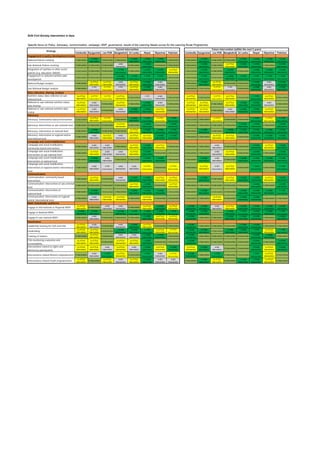
SUN Civil Society intervention in Asia
Specific focus on Policy, Advocacy, communication, campaign, MSP, governance: results of the Learning Needs survey for the Learning Route Programme)
Cambodia Kyrgyzstan Lao PDR Bangladesh Sri Lanka Nepal Myanmar Pakistan Cambodia Kyrgyzstan Lao PDR Bangladesh Sri Lanka Nepal Myanmar Pakistan
Engagement in policy development/review
National Policies tracking 2-Intervention
1-CORE
intervention
2-Intervention 2-Intervention
1-CORE
intervention
1-CORE
intervention
1-CORE
intervention
2-Intervention 2-Intervention
1-CORE
intervention
2-Intervention 2-Intervention
1-CORE
intervention
1-CORE
intervention
1-CORE
intervention
1-CORE
intervention
Sub-National Policies tracking 2-Intervention 2-Intervention 2-Intervention
4-NO
intervention
2-Intervention
1-CORE
intervention
2-Intervention 2-Intervention 2-Intervention
1-CORE
intervention
2-Intervention
3-LITTLE
intervention
1-CORE
intervention
1-CORE
intervention
2-Intervention
1-CORE
intervention
Integration of nutrition in other sector
policies (e.g. education; WASH)
2-Intervention 2-Intervention 2-Intervention
1-CORE
intervention
2-Intervention
1-CORE
intervention
1-CORE
intervention
3-LITTLE
intervention
2-Intervention
1-CORE
intervention
2-Intervention
1-CORE
intervention
2-Intervention
1-CORE
intervention
1-CORE
intervention
1-CORE
intervention
Engagement in national nutrition plan
development
2-Intervention 2-Intervention 2-Intervention
1-CORE
intervention
1-CORE
intervention
1-CORE
intervention
1-CORE
intervention
2-Intervention 2-Intervention
1-CORE
intervention
2-Intervention
1-CORE
intervention
1-CORE
intervention
1-CORE
intervention
1-CORE
intervention
1-CORE
intervention
National Budget analysis 2-Intervention
3-LITTLE
intervention
3-LITTLE
intervention
4-NO
intervention
3-LITTLE
intervention
1-CORE
intervention
4-NO
intervention
2-Intervention 2-Intervention
1-CORE
intervention
3-LITTLE
intervention
2-Intervention 2-Intervention
1-CORE
intervention
4-NO
intervention
1-CORE
intervention
Sub-National Budget analysis 2-Intervention
4-NO
intervention
3-LITTLE
intervention
4-NO
intervention
3-LITTLE
intervention
1-CORE
intervention
4-NO
intervention
2-Intervention 2-Intervention 2-Intervention
3-LITTLE
intervention
4-NO
intervention
2-Intervention
1-CORE
intervention
4-NO
intervention
1-CORE
intervention
Data collection, sharing, analysis
Nutrition status data collection at sub-
national level
3-LITTLE
intervention
3-LITTLE
intervention
3-LITTLE
intervention
3-LITTLE
intervention
2-Intervention
4-NO
intervention
4-NO
intervention
2-Intervention
3-LITTLE
intervention
2-Intervention
3-LITTLE
intervention
3-LITTLE
intervention
2-Intervention
1-CORE
intervention
3-LITTLE
intervention
2-Intervention
National or sub-national nutrition status
data sharing
3-LITTLE
intervention
4-NO
intervention
2-Intervention
3-LITTLE
intervention
2-Intervention
1-CORE
intervention
4-NO
intervention
2-Intervention
3-LITTLE
intervention
3-LITTLE
intervention
2-Intervention
3-LITTLE
intervention
1-CORE
intervention
1-CORE
intervention
4-NO
intervention
2-Intervention
National or sub-national nutrition data
review
3-LITTLE
intervention
4-NO
intervention
2-Intervention
4-NO
intervention
1-CORE
intervention
1-CORE
intervention
3-LITTLE
intervention
2-Intervention
3-LITTLE
intervention
3-LITTLE
intervention
2-Intervention
4-NO
intervention
1-CORE
intervention
1-CORE
intervention
3-LITTLE
intervention
2-Intervention
Advocacy
Advocacy: communities based intervention 2-Intervention
3-LITTLE
intervention
3-LITTLE
intervention
2-Intervention
1-CORE
intervention
1-CORE
intervention
3-LITTLE
intervention
1-CORE
intervention
2-Intervention 2-Intervention
3-LITTLE
intervention
2-Intervention 2-Intervention
1-CORE
intervention
3-LITTLE
intervention
1-CORE
intervention
Advocacy: intervention at sub-national level 2-Intervention 2-Intervention 2-Intervention
3-LITTLE
intervention
2-Intervention
1-CORE
intervention
2-Intervention
1-CORE
intervention
2-Intervention 2-Intervention 2-Intervention 2-Intervention
1-CORE
intervention
1-CORE
intervention
2-Intervention
1-CORE
intervention
Advocacy: intervention at national level 2-Intervention
1-CORE
intervention
2-Intervention 2-Intervention
3-LITTLE
intervention
1-CORE
intervention
1-CORE
intervention
1-CORE
intervention
2-Intervention
1-CORE
intervention
2-Intervention
1-CORE
intervention
1-CORE
intervention
1-CORE
intervention
1-CORE
intervention
1-CORE
intervention
Advocacy: intervention at regional and/or
international level
2-Intervention
4-NO
intervention
3-LITTLE
intervention
4-NO
intervention
3-LITTLE
intervention
3-LITTLE
intervention
1-CORE
intervention
1-CORE
intervention
2-Intervention 2-Intervention
3-LITTLE
intervention
3-LITTLE
intervention
2-Intervention
1-CORE
intervention
1-CORE
intervention
1-CORE
intervention
Campaign and social mobilization
Campaign and social mobilization:
community based intervention
2-Intervention
4-NO
intervention
4-NO
intervention
2-Intervention
3-LITTLE
intervention
1-CORE
intervention
3-LITTLE
intervention
2-Intervention 2-Intervention 2-Intervention
4-NO
intervention
2-Intervention 2-Intervention
1-CORE
intervention
3-LITTLE
intervention
1-CORE
intervention
Campaign and social mobilization:
intervention at sub-national level
2-Intervention
3-LITTLE
intervention
4-NO
intervention
4-NO
intervention
3-LITTLE
intervention
1-CORE
intervention
2-Intervention 2-Intervention 2-Intervention 2-Intervention
4-NO
intervention
3-LITTLE
intervention
2-Intervention
1-CORE
intervention
2-Intervention
1-CORE
intervention
Campaign and social mobilization:
intervention at national level
2-Intervention
1-CORE
intervention
4-NO
intervention
2-Intervention 2-Intervention
1-CORE
intervention
1-CORE
intervention
2-Intervention 2-Intervention
1-CORE
intervention
4-NO
intervention
2-Intervention
1-CORE
intervention
1-CORE
intervention
1-CORE
intervention
1-CORE
intervention
Campaign and social mobilization:
intervention at regional and/or international
level
2-Intervention
4-NO
intervention
4-NO
intervention
4-NO
intervention
4-NO
intervention
3-LITTLE
intervention
2-Intervention
3-LITTLE
intervention
2-Intervention
3-LITTLE
intervention
4-NO
intervention
3-LITTLE
intervention
2-Intervention
1-CORE
intervention
2-Intervention
1-CORE
intervention
Communication
Communication: community based
intervention
2-Intervention
3-LITTLE
intervention
2-Intervention
4-NO
intervention
1-CORE
intervention
1-CORE
intervention
3-LITTLE
intervention
3-LITTLE
intervention
2-Intervention
1-CORE
intervention
2-Intervention
3-LITTLE
intervention
1-CORE
intervention
1-CORE
intervention
3-LITTLE
intervention
1-CORE
intervention
Communication: intervention at sub-national
level
2-Intervention 2-Intervention 2-Intervention 2-Intervention
3-LITTLE
intervention
1-CORE
intervention
2-Intervention
3-LITTLE
intervention
2-Intervention 2-Intervention 2-Intervention 2-Intervention 2-Intervention
1-CORE
intervention
2-Intervention
1-CORE
intervention
Communication: intervention at
national level
2-Intervention
1-CORE
intervention
2-Intervention 2-Intervention
1-CORE
intervention
1-CORE
intervention
1-CORE
intervention
2-Intervention 2-Intervention
1-CORE
intervention
2-Intervention 2-Intervention
1-CORE
intervention
1-CORE
intervention
1-CORE
intervention
1-CORE
intervention
Communication: intervention at regional
and/or international level
2-Intervention
4-NO
intervention
3-LITTLE
intervention
3-LITTLE
intervention
2-Intervention
3-LITTLE
intervention
2-Intervention 2-Intervention 2-Intervention 2-Intervention
3-LITTLE
intervention
2-Intervention
1-CORE
intervention
1-CORE
intervention
2-Intervention 2-Intervention
Multi Stakeholder platforms
Engage in International or Regional MSPs
3-LITTLE
intervention
2-Intervention
4-NO
intervention
4-NO
intervention
2-Intervention
3-LITTLE
intervention
1-CORE
intervention
3-LITTLE
intervention
1-CORE
intervention
1-CORE
intervention
4-NO
intervention
3-LITTLE
intervention
1-CORE
intervention
1-CORE
intervention
1-CORE
intervention
1-CORE
intervention
Engage in National MSPs
1-CORE
intervention
1-CORE
intervention
2-Intervention
1-CORE
intervention
1-CORE
intervention
1-CORE
intervention
1-CORE
intervention
1-CORE
intervention
1-CORE
intervention
1-CORE
intervention
2-Intervention
1-CORE
intervention
1-CORE
intervention
1-CORE
intervention
1-CORE
intervention
1-CORE
intervention
Engage in sub-national MSPs 2-Intervention
4-NO
intervention
2-Intervention 2-Intervention 2-Intervention
1-CORE
intervention
3-LITTLE
intervention
3-LITTLE
intervention
1-CORE
intervention
2-Intervention 2-Intervention
1-CORE
intervention
1-CORE
intervention
1-CORE
intervention
2-Intervention
1-CORE
intervention
Governance
Leadership training for CSO and CSA
3-LITTLE
intervention
4-NO
intervention
2-Intervention
4-NO
intervention
1-CORE
intervention
3-LITTLE
intervention
2-Intervention 2-Intervention
1-CORE
intervention
2-Intervention 2-Intervention 2-Intervention
1-CORE
intervention
1-CORE
intervention
2-Intervention 2-Intervention
Fundraising
3-LITTLE
intervention
3-LITTLE
intervention
2-Intervention
1-CORE
intervention
1-CORE
intervention
1-CORE
intervention
3-LITTLE
intervention
3-LITTLE
intervention
1-CORE
intervention
1-CORE
intervention
2-Intervention
1-CORE
intervention
1-CORE
intervention
1-CORE
intervention
3-LITTLE
intervention
1-CORE
intervention
Training of trainers 2-Intervention
3-LITTLE
intervention
2-Intervention
4-NO
intervention
4-NO
intervention
1-CORE
intervention
1-CORE
intervention
2-Intervention
1-CORE
intervention
2-Intervention 2-Intervention 2-Intervention 2-Intervention
1-CORE
intervention
1-CORE
intervention
2-Intervention
CSA monitoring evaluation and
accountability
3-LITTLE
intervention
3-LITTLE
intervention
2-Intervention
3-LITTLE
intervention
3-LITTLE
intervention
1-CORE
intervention
2-Intervention 2-Intervention
1-CORE
intervention
2-Intervention 2-Intervention 2-Intervention 2-Intervention
1-CORE
intervention
2-Intervention
1-CORE
intervention
Interventions related to rights and
democracy participation
3-LITTLE
intervention
3-LITTLE
intervention
4-NO
intervention
3-LITTLE
intervention
4-NO
intervention
1-CORE
intervention
3-LITTLE
intervention
1-CORE
intervention
3-LITTLE
intervention
1-CORE
intervention
4-NO
intervention
2-Intervention 2-Intervention
1-CORE
intervention
3-LITTLE
intervention
1-CORE
intervention
Interventions related Women empowerment 2-Intervention
4-NO
intervention
1-CORE
intervention
3-LITTLE
intervention
2-Intervention
1-CORE
intervention
4-NO
intervention
3-LITTLE
intervention
1-CORE
intervention
2-Intervention
1-CORE
intervention
2-Intervention 2-Intervention
1-CORE
intervention
3-LITTLE
intervention
2-Intervention
Interventions related Youth empowerment
3-LITTLE
intervention
2-Intervention
3-LITTLE
intervention
4-NO
intervention
3-LITTLE
intervention
1-CORE
intervention
4-NO
intervention
4-NO
intervention
2-Intervention
1-CORE
intervention
3-LITTLE
intervention
2-Intervention
1-CORE
intervention
1-CORE
intervention
3-LITTLE
intervention
2-Intervention
Strategy
Current intervention Future intervention (within the next 5 years)
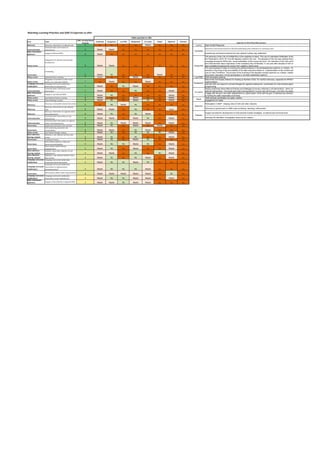
Matching Learning Priorities and SUN CS Expertise to offer
Area Topic
CSAs Learning Needs
Ranking
Cambodia Kyrgyzstan Lao PDR Bangladesh Sri Lanka Nepal Myanmar Pakistan
Advocacy Advocacy: intervention at national level 8 Yes Yes Yes Yes Maybe Yes Yes Yes Country Open-Ended Response
Communication
Communication: intervention at
national level 8 Maybe Maybe Yes Yes Yes Yes Yes Yes
Experiences and lessons learned on World breastfeeding week celebration at community level
Multi Stakeholder
platforms
Engage in National MSPs
8 Maybe Yes Yes Yes Yes Yes Yes Yes
Experiences and lessons learned from the national nutrition day celebration
Policy review
Engagement in national nutrition plan
development
8 Maybe Maybe Yes Yes Yes Yes Yes Yes
The advocacy of the Law on fortified flour is the expertise to share. The Law on mandatory fortification of flour was adopted by
the Parliament in 2015, 92 from 96 deputies voted for the Law . The adoption of the Law was reached through informational
campaign among the NGOs and social mobilization at the community level. The members of the CSA met the parliamentarians
and informed them about importance of the mandatory flour fortification. In one year after adoption of the Law fortified flour has
been available throughout the country from capital to district level.
Governance
Fundraising
8 Maybe No Yes Yes Yes Maybe Yes Yes
The next expertise to share is involving the parliamentarians in the Multistakeholder platform on nutrition. Their involvement
resulted in improving of the accoutability of the state executive bodies on implementation of the nutrition policy, including the
Law on Flour Fortifiction. The process of the involving of the deputies included seminars on nutrition, meetings, exchanging of
documents, discussion of their participation in the Multi-stakeholder platform.
Policy review National Policies tracking 7 Maybe Yes Yes Maybe Yes Yes Yes Yes Lao PDR SUN information sharing
Policy review
Integration of nutrition in other sector
policies (e.g. education; WASH) 7 Yes Maybe Yes Yes Maybe Yes Yes Yes
Role of the Civil Society Alliance for Scaling up Nutrition (CSA) for nutrition advocacy, especially for NPAN follow up and
implementation
Campaign and social
mobilization
Campaign and social mobilization:
intervention at national level 7 Maybe Yes No Maybe Yes Yes Yes Yes
How the CSA can support to provide linkages for capacity building and coordination for multi-sectoral approaches to nutrition
programming
Communication
Communication: community based
intervention 7 Maybe Yes Yes No Yes Yes Maybe Yes
Always proactively follow National Policies and Strategies to ensure uniformity in all interventions - which complements the
national interventions. This would also build a strong platform to work well with the govt. and other key stakeholders.
Multi Stakeholder
platforms
Engage in sub-national MSPs
7 Maybe No Yes Yes Yes Yes Maybe Yes
Engage with the govt. and other stakeholders to a great extent. Work with the govt. to address key national issues as opposed
to holding the state responsible at all times.
Policy review Sub-National Policies tracking 6 Maybe Yes Yes Maybe Yes Yes Maybe Yes Multi sectoral coordination for better nutrition
Policy review National Budget analysis 6 Maybe No Yes Maybe No Yes Maybe Yes engagement of media
Advocacy
Advocacy: communities based intervention
6 Yes No Maybe No Yes Yes Yes Yes
Participation in MSP - shaping roles of CSA and other networks
Advocacy
Advocacy: intervention at sub-national
level 6 Maybe Maybe Yes No Yes Yes Maybe Yes
Advocacy to government re: BMS code monitoring, reporting, enforcement
Advocacy
Advocacy: intervention at regional and/or
international level 6 Maybe No Yes No Maybe Yes Yes Yes
Support provided for development of multi-sectoral nutrition strategies at national and provincial level.
Communication
Communication: intervention at sub-
national level 6 Maybe Maybe Yes Maybe No Yes Maybe Yes Advocacy for allocation of budgetary resources for nutrition
Communication
Communication: intervention at regional
and/or international level 6 Maybe No Maybe Maybe Maybe Yes Maybe Yes
Governance Leadership training for CSO and CSA 6 Maybe No Yes Maybe Yes Maybe Yes Yes
Governance
CSA monitoring evaluation and
accountability 6 Maybe Maybe Yes No Maybe Yes Yes Yes
Policy review Sub-National Budget analysis 5 Maybe No Yes No No No Maybe Yes
Data collection,
sharing, analysis
National or sub-national nutrition data
review 5 Maybe No Yes No Yes Yes Maybe Yes
Governance Training of trainers 5 Maybe No Yes Maybe No Yes Yes Yes
Governance
Interventions related to rights and
democracy participation 5 Maybe No No Maybe No Yes Maybe Yes
Governance
Interventions related Women
empowerment 5 Maybe No Yes Maybe Yes Yes Maybe Yes
Data collection,
sharing, analysis
Nutrition status data collection at sub-
national level 4 Maybe Maybe Yes No Yes No Maybe Yes
Data collection,
sharing, analysis
National or sub-national nutrition status
data sharing 4 Maybe No Yes No Maybe Yes Maybe Yes
Campaign and social
mobilization
Campaign and social mobilization:
community based intervention 4 Maybe No No Maybe No Yes Yes Yes
Campaign and social
mobilization
Campaign and social mobilization:
intervention at regional and/or
international level 4 Maybe No No No Maybe Yes Yes Yes
Governance
Interventions related Youth empowerment
4 Maybe Maybe Maybe Maybe Maybe Yes No Yes
Campaign and social
mobilization
Campaign and social mobilization:
intervention at sub-national level 3 Maybe No No Maybe Maybe Yes Maybe Yes
Multi Stakeholder
platforms Engage in International or Regional MSPs 3 Maybe Maybe No Maybe Maybe Yes Yes Yes
CSAs expertise to offer
Myanmar
Pakistan
Expertise to offer/share/Best practice
Cambodia
Kyrgyzstan
Bangladesh
Sri Lanka
Nepal
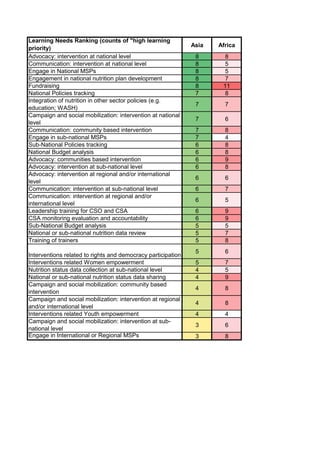
Learning Needs Ranking (counts of "high learning
priority)
Asia Africa
Advocacy: intervention at national level 8 8
Communication: intervention at national level 8 5
Engage in National MSPs 8 5
Engagement in national nutrition plan development 8 7
Fundraising 8 11
National Policies tracking 7 8
Integration of nutrition in other sector policies (e.g.
education; WASH)
7 7
Campaign and social mobilization: intervention at national
level
7 6
Communication: community based intervention 7 8
Engage in sub-national MSPs 7 4
Sub-National Policies tracking 6 8
National Budget analysis 6 8
Advocacy: communities based intervention 6 9
Advocacy: intervention at sub-national level 6 8
Advocacy: intervention at regional and/or international
level
6 6
Communication: intervention at sub-national level 6 7
Communication: intervention at regional and/or
international level
6 5
Leadership training for CSO and CSA 6 9
CSA monitoring evaluation and accountability 6 9
Sub-National Budget analysis 5 5
National or sub-national nutrition data review 5 7
Training of trainers 5 8
Interventions related to rights and democracy participation
5 6
Interventions related Women empowerment 5 7
Nutrition status data collection at sub-national level 4 5
National or sub-national nutrition status data sharing 4 9
Campaign and social mobilization: community based
intervention
4 8
Campaign and social mobilization: intervention at regional
and/or international level
4 8
Interventions related Youth empowerment 4 4
Campaign and social mobilization: intervention at sub-
national level
3 6
Engage in International or Regional MSPs 3 8
Estimated time and $ invested across the macro intervention areas
Engagement in policy development/review
Estimated
time
invested
(%)
Estimated
$ invested
(% overall
CSA
budget)
Cambodia 30 10 Cambodia 130 80 wrong
Kyrgyzstan 30 10 Kyrgyzstan 100 100 ok
Lao PDR 10 10 Lao PDR 100 100 ok
Bangladesh
50 50
Bangladesh
190 310 wrong
Sri Lanka 50 20 Sri Lanka 100 100 ok
Nepal 50 20 Nepal 280 200 wrong
Myanmar 20 10 Myanmar 110 100 wrong
Pakistan 80 70 Pakistan 350 300 wrong
Data collection/review/sharing
Estimated
time
invested
(%)
Estimated
$ invested
(% overall
CSA
budget)
Cambodia 30 20
Kyrgyzstan 10 10
Lao PDR 10 10
Bangladesh 30 70
Sri Lanka 10 10
Nepal 40 50
Myanmar 10
Pakistan 50 50
Advocacy
Estimated
time
invested
(%)
Estimated
$ invested
(% overall
CSA
budget)
Cambodia 30 30
Kyrgyzstan 20 50
Lao PDR 40 40
Bangladesh 30 70
Sri Lanka 10 50
Nepal 80 90
Myanmar 30 50
Pakistan 70 70
Engage in multi-stakeholders platforms
Estimated
time
invested
(%)
Estimated
$ invested
(% overall
CSA
budget)
Cambodia 30 10
Kyrgyzstan 30 20
Lao PDR 30 30
Bangladesh 40 60
Sri Lanka 20 10
Nepal 90 20
Myanmar 40 30
Pakistan 80 60
CSA/CSO Good governance
Estimated
time
invested
(%)
Estimated
$ invested
(% overall
CSA
budget)
Cambodia 10 10
Kyrgyzstan 10 10
Lao PDR 10 10
Bangladesh 40 60
Sri Lanka 10 10
Nepal 20 20
Myanmar 10 10
Pakistan 70 50
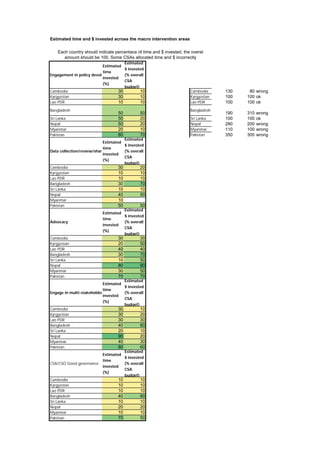
Each country should indicate percentace of time and $ invested, the overal
amount should be 100. Some CSAs allocated time and $ incorrectly
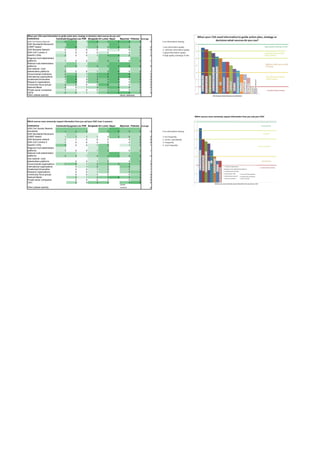
When your CSA need information to guide action plan, strategy or decisions what sources do you use?
Institutions Cambodia KyrgyzstanLao PDR BangladeshSri Lanka Nepal Myanmar Pakistan Average
SUN Civil Society Network 3 4 1 4 3 4 4 3 3 0-no information sharing
SUN Secretariat Movement
(UNDP based) 2 4 1 3 2 4 3 2 3 1-low information quality
SUN Business Network 0 0 0 0 0 1 0 2 0 2- sufficient information quality
SUN CoP 2 and/or 4 1 0 0 0 1 0 2 1 3-good information quality
Specific CSAs 2 0 0 1 3 4 2 2 2 4-high quality exchange of info
Regional multi-stakeholders
platforms 1 0 0 1 3 3 0 3 1
National multi-stakeholders
platforms 2 3 1 3 3 4 4 3 3
Sub-national multi-
stakeholders platforms 2 0 0 1 2 4 0 2 1
Governmental institutions 2 3 1 3 4 4 4 3 3
International organizations 2 4 1 3 4 4 4 3 3
Academies/Universities 1 4 0 3 3 4 0 3 2
Research organizations 1 4 0 3 3 4 0 3 2
Community focus groups 2 2 0 0 4 3 0 2 2
National Media 2 0 1 2 3 4 2 2 2
Private sector companies 1 1 0 0 2 3 0 2 1
CSOs 2 2 1 1 3 4 4 3 3
Other (please specify) donor networks
Which sources most commonly request information from you and your CSA? 
Which sources most commonly request information from you and your CSA? (max 5 answers)
Institutions Cambodia KyrgyzstanLao PDR BangladeshSri Lanka Nepal Myanmar Pakistan Average
SUN Civil Society Network
secretariat 3 3 3 3 4 3 3 3 0-no information sharing
SUN Secretariat Movement
(UNDP based) 1 2 1 1 0 3 2 2 2 1-not frequently
SUN Business network 1 0 0 0 0 0 2 0 2- ad hoc, sporadically
SUN CoP 2 and/or 4 1 0 0 0 0 0 2 0 3- frequently
Specific CSAs 3 0 0 1 3 1 2 1 4- very frequently
Regional multi-stakeholders
platforms 1 0 0 1 3 0 2 1
National multi-stakeholders
platforms 2 2 1 2 3 4 2 3 2
Sub-national multi-
stakeholders platforms 0 0 1 2 0 3 1
Governmental organizations 2 3 1 2 3 3 3 3 3
International organizations 0 1 2 2 3 2 1
Academies/Universities 0 0 1 2 2 2 1
Research organizations 0 0 1 2 2 3 1
Community focus groups 0 0 1 0 0 2 0
National Media 2 1 2 3 4 3 3 2
Private sector companies 0 0 0 0 0 2 0
CSO 2 0 3 3 3 4 2
Other (please specify)
Donor
network 0
2015 SUNCSN Annual Survey
Good governance elements Total CSAs Asian CSAs
Constitution or ToR for the CSA? 78% 83%
CSA Hosted by an NGO? 78% 83%
CSA registered as an Independent Entity? 17% 17%
Memorandum of Understanding between the CSA and host organization? 44% 17%
Full-time CSA coordinator? 43% 67%
ToR for the steering group or executive committee? 65% 83%
Steering group or an executive committee? 78% 100%
Do you have decentralized representation as a CSA (e.g at a district level)? 48% 33%
Membership development strategy? 35% 17%
Sustainability Plan? 22% 17%
Conflict of interest policy? 22% 0%
Membership application/screening process? 70% 83%
Process for resolving conflict between members of the CSA? 30% 17%
Process for nominating and facilitating equitable access to opportunities? 22% 17%
CSA organisations internal registry 65% 50%
Process for tracking of women’s participation in leadership of the CSA? 22% 17%
Advocacy strategy Total CSAs Asian CSAs
Does your CSA have its own advocacy, communications and/or social mobilization plan?52% 67%
Contribution to a national advocacy and communications strategy aligned to the country plan, efforts and priorities86% 100%
Regional advocacy initiatives 52% 17%
International advocacy initiatives 43% 33%
Increased resources for nutrition 90% 83%
Do you have nutrition champions 48% 33%
Advocacy Theme
Improved budget tracking by government for nutrition 48% 17%
Improved allocation of resources for nutrition 81% 67%
Civil society financial contributions to the nutrition sector 43% 33%
Breastmilk substitute marketing code 71% 67%
Right to food and nutrition 71% 50%
Food sovereignty 43% 17%
Contribution to National Efforts
National monitoring, evaluation and learning activities 67% 67%
National nutrition plan development 76% 67%
National nutrition information systems development 38% 33%
0% 0%
Does your country have? 0% 0%
A Nutrition Multi-sectoral Plan (NMP)? 86% 100%
A Common Results Framework (CRF)? 57% 33%
Themes Total CSAs Asian CSAs
Agriculture 90% 100%
Food Security 95% 100%
Nutrition 95% 100%
Education 90% 100%
Health 95% 100%
Social protection 81% 67%
Water, sanitation and hygiene 86% 83%
Right to food and nutrition 76% 33%
Gender & Women's Empowerment 90% 100%
Climate Change 43% 17%
Support for exclusive breastfeeding up 90% 100%
Micronutrient supplementation 76% 83%
Fortification of foods 76% 67%
Treatment of severe malnutrition 62% 50%
Agriculture: Making nutritious food more accessible to everyone, and supporting small farms as a source of income for women and families81% 83%
Education and Emplyment: Making sure children have the energy that they need to learn and earn sufficient income as adults52% 50%
Clean Water and Sanitation: Improving access to reduce infection and disease 67% 67%
Health Care: Improving access to services to ensure that women and children stay healthy81% 67%
Support for Resilience: Establishing a stronger, healthier population and sustained prosperity to better endure emergencies and conflicts57% 50%
Women’s Empowerment: Women empowered to be leaders in their families and communities, leading the way to a healthier and stronger world71% 67%
Lao PDR
Kyrgyz Republic The best practice to share is an advocating of amendments into the Law on Flour Fortification to implement mandatory flour fortification. Representatives from NGOs were trained on nutrition and flour fortification topics, printed materials were distributed. About 17 organisations took part in the advocacy work directly and they engaged their own partners in collecting signatures of people on community level, sent letters to parliamentarians. Members participated in TV talk shows, visited parliamentarians to inform them about importance of flour fortification.
Pakistan Constant engagement with general members of CSA Engagement of media and other like minded coalitions in nutrition advocacy
Cambodia In Cambodia, we found that since the Cambodia SUN CSA has been established in the last few months, the Civil Society has very stronger voice to advocate for nutrition related agenda with the government. In the past, individual NGO advocated for anything they wanted with government. Now, instead of individual NGO approaches to government for advocacy, we come as a team. This is more effective and makes the government listens to us well.
Myanmar Coming together as an MSP has proven difficult in Myanmar, so the CSA has been actively working to increase opportunities for informal engagement and experience sharing with other networks. For example, we meet regularly with the UN Network in Yangon and have begun to schedule meetings with representatives of donor agencies in order to strengthen the Donor Network. We have also created an email list in order to facilitate regular communication with the MSP.
Nepal The national alliance and formation of district chapters to bridge between community and national level. A lobby team within CSAN with experts. Regular coordination with government to recognize the advocacy issues Media engagement is the best means for highlighting the issue in general public and among policy makers. Signatory commitment collection is found effective to generate ownership on issue. Real case collection and video show are found as best means as advocacy tools Regular meetings and sharing of information among CSOs
Learning needs (“Priorities for support”)
Knowledge and IEC material collection, dissemination and sharing.
Grants management (e.g. SUN CSA provides small grants to local civil society from larger INGOs members)
Kyrgyz Republic Development of MSP ;
Flour fortification ;
Development of CSA ;
Budget analysis.
Pakistan
Additional Resources for Nutrition
Implementation of Multi-sectoral Plans
Myanmar Develop effective advocacy plan
Nepal Identifying additional funding opportunities.
The donor convener has not been active in the MSP and the CSA is currently seeking continued funding to cover program costs.
Best practices
Lao PDR
Cambodia
SUN CSA Laos has only been fully operational late 2014, thus we do not have a lot of lessons or best practices to share. However, we could share our
experiences we had on building momentum from members and government counterparts. How we were able to increase our members, commitment from
our management committee as well as gain acceptance from the government to be involved in many health and nutrition related discussions, events and
meetings.

Asia lr survey for sharing

  • 1.
    Aug-16 Before looking atthis preliminary analysis Content of this document: To understand which is the CSA intervention strategy related to the LR main learning areas, currently and on the mid term To find out what expertise we have "in-house" and which are the learning needs of our alliance Learning Needs priorities To fin out in the overall how much efforst and resources each Alliance is dedicating to the different macro areas Knowledge sharing To find out where the CSAs seek information for their planning and which institutions refer to the CSA to get information. Additional backgound information that will guide the LR and the M&E The information shared in this document is the result of a preliminary analysis of the Learning Route survey. The information collected will serve as baseline for the LR in asia and to guide the development of the learning program for the SUN Civil Society Alliances that applied for the Learning Route. For questions and clarifications, please write to the SUN CS Learning Route program coordinator: c.ruberto@savethechildren.org.uk Strategy Exertise and learning needs Ranking 2015 SUNCSN Annual Survey Time-$ alloacation
  • 2.
    SUN Civil Societyintervention in Asia Specific focus on Policy, Advocacy, communication, campaign, MSP, governance: results of the Learning Needs survey for the Learning Route Programme) Cambodia Kyrgyzstan Lao PDR Bangladesh Sri Lanka Nepal Myanmar Pakistan Cambodia Kyrgyzstan Lao PDR Bangladesh Sri Lanka Nepal Myanmar Pakistan Engagement in policy development/review National Policies tracking 2-Intervention 1-CORE intervention 2-Intervention 2-Intervention 1-CORE intervention 1-CORE intervention 1-CORE intervention 2-Intervention 2-Intervention 1-CORE intervention 2-Intervention 2-Intervention 1-CORE intervention 1-CORE intervention 1-CORE intervention 1-CORE intervention Sub-National Policies tracking 2-Intervention 2-Intervention 2-Intervention 4-NO intervention 2-Intervention 1-CORE intervention 2-Intervention 2-Intervention 2-Intervention 1-CORE intervention 2-Intervention 3-LITTLE intervention 1-CORE intervention 1-CORE intervention 2-Intervention 1-CORE intervention Integration of nutrition in other sector policies (e.g. education; WASH) 2-Intervention 2-Intervention 2-Intervention 1-CORE intervention 2-Intervention 1-CORE intervention 1-CORE intervention 3-LITTLE intervention 2-Intervention 1-CORE intervention 2-Intervention 1-CORE intervention 2-Intervention 1-CORE intervention 1-CORE intervention 1-CORE intervention Engagement in national nutrition plan development 2-Intervention 2-Intervention 2-Intervention 1-CORE intervention 1-CORE intervention 1-CORE intervention 1-CORE intervention 2-Intervention 2-Intervention 1-CORE intervention 2-Intervention 1-CORE intervention 1-CORE intervention 1-CORE intervention 1-CORE intervention 1-CORE intervention National Budget analysis 2-Intervention 3-LITTLE intervention 3-LITTLE intervention 4-NO intervention 3-LITTLE intervention 1-CORE intervention 4-NO intervention 2-Intervention 2-Intervention 1-CORE intervention 3-LITTLE intervention 2-Intervention 2-Intervention 1-CORE intervention 4-NO intervention 1-CORE intervention Sub-National Budget analysis 2-Intervention 4-NO intervention 3-LITTLE intervention 4-NO intervention 3-LITTLE intervention 1-CORE intervention 4-NO intervention 2-Intervention 2-Intervention 2-Intervention 3-LITTLE intervention 4-NO intervention 2-Intervention 1-CORE intervention 4-NO intervention 1-CORE intervention Data collection, sharing, analysis Nutrition status data collection at sub- national level 3-LITTLE intervention 3-LITTLE intervention 3-LITTLE intervention 3-LITTLE intervention 2-Intervention 4-NO intervention 4-NO intervention 2-Intervention 3-LITTLE intervention 2-Intervention 3-LITTLE intervention 3-LITTLE intervention 2-Intervention 1-CORE intervention 3-LITTLE intervention 2-Intervention National or sub-national nutrition status data sharing 3-LITTLE intervention 4-NO intervention 2-Intervention 3-LITTLE intervention 2-Intervention 1-CORE intervention 4-NO intervention 2-Intervention 3-LITTLE intervention 3-LITTLE intervention 2-Intervention 3-LITTLE intervention 1-CORE intervention 1-CORE intervention 4-NO intervention 2-Intervention National or sub-national nutrition data review 3-LITTLE intervention 4-NO intervention 2-Intervention 4-NO intervention 1-CORE intervention 1-CORE intervention 3-LITTLE intervention 2-Intervention 3-LITTLE intervention 3-LITTLE intervention 2-Intervention 4-NO intervention 1-CORE intervention 1-CORE intervention 3-LITTLE intervention 2-Intervention Advocacy Advocacy: communities based intervention 2-Intervention 3-LITTLE intervention 3-LITTLE intervention 2-Intervention 1-CORE intervention 1-CORE intervention 3-LITTLE intervention 1-CORE intervention 2-Intervention 2-Intervention 3-LITTLE intervention 2-Intervention 2-Intervention 1-CORE intervention 3-LITTLE intervention 1-CORE intervention Advocacy: intervention at sub-national level 2-Intervention 2-Intervention 2-Intervention 3-LITTLE intervention 2-Intervention 1-CORE intervention 2-Intervention 1-CORE intervention 2-Intervention 2-Intervention 2-Intervention 2-Intervention 1-CORE intervention 1-CORE intervention 2-Intervention 1-CORE intervention Advocacy: intervention at national level 2-Intervention 1-CORE intervention 2-Intervention 2-Intervention 3-LITTLE intervention 1-CORE intervention 1-CORE intervention 1-CORE intervention 2-Intervention 1-CORE intervention 2-Intervention 1-CORE intervention 1-CORE intervention 1-CORE intervention 1-CORE intervention 1-CORE intervention Advocacy: intervention at regional and/or international level 2-Intervention 4-NO intervention 3-LITTLE intervention 4-NO intervention 3-LITTLE intervention 3-LITTLE intervention 1-CORE intervention 1-CORE intervention 2-Intervention 2-Intervention 3-LITTLE intervention 3-LITTLE intervention 2-Intervention 1-CORE intervention 1-CORE intervention 1-CORE intervention Campaign and social mobilization Campaign and social mobilization: community based intervention 2-Intervention 4-NO intervention 4-NO intervention 2-Intervention 3-LITTLE intervention 1-CORE intervention 3-LITTLE intervention 2-Intervention 2-Intervention 2-Intervention 4-NO intervention 2-Intervention 2-Intervention 1-CORE intervention 3-LITTLE intervention 1-CORE intervention Campaign and social mobilization: intervention at sub-national level 2-Intervention 3-LITTLE intervention 4-NO intervention 4-NO intervention 3-LITTLE intervention 1-CORE intervention 2-Intervention 2-Intervention 2-Intervention 2-Intervention 4-NO intervention 3-LITTLE intervention 2-Intervention 1-CORE intervention 2-Intervention 1-CORE intervention Campaign and social mobilization: intervention at national level 2-Intervention 1-CORE intervention 4-NO intervention 2-Intervention 2-Intervention 1-CORE intervention 1-CORE intervention 2-Intervention 2-Intervention 1-CORE intervention 4-NO intervention 2-Intervention 1-CORE intervention 1-CORE intervention 1-CORE intervention 1-CORE intervention Campaign and social mobilization: intervention at regional and/or international level 2-Intervention 4-NO intervention 4-NO intervention 4-NO intervention 4-NO intervention 3-LITTLE intervention 2-Intervention 3-LITTLE intervention 2-Intervention 3-LITTLE intervention 4-NO intervention 3-LITTLE intervention 2-Intervention 1-CORE intervention 2-Intervention 1-CORE intervention Communication Communication: community based intervention 2-Intervention 3-LITTLE intervention 2-Intervention 4-NO intervention 1-CORE intervention 1-CORE intervention 3-LITTLE intervention 3-LITTLE intervention 2-Intervention 1-CORE intervention 2-Intervention 3-LITTLE intervention 1-CORE intervention 1-CORE intervention 3-LITTLE intervention 1-CORE intervention Communication: intervention at sub-national level 2-Intervention 2-Intervention 2-Intervention 2-Intervention 3-LITTLE intervention 1-CORE intervention 2-Intervention 3-LITTLE intervention 2-Intervention 2-Intervention 2-Intervention 2-Intervention 2-Intervention 1-CORE intervention 2-Intervention 1-CORE intervention Communication: intervention at national level 2-Intervention 1-CORE intervention 2-Intervention 2-Intervention 1-CORE intervention 1-CORE intervention 1-CORE intervention 2-Intervention 2-Intervention 1-CORE intervention 2-Intervention 2-Intervention 1-CORE intervention 1-CORE intervention 1-CORE intervention 1-CORE intervention Communication: intervention at regional and/or international level 2-Intervention 4-NO intervention 3-LITTLE intervention 3-LITTLE intervention 2-Intervention 3-LITTLE intervention 2-Intervention 2-Intervention 2-Intervention 2-Intervention 3-LITTLE intervention 2-Intervention 1-CORE intervention 1-CORE intervention 2-Intervention 2-Intervention Multi Stakeholder platforms Engage in International or Regional MSPs 3-LITTLE intervention 2-Intervention 4-NO intervention 4-NO intervention 2-Intervention 3-LITTLE intervention 1-CORE intervention 3-LITTLE intervention 1-CORE intervention 1-CORE intervention 4-NO intervention 3-LITTLE intervention 1-CORE intervention 1-CORE intervention 1-CORE intervention 1-CORE intervention Engage in National MSPs 1-CORE intervention 1-CORE intervention 2-Intervention 1-CORE intervention 1-CORE intervention 1-CORE intervention 1-CORE intervention 1-CORE intervention 1-CORE intervention 1-CORE intervention 2-Intervention 1-CORE intervention 1-CORE intervention 1-CORE intervention 1-CORE intervention 1-CORE intervention Engage in sub-national MSPs 2-Intervention 4-NO intervention 2-Intervention 2-Intervention 2-Intervention 1-CORE intervention 3-LITTLE intervention 3-LITTLE intervention 1-CORE intervention 2-Intervention 2-Intervention 1-CORE intervention 1-CORE intervention 1-CORE intervention 2-Intervention 1-CORE intervention Governance Leadership training for CSO and CSA 3-LITTLE intervention 4-NO intervention 2-Intervention 4-NO intervention 1-CORE intervention 3-LITTLE intervention 2-Intervention 2-Intervention 1-CORE intervention 2-Intervention 2-Intervention 2-Intervention 1-CORE intervention 1-CORE intervention 2-Intervention 2-Intervention Fundraising 3-LITTLE intervention 3-LITTLE intervention 2-Intervention 1-CORE intervention 1-CORE intervention 1-CORE intervention 3-LITTLE intervention 3-LITTLE intervention 1-CORE intervention 1-CORE intervention 2-Intervention 1-CORE intervention 1-CORE intervention 1-CORE intervention 3-LITTLE intervention 1-CORE intervention Training of trainers 2-Intervention 3-LITTLE intervention 2-Intervention 4-NO intervention 4-NO intervention 1-CORE intervention 1-CORE intervention 2-Intervention 1-CORE intervention 2-Intervention 2-Intervention 2-Intervention 2-Intervention 1-CORE intervention 1-CORE intervention 2-Intervention CSA monitoring evaluation and accountability 3-LITTLE intervention 3-LITTLE intervention 2-Intervention 3-LITTLE intervention 3-LITTLE intervention 1-CORE intervention 2-Intervention 2-Intervention 1-CORE intervention 2-Intervention 2-Intervention 2-Intervention 2-Intervention 1-CORE intervention 2-Intervention 1-CORE intervention Interventions related to rights and democracy participation 3-LITTLE intervention 3-LITTLE intervention 4-NO intervention 3-LITTLE intervention 4-NO intervention 1-CORE intervention 3-LITTLE intervention 1-CORE intervention 3-LITTLE intervention 1-CORE intervention 4-NO intervention 2-Intervention 2-Intervention 1-CORE intervention 3-LITTLE intervention 1-CORE intervention Interventions related Women empowerment 2-Intervention 4-NO intervention 1-CORE intervention 3-LITTLE intervention 2-Intervention 1-CORE intervention 4-NO intervention 3-LITTLE intervention 1-CORE intervention 2-Intervention 1-CORE intervention 2-Intervention 2-Intervention 1-CORE intervention 3-LITTLE intervention 2-Intervention Interventions related Youth empowerment 3-LITTLE intervention 2-Intervention 3-LITTLE intervention 4-NO intervention 3-LITTLE intervention 1-CORE intervention 4-NO intervention 4-NO intervention 2-Intervention 1-CORE intervention 3-LITTLE intervention 2-Intervention 1-CORE intervention 1-CORE intervention 3-LITTLE intervention 2-Intervention Strategy Current intervention Future intervention (within the next 5 years)
  • 3.
    Matching Learning Prioritiesand SUN CS Expertise to offer Area Topic CSAs Learning Needs Ranking Cambodia Kyrgyzstan Lao PDR Bangladesh Sri Lanka Nepal Myanmar Pakistan Advocacy Advocacy: intervention at national level 8 Yes Yes Yes Yes Maybe Yes Yes Yes Country Open-Ended Response Communication Communication: intervention at national level 8 Maybe Maybe Yes Yes Yes Yes Yes Yes Experiences and lessons learned on World breastfeeding week celebration at community level Multi Stakeholder platforms Engage in National MSPs 8 Maybe Yes Yes Yes Yes Yes Yes Yes Experiences and lessons learned from the national nutrition day celebration Policy review Engagement in national nutrition plan development 8 Maybe Maybe Yes Yes Yes Yes Yes Yes The advocacy of the Law on fortified flour is the expertise to share. The Law on mandatory fortification of flour was adopted by the Parliament in 2015, 92 from 96 deputies voted for the Law . The adoption of the Law was reached through informational campaign among the NGOs and social mobilization at the community level. The members of the CSA met the parliamentarians and informed them about importance of the mandatory flour fortification. In one year after adoption of the Law fortified flour has been available throughout the country from capital to district level. Governance Fundraising 8 Maybe No Yes Yes Yes Maybe Yes Yes The next expertise to share is involving the parliamentarians in the Multistakeholder platform on nutrition. Their involvement resulted in improving of the accoutability of the state executive bodies on implementation of the nutrition policy, including the Law on Flour Fortifiction. The process of the involving of the deputies included seminars on nutrition, meetings, exchanging of documents, discussion of their participation in the Multi-stakeholder platform. Policy review National Policies tracking 7 Maybe Yes Yes Maybe Yes Yes Yes Yes Lao PDR SUN information sharing Policy review Integration of nutrition in other sector policies (e.g. education; WASH) 7 Yes Maybe Yes Yes Maybe Yes Yes Yes Role of the Civil Society Alliance for Scaling up Nutrition (CSA) for nutrition advocacy, especially for NPAN follow up and implementation Campaign and social mobilization Campaign and social mobilization: intervention at national level 7 Maybe Yes No Maybe Yes Yes Yes Yes How the CSA can support to provide linkages for capacity building and coordination for multi-sectoral approaches to nutrition programming Communication Communication: community based intervention 7 Maybe Yes Yes No Yes Yes Maybe Yes Always proactively follow National Policies and Strategies to ensure uniformity in all interventions - which complements the national interventions. This would also build a strong platform to work well with the govt. and other key stakeholders. Multi Stakeholder platforms Engage in sub-national MSPs 7 Maybe No Yes Yes Yes Yes Maybe Yes Engage with the govt. and other stakeholders to a great extent. Work with the govt. to address key national issues as opposed to holding the state responsible at all times. Policy review Sub-National Policies tracking 6 Maybe Yes Yes Maybe Yes Yes Maybe Yes Multi sectoral coordination for better nutrition Policy review National Budget analysis 6 Maybe No Yes Maybe No Yes Maybe Yes engagement of media Advocacy Advocacy: communities based intervention 6 Yes No Maybe No Yes Yes Yes Yes Participation in MSP - shaping roles of CSA and other networks Advocacy Advocacy: intervention at sub-national level 6 Maybe Maybe Yes No Yes Yes Maybe Yes Advocacy to government re: BMS code monitoring, reporting, enforcement Advocacy Advocacy: intervention at regional and/or international level 6 Maybe No Yes No Maybe Yes Yes Yes Support provided for development of multi-sectoral nutrition strategies at national and provincial level. Communication Communication: intervention at sub- national level 6 Maybe Maybe Yes Maybe No Yes Maybe Yes Advocacy for allocation of budgetary resources for nutrition Communication Communication: intervention at regional and/or international level 6 Maybe No Maybe Maybe Maybe Yes Maybe Yes Governance Leadership training for CSO and CSA 6 Maybe No Yes Maybe Yes Maybe Yes Yes Governance CSA monitoring evaluation and accountability 6 Maybe Maybe Yes No Maybe Yes Yes Yes Policy review Sub-National Budget analysis 5 Maybe No Yes No No No Maybe Yes Data collection, sharing, analysis National or sub-national nutrition data review 5 Maybe No Yes No Yes Yes Maybe Yes Governance Training of trainers 5 Maybe No Yes Maybe No Yes Yes Yes Governance Interventions related to rights and democracy participation 5 Maybe No No Maybe No Yes Maybe Yes Governance Interventions related Women empowerment 5 Maybe No Yes Maybe Yes Yes Maybe Yes Data collection, sharing, analysis Nutrition status data collection at sub- national level 4 Maybe Maybe Yes No Yes No Maybe Yes Data collection, sharing, analysis National or sub-national nutrition status data sharing 4 Maybe No Yes No Maybe Yes Maybe Yes Campaign and social mobilization Campaign and social mobilization: community based intervention 4 Maybe No No Maybe No Yes Yes Yes Campaign and social mobilization Campaign and social mobilization: intervention at regional and/or international level 4 Maybe No No No Maybe Yes Yes Yes Governance Interventions related Youth empowerment 4 Maybe Maybe Maybe Maybe Maybe Yes No Yes Campaign and social mobilization Campaign and social mobilization: intervention at sub-national level 3 Maybe No No Maybe Maybe Yes Maybe Yes Multi Stakeholder platforms Engage in International or Regional MSPs 3 Maybe Maybe No Maybe Maybe Yes Yes Yes CSAs expertise to offer Myanmar Pakistan Expertise to offer/share/Best practice Cambodia Kyrgyzstan Bangladesh Sri Lanka Nepal
  • 4.
    Learning Needs Ranking(counts of "high learning priority) Asia Africa Advocacy: intervention at national level 8 8 Communication: intervention at national level 8 5 Engage in National MSPs 8 5 Engagement in national nutrition plan development 8 7 Fundraising 8 11 National Policies tracking 7 8 Integration of nutrition in other sector policies (e.g. education; WASH) 7 7 Campaign and social mobilization: intervention at national level 7 6 Communication: community based intervention 7 8 Engage in sub-national MSPs 7 4 Sub-National Policies tracking 6 8 National Budget analysis 6 8 Advocacy: communities based intervention 6 9 Advocacy: intervention at sub-national level 6 8 Advocacy: intervention at regional and/or international level 6 6 Communication: intervention at sub-national level 6 7 Communication: intervention at regional and/or international level 6 5 Leadership training for CSO and CSA 6 9 CSA monitoring evaluation and accountability 6 9 Sub-National Budget analysis 5 5 National or sub-national nutrition data review 5 7 Training of trainers 5 8 Interventions related to rights and democracy participation 5 6 Interventions related Women empowerment 5 7 Nutrition status data collection at sub-national level 4 5 National or sub-national nutrition status data sharing 4 9 Campaign and social mobilization: community based intervention 4 8 Campaign and social mobilization: intervention at regional and/or international level 4 8 Interventions related Youth empowerment 4 4 Campaign and social mobilization: intervention at sub- national level 3 6 Engage in International or Regional MSPs 3 8
  • 5.
    Estimated time and$ invested across the macro intervention areas Engagement in policy development/review Estimated time invested (%) Estimated $ invested (% overall CSA budget) Cambodia 30 10 Cambodia 130 80 wrong Kyrgyzstan 30 10 Kyrgyzstan 100 100 ok Lao PDR 10 10 Lao PDR 100 100 ok Bangladesh 50 50 Bangladesh 190 310 wrong Sri Lanka 50 20 Sri Lanka 100 100 ok Nepal 50 20 Nepal 280 200 wrong Myanmar 20 10 Myanmar 110 100 wrong Pakistan 80 70 Pakistan 350 300 wrong Data collection/review/sharing Estimated time invested (%) Estimated $ invested (% overall CSA budget) Cambodia 30 20 Kyrgyzstan 10 10 Lao PDR 10 10 Bangladesh 30 70 Sri Lanka 10 10 Nepal 40 50 Myanmar 10 Pakistan 50 50 Advocacy Estimated time invested (%) Estimated $ invested (% overall CSA budget) Cambodia 30 30 Kyrgyzstan 20 50 Lao PDR 40 40 Bangladesh 30 70 Sri Lanka 10 50 Nepal 80 90 Myanmar 30 50 Pakistan 70 70 Engage in multi-stakeholders platforms Estimated time invested (%) Estimated $ invested (% overall CSA budget) Cambodia 30 10 Kyrgyzstan 30 20 Lao PDR 30 30 Bangladesh 40 60 Sri Lanka 20 10 Nepal 90 20 Myanmar 40 30 Pakistan 80 60 CSA/CSO Good governance Estimated time invested (%) Estimated $ invested (% overall CSA budget) Cambodia 10 10 Kyrgyzstan 10 10 Lao PDR 10 10 Bangladesh 40 60 Sri Lanka 10 10 Nepal 20 20 Myanmar 10 10 Pakistan 70 50 Each country should indicate percentace of time and $ invested, the overal amount should be 100. Some CSAs allocated time and $ incorrectly
  • 6.
    When your CSA needinformation to guide action plan, strategy or decisions what sources do you use? Institutions Cambodia KyrgyzstanLao PDR BangladeshSri Lanka Nepal Myanmar Pakistan Average SUN Civil Society Network 3 4 1 4 3 4 4 3 3 0-no information sharing SUN Secretariat Movement (UNDP based) 2 4 1 3 2 4 3 2 3 1-low information quality SUN Business Network 0 0 0 0 0 1 0 2 0 2- sufficient information quality SUN CoP 2 and/or 4 1 0 0 0 1 0 2 1 3-good information quality Specific CSAs 2 0 0 1 3 4 2 2 2 4-high quality exchange of info Regional multi-stakeholders platforms 1 0 0 1 3 3 0 3 1 National multi-stakeholders platforms 2 3 1 3 3 4 4 3 3 Sub-national multi- stakeholders platforms 2 0 0 1 2 4 0 2 1 Governmental institutions 2 3 1 3 4 4 4 3 3 International organizations 2 4 1 3 4 4 4 3 3 Academies/Universities 1 4 0 3 3 4 0 3 2 Research organizations 1 4 0 3 3 4 0 3 2 Community focus groups 2 2 0 0 4 3 0 2 2 National Media 2 0 1 2 3 4 2 2 2 Private sector companies 1 1 0 0 2 3 0 2 1 CSOs 2 2 1 1 3 4 4 3 3 Other (please specify) donor networks Which sources most commonly request information from you and your CSA?  Which sources most commonly request information from you and your CSA? (max 5 answers) Institutions Cambodia KyrgyzstanLao PDR BangladeshSri Lanka Nepal Myanmar Pakistan Average SUN Civil Society Network secretariat 3 3 3 3 4 3 3 3 0-no information sharing SUN Secretariat Movement (UNDP based) 1 2 1 1 0 3 2 2 2 1-not frequently SUN Business network 1 0 0 0 0 0 2 0 2- ad hoc, sporadically SUN CoP 2 and/or 4 1 0 0 0 0 0 2 0 3- frequently Specific CSAs 3 0 0 1 3 1 2 1 4- very frequently Regional multi-stakeholders platforms 1 0 0 1 3 0 2 1 National multi-stakeholders platforms 2 2 1 2 3 4 2 3 2 Sub-national multi- stakeholders platforms 0 0 1 2 0 3 1 Governmental organizations 2 3 1 2 3 3 3 3 3 International organizations 0 1 2 2 3 2 1 Academies/Universities 0 0 1 2 2 2 1 Research organizations 0 0 1 2 2 3 1 Community focus groups 0 0 1 0 0 2 0 National Media 2 1 2 3 4 3 3 2 Private sector companies 0 0 0 0 0 2 0 CSO 2 0 3 3 3 4 2 Other (please specify) Donor network 0
  • 7.
    2015 SUNCSN AnnualSurvey Good governance elements Total CSAs Asian CSAs Constitution or ToR for the CSA? 78% 83% CSA Hosted by an NGO? 78% 83% CSA registered as an Independent Entity? 17% 17% Memorandum of Understanding between the CSA and host organization? 44% 17% Full-time CSA coordinator? 43% 67% ToR for the steering group or executive committee? 65% 83% Steering group or an executive committee? 78% 100% Do you have decentralized representation as a CSA (e.g at a district level)? 48% 33% Membership development strategy? 35% 17% Sustainability Plan? 22% 17% Conflict of interest policy? 22% 0% Membership application/screening process? 70% 83% Process for resolving conflict between members of the CSA? 30% 17% Process for nominating and facilitating equitable access to opportunities? 22% 17% CSA organisations internal registry 65% 50% Process for tracking of women’s participation in leadership of the CSA? 22% 17% Advocacy strategy Total CSAs Asian CSAs Does your CSA have its own advocacy, communications and/or social mobilization plan?52% 67% Contribution to a national advocacy and communications strategy aligned to the country plan, efforts and priorities86% 100% Regional advocacy initiatives 52% 17% International advocacy initiatives 43% 33% Increased resources for nutrition 90% 83% Do you have nutrition champions 48% 33% Advocacy Theme Improved budget tracking by government for nutrition 48% 17% Improved allocation of resources for nutrition 81% 67% Civil society financial contributions to the nutrition sector 43% 33% Breastmilk substitute marketing code 71% 67% Right to food and nutrition 71% 50% Food sovereignty 43% 17% Contribution to National Efforts National monitoring, evaluation and learning activities 67% 67% National nutrition plan development 76% 67% National nutrition information systems development 38% 33% 0% 0% Does your country have? 0% 0% A Nutrition Multi-sectoral Plan (NMP)? 86% 100% A Common Results Framework (CRF)? 57% 33% Themes Total CSAs Asian CSAs Agriculture 90% 100% Food Security 95% 100% Nutrition 95% 100% Education 90% 100% Health 95% 100% Social protection 81% 67% Water, sanitation and hygiene 86% 83% Right to food and nutrition 76% 33% Gender & Women's Empowerment 90% 100% Climate Change 43% 17% Support for exclusive breastfeeding up 90% 100% Micronutrient supplementation 76% 83% Fortification of foods 76% 67% Treatment of severe malnutrition 62% 50% Agriculture: Making nutritious food more accessible to everyone, and supporting small farms as a source of income for women and families81% 83% Education and Emplyment: Making sure children have the energy that they need to learn and earn sufficient income as adults52% 50% Clean Water and Sanitation: Improving access to reduce infection and disease 67% 67% Health Care: Improving access to services to ensure that women and children stay healthy81% 67% Support for Resilience: Establishing a stronger, healthier population and sustained prosperity to better endure emergencies and conflicts57% 50% Women’s Empowerment: Women empowered to be leaders in their families and communities, leading the way to a healthier and stronger world71% 67% Lao PDR Kyrgyz Republic The best practice to share is an advocating of amendments into the Law on Flour Fortification to implement mandatory flour fortification. Representatives from NGOs were trained on nutrition and flour fortification topics, printed materials were distributed. About 17 organisations took part in the advocacy work directly and they engaged their own partners in collecting signatures of people on community level, sent letters to parliamentarians. Members participated in TV talk shows, visited parliamentarians to inform them about importance of flour fortification. Pakistan Constant engagement with general members of CSA Engagement of media and other like minded coalitions in nutrition advocacy Cambodia In Cambodia, we found that since the Cambodia SUN CSA has been established in the last few months, the Civil Society has very stronger voice to advocate for nutrition related agenda with the government. In the past, individual NGO advocated for anything they wanted with government. Now, instead of individual NGO approaches to government for advocacy, we come as a team. This is more effective and makes the government listens to us well. Myanmar Coming together as an MSP has proven difficult in Myanmar, so the CSA has been actively working to increase opportunities for informal engagement and experience sharing with other networks. For example, we meet regularly with the UN Network in Yangon and have begun to schedule meetings with representatives of donor agencies in order to strengthen the Donor Network. We have also created an email list in order to facilitate regular communication with the MSP. Nepal The national alliance and formation of district chapters to bridge between community and national level. A lobby team within CSAN with experts. Regular coordination with government to recognize the advocacy issues Media engagement is the best means for highlighting the issue in general public and among policy makers. Signatory commitment collection is found effective to generate ownership on issue. Real case collection and video show are found as best means as advocacy tools Regular meetings and sharing of information among CSOs Learning needs (“Priorities for support”) Knowledge and IEC material collection, dissemination and sharing. Grants management (e.g. SUN CSA provides small grants to local civil society from larger INGOs members) Kyrgyz Republic Development of MSP ; Flour fortification ; Development of CSA ; Budget analysis. Pakistan Additional Resources for Nutrition Implementation of Multi-sectoral Plans Myanmar Develop effective advocacy plan Nepal Identifying additional funding opportunities. The donor convener has not been active in the MSP and the CSA is currently seeking continued funding to cover program costs. Best practices Lao PDR Cambodia SUN CSA Laos has only been fully operational late 2014, thus we do not have a lot of lessons or best practices to share. However, we could share our experiences we had on building momentum from members and government counterparts. How we were able to increase our members, commitment from our management committee as well as gain acceptance from the government to be involved in many health and nutrition related discussions, events and meetings.