SWA Webinar
Sector Planning: Strategies and their
implementation
27 September, 2019
2
Presenters
Betsy Engebretson, World Health Organization’s UN-Water Global
Analysis and Assessment of Sanitation and Drinking-Water (GLAAS)
team
Suzzy Abaidoo, GLAAS Focal Point, Ministry of Water Resources and
Sanitation, Ghana
Oliver Subasinghe, Communications & Data Advisor, Water Office,
USAID
Lucy Flaws, Global Strategy Analyst, WaterAid
3
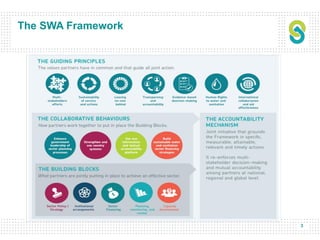
The SWA Framework
4
5
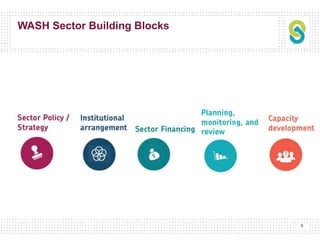
WASH Sector Building Blocks
6
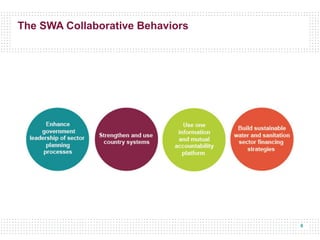
The SWA Collaborative Behaviors
7
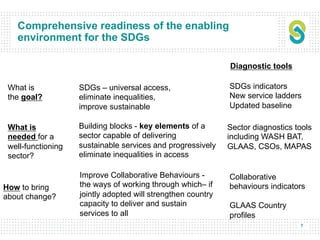
Comprehensive readiness of the enabling
environment for the SDGs
What is
the goal?
SDGs – universal access,
eliminate inequalities,
improve sustainable
SDGs indicators
New service ladders
Updated baseline
What is
needed for a
well-functioning
sector?
Improve Collaborative Behaviours -
the ways of working through which– if
jointly adopted will strengthen country
capacity to deliver and sustain
services to all
Sector diagnostics tools
including WASH BAT,
GLAAS, CSOs, MAPAS
How to bring
about change?
Building blocks - key elements of a
sector capable of delivering
sustainable services and progressively
eliminate inequalities in access
Collaborative
behaviours indicators
GLAAS Country
profiles
Diagnostic tools
Betsy Engebretson,
World Health Organization’s UN-Water Global Analysis and
Assessment of Sanitation and Drinking-Water (GLAAS) team
26 and 27 September, 2019
National Systems to Support
Drinking-Water, Sanitation and
Hygiene:
Global Status Report 2019
What is GLAAS?
GLAAS: UN-Water Global Analysis and Assessment of
Sanitation and Drinking-Water
– Implemented by the World Health Organization on behalf
of UN-Water
– A global, biennial update on the policy frameworks,
institutional arrangements, monitoring systems, human
resources base and finance streams in support of
sanitation, drinking-water, hygiene sector
– 5th GLAAS report released in August 2019
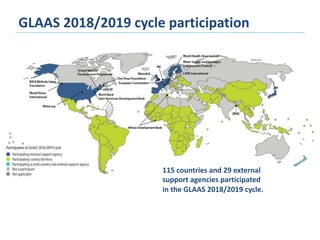
GLAAS 2018/2019 cycle participation
115 countries and 29 external
support agencies participated
in the GLAAS 2018/2019 cycle.
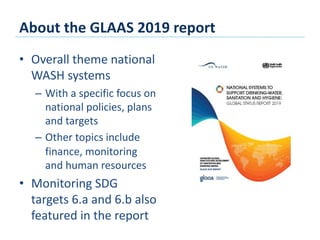
About the GLAAS 2019 report
• Overall theme national
WASH systems
– With a specific focus on
national policies, plans
and targets
– Other topics include
finance, monitoring
and human resources
• Monitoring SDG
targets 6.a and 6.b also
featured in the report
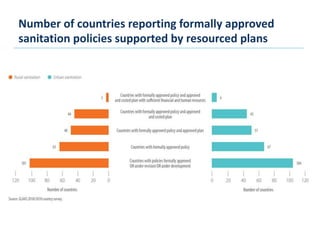
Number of countries reporting formally approved
sanitation policies supported by resourced plans
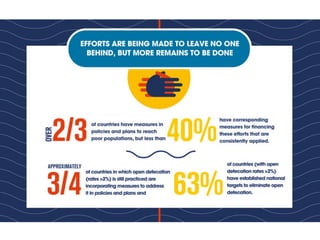
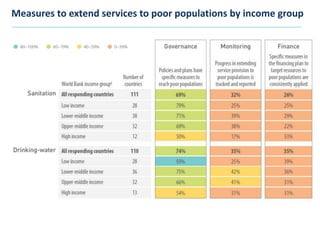
Measures to extend services to poor populations by income group
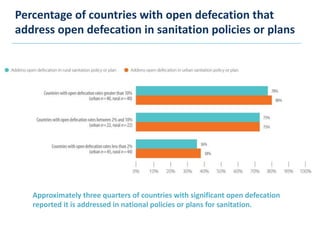
Percentage of countries with open defecation that
address open defecation in sanitation policies or plans
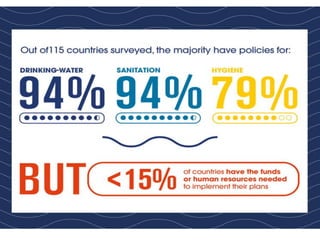
Approximately three quarters of countries with significant open defecation
reported it is addressed in national policies or plans for sanitation.
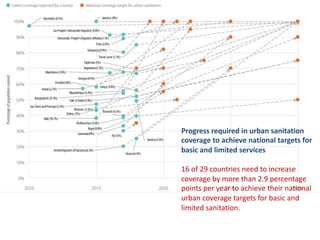
Progress required in urban sanitation
coverage to achieve national targets for
basic and limited services
16 of 29 countries need to increase
coverage by more than 2.9 percentage
points per year to achieve their national
urban coverage targets for basic and
limited sanitation.
Malawi (3.8%)
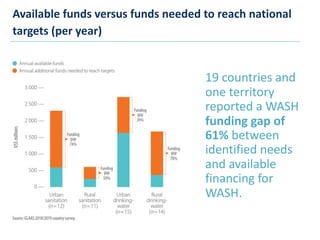
Available funds versus funds needed to reach national
targets (per year)
19 countries and
one territory
reported a WASH
funding gap of
61% between
identified needs
and available
financing for
WASH.
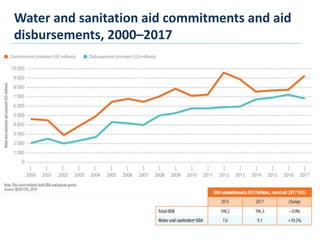
Water and sanitation aid commitments and aid
disbursements, 2000–2017
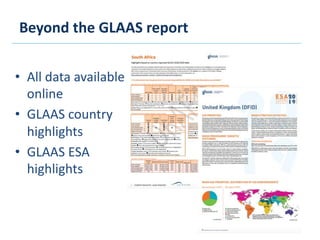
Beyond the GLAAS report
• All data available
online
• GLAAS country
highlights
• GLAAS ESA
highlights
Questions?
Thank you!
For additional information or assistance
please contact glaas@who.int.
Suzzy Abaidoo, Ministry of Water Resources
and Sanitation, Ghana
26 and 27 September, 2019
26
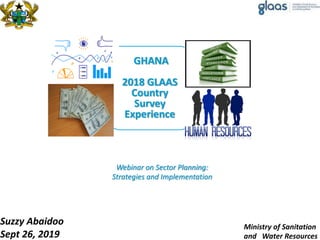
GHANA
2018 GLAAS
Country
Survey
Experience
Ministry of Sanitation
and Water Resources
Suzzy Abaidoo
Sept 26, 2019
Webinar on Sector Planning:
Strategies and Implementation
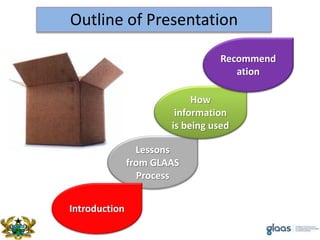
Outline of Presentation
Lessons
from GLAAS
Process
How
information
is being used
Recommend
ation
Introduction
• Ghana expressed interest in participating in the
2018 GLAAS survey
• WHO offered to provide some support
• UNICEF and WaterAid also responded to
Ministry’s Call for additional support for the
process
• Stakeholders were informed of upcoming survey
• Implementation Plan submitted to GLAAS Team
by Ministry
• Terms of Reference prepared and Consultant
engaged with the support of WHO
Introduction
• Government recognizes the importance of the
process. Tracking is therefore not only done
for outputs but also inputs
• Government Leadership is Key
• Contributed to a confirmation of the
following:
– Inconsistencies in data, even when from the same
Agency.
– Inadequate documentation and preservation of
document. Reliance on institutional memory..
• Networking skills needed to access some
Agencies
Lessons Learnt
• Highlighted the gaps in monitoring and human
resource needs assessment for WASH
• The Sector Information System under development
should be sped up, be comprehensive to include
indicators on the enabling environment and
Reporting and Reviews as well.
• Subjective nature of some questions and
responses/lack of objectively verifiable responses.
e.g. Adequacy of policy/plans to meet targets, human resource needs
Lessons Learnt
• Discussions on some of the gaps identified
resurfaced
– eg. Revising of NWP and ESP and NESSAP to align
with SDGs and current trend on-going
– Contributed to reviving a higher level coordinating
platform- WSSWG Meetings
– Review of the regulatory landscape of the water
and sanitation sector.
– Supported the need to disseminate Ghana’s SDG
targets and target setting process for water and
sanitation widely
– Provided evidence for NGOs to step-up advocacy
on capturing the human right to water in
legislative instrument or regulation
How information is used
• Develop strategies to engage the interest of the stakeholders
especially during the inception meeting
• Agree with country stakeholders on how to sustain the process
by mainstreaming some indicators in country monitoring and
evaluation systems
• GLAAS is also supposed to analyse the factors associated with
progress in order to identify drivers and bottlenecks… However
bottlenecks are in most cases the highlights. It is important to
also highlight drivers.
Recommendations to other countries
• Team to consider a further consolidation of the assessment
criteria as that may contribute to reducing the volume of survey
forms
• It may be useful for the team to request for objectively
verifiable responses. The Guidance Note did not adequately
clearly define certain terms.
– Eg. For A4c the issue of what is “partially effective” is subjective
– A4g “promoted and required”
Recommendations to GLAAS Team
Acknowledgements
Pictures:
Ø projectscontrolsonline
Ø en.unesco.org
ØPixabay.com
ØSkpei.com
Oliver Subasinghe, Communications & Data
Advisor, Water Office, USAID
Lucy Flaws, Global Strategy Analyst, WaterAid
Engaging in GLAAS
-WaterAid’s Perspective
Lucy Flaws, WaterAid International
Sept 2019
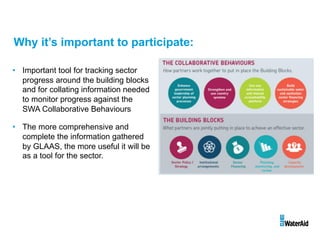
Why it’s important to participate:
• 60
%
• 40
%
• 30%
• 25
%
• Important tool for tracking sector
progress around the building blocks
and for collating information needed
to monitor progress against the
SWA Collaborative Behaviours
• The more comprehensive and
complete the information gathered
by GLAAS, the more useful it will be
as a tool for the sector.
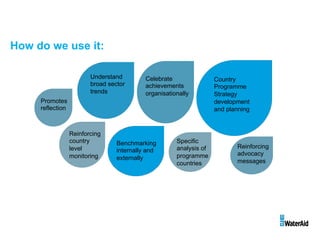
How do we use it:
Reinforcing
advocacy
messages
Celebrate
achievements
organisationally
Country
Programme
Strategy
development
and planning
Understand
broad sector
trends
Specific
analysis of
programme
countries
Reinforcing
country
level
monitoring
Benchmarking
internally and
externally
Promotes
reflection
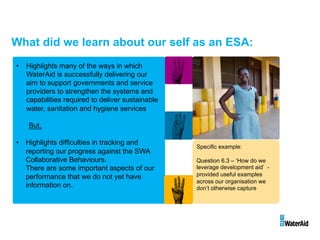
• Highlights many of the ways in which
WaterAid is successfully delivering our
aim to support governments and service
providers to strengthen the systems and
capabilities required to deliver sustainable
water, sanitation and hygiene services
But,
• Highlights difficulties in tracking and
reporting our progress against the SWA
Collaborative Behaviours.
There are some important aspects of our
performance that we do not yet have
information on.
Specific example:
Question 6.3 – ‘How do we
leverage development aid’ -
provided useful examples
across our organisation we
don’t otherwise capture
WaterAid/ Nyani Quarmyne/ Panos
What did we learn about our self as an ESA:
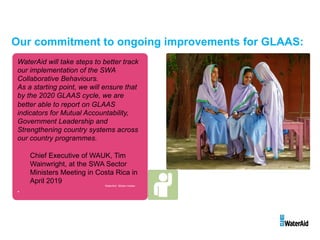
WaterAid will take steps to better track
our implementation of the SWA
Collaborative Behaviours.
As a starting point, we will ensure that
by the 2020 GLAAS cycle, we are
better able to report on GLAAS
indicators for Mutual Accountability,
Government Leadership and
Strengthening country systems across
our country programmes.
Chief Executive of WAUK, Tim
Wainwright, at the SWA Sector
Ministers Meeting in Costa Rica in
April 2019
.
WaterAid/ Sibtain Haider
Our commitment to ongoing improvements for GLAAS:
Questions?
Thanks!
WaterAid/NyaniQuarmyne/Panos
45
How will you take this forward?
• When is the next opportunity you will have to discuss the GLAAS
results as they pertain to you?
• What is the key action your need to do given the results of the
GLAAS report?
• Considering the Mutual Accountability Mechanism process, do you
foresee an opportunity to strengthen existing commitments or table
new ones?

Sector planning-strategies-and-their-implementation-water for all

  • 1.
    SWA Webinar Sector Planning:Strategies and their implementation 27 September, 2019
  • 2.
    2 Presenters Betsy Engebretson, WorldHealth Organization’s UN-Water Global Analysis and Assessment of Sanitation and Drinking-Water (GLAAS) team Suzzy Abaidoo, GLAAS Focal Point, Ministry of Water Resources and Sanitation, Ghana Oliver Subasinghe, Communications & Data Advisor, Water Office, USAID Lucy Flaws, Global Strategy Analyst, WaterAid
  • 3.
  • 4.
  • 5.
  • 6.
  • 7.
    7 Comprehensive readiness ofthe enabling environment for the SDGs What is the goal? SDGs – universal access, eliminate inequalities, improve sustainable SDGs indicators New service ladders Updated baseline What is needed for a well-functioning sector? Improve Collaborative Behaviours - the ways of working through which– if jointly adopted will strengthen country capacity to deliver and sustain services to all Sector diagnostics tools including WASH BAT, GLAAS, CSOs, MAPAS How to bring about change? Building blocks - key elements of a sector capable of delivering sustainable services and progressively eliminate inequalities in access Collaborative behaviours indicators GLAAS Country profiles Diagnostic tools
  • 8.
    Betsy Engebretson, World HealthOrganization’s UN-Water Global Analysis and Assessment of Sanitation and Drinking-Water (GLAAS) team 26 and 27 September, 2019
  • 9.
    National Systems toSupport Drinking-Water, Sanitation and Hygiene: Global Status Report 2019
  • 10.
    What is GLAAS? GLAAS:UN-Water Global Analysis and Assessment of Sanitation and Drinking-Water – Implemented by the World Health Organization on behalf of UN-Water – A global, biennial update on the policy frameworks, institutional arrangements, monitoring systems, human resources base and finance streams in support of sanitation, drinking-water, hygiene sector – 5th GLAAS report released in August 2019
  • 11.
    GLAAS 2018/2019 cycleparticipation 115 countries and 29 external support agencies participated in the GLAAS 2018/2019 cycle.
  • 12.
    About the GLAAS2019 report • Overall theme national WASH systems – With a specific focus on national policies, plans and targets – Other topics include finance, monitoring and human resources • Monitoring SDG targets 6.a and 6.b also featured in the report
  • 14.
    Number of countriesreporting formally approved sanitation policies supported by resourced plans
  • 16.
    Measures to extendservices to poor populations by income group
  • 17.
    Percentage of countrieswith open defecation that address open defecation in sanitation policies or plans Approximately three quarters of countries with significant open defecation reported it is addressed in national policies or plans for sanitation.
  • 19.
    Progress required inurban sanitation coverage to achieve national targets for basic and limited services 16 of 29 countries need to increase coverage by more than 2.9 percentage points per year to achieve their national urban coverage targets for basic and limited sanitation. Malawi (3.8%)
  • 20.
    Available funds versusfunds needed to reach national targets (per year) 19 countries and one territory reported a WASH funding gap of 61% between identified needs and available financing for WASH.
  • 22.
    Water and sanitationaid commitments and aid disbursements, 2000–2017
  • 23.
    Beyond the GLAASreport • All data available online • GLAAS country highlights • GLAAS ESA highlights
  • 24.
    Questions? Thank you! For additionalinformation or assistance please contact glaas@who.int.
  • 25.
    Suzzy Abaidoo, Ministryof Water Resources and Sanitation, Ghana 26 and 27 September, 2019
  • 26.
  • 27.
    GHANA 2018 GLAAS Country Survey Experience Ministry ofSanitation and Water Resources Suzzy Abaidoo Sept 26, 2019 Webinar on Sector Planning: Strategies and Implementation
  • 28.
    Outline of Presentation Lessons fromGLAAS Process How information is being used Recommend ation Introduction
  • 29.
    • Ghana expressedinterest in participating in the 2018 GLAAS survey • WHO offered to provide some support • UNICEF and WaterAid also responded to Ministry’s Call for additional support for the process • Stakeholders were informed of upcoming survey • Implementation Plan submitted to GLAAS Team by Ministry • Terms of Reference prepared and Consultant engaged with the support of WHO Introduction
  • 30.
    • Government recognizesthe importance of the process. Tracking is therefore not only done for outputs but also inputs • Government Leadership is Key • Contributed to a confirmation of the following: – Inconsistencies in data, even when from the same Agency. – Inadequate documentation and preservation of document. Reliance on institutional memory.. • Networking skills needed to access some Agencies Lessons Learnt
  • 31.
    • Highlighted thegaps in monitoring and human resource needs assessment for WASH • The Sector Information System under development should be sped up, be comprehensive to include indicators on the enabling environment and Reporting and Reviews as well. • Subjective nature of some questions and responses/lack of objectively verifiable responses. e.g. Adequacy of policy/plans to meet targets, human resource needs Lessons Learnt
  • 32.
    • Discussions onsome of the gaps identified resurfaced – eg. Revising of NWP and ESP and NESSAP to align with SDGs and current trend on-going – Contributed to reviving a higher level coordinating platform- WSSWG Meetings – Review of the regulatory landscape of the water and sanitation sector. – Supported the need to disseminate Ghana’s SDG targets and target setting process for water and sanitation widely – Provided evidence for NGOs to step-up advocacy on capturing the human right to water in legislative instrument or regulation How information is used
  • 33.
    • Develop strategiesto engage the interest of the stakeholders especially during the inception meeting • Agree with country stakeholders on how to sustain the process by mainstreaming some indicators in country monitoring and evaluation systems • GLAAS is also supposed to analyse the factors associated with progress in order to identify drivers and bottlenecks… However bottlenecks are in most cases the highlights. It is important to also highlight drivers. Recommendations to other countries
  • 34.
    • Team toconsider a further consolidation of the assessment criteria as that may contribute to reducing the volume of survey forms • It may be useful for the team to request for objectively verifiable responses. The Guidance Note did not adequately clearly define certain terms. – Eg. For A4c the issue of what is “partially effective” is subjective – A4g “promoted and required” Recommendations to GLAAS Team
  • 35.
  • 37.
    Oliver Subasinghe, Communications& Data Advisor, Water Office, USAID
  • 38.
    Lucy Flaws, GlobalStrategy Analyst, WaterAid
  • 39.
    Engaging in GLAAS -WaterAid’sPerspective Lucy Flaws, WaterAid International Sept 2019
  • 40.
    Why it’s importantto participate: • 60 % • 40 % • 30% • 25 % • Important tool for tracking sector progress around the building blocks and for collating information needed to monitor progress against the SWA Collaborative Behaviours • The more comprehensive and complete the information gathered by GLAAS, the more useful it will be as a tool for the sector.
  • 41.
    How do weuse it: Reinforcing advocacy messages Celebrate achievements organisationally Country Programme Strategy development and planning Understand broad sector trends Specific analysis of programme countries Reinforcing country level monitoring Benchmarking internally and externally Promotes reflection
  • 42.
    • Highlights manyof the ways in which WaterAid is successfully delivering our aim to support governments and service providers to strengthen the systems and capabilities required to deliver sustainable water, sanitation and hygiene services But, • Highlights difficulties in tracking and reporting our progress against the SWA Collaborative Behaviours. There are some important aspects of our performance that we do not yet have information on. Specific example: Question 6.3 – ‘How do we leverage development aid’ - provided useful examples across our organisation we don’t otherwise capture WaterAid/ Nyani Quarmyne/ Panos What did we learn about our self as an ESA:
  • 43.
    WaterAid will takesteps to better track our implementation of the SWA Collaborative Behaviours. As a starting point, we will ensure that by the 2020 GLAAS cycle, we are better able to report on GLAAS indicators for Mutual Accountability, Government Leadership and Strengthening country systems across our country programmes. Chief Executive of WAUK, Tim Wainwright, at the SWA Sector Ministers Meeting in Costa Rica in April 2019 . WaterAid/ Sibtain Haider Our commitment to ongoing improvements for GLAAS:
  • 44.
  • 45.
    45 How will youtake this forward? • When is the next opportunity you will have to discuss the GLAAS results as they pertain to you? • What is the key action your need to do given the results of the GLAAS report? • Considering the Mutual Accountability Mechanism process, do you foresee an opportunity to strengthen existing commitments or table new ones?