A TERRITORIAL APPROACH
TO FOOD SECURITY AND
NUTRITION POLICY
Stefano Marta, OECD
Regional Development Policy Division
Public Governance and Territorial
Development Directorate
OECD-FAO-UNCDF
Joint Initiative
Annual General Assembly – Global Donor Platform for Rural
Development – Brussels, 1-2 February 2017
• The joint initiative: rationale and conceptual framework
• Key findings and policy recommendations
• Second phase: priority areas
• Importance of the territorial approach for the 2030 Agenda
• Scaling-up the initiative towards 2030
• Three key messages
Structure of the presentation
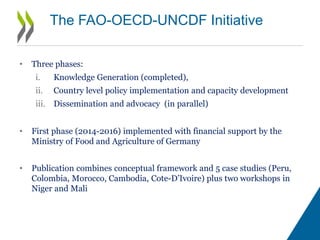
• Three phases:
i. Knowledge Generation (completed),
ii. Country level policy implementation and capacity development
iii. Dissemination and advocacy (in parallel)
• First phase (2014-2016) implemented with financial support by the
Ministry of Food and Agriculture of Germany
– Expo Milan presentation of preliminary draft (October 19-20, 2015)
– Launch of publication in Paris headquarter s (29th April, 2016)
– Disseminate findings with participating countries (2016)
• Publication combines conceptual framework and 5 case studies (Peru,
Colombia, Morocco, Cambodia, Cote-D’Ivoire) plus two workshops in
Niger and Mali
The FAO-OECD-UNCDF Initiative
 We produce enough food in the world to feed everyone, yet about 800
million people are food insecure (uneven distribution and
progress)
 Future challenges (demographic, institutional, environmental,
employment, connectivity, etc.) have a territorial dimension:
problems are different across various regional typologies
(metropolitan, close to cities, remote rural)
 Importance of addressing all the dimensions, while traditional strong
focus on food production, less on the access dimension: food insecurity
is often a problem of poverty
 Hence sectoral approaches are not sufficient. A multi-dimensional
approach is needed: multi-objective, multi-sector and multi-
stakeholder
The Rationale for a Territorial
Approach to FSN
• Based on work of RDPC Committee past 20 years
 Principles on Effective Public Investment (March 2014)
• In close collaboration with FAO/UNCDF, adapted New Rural
Paradigm (2006) to conditions of countries and FSN topic.
 Multi-sectoral, bottom-up, multilevel governance, place-based,
competiveness and valorisation of assets
• OECD countries evolving during last decade to Rural Policy 3.0
 Well-being, rural-urban linkages, synergies, implementation, productivity
in low density economies
• OECD Development Centre, building on the NRP, recently launched
New Rural Development Paradigm
Conceptual framework - territorial approach
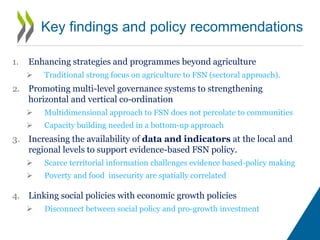
1. Increasing the availability of data and indicators at the local and
regional levels to support evidence-based FSN policy.
 Scarce territorial information challenges evidence based-policy making
 Poverty and food insecurity are spatially correlated
2. Enhancing strategies and programmes beyond agriculture
 Traditional strong focus on agriculture to FSN (sectoral approach).
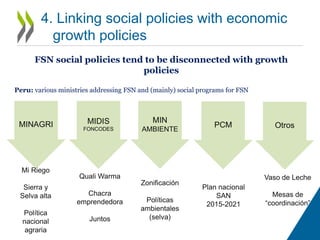
3. Linking social policies with economic growth policies
 Disconnect between social policy and pro-growth investment
4. Promoting multi-level governance systems to strengthening
horizontal and vertical co-ordination
 Multidimensional approach to FSN does not percolate to communities
 Capacity building needed in a bottom-up approach
Key findings and policy recommendations
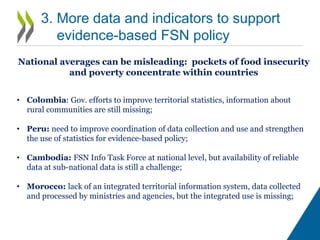
1. More data and indicators to support
evidence-based FSN policy
Rural in these countries means also being poor…
Pockets of poverty concentrate within countries….
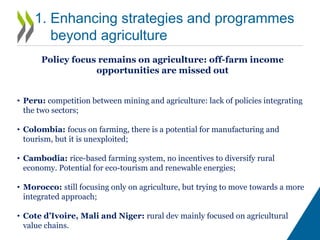
2. Enhancing strategies and programmes
beyond agriculture
Skillsandhumancapital
Diversificationofincome
(non-farmingactivities)
Foodproduction
Traditional
approach to FSN
Territories – subnational entities
Accessibilityand
infrastructure
Institutionsatdifferent
levelsofgovernment
Integrated
multidimensional
approach
• Metropolitan areas
• Rural close to cities
• Rural remote
3. Linking social policies with economic
growth policies
HealthCare
Infrastructure
Pro-growth
policy
ConditionalCash
Transfers
Foodproduction
Typical domain of Food security and nutrition policies
HumanCapital
InnovationandR&D
Territories – subnational entities
• Physical AVAILABILITY of food
• Economic and physical ACCESS to food
• Food UTILIZATION
• STABILITY of the other three dimensions over time
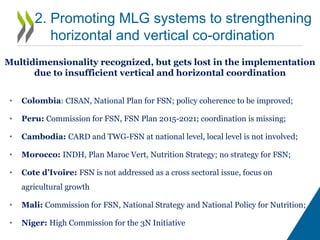
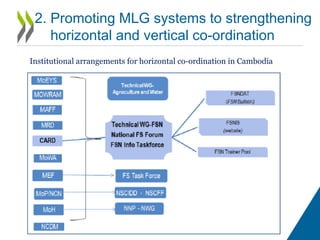
4. Promoting MLG systems to strengthening
horizontal and vertical co-ordination
• Horizontal and vertical coordination across national and sub-
national authorities.
 Case studies provide some examples of coordination at national level
(inter-ministerial council or commission) with vague roles – no executive
powers to influence policy making process and financial resources
 Sub-national authorities in charge of implementing national policies but
without the chance to influence their formulation
 A lack of vertical coordination stiffens bottom-up development
• The role of sub-national institutions
 Decentralisation alone cannot be viewed as a panacea
 Lack of capacity in case studies appear as the most critical priority to
ensure FSN policies can be effectively adapted and implemented at the
local level
 Dangers of local elite capture and corruption
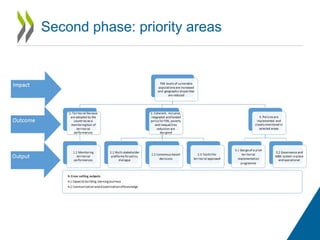
Second phase: priority areas
Relevance for the 2030 Agenda
• The initiative target directly SDG1 and SDG 2, but also SDG 10 (in
particular within countries inequality);
• Poverty and food insecurity are spatially concentrated in certain
geographical areas. A territorial approach provides medium/long-term
solutions targeting enabling factors in these geographies: no shortcuts to
development
• TA promotes policy coherence : all goals are interconnected and their
implementation will depend on the progress made by the other SDGs as well
as on coherent policy frameworks (PCSD target 17.14);
• Given the complexity and the interconnectedness of those issues,
assuming that one isolated policy can tackle one isolated challenge is not
realistic.
Sustainability and Scaling up the initiative
towards 2030
Opportunities:
• There is a demand by countries to help them in the implementation of this
approach. In some countries, scaling up can start even before 2030;
• Sustainability ensured by providing tools/knowhow to target the enabling
factors of development:
 Support statistical offices to create a territorial information systems;
 Work in close collaboration with the governments for the territorial reviews and toolkit
for monitoring implementation;
 Focus on institutional arrangements/mechanisms, skills development, education,
service delivery;
 Building on and strengthening existing platforms for policy dialogue to improve policy
coherence and coordination;
• Peer review mechanism to share countries experiences;
• Improve sustainability of social programmes by better connecting them with
economic agenda;
• ODA contribution is key to start the process (first five years), scaling up
with the budget of the countries;
• In the medium-long term, TA can contribute to save money by better
coordinating policies, building synergies and by targeting investments
Sustainability and Scaling up the
initiative towards 2030
Potential obstacles:
• Lack of commitment from countries: country ownership and
commitment is a key precondition for the identification of the countries
for phase II;
• Initiative perceived as a duplication of platforms and
institutions: avoid duplication and overlapping. We will build on
existing platforms for policy dialogue (CISAN in Colombia, TWG FSN in
Cambodia, etc) and existing policy processes;
• TA perceived as too complicated or too demanding in terms of time
and budget;
• Pressure by the international community to support initiatives
focused on short-term results.
• Territorial Approach is key for the 2030 Agenda: integration of
policies and policy coherence are at the heart of the territorial approach.
• There is a need to support countries in their current efforts to
shift towards a Territorial Approach to FSN policy that embraces
multi-sectoral, bottom-up and place-based interventions
• A Territorial Approach helps the implementation of FSN policy by:
1. Enhancing interventions beyond sectoral approaches,
2. Promoting multi-level governance systems,
3. Increasing the availability of local and regional data
4. Linking social policies with economic growth policies.
Three key messages

A territorial approach to food security

  • 1.
    A TERRITORIAL APPROACH TOFOOD SECURITY AND NUTRITION POLICY Stefano Marta, OECD Regional Development Policy Division Public Governance and Territorial Development Directorate OECD-FAO-UNCDF Joint Initiative Annual General Assembly – Global Donor Platform for Rural Development – Brussels, 1-2 February 2017
  • 2.
    • The jointinitiative: rationale and conceptual framework • Key findings and policy recommendations • Second phase: priority areas • Importance of the territorial approach for the 2030 Agenda • Scaling-up the initiative towards 2030 • Three key messages Structure of the presentation
  • 3.
    • Three phases: i.Knowledge Generation (completed), ii. Country level policy implementation and capacity development iii. Dissemination and advocacy (in parallel) • First phase (2014-2016) implemented with financial support by the Ministry of Food and Agriculture of Germany – Expo Milan presentation of preliminary draft (October 19-20, 2015) – Launch of publication in Paris headquarter s (29th April, 2016) – Disseminate findings with participating countries (2016) • Publication combines conceptual framework and 5 case studies (Peru, Colombia, Morocco, Cambodia, Cote-D’Ivoire) plus two workshops in Niger and Mali The FAO-OECD-UNCDF Initiative
  • 4.
     We produceenough food in the world to feed everyone, yet about 800 million people are food insecure (uneven distribution and progress)  Future challenges (demographic, institutional, environmental, employment, connectivity, etc.) have a territorial dimension: problems are different across various regional typologies (metropolitan, close to cities, remote rural)  Importance of addressing all the dimensions, while traditional strong focus on food production, less on the access dimension: food insecurity is often a problem of poverty  Hence sectoral approaches are not sufficient. A multi-dimensional approach is needed: multi-objective, multi-sector and multi- stakeholder The Rationale for a Territorial Approach to FSN
  • 5.
    • Based onwork of RDPC Committee past 20 years  Principles on Effective Public Investment (March 2014) • In close collaboration with FAO/UNCDF, adapted New Rural Paradigm (2006) to conditions of countries and FSN topic.  Multi-sectoral, bottom-up, multilevel governance, place-based, competiveness and valorisation of assets • OECD countries evolving during last decade to Rural Policy 3.0  Well-being, rural-urban linkages, synergies, implementation, productivity in low density economies • OECD Development Centre, building on the NRP, recently launched New Rural Development Paradigm Conceptual framework - territorial approach
  • 6.
    1. Increasing theavailability of data and indicators at the local and regional levels to support evidence-based FSN policy.  Scarce territorial information challenges evidence based-policy making  Poverty and food insecurity are spatially correlated 2. Enhancing strategies and programmes beyond agriculture  Traditional strong focus on agriculture to FSN (sectoral approach). 3. Linking social policies with economic growth policies  Disconnect between social policy and pro-growth investment 4. Promoting multi-level governance systems to strengthening horizontal and vertical co-ordination  Multidimensional approach to FSN does not percolate to communities  Capacity building needed in a bottom-up approach Key findings and policy recommendations
  • 7.
    1. More dataand indicators to support evidence-based FSN policy Rural in these countries means also being poor… Pockets of poverty concentrate within countries….
  • 8.
    2. Enhancing strategiesand programmes beyond agriculture Skillsandhumancapital Diversificationofincome (non-farmingactivities) Foodproduction Traditional approach to FSN Territories – subnational entities Accessibilityand infrastructure Institutionsatdifferent levelsofgovernment Integrated multidimensional approach • Metropolitan areas • Rural close to cities • Rural remote
  • 9.
    3. Linking socialpolicies with economic growth policies HealthCare Infrastructure Pro-growth policy ConditionalCash Transfers Foodproduction Typical domain of Food security and nutrition policies HumanCapital InnovationandR&D Territories – subnational entities • Physical AVAILABILITY of food • Economic and physical ACCESS to food • Food UTILIZATION • STABILITY of the other three dimensions over time
  • 10.
    4. Promoting MLGsystems to strengthening horizontal and vertical co-ordination • Horizontal and vertical coordination across national and sub- national authorities.  Case studies provide some examples of coordination at national level (inter-ministerial council or commission) with vague roles – no executive powers to influence policy making process and financial resources  Sub-national authorities in charge of implementing national policies but without the chance to influence their formulation  A lack of vertical coordination stiffens bottom-up development • The role of sub-national institutions  Decentralisation alone cannot be viewed as a panacea  Lack of capacity in case studies appear as the most critical priority to ensure FSN policies can be effectively adapted and implemented at the local level  Dangers of local elite capture and corruption
  • 11.
  • 12.
    Relevance for the2030 Agenda • The initiative target directly SDG1 and SDG 2, but also SDG 10 (in particular within countries inequality); • Poverty and food insecurity are spatially concentrated in certain geographical areas. A territorial approach provides medium/long-term solutions targeting enabling factors in these geographies: no shortcuts to development • TA promotes policy coherence : all goals are interconnected and their implementation will depend on the progress made by the other SDGs as well as on coherent policy frameworks (PCSD target 17.14); • Given the complexity and the interconnectedness of those issues, assuming that one isolated policy can tackle one isolated challenge is not realistic.
  • 13.
    Sustainability and Scalingup the initiative towards 2030 Opportunities: • There is a demand by countries to help them in the implementation of this approach. In some countries, scaling up can start even before 2030; • Sustainability ensured by providing tools/knowhow to target the enabling factors of development:  Support statistical offices to create a territorial information systems;  Work in close collaboration with the governments for the territorial reviews and toolkit for monitoring implementation;  Focus on institutional arrangements/mechanisms, skills development, education, service delivery;  Building on and strengthening existing platforms for policy dialogue to improve policy coherence and coordination; • Peer review mechanism to share countries experiences; • Improve sustainability of social programmes by better connecting them with economic agenda; • ODA contribution is key to start the process (first five years), scaling up with the budget of the countries; • In the medium-long term, TA can contribute to save money by better coordinating policies, building synergies and by targeting investments
  • 14.
    Sustainability and Scalingup the initiative towards 2030 Potential obstacles: • Lack of commitment from countries: country ownership and commitment is a key precondition for the identification of the countries for phase II; • Initiative perceived as a duplication of platforms and institutions: avoid duplication and overlapping. We will build on existing platforms for policy dialogue (CISAN in Colombia, TWG FSN in Cambodia, etc) and existing policy processes; • TA perceived as too complicated or too demanding in terms of time and budget; • Pressure by the international community to support initiatives focused on short-term results.
  • 15.
    • Territorial Approachis key for the 2030 Agenda: integration of policies and policy coherence are at the heart of the territorial approach. • There is a need to support countries in their current efforts to shift towards a Territorial Approach to FSN policy that embraces multi-sectoral, bottom-up and place-based interventions • A Territorial Approach helps the implementation of FSN policy by: 1. Enhancing interventions beyond sectoral approaches, 2. Promoting multi-level governance systems, 3. Increasing the availability of local and regional data 4. Linking social policies with economic growth policies. Three key messages