Francis Ukwuije, SMOH and Felix Obi, R4D
USAID HFG Health Financing Workshop
Abuja, February 2017
What is Joint Learning?
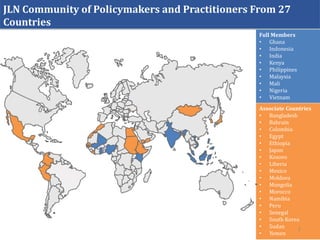
Full Members
• Ghana
• Indonesia
• India
• Kenya
• Philippines
• Malaysia
• Mali
• Nigeria
• Vietnam
Associate Countries
• Bangladesh
• Bahrain
• Colombia
• Egypt
• Ethiopia
• Japan
• Kosovo
• Liberia
• Mexico
• Moldova
• Mongolia
• Morocco
• Namibia
• Peru
• Senegal
• South Korea
• Sudan
• Yemen
JLN Community of Policymakers and Practitioners From 27
Countries
2
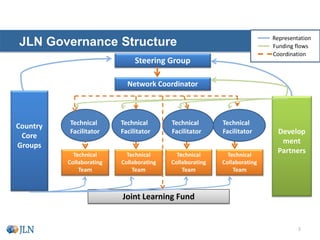
JLN Governance Structure
3
Network Coordinator
Steering Group
Technical
Facilitator
Technical
Facilitator
Technical
Facilitator
Technical
Facilitator
Technical
Collaborating
Team
Technical
Collaborating
Team
Technical
Collaborating
Team
Technical
Collaborating
Team
Country
Core
Groups
Develop
ment
Partners
Joint Learning Fund
Representation
Funding flows
Coordination
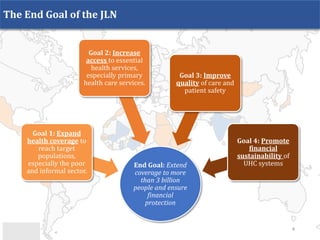
End Goal: Extend
coverage to more
than 3 billion
people and ensure
financial
protection
Goal 1: Expand
health coverage to
reach target
populations,
especially the poor
and informal sector.
Goal 2: Increase
access to essential
health services,
especially primary
health care services.
Goal 3: Improve
quality of care and
patient safety
Goal 4: Promote
financial
sustainability of
UHC systems
The End Goal of the JLN
4
jointlearningnetwork.org 5
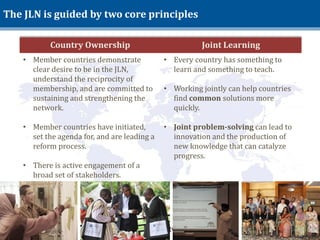
The JLN is guided by two core principles
Country Ownership Joint Learning
• Member countries demonstrate
clear desire to be in the JLN,
understand the reciprocity of
membership, and are committed to
sustaining and strengthening the
network.
• Member countries have initiated,
set the agenda for, and are leading a
reform process.
• There is active engagement of a
broad set of stakeholders.
• Every country has something to
learn and something to teach.
• Working jointly can help countries
find common solutions more
quickly.
• Joint problem-solving can lead to
innovation and the production of
new knowledge that can catalyze
progress.
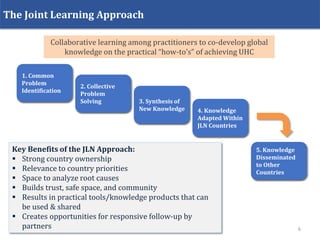
The Joint Learning Approach
1. Common
Problem
Identification
2. Collective
Problem
Solving 3. Synthesis of
New Knowledge 4. Knowledge
Adapted Within
JLN Countries
5. Knowledge
Disseminated
to Other
Countries
Key Benefits of the JLN Approach:
 Strong country ownership
 Relevance to country priorities
 Space to analyze root causes
 Builds trust, safe space, and community
 Results in practical tools/knowledge products that can
be used & shared
 Creates opportunities for responsive follow-up by
partners
Collaborative learning among practitioners to co-develop global
knowledge on the practical “how-to’s” of achieving UHC
6
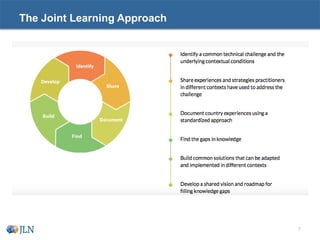
The Joint Learning Approach
7
JLN Technical Initiatives and Collaboratives
8
•PHC-UHC Self-Assessment
•Engaging the Private Sector in PHC Delivery
•Health Benefits Policies for PHC
•PHC Performance Measurement and Improvement
•Financing and Payment Models for PHC
Primary Health
Care
•Costing Collaborative
•Data Analytics for Monitoring Provider Payment Systems
•Financing and Payment Models for PHC
Provider
Payment
•Reaching the informal sector and the poor
•User experience mapping to inform identification and enrollment
•Strategic Communications (NEW)
Population
Coverage
•Institutional Roles and Relationships in the Governance of Health Care Quality
•Medical Audits
Quality
•OpenHDD
•Health Management System Interoperability
•Common Standards for National Health Coverage
•Data analytics for Monitoring Provider Payment
Information
Technology
•Domestic Resource Mobilization
•Managing More from Existing Resources
•Fiscal Policy Instruments for Health Outcome
Health Financing
[NEW]
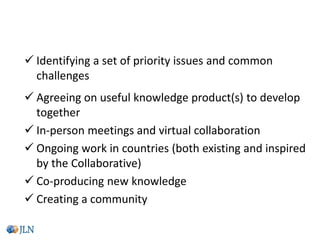
 Identifying a set of priority issues and common
challenges
 Agreeing on useful knowledge product(s) to develop
together
 In-person meetings and virtual collaboration
 Ongoing work in countries (both existing and inspired
by the Collaborative)
 Co-producing new knowledge
 Creating a community
The main ingredients of JLN collaboratives
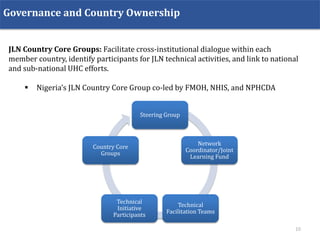
Steering Group
Network
Coordinator/Joint
Learning Fund
Technical
Facilitation Teams
Technical
Initiative
Participants
Country Core
Groups
Governance and Country Ownership
JLN Country Core Groups: Facilitate cross-institutional dialogue within each
member country, identify participants for JLN technical activities, and link to national
and sub-national UHC efforts.
 Nigeria’s JLN Country Core Group co-led by FMOH, NHIS, and NPHCDA
10
Opportunity: Sub-National Joint Learning in Nigeria
11
At the Global Level:
Nigeria is a full member of the JLN and has participated in a
variety of activities at the global level.
At the Country Level:
• There is now an opportunity to develop a sub-national joint
learning network in Nigeria
• The network will create a platform for states to share their
experiences, challenges, and progress as they work jointly
towards UHC goals
• Evidence can be generated, synthesized, and translated:
• From state to state
• From the federal to state level
• From the state to federal level
• Kick off joint learning with a sub-set of states in April/May
• Propose to start with USAID and BMGF priority states, as well as
BHCPF pilot states (TBD)
• Agenda will be developed collaboratively, building from this and
preceding workshops. Will aim to be highly practical!
• Co-define set of priority topics for future joint learning across states
• Form 2-3 joint learning collaboratives (est. 6-12 months in duration)
• States opt into 1 or more priority technical topics
• Collaboratives meet regularly (every 2-3 months), and communicate
virtually in between
• Practical product(s) that states can co-develop and use are defined
for each learning collaborative
• Bring all joint learning states back together later in 2017
• Share updates on progress and discuss next steps/future priorities
• Discuss strategy for scaling joint learning to other states in 2018
Proposed Next Steps
12
1. What is the biggest challenge your state is facing in moving
forward health financing reforms?
2. What experiences would you like to learn about from your
peers in other states in Nigeria? From your peers in other
countries?
3. What experiences and lessons learned from your state would
you like to share with others?
4. What kind of platform for learning would you like to see
develop?
 Who would you want to be involved? What states? What types
of institutions and people?
 What topics would you want to focus on?
 How do you want to connect and engage with your peers? In-
person meetings? Virtually (e.g., WhatsApp, email, etc.)?
Discussion Questions
13
Discussion
14

What is Joint Learning?

  • 1.
    Francis Ukwuije, SMOHand Felix Obi, R4D USAID HFG Health Financing Workshop Abuja, February 2017 What is Joint Learning?
  • 2.
    Full Members • Ghana •Indonesia • India • Kenya • Philippines • Malaysia • Mali • Nigeria • Vietnam Associate Countries • Bangladesh • Bahrain • Colombia • Egypt • Ethiopia • Japan • Kosovo • Liberia • Mexico • Moldova • Mongolia • Morocco • Namibia • Peru • Senegal • South Korea • Sudan • Yemen JLN Community of Policymakers and Practitioners From 27 Countries 2
  • 3.
    JLN Governance Structure 3 NetworkCoordinator Steering Group Technical Facilitator Technical Facilitator Technical Facilitator Technical Facilitator Technical Collaborating Team Technical Collaborating Team Technical Collaborating Team Technical Collaborating Team Country Core Groups Develop ment Partners Joint Learning Fund Representation Funding flows Coordination
  • 4.
    End Goal: Extend coverageto more than 3 billion people and ensure financial protection Goal 1: Expand health coverage to reach target populations, especially the poor and informal sector. Goal 2: Increase access to essential health services, especially primary health care services. Goal 3: Improve quality of care and patient safety Goal 4: Promote financial sustainability of UHC systems The End Goal of the JLN 4
  • 5.
    jointlearningnetwork.org 5 The JLNis guided by two core principles Country Ownership Joint Learning • Member countries demonstrate clear desire to be in the JLN, understand the reciprocity of membership, and are committed to sustaining and strengthening the network. • Member countries have initiated, set the agenda for, and are leading a reform process. • There is active engagement of a broad set of stakeholders. • Every country has something to learn and something to teach. • Working jointly can help countries find common solutions more quickly. • Joint problem-solving can lead to innovation and the production of new knowledge that can catalyze progress.
  • 6.
    The Joint LearningApproach 1. Common Problem Identification 2. Collective Problem Solving 3. Synthesis of New Knowledge 4. Knowledge Adapted Within JLN Countries 5. Knowledge Disseminated to Other Countries Key Benefits of the JLN Approach:  Strong country ownership  Relevance to country priorities  Space to analyze root causes  Builds trust, safe space, and community  Results in practical tools/knowledge products that can be used & shared  Creates opportunities for responsive follow-up by partners Collaborative learning among practitioners to co-develop global knowledge on the practical “how-to’s” of achieving UHC 6
  • 7.
  • 8.
    JLN Technical Initiativesand Collaboratives 8 •PHC-UHC Self-Assessment •Engaging the Private Sector in PHC Delivery •Health Benefits Policies for PHC •PHC Performance Measurement and Improvement •Financing and Payment Models for PHC Primary Health Care •Costing Collaborative •Data Analytics for Monitoring Provider Payment Systems •Financing and Payment Models for PHC Provider Payment •Reaching the informal sector and the poor •User experience mapping to inform identification and enrollment •Strategic Communications (NEW) Population Coverage •Institutional Roles and Relationships in the Governance of Health Care Quality •Medical Audits Quality •OpenHDD •Health Management System Interoperability •Common Standards for National Health Coverage •Data analytics for Monitoring Provider Payment Information Technology •Domestic Resource Mobilization •Managing More from Existing Resources •Fiscal Policy Instruments for Health Outcome Health Financing [NEW]
  • 9.
     Identifying aset of priority issues and common challenges  Agreeing on useful knowledge product(s) to develop together  In-person meetings and virtual collaboration  Ongoing work in countries (both existing and inspired by the Collaborative)  Co-producing new knowledge  Creating a community The main ingredients of JLN collaboratives
  • 10.
    Steering Group Network Coordinator/Joint Learning Fund Technical FacilitationTeams Technical Initiative Participants Country Core Groups Governance and Country Ownership JLN Country Core Groups: Facilitate cross-institutional dialogue within each member country, identify participants for JLN technical activities, and link to national and sub-national UHC efforts.  Nigeria’s JLN Country Core Group co-led by FMOH, NHIS, and NPHCDA 10
  • 11.
    Opportunity: Sub-National JointLearning in Nigeria 11 At the Global Level: Nigeria is a full member of the JLN and has participated in a variety of activities at the global level. At the Country Level: • There is now an opportunity to develop a sub-national joint learning network in Nigeria • The network will create a platform for states to share their experiences, challenges, and progress as they work jointly towards UHC goals • Evidence can be generated, synthesized, and translated: • From state to state • From the federal to state level • From the state to federal level
  • 12.
    • Kick offjoint learning with a sub-set of states in April/May • Propose to start with USAID and BMGF priority states, as well as BHCPF pilot states (TBD) • Agenda will be developed collaboratively, building from this and preceding workshops. Will aim to be highly practical! • Co-define set of priority topics for future joint learning across states • Form 2-3 joint learning collaboratives (est. 6-12 months in duration) • States opt into 1 or more priority technical topics • Collaboratives meet regularly (every 2-3 months), and communicate virtually in between • Practical product(s) that states can co-develop and use are defined for each learning collaborative • Bring all joint learning states back together later in 2017 • Share updates on progress and discuss next steps/future priorities • Discuss strategy for scaling joint learning to other states in 2018 Proposed Next Steps 12
  • 13.
    1. What isthe biggest challenge your state is facing in moving forward health financing reforms? 2. What experiences would you like to learn about from your peers in other states in Nigeria? From your peers in other countries? 3. What experiences and lessons learned from your state would you like to share with others? 4. What kind of platform for learning would you like to see develop?  Who would you want to be involved? What states? What types of institutions and people?  What topics would you want to focus on?  How do you want to connect and engage with your peers? In- person meetings? Virtually (e.g., WhatsApp, email, etc.)? Discussion Questions 13
  • 14.