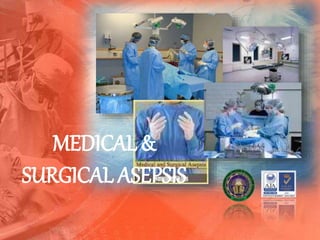
MEDICAL &
SURGICAL ASEPSIS
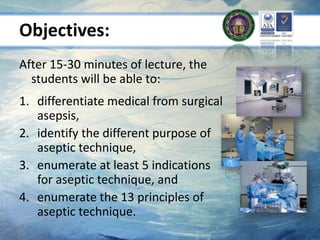
Objectives:
After 15-30 minutes of lecture, the
students will be able to:
1. differentiate medical from surgical
asepsis,
2. identify the different purpose of
aseptic technique,
3. enumerate at least 5 indications
for aseptic technique, and
4. enumerate the 13 principles of
aseptic technique.
MEDICAL & SURGICAL
ASEPSIS
Asepsis
• It is the absence of germs
or microorganisms.
Types of Asepsis
Medical Asepsis
vs
Surgical Asepsis
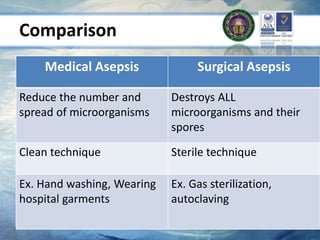
Comparison
Medical Asepsis Surgical Asepsis
Reduce the number and
spread of microorganisms
Destroys ALL
microorganisms and their
spores
Clean technique Sterile technique
Ex. Hand washing, Wearing
hospital garments
Ex. Gas sterilization,
autoclaving
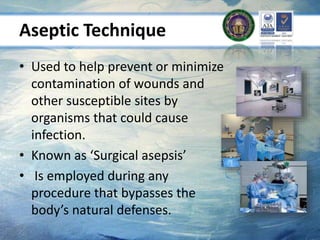
Aseptic Technique
• Used to help prevent or minimize
contamination of wounds and
other susceptible sites by
organisms that could cause
infection.
• Known as ‘Surgical asepsis’
• Is employed during any
procedure that bypasses the
body’s natural defenses.
Aim of aseptic technique
• To protect the patient
from infection and to
prevent the spread of
pathogens
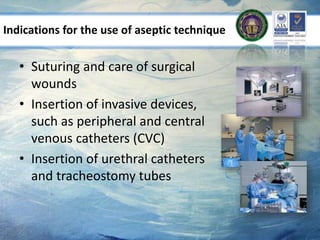
Indications for the use of aseptic technique
• Suturing and care of surgical
wounds
• Insertion of invasive devices,
such as peripheral and central
venous catheters (CVC)
• Insertion of urethral catheters
and tracheostomy tubes
13 PRINCIPLES OF ASEPSIS
1. Allitems in a
sterile field must be
sterile.
13 PRINCIPLES OF ASEPSIS
2. Sterile persons
touch sterile
articles while
UNSTERILE persons
touch only unsterile
articles.
13 PRINCIPLES OF ASEPSIS
3. If in doubt
about the sterility of
anything, CONSIDER it
UNSTERILE!
13 PRINCIPLES OF ASEPSIS
4. Unsterile persons,
avoid reaching over
sterile field while sterile
persons avoid leaning
over unsterile area.
13 PRINCIPLES OF ASEPSIS
5.Tables are sterile
only at table level.
13 PRINCIPLES OF ASEPSIS
6. Gowns are considered
sterile only from the
waist- shoulder
level and the sleeves.
13 PRINCIPLES OF ASEPSIS
7. The edge of
anything that encloses
sterile contents is
considered unsterile.
13 PRINCIPLES OF ASEPSIS
8. Sterile persons keep
within the sterile area.
9. Non-sterile persons
keep AWAY from sterile
area.
13 PRINCIPLES OF ASEPSIS
10. Sterile persons
keep contact with
sterile area to a
minimum.
13 PRINCIPLES OF ASEPSIS
11. Moisture
may cause
contamination.
13 PRINCIPLES OF ASEPSIS
12. When bacteria
cannot be eliminated
from a field they
must be kept to an
irreducible minimum.
13 PRINCIPLES OF ASEPSIS
13. Destruction of
integrity of microbial
barriers result in
contamination.
Pictures
Opening sterile packs
Passing sterile object to a sterile person
Putting an object in the sterile field
Transferring a sterile object
Thank you!

ASEPTIC technique shorter.pptx

  • 1.
  • 2.
    Objectives: After 15-30 minutesof lecture, the students will be able to: 1. differentiate medical from surgical asepsis, 2. identify the different purpose of aseptic technique, 3. enumerate at least 5 indications for aseptic technique, and 4. enumerate the 13 principles of aseptic technique.
  • 3.
  • 4.
    Asepsis • It isthe absence of germs or microorganisms.
  • 5.
    Types of Asepsis MedicalAsepsis vs Surgical Asepsis
  • 6.
    Comparison Medical Asepsis SurgicalAsepsis Reduce the number and spread of microorganisms Destroys ALL microorganisms and their spores Clean technique Sterile technique Ex. Hand washing, Wearing hospital garments Ex. Gas sterilization, autoclaving
  • 7.
    Aseptic Technique • Usedto help prevent or minimize contamination of wounds and other susceptible sites by organisms that could cause infection. • Known as ‘Surgical asepsis’ • Is employed during any procedure that bypasses the body’s natural defenses.
  • 8.
    Aim of aseptictechnique • To protect the patient from infection and to prevent the spread of pathogens
  • 9.
    Indications for theuse of aseptic technique • Suturing and care of surgical wounds • Insertion of invasive devices, such as peripheral and central venous catheters (CVC) • Insertion of urethral catheters and tracheostomy tubes
  • 10.
  • 11.
    1. Allitems ina sterile field must be sterile. 13 PRINCIPLES OF ASEPSIS
  • 12.
    2. Sterile persons touchsterile articles while UNSTERILE persons touch only unsterile articles. 13 PRINCIPLES OF ASEPSIS
  • 13.
    13 PRINCIPLES OFASEPSIS 3. If in doubt about the sterility of anything, CONSIDER it UNSTERILE!
  • 14.
    13 PRINCIPLES OFASEPSIS 4. Unsterile persons, avoid reaching over sterile field while sterile persons avoid leaning over unsterile area.
  • 15.
    13 PRINCIPLES OFASEPSIS 5.Tables are sterile only at table level.
  • 16.
    13 PRINCIPLES OFASEPSIS 6. Gowns are considered sterile only from the waist- shoulder level and the sleeves.
  • 17.
    13 PRINCIPLES OFASEPSIS 7. The edge of anything that encloses sterile contents is considered unsterile.
  • 18.
    13 PRINCIPLES OFASEPSIS 8. Sterile persons keep within the sterile area. 9. Non-sterile persons keep AWAY from sterile area.
  • 19.
    13 PRINCIPLES OFASEPSIS 10. Sterile persons keep contact with sterile area to a minimum.
  • 20.
    13 PRINCIPLES OFASEPSIS 11. Moisture may cause contamination.
  • 21.
    13 PRINCIPLES OFASEPSIS 12. When bacteria cannot be eliminated from a field they must be kept to an irreducible minimum.
  • 22.
    13 PRINCIPLES OFASEPSIS 13. Destruction of integrity of microbial barriers result in contamination.
  • 23.
  • 24.
  • 25.
    Passing sterile objectto a sterile person
  • 26.
    Putting an objectin the sterile field
  • 27.
  • 28.

Editor's Notes

  • #4 Brief introduction In 2003 DOH published ‘Winning Ways’ a strategy for reducing healthcare associated infections. Goal health care providers to consistently perform high standards of aseptic technique become a requirement for all health organisations to have a standardised technique for asepsis
  • #5 The fundamental principle of asepsis is to prevent infection. Methods of asepsis/ sterility Chemical –gas sterilization physical methods- autoclave
  • #8 for example the skin, mucous membranes or when handling invasive equipment such as intravenous cannulae and urinary catheters. In 2003, the Department of Health published ‘Winning Ways’ a strategy for reducing healthcare associated infections. It stated that “Clinical teams will demonstrate consistently high standards of aseptic technique …” It is now a requirement for all NHS organisations to have a standardised technique for asepsis, and compliance should be audited.
  • #11 The Center for Disease Control and Prevention (CDC) estimates that over 27 million surgical procedures are perdomred each year in the US. Surgical site infection rannked as the third most common nosocomial infection and are responsible for longer hospital stays and increased costs to the patient and the hospital. Aseptic technique is vital in reducing the morbidity and moratlity associated with surgical infections.  
  • #12   When preparing for the equipments that are to be used for an operation, always remember that the equipments are already sterilized and therefore are free from pathogen so never touch them with your bare hands.
  • #13  Sterile persons only include: Doctor, Assistant, Instrument Nurse, Suture Nurse Unsterile person include: Anesthesiologist, Circulating Nurse
  • #14  Ex. If you needed to use HCL and you have seen it already has a different color, remember that hydrochloric acid should always be colorless so if you have seen it otherwise then you should doubt its sterility and consider it unsterile. Another example would be if an HCL bottle does not have an expiry date, then doubt its sterility and consider it unsterile.
  • #16  When opening your gown always remember to keep at least a meter away from the table because when your gown accidentally touches below the table surface level then your gown would become unsterile.
  • #17  Sterile Part: From Chest to Waist, Sleeve that covers the Hands to 1 inch beyond the elbow of sleeves Unsterile Part: Back, Shoulders to 1 inch before the elbow of sleeves, Waist and below
  • #18 Never touch the rim of bottles/containers of sterile content. Consider the rim of bottles unsterile. Never touch equipments on rims of bottles. Before using the sterile content, pour a little amount to clean the rim of its container.
  • #20 Although sterile persons are sterile still refrain from touching the sterile equipments to prevent any contamination.
  • #21 Sweat is moisture and may cause contamination. Your armpit is one site so never place your hands under it or near it.
  • #23 Your sterile gloves' pack should never be folded to prevent crease and to prevent it from easily being torn and exposed. Sterile packages or fields are opened or created as close as possible to the time of actual use. Non-sterile items should not cross above a sterile field. Contaminated items must be removed immediately from the sterile field. There should be no talking, laughing, coughing or sneezing across a sterile field. Personnel with colds should avoid working while ill or apply a double mask. A safe space or margin of safety is maintained between sterile and non-sterile objects and areas.