FRONT COVER
POSTPARTUM
FAMILY
PLANNING
Supplement to
The Philippines Clinical Standards Manual
on Family Planning
POSTPARTUM
FAMILY
PLANNING
Supplement to
The Philippines Clinical Standards Manual
on Family Planning
This Supplement is made possible by the generous support of the American
People through the United States Agency for International Development
(USAID). The contents of this Supplement are the sole responsibility of MCHIP
Philippines and do not necessarily reflect the views of USAID or the United
States Government.
01
TABLE OF CONTENTS
Foreword
Acknowledgements
Acronyms
Introduction
Lactational Amennorrhea Method (LAM)
Hormonals: Progestin Only
Progestin-Only Pills
Progestin-Only Injectible
Single Rod Subdermal Implant
Postpartum Intrauterine Device (PPIUD)
Post Miscarriage Family Planning
Reference Section
Annex: Recording Postpartum Family Planning
2
3
4
5
7
8
9
10
12
18
21
22
02
FOREWORD
The Postpartum period represents a critical window of opportunity for women
to receive family planning services as many women will access health services
during pregnancy and childbirth at which point they can be introduced and linked
with family planning methods that can help attain their reproductive intentions.
The Postpartum Family Planning Supplement to The Philippine Clinical
Standards Manual on Family Planning augments the existing edition to
further enhance the quality of family planning (FP) services delivered by clinic-
based providers in both public and private sector. Critical focus is devoted to
the postpartum period as often times, this represents a missed opportunity to
introduce family planning methods that will improve the health of our women
and families. It contains updated information on different family planning
methods that can be used in the postpartum period including timing of initiation,
attributes, risks and benefits. The information presented here is drawn from
actual experiences of family planning experts, and backed up by evidence-based
medical information and effective FP practices recommended by highly credible
international references and organization such as World Health Organization
(WHO). This supplement is a timely and relevant publication that can aid in our
target to reach our Millennium Development Goals (MDGs) of reducing child
mortality rates and improving maternal health. This further contributes to our
wider objective of bringing Universal Health Care (UHC) to all Filipinos.
The health service providers will always be central in the overall delivery of
quality health care to our people. I strongly urge that FP providers utilize this
supplement to complement The Philippine Clinical Standards Manual on Family
Planning in ensuring quality in the delivery of family planning services to women
and families who need them most. And with this, we can achieve and sustain
better maternal and newborn health outcomes.
Enrique T. Ona, MD, FPCS, FACS
Secretary of Health
03
ACKNOWLEDGEMENT
The Department of Health (DOH) extends its sincere appreciation and gratitude to
all of those who were instrumental in the conceptualization, development, review
and finalization of this Supplement. In particular, the DOH would like to thank the
following:
The United States Agency for International Development (USAID), for its technical
assistance in supporting the repositioning of Postpartum Family Planning in the
Philippine Family Planning (FP) program
The Maternal and Child Health Integrated Program (MCHIP) in the Philippines
headed by Dr. Bernabe Marinduque and its team for lending its technical and
practical expertise in drafting this Postpartum Supplement to the existing clinical
standards manual on family planning.
The Supplement to The Philippine Clinical Standards Manual on Family Planning
Technical Working Group for their support in the development of this Supplement:
Chairperson:
Dr. Irma Asuncion
Department of Health
Members:
Dr. Honorata Catibog
Department of Health
Dr. Florencia Apale
Department of Health
Dr. Bernabe Marinduque
MCHIP
Marie Grace Mateo
MCHIP
Dr. Cynthia Garcia
LuzonHealth
Dr. Joyce Mondina
Dr. Jose Fabella
Memorial Hospital
Consuelo Anonuevo
USAID
We hope that as more healthcare providers and facilities across the country
integrate the postpartum family planning services into their existing Maternal and
Child Health programs, we will be able to provide high quality services to more
women who need family planning services and eventually achieve our MDGs 4 &
5 commitments to reduce maternal and child mortality.
ACRONYMS
AIDS Acquired Immunodeficiency Syndrome
AMTSL Active Management of the Third Stage of Labor
ARV		 Anti-retroviral
CHO		 City Health Office
DMPA Depo-Medroxyprogesterone Acetate
DOH		 Department of Health
FP Family Planning
HIV		 Human Immunodeficiency Virus infection
ICV		 Informed Choice and Voluntarism
IM		 Intra-muscular
IUD		 Intrauterine contraceptive Device
LAM Lactational Amenorrhea Method
LARC		 Long-acting Reversible Contraceptive
MCH Maternal and Child Health
MEC		 Medical Eligibility Criteria
PID		 Pelvic Inflammatory Disease
PPFP Postpartum Family Planning
PPIUD Postpartum Intrauterine Device
PROM Prolonged Rupture of Membrane
RHU		 Rural Health Unit
STI		 Sexually Transmitted Infection
VTE		 Venous Thromboembolism
WHO		 World Health Organization
04
INTRODUCTION
05
The provision of Family Planning (FP) services in the postpartum period, when
a woman is most receptive, is not routine for most practitioners involved in FP/
MCH care. Majority of postpartum women when asked will say that they do not
plan to get pregnant again in the next few years. And yet they do not access
from FP services prior to going home from a birthing facility. Postpartum women,
constitute a sizeable percentage of the unmet need for modern FP methods in
the Philippines. Unfortunately, the time after birth is often a missed opportunity
for FP as a life-saving health intervention
The postpartum period refers to the period beginning immediately after the birth
of a child and delivery of placenta continuing until about six weeks.
There are multiple studies that show that close pregnancy spacing may lead to
adverse maternal, perinatal and infant outcomes. The WHO (2006), in reviewing
the evidence, came up with the following recommendations for healthy pregnancy
intervals:
• A woman after giving birth should wait for at least 2 years but not more than 5
years before getting pregnant again.
• A woman should wait for at least 6 months after a miscarriage or abortion
before getting pregnant again.
• A young woman should wait until after she is at least 18 years of age before
getting pregnant.
Spacing pregnancies 2 years or more apart could prevent 30% of maternal
mortality and 10% of child mortality (Lancelet 2012; 380: 147-56).
06
The reasons why postpartum FP is not institutionalized include:
• Limited knowledge on the available choices that can be offered to postpartum
women whether they are breastfeeding or not
• Failure to integrate postpartum family planning (PPFP) counseling in the
antenatal care, early labor and immediate postpartum period
• Confusion as to when fertility comes back and unpredictability of the timing
of the onset of intercourse
• Myths and misconceptions surrounding postpartum FP
• Lack of standardized protocol for postpartum FP service delivery
The key to successful integration of postpartum family planning in MCH is to offer
the service while the mother is still in the birthing facility. Referral for FP services
at a later time is not heeded. Other measures that help the mother choose an FP
method in the postpartum period include:
• Start counseling during the antenatal visits
• Focus on the health and economic benefits of birth spacing or limiting for the
woman and her family
• Make sure that there are different methods available for the mother in the
birthing facility
This addendum to the Philippine Clinical Standards Manual discusses different
contraceptive methods that can be used in the postpartum period including
timing of initiation, attributes, and risks and benefits of the available choices.
The thrust of the Department of Health (DOH) is to meet the increasing demand
for permanent and long acting reversible contraceptive (LARC) methods and
therefore more attention is given to postpartum IUD and implants in the discussion.
Bilateral tubal ligation and vasectomy are covered in separate guidelines. For a
more detailed discussion of the other methods contained in this addendum, the
reader is advised to refer to The Philippine Clinical Standards Manual on Family
Planning (2006). This material serves as a quick and easy reference for use by
public and private service providers attending to deliveries in birthing units of
hospitals, lying-ins, RHUs or CHOs.
07
LACTATIONAL AMENORRHEA METHOD (LAM)
What is the method?
All postpartum women should be
encouraged to breastfeed.
Breastfeedinginitselfisnotacontraceptive
method. However, if the following 3 criteria
of LAM are met, the method can be used
as an effective contraception for up to 6
months after birth.
• exclusively breastfeeding
• amenorrhea
• the baby is less than 6 months old
The requirement to exclusively
breastfeed means that no other liquid
or solid food is given. Also, the baby
is fed on demand and often, that is, at
least every 4 hours during the daytime
and at least every 6 hours at night.
When menstruation has returned, it is
a signal that the woman’s fertility has
returned and therefore, breastfeeding/
suckling is no longer effective in
preventing ovulation.
At 6 months, the WHO recommends
that supplemental feeding be initiated
which will decrease suckling and as a
consequence decrease the effectiveness
of LAM.
Women who received LAM counseling
and accepted the method are more
likely to use a modern method of
contraception later on when any of
the criteria for LAM is no longer met
or even when all 3 criteria are still
met. Adding an appropriate method of
contraception while the woman is still on
LAM will provide continuous protection
should she stop breastfeeding, start
menstruation, or decide to supplement-
feed the baby.
When to start LAM?
Initiate exclusive breastfeeding within
one hour after birth.
How effective is LAM?
Perfect use: 99.5% Typical use: 98%
What is the continuation rate
of the method at 1 year?
There is no 1-year continuation rate
of LAM as a contraceptive method
because the criteria limits its use to 6
months.
What is the mechanism of action?
Suppression of ovulation brought about
by the woman’s hormonal response to
the baby’s suckling.
What are the advantages
of using the method?
• benefits both the mother and the
newborn
• effective if the 3 criteria of LAM are
strictly met
• no side effects
• all postpartum women can use LAM
and exceptions are rare
• it can be started immediately right
after giving birth
• no expense
08
What are the disadvantages
and side effects of the method?
• can only be used for a relatively short
period of time
• can not protect the mother from STIs
including HIV
Who cannot use the method?
• those with HIV infection
• postpartum women who are using
certain medications: mood-altering
drugs, reserpine, ergotamine,
antimetabolites, cyclosporine,
high doses of corticosteroids,
bromocriptine, radioactive drugs,
lithium, certain anticoagulants
• when the newborn has a condition
(e.g. cleft lip and palate) that makes it
difficult to breastfeed
HORMONALS:
PROGESTIN-Only method
Progestin-Only Pills
What is the method?
There are 2 preparations of oral
progestin-only pill in the Philippines,
namely:
• 0.5-mg Lynestrenol, a 28-day pill
taken daily without any gaps, at the
same time of the day, everyday
• 75-ug Desogestrel, a 28-day pill taken
the same way as above
Progestin-only pill can be used both by
breastfeeding and non-breastfeeding
women. Many studies show that
progestins do not have adverse effects
on breast milk production and quality
of milk produced as well as on infant
health, growth and development.
When to start the
progestin-only pill?
For breastfeeding women:
start at 6 weeks postpartum
For non-breastfeeding women:
start immediately prior to discharge of
the mother from the facility
How effective
is the progestin-only pill?
Perfect use: 99.5% Typical use: 99.0%
What is the continuation rate
of the method at 1 year?
The continuation rate is 68%.
What is the mechanism of action?
Progestin thickens the cervical mucus,
which then serves as a barrier to the
entry of sperm in the uterus.
What are the advantages
of the method?
• more effective if used concomitantly
with breastfeeding
• rapid return to fertility after
discontinuation
• no side effects of estrogen
09
• prevents cancer of the ovary and
endometrium as well as fibrocystic
conditions of the breast
What are the disadvantages
of the method?
• menstrual changes are the norm
with users
• daily pill intake at exact time everyday
may be susceptible to discontinuation
Who cannot use the method?
• women who are taking certain
anti-convulsants and antiretroviral
(ARV) therapy
• post partum women who currently
have a blood clot in the legs or lungs
• patients who currently have or had
a history of breast cancer
Progestin-Only Injectible
What is the method?
The available progestin-only IM
injections and their respective
dosages are the following:
• 150-mg Depo-Medroxyprogesterone
Acetate (DMPA) IM given in the
deltoid or gluteal muscle every
3 months
• 200-mg Norethisterone enanthate
IM given in the deltoid or gluteal
muscle every 2 months
Progestin-only injectable can be
used by both breastfeeding and
non-breastfeeding women. Many
studies show that progestins do
not have adverse effects on breast
milk production and quality of milk
produced as well as on infant health,
growth and development.
When to start the
progestin-only injectable?
For breastfeeding women:
start at 6 weeks postpartum
For non-breastfeeding women:
start immediately prior to discharge of
the mother from the facility
How effective is the
progestin-only injectable?
Perfect use: 99.7% Typical use: 97%
What is the continuation rate
of the method at 1 year?
The continuation rate for
DMPA is 56%.
What is the mechanism of action?
Progestin thickens the cervical
mucus, which then serves as a barrier
preventing the entry of sperm in the
uterus.
What are the advantages
of the method?
• no daily pill intake
• no side effects of estrogen
• private
• prevents endometrial cancer,
anemia and ectopic pregnancy
10
What are the disadvantages
of the method?
• menstrual changes are the norm
with users
• slow return to fertility after
discontinuation
• requires regular visit to the clinic
every 3 months for DMPA and
2 months for norethisterone
enanthate for next dose
• women are not protected against
HIV and STIs
Who cannot use the method?
• women who are taking rifampicin,
rifabutin, certain anti-convulsants
and ARV therapy.
• postpartum women who currently
have a blood clot in the legs or lungs
• patients who currently have or had a
history of breast cancer
Single Rod Subdermal Implant
What is the method?
Single rod subdermal implant is a
long-acting, progestin-only hormonal
contraceptive which is effective for
3 years. The white flexible implant
contains 68 mg of etonogestrel and
releases at a rate of 60-70 micrograms/
day at 5-6 weeks and gradually
decreases to 35-45 micrograms/
day at the end of the first year, 30-
40 micrograms/day at the end of
the second year and finally to 25-30
micrograms at the end of the third year.
The provider who wishes to insert
etonogestrel implants should undergo
training to ensure that the correct
technique is learned and utilized. Most
of the unintended pregnancies that
result after insertion are due to incorrect
insertion technique or insertion on the
wrong day of the menstrual cycle. If the
provider is not careful, the implant may
fall out of the needle before insertion is
completed. The insertion site must be
palpated after insertion to confirm the
presence of a matchstick-sized implant.
If the implant is inserted beyond the
first 5 days of the menstrual cycle, the
provider must make sure that the client
is not pregnant. Wrong timing is not an
issue in postpartum insertions.
Post-marketing surveillance on single
rod subdermal implants since 1998 did
not show any deleterious effects on the
fetus if the user gets pregnant or even
if the implant is inadvertently inserted
in a pregnant client. If a user is found
to be pregnant, the implant is simply
removed and no additional intervention
is necessary.
Single rod subdermal implant is the
most effective long-acting reversible
contraceptive. It is immediately
effective because it is rapidly absorbed
and reaches an ovulatory-inhibiting
level on the first day of insertion and
the maximum level is attained within
1-13 days. Fertility returns immediately
after removal. Etonogestrel decreases
to undetectable level within 1 week
after it is removed with fertility returning
usually within 3 weeks.
11
The ovarian function of single rod
subdermal implant users is not
completely suppressed. The estradiol
levelsofusersisabovethelevelnormally
seen in the early follicular phase which
is above the level necessary to maintain
bone mass. There is evidence that bone
mass in users is not adversely affected
by etonogestrel.
There is evidence that insertion of single
rod subdermal implant in the immediate
postpartum period does not have any
adverse effects on the hemostatic
mechanism of the client in the first 12
weeks postpartum when the thrombosis
risk is highest. Immediate postpartum
insertion likewise does not have any
effect on the metabolic functions of the
infant and also does not influence the
amount and quality of milk produced
by the client. Breastfed infants ingest
about 0.2% of the daily maternal dose
and decreases over time as lactation is
continued. Long-term data on breastfed
children of single rod subdermal implant
users showed no differences in growth,
physical and psychomotor development
compared with children whose mothers
had IUDs.
When to start the method?
• For breastfeeding, partially
breastfeeding and non-breastfeeding
clients: the etonogestrel implant may
be inserted immediately after delivery,
before she is discharged from the
birthing facility.
• Later than 21 days, a client who is
not on LAM is advised to use back up
protection for 7 days after insertion. If
the client were already sexually active
and has not been using LAM,
pregnancy should be excluded or the
first natural period is awaited prior to
insertion.
How effective is the method?
Perfect use: 99.95%
Typical use: 99.95%
• The effectiveness of single rod
subdermal implants is not user-
dependent. There are no daily routines
compared with oral contraceptives or
quarterly clinic appointments as with
DMPA. This is ideal for postpartum
women whose attention and time is
primarily devoted to taking to care of
their infants rather than themselves
and therefore do not have to worry
about missed FP appointment or
missed dosage.
• Drugs that reduce the effectiveness
of hormonal contraceptives also
decrease the effectiveness of single
rod subdermal implants.
Cytochrome P450
Enzyme-inducing drugs
that decrease the effectiveness
Single Rod Subdermal Implant
• Anticonvulsants:
Carbamazepine, hydantoins,
barbiturates, oxcarbazepine
• Antituberculosis, antifungal
and antiviral:
Rifampicin, rifabutin,
griseofulvin, ARVs for HIV
• Other liver enzyme inducers:
St. John’s Wort
What is the continuation rate?
• 84% continuation rate at 1 year
• Single rod subdermal implant has
the best continuation rate among the
reversible contraceptive methods.
12
What is the mechanism of action
of etonogestrel implant?
Single rod subdermal implant inhibits
ovulation. No ovulation occurs in the
first 2 years and in the third year it
may happen but rarely. In addition, it
thickens the cervical mucus and makes
it impenetrable to the spermatozoa.
What are the advantages
of the method?
• lesser complaint of dysmenorrhea
• highly effective and long acting
• compatible with breastfeeding
• immediate effectivity after insertion
and immediate return to fertility after
removal
• the procedure is easy to learn
for providers
What are the disadvantages
and side effects of the method?
• altered menstrual bleeding pattern,
which is unpredictable. There may be
changes in the frequency, duration
and amount of bleeding
• headache
• weight gain
• acne
• breast pain/discomfort
• emotional lability
• abdominal pain
• requires a trained provider to insert
Who cannot use the method?
• pregnant women
• current venous thromboembolism (VTE)
• steroid-dependent tumors such as
benign or malignant liver tumors and
known or suspected breast cancer
POSTPARTUM IUD
What is the method?
The Intrauterine Device (IUD) is a
T-shaped small plastic device placed
inside the uterine cavity. There
are 2 types of IUD available in the
Philippines -- Copper T-380A, which
has coils of copper wire wound around
its horizontal and vertical arms and
Mirena, which contains and slowly
releases levonorgestrel from its vertical
arm. Currently, only the TCu-380A is
used for postpartum insertion.
The global initiative to increase
Postpartum Intrauterine Device
(PPIUD) insertion is due to the following
reasons:
• The evidence for its safety and
effectiveness when inserted during the
immediate (10 minutes after placental
expulsion) and early postpartum
periods (within 48 hours) is supported
by strong data in the literature.
• The evidence-based medical eligibility
criteria for its specific use has changed
and whereas in the past there were 39
WHO Medical Eligibility Criteria (MEC)
category 4 conditions, currently there
are only 10.
13
• The success of the PPIUD programs
globally, support the feasibility of
implementing this approach.
• The IUD is repositioned as an
attractive alternative to BTL in low-
resource settings because it can be
continuously used for 12 years with
minimal cost for the user.
The risk of pelvic inflammatory disease
with the IUD is very low and this risk
is highest only within the first 20 days
post insertion. After that, the IUD user’s
risk approximates that of non-users.
Current estimate is at 1.6 cases of Pelvic
Inflammatory Disease (PID) per 1,000
women per year. The main causes of
pelvic infection in IUD users are lack of
provider skill, inconsistent or improper
infection prevention measures, and
pre-existing infection. However, PID
following PPIUD insertion may also
be due to newly acquired infection
with gonococcus and/or chlamydia
trachomatis. In this situation, both the
client and her partner should be treated.
Pelvic infection following IUD insertion
is treated without removing the device.
However, if the client’s infection does
not improve within 3 days, then removal
of the IUD is necessary.
Postpartum women who are HIV-
infected but clinically well, especially
if they are on ARVs may be offered
PPIUD. The IUD does not increase the
incidence of pelvic infection, does not
facilitate progression to AIDS and does
not increase the transmission of the
virus to an uninfected partner. In women
who are not HIV-infected but whose
partner is infected, the use of IUD
does not increase the risk of acquiring
the virus. It must be emphasized,
however, that condom use at all times
is recommended to reduce the risk of
acquiring and/or transmitting HIV.
Although menstrual bleeding in some
women with IUD increases, this rarely
results to anemia. Therefore, even in
anemic postpartum women, the IUD
is a safe option to offer but the anemia
should be treated with iron folate.
The expulsion rate for PPIUD is higher
compared with interval insertion and
generally ranges from 10-15%. This
rate can be reduced to 4-5% by using
the correct instrument (Kelly placental
forceps) and correct technique. The
expulsion rate is also related to the
timing of PPIUD insertion with the
rate lower when the IUD is inserted in
the immediate postpartum (within 10
minutes of placental expulsion) and
during a cesarean section compared
with early postpartum insertion (within
48 hours postpartum).
Uterine perforation during interval
insertion although uncommon, occurs.
The risk of perforation during PPIUD
insertion appears to be less compared
with interval IUD. A WHO review in
2009 reported no cases of perforation.
Caliskan, et al., in 2003 had one case of
uterine perforation. In an unpublished
series of 10,000 cases in El Salvador,
Bataglia, et al., did not have a single
case of uterine perforation.
A Cochrane Database Review (2003)
on the safety of PPIUD yielded the
following conclusions:
• PPIUD is safe and effective.
14
• There are very few medical reasons
that make the PPIUD an inappropriate
option (Please refer to “Who cannot
use the method” section below).
• PPIUD has the following unique
advantages: clients are highly
motivated to use FP method,
assurance that she is not pregnant,
and convenience.
• Compared with interval insertion,
expulsion rate with PPIUD is higher.
• Feasibility of implementation is proven
by the success of the PPIUD programs
globally.
• Early follow up is recommended to
assess for expulsion and other
complications.
PPIUD insertion should follow active
management of the third stage of labor
(AMTSL). AMTSL does not interfere
with PPIUD insertion. It is an important
component of postpartum management
that can potentially save lives because
it prevents postpartum hemorrhage.
An expert review panel suggests that
expulsion and perforation are not
increased when AMTSL is done prior
to PPIUD insertion. The panel further
suggests that the uterine contractions
resulting from AMTSL may even hold
the IUD in place rather than push it out.
In the Philippines, by age 19 years, 37%
of the female population already had
sex. Births under 19 constitute about
12% of the total births in the country.
And these figures are increasing.
Both the young client and the provider
rarely select the most effective method
for this population, which are the
long acting reversible contraceptives
(LARCs), namely, IUD and implant.
Barriers to IUD and implant use in the
young include provider bias, myths
and misconceptions surrounding the
method, lack of access and trained
providers.
LARCs have higher continuation rates,
lower unintended pregnancy rates and
better satisfaction rates among young
users compared with the short acting
reversible contraceptives such as the
COCs, minipill, patches, and DMPA.
LARCs therefore are the method of
choice for this population.
When to start?
Immediate postpartum:
within 10 minutes after placental
expulsion in a normal vaginal
delivery or during cesarean section
(intracesarean)
Early postpartum:
within 48 hours postpartum after a
normal vaginal delivery. If possible
perform the procedure within 24 hours
postpartum.
How effective is PPIUD?
Perfect use: 99.4% Typical use: 99.2%
What is the continuation rate
of the method at 1 year:
The continuation rate is very good at
78% per year.
What is the mechanism of action?
Copper released from the Copper
T-380A inhibits sperm and ovum
transport. The spermatozoa and the
ovum do not meet therefore fertilization
does not take place.
15
What are the advantages
of the method?
• highly effective, long-term method
which is immediately effective upon
insertion
• inexpensive
• does not require daily action
• immediate return to fertility upon
removal
• effective for 12 years
• well-tolerated and satisfaction rate
is high among users
• few side effects, absent hormonal
side effects
• few complications
• protects against ectopic pregnancy
• compatible with breastfeeding
What are the disadvantages
and side effects of the method?
• menstrual pattern may change, may
be heavier and more painful especially
in the first 3 months but improves
over time
• higher expulsion rate compared with
interval insertion
• a trained provider is required for
insertion and removal
Who cannot use the method?
Eligibility Criteria for
Postpartum Insertion
MEC Category 4
• postpartum women with
chorioamnionitis (not in WHO MEC)
• puerperal sepsis
• postpartum endometritis
• unresolved postpartum hemorrhage
(not in WHO MEC)
• following septic abortion
MEC Category 3
• between 48 hours and 4 weeks
postpartum
• prolonged rupture of membranes
(PROM) greater than 18 hours
(not in WHO MEC)
Postpartum Insertion of the
IUD- The Process
PPIUD services when fully integrated
in the antepartum, intrapartum and
postpartum care of a pregnant woman
is not a separate procedure but rather
become part of the process of achieving
healthier lives for the mother, baby
and whole family. The integration is
implemented in stages and culminates
in the insertion of IUD.
The foundation for quality of care in
the provision of PPIUD services rests
on the adherence of the provider to the
following tenets of care:
• respect for the client
• standardized counseling keeping
in mind ICV principles
• standardized infection prevention
protocol
• global performance standards
for the procedure
• systematic and accurate recording
and reporting
Stages in the Integration of PPIUD
Services in the Care of a Pregnant
Woman
A) PPFP Education/Counseling
in the Antenatal Period
• Provide basic information about
healthy birth spacing or limiting as
16
part of general health education and
discussion of the available options for
the woman based on her reproductive
intentions.
• Once the woman expresses interest
in a particular method, i.e. IUD, more
specific information is given on this
method. Discuss the various timing
for insertion and remind her that
immediate (10 minutes after placental
expulsion) and intracesarean insertions
are associated with fewer problems
compared with insertions done later but
within 48 hours postpartum.
• Initial screening for medical eligibility
for IUD use is done.
• If a decision has been arrived at, this
information should be reflected in her
record or in her mother and baby book
(MCB).
• Although the decision is solely the
woman to make, her husband or
her family may be engaged in the
discussion.
• The woman is reminded of her
decision several times in the course
of her antenatal care and encouraged
to ask questions which should be
answered in clear and straightforward
manner. She can always change her
decision and must not be made to feel
that she is imposed upon.
B) Confirmation of the Client’s Choice
in the Facility (Potential IUD Acceptor)
• Although a decision has been
arrived at during the antenatal period,
confirmation of the decision has to be
made when the woman is admitted
in labor. This is necessary so that the
staff attending to her can prepare for
the procedure. She should also be
encouragedtoaskquestionsandfurther
counseling be given, if necessary.
Should the client change her mind and
not proceed with PPIUD, alternative
FP options may be presented. It is
important to note that counselling
at this point is only done when the
woman is in early labor and not
discomfited by painful contractions.
• For women in early labor who
walks in without prior counseling and
screening, an abbreviated process
of health education on birth spacing
or limiting, general PPFP counseling,
method-specific counseling on the
method she is considering and finally
screening for eligibility for the method
chosen is undertaken by the provider.
If the woman choses PPIUD, proper
documentation of the decision is made
and preparation for the procedure is
done.
• If the woman is scheduled for a
cesarean section, confirmation of her
choice is made upon admission.
• During this time a careful review of the
medical eligibility of the client for her
chosen method should be undertaken
even if previous screening was already
done prior to her admission.
• Timing of PPIUD insertion is again
discussed and the association
of immediate postpartum and
intracesarean insertions with fewer
problems compared with later insertions
is highlighted. If the procedure is done
within 10 minutes after placental
expulsion, it becomes part of the
delivery process and not treated as a
separate procedure as when it takes
place within 48 hours when the mother
is already in the wards or in her room
17
recovering and she needs to be brought
to a separate procedure room for IUD
insertion.
C) Second Confirmation in the
Delivery Room (After Delivery)
• A second screening for eligibility prior
to final confirmation that the woman
really opted for IUD is necessary. There
may be conditions related to labor
and delivery, the occurrence of which
may exclude the postpartum woman
from PPIUD. These conditions are not
included in the WHO MEC for IUD.
> Chorioamnionitis - characterized
by fever of 38ºC and abdominal
pain with one of any of the following
findings: tender uterus, foul-smelling
amniotic fluid or fetal tachycardia
greater than 160 beats per minute.
> Prolonged rupture of membranes
(PROM) for 18 hours or more prior
to delivery - increases woman’s risk
of infection.
> Unresolved postpartum hemorrhage
- addressing this life threatening
condition takes precedence over an
elective procedure.Aside from difficulty
in inserting an IUD in a woman who
is actively bleeding, the continuing
hemorrhage may dislodge the IUD.
> Extensive vaginal lacerations-
repair of extensive vaginal lacerations
should be done first before inserting
the IUD. If the lacerations are not
bleeding they are covered with sterile
gauzes or towel when inserting the
IUD. In women who already had
repair of the lacerations, the provider
makes sure that inserting an IUD
will not be too uncomfortable and
disrupt the repair.
• For postpartum women who did
not benefit from antenatal PPFP
counseling, an abbreviated process
of general health education on birth
spacing or limiting, PPFP counseling,
method-specific counseling on the
method chosen, and medical eligibility
screening for that particular method
can still be done after she is adequately
rested from the delivery. The provider
must keep in mind the ICV principles
while counseling the postpartum
women. If the woman opted and
assessed to be medically eligible
for PPIUD, she is prepared for the
procedure and an IUD inserted within
48 hours postpartum.
D) Post-insertion Care
and Counseling
• Post-insertion care and counseling
should be integrated in the protocols
for postpartum and newborn care.
Counseling which is focused on what to
expect with the IUD, identification and
timely consultation for problems that
may arise and importance of follow up
to assess for expulsion, complications
and satisfaction with the method is
done after the patient has sufficiently
rested and can pay attention to the
discussion.
• The woman should be admonished
to immediately return to the facility for
heavy vaginal bleeding, severe lower
abdominal discomfort, fever, and even
a general feeling of not feeling well.
She should also be advised to come
for any unusual discharge, suspicion
18
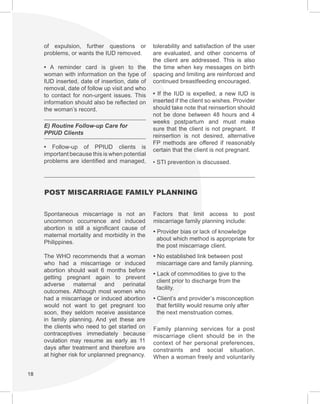
of expulsion, further questions or
problems, or wants the IUD removed.
• A reminder card is given to the
woman with information on the type of
IUD inserted, date of insertion, date of
removal, date of follow up visit and who
to contact for non-urgent issues. This
information should also be reflected on
the woman’s record.
E) Routine Follow-up Care for
PPIUD Clients
• Follow-up of PPIUD clients is
important because this is when potential
problems are identified and managed,
tolerability and satisfaction of the user
are evaluated, and other concerns of
the client are addressed. This is also
the time when key messages on birth
spacing and limiting are reinforced and
continued breastfeeding encouraged.
• If the IUD is expelled, a new IUD is
inserted if the client so wishes. Provider
should take note that reinsertion should
not be done between 48 hours and 4
weeks postpartum and must make
sure that the client is not pregnant. If
reinsertion is not desired, alternative
FP methods are offered if reasonably
certain that the client is not pregnant.
• STI prevention is discussed.
POST MISCARRIAGE FAMILY PLANNING
Spontaneous miscarriage is not an
uncommon occurrence and induced
abortion is still a significant cause of
maternal mortality and morbidity in the
Philippines.
The WHO recommends that a woman
who had a miscarriage or induced
abortion should wait 6 months before
getting pregnant again to prevent
adverse maternal and perinatal
outcomes. Although most women who
had a miscarriage or induced abortion
would not want to get pregnant too
soon, they seldom receive assistance
in family planning. And yet these are
the clients who need to get started on
contraceptives immediately because
ovulation may resume as early as 11
days after treatment and therefore are
at higher risk for unplanned pregnancy.
Factors that limit access to post
miscarriage family planning include:
• Provider bias or lack of knowledge
about which method is appropriate for
the post miscarriage client.
• No established link between post
miscarriage care and family planning.
• Lack of commodities to give to the
client prior to discharge from the
facility.
• Client’s and provider’s misconception
that fertility would resume only after
the next menstruation comes.
Family planning services for a post
miscarriage client should be in the
context of her personal preferences,
constraints and social situation.
When a woman freely and voluntarily
19
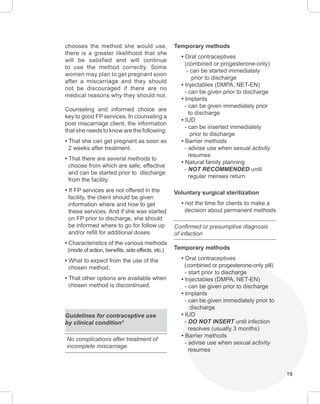
chooses the method she would use,
there is a greater likelihood that she
will be satisfied and will continue
to use the method correctly. Some
women may plan to get pregnant soon
after a miscarriage and they should
not be discouraged if there are no
medical reasons why they should not.
Counseling and informed choice are
key to good FP services. In counseling a
post miscarriage client, the information
that she needs to know are the following:
• That she can get pregnant as soon as
2 weeks after treatment.
• That there are several methods to
choose from which are safe, effective
and can be started prior to discharge
from the facility.
• If FP services are not offered in the
facility, the client should be given
information where and how to get
these services. And if she was started
on FP prior to discharge, she should
be informed where to go for follow up
and/or refill for additional doses.
• Characteristics of the various methods
(mode of action, benefits, side effects, etc.)
• What to expect from the use of the
chosen method.

• That other options are available when
chosen method is discontinued.
Guidelines for contraceptive use
by clinical condition*
No complications after treatment of
incomplete miscarriage
Temporary methods
• Oral contraceptives
(combined or progesterone-only)
- can be started immediately
prior to discharge
• Injectables (DMPA, NET-EN)
- can be given prior to discharge
• Implants
- can be given immediately prior
to discharge
• IUD
- can be inserted immediately
prior to discharge
• Barrier methods
- advise use when sexual activity
resumes
• Natural family planning
- NOT RECOMMENDED until
regular menses return
Voluntary surgical sterilization
• not the time for clients to make a
decision about permanent methods
Confirmed or presumptive diagnosis
of infection
Temporary methods
• Oral contraceptives
(combined or progesterone-only pill)
- start prior to discharge
• Injectables (DMPA, NET-EN)
- can be given prior to discharge
• Implants
- can be given immediately prior to
discharge
• IUD
- DO NOT INSERT until infection
resolves (usually 3 months)
• Barrier methods
- advise use when sexual activity
resumes
20
• Natural family planning
- NOT RECOMMENDED until
regular menses returned
Voluntary surgical sterilization
• not done until infection is resolved
(usually 3 months)
Injury to the genital tract
(e.g., uterine perforation from
instrumentation)
Temporary methods
• Oral contraceptives
(combined or progesterone-only pill)
- start prior to discharge
• Injectables (DMPA, NET-EN)
- can be given prior to discharge
• Implants
- can be given immediately prior
to discharge
• IUD
- DO NOT INSERT until injury has
healed (3 months)
• Barrier methods
- advise use when sexual activity
resumes
• Natural family planning
- NOT RECOMMENDED until
regular menses resume
Voluntary surgical sterilization
• may be done after the injury has
healed (3 months)
Hemorrhage and severe anemia
(Hb <7 gm/dl, Hct <20)
Temporary methods
• Combined oral contraceptive pill
- start prior to discharge
(decreases menstrual bleeding
which helps in improving anemia)
• Progesterone-only pill
- can be given immediately prior to
discharge, start client on iron folate
concomitantly
• Injectables (DMPA, NET-EN)
- can be given immediately prior to
discharge, start client on iron folate
concomitantly
• Implants
- can be given immediately prior to
discharge, start client on iron folate
concomitantly
• Copper IUD
- can be given immediately prior to
discharge, start client on iron folate
concomitantly
• Levonorgestrel IUD
- can be given immediately prior to
discharge, start client on iron folate
concomitantly
• Barrier methods
- advise use when sexual activity
resumes
• Natural family planning method
- NOT RECOMMENDED until
regular menses resume
Voluntary surgical sterilization (BTL)
• Delay until the anemia improves
Second-trimester
incomplete miscarriage
Temporary methods
• Oral contraceptive pills
(combined or progesterone-only pills)
- start prior to discharge
• Injectables (DMPA, NET-EN)
- can be given prior to discharge
• Implants
- can be inserted prior to discharge
• IUD
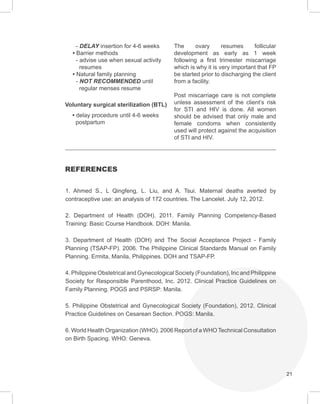
21
- DELAY insertion for 4-6 weeks
• Barrier methods
- advise use when sexual activity
resumes
• Natural family planning
- NOT RECOMMENDED until
regular menses resume
Voluntary surgical sterilization (BTL)
• delay procedure until 4-6 weeks
postpartum
The ovary resumes follicular
development as early as 1 week
following a first trimester miscarriage
which is why it is very important that FP
be started prior to discharging the client
from a facility.
Post miscarriage care is not complete
unless assessment of the client’s risk
for STI and HIV is done. All women
should be advised that only male and
female condoms when consistently
used will protect against the acquisition
of STI and HIV.
REFERENCES
1. Ahmed S., L Qingfeng, L. Liu, and A. Tsui. Maternal deaths averted by
contraceptive use: an analysis of 172 countries. The Lancelet. July 12, 2012.
2. Department of Health (DOH). 2011. Family Planning Competency-Based
Training: Basic Course Handbook. DOH: Manila.
3. Department of Health (DOH) and The Social Acceptance Project - Family
Planning (TSAP-FP). 2006. The Philippine Clinical Standards Manual on Family
Planning. Ermita, Manila, Philippines. DOH and TSAP-FP.
4. Philippine Obstetrical and Gynecological Society (Foundation), Inc and Philippine
Society for Responsible Parenthood, Inc. 2012. Clinical Practice Guidelines on
Family Planning. POGS and PSRSP: Manila.
5. Philippine Obstetrical and Gynecological Society (Foundation), 2012. Clinical
Practice Guidelines on Cesarean Section. POGS: Manila.
6. World Health Organization (WHO). 2006 Report of a WHOTechnical Consultation
on Birth Spacing. WHO: Geneva.
22
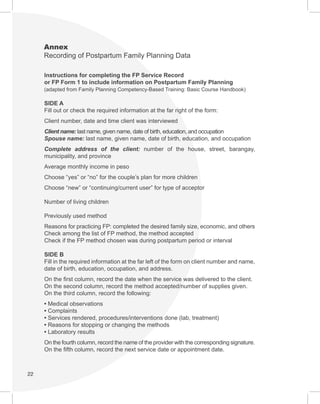
Annex
Recording of Postpartum Family Planning Data
Instructions for completing the FP Service Record
or FP Form 1 to include information on Postpartum Family Planning
(adapted from Family Planning Competency-Based Training: Basic Course Handbook)
SIDE A
Fill out or check the required information at the far right of the form:
Client number, date and time client was interviewed
Client name: last name, given name, date of birth, education, and occupation
Spouse name: last name, given name, date of birth, education, and occupation
Complete address of the client: number of the house, street, barangay,
municipality, and province
Average monthly income in peso
Choose “yes” or “no” for the couple’s plan for more children
Choose “new” or “continuing/current user” for type of acceptor
Number of living children
Previously used method
Reasons for practicing FP: completed the desired family size, economic, and others
Check among the list of FP method, the method accepted
Check if the FP method chosen was during postpartum period or interval
SIDE B
Fill in the required information at the far left of the form on client number and name,
date of birth, education, occupation, and address.
On the first column, record the date when the service was delivered to the client.
On the second column, record the method accepted/number of supplies given.
On the third column, record the following:
• Medical observations
• Complaints
• Services rendered, procedures/interventions done (lab, treatment)
• Reasons for stopping or changing the methods
• Laboratory results
On the fourth column, record the name of the provider with the corresponding signature.
On the fifth column, record the next service date or appointment date.
23
	
  
FAMILY PLANNING SERVICE RECORD SIDE A
MEDICAL HISTORY PHYSICAL EXAMINATION
METHOD
ACCEPTED:
�COC
�POP
�Injectable
�Condom
�IUD
�
BTL
�NSV
�LAM
�SDM
�BBT
�BOM/CMM/STM
�Implant
TIMING
:
�Postpartum
�Interval
NO.
OF
LIVING
CHILDREN:
________
PLAN
MORE
CHILDREN:
�Yes
�No
REASON
FOR
PRACTICING
FP:
______________________________________________
NAME
OF
SPOUSE:
NAME
OF
CLIENT:
CLIENT
NO.:
_____
TYPE
OF
ACCEPTOR:
�New
to
the
program
�Continuing
User
PREVIOUSLY
USED
METHOD:
______________________________
DATE/TIME
________
HEENT
Blood pressure: ________ mm/Hg
Weight ________ kg/lbs
Pulse rate ________ /min
CONJUNCTIVA
� Pale
� Yellowish
NECK
� Enlarged thyroid
� Enlarged lymph nodes
BREAST
� Mass
� Nipple discharge
� Skin-orange peel or dimpling
� Enlarged axillary lymph nodes
THORAX
� Abnormal heart sounds/cardiac rate
� Abnormal breath sounds/respiratory rate
ABDOMEN
� Enlarged liver
� Mass
� Varicosities
EXTREMITIES
� Edema
� Varicosities
� Epilepsy/Convulsion/Seizure
� Severe headache/dizziness
� Visual disturbance/blurring of vision
� Yellowish conjunctivae
� Enlarged thyroid
CHEST/HEART
� Severe chest pain
� Shortness of breath and easy fatigability
� Breast/axillary mass
� Nipple discharge (specify if blood or pus)
� Systolic of 140 and above
� Diastolic of 90 and above
� Family history of CVA (strokes), heart
attack, asthma, rheumatic heart diseases
_________________________
Last
Name
Given
Name
MI
_________________________
Last
Name
Given
Name
MI
ABDOMEN
� Mass in the abdomen
� History of gall bladder disease
� History of liver disease
GENITAL
� Mass in the uterus
� Vaginal discharge
� Intermenstrual bleeding
� Postcoital bleeding
___/___/_____
Date
of
Birth
___/___/_____
Date
of
Birth
EXTREMITIES
� Severe varicosities
� Swelling or severe pain in the legs not
related to injuries
PELVIC EXAMINATION
PERINEUM
� Scars
� Warts
� Reddish
� Laceration
VAGINA
� Congested
� Bartholin’s cyst
� Warts
� Skene’s gland
discharge
� Rectocele
� Cystocele
CERVIX
� Congested
� Erosion
� Discharge
� Polyps/cysts
� Laceration
CONSISTENCY
� Firm
� Soft
UTERUS
Position
� Mid
� Anteflexed
� Retroflexed
Size
� Normal
� Small
� Large
� Mass
Uterine Depth: ____ cms.
(for intended IUD users)
ADNEXA
� Mass
� Tenderness
RISKS FOR VIOLENCE AGAINST WOMEN (VAW)
� History of domestic violence or VAW
� Unpleasant relationships with partner
� Partner does not approve of the visit to FP clinic
� Partner disagrees to use FP
Referred to: � DSWD � WCPU � NGOs
� Others (specify: ______)
ACKNOWLEDGEMENT:
This is to certify that the Physician/Nurse/Midwife of
the clinic has fully explained to me the different
methods available in family planning and I freely
choose the _________________________ method.
_________________ _________________
Client Signature Date
SKIN
_________
_______
HIGHEST
EDUC
OCCUPATION
_________
_______
HIGHEST
EDUC
OCCUPATION
� Yellowish skin
HISTORY OF ANY OF THE FOLLOWING
� Smoking
� Allergies
� Drug intake (anti-tuberculosis, anti-diabetic,
anticonvulsant)
� STI/HIV/AIDS/PIDS
� Bleeding tendencies (nose, gums, etc.)
� Anemia
� Diabetes
OBSTETRICAL HISTORY
AVERAGE
MONTHLY
INCOME:
________________________
_____________________________________________
NO.
STREET
BARANGAY
MUNICIPALITY
PROVINCE
� Number of pregnancies:
___Full term ___Premature
___Abortion ___Living Children
� Date of last delivery ____/____/____
� Type of last delivery _______________
� Past menstrual period _______________
� Last menstrual period _______________
� Number of days menses
___Scanty ___Moderate ___Heavy
___Painful ___Regular
� Hydatidiform mole (within the last 12
months)
� Ectopic pregnancy
STI RISKS
� With history of multiple partners
� For Women:
� Unusual discharge from vagina
� Itching or sores in or around vagina
� Pain or burning sensation
� Treated for STIs in the past
� For Men:
� Pain or burning sensation
� Open sores anywhere in genital area
� Pus coming from penis
� Treated for STIs in the past
Reminder:	
  Kindly	
  refer	
  to	
  PHYSICIAN	
  for	
  any	
  check	
  (/)	
  marks	
  prior	
  to	
  provision	
  of	
  any	
  method	
  for	
  further	
  evaluation	
  
FP Service Record (FP Form 1)
24
	
  
SIDE B FAMILY PLANNING SERVICE RECORD
CLINET
NUMBER
__________
NAME
OF
CLIENT:
____________
___/___/___
Education
_______
Occupation
_______
Address
_____________________
(Last
Name,
Given
Name,
MI)
Date
of
Birth
(No.
Street
Barangay
Municipality
Province DATE
SERVICE
GIVEN
METHOD TO
BE USED/
SUPPLIES
GIVEN
(cycles,
pieces, etc.)
REMARKS
• MEDICAL
OBSERVATION
• COMPLAINTS/
COMPLICATION
• SERVICE RENDERED/
PROCEDURES/
INTERVENTIONS
DONE (i.e. laboratory
examination, treatment,
referrals, etc.)
NAME AND
SIGNATURE OF
PROVIDER
NEXT SERVICE
DATE
FP Service Record (FP Form 1)
25
Instructions for Completing the Target Client List (TCL)
for Family Planning to include Postpartum Family Planning
(adapted from Family Planning Competency-Based Training: Basic Course Handbook)
The TCL is filled out by health workers when providing services and is updated
every time a client comes back for a follow-up visit. It has the following purposes:
1. It helps the health worker plan and carry outpatient care and service delivery
2. It facilitates the monitoring and supervision of service delivery activities
3. It facilitates the preparation of reports,
4. it provides clinic-level data that can be accessed for further studies.
In the Right Upper Corner of the TCL form (front page) - put the name of FP
method. This page includes listing of all clients who accepted any modern FP
method for the first term or new to the program or currently using a specific FP
method e.g. pill, so each specific method will have a separate TCL.
Column 1: DATE (OF REGISTRATION) - Indicate in this column the date month,
day, and year a client made the first clinic visit or the date when client re-started
his/her availment of the FP service.
Column 2: FAMILY SERIAL NUMBER - Indicate in this column the number that
corresponds to the number written on the family folder or envelope or individual
treatment record. This column will help you to easily facilitate retrieval of the record.
Column 3: CLIENT’S NAME - Write the client’s complete name.
(given name, middle initial, and family name).
Column 4: ADDRESS - Record the client’s present permanent place of residence
(number of the house, name of the street, barangay, municipality, and province) for
monitoring follow-up of clients.
Column 5: AGE - Indicate in this column the age of the female client or wife as of
last birthday. In the case of a male client, indicate the age of client’s wife.
Column 6: NUMBER OF LIVING CHILDREN - Indicate number of living children.
Column 7: TYPE OF CLIENT AND CODES OF CLIENTS - Write on this column
the code of the following client categories.
Column 8: PREVIOUS METHOD - Refers to last method used prior to accepting
a new method. Enter in this column the codes as indicated below the front page
of Target Client List
26
Column 9: FOLLOW-UP VISITS - Write the next scheduled date of visit in the
appropriate column for the month followed by a slash, e.g. 3-31/. When the client
returns for the scheduled visit, write the date at the right of the slash, e.g. 3-31/3-
29. A client who is scheduled for a particular month but fails to make the clinic visit
will have only one date entered for that particular month.
Column 10: DROPOUT - If a client fails to return for the next service date, he or
she is considered a dropout. Enter the date the client became a dropout under
column “Date” and indicate the reason under column “Reason.” Validate client first
prior to dropping out from the record.
Column 11:REMARKS - Indicate in this column the date and reason for every
referral made (to other clinics) and referral received (from other clinics), which can
be due to medical complications or unavailable family planning services and other
significant findings to client care.
Method Dropouts (when is a client considered a dropout from the method):
LACTATIONAL AMENORRHEA METHOD (LAM)
• has her menses any time within six months postpartum (bleeding or spotting
within 56 days postpartum is not considered as menses); or
• practices mixed regular feeding and/or regularly introduces solid food, liquid,
vitamins within the first six months or not exclusively breastfeeding her baby or;
when the child reaches six months old.
NATURAL FAMILY PLANNING (NFP)
a. Basal Body Temperature Method - If the user fails to chart her own fertile and
infertile periods, she is considered a dropout.
b. Cervical Mucus or Billings Ovulation Method - If the user fails to chart her
own fertile and infertile periods, she is considered a dropout.
c. Sympto-thermal Method - If the user fails to chart her own fertile and infertile
periods, she is considered a dropout.
d. Standard Days Method - If the user has no indication of (a) SDM use through
beads or (b) knowledge of first day of menstruation or cycle length.
Note: Validate chart monthly if client needs to be dropped.
27
PILLS - If the client
• fails to return for a re-supply/clinic visit on the scheduled date unless client was
validated as getting supplies from other sources other than the clinic;
• gets supplies and/or transfers to another clinic; the client is considered as a
current user in the clinic where she transferred, but is a dropout in her former clinic;
• desires to stop the pills for any reason.
INJECTABLE (DMPA) - If the client
• fails to return for more than two weeks from the scheduled date of injection unless
client was validated getting supply from other sources other than the clinic;
• gets herself injected with DMPA in another clinic; the client is considered a current
user in the clinic where she transferred, but is a dropout in her former clinic;
• stops to receive the injection for any reason.
INTRAUTERINE DEVICE (IUD) - If the client
• does not return to the clinic for checkup for three to six weeks; not later than three
months after her first post-insertion menses or has not been followed-up for two
years;
• requests for IUD removal;
• has had her IUD expelled.
CONDOM - If the client
• fails to return for a re-supply/clinic visit on scheduled visit unless client was
validated getting supplies from other sources other than the clinic;
• gets supplies from another clinic and/or transfers to another clinic; the client is
considered a current user in the clinic where she transferred, but is a dropout in
her former clinic;
• stops using the method for any other reason.
VOLUNTARY SURGICAL CONTRACEPTION
• Tubal ligation - If the client is already menopausal (average: 50 years old);
• Vasectomy - indefinite
NOTE TO SERVICE PROVIDERS: For client using pills, injectables, IUDs, condoms, tubal ligation or vasectomy,
validate client first whether she/he is using the method or not before dropping her/him out from the record.
 
TARGET	
  
C
LIENT	
  
L
IST	
  
F
OR	
  
F
AMILY	
  
P
LANNING	
  
METHOD	
  
O
F	
  
C
ONTRACEPTIVE	
  
_
___________________________	
  
DATE	
  
O
F	
  
REGISTRATION	
  
mm/dd/yy	
  
(1)	
  
FAMILY	
  
SERIAL	
  
N
O.	
  
(2)	
  
NAME	
  
(3)	
  
ADDRESS	
  
(4)	
  
AGE	
  
(5)	
  
NUMBER	
  
OF	
  
L
IVING	
  
CHILDREN	
  
(6)	


TYPE	
  
O
F	
  
C
LIENT*	
  
(use	
  
c
odes)	
  
(7)	
  
PREVIOUS	
  
METHOD**	
  
(use	
  
c
odes)	
  
(8)	


*Type	
  
o
f	
  
c
lient	


**Previous	
  
M
ethod	
  
CU	
  
=
	
  
C
urrent	
  
U
sers	


CON	
  
=
	
  
C
ondom	


NFP	
  
–
	
  
B
BT	
  
=
	
  
B
asal	
  
B
ody	
  
T
emprerature	


NFP	
  
–
	
  
S
DM	
  
=
	
  
S
tandard	
  
D
ays	
  
M
ethod	
  
NA	
  
=
	
  
N
ew	
  
A
cceptors	


INJ	
  
=
	
  
D
epo	
  
M
edroxyprogesterone	
  
A
cetate	
  
(
DMPA)	


NFP	
  
–
	
  
C
M	
  
=
	
  
C
ervical	
  
M
ethod	


MSTR/Vasec	
  
=
	
  
M
ale	
  
S
ter/Vasectomy	


CM	
  
=
	
  
C
hanging	
  
M
ethod	


IUD	
  
=
	
  
I
ntrauterine	
  
D
evice	


NFP	
  
–
	
  
S
TM	
  
=
	
  
S
ympto-­‐thermal	
  
M
ethod	


FSTR/BTL	
  
=
	
  
F
emale	
  
S
ter/Bilateral	
  
T
ubal	
  
L
igation	
  
CC	
  
=
	
  
C
hanging	
  
C
linic	


PPIUD	
  
=
	
  
P
ostpartum	
  
I
ntrauterine	
  
D
evice	


NFP	
  
–
	
  
L
AM	
  
=
	
  
L
actational	
  
A
menorrhea	
  
M
ethod	


RS	
  
=
	
  
R
estart	


Pills	
  
=
	
  
P
ills	


IMP	
  
=
	
  
S
ingle	
  
R
od	
  
S
ubdermal	
  
I
mplant	


28
Target
Client
List
Form
(TCL
Form)
back cover

PostPartum_Family_Planning.pdf

  • 1.
    FRONT COVER POSTPARTUM FAMILY PLANNING Supplement to ThePhilippines Clinical Standards Manual on Family Planning
  • 3.
    POSTPARTUM FAMILY PLANNING Supplement to The PhilippinesClinical Standards Manual on Family Planning
  • 4.
    This Supplement ismade possible by the generous support of the American People through the United States Agency for International Development (USAID). The contents of this Supplement are the sole responsibility of MCHIP Philippines and do not necessarily reflect the views of USAID or the United States Government.
  • 5.
    01 TABLE OF CONTENTS Foreword Acknowledgements Acronyms Introduction LactationalAmennorrhea Method (LAM) Hormonals: Progestin Only Progestin-Only Pills Progestin-Only Injectible Single Rod Subdermal Implant Postpartum Intrauterine Device (PPIUD) Post Miscarriage Family Planning Reference Section Annex: Recording Postpartum Family Planning 2 3 4 5 7 8 9 10 12 18 21 22
  • 6.
    02 FOREWORD The Postpartum periodrepresents a critical window of opportunity for women to receive family planning services as many women will access health services during pregnancy and childbirth at which point they can be introduced and linked with family planning methods that can help attain their reproductive intentions. The Postpartum Family Planning Supplement to The Philippine Clinical Standards Manual on Family Planning augments the existing edition to further enhance the quality of family planning (FP) services delivered by clinic- based providers in both public and private sector. Critical focus is devoted to the postpartum period as often times, this represents a missed opportunity to introduce family planning methods that will improve the health of our women and families. It contains updated information on different family planning methods that can be used in the postpartum period including timing of initiation, attributes, risks and benefits. The information presented here is drawn from actual experiences of family planning experts, and backed up by evidence-based medical information and effective FP practices recommended by highly credible international references and organization such as World Health Organization (WHO). This supplement is a timely and relevant publication that can aid in our target to reach our Millennium Development Goals (MDGs) of reducing child mortality rates and improving maternal health. This further contributes to our wider objective of bringing Universal Health Care (UHC) to all Filipinos. The health service providers will always be central in the overall delivery of quality health care to our people. I strongly urge that FP providers utilize this supplement to complement The Philippine Clinical Standards Manual on Family Planning in ensuring quality in the delivery of family planning services to women and families who need them most. And with this, we can achieve and sustain better maternal and newborn health outcomes. Enrique T. Ona, MD, FPCS, FACS Secretary of Health
  • 7.
    03 ACKNOWLEDGEMENT The Department ofHealth (DOH) extends its sincere appreciation and gratitude to all of those who were instrumental in the conceptualization, development, review and finalization of this Supplement. In particular, the DOH would like to thank the following: The United States Agency for International Development (USAID), for its technical assistance in supporting the repositioning of Postpartum Family Planning in the Philippine Family Planning (FP) program The Maternal and Child Health Integrated Program (MCHIP) in the Philippines headed by Dr. Bernabe Marinduque and its team for lending its technical and practical expertise in drafting this Postpartum Supplement to the existing clinical standards manual on family planning. The Supplement to The Philippine Clinical Standards Manual on Family Planning Technical Working Group for their support in the development of this Supplement: Chairperson: Dr. Irma Asuncion Department of Health Members: Dr. Honorata Catibog Department of Health Dr. Florencia Apale Department of Health Dr. Bernabe Marinduque MCHIP Marie Grace Mateo MCHIP Dr. Cynthia Garcia LuzonHealth Dr. Joyce Mondina Dr. Jose Fabella Memorial Hospital Consuelo Anonuevo USAID We hope that as more healthcare providers and facilities across the country integrate the postpartum family planning services into their existing Maternal and Child Health programs, we will be able to provide high quality services to more women who need family planning services and eventually achieve our MDGs 4 & 5 commitments to reduce maternal and child mortality.
  • 8.
    ACRONYMS AIDS Acquired ImmunodeficiencySyndrome AMTSL Active Management of the Third Stage of Labor ARV Anti-retroviral CHO City Health Office DMPA Depo-Medroxyprogesterone Acetate DOH Department of Health FP Family Planning HIV Human Immunodeficiency Virus infection ICV Informed Choice and Voluntarism IM Intra-muscular IUD Intrauterine contraceptive Device LAM Lactational Amenorrhea Method LARC Long-acting Reversible Contraceptive MCH Maternal and Child Health MEC Medical Eligibility Criteria PID Pelvic Inflammatory Disease PPFP Postpartum Family Planning PPIUD Postpartum Intrauterine Device PROM Prolonged Rupture of Membrane RHU Rural Health Unit STI Sexually Transmitted Infection VTE Venous Thromboembolism WHO World Health Organization 04
  • 9.
    INTRODUCTION 05 The provision ofFamily Planning (FP) services in the postpartum period, when a woman is most receptive, is not routine for most practitioners involved in FP/ MCH care. Majority of postpartum women when asked will say that they do not plan to get pregnant again in the next few years. And yet they do not access from FP services prior to going home from a birthing facility. Postpartum women, constitute a sizeable percentage of the unmet need for modern FP methods in the Philippines. Unfortunately, the time after birth is often a missed opportunity for FP as a life-saving health intervention The postpartum period refers to the period beginning immediately after the birth of a child and delivery of placenta continuing until about six weeks. There are multiple studies that show that close pregnancy spacing may lead to adverse maternal, perinatal and infant outcomes. The WHO (2006), in reviewing the evidence, came up with the following recommendations for healthy pregnancy intervals: • A woman after giving birth should wait for at least 2 years but not more than 5 years before getting pregnant again. • A woman should wait for at least 6 months after a miscarriage or abortion before getting pregnant again. • A young woman should wait until after she is at least 18 years of age before getting pregnant. Spacing pregnancies 2 years or more apart could prevent 30% of maternal mortality and 10% of child mortality (Lancelet 2012; 380: 147-56).
  • 10.
    06 The reasons whypostpartum FP is not institutionalized include: • Limited knowledge on the available choices that can be offered to postpartum women whether they are breastfeeding or not • Failure to integrate postpartum family planning (PPFP) counseling in the antenatal care, early labor and immediate postpartum period • Confusion as to when fertility comes back and unpredictability of the timing of the onset of intercourse • Myths and misconceptions surrounding postpartum FP • Lack of standardized protocol for postpartum FP service delivery The key to successful integration of postpartum family planning in MCH is to offer the service while the mother is still in the birthing facility. Referral for FP services at a later time is not heeded. Other measures that help the mother choose an FP method in the postpartum period include: • Start counseling during the antenatal visits • Focus on the health and economic benefits of birth spacing or limiting for the woman and her family • Make sure that there are different methods available for the mother in the birthing facility This addendum to the Philippine Clinical Standards Manual discusses different contraceptive methods that can be used in the postpartum period including timing of initiation, attributes, and risks and benefits of the available choices. The thrust of the Department of Health (DOH) is to meet the increasing demand for permanent and long acting reversible contraceptive (LARC) methods and therefore more attention is given to postpartum IUD and implants in the discussion. Bilateral tubal ligation and vasectomy are covered in separate guidelines. For a more detailed discussion of the other methods contained in this addendum, the reader is advised to refer to The Philippine Clinical Standards Manual on Family Planning (2006). This material serves as a quick and easy reference for use by public and private service providers attending to deliveries in birthing units of hospitals, lying-ins, RHUs or CHOs.
  • 11.
    07 LACTATIONAL AMENORRHEA METHOD(LAM) What is the method? All postpartum women should be encouraged to breastfeed. Breastfeedinginitselfisnotacontraceptive method. However, if the following 3 criteria of LAM are met, the method can be used as an effective contraception for up to 6 months after birth. • exclusively breastfeeding • amenorrhea • the baby is less than 6 months old The requirement to exclusively breastfeed means that no other liquid or solid food is given. Also, the baby is fed on demand and often, that is, at least every 4 hours during the daytime and at least every 6 hours at night. When menstruation has returned, it is a signal that the woman’s fertility has returned and therefore, breastfeeding/ suckling is no longer effective in preventing ovulation. At 6 months, the WHO recommends that supplemental feeding be initiated which will decrease suckling and as a consequence decrease the effectiveness of LAM. Women who received LAM counseling and accepted the method are more likely to use a modern method of contraception later on when any of the criteria for LAM is no longer met or even when all 3 criteria are still met. Adding an appropriate method of contraception while the woman is still on LAM will provide continuous protection should she stop breastfeeding, start menstruation, or decide to supplement- feed the baby. When to start LAM? Initiate exclusive breastfeeding within one hour after birth. How effective is LAM? Perfect use: 99.5% Typical use: 98% What is the continuation rate of the method at 1 year? There is no 1-year continuation rate of LAM as a contraceptive method because the criteria limits its use to 6 months. What is the mechanism of action? Suppression of ovulation brought about by the woman’s hormonal response to the baby’s suckling. What are the advantages of using the method? • benefits both the mother and the newborn • effective if the 3 criteria of LAM are strictly met • no side effects • all postpartum women can use LAM and exceptions are rare • it can be started immediately right after giving birth • no expense
  • 12.
    08 What are thedisadvantages and side effects of the method? • can only be used for a relatively short period of time • can not protect the mother from STIs including HIV Who cannot use the method? • those with HIV infection • postpartum women who are using certain medications: mood-altering drugs, reserpine, ergotamine, antimetabolites, cyclosporine, high doses of corticosteroids, bromocriptine, radioactive drugs, lithium, certain anticoagulants • when the newborn has a condition (e.g. cleft lip and palate) that makes it difficult to breastfeed HORMONALS: PROGESTIN-Only method Progestin-Only Pills What is the method? There are 2 preparations of oral progestin-only pill in the Philippines, namely: • 0.5-mg Lynestrenol, a 28-day pill taken daily without any gaps, at the same time of the day, everyday • 75-ug Desogestrel, a 28-day pill taken the same way as above Progestin-only pill can be used both by breastfeeding and non-breastfeeding women. Many studies show that progestins do not have adverse effects on breast milk production and quality of milk produced as well as on infant health, growth and development. When to start the progestin-only pill? For breastfeeding women: start at 6 weeks postpartum For non-breastfeeding women: start immediately prior to discharge of the mother from the facility How effective is the progestin-only pill? Perfect use: 99.5% Typical use: 99.0% What is the continuation rate of the method at 1 year? The continuation rate is 68%. What is the mechanism of action? Progestin thickens the cervical mucus, which then serves as a barrier to the entry of sperm in the uterus. What are the advantages of the method? • more effective if used concomitantly with breastfeeding • rapid return to fertility after discontinuation • no side effects of estrogen
  • 13.
    09 • prevents cancerof the ovary and endometrium as well as fibrocystic conditions of the breast What are the disadvantages of the method? • menstrual changes are the norm with users • daily pill intake at exact time everyday may be susceptible to discontinuation Who cannot use the method? • women who are taking certain anti-convulsants and antiretroviral (ARV) therapy • post partum women who currently have a blood clot in the legs or lungs • patients who currently have or had a history of breast cancer Progestin-Only Injectible What is the method? The available progestin-only IM injections and their respective dosages are the following: • 150-mg Depo-Medroxyprogesterone Acetate (DMPA) IM given in the deltoid or gluteal muscle every 3 months • 200-mg Norethisterone enanthate IM given in the deltoid or gluteal muscle every 2 months Progestin-only injectable can be used by both breastfeeding and non-breastfeeding women. Many studies show that progestins do not have adverse effects on breast milk production and quality of milk produced as well as on infant health, growth and development. When to start the progestin-only injectable? For breastfeeding women: start at 6 weeks postpartum For non-breastfeeding women: start immediately prior to discharge of the mother from the facility How effective is the progestin-only injectable? Perfect use: 99.7% Typical use: 97% What is the continuation rate of the method at 1 year? The continuation rate for DMPA is 56%. What is the mechanism of action? Progestin thickens the cervical mucus, which then serves as a barrier preventing the entry of sperm in the uterus. What are the advantages of the method? • no daily pill intake • no side effects of estrogen • private • prevents endometrial cancer, anemia and ectopic pregnancy
  • 14.
    10 What are thedisadvantages of the method? • menstrual changes are the norm with users • slow return to fertility after discontinuation • requires regular visit to the clinic every 3 months for DMPA and 2 months for norethisterone enanthate for next dose • women are not protected against HIV and STIs Who cannot use the method? • women who are taking rifampicin, rifabutin, certain anti-convulsants and ARV therapy. • postpartum women who currently have a blood clot in the legs or lungs • patients who currently have or had a history of breast cancer Single Rod Subdermal Implant What is the method? Single rod subdermal implant is a long-acting, progestin-only hormonal contraceptive which is effective for 3 years. The white flexible implant contains 68 mg of etonogestrel and releases at a rate of 60-70 micrograms/ day at 5-6 weeks and gradually decreases to 35-45 micrograms/ day at the end of the first year, 30- 40 micrograms/day at the end of the second year and finally to 25-30 micrograms at the end of the third year. The provider who wishes to insert etonogestrel implants should undergo training to ensure that the correct technique is learned and utilized. Most of the unintended pregnancies that result after insertion are due to incorrect insertion technique or insertion on the wrong day of the menstrual cycle. If the provider is not careful, the implant may fall out of the needle before insertion is completed. The insertion site must be palpated after insertion to confirm the presence of a matchstick-sized implant. If the implant is inserted beyond the first 5 days of the menstrual cycle, the provider must make sure that the client is not pregnant. Wrong timing is not an issue in postpartum insertions. Post-marketing surveillance on single rod subdermal implants since 1998 did not show any deleterious effects on the fetus if the user gets pregnant or even if the implant is inadvertently inserted in a pregnant client. If a user is found to be pregnant, the implant is simply removed and no additional intervention is necessary. Single rod subdermal implant is the most effective long-acting reversible contraceptive. It is immediately effective because it is rapidly absorbed and reaches an ovulatory-inhibiting level on the first day of insertion and the maximum level is attained within 1-13 days. Fertility returns immediately after removal. Etonogestrel decreases to undetectable level within 1 week after it is removed with fertility returning usually within 3 weeks.
  • 15.
    11 The ovarian functionof single rod subdermal implant users is not completely suppressed. The estradiol levelsofusersisabovethelevelnormally seen in the early follicular phase which is above the level necessary to maintain bone mass. There is evidence that bone mass in users is not adversely affected by etonogestrel. There is evidence that insertion of single rod subdermal implant in the immediate postpartum period does not have any adverse effects on the hemostatic mechanism of the client in the first 12 weeks postpartum when the thrombosis risk is highest. Immediate postpartum insertion likewise does not have any effect on the metabolic functions of the infant and also does not influence the amount and quality of milk produced by the client. Breastfed infants ingest about 0.2% of the daily maternal dose and decreases over time as lactation is continued. Long-term data on breastfed children of single rod subdermal implant users showed no differences in growth, physical and psychomotor development compared with children whose mothers had IUDs. When to start the method? • For breastfeeding, partially breastfeeding and non-breastfeeding clients: the etonogestrel implant may be inserted immediately after delivery, before she is discharged from the birthing facility. • Later than 21 days, a client who is not on LAM is advised to use back up protection for 7 days after insertion. If the client were already sexually active and has not been using LAM, pregnancy should be excluded or the first natural period is awaited prior to insertion. How effective is the method? Perfect use: 99.95% Typical use: 99.95% • The effectiveness of single rod subdermal implants is not user- dependent. There are no daily routines compared with oral contraceptives or quarterly clinic appointments as with DMPA. This is ideal for postpartum women whose attention and time is primarily devoted to taking to care of their infants rather than themselves and therefore do not have to worry about missed FP appointment or missed dosage. • Drugs that reduce the effectiveness of hormonal contraceptives also decrease the effectiveness of single rod subdermal implants. Cytochrome P450 Enzyme-inducing drugs that decrease the effectiveness Single Rod Subdermal Implant • Anticonvulsants: Carbamazepine, hydantoins, barbiturates, oxcarbazepine • Antituberculosis, antifungal and antiviral: Rifampicin, rifabutin, griseofulvin, ARVs for HIV • Other liver enzyme inducers: St. John’s Wort What is the continuation rate? • 84% continuation rate at 1 year • Single rod subdermal implant has the best continuation rate among the reversible contraceptive methods.
  • 16.
    12 What is themechanism of action of etonogestrel implant? Single rod subdermal implant inhibits ovulation. No ovulation occurs in the first 2 years and in the third year it may happen but rarely. In addition, it thickens the cervical mucus and makes it impenetrable to the spermatozoa. What are the advantages of the method? • lesser complaint of dysmenorrhea • highly effective and long acting • compatible with breastfeeding • immediate effectivity after insertion and immediate return to fertility after removal • the procedure is easy to learn for providers What are the disadvantages and side effects of the method? • altered menstrual bleeding pattern, which is unpredictable. There may be changes in the frequency, duration and amount of bleeding • headache • weight gain • acne • breast pain/discomfort • emotional lability • abdominal pain • requires a trained provider to insert Who cannot use the method? • pregnant women • current venous thromboembolism (VTE) • steroid-dependent tumors such as benign or malignant liver tumors and known or suspected breast cancer POSTPARTUM IUD What is the method? The Intrauterine Device (IUD) is a T-shaped small plastic device placed inside the uterine cavity. There are 2 types of IUD available in the Philippines -- Copper T-380A, which has coils of copper wire wound around its horizontal and vertical arms and Mirena, which contains and slowly releases levonorgestrel from its vertical arm. Currently, only the TCu-380A is used for postpartum insertion. The global initiative to increase Postpartum Intrauterine Device (PPIUD) insertion is due to the following reasons: • The evidence for its safety and effectiveness when inserted during the immediate (10 minutes after placental expulsion) and early postpartum periods (within 48 hours) is supported by strong data in the literature. • The evidence-based medical eligibility criteria for its specific use has changed and whereas in the past there were 39 WHO Medical Eligibility Criteria (MEC) category 4 conditions, currently there are only 10.
  • 17.
    13 • The successof the PPIUD programs globally, support the feasibility of implementing this approach. • The IUD is repositioned as an attractive alternative to BTL in low- resource settings because it can be continuously used for 12 years with minimal cost for the user. The risk of pelvic inflammatory disease with the IUD is very low and this risk is highest only within the first 20 days post insertion. After that, the IUD user’s risk approximates that of non-users. Current estimate is at 1.6 cases of Pelvic Inflammatory Disease (PID) per 1,000 women per year. The main causes of pelvic infection in IUD users are lack of provider skill, inconsistent or improper infection prevention measures, and pre-existing infection. However, PID following PPIUD insertion may also be due to newly acquired infection with gonococcus and/or chlamydia trachomatis. In this situation, both the client and her partner should be treated. Pelvic infection following IUD insertion is treated without removing the device. However, if the client’s infection does not improve within 3 days, then removal of the IUD is necessary. Postpartum women who are HIV- infected but clinically well, especially if they are on ARVs may be offered PPIUD. The IUD does not increase the incidence of pelvic infection, does not facilitate progression to AIDS and does not increase the transmission of the virus to an uninfected partner. In women who are not HIV-infected but whose partner is infected, the use of IUD does not increase the risk of acquiring the virus. It must be emphasized, however, that condom use at all times is recommended to reduce the risk of acquiring and/or transmitting HIV. Although menstrual bleeding in some women with IUD increases, this rarely results to anemia. Therefore, even in anemic postpartum women, the IUD is a safe option to offer but the anemia should be treated with iron folate. The expulsion rate for PPIUD is higher compared with interval insertion and generally ranges from 10-15%. This rate can be reduced to 4-5% by using the correct instrument (Kelly placental forceps) and correct technique. The expulsion rate is also related to the timing of PPIUD insertion with the rate lower when the IUD is inserted in the immediate postpartum (within 10 minutes of placental expulsion) and during a cesarean section compared with early postpartum insertion (within 48 hours postpartum). Uterine perforation during interval insertion although uncommon, occurs. The risk of perforation during PPIUD insertion appears to be less compared with interval IUD. A WHO review in 2009 reported no cases of perforation. Caliskan, et al., in 2003 had one case of uterine perforation. In an unpublished series of 10,000 cases in El Salvador, Bataglia, et al., did not have a single case of uterine perforation. A Cochrane Database Review (2003) on the safety of PPIUD yielded the following conclusions: • PPIUD is safe and effective.
  • 18.
    14 • There arevery few medical reasons that make the PPIUD an inappropriate option (Please refer to “Who cannot use the method” section below). • PPIUD has the following unique advantages: clients are highly motivated to use FP method, assurance that she is not pregnant, and convenience. • Compared with interval insertion, expulsion rate with PPIUD is higher. • Feasibility of implementation is proven by the success of the PPIUD programs globally. • Early follow up is recommended to assess for expulsion and other complications. PPIUD insertion should follow active management of the third stage of labor (AMTSL). AMTSL does not interfere with PPIUD insertion. It is an important component of postpartum management that can potentially save lives because it prevents postpartum hemorrhage. An expert review panel suggests that expulsion and perforation are not increased when AMTSL is done prior to PPIUD insertion. The panel further suggests that the uterine contractions resulting from AMTSL may even hold the IUD in place rather than push it out. In the Philippines, by age 19 years, 37% of the female population already had sex. Births under 19 constitute about 12% of the total births in the country. And these figures are increasing. Both the young client and the provider rarely select the most effective method for this population, which are the long acting reversible contraceptives (LARCs), namely, IUD and implant. Barriers to IUD and implant use in the young include provider bias, myths and misconceptions surrounding the method, lack of access and trained providers. LARCs have higher continuation rates, lower unintended pregnancy rates and better satisfaction rates among young users compared with the short acting reversible contraceptives such as the COCs, minipill, patches, and DMPA. LARCs therefore are the method of choice for this population. When to start? Immediate postpartum: within 10 minutes after placental expulsion in a normal vaginal delivery or during cesarean section (intracesarean) Early postpartum: within 48 hours postpartum after a normal vaginal delivery. If possible perform the procedure within 24 hours postpartum. How effective is PPIUD? Perfect use: 99.4% Typical use: 99.2% What is the continuation rate of the method at 1 year: The continuation rate is very good at 78% per year. What is the mechanism of action? Copper released from the Copper T-380A inhibits sperm and ovum transport. The spermatozoa and the ovum do not meet therefore fertilization does not take place.
  • 19.
    15 What are theadvantages of the method? • highly effective, long-term method which is immediately effective upon insertion • inexpensive • does not require daily action • immediate return to fertility upon removal • effective for 12 years • well-tolerated and satisfaction rate is high among users • few side effects, absent hormonal side effects • few complications • protects against ectopic pregnancy • compatible with breastfeeding What are the disadvantages and side effects of the method? • menstrual pattern may change, may be heavier and more painful especially in the first 3 months but improves over time • higher expulsion rate compared with interval insertion • a trained provider is required for insertion and removal Who cannot use the method? Eligibility Criteria for Postpartum Insertion MEC Category 4 • postpartum women with chorioamnionitis (not in WHO MEC) • puerperal sepsis • postpartum endometritis • unresolved postpartum hemorrhage (not in WHO MEC) • following septic abortion MEC Category 3 • between 48 hours and 4 weeks postpartum • prolonged rupture of membranes (PROM) greater than 18 hours (not in WHO MEC) Postpartum Insertion of the IUD- The Process PPIUD services when fully integrated in the antepartum, intrapartum and postpartum care of a pregnant woman is not a separate procedure but rather become part of the process of achieving healthier lives for the mother, baby and whole family. The integration is implemented in stages and culminates in the insertion of IUD. The foundation for quality of care in the provision of PPIUD services rests on the adherence of the provider to the following tenets of care: • respect for the client • standardized counseling keeping in mind ICV principles • standardized infection prevention protocol • global performance standards for the procedure • systematic and accurate recording and reporting Stages in the Integration of PPIUD Services in the Care of a Pregnant Woman A) PPFP Education/Counseling in the Antenatal Period • Provide basic information about healthy birth spacing or limiting as
  • 20.
    16 part of generalhealth education and discussion of the available options for the woman based on her reproductive intentions. • Once the woman expresses interest in a particular method, i.e. IUD, more specific information is given on this method. Discuss the various timing for insertion and remind her that immediate (10 minutes after placental expulsion) and intracesarean insertions are associated with fewer problems compared with insertions done later but within 48 hours postpartum. • Initial screening for medical eligibility for IUD use is done. • If a decision has been arrived at, this information should be reflected in her record or in her mother and baby book (MCB). • Although the decision is solely the woman to make, her husband or her family may be engaged in the discussion. • The woman is reminded of her decision several times in the course of her antenatal care and encouraged to ask questions which should be answered in clear and straightforward manner. She can always change her decision and must not be made to feel that she is imposed upon. B) Confirmation of the Client’s Choice in the Facility (Potential IUD Acceptor) • Although a decision has been arrived at during the antenatal period, confirmation of the decision has to be made when the woman is admitted in labor. This is necessary so that the staff attending to her can prepare for the procedure. She should also be encouragedtoaskquestionsandfurther counseling be given, if necessary. Should the client change her mind and not proceed with PPIUD, alternative FP options may be presented. It is important to note that counselling at this point is only done when the woman is in early labor and not discomfited by painful contractions. • For women in early labor who walks in without prior counseling and screening, an abbreviated process of health education on birth spacing or limiting, general PPFP counseling, method-specific counseling on the method she is considering and finally screening for eligibility for the method chosen is undertaken by the provider. If the woman choses PPIUD, proper documentation of the decision is made and preparation for the procedure is done. • If the woman is scheduled for a cesarean section, confirmation of her choice is made upon admission. • During this time a careful review of the medical eligibility of the client for her chosen method should be undertaken even if previous screening was already done prior to her admission. • Timing of PPIUD insertion is again discussed and the association of immediate postpartum and intracesarean insertions with fewer problems compared with later insertions is highlighted. If the procedure is done within 10 minutes after placental expulsion, it becomes part of the delivery process and not treated as a separate procedure as when it takes place within 48 hours when the mother is already in the wards or in her room
  • 21.
    17 recovering and sheneeds to be brought to a separate procedure room for IUD insertion. C) Second Confirmation in the Delivery Room (After Delivery) • A second screening for eligibility prior to final confirmation that the woman really opted for IUD is necessary. There may be conditions related to labor and delivery, the occurrence of which may exclude the postpartum woman from PPIUD. These conditions are not included in the WHO MEC for IUD. > Chorioamnionitis - characterized by fever of 38ºC and abdominal pain with one of any of the following findings: tender uterus, foul-smelling amniotic fluid or fetal tachycardia greater than 160 beats per minute. > Prolonged rupture of membranes (PROM) for 18 hours or more prior to delivery - increases woman’s risk of infection. > Unresolved postpartum hemorrhage - addressing this life threatening condition takes precedence over an elective procedure.Aside from difficulty in inserting an IUD in a woman who is actively bleeding, the continuing hemorrhage may dislodge the IUD. > Extensive vaginal lacerations- repair of extensive vaginal lacerations should be done first before inserting the IUD. If the lacerations are not bleeding they are covered with sterile gauzes or towel when inserting the IUD. In women who already had repair of the lacerations, the provider makes sure that inserting an IUD will not be too uncomfortable and disrupt the repair. • For postpartum women who did not benefit from antenatal PPFP counseling, an abbreviated process of general health education on birth spacing or limiting, PPFP counseling, method-specific counseling on the method chosen, and medical eligibility screening for that particular method can still be done after she is adequately rested from the delivery. The provider must keep in mind the ICV principles while counseling the postpartum women. If the woman opted and assessed to be medically eligible for PPIUD, she is prepared for the procedure and an IUD inserted within 48 hours postpartum. D) Post-insertion Care and Counseling • Post-insertion care and counseling should be integrated in the protocols for postpartum and newborn care. Counseling which is focused on what to expect with the IUD, identification and timely consultation for problems that may arise and importance of follow up to assess for expulsion, complications and satisfaction with the method is done after the patient has sufficiently rested and can pay attention to the discussion. • The woman should be admonished to immediately return to the facility for heavy vaginal bleeding, severe lower abdominal discomfort, fever, and even a general feeling of not feeling well. She should also be advised to come for any unusual discharge, suspicion
  • 22.
    18 of expulsion, furtherquestions or problems, or wants the IUD removed. • A reminder card is given to the woman with information on the type of IUD inserted, date of insertion, date of removal, date of follow up visit and who to contact for non-urgent issues. This information should also be reflected on the woman’s record. E) Routine Follow-up Care for PPIUD Clients • Follow-up of PPIUD clients is important because this is when potential problems are identified and managed, tolerability and satisfaction of the user are evaluated, and other concerns of the client are addressed. This is also the time when key messages on birth spacing and limiting are reinforced and continued breastfeeding encouraged. • If the IUD is expelled, a new IUD is inserted if the client so wishes. Provider should take note that reinsertion should not be done between 48 hours and 4 weeks postpartum and must make sure that the client is not pregnant. If reinsertion is not desired, alternative FP methods are offered if reasonably certain that the client is not pregnant. • STI prevention is discussed. POST MISCARRIAGE FAMILY PLANNING Spontaneous miscarriage is not an uncommon occurrence and induced abortion is still a significant cause of maternal mortality and morbidity in the Philippines. The WHO recommends that a woman who had a miscarriage or induced abortion should wait 6 months before getting pregnant again to prevent adverse maternal and perinatal outcomes. Although most women who had a miscarriage or induced abortion would not want to get pregnant too soon, they seldom receive assistance in family planning. And yet these are the clients who need to get started on contraceptives immediately because ovulation may resume as early as 11 days after treatment and therefore are at higher risk for unplanned pregnancy. Factors that limit access to post miscarriage family planning include: • Provider bias or lack of knowledge about which method is appropriate for the post miscarriage client. • No established link between post miscarriage care and family planning. • Lack of commodities to give to the client prior to discharge from the facility. • Client’s and provider’s misconception that fertility would resume only after the next menstruation comes. Family planning services for a post miscarriage client should be in the context of her personal preferences, constraints and social situation. When a woman freely and voluntarily
  • 23.
    19 chooses the methodshe would use, there is a greater likelihood that she will be satisfied and will continue to use the method correctly. Some women may plan to get pregnant soon after a miscarriage and they should not be discouraged if there are no medical reasons why they should not. Counseling and informed choice are key to good FP services. In counseling a post miscarriage client, the information that she needs to know are the following: • That she can get pregnant as soon as 2 weeks after treatment. • That there are several methods to choose from which are safe, effective and can be started prior to discharge from the facility. • If FP services are not offered in the facility, the client should be given information where and how to get these services. And if she was started on FP prior to discharge, she should be informed where to go for follow up and/or refill for additional doses. • Characteristics of the various methods (mode of action, benefits, side effects, etc.) • What to expect from the use of the chosen method. • That other options are available when chosen method is discontinued. Guidelines for contraceptive use by clinical condition* No complications after treatment of incomplete miscarriage Temporary methods • Oral contraceptives (combined or progesterone-only) - can be started immediately prior to discharge • Injectables (DMPA, NET-EN) - can be given prior to discharge • Implants - can be given immediately prior to discharge • IUD - can be inserted immediately prior to discharge • Barrier methods - advise use when sexual activity resumes • Natural family planning - NOT RECOMMENDED until regular menses return Voluntary surgical sterilization • not the time for clients to make a decision about permanent methods Confirmed or presumptive diagnosis of infection Temporary methods • Oral contraceptives (combined or progesterone-only pill) - start prior to discharge • Injectables (DMPA, NET-EN) - can be given prior to discharge • Implants - can be given immediately prior to discharge • IUD - DO NOT INSERT until infection resolves (usually 3 months) • Barrier methods - advise use when sexual activity resumes
  • 24.
    20 • Natural familyplanning - NOT RECOMMENDED until regular menses returned Voluntary surgical sterilization • not done until infection is resolved (usually 3 months) Injury to the genital tract (e.g., uterine perforation from instrumentation) Temporary methods • Oral contraceptives (combined or progesterone-only pill) - start prior to discharge • Injectables (DMPA, NET-EN) - can be given prior to discharge • Implants - can be given immediately prior to discharge • IUD - DO NOT INSERT until injury has healed (3 months) • Barrier methods - advise use when sexual activity resumes • Natural family planning - NOT RECOMMENDED until regular menses resume Voluntary surgical sterilization • may be done after the injury has healed (3 months) Hemorrhage and severe anemia (Hb <7 gm/dl, Hct <20) Temporary methods • Combined oral contraceptive pill - start prior to discharge (decreases menstrual bleeding which helps in improving anemia) • Progesterone-only pill - can be given immediately prior to discharge, start client on iron folate concomitantly • Injectables (DMPA, NET-EN) - can be given immediately prior to discharge, start client on iron folate concomitantly • Implants - can be given immediately prior to discharge, start client on iron folate concomitantly • Copper IUD - can be given immediately prior to discharge, start client on iron folate concomitantly • Levonorgestrel IUD - can be given immediately prior to discharge, start client on iron folate concomitantly • Barrier methods - advise use when sexual activity resumes • Natural family planning method - NOT RECOMMENDED until regular menses resume Voluntary surgical sterilization (BTL) • Delay until the anemia improves Second-trimester incomplete miscarriage Temporary methods • Oral contraceptive pills (combined or progesterone-only pills) - start prior to discharge • Injectables (DMPA, NET-EN) - can be given prior to discharge • Implants - can be inserted prior to discharge • IUD
  • 25.
    21 - DELAY insertionfor 4-6 weeks • Barrier methods - advise use when sexual activity resumes • Natural family planning - NOT RECOMMENDED until regular menses resume Voluntary surgical sterilization (BTL) • delay procedure until 4-6 weeks postpartum The ovary resumes follicular development as early as 1 week following a first trimester miscarriage which is why it is very important that FP be started prior to discharging the client from a facility. Post miscarriage care is not complete unless assessment of the client’s risk for STI and HIV is done. All women should be advised that only male and female condoms when consistently used will protect against the acquisition of STI and HIV. REFERENCES 1. Ahmed S., L Qingfeng, L. Liu, and A. Tsui. Maternal deaths averted by contraceptive use: an analysis of 172 countries. The Lancelet. July 12, 2012. 2. Department of Health (DOH). 2011. Family Planning Competency-Based Training: Basic Course Handbook. DOH: Manila. 3. Department of Health (DOH) and The Social Acceptance Project - Family Planning (TSAP-FP). 2006. The Philippine Clinical Standards Manual on Family Planning. Ermita, Manila, Philippines. DOH and TSAP-FP. 4. Philippine Obstetrical and Gynecological Society (Foundation), Inc and Philippine Society for Responsible Parenthood, Inc. 2012. Clinical Practice Guidelines on Family Planning. POGS and PSRSP: Manila. 5. Philippine Obstetrical and Gynecological Society (Foundation), 2012. Clinical Practice Guidelines on Cesarean Section. POGS: Manila. 6. World Health Organization (WHO). 2006 Report of a WHOTechnical Consultation on Birth Spacing. WHO: Geneva.
  • 26.
    22 Annex Recording of PostpartumFamily Planning Data Instructions for completing the FP Service Record or FP Form 1 to include information on Postpartum Family Planning (adapted from Family Planning Competency-Based Training: Basic Course Handbook) SIDE A Fill out or check the required information at the far right of the form: Client number, date and time client was interviewed Client name: last name, given name, date of birth, education, and occupation Spouse name: last name, given name, date of birth, education, and occupation Complete address of the client: number of the house, street, barangay, municipality, and province Average monthly income in peso Choose “yes” or “no” for the couple’s plan for more children Choose “new” or “continuing/current user” for type of acceptor Number of living children Previously used method Reasons for practicing FP: completed the desired family size, economic, and others Check among the list of FP method, the method accepted Check if the FP method chosen was during postpartum period or interval SIDE B Fill in the required information at the far left of the form on client number and name, date of birth, education, occupation, and address. On the first column, record the date when the service was delivered to the client. On the second column, record the method accepted/number of supplies given. On the third column, record the following: • Medical observations • Complaints • Services rendered, procedures/interventions done (lab, treatment) • Reasons for stopping or changing the methods • Laboratory results On the fourth column, record the name of the provider with the corresponding signature. On the fifth column, record the next service date or appointment date.
  • 27.
    23   FAMILY PLANNINGSERVICE RECORD SIDE A MEDICAL HISTORY PHYSICAL EXAMINATION METHOD ACCEPTED: �COC �POP �Injectable �Condom �IUD � BTL �NSV �LAM �SDM �BBT �BOM/CMM/STM �Implant TIMING : �Postpartum �Interval NO. OF LIVING CHILDREN: ________ PLAN MORE CHILDREN: �Yes �No REASON FOR PRACTICING FP: ______________________________________________ NAME OF SPOUSE: NAME OF CLIENT: CLIENT NO.: _____ TYPE OF ACCEPTOR: �New to the program �Continuing User PREVIOUSLY USED METHOD: ______________________________ DATE/TIME ________ HEENT Blood pressure: ________ mm/Hg Weight ________ kg/lbs Pulse rate ________ /min CONJUNCTIVA � Pale � Yellowish NECK � Enlarged thyroid � Enlarged lymph nodes BREAST � Mass � Nipple discharge � Skin-orange peel or dimpling � Enlarged axillary lymph nodes THORAX � Abnormal heart sounds/cardiac rate � Abnormal breath sounds/respiratory rate ABDOMEN � Enlarged liver � Mass � Varicosities EXTREMITIES � Edema � Varicosities � Epilepsy/Convulsion/Seizure � Severe headache/dizziness � Visual disturbance/blurring of vision � Yellowish conjunctivae � Enlarged thyroid CHEST/HEART � Severe chest pain � Shortness of breath and easy fatigability � Breast/axillary mass � Nipple discharge (specify if blood or pus) � Systolic of 140 and above � Diastolic of 90 and above � Family history of CVA (strokes), heart attack, asthma, rheumatic heart diseases _________________________ Last Name Given Name MI _________________________ Last Name Given Name MI ABDOMEN � Mass in the abdomen � History of gall bladder disease � History of liver disease GENITAL � Mass in the uterus � Vaginal discharge � Intermenstrual bleeding � Postcoital bleeding ___/___/_____ Date of Birth ___/___/_____ Date of Birth EXTREMITIES � Severe varicosities � Swelling or severe pain in the legs not related to injuries PELVIC EXAMINATION PERINEUM � Scars � Warts � Reddish � Laceration VAGINA � Congested � Bartholin’s cyst � Warts � Skene’s gland discharge � Rectocele � Cystocele CERVIX � Congested � Erosion � Discharge � Polyps/cysts � Laceration CONSISTENCY � Firm � Soft UTERUS Position � Mid � Anteflexed � Retroflexed Size � Normal � Small � Large � Mass Uterine Depth: ____ cms. (for intended IUD users) ADNEXA � Mass � Tenderness RISKS FOR VIOLENCE AGAINST WOMEN (VAW) � History of domestic violence or VAW � Unpleasant relationships with partner � Partner does not approve of the visit to FP clinic � Partner disagrees to use FP Referred to: � DSWD � WCPU � NGOs � Others (specify: ______) ACKNOWLEDGEMENT: This is to certify that the Physician/Nurse/Midwife of the clinic has fully explained to me the different methods available in family planning and I freely choose the _________________________ method. _________________ _________________ Client Signature Date SKIN _________ _______ HIGHEST EDUC OCCUPATION _________ _______ HIGHEST EDUC OCCUPATION � Yellowish skin HISTORY OF ANY OF THE FOLLOWING � Smoking � Allergies � Drug intake (anti-tuberculosis, anti-diabetic, anticonvulsant) � STI/HIV/AIDS/PIDS � Bleeding tendencies (nose, gums, etc.) � Anemia � Diabetes OBSTETRICAL HISTORY AVERAGE MONTHLY INCOME: ________________________ _____________________________________________ NO. STREET BARANGAY MUNICIPALITY PROVINCE � Number of pregnancies: ___Full term ___Premature ___Abortion ___Living Children � Date of last delivery ____/____/____ � Type of last delivery _______________ � Past menstrual period _______________ � Last menstrual period _______________ � Number of days menses ___Scanty ___Moderate ___Heavy ___Painful ___Regular � Hydatidiform mole (within the last 12 months) � Ectopic pregnancy STI RISKS � With history of multiple partners � For Women: � Unusual discharge from vagina � Itching or sores in or around vagina � Pain or burning sensation � Treated for STIs in the past � For Men: � Pain or burning sensation � Open sores anywhere in genital area � Pus coming from penis � Treated for STIs in the past Reminder:  Kindly  refer  to  PHYSICIAN  for  any  check  (/)  marks  prior  to  provision  of  any  method  for  further  evaluation   FP Service Record (FP Form 1)
  • 28.
    24   SIDE BFAMILY PLANNING SERVICE RECORD CLINET NUMBER __________ NAME OF CLIENT: ____________ ___/___/___ Education _______ Occupation _______ Address _____________________ (Last Name, Given Name, MI) Date of Birth (No. Street Barangay Municipality Province DATE SERVICE GIVEN METHOD TO BE USED/ SUPPLIES GIVEN (cycles, pieces, etc.) REMARKS • MEDICAL OBSERVATION • COMPLAINTS/ COMPLICATION • SERVICE RENDERED/ PROCEDURES/ INTERVENTIONS DONE (i.e. laboratory examination, treatment, referrals, etc.) NAME AND SIGNATURE OF PROVIDER NEXT SERVICE DATE FP Service Record (FP Form 1)
  • 29.
    25 Instructions for Completingthe Target Client List (TCL) for Family Planning to include Postpartum Family Planning (adapted from Family Planning Competency-Based Training: Basic Course Handbook) The TCL is filled out by health workers when providing services and is updated every time a client comes back for a follow-up visit. It has the following purposes: 1. It helps the health worker plan and carry outpatient care and service delivery 2. It facilitates the monitoring and supervision of service delivery activities 3. It facilitates the preparation of reports, 4. it provides clinic-level data that can be accessed for further studies. In the Right Upper Corner of the TCL form (front page) - put the name of FP method. This page includes listing of all clients who accepted any modern FP method for the first term or new to the program or currently using a specific FP method e.g. pill, so each specific method will have a separate TCL. Column 1: DATE (OF REGISTRATION) - Indicate in this column the date month, day, and year a client made the first clinic visit or the date when client re-started his/her availment of the FP service. Column 2: FAMILY SERIAL NUMBER - Indicate in this column the number that corresponds to the number written on the family folder or envelope or individual treatment record. This column will help you to easily facilitate retrieval of the record. Column 3: CLIENT’S NAME - Write the client’s complete name. (given name, middle initial, and family name). Column 4: ADDRESS - Record the client’s present permanent place of residence (number of the house, name of the street, barangay, municipality, and province) for monitoring follow-up of clients. Column 5: AGE - Indicate in this column the age of the female client or wife as of last birthday. In the case of a male client, indicate the age of client’s wife. Column 6: NUMBER OF LIVING CHILDREN - Indicate number of living children. Column 7: TYPE OF CLIENT AND CODES OF CLIENTS - Write on this column the code of the following client categories. Column 8: PREVIOUS METHOD - Refers to last method used prior to accepting a new method. Enter in this column the codes as indicated below the front page of Target Client List
  • 30.
    26 Column 9: FOLLOW-UPVISITS - Write the next scheduled date of visit in the appropriate column for the month followed by a slash, e.g. 3-31/. When the client returns for the scheduled visit, write the date at the right of the slash, e.g. 3-31/3- 29. A client who is scheduled for a particular month but fails to make the clinic visit will have only one date entered for that particular month. Column 10: DROPOUT - If a client fails to return for the next service date, he or she is considered a dropout. Enter the date the client became a dropout under column “Date” and indicate the reason under column “Reason.” Validate client first prior to dropping out from the record. Column 11:REMARKS - Indicate in this column the date and reason for every referral made (to other clinics) and referral received (from other clinics), which can be due to medical complications or unavailable family planning services and other significant findings to client care. Method Dropouts (when is a client considered a dropout from the method): LACTATIONAL AMENORRHEA METHOD (LAM) • has her menses any time within six months postpartum (bleeding or spotting within 56 days postpartum is not considered as menses); or • practices mixed regular feeding and/or regularly introduces solid food, liquid, vitamins within the first six months or not exclusively breastfeeding her baby or; when the child reaches six months old. NATURAL FAMILY PLANNING (NFP) a. Basal Body Temperature Method - If the user fails to chart her own fertile and infertile periods, she is considered a dropout. b. Cervical Mucus or Billings Ovulation Method - If the user fails to chart her own fertile and infertile periods, she is considered a dropout. c. Sympto-thermal Method - If the user fails to chart her own fertile and infertile periods, she is considered a dropout. d. Standard Days Method - If the user has no indication of (a) SDM use through beads or (b) knowledge of first day of menstruation or cycle length. Note: Validate chart monthly if client needs to be dropped.
  • 31.
    27 PILLS - Ifthe client • fails to return for a re-supply/clinic visit on the scheduled date unless client was validated as getting supplies from other sources other than the clinic; • gets supplies and/or transfers to another clinic; the client is considered as a current user in the clinic where she transferred, but is a dropout in her former clinic; • desires to stop the pills for any reason. INJECTABLE (DMPA) - If the client • fails to return for more than two weeks from the scheduled date of injection unless client was validated getting supply from other sources other than the clinic; • gets herself injected with DMPA in another clinic; the client is considered a current user in the clinic where she transferred, but is a dropout in her former clinic; • stops to receive the injection for any reason. INTRAUTERINE DEVICE (IUD) - If the client • does not return to the clinic for checkup for three to six weeks; not later than three months after her first post-insertion menses or has not been followed-up for two years; • requests for IUD removal; • has had her IUD expelled. CONDOM - If the client • fails to return for a re-supply/clinic visit on scheduled visit unless client was validated getting supplies from other sources other than the clinic; • gets supplies from another clinic and/or transfers to another clinic; the client is considered a current user in the clinic where she transferred, but is a dropout in her former clinic; • stops using the method for any other reason. VOLUNTARY SURGICAL CONTRACEPTION • Tubal ligation - If the client is already menopausal (average: 50 years old); • Vasectomy - indefinite NOTE TO SERVICE PROVIDERS: For client using pills, injectables, IUDs, condoms, tubal ligation or vasectomy, validate client first whether she/he is using the method or not before dropping her/him out from the record.
  • 32.
      TARGET   C LIENT   L IST   F OR   F AMILY   P LANNING   METHOD   O F   C ONTRACEPTIVE   _ ___________________________   DATE   O F   REGISTRATION   mm/dd/yy   (1)   FAMILY   SERIAL   N O.   (2)   NAME   (3)   ADDRESS   (4)   AGE   (5)   NUMBER   OF   L IVING   CHILDREN   (6)     TYPE   O F   C LIENT*   (use   c odes)   (7)   PREVIOUS   METHOD**   (use   c odes)   (8)                                                                                                                                                                                                                                                                                                                                                     *Type   o f   c lient     **Previous   M ethod   CU   =   C urrent   U sers     CON   =   C ondom           NFP   –   B BT   =   B asal   B ody   T emprerature       NFP   –   S DM   =   S tandard   D ays   M ethod   NA   =   N ew   A cceptors     INJ   =   D epo   M edroxyprogesterone   A cetate   ( DMPA)       NFP   –   C M   =   C ervical   M ethod       MSTR/Vasec   =   M ale   S ter/Vasectomy     CM   =   C hanging   M ethod     IUD   =   I ntrauterine   D evice         NFP   –   S TM   =   S ympto-­‐thermal   M ethod     FSTR/BTL   =   F emale   S ter/Bilateral   T ubal   L igation   CC   =   C hanging   C linic     PPIUD   =   P ostpartum   I ntrauterine   D evice       NFP   –   L AM   =   L actational   A menorrhea   M ethod     RS   =   R estart         Pills   =   P ills             IMP   =   S ingle   R od   S ubdermal   I mplant         28 Target Client List Form (TCL Form)
  • 34.