ORAL  & MAXILLOFACIAL DEPARTAMENT  SAMUEL BENARROCH  MD, DDS  RODOLFO ASENSIO  MD
NASAL CONSIDERATIONS  IN THE  UNILATERAL CLEFT LIP USING THE  ASENSIO TECHNIQUE
CLEFT LIP- NOSE  AND PALATE   DEFORMITY SECOND CONGENITAL : 1:750  a 1: 1000  BIRTHS VENEZUELA:   2 C. L.P. 24 HOURS   1 C. P. / 24 HOURS   517 NEW CASES / YEAR    YEAR  2. 000:  23.247 PATIENTS   USA BUREAU OF CENSUS, INTERNACIONAL DATA BASE, 1997
ROTATION AND ADVANCEMENT FLAPS RESTABLISH LIP ANATOMY DO NOT CONSIDER  ISOLATED NASAL PROCEDURES  Asensio, Oscar.  Labio Leporino Unilateral; Técnica quirurgica para su correccion . Revista Guatemalteca de Estomatologia, Vol. 2, Num.. 2, 1.972.  Millard, Ralph . Cleft Craft: The evolution of its Surgery - The Unilateral  Deformity, The Asensio Technique for Unilateral Cleft lip . Vol.. 1, p408-412, 1.976 ASENSIO  TECHNIQUE
MORPHOLOGIC  FACTORS IMBALANCE OF THE FACIAL MUSCULATURE. HIPOPLASIA OF THE SKELETAL BASE ASIMMETRY OF THE SKELETAL BASE
ANALISIS OF NASAL DEFORMITY   HUFFMAN- LIERLE, 1.949  HURWITZ,1.976  ANDERL, 1.985  McCOMB, 1.986 BARDACH, 1.987 SALYER, 1.987
DESCRIPTION OF THE NASAL DEFORMITY The columella is shorter on the cleft side. The columella has an oblique position with its base desviated to the noncleft side. The lateral crus of the lower lateral cartilage and the adherent skin are drawn into an S- shaped fold. The lateral crus of the lower lateral cartilage is longer on the cleft side.
DESCRIPTION OF THE NASAL DEFORMITY The lower lateral cartilage is displaced in the frontal and horizontal (backward and downward) planes The nasal tip is displaced in the frontal  and horizontal planes following  displacement of the lower lateral cartilage. The nasal tip is asymmetric. The vestibular dome is excessively obtuse .
DESCRIPTION OF THE NASAL DEFORMITY The ala is flattened, resulting in a horizontal orientation of the nostril. The nostril is smaller or larger than that of the opposite side The nasal tip is displaced in the frontal  and horizontal planes following  displacement of the lower lateral cartilage. The nasal tip is asymmetric.
DESCRIPTION OF THE NASAL DEFORMITY The vestibular dome is excessively obtuse. The ala is flattened, resulting in a horizontal orientation of the nostril. The nostril is smaller or larger than that of the opposite side The base of The ala is displaced laterally and/or posteriorly, and or inferiorly .
DESCRIPTION OF THE NASAL DEFORMITY The nasal floor is absent and is lower on the cleft side. Nasolabial fistula may be present. The caudal edge of the nasal septum and the anterior nasal spine are deflected into the non cleft  vestibule.
DESCRIPTION OF THE NASAL DEFORMITY The nasal septum is desviated, resulting in varying degrees of nasal obstruction on the cleft side. The lower turbinate on the cleft side is hypertrophic. The nasal  pyramid is asymetric
  MODIFIED ASENSIO Reubication of point number 6. Lateral extention  of the alar base incision, on the cleft side. Undermining the lower lateral cartilage (lateral crura). Correction of the dislocated septum. Forming  the  nasal tip (medial crura). Lateral reposition of the alar base. Postoperatively nostril conformation by means of a splint    BENARROCH,1.998
MODIFIED ASENSIO     REUBICATION OF   POINT NUMBER 6  Benarroch,1998
MODIFIED ASENSIO    LATERAL   EXTENTION OF THE ALAR BASE INCISION Benarroch, 1998
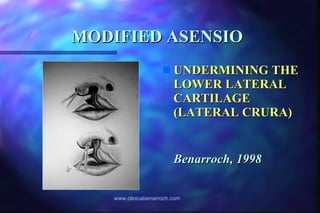
MODIFIED ASENSIO   UNDERMINING THE LOWER LATERAL CARTILAGE (LATERAL CRURA) Benarroch, 1998
MODIFIED   ASENSIO   CORRECTION OF THE DISLOCATED SEPTUM Benarroch,1998
MODIFIED ASENSIO   FORMING THE NASAL TIP (MEDIAL CRURA) Benarroch, 1998
MODIFIED ASENSIO LATERAL REPOSITION  OF THE ALAR BASE  Benarroch, 1998
MODIFIED ASENSIO POSTOPERATIVELY NOSTRIL CONFORMATION BY MEANS OF A STENT     Benarroch, 1998
  RESULTS   1. What are the results  and advantages that  can be  achieved with  simultaneous lip and nose repair?    2. Is there any sign of growth retardation  or alteration of the nose in long term  follow-up?
ADVANTAGES  (variables to consider)    Comparisons of the right and left sides of the nose. Desviation of the nose and septum. Symmetry of the tip of the nose or asymmetry on the cleft side. Shape and position of the alar cartilages
Any  signs of hypoplasia of the nose. Shape of the nostrils (especially on the cleft side). Position and length of the columella and the shape of the alar base. Evidence of hypoplasia of the underlying bone
NO NASAL GROWTH DISTURBANCES ORTIZ- MONASTERIOS, F, OLMEDO, A.(1981). Corrective rhinoplasty before puberty: A long  term follow up. Plastic Reconstructive Surgery 68:381. SAYLER,  K (1986). Primary correction of the unilateral cleft lip nose: a 15- year experience. Plastic Reconstructive Surgery 75:791. McCOMB, H. (1985). Primary correction of the unilateral cleft lip nasal deformity: a ten year review. Plast Reconstr Surg 75:791. ANDERL, H. (1985). Simultaneous repair of lip and nose in the unilateral cleft (a long term report). Recent Advances in Plastic Surgery. Edinburgh: Churcill Livingdtone
EARLY POST-OP WITHOUT  NASAL PROCEDURES     ORIGINAL   ASENSIO
EARLY POST-OP WITH  NASAL PROCEDURES MODIFIED ASENSIO  BENARROCH, 1.998

Cirugía Oral y Maxilofacial - Técnica Asensio

  • 1.
    ORAL &MAXILLOFACIAL DEPARTAMENT SAMUEL BENARROCH MD, DDS RODOLFO ASENSIO MD
  • 2.
    NASAL CONSIDERATIONS IN THE UNILATERAL CLEFT LIP USING THE ASENSIO TECHNIQUE
  • 3.
    CLEFT LIP- NOSE AND PALATE DEFORMITY SECOND CONGENITAL : 1:750 a 1: 1000 BIRTHS VENEZUELA: 2 C. L.P. 24 HOURS 1 C. P. / 24 HOURS 517 NEW CASES / YEAR YEAR 2. 000: 23.247 PATIENTS USA BUREAU OF CENSUS, INTERNACIONAL DATA BASE, 1997
  • 4.
    ROTATION AND ADVANCEMENTFLAPS RESTABLISH LIP ANATOMY DO NOT CONSIDER ISOLATED NASAL PROCEDURES Asensio, Oscar. Labio Leporino Unilateral; Técnica quirurgica para su correccion . Revista Guatemalteca de Estomatologia, Vol. 2, Num.. 2, 1.972. Millard, Ralph . Cleft Craft: The evolution of its Surgery - The Unilateral Deformity, The Asensio Technique for Unilateral Cleft lip . Vol.. 1, p408-412, 1.976 ASENSIO TECHNIQUE
  • 5.
    MORPHOLOGIC FACTORSIMBALANCE OF THE FACIAL MUSCULATURE. HIPOPLASIA OF THE SKELETAL BASE ASIMMETRY OF THE SKELETAL BASE
  • 6.
    ANALISIS OF NASALDEFORMITY HUFFMAN- LIERLE, 1.949 HURWITZ,1.976 ANDERL, 1.985 McCOMB, 1.986 BARDACH, 1.987 SALYER, 1.987
  • 7.
    DESCRIPTION OF THENASAL DEFORMITY The columella is shorter on the cleft side. The columella has an oblique position with its base desviated to the noncleft side. The lateral crus of the lower lateral cartilage and the adherent skin are drawn into an S- shaped fold. The lateral crus of the lower lateral cartilage is longer on the cleft side.
  • 8.
    DESCRIPTION OF THENASAL DEFORMITY The lower lateral cartilage is displaced in the frontal and horizontal (backward and downward) planes The nasal tip is displaced in the frontal and horizontal planes following displacement of the lower lateral cartilage. The nasal tip is asymmetric. The vestibular dome is excessively obtuse .
  • 9.
    DESCRIPTION OF THENASAL DEFORMITY The ala is flattened, resulting in a horizontal orientation of the nostril. The nostril is smaller or larger than that of the opposite side The nasal tip is displaced in the frontal and horizontal planes following displacement of the lower lateral cartilage. The nasal tip is asymmetric.
  • 10.
    DESCRIPTION OF THENASAL DEFORMITY The vestibular dome is excessively obtuse. The ala is flattened, resulting in a horizontal orientation of the nostril. The nostril is smaller or larger than that of the opposite side The base of The ala is displaced laterally and/or posteriorly, and or inferiorly .
  • 11.
    DESCRIPTION OF THENASAL DEFORMITY The nasal floor is absent and is lower on the cleft side. Nasolabial fistula may be present. The caudal edge of the nasal septum and the anterior nasal spine are deflected into the non cleft vestibule.
  • 12.
    DESCRIPTION OF THENASAL DEFORMITY The nasal septum is desviated, resulting in varying degrees of nasal obstruction on the cleft side. The lower turbinate on the cleft side is hypertrophic. The nasal pyramid is asymetric
  • 13.
    MODIFIEDASENSIO Reubication of point number 6. Lateral extention of the alar base incision, on the cleft side. Undermining the lower lateral cartilage (lateral crura). Correction of the dislocated septum. Forming the nasal tip (medial crura). Lateral reposition of the alar base. Postoperatively nostril conformation by means of a splint BENARROCH,1.998
  • 14.
    MODIFIED ASENSIO REUBICATION OF POINT NUMBER 6 Benarroch,1998
  • 15.
    MODIFIED ASENSIO LATERAL EXTENTION OF THE ALAR BASE INCISION Benarroch, 1998
  • 16.
    MODIFIED ASENSIO UNDERMINING THE LOWER LATERAL CARTILAGE (LATERAL CRURA) Benarroch, 1998
  • 17.
    MODIFIED ASENSIO CORRECTION OF THE DISLOCATED SEPTUM Benarroch,1998
  • 18.
    MODIFIED ASENSIO FORMING THE NASAL TIP (MEDIAL CRURA) Benarroch, 1998
  • 19.
    MODIFIED ASENSIO LATERALREPOSITION OF THE ALAR BASE Benarroch, 1998
  • 20.
    MODIFIED ASENSIO POSTOPERATIVELYNOSTRIL CONFORMATION BY MEANS OF A STENT Benarroch, 1998
  • 21.
    RESULTS 1. What are the results and advantages that can be achieved with simultaneous lip and nose repair? 2. Is there any sign of growth retardation or alteration of the nose in long term follow-up?
  • 22.
    ADVANTAGES (variablesto consider) Comparisons of the right and left sides of the nose. Desviation of the nose and septum. Symmetry of the tip of the nose or asymmetry on the cleft side. Shape and position of the alar cartilages
  • 23.
    Any signsof hypoplasia of the nose. Shape of the nostrils (especially on the cleft side). Position and length of the columella and the shape of the alar base. Evidence of hypoplasia of the underlying bone
  • 24.
    NO NASAL GROWTHDISTURBANCES ORTIZ- MONASTERIOS, F, OLMEDO, A.(1981). Corrective rhinoplasty before puberty: A long term follow up. Plastic Reconstructive Surgery 68:381. SAYLER, K (1986). Primary correction of the unilateral cleft lip nose: a 15- year experience. Plastic Reconstructive Surgery 75:791. McCOMB, H. (1985). Primary correction of the unilateral cleft lip nasal deformity: a ten year review. Plast Reconstr Surg 75:791. ANDERL, H. (1985). Simultaneous repair of lip and nose in the unilateral cleft (a long term report). Recent Advances in Plastic Surgery. Edinburgh: Churcill Livingdtone
  • 25.
    EARLY POST-OP WITHOUT NASAL PROCEDURES ORIGINAL ASENSIO
  • 26.
    EARLY POST-OP WITH NASAL PROCEDURES MODIFIED ASENSIO BENARROCH, 1.998

Editor's Notes

  • #4 The incidence of cleft lip and or palate in venezuela is similar than the reported worldwide, 1 in 800 live births. In year 2.000 we are going to have 23.247 patients with the deformity, becoming a public health problem.
  • #5 Initially the Asensio technique, like others concentrated its attention on lip repair only. Recently, cleft nasal repair has been emphasized given equal attention directed to reconstruction of the lip and nose. The lip will not be reviewed in this presentation, a complete description of dr. Asensio Technique was oresent early this afternoon.
  • #6 The nasal deformity in unilateral clefts is an integral part of the complex cleft syndrome that includes the lip, alveolus, palate, maxilla and nose. Unilateral clefting results in a nasal deformity that may be caused by three major factos: imbalance of the facial musculature, hy poplasia of the skeletal base and asymetry of the skeletal base
  • #7 When analyzing the nasal deformity, it must be realized that correction of one of the factors rarely suffices to alleviate the existing nasal deformity. It should be understood that these factors produced changes in the lower lateral cartilage, nostril, columella. Septum, alar base and nasal tip.
  • #8 The following is a list of characteristics of a typical unilateral nasal deformity; however, they are not necessarily listed in order of frequency or importance. All of them may be present prior to lip repair and subsequent to the primary operation.
  • #15 With this reubication, we gain a precious amount of excess mucosa, in order to avoid narrowing inside the nose. Mucosa that we can use and play with.
  • #16 This prolongation around the alar base and posterior dissection of the soft tissues, allows to oriented and positioned without tension the alar base complex.
  • #17 Gaining access through the same alar base incision, the ala lateral crura of the lower cartilage is separated from the skin and from the the underlying nasal mucosa .
  • #18 When straightening the septum, two points have to be considered: 1.-The curved frontal part must be released from the bone and 2.- The mucosa must be detached from the catilage in this area. After dissecting the mucosa on both sides of the curved septum and disconnecting it from the bone the septum and all other structures can be shifted to the midline. In addition, excessive mucosa is gained on the cleft side.
  • #19 In this part of the operation we place the dropped ala in a symmetric position relative to the normal side and lift the nasal tip on the cleft side. This mobilization is accomplished trough extensive undermining of the nasal skin and separation of the cartilages from each other within the columella and the dome.
  • #20 With this maneuver and only excising little portions of skin we obtain equally wide nostrils and must be no narrowing inside the nose
  • #21 After closure, we used the nostril splint to contour and reshape the lower lateral cartilage, homeostasis and space maintainer for 15 days.
  • #22 Summarizing our experience, two questions must be addressed
  • #23 The advantages of this approach have led to good results, especially when compared to patients who were operated on, before application of this concept. Correction of the nasal deformity, resulted in adequate and symmetric nose, good projection of the nasal tip and shape of the nostril, and finally curved shape of the alar rim . In conclusion our results do not differ with other publications worldwide that included nasal procedures to the original lip closures techniques .
  • #25 Many studies have been publish related to this controversial subject . No growth impairment was mentioned in any of this publications, justifying further application of this procedures .
  • #26 In a great number of patients, lip repair alone leads to the typical nasal deformity with functional and aesthetic disorders, that causes discontent in patients, parents and the surgeon.
  • #27 Sum nasal procedures to the original Asensio Technique achieving: Symmetry of the nasal floor,ala,and dome on both sides. Symmetric nasal tip projection Reshaping of the lower lateral cartilage Repositioning of the lower lateral cartilage and alar base Reshaping of the nasal ala