MANDIBULAR ANATOMICAL
LANDMARKS
Submitted by: Lana Michael
IVth year
LIMITING STRUCTURES
 Labial frenum
 Labial vestibule
 Buccal frenum
 Buccal vestibule
 Lingual frenum
 Alveololingual sulcus
 Retromolar pads
 Pterygomandibular raphe
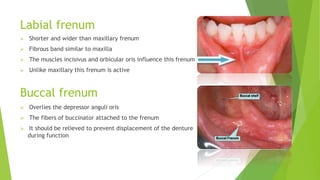
Labial frenum
 Shorter and wider than maxillary frenum
 Fibrous band similar to maxilla
 The muscles incisivus and orbicular oris influence this frenum
 Unlike maxillary this frenum is active
 Overlies the depressor anguli oris
 The fibers of buccinator attached to the frenum
 It should be relieved to prevent displacement of the denture
during function
Buccal frenum
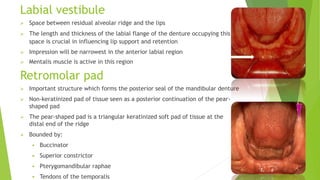
Labial vestibule
 Space between residual alveolar ridge and the lips
 The length and thickness of the labial flange of the denture occupying this
space is crucial in influencing lip support and retention
 Impression will be narrowest in the anterior labial region
 Mentalis muscle is active in this region
 Important structure which forms the posterior seal of the mandibular denture
 Non-keratinized pad of tissue seen as a posterior continuation of the pear-
shaped pad
 The pear-shaped pad is a triangular keratinized soft pad of tissue at the
distal end of the ridge
 Bounded by:
 Buccinator
 Superior constrictor
 Pterygomandibular raphae
 Tendons of the temporalis
Retromolar pad
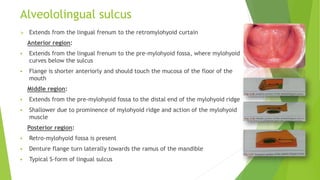
Alveololingual sulcus
 Extends from the lingual frenum to the retromylohyoid curtain
Anterior region:
 Extends from the lingual frenum to the pre-mylohyoid fossa, where mylohyoid
curves below the sulcus
 Flange is shorter anteriorly and should touch the mucosa of the floor of the
mouth
Middle region:
 Extends from the pre-mylohyoid fossa to the distal end of the mylohyoid ridge
 Shallower due to prominence of mylohyoid ridge and action of the mylohyoid
muscle
Posterior region:
 Retro-mylohyoid fossa is present
 Denture flange turn laterally towards the ramus of the mandible
 Typical S-form of lingual sulcus
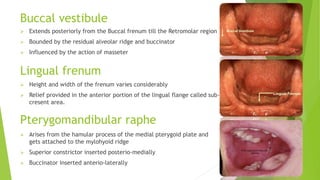
Buccal vestibule
 Extends posteriorly from the Buccal frenum till the Retromolar region
 Bounded by the residual alveolar ridge and buccinator
 Influenced by the action of masseter
Lingual frenum
 Height and width of the frenum varies considerably
 Relief provided in the anterior portion of the lingual flange called sub-lingual
cresent area.
 Arises from the hamular process of the medial pterygoid plate and
gets attached to the mylohyoid ridge
 Superior constrictor inserted posterio-medially
 Buccinator inserted anterio-laterally
Pterygomandibular raphe
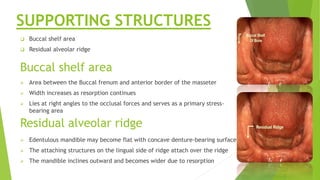
SUPPORTING STRUCTURES
 Buccal shelf area
 Residual alveolar ridge
Buccal shelf area
 Area between the Buccal frenum and anterior border of the masseter
 Width increases as resorption continues
 Lies at right angles to the occlusal forces and serves as a primary stress-
bearing area
Residual alveolar ridge
 Edentulous mandible may become flat with concave denture-bearing surface
 The attaching structures on the lingual side of ridge attach over the ridge
 The mandible inclines outward and becomes wider due to resorption
RELIEF AREA
 Mylohyoid ridge
 Mental foramen
 Genial tubercles
 Torus mandibularis
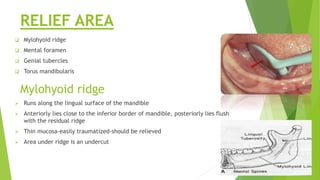
Mylohyoid ridge
 Runs along the lingual surface of the mandible
 Anteriorly lies close to the inferior border of mandible, posteriorly lies flush
with the residual ridge
 Thin mucosa-easily traumatized-should be relieved
 Area under ridge is an undercut
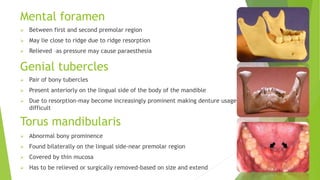
Mental foramen
 Between first and second premolar region
 May lie close to ridge due to ridge resorption
 Relieved –as pressure may cause paraesthesia
 Pair of bony tubercles
 Present anteriorly on the lingual side of the body of the mandible
 Due to resorption-may become increasingly prominent making denture usage
difficult
Genial tubercles
Torus mandibularis
 Abnormal bony prominence
 Found bilaterally on the lingual side-near premolar region
 Covered by thin mucosa
 Has to be relieved or surgically removed-based on size and extend
Mandibular landmarks

Mandibular landmarks

  • 1.
  • 2.
    LIMITING STRUCTURES  Labialfrenum  Labial vestibule  Buccal frenum  Buccal vestibule  Lingual frenum  Alveololingual sulcus  Retromolar pads  Pterygomandibular raphe
  • 3.
    Labial frenum  Shorterand wider than maxillary frenum  Fibrous band similar to maxilla  The muscles incisivus and orbicular oris influence this frenum  Unlike maxillary this frenum is active  Overlies the depressor anguli oris  The fibers of buccinator attached to the frenum  It should be relieved to prevent displacement of the denture during function Buccal frenum
  • 4.
    Labial vestibule  Spacebetween residual alveolar ridge and the lips  The length and thickness of the labial flange of the denture occupying this space is crucial in influencing lip support and retention  Impression will be narrowest in the anterior labial region  Mentalis muscle is active in this region  Important structure which forms the posterior seal of the mandibular denture  Non-keratinized pad of tissue seen as a posterior continuation of the pear- shaped pad  The pear-shaped pad is a triangular keratinized soft pad of tissue at the distal end of the ridge  Bounded by:  Buccinator  Superior constrictor  Pterygomandibular raphae  Tendons of the temporalis Retromolar pad
  • 5.
    Alveololingual sulcus  Extendsfrom the lingual frenum to the retromylohyoid curtain Anterior region:  Extends from the lingual frenum to the pre-mylohyoid fossa, where mylohyoid curves below the sulcus  Flange is shorter anteriorly and should touch the mucosa of the floor of the mouth Middle region:  Extends from the pre-mylohyoid fossa to the distal end of the mylohyoid ridge  Shallower due to prominence of mylohyoid ridge and action of the mylohyoid muscle Posterior region:  Retro-mylohyoid fossa is present  Denture flange turn laterally towards the ramus of the mandible  Typical S-form of lingual sulcus
  • 6.
    Buccal vestibule  Extendsposteriorly from the Buccal frenum till the Retromolar region  Bounded by the residual alveolar ridge and buccinator  Influenced by the action of masseter Lingual frenum  Height and width of the frenum varies considerably  Relief provided in the anterior portion of the lingual flange called sub-lingual cresent area.  Arises from the hamular process of the medial pterygoid plate and gets attached to the mylohyoid ridge  Superior constrictor inserted posterio-medially  Buccinator inserted anterio-laterally Pterygomandibular raphe
  • 7.
    SUPPORTING STRUCTURES  Buccalshelf area  Residual alveolar ridge Buccal shelf area  Area between the Buccal frenum and anterior border of the masseter  Width increases as resorption continues  Lies at right angles to the occlusal forces and serves as a primary stress- bearing area Residual alveolar ridge  Edentulous mandible may become flat with concave denture-bearing surface  The attaching structures on the lingual side of ridge attach over the ridge  The mandible inclines outward and becomes wider due to resorption
  • 8.
    RELIEF AREA  Mylohyoidridge  Mental foramen  Genial tubercles  Torus mandibularis Mylohyoid ridge  Runs along the lingual surface of the mandible  Anteriorly lies close to the inferior border of mandible, posteriorly lies flush with the residual ridge  Thin mucosa-easily traumatized-should be relieved  Area under ridge is an undercut
  • 9.
    Mental foramen  Betweenfirst and second premolar region  May lie close to ridge due to ridge resorption  Relieved –as pressure may cause paraesthesia  Pair of bony tubercles  Present anteriorly on the lingual side of the body of the mandible  Due to resorption-may become increasingly prominent making denture usage difficult Genial tubercles Torus mandibularis  Abnormal bony prominence  Found bilaterally on the lingual side-near premolar region  Covered by thin mucosa  Has to be relieved or surgically removed-based on size and extend