ASD Community of Practice Model
             Bruce L. Keisling, Ph.D.
                Associate Director
  Boling Center for Developmental Disabilities
 University of Tennessee Health Science Center
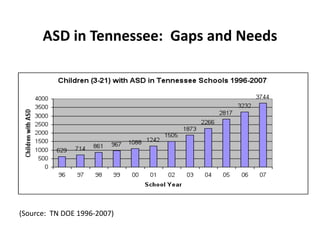
ASD in Tennessee:  Gaps and Needs


(Source:  TN DOE 1996‐2007) 
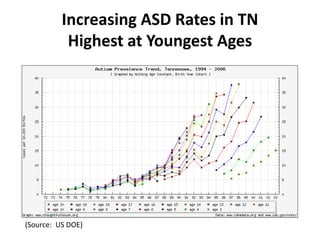
Increasing ASD Rates in TN 
            Highest at Youngest Ages


(Source:  US DOE) 
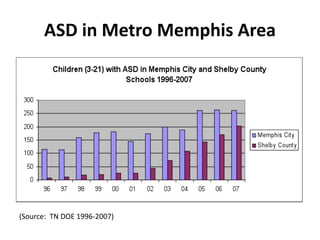
ASD in Metro Memphis Area


(Source:  TN DOE 1996‐2007) 
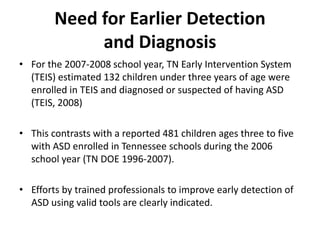
Need for Earlier Detection 
             and Diagnosis
• For the 2007‐2008 school year, TN Early Intervention System 
  (TEIS) estimated 132 children under three years of age were 
  enrolled in TEIS and diagnosed or suspected of having ASD 
  (TEIS, 2008)  

• This contrasts with a reported 481 children ages three to five 
  with ASD enrolled in Tennessee schools during the 2006 
  school year (TN DOE 1996‐2007).  

• Efforts by trained professionals to improve early detection of 
  ASD using valid tools are clearly indicated.
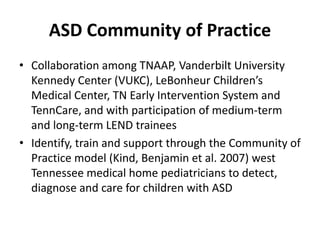
ASD Community of Practice
• Collaboration among TNAAP, Vanderbilt University 
  Kennedy Center (VUKC), LeBonheur Children’s 
  Medical Center, TN Early Intervention System and 
  TennCare, and with participation of medium‐term 
  and long‐term LEND trainees
• Identify, train and support through the Community of 
  Practice model (Kind, Benjamin et al. 2007) west 
  Tennessee medical home pediatricians to detect, 
  diagnose and care for children with ASD 
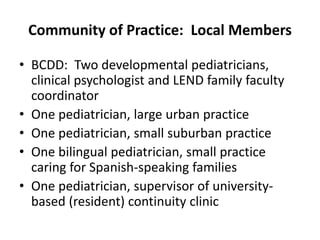
Community of Practice:  Local Members

• BCDD:  Two developmental pediatricians, 
  clinical psychologist and LEND family faculty 
  coordinator 
• One pediatrician, large urban practice
• One pediatrician, small suburban practice
• One bilingual pediatrician, small practice 
  caring for Spanish‐speaking families 
• One pediatrician, supervisor of university‐
  based (resident) continuity clinic
Community of Practice:  Training
• Provide training in family‐centered, culturally 
  competent assessment and care of children with 
  ASD to include the administration and 
  interpretation of the Screening Tool for Autism in 
  Two‐Year‐Olds (STAT) (Stone, Coonrod et al. 2000; 
  Stone, Coonrod et al. 2004). 
• Replicate the VKC training model (Warren, Stone, 
  & Humberd 2009) for use of STAT in diagnosis of 
  ASD in community pediatric practices
Community of Practice:  Follow Through

• Model uses adult‐learning strategies and 
  includes: periodic group meetings and 
  discussions; regular consultation through 
  email, phone and password‐protected intranet 
  site; journal club; ongoing technical assistance
• Evaluate the effectiveness of the training, 
  fidelity to the model; provide confirmatory, 
  interdisciplinary evaluations for some cases

ASD Community of Practice Model