A Smartphone Application
Designed to Teach Emergency
Skills to Children
Dr. Joelene Huber, MD FRCPC, PhD, Msc
Dr.Catharine Walsh, MD, Med, PhD, FRCPC
Study Team
• Dr. Joelene Huber, Principal investigator, Developmental
Pediatrician
• Dr. Catharine Walsh, Co-Principal Investigator, Education
Researcher
• Ankit Guglani, Marki Sveen and Nitin Malik, Mobile Application
Developer, Computer Science Student
• Thivia Jegathesan, Research Coordinator in Department of
Pediatrics
• Sarah Davis, Behavior Therapist
• Jean Phan, Research Assistant, Life Science Student
• Dr. Niraj Mistry, Co-investigator, Mobile Health Expert
• Dr. Elizabeth Young, Co-investigator, Developmental Pediatrician
• Dr. Douglas Campbell, Co-investigator, Director of Allan Walters
Simulation Centre, St. Michael’s Hospital
• Dr. Joey Bonifacio, Co-investigator, Adolescent Medicine
• Dr. Alex Mihalidis, Biomedical Engineer, Toronto Rehabilitation
Institute
Children Saving Lives
Emergency Simulation
Teaching
Didactic Emergency
Teaching
Didactic Teaching
Emergency Simulation Teaching: 9-1-1 Heroes
Simulations
Assemble An Interdisciplinary Team
9-1-1 Heroes App Development
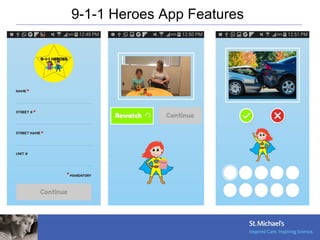
9-1-1 Heroes App Features
Smartphone Application to Teach Emergency Skills to
Children
Purpose: The need for smartphone application in teaching children
emergency skills
Methods:
Baseline Assessment: 9-1-1 Emergency Simulation
•Behaviour skills 9-1-1 task analysis checklist
45 minutes educational Session
•Didactic teaching of Emergency Skills
•Simulation Teaching: 9-1-1 Heroes APP
Post Assessment: 9-1-1 Emergency Simulation
•Behaviour skills 9-1-1 task analysis checklist
Questionnaires
•Demographic
•Follow-up
Results
• 70% of intervention group identified emergency (42.9% of
kindergarten, 33.3% first, 100% second and third grades
• 54.8 % of the traditional group (20% of Kindergarten, 66.7% first and
third grades, 85.7% second grade
Results
Results
Future Directions
• Further App Development
• Simulations Teaching vs. Didactic Teaching
Questions?
Division Round Powerpoint

Division Round Powerpoint

  • 1.
    A Smartphone Application Designedto Teach Emergency Skills to Children Dr. Joelene Huber, MD FRCPC, PhD, Msc Dr.Catharine Walsh, MD, Med, PhD, FRCPC
  • 2.
    Study Team • Dr.Joelene Huber, Principal investigator, Developmental Pediatrician • Dr. Catharine Walsh, Co-Principal Investigator, Education Researcher • Ankit Guglani, Marki Sveen and Nitin Malik, Mobile Application Developer, Computer Science Student • Thivia Jegathesan, Research Coordinator in Department of Pediatrics • Sarah Davis, Behavior Therapist • Jean Phan, Research Assistant, Life Science Student • Dr. Niraj Mistry, Co-investigator, Mobile Health Expert • Dr. Elizabeth Young, Co-investigator, Developmental Pediatrician • Dr. Douglas Campbell, Co-investigator, Director of Allan Walters Simulation Centre, St. Michael’s Hospital • Dr. Joey Bonifacio, Co-investigator, Adolescent Medicine • Dr. Alex Mihalidis, Biomedical Engineer, Toronto Rehabilitation Institute
  • 4.
  • 8.
  • 9.
  • 10.
  • 12.
  • 13.
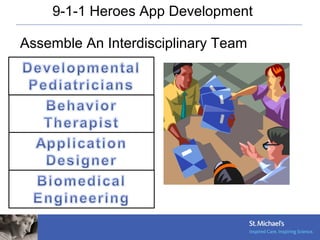
    Assemble An InterdisciplinaryTeam 9-1-1 Heroes App Development
  • 14.
  • 15.
  • 16.
    Smartphone Application toTeach Emergency Skills to Children Purpose: The need for smartphone application in teaching children emergency skills Methods: Baseline Assessment: 9-1-1 Emergency Simulation •Behaviour skills 9-1-1 task analysis checklist 45 minutes educational Session •Didactic teaching of Emergency Skills •Simulation Teaching: 9-1-1 Heroes APP Post Assessment: 9-1-1 Emergency Simulation •Behaviour skills 9-1-1 task analysis checklist Questionnaires •Demographic •Follow-up
  • 17.
    Results • 70% ofintervention group identified emergency (42.9% of kindergarten, 33.3% first, 100% second and third grades • 54.8 % of the traditional group (20% of Kindergarten, 66.7% first and third grades, 85.7% second grade
  • 18.
  • 19.
  • 20.
    Future Directions • FurtherApp Development • Simulations Teaching vs. Didactic Teaching
  • 21.

Editor's Notes

  • #4 Training children to recognize emergencies and dial 911 can save lives.
  • #5 Children as young as three to four years of age are able to recognize emergencies and dial 911
  • #6 Many children, however, do not know how to respond, if faced with an emergency situation, placing them at a significant safety risk.
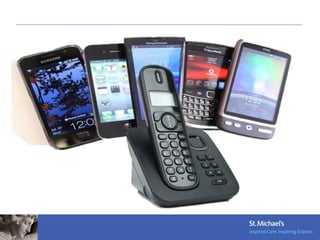
  • #7 Mobile Phones Replacing Landline Phones -Personal mobile phones are rapidly replacing landline phone use. -Children have been reported to be the largest new user groups of mobile technology, suggesting a transition from landline phone use to mobile phones (5).
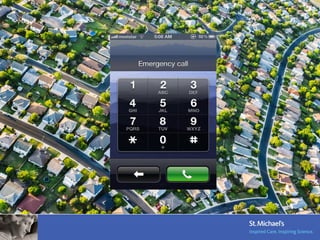
  • #8 -However due to the complexity of mobile devices compared to landline phones, children may not know how to bypass a pass-code and access the emergency call function on any mobile phone. -Also, 911 dispatchers are unable to identify a location through a mobile phone call and would therefore require a child’s report of their address (7).-Dispatchers can no determine the precise location of a caller who dials 9-1-1 from any cell phone -It is essential to stay on the line and give the location to the 911 call taker.
  • #9 - Purpose to determine the effectiveness mobile apps vs. didactic teaching if emergency protocol
  • #10 Didactic training does not include Use of mobile phones Simulated practice Feedback Needs of ASD children
  • #11 *Simulation teaching of our programs uses a mobile application app 9-1-1 superhero that uses Applied Behaviour Analysis (ABA) Principles (modeling, rehearsal, performance and feedback) and simulated practice to teach children to identify an emergency, call 911 and report their name, emergency and location on a mobile device
  • #12 One of the most effective way to teach a child new skill ABA training principles (modeling, rehearsal, performance and feedback), with simulated practice, utilize prompts and positive reinforcement while systematically fading prompts, based on the child’s individual success, as target skills are achieved (Kilroe, Murphy et al. 2014, Schwebel, McClure et al. 2014).
  • #13 The Canadian government Health-Emergency preparedness recommendations advise preparing children for emergencies and training emergency recognition and response skills, such as dialing 9-1-1, through simulated practice (Canada 2012). Simulated practice has been shown to be an effective education strategy for building competence in emergency skills (Coles, Strickland et al. 2007, Trepagnier, Olsen et al. 2011, Police 2014) simulated practice interventions are a unique way to learn crucial skills in a safe environment.
  • #14 911 Superheroes an emergency app was developed by an interdisciplinary team - Operationalize app using android features– speech language library ,voice detection, videos
  • #15 The app is compatible on android smartphone devices with the capability of being adapted to IOS Operationalize app using android features– speech language library ,voice detection, videos 9-1-1 Superhero includes a modeling video, followed by behavior training modules that incorporate audio and visual prompts, gradual fading of prompts when accuracy is achieved and gaming-style feedback.
  • #16 These modules teach children to identify an emergency, bypass a password-protected screen and access the emergency function to dial 9-1-1 and respond to a simulated dispatcher. Through the use of voice recognition technology, children learn to accurately respond to the simulated 9-1-1 dispatcher’s questions such as type of emergency (i.e., fire, ambulance or police), name, location, description of the emergency, and a safety assessment.
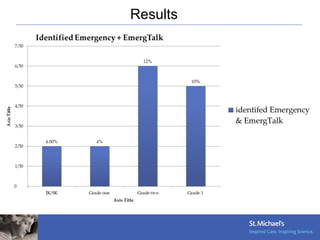
  • #18 Fifty children completed the baseline simulated emergency test. There was no significant difference in performance between groups. . Seventy percent of the intervention group recognized the situation as an emergency (42.9% of kindergarten, 33.3% first, 100% second and third grades) compared to 54.8 % of the traditional group (20% of Kindergarten, 66.7% first and third grades, 85.7% second grade)  Pre-test Preliminary Analysis Did not Identify an Emergency JK/SK10/5020% Grade 15/5010% Grade 22/50 4% Grade 3 4/50 8% Called 9-1-1 JK/SK0/500% Grade 10/500% Grade 23/506% Grade 3 2/504% Did not identify an Emergency JK/SK7/5014% Grade 13/506% Grade 211/5022% Grade 3 8/5016% Post-test Preliminary Analysis Did not Identify an Emergency JK/SK: 12/46=26% Grade 1: 3/46= 6.52% Grade 2:1/46= 2.17% Grade 3 :2/46= 4.35% Called 9-1-1 JK/SK:0/46=0% Grade 10/46=0% Grade 23/46=6.52% Grade 3 7/46=15% Identified an Emergency JK/SK:5/46 = 10.87% Grade1: 3/46= 6.52% Grade 2: 9/46 = 19.56% Grade 3 :11/46=23.91%
  • #19 Of the parents of children who identified the emergency, 78% in the control group (10% of Kindergarten, 5% first, 15% second, 20% third grade) and 50% in the control group (all first graders, 33.3% of grade 2 and 75% of grade 3) reported to talk to their children about when and how to dial 9-1-1. Four children from the app group dialed 9-1-1 (all third graders) compared to six children in the control group (3 second and 3 third graders). Pre-test Identified Emergency and had Emergency talk JK/SK:2/50=4% Grade 1: 2/50=4% Grade 2 6/50=12% Grade 3 5/50=10%
  • #20 All three children in the intervention group were shown how to dial 9-1-1 on their parent’s phone and four of the children in the traditional group. Pre-test preliminary Analysis Called 9-1-1 and had emergency talk JK/SK:0/50=0% Grade 1: 0/50=0% Grade 2:1/50=2% Grade 3 :2/50=4%