ASAP Implementation
Roadmap
SAP Business Solution
Presented By: Riasatian
Riasatian@SamehAra.com
Riasatian@Gmail.com
Mob: 0912 1791087
Date : 1390.05.20
Methodology – why? ASAP Overview
ASAP Roadmap Structure
ASAP Content Overview
How to access Roadmap
Project Management in ASAP
Projects from another perspective
“An estimated 68% of corporate IT projects are
neither on time nor budget, and they don’t deliver
the originally stated business goals. Some even
claim that during the last two years, $100 billion to
$150 billion of U.S. IT projects have failed
altogether.”
Mark Jeffery and Ingmar Leliveld: Best Practices in IT Portfolio Management,
MITSloan Management Review, Spring 2004
Mohsen Riastian, Samehara Page 3
Typical questions when you starting the project
How to best use selected
solution capabilities?
Do we have internal
capabilities
and capacity to
staff the project?How and where
do we start?
Who does what
in this project?
How expensive will
this project be? How
do we keep the costs low?
How to manage
project and business
risks involved?
How do we assure
success?
How to build
internal
expertise?
Mohsen Riastian, Samehara Page 4
Industry Best Practices to mitigate project failure risk
MOST UTILIZED PRACTICES in IT projects10TOP
1. Regularly use project management methodologies: 96%
2. Conduct regular strategic planning meetings to achieve alignment: 93%
3. Conduct internal customer satisfaction surveys: 86%
4. Create and use performance metrics: 81%
5. Regularly use portfolio management or other project prioritization methodology: 80%
6. Perform financial audits: 79%
7. Use leadership development programs: 79%
8. Make the CIO a member of the corporate board or executive committee: 76%
9. Employ internal relationship managers/account executives to work with the business: 75%
10. Conduct post-implementation audits: 74%
(Percentages refer to number of respondents using this practice.)
Source: Richard Pastore and Lorraine Cosgrove Ware: The Best Practices, CIO Magazine May 2004
Mohsen Riastian, Samehara Page 5
Delivering Successful Solutions
AcceleratedSAP Methodology
Description
http://service.sap.com/asap
AcceleratedSAP methodology is proven, repeatable and successful
approach to implement SAP solutions across industries and customer
environments.
AcceleratedSAP provides content, tools and expertise from thousands of
successful implementations.
More info
Mohsen Riastian, Samehara Page 6
Project Management expertise
Management of the implementation project
Aligned with industry standards and procedures (PMI PMBOK®)
Specific to implementation of SAP solutions
Key components for success
AcceleratedSAP - proven methodology
Aligns customer’s business
requirements to SAP
solutions
SAP Solution Composer
Offers AcceleratedSAP
roadmap composed to fit
specific project needs
SAP Roadmaps
Facilitates efficient solution
design, documentation,
configuration, testing and
operations
SAP Solution Manager
AcceleratedSAP toolset
Mohsen Riastian, Samehara Page 7
Key components for success
AcceleratedSAP - proven methodology
NewToolset
 Facilitates efficient solution
design, configuration, testing
and operation
 Delivered offline in SAP Service
Marketplace and in SAP Solution
Manager
ValueSAPToolset
 Aligns customer’s business
requirements to SAP solutions
SAP Solution Composer SAP Roadmaps SAP Solution Manager
AcceleratedSAP methodology
 Provides proven, comprehensive, repeatable and rich implementation
methodology to streamline projects
 PMI aligned framework with templates and tools for performing effective
project management
SAP Solution Map
Composer
Implementation
Assistant
Q&Adb, BPML, Diagram
Explorer
Evolved to Evolved to Replaced by
Mohsen Riastian, Samehara Page 8
Methodology
People
and
Expertise
Content
and
Tools
Consulting
Services
SAP Consulting
Where Methodology fits
Achieve your
implementation
goals through
leveraging SAP
experts, services,
methodology,
content and tools.
Mohsen Riastian, Samehara Page 9
Content: AcceleratedSAP Roadmaps
Guidance and navigation for your implementation team
Definition
Benefits
More info
ASAP roadmaps outline the activities involved in
implementing, upgrading, or enhancing SAP solutions
enriched with set of deliverables, accelerators, role
descriptions and additional guides
 Transparent, proven approach helping the project team to really work as a team and to reduce
implementation time, costs and risks
 Achieve better results since you base your project on the experiences others made before. Both hard facts
as well as soft skills are addressed
 Knowledge management - use the Implementation Roadmap for SAP solutions to gather knowledge on how
to organize and run your implementation projects
http://service.sap.com/roadmaps
Usage
Provide content (work packages, activities, tasks,
deliverables, accelerators) that can be used during the
entire project lifecycle.
Target Group
Customers, Partners, SAP Consulting
Availability
The roadmaps are made available through: SAP Solution
Manager and SAP Service Marketplace
Mohsen Riastian, Samehara Page 10
AcceleratedSAP Implementation Methodology
Phase 1: Project Preparation
for SAP project.initial planning and preparationDuring this phase the team goes through
Phase 2: Business Blueprint
common understanding of how the companyThe purpose of this phase is to achieve a
. The result is the Business Blueprint, a detailedintends to run SAP to support their business
documentation of the results gathered during requirements workshops.
Phase 3: Realization
requirements based onimplement all the business processThe purpose of this phase is to
the Business Blueprint. The system configuration methodology is provided in two work
packages: Baseline (major scope); and Final configuration (remaining scope).
Phase 4: Final Preparation
(including testing, end usercomplete the final preparationThe purpose of this phase is to
training, system management and cutover activities) to finalize your readiness to go live.
The Final Preparation phase also serves to resolve all critical open issues. On successful
completion of this phase, you are ready to run your business in your live SAP System.
Phase 5: Go Live & Support
The purpose of this phase is to move from a project-oriented, pre-production environment to
live production operation.
Mohsen Riastian, Samehara Page 11
SAP Standard Roadmaps (1/2)
Implementation Roadmap for SAP Solutions provides the
methodological framework for the project team to leverage in
the implementation of a SAP solution. It covers, among other
things, the necessary project management, requirements
gathering, design, configuration of business processes,
technical implementation, test procedures, training and
organization change management.
In this roadmap deliverables represent the main objects within a
project. Each deliverable then provides outline of the Outputs
(components creating the deliverable) and relevant Methods
that represent the activities and tasks the project team
conducts
Implementation
DescriptionRoadmap Type
The Global Template Roadmap describes how to organize and
how to run a project in which a corporate template is
developed. The Global Template Roadmap is geared to more
complex implementation or harmonization projects, typically
involving more than one kind of SAP solution, and a variety of
sites, possibly in different countries. The corporate template is
rolled out to other sites in a follow-up project.
Global Template
Mohsen Riastian, Samehara Page 12
SAP Standard Roadmaps (2/2)
This roadmap is designed to help you carry out the customizing
activities required for an upgrade. These customizing activities
are essential if you want to continue to use the same functions
in your business application components after an upgrade.
Upgrade
DescriptionRoadmap Type
The Solution Management Roadmap provides a methodology
for the implementation of the technical infrastructure and its
operation. The Solution Management Roadmap complements
the Implementation Roadmap.
Solution Management
Mohsen Riastian, Samehara Page 13
Roadmaps Add Value to the Implementation
What to do,
and when to
do it
Why you should do it
and how to do it
Accelerators
Who does it
When used properly, a roadmap will provide guidance on the following:
Enforcing standards
Methodology alone will not make your project
successful. You need to enforce it – appoint
methodology champion for the project.
Mohsen Riastian, Samehara Page 15
Methodology – why? ASAP Overview
ASAP Roadmap Structure
ASAP Content Overview
How to access Roadmap
Project Management in ASAP
Source: Implementation Roadmap – Activity based (ABR)
Each work package comprises several
activities. Activities contain the tasks
that project team members need to
carry out, in order to fulfill the project
goals. At this level, you can find more
accelerators containing information
relevant for your implementation
project.
Activity
(Level 3)
Each ASAP Roadmap phase is made
up of several work packages with
topics. The work packages are
designed to realize the main
objectives of each Roadmap phase.
Work packages are made up of
activities and tasks.
Work Package
(Level 2)
Each Roadmap is divided into several
large phases, each of which
represents a major milestone in the
project plan.
Phase
(Level 1)
DescriptionStructure
Each activity is made up of several
tasks. The task describes the steps
Project team members are required to
perform the tasks.
Task
(Level 4)
Level 1
Level 2
Level 3
Level 4
Mohsen Riastian, Samehara Page 17
Source: Implementation Roadmap – Deliverable based (DBR)
Each deliverables comprises several
outputs. Outputs are document or
tangible items that are results of a
process. The output supports the
completion of a desired deliverable
as a standalone component.
Output
(Level 3)
Each phase is made up of several
deliverables with topics. The
deliverables represent the main
objects within a project. A
deliverables are further comprised of
outputs.
Deliverable
(Level 2)
Each Roadmap is divided into several
large phases, each of which
represents a major milestone in the
project plan.
Phase
(Level 1)
Level 1
Level 2
Level 3
DescriptionStructure
The Deliverable-based Roadmap will also have a ‘references’
tab to provide a link to the activities & tasks (method)
associated with creating the deliverable.
Mohsen Riastian, Samehara Page 18
Improved Implementation Roadmap
Activity based Impl. Roadmap
Deliverable Based Impl. Roadmap
Implementation Roadmap
Mohsen Riastian, Samehara Page 19
Implementation Roadmap - Structure
Phase
Deliverable Group 1
Deliverable
O: Output α.1
O: Output α.2
M: Activity 1.1
Task 1.1.1
Task 1.1.2
M: Activity 1.2
Task 1.2.1
Deliverable Group 2
Milestone A
Deliverable
consists of
several outputs
Methods
(activities and
tasks) that create
or contribute to
creation of the
deliverable
Mohsen Riastian, Samehara Page 20
Easy navigation in the roadmap
Attributes used to classify roadmap nodes and accelerators to enable easy
navigation and user specific views.
Following attributes are used
Flavors – represents SAP Solutions (mySAP ERP, mySAP CRM, ….)
Subject Areas – knowledge domains in the implementation project (Project Management, Org.
Change Management, Technical Implementation, …)
Project Roles – filter activities, tasks or outputs
Showing only relevant areas of the roadmap (by user preference)
Activity based view
Deliverable based view
Mohsen Riastian, Samehara Page 21
References
Relationship between Outputs and relevant Activities or Tasks
Phase
Deliverable Group 1
Deliverable
O: Output α.1
O: Output α.2
M: Activity 1.1
Task 1.1.1
Task 1.1.2
M: Activity 1.2
Task 1.2.1
Deliverable Group 2
Milestone A
References point from Tasks or Activities
(where tasks are not available) to the relevant
Outputs that are being produced (or
contributed to) by the performed task or
activity.
Mohsen Riastian, Samehara Page 22
Deliverable: Methods and Outputs relationship
Mohsen Riastian, Samehara Page 23
Project Roles and Subject Areas
Phase
Deliverable Group 1
Deliverable
O: Output α.1
O: Output α.2
M: Activity 1.1
Task 1.1.1
Task 1.1.2
M: Activity 1.2
Deliverable Group 2
Milestone A
Subject Area –
deliverable is part
of a discipline,
domain or subject
area in the project
AttributeStructure
Project Roles
- project role is
involved or
performs the
activity producing
an Output
Project Roles assigned
to Outputs and Tasks (or
Activity where tasks not
available)
Mohsen Riastian, Samehara Page 24
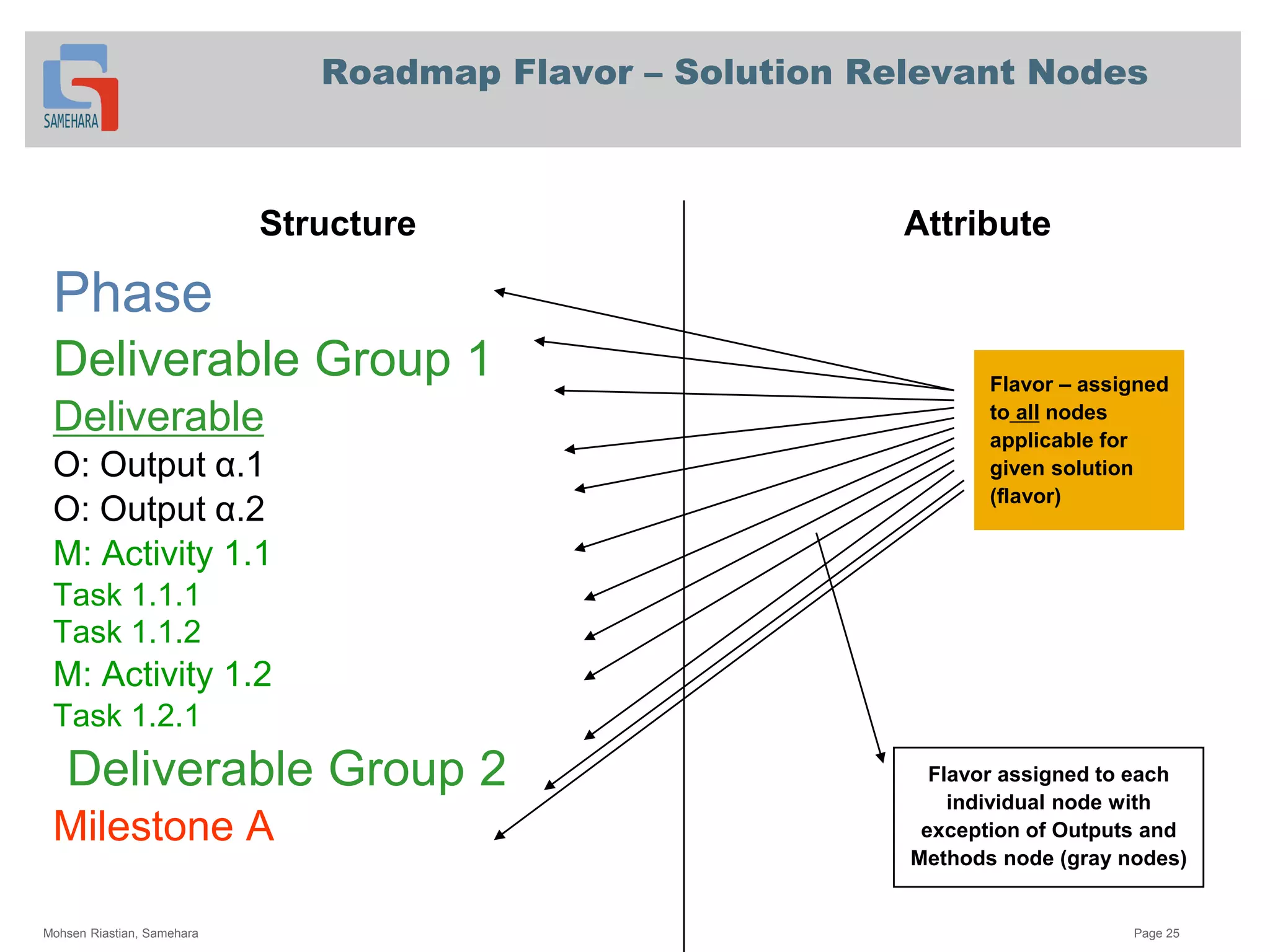
Roadmap Flavor – Solution Relevant Nodes
Phase
Deliverable Group 1
Deliverable
O: Output α.1
O: Output α.2
M: Activity 1.1
Task 1.1.1
Task 1.1.2
M: Activity 1.2
Task 1.2.1
Deliverable Group 2
Milestone A
Flavor – assigned
to all nodes
applicable for
given solution
(flavor)
AttributeStructure
Flavor assigned to each
individual node with
exception of Outputs and
Methods node (gray nodes)
Mohsen Riastian, Samehara Page 25
Methodology – why? ASAP Overview
ASAP Roadmap Structure
ASAP Content Overview
How to access Roadmap
Project Management in ASAP
PM Processes happen throughout the project
Each phase has Phase Start, Deliverable Creation/Acceptance and Closure tasks
Mohsen Riastian, Samehara Page 27
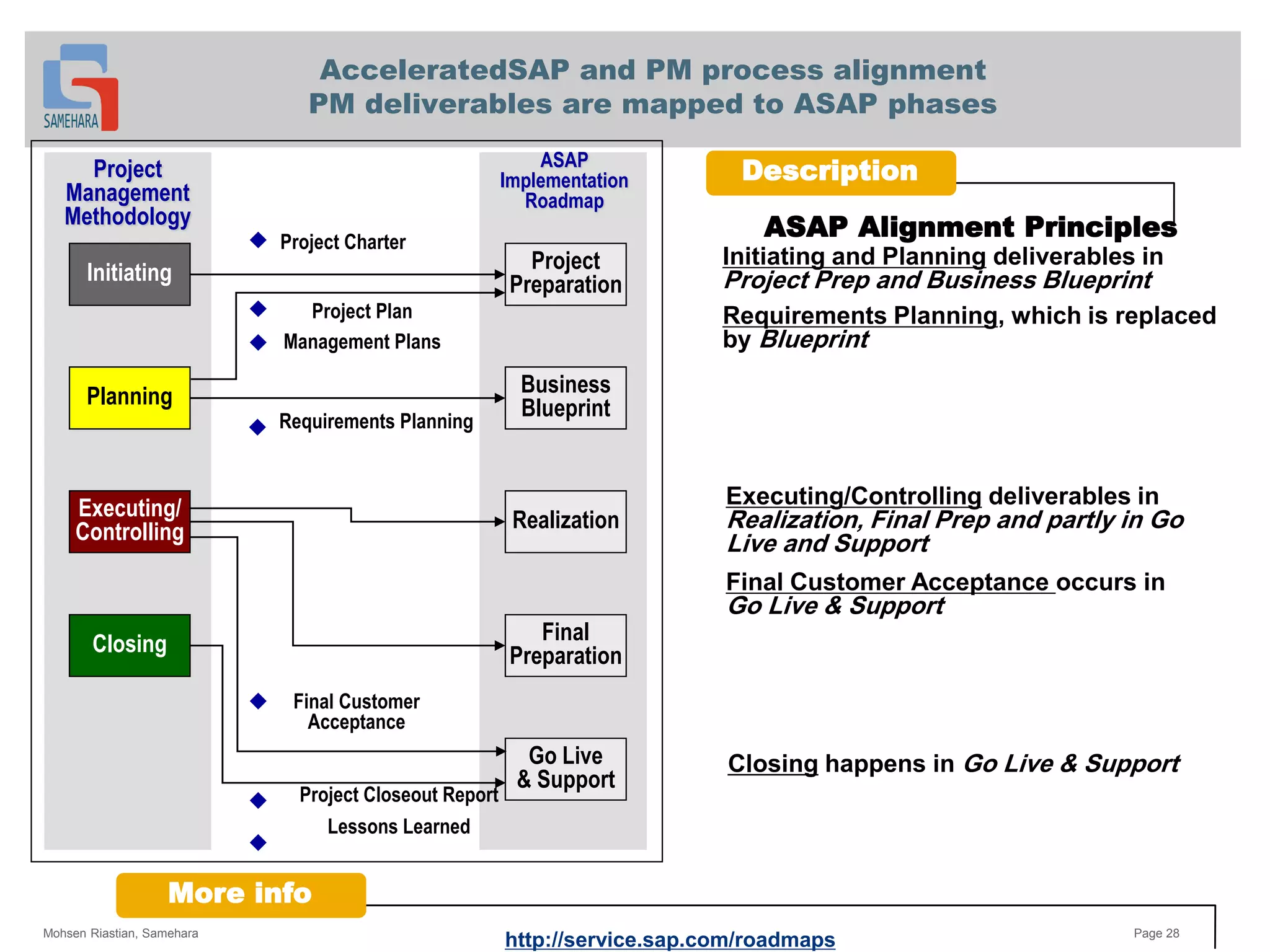
AcceleratedSAP and PM process alignment
PM deliverables are mapped to ASAP phases
Description
More info
http://service.sap.com/roadmaps
Project
Management
Methodology ASAP Alignment Principles
Initiating and Planning deliverables in
Project Prep and Business Blueprint
Requirements Planning, which is replaced
by Blueprint
Executing/Controlling deliverables in
Realization, Final Prep and partly in Go
Live and Support
Final Customer Acceptance occurs in
Go Live & Support
Initiating Project
Preparation
Planning
Executing/
Controlling
Closing
Business
Blueprint
Realization
Final
Preparation
Go Live
& Support
Project Charter
Project Plan
Management Plans
Requirements Planning
Final Customer
Acceptance
Project Closeout Report
Lessons Learned
ASAP
Implementation
Roadmap
Closing happens in Go Live & Support
Mohsen Riastian, Samehara Page 28
Methodology – why? ASAP Overview
ASAP Roadmap Structure
ASAP Content Overview
How to access Roadmap
Project Management in ASAP
ASAP Structure
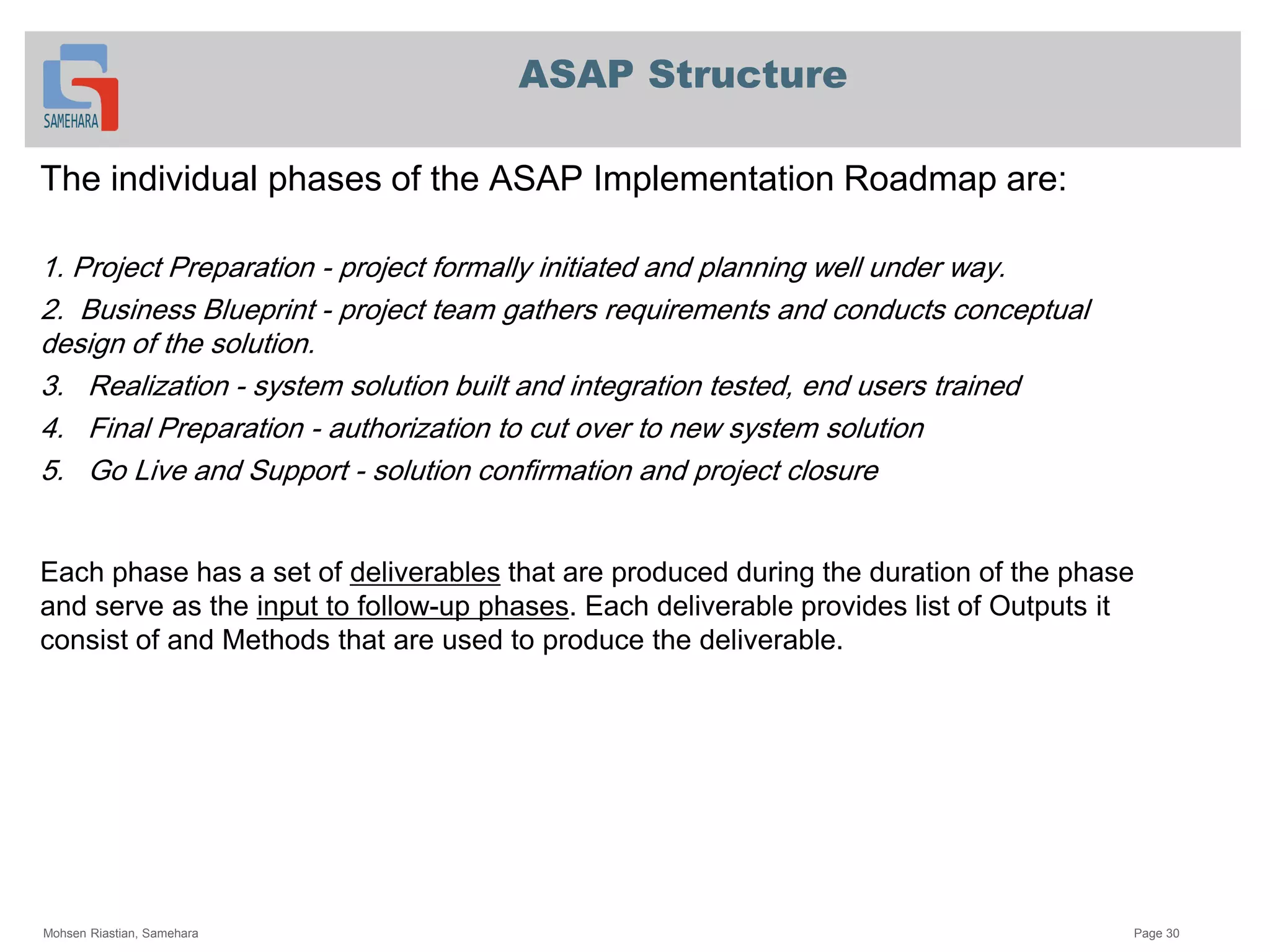
The individual phases of the ASAP Implementation Roadmap are:
1. Project Preparation - project formally initiated and planning well under way.
2. Business Blueprint - project team gathers requirements and conducts conceptual
design of the solution.
3. Realization - system solution built and integration tested, end users trained
4. Final Preparation - authorization to cut over to new system solution
5. Go Live and Support - solution confirmation and project closure
that are produced during the duration of the phasedeliverablesEach phase has a set of
. Each deliverable provides list of Outputs itup phases-input to followand serve as the
consist of and Methods that are used to produce the deliverable.
Mohsen Riastian, Samehara Page 30
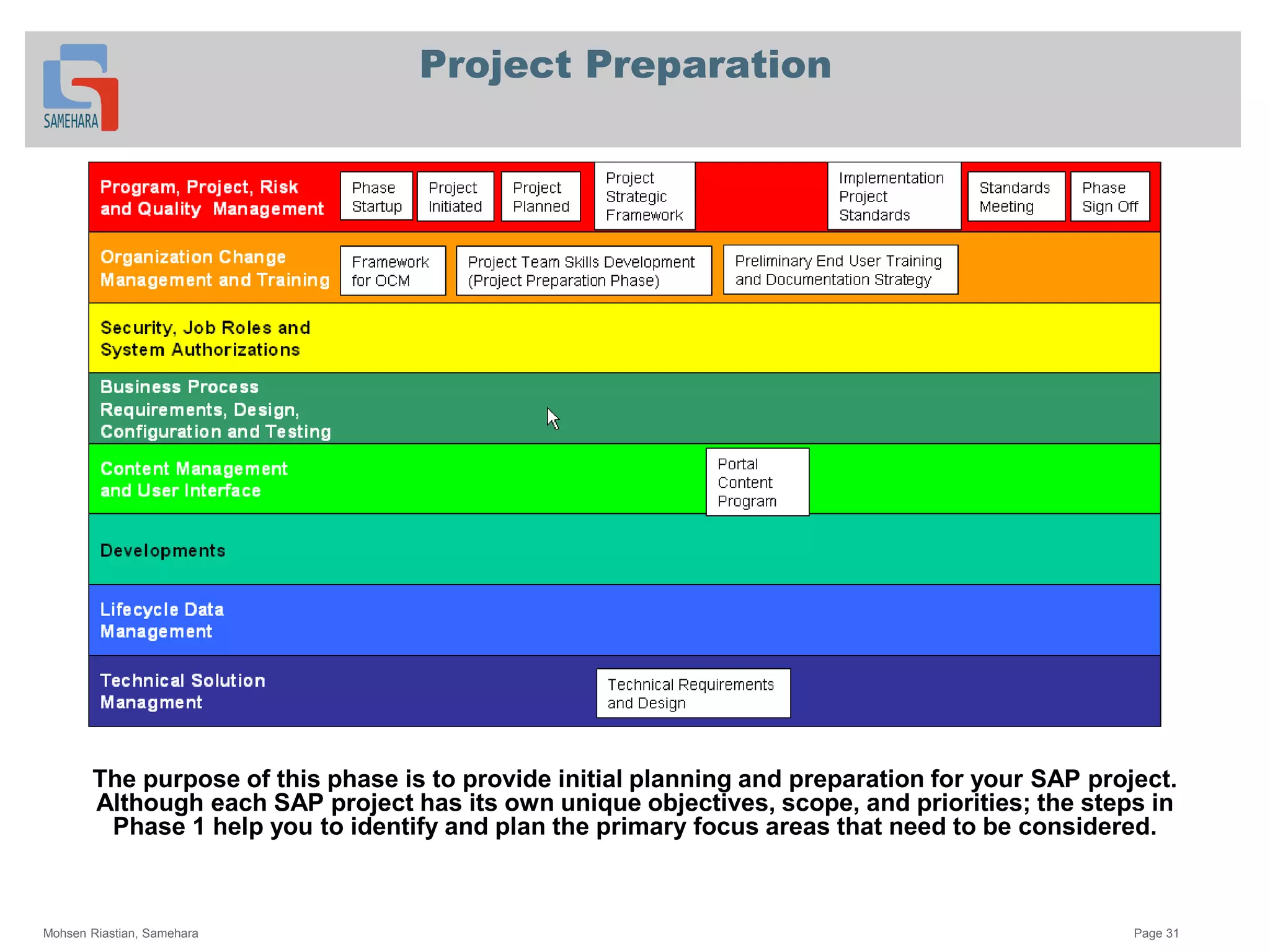
Project Preparation
The purpose of this phase is to provide initial planning and preparation for your SAP project.
Although each SAP project has its own unique objectives, scope, and priorities; the steps in
Phase 1 help you to identify and plan the primary focus areas that need to be considered.
Mohsen Riastian, Samehara Page 31
Business Blueprint
The purpose of this phase is to create the Business Blueprint, which is detailed
documentation of the results gathered during requirements workshops. Furthermore,
the Business Blueprint documents the business process requirements of the company.
With this, you can better understand how the company intends to run its business
within the SAP System
Mohsen Riastian, Samehara Page 32
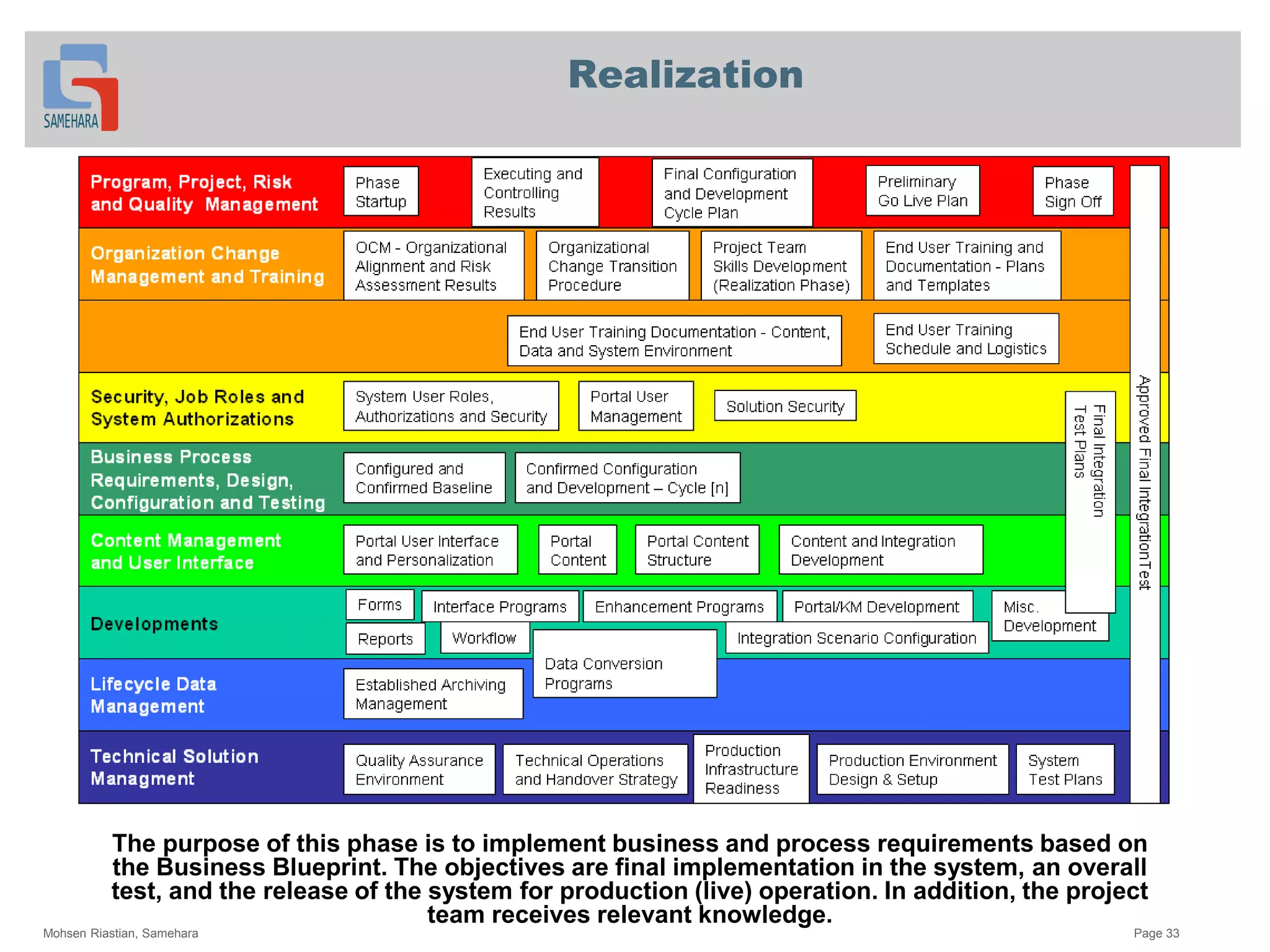
Realization
The purpose of this phase is to implement business and process requirements based on
the Business Blueprint. The objectives are final implementation in the system, an overall
test, and the release of the system for production (live) operation. In addition, the project
team receives relevant knowledge.
Mohsen Riastian, Samehara Page 33
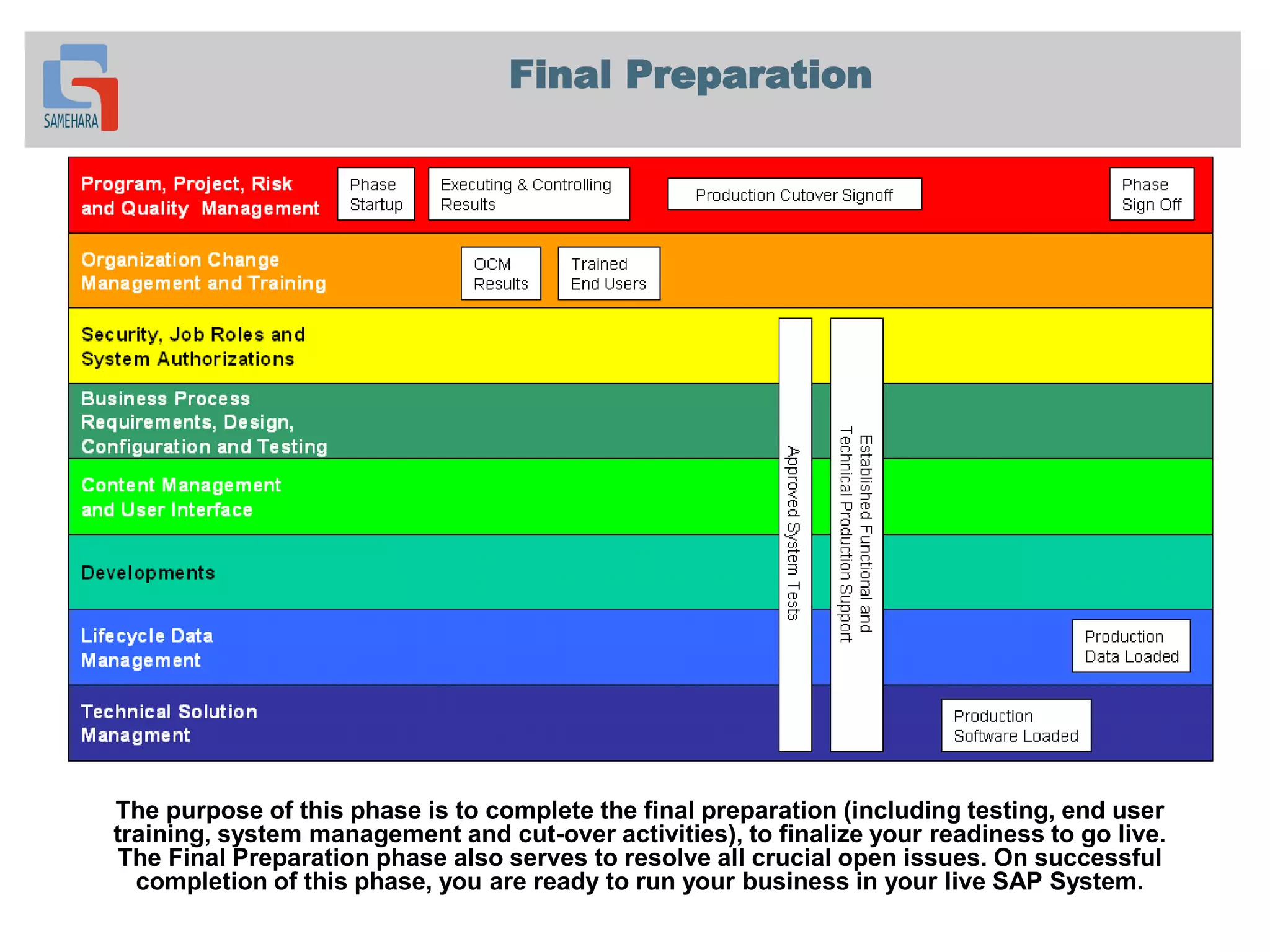
Final Preparation
The purpose of this phase is to complete the final preparation (including testing, end user
training, system management and cut-over activities), to finalize your readiness to go live.
The Final Preparation phase also serves to resolve all crucial open issues. On successful
completion of this phase, you are ready to run your business in your live SAP System.
Go Live and Support
The purpose of this phase is to cut over to live productive operation and to
continuously support and improve live operations
Mohsen Riastian, Samehara Page 35
Methodology – why? ASAP Overview
ASAP Roadmap Structure
ASAP Content Overview
How to access Roadmap
Project Management in ASAP
SAP Roadmaps – Today
Delivery mechanism
Solution Management
Implementation
Global Template
Upgrade
Implementation
Deliverables Based – implementation roadmap oriented to deliverables that the project team needs to prepare in order to implement
the solution
Legend:
Activity/Task Based – roadmap presented as sequence of activities that the project team performs to implement the
solution
Primary toolset for ASAP
roadmap delivery to
customers and partners
Primary toolset for
customers and partners
without access to SAP
Solution Manager
system
Mohsen Riastian, Samehara Page 37
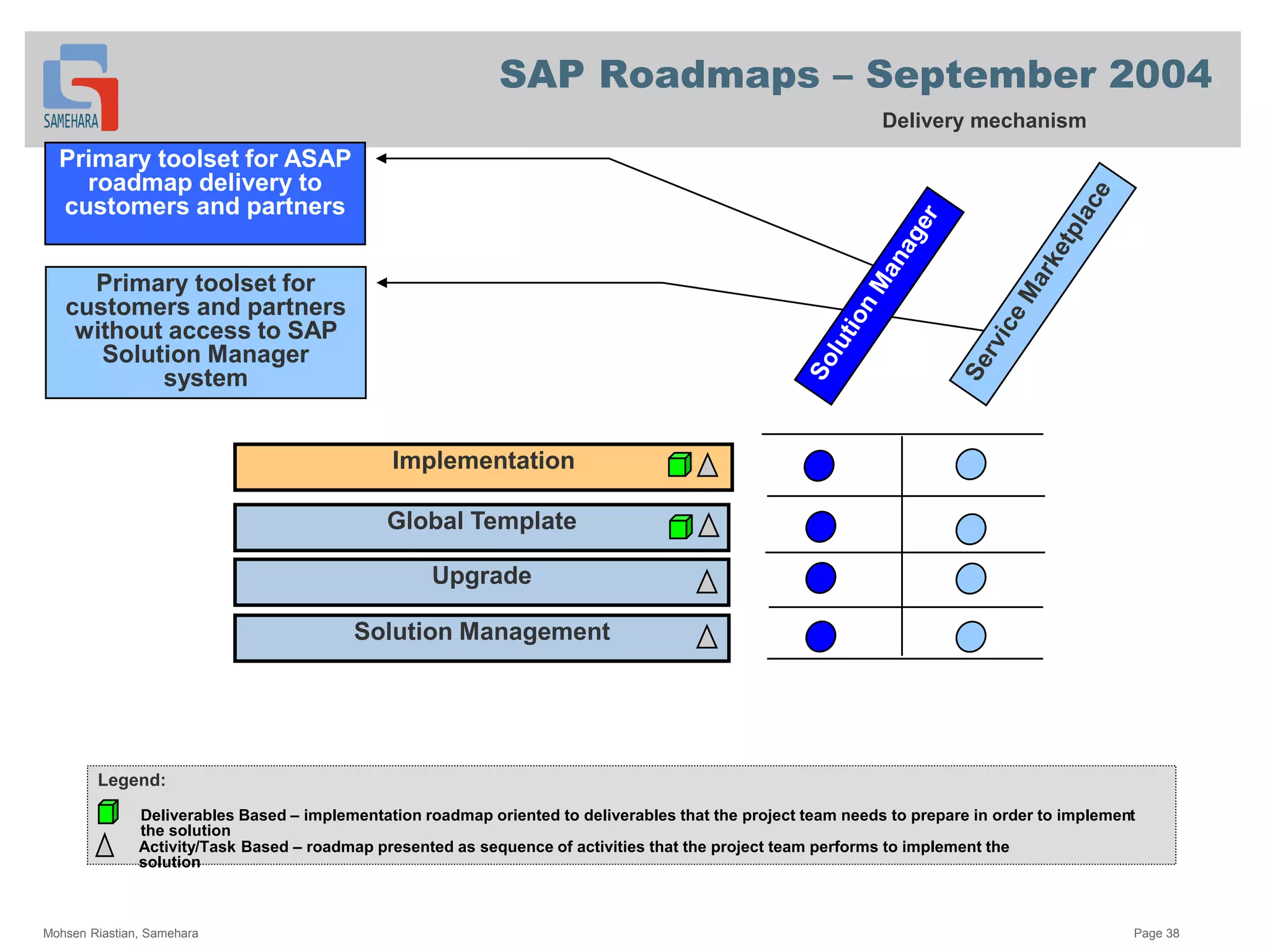
SAP Roadmaps – September 2004
Delivery mechanism
Solution Management
Implementation
Global Template
Upgrade
Deliverables Based – implementation roadmap oriented to deliverables that the project team needs to prepare in order to implement
the solution
Legend:
Activity/Task Based – roadmap presented as sequence of activities that the project team performs to implement the
solution
Primary toolset for ASAP
roadmap delivery to
customers and partners
Primary toolset for
customers and partners
without access to SAP
Solution Manager
system
Mohsen Riastian, Samehara Page 38
How SAP delivers ASAP Roadmaps
AcceleratedSAP Roadmaps delivered
via SAP Service Marketplace and
SAP Solution Manager (Improved
Implementation Roadmap delivered
in Solution Manager 3.2 and higher).
Mohsen Riastian, Samehara Page 39
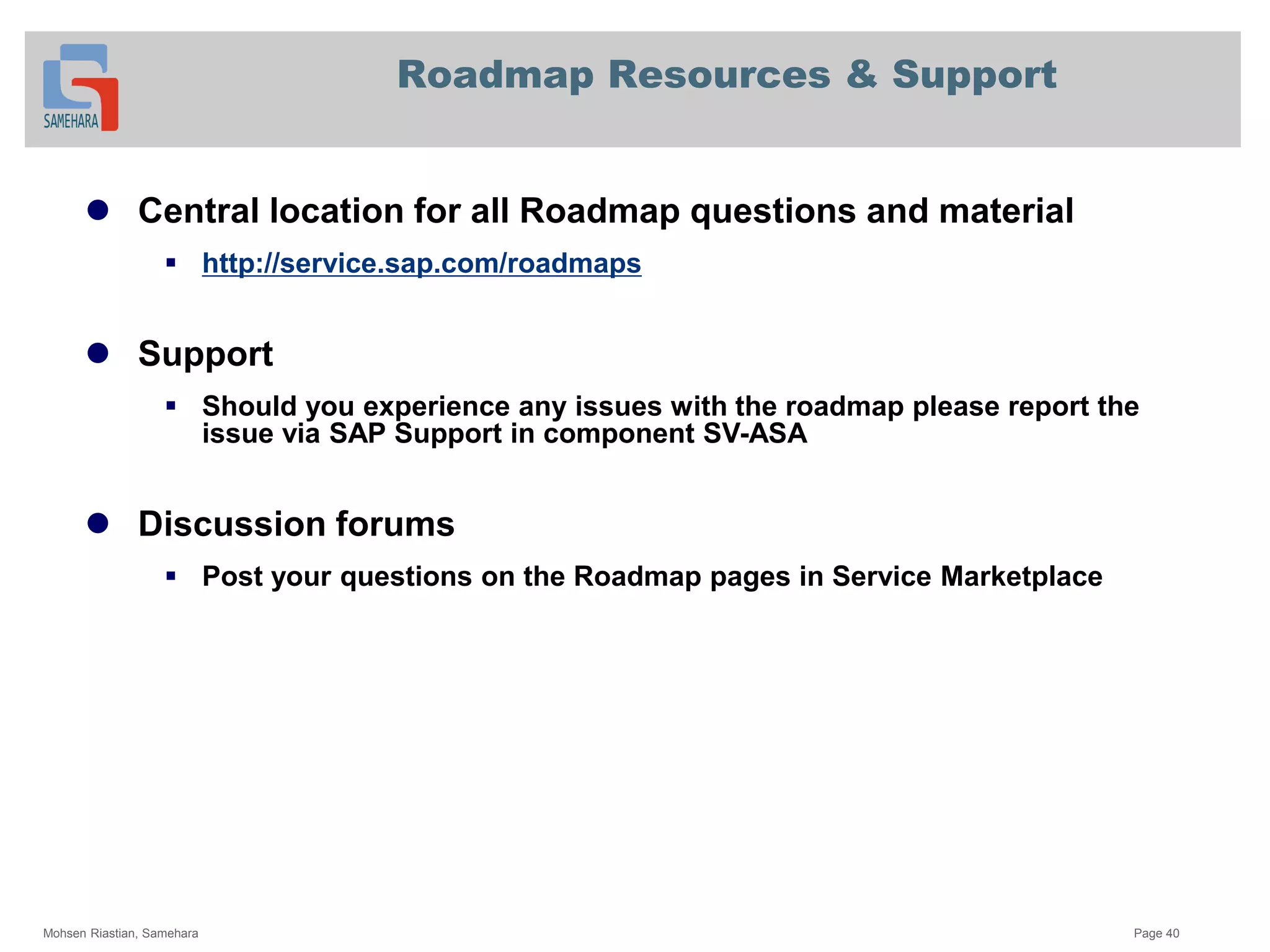
Roadmap Resources & Support
 Central location for all Roadmap questions and material
 http://service.sap.com/roadmaps
 Support
 Should you experience any issues with the roadmap please report the
issue via SAP Support in component SV-ASA
 Discussion forums
 Post your questions on the Roadmap pages in Service Marketplace
Mohsen Riastian, Samehara Page 40
Question & Answer
Toward Excellence

ASAP Methodology

  • 1.
    ASAP Implementation Roadmap SAP BusinessSolution Presented By: Riasatian Riasatian@SamehAra.com Riasatian@Gmail.com Mob: 0912 1791087 Date : 1390.05.20
  • 2.
    Methodology – why?ASAP Overview ASAP Roadmap Structure ASAP Content Overview How to access Roadmap Project Management in ASAP
  • 3.
    Projects from anotherperspective “An estimated 68% of corporate IT projects are neither on time nor budget, and they don’t deliver the originally stated business goals. Some even claim that during the last two years, $100 billion to $150 billion of U.S. IT projects have failed altogether.” Mark Jeffery and Ingmar Leliveld: Best Practices in IT Portfolio Management, MITSloan Management Review, Spring 2004 Mohsen Riastian, Samehara Page 3
  • 4.
    Typical questions whenyou starting the project How to best use selected solution capabilities? Do we have internal capabilities and capacity to staff the project?How and where do we start? Who does what in this project? How expensive will this project be? How do we keep the costs low? How to manage project and business risks involved? How do we assure success? How to build internal expertise? Mohsen Riastian, Samehara Page 4
  • 5.
    Industry Best Practicesto mitigate project failure risk MOST UTILIZED PRACTICES in IT projects10TOP 1. Regularly use project management methodologies: 96% 2. Conduct regular strategic planning meetings to achieve alignment: 93% 3. Conduct internal customer satisfaction surveys: 86% 4. Create and use performance metrics: 81% 5. Regularly use portfolio management or other project prioritization methodology: 80% 6. Perform financial audits: 79% 7. Use leadership development programs: 79% 8. Make the CIO a member of the corporate board or executive committee: 76% 9. Employ internal relationship managers/account executives to work with the business: 75% 10. Conduct post-implementation audits: 74% (Percentages refer to number of respondents using this practice.) Source: Richard Pastore and Lorraine Cosgrove Ware: The Best Practices, CIO Magazine May 2004 Mohsen Riastian, Samehara Page 5
  • 6.
    Delivering Successful Solutions AcceleratedSAPMethodology Description http://service.sap.com/asap AcceleratedSAP methodology is proven, repeatable and successful approach to implement SAP solutions across industries and customer environments. AcceleratedSAP provides content, tools and expertise from thousands of successful implementations. More info Mohsen Riastian, Samehara Page 6
  • 7.
    Project Management expertise Managementof the implementation project Aligned with industry standards and procedures (PMI PMBOK®) Specific to implementation of SAP solutions Key components for success AcceleratedSAP - proven methodology Aligns customer’s business requirements to SAP solutions SAP Solution Composer Offers AcceleratedSAP roadmap composed to fit specific project needs SAP Roadmaps Facilitates efficient solution design, documentation, configuration, testing and operations SAP Solution Manager AcceleratedSAP toolset Mohsen Riastian, Samehara Page 7
  • 8.
    Key components forsuccess AcceleratedSAP - proven methodology NewToolset  Facilitates efficient solution design, configuration, testing and operation  Delivered offline in SAP Service Marketplace and in SAP Solution Manager ValueSAPToolset  Aligns customer’s business requirements to SAP solutions SAP Solution Composer SAP Roadmaps SAP Solution Manager AcceleratedSAP methodology  Provides proven, comprehensive, repeatable and rich implementation methodology to streamline projects  PMI aligned framework with templates and tools for performing effective project management SAP Solution Map Composer Implementation Assistant Q&Adb, BPML, Diagram Explorer Evolved to Evolved to Replaced by Mohsen Riastian, Samehara Page 8
  • 9.
    Methodology People and Expertise Content and Tools Consulting Services SAP Consulting Where Methodologyfits Achieve your implementation goals through leveraging SAP experts, services, methodology, content and tools. Mohsen Riastian, Samehara Page 9
  • 10.
    Content: AcceleratedSAP Roadmaps Guidanceand navigation for your implementation team Definition Benefits More info ASAP roadmaps outline the activities involved in implementing, upgrading, or enhancing SAP solutions enriched with set of deliverables, accelerators, role descriptions and additional guides  Transparent, proven approach helping the project team to really work as a team and to reduce implementation time, costs and risks  Achieve better results since you base your project on the experiences others made before. Both hard facts as well as soft skills are addressed  Knowledge management - use the Implementation Roadmap for SAP solutions to gather knowledge on how to organize and run your implementation projects http://service.sap.com/roadmaps Usage Provide content (work packages, activities, tasks, deliverables, accelerators) that can be used during the entire project lifecycle. Target Group Customers, Partners, SAP Consulting Availability The roadmaps are made available through: SAP Solution Manager and SAP Service Marketplace Mohsen Riastian, Samehara Page 10
  • 11.
    AcceleratedSAP Implementation Methodology Phase1: Project Preparation for SAP project.initial planning and preparationDuring this phase the team goes through Phase 2: Business Blueprint common understanding of how the companyThe purpose of this phase is to achieve a . The result is the Business Blueprint, a detailedintends to run SAP to support their business documentation of the results gathered during requirements workshops. Phase 3: Realization requirements based onimplement all the business processThe purpose of this phase is to the Business Blueprint. The system configuration methodology is provided in two work packages: Baseline (major scope); and Final configuration (remaining scope). Phase 4: Final Preparation (including testing, end usercomplete the final preparationThe purpose of this phase is to training, system management and cutover activities) to finalize your readiness to go live. The Final Preparation phase also serves to resolve all critical open issues. On successful completion of this phase, you are ready to run your business in your live SAP System. Phase 5: Go Live & Support The purpose of this phase is to move from a project-oriented, pre-production environment to live production operation. Mohsen Riastian, Samehara Page 11
  • 12.
    SAP Standard Roadmaps(1/2) Implementation Roadmap for SAP Solutions provides the methodological framework for the project team to leverage in the implementation of a SAP solution. It covers, among other things, the necessary project management, requirements gathering, design, configuration of business processes, technical implementation, test procedures, training and organization change management. In this roadmap deliverables represent the main objects within a project. Each deliverable then provides outline of the Outputs (components creating the deliverable) and relevant Methods that represent the activities and tasks the project team conducts Implementation DescriptionRoadmap Type The Global Template Roadmap describes how to organize and how to run a project in which a corporate template is developed. The Global Template Roadmap is geared to more complex implementation or harmonization projects, typically involving more than one kind of SAP solution, and a variety of sites, possibly in different countries. The corporate template is rolled out to other sites in a follow-up project. Global Template Mohsen Riastian, Samehara Page 12
  • 13.
    SAP Standard Roadmaps(2/2) This roadmap is designed to help you carry out the customizing activities required for an upgrade. These customizing activities are essential if you want to continue to use the same functions in your business application components after an upgrade. Upgrade DescriptionRoadmap Type The Solution Management Roadmap provides a methodology for the implementation of the technical infrastructure and its operation. The Solution Management Roadmap complements the Implementation Roadmap. Solution Management Mohsen Riastian, Samehara Page 13
  • 14.
    Roadmaps Add Valueto the Implementation What to do, and when to do it Why you should do it and how to do it Accelerators Who does it When used properly, a roadmap will provide guidance on the following:
  • 15.
    Enforcing standards Methodology alonewill not make your project successful. You need to enforce it – appoint methodology champion for the project. Mohsen Riastian, Samehara Page 15
  • 16.
    Methodology – why?ASAP Overview ASAP Roadmap Structure ASAP Content Overview How to access Roadmap Project Management in ASAP
  • 17.
    Source: Implementation Roadmap– Activity based (ABR) Each work package comprises several activities. Activities contain the tasks that project team members need to carry out, in order to fulfill the project goals. At this level, you can find more accelerators containing information relevant for your implementation project. Activity (Level 3) Each ASAP Roadmap phase is made up of several work packages with topics. The work packages are designed to realize the main objectives of each Roadmap phase. Work packages are made up of activities and tasks. Work Package (Level 2) Each Roadmap is divided into several large phases, each of which represents a major milestone in the project plan. Phase (Level 1) DescriptionStructure Each activity is made up of several tasks. The task describes the steps Project team members are required to perform the tasks. Task (Level 4) Level 1 Level 2 Level 3 Level 4 Mohsen Riastian, Samehara Page 17
  • 18.
    Source: Implementation Roadmap– Deliverable based (DBR) Each deliverables comprises several outputs. Outputs are document or tangible items that are results of a process. The output supports the completion of a desired deliverable as a standalone component. Output (Level 3) Each phase is made up of several deliverables with topics. The deliverables represent the main objects within a project. A deliverables are further comprised of outputs. Deliverable (Level 2) Each Roadmap is divided into several large phases, each of which represents a major milestone in the project plan. Phase (Level 1) Level 1 Level 2 Level 3 DescriptionStructure The Deliverable-based Roadmap will also have a ‘references’ tab to provide a link to the activities & tasks (method) associated with creating the deliverable. Mohsen Riastian, Samehara Page 18
  • 19.
    Improved Implementation Roadmap Activitybased Impl. Roadmap Deliverable Based Impl. Roadmap Implementation Roadmap Mohsen Riastian, Samehara Page 19
  • 20.
    Implementation Roadmap -Structure Phase Deliverable Group 1 Deliverable O: Output α.1 O: Output α.2 M: Activity 1.1 Task 1.1.1 Task 1.1.2 M: Activity 1.2 Task 1.2.1 Deliverable Group 2 Milestone A Deliverable consists of several outputs Methods (activities and tasks) that create or contribute to creation of the deliverable Mohsen Riastian, Samehara Page 20
  • 21.
    Easy navigation inthe roadmap Attributes used to classify roadmap nodes and accelerators to enable easy navigation and user specific views. Following attributes are used Flavors – represents SAP Solutions (mySAP ERP, mySAP CRM, ….) Subject Areas – knowledge domains in the implementation project (Project Management, Org. Change Management, Technical Implementation, …) Project Roles – filter activities, tasks or outputs Showing only relevant areas of the roadmap (by user preference) Activity based view Deliverable based view Mohsen Riastian, Samehara Page 21
  • 22.
    References Relationship between Outputsand relevant Activities or Tasks Phase Deliverable Group 1 Deliverable O: Output α.1 O: Output α.2 M: Activity 1.1 Task 1.1.1 Task 1.1.2 M: Activity 1.2 Task 1.2.1 Deliverable Group 2 Milestone A References point from Tasks or Activities (where tasks are not available) to the relevant Outputs that are being produced (or contributed to) by the performed task or activity. Mohsen Riastian, Samehara Page 22
  • 23.
    Deliverable: Methods andOutputs relationship Mohsen Riastian, Samehara Page 23
  • 24.
    Project Roles andSubject Areas Phase Deliverable Group 1 Deliverable O: Output α.1 O: Output α.2 M: Activity 1.1 Task 1.1.1 Task 1.1.2 M: Activity 1.2 Deliverable Group 2 Milestone A Subject Area – deliverable is part of a discipline, domain or subject area in the project AttributeStructure Project Roles - project role is involved or performs the activity producing an Output Project Roles assigned to Outputs and Tasks (or Activity where tasks not available) Mohsen Riastian, Samehara Page 24
  • 25.
    Roadmap Flavor –Solution Relevant Nodes Phase Deliverable Group 1 Deliverable O: Output α.1 O: Output α.2 M: Activity 1.1 Task 1.1.1 Task 1.1.2 M: Activity 1.2 Task 1.2.1 Deliverable Group 2 Milestone A Flavor – assigned to all nodes applicable for given solution (flavor) AttributeStructure Flavor assigned to each individual node with exception of Outputs and Methods node (gray nodes) Mohsen Riastian, Samehara Page 25
  • 26.
    Methodology – why?ASAP Overview ASAP Roadmap Structure ASAP Content Overview How to access Roadmap Project Management in ASAP
  • 27.
    PM Processes happenthroughout the project Each phase has Phase Start, Deliverable Creation/Acceptance and Closure tasks Mohsen Riastian, Samehara Page 27
  • 28.
    AcceleratedSAP and PMprocess alignment PM deliverables are mapped to ASAP phases Description More info http://service.sap.com/roadmaps Project Management Methodology ASAP Alignment Principles Initiating and Planning deliverables in Project Prep and Business Blueprint Requirements Planning, which is replaced by Blueprint Executing/Controlling deliverables in Realization, Final Prep and partly in Go Live and Support Final Customer Acceptance occurs in Go Live & Support Initiating Project Preparation Planning Executing/ Controlling Closing Business Blueprint Realization Final Preparation Go Live & Support Project Charter Project Plan Management Plans Requirements Planning Final Customer Acceptance Project Closeout Report Lessons Learned ASAP Implementation Roadmap Closing happens in Go Live & Support Mohsen Riastian, Samehara Page 28
  • 29.
    Methodology – why?ASAP Overview ASAP Roadmap Structure ASAP Content Overview How to access Roadmap Project Management in ASAP
  • 30.
    ASAP Structure The individualphases of the ASAP Implementation Roadmap are: 1. Project Preparation - project formally initiated and planning well under way. 2. Business Blueprint - project team gathers requirements and conducts conceptual design of the solution. 3. Realization - system solution built and integration tested, end users trained 4. Final Preparation - authorization to cut over to new system solution 5. Go Live and Support - solution confirmation and project closure that are produced during the duration of the phasedeliverablesEach phase has a set of . Each deliverable provides list of Outputs itup phases-input to followand serve as the consist of and Methods that are used to produce the deliverable. Mohsen Riastian, Samehara Page 30
  • 31.
    Project Preparation The purposeof this phase is to provide initial planning and preparation for your SAP project. Although each SAP project has its own unique objectives, scope, and priorities; the steps in Phase 1 help you to identify and plan the primary focus areas that need to be considered. Mohsen Riastian, Samehara Page 31
  • 32.
    Business Blueprint The purposeof this phase is to create the Business Blueprint, which is detailed documentation of the results gathered during requirements workshops. Furthermore, the Business Blueprint documents the business process requirements of the company. With this, you can better understand how the company intends to run its business within the SAP System Mohsen Riastian, Samehara Page 32
  • 33.
    Realization The purpose ofthis phase is to implement business and process requirements based on the Business Blueprint. The objectives are final implementation in the system, an overall test, and the release of the system for production (live) operation. In addition, the project team receives relevant knowledge. Mohsen Riastian, Samehara Page 33
  • 34.
    Final Preparation The purposeof this phase is to complete the final preparation (including testing, end user training, system management and cut-over activities), to finalize your readiness to go live. The Final Preparation phase also serves to resolve all crucial open issues. On successful completion of this phase, you are ready to run your business in your live SAP System.
  • 35.
    Go Live andSupport The purpose of this phase is to cut over to live productive operation and to continuously support and improve live operations Mohsen Riastian, Samehara Page 35
  • 36.
    Methodology – why?ASAP Overview ASAP Roadmap Structure ASAP Content Overview How to access Roadmap Project Management in ASAP
  • 37.
    SAP Roadmaps –Today Delivery mechanism Solution Management Implementation Global Template Upgrade Implementation Deliverables Based – implementation roadmap oriented to deliverables that the project team needs to prepare in order to implement the solution Legend: Activity/Task Based – roadmap presented as sequence of activities that the project team performs to implement the solution Primary toolset for ASAP roadmap delivery to customers and partners Primary toolset for customers and partners without access to SAP Solution Manager system Mohsen Riastian, Samehara Page 37
  • 38.
    SAP Roadmaps –September 2004 Delivery mechanism Solution Management Implementation Global Template Upgrade Deliverables Based – implementation roadmap oriented to deliverables that the project team needs to prepare in order to implement the solution Legend: Activity/Task Based – roadmap presented as sequence of activities that the project team performs to implement the solution Primary toolset for ASAP roadmap delivery to customers and partners Primary toolset for customers and partners without access to SAP Solution Manager system Mohsen Riastian, Samehara Page 38
  • 39.
    How SAP deliversASAP Roadmaps AcceleratedSAP Roadmaps delivered via SAP Service Marketplace and SAP Solution Manager (Improved Implementation Roadmap delivered in Solution Manager 3.2 and higher). Mohsen Riastian, Samehara Page 39
  • 40.
    Roadmap Resources &Support  Central location for all Roadmap questions and material  http://service.sap.com/roadmaps  Support  Should you experience any issues with the roadmap please report the issue via SAP Support in component SV-ASA  Discussion forums  Post your questions on the Roadmap pages in Service Marketplace Mohsen Riastian, Samehara Page 40
  • 41.