321
Accounting for Amalgamation 
(AS 14) 
Venkanna Setty |SSAA & Associates
Index 
Introduction 
Definitions 
Types of Amalgamation 
Methods of Accounting for 
Amalgamations 
Consideration 
Disclosures
Introduction 
 What is Amalgamation 
? Two are More Companies join to form new 
Company 
 Absorption or blending of one by other 
 Amalgamation includes 
 Amalgamation 
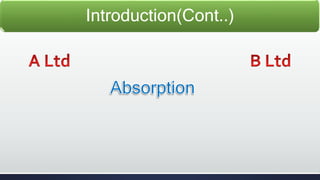
 Absorption 
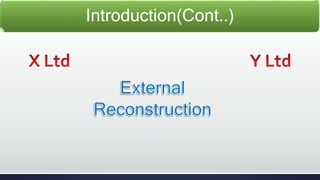
 External Reconstruction
Introduction(Cont..) 
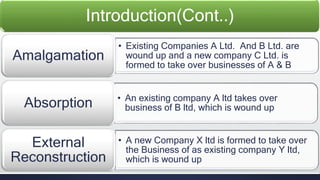
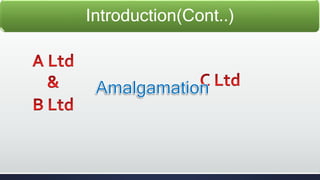
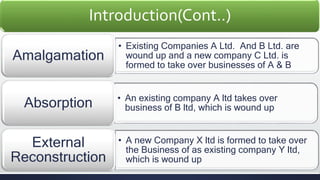
• Existing Companies A Ltd. And B Ltd. are 
wound up and a new company C Ltd. is 
formed to take over businesses of A & B 
Amalgamation 
• An existing company A ltd takes over 
business of B ltd, which is wound up Absorption 
• A new Company X ltd is formed to take over 
the Business of as existing company Y ltd, 
which is wound up 
External 
Reconstruction
Introduction(Cont..)
Introduction(Cont..) 
• Existing Companies A Ltd. And B Ltd. are 
wound up and a new company C Ltd. is 
formed to take over businesses of A & B 
Amalgamation 
• An existing company A ltd takes over 
business of B ltd, which is wound up Absorption 
• A new Company X ltd is formed to take over 
the Business of as existing company Y ltd, 
which is wound up 
External 
Reconstruction
Introduction(Cont..)
Introduction(Cont..) 
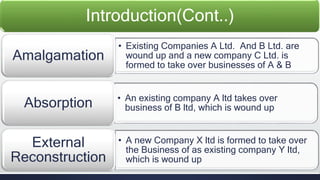
• Existing Companies A Ltd. And B Ltd. are 
wound up and a new company C Ltd. is 
formed to take over businesses of A & B 
Amalgamation 
• An existing company A ltd takes over 
business of B ltd, which is wound up Absorption 
• A new Company X ltd is formed to take over 
the Business of as existing company Y ltd, 
which is wound up 
External 
Reconstruction
Introduction(Cont..)
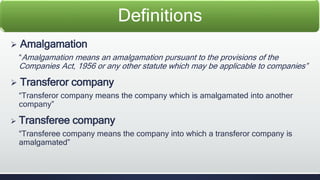
 Amalgamation 
Definitions 
“Amalgamation means an amalgamation pursuant to the provisions of the 
Companies Act, 1956 or any other statute which may be applicable to companies” 
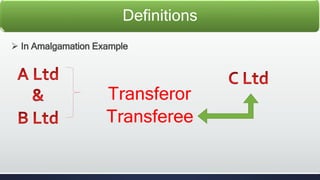
 Transferor company 
“Transferor company means the company which is amalgamated into another 
company” 
 Transferee company 
“Transferee company means the company into which a transferor company is 
amalgamated”
Definitions 
 In Amalgamation Example 
Transferor 
Transferee
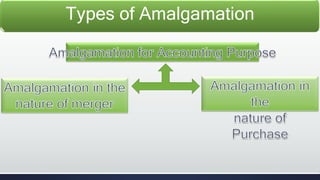
Types of Amalgamation
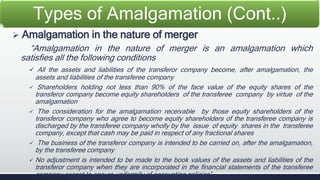
Types of Amalgamation (Cont..) 
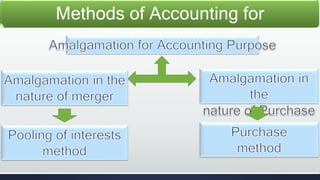
 Amalgamation in the nature of merger 
“Amalgamation in the nature of merger is an amalgamation which 
satisfies all the following conditions 
 All the assets and liabilities of the transferor company become, after amalgamation, the 
assets and liabilities of the transferee company 
 Shareholders holding not less than 90% of the face value of the equity shares of the 
transferor company become equity shareholders of the transferee company by virtue of the 
amalgamation 
 The consideration for the amalgamation receivable by those equity shareholders of the 
transferor company who agree to become equity shareholders of the transferee company is 
discharged by the transferee company wholly by the issue of equity shares in the transferee 
company, except that cash may be paid in respect of any fractional shares 
 The business of the transferor company is intended to be carried on, after the amalgamation, 
by the transferee company 
 No adjustment is intended to be made to the book values of the assets and liabilities of the 
transferor company when they are incorporated in the financial statements of the transferee 
company except to ensure uniformity of accounting policies”
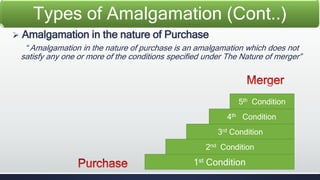
Types of Amalgamation (Cont..) 
 Amalgamation in the nature of Purchase 
“ Amalgamation in the nature of purchase is an amalgamation which does not 
satisfy any one or more of the conditions specified under The Nature of merger” 
5th Condition 
4th Condition 
3rd Condition 
2nd Condition 
1st Condition
Methods of Accounting for 
Amalgamation
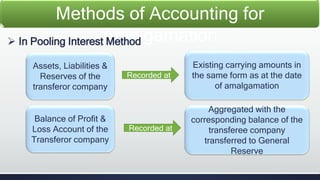
Methods of Accounting for 
Amalgamation  In Pooling Interest Method 
Assets, Liabilities & 
Reserves of the 
transferor company 
Recorded at 
Existing carrying amounts in 
the same form as at the date 
of amalgamation 
Balance of Profit & 
Loss Account of the 
Transferor company 
Recorded at 
Aggregated with the 
corresponding balance of the 
transferee company 
transferred to General 
Reserve
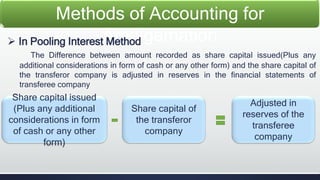
Methods of Accounting for 
Amalgamation  In Pooling Interest Method 
The Difference between amount recorded as share capital issued(Plus any 
additional considerations in form of cash or any other form) and the share capital of 
the transferor company is adjusted in reserves in the financial statements of 
transferee company 
Share capital issued 
(Plus any additional 
considerations in form 
of cash or any other 
form) 
Share capital of 
the transferor 
company 
Adjusted in 
reserves of the 
transferee 
company
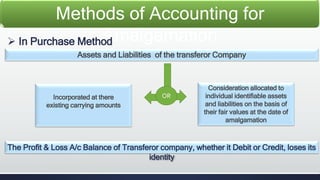
Methods of Accounting for 
Amalgamation  In Purchase Method 
Assets and Liabilities of the transferor Company 
Incorporated at there 
existing carrying amounts 
Consideration allocated to 
individual identifiable assets 
and liabilities on the basis of 
their fair values at the date of 
amalgamation 
OR 
The Profit & Loss A/c Balance of Transferor company, whether it Debit or Credit, loses its 
identity
Methods of Accounting for 
Amalgamation  In Purchase Method 
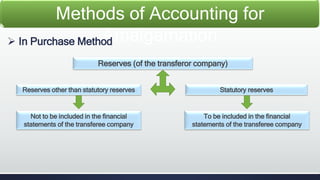
Reserves (of the transferor company) 
Reserves other than statutory reserves Statutory reserves 
Not to be included in the financial 
statements of the transferee company 
To be included in the financial 
statements of the transferee company
Consideration 
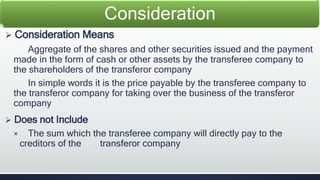
 Consideration Means 
Aggregate of the shares and other securities issued and the payment 
made in the form of cash or other assets by the transferee company to 
the shareholders of the transferor company 
In simple words it is the price payable by the transferee company to 
the transferor company for taking over the business of the transferor 
company 
 Does not Include 
× The sum which the transferee company will directly pay to the 
creditors of the transferor company
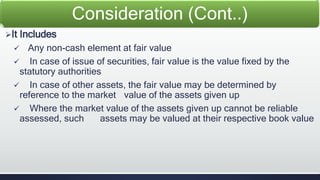
It Includes 
Consideration (Cont..) 
 Any non-cash element at fair value 
 In case of issue of securities, fair value is the value fixed by the 
statutory authorities 
 In case of other assets, the fair value may be determined by 
reference to the market value of the assets given up 
 Where the market value of the assets given up cannot be reliable 
assessed, such assets may be valued at their respective book value
Consideration (Cont..) 
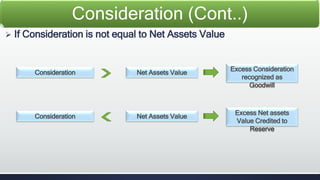
 If Consideration is not equal to Net Assets Value 
Consideration Net Assets Value 
Excess Consideration 
recognized as 
Goodwill 
Consideration Net Assets Value 
Excess Net assets 
Value Credited to 
Reserve
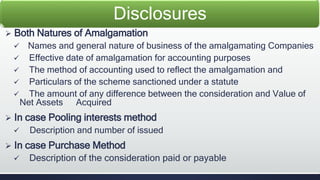
Disclosures 
 Both Natures of Amalgamation 
 Names and general nature of business of the amalgamating Companies 
 Effective date of amalgamation for accounting purposes 
 The method of accounting used to reflect the amalgamation and 
 Particulars of the scheme sanctioned under a statute 
 The amount of any difference between the consideration and Value of 
Net Assets Acquired 
 In case Pooling interests method 
 Description and number of issued 
 In case Purchase Method 
 Description of the consideration paid or payable
All the best to all participants 
THANK YOU

AS 14 - Accounting for Amalgamation

  • 1.
  • 3.
    Accounting for Amalgamation (AS 14) Venkanna Setty |SSAA & Associates
  • 4.
    Index Introduction Definitions Types of Amalgamation Methods of Accounting for Amalgamations Consideration Disclosures
  • 5.
    Introduction  Whatis Amalgamation ? Two are More Companies join to form new Company  Absorption or blending of one by other  Amalgamation includes  Amalgamation  Absorption  External Reconstruction
  • 6.
    Introduction(Cont..) • ExistingCompanies A Ltd. And B Ltd. are wound up and a new company C Ltd. is formed to take over businesses of A & B Amalgamation • An existing company A ltd takes over business of B ltd, which is wound up Absorption • A new Company X ltd is formed to take over the Business of as existing company Y ltd, which is wound up External Reconstruction
  • 7.
  • 8.
    Introduction(Cont..) • ExistingCompanies A Ltd. And B Ltd. are wound up and a new company C Ltd. is formed to take over businesses of A & B Amalgamation • An existing company A ltd takes over business of B ltd, which is wound up Absorption • A new Company X ltd is formed to take over the Business of as existing company Y ltd, which is wound up External Reconstruction
  • 9.
  • 10.
    Introduction(Cont..) • ExistingCompanies A Ltd. And B Ltd. are wound up and a new company C Ltd. is formed to take over businesses of A & B Amalgamation • An existing company A ltd takes over business of B ltd, which is wound up Absorption • A new Company X ltd is formed to take over the Business of as existing company Y ltd, which is wound up External Reconstruction
  • 11.
  • 12.
     Amalgamation Definitions “Amalgamation means an amalgamation pursuant to the provisions of the Companies Act, 1956 or any other statute which may be applicable to companies”  Transferor company “Transferor company means the company which is amalgamated into another company”  Transferee company “Transferee company means the company into which a transferor company is amalgamated”
  • 13.
    Definitions  InAmalgamation Example Transferor Transferee
  • 14.
  • 15.
    Types of Amalgamation(Cont..)  Amalgamation in the nature of merger “Amalgamation in the nature of merger is an amalgamation which satisfies all the following conditions  All the assets and liabilities of the transferor company become, after amalgamation, the assets and liabilities of the transferee company  Shareholders holding not less than 90% of the face value of the equity shares of the transferor company become equity shareholders of the transferee company by virtue of the amalgamation  The consideration for the amalgamation receivable by those equity shareholders of the transferor company who agree to become equity shareholders of the transferee company is discharged by the transferee company wholly by the issue of equity shares in the transferee company, except that cash may be paid in respect of any fractional shares  The business of the transferor company is intended to be carried on, after the amalgamation, by the transferee company  No adjustment is intended to be made to the book values of the assets and liabilities of the transferor company when they are incorporated in the financial statements of the transferee company except to ensure uniformity of accounting policies”
  • 16.
    Types of Amalgamation(Cont..)  Amalgamation in the nature of Purchase “ Amalgamation in the nature of purchase is an amalgamation which does not satisfy any one or more of the conditions specified under The Nature of merger” 5th Condition 4th Condition 3rd Condition 2nd Condition 1st Condition
  • 17.
    Methods of Accountingfor Amalgamation
  • 18.
    Methods of Accountingfor Amalgamation  In Pooling Interest Method Assets, Liabilities & Reserves of the transferor company Recorded at Existing carrying amounts in the same form as at the date of amalgamation Balance of Profit & Loss Account of the Transferor company Recorded at Aggregated with the corresponding balance of the transferee company transferred to General Reserve
  • 19.
    Methods of Accountingfor Amalgamation  In Pooling Interest Method The Difference between amount recorded as share capital issued(Plus any additional considerations in form of cash or any other form) and the share capital of the transferor company is adjusted in reserves in the financial statements of transferee company Share capital issued (Plus any additional considerations in form of cash or any other form) Share capital of the transferor company Adjusted in reserves of the transferee company
  • 20.
    Methods of Accountingfor Amalgamation  In Purchase Method Assets and Liabilities of the transferor Company Incorporated at there existing carrying amounts Consideration allocated to individual identifiable assets and liabilities on the basis of their fair values at the date of amalgamation OR The Profit & Loss A/c Balance of Transferor company, whether it Debit or Credit, loses its identity
  • 21.
    Methods of Accountingfor Amalgamation  In Purchase Method Reserves (of the transferor company) Reserves other than statutory reserves Statutory reserves Not to be included in the financial statements of the transferee company To be included in the financial statements of the transferee company
  • 22.
    Consideration  ConsiderationMeans Aggregate of the shares and other securities issued and the payment made in the form of cash or other assets by the transferee company to the shareholders of the transferor company In simple words it is the price payable by the transferee company to the transferor company for taking over the business of the transferor company  Does not Include × The sum which the transferee company will directly pay to the creditors of the transferor company
  • 23.
    It Includes Consideration(Cont..)  Any non-cash element at fair value  In case of issue of securities, fair value is the value fixed by the statutory authorities  In case of other assets, the fair value may be determined by reference to the market value of the assets given up  Where the market value of the assets given up cannot be reliable assessed, such assets may be valued at their respective book value
  • 24.
    Consideration (Cont..) If Consideration is not equal to Net Assets Value Consideration Net Assets Value Excess Consideration recognized as Goodwill Consideration Net Assets Value Excess Net assets Value Credited to Reserve
  • 25.
    Disclosures  BothNatures of Amalgamation  Names and general nature of business of the amalgamating Companies  Effective date of amalgamation for accounting purposes  The method of accounting used to reflect the amalgamation and  Particulars of the scheme sanctioned under a statute  The amount of any difference between the consideration and Value of Net Assets Acquired  In case Pooling interests method  Description and number of issued  In case Purchase Method  Description of the consideration paid or payable
  • 26.
    All the bestto all participants THANK YOU

Editor's Notes

  • #2 Animated countdown timer on textured background (Difficult) Tip: Some shape effects on this slide are created with the Combine Shapes commands. To access this command, you must add it to the Quick Access Toolbar, located above the File tab. To customize the Quick Access Toolbar, do the following: Click the arrow next to the Quick Access Toolbar, and then under Customize Quick Access Toolbar click More Commands. In the PowerPoint Options dialog box, in the Choose commands from list, select All Commands. In the list of commands, click Combine Shapes, and then click Add. To reproduce the donut shape effects on this slide, do the following: On the Home tab, in the Slides group, click Layout, and then click Blank. On the Insert tab, in the Illustrations group, click Shapes, and then under Basic Shapes click Donut. On the slide, drag to draw a donut. Drag the yellow sizing handle so that the donut is roughly 0.25” in thickness. Select the donut. Under Drawing Tools, on the Format tab, in the Size group, in the Height box enter 5” and in the Width box enter 5”. Also under Drawing Tools, on the Format tab, in the Shape Styles group, click Shape Outline and then click No Outline. On the Insert tab, in the Illustrations group, click Shapes, and then under Rectangles click Rectangle. On the slide, drag to draw a rectangle. Select the rectangle. Under Drawing Tools, on the Format tab, in the Size group, in the Height box enter 5.5” and in the Width box enter 0.08”. Also under Drawing Tools, on the Format tab, in the Shape Styles group, click Shape Outline and then click No Outline. Select the rectangle. On the Home tab, in the Clipboard group, click the arrow to the right of Copy, and then click Duplicate. Repeat this process this process 7 times for a total of 9 thin rectangles. Select a duplicate rectangle. Under Drawing Tools, on the Format tab, in the Size group, click the Size and Position dialog box launcher. In the Format Shape dialog box, click Size in the left pane, and in the Size pane, under Size and rotate, in the Rotation box enter 10. Select another duplicate rectangle. Under Drawing Tools, on the Format tab, in the Size group, click the Size and Position dialog box launcher. In the Format Shape dialog box, click Size in the left pane, and in the Size pane, under Size and rotate, in the Rotation box enter 20. Select another duplicate rectangle. Under Drawing Tools, on the Format tab, in the Size group, click the Size and Position dialog box launcher. In the Format Shape dialog box, click Size in the left pane, and in the Size pane, under Size and rotate, in the Rotation box enter 30. Select another duplicate rectangle. Under Drawing Tools, on the Format tab, in the Size group, click the Size and Position dialog box launcher. In the Format Shape dialog box, click Size in the left pane, and in the Size pane, under Size and rotate, in the Rotation box enter 40. Select another duplicate rectangle. Under Drawing Tools, on the Format tab, in the Size group, click the Size and Position dialog box launcher. In the Format Shape dialog box, click Size in the left pane, and in the Size pane, under Size and rotate, in the Rotation box enter 50. Select another duplicate rectangle. Under Drawing Tools, on the Format tab, in the Size group, click the Size and Position dialog box launcher. In the Format Shape dialog box, click Size in the left pane, and in the Size pane, under Size and rotate, in the Rotation box enter 60. Select another duplicate rectangle. Under Drawing Tools, on the Format tab, in the Size group, click the Size and Position dialog box launcher. In the Format Shape dialog box, click Size in the left pane, and in the Size pane, under Size and rotate, in the Rotation box enter 70. Select the last duplicate rectangle. Under Drawing Tools, on the Format tab, in the Size group, click the Size and Position dialog box launcher. In the Format Shape dialog box, click Size in the left pane, and in the Size pane, under Size and rotate, in the Rotation box enter 80. Press and hold CTRL, and then select all of the small thin rectangles. On the Quick Access Toolbar, click Combine Shapes, and then click Shape Union. Also on the Home tab, in the Clipboard group, click Copy, and then click Duplicate. Select the duplicate group of rectangles. On the Home tab, in the Drawing group, click Arrange, point to Rotate, and then click Rotate Right 90°. On the Home tab, in the Edit group, click Select, and then click Select All. Also on the Home tab, in the Drawing group, click Arrange, point to Align, and then do the following: Click Align to Slide. Click Align Middle. Click Align Center. Press and hold CTRL, select the donut shape, and then select the first group of rectangles. On the Quick Access Toolbar, click Combine Shapes, and then click Shape Subtract. Press and hold CTRL, select the donut shape, and then select the second group of rectangles. On the Quick Access Toolbar, click Combine Shapes, and then click Shape Subtract. On the Insert tab, in the Illustrations group, click Shapes, and then under Basic Shapes click Donut. On the slide, drag to draw a donut. Drag a sizing handle so that the donut is roughly 0.5” in thickness. Select the second donut. Under Drawing Tools, on the Format tab, in the Size group, in the Height box enter 5.21” and in the Width box enter 5.21”. Also under Drawing Tools, on the Format tab, in the Shape Styles group, click Shape Outline, and then click No Outline. Press and hold CTRL, select the second donut, and then select the first, segmented donut. On the Quick Access Toolbar, click Combine Shapes, and then click Shape Subtract. Select the remaining donut. Under Drawing Tools, on the Format tab, in the Shape Styles group, click the Format Shape dialog box launcher. In the Format Shape dialog box, click Fill in the left pane, in the Fill pane, click Gradient fill, and then do the following: Click the button next to Preset colors and then click Silver. In the Type list, select Linear. Also in the Format Shape dialog box, click Line Color in the left pane, and then in the Line Color pane click No line. Also in the Format Shape dialog box, click Shadow in the left pane, in the Shadow pane, click the button next to Presets, and then under Outer click Offset Center. Also in the Format Shape dialog box, click 3-D Format in the left pane, in the 3-D Format pane, under Bevel, click the button next to Top and then click Slope. On the Insert tab, in the Illustrations group, click Shapes, and then under Basic Shapes click Donut. On the slide, drag to draw a donut. Drag a sizing handle so that the donut is roughly 0.25” in thickness. Select the new donut. Under Drawing Tools, on the Format tab, in the Shape Styles group, click the Format Shape dialog box launcher. In the Format Shape dialog box, click Fill in the left pane, in the Fill pane, click the button next to Color, click More Colors, and then in the Colors dialog box, on the Custom tab, enter values for Red: 194, Green: 10, and Blue: 6. Also in the Format Shape dialog box, click Line Color in the left pane, and then in the Line Color pane click No line. Also in the Format Shape dialog box, click Size in the left pane, in the Size pane, under Size and rotate, in the Height box enter 5.14” and in the Width box enter 5.14”. Select the new donut. On the Home tab, in the Drawing group, click Arrange, and then click Send Backward. Press and hold CTRL, and then select the two donuts. On the Home tab, in the Drawing group, click Arrange, point to Align, and then do the following: Click Align Selected Objects. Click Align Center. Click Align Middle. With both donuts selected, drag the donuts so that the top edge is roughly 1” from the top edge of the slide. To reproduce the other shape effects on this slide, do the following: On the Insert tab, in the Illustrations group, click Shapes, and then under Rectangles click Rectangle. On the slide, drag to draw a rectangle. Select the rectangle. On the Home tab, in the Drawing tab, click the Format Shape dialog box launcher. In the Format Shape dialog box, click Fill in the left pane, in the Fill pane, click Gradient fill, and then do the following: In the Type list, select Linear. In the Angle box, enter 90. Under Gradient stops, click Add gradient stop or Remove gradient stop until three stops appear in the slider, then customize the gradient stops as follows: Select the first stop in the slider, and then do the following: In the Position box, enter 0%. Click the button next to Color, and then under Theme Colors click Black, Text 1 (first row, first option from the left). In the Transparency box, enter 75%. Select the next stop in the slider, and then do the following: In the Position box, enter 35%. Click the button next to Color, and then under Theme Colors click Black, Text 1 (first row, first option from the left). In the Transparency box, enter 0%. Select the last stop in the slider, and then do the following: In the Position box, enter 100%. Click the button next to Color, and then under Theme Colors click Black, Text 1 (first row, first option from the left). In the Transparency box, enter 100%. Also in the Format Shape dialog box, click Line Color in the left pane, and then in the Line Color pane click No line. Also in the Format Shape dialog box, click Size, and in the Height box enter 7.5, and in the Width box enter 2.83. On the slide, select the rectangle. On the Home tab, in the Drawing group, click Arrange, and then click Send Backward. Also on the Home tab, in the Drawing group, click Arrange, point to Align, and then click Align Middle and Align Center. To reproduce the text effects on this slide, do the following: On the Insert tab, in the Text group, click Text Box. On the slide, drag to draw a text box. Type “3” in the text box, and then select the text. On the Home tab, in the Font group, select Lucida Bright from the Font list, select White, Background 1 from the Font Color list, and then select 96 pt. from the Font Size list. Select the text box. On the Home tab, in the Clipboard group, click the arrow next to Copy, and then click Duplicate. Select the second text box. Change the text to “2.” Select the text box. On the Home tab, in the Clipboard group, click the arrow next to Copy, and then click Duplicate. Select the third text box. Change the text to “1.” Press and hold CTRL, and then select all three text boxes. On the Home tab, in the Drawing group, click Arrange, point to Align, and then do the following: Click Align Selected Objects. Click Align Middle. Click Align Center. With all three text boxes selected, position the text boxes in the center of the two donuts. To reproduce the animation effects on this slide, do the following: On the Home tab, in the Editing group, click Select, and then click Selection Pane. On the slide, select the silver, segmented donut. On the Animations tab, in the Advanced Animation group, click Add Animation, and then under Entrance click Grow & Turn. Also on the Animations tab, in the Timing group, do the following: In the Start list, select With Previous. In the Duration box, enter 1.00. On the slide, select the gradient-fill rectangle. On the Animations tab, in the Advanced Animation group, click Add Animation, and then click More Entrance Effects. In the Add Entrance Effect dialog box, under Subtle, click Expand. Also on the Animations tab, in the Timing group, do the following: In the Start list, select With Previous. In the Duration box, enter 1.00. On the slide, select the red, solid donut. On the Animations tab, in the Advanced Animation group, click Add Animation, and then under Entrance click Fade. Also on the Animations tab, in the Timing group, do the following: In the Start list, select After Previous. In the Duration box, enter 0.25. In the Selection and Visibility pane, select the “3” text box. On the Animations tab, in the Advanced Animation group, click Add Animation, and then under Entrance click Fade. Also on the Animations tab, in the Timing group, in the Duration box enter 0.50. Select the red, solid donut. On the Animations tab, in the Advanced Animation group, click Add Animation, and then under Exit click Wheel. Also on the Animations tab, in the Timing group, do the following: In the Start list, select With Previous. In the Duration box, enter 1.00. In the Selection and Visibility pane, select the “3” text box. On the Animations tab, in the Advanced Animation group, click Add Animation, and then under Exit click Fade. Also on the Animations tab, in the Timing group, do the following: In the Start list, select With Previous. In the Duration box, enter 0.50. In the Delay box, enter 0.50. In the Selection and Visibility pane, select the solid red donut. On the Animations tab, in the Advanced Animation group, click Add Animation, and then under Entrance click Fade. Also on the Animations tab, in the Timing group, do the following: In the Start list, select With Previous. In the Duration box, enter 0.25. In the Delay box, enter 1.00. In the Selection and Visibility pane, select the “2” text box. On the Animations tab, in the Advanced Animation group, click Add Animation, and then under Entrance click Fade. Also on the Animations tab, in the Timing group, do the following: In the Start list, select With Previous. In the Duration box, enter 0.50. In the Delay box, enter 1.00. Select the red, solid donut. On the Animations tab, in the Advanced Animation group, click Add Animation, and then under Exit click Wheel. Also on the Animations tab, in the Timing group, do the following: In the Start list, select With Previous. In the Duration box, enter 1.00. In the Selection and Visibility pane, select the “2” text box. On the Animations tab, in the Advanced Animation group, click Add Animation, and then under Exit click Fade. Also on the Animations tab, in the Timing group, do the following: In the Start list, select With Previous. In the Duration box, enter 0.50. In the Delay box, enter 1.50. In the Selection and Visibility pane, select the “1” text box. On the Animations tab, in the Advanced Animation group, click Add Animation, and then under Entrance click Fade. Also on the Animations tab, in the Timing group, do the following: In the Start list, select With Previous. In the Duration box, enter 0.50. In the Delay box, enter 1.50. In the Selection and Visibility pane, select the solid red donut. On the Animations tab, in the Advanced Animation group, click Add Animation, and then under Entrance click Fade. Also on the Animations tab, in the Timing group, do the following: In the Start list, select With Previous. In the Duration box, enter 0.25. In the Delay box, enter 1.00. In the Selection and Visibility pane, select the “1” text box. On the Animations tab, in the Advanced Animation group, click Add Animation, and then under Exit click Fade Also on the Animations tab, in the Timing group, do the following: In the Start list, select With Previous. In the Duration box, enter 0.50. In the Delay box, enter 2.00. Select the red, solid donut. On the Animations tab, in the Advanced Animation group, click Add Animation, and then under Exit click Wheel. Also on the Animations tab, in the Timing group, do the following: In the Start list, select With Previous. In the Duration box, enter 2.00. To reproduce the background effects on this slide, do the following: On the Insert tab, in the Illustrations group, click Shapes, and then under Rectangles click Rectangle. On the slide, drag to draw a rectangle. Select the rectangle. Under Drawing Tools, on the Format tab, in the Shape Styles group, click the Format Shape dialog box. In the Format Shape dialog box, click Fill in the left pane, in the Fill pane, click Picture or texture fill, and then do the following: Click the button next to Texture and select Brown Marble (fourth row, first option from the left). Clear the Tile picture as texture box. Also in the Format Picture dialog box, click Line Color in the left pane, and in the Line Color pane, click No line. Also in the Format Picture dialog box, click Picture Corrections in the left pane, and in the Picture Corrections pane, under Brightness and contrast, do the following: In the Brightness box, enter -42%. In the Contrast Box, enter -28%. Also in the Format Picture dialog box, click Picture Color in the left pane, and in the Picture Color pane, under Recolor, click the button next to Presets and then click Grayscale. Also in the Format Picture dialog box, click Artistic Effects in the left pane, and in the Artistic Effects pane, do the following: Click the button next to Artistic Effects and then click Blur. In the Radius box, enter 7. Also in the Format Picture dialog box, click Size in the left pane, and then under Size and rotate do the following: In the Height box, enter 7.5. In the Width box, enter 10. On the slide, select the rectangle. On the Home tab, in the Drawing group, click Arrange, point to Align, and then click Align Middle and Align Center. On the Home tab, in the Clipboard group, click the arrow to the right of Copy, and then click Duplicate. Select the second, duplicate rectangle. Under Drawing Tools, on the Format tab, in the Shape Styles group, click the Format Shape dialog box launcher. In the Format Shape dialog box, click Fill in the left pane, in the Fill pane, in the Transparency box, enter 90%. Also in the Format Picture dialog box, click Picture Corrections in the left pane, and in the Picture Corrections pane, under Brightness and contrast, do the following: In the Brightness box, enter 12%. In the Contrast Box, enter 44%. Also in the Format Picture dialog box, click Artistic Effects in the left pane, and in the Artistic Effects pane, do the following: Click the button next to Artistic Effects and then click Blur. In the Radius box, enter 9. On the slide, select the rectangle. On the Home tab, in the Drawing group, click Arrange, point to Align, and then click Align Middle and Align Center. On the Home tab, in the Clipboard group, click the arrow to the right of Copy, and then click Duplicate. Select the third, duplicate rectangle. Under Picture Tools, on the Format tab, in the Adjust group, click Reset Picture. Also under Picture Tools, on the Format tab, in the Picture Styles group, click the Format Picture dialog box launcher. In the Format Picture dialog box, click Fill in the left pane, and then in the Fill pane, do the following: Click the button next to Texture and then click Granite. Select Tile picture as texture. In the Transparency box, enter 94%. Also in the Format Picture dialog box, click Picture Corrections in the left pane, in the Picture Corrections pane, under Brightness and contrast, do the following: In the Brightness box, enter 2%. In the Contrast box, enter 70%. Also in the Format Picture dialog box, click Artistic Effects in the left pane, and then in the Artistic Effects pane, do the following: Click the button next to Artistic Effect and then click Photocopy. In the Detail box, enter 9. On the slide, select the third rectangle. On the Home tab, in the Drawing group, click Arrange, point to Align, and then click Align Middle and Align Center. On the Home tab, in the Clipboard group, click the arrow to the right of Copy, and then click Duplicate. Select the fourth, duplicate rectangle. On the Home tab, in the Drawing group, click the Format Shape dialog box launcher. In the Format Picture dialog box, click Fill in the left pane, in the Fill pane, click Gradient fill, and then do the following: In the Type list, select Radial. In the Direction list, select From Center. Under Gradient stops, click Add gradient stop or Remove gradient stop until two stops appear on the slider. Customize the gradient stops as follows: Select the first stop in the slider, and then do the following: In the Position box, enter 0%. Click the button next to Color, and then under Theme Colors click Black, Text 1 (first row, second option from the left). In the Transparency box, enter 100%. Select the last stop in the slider, and then do the following: In the Position box, enter 100%. Click the button next to Color, and then under Theme Colors click Black, Text 1 (first row, second option from the left). In the Transparency box, enter 50%. On the slide, select the fourth rectangle. On the Home tab, in the Drawing group, click Arrange, point to Align, and then click Align Middle and Align Center. Also on the Home tab, in the Editing group, click Select, and then click Select All. Also on the Home tab, in the Drawing group, click Arrange, and then click Group. On the slide, select the grouped rectangles. Also on the Home tab, in the Clipboard group, click Cut. Also on the Home tab, in the Clipboard group, click the arrow below Paste, and select Paste Special. In the Paste Special dialog box, select Paste, and then under As, select Picture (PNG). Also on the Home tab, in the Drawing group, click Arrange, point to Align and then click Align Middle and Align Center.
  • #6 May require more than one slide