ACCOUNTING FOR BUSINESS
COMBINATION - I
“Amalgamation is not just a corporate
term; it's a magical process of blending
businesses to create something new.
Learn more about it.”
hR
by Dr. Panduranganagouda Honnali
AGENDA
 Meaning –
o Amalgamation
o Acquisition
o External reconstruction
 Differences between Amalgamation, Acquisition
and External reconstruction
hR
Defining Amalgamation
1 Definition
• “Amalgamation refers to the process of
combining two or more separate entities, such
as companies or organizations, to form a
single new entity.
• This can be achieved through various means,
including mergers and consolidations.”
• Amalgamations can be achieved through
mergers (where companies combine to form
a new entity) or consolidations (where
multiple companies create an entirely new
entity).
Defining Amalgamation
1 Definition
• “It is a process where two or more
companies transfer their businesses to a
newly formed company.” The transferor
companies are wound up
• Amalgamation is the process of two or
more companies coming together to form
a new entity.
Amalgamation means an amalgamation
pursuant to the provisions of the Companies
Act, 1956 or any other statute which may be
applicable to companies.
Defining Amalgamation
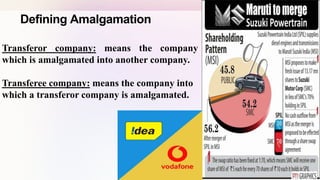
Transferor company: means the company
which is amalgamated into another company.
Transferee company: means the company into
which a transferor company is amalgamated.
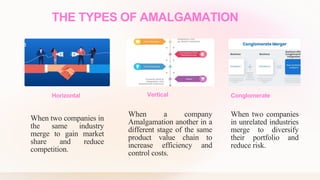
THE TYPES OF AMALGAMATION
Horizontal
When two companies in
the same industry
merge to gain market
share and reduce
competition.
Vertical
When a company
Amalgamation another in a
different stage of the same
product value chain to
increase efficiency and
control costs.
Conglomerate
When two companies
in unrelated industries
merge to diversify
their portfolio and
reduce risk.
Acquisition / Takeover / Absorption
Meaning :
• Acquisition or Takeover refers to a- “A company gets
liquidated and is sold to another company.”
• Absorption of Company is a way of business
arrangement in which an existing company takes over
the business of the another entity. The entity who gets
absorbed goes into the liquidation process.
• It means one existing company in taken over (purchased)
by another existing company for an agreed consideration
• Refers to taking over controlling “stake in a company”
by another company
Acquisition / Takeover / Absorption
Meaning :
• Taking over the business of one or more companies by
an existing company
• Here, one existing company will continue the business
with the same identity
• The seller companies are liquidated
EXTERNAL RECONSTRUCTION
“It is a process by which company transfers its business to
another company consisting substantially of the same
shareholders with a view to its being continued by the
transferee company.”
Its involves winding up of an existing company and
formation of a new company
A company gets liquidated and in place of it a new
company is formed.
In short ―One liquidation and one formation or
External Reconstruction
Goldstar = LG
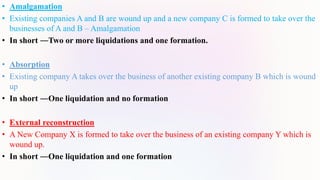
• Amalgamation
• Existing companies A and B are wound up and a new company C is formed to take over the
businesses of A and B – Amalgamation
• In short ―Two or more liquidations and one formation.
• Absorption
• Existing company A takes over the business of another existing company B which is wound
up
• In short ―One liquidation and no formation
• External reconstruction
• A New Company X is formed to take over the business of an existing company Y which is
wound up.
• In short ―One liquidation and one formation
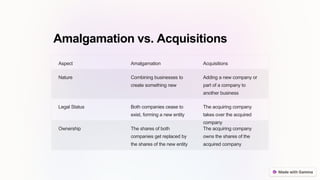
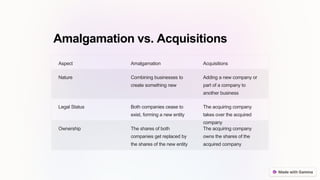
Amalgamation vs. Acquisitions
Aspect Amalgamation Acquisitions
Nature Combining businesses to
create something new
Adding a new company or
part of a company to
another business
Legal Status Both companies cease to
exist, forming a new entity
The acquiring company
takes over the acquired
company
Ownership The shares of both
companies get replaced by
the shares of the new entity
The acquiring company
owns the shares of the
acquired company
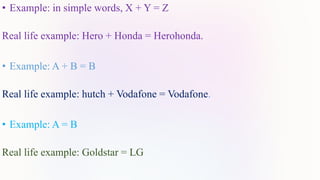
• Example: in simple words, X + Y = Z
Real life example: Hero + Honda = Herohonda.
• Example: A + B = B
Real life example: hutch + Vodafone = Vodafone.
• Example: A = B
Real life example: Goldstar = LG
WHY AMALGAMATE ?
1. To acquire cash resources
2. Eliminate competition
3. Tax savings
4. Economies of large-scale operations
5. Increase shareholders value
6. To reduce the degree of risk by diversification
7. Managerial effectiveness
8. To achieve growth and gain financially
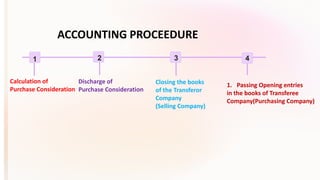
ACCOUNTING PROCEEDURE
1
Calculation of
Purchase Consideration
2
Discharge of
Purchase Consideration
3 4
Closing the books
of the Transferor
Company
(Selling Company)
1. Passing Opening entries
in the books of Transferee
Company(Purchasing Company)
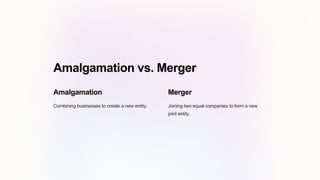
Amalgamation vs. Merger
Amalgamation
Combining businesses to create a new entity.
Merger
Joining two equal companies to form a new
joint entity.
Real-life Examples
Disney and Pixar
In 2006, Disney acquired Pixar
in a $7.4 billion amalgamation
deal.
AOL and Time Warner
In 2000, AOL acquired Time
Warner in a $164 billion
merger.
Exxon and Mobil
In 1999, Exxon and Mobil
merged to create the world's
largest company at the time
with a market cap of $504
billion.
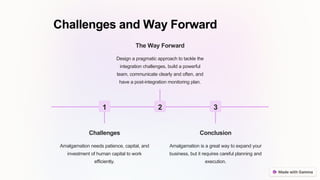
Challenges and Way Forward
1
Challenges
Amalgamation needs patience, capital, and
investment of human capital to work
efficiently.
2
The Way Forward
Design a pragmatic approach to tackle the
integration challenges, build a powerful
team, communicate clearly and often, and
have a post-integration monitoring plan.
3
Conclusion
Amalgamation is a great way to expand your
business, but it requires careful planning and
execution.
Amalgamation vs. Acquisitions
Aspect Amalgamation Acquisitions
Nature Combining businesses to
create something new
Adding a new company or
part of a company to
another business
Legal Status Both companies cease to
exist, forming a new entity
The acquiring company
takes over the acquired
company
Ownership The shares of both
companies get replaced by
the shares of the new entity
The acquiring company
owns the shares of the
acquired company
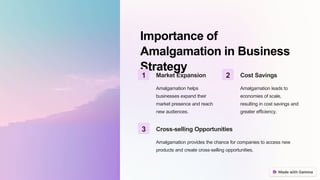
Importance of
Amalgamation in Business
Strategy
1 Market Expansion
Amalgamation helps
businesses expand their
market presence and reach
new audiences.
2 Cost Savings
Amalgamation leads to
economies of scale,
resulting in cost savings and
greater efficiency.
3 Cross-selling Opportunities
Amalgamation provides the chance for companies to access new
products and create cross-selling opportunities.
Meaning of Amalgamation

  • 1.
    ACCOUNTING FOR BUSINESS COMBINATION- I “Amalgamation is not just a corporate term; it's a magical process of blending businesses to create something new. Learn more about it.” hR by Dr. Panduranganagouda Honnali
  • 2.
    AGENDA  Meaning – oAmalgamation o Acquisition o External reconstruction  Differences between Amalgamation, Acquisition and External reconstruction hR
  • 3.
    Defining Amalgamation 1 Definition •“Amalgamation refers to the process of combining two or more separate entities, such as companies or organizations, to form a single new entity. • This can be achieved through various means, including mergers and consolidations.” • Amalgamations can be achieved through mergers (where companies combine to form a new entity) or consolidations (where multiple companies create an entirely new entity).
  • 4.
    Defining Amalgamation 1 Definition •“It is a process where two or more companies transfer their businesses to a newly formed company.” The transferor companies are wound up • Amalgamation is the process of two or more companies coming together to form a new entity. Amalgamation means an amalgamation pursuant to the provisions of the Companies Act, 1956 or any other statute which may be applicable to companies.
  • 5.
    Defining Amalgamation Transferor company:means the company which is amalgamated into another company. Transferee company: means the company into which a transferor company is amalgamated.
  • 6.
    THE TYPES OFAMALGAMATION Horizontal When two companies in the same industry merge to gain market share and reduce competition. Vertical When a company Amalgamation another in a different stage of the same product value chain to increase efficiency and control costs. Conglomerate When two companies in unrelated industries merge to diversify their portfolio and reduce risk.
  • 7.
    Acquisition / Takeover/ Absorption Meaning : • Acquisition or Takeover refers to a- “A company gets liquidated and is sold to another company.” • Absorption of Company is a way of business arrangement in which an existing company takes over the business of the another entity. The entity who gets absorbed goes into the liquidation process. • It means one existing company in taken over (purchased) by another existing company for an agreed consideration • Refers to taking over controlling “stake in a company” by another company
  • 8.
    Acquisition / Takeover/ Absorption Meaning : • Taking over the business of one or more companies by an existing company • Here, one existing company will continue the business with the same identity • The seller companies are liquidated
  • 9.
    EXTERNAL RECONSTRUCTION “It isa process by which company transfers its business to another company consisting substantially of the same shareholders with a view to its being continued by the transferee company.” Its involves winding up of an existing company and formation of a new company A company gets liquidated and in place of it a new company is formed. In short ―One liquidation and one formation or External Reconstruction Goldstar = LG
  • 10.
    • Amalgamation • Existingcompanies A and B are wound up and a new company C is formed to take over the businesses of A and B – Amalgamation • In short ―Two or more liquidations and one formation. • Absorption • Existing company A takes over the business of another existing company B which is wound up • In short ―One liquidation and no formation • External reconstruction • A New Company X is formed to take over the business of an existing company Y which is wound up. • In short ―One liquidation and one formation
  • 11.
    Amalgamation vs. Acquisitions AspectAmalgamation Acquisitions Nature Combining businesses to create something new Adding a new company or part of a company to another business Legal Status Both companies cease to exist, forming a new entity The acquiring company takes over the acquired company Ownership The shares of both companies get replaced by the shares of the new entity The acquiring company owns the shares of the acquired company
  • 12.
    • Example: insimple words, X + Y = Z Real life example: Hero + Honda = Herohonda. • Example: A + B = B Real life example: hutch + Vodafone = Vodafone. • Example: A = B Real life example: Goldstar = LG
  • 13.
    WHY AMALGAMATE ? 1.To acquire cash resources 2. Eliminate competition 3. Tax savings 4. Economies of large-scale operations 5. Increase shareholders value 6. To reduce the degree of risk by diversification 7. Managerial effectiveness 8. To achieve growth and gain financially
  • 14.
    ACCOUNTING PROCEEDURE 1 Calculation of PurchaseConsideration 2 Discharge of Purchase Consideration 3 4 Closing the books of the Transferor Company (Selling Company) 1. Passing Opening entries in the books of Transferee Company(Purchasing Company)
  • 15.
    Amalgamation vs. Merger Amalgamation Combiningbusinesses to create a new entity. Merger Joining two equal companies to form a new joint entity.
  • 16.
    Real-life Examples Disney andPixar In 2006, Disney acquired Pixar in a $7.4 billion amalgamation deal. AOL and Time Warner In 2000, AOL acquired Time Warner in a $164 billion merger. Exxon and Mobil In 1999, Exxon and Mobil merged to create the world's largest company at the time with a market cap of $504 billion.
  • 17.
    Challenges and WayForward 1 Challenges Amalgamation needs patience, capital, and investment of human capital to work efficiently. 2 The Way Forward Design a pragmatic approach to tackle the integration challenges, build a powerful team, communicate clearly and often, and have a post-integration monitoring plan. 3 Conclusion Amalgamation is a great way to expand your business, but it requires careful planning and execution.
  • 18.
    Amalgamation vs. Acquisitions AspectAmalgamation Acquisitions Nature Combining businesses to create something new Adding a new company or part of a company to another business Legal Status Both companies cease to exist, forming a new entity The acquiring company takes over the acquired company Ownership The shares of both companies get replaced by the shares of the new entity The acquiring company owns the shares of the acquired company
  • 19.
    Importance of Amalgamation inBusiness Strategy 1 Market Expansion Amalgamation helps businesses expand their market presence and reach new audiences. 2 Cost Savings Amalgamation leads to economies of scale, resulting in cost savings and greater efficiency. 3 Cross-selling Opportunities Amalgamation provides the chance for companies to access new products and create cross-selling opportunities.