The Arts Curriculum

  Prepared by Dr. Carla Piper
  “Who Am I in the Lives of Children?”
    Feeny, Christensen, Moravcik
Creative Arts Curriculum
   Help children:
     Recognize and express their feelings

     Communicate ideas in new forms

     Develop their senses

     Develop creativity and originality

   Arts are a vehicle for all kinds of learning:
     Art

     Music

     Creative Movement

     Aesthetics
Arts Experiences

Help children:
   Feel good about themselves as individuals
   Develop ability to observe and respond
    sensitively
   Develop skill, creativity, imagination
   Develop beginning understanding of the arts
   Become appreciative of music, art, and dance
    from their own and other cultures, times, and
    places.
Art
 Purpose to enhance artistic and
  creative development
 Develop motor control and
  perceptual discrimination
 Use language and learn vocabulary
 Develop problem-solving strategies
 Enhance social skills
 Develop aesthetic awareness and
  appreciation for arts
Art Curriculum
        Allow for child's own creative expression!

   Studio Art
       Children explore and create
       Use different art media
       Use processes – drawing, painting, print making,
        collage, construction, modeling, sculpting.
   Discipline-based Art
       Children encounter, discuss, and think about art
       Children understand and appreciate how art is
        created
       Exposed to artists from their own and other
        cultures and times
       Avoid pattern books
Music
   Sounds of the city – traffic, footsteps, voices
   Sound of the country – birds, wind, water
   Before we are born – music of the heartbeat
   Called the universal language
   Powerful link to emotions – happy, sad,
    excited, calm, patriotic, love, empathy
   Sharing music shares culture
   Music provides a path to other kinds of
    learning – problem-solving, language, memory
Music Curriculum
   Singing
       Short songs with distinct rhythm
       Need repertoire of songs with different moods, subjects,
        tempos, styles
   Playing instruments
       Start with rhythm instruments
   Composing and improvising – creating music
   Listening to and appreciating all kinds of
    music
   Performing
   Provide a creative climate where music is
    always present.
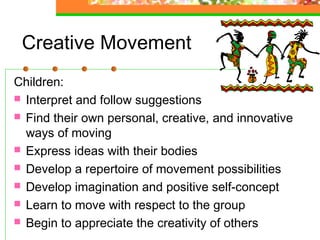
Creative Movement
Children:
 Interpret and follow suggestions
 Find their own personal, creative, and innovative
  ways of moving
 Express ideas with their bodies
 Develop a repertoire of movement possibilities
 Develop imagination and positive self-concept
 Learn to move with respect to the group
 Begin to appreciate the creativity of others
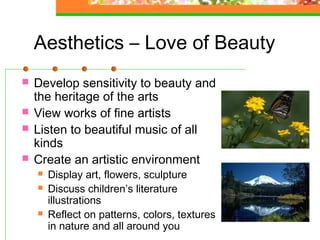
Aesthetics – Love of Beauty
   Develop sensitivity to beauty and
    the heritage of the arts
   View works of fine artists
   Listen to beautiful music of all
    kinds
   Create an artistic environment
       Display art, flowers, sculpture
       Discuss children’s literature
        illustrations
       Reflect on patterns, colors, textures
        in nature and all around you
The National Standards for the Arts

What students should know and be able
 to do in the arts....
   develop and present basic analyses of works of art
    from structural, historical, and cultural perspectives,
    and from combinations of those perspectives.
   have an informed acquaintance with exemplary
    works of art from a variety of cultures and historical
    periods, and a basic understanding of historical
    development in the arts disciplines, across the arts as
    a whole, and within cultures.
   relate various types of arts knowledge and skills
    within and across the arts disciplines.
National MENC Beliefs for Music
    Education of All Children

1. All children have musical potential
2. Children bring their own unique interests and
  abilities to the music learning environment
3. Very young children are capable of
  developing critical thinking skills through
  musical ideas
4. Children come to early-childhood music
  experiences from diverse backgrounds
5. Children should experience exemplary
  musical sounds, activities, and materials
National MENC Beliefs for Music
    Education of All Children
6. Children should not be encumbered with the
  need to meet performance goals
7. Children's play is their work
8. Children learn best in pleasant physical and
  social environments
9. Diverse learning environments are needed to
  serve the developmental needs of many
  individual children
10. Children need effective adult models
California Standards for Visual
          and Performing Arts

 Aesthetic Perception
 Creative Expression
 Historical and Cultural Context
 Aesthetic Valuing
 Connections, Relationships , Applications


Standards - http://www.cde.ca.gov/re/pn/fd/documents/visperfmarts-stnd-comp.pdf
Standards Online
   Visual and Performing Arts: Dance -
    http://www.cde.ca.gov/be/st/ss/damain.asp
   Visual and Performing Arts: Music -
    http://www.cde.ca.gov/be/st/ss/mumain.asp
   Visual and Performing Arts: Theatre -
    http://www.cde.ca.gov/be/st/ss/thmain.asp
   Visual and Performing Arts: Visual Arts -
    http://www.cde.ca.gov/be/st/ss/vamain.asp
Kindergarten Music Example
   Visual and Performing Arts Standards – Pre k
    through 12th grade
   Example of kindergarten expectations in
    music
      Many adults would find these standards
       challenging
      Previous teacher training programs
       included extensive visual and performing
       arts instruction and practicum
       http://www.cde.ca.gov/be/st/ss/mukindergarten.asp
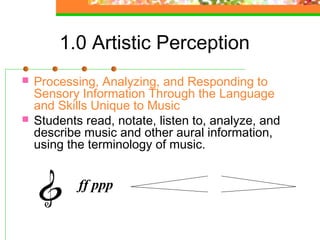
1.0 Artistic Perception
   Processing, Analyzing, and Responding to
    Sensory Information Through the Language
    and Skills Unique to Music
   Students read, notate, listen to, analyze, and
    describe music and other aural information,
    using the terminology of music.


            ff ppp
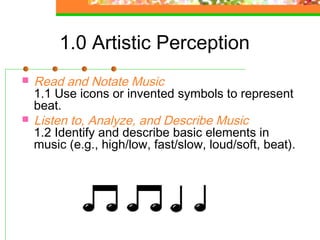
1.0 Artistic Perception
   Read and Notate Music
    1.1 Use icons or invented symbols to represent
    beat.
   Listen to, Analyze, and Describe Music
    1.2 Identify and describe basic elements in
    music (e.g., high/low, fast/slow, loud/soft, beat).
2.0 Creative Expression
   Creating, Performing, and Participating in Music
   Students apply vocal and instrumental musical
    skills in performing a varied repertoire of music.
    They compose and arrange music and
    improvise melodies, variations, and
    accompaniments, using digital/electronic
    technology when appropriate.
2.0 Creative Expression
   Apply Vocal and Instrumental Skills
    2.1 Use the singing voice to echo short
    melodic patterns.
    2.2 Sing age-appropriate songs from memory.
    2.3 Play instruments and move or verbalize to
    demonstrate awareness of beat, tempo,
    dynamics, and melodic direction.
   Compose, Arrange, and Improvise
    2.4 Create accompaniments, using the voice
    or a variety of classroom instruments.
3.0 Historical and Cultural
              Context
 Understanding the Historical
  Contributions and Cultural Dimensions
  of Music
 Students analyze the role of music in
  past and present cultures throughout
  the world, noting cultural diversity as it
  relates to music, musicians, and
  composers.
3.0 Historical and Cultural
                Context
   Diversity of Music
    3.2 Sing and play simple singing games from
    various cultures.
    3.3 Use a personal vocabulary to describe
    voices and instruments from diverse cultures.
    3.4 Use developmentally appropriate
    movements in responding to music from
    various genres and styles (rhythm, melody).
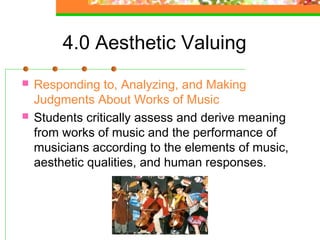
4.0 Aesthetic Valuing
   Responding to, Analyzing, and Making
    Judgments About Works of Music
   Students critically assess and derive meaning
    from works of music and the performance of
    musicians according to the elements of music,
    aesthetic qualities, and human responses.
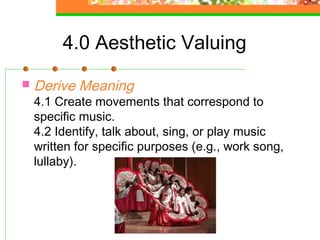
4.0 Aesthetic Valuing
   Derive Meaning
    4.1 Create movements that correspond to
    specific music.
    4.2 Identify, talk about, sing, or play music
    written for specific purposes (e.g., work song,
    lullaby).
5.0 Connections, Relationships,
             Applications
   Connecting and Applying What Is Learned in
    Music to Learning in Other Art Forms and
    Subject Areas and to Careers
   Students apply what they learn in music
    across subject areas. They develop
    competencies and creative skills in problem
    solving, communication, and management of
    time and resources that contribute to lifelong
    learning and career skills. They learn about
    careers in and related to music.
5.0 Connections, Relationships,
         Applications
   Connections and Applications
    5.1 Use music, together with dance, theatre,
    and the visual arts, for storytelling.
   Careers and Career-Related Skills
    5.2 Identify and talk about the reasons artists
    have for creating dances, music, theatre
    pieces, and works of visual art.

Arts Curriculum

  • 1.
    The Arts Curriculum Prepared by Dr. Carla Piper “Who Am I in the Lives of Children?” Feeny, Christensen, Moravcik
  • 2.
    Creative Arts Curriculum  Help children:  Recognize and express their feelings  Communicate ideas in new forms  Develop their senses  Develop creativity and originality  Arts are a vehicle for all kinds of learning:  Art  Music  Creative Movement  Aesthetics
  • 3.
    Arts Experiences Help children:  Feel good about themselves as individuals  Develop ability to observe and respond sensitively  Develop skill, creativity, imagination  Develop beginning understanding of the arts  Become appreciative of music, art, and dance from their own and other cultures, times, and places.
  • 4.
    Art  Purpose toenhance artistic and creative development  Develop motor control and perceptual discrimination  Use language and learn vocabulary  Develop problem-solving strategies  Enhance social skills  Develop aesthetic awareness and appreciation for arts
  • 5.
    Art Curriculum Allow for child's own creative expression!  Studio Art  Children explore and create  Use different art media  Use processes – drawing, painting, print making, collage, construction, modeling, sculpting.  Discipline-based Art  Children encounter, discuss, and think about art  Children understand and appreciate how art is created  Exposed to artists from their own and other cultures and times  Avoid pattern books
  • 6.
    Music  Sounds of the city – traffic, footsteps, voices  Sound of the country – birds, wind, water  Before we are born – music of the heartbeat  Called the universal language  Powerful link to emotions – happy, sad, excited, calm, patriotic, love, empathy  Sharing music shares culture  Music provides a path to other kinds of learning – problem-solving, language, memory
  • 7.
    Music Curriculum  Singing  Short songs with distinct rhythm  Need repertoire of songs with different moods, subjects, tempos, styles  Playing instruments  Start with rhythm instruments  Composing and improvising – creating music  Listening to and appreciating all kinds of music  Performing  Provide a creative climate where music is always present.
  • 8.
    Creative Movement Children:  Interpretand follow suggestions  Find their own personal, creative, and innovative ways of moving  Express ideas with their bodies  Develop a repertoire of movement possibilities  Develop imagination and positive self-concept  Learn to move with respect to the group  Begin to appreciate the creativity of others
  • 9.
    Aesthetics – Loveof Beauty  Develop sensitivity to beauty and the heritage of the arts  View works of fine artists  Listen to beautiful music of all kinds  Create an artistic environment  Display art, flowers, sculpture  Discuss children’s literature illustrations  Reflect on patterns, colors, textures in nature and all around you
  • 10.
    The National Standardsfor the Arts What students should know and be able to do in the arts....  develop and present basic analyses of works of art from structural, historical, and cultural perspectives, and from combinations of those perspectives.  have an informed acquaintance with exemplary works of art from a variety of cultures and historical periods, and a basic understanding of historical development in the arts disciplines, across the arts as a whole, and within cultures.  relate various types of arts knowledge and skills within and across the arts disciplines.
  • 11.
    National MENC Beliefsfor Music Education of All Children 1. All children have musical potential 2. Children bring their own unique interests and abilities to the music learning environment 3. Very young children are capable of developing critical thinking skills through musical ideas 4. Children come to early-childhood music experiences from diverse backgrounds 5. Children should experience exemplary musical sounds, activities, and materials
  • 12.
    National MENC Beliefsfor Music Education of All Children 6. Children should not be encumbered with the need to meet performance goals 7. Children's play is their work 8. Children learn best in pleasant physical and social environments 9. Diverse learning environments are needed to serve the developmental needs of many individual children 10. Children need effective adult models
  • 13.
    California Standards forVisual and Performing Arts  Aesthetic Perception  Creative Expression  Historical and Cultural Context  Aesthetic Valuing  Connections, Relationships , Applications Standards - http://www.cde.ca.gov/re/pn/fd/documents/visperfmarts-stnd-comp.pdf
  • 14.
    Standards Online  Visual and Performing Arts: Dance - http://www.cde.ca.gov/be/st/ss/damain.asp  Visual and Performing Arts: Music - http://www.cde.ca.gov/be/st/ss/mumain.asp  Visual and Performing Arts: Theatre - http://www.cde.ca.gov/be/st/ss/thmain.asp  Visual and Performing Arts: Visual Arts - http://www.cde.ca.gov/be/st/ss/vamain.asp
  • 15.
    Kindergarten Music Example  Visual and Performing Arts Standards – Pre k through 12th grade  Example of kindergarten expectations in music  Many adults would find these standards challenging  Previous teacher training programs included extensive visual and performing arts instruction and practicum  http://www.cde.ca.gov/be/st/ss/mukindergarten.asp
  • 16.
    1.0 Artistic Perception  Processing, Analyzing, and Responding to Sensory Information Through the Language and Skills Unique to Music  Students read, notate, listen to, analyze, and describe music and other aural information, using the terminology of music. ff ppp
  • 17.
    1.0 Artistic Perception  Read and Notate Music 1.1 Use icons or invented symbols to represent beat.  Listen to, Analyze, and Describe Music 1.2 Identify and describe basic elements in music (e.g., high/low, fast/slow, loud/soft, beat).
  • 18.
    2.0 Creative Expression  Creating, Performing, and Participating in Music  Students apply vocal and instrumental musical skills in performing a varied repertoire of music. They compose and arrange music and improvise melodies, variations, and accompaniments, using digital/electronic technology when appropriate.
  • 19.
    2.0 Creative Expression  Apply Vocal and Instrumental Skills 2.1 Use the singing voice to echo short melodic patterns. 2.2 Sing age-appropriate songs from memory. 2.3 Play instruments and move or verbalize to demonstrate awareness of beat, tempo, dynamics, and melodic direction.  Compose, Arrange, and Improvise 2.4 Create accompaniments, using the voice or a variety of classroom instruments.
  • 20.
    3.0 Historical andCultural Context  Understanding the Historical Contributions and Cultural Dimensions of Music  Students analyze the role of music in past and present cultures throughout the world, noting cultural diversity as it relates to music, musicians, and composers.
  • 21.
    3.0 Historical andCultural Context  Diversity of Music 3.2 Sing and play simple singing games from various cultures. 3.3 Use a personal vocabulary to describe voices and instruments from diverse cultures. 3.4 Use developmentally appropriate movements in responding to music from various genres and styles (rhythm, melody).
  • 22.
    4.0 Aesthetic Valuing  Responding to, Analyzing, and Making Judgments About Works of Music  Students critically assess and derive meaning from works of music and the performance of musicians according to the elements of music, aesthetic qualities, and human responses.
  • 23.
    4.0 Aesthetic Valuing  Derive Meaning 4.1 Create movements that correspond to specific music. 4.2 Identify, talk about, sing, or play music written for specific purposes (e.g., work song, lullaby).
  • 24.
    5.0 Connections, Relationships, Applications  Connecting and Applying What Is Learned in Music to Learning in Other Art Forms and Subject Areas and to Careers  Students apply what they learn in music across subject areas. They develop competencies and creative skills in problem solving, communication, and management of time and resources that contribute to lifelong learning and career skills. They learn about careers in and related to music.
  • 25.
    5.0 Connections, Relationships, Applications  Connections and Applications 5.1 Use music, together with dance, theatre, and the visual arts, for storytelling.  Careers and Career-Related Skills 5.2 Identify and talk about the reasons artists have for creating dances, music, theatre pieces, and works of visual art.