•Photography is the science, art and practice of
creating durable images by recording light or
other electromagnetic radiation, either
electronically by means of an image sensor, or
chemically by means of a light-sensitive material
such as photographic film.
•From the Greek “photos” (meaning light) and
“graphos” (meaning writing)
•Focusing a camera at a subject and clicking
the shutter is photography as process.
•Discerning a significant moment or a unique
expression, framing it in the camera
viewfinder with an eye for composition, and
then clicking the shutter is photography as
art.
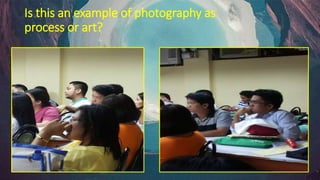
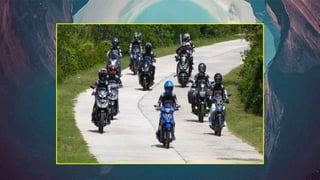
Is this an example of photography as
process or art?
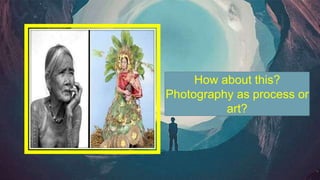
How about this?
Photography as process or
art?
Here are some possible venues where you can try your hand
in the field of artistic photography:
1. Fine arts photography – Focuses on using photographs as
artworks.
2. Portrait photography – a specialization that focuses on
taking pictures of persons in their studios or on location.
3. Scientific photography – a record of scientific or medical
data or events using photography.
4. News photography or photojournalism – photographs to
tell news
5. Glamour photography – a photos designated to sell
products, for advertising
Noteworthy Philippine Photographers
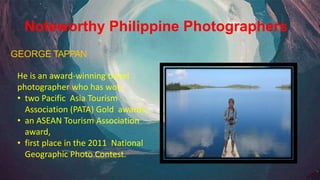
GEORGE TAPPAN
He is an award-winning travel
photographer who has won
• two Pacific Asia Tourism
Association (PATA) Gold awards,
• an ASEAN Tourism Association
award,
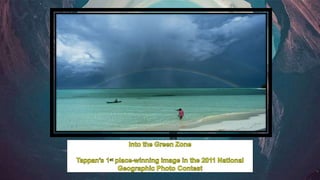
• first place in the 2011 National
Geographic Photo Contest.
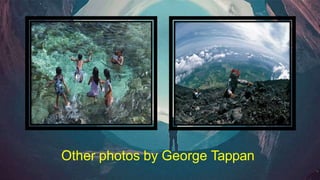
Other photos by George Tappan
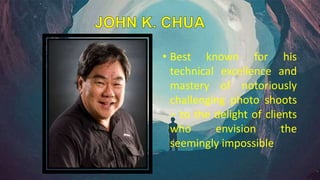
• Best known for his
technical excellence and
mastery of notoriously
challenging photo shoots
– to the delight of clients
who envision the
seemingly impossible
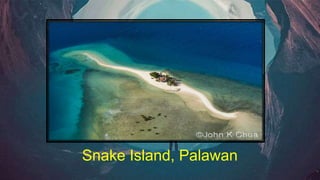
Snake Island, Palawan
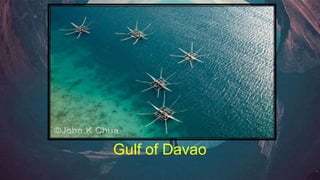
Gulf of Davao
TEST I. Directions: Identify the word being described by
the following statement.
1. Photography is the science, art and practice of creating durable
images by recording light or other electromagnetic radiation.
2. It is the meaning of light in Greek word.
3. It is the meaning of writing in Greek word.
4. A photos designated to sell products, for advertising.
5. Photographs to tell news.
6. A record of scientific or medical data or events using photography.
7. A specialization that focuses on taking pictures of persons in their
studios or on location.
8. Focuses on using photographs as artworks.
TEST II. Directions: Write Art if the following picture
is photography as art and if not write Process.
MOTION PICTURE
 Motion pictures are called by many different
names like movies, cinema, videos etc.
 Movies – are made of series of still pictures
called Frames that are shown continuously and
sequentially, creating an illusion that seems to
make images move.
FILM or CINEMA
•art form which has risen to tremendous heights
within the century
•Brought yet another dimension into play
(moving images)
HISTORY OF FILMS
 the first film were in black and white
 did not have any sound
 the viewers had to rely on the subtitles
 in late 1920s, filmmaking evolved that made it practical to
record sound along with the movie
 in the 1930s, color was introduced to movies
 in the 1940s, televisions were starting to sprout in
households
 in the 1980s, Sony developed digital cinematography that
captures events and scenes and stored it in electronic
format.
Stages in Film Production
• A film is a collaborative effort that requires people from different
disciplines to work together to be able to make a film.
• The type of film and its budget would determine the number of
people that would be employed to work on the film.
• Blockbusters usually hire thousands of workers while small budget
independent films would have less than a dozen people working o a
film.
• Creating a movie involves a lot of planning and preparation. A typical
film would go through five stages of production.
Stages in Film Production
1. DEVELOPMENT
• this is the stage where the ideas for the film is discussed
2. TREATMENT
• Describes the story, the mood of the film, and its characters
3. PRODUCTION
• It is the phase where the director is hired as well as the cast and crew.
4. POST-PRODUCTION
• It is where the visual effects and musical scores are added
5. DISTRIBUTION
• It is the final phase of film production where the film is released to
the cinemas or in some cases to digital media providers
FILIPINO FILM MAKERS
BRILLANTE MENDOZA
• He was born in 1960 in San Fernando, Pampanga
• Studied Advertising Arts at the University of Santo Tomas.
• The first film director who gained the recognition here and abroad for
his 2005 independent film, MASAHISTA
• His work are staple in film festivals all over the world and is
continually recognized like THY WOMB where he won again the Best
Actor in the Asia-Pacific Screen Awards in 2012.
FILIPINO FILM MAKERS
Maryo J. de los Reyes
• He was born in 1952 in Sta. Cruz, Manila
• He took up Mass Communication at the University of the Philippines
where he graduated with honors
• His career in the film industry started as a writer for drama
anthologies for television.
• He soon transitioned as a television director and was awarded as
BEST DIRECTOR and WRITER in 1978
• This director has garnered awards both locally and internationally
through out his career.
• Some of his recognized works include ALAB NG LAHI (1983),
SINUNGALING MONG PUSO (1992), and MAGNIFICO (2003)
FILIPINO FILM MAKERS
Laurice Guillen
• An actress and director
• She was born in 1947 and first work in the industry as
an actress.
• Some of her memorable acting roles were for classic
films such as TINIMBANG NGUNIT KULANG (1974),
SISTER STELLA L (1984), and A DANGEROUS LIFE
(1988)
ANIMATION
• It is the art of sequencing drawings or static images
together to achieve the illusion of movement or life.
• Animations can have different forms like cartoons,
stop motion animation, and Claymation.
• Earliest cartoons looked like comic books and it can
only be viewed by a limited number of people.
A second of a cartoon wood need about 24 drawings or frames. A 30-
minute cartoon would need about 43, 200 frames and because of this,
animators will have to work with other animators to finish a episode.
- Animators begin with a story that would be broken down into sequence
through a small comic strip-like drawing called STORYBOARDS.
- Main animators usually draw the important positions of the frames,
usually the start and the end.
- In-betweeners are the ones in charge of filling up the rest of the
movement.
- Before the advent of computers, animators had to draw each and every
frame. But now, almost all animation companies use computers to help the
in-betweeners fill in the movement.
There are different specialization with regards
to animation
Computer animators
-are the one who create images using computers.
-can make an image look (2-D) like the traditional
cartoons or they can make it look three-
dimensional (3D), like many computer-generated
movies such as Avatar, Toy Story, Finding Nemo,
Frozen
Stop Motion Animators
- Animators who use dolls and puppets with movable
joints in the creation of the film.
Examples of stop motion films
- The Nightmare Before Christmas
- Corpse Bride
- Gumby
- Wallace
Philippine Animation History and Animators
Juan Tamad
- the first Filipino cartoon animated
- made in 1955 by cartoonists Jose Zabala Santos
Tadhana
- the first full-length animated movie
- made in 1978
- it was created by New York – trained animator, Nonoy
Mercado
Ang Panday (1986)
- the first Filipino cartoon series
- It is based from the comic character created by Carlo J.
Caparas and Steve Gan
- It was made into an animated cartoon by Geirry Garcia
- The series success lead other cartoon series to be produced
such as Darna and Captain Barbel
Adarna
- The first full-length Filipino animated film
- An adaptation of a local Filipino folklore.
RPG METONOIA (2010)
- The first full-length 3D animated film
- Directed by Luis C. Suarez
- Made by Ambient Media Thaumatrope Animation
Production
- Won the third best picture in the 2010 Metro Manila
Film Festival
Animation Studios in the Philippines

ARTS 10 THIRD QUARTER.pptx

  • 2.
    •Photography is thescience, art and practice of creating durable images by recording light or other electromagnetic radiation, either electronically by means of an image sensor, or chemically by means of a light-sensitive material such as photographic film. •From the Greek “photos” (meaning light) and “graphos” (meaning writing)
  • 3.
    •Focusing a cameraat a subject and clicking the shutter is photography as process. •Discerning a significant moment or a unique expression, framing it in the camera viewfinder with an eye for composition, and then clicking the shutter is photography as art.
  • 4.
    Is this anexample of photography as process or art?
  • 5.
    How about this? Photographyas process or art?
  • 10.
    Here are somepossible venues where you can try your hand in the field of artistic photography: 1. Fine arts photography – Focuses on using photographs as artworks. 2. Portrait photography – a specialization that focuses on taking pictures of persons in their studios or on location. 3. Scientific photography – a record of scientific or medical data or events using photography. 4. News photography or photojournalism – photographs to tell news 5. Glamour photography – a photos designated to sell products, for advertising
  • 11.
    Noteworthy Philippine Photographers GEORGETAPPAN He is an award-winning travel photographer who has won • two Pacific Asia Tourism Association (PATA) Gold awards, • an ASEAN Tourism Association award, • first place in the 2011 National Geographic Photo Contest.
  • 13.
    Other photos byGeorge Tappan
  • 14.
    • Best knownfor his technical excellence and mastery of notoriously challenging photo shoots – to the delight of clients who envision the seemingly impossible
  • 15.
  • 16.
  • 17.
    TEST I. Directions:Identify the word being described by the following statement. 1. Photography is the science, art and practice of creating durable images by recording light or other electromagnetic radiation. 2. It is the meaning of light in Greek word. 3. It is the meaning of writing in Greek word. 4. A photos designated to sell products, for advertising. 5. Photographs to tell news. 6. A record of scientific or medical data or events using photography. 7. A specialization that focuses on taking pictures of persons in their studios or on location. 8. Focuses on using photographs as artworks.
  • 18.
    TEST II. Directions:Write Art if the following picture is photography as art and if not write Process.
  • 21.
    MOTION PICTURE  Motionpictures are called by many different names like movies, cinema, videos etc.  Movies – are made of series of still pictures called Frames that are shown continuously and sequentially, creating an illusion that seems to make images move.
  • 22.
    FILM or CINEMA •artform which has risen to tremendous heights within the century •Brought yet another dimension into play (moving images)
  • 23.
    HISTORY OF FILMS the first film were in black and white  did not have any sound  the viewers had to rely on the subtitles  in late 1920s, filmmaking evolved that made it practical to record sound along with the movie  in the 1930s, color was introduced to movies  in the 1940s, televisions were starting to sprout in households  in the 1980s, Sony developed digital cinematography that captures events and scenes and stored it in electronic format.
  • 24.
    Stages in FilmProduction • A film is a collaborative effort that requires people from different disciplines to work together to be able to make a film. • The type of film and its budget would determine the number of people that would be employed to work on the film. • Blockbusters usually hire thousands of workers while small budget independent films would have less than a dozen people working o a film. • Creating a movie involves a lot of planning and preparation. A typical film would go through five stages of production.
  • 25.
    Stages in FilmProduction 1. DEVELOPMENT • this is the stage where the ideas for the film is discussed 2. TREATMENT • Describes the story, the mood of the film, and its characters 3. PRODUCTION • It is the phase where the director is hired as well as the cast and crew. 4. POST-PRODUCTION • It is where the visual effects and musical scores are added 5. DISTRIBUTION • It is the final phase of film production where the film is released to the cinemas or in some cases to digital media providers
  • 26.
    FILIPINO FILM MAKERS BRILLANTEMENDOZA • He was born in 1960 in San Fernando, Pampanga • Studied Advertising Arts at the University of Santo Tomas. • The first film director who gained the recognition here and abroad for his 2005 independent film, MASAHISTA • His work are staple in film festivals all over the world and is continually recognized like THY WOMB where he won again the Best Actor in the Asia-Pacific Screen Awards in 2012.
  • 27.
    FILIPINO FILM MAKERS MaryoJ. de los Reyes • He was born in 1952 in Sta. Cruz, Manila • He took up Mass Communication at the University of the Philippines where he graduated with honors • His career in the film industry started as a writer for drama anthologies for television. • He soon transitioned as a television director and was awarded as BEST DIRECTOR and WRITER in 1978 • This director has garnered awards both locally and internationally through out his career. • Some of his recognized works include ALAB NG LAHI (1983), SINUNGALING MONG PUSO (1992), and MAGNIFICO (2003)
  • 28.
    FILIPINO FILM MAKERS LauriceGuillen • An actress and director • She was born in 1947 and first work in the industry as an actress. • Some of her memorable acting roles were for classic films such as TINIMBANG NGUNIT KULANG (1974), SISTER STELLA L (1984), and A DANGEROUS LIFE (1988)
  • 29.
    ANIMATION • It isthe art of sequencing drawings or static images together to achieve the illusion of movement or life. • Animations can have different forms like cartoons, stop motion animation, and Claymation. • Earliest cartoons looked like comic books and it can only be viewed by a limited number of people.
  • 30.
    A second ofa cartoon wood need about 24 drawings or frames. A 30- minute cartoon would need about 43, 200 frames and because of this, animators will have to work with other animators to finish a episode. - Animators begin with a story that would be broken down into sequence through a small comic strip-like drawing called STORYBOARDS. - Main animators usually draw the important positions of the frames, usually the start and the end. - In-betweeners are the ones in charge of filling up the rest of the movement. - Before the advent of computers, animators had to draw each and every frame. But now, almost all animation companies use computers to help the in-betweeners fill in the movement.
  • 31.
    There are differentspecialization with regards to animation Computer animators -are the one who create images using computers. -can make an image look (2-D) like the traditional cartoons or they can make it look three- dimensional (3D), like many computer-generated movies such as Avatar, Toy Story, Finding Nemo, Frozen
  • 32.
    Stop Motion Animators -Animators who use dolls and puppets with movable joints in the creation of the film. Examples of stop motion films - The Nightmare Before Christmas - Corpse Bride - Gumby - Wallace
  • 33.
    Philippine Animation Historyand Animators Juan Tamad - the first Filipino cartoon animated - made in 1955 by cartoonists Jose Zabala Santos Tadhana - the first full-length animated movie - made in 1978 - it was created by New York – trained animator, Nonoy Mercado
  • 34.
    Ang Panday (1986) -the first Filipino cartoon series - It is based from the comic character created by Carlo J. Caparas and Steve Gan - It was made into an animated cartoon by Geirry Garcia - The series success lead other cartoon series to be produced such as Darna and Captain Barbel Adarna - The first full-length Filipino animated film - An adaptation of a local Filipino folklore.
  • 35.
    RPG METONOIA (2010) -The first full-length 3D animated film - Directed by Luis C. Suarez - Made by Ambient Media Thaumatrope Animation Production - Won the third best picture in the 2010 Metro Manila Film Festival
  • 36.
    Animation Studios inthe Philippines