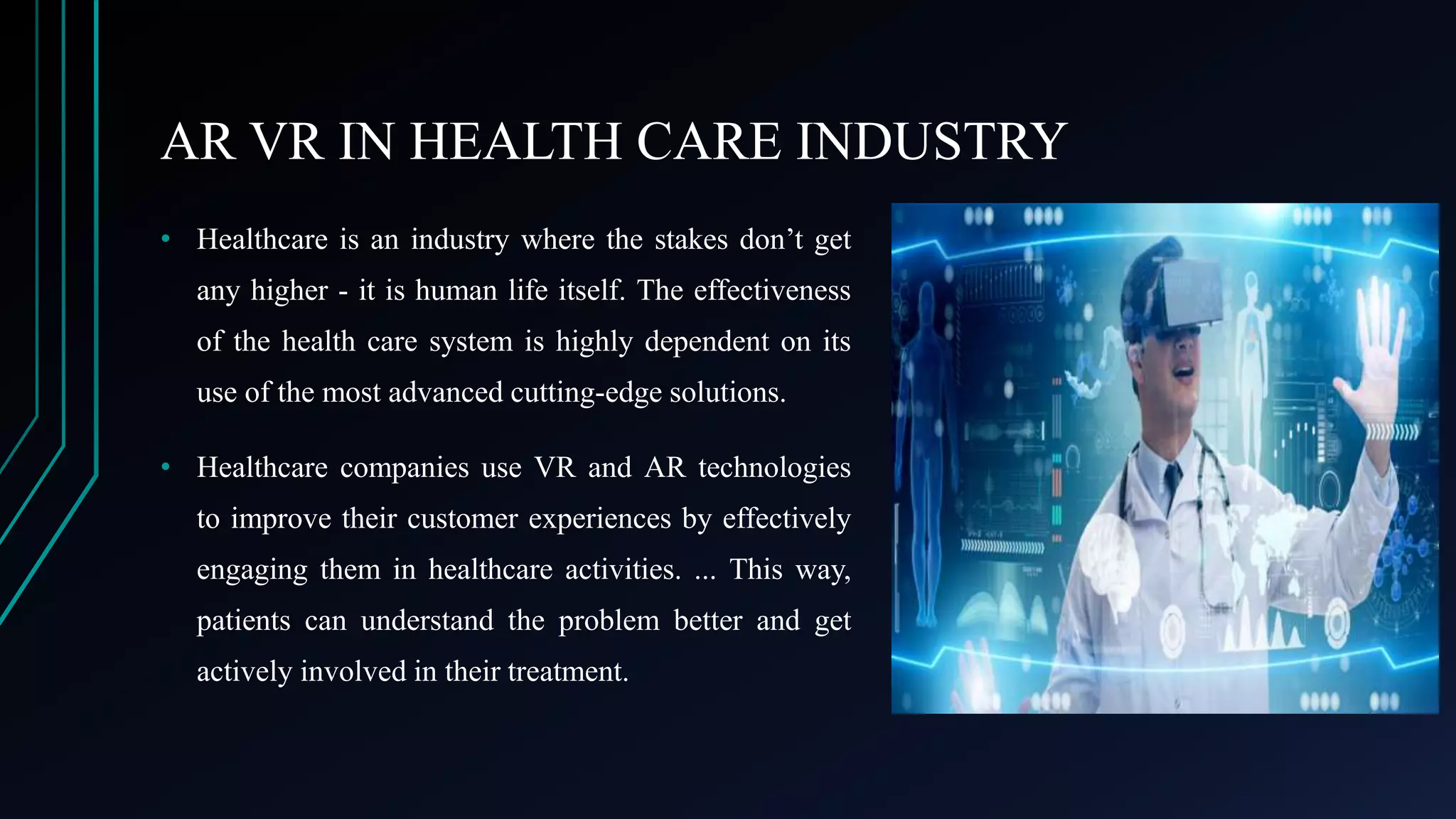
Virtual and augmented reality technologies have potential applications in healthcare by improving training, visualization of anatomy, skills development, and patient education and experience. Some key ways AR/VR can benefit healthcare include:
1) Facilitating medical learning and training through more engaging and cost-effective methods compared to traditional textbooks.
2) Providing realistic 3D visualization of human anatomy that is more effective than 2D images.
3) Allowing skills development through virtual performance of tasks like surgeries and injections.
4) Advancing learning for medical professionals through immersive experiences of new procedures.