ARTIFICIAL INTELLIGENCE IN CYBER
             DEFENSE


                      By –
                      Ujjwal Tripathi
                                Page 1
TOPICS IN THIS SEMINAR

•   INTRODUCTION TO AI
•    APPLICATION OF AI
•   SOME EXAMPLES
•   EXPERT SYSTEM
•   AGENTS
•   NEURAL NETS


                         Page 2
WHAT IS AI ?

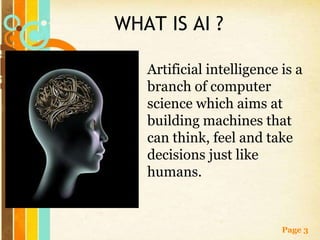
   Artificial intelligence is a
   branch of computer
   science which aims at
   building machines that
   can think, feel and take
   decisions just like
   humans.


                           Page 3
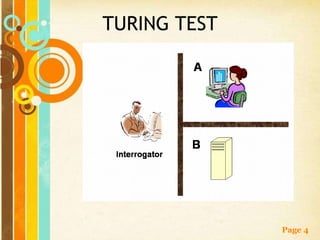
TURING TEST


              Page 4
FIELDS OF A.I.

•   Expert System
•   Robotics
•   Natural language Processing
•   Neural Network
•   Intelligent Agents
•   Search
•   Knowledge Representation

                                  Page 5
Practical Application of AI

     ALVINN
     Deep Blue
     Machine translation
     Autonomous agents
     Speech Recognition
     Handwriting Recognition
     Optical Character Recognition

                                  Page 6
EXPERT SYSTEM

 An expert system is a computer
  program designed to act as an
  expert in a particular domain
  also known as knowledge based
  system.

 Provide portable knowledge


                               Page 7
Architecture of Expert
       System
• Knowledge base
  – Stores all relevant information, data, rules,
    cases, and relationships used by the expert
    system
• Inference engine
  – Seeks information and relationships from
    the knowledge base and provides answers,
    predictions, and suggestions in the way a
    human expert would do.
• Rule
  – A conditional statement that links given
    conditions to actions or outcomes
                                             Page 8
Architecture of Expert System

    • Backward chaining
      – A method of reasoning that starts with
        conclusions and works backward to the
        supporting facts


    • Forward chaining
      – A method of reasoning that starts with the
        facts and works forward to the conclusions


                                              Page 9
Applications of Expert Systems
  and Artificial Intelligence
          • Credit granting
          • Information management and
            retrieval
          • Plant layout
          • Hospitals and medical facilities
          • Help desks and assistance
          • Employee performance evaluation
          • Virus detection
          • Repair and maintenance
          • Shipping
          • Marketing

                                          Page 10
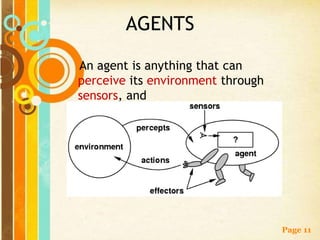
AGENTS

An agent is anything that can
perceive its environment through
sensors, and
act upon that environment through
actuators (or effectors)


                                    Page 11
EXAMPLES OF AGENTS

• Humans can be looked upon as agents.
  They have eyes, ears, skin, taste buds,
  etc. for sensors; and hands, fingers, legs,
  mouth for effectors.

•    Robots are agents. Robots may have
    camera, sonar, infrared, bumper, etc. for
    sensors. They can have grippers, wheels,
    lights, speakers, etc. for actuators.


                                         Page 12
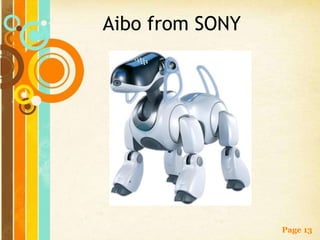
Aibo from SONY


                 Page 13
INTELLEGENT AGENTS

 • An intelligent agent is a
   program that runs in the
   background and learns your
   patterns, like any other agent
   working for you.


                                    Page 14
NEURAL NETWORKS
• The term neural network was
  traditionally used to refer to a
  network or circuit of biological
  neurons. The modern usage of
  the term often refers to artificial
  neural networks.


                                 Page 15
NEUARAL NETWORKS (CONTD.)


    • A neural net is an artificial
      representation of the human
      brain that tries to simulate its
      learning process. An artificial
      neural n/w is often called a
      “Neural Network”.


                                         Page 16
TYPES OF NEURAL N/W

• Biological neural networks are
  made up of real biological neurons
  that are connected or functionally
  related in a nervous system.
• Artificial neural networks are
  composed of interconnecting
  artificial neurons that uses a
  mathematical model or
  computation model.
                                Page 17
THANK YOU


            Page 18

Artificial intelligence in cyber defense

  • 1.
    ARTIFICIAL INTELLIGENCE INCYBER DEFENSE By – Ujjwal Tripathi Page 1
  • 2.
    TOPICS IN THISSEMINAR • INTRODUCTION TO AI • APPLICATION OF AI • SOME EXAMPLES • EXPERT SYSTEM • AGENTS • NEURAL NETS Page 2
  • 3.
    WHAT IS AI? Artificial intelligence is a branch of computer science which aims at building machines that can think, feel and take decisions just like humans. Page 3
  • 4.
  • 5.
    FIELDS OF A.I. • Expert System • Robotics • Natural language Processing • Neural Network • Intelligent Agents • Search • Knowledge Representation Page 5
  • 6.
    Practical Application ofAI  ALVINN  Deep Blue  Machine translation  Autonomous agents  Speech Recognition  Handwriting Recognition  Optical Character Recognition Page 6
  • 7.
    EXPERT SYSTEM  Anexpert system is a computer program designed to act as an expert in a particular domain also known as knowledge based system.  Provide portable knowledge Page 7
  • 8.
    Architecture of Expert System • Knowledge base – Stores all relevant information, data, rules, cases, and relationships used by the expert system • Inference engine – Seeks information and relationships from the knowledge base and provides answers, predictions, and suggestions in the way a human expert would do. • Rule – A conditional statement that links given conditions to actions or outcomes Page 8
  • 9.
    Architecture of ExpertSystem • Backward chaining – A method of reasoning that starts with conclusions and works backward to the supporting facts • Forward chaining – A method of reasoning that starts with the facts and works forward to the conclusions Page 9
  • 10.
    Applications of ExpertSystems and Artificial Intelligence • Credit granting • Information management and retrieval • Plant layout • Hospitals and medical facilities • Help desks and assistance • Employee performance evaluation • Virus detection • Repair and maintenance • Shipping • Marketing Page 10
  • 11.
    AGENTS An agent isanything that can perceive its environment through sensors, and act upon that environment through actuators (or effectors) Page 11
  • 12.
    EXAMPLES OF AGENTS •Humans can be looked upon as agents. They have eyes, ears, skin, taste buds, etc. for sensors; and hands, fingers, legs, mouth for effectors. • Robots are agents. Robots may have camera, sonar, infrared, bumper, etc. for sensors. They can have grippers, wheels, lights, speakers, etc. for actuators. Page 12
  • 13.
  • 14.
    INTELLEGENT AGENTS •An intelligent agent is a program that runs in the background and learns your patterns, like any other agent working for you. Page 14
  • 15.
    NEURAL NETWORKS • Theterm neural network was traditionally used to refer to a network or circuit of biological neurons. The modern usage of the term often refers to artificial neural networks. Page 15
  • 16.
    NEUARAL NETWORKS (CONTD.) • A neural net is an artificial representation of the human brain that tries to simulate its learning process. An artificial neural n/w is often called a “Neural Network”. Page 16
  • 17.
    TYPES OF NEURALN/W • Biological neural networks are made up of real biological neurons that are connected or functionally related in a nervous system. • Artificial neural networks are composed of interconnecting artificial neurons that uses a mathematical model or computation model. Page 17
  • 18.
    THANK YOU Page 18