ARTIFICIAL INTELLIGENCE
INTELLIGENCE
INTELLIGENCE  ! Intelligence is the computational part of the ability to achieve goals in the world. Varying kinds and degrees of intelligence occur in people, many animals and some machines.
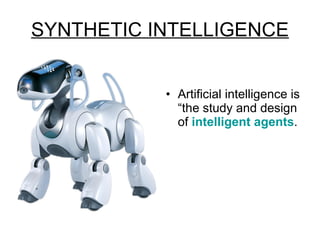
SYNTHETIC INTELLIGENCE Artificial intelligence is “the study and design of  intelligent agents .
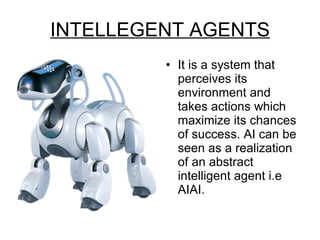
INTELLEGENT AGENTS It is a system that perceives its environment and takes actions which maximize its chances of success. AI can be seen as a realization of an abstract intelligent agent i.e AIAI.
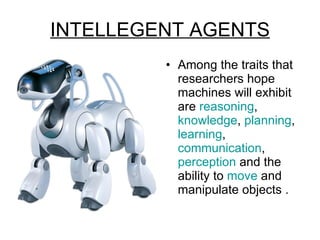
INTELLEGENT AGENTS Among the traits that researchers hope machines will exhibit are  reasoning ,  knowledge ,  planning ,  learning ,  communication ,  perception  and the ability to  move  and manipulate objects .
HISTORY
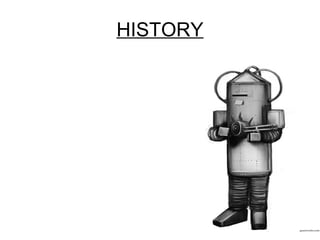
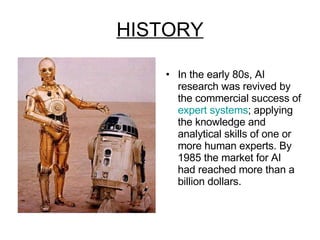
HISTORY In the early 80s, AI research was revived by the commercial success of  expert systems ; applying the knowledge and analytical skills of one or more human experts. By 1985 the market for AI had reached more than a billion dollars.
A Question-  ‘ CAN’  it be done  ??
Problems of AI
Deduction, Reasoning, Problem solving   Early AI researchers imitated the process of step-by-step reasoning that human beings use when they solve puzzles, play board games, or make logical deductions. AI research had also developed successful methods for dealing with  uncertain  or incomplete information.
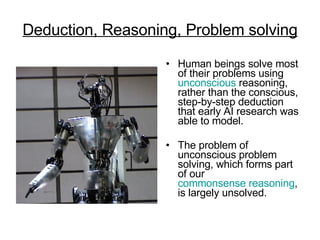
Deduction, Reasoning, Problem solving Human beings solve most of their problems using  unconscious  reasoning, rather than the conscious, step-by-step deduction that early AI research was able to model.  The problem of unconscious problem solving, which forms part of our  commonsense reasoning , is largely unsolved.
Unconscious Knowledge Much of what people know isn't represented as "facts" or "statements" that they could actually say out loud. They take the form of  intuitions  or tendencies and are represented in the brain unconsciously. This unconscious knowledge informs, supports and provides a context for our conscious knowledge.
Unsupervised Learning Find a model that matches a stream of input "experiences", and be able to predict what new "experiences" to expect.
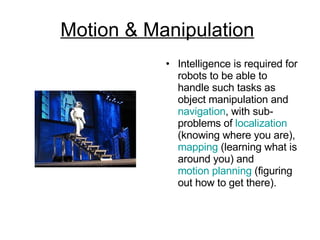
Motion & Manipulation   Intelligence is required for robots to be able to handle such tasks as object manipulation and  navigation , with sub-problems of  localization  (knowing where you are),  mapping  (learning what is around you) and  motion planning  (figuring out how to get there).
Approaches to AI
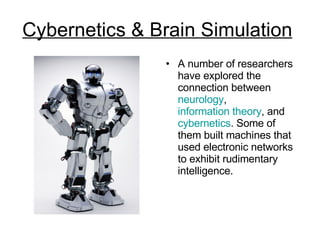
Cybernetics & Brain Simulation   A number of researchers have explored the connection between  neurology ,  information theory , and  cybernetics . Some of them built machines that used electronic networks to exhibit rudimentary intelligence.
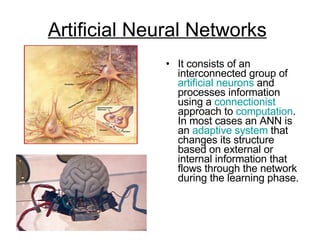
Artificial Neural Networks   It consists of an interconnected group of  artificial neurons  and processes information using a  connectionist  approach to  computation . In most cases an ANN is an  adaptive system  that changes its structure based on external or internal information that flows through the network during the learning phase.
Knowledge based AI
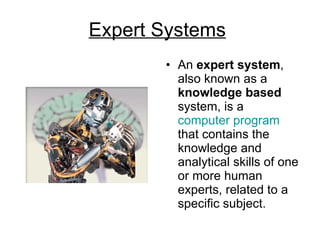
Expert Systems   An  expert system , also known as a  knowledge based  system, is a  computer program  that contains the knowledge and analytical skills of one or more human experts, related to a specific subject.
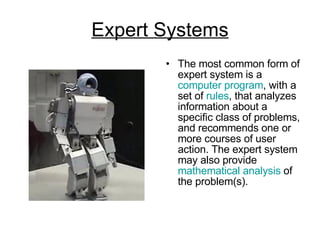
Expert Systems The most common form of expert system is a  computer program , with a set of  rules , that analyzes information about a specific class of problems, and recommends one or more courses of user action. The expert system may also provide  mathematical analysis  of the problem(s).
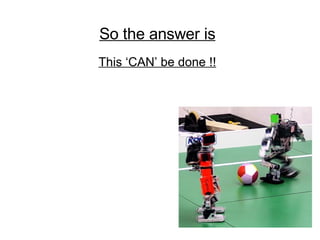
So the answer is This ‘CAN’ be done !!
Applications of AI
Welcome to the FUTURE
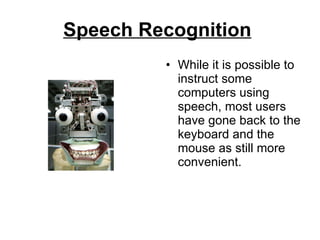
Speech Recognition   While it is possible to instruct some computers using speech, most users have gone back to the keyboard and the mouse as still more convenient.
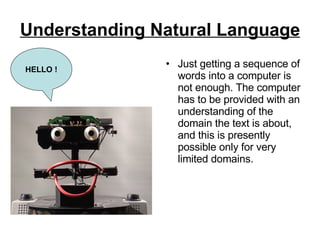
Understanding Natural Language   Just getting a sequence of words into a computer is not enough. The computer has to be provided with an understanding of the domain the text is about, and this is presently possible only for very limited domains.  HELLO !
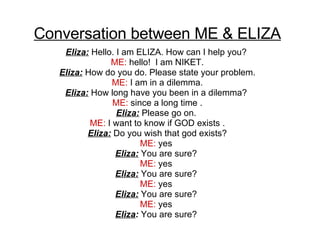
Conversation between ME & ELIZA Eliza:  Hello. I am ELIZA. How can I help you?  ME:  hello!  I am NIKET. Eliza:  How do you do. Please state your problem. ME:  I am in a dilemma. Eliza:  How long have you been in a dilemma?  ME:  since a long time . Eliza:  Please go on.  ME:  I want to know if GOD exists . Eliza:  Do you wish that god exists? ME:  yes  Eliza:  You are sure?  ME:  yes  Eliza:  You are sure?  ME:  yes  Eliza:  You are sure?  ME:  yes  Eliza :  You are sure?
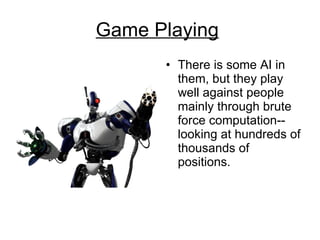
Game Playing   There is some AI in them, but they play well against people mainly through brute force computation--looking at hundreds of thousands of positions.
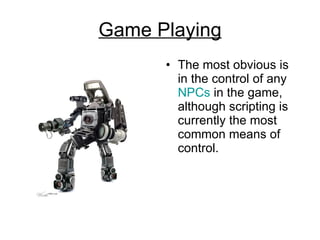
Game Playing The most obvious is in the control of any  NPCs  in the game, although scripting is currently the most common means of control.
Pattern Recognition   For example, a vision program may try to match a pattern of eyes and a nose in a scene in order to find a face. More complex patterns, e.g. in a chess position are also studied. These more complex patterns require quite different methods than do the simple patterns.
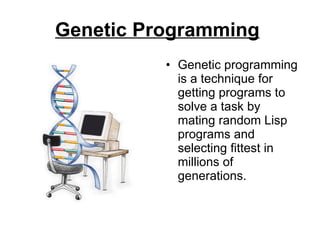
Genetic Programming   Genetic programming is a technique for getting programs to solve a task by mating random Lisp programs and selecting fittest in millions of generations.
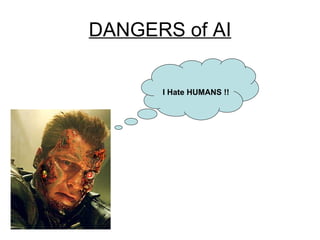
DANGERS of AI I Hate HUMANS !!
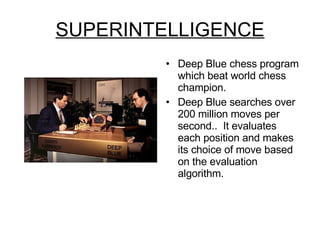
SUPERINTELLIGENCE Deep Blue chess program which beat world chess champion. Deep Blue searches over 200 million moves per second..  It evaluates each position and makes its choice of move based on the evaluation algorithm.
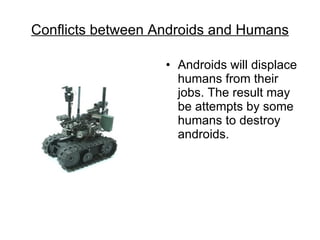
Conflicts between Androids and Humans Androids will displace humans from their jobs. The result may be attempts by some humans to destroy androids.
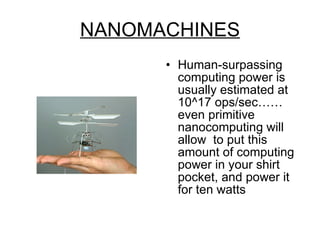
NANOMACHINES Human-surpassing computing power is usually estimated at 10^17 ops/sec…… even primitive nanocomputing will allow  to put this amount of computing power in your shirt pocket, and power it for ten watts
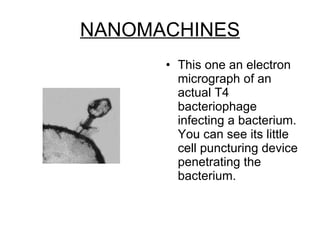
NANOMACHINES This one an electron micrograph of an actual T4 bacteriophage infecting a bacterium. You can see its little cell puncturing device penetrating the bacterium.
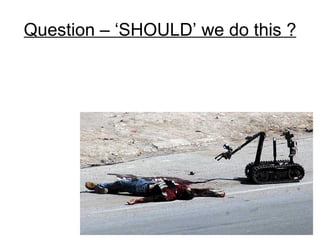
Question – ‘SHOULD’ we do this ?
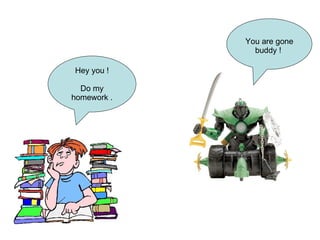
Hey you ! Do my homework . You are gone buddy !
By:  NIKET SINGH THANKS  FOR  LISTENING !

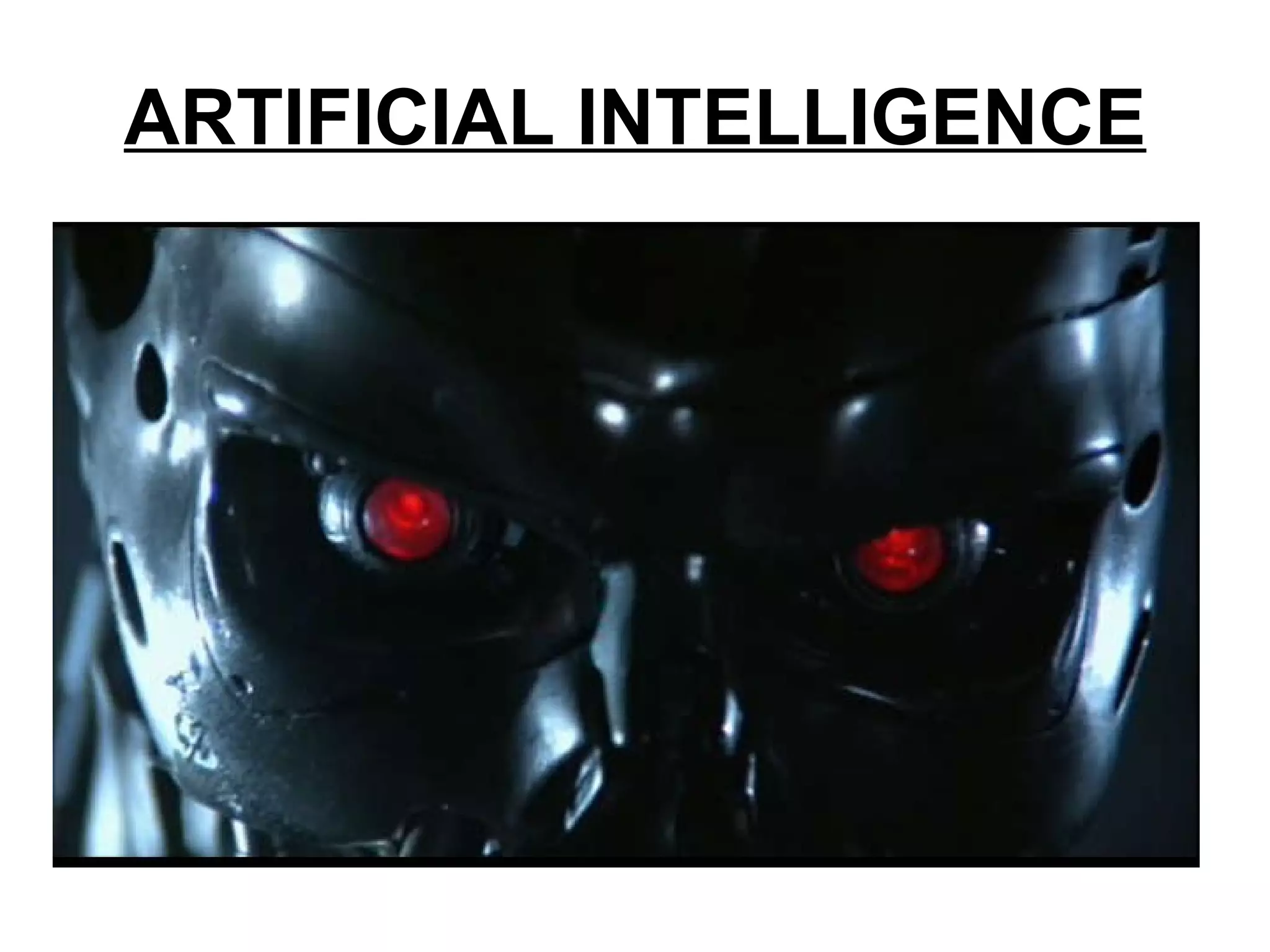
Artificial Intelligence

  • 1.
  • 2.
  • 3.
    INTELLIGENCE !Intelligence is the computational part of the ability to achieve goals in the world. Varying kinds and degrees of intelligence occur in people, many animals and some machines.
  • 4.
    SYNTHETIC INTELLIGENCE Artificialintelligence is “the study and design of intelligent agents .
  • 5.
    INTELLEGENT AGENTS Itis a system that perceives its environment and takes actions which maximize its chances of success. AI can be seen as a realization of an abstract intelligent agent i.e AIAI.
  • 6.
    INTELLEGENT AGENTS Amongthe traits that researchers hope machines will exhibit are reasoning , knowledge , planning , learning , communication , perception and the ability to move and manipulate objects .
  • 7.
  • 8.
    HISTORY In theearly 80s, AI research was revived by the commercial success of expert systems ; applying the knowledge and analytical skills of one or more human experts. By 1985 the market for AI had reached more than a billion dollars.
  • 9.
    A Question- ‘ CAN’ it be done ??
  • 10.
  • 11.
    Deduction, Reasoning, Problemsolving Early AI researchers imitated the process of step-by-step reasoning that human beings use when they solve puzzles, play board games, or make logical deductions. AI research had also developed successful methods for dealing with uncertain or incomplete information.
  • 12.
    Deduction, Reasoning, Problemsolving Human beings solve most of their problems using unconscious reasoning, rather than the conscious, step-by-step deduction that early AI research was able to model. The problem of unconscious problem solving, which forms part of our commonsense reasoning , is largely unsolved.
  • 13.
    Unconscious Knowledge Muchof what people know isn't represented as "facts" or "statements" that they could actually say out loud. They take the form of intuitions or tendencies and are represented in the brain unconsciously. This unconscious knowledge informs, supports and provides a context for our conscious knowledge.
  • 14.
    Unsupervised Learning Finda model that matches a stream of input "experiences", and be able to predict what new "experiences" to expect.
  • 15.
    Motion & Manipulation Intelligence is required for robots to be able to handle such tasks as object manipulation and navigation , with sub-problems of localization (knowing where you are), mapping (learning what is around you) and motion planning (figuring out how to get there).
  • 16.
  • 17.
    Cybernetics & BrainSimulation A number of researchers have explored the connection between neurology , information theory , and cybernetics . Some of them built machines that used electronic networks to exhibit rudimentary intelligence.
  • 18.
    Artificial Neural Networks It consists of an interconnected group of artificial neurons and processes information using a connectionist approach to computation . In most cases an ANN is an adaptive system that changes its structure based on external or internal information that flows through the network during the learning phase.
  • 19.
  • 20.
    Expert Systems An expert system , also known as a knowledge based system, is a computer program that contains the knowledge and analytical skills of one or more human experts, related to a specific subject.
  • 21.
    Expert Systems Themost common form of expert system is a computer program , with a set of rules , that analyzes information about a specific class of problems, and recommends one or more courses of user action. The expert system may also provide mathematical analysis of the problem(s).
  • 22.
    So the answeris This ‘CAN’ be done !!
  • 23.
  • 24.
  • 25.
    Speech Recognition While it is possible to instruct some computers using speech, most users have gone back to the keyboard and the mouse as still more convenient.
  • 26.
    Understanding Natural Language Just getting a sequence of words into a computer is not enough. The computer has to be provided with an understanding of the domain the text is about, and this is presently possible only for very limited domains. HELLO !
  • 27.
    Conversation between ME& ELIZA Eliza: Hello. I am ELIZA. How can I help you? ME: hello! I am NIKET. Eliza: How do you do. Please state your problem. ME: I am in a dilemma. Eliza: How long have you been in a dilemma? ME: since a long time . Eliza: Please go on. ME: I want to know if GOD exists . Eliza: Do you wish that god exists? ME: yes Eliza: You are sure? ME: yes Eliza: You are sure? ME: yes Eliza: You are sure? ME: yes Eliza : You are sure?
  • 28.
    Game Playing There is some AI in them, but they play well against people mainly through brute force computation--looking at hundreds of thousands of positions.
  • 29.
    Game Playing Themost obvious is in the control of any NPCs in the game, although scripting is currently the most common means of control.
  • 30.
    Pattern Recognition For example, a vision program may try to match a pattern of eyes and a nose in a scene in order to find a face. More complex patterns, e.g. in a chess position are also studied. These more complex patterns require quite different methods than do the simple patterns.
  • 31.
    Genetic Programming Genetic programming is a technique for getting programs to solve a task by mating random Lisp programs and selecting fittest in millions of generations.
  • 32.
    DANGERS of AII Hate HUMANS !!
  • 33.
    SUPERINTELLIGENCE Deep Bluechess program which beat world chess champion. Deep Blue searches over 200 million moves per second.. It evaluates each position and makes its choice of move based on the evaluation algorithm.
  • 34.
    Conflicts between Androidsand Humans Androids will displace humans from their jobs. The result may be attempts by some humans to destroy androids.
  • 35.
    NANOMACHINES Human-surpassing computingpower is usually estimated at 10^17 ops/sec…… even primitive nanocomputing will allow to put this amount of computing power in your shirt pocket, and power it for ten watts
  • 36.
    NANOMACHINES This onean electron micrograph of an actual T4 bacteriophage infecting a bacterium. You can see its little cell puncturing device penetrating the bacterium.
  • 37.
  • 38.
    Hey you !Do my homework . You are gone buddy !
  • 39.
    By: NIKETSINGH THANKS FOR LISTENING !