2
Introduction to AI
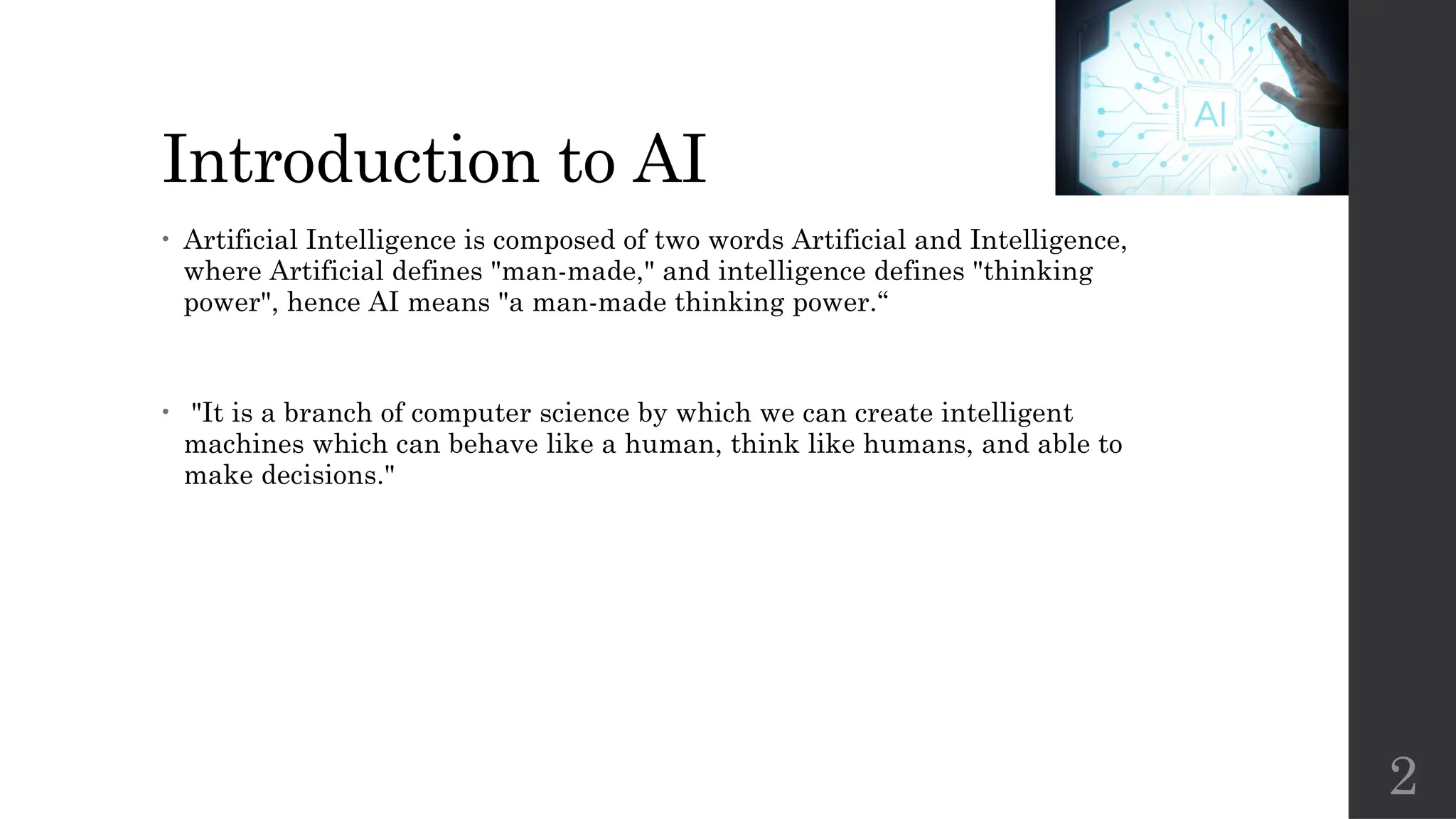
•Artificial Intelligence is composed of two words Artificial and Intelligence,
where Artificial defines "man-made," and intelligence defines "thinking
power", hence AI means "a man-made thinking power.“
• "It is a branch of computer science by which we can create intelligent
machines which can behave like a human, think like humans, and able to
make decisions."
3.
3
Introduction to AI
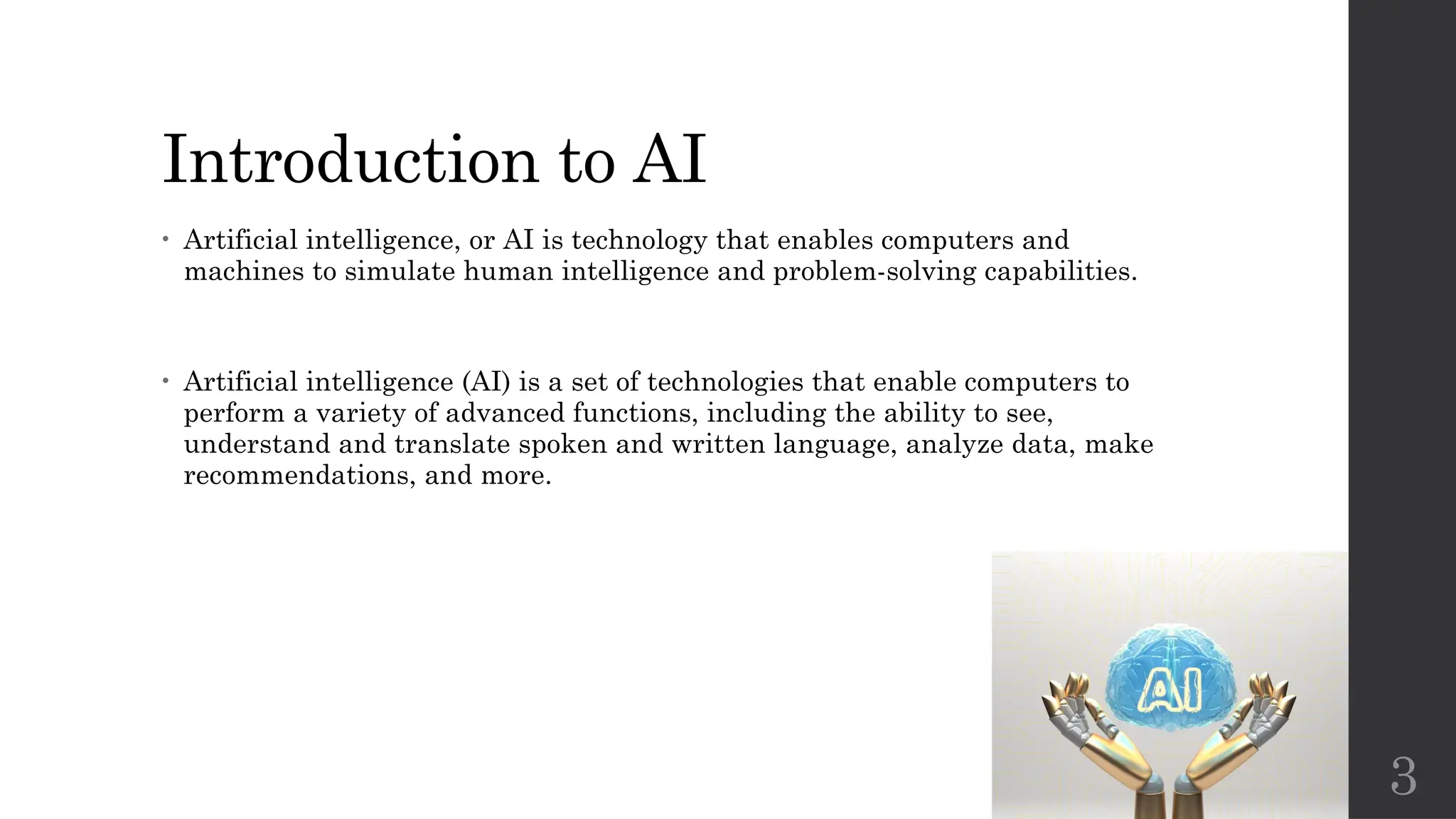
•Artificial intelligence, or AI is technology that enables computers and
machines to simulate human intelligence and problem-solving capabilities.
• Artificial intelligence (AI) is a set of technologies that enable computers to
perform a variety of advanced functions, including the ability to see,
understand and translate spoken and written language, analyze data, make
recommendations, and more.
4.
4
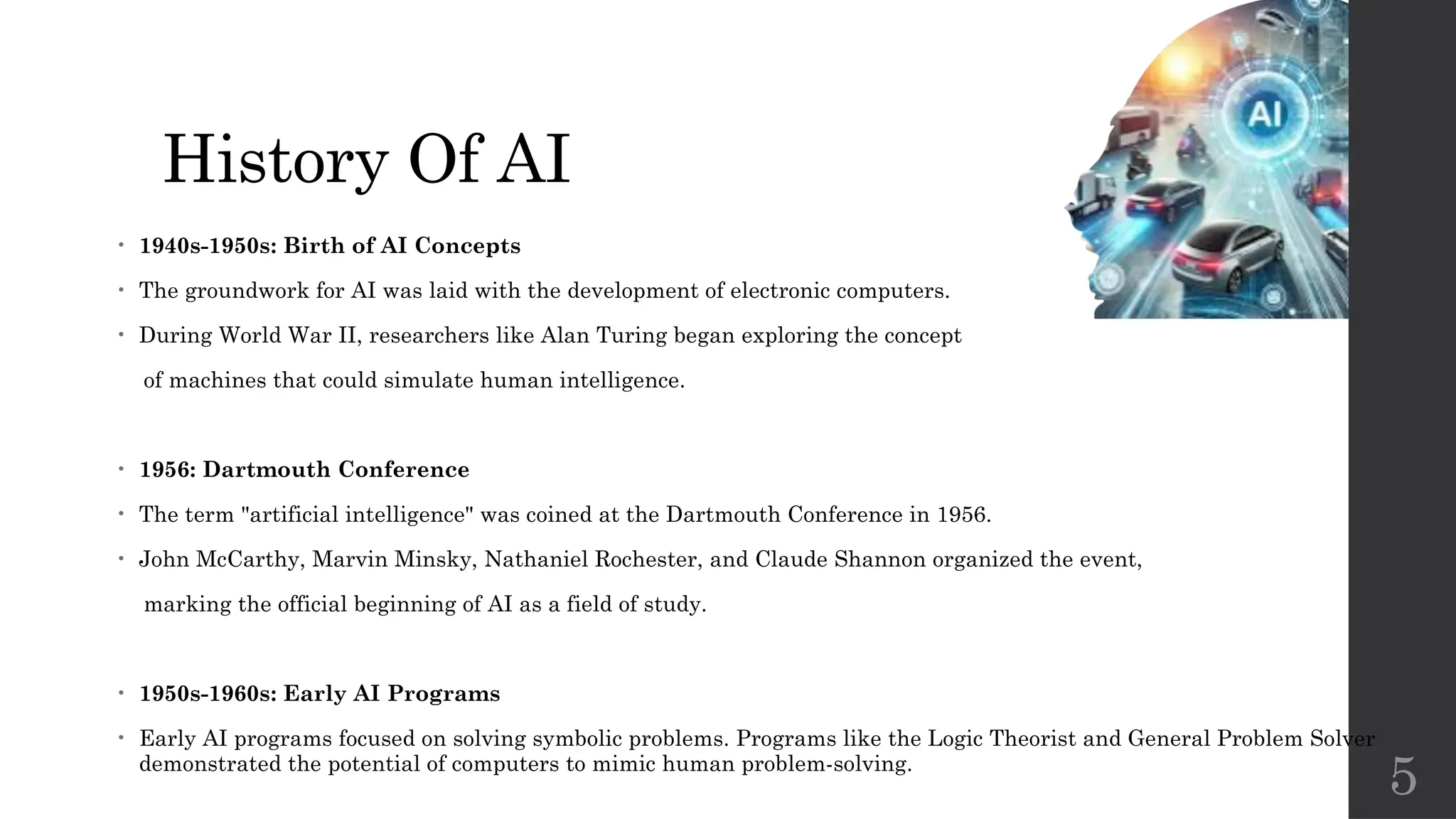
History of AI
•The modern field of AI emerged in the 1950s, when computer scientists and researchers
began exploring the possibility of creating machines that could think, learn, and solve
problems like humans.
• One of the pioneering figures in the field of AI was Alan Turing, a British mathematician
and computer scientist, who in 1950 proposed the Turing test, a method for determining
whether a machine can exhibit intelligent behavior very similar to a human.
• This sparked a wave of research and development in AI, with scientists and researchers
working to create machines that could perform tasks such as playing chess, solving
mathematical problems, and understanding natural language.
5.
5
History Of AI
•1940s-1950s: Birth of AI Concepts
• The groundwork for AI was laid with the development of electronic computers.
• During World War II, researchers like Alan Turing began exploring the concept
of machines that could simulate human intelligence.
• 1956: Dartmouth Conference
• The term "artificial intelligence" was coined at the Dartmouth Conference in 1956.
• John McCarthy, Marvin Minsky, Nathaniel Rochester, and Claude Shannon organized the event,
marking the official beginning of AI as a field of study.
• 1950s-1960s: Early AI Programs
• Early AI programs focused on solving symbolic problems. Programs like the Logic Theorist and General Problem Solver
demonstrated the potential of computers to mimic human problem-solving.
6.
6
History Of AI
•1960s-1970s: Expert Systems
• AI research shifted towards expert systems, which were rule-based programs designed to
mimic human expertise in specific domains. The Dendral project, focused on chemical
analysis, and MYCIN, for medical diagnosis, were notable examples.
• 1980s: AI Winter
• Funding and interest in AI waned during the 1980s due to unmet expectations and
overpromising. This period became known as the "AI Winter.
• Over the years, funding for AI initiatives has gone through a number of active and inactive
cycles. The label winter is used to describe dormant periods when customer interest in AI
declines. Use of the season winter to describe the resulting downturn emphasizes the idea that
the quiet period will be a temporary state, followed again by growth and renewed interest.
7.
7
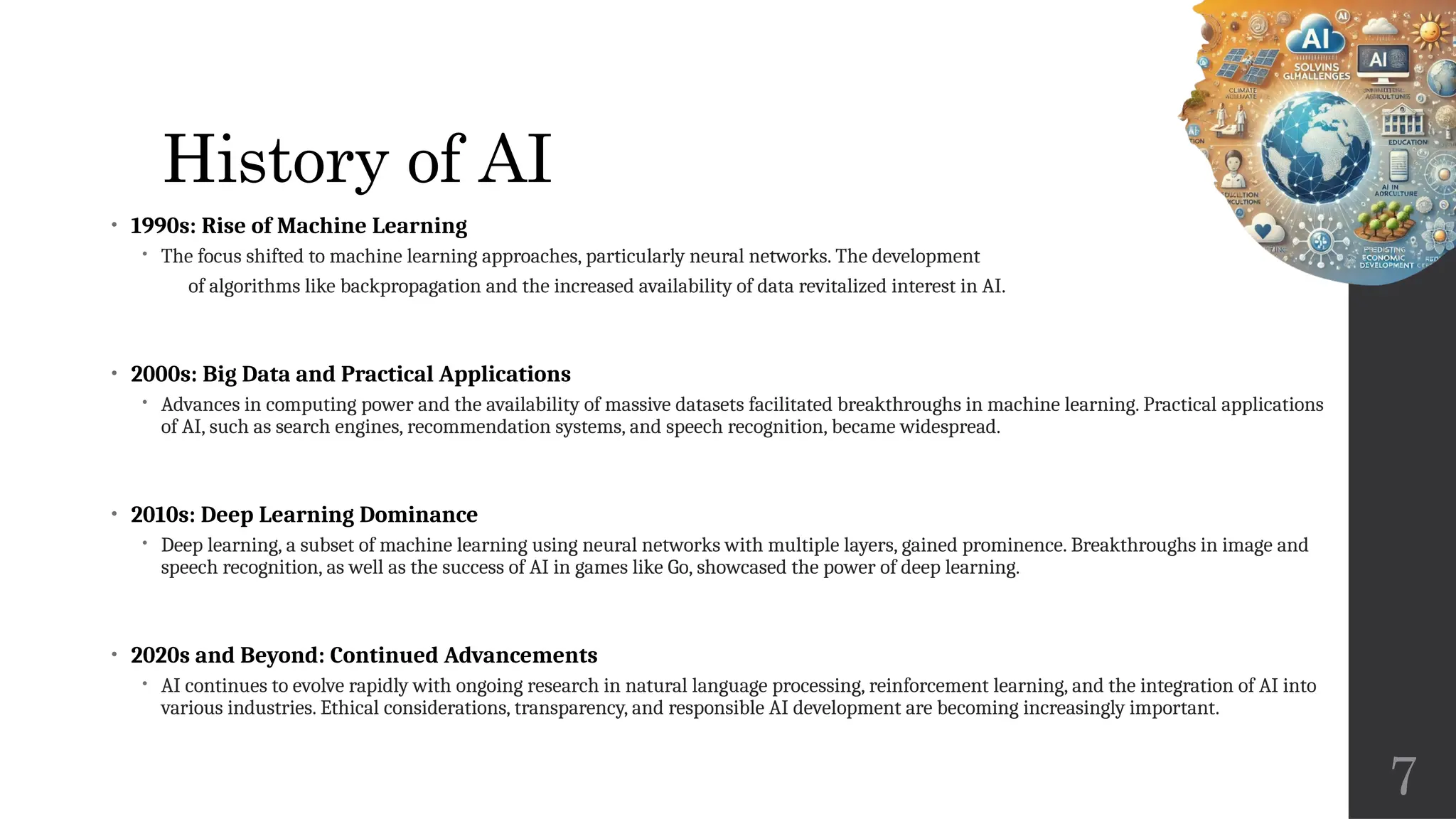
History of AI
•1990s: Rise of Machine Learning
The focus shifted to machine learning approaches, particularly neural networks. The development
of algorithms like backpropagation and the increased availability of data revitalized interest in AI.
• 2000s: Big Data and Practical Applications
Advances in computing power and the availability of massive datasets facilitated breakthroughs in machine learning. Practical applications
of AI, such as search engines, recommendation systems, and speech recognition, became widespread.
• 2010s: Deep Learning Dominance
Deep learning, a subset of machine learning using neural networks with multiple layers, gained prominence. Breakthroughs in image and
speech recognition, as well as the success of AI in games like Go, showcased the power of deep learning.
• 2020s and Beyond: Continued Advancements
AI continues to evolve rapidly with ongoing research in natural language processing, reinforcement learning, and the integration of AI into
various industries. Ethical considerations, transparency, and responsible AI development are becoming increasingly important.
8.
8
Why AI?
• Withthe help of AI, you can create such software or devices which can solve
real-world problems very easily and with accuracy such as health issues,
marketing, traffic issues, etc.
• With the help of AI, you can create your personal virtual Assistant, such as
Cortana, Google Assistant, Siri, etc.
• With the help of AI, you can build such Robots which can work in an
environment where survival of humans can be at risk.
• AI opens a path for other new technologies, new devices, and new
Opportunities.
9.
9
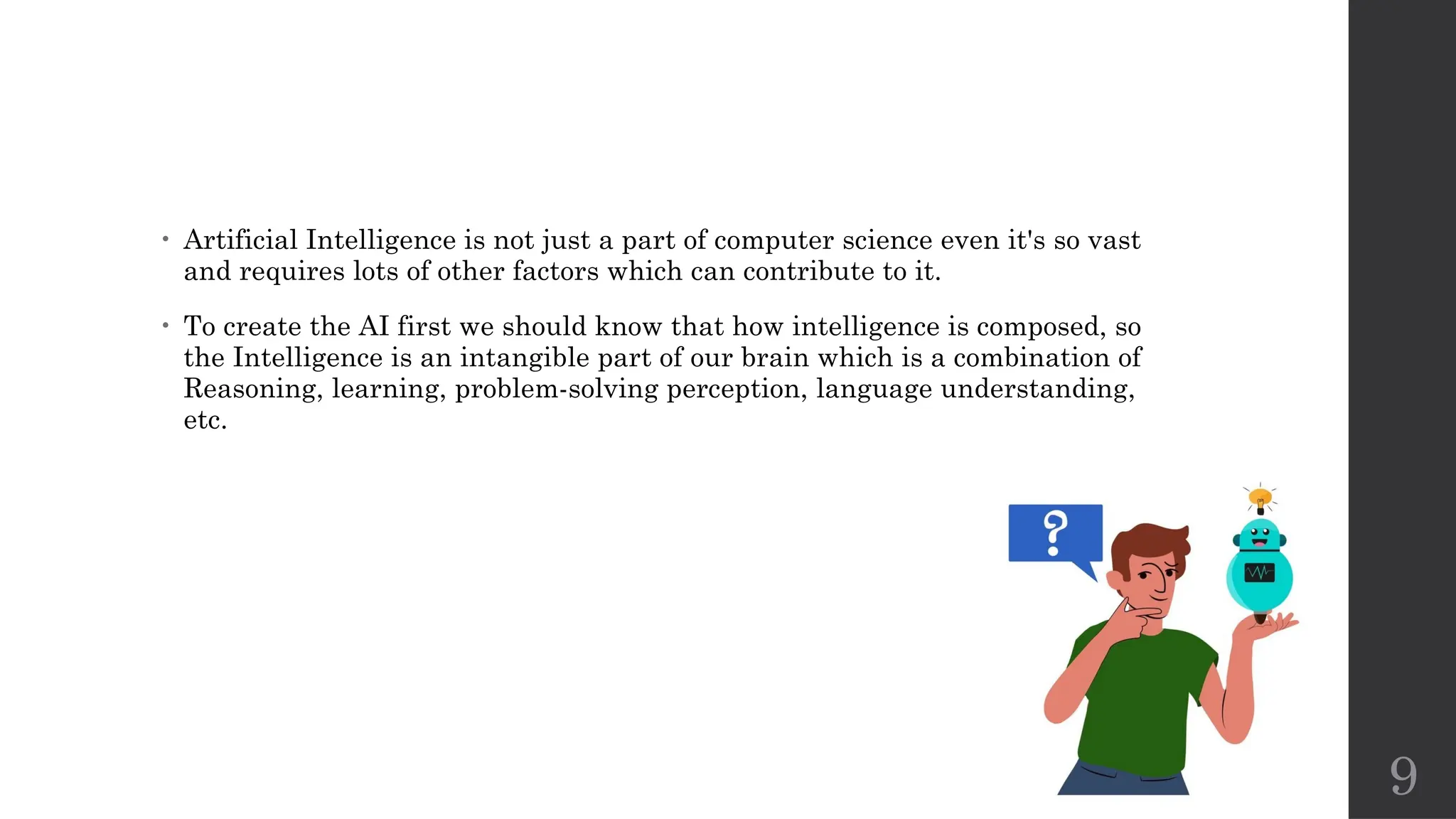
• Artificial Intelligenceis not just a part of computer science even it's so vast
and requires lots of other factors which can contribute to it.
• To create the AI first we should know that how intelligence is composed, so
the Intelligence is an intangible part of our brain which is a combination of
Reasoning, learning, problem-solving perception, language understanding,
etc.
10.
10
Key concepts ofAI
• Machine Learning (ML): A subset of AI that involves training algorithms to learn from
data and make predictions or decisions. ML models improve their performance over
time as they are exposed to more data.
• Natural Language Processing (NLP): The ability of AI to understand, interpret, and
generate human language.
• Computer Vision: The capability of AI to interpret and understand visual information
from the world, such as images and videos. This is used in facial recognition,
autonomous vehicles, and medical imaging.
11.
11
Key concepts ofAI
• Robotics: The branch of AI that deals with the design and creation of robots.
These robots can perform tasks autonomously or semi-autonomously, often
in environments that are dangerous or inaccessible to humans.
• Deep Learning: A specialized form of machine learning that uses neural
networks with many layers (hence "deep") to analyze complex patterns in
data. Deep learning is particularly effective in tasks like image and speech
recognition.
12.
12
Types of AI
Basedon Capabilities
1. Weak AI or Narrow AI:
• Narrow AI, also known as Weak AI, is like a specialist in the world of Artificial
Intelligence. Imagine it as a virtual expert dedicated to performing one specific task
with intelligence.
• For example, think of Apple's Siri. It's pretty smart when it comes to voice commands
and answering questions, but it doesn't understand or do much beyond that. Narrow AI
operates within strict limits, and if you ask it to step outside its comfort zone, it might
not perform as expected. This type of AI is everywhere in today's world, from self-
driving cars to image recognition on your smartphone.
13.
13
Types of AI
2.General AI:
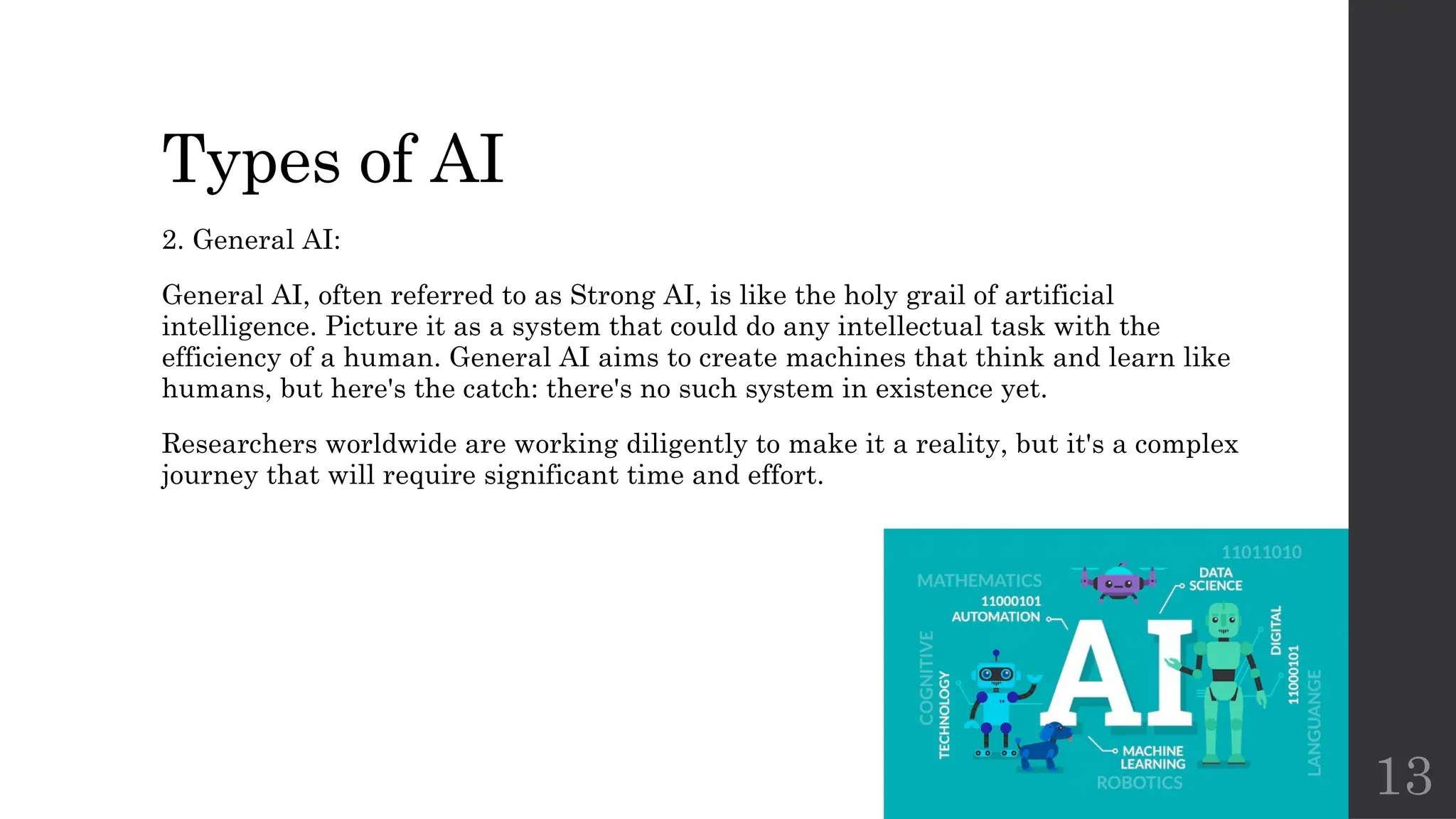
General AI, often referred to as Strong AI, is like the holy grail of artificial
intelligence. Picture it as a system that could do any intellectual task with the
efficiency of a human. General AI aims to create machines that think and learn like
humans, but here's the catch: there's no such system in existence yet.
Researchers worldwide are working diligently to make it a reality, but it's a complex
journey that will require significant time and effort.
14.
14
Types of AI
3.Super AI:
Super AI takes AI to another level entirely. It's the pinnacle of machine
intelligence, where machines surpass human capabilities in every cognitive
aspect. These machines can think, reason, solve puzzles, make judgments,
plan, learn, and communicate independently.
However, it's important to note that Super AI is currently a hypothetical
concept. Achieving such a level of artificial intelligence would be nothing short
of revolutionary, and it's a challenge that's still on the horizon.
15.
15
AI applications acrossindustries
Healthcare
• Drug discovery: Accelerating the process of finding new drugs by
analyzing vast datasets.
• Medical imaging: Improving accuracy in diagnosing diseases like cancer
through image analysis.
• Personalized medicine: By analyzing genomic data, integrating patient
information, and utilizing predictive analytics, AI enables the creation of
customized treatment plans that enhance efficiancy and minimize side
effects.
• This approach considers a patient’s unique genetic makeup, lifestyle, and
health history to select the most effective therapies, adjust dosages
accurately, and anticipate potential health issues.
16.
16
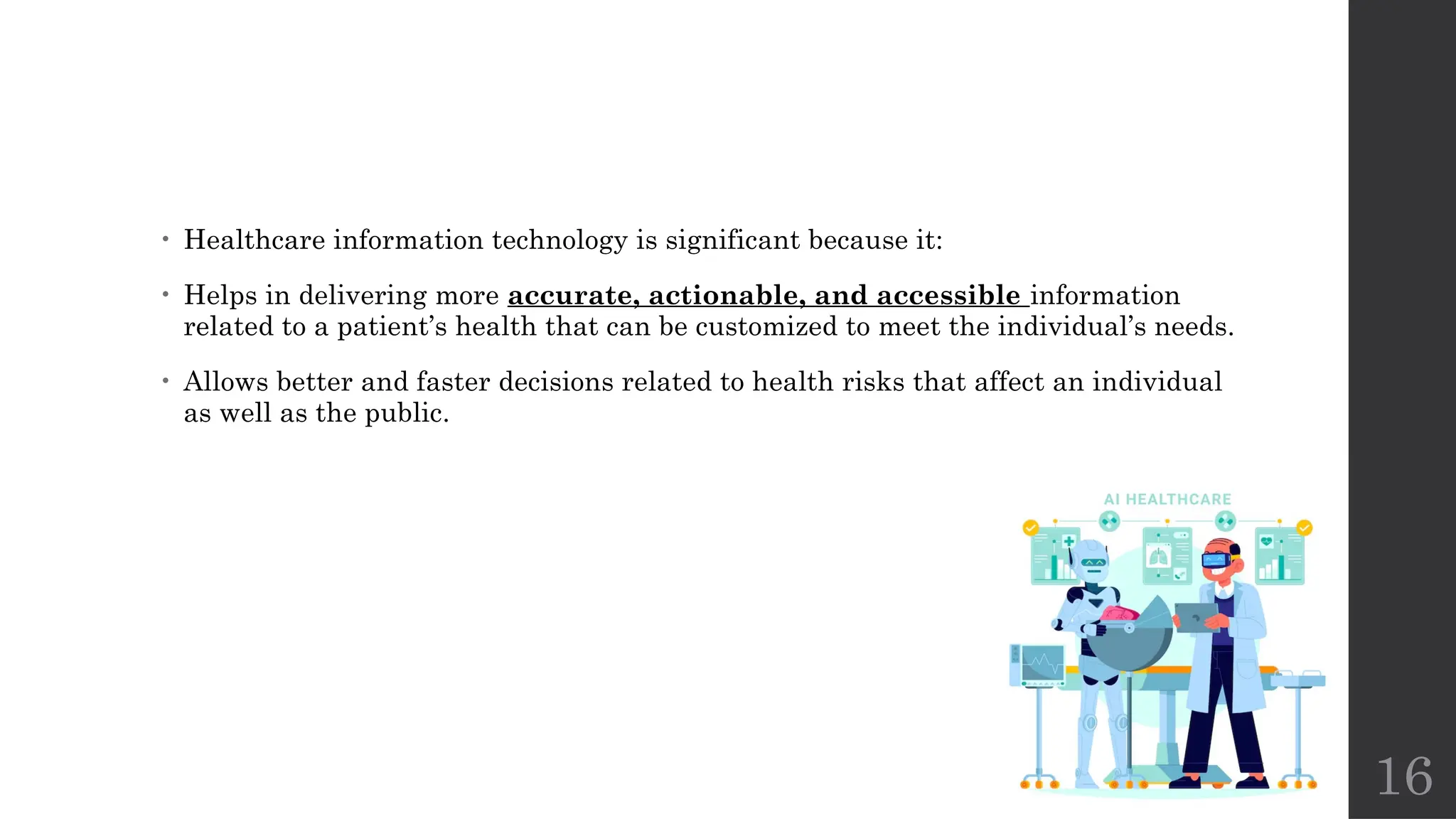
• Healthcare informationtechnology is significant because it:
• Helps in delivering more accurate, actionable, and accessible information
related to a patient’s health that can be customized to meet the individual’s needs.
• Allows better and faster decisions related to health risks that affect an individual
as well as the public.
17.
17
• EHR analysis:
•AI analyzes EHR data to identify patterns and trends, predict disease risks
and enable personalized prevention strategies. It examines medical history,
lifestyle, and genetic information to forecast risks such as diabetes or heart
disease and identifies patterns in medication data to prevent adverse drug
reactions.
18.
18
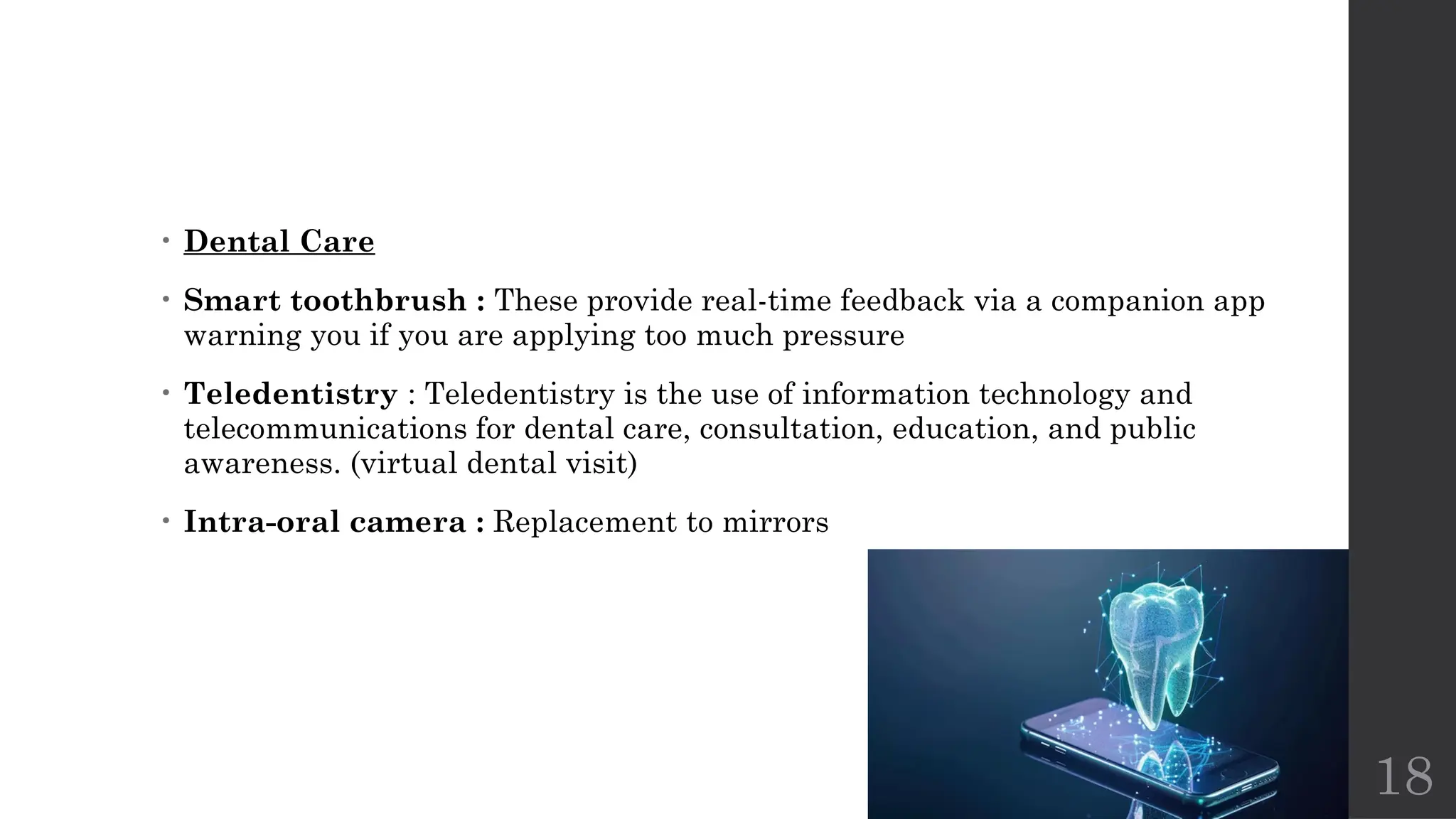
• Dental Care
•Smart toothbrush : These provide real-time feedback via a companion app
warning you if you are applying too much pressure
• Teledentistry : Teledentistry is the use of information technology and
telecommunications for dental care, consultation, education, and public
awareness. (virtual dental visit)
• Intra-oral camera : Replacement to mirrors
19.
19
Retail and E-commerce
AIscrutinizes customer behavior, preferences, and purchase history, offering
tailored product suggestions based on individualized insights. This enhances
the shopping experience, increases customer engagement, and boosts sales by
presenting items tailored to individual tastes
Dynamic pricing optimization: Retailers use AI algorithms to analyze real-
time market conditions, competitor pricing, and customer demand. This
enables dynamic pricing adjustments, ensuring optimal pricing strategies to
remain competitive, maximize profits, and respond to market fluctuations
effectively.
20.
20
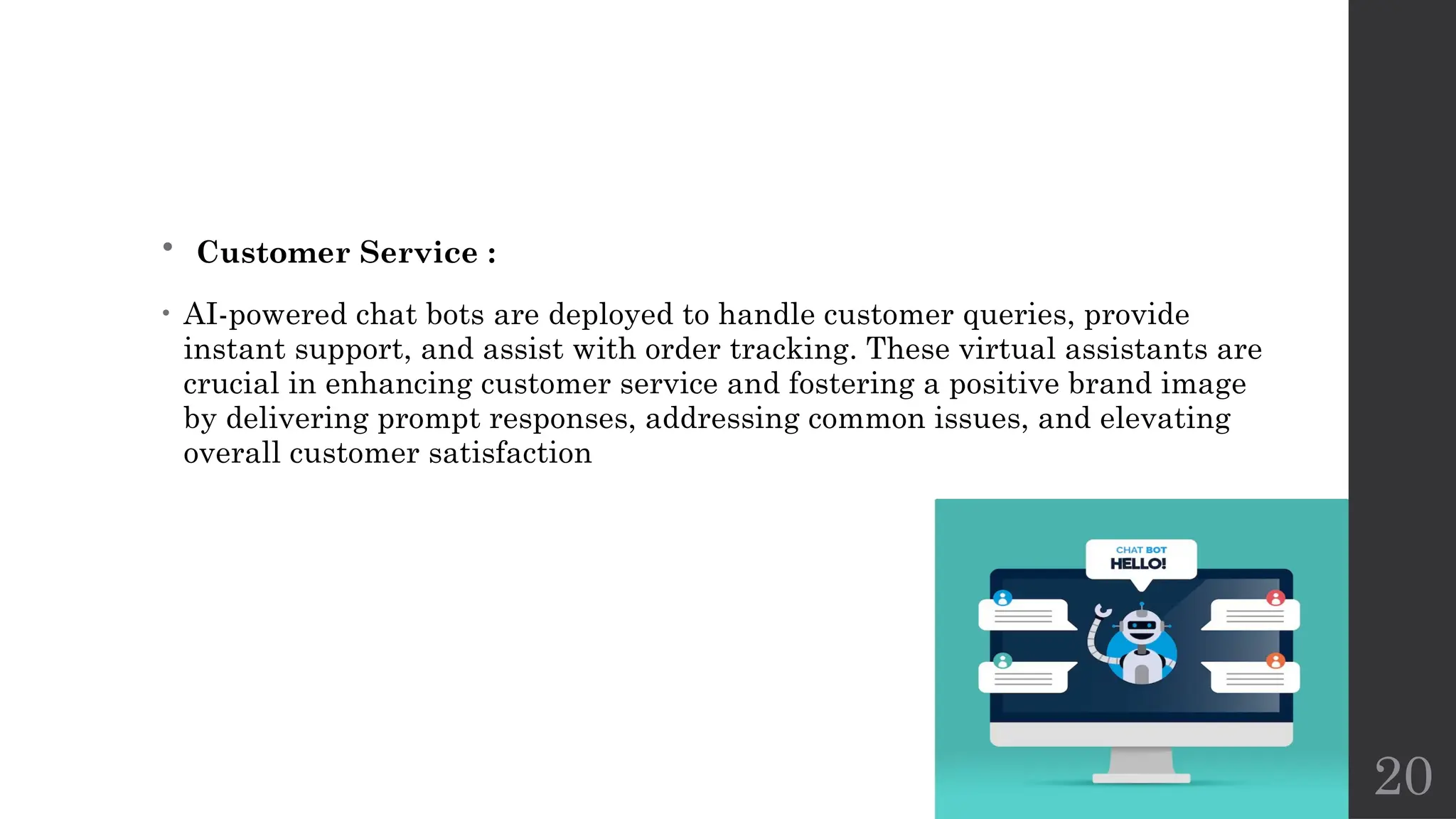
• Customer Service:
• AI-powered chat bots are deployed to handle customer queries, provide
instant support, and assist with order tracking. These virtual assistants are
crucial in enhancing customer service and fostering a positive brand image
by delivering prompt responses, addressing common issues, and elevating
overall customer satisfaction
21.
21
• Customer Segmentation:
• AI algorithms analyze vast datasets to identify patterns and similarities
among customers, enabling retailers to create targeted marketing campaigns
and personalized product recommendations tailored to each segment. This
approach enhances customer engagement, increases conversion rates, and
drives revenue growth by delivering relevant content and offers that resonate
with specific customer groups, ultimately optimizing the shopping experience
and fostering customer loyalty.
22.
22
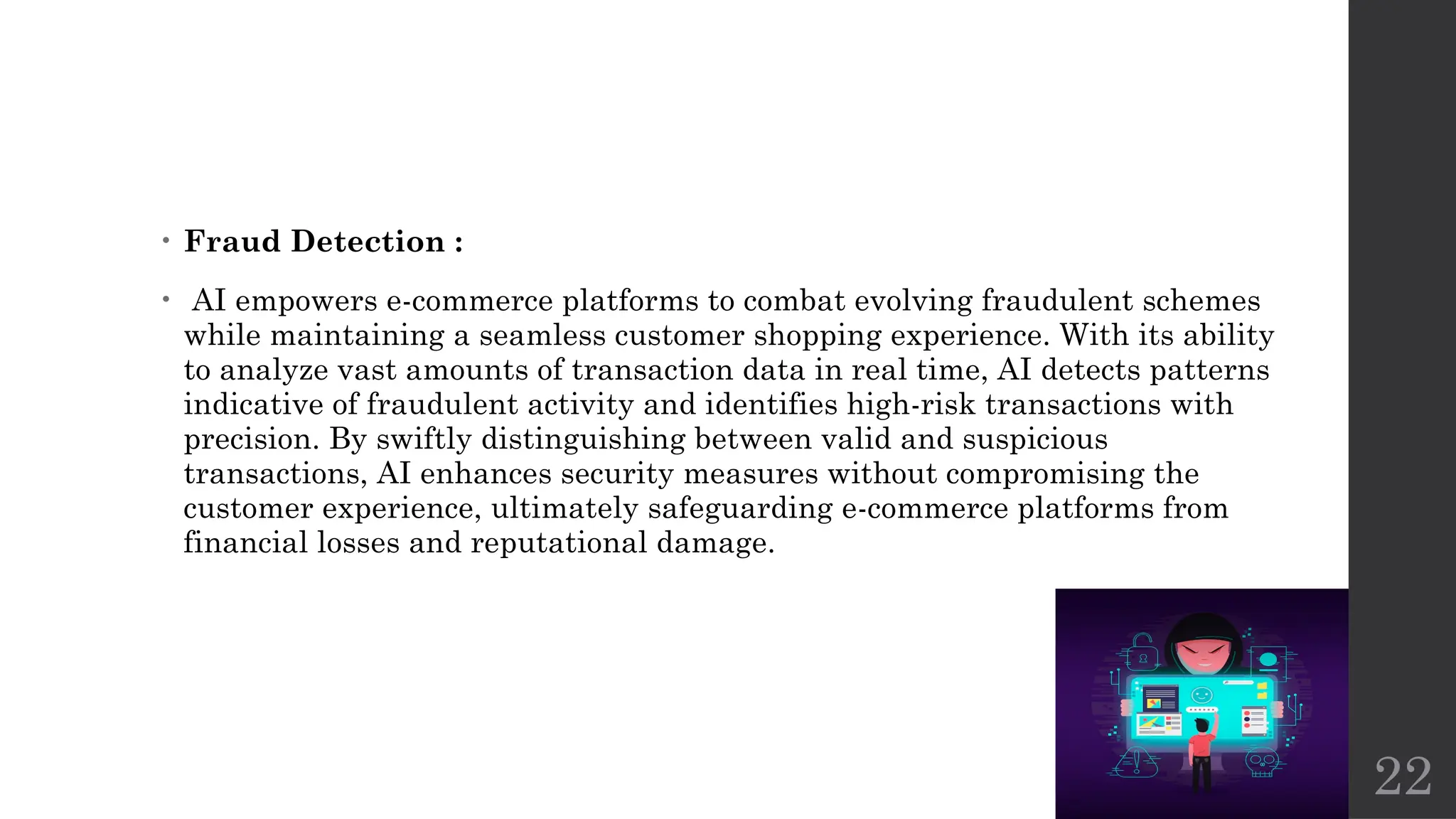
• Fraud Detection:
• AI empowers e-commerce platforms to combat evolving fraudulent schemes
while maintaining a seamless customer shopping experience. With its ability
to analyze vast amounts of transaction data in real time, AI detects patterns
indicative of fraudulent activity and identifies high-risk transactions with
precision. By swiftly distinguishing between valid and suspicious
transactions, AI enhances security measures without compromising the
customer experience, ultimately safeguarding e-commerce platforms from
financial losses and reputational damage.
23.
23
• Media &Entertainment :
• AI in game design and gameplay: AI elevates game design by improving
Non-player Characters (NPCs) and refining mechanics, creating realistic and
challenging levels that enhance the player’s experience. AI creates formidable
opponents for heightened immersion in gameplay and generates procedural
content, including new levels and characters, ensuring a consistently fresh
and engaging gaming journey.
• Social media: Social media platforms like Facebook, Instagram, Snapchat
leverage various AI technologies, from analytics to computer vision, to deliver
more personalized products and services to their users. AI enhances user
experience by tailoring content, advertisements, and recommendations based
on individual preferences and behaviors. Also, AI-driven algorithms help
these platforms detect and mitigate harmful content, ensuring a safer and
more engaging user environment.
24.
24
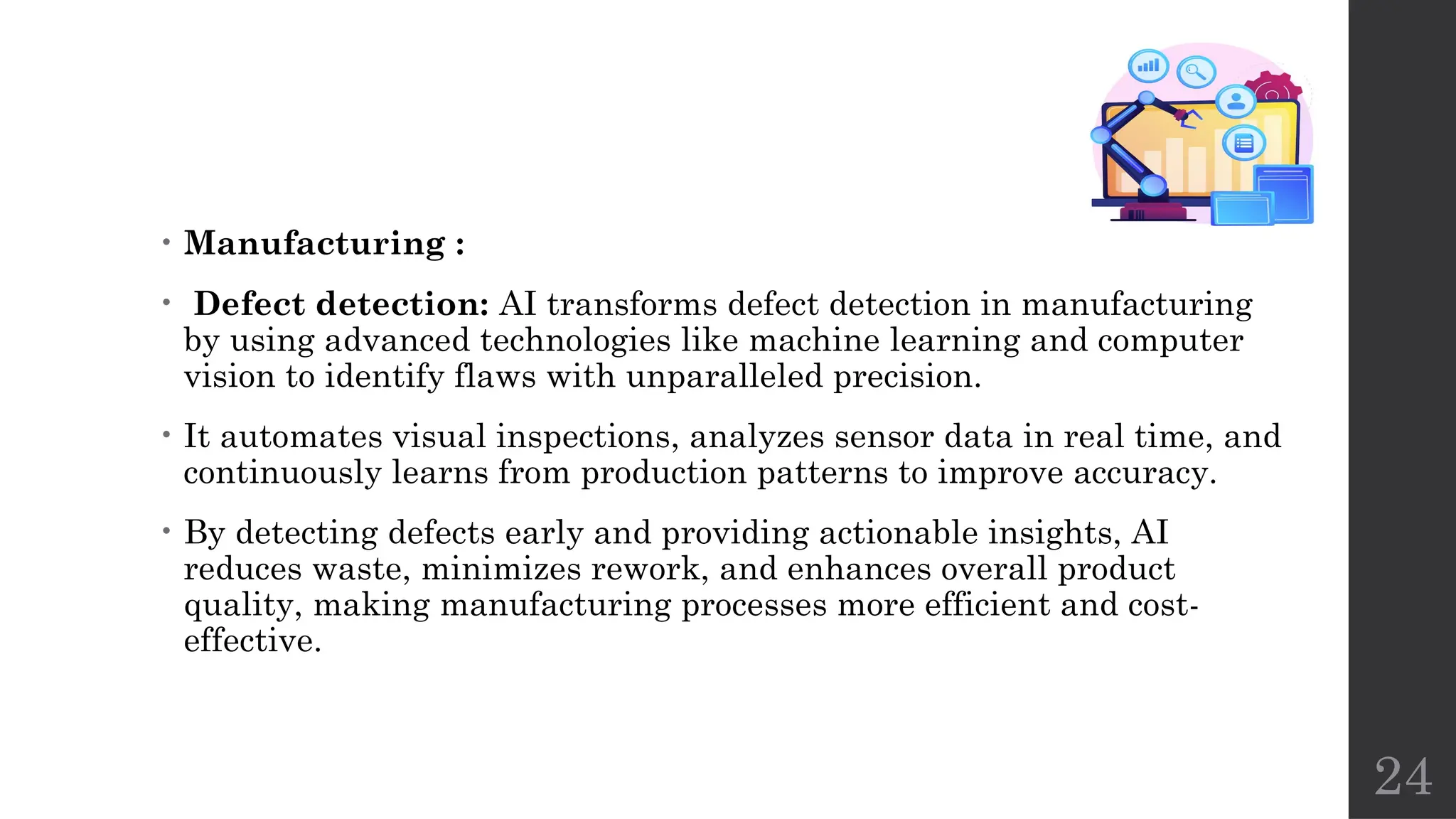
• Manufacturing :
•Defect detection: AI transforms defect detection in manufacturing
by using advanced technologies like machine learning and computer
vision to identify flaws with unparalleled precision.
• It automates visual inspections, analyzes sensor data in real time, and
continuously learns from production patterns to improve accuracy.
• By detecting defects early and providing actionable insights, AI
reduces waste, minimizes rework, and enhances overall product
quality, making manufacturing processes more efficient and cost-
effective.
25.
25
• Predictive analytics:
•AI algorithms predict equipment failures by analyzing sensor data and maintenance
records, enabling proactive scheduling of maintenance activities.
• This predictive approach minimizes unplanned downtime, reduces maintenance costs,
and optimizes production uptime, enhancing overall equipment effectiveness and
operational efficiency.
26.
26
• Education :
•Intelligent tutoring: AI-driven tutoring systems offer personalized
guidance and feedback, elevating the learning experience for students.
These systems adapt to individual learning styles, providing targeted
assistance and enhancing understanding in various subjects.
• Automated grading: AI algorithms streamline the grading process,
automating assessments for assignments, quizzes, and exams. This
saves educators valuable time and ensures prompt and consistent
feedback for students, fostering a more efficient learning environment.
27.
27
• Hospitality :
•Personalized recommendations : AI algorithms can analyze customer
preferences, past bookings, and browsing behavior to provide personalized
recommendations for accommodations, dining options, and activities,
enhancing the overall guest experience.
• Revenue management: AI can analyze market trends, historical data, and
demand patterns to optimize pricing strategies, maximize room occupancy
rates, and increase revenue for hotels and resorts.
28.
28
Current State ofAI
• Generative AI dominance: The rise of models like GPT-4 has showcased the
potential of AI in generating human-quality text, images, and code.
• Increased adoption: AI is being integrated into various sectors, from healthcare to
finance, driving efficiency and innovation.
• Focus on specialization: While general-purpose AI is advancing, there's a growing
emphasis on developing AI models tailored to specific tasks and industries.
• Ethical considerations: Concerns about bias, privacy, and job displacement are
prompting discussions on responsible AI development.
29.
29
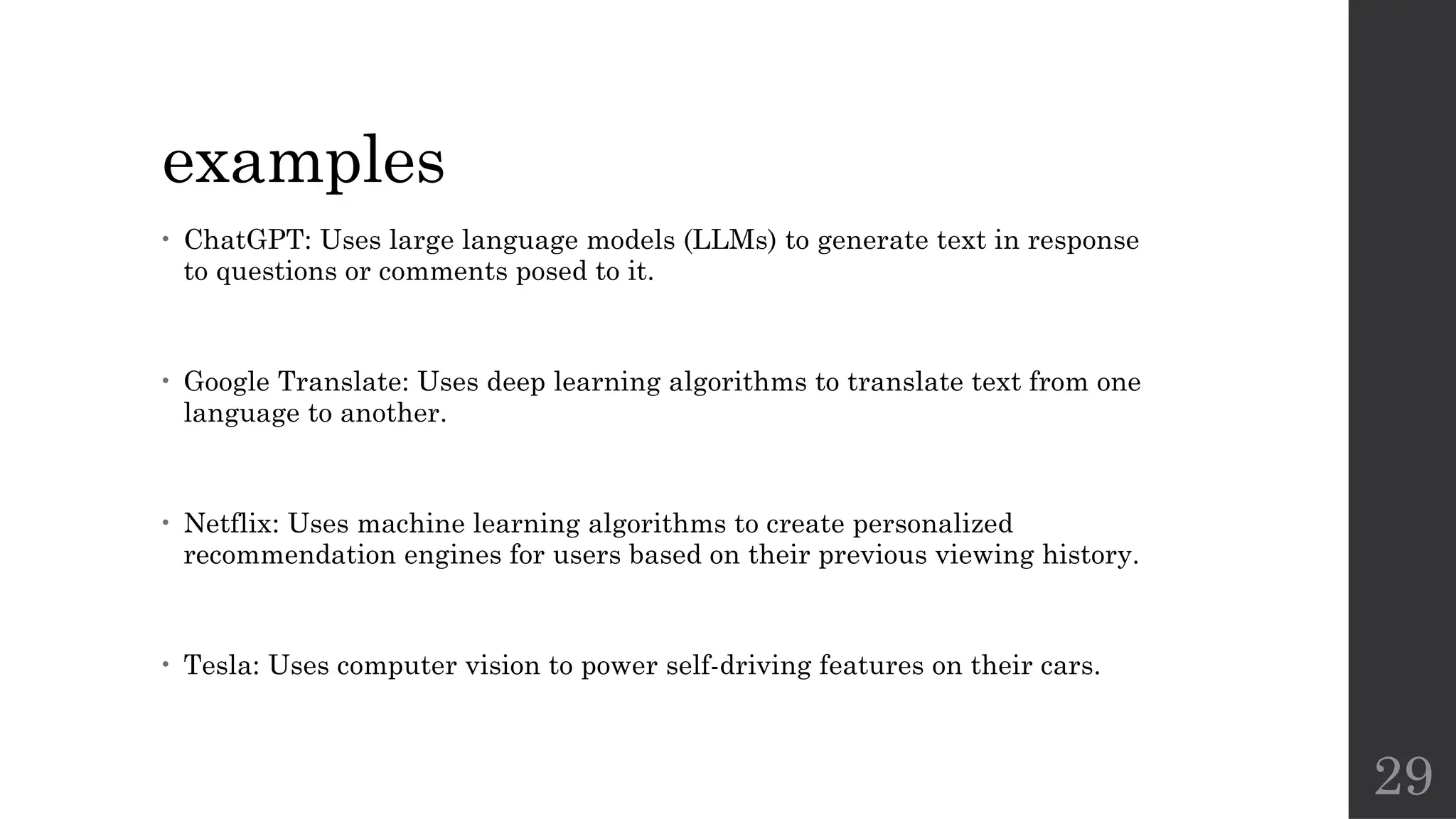
examples
• ChatGPT: Useslarge language models (LLMs) to generate text in response
to questions or comments posed to it.
• Google Translate: Uses deep learning algorithms to translate text from one
language to another.
• Netflix: Uses machine learning algorithms to create personalized
recommendation engines for users based on their previous viewing history.
• Tesla: Uses computer vision to power self-driving features on their cars.
30.
30
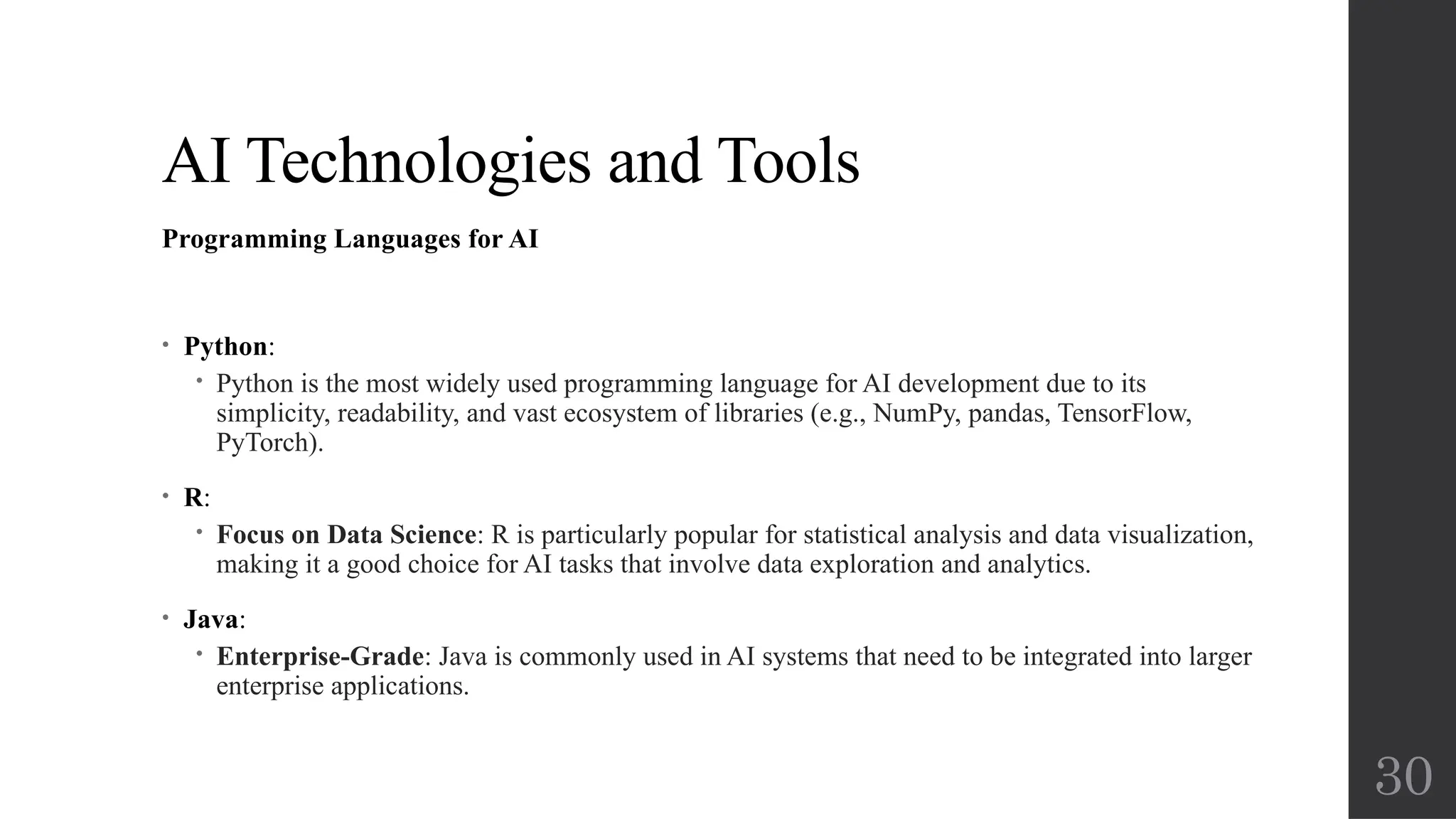
AI Technologies andTools
Programming Languages for AI
• Python:
Python is the most widely used programming language for AI development due to its
simplicity, readability, and vast ecosystem of libraries (e.g., NumPy, pandas, TensorFlow,
PyTorch).
• R:
Focus on Data Science: R is particularly popular for statistical analysis and data visualization,
making it a good choice for AI tasks that involve data exploration and analytics.
• Java:
Enterprise-Grade: Java is commonly used in AI systems that need to be integrated into larger
enterprise applications.
31.
31
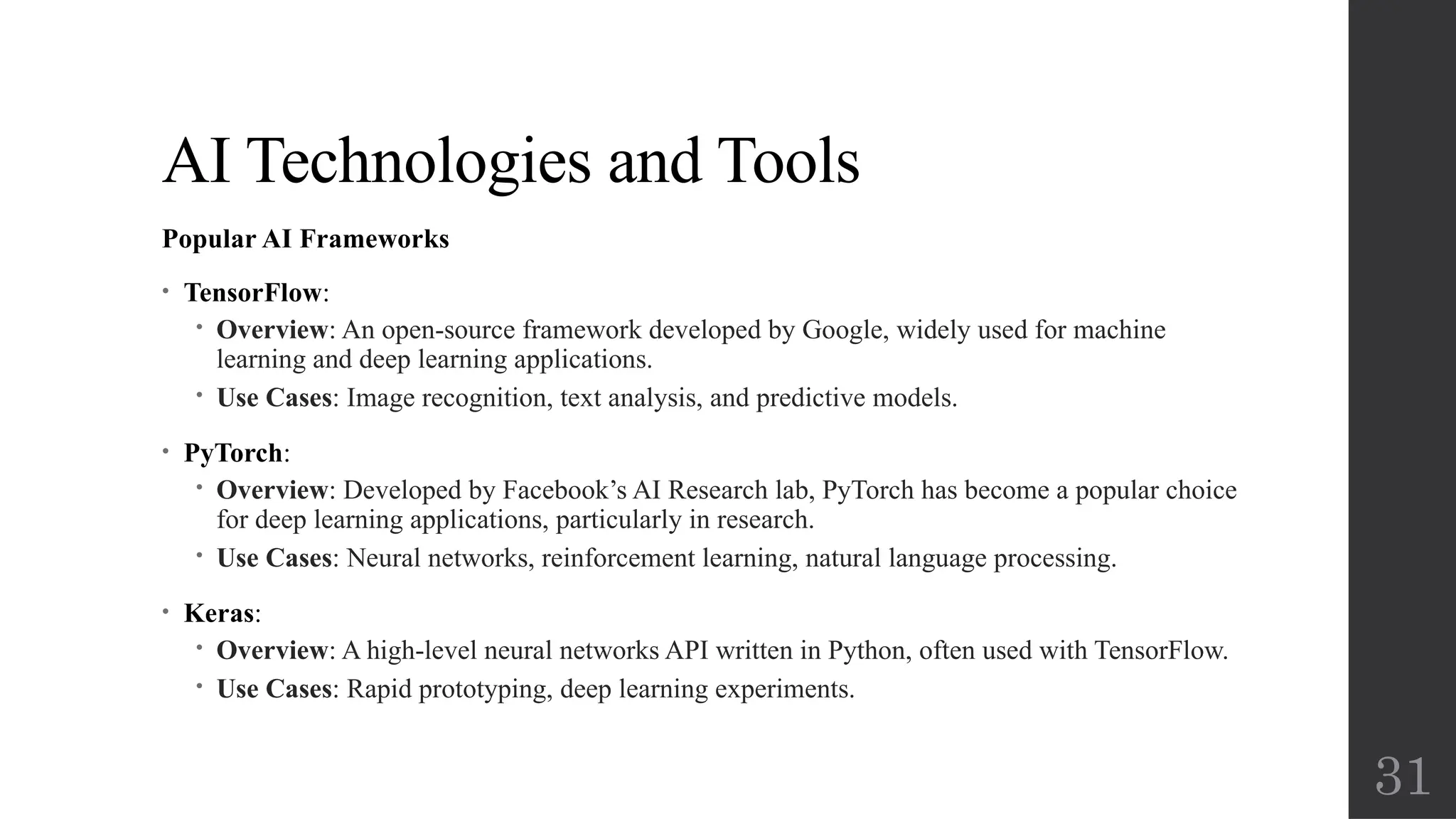
AI Technologies andTools
Popular AI Frameworks
• TensorFlow:
Overview: An open-source framework developed by Google, widely used for machine
learning and deep learning applications.
Use Cases: Image recognition, text analysis, and predictive models.
• PyTorch:
Overview: Developed by Facebook’s AI Research lab, PyTorch has become a popular choice
for deep learning applications, particularly in research.
Use Cases: Neural networks, reinforcement learning, natural language processing.
• Keras:
Overview: A high-level neural networks API written in Python, often used with TensorFlow.
Use Cases: Rapid prototyping, deep learning experiments.
32.
32
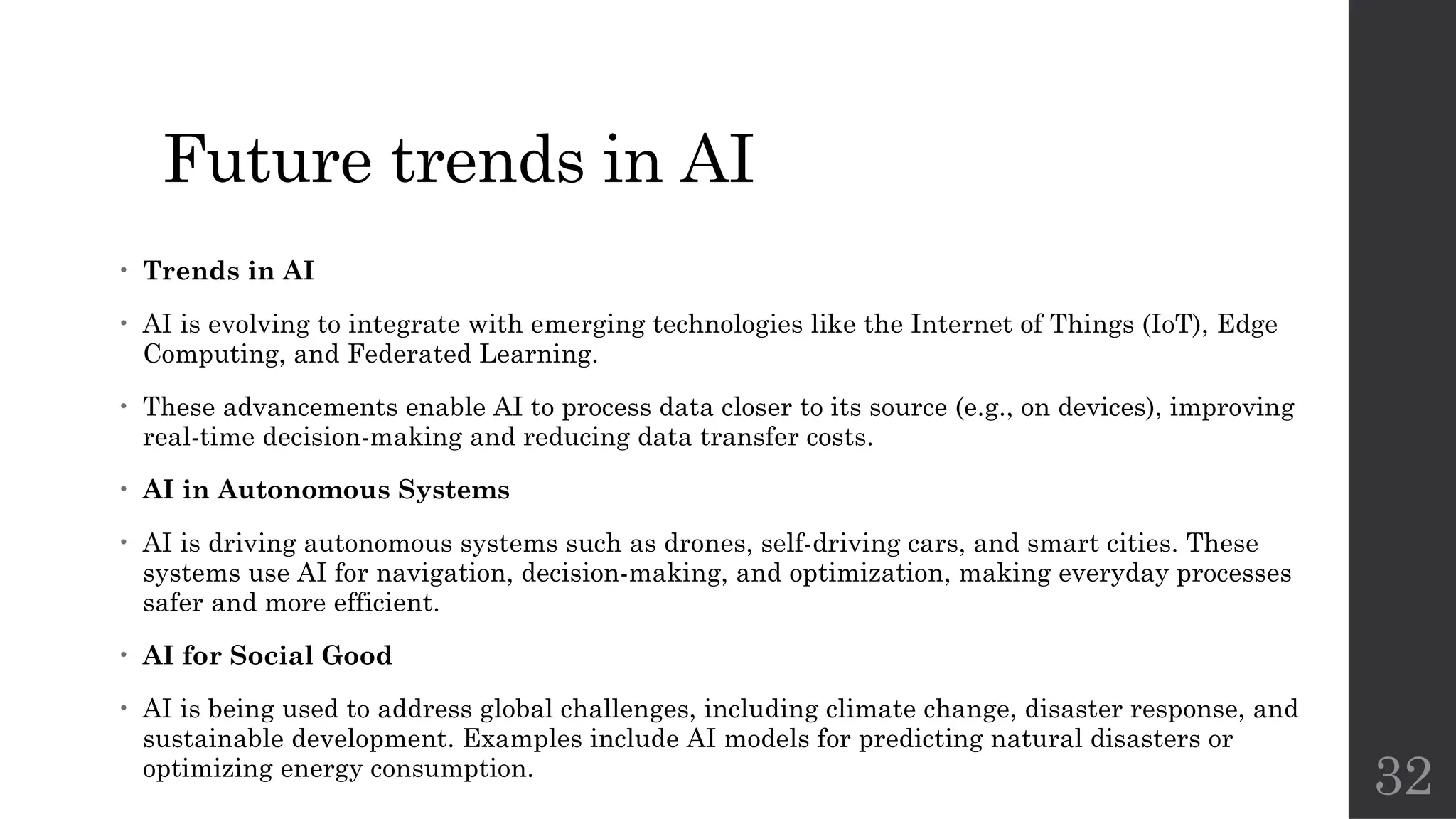
Future trends inAI
• Trends in AI
• AI is evolving to integrate with emerging technologies like the Internet of Things (IoT), Edge
Computing, and Federated Learning.
• These advancements enable AI to process data closer to its source (e.g., on devices), improving
real-time decision-making and reducing data transfer costs.
• AI in Autonomous Systems
• AI is driving autonomous systems such as drones, self-driving cars, and smart cities. These
systems use AI for navigation, decision-making, and optimization, making everyday processes
safer and more efficient.
• AI for Social Good
• AI is being used to address global challenges, including climate change, disaster response, and
sustainable development. Examples include AI models for predicting natural disasters or
optimizing energy consumption.
33.
33
Future trends inAI
• AI in space Exploration
• AI technologies are being utilized for space exploration by NASA, SpaceX, and other
agencies. AI helps in mission planning, spacecraft navigation, and data analysis from
space missions.
• Human-AI Collaboration
• The future of AI involves working alongside humans to augment creativity, enhance
productivity, and solve complex problems. AI systems will assist rather than replace
human decision-making, providing valuable tools for various industries.
34.
34
Future trends inAI
• Evolution of AI: From basic rule-based systems to advanced deep learning
and NLP, AI has revolutionized industries and everyday life.
• Career & Opportunities: AI offers vast career potential in machine
learning, robotics, healthcare, and emerging fields like quantum computing
and AI ethics.
• Impact on Society: AI is transforming sectors like healthcare, finance, and
transportation, but poses challenges around privacy, job displacement, and
ethics.
• Future of AI: AI’s continued growth promises greater innovation,
automation, and societal change, demanding responsible development and
regulation.
35.
35
Advantages of AI
•High Accuracy with less errors: AI machines or systems are prone to less errors and
high accuracy as it takes decisions as per pre-experience or information.
• High-Speed: AI systems can be of very high-speed and fast-decision making, because
of that AI systems can beat a chess champion in the Chess game.
• High reliability: AI machines are highly reliable and can perform the same action
multiple times with high accuracy.
• Useful for risky areas: AI machines can be helpful in situations such as defusing a
bomb, exploring the ocean floor, where to employ a human can be risky.
36.
36
• Digital Assistant:AI can be very useful to provide digital assistant to the users such as
AI technology is currently used by various E-commerce websites to show the products
as per customer requirement.
• Useful as a public utility: AI can be very useful for public utilities such as a self-
driving car which can make our journey safer and hassle-free, facial recognition for
security purpose, Natural language processing to communicate with the human in
human-language, etc.
• Enhanced Security: AI can be very helpful in enhancing security, as It can detect and
respond to cyber threats in real time, helping companies protect their data and
systems.
37.
37
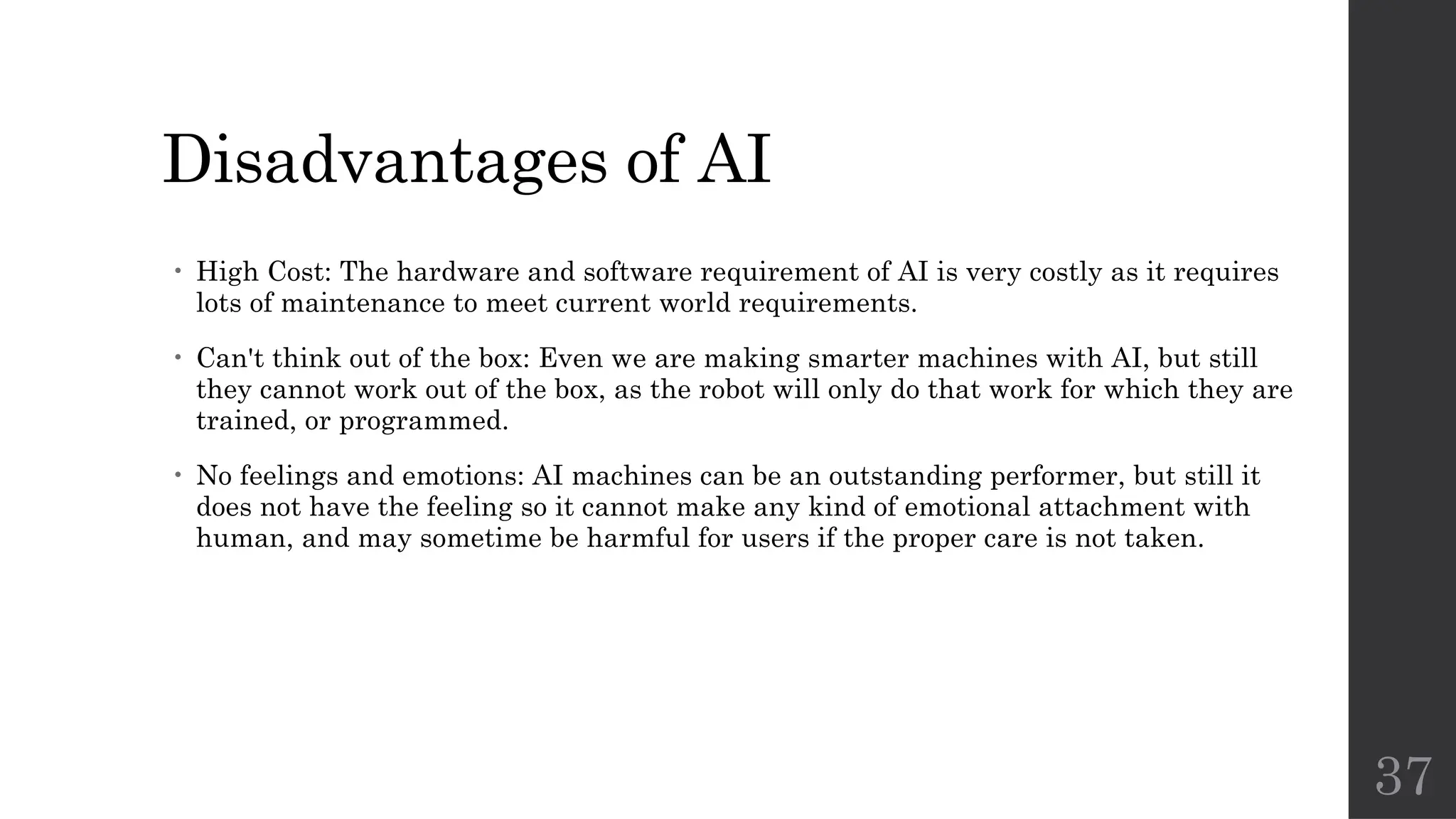
Disadvantages of AI
•High Cost: The hardware and software requirement of AI is very costly as it requires
lots of maintenance to meet current world requirements.
• Can't think out of the box: Even we are making smarter machines with AI, but still
they cannot work out of the box, as the robot will only do that work for which they are
trained, or programmed.
• No feelings and emotions: AI machines can be an outstanding performer, but still it
does not have the feeling so it cannot make any kind of emotional attachment with
human, and may sometime be harmful for users if the proper care is not taken.
38.
38
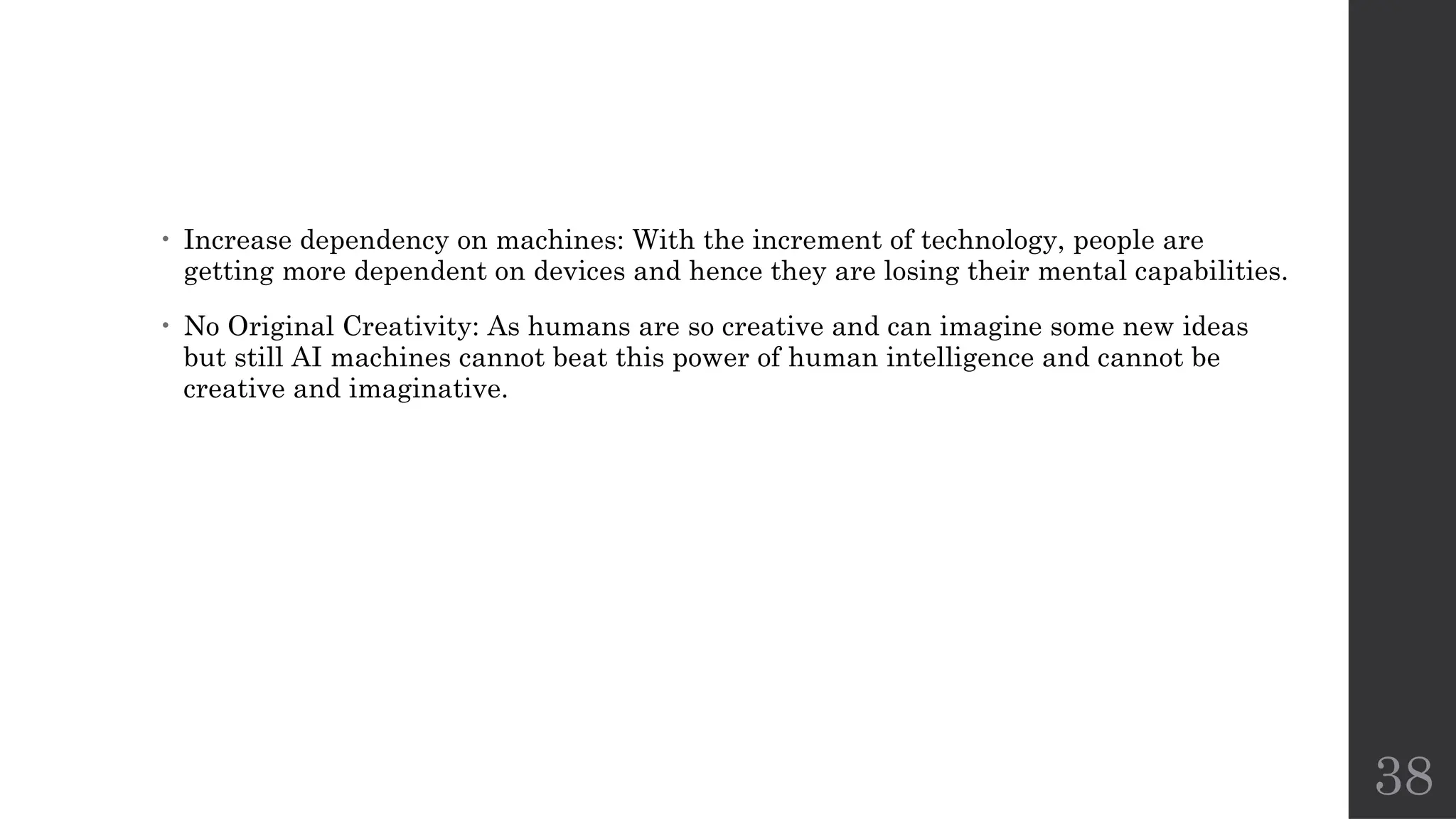
• Increase dependencyon machines: With the increment of technology, people are
getting more dependent on devices and hence they are losing their mental capabilities.
• No Original Creativity: As humans are so creative and can imagine some new ideas
but still AI machines cannot beat this power of human intelligence and cannot be
creative and imaginative.
#11 Reinforcement Learning: A type of machine learning where an AI system learns to make decisions by performing actions in an environment and receiving feedback through rewards or punishments.
#15 Bisam Pharmaceuticals has launched the world's first AI-powered health monitoring app, "Quick Vitals, (Hyderabad, Aug 2024). this app utilizes the Photoplethysmography (PPG) technique to analyze light absorption changes due to blood volume variations.
#21 Similarities among the Customer, similar taste. Market campaigns can be targeted. Zomato targets you based on your information, give personalized notifications and people feel the dopamine and hence they order food



![Movavi Photo Editor 6.7.1 + Crack Free Download [Latest]](https://cdn.slidesharecdn.com/ss_thumbnails/artificialintelligence24-250529090646-f4ef337f-thumbnail.jpg?width=640&height=640&fit=bounds)
![Prism Video Converter Plus 6.91 Crack + Registration Code [Latest]](https://cdn.slidesharecdn.com/ss_thumbnails/artificialintelligence24-250528124915-f42662af-thumbnail.jpg?width=640&height=640&fit=bounds)


![ESET NOD32 Antivirus 14.0.22.0 + License Key 2025 [Latest]](https://cdn.slidesharecdn.com/ss_thumbnails/artificialintelligence24-250529065957-1676755b-thumbnail.jpg?width=640&height=640&fit=bounds)
![System Mechanic Pro 20.7.1.34 Crack + Activation Key [Latest]](https://cdn.slidesharecdn.com/ss_thumbnails/artificialintelligence23-250529090917-a82b4003-thumbnail.jpg?width=640&height=640&fit=bounds)

![DAEMON Tools Pro 8.3.0.0749 Full Crack Download [Latest]](https://cdn.slidesharecdn.com/ss_thumbnails/artificialintelligence23-250528110016-acac03df-thumbnail.jpg?width=640&height=640&fit=bounds)

![ESET Internet Security 14.0.22.0 + License Key 2025 [Latest]](https://cdn.slidesharecdn.com/ss_thumbnails/artificialintelligence23-250529070312-acd88477-thumbnail.jpg?width=640&height=640&fit=bounds)


