Artificial Intelligence (AI) in
Medical Data Analysis
DR. A. PRABAHARAN
PROFESSOR & RESEARCH DIRECTOR
PUBLIC ACTION
1
AI in Medical Data Analysis
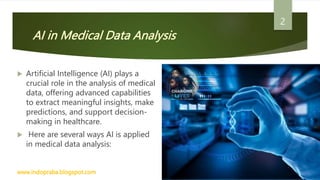
 Artificial Intelligence (AI) plays a
crucial role in the analysis of medical
data, offering advanced capabilities
to extract meaningful insights, make
predictions, and support decision-
making in healthcare.
 Here are several ways AI is applied
in medical data analysis:
www.indopraba.blogspot.com
2
Medical Imaging Analysis
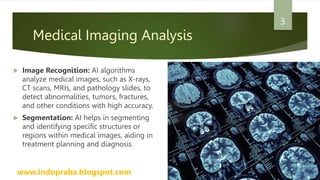
 Image Recognition: AI algorithms
analyze medical images, such as X-rays,
CT scans, MRIs, and pathology slides, to
detect abnormalities, tumors, fractures,
and other conditions with high accuracy.
 Segmentation: AI helps in segmenting
and identifying specific structures or
regions within medical images, aiding in
treatment planning and diagnosis
www.indopraba.blogspot.com
3
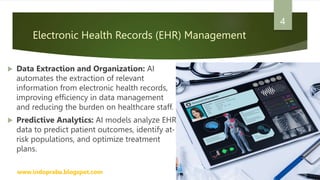
Electronic Health Records (EHR) Management
 Data Extraction and Organization: AI
automates the extraction of relevant
information from electronic health records,
improving efficiency in data management
and reducing the burden on healthcare staff.
 Predictive Analytics: AI models analyze EHR
data to predict patient outcomes, identify at-
risk populations, and optimize treatment
plans.
www.indopraba.blogspot.com
4
Genomic Data Analysis
 Variant Identification: AI is used to analyze
genomic data, identifying variations and mutations
associated with diseases. This information is crucial
for personalized medicine and targeted treatment
approaches.
 Pathway Analysis: AI helps in understanding
complex biological pathways and interactions
within the genome, contributing to the discovery
of potential therapeutic targets.
www.indopraba.blogspot.com
5
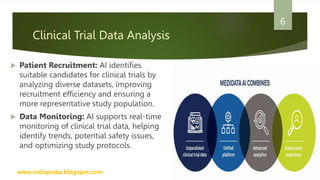
Clinical Trial Data Analysis
 Patient Recruitment: AI identifies
suitable candidates for clinical trials by
analyzing diverse datasets, improving
recruitment efficiency and ensuring a
more representative study population.
 Data Monitoring: AI supports real-time
monitoring of clinical trial data, helping
identify trends, potential safety issues,
and optimizing study protocols.
www.indopraba.blogspot.com
6
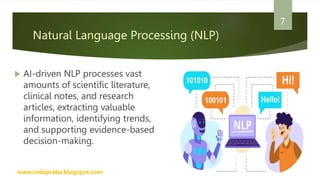
Natural Language Processing (NLP)
 AI-driven NLP processes vast
amounts of scientific literature,
clinical notes, and research
articles, extracting valuable
information, identifying trends,
and supporting evidence-based
decision-making.
www.indopraba.blogspot.com
7
Real-time Monitoring and Predictive
Analytics
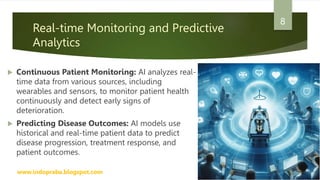
 Continuous Patient Monitoring: AI analyzes real-
time data from various sources, including
wearables and sensors, to monitor patient health
continuously and detect early signs of
deterioration.
 Predicting Disease Outcomes: AI models use
historical and real-time patient data to predict
disease progression, treatment response, and
patient outcomes.
www.indopraba.blogspot.com
8
Population Health Management
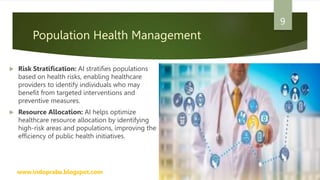
 Risk Stratification: AI stratifies populations
based on health risks, enabling healthcare
providers to identify individuals who may
benefit from targeted interventions and
preventive measures.
 Resource Allocation: AI helps optimize
healthcare resource allocation by identifying
high-risk areas and populations, improving the
efficiency of public health initiatives.
www.indopraba.blogspot.com
9
Drug Discovery and Development
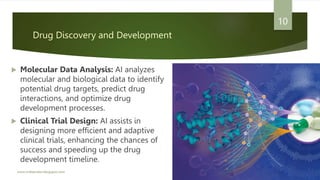
 Molecular Data Analysis: AI analyzes
molecular and biological data to identify
potential drug targets, predict drug
interactions, and optimize drug
development processes.
 Clinical Trial Design: AI assists in
designing more efficient and adaptive
clinical trials, enhancing the chances of
success and speeding up the drug
development timeline.
www.indopraba.blogspot.com
10
Challenges and Considerations
 Data Quality and Integration: Ensuring the quality
and interoperability of diverse medical datasets is
crucial for accurate and meaningful AI analysis.
 Interpretability: Developing AI models that are
interpretable and explainable to healthcare
professionals is essential for gaining trust in their
recommendations.
 Data Privacy and Security: Protecting sensitive
medical data and ensuring compliance with data
privacy regulations are paramount concerns in medical
data analysis.
www.indopraba.blogspot.com
11
Future Trends
 Federated Learning: Collaborative and privacy-
preserving approaches like federated learning are
gaining attention, allowing AI models to be trained
across multiple institutions without sharing
sensitive data.
 Explainable AI (XAI): Continued emphasis on
developing AI models that provide clear
explanations of their decision-making processes,
enhancing transparency and trust.
 Integration of Multi-modal Data: AI will
increasingly integrate information from various
sources, such as imaging, genomics, and clinical
data, to provide a more comprehensive
understanding of patient health.
www.indopraba.blogspot.com
12
End Note
 AI in medical data analysis is driving
innovation and efficiency in healthcare,
enabling more accurate diagnostics,
personalized treatments, and data-driven
decision-making.
 As technology continues to advance, the
application of AI in medical data analysis is
likely to expand, further improving patient
outcomes and shaping the future of
healthcare.
www.indopraba.blogspot.com
13
www.indopraba.blogspot.com

Artificial Intelligence (AI) in Medical Data Analysis.pptx

  • 1.
    Artificial Intelligence (AI)in Medical Data Analysis DR. A. PRABAHARAN PROFESSOR & RESEARCH DIRECTOR PUBLIC ACTION 1
  • 2.
    AI in MedicalData Analysis  Artificial Intelligence (AI) plays a crucial role in the analysis of medical data, offering advanced capabilities to extract meaningful insights, make predictions, and support decision- making in healthcare.  Here are several ways AI is applied in medical data analysis: www.indopraba.blogspot.com 2
  • 3.
    Medical Imaging Analysis Image Recognition: AI algorithms analyze medical images, such as X-rays, CT scans, MRIs, and pathology slides, to detect abnormalities, tumors, fractures, and other conditions with high accuracy.  Segmentation: AI helps in segmenting and identifying specific structures or regions within medical images, aiding in treatment planning and diagnosis www.indopraba.blogspot.com 3
  • 4.
    Electronic Health Records(EHR) Management  Data Extraction and Organization: AI automates the extraction of relevant information from electronic health records, improving efficiency in data management and reducing the burden on healthcare staff.  Predictive Analytics: AI models analyze EHR data to predict patient outcomes, identify at- risk populations, and optimize treatment plans. www.indopraba.blogspot.com 4
  • 5.
    Genomic Data Analysis Variant Identification: AI is used to analyze genomic data, identifying variations and mutations associated with diseases. This information is crucial for personalized medicine and targeted treatment approaches.  Pathway Analysis: AI helps in understanding complex biological pathways and interactions within the genome, contributing to the discovery of potential therapeutic targets. www.indopraba.blogspot.com 5
  • 6.
    Clinical Trial DataAnalysis  Patient Recruitment: AI identifies suitable candidates for clinical trials by analyzing diverse datasets, improving recruitment efficiency and ensuring a more representative study population.  Data Monitoring: AI supports real-time monitoring of clinical trial data, helping identify trends, potential safety issues, and optimizing study protocols. www.indopraba.blogspot.com 6
  • 7.
    Natural Language Processing(NLP)  AI-driven NLP processes vast amounts of scientific literature, clinical notes, and research articles, extracting valuable information, identifying trends, and supporting evidence-based decision-making. www.indopraba.blogspot.com 7
  • 8.
    Real-time Monitoring andPredictive Analytics  Continuous Patient Monitoring: AI analyzes real- time data from various sources, including wearables and sensors, to monitor patient health continuously and detect early signs of deterioration.  Predicting Disease Outcomes: AI models use historical and real-time patient data to predict disease progression, treatment response, and patient outcomes. www.indopraba.blogspot.com 8
  • 9.
    Population Health Management Risk Stratification: AI stratifies populations based on health risks, enabling healthcare providers to identify individuals who may benefit from targeted interventions and preventive measures.  Resource Allocation: AI helps optimize healthcare resource allocation by identifying high-risk areas and populations, improving the efficiency of public health initiatives. www.indopraba.blogspot.com 9
  • 10.
    Drug Discovery andDevelopment  Molecular Data Analysis: AI analyzes molecular and biological data to identify potential drug targets, predict drug interactions, and optimize drug development processes.  Clinical Trial Design: AI assists in designing more efficient and adaptive clinical trials, enhancing the chances of success and speeding up the drug development timeline. www.indopraba.blogspot.com 10
  • 11.
    Challenges and Considerations Data Quality and Integration: Ensuring the quality and interoperability of diverse medical datasets is crucial for accurate and meaningful AI analysis.  Interpretability: Developing AI models that are interpretable and explainable to healthcare professionals is essential for gaining trust in their recommendations.  Data Privacy and Security: Protecting sensitive medical data and ensuring compliance with data privacy regulations are paramount concerns in medical data analysis. www.indopraba.blogspot.com 11
  • 12.
    Future Trends  FederatedLearning: Collaborative and privacy- preserving approaches like federated learning are gaining attention, allowing AI models to be trained across multiple institutions without sharing sensitive data.  Explainable AI (XAI): Continued emphasis on developing AI models that provide clear explanations of their decision-making processes, enhancing transparency and trust.  Integration of Multi-modal Data: AI will increasingly integrate information from various sources, such as imaging, genomics, and clinical data, to provide a more comprehensive understanding of patient health. www.indopraba.blogspot.com 12
  • 13.
    End Note  AIin medical data analysis is driving innovation and efficiency in healthcare, enabling more accurate diagnostics, personalized treatments, and data-driven decision-making.  As technology continues to advance, the application of AI in medical data analysis is likely to expand, further improving patient outcomes and shaping the future of healthcare. www.indopraba.blogspot.com 13
  • 14.