
Artificial Intelligence
(AI) in Diagnosis
Dr. A. Prabaharan
Professor & Research Director
Public Action
www.indopraba.blogspot.com 1
AI in Diagnosis
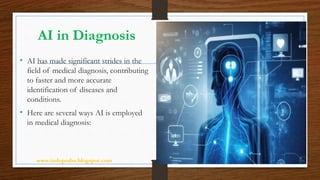
• AI has made significant strides in the
field of medical diagnosis, contributing
to faster and more accurate
identification of diseases and
conditions.
• Here are several ways AI is employed
in medical diagnosis:
www.indopraba.blogspot.com 2
www.indopraba.blogspot.com
3
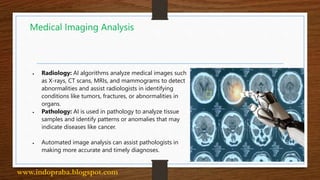
Medical Imaging Analysis
 Radiology: AI algorithms analyze medical images such
as X-rays, CT scans, MRIs, and mammograms to detect
abnormalities and assist radiologists in identifying
conditions like tumors, fractures, or abnormalities in
organs.
 Pathology: AI is used in pathology to analyze tissue
samples and identify patterns or anomalies that may
indicate diseases like cancer.
 Automated image analysis can assist pathologists in
making more accurate and timely diagnoses.
www.indopraba.blogspot.com 4
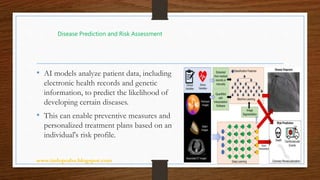
• AI models analyze patient data, including
electronic health records and genetic
information, to predict the likelihood of
developing certain diseases.
• This can enable preventive measures and
personalized treatment plans based on an
individual's risk profile.
Disease Prediction and Risk Assessment
www.indopraba.blogspot.com 5
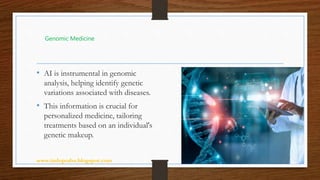
• AI is instrumental in genomic
analysis, helping identify genetic
variations associated with diseases.
• This information is crucial for
personalized medicine, tailoring
treatments based on an individual's
genetic makeup.
Genomic Medicine
• .
www.indopraba.blogspot.com 6
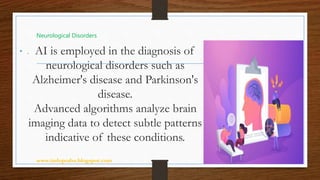
AI is employed in the diagnosis of
neurological disorders such as
Alzheimer's disease and Parkinson's
disease.
Advanced algorithms analyze brain
imaging data to detect subtle patterns
indicative of these conditions.
Neurological Disorders
www.indopraba.blogspot.com 7
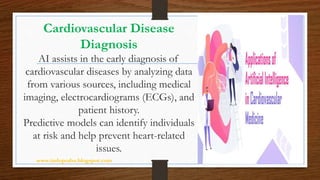
Cardiovascular Disease
Diagnosis
AI assists in the early diagnosis of
cardiovascular diseases by analyzing data
from various sources, including medical
imaging, electrocardiograms (ECGs), and
patient history.
Predictive models can identify individuals
at risk and help prevent heart-related
issues.
www.indopraba.blogspot.com 8
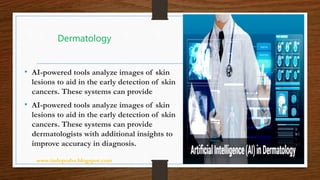
• AI-powered tools analyze images of skin
lesions to aid in the early detection of skin
cancers. These systems can provide
• AI-powered tools analyze images of skin
lesions to aid in the early detection of skin
cancers. These systems can provide
dermatologists with additional insights to
improve accuracy in diagnosis.
Dermatology
Gastrointestinal Disorders
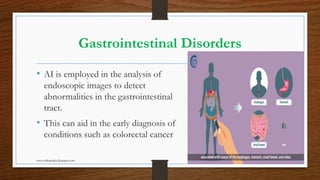
• AI is employed in the analysis of
endoscopic images to detect
abnormalities in the gastrointestinal
tract.
• This can aid in the early diagnosis of
conditions such as colorectal cancer
www.indopraba.blogspot.com 9
Challenges and
Considerations
www.indopraba.blogspot.com 10
 Data Quality and Bias: The accuracy of AI models
depends on the quality and diversity of the data used
for training. Biases in the data can lead to biased
predictions and potential disparities in diagnosis.
 Interpretability: Understanding how AI systems reach
specific diagnoses can be challenging, making it
important to develop models that are interpretable
and transparent for healthcare professionals.
 Regulatory Approval: Ensuring that AI-based
diagnostic tools comply with regulatory standards is
crucial for widespread adoption and acceptance within
the medical community.
End Note
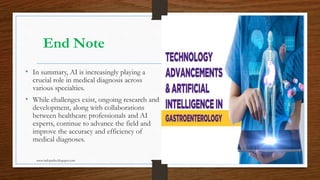
• In summary, AI is increasingly playing a
crucial role in medical diagnosis across
various specialties.
• While challenges exist, ongoing research and
development, along with collaborations
between healthcare professionals and AI
experts, continue to advance the field and
improve the accuracy and efficiency of
medical diagnoses.
www.indopraba.blogspot.com 11
www.indopraba.blogspot.com

Artificial Intelligence (AI) in Diagnosis.pptx

  • 1.
    Artificial Intelligence (AI) inDiagnosis Dr. A. Prabaharan Professor & Research Director Public Action www.indopraba.blogspot.com 1
  • 2.
    AI in Diagnosis •AI has made significant strides in the field of medical diagnosis, contributing to faster and more accurate identification of diseases and conditions. • Here are several ways AI is employed in medical diagnosis: www.indopraba.blogspot.com 2
  • 3.
    www.indopraba.blogspot.com 3 Medical Imaging Analysis Radiology: AI algorithms analyze medical images such as X-rays, CT scans, MRIs, and mammograms to detect abnormalities and assist radiologists in identifying conditions like tumors, fractures, or abnormalities in organs.  Pathology: AI is used in pathology to analyze tissue samples and identify patterns or anomalies that may indicate diseases like cancer.  Automated image analysis can assist pathologists in making more accurate and timely diagnoses.
  • 4.
    www.indopraba.blogspot.com 4 • AImodels analyze patient data, including electronic health records and genetic information, to predict the likelihood of developing certain diseases. • This can enable preventive measures and personalized treatment plans based on an individual's risk profile. Disease Prediction and Risk Assessment
  • 5.
    www.indopraba.blogspot.com 5 • AIis instrumental in genomic analysis, helping identify genetic variations associated with diseases. • This information is crucial for personalized medicine, tailoring treatments based on an individual's genetic makeup. Genomic Medicine
  • 6.
    • . www.indopraba.blogspot.com 6 AIis employed in the diagnosis of neurological disorders such as Alzheimer's disease and Parkinson's disease. Advanced algorithms analyze brain imaging data to detect subtle patterns indicative of these conditions. Neurological Disorders
  • 7.
    www.indopraba.blogspot.com 7 Cardiovascular Disease Diagnosis AIassists in the early diagnosis of cardiovascular diseases by analyzing data from various sources, including medical imaging, electrocardiograms (ECGs), and patient history. Predictive models can identify individuals at risk and help prevent heart-related issues.
  • 8.
    www.indopraba.blogspot.com 8 • AI-poweredtools analyze images of skin lesions to aid in the early detection of skin cancers. These systems can provide • AI-powered tools analyze images of skin lesions to aid in the early detection of skin cancers. These systems can provide dermatologists with additional insights to improve accuracy in diagnosis. Dermatology
  • 9.
    Gastrointestinal Disorders • AIis employed in the analysis of endoscopic images to detect abnormalities in the gastrointestinal tract. • This can aid in the early diagnosis of conditions such as colorectal cancer www.indopraba.blogspot.com 9
  • 10.
    Challenges and Considerations www.indopraba.blogspot.com 10 Data Quality and Bias: The accuracy of AI models depends on the quality and diversity of the data used for training. Biases in the data can lead to biased predictions and potential disparities in diagnosis.  Interpretability: Understanding how AI systems reach specific diagnoses can be challenging, making it important to develop models that are interpretable and transparent for healthcare professionals.  Regulatory Approval: Ensuring that AI-based diagnostic tools comply with regulatory standards is crucial for widespread adoption and acceptance within the medical community.
  • 11.
    End Note • Insummary, AI is increasingly playing a crucial role in medical diagnosis across various specialties. • While challenges exist, ongoing research and development, along with collaborations between healthcare professionals and AI experts, continue to advance the field and improve the accuracy and efficiency of medical diagnoses. www.indopraba.blogspot.com 11
  • 12.