INTELLIGENCE
Intelligence isthe computational part of the ability
to achieve goals in the world. Varying kinds and
degrees of intelligence occur in people, many
animals and some machines.
4.
Artificial intelligence (AI)
Artificial intelligence (AI) is the intelligence
exhibited by machines or software.
Major AI researchers and textbooks define this
field as "the study and design of intelligent agents",
where an intelligent agent is a system that
perceives its environment and takes actions that
maximize its chances of success.
5.
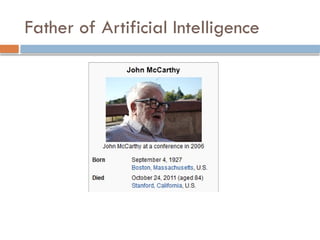
John McCarthy,who coined the term in 1955,
defines it as "the science and engineering of
making intelligent machines".
6.
Main area’s ofResearch in
AI
reasoning,
knowledge,
planning,
learning,
natural language processing (communication),
perception and the ability to move and manipulate
objects
7.
Scope of AI
Automated Reasoning
Data Mining
Intelligent Agents
Robotics
Machine Learning
Natural Language Processing
Pattern Recognition
Semantic Web
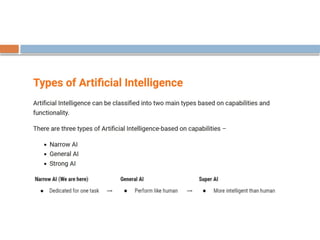
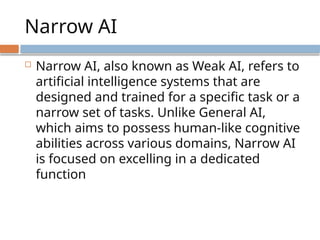
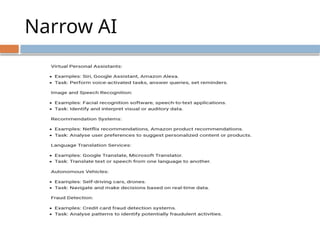
Narrow AI
NarrowAI, also known as Weak AI, refers to
artificial intelligence systems that are
designed and trained for a specific task or a
narrow set of tasks. Unlike General AI,
which aims to possess human-like cognitive
abilities across various domains, Narrow AI
is focused on excelling in a dedicated
function
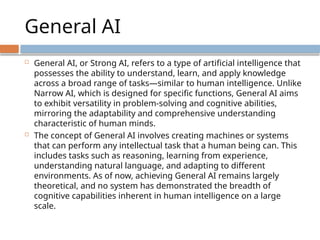
General AI
GeneralAI, or Strong AI, refers to a type of artificial intelligence that
possesses the ability to understand, learn, and apply knowledge
across a broad range of tasks—similar to human intelligence. Unlike
Narrow AI, which is designed for specific functions, General AI aims
to exhibit versatility in problem-solving and cognitive abilities,
mirroring the adaptability and comprehensive understanding
characteristic of human minds.
The concept of General AI involves creating machines or systems
that can perform any intellectual task that a human being can. This
includes tasks such as reasoning, learning from experience,
understanding natural language, and adapting to different
environments. As of now, achieving General AI remains largely
theoretical, and no system has demonstrated the breadth of
cognitive capabilities inherent in human intelligence on a large
scale.
16.
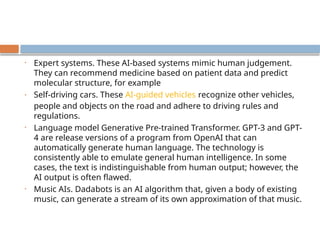
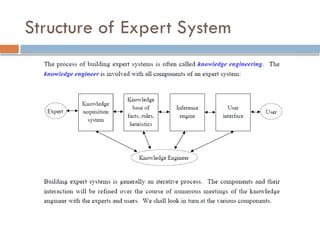
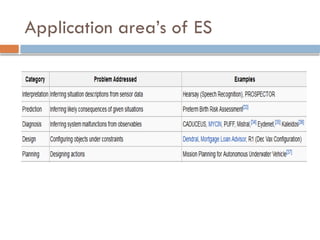
• Expert systems.These AI-based systems mimic human judgement.
They can recommend medicine based on patient data and predict
molecular structure, for example
• Self-driving cars. These AI-guided vehicles recognize other vehicles,
people and objects on the road and adhere to driving rules and
regulations.
• Language model Generative Pre-trained Transformer. GPT-3 and GPT-
4 are release versions of a program from OpenAI that can
automatically generate human language. The technology is
consistently able to emulate general human intelligence. In some
cases, the text is indistinguishable from human output; however, the
AI output is often flawed.
• Music AIs. Dadabots is an AI algorithm that, given a body of existing
music, can generate a stream of its own approximation of that music.
17.
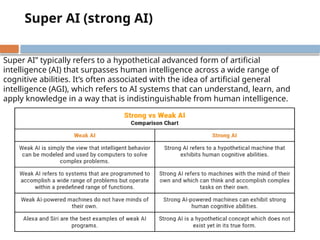
Super AI (strongAI)
Super AI” typically refers to a hypothetical advanced form of artificial
intelligence (AI) that surpasses human intelligence across a wide range of
cognitive abilities. It’s often associated with the idea of artificial general
intelligence (AGI), which refers to AI systems that can understand, learn, and
apply knowledge in a way that is indistinguishable from human intelligence.
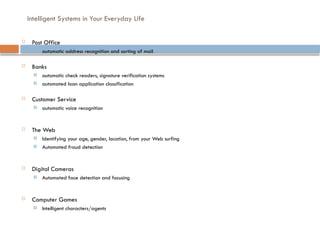
Intelligent Systems inYour Everyday Life
Post Office
automatic address recognition and sorting of mail
Banks
automatic check readers, signature verification systems
automated loan application classification
Customer Service
automatic voice recognition
The Web
Identifying your age, gender, location, from your Web surfing
Automated fraud detection
Digital Cameras
Automated face detection and focusing
Computer Games
Intelligent characters/agents
22.
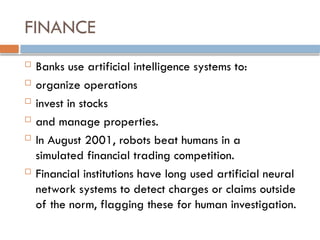
FINANCE
Banks useartificial intelligence systems to:
organize operations
invest in stocks
and manage properties.
In August 2001, robots beat humans in a
simulated financial trading competition.
Financial institutions have long used artificial neural
network systems to detect charges or claims outside
of the norm, flagging these for human investigation.
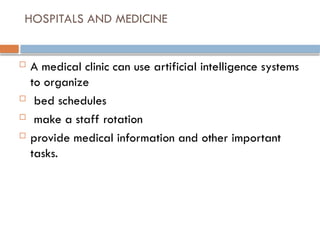
23.
HOSPITALS AND MEDICINE
A medical clinic can use artificial intelligence systems
to organize
bed schedules
make a staff rotation
provide medical information and other important
tasks.
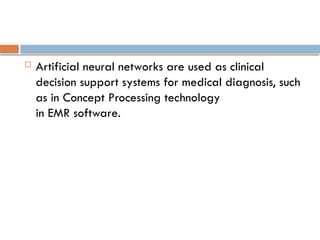
24.
Artificial neuralnetworks are used as clinical
decision support systems for medical diagnosis, such
as in Concept Processing technology
in EMR software.
25.
Computer-aided interpretationof medical images
Such systems help scan digital
images, e.g. from computed tomography, for
typical appearances and to highlight
conspicuous sections, such as possible diseases. A
typical application is the detection of a tumor.
Heart sound analysis
26.
HEAVY INDUSTRY
Robotshave proven effective in jobs that are very
repetitive which may lead to mistakes or accidents
due to a lapse in concentration and other jobs which
humans may find degrading.
Japan is the leader in using and producing robots in
the world.
In 1999, 1,700,000 robots were in use worldwide.
27.
TRANSPORTATION
Fuzzy logiccontrollers have been developed for
automatic gearboxes in automobiles.
For example, the 2006 Audi TT, VW Toureg VW
Caravell feature the DSP transmission which utilizes
Fuzzy Logic. A number of Škoda variants also
currently include a Fuzzy Logic based controller.
28.
TELECOMMUNICATIONS MAINTENANCE
Manytelecommunications companies make use
of heuristic search in the management of their
workforces
for example BT Group has deployed heuristic
search in a scheduling application that provides the
work schedules of 20,000 engineers.
29.
Toys and games
The 1990s saw some of the first attempts to mass-produce
domestically aimed types of basic Artificial Intelligence for
education, or leisure.
Digital Revolution
Tamagotchis and Giga Pets, iPod Touch,
The Internet
The first widely released robot, Furby
Aibo, a robotic dog with intelligent features and autonomy.
AI has also been applied to video games, for example video
game bots, which are designed to stand in as opponents
where humans aren't available or desired
30.
AVIATION
The AirOperations Division (AOD) uses AI for the
rule based expert systems.
The AOD has use for artificial intelligence for
surrogate operators for combat and training
simulators
1. Mission management aids
2. Support systems for tactical decision making
3. Post processing of the simulator data into symbolic
summaries.
31.
Airplane simulatorsare using artificial intelligence
in order to process the data taken from simulated
flights.
The computers are able to come up with the best
success scenarios in these situations.
The computers can also create strategies based on
the placement, size, speed and strength of the
forces and counter forces. Pilots may be given
assistance in the air during combat by computers.
32.
SPEECH RECOGNITION
Inthe 1990s, computer speech recognition reached
a practical level for limited purposes.
United Airlines has replaced its keyboard tree for
flight information by a system using speech
recognition of flight numbers and city names.
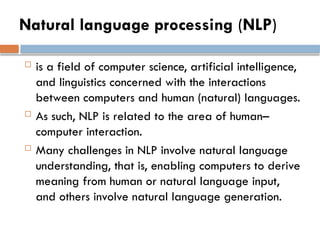
is afield of computer science, artificial intelligence,
and linguistics concerned with the interactions
between computers and human (natural) languages.
As such, NLP is related to the area of human–
computer interaction.
Many challenges in NLP involve natural language
understanding, that is, enabling computers to derive
meaning from human or natural language input,
and others involve natural language generation.
Natural language processing (NLP)
35.
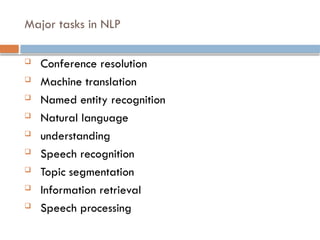
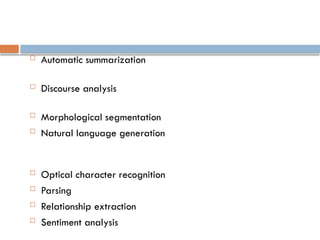
Major tasks inNLP
Conference resolution
Machine translation
Named entity recognition
Natural language
understanding
Speech recognition
Topic segmentation
Information retrieval
Speech processing
History
The firstexpert systems were created in the 1970s
and then proliferated in the 1980s. Expert systems
were among the first truly successful forms
of AI software
40.
Expert systems
Inartificial intelligence, an expert system is a
computer system that emulates the decision-making
ability of a human expert
Expert systems are designed to solve complex
problems by reasoning about knowledge,
represented primarily as if–then rules rather than
through conventional procedural code
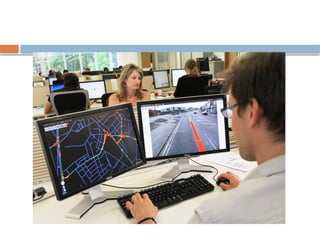
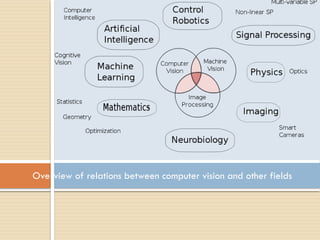
Computer vision
Computervision is a field that includes methods for
acquiring, processing, analyzing, and understanding
images and, high-dimensional data from the real
world in order to produce numerical or symbolic
information, in the forms of decisions.
44.
Applications for computervision
Applications range from tasks such as
industrial machine vision systems
Computer vision covers the core technology of
automated image analysis which is used in many
fields.
45.
APPLICATIONS OF COMPUTERVISION INCLUDE
Controlling processes: an industrial robot
Navigation: by an autonomous vehicle or mobile robot;
Detecting events: for visual surveillance or people counting
Organizing information: for indexing databases of images
and image sequences;
Modeling objects or environments: medical image analysis
or topographical modeling;
Interaction: as the input to a device for computer-human
interaction
Automatic inspection: in manufacturing applications.
Speech recognition andgeneration
Speech Technology
The speech capabilities that can be added to an application are
text-to-speech synthesis (TTS) and speech recognition (SR).
Text-To-Speech Synthesis (TTS)
This involves turning a string into spoken language that is played
through the computer speakers. The complexities of turning words
into phonemes, adding appropriate emphasis and translating the
result into digital audio are beyond the scope of this paper and
are catered for by a TTS engine installed on your machine.
The end result is that the computer talks to the user to save the
user having to read some text on the screen.
49.
SPEECH RECOGNITION (SR)
computer takes the user's speech and interprets
what has been said. This allows the user to control
the computer by voice, rather than having to use the
mouse and keyboard, or alternatively just dictating
the contents of a document.
50.
The complexnature of translating the raw audio
into phonemes involves a lot of signal processing.
These details are taken care of by an SR engine
that will be installed on machine.
SR engines are called recognisers and these days
typically implement continuous speech recognition
52.
Robotics
Robotics isthe branch of mechanical engineering,
electrical engineering and computer science that
deals with the design, construction, operation, and
application of robots, as well as computer systems
for their control, sensory feedback, and information
processing. The word robotics was derived from the
word robot, which was introduced to the public by
Czech writer Karel Čapek in his play R.U.R. (
Rossum's Universal Robots), which was published in
1920
53.
Aspects of robotics
Robots all have some kind of mechanical
construction, a frame, form or shape designed to
achieve a particular task.
Robots have electrical components which power and
control the machinery.
All robots contain some level of
computer programming code.
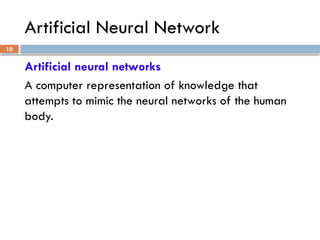
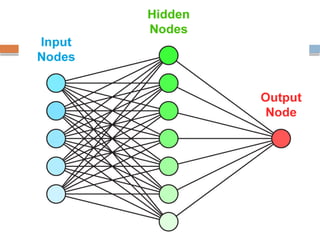
ARTIFICIAL NEURAL NETWORKS
In machine learning, artificial neural
networks (ANNs) are a family of statistical
learning algorithms inspired by biological neural
networks and are used to estimate
or approximate functions that can depend on a
large number of inputs and are generally unknown.
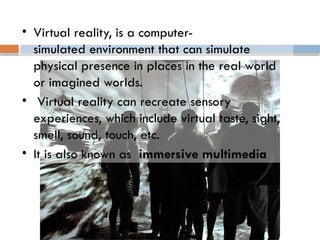
• Virtual reality,is a computer-
simulated environment that can simulate
physical presence in places in the real world
or imagined worlds.
• Virtual reality can recreate sensory
experiences, which include virtual taste, sight,
smell, sound, touch, etc.
• It is also known as immersive multimedia
59.
GAMES
The useof graphics, sound and input technology in
video games can be incorporated into VR
the Virtual Boy developed by Nintendo, the
iGlasses developed by Virtual I-O, the Cybermaxx
developed by Victormaxx and the VFX-1
developed by Forte Technologies
60.
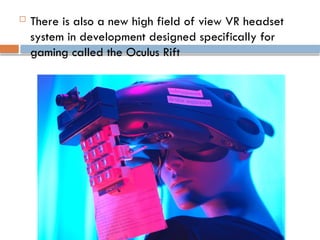
There isalso a new high field of view VR headset
system in development designed specifically for
gaming called the Oculus Rift
62.
TRAINING
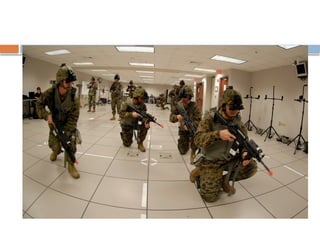
The usageof VR in a training perspective is to allow
professionals to conduct training in a virtual
environment where they can improve upon their
skills without the consequence of failing the
operation.
VR plays an important role in combat training for
the military
64.
Expert system
Inartificial intelligence, an expert system is a
computer system that emulates the decision-making
ability of a human expert.
65.
Evaluation of ExpertSystem
Expert systems were introduced by the Stanford
Heuristic Programming Project led by Feigenbaum,
who is sometimes referred to as the "father of
expert systems".
66.
The Stanfordresearchers tried to identify domains
where expertise was highly valued and complex,
such as diagnosing infectious diseases (Mycin) and
identifying unknown organic molecules (Dendral).
Types of ExpertSystems
Expert systems are divided in two types based on
inference engine.
Forward Chaining inference Engine
Backward Chaining Inference Engine
73.
Forward Chaining
Inartificial intelligence (AI) systems, forward
chaining refers to a scenario where the AI has been
provided with a specific problem must "work
forwards" to figure out how to solve the set
problem. To do this, the AI would look back through
the rule-based system to find the "if" rules and
determine which rules to use.
74.
CPSC 433 ArtificialIntelligence
Forward Chaining Example
If [X croaks and eats flies]
Then [X is a frog]
[Fritz croaks and eats flies]
[Fritz is a frog]
If [X is a frog]
Then [X is colored green]
[Fritz is colored green] [Fritz is colored Y] ?
Knowledge Base
If [X croaks and eats flies]
Then [X is a frog]
If [X chirps and sings]
Then [X is a canary]
If [X is a frog]
Then [X is colored green]
If [X is a canary]
Then [X is colored yellow]
[Fritz croaks and eats flies]
[Fritz is a frog]
[Fritz is colored green]
Goal
[Fritz is colored Y]?
Y = green
75.
Backward chaining
Backwardchaining (or backward reasoning) is an
inference method that can be described (in lay
terms) as working backward from the goal(s).
76.
CPSC 433 ArtificialIntelligence
Backward Chaining Example
Knowledge Base
If [X croaks and eats flies]
Then [X is a frog]
If [X chirps and sings]
Then [X is a canary]
If [X is a frog]
Then [X is colored green]
If [X is a canary]
Then [X is colored yellow]
[Fritz croaks and eats flies]
Goals
[Fritz is colored Y]?
[X is a frog]
[X is a canary]
[X croaks and eats flies]
[Fritz is colored Y]
If [X is a frog]
Then [X is colored green]
[X is a frog]
If [X is a canary]
Then [X is colored yellow]
[X is a canary]
If [X croaks and eats flies]
Then [X is a frog]
[X croaks and eats flies] [Fritz croaks and eats flies]
X = Fritz, Y = green
Week 4
Featuresof expert system
Overview of expert system’s programming tools
Benefits and limitations of Experts systems
80.
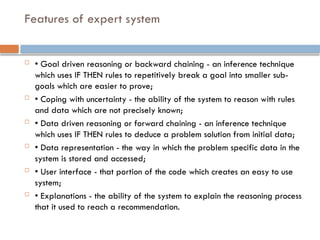
Features of expertsystem
• Goal driven reasoning or backward chaining - an inference technique
which uses IF THEN rules to repetitively break a goal into smaller sub-
goals which are easier to prove;
• Coping with uncertainty - the ability of the system to reason with rules
and data which are not precisely known;
• Data driven reasoning or forward chaining - an inference technique
which uses IF THEN rules to deduce a problem solution from initial data;
• Data representation - the way in which the problem specific data in the
system is stored and accessed;
• User interface - that portion of the code which creates an easy to use
system;
• Explanations - the ability of the system to explain the reasoning process
that it used to reach a recommendation.
82.
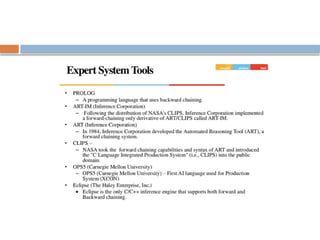
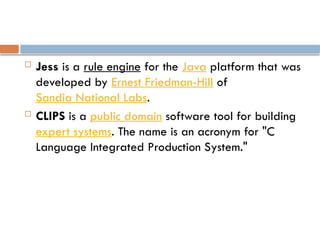
Jess isa rule engine for the Java platform that was
developed by Ernest Friedman-Hill of
Sandia National Labs.
CLIPS is a public domain software tool for building
expert systems. The name is an acronym for "C
Language Integrated Production System."
1. DENDRAL
• Firstexpert system
• Project began at Stanford in mid 1960's, and is still being used.
• Domain: Organic chemistry - mass spectrometry
• Task: identify molecular structure of unknown compounds
from mass spectra data
87.
2. MACSYMA
• Developedat MIT since 1968 onwards
• Domain: high-performance symbolic math (algebra, calculus,
differential equations,...)
• Task: carry out complex mathematical derivations
88.
3. Hearsay Iand II
• Developed at Carnegie-Mellon in late 1960's
• Domain: speech understanding for simple database query
• Task: Using specific vocabulary and grammar criteria, generate
correct speech recognition
89.
4. INTERNIST/CADUCEUS
• Developedat U of Pittsburgh in early 1970's thru mid 80’s
• Domain: diagnostic aid for all of internal medicine
• Task: medical diagnosis given interactive input
90.
5. MYCIN
• StanfordU in mid 70's
• Domain: Medical diagnosis for bacterial and meningitis infections
• Task: interview physician, make diagnosis and therapy recommendations
91.
6. Prospector
• Developedat SRI international in late 1970's
• Domain: exploratory geology
• Task: evaluate geological sites
.
92.
7. PUFF
• Developedat Stanford in 1979
• Domain: Diagnosis of obstructive airway diseases using MYCIN's
inference engine and a new knowledge base
• Task: Take data from instruments and dialog, and diagnose type and
severity of disease
•
93.
8. XCON
• Originallycalled R1, developed at Carnegie Mellon and DEC in late 70's
• Domain: configure computer hardware
94.
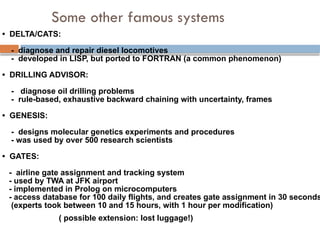
Some other famoussystems
• DELTA/CATS:
- diagnose and repair diesel locomotives
- developed in LISP, but ported to FORTRAN (a common phenomenon)
• DRILLING ADVISOR:
- diagnose oil drilling problems
- rule-based, exhaustive backward chaining with uncertainty, frames
• GENESIS:
- designs molecular genetics experiments and procedures
- was used by over 500 research scientists
• GATES:
- airline gate assignment and tracking system
- used by TWA at JFK airport
- implemented in Prolog on microcomputers
- access database for 100 daily flights, and creates gate assignment in 30 seconds
(experts took between 10 and 15 hours, with 1 hour per modification)
( possible extension: lost luggage!)
95.
Week 5
Robotics:
Reasons to use a robot
Main application areas
Laws of robotics
96.
Robotics
Robotics isthe branch of mechanical engineering,
electrical engineering and computer science that
deals with the design, construction, operation, and
application of robots, as well as computer systems
for their control, sensory feedback, and information
processing.
97.
Reasons to usea robot
Robots are powerful machines that give us access to
places that are otherwise inaccessible to the human
population. They protect us from danger by
performing tasks that are harmful to our health.
Some of the first robots were used in the 1940s to
handle radioactive materials.
98.
Since thenrobots have become permanent members
of the industrial workforce, including parts handling,
welding, and painting.
Robots simulate many human functions. They can
move, sense their surroundings, and respond to
changes in the environment. Many robots are
mechanical arms attached to a base. Robotic arms
use flexible joints to perform tasks that require very
precise movements.
99.
Medical robotsare now so advanced that they are
being employed in brain, heart and eye surgeries,
allowing doctors to treat conditions that were
previously only possible through treatments nearly
as dangerous as the offending condition.
100.
Robotics Applications
OuterSpace - Manipulative arms that are controlled by a human are used to unload the docking
bay of space shuttles to launch satellites or to construct a space station
The Intelligent Home - Automated systems can now monitor home security, environmental conditions
and energy usage. Door and windows can be opened automatically and appliances such as lighting
and air conditioning can be pre programmed to activate. This assists occupants irrespective of their
state of mobility.
Exploration - Robots can visit environments that are harmful to humans. An example is monitoring the
environment inside a volcano or exploring our deepest oceans. NASA has used robotic probes for
planetary exploration since the early sixties.
Military Robots - Airborne robot drones are used for surveillance in today's modern army. In the
future automated aircraft and vehicles could be used to carry fuel and ammunition or clear
minefields
Farms - Automated harvesters can cut and gather crops. Robotic dairies are available allowing
operators to feed and milk their cows remotely.
101.
The CarIndustry - Robotic arms that are able to perform multiple
tasks are used in the car manufacturing process. They perform
tasks such as welding, cutting, lifting, sorting and bending. Similar
applications but on a smaller scale are now being planned for the
food processing industry in particular the trimming, cutting and
processing of various meats such as fish, lamb, beef.
Hospitals - Under development is a robotic suit that will enable
nurses to lift patients without damaging their backs. Scientists in
Japan have developed a power-assisted suit which will give nurses
the extra muscle they need to lift their patients - and avoid back
injuries.
102.
Disaster Areas- Surveillance robots fitted with
advanced sensing and imaging equipment can
operate in hazardous environments such as urban
setting damaged by earthquakes by scanning walls,
floors and ceilings for structural integrity.
Entertainment - Interactive robots that exhibit
behaviors and learning ability. SONY has one such
robot which moves freely, plays with a ball and can
respond to verbal instructions.
103.
Laws of Robotics
A robot may not injure a human being or, through
inaction, allow a human being to come to harm.
A robot must obey orders given it by human beings
except where such orders would conflict with the First
Law.
A robot must protect its own existence as long as such
protection does not conflict with the First or Second
Law.
By Isaac Asimov's was an American author and
professor of biochemistry at Boston University,
Main Components ofrobot
CONTROLLER :
Every robot is connected to a computer, which keeps
the pieces of the arm working together. This
computer is known as the controller. The controller
functions as the "brain" of the robot. The controller
also allows the robot to be networked to other
systems, so that it may work together with other
machines, processes, or robots.
109.
ARM :
Robotarms come in all shapes and sizes. The arm is
the part of the robot that positions the end-affector
and sensors to do their pre-programmed business.
110.
DRIVE :
Thedrive is the "engine" that drives the links (the
sections between the joints into their desired
position. Without a drive, a robot would just sit
there, which is not often helpful. Most drives are
powered by air, water pressure, or electricity.
111.
END- EFFECTOR:
The end-effector is the "hand" connected to the
robot's arm. It is often different from a human hand
- it could be a tool such as a gripper, a vacuum
pump, tweezers, scalpel, blowtorch - just about
anything that helps it do its job. Some robots can
change end-effectors, and be reprogrammed for a
different set of tasks.
112.
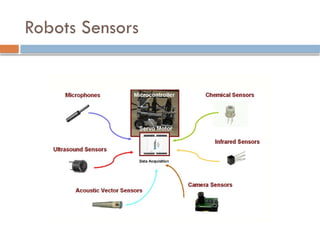
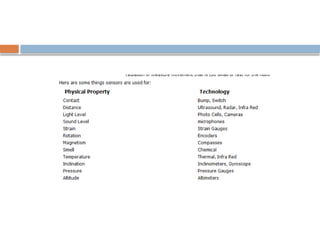
SENSOR :
Mostrobots of today are nearly deaf and blind.
Sensors can provide some limited feedback to the
robot so it can do its job. Compared to the senses
and abilities of even the simplest living things,
robots have a very long way to go.
Robotic sensing
Roboticsensing is a branch of robotics science
intended to give robots sensing capabilities, so that
robots are more human-like. Robotic sensing mainly
gives robots the ability to see.
Week-7
NaturalLanguage Processing(N LP)
Natural languages vs. computer languages
Natural language understanding (NLU)
Natural language generation (NLG)
Domain areas of NLP
Programming tools for NLP
123.
BİL711 Natural LanguageProcessing
123
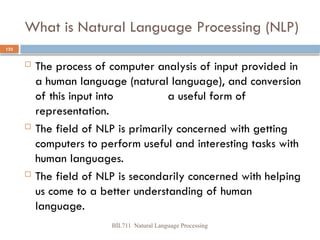
What is Natural Language Processing (NLP)
The process of computer analysis of input provided in
a human language (natural language), and conversion
of this input into a useful form of
representation.
The field of NLP is primarily concerned with getting
computers to perform useful and interesting tasks with
human languages.
The field of NLP is secondarily concerned with helping
us come to a better understanding of human
language.
124.
Forms of NaturalLanguage
The input/output of a NLP system can be:
written text
speech
125.
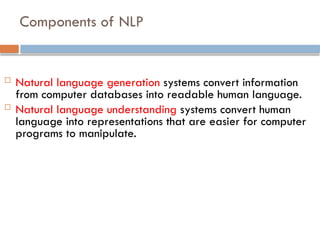
Components of NLP
Natural language generation systems convert information
from computer databases into readable human language.
Natural language understanding systems convert human
language into representations that are easier for computer
programs to manipulate.
126.
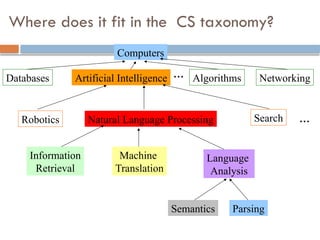
Where does itfit in the CS taxonomy?
Computers
Artificial Intelligence Algorithms
Databases Networking
Robotics Search
Natural Language Processing
Information
Retrieval
Machine
Translation
Language
Analysis
Semantics Parsing
…
…
127.
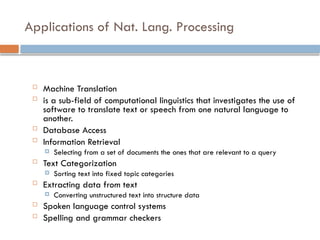
Applications of Nat.Lang. Processing
Machine Translation
is a sub-field of computational linguistics that investigates the use of
software to translate text or speech from one natural language to
another.
Database Access
Information Retrieval
Selecting from a set of documents the ones that are relevant to a query
Text Categorization
Sorting text into fixed topic categories
Extracting data from text
Converting unstructured text into structure data
Spoken language control systems
Spelling and grammar checkers
128.
NLP - Prof.Carolina Ruiz
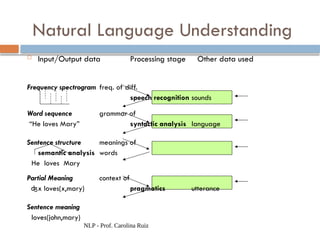
Input/Output data Processing stage Other data used
Frequency spectrogram freq. of diff.
speech recognition sounds
Word sequence grammar of
“He loves Mary” syntactic analysis language
Sentence structure meanings of
semantic analysis words
He loves Mary
Partial Meaning context of
x loves(x,mary) pragmatics utterance
Sentence meaning
loves(john,mary)
Natural Language Understanding
129.
Natural language understandingPhases
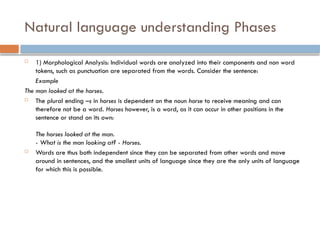
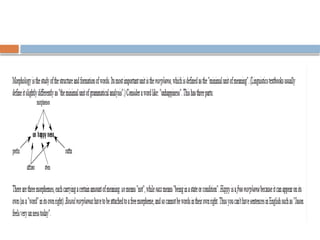
1) Morphological Analysis: Individual words are analyzed into their components and non word
tokens, such as punctuation are separated from the words. Consider the sentence:
Example
The man looked at the horses.
The plural ending –s in horses is dependent on the noun horse to receive meaning and can
therefore not be a word. Horses however, is a word, as it can occur in other positions in the
sentence or stand on its own:
The horses looked at the man.
- What is the man looking at? - Horses.
Words are thus both independent since they can be separated from other words and move
around in sentences, and the smallest units of language since they are the only units of language
for which this is possible.
132.
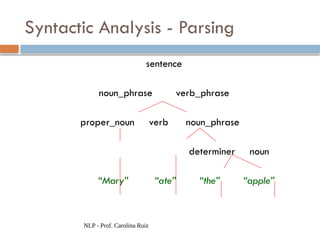
2) SyntacticAnalysis: Linear sequences of words are
transformed into structures that show how the words
relate each other. Some word sequences may be
rejected if they violate the languages rules for how
words may be combined.
3) SemanticAnalysis: The structures created by the
syntactic analyzer are assigned meanings.
135.
NLP - Prof.Carolina Ruiz
4) Pragmatics
Uses context of utterance
Where, by who, to whom, why, when it was said
Intentions: inform, request, promise, criticize, …
Handling Pronouns
“Mary eats apples. She likes them.”
She=“Mary”, them=“apples”.
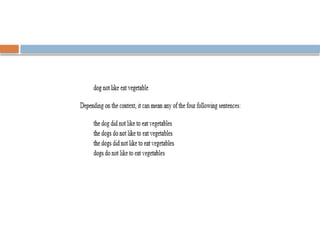
Handling ambiguity
Pragmatic ambiguity: “you’re late”: What’s the
speaker’s intention: informing or criticizing?
136.
5) Phonology
Phonologyis a branch of linguistics concerned with
the systematic organization of sounds in languages.
137.
Natural Language Generation(NLG)
Natural Language Generation (NLG) Systems
which take information from some database
and figure out how to present it to a human.
Very little linguistics involved.
138.
NLP - Prof.Carolina Ruiz
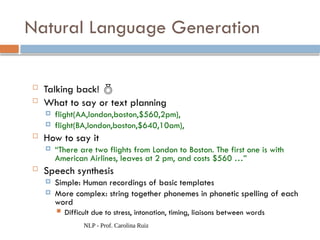
Natural Language Generation
Talking back!
What to say or text planning
flight(AA,london,boston,$560,2pm),
flight(BA,london,boston,$640,10am),
How to say it
“There are two flights from London to Boston. The first one is with
American Airlines, leaves at 2 pm, and costs $560 …”
Speech synthesis
Simple: Human recordings of basic templates
More complex: string together phonemes in phonetic spelling of each
word
Difficult due to stress, intonation, timing, liaisons between words
Week-8
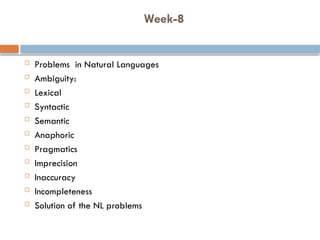
Problems inNatural Languages
Ambiguity:
Lexical
Syntactic
Semantic
Anaphoric
Pragmatics
Imprecision
Inaccuracy
Incompleteness
Solution of the NL problems
142.
Ambiguity
Ambiguity canbe referred as the ability of having
more than one meaning or being understood in
more than one way.
143.
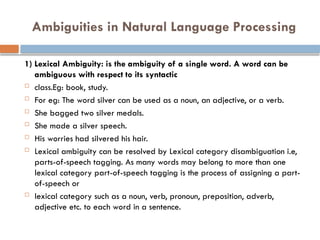
Ambiguities in NaturalLanguage Processing
1) Lexical Ambiguity: is the ambiguity of a single word. A word can be
ambiguous with respect to its syntactic
class.Eg: book, study.
For eg: The word silver can be used as a noun, an adjective, or a verb.
She bagged two silver medals.
She made a silver speech.
His worries had silvered his hair.
Lexical ambiguity can be resolved by Lexical category disambiguation i.e,
parts-of-speech tagging. As many words may belong to more than one
lexical category part-of-speech tagging is the process of assigning a part-
of-speech or
lexical category such as a noun, verb, pronoun, preposition, adverb,
adjective etc. to each word in a sentence.
144.
2) SyntacticAmbiguity: The structural
ambiguities were syntactic ambiguities.
Structural ambiguity is of two kinds: Scope
Ambiguity and Attachment Ambiguity.
145.
2.1 Scope ambiguityinvolves operators and quantifiers.
Consider the example:
Old men and women were taken to safe locations.
The scope of the adjective (i.e., the amount of text it qualifies) is
ambiguous. That is, whether the structure (old men and
women) or ((old men) and women)?
The scope of quantifiers is often not clear and creates ambiguity.
Every man loves a woman.[7]
The interpretations can be, For every man there is a woman and
also it can be there is one particular woman who is
loved by every man.
146.
2.2) AttachmentAmbiguity
A sentence has attachment ambiguity if a constituent fits more than one position in
a parse tree. Attachment ambiguity arises from uncertainty of attaching a phrase
or clause to a part of a sentence.
Consider the example:
The man saw the girl with the telescope.[2]
It is ambiguous whether the man saw a girl carrying a telescope, or he saw her
through his telescope.
The meaning is dependent on whether the preposition ‘with’ is attached to the girl
or the man.
Consider the example:
Buy books for children
Preposition Phrase ‘for children’ can be either adverbial and attach to the verb
buy or adjectival and attach to the object noun books.
147.
3) Semantic Ambiguity:This occurs when the meaning of the words themselves can be
misinterpreted. Even after the syntax and the meanings of the individual words have been resolved, there are
two ways of reading the sentence.
Consider the example,
Seema loves her mother and Sriya does too.
The interpretations can be Sriya loves Seema’s mother or Sriya likes her own mother.
Semantic ambiguities born from the fact that generally a computer is not in a position to distinguishing what is
logical from what is not.
Consider the example:
The car hit the pole while it was moving.
The interpretations can be The car, while moving, hit the pole and The car hit the pole while the pole was
moving. The first interpretation is preferred to the second one because we have a model of the world that
helps us to distinguish what
is logical (or possible) from what is not. To supply to a computer a model of the world is not so easy.[4]
Consider the example:
We saw his duck
Duck can refer to the person’s bird or to a motion he made.
Semantic ambiguity happens when a sentence contains an ambiguous word or phrase.
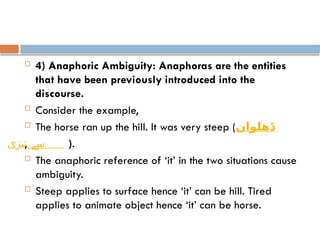
148.
4) AnaphoricAmbiguity: Anaphoras are the entities
that have been previously introduced into the
discourse.
Consider the example,
The horse ran up the hill. It was very steep (ڈھلوان
, سے
تیزی ).
The anaphoric reference of ‘it’ in the two situations cause
ambiguity.
Steep applies to surface hence ‘it’ can be hill. Tired
applies to animate object hence ‘it’ can be horse.
149.
Agenda
Machine Translation
Why Machine Translation
History of MT
Approaches to MT
MT Application
Recent Research
Strategies of MT
Types of MT
Next Week Plan
The End
Natural Language Processing (NLP) by Rahman Ali, Lect: QACC, UOP
149
February 14, 2025
150.
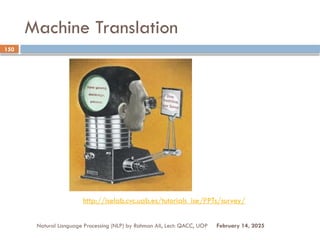
Machine Translation
Natural LanguageProcessing (NLP) by Rahman Ali, Lect: QACC, UOP
150
February 14, 2025
http://iselab.cvc.uab.es/tutorials_ise/PPTs/survey/
151.
Machine Translation
MachineTranslation (MT) is the task of automatically
converting one natural language into another,
preserving the meaning of the input text, and
producing fluent text in the output language.
http://nlp.stanford.edu/projects/mt.shtml, Retrieval date: 28 Nov, 2010)
Natural Language Processing (NLP) by Rahman Ali, Lect: QACC, UOP
151
February 14, 2025
152.
Why Machine Translationor Goals of MT ???
Cheap, universal access to world’s online
information regardless of original language.
Natural Language Processing (NLP) by Rahman Ali, Lect: QACC, UOP
152
February 14, 2025
153.
History of MachineTranslation
The history of machine translation started way back in the
1950s.
The first work of translation was published in 1954 in the
Georgetown experiment involving fully automatic translation of
more than 60 Russian sentences into English.
The experiment was a great success and the authors claimed
that machine translation would be used in translations within
three or five years.
However, the real progress was very slow.
(http://www.thelanguagetranslation.com/machine-translation.html)
Natural Language Processing (NLP) by Rahman Ali, Lect: QACC, UOP
153
February 14, 2025
154.
History of MachineTranslation (Cont..)
The ALPAC (Automatic Language Processing Advisory
Committee) report in 1966 further reduced the
investment in Machine translation because the report
evaluated the progress in computational linguistics in
general and machine translation in particular and was
very skeptical (disbelieving) to research done in
machine translation so far and gave more emphasis to
the need for basic research in computational
linguistics.
(http://www.thelanguagetranslation.com/machine-translation.html)
Natural Language Processing (NLP) by Rahman Ali, Lect: QACC, UOP
154
February 14, 2025
155.
History of MachineTranslation (Cont..)
However, starting in the late 1970s and beginning 1980s, with
the impact of personal computer revolution, with the increase in
computational power, more interest began to be shown in
statistical models for machine translation.
There was growth in the use of machine translation as a result of
the beginning of less expensive and more powerful computers.
With the 1990s, the importance of machine translation further
increased (for better or worse) and the use of "translation
engines" on the Internet to allow for translation of websites and
email languages.
(http://www.thelanguagetranslation.com/machine-translation.html)
Natural Language Processing (NLP) by Rahman Ali, Lect: QACC, UOP
155
February 14, 2025
156.
History of MachineTranslation (Cont..)
Today there are many software programs several
of them online for translating source language.
Such software includes the SYSTRAN system which
powers both Google translate, AltaVista's Babelfish,
StarDict etc.
These tools produce a rough translation that gives
the summary of the source text.
Natural Language Processing (NLP) by Rahman Ali, Lect: QACC, UOP
156
February 14, 2025
157.
Translation process
Thehuman translation process may be described as:
Decoding the meaning of the source text; and
Re-encoding this meaning in the target language.
158.
Bilingual MT
Abilingual dictionary or translation dictionary is a
specialized dictionary used to translate words or
phrases from one language to another. Bilingual
dictionaries can be unidirectional, meaning that they
list the meanings of words of one language in
another, or can be bidirectional, allowing translation
to and from both languages. Bidirectional bilingual
dictionaries usually consist of two sections, each
listing words and phrases of one language
alphabetically along with their translation.
159.
Multilingual MT
AMultilingual MT or translation dictionary is a
specialized dictionary used to translate words or
phrases from one language to several other
languages. Multilingual MT can be unidirectional,
meaning that they list the meanings of words of one
language in another, or can be bidirectional,
allowing translation to and from both languages.
Multilingual MT usually consist of two sections, each
listing words and phrases of one language
alphabetically along with their translation.
160.
Approaches of MachineTranslation
Rule-based MT
Example-based MT
Statistical Based MT
Hybrid MT
Natural Language Processing (NLP) by Rahman Ali, Lect: QACC, UOP
160
February 14, 2025
161.
Rule-based Machine Translation(RBMT
Also known as “Knowledge-based Machine Translation”;
“Classical Approach” of MT).
Machine translation systems that are based on linguistic
information about source and target languages basically
retrieved from (bilingual) dictionaries and grammars covering
the main semantic, morphological, and syntactic regularities of
each language respectively.
This approach of MT make use of morphological, syntactic,
and semantic analysis of both the source and the target
languages involved in a concrete translation task.
(http://en.wikipedia.org/wiki/Rule-based_machine_translation)
Natural Language Processing (NLP) by Rahman Ali, Lect: QACC, UOP
161
February 14, 2025
162.
Basic principles
Agirl eats an apple. Source Language = English;
Demanded Target Language = German Minimally, to
get a German translation of this English sentence one
needs:
A dictionary that will map each English word to an
appropriate German word.
Rules representing regular English sentence structure.
Rules representing regular German sentence structure.
163.
A girleats an apple. => Ein Mädchen isst einen
Apfel.
164.
Example-based Machine Translation(EBMT)
EBMT approach to machine translation is often characterized by
its use of a bilingual corpus with parallel texts as its main
knowledge base, at run-time.
It is essentially a translation by analogy and can be viewed as an
implementation of case-based reasoning approach of machine
learning.
(EBMT) approach was proposed by Makoto Nagao in 1984.[3][4]
(http://en.wikipedia.org/wiki/Example-based_machine_translation)
Natural Language Processing (NLP) by Rahman Ali, Lect: QACC, UOP
164
February 14, 2025
165.
165
/23
Example-based MT
Long-establishedapproach to empirical MT
First developed in contrast with rule-based MT
Idea of translation by analogy (Nagao 1984)
Translate by adapting previously seen examples rather
than by linguistic rule
“Existing translations contain more solutions to more
translation problems than any other available resource.”
(P. Isabelle et al., TMI, Kyoto, 1993)
In computational terms, belongs in family of Case-based
reasoning approaches
166.
166
/23
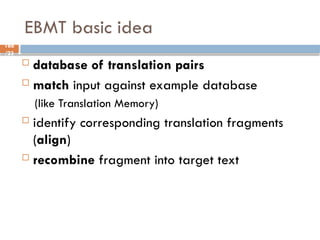
EBMT basic idea
database of translation pairs
match input against example database
(like Translation Memory)
identify corresponding translation fragments
(align)
recombine fragment into target text
167.
167
/23
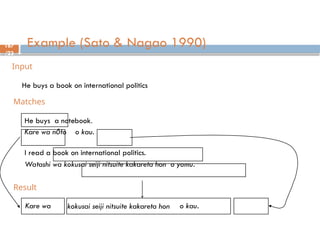
He buys abook on international politics
Input
Matches
He buys a notebook.
Kare wa n to o kau
ō .
I read a book on international politics.
Watashi wa kokusai seiji nitsuite kakareta hon o yomu.
Result
Kare wa o kau.
kokusai seiji nitsuite kakareta hon
Example (Sato & Nagao 1990)
168.
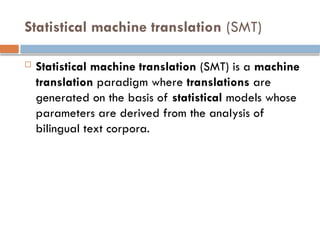
Statistical machine translation(SMT)
Statistical machine translation (SMT) is a machine
translation paradigm where translations are
generated on the basis of statistical models whose
parameters are derived from the analysis of
bilingual text corpora.
169.
169
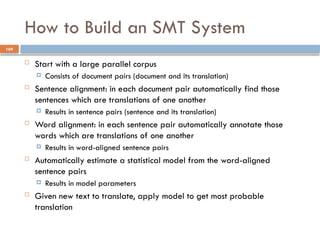
How to Buildan SMT System
Start with a large parallel corpus
Consists of document pairs (document and its translation)
Sentence alignment: in each document pair automatically find those
sentences which are translations of one another
Results in sentence pairs (sentence and its translation)
Word alignment: in each sentence pair automatically annotate those
words which are translations of one another
Results in word-aligned sentence pairs
Automatically estimate a statistical model from the word-aligned
sentence pairs
Results in model parameters
Given new text to translate, apply model to get most probable
translation
170.
170
Sentence alignment
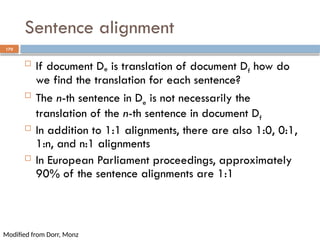
Ifdocument De is translation of document Df how do
we find the translation for each sentence?
The n-th sentence in De is not necessarily the
translation of the n-th sentence in document Df
In addition to 1:1 alignments, there are also 1:0, 0:1,
1:n, and n:1 alignments
In European Parliament proceedings, approximately
90% of the sentence alignments are 1:1
Modified from Dorr, Monz
171.
171
Sentence alignment
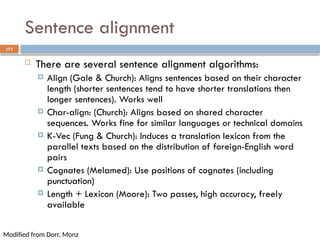
Thereare several sentence alignment algorithms:
Align (Gale & Church): Aligns sentences based on their character
length (shorter sentences tend to have shorter translations then
longer sentences). Works well
Char-align: (Church): Aligns based on shared character
sequences. Works fine for similar languages or technical domains
K-Vec (Fung & Church): Induces a translation lexicon from the
parallel texts based on the distribution of foreign-English word
pairs
Cognates (Melamed): Use positions of cognates (including
punctuation)
Length + Lexicon (Moore): Two passes, high accuracy, freely
available
Modified from Dorr, Monz
172.
Corpus
Corpus:
corpus,plural corpora A collection of linguistic data, either
compiled as written texts or as a transcription of recorded
speech.
Natural Language Processing (NLP) by Rahman Ali, Lect: QACC, UOP
172
February 14, 2025
173.
Hybrid Machine Translation(HMT)
Hybrid machine translation (HMT) leverages the
strengths of statistical and rule-based translation
methodologies.[5]
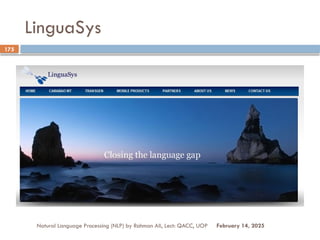
Several MT companies (Asia Online, LinguaSys, and
Systran) are claiming to have a hybrid approach
using both rules and statistics.
Natural Language Processing (NLP) by Rahman Ali, Lect: QACC, UOP
173
February 14, 2025
174.
Machine Translation Applications
LinguaSys (http://www.linguasys.net/)
provides highly customized hybrid machine translation that can go from any language to any
language. [Video: http://www.youtube.com/watch?v=lcSYwNP4CQ4]
Asia Online [http://www.asiaonline.net/translation.aspx]
provides a custom machine translation engine building capability that they claim gives near-
human quality compared to the "gist" based quality of free online engines. Asia Online also
provides tools to edit and create custom machine translation engines with their
Language Studio suite of products.
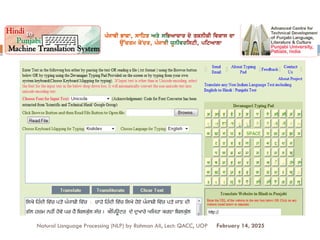
Hindi to Punjabi Machine Translation System[3],
provides machine translation using a direct approach. It translates Hindi into Punjabi. It also
features writing e-mail in the Hindi language and sending the same in Punjabi to the recipient.
IdiomaX,
which powers online translation services at idiomax.com
Toggletext
uses a transfer-based system (known as Kataku) to translate between English and Indonesian.
Natural Language Processing (NLP) by Rahman Ali, Lect: QACC, UOP
174
February 14, 2025
Machine Translation Applications(Cont..)
Arabic machine translation
in multilingual framework.
Worldlingo
provides machine translation using both statistical based TE's and rule based TE's. Most
recognizable as the MT partner in Microsoft Windows and Microsoft Mac Office.
Power Translator
SDL ETS and Language Weaver
which power FreeTranslation.com (website)
SYSTRAN,
which powers Yahoo! Babel Fish
Promt,
which powers online translation services at Voila.fr and Orange.fr
AppTek,
which released a hybrid MT system in 2009.[4]
Natural Language Processing (NLP) by Rahman Ali, Lect: QACC, UOP
177
February 14, 2025
178.
Machine Translation Applications(Cont..)
Anusaaraka
A free open source machine translation from English to Hindi based on Panini grammar and
uses state of the art NLP tools. Can be used online and downloaded from
Apertium,
a free and open source machine translation platform (WinXLator gives this a Windows
GUI, but it is likely to be in violation of the Apertium GPL license)
Google Translator
A free online translator from Google. [URL: translate.google.com]
Other translation software, most of them running under Microsoft Windows,
includes:
Translation memory tools, such as SDL Trados, Wordfast, Deja Vu, Swordfish, and
localization tools, such and Alchemy CATALYST and Multilizer.
Natural Language Processing (NLP) by Rahman Ali, Lect: QACC, UOP
178
February 14, 2025
Recent Research
Presentlya large amount of research is done into
example-based machine translation and statistical
machine translation
Natural Language Processing (NLP) by Rahman Ali, Lect: QACC, UOP
180
February 14, 2025
181.
Advantages of MachineTranslations
Machine translations work at a faster rate than human translations.
Another advantage of machine translation is that it is comparatively cheaper. It is one time cost
-the cost of the tool and its installation.
When time is a crucial factor, machine translation can save the day. You don't have to spend
hours poring over dictionaries to translate the words. Instead, the software can translate the
content quickly and provide a quality output to the user in no time at all.
The next benefit of machine translation is that it is comparatively cheap. Initially, it might look
like a unnecessary investment but in the long run it is a very small cost considering the return it
provides. This is because if you use the expertise of a professional translator, he will charge you
on a per page basis which is going to be extremely costly while this will be cheap.
Confidentiality is another matter which makes machine translation favorable. Giving sensitive
data to a translator might be risky while with machine translation your information is protected.
A machine translator usually translates text which is in any language so there is no such major
concern while a professional translator specializes in one particular field.
[http://www.thelanguagetranslation.com/machine-translation.html]
Natural Language Processing (NLP) by Rahman Ali, Lect: QACC, UOP
181
February 14, 2025
182.
Drawback of MT
Accuracy is not offered by the machine translation on a consistent basis.
You can get the gist of the draft or documents but machine translation
only does word to word translation without comprehending the
information which might have to be corrected manually later on.
Systematic and formal rules are followed by machine translation so it
cannot concentrate on a context and solve ambiguity and neither makes
use of experience or mental outlook like a human translator can.
[http://www.thelanguagetranslation.com/machine-translation.html]
Natural Language Processing (NLP) by Rahman Ali, Lect: QACC, UOP
182
February 14, 2025
183.
Types of MachineTranslation
Monolingual
Bilingual
Multilingual
Natural Language Processing (NLP) by Rahman Ali, Lect: QACC, UOP
183
February 14, 2025
184.
Monolingual Machine Translation
The translation of natural language text of the source
language to the target text in the same language is
called Monolingual Machine Translation.
Source Text (English)……..Computer…………> Target Text (English)
Source Text (Urdu)……..Computer…………> Target Text (Urdu)
Source Text (Pashto)……..Computer…………> Target Text (Pashto)
Natural Language Processing (NLP) by Rahman Ali, Lect: QACC, UOP
184
February 14, 2025
185.
Bilingual Machine Translation
The translation of natural language text written in one
natural language to the target text in the other
language is called bilingual Machine Translation.
Source Text (English)……..Computer…………> Target Text (Pashto)
Source Text (Urdu)……..Computer…………> Target Text (Chines)
Source Text (Pashto)……..Computer…………> Target Text (Hindko)
Natural Language Processing (NLP) by Rahman Ali, Lect: QACC, UOP
185
February 14, 2025
186.
Multilingual Machine Translation
The translation of natural language text written in one
language to the target text in more than two
languages is called Multilingual Machine Translation.
Source Text (English)……..Computer…………> Target Text (Urdu, Pashto)
Source Text (Urdu)……..Computer…………> Target Text (Hindko, Japanies,
Turkish)
Natural Language Processing (NLP) by Rahman Ali, Lect: QACC, UOP
186
February 14, 2025
187.
Translation Unit
187
February 14,2025
In the field of translation, a translation unit is a
segment of a text which the translator treats as a
single cognitive unit for the purposes of establishing
an equivalence.
The translation unit may be a
Single word, or it may be
Sentence
Discourse
188.
Translation Unit (Cont..)
When a translator segments a text into translation units, the
larger these units are, better chance there is of obtaining an
idiomatic translation.
This is true not only of human translation, but also in cases
where human translators use computer-assisted translation, and
also when translations are performed by machine translation
systems.
Natural Language Processing (NLP) by Rahman Ali, Lect: QACC, UOP
188
February 14, 2025
189.
Word-For-Word Translation
Transferringthe meaning of each individual word in a
text to another, equivalent word in the target language.
Sometimes called 'Literal Translation'.
While this is clearly appropriate for dictionaries, it can
produce very complex passages of text.
[Translation Theory, http://www.translatum.gr/etexts/translation-theory.htm#UnitOfTranslation,
Retrieved date: 09-Jan,2011]
Natural Language Processing (NLP) by Rahman Ali, Lect: QACC, UOP
189
February 14, 2025
190.
Word-For-Word Translation (Cont..)
Problems/limitations
Words order in source and target language
SOV vs SVO
I ate the meal [English]
Ma dody wakhwara [Pashto]
Sometimes, no matching word in target language
No (1-1) correspondence between the words of source
language and target language
Poly-semantic words
Natural Language Processing (NLP) by Rahman Ali, Lect: QACC, UOP
190
February 14, 2025
191.
Sentence-by-sentence Translation
Asentence in the source language is taken as a unit of
translation and translated to the corresponding target
language.
Most MT work focuses on sentence translation.
Natural Language Processing (NLP) by Rahman Ali, Lect: QACC, UOP
191
February 14, 2025
192.
Sentence-by-sentence Translation (Cont..)
What does sentence translation ignore?
Discourse properties/structure
Inter-sentence co-reference.
Natural Language Processing (NLP) by Rahman Ali, Lect: QACC, UOP
192
February 14, 2025
193.
193
William Shakespeare wasan English poet and playwright
widely regarded as the greatest writer of the English
language, as well as one of the greatest in Western
literature, and the world's pre-eminent dramatist.
He wrote about thirty-eight plays and 154 sonnets
(poems), as well as a variety of other poems.
<doc>
</doc>
. . .
<sentence>
<sentence>
<sentence>
Problems in Sentence-based MT
What is the referent of “He”?
Natural Language Processing (NLP) by Rahman Ali, Lect: QACC, UOP
194.
Contents
Referring Expression
Referring expression
Referent
Types of References
Exophora and
Endophora
Types of Endophora
Anaphora and
Cataphora
Types or Categories of Anaphora
Anaphoric/Cataphoric Devices
Anaphora Resolution
Anaphora and Ambiguity
Reading/References
Next Week Plan
194
195.
Reference
Reference isa relation between objects in which
one object designates, or acts as a means by which
to connect to or link to, another object. The first
object in this relation is said to refer to the second
object.
196.
Referring Expression
Anatural language expression used to perform reference is
called a referring expression and the entity that is referred to
is called the referent.
Referring expressions are words or phrases, the semantic interpretation of
which is a discourse entity (also called referent)
Example:
A pretty woman entered the restaurant. She sat at the table next to
mine and only then I recognized her. This was Amy Garcia, my next door
neighbor from 10 years ago. The woman has totally changed! Amy was
at the time shy…
196
197.
Referring Expression (Cont’)
A pretty woman entered the restaurant. She sat at the
table next to mine and only then I recognized her. This
was Amy Garcia, my next door neighbor from 10
years ago. The woman has totally changed! Amy was
at the time shy…
197
Referent
Referring Expression
198.
Referring Expression:any expressions used to refer to
somebody or someone with the particular picture in mind
(Heasley 1983)
199.
Types of References
Wecan summaries reference with a diagram to
make it easier to grasp:
199
200.
Exophoric Reference
Exophoricreference, depends on the context outside the text
for its meaning.
In linguistics, Exophora is reference to something extra-
linguistic.
For example
"What is this?",
here "this" is exophoric rather than endophoric, because it refers to
something extra-linguistic, i.e. there is not enough information in
the utterance itself to determine what "this" refers to, but we must
instead observe the non-linguistic context of the utterance (e.g. the
speaker might be holding an unknown object in their hand as they
ask that question.)
200
201.
"Did thegardener water those plants?", it is quite
possible that "those" refers back to the preceding
text, to some earlier mention of those particular
plants in the discussion.
202.
Endophoric Reference
Thepronouns refer to items within the same text; it is
endophoric reference.
Endophora is a linguistic reference to something intra-linguistic.
For Example:
"I saw Sally yesterday. She was lying on the beach".
Here, "she" is intra-linguistic, and hence endophoric, because it refers to something
(Sally, in this case) already mentioned in the text.
(From Wikipedia, the free encyclopedia)
202
203.
Endophora (Another Definition)
Words or phrases like pronouns are endophora
when they point backwards or forwards to
something in the text:
For example:
As [he]1
was late, [Harry] 1
wanted to phone [his] 1
[boss] 2 and tell [her] 2
what had happened.
(From Wikipedia, the free encyclopedia)
203
204.
Types of Endophora
1) Cataphora:
The type of endophora in which the referring expression occur before the referent are
termed as cataphora.
OR The type of endophora in which the pronouns link forward to a referent (nouns) in
the text that follows.
For example:
When [she] 1
saw the snake, [Harry] 1
cried.
The elevator opened for [him] 1
on the 14th
flour, and [Ali] 1
stepped out quickly.
2) Anaphora:
The type of endophora in which the referent occurs before the referring expression
are termed as anaphora.
OR The type of endophora in which the pronouns link backward to a referent (nouns) in
the text.
For example:
204
205.
Anaphora(Another Definition)
Anaphorais a phenomenon in which certain textual
elements refer to earlier text elements (called
correlates) and share the meaning of the correlates.
For Example:
1)John helped Mary.
2) He was kind.
205
Correlate/
Referent/
Antecedent
Referring Element/
Anaphor/
Anaphoric Device (AD)
206.
Anaphoric and CataphoricDevices
The referring elements (pronouns) in anaphoric text that refer to their
corresponding referent ( nouns) backward are called anaphoric
devices. Also, called anaphor.
For example:
Bell is a powerful player but unfortunately he will not take part in the trophy due to
injury.
The referring elements (pronouns) that refer to their corresponding referent
(nouns) forward in cataphoric text are called cataphoric devices. Also,
called cataphor.
For example:
As her father went abroad, Nighat took control of the organization by herself.
206
Anaphoric Device
Cataphoric Device
207.
Types of Anaphora(On the basis of position of
anaphor and its antecedent)
Intra-sentential/Sentence internal anaphora:
The anaphora in which the AD and its antecedent both occurs in the
same sentence is called sentence internal.
Reflexive pronouns
(himself, herself, itself, themselves) are typical examples of intra-sentential anaphora.
Possessive pronouns
(his, her, hers, its, their, theirs) can often be used as intra-sentential anaphors too, and
often be in the same clause as the anaphor.
For example:
[John] 1
took [his] 1
[hat] 2 off and hung [it] 2 on a peg.
207
208.
Types of Anaphora(Cont..)
Inter-sentential/Sentence external anaphora:
The anaphora in which the AD and its antecedent doesn’t
occur in the same sentence is called sentence external or
inter-sentential anaphora.
For example:
[Jehansher] 1
Khan was senior player of Sqash. [He] 1
has won several
trophies.
[John] 1
took his hat off and hung it on a peg. [He] 1
was very tied
therefore went to slept..
208
209.
Anaphora and Ambiguity
Many anaphors are ambiguous. Like:
A)
Jane told Marry she was in love (ambiguous)
Jane informed Marry she was in love. (Here Jane is in love)
B)
Jane told marry she was in danger (ambiguous)
Jane warned Marry she was in danger.
209
210.
Anaphora Resolution
AnaphoraResolution == the problem of resolving what a
pronoun, or a noun phrase refers to.
Consider the following Discourse:
1) John helped Mary.
2) He was kind.
After anaphora resolution:
1) John helped Mary.
2) John was kind.
210
211.
Agenda
Natural LanguageUnderstanding (NLU)
Ellipsis Definition
Examples of Ellipsis
Origin of the Word Ellipsis
Natural Language Processing (NLP) by Rahman Ali, Lect: QACC, UOP
211
February 14, 2025
212.
Ellipsis
Definition:
Theomission of a portion, of a phrase or a sentence is
called Ellipsis (Rav, L., F.).
Example:
He is rich, but his brother is not ᶲ.
Bob ᶲ and Tom ate cheese.
Natural Language Processing (NLP) by Rahman Ali, Lect: QACC, UOP
212
February 14, 2025
213.
Examples of Ellipsis
George bought a huge box of chocolates but few were
Ǿ
left by the end of the day.
I have never been to Karachi but my father has , and
Ǿ
he says it was wonderful.
Natural Language Processing (NLP) by Rahman Ali, Lect: QACC, UOP
213
February 14, 2025
Chocolates
Been to Karachi
214.
Examples of Ellipsis
NaturalLanguage Processing (NLP) by Rahman Ali, Lect: QACC, UOP
214
February 14, 2025
(1)
او شول ټپيان خلک ډير السه له بريدونو ځانمرګې د
شول ووژل پکښ څو يو
ے -
او شول ټپيان خلک ډير السه له بريدونو ځانمرګې د
څو يو
خلک
شول ووژل پکښ
ے -
Shows that here a noun is missing which is the possible
referring expression for the antecedent [People]
LEARNING
Learning isthe improvement of performance with
experience over time.
Learning element is the portion of a learning AI
system that decides how to modify the performance
element and implements those modifications.
217.
There arefive methods of learning . They are,
1. Rote learning
2. Direct instruction (by being told)
3. Analogy
4. Induction
5. Deduction
218.
Rote Learning
Rotelearning is the memorization of information
based on repetition. The two biggest examples of
rote learning are the alphabet and numbers.
Example:- Memorizing multiplication tables,
formulate , etc.
219.
Learning by Instruction
This type of learning occur when a person is
instructed about a problem solution or for new
knowledge learning by an instructor.
For example
Learning by instruction occurs when one male imitates
the song of another.
220.
Learn by Analogy
Analogical learning is the process of learning a new
concept or solution through the use of similar known
concepts or solutions. We use this type of learning
when solving problems on an exam where
previously learned examples serve as a guide or
when make frequent use of analogical learning.
221.
Inductive Learning
InductiveLearning is the process of making
generalized decisions after observing, or
witnessing, repeated specific instances of something.
For example
This cat is black. That cat is black A third cat is
black. Therefore all cats are black.
This marble from the bag is black. That marble from
the bag is black. A third marble from the bag is
black. Therefore all the marbles in the bag black.
222.
Learning by Deduction
In the process of deduction, you begin with some
statements, called 'premises', that are assumed to
be true, you then determine what else would have
to be true if the premises are true.
All men are mortal. Joe is a man. Therefore Joe is
mortal. If the first two statements are true, then the
conclusion must be true. 2
Bachelor's are unmarried men. Bill is unmarried.
Therefore, Bill is a bachelor. 3




![CPSC 433 Artificial Intelligence
Forward Chaining Example
If [X croaks and eats flies]
Then [X is a frog]
[Fritz croaks and eats flies]
[Fritz is a frog]
If [X is a frog]
Then [X is colored green]
[Fritz is colored green] [Fritz is colored Y] ?
Knowledge Base
If [X croaks and eats flies]
Then [X is a frog]
If [X chirps and sings]
Then [X is a canary]
If [X is a frog]
Then [X is colored green]
If [X is a canary]
Then [X is colored yellow]
[Fritz croaks and eats flies]
[Fritz is a frog]
[Fritz is colored green]
Goal
[Fritz is colored Y]?
Y = green](https://image.slidesharecdn.com/aibasics-250214151921-39130f9c/85/Artificial-Intelligence-Basics-Unit-1-pptx-74-320.jpg)
![CPSC 433 Artificial Intelligence
Backward Chaining Example
Knowledge Base
If [X croaks and eats flies]
Then [X is a frog]
If [X chirps and sings]
Then [X is a canary]
If [X is a frog]
Then [X is colored green]
If [X is a canary]
Then [X is colored yellow]
[Fritz croaks and eats flies]
Goals
[Fritz is colored Y]?
[X is a frog]
[X is a canary]
[X croaks and eats flies]
[Fritz is colored Y]
If [X is a frog]
Then [X is colored green]
[X is a frog]
If [X is a canary]
Then [X is colored yellow]
[X is a canary]
If [X croaks and eats flies]
Then [X is a frog]
[X croaks and eats flies] [Fritz croaks and eats flies]
X = Fritz, Y = green](https://image.slidesharecdn.com/aibasics-250214151921-39130f9c/85/Artificial-Intelligence-Basics-Unit-1-pptx-76-320.jpg)
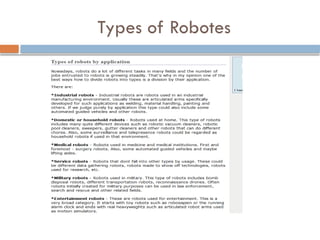
![2.1 Scope ambiguity involves operators and quantifiers.
Consider the example:
Old men and women were taken to safe locations.
The scope of the adjective (i.e., the amount of text it qualifies) is
ambiguous. That is, whether the structure (old men and
women) or ((old men) and women)?
The scope of quantifiers is often not clear and creates ambiguity.
Every man loves a woman.[7]
The interpretations can be, For every man there is a woman and
also it can be there is one particular woman who is
loved by every man.](https://image.slidesharecdn.com/aibasics-250214151921-39130f9c/85/Artificial-Intelligence-Basics-Unit-1-pptx-145-320.jpg)
![ 2.2) Attachment Ambiguity
A sentence has attachment ambiguity if a constituent fits more than one position in
a parse tree. Attachment ambiguity arises from uncertainty of attaching a phrase
or clause to a part of a sentence.
Consider the example:
The man saw the girl with the telescope.[2]
It is ambiguous whether the man saw a girl carrying a telescope, or he saw her
through his telescope.
The meaning is dependent on whether the preposition ‘with’ is attached to the girl
or the man.
Consider the example:
Buy books for children
Preposition Phrase ‘for children’ can be either adverbial and attach to the verb
buy or adjectival and attach to the object noun books.](https://image.slidesharecdn.com/aibasics-250214151921-39130f9c/85/Artificial-Intelligence-Basics-Unit-1-pptx-146-320.jpg)
![
3) Semantic Ambiguity: This occurs when the meaning of the words themselves can be
misinterpreted. Even after the syntax and the meanings of the individual words have been resolved, there are
two ways of reading the sentence.
Consider the example,
Seema loves her mother and Sriya does too.
The interpretations can be Sriya loves Seema’s mother or Sriya likes her own mother.
Semantic ambiguities born from the fact that generally a computer is not in a position to distinguishing what is
logical from what is not.
Consider the example:
The car hit the pole while it was moving.
The interpretations can be The car, while moving, hit the pole and The car hit the pole while the pole was
moving. The first interpretation is preferred to the second one because we have a model of the world that
helps us to distinguish what
is logical (or possible) from what is not. To supply to a computer a model of the world is not so easy.[4]
Consider the example:
We saw his duck
Duck can refer to the person’s bird or to a motion he made.
Semantic ambiguity happens when a sentence contains an ambiguous word or phrase.](https://image.slidesharecdn.com/aibasics-250214151921-39130f9c/85/Artificial-Intelligence-Basics-Unit-1-pptx-147-320.jpg)
![Example-based Machine Translation (EBMT)
EBMT approach to machine translation is often characterized by
its use of a bilingual corpus with parallel texts as its main
knowledge base, at run-time.
It is essentially a translation by analogy and can be viewed as an
implementation of case-based reasoning approach of machine
learning.
(EBMT) approach was proposed by Makoto Nagao in 1984.[3][4]
(http://en.wikipedia.org/wiki/Example-based_machine_translation)
Natural Language Processing (NLP) by Rahman Ali, Lect: QACC, UOP
164
February 14, 2025](https://image.slidesharecdn.com/aibasics-250214151921-39130f9c/85/Artificial-Intelligence-Basics-Unit-1-pptx-164-320.jpg)
![Hybrid Machine Translation (HMT)
Hybrid machine translation (HMT) leverages the
strengths of statistical and rule-based translation
methodologies.[5]
Several MT companies (Asia Online, LinguaSys, and
Systran) are claiming to have a hybrid approach
using both rules and statistics.
Natural Language Processing (NLP) by Rahman Ali, Lect: QACC, UOP
173
February 14, 2025](https://image.slidesharecdn.com/aibasics-250214151921-39130f9c/85/Artificial-Intelligence-Basics-Unit-1-pptx-173-320.jpg)
![Machine Translation Applications
LinguaSys (http://www.linguasys.net/)
provides highly customized hybrid machine translation that can go from any language to any
language. [Video: http://www.youtube.com/watch?v=lcSYwNP4CQ4]
Asia Online [http://www.asiaonline.net/translation.aspx]
provides a custom machine translation engine building capability that they claim gives near-
human quality compared to the "gist" based quality of free online engines. Asia Online also
provides tools to edit and create custom machine translation engines with their
Language Studio suite of products.
Hindi to Punjabi Machine Translation System[3],
provides machine translation using a direct approach. It translates Hindi into Punjabi. It also
features writing e-mail in the Hindi language and sending the same in Punjabi to the recipient.
IdiomaX,
which powers online translation services at idiomax.com
Toggletext
uses a transfer-based system (known as Kataku) to translate between English and Indonesian.
Natural Language Processing (NLP) by Rahman Ali, Lect: QACC, UOP
174
February 14, 2025](https://image.slidesharecdn.com/aibasics-250214151921-39130f9c/85/Artificial-Intelligence-Basics-Unit-1-pptx-174-320.jpg)
![Machine Translation Applications (Cont..)
Arabic machine translation
in multilingual framework.
Worldlingo
provides machine translation using both statistical based TE's and rule based TE's. Most
recognizable as the MT partner in Microsoft Windows and Microsoft Mac Office.
Power Translator
SDL ETS and Language Weaver
which power FreeTranslation.com (website)
SYSTRAN,
which powers Yahoo! Babel Fish
Promt,
which powers online translation services at Voila.fr and Orange.fr
AppTek,
which released a hybrid MT system in 2009.[4]
Natural Language Processing (NLP) by Rahman Ali, Lect: QACC, UOP
177
February 14, 2025](https://image.slidesharecdn.com/aibasics-250214151921-39130f9c/85/Artificial-Intelligence-Basics-Unit-1-pptx-177-320.jpg)
![Machine Translation Applications (Cont..)
Anusaaraka
A free open source machine translation from English to Hindi based on Panini grammar and
uses state of the art NLP tools. Can be used online and downloaded from
Apertium,
a free and open source machine translation platform (WinXLator gives this a Windows
GUI, but it is likely to be in violation of the Apertium GPL license)
Google Translator
A free online translator from Google. [URL: translate.google.com]
Other translation software, most of them running under Microsoft Windows,
includes:
Translation memory tools, such as SDL Trados, Wordfast, Deja Vu, Swordfish, and
localization tools, such and Alchemy CATALYST and Multilizer.
Natural Language Processing (NLP) by Rahman Ali, Lect: QACC, UOP
178
February 14, 2025](https://image.slidesharecdn.com/aibasics-250214151921-39130f9c/85/Artificial-Intelligence-Basics-Unit-1-pptx-178-320.jpg)
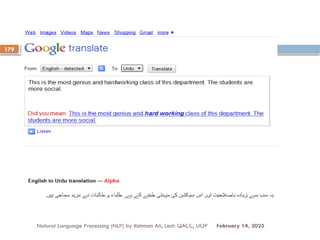
![Advantages of Machine Translations
Machine translations work at a faster rate than human translations.
Another advantage of machine translation is that it is comparatively cheaper. It is one time cost
-the cost of the tool and its installation.
When time is a crucial factor, machine translation can save the day. You don't have to spend
hours poring over dictionaries to translate the words. Instead, the software can translate the
content quickly and provide a quality output to the user in no time at all.
The next benefit of machine translation is that it is comparatively cheap. Initially, it might look
like a unnecessary investment but in the long run it is a very small cost considering the return it
provides. This is because if you use the expertise of a professional translator, he will charge you
on a per page basis which is going to be extremely costly while this will be cheap.
Confidentiality is another matter which makes machine translation favorable. Giving sensitive
data to a translator might be risky while with machine translation your information is protected.
A machine translator usually translates text which is in any language so there is no such major
concern while a professional translator specializes in one particular field.
[http://www.thelanguagetranslation.com/machine-translation.html]
Natural Language Processing (NLP) by Rahman Ali, Lect: QACC, UOP
181
February 14, 2025](https://image.slidesharecdn.com/aibasics-250214151921-39130f9c/85/Artificial-Intelligence-Basics-Unit-1-pptx-181-320.jpg)
![Drawback of MT
Accuracy is not offered by the machine translation on a consistent basis.
You can get the gist of the draft or documents but machine translation
only does word to word translation without comprehending the
information which might have to be corrected manually later on.
Systematic and formal rules are followed by machine translation so it
cannot concentrate on a context and solve ambiguity and neither makes
use of experience or mental outlook like a human translator can.
[http://www.thelanguagetranslation.com/machine-translation.html]
Natural Language Processing (NLP) by Rahman Ali, Lect: QACC, UOP
182
February 14, 2025](https://image.slidesharecdn.com/aibasics-250214151921-39130f9c/85/Artificial-Intelligence-Basics-Unit-1-pptx-182-320.jpg)
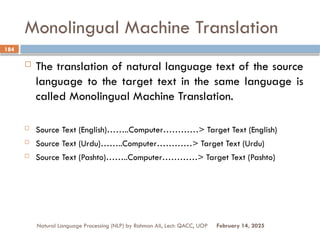
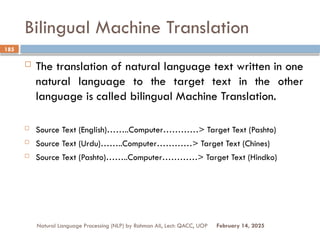
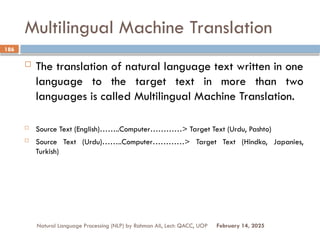
![Word-For-Word Translation
Transferring the meaning of each individual word in a
text to another, equivalent word in the target language.
Sometimes called 'Literal Translation'.
While this is clearly appropriate for dictionaries, it can
produce very complex passages of text.
[Translation Theory, http://www.translatum.gr/etexts/translation-theory.htm#UnitOfTranslation,
Retrieved date: 09-Jan,2011]
Natural Language Processing (NLP) by Rahman Ali, Lect: QACC, UOP
189
February 14, 2025](https://image.slidesharecdn.com/aibasics-250214151921-39130f9c/85/Artificial-Intelligence-Basics-Unit-1-pptx-189-320.jpg)
![Word-For-Word Translation (Cont..)
Problems/limitations
Words order in source and target language
SOV vs SVO
I ate the meal [English]
Ma dody wakhwara [Pashto]
Sometimes, no matching word in target language
No (1-1) correspondence between the words of source
language and target language
Poly-semantic words
Natural Language Processing (NLP) by Rahman Ali, Lect: QACC, UOP
190
February 14, 2025](https://image.slidesharecdn.com/aibasics-250214151921-39130f9c/85/Artificial-Intelligence-Basics-Unit-1-pptx-190-320.jpg)
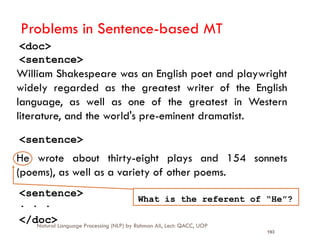
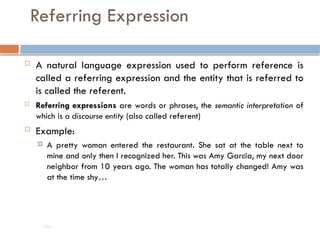
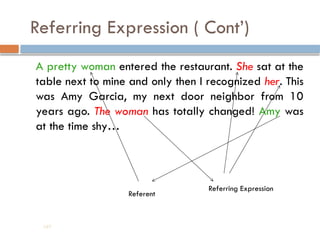
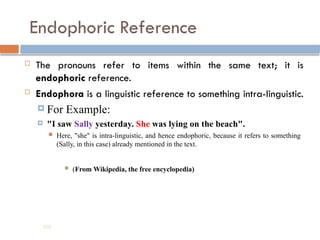
![Endophora (Another Definition)
Words or phrases like pronouns are endophora
when they point backwards or forwards to
something in the text:
For example:
As [he]1
was late, [Harry] 1
wanted to phone [his] 1
[boss] 2 and tell [her] 2
what had happened.
(From Wikipedia, the free encyclopedia)
203](https://image.slidesharecdn.com/aibasics-250214151921-39130f9c/85/Artificial-Intelligence-Basics-Unit-1-pptx-203-320.jpg)
![Types of Endophora
1) Cataphora:
The type of endophora in which the referring expression occur before the referent are
termed as cataphora.
OR The type of endophora in which the pronouns link forward to a referent (nouns) in
the text that follows.
For example:
When [she] 1
saw the snake, [Harry] 1
cried.
The elevator opened for [him] 1
on the 14th
flour, and [Ali] 1
stepped out quickly.
2) Anaphora:
The type of endophora in which the referent occurs before the referring expression
are termed as anaphora.
OR The type of endophora in which the pronouns link backward to a referent (nouns) in
the text.
For example:
204](https://image.slidesharecdn.com/aibasics-250214151921-39130f9c/85/Artificial-Intelligence-Basics-Unit-1-pptx-204-320.jpg)
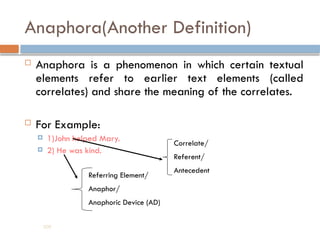
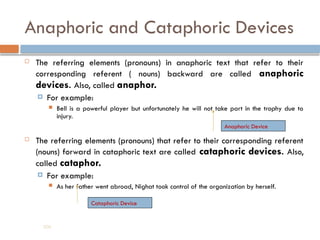
![Types of Anaphora (On the basis of position of
anaphor and its antecedent)
Intra-sentential/Sentence internal anaphora:
The anaphora in which the AD and its antecedent both occurs in the
same sentence is called sentence internal.
Reflexive pronouns
(himself, herself, itself, themselves) are typical examples of intra-sentential anaphora.
Possessive pronouns
(his, her, hers, its, their, theirs) can often be used as intra-sentential anaphors too, and
often be in the same clause as the anaphor.
For example:
[John] 1
took [his] 1
[hat] 2 off and hung [it] 2 on a peg.
207](https://image.slidesharecdn.com/aibasics-250214151921-39130f9c/85/Artificial-Intelligence-Basics-Unit-1-pptx-207-320.jpg)
![Types of Anaphora (Cont..)
Inter-sentential/Sentence external anaphora:
The anaphora in which the AD and its antecedent doesn’t
occur in the same sentence is called sentence external or
inter-sentential anaphora.
For example:
[Jehansher] 1
Khan was senior player of Sqash. [He] 1
has won several
trophies.
[John] 1
took his hat off and hung it on a peg. [He] 1
was very tied
therefore went to slept..
208](https://image.slidesharecdn.com/aibasics-250214151921-39130f9c/85/Artificial-Intelligence-Basics-Unit-1-pptx-208-320.jpg)
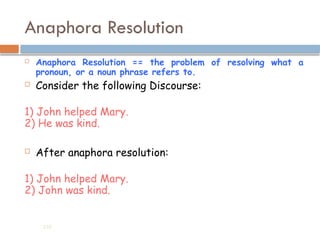
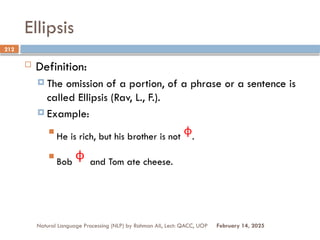
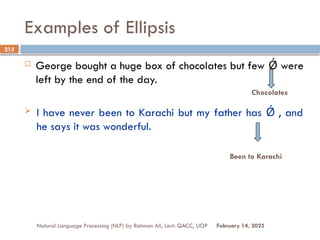
![Examples of Ellipsis
Natural Language Processing (NLP) by Rahman Ali, Lect: QACC, UOP
214
February 14, 2025
(1)
او شول ټپيان خلک ډير السه له بريدونو ځانمرګې د
شول ووژل پکښ څو يو
ے -
او شول ټپيان خلک ډير السه له بريدونو ځانمرګې د
څو يو
خلک
شول ووژل پکښ
ے -
Shows that here a noun is missing which is the possible
referring expression for the antecedent [People]](https://image.slidesharecdn.com/aibasics-250214151921-39130f9c/85/Artificial-Intelligence-Basics-Unit-1-pptx-214-320.jpg)
![Examples of Ellipsis
-Ǿ ما کله ورپسې به ډوډ
ۍ
يوړه
نورينې به کله
]Mirza Jahanzeb Yar, ”Gulmeena", Page-45]
ما *
هکل ورپسې به ډوډ
ۍ
يوړه
نورينې به کله
يوړه -
.
Natural Language Processing (NLP) by Rahman Ali, Lect: QACC, UOP
215
February 14, 2025
Denotes the missing verb
phrased [يوړه].](https://image.slidesharecdn.com/aibasics-250214151921-39130f9c/85/Artificial-Intelligence-Basics-Unit-1-pptx-215-320.jpg)