A PRESENTATION ON
ARTIFICIAL INTELLIGENCE.
AI TO A BETTER FUTURE.
BY
ISHWAR SHENOY 116A4019
MITALI SHETTY 116A4020
SRIGANESH SANKAR 116A4021
SUSHMITA GANAPATHI 116A4022
VINAY THAKUR 116A4024
THIRD YEAR ENGINEERING,
PRINTING & PACKAGING TECHNOLOGY DEPARTMENT.
INTRODUCTION.
• ARTIFICIAL:-
The simple definition of artificial is that objects that are made or produced by human beings rather
than occurring naturally.
• INTELLIGENCE:-
The simple definition of intelligence is a process of entail a set of skills of problem solving, enabling
to resolve genuine problems or difficulties that encounters and to create an effective product and must
also entail the potential for finding or creating problems and thereby laying the groundwork for the
acquisition of new knowledge.
• ARTIFICIAL INTELLIGENCE:-
Artificial intelligence is a branch of science which deals with helping machines find solution to
complex problems in a more human like fashion. This generally involves borrowing characteristics from
human intelligence, and applying them as algorithms in a computer friendly way.
HISTORY.
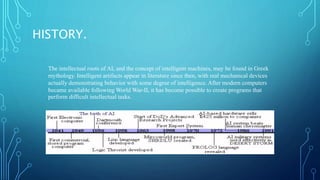
The intellectual roots of AI, and the concept of intelligent machines, may be found in Greek
mythology. Intelligent artifacts appear in literature since then, with real mechanical devices
actually demonstrating behavior with some degree of intelligence. After modern computers
became available following World War-II, it has become possible to create programs that
perform difficult intellectual tasks.
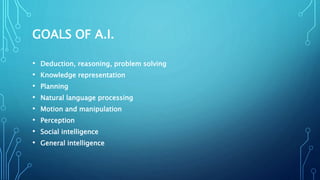
GOALS OF A.I.
• Deduction, reasoning, problem solving
• Knowledge representation
• Planning
• Natural language processing
• Motion and manipulation
• Perception
• Social intelligence
• General intelligence
CATEGORIES OF A.I.
• AI divides roughly into two schools of thought:
1. Conventional AI.
2. Computational Intelligence (CI).
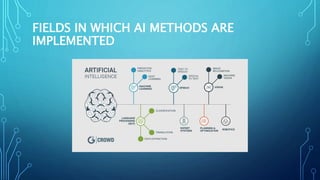
FIELDS IN WHICH AI METHODS ARE
IMPLEMENTED
APPLICATIONS OF A.I.
• Hospitals and medicine
• Heavy industry
• Game Playing
• Speech Recognition
• Understanding Natural Language
• Computer Vision
• Expert Systems
• Heuristic Classification
FUTURE OF A.I.
• In the next 10 years technologies in narrow fields such as speech recognition will
continue to improve and will reach human levels.
• In 10 years AI will be able to communicate with humans in unstructured English using text
or voice, navigate (not perfectly) in an unprepared environment and will have some
rudimentary common sense (and domain-specific intelligence).
• We will recreate some parts of the human (animal) brain in silicon. The feasibility of this is
demonstrated by tentative hippocampus experiments in rats There are two major projects
aiming for human brain simulation, Cortex and IBM Blue Brain.
• There will be an increasing number of practical applications based on digitally recreated
aspects human intelligence, such as cognition, perception, rehearsal learning, or learning
by repetitive practice.
• The development of meaningful artificial intelligence will require that machines acquire
some variant of human consciousness.
RISKS OF AI
HOW CAN AI BE DANGEROUS?
• The AI is programmed to do something devastating:
• The AI is programmed to do something beneficial, but it
develops a destructive method for achieving its goal:
CONCLUSION.
• The machine could successfully pretend to be human to a
knowledgeable observer then you certainly should consider it
intelligent.
• AI systems are now in routine use in various field such as economics,
medicine, engineering and the military, as well as being built into
many common home computer software applications, traditional
strategy games etc.
• AI is an exciting and rewarding discipline. The revised definition of AI
is - AI is the study of mechanisms underlying intelligent behavior
through the construction and evaluation of artifacts that attempt to
enact those mechanisms.
THANK YOU

Artificial intelligence to a better future.

  • 1.
    A PRESENTATION ON ARTIFICIALINTELLIGENCE. AI TO A BETTER FUTURE. BY ISHWAR SHENOY 116A4019 MITALI SHETTY 116A4020 SRIGANESH SANKAR 116A4021 SUSHMITA GANAPATHI 116A4022 VINAY THAKUR 116A4024 THIRD YEAR ENGINEERING, PRINTING & PACKAGING TECHNOLOGY DEPARTMENT.
  • 2.
    INTRODUCTION. • ARTIFICIAL:- The simpledefinition of artificial is that objects that are made or produced by human beings rather than occurring naturally. • INTELLIGENCE:- The simple definition of intelligence is a process of entail a set of skills of problem solving, enabling to resolve genuine problems or difficulties that encounters and to create an effective product and must also entail the potential for finding or creating problems and thereby laying the groundwork for the acquisition of new knowledge. • ARTIFICIAL INTELLIGENCE:- Artificial intelligence is a branch of science which deals with helping machines find solution to complex problems in a more human like fashion. This generally involves borrowing characteristics from human intelligence, and applying them as algorithms in a computer friendly way.
  • 3.
    HISTORY. The intellectual rootsof AI, and the concept of intelligent machines, may be found in Greek mythology. Intelligent artifacts appear in literature since then, with real mechanical devices actually demonstrating behavior with some degree of intelligence. After modern computers became available following World War-II, it has become possible to create programs that perform difficult intellectual tasks.
  • 4.
    GOALS OF A.I. •Deduction, reasoning, problem solving • Knowledge representation • Planning • Natural language processing • Motion and manipulation • Perception • Social intelligence • General intelligence
  • 5.
    CATEGORIES OF A.I. •AI divides roughly into two schools of thought: 1. Conventional AI. 2. Computational Intelligence (CI).
  • 6.
    FIELDS IN WHICHAI METHODS ARE IMPLEMENTED
  • 7.
    APPLICATIONS OF A.I. •Hospitals and medicine • Heavy industry • Game Playing • Speech Recognition • Understanding Natural Language • Computer Vision • Expert Systems • Heuristic Classification
  • 8.
    FUTURE OF A.I. •In the next 10 years technologies in narrow fields such as speech recognition will continue to improve and will reach human levels. • In 10 years AI will be able to communicate with humans in unstructured English using text or voice, navigate (not perfectly) in an unprepared environment and will have some rudimentary common sense (and domain-specific intelligence). • We will recreate some parts of the human (animal) brain in silicon. The feasibility of this is demonstrated by tentative hippocampus experiments in rats There are two major projects aiming for human brain simulation, Cortex and IBM Blue Brain. • There will be an increasing number of practical applications based on digitally recreated aspects human intelligence, such as cognition, perception, rehearsal learning, or learning by repetitive practice. • The development of meaningful artificial intelligence will require that machines acquire some variant of human consciousness.
  • 9.
    RISKS OF AI HOWCAN AI BE DANGEROUS? • The AI is programmed to do something devastating: • The AI is programmed to do something beneficial, but it develops a destructive method for achieving its goal:
  • 10.
    CONCLUSION. • The machinecould successfully pretend to be human to a knowledgeable observer then you certainly should consider it intelligent. • AI systems are now in routine use in various field such as economics, medicine, engineering and the military, as well as being built into many common home computer software applications, traditional strategy games etc. • AI is an exciting and rewarding discipline. The revised definition of AI is - AI is the study of mechanisms underlying intelligent behavior through the construction and evaluation of artifacts that attempt to enact those mechanisms.
  • 11.