Introduction - what this is about 
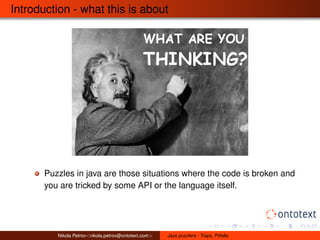
Puzzles in java are those situations where the code is broken and 
you are tricked by some API or the language itself. 
Nikola Petrov<nikola.petrov@ontotext.com> Java puzzlers - Traps, Pitfalls
Introduction - what this is about 
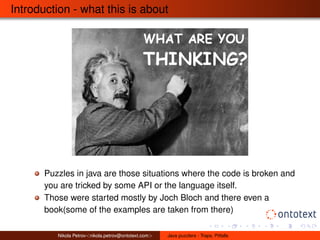
Puzzles in java are those situations where the code is broken and 
you are tricked by some API or the language itself. 
Those were started mostly by Joch Bloch and there even a 
book(some of the examples are taken from there) 
Nikola Petrov<nikola.petrov@ontotext.com> Java puzzlers - Traps, Pitfalls
Introduction - what this is about 
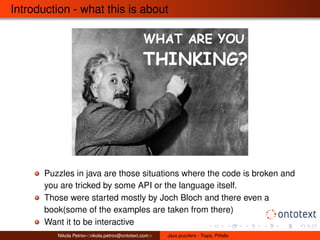
Puzzles in java are those situations where the code is broken and 
you are tricked by some API or the language itself. 
Those were started mostly by Joch Bloch and there even a 
book(some of the examples are taken from there) 
Want it to be interactive 
Nikola Petrov<nikola.petrov@ontotext.com> Java puzzlers - Traps, Pitfalls
Awards as I think you will be lazy 
Nikola Petrov<nikola.petrov@ontotext.com> Java puzzlers - Traps, Pitfalls
SplittingSizes 
public class RegexSplit { 
public static void main(String[] args) { 
String[] nothing = "".split(":"); 
String[] bunchOfNothing = ":".split(":"); 
System.out.printf("%d|%d%n", nothing.length, 
bunchOfNothing.length); 
} 
} 
Nikola Petrov<nikola.petrov@ontotext.com> Java puzzlers - Traps, Pitfalls
SplittingSizes 
public class RegexSplit { 
Answers 
(a) 1j2 
(b) 1j0 
(c) 0j2 
(d) Throws an exception 
(e) None of the above 
public static void main(String[] args) { 
String[] nothing = "".split(":"); 
String[] bunchOfNothing = ":".split(":"); 
System.out.printf("%d|%d%n", nothing.length, 
bunchOfNothing.length); 
} 
} 
Nikola Petrov<nikola.petrov@ontotext.com> Java puzzlers - Traps, Pitfalls
SplittingSizes 
public class RegexSplit { 
Answers 
(a) 1j2 
(b) 1j0 - Explanation follows. . . 
(c) 0j2 
(d) Throws an exception 
(e) None of the above 
public static void main(String[] args) { 
String[] nothing = "".split(":"); 
String[] bunchOfNothing = ":".split(":"); 
System.out.printf("%d|%d%n", nothing.length, 
bunchOfNothing.length); 
} 
} 
Nikola Petrov<nikola.petrov@ontotext.com> Java puzzlers - Traps, Pitfalls
If you navigate through the source for String.split, you’ll discover 
that str.split(":") is effectively the same as 
Pattern.compile(":").split(str, 0). 
so. . . lets look there: 
Pattern.split(Charsequence, int): 
If this pattern does not match any subsequence of the input 
then the resulting array has just one element, namely the 
input sequence in string form. 
If n is zero then the pattern will be applied as many times as 
possible, the array can have any length, and trailing empty 
strings will be discarded. [ emphasis added. ] 
Nikola Petrov<nikola.petrov@ontotext.com> Java puzzlers - Traps, Pitfalls
Joy of sets 
import java.net.*; 
public class UrlSet { 
private static final String[] URL_NAMES = { 
"http://javapuzzlers.com", 
"http://www.summerartcircle.com", 
"http://www.google.com", 
"http://javapuzzlers.com", 
"http://findbugs.sourceforge.net", 
"http://www.cs.umd.edu" 
}; 
public static void main(String[] args) throws Exception { 
Set<URL> favourites = new HashSet<URL>(); 
for (String urlName : URL_NAMES){ 
favourites.add(new URL(urlName)); 
} 
System.out.println(favourites.size()); 
} 
} 
Nikola Petrov<nikola.petrov@ontotext.com> Java puzzlers - Traps, Pitfalls
Joy of sets 
import java.net.*; 
public class UrlSet { 
Answers 
(a) 4 
(b) 5 
(c) Throws an exception 
(d) None of the above 
private static final String[] URL_NAMES = { 
"http://javapuzzlers.com", 
"http://www.summerartcircle.com", 
"http://www.google.com", 
"http://javapuzzlers.com", 
"http://findbugs.sourceforge.net", 
"http://www.cs.umd.edu" 
}; 
public static void main(String[] args) throws Exception { 
Set<URL> favourites = new HashSet<URL>(); 
for (String urlName : URL_NAMES){ 
favourites.add(new URL(urlName)); 
} 
System.out.println(favourites.size()); 
} 
} 
Nikola Petrov<nikola.petrov@ontotext.com> Java puzzlers - Traps, Pitfalls
Joy of sets 
import java.net.*; 
public class UrlSet { 
Answers 
(a) 4 (assuming you are connected 
private static final String[] URL_NAMES = { 
to the net) 
"http://javapuzzlers.com", 
"http://www.summerartcircle.com", 
"http://www.google.com", 
"http://javapuzzlers.com", 
"http://findbugs.sourceforge.net", 
"http://www.cs.umd.edu" 
(b) 5 
(c) Throws an exception 
(d) None of the above - it varies 
from run to run 
}; 
public static void main(String[] args) throws Exception { 
Set<URL> favourites = new HashSet<URL>(); 
for (String urlName : URL_NAMES){ 
favourites.add(new URL(urlName)); 
} 
System.out.println(favourites.size()); 
} 
} 
Nikola Petrov<nikola.petrov@ontotext.com> Java puzzlers - Traps, Pitfalls
URL equals and hashCode are broken! 
Two URL objects are equal if they have the same protocol, reference 
equivalent hosts, have the same port number on the host, and the 
same file and fragment of the file. 
Two hosts are considered equivalent if both host names can be 
resolved into the same IP addresses; else if either host name can’t be 
resolved, the host names must be equal without regard to case; or 
both host names equal to null. 
Since hosts comparison requires name resolution, this operation is a 
blocking operation. 
Nikola Petrov<nikola.petrov@ontotext.com> Java puzzlers - Traps, Pitfalls
Another look 
public class Histogram { 
private static final String[] words = { "I", "recommend", 
"polygene", "lubricants" }; 
public static void main(String[] args) { 
int[] histogram = new int[5]; 
for (String word1 : words) { 
for (String word2 : words) { 
String pair = word1 + word2; 
int bucket = Math.abs(pair.hashCode()) 
% histogram.length; 
histogram[bucket]++; 
} 
} 
int pairCount = 0; 
for (int freq : histogram) { 
pairCount += freq; 
} 
System.out.println(’C’ + pairCount); 
} 
} 
Nikola Petrov<nikola.petrov@ontotext.com> Java puzzlers - Traps, Pitfalls
Another look 
public class Histogram { 
Answers 
(a) 83 
(b) C16 
(c) S 
(d) None of the above 
private static final String[] words = { "I", "recommend", 
"polygene", "lubricants" }; 
public static void main(String[] args) { 
int[] histogram = new int[5]; 
for (String word1 : words) { 
for (String word2 : words) { 
String pair = word1 + word2; 
int bucket = Math.abs(pair.hashCode()) 
% histogram.length; 
histogram[bucket]++; 
} 
} 
int pairCount = 0; 
for (int freq : histogram) { 
pairCount += freq; 
} 
System.out.println(’C’ + pairCount); 
} 
} 
Nikola Petrov<nikola.petrov@ontotext.com> Java puzzlers - Traps, Pitfalls
Another look 
public class Histogram { 
Answers 
(a) 83 
(b) C16 
(c) S 
(d) None of the above - throws 
private static final String[] words = { "I", "recommend", 
"polygene", "lubricants" }; 
public static void main(String[] args) { 
int[] histogram = new int[5]; 
for (String word1 : words) { 
for (String word2 : words) { 
ArrayOutOfBoundsException 
String pair = word1 + word2; 
int bucket = Math.abs(pair.hashCode()) 
% histogram.length; 
histogram[bucket]++; 
} 
} 
int pairCount = 0; 
for (int freq : histogram) { 
pairCount += freq; 
} 
System.out.println(’C’ + pairCount); 
} 
} 
Nikola Petrov<nikola.petrov@ontotext.com> Java puzzlers - Traps, Pitfalls
Math.abs(int) can return a negative number, and so can the % 
operator 
The hashcode of “polygenelubricants” is actually 
Integer.MIN_VALUE i.e. 
"polygenelubricants".hashCode() == Integer.MIN_VALUE 
Nikola Petrov<nikola.petrov@ontotext.com> Java puzzlers - Traps, Pitfalls
Long division 
public class LongDivision { 
public static void main(String[] args) { 
final long MICROS_PER_DAY = 24 * 60 * 60 * 1000 * 1000; 
final long MILLIS_PER_DAY = 24 * 60 * 60 * 1000; 
System.out.println(MICROS_PER_DAY / MILLIS_PER_DAY); 
} 
} 
Nikola Petrov<nikola.petrov@ontotext.com> Java puzzlers - Traps, Pitfalls
Long division 
public class LongDivision { 
public static void main(String[] args) { 
final long MICROS_PER_DAY = 24 * 60 * 60 * 1000 * 1000; 
final long MILLIS_PER_DAY = 24 * 60 * 60 * 1000; 
System.out.println(MICROS_PER_DAY / MILLIS_PER_DAY); 
} 
} 
Answers 
(a) 0 
(b) 5 
(c) 1000 
(d) Throws an exception 
(e) None of the above 
Nikola Petrov<nikola.petrov@ontotext.com> Java puzzlers - Traps, Pitfalls
Long division answer 
public class LongDivision { 
public static void main(String[] args) { 
//Multiplication is not with long numbers! 
final long MICROS_PER_DAY = 24L * 60 * 60 * 1000 * 1000; 
final long MILLIS_PER_DAY = 24L * 60 * 60 * 1000; 
System.out.println(MICROS_PER_DAY / MILLIS_PER_DAY); 
} 
} 
Answers 
(a) 0 
(b) 5 - not actually long division 
(c) 1000 
(d) Throws an exception 
(e) None of the above 
Nikola Petrov<nikola.petrov@ontotext.com> Java puzzlers - Traps, Pitfalls
The Dating Game 
import java.util.*; 
public class DatingGame { 
public static void main(String[] args) { 
Calendar cal = Calendar.getInstance(); 
cal.set(1999, 12, 31); // Year, Month, Day 
System.out.print(cal.get(Calendar.YEAR) + " "); 
Date d = cal.getTime(); 
System.out.print(d.getDay() + " "); 
System.out.println(cal.get(Calendar.DAY_OF_MONTH)); 
} 
} 
Nikola Petrov<nikola.petrov@ontotext.com> Java puzzlers - Traps, Pitfalls
The Dating Game 
import java.util.*; 
public class DatingGame { 
Answers 
(a) 1999 31 31 
(b) 1999 31 1 
(c) 2000 1 31 
(d) 2000 31 31 
(e) None of the above 
public static void main(String[] args) { 
Calendar cal = Calendar.getInstance(); 
cal.set(1999, 12, 31); // Year, Month, Day 
System.out.print(cal.get(Calendar.YEAR) + " "); 
Date d = cal.getTime(); 
System.out.print(d.getDay() + " "); 
System.out.println(cal.get(Calendar.DAY_OF_MONTH)); 
} 
} 
Nikola Petrov<nikola.petrov@ontotext.com> Java puzzlers - Traps, Pitfalls
The Dating Game 
import java.util.*; 
public class DatingGame { 
Answers 
(a) 1999 31 31 
(b) 1999 31 1 
(c) 2000 1 31 - maybe the Y2K 
public static void main(String[] args) { 
Calendar cal = Calendar.getInstance(); 
cal.set(1999, 12, 31); // Year, Month, Day 
System.out.print(cal.get(Calendar.YEAR) + " "); 
Date d = cal.getTime(); 
System.out.print(d.getDay() + " "); 
System.out.println(cal.get(Calendar.DAY_OF_MONTH)); 
} 
} 
problem? 
(d) 2000 31 31 
(e) None of the above 
Nikola Petrov<nikola.petrov@ontotext.com> Java puzzlers - Traps, Pitfalls
The Dating Game - answer 
When the Java platform was first released, its only support for 
calendar calculations was the Date class. This class was limited in 
power, especially when it came to support for internationalization, and 
it had a basic design flaw: Date instances were mutable. In release 
1.1, the Calendar class was added to the platform to rectify the 
shortcomings of Date; most Date methods were deprecated. 
Unfortunately, this only made a bad situation worse. 
Nikola Petrov<nikola.petrov@ontotext.com> Java puzzlers - Traps, Pitfalls
The Dating Game - answer 
When the Java platform was first released, its only support for 
calendar calculations was the Date class. This class was limited in 
power, especially when it came to support for internationalization, and 
it had a basic design flaw: Date instances were mutable. In release 
1.1, the Calendar class was added to the platform to rectify the 
shortcomings of Date; most Date methods were deprecated. 
Unfortunately, this only made a bad situation worse. 
The program just illustrates some of the shortcomings in the current 
API. The Calendar doesn’t warn us when it overflows and the months 
start the count from 0 
Nikola Petrov<nikola.petrov@ontotext.com> Java puzzlers - Traps, Pitfalls
The Dating Game - answer 
When the Java platform was first released, its only support for 
calendar calculations was the Date class. This class was limited in 
power, especially when it came to support for internationalization, and 
it had a basic design flaw: Date instances were mutable. In release 
1.1, the Calendar class was added to the platform to rectify the 
shortcomings of Date; most Date methods were deprecated. 
Unfortunately, this only made a bad situation worse. 
The program just illustrates some of the shortcomings in the current 
API. The Calendar doesn’t warn us when it overflows and the months 
start the count from 0 
Use Joda Time which will be included in java8. . . 
Nikola Petrov<nikola.petrov@ontotext.com> Java puzzlers - Traps, Pitfalls
Some comments and references 
Use Sonar which will catch some of the problems from this 
presentation with the findbugs plugin 
Nikola Petrov<nikola.petrov@ontotext.com> Java puzzlers - Traps, Pitfalls
Some comments and references 
Use Sonar which will catch some of the problems from this 
presentation with the findbugs plugin 
Clickable links: 
Advanced Topics in Programming Languages: Java Puzzlers 
Java-Puzzlers InfoQ 
Nikola Petrov<nikola.petrov@ontotext.com> Java puzzlers - Traps, Pitfalls

Java puzzles

  • 1.
    Introduction - whatthis is about Puzzles in java are those situations where the code is broken and you are tricked by some API or the language itself. Nikola Petrov<nikola.petrov@ontotext.com> Java puzzlers - Traps, Pitfalls
  • 2.
    Introduction - whatthis is about Puzzles in java are those situations where the code is broken and you are tricked by some API or the language itself. Those were started mostly by Joch Bloch and there even a book(some of the examples are taken from there) Nikola Petrov<nikola.petrov@ontotext.com> Java puzzlers - Traps, Pitfalls
  • 3.
    Introduction - whatthis is about Puzzles in java are those situations where the code is broken and you are tricked by some API or the language itself. Those were started mostly by Joch Bloch and there even a book(some of the examples are taken from there) Want it to be interactive Nikola Petrov<nikola.petrov@ontotext.com> Java puzzlers - Traps, Pitfalls
  • 4.
    Awards as Ithink you will be lazy Nikola Petrov<nikola.petrov@ontotext.com> Java puzzlers - Traps, Pitfalls
  • 5.
    SplittingSizes public classRegexSplit { public static void main(String[] args) { String[] nothing = "".split(":"); String[] bunchOfNothing = ":".split(":"); System.out.printf("%d|%d%n", nothing.length, bunchOfNothing.length); } } Nikola Petrov<nikola.petrov@ontotext.com> Java puzzlers - Traps, Pitfalls
  • 6.
    SplittingSizes public classRegexSplit { Answers (a) 1j2 (b) 1j0 (c) 0j2 (d) Throws an exception (e) None of the above public static void main(String[] args) { String[] nothing = "".split(":"); String[] bunchOfNothing = ":".split(":"); System.out.printf("%d|%d%n", nothing.length, bunchOfNothing.length); } } Nikola Petrov<nikola.petrov@ontotext.com> Java puzzlers - Traps, Pitfalls
  • 7.
    SplittingSizes public classRegexSplit { Answers (a) 1j2 (b) 1j0 - Explanation follows. . . (c) 0j2 (d) Throws an exception (e) None of the above public static void main(String[] args) { String[] nothing = "".split(":"); String[] bunchOfNothing = ":".split(":"); System.out.printf("%d|%d%n", nothing.length, bunchOfNothing.length); } } Nikola Petrov<nikola.petrov@ontotext.com> Java puzzlers - Traps, Pitfalls
  • 8.
    If you navigatethrough the source for String.split, you’ll discover that str.split(":") is effectively the same as Pattern.compile(":").split(str, 0). so. . . lets look there: Pattern.split(Charsequence, int): If this pattern does not match any subsequence of the input then the resulting array has just one element, namely the input sequence in string form. If n is zero then the pattern will be applied as many times as possible, the array can have any length, and trailing empty strings will be discarded. [ emphasis added. ] Nikola Petrov<nikola.petrov@ontotext.com> Java puzzlers - Traps, Pitfalls
  • 9.
    Joy of sets import java.net.*; public class UrlSet { private static final String[] URL_NAMES = { "http://javapuzzlers.com", "http://www.summerartcircle.com", "http://www.google.com", "http://javapuzzlers.com", "http://findbugs.sourceforge.net", "http://www.cs.umd.edu" }; public static void main(String[] args) throws Exception { Set<URL> favourites = new HashSet<URL>(); for (String urlName : URL_NAMES){ favourites.add(new URL(urlName)); } System.out.println(favourites.size()); } } Nikola Petrov<nikola.petrov@ontotext.com> Java puzzlers - Traps, Pitfalls
  • 10.
    Joy of sets import java.net.*; public class UrlSet { Answers (a) 4 (b) 5 (c) Throws an exception (d) None of the above private static final String[] URL_NAMES = { "http://javapuzzlers.com", "http://www.summerartcircle.com", "http://www.google.com", "http://javapuzzlers.com", "http://findbugs.sourceforge.net", "http://www.cs.umd.edu" }; public static void main(String[] args) throws Exception { Set<URL> favourites = new HashSet<URL>(); for (String urlName : URL_NAMES){ favourites.add(new URL(urlName)); } System.out.println(favourites.size()); } } Nikola Petrov<nikola.petrov@ontotext.com> Java puzzlers - Traps, Pitfalls
  • 11.
    Joy of sets import java.net.*; public class UrlSet { Answers (a) 4 (assuming you are connected private static final String[] URL_NAMES = { to the net) "http://javapuzzlers.com", "http://www.summerartcircle.com", "http://www.google.com", "http://javapuzzlers.com", "http://findbugs.sourceforge.net", "http://www.cs.umd.edu" (b) 5 (c) Throws an exception (d) None of the above - it varies from run to run }; public static void main(String[] args) throws Exception { Set<URL> favourites = new HashSet<URL>(); for (String urlName : URL_NAMES){ favourites.add(new URL(urlName)); } System.out.println(favourites.size()); } } Nikola Petrov<nikola.petrov@ontotext.com> Java puzzlers - Traps, Pitfalls
  • 12.
    URL equals andhashCode are broken! Two URL objects are equal if they have the same protocol, reference equivalent hosts, have the same port number on the host, and the same file and fragment of the file. Two hosts are considered equivalent if both host names can be resolved into the same IP addresses; else if either host name can’t be resolved, the host names must be equal without regard to case; or both host names equal to null. Since hosts comparison requires name resolution, this operation is a blocking operation. Nikola Petrov<nikola.petrov@ontotext.com> Java puzzlers - Traps, Pitfalls
  • 13.
    Another look publicclass Histogram { private static final String[] words = { "I", "recommend", "polygene", "lubricants" }; public static void main(String[] args) { int[] histogram = new int[5]; for (String word1 : words) { for (String word2 : words) { String pair = word1 + word2; int bucket = Math.abs(pair.hashCode()) % histogram.length; histogram[bucket]++; } } int pairCount = 0; for (int freq : histogram) { pairCount += freq; } System.out.println(’C’ + pairCount); } } Nikola Petrov<nikola.petrov@ontotext.com> Java puzzlers - Traps, Pitfalls
  • 14.
    Another look publicclass Histogram { Answers (a) 83 (b) C16 (c) S (d) None of the above private static final String[] words = { "I", "recommend", "polygene", "lubricants" }; public static void main(String[] args) { int[] histogram = new int[5]; for (String word1 : words) { for (String word2 : words) { String pair = word1 + word2; int bucket = Math.abs(pair.hashCode()) % histogram.length; histogram[bucket]++; } } int pairCount = 0; for (int freq : histogram) { pairCount += freq; } System.out.println(’C’ + pairCount); } } Nikola Petrov<nikola.petrov@ontotext.com> Java puzzlers - Traps, Pitfalls
  • 15.
    Another look publicclass Histogram { Answers (a) 83 (b) C16 (c) S (d) None of the above - throws private static final String[] words = { "I", "recommend", "polygene", "lubricants" }; public static void main(String[] args) { int[] histogram = new int[5]; for (String word1 : words) { for (String word2 : words) { ArrayOutOfBoundsException String pair = word1 + word2; int bucket = Math.abs(pair.hashCode()) % histogram.length; histogram[bucket]++; } } int pairCount = 0; for (int freq : histogram) { pairCount += freq; } System.out.println(’C’ + pairCount); } } Nikola Petrov<nikola.petrov@ontotext.com> Java puzzlers - Traps, Pitfalls
  • 16.
    Math.abs(int) can returna negative number, and so can the % operator The hashcode of “polygenelubricants” is actually Integer.MIN_VALUE i.e. "polygenelubricants".hashCode() == Integer.MIN_VALUE Nikola Petrov<nikola.petrov@ontotext.com> Java puzzlers - Traps, Pitfalls
  • 17.
    Long division publicclass LongDivision { public static void main(String[] args) { final long MICROS_PER_DAY = 24 * 60 * 60 * 1000 * 1000; final long MILLIS_PER_DAY = 24 * 60 * 60 * 1000; System.out.println(MICROS_PER_DAY / MILLIS_PER_DAY); } } Nikola Petrov<nikola.petrov@ontotext.com> Java puzzlers - Traps, Pitfalls
  • 18.
    Long division publicclass LongDivision { public static void main(String[] args) { final long MICROS_PER_DAY = 24 * 60 * 60 * 1000 * 1000; final long MILLIS_PER_DAY = 24 * 60 * 60 * 1000; System.out.println(MICROS_PER_DAY / MILLIS_PER_DAY); } } Answers (a) 0 (b) 5 (c) 1000 (d) Throws an exception (e) None of the above Nikola Petrov<nikola.petrov@ontotext.com> Java puzzlers - Traps, Pitfalls
  • 19.
    Long division answer public class LongDivision { public static void main(String[] args) { //Multiplication is not with long numbers! final long MICROS_PER_DAY = 24L * 60 * 60 * 1000 * 1000; final long MILLIS_PER_DAY = 24L * 60 * 60 * 1000; System.out.println(MICROS_PER_DAY / MILLIS_PER_DAY); } } Answers (a) 0 (b) 5 - not actually long division (c) 1000 (d) Throws an exception (e) None of the above Nikola Petrov<nikola.petrov@ontotext.com> Java puzzlers - Traps, Pitfalls
  • 20.
    The Dating Game import java.util.*; public class DatingGame { public static void main(String[] args) { Calendar cal = Calendar.getInstance(); cal.set(1999, 12, 31); // Year, Month, Day System.out.print(cal.get(Calendar.YEAR) + " "); Date d = cal.getTime(); System.out.print(d.getDay() + " "); System.out.println(cal.get(Calendar.DAY_OF_MONTH)); } } Nikola Petrov<nikola.petrov@ontotext.com> Java puzzlers - Traps, Pitfalls
  • 21.
    The Dating Game import java.util.*; public class DatingGame { Answers (a) 1999 31 31 (b) 1999 31 1 (c) 2000 1 31 (d) 2000 31 31 (e) None of the above public static void main(String[] args) { Calendar cal = Calendar.getInstance(); cal.set(1999, 12, 31); // Year, Month, Day System.out.print(cal.get(Calendar.YEAR) + " "); Date d = cal.getTime(); System.out.print(d.getDay() + " "); System.out.println(cal.get(Calendar.DAY_OF_MONTH)); } } Nikola Petrov<nikola.petrov@ontotext.com> Java puzzlers - Traps, Pitfalls
  • 22.
    The Dating Game import java.util.*; public class DatingGame { Answers (a) 1999 31 31 (b) 1999 31 1 (c) 2000 1 31 - maybe the Y2K public static void main(String[] args) { Calendar cal = Calendar.getInstance(); cal.set(1999, 12, 31); // Year, Month, Day System.out.print(cal.get(Calendar.YEAR) + " "); Date d = cal.getTime(); System.out.print(d.getDay() + " "); System.out.println(cal.get(Calendar.DAY_OF_MONTH)); } } problem? (d) 2000 31 31 (e) None of the above Nikola Petrov<nikola.petrov@ontotext.com> Java puzzlers - Traps, Pitfalls
  • 23.
    The Dating Game- answer When the Java platform was first released, its only support for calendar calculations was the Date class. This class was limited in power, especially when it came to support for internationalization, and it had a basic design flaw: Date instances were mutable. In release 1.1, the Calendar class was added to the platform to rectify the shortcomings of Date; most Date methods were deprecated. Unfortunately, this only made a bad situation worse. Nikola Petrov<nikola.petrov@ontotext.com> Java puzzlers - Traps, Pitfalls
  • 24.
    The Dating Game- answer When the Java platform was first released, its only support for calendar calculations was the Date class. This class was limited in power, especially when it came to support for internationalization, and it had a basic design flaw: Date instances were mutable. In release 1.1, the Calendar class was added to the platform to rectify the shortcomings of Date; most Date methods were deprecated. Unfortunately, this only made a bad situation worse. The program just illustrates some of the shortcomings in the current API. The Calendar doesn’t warn us when it overflows and the months start the count from 0 Nikola Petrov<nikola.petrov@ontotext.com> Java puzzlers - Traps, Pitfalls
  • 25.
    The Dating Game- answer When the Java platform was first released, its only support for calendar calculations was the Date class. This class was limited in power, especially when it came to support for internationalization, and it had a basic design flaw: Date instances were mutable. In release 1.1, the Calendar class was added to the platform to rectify the shortcomings of Date; most Date methods were deprecated. Unfortunately, this only made a bad situation worse. The program just illustrates some of the shortcomings in the current API. The Calendar doesn’t warn us when it overflows and the months start the count from 0 Use Joda Time which will be included in java8. . . Nikola Petrov<nikola.petrov@ontotext.com> Java puzzlers - Traps, Pitfalls
  • 26.
    Some comments andreferences Use Sonar which will catch some of the problems from this presentation with the findbugs plugin Nikola Petrov<nikola.petrov@ontotext.com> Java puzzlers - Traps, Pitfalls
  • 27.
    Some comments andreferences Use Sonar which will catch some of the problems from this presentation with the findbugs plugin Clickable links: Advanced Topics in Programming Languages: Java Puzzlers Java-Puzzlers InfoQ Nikola Petrov<nikola.petrov@ontotext.com> Java puzzlers - Traps, Pitfalls