1987 PHILIPPINE
CONSTITUTION
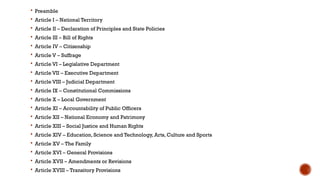
 Preamble
 Article I – National Territory
 Article II – Declaration of Principles and State Policies
 Article III – Bill of Rights
 Article IV – Citizenship
 Article V – Suffrage
 Article VI – Legislative Department
 Article VII – Executive Department
 Article VIII – Judicial Department
 Article IX – Constitutional Commissions
 Article X – Local Government
 Article XI – Accountability of Public Officers
 Article XII – National Economy and Patrimony
 Article XIII – Social Justice and Human Rights
 Article XIV – Education, Science and Technology, Arts, Culture and Sports
 Article XV – The Family
 Article XVI – General Provisions
 Article XVII – Amendments or Revisions
 Article XVIII – Transitory Provisions
ELEMENTS OF THE STATE
People
Territory
Government
Sovereignty
CONSTITUTION
 Body of rules and principles in accordance with which the powers of sovereignty
are regularly exercised
CONSTITUTION OF THE PHILIPPINES
 Written instrument by which the fundamental powers of the government are
established, limited and defined and by which these powers are distributed among
several departments or branches for their safe and useful exercise for the benefit
of the people
ARTICLE I NATIONAL TERRITORY
PHILIPPINE ARCHIPELAGO
 Islands and waters embraced therein
 All other territories over which the Philippines has sovereignty
(Spratly Islands, Scarborough Shoal) or jurisdiction (Philippine
Embassies)
 Terrestrial – land
 Fluvial – water (territorial sea, seabed, subsoil, insular shelves or
submarine areas)
 Aerial - air
ARCHIPELAGIC DOCTRINE
Waters around, between and connecting the islands of the
archipelago, regardless of their breadth or dimensions,
form part of the internal waters of the Philippines.
ARTICLE II DECLARATION OF PRINCIPLES AND STATE POLICIES
DEMOCRATIC/REPUBLICAN STATE
 Sovereignty resides in the people, and all government authority emanates from
them.
 Republican government – democratic government by representation chosen by the
people at large; Indirect representation rule
CIVILIAN AUTHORITY
Civilian Authority is at all times supreme over the military.
The prime duty of the government is to serve and protect
the people.

ARTICLE III BILL OF RIGHTS
3 INHERENT POWERS OF THE STATE
 Police Power
 Eminent Domain (Power of Expropriation)
 Taxation
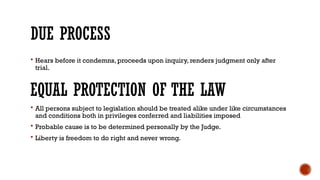
DUE PROCESS
 Hears before it condemns, proceeds upon inquiry, renders judgment only after
trial.
EQUAL PROTECTION OF THE LAW
 All persons subject to legislation should be treated alike under like circumstances
and conditions both in privileges conferred and liabilities imposed
 Probable cause is to be determined personally by the Judge.
 Liberty is freedom to do right and never wrong.
PRIVACY OF COMMUNICATION
 Privacy of Communication is inviolable.
 Effect: Evidence is inadmissible
RIGHT OF ASSEMBLY
 Right on the part of the citizens to meet peaceably for consultation in respect to
public affairs.
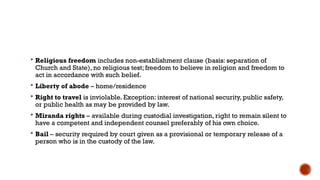
 Religious freedom includes non-establishment clause (basis: separation of
Church and State), no religious test; freedom to believe in religion and freedom to
act in accordance with such belief.
 Liberty of abode – home/residence
 Right to travel is inviolable. Exception: interest of national security, public safety,
or public health as may be provided by law.
 Miranda rights – available during custodial investigation, right to remain silent to
have a competent and independent counsel preferably of his own choice.
 Bail – security required by court given as a provisional or temporary release of a
person who is in the custody of the law.
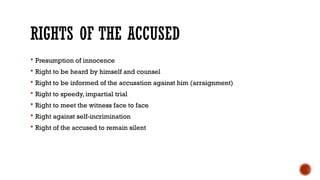
RIGHTS OF THE ACCUSED
 Presumption of innocence
 Right to be heard by himself and counsel
 Right to be informed of the accusation against him (arraignment)
 Right to speedy, impartial trial
 Right to meet the witness face to face
 Right against self-incrimination
 Right of the accused to remain silent
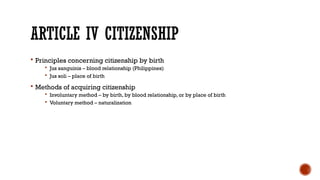
ARTICLE IV CITIZENSHIP
 Principles concerning citizenship by birth
 Jus sanguinis – blood relationship (Philippines)
 Jus soli – place of birth
 Methods of acquiring citizenship
 Involuntary method – by birth, by blood relationship, or by place of birth
 Voluntary method – naturalization
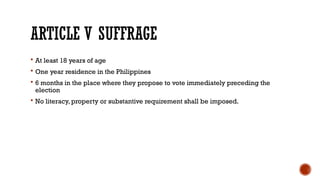
ARTICLE V SUFFRAGE
 At least 18 years of age
 One year residence in the Philippines
 6 months in the place where they propose to vote immediately preceding the
election
 No literacy, property or substantive requirement shall be imposed.
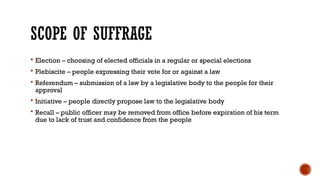
SCOPE OF SUFFRAGE
 Election – choosing of elected officials in a regular or special elections
 Plebiscite – people expressing their vote for or against a law
 Referendum – submission of a law by a legislative body to the people for their
approval
 Initiative – people directly propose law to the legislative body
 Recall – public officer may be removed from office before expiration of his term
due to lack of trust and confidence from the people
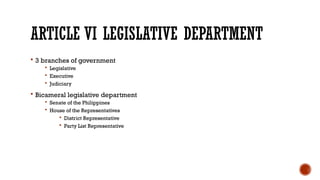
ARTICLE VI LEGISLATIVE DEPARTMENT
 3 branches of government
 Legislative
 Executive
 Judiciary
 Bicameral legislative department
 Senate of the Philippines
 House of the Representatives
 District Representative
 Party List Representative
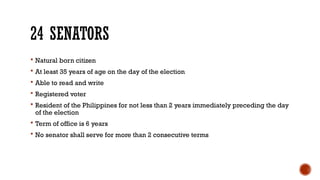
24 SENATORS
 Natural born citizen
 At least 35 years of age on the day of the election
 Able to read and write
 Registered voter
 Resident of the Philippines for not less than 2 years immediately preceding the day
of the election
 Term of office is 6 years
 No senator shall serve for more than 2 consecutive terms
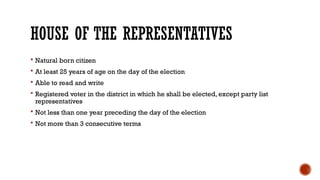
HOUSE OF THE REPRESENTATIVES
 Natural born citizen
 At least 25 years of age on the day of the election
 Able to read and write
 Registered voter in the district in which he shall be elected, except party list
representatives
 Not less than one year preceding the day of the election
 Not more than 3 consecutive terms
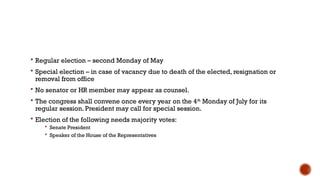
 Regular election – second Monday of May
 Special election – in case of vacancy due to death of the elected, resignation or
removal from office
 No senator or HR member may appear as counsel.
 The congress shall convene once every year on the 4th
Monday of July for its
regular session. President may call for special session.
 Election of the following needs majority votes:
 Senate President
 Speaker of the House of the Representatives
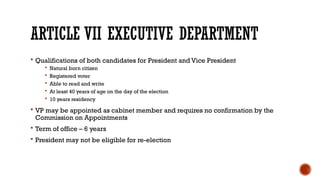
ARTICLE VII EXECUTIVE DEPARTMENT
 Qualifications of both candidates for President and Vice President
 Natural born citizen
 Registered voter
 Able to read and write
 At least 40 years of age on the day of the election
 10 years residency
 VP may be appointed as cabinet member and requires no confirmation by the
Commission on Appointments
 Term of office – 6 years
 President may not be eligible for re-election
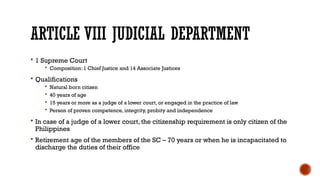
ARTICLE VIII JUDICIAL DEPARTMENT
 1 Supreme Court
 Composition: 1 Chief Justice and 14 Associate Justices
 Qualifications
 Natural born citizen
 40 years of age
 15 years or more as a judge of a lower court, or engaged in the practice of law
 Person of proven competence, integrity, probity and independence
 In case of a judge of a lower court, the citizenship requirement is only citizen of the
Philippines
 Retirement age of the members of the SC – 70 years or when he is incapacitated to
discharge the duties of their office
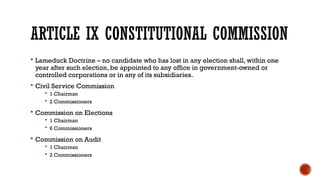
ARTICLE IX CONSTITUTIONAL COMMISSION
 Lameduck Doctrine – no candidate who has lost in any election shall, within one
year after such election, be appointed to any office in government-owned or
controlled corporations or in any of its subsidiaries.
 Civil Service Commission
 1 Chairman
 2 Commissioners
 Commission on Elections
 1 Chairman
 6 Commissioners
 Commission on Audit
 1 Chairman
 2 Commissioners
ARTICLE X LOCAL GOVERNMENT
 Political subdivisions
 Provinces
 Municipalities
 Cities
 Barangays
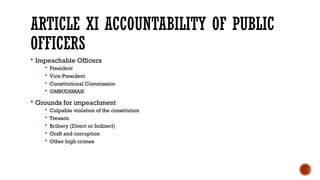
ARTICLE XI ACCOUNTABILITY OF PUBLIC
OFFICERS
 Impeachable Officers
 President
 Vice President
 Constitutional Commission
 OMBUDSMAN
 Grounds for impeachment
 Culpable violation of the constitution
 Treason
 Bribery (Direct or Indirect)
 Graft and corruption
 Other high crimes
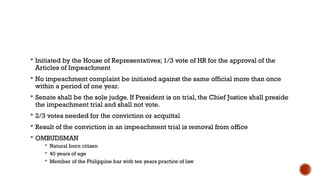
 Initiated by the House of Representatives; 1/3 vote of HR for the approval of the
Articles of Impeachment
 No impeachment complaint be initiated against the same official more than once
within a period of one year.
 Senate shall be the sole judge. If President is on trial, the Chief Justice shall preside
the impeachment trial and shall not vote.
 2/3 votes needed for the conviction or acquittal
 Result of the conviction in an impeachment trial is removal from office
 OMBUDSMAN
 Natural born citizen
 40 years of age
 Member of the Philippine bar with ten years practice of law
ARTICLE XIII SOCIAL JUSTICE AND HUMAN
RIGHTS
 Commission on Human Rights
 1 Chairman
 4 members
 Natural born citizen
 Majority members are lawyers

Philippine Constitution PPThreiothoriehtreho.pptx

  • 1.
  • 2.
     Preamble  ArticleI – National Territory  Article II – Declaration of Principles and State Policies  Article III – Bill of Rights  Article IV – Citizenship  Article V – Suffrage  Article VI – Legislative Department  Article VII – Executive Department  Article VIII – Judicial Department  Article IX – Constitutional Commissions  Article X – Local Government  Article XI – Accountability of Public Officers  Article XII – National Economy and Patrimony  Article XIII – Social Justice and Human Rights  Article XIV – Education, Science and Technology, Arts, Culture and Sports  Article XV – The Family  Article XVI – General Provisions  Article XVII – Amendments or Revisions  Article XVIII – Transitory Provisions
  • 3.
    ELEMENTS OF THESTATE People Territory Government Sovereignty
  • 4.
    CONSTITUTION  Body ofrules and principles in accordance with which the powers of sovereignty are regularly exercised CONSTITUTION OF THE PHILIPPINES  Written instrument by which the fundamental powers of the government are established, limited and defined and by which these powers are distributed among several departments or branches for their safe and useful exercise for the benefit of the people
  • 5.
    ARTICLE I NATIONALTERRITORY PHILIPPINE ARCHIPELAGO  Islands and waters embraced therein  All other territories over which the Philippines has sovereignty (Spratly Islands, Scarborough Shoal) or jurisdiction (Philippine Embassies)  Terrestrial – land  Fluvial – water (territorial sea, seabed, subsoil, insular shelves or submarine areas)  Aerial - air
  • 6.
    ARCHIPELAGIC DOCTRINE Waters around,between and connecting the islands of the archipelago, regardless of their breadth or dimensions, form part of the internal waters of the Philippines.
  • 7.
    ARTICLE II DECLARATIONOF PRINCIPLES AND STATE POLICIES DEMOCRATIC/REPUBLICAN STATE  Sovereignty resides in the people, and all government authority emanates from them.  Republican government – democratic government by representation chosen by the people at large; Indirect representation rule
  • 8.
    CIVILIAN AUTHORITY Civilian Authorityis at all times supreme over the military. The prime duty of the government is to serve and protect the people.
  • 9.
    ARTICLE III BILLOF RIGHTS 3 INHERENT POWERS OF THE STATE  Police Power  Eminent Domain (Power of Expropriation)  Taxation
  • 10.
    DUE PROCESS  Hearsbefore it condemns, proceeds upon inquiry, renders judgment only after trial. EQUAL PROTECTION OF THE LAW  All persons subject to legislation should be treated alike under like circumstances and conditions both in privileges conferred and liabilities imposed  Probable cause is to be determined personally by the Judge.  Liberty is freedom to do right and never wrong.
  • 11.
    PRIVACY OF COMMUNICATION Privacy of Communication is inviolable.  Effect: Evidence is inadmissible RIGHT OF ASSEMBLY  Right on the part of the citizens to meet peaceably for consultation in respect to public affairs.
  • 12.
     Religious freedomincludes non-establishment clause (basis: separation of Church and State), no religious test; freedom to believe in religion and freedom to act in accordance with such belief.  Liberty of abode – home/residence  Right to travel is inviolable. Exception: interest of national security, public safety, or public health as may be provided by law.  Miranda rights – available during custodial investigation, right to remain silent to have a competent and independent counsel preferably of his own choice.  Bail – security required by court given as a provisional or temporary release of a person who is in the custody of the law.
  • 13.
    RIGHTS OF THEACCUSED  Presumption of innocence  Right to be heard by himself and counsel  Right to be informed of the accusation against him (arraignment)  Right to speedy, impartial trial  Right to meet the witness face to face  Right against self-incrimination  Right of the accused to remain silent
  • 14.
    ARTICLE IV CITIZENSHIP Principles concerning citizenship by birth  Jus sanguinis – blood relationship (Philippines)  Jus soli – place of birth  Methods of acquiring citizenship  Involuntary method – by birth, by blood relationship, or by place of birth  Voluntary method – naturalization
  • 15.
    ARTICLE V SUFFRAGE At least 18 years of age  One year residence in the Philippines  6 months in the place where they propose to vote immediately preceding the election  No literacy, property or substantive requirement shall be imposed.
  • 16.
    SCOPE OF SUFFRAGE Election – choosing of elected officials in a regular or special elections  Plebiscite – people expressing their vote for or against a law  Referendum – submission of a law by a legislative body to the people for their approval  Initiative – people directly propose law to the legislative body  Recall – public officer may be removed from office before expiration of his term due to lack of trust and confidence from the people
  • 17.
    ARTICLE VI LEGISLATIVEDEPARTMENT  3 branches of government  Legislative  Executive  Judiciary  Bicameral legislative department  Senate of the Philippines  House of the Representatives  District Representative  Party List Representative
  • 18.
    24 SENATORS  Naturalborn citizen  At least 35 years of age on the day of the election  Able to read and write  Registered voter  Resident of the Philippines for not less than 2 years immediately preceding the day of the election  Term of office is 6 years  No senator shall serve for more than 2 consecutive terms
  • 19.
    HOUSE OF THEREPRESENTATIVES  Natural born citizen  At least 25 years of age on the day of the election  Able to read and write  Registered voter in the district in which he shall be elected, except party list representatives  Not less than one year preceding the day of the election  Not more than 3 consecutive terms
  • 20.
     Regular election– second Monday of May  Special election – in case of vacancy due to death of the elected, resignation or removal from office  No senator or HR member may appear as counsel.  The congress shall convene once every year on the 4th Monday of July for its regular session. President may call for special session.  Election of the following needs majority votes:  Senate President  Speaker of the House of the Representatives
  • 21.
    ARTICLE VII EXECUTIVEDEPARTMENT  Qualifications of both candidates for President and Vice President  Natural born citizen  Registered voter  Able to read and write  At least 40 years of age on the day of the election  10 years residency  VP may be appointed as cabinet member and requires no confirmation by the Commission on Appointments  Term of office – 6 years  President may not be eligible for re-election
  • 22.
    ARTICLE VIII JUDICIALDEPARTMENT  1 Supreme Court  Composition: 1 Chief Justice and 14 Associate Justices  Qualifications  Natural born citizen  40 years of age  15 years or more as a judge of a lower court, or engaged in the practice of law  Person of proven competence, integrity, probity and independence  In case of a judge of a lower court, the citizenship requirement is only citizen of the Philippines  Retirement age of the members of the SC – 70 years or when he is incapacitated to discharge the duties of their office
  • 23.
    ARTICLE IX CONSTITUTIONALCOMMISSION  Lameduck Doctrine – no candidate who has lost in any election shall, within one year after such election, be appointed to any office in government-owned or controlled corporations or in any of its subsidiaries.  Civil Service Commission  1 Chairman  2 Commissioners  Commission on Elections  1 Chairman  6 Commissioners  Commission on Audit  1 Chairman  2 Commissioners
  • 24.
    ARTICLE X LOCALGOVERNMENT  Political subdivisions  Provinces  Municipalities  Cities  Barangays
  • 25.
    ARTICLE XI ACCOUNTABILITYOF PUBLIC OFFICERS  Impeachable Officers  President  Vice President  Constitutional Commission  OMBUDSMAN  Grounds for impeachment  Culpable violation of the constitution  Treason  Bribery (Direct or Indirect)  Graft and corruption  Other high crimes
  • 26.
     Initiated bythe House of Representatives; 1/3 vote of HR for the approval of the Articles of Impeachment  No impeachment complaint be initiated against the same official more than once within a period of one year.  Senate shall be the sole judge. If President is on trial, the Chief Justice shall preside the impeachment trial and shall not vote.  2/3 votes needed for the conviction or acquittal  Result of the conviction in an impeachment trial is removal from office  OMBUDSMAN  Natural born citizen  40 years of age  Member of the Philippine bar with ten years practice of law
  • 27.
    ARTICLE XIII SOCIALJUSTICE AND HUMAN RIGHTS  Commission on Human Rights  1 Chairman  4 members  Natural born citizen  Majority members are lawyers