Ceramic Masks Art 3/D Comp II Art 3/D Comp III
Masks Masks have always been connected to the idea of transformation (synonyms: change, alteration). For example, in many cultures they are associated with death and the idea of an afterlife.
Themes for masks Content: Nature: mammals, water creatures, birds, reptiles Theater Popular culture (think Halloween masks) Mardi Gras or carnival Cultural Rituals: African, Japanese
Diverse cultures that use masks Jomon people of ancient Japan Pre-Columbian (Ecuador) Contemporary Chinese artists
Links http://www.kilnhousesculpture.com/ http://www.mardigrasmasks.com Greek Masks Greek theater masks
Process The mask will be constructed using the SLAB method. A slab is a rolled out, pancake-shaped piece of clay. You will be using rolling pins or the slab roller to flatten out the clay.
Successful Slabs Start by flattening out your clay by squeezing it with your hands. Lay cloth (or newspaper) on the table to prevent the clay from sticking. Place the clay on top and roll it with the rolling pin 2-3 times. Then, rotate the slab so it is perpendicular to you, roll 2-3 times, and repeat if needed.
Using newspaper Crumple up newspaper tightly to create a mound form.  Use tape to wrap the form. Lay the slab on top of the newspaper mold. This will allow the clay to conform to the shape of the curves.
Sketchbook Assignment  (write this down) What will your mask represent or communicate? Will it be functional? What is the source of inspiration for your mask?  (Where did you get the idea?) Draw two different ideas and color them with colored pencils. Include proposed dimensions, in inches. You will use white earthenware clay. Include a material you will use that is not clay.
Facial Proportions  (write this down) Traditionally, in figure drawing, the human face is proportioned in the following ways: The face is 5 eyes wide The eyes are placed in the middle of the head
Mixed-media  You are being challenged within this project to also use materials that are  not  clay. For example: Ribbons, string, raffia Beading Wire, wood, paper mache Feathers Use your own ideas!
You will be graded on  (write this down) Participating in class critique Quality of artwork Creativity in design Submitted  on time  for firing Surface treatment: Paint? Glaze? Other? Use of mixed media materials
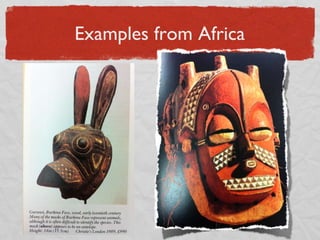
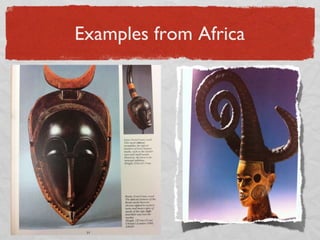
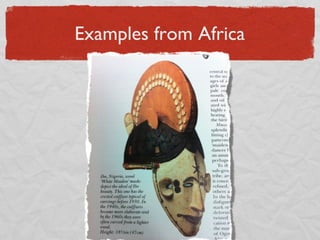
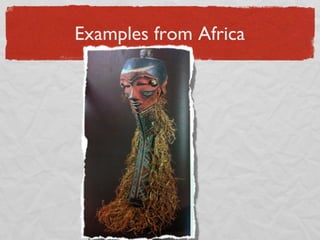
Examples from Africa
More examples http://gallery.me.com/christinecolby#100762

Art 3D II & III: Ceramic masks Presentation

  • 1.
    Ceramic Masks Art3/D Comp II Art 3/D Comp III
  • 2.
    Masks Masks havealways been connected to the idea of transformation (synonyms: change, alteration). For example, in many cultures they are associated with death and the idea of an afterlife.
  • 3.
    Themes for masksContent: Nature: mammals, water creatures, birds, reptiles Theater Popular culture (think Halloween masks) Mardi Gras or carnival Cultural Rituals: African, Japanese
  • 4.
    Diverse cultures thatuse masks Jomon people of ancient Japan Pre-Columbian (Ecuador) Contemporary Chinese artists
  • 5.
  • 6.
    Process The maskwill be constructed using the SLAB method. A slab is a rolled out, pancake-shaped piece of clay. You will be using rolling pins or the slab roller to flatten out the clay.
  • 7.
    Successful Slabs Startby flattening out your clay by squeezing it with your hands. Lay cloth (or newspaper) on the table to prevent the clay from sticking. Place the clay on top and roll it with the rolling pin 2-3 times. Then, rotate the slab so it is perpendicular to you, roll 2-3 times, and repeat if needed.
  • 8.
    Using newspaper Crumpleup newspaper tightly to create a mound form. Use tape to wrap the form. Lay the slab on top of the newspaper mold. This will allow the clay to conform to the shape of the curves.
  • 9.
    Sketchbook Assignment (write this down) What will your mask represent or communicate? Will it be functional? What is the source of inspiration for your mask? (Where did you get the idea?) Draw two different ideas and color them with colored pencils. Include proposed dimensions, in inches. You will use white earthenware clay. Include a material you will use that is not clay.
  • 10.
    Facial Proportions (write this down) Traditionally, in figure drawing, the human face is proportioned in the following ways: The face is 5 eyes wide The eyes are placed in the middle of the head
  • 11.
    Mixed-media Youare being challenged within this project to also use materials that are not clay. For example: Ribbons, string, raffia Beading Wire, wood, paper mache Feathers Use your own ideas!
  • 12.
    You will begraded on (write this down) Participating in class critique Quality of artwork Creativity in design Submitted on time for firing Surface treatment: Paint? Glaze? Other? Use of mixed media materials
  • 13.
  • 14.
  • 15.
  • 16.
  • 17.