Masks From Around The World
a presentation by Prof. Aloke Kumar
to accompany an exhibition on Masks from the collection of
Smt Anupama & GOC-in-EC. Lieutenant General Anil Chauhan
A mask is an object normally worn on the face, typically
for protection, disguise, performance, or entertainment.
Masks have been used since antiquity for both
ceremonial and practical purposes, as well as in the
performing arts and for entertainment.
They are usually worn on the face, although they may
also be positioned for effect elsewhere on the wearer's
body.
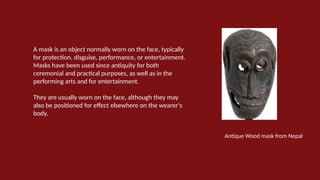
Antique Wood mask from Nepal
More generally in art history, especially sculpture, ‘mask’
is the term for a face without a body that is not modelled
in the round , which would make it a ‘head’ , but for
example appears in low relief.
A Mask can be accompanied by a matching full body
gear.
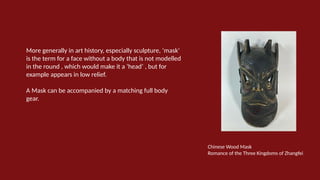
Chinese Wood Mask
Romance of the Three Kingdoms of Zhangfei
The word ‘mask’ appeared in English in the 1530s, from Middle
French masque, meaning , ‘covering to hide or guard
the face’, derived in turn from Italian maschera, from Medieval
Latin masca, meaning mask, spectre, nightmare.
This word may also have its origin, from Arabic maskharah,
from the verb sakhira ‘ to ridicule’.
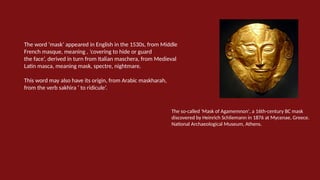
The so-called 'Mask of Agamemnon', a 16th-century BC mask
discovered by Heinrich Schliemann in 1876 at Mycenae, Greece.
National Archaeological Museum, Athens.
However, it may also come from Provençal mascara,
meaning ‘to black the face’ or the related Catalan
mascarar, Old French mascurer.
This in turn is of uncertain origin – perhaps from a
Germanic source akin to English ‘mesh’, but perhaps
from mask, ‘black’, a borrowing from a pre-Indo-
European language.
Or from Sanskrit मकुष्ठः Makushthah, leading to Hindi
मुखौटा Mukhota.
Most importantly Mask is there in most major languages.
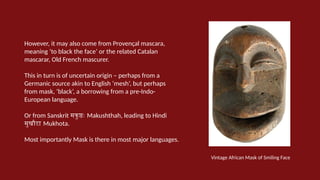
Vintage African Mask of Smiling Face
The use of masks in rituals or ceremonies is a very ancient
human practice across the world, although masks can also be
worn for protection, in hunting, in sports, in feasts, or in wars –
or simply used as ornamentation.
Some ceremonial or decorative masks were not designed to be
worn. And some to be worn as pendant.
Although the religious use of masks has waned, masks are used
sometimes in drama therapy or psychotherapy.
And off course today as a protection against the pandemic.
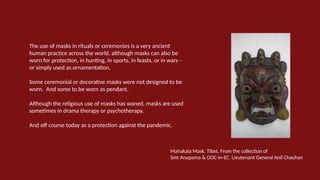
Mahakala Mask. Tibet. From the collection of
Smt Anupama & GOC-in-EC. Lieutenant General Anil Chauhan
The oldest masks that have been discovered are 9,000 years
old, being held by the Musée ‘Bible et Terre Sainte’ , Paris, and
the Israel Museum in Jerusalem.
Most probably the practice of masking is much older – the
earliest known anthropomorphic mask, having human
characteristics is circa 30,000 to 40,000 years old.
It involved the use of war-paint, leather, vegetative material, or
wooden masks.
These masks have not been preserved.
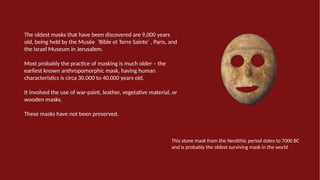
This stone mask from the Neolithic period dates to 7000 BC
and is probably the oldest surviving mask in the world
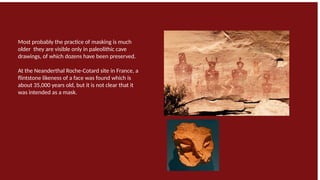
Most probably the practice of masking is much
older they are visible only in paleolithic cave
drawings, of which dozens have been preserved.
At the Neanderthal Roche-Cotard site in France, a
flintstone likeness of a face was found which is
about 35,000 years old, but it is not clear that it
was intended as a mask.
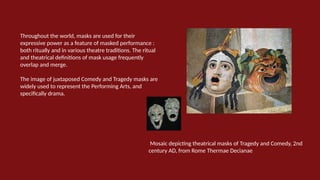
Throughout the world, masks are used for their
expressive power as a feature of masked performance :
both ritually and in various theatre traditions. The ritual
and theatrical definitions of mask usage frequently
overlap and merge.
The image of juxtaposed Comedy and Tragedy masks are
widely used to represent the Performing Arts, and
specifically drama.
Mosaic depicting theatrical masks of Tragedy and Comedy, 2nd
century AD, from Rome Thermae Decianae
In many dramatic traditions including the theatre of ancient
Noh drama of Japan, originating in 14th century.
Masks were worn by all the performers, with several different
types of mask used for different types of character.
Hannya Noh Mask , first half of the 17th century
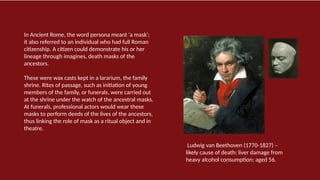
In Ancient Rome, the word persona meant 'a mask';
it also referred to an individual who had full Roman
citizenship. A citizen could demonstrate his or her
lineage through imagines, death masks of the
ancestors.
These were wax casts kept in a lararium, the family
shrine. Rites of passage, such as initiation of young
members of the family, or funerals, were carried out
at the shrine under the watch of the ancestral masks.
At funerals, professional actors would wear these
masks to perform deeds of the lives of the ancestors,
thus linking the role of mask as a ritual object and in
theatre.
Ludwig van Beethoven (1770-1827) –
likely cause of death: liver damage from
heavy alcohol consumption; aged 56.
Masks are a familiar and vivid element in many folk and
traditional pageants, ceremonies, rituals, and festivals, and
are often of an ancient origin.
The mask is normally a part of a costume that adorns the
whole body and embodies a tradition important to the
religious and/or social life of the community as whole or a
particular group within the community.
In parts of Africa, giant totem masks cover the body.
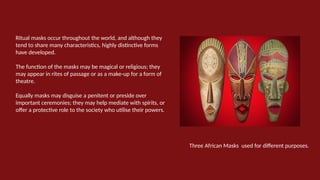
Ritual masks occur throughout the world, and although they
tend to share many characteristics, highly distinctive forms
have developed.
The function of the masks may be magical or religious; they
may appear in rites of passage or as a make-up for a form of
theatre.
Equally masks may disguise a penitent or preside over
important ceremonies; they may help mediate with spirits, or
offer a protective role to the society who utilise their powers.
Three African Masks used for different purposes.
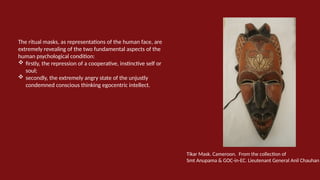
The ritual masks, as representations of the human face, are
extremely revealing of the two fundamental aspects of the
human psychological condition:
 firstly, the repression of a cooperative, instinctive self or
soul;
 secondly, the extremely angry state of the unjustly
condemned conscious thinking egocentric intellect.
Tikar Mask. Cameroon. From the collection of
Smt Anupama & GOC-in-EC. Lieutenant General Anil Chauhan
MASKS : Africa
The existence of African masks can be traced as far back as the
Stone Age. For thousands of years, African people have
incorporated tribal masks into their cultural ceremonies, rituals,
and celebrations.
Each of these creations is designed according to the particular
traditions of their region.
Clay Tablet Mask. Angola- Africa. From the collection of
Smt Anupama & GOC-in-EC. Lieutenant General Anil Chauhan
MASKS : Africa
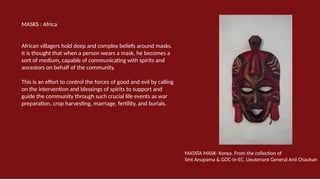
African villagers hold deep and complex beliefs around masks.
It is thought that when a person wears a mask, he becomes a
sort of medium, capable of communicating with spirits and
ancestors on behalf of the community.
This is an effort to control the forces of good and evil by calling
on the intervention and blessings of spirits to support and
guide the community through such crucial life events as war
preparation, crop harvesting, marriage, fertility, and burials.
MATATA MASK- Kenya. From the collection of
Smt Anupama & GOC-in-EC. Lieutenant General Anil Chauhan
MASKS : Africa
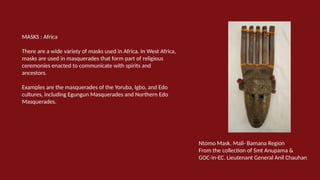
There are a wide variety of masks used in Africa. In West Africa,
masks are used in masquerades that form part of religious
ceremonies enacted to communicate with spirits and
ancestors.
Examples are the masquerades of the Yoruba, Igbo, and Edo
cultures, including Egungun Masquerades and Northern Edo
Masquerades.
Ntomo Mask. Mali- Bamana Region
From the collection of Smt Anupama &
GOC-in-EC. Lieutenant General Anil Chauhan
MASKS : Africa
The masks are usually carved with an extraordinary skill and
variety by artists who will usually have received their training as
an apprentice to a master carver .
Frequently it is a tradition that has been passed down within a
family through many generations.
Such an artist holds a respected position in tribal society
because of the work that he or she creates, embodying not
only complex craft techniques but also spiritual/social and
symbolic knowledge.
African masks are also used in the Mas or Masquerade of the
Caribbean Carnival.
African Mask. Massai. Kenya
MASKS : North America
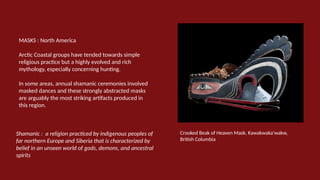
Arctic Coastal groups have tended towards simple
religious practice but a highly evolved and rich
mythology, especially concerning hunting.
In some areas, annual shamanic ceremonies involved
masked dances and these strongly abstracted masks
are arguably the most striking artifacts produced in
this region.
Crooked Beak of Heaven Mask, Kawakwaka'wakw,
British Columbia
Shamanic : a religion practiced by indigenous peoples of
far northern Europe and Siberia that is characterized by
belief in an unseen world of gods, demons, and ancestral
spirits
MASKS : North America
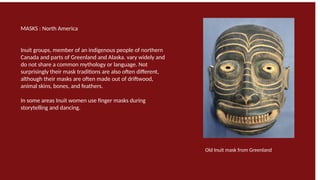
Inuit groups, member of an indigenous people of northern
Canada and parts of Greenland and Alaska. vary widely and
do not share a common mythology or language. Not
surprisingly their mask traditions are also often different,
although their masks are often made out of driftwood,
animal skins, bones, and feathers.
In some areas Inuit women use finger masks during
storytelling and dancing.
Old Inuit mask from Greenland
MASKS : North America
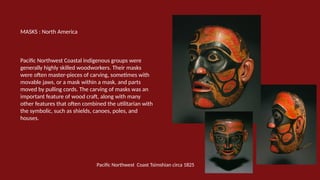
Pacific Northwest Coastal indigenous groups were
generally highly skilled woodworkers. Their masks
were often master-pieces of carving, sometimes with
movable jaws, or a mask within a mask, and parts
moved by pulling cords. The carving of masks was an
important feature of wood craft, along with many
other features that often combined the utilitarian with
the symbolic, such as shields, canoes, poles, and
houses.
Pacific Northwest Coast Tsimshian circa 1825
MASKS : Latin America
Distinctive styles of masks began to emerge in pre-Hispanic
America about 1200BC, although there is evidence of far older
mask forms. In the Andes, masks were used to dress the faces
of the dead.
These were originally made of fabric, but later burial masks
were sometimes made of beaten copper or gold, and
occasionally of clay.
Aztec mask of Xiuhtecuhtli, c. 1500,
of Mixtec-Aztec provenance
MASKS : Latin America
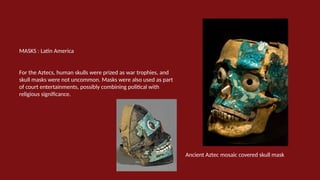
For the Aztecs, human skulls were prized as war trophies, and
skull masks were not uncommon. Masks were also used as part
of court entertainments, possibly combining political with
religious significance.
Ancient Aztec mosaic covered skull mask
MASKS : Latin America
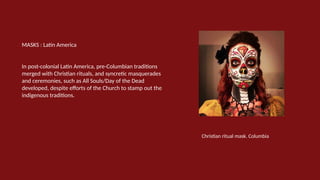
In post-colonial Latin America, pre-Columbian traditions
merged with Christian rituals, and syncretic masquerades
and ceremonies, such as All Souls/Day of the Dead
developed, despite efforts of the Church to stamp out the
indigenous traditions.
Christian ritual mask. Columbia
MASKS : Latin America
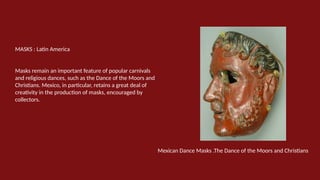
Masks remain an important feature of popular carnivals
and religious dances, such as the Dance of the Moors and
Christians. Mexico, in particular, retains a great deal of
creativity in the production of masks, encouraged by
collectors.
Mexican Dance Masks .The Dance of the Moors and Christians
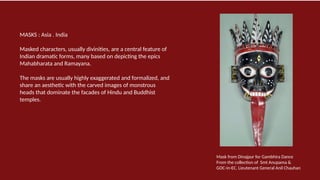
MASKS : Asia . India
Masked characters, usually divinities, are a central feature of
Indian dramatic forms, many based on depicting the epics
Mahabharata and Ramayana.
The masks are usually highly exaggerated and formalized, and
share an aesthetic with the carved images of monstrous
heads that dominate the facades of Hindu and Buddhist
temples.
Mask from Dinajpur for Gambhira Dance
From the collection of Smt Anupama &
GOC-in-EC. Lieutenant General Anil Chauhan
MASKS : Asia . India
Masks are an important part of the culture and
heritage of India. India being a subcontinent ,
there is no singular style of mask in India.
You have the Chhau mask in Bengal and the
Kummatti Kali the colorful mask-dance of Kerala.
Most of the masks are related to religion,
particularly Hinduism and Buddhism.
The most popular mask that is seen throughout
India is that of Ganesh.
From the collection of
Smt Anupama & GOC-in-EC. Lieutenant General Anil Chauhan
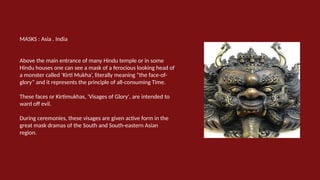
MASKS : Asia . India
Above the main entrance of many Hindu temple or in some
Hindu houses one can see a mask of a ferocious looking head of
a monster called ‘Kirti Mukha’, literally meaning “the face-of-
glory” and it represents the principle of all-consuming Time.
These faces or Kirtimukhas, 'Visages of Glory', are intended to
ward off evil.
During ceremonies, these visages are given active form in the
great mask dramas of the South and South-eastern Asian
region.
MASKS : Asia . India
‘Kirti Mukha’, 'Visages of Glory', in Every Day Art and Use.
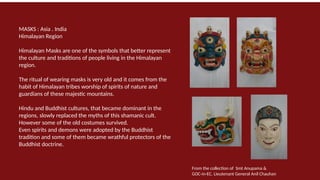
MASKS : Asia . India
Himalayan Region
Himalayan Masks are one of the symbols that better represent
the culture and traditions of people living in the Himalayan
region.
The ritual of wearing masks is very old and it comes from the
habit of Himalayan tribes worship of spirits of nature and
guardians of these majestic mountains.
Hindu and Buddhist cultures, that became dominant in the
regions, slowly replaced the myths of this shamanic cult.
However some of the old costumes survived.
Even spirits and demons were adopted by the Buddhist
tradition and some of them became wrathful protectors of the
Buddhist doctrine.
From the collection of Smt Anupama &
GOC-in-EC. Lieutenant General Anil Chauhan
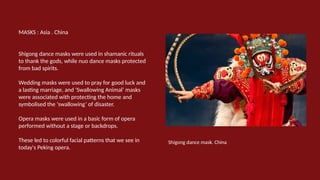
MASKS : Asia . China
Shigong dance masks were used in shamanic rituals
to thank the gods, while nuo dance masks protected
from bad spirits.
Wedding masks were used to pray for good luck and
a lasting marriage, and ‘Swallowing Animal’ masks
were associated with protecting the home and
symbolised the ‘swallowing’ of disaster.
Opera masks were used in a basic form of opera
performed without a stage or backdrops.
These led to colorful facial patterns that we see in
today's Peking opera.
Shigong dance mask. China
MASKS : Asia . China
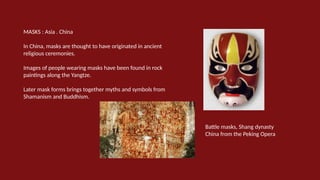
In China, masks are thought to have originated in ancient
religious ceremonies.
Images of people wearing masks have been found in rock
paintings along the Yangtze.
Later mask forms brings together myths and symbols from
Shamanism and Buddhism.
Battle masks, Shang dynasty
China from the Peking Opera
MASKS : Asia . Japan
The Nō or Noh mask evolved from the gigaku and bugaku and
are acted entirely by men. T
The masks are worn throughout very long performances and
are consequently very light. The nō mask is the supreme
achievement of Japanese mask-making.
Nō masks represent gods, men, women, madmen and devils,
and each category has many sub-divisions. Kyōgen are short
farces with their own masks, and accompany the tragic nō
plays.
Kabuki is the theatre of modern Japan, rooted in the older
forms, but in this form masks are replaced by painted faces.
MASKS : Asia . Japan
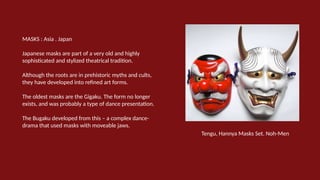
Japanese masks are part of a very old and highly
sophisticated and stylized theatrical tradition.
Although the roots are in prehistoric myths and cults,
they have developed into refined art forms.
The oldest masks are the Gigaku. The form no longer
exists, and was probably a type of dance presentation.
The Bugaku developed from this – a complex dance-
drama that used masks with moveable jaws.
Tengu, Hannya Masks Set. Noh-Men
MASKS : Asia . Indonesia
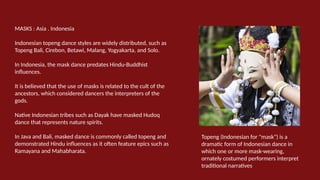
Indonesian topeng dance styles are widely distributed, such as
Topeng Bali, Cirebon, Betawi, Malang, Yogyakarta, and Solo.
In Indonesia, the mask dance predates Hindu-Buddhist
influences.
It is believed that the use of masks is related to the cult of the
ancestors, which considered dancers the interpreters of the
gods.
Native Indonesian tribes such as Dayak have masked Hudoq
dance that represents nature spirits.
In Java and Bali, masked dance is commonly called topeng and
demonstrated Hindu influences as it often feature epics such as
Ramayana and Mahabharata.
Topeng (Indonesian for "mask") is a
dramatic form of Indonesian dance in
which one or more mask-wearing,
ornately costumed performers interpret
traditional narratives
MASKS : Asia . Korea
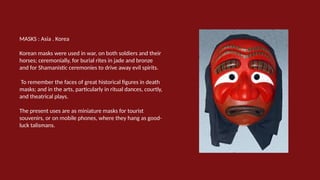
Korean masks were used in war, on both soldiers and their
horses; ceremonially, for burial rites in jade and bronze
and for Shamanistic ceremonies to drive away evil spirits.
To remember the faces of great historical figures in death
masks; and in the arts, particularly in ritual dances, courtly,
and theatrical plays.
The present uses are as miniature masks for tourist
souvenirs, or on mobile phones, where they hang as good-
luck talismans.
MASKS : Asia . Korea
Korean masks have a long tradition associated with Shamanism
and later in ritual dance.
Shamanism is a religious practice that involves a practitioner
who is believed to interact with a spirit world through altered
states of consciousness, such as trance.
The goal of this is usually to direct these spirits or spiritual
energies into the physical world, for healing or other purpose.
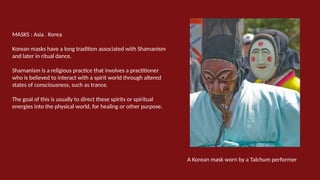
A Korean mask worn by a Talchum performer
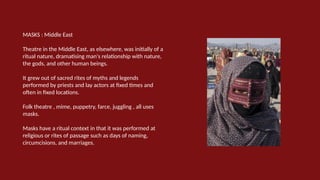
MASKS : Middle East
Theatre in the Middle East, as elsewhere, was initially of a
ritual nature, dramatising man's relationship with nature,
the gods, and other human beings.
It grew out of sacred rites of myths and legends
performed by priests and lay actors at fixed times and
often in fixed locations.
Folk theatre , mime, puppetry, farce, juggling , all uses
masks.
Masks have a ritual context in that it was performed at
religious or rites of passage such as days of naming,
circumcisions, and marriages.
MASKS : Middle East
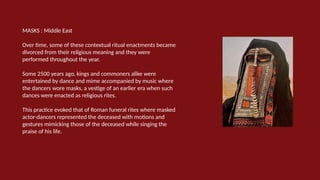
Over time, some of these contextual ritual enactments became
divorced from their religious meaning and they were
performed throughout the year.
Some 2500 years ago, kings and commoners alike were
entertained by dance and mime accompanied by music where
the dancers wore masks, a vestige of an earlier era when such
dances were enacted as religious rites.
This practice evoked that of Roman funeral rites where masked
actor-dancers represented the deceased with motions and
gestures mimicking those of the deceased while singing the
praise of his life.
MASKS : Europe
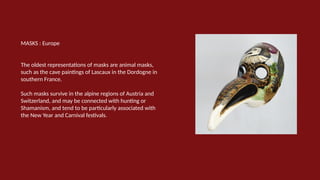
The oldest representations of masks are animal masks,
such as the cave paintings of Lascaux in the Dordogne in
southern France.
Such masks survive in the alpine regions of Austria and
Switzerland, and may be connected with hunting or
Shamanism, and tend to be particularly associated with
the New Year and Carnival festivals.
MASKS : Europe
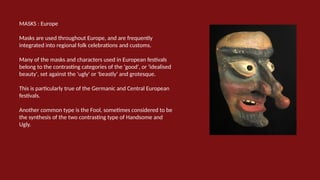
Masks are used throughout Europe, and are frequently
integrated into regional folk celebrations and customs.
Many of the masks and characters used in European festivals
belong to the contrasting categories of the 'good', or 'idealised
beauty', set against the 'ugly' or 'beastly' and grotesque.
This is particularly true of the Germanic and Central European
festivals.
Another common type is the Fool, sometimes considered to be
the synthesis of the two contrasting type of Handsome and
Ugly.
MASKS : Europe
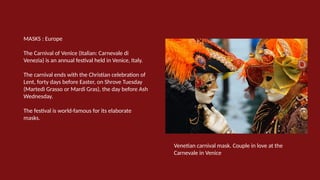
The Carnival of Venice (Italian: Carnevale di
Venezia) is an annual festival held in Venice, Italy.
The carnival ends with the Christian celebration of
Lent, forty days before Easter, on Shrove Tuesday
(Martedì Grasso or Mardi Gras), the day before Ash
Wednesday.
The festival is world-famous for its elaborate
masks.
Venetian carnival mask. Couple in love at the
Carnevale in Venice
MASKS : Dance
Masks have a long history of use in dance.
In the Indian Dance form masks have been used in to
portray certain characters, disguise identity, and to
depersonalize the dancer.
The types of masks and their usage in dance have
evolved in time, and are still employed in modern
choreographic works.
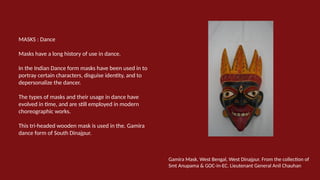
This tri-headed wooden mask is used in the. Gamira
dance form of South Dinajpur.
Gamira Mask. West Bengal, West Dinajpur. From the collection of
Smt Anupama & GOC-in-EC. Lieutenant General Anil Chauhan
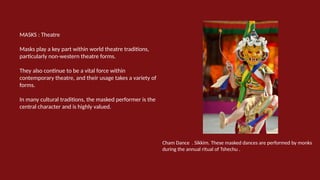
MASKS : Theatre
Masks play a key part within world theatre traditions,
particularly non-western theatre forms.
They also continue to be a vital force within
contemporary theatre, and their usage takes a variety of
forms.
In many cultural traditions, the masked performer is the
central character and is highly valued.
Cham Dance . Sikkim. These masked dances are performed by monks
during the annual ritual of Tshechu .
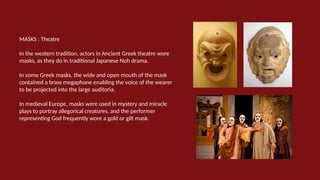
MASKS : Theatre
In the western tradition, actors in Ancient Greek theatre wore
masks, as they do in traditional Japanese Noh drama.
In some Greek masks, the wide and open mouth of the mask
contained a brass megaphone enabling the voice of the wearer
to be projected into the large auditoria.
In medieval Europe, masks were used in mystery and miracle
plays to portray allegorical creatures, and the performer
representing God frequently wore a gold or gilt mask.
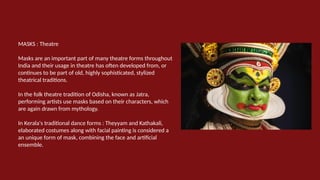
MASKS : Theatre
Masks are an important part of many theatre forms throughout
India and their usage in theatre has often developed from, or
continues to be part of old, highly sophisticated, stylized
theatrical traditions.
In the folk theatre tradition of Odisha, known as Jatra,
performing artists use masks based on their characters, which
are again drawn from mythology.
In Kerala's traditional dance forms : Theyyam and Kathakali,
elaborated costumes along with facial painting is considered a
an unique form of mask, combining the face and artificial
ensemble.
MASKS : Theatre
During the Renaissance, masques and ballet de cour developed
courtly masked entertainments that continued as part of ballet
conventions until the late eighteenth century.
The masked characters of the Commedia dell'arte included the
ancestors of the modern clown.
In contemporary western theatre, the mask is often used
alongside puppetry to create a theatre which is essentially
visual rather than verbal, and many of its practitioners have
been visual artists.
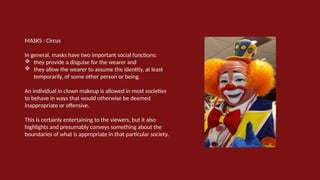
MASKS : Circus
In general, masks have two important social functions:
 they provide a disguise for the wearer and
 they allow the wearer to assume the identity, at least
temporarily, of some other person or being.
An individual in clown makeup is allowed in most societies
to behave in ways that would otherwise be deemed
inappropriate or offensive.
This is certainly entertaining to the viewers, but it also
highlights and presumably conveys something about the
boundaries of what is appropriate in that particular society.
MASKS : Sports
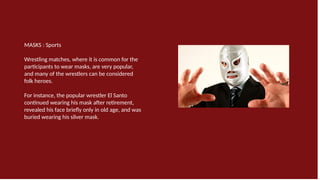
Wrestling matches, where it is common for the
participants to wear masks, are very popular,
and many of the wrestlers can be considered
folk heroes.
For instance, the popular wrestler El Santo
continued wearing his mask after retirement,
revealed his face briefly only in old age, and was
buried wearing his silver mask.
MASKS : Film
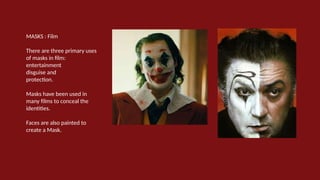
There are three primary uses
of masks in film:
entertainment
disguise and
protection.
Masks have been used in
many films to conceal the
identities.
Faces are also painted to
create a Mask.
MASKS : Art
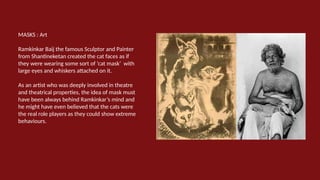
Ramkinkar Baij the famous Sculptor and Painter
from Shantineketan created the cat faces as if
they were wearing some sort of ‘cat mask’ with
large eyes and whiskers attached on it.
As an artist who was deeply involved in theatre
and theatrical properties, the idea of mask must
have been always behind Ramkinkar’s mind and
he might have even believed that the cats were
the real role players as they could show extreme
behaviours.
MASK of all MASKS
The Mummy of Egypt has a painted cover to Mask the dead
body.
The mummy portraits on the cover are actually masks and
probably the most famous example of painted masks.
They are a type of naturalistic painted portrait on wooden
boards attached to mummies from Egypt.
They belong to the tradition of panel painting, one of the
most highly regarded forms of art in the Classical world.
What is interesting that it is believed that the paintings
were exact representation of the deceased.
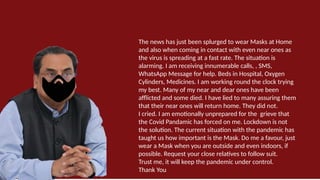
The news has just been splurged to wear Masks at Home
and also when coming in contact with even near ones as
the virus is spreading at a fast rate. The situation is
alarming. I am receiving innumerable calls, , SMS,
WhatsApp Message for help. Beds in Hospital, Oxygen
Cylinders, Medicines. I am working round the clock trying
my best. Many of my near and dear ones have been
afflicted and some died. I have lied to many assuring them
that their near ones will return home. They did not.
I cried. I am emotionally unprepared for the grieve that
the Covid Pandamic has forced on me. Lockdown is not
the solution. The current situation with the pandemic has
taught us how important is the Mask. Do me a favour, just
wear a Mask when you are outside and even indoors, if
possible. Request your close relatives to follow suit.
Trust me, it will keep the pandemic under control.
Thank You
MASKS : Voodoo
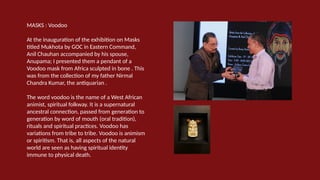
At the inauguration of the exhibition on Masks
titled Mukhota by GOC in Eastern Command,
Anil Chauhan accompanied by his spouse,
Anupama; I presented them a pendant of a
Voodoo mask from Africa sculpted in bone . This
was from the collection of my father Nirmal
Chandra Kumar, the antiquarian .
The word voodoo is the name of a West African
animist, spiritual folkway. It is a supernatural
ancestral connection, passed from generation to
generation by word of mouth (oral tradition),
rituals and spiritual practices. Voodoo has
variations from tribe to tribe. Voodoo is animism
or spiritism. That is, all aspects of the natural
world are seen as having spiritual identity
immune to physical death.

Presentation Masks around the world.pptx

  • 1.
    Masks From AroundThe World a presentation by Prof. Aloke Kumar to accompany an exhibition on Masks from the collection of Smt Anupama & GOC-in-EC. Lieutenant General Anil Chauhan
  • 2.
    A mask isan object normally worn on the face, typically for protection, disguise, performance, or entertainment. Masks have been used since antiquity for both ceremonial and practical purposes, as well as in the performing arts and for entertainment. They are usually worn on the face, although they may also be positioned for effect elsewhere on the wearer's body. Antique Wood mask from Nepal
  • 3.
    More generally inart history, especially sculpture, ‘mask’ is the term for a face without a body that is not modelled in the round , which would make it a ‘head’ , but for example appears in low relief. A Mask can be accompanied by a matching full body gear. Chinese Wood Mask Romance of the Three Kingdoms of Zhangfei
  • 4.
    The word ‘mask’appeared in English in the 1530s, from Middle French masque, meaning , ‘covering to hide or guard the face’, derived in turn from Italian maschera, from Medieval Latin masca, meaning mask, spectre, nightmare. This word may also have its origin, from Arabic maskharah, from the verb sakhira ‘ to ridicule’. The so-called 'Mask of Agamemnon', a 16th-century BC mask discovered by Heinrich Schliemann in 1876 at Mycenae, Greece. National Archaeological Museum, Athens.
  • 5.
    However, it mayalso come from Provençal mascara, meaning ‘to black the face’ or the related Catalan mascarar, Old French mascurer. This in turn is of uncertain origin – perhaps from a Germanic source akin to English ‘mesh’, but perhaps from mask, ‘black’, a borrowing from a pre-Indo- European language. Or from Sanskrit मकुष्ठः Makushthah, leading to Hindi मुखौटा Mukhota. Most importantly Mask is there in most major languages. Vintage African Mask of Smiling Face
  • 6.
    The use ofmasks in rituals or ceremonies is a very ancient human practice across the world, although masks can also be worn for protection, in hunting, in sports, in feasts, or in wars – or simply used as ornamentation. Some ceremonial or decorative masks were not designed to be worn. And some to be worn as pendant. Although the religious use of masks has waned, masks are used sometimes in drama therapy or psychotherapy. And off course today as a protection against the pandemic. Mahakala Mask. Tibet. From the collection of Smt Anupama & GOC-in-EC. Lieutenant General Anil Chauhan
  • 7.
    The oldest masksthat have been discovered are 9,000 years old, being held by the Musée ‘Bible et Terre Sainte’ , Paris, and the Israel Museum in Jerusalem. Most probably the practice of masking is much older – the earliest known anthropomorphic mask, having human characteristics is circa 30,000 to 40,000 years old. It involved the use of war-paint, leather, vegetative material, or wooden masks. These masks have not been preserved. This stone mask from the Neolithic period dates to 7000 BC and is probably the oldest surviving mask in the world
  • 8.
    Most probably thepractice of masking is much older they are visible only in paleolithic cave drawings, of which dozens have been preserved. At the Neanderthal Roche-Cotard site in France, a flintstone likeness of a face was found which is about 35,000 years old, but it is not clear that it was intended as a mask.
  • 9.
    Throughout the world,masks are used for their expressive power as a feature of masked performance : both ritually and in various theatre traditions. The ritual and theatrical definitions of mask usage frequently overlap and merge. The image of juxtaposed Comedy and Tragedy masks are widely used to represent the Performing Arts, and specifically drama. Mosaic depicting theatrical masks of Tragedy and Comedy, 2nd century AD, from Rome Thermae Decianae
  • 10.
    In many dramatictraditions including the theatre of ancient Noh drama of Japan, originating in 14th century. Masks were worn by all the performers, with several different types of mask used for different types of character. Hannya Noh Mask , first half of the 17th century
  • 11.
    In Ancient Rome,the word persona meant 'a mask'; it also referred to an individual who had full Roman citizenship. A citizen could demonstrate his or her lineage through imagines, death masks of the ancestors. These were wax casts kept in a lararium, the family shrine. Rites of passage, such as initiation of young members of the family, or funerals, were carried out at the shrine under the watch of the ancestral masks. At funerals, professional actors would wear these masks to perform deeds of the lives of the ancestors, thus linking the role of mask as a ritual object and in theatre. Ludwig van Beethoven (1770-1827) – likely cause of death: liver damage from heavy alcohol consumption; aged 56.
  • 12.
    Masks are afamiliar and vivid element in many folk and traditional pageants, ceremonies, rituals, and festivals, and are often of an ancient origin. The mask is normally a part of a costume that adorns the whole body and embodies a tradition important to the religious and/or social life of the community as whole or a particular group within the community. In parts of Africa, giant totem masks cover the body.
  • 13.
    Ritual masks occurthroughout the world, and although they tend to share many characteristics, highly distinctive forms have developed. The function of the masks may be magical or religious; they may appear in rites of passage or as a make-up for a form of theatre. Equally masks may disguise a penitent or preside over important ceremonies; they may help mediate with spirits, or offer a protective role to the society who utilise their powers. Three African Masks used for different purposes.
  • 14.
    The ritual masks,as representations of the human face, are extremely revealing of the two fundamental aspects of the human psychological condition:  firstly, the repression of a cooperative, instinctive self or soul;  secondly, the extremely angry state of the unjustly condemned conscious thinking egocentric intellect. Tikar Mask. Cameroon. From the collection of Smt Anupama & GOC-in-EC. Lieutenant General Anil Chauhan
  • 15.
    MASKS : Africa Theexistence of African masks can be traced as far back as the Stone Age. For thousands of years, African people have incorporated tribal masks into their cultural ceremonies, rituals, and celebrations. Each of these creations is designed according to the particular traditions of their region. Clay Tablet Mask. Angola- Africa. From the collection of Smt Anupama & GOC-in-EC. Lieutenant General Anil Chauhan
  • 16.
    MASKS : Africa Africanvillagers hold deep and complex beliefs around masks. It is thought that when a person wears a mask, he becomes a sort of medium, capable of communicating with spirits and ancestors on behalf of the community. This is an effort to control the forces of good and evil by calling on the intervention and blessings of spirits to support and guide the community through such crucial life events as war preparation, crop harvesting, marriage, fertility, and burials. MATATA MASK- Kenya. From the collection of Smt Anupama & GOC-in-EC. Lieutenant General Anil Chauhan
  • 17.
    MASKS : Africa Thereare a wide variety of masks used in Africa. In West Africa, masks are used in masquerades that form part of religious ceremonies enacted to communicate with spirits and ancestors. Examples are the masquerades of the Yoruba, Igbo, and Edo cultures, including Egungun Masquerades and Northern Edo Masquerades. Ntomo Mask. Mali- Bamana Region From the collection of Smt Anupama & GOC-in-EC. Lieutenant General Anil Chauhan
  • 18.
    MASKS : Africa Themasks are usually carved with an extraordinary skill and variety by artists who will usually have received their training as an apprentice to a master carver . Frequently it is a tradition that has been passed down within a family through many generations. Such an artist holds a respected position in tribal society because of the work that he or she creates, embodying not only complex craft techniques but also spiritual/social and symbolic knowledge. African masks are also used in the Mas or Masquerade of the Caribbean Carnival. African Mask. Massai. Kenya
  • 19.
    MASKS : NorthAmerica Arctic Coastal groups have tended towards simple religious practice but a highly evolved and rich mythology, especially concerning hunting. In some areas, annual shamanic ceremonies involved masked dances and these strongly abstracted masks are arguably the most striking artifacts produced in this region. Crooked Beak of Heaven Mask, Kawakwaka'wakw, British Columbia Shamanic : a religion practiced by indigenous peoples of far northern Europe and Siberia that is characterized by belief in an unseen world of gods, demons, and ancestral spirits
  • 20.
    MASKS : NorthAmerica Inuit groups, member of an indigenous people of northern Canada and parts of Greenland and Alaska. vary widely and do not share a common mythology or language. Not surprisingly their mask traditions are also often different, although their masks are often made out of driftwood, animal skins, bones, and feathers. In some areas Inuit women use finger masks during storytelling and dancing. Old Inuit mask from Greenland
  • 21.
    MASKS : NorthAmerica Pacific Northwest Coastal indigenous groups were generally highly skilled woodworkers. Their masks were often master-pieces of carving, sometimes with movable jaws, or a mask within a mask, and parts moved by pulling cords. The carving of masks was an important feature of wood craft, along with many other features that often combined the utilitarian with the symbolic, such as shields, canoes, poles, and houses. Pacific Northwest Coast Tsimshian circa 1825
  • 22.
    MASKS : LatinAmerica Distinctive styles of masks began to emerge in pre-Hispanic America about 1200BC, although there is evidence of far older mask forms. In the Andes, masks were used to dress the faces of the dead. These were originally made of fabric, but later burial masks were sometimes made of beaten copper or gold, and occasionally of clay. Aztec mask of Xiuhtecuhtli, c. 1500, of Mixtec-Aztec provenance
  • 23.
    MASKS : LatinAmerica For the Aztecs, human skulls were prized as war trophies, and skull masks were not uncommon. Masks were also used as part of court entertainments, possibly combining political with religious significance. Ancient Aztec mosaic covered skull mask
  • 24.
    MASKS : LatinAmerica In post-colonial Latin America, pre-Columbian traditions merged with Christian rituals, and syncretic masquerades and ceremonies, such as All Souls/Day of the Dead developed, despite efforts of the Church to stamp out the indigenous traditions. Christian ritual mask. Columbia
  • 25.
    MASKS : LatinAmerica Masks remain an important feature of popular carnivals and religious dances, such as the Dance of the Moors and Christians. Mexico, in particular, retains a great deal of creativity in the production of masks, encouraged by collectors. Mexican Dance Masks .The Dance of the Moors and Christians
  • 26.
    MASKS : Asia. India Masked characters, usually divinities, are a central feature of Indian dramatic forms, many based on depicting the epics Mahabharata and Ramayana. The masks are usually highly exaggerated and formalized, and share an aesthetic with the carved images of monstrous heads that dominate the facades of Hindu and Buddhist temples. Mask from Dinajpur for Gambhira Dance From the collection of Smt Anupama & GOC-in-EC. Lieutenant General Anil Chauhan
  • 27.
    MASKS : Asia. India Masks are an important part of the culture and heritage of India. India being a subcontinent , there is no singular style of mask in India. You have the Chhau mask in Bengal and the Kummatti Kali the colorful mask-dance of Kerala. Most of the masks are related to religion, particularly Hinduism and Buddhism. The most popular mask that is seen throughout India is that of Ganesh. From the collection of Smt Anupama & GOC-in-EC. Lieutenant General Anil Chauhan
  • 28.
    MASKS : Asia. India Above the main entrance of many Hindu temple or in some Hindu houses one can see a mask of a ferocious looking head of a monster called ‘Kirti Mukha’, literally meaning “the face-of- glory” and it represents the principle of all-consuming Time. These faces or Kirtimukhas, 'Visages of Glory', are intended to ward off evil. During ceremonies, these visages are given active form in the great mask dramas of the South and South-eastern Asian region.
  • 29.
    MASKS : Asia. India ‘Kirti Mukha’, 'Visages of Glory', in Every Day Art and Use.
  • 30.
    MASKS : Asia. India Himalayan Region Himalayan Masks are one of the symbols that better represent the culture and traditions of people living in the Himalayan region. The ritual of wearing masks is very old and it comes from the habit of Himalayan tribes worship of spirits of nature and guardians of these majestic mountains. Hindu and Buddhist cultures, that became dominant in the regions, slowly replaced the myths of this shamanic cult. However some of the old costumes survived. Even spirits and demons were adopted by the Buddhist tradition and some of them became wrathful protectors of the Buddhist doctrine. From the collection of Smt Anupama & GOC-in-EC. Lieutenant General Anil Chauhan
  • 31.
    MASKS : Asia. China Shigong dance masks were used in shamanic rituals to thank the gods, while nuo dance masks protected from bad spirits. Wedding masks were used to pray for good luck and a lasting marriage, and ‘Swallowing Animal’ masks were associated with protecting the home and symbolised the ‘swallowing’ of disaster. Opera masks were used in a basic form of opera performed without a stage or backdrops. These led to colorful facial patterns that we see in today's Peking opera. Shigong dance mask. China
  • 32.
    MASKS : Asia. China In China, masks are thought to have originated in ancient religious ceremonies. Images of people wearing masks have been found in rock paintings along the Yangtze. Later mask forms brings together myths and symbols from Shamanism and Buddhism. Battle masks, Shang dynasty China from the Peking Opera
  • 33.
    MASKS : Asia. Japan The Nō or Noh mask evolved from the gigaku and bugaku and are acted entirely by men. T The masks are worn throughout very long performances and are consequently very light. The nō mask is the supreme achievement of Japanese mask-making. Nō masks represent gods, men, women, madmen and devils, and each category has many sub-divisions. Kyōgen are short farces with their own masks, and accompany the tragic nō plays. Kabuki is the theatre of modern Japan, rooted in the older forms, but in this form masks are replaced by painted faces.
  • 34.
    MASKS : Asia. Japan Japanese masks are part of a very old and highly sophisticated and stylized theatrical tradition. Although the roots are in prehistoric myths and cults, they have developed into refined art forms. The oldest masks are the Gigaku. The form no longer exists, and was probably a type of dance presentation. The Bugaku developed from this – a complex dance- drama that used masks with moveable jaws. Tengu, Hannya Masks Set. Noh-Men
  • 35.
    MASKS : Asia. Indonesia Indonesian topeng dance styles are widely distributed, such as Topeng Bali, Cirebon, Betawi, Malang, Yogyakarta, and Solo. In Indonesia, the mask dance predates Hindu-Buddhist influences. It is believed that the use of masks is related to the cult of the ancestors, which considered dancers the interpreters of the gods. Native Indonesian tribes such as Dayak have masked Hudoq dance that represents nature spirits. In Java and Bali, masked dance is commonly called topeng and demonstrated Hindu influences as it often feature epics such as Ramayana and Mahabharata. Topeng (Indonesian for "mask") is a dramatic form of Indonesian dance in which one or more mask-wearing, ornately costumed performers interpret traditional narratives
  • 36.
    MASKS : Asia. Korea Korean masks were used in war, on both soldiers and their horses; ceremonially, for burial rites in jade and bronze and for Shamanistic ceremonies to drive away evil spirits. To remember the faces of great historical figures in death masks; and in the arts, particularly in ritual dances, courtly, and theatrical plays. The present uses are as miniature masks for tourist souvenirs, or on mobile phones, where they hang as good- luck talismans.
  • 37.
    MASKS : Asia. Korea Korean masks have a long tradition associated with Shamanism and later in ritual dance. Shamanism is a religious practice that involves a practitioner who is believed to interact with a spirit world through altered states of consciousness, such as trance. The goal of this is usually to direct these spirits or spiritual energies into the physical world, for healing or other purpose. A Korean mask worn by a Talchum performer
  • 38.
    MASKS : MiddleEast Theatre in the Middle East, as elsewhere, was initially of a ritual nature, dramatising man's relationship with nature, the gods, and other human beings. It grew out of sacred rites of myths and legends performed by priests and lay actors at fixed times and often in fixed locations. Folk theatre , mime, puppetry, farce, juggling , all uses masks. Masks have a ritual context in that it was performed at religious or rites of passage such as days of naming, circumcisions, and marriages.
  • 39.
    MASKS : MiddleEast Over time, some of these contextual ritual enactments became divorced from their religious meaning and they were performed throughout the year. Some 2500 years ago, kings and commoners alike were entertained by dance and mime accompanied by music where the dancers wore masks, a vestige of an earlier era when such dances were enacted as religious rites. This practice evoked that of Roman funeral rites where masked actor-dancers represented the deceased with motions and gestures mimicking those of the deceased while singing the praise of his life.
  • 40.
    MASKS : Europe Theoldest representations of masks are animal masks, such as the cave paintings of Lascaux in the Dordogne in southern France. Such masks survive in the alpine regions of Austria and Switzerland, and may be connected with hunting or Shamanism, and tend to be particularly associated with the New Year and Carnival festivals.
  • 41.
    MASKS : Europe Masksare used throughout Europe, and are frequently integrated into regional folk celebrations and customs. Many of the masks and characters used in European festivals belong to the contrasting categories of the 'good', or 'idealised beauty', set against the 'ugly' or 'beastly' and grotesque. This is particularly true of the Germanic and Central European festivals. Another common type is the Fool, sometimes considered to be the synthesis of the two contrasting type of Handsome and Ugly.
  • 42.
    MASKS : Europe TheCarnival of Venice (Italian: Carnevale di Venezia) is an annual festival held in Venice, Italy. The carnival ends with the Christian celebration of Lent, forty days before Easter, on Shrove Tuesday (Martedì Grasso or Mardi Gras), the day before Ash Wednesday. The festival is world-famous for its elaborate masks. Venetian carnival mask. Couple in love at the Carnevale in Venice
  • 43.
    MASKS : Dance Maskshave a long history of use in dance. In the Indian Dance form masks have been used in to portray certain characters, disguise identity, and to depersonalize the dancer. The types of masks and their usage in dance have evolved in time, and are still employed in modern choreographic works. This tri-headed wooden mask is used in the. Gamira dance form of South Dinajpur. Gamira Mask. West Bengal, West Dinajpur. From the collection of Smt Anupama & GOC-in-EC. Lieutenant General Anil Chauhan
  • 44.
    MASKS : Theatre Masksplay a key part within world theatre traditions, particularly non-western theatre forms. They also continue to be a vital force within contemporary theatre, and their usage takes a variety of forms. In many cultural traditions, the masked performer is the central character and is highly valued. Cham Dance . Sikkim. These masked dances are performed by monks during the annual ritual of Tshechu .
  • 45.
    MASKS : Theatre Inthe western tradition, actors in Ancient Greek theatre wore masks, as they do in traditional Japanese Noh drama. In some Greek masks, the wide and open mouth of the mask contained a brass megaphone enabling the voice of the wearer to be projected into the large auditoria. In medieval Europe, masks were used in mystery and miracle plays to portray allegorical creatures, and the performer representing God frequently wore a gold or gilt mask.
  • 46.
    MASKS : Theatre Masksare an important part of many theatre forms throughout India and their usage in theatre has often developed from, or continues to be part of old, highly sophisticated, stylized theatrical traditions. In the folk theatre tradition of Odisha, known as Jatra, performing artists use masks based on their characters, which are again drawn from mythology. In Kerala's traditional dance forms : Theyyam and Kathakali, elaborated costumes along with facial painting is considered a an unique form of mask, combining the face and artificial ensemble.
  • 47.
    MASKS : Theatre Duringthe Renaissance, masques and ballet de cour developed courtly masked entertainments that continued as part of ballet conventions until the late eighteenth century. The masked characters of the Commedia dell'arte included the ancestors of the modern clown. In contemporary western theatre, the mask is often used alongside puppetry to create a theatre which is essentially visual rather than verbal, and many of its practitioners have been visual artists.
  • 48.
    MASKS : Circus Ingeneral, masks have two important social functions:  they provide a disguise for the wearer and  they allow the wearer to assume the identity, at least temporarily, of some other person or being. An individual in clown makeup is allowed in most societies to behave in ways that would otherwise be deemed inappropriate or offensive. This is certainly entertaining to the viewers, but it also highlights and presumably conveys something about the boundaries of what is appropriate in that particular society.
  • 49.
    MASKS : Sports Wrestlingmatches, where it is common for the participants to wear masks, are very popular, and many of the wrestlers can be considered folk heroes. For instance, the popular wrestler El Santo continued wearing his mask after retirement, revealed his face briefly only in old age, and was buried wearing his silver mask.
  • 50.
    MASKS : Film Thereare three primary uses of masks in film: entertainment disguise and protection. Masks have been used in many films to conceal the identities. Faces are also painted to create a Mask.
  • 51.
    MASKS : Art RamkinkarBaij the famous Sculptor and Painter from Shantineketan created the cat faces as if they were wearing some sort of ‘cat mask’ with large eyes and whiskers attached on it. As an artist who was deeply involved in theatre and theatrical properties, the idea of mask must have been always behind Ramkinkar’s mind and he might have even believed that the cats were the real role players as they could show extreme behaviours.
  • 52.
    MASK of allMASKS The Mummy of Egypt has a painted cover to Mask the dead body. The mummy portraits on the cover are actually masks and probably the most famous example of painted masks. They are a type of naturalistic painted portrait on wooden boards attached to mummies from Egypt. They belong to the tradition of panel painting, one of the most highly regarded forms of art in the Classical world. What is interesting that it is believed that the paintings were exact representation of the deceased.
  • 54.
    The news hasjust been splurged to wear Masks at Home and also when coming in contact with even near ones as the virus is spreading at a fast rate. The situation is alarming. I am receiving innumerable calls, , SMS, WhatsApp Message for help. Beds in Hospital, Oxygen Cylinders, Medicines. I am working round the clock trying my best. Many of my near and dear ones have been afflicted and some died. I have lied to many assuring them that their near ones will return home. They did not. I cried. I am emotionally unprepared for the grieve that the Covid Pandamic has forced on me. Lockdown is not the solution. The current situation with the pandemic has taught us how important is the Mask. Do me a favour, just wear a Mask when you are outside and even indoors, if possible. Request your close relatives to follow suit. Trust me, it will keep the pandemic under control. Thank You
  • 55.
    MASKS : Voodoo Atthe inauguration of the exhibition on Masks titled Mukhota by GOC in Eastern Command, Anil Chauhan accompanied by his spouse, Anupama; I presented them a pendant of a Voodoo mask from Africa sculpted in bone . This was from the collection of my father Nirmal Chandra Kumar, the antiquarian . The word voodoo is the name of a West African animist, spiritual folkway. It is a supernatural ancestral connection, passed from generation to generation by word of mouth (oral tradition), rituals and spiritual practices. Voodoo has variations from tribe to tribe. Voodoo is animism or spiritism. That is, all aspects of the natural world are seen as having spiritual identity immune to physical death.