3/D Design Lesson Plan:
Elongated Pinch Pot
Vessel
NSBH’s Ceramics II, III, AP
Ms. Colby
Content
• This lesson introduces an alternate
approach to the basic pinch pot
building technique in ceramics that
moves beyond the traditional pinch
pot bowl to explore a more
complex form.
Content, continued
• The technique is explored through
the design of a vessel that
incorporates simplicity, movement,
and elegance in form. These
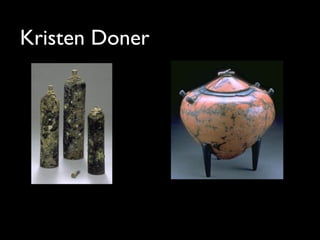
bottles are inspired by the work of
potters Joyce Michaud and Kristen
Doner.
Joyce Michaud
Kristen Doner
Objective
• The student will learn how to form
a clay vase by lightly pinching and
shaping a ball of clay using the
fingers and thumb.
Objective
• The student will combine two
sections of pinched clay
constructions (using low-fire clay)
to create a bottle with an
elongated neck that demonstrates
balance, harmony, unity, and
movement.
Process (brainstorming)
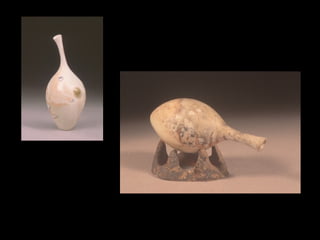
• Look online at the pinch pots
created by potter Joyce Michaud
and Kristen Doner with the class
and analyze the movement and
form in the pinch pots
Joyce Michaud Gallery
Pinch Pots by Kristen Doner
Process
• Make three sketches in your
sketchbook (each one a full-page
sketch) of clay pinch pot bottle
forms that show movement and
are elongated in design
• With me, critique pinch pot bottle
designs
•
Process
• Select one design for the bottle
project
• Form bottle by pinching clay,
joining clay sections, and cleaning
up any discernible joint edges
Process
• Glaze the bisque-fired bottle, using
multiple glazes (both “from scratch” and
“store bought”)
• Write a critique of completed piece in
art journal
• Demonstrate mastery of technique
• Show evidence of craftsmanship
Vocabulary refresher
• 1. Pinch pot -- A clay pot formed by
pinching a ball of clay with the thumb and
fingers
• 2. Elongated -- Made longer or extended;
having more length than width
• 3. Aesthetics -- A pleasing appearance or
effect
• 4. Harmony -- A way of combining elements
of art to accent their similarities and combine
the parts into a whole
Vocabulary refresher
• 5. Unity -- The quality of wholeness or
oneness that is achieved through the
effective use of the elements and
principles of design
• 6. Balance -- Proportion of parts or
areas in a design arranged to create a
feeling of stability in a work
•
Vocabulary refresher
• 7. Mouth -- Opening of a bottle or
vessel
• 8. Neck -- A cylinder form
• 9. Vessel -- Container
Evaluation
• The student will:
• 1. Review clay properties in class text
• 2. Partake in class discussions
• 3. Analyze forms of potters' works (in class discussion
and/or comments in art journal)
• 4. Make three sketches in his/her art journal (each one
a full-page sketch) of clay pinch pot vessel forms that
show movement and have an elongated neck
incorporated into the design
• 5. With teacher, critique pinch pot vessel designs
Evaluation, page 2
• 1. Construct a piece that possesses
aesthetic sensibility
• 2. Construct a piece that incorporates harmony,
unity, and balance
• 3. Construct a vessel that has walls that are of even
thickness and no more than 1/4" thick
• 4. Join areas of the neck and vessel so that seams
are not visible, demonstrating good craftsmanship
• 5. Glaze the piece properly
• 6. Demonstrate mastery of technique and
craftsmanship
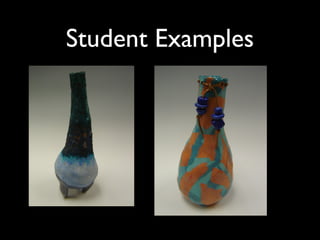
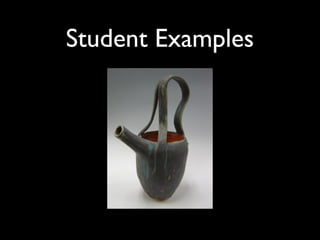
Student Examples
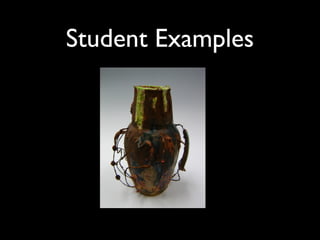
Student Examples
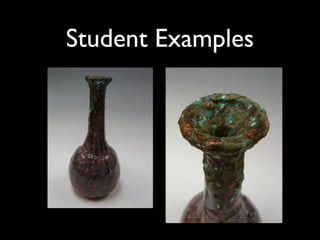
Student Examples
Student Examples
Student Examples

Elongated Pinch Pot Project

  • 1.
    3/D Design LessonPlan: Elongated Pinch Pot Vessel NSBH’s Ceramics II, III, AP Ms. Colby
  • 2.
    Content • This lessonintroduces an alternate approach to the basic pinch pot building technique in ceramics that moves beyond the traditional pinch pot bowl to explore a more complex form.
  • 3.
    Content, continued • Thetechnique is explored through the design of a vessel that incorporates simplicity, movement, and elegance in form. These bottles are inspired by the work of potters Joyce Michaud and Kristen Doner.
  • 4.
  • 5.
  • 6.
    Objective • The studentwill learn how to form a clay vase by lightly pinching and shaping a ball of clay using the fingers and thumb.
  • 7.
    Objective • The studentwill combine two sections of pinched clay constructions (using low-fire clay) to create a bottle with an elongated neck that demonstrates balance, harmony, unity, and movement.
  • 9.
    Process (brainstorming) • Lookonline at the pinch pots created by potter Joyce Michaud and Kristen Doner with the class and analyze the movement and form in the pinch pots Joyce Michaud Gallery Pinch Pots by Kristen Doner
  • 10.
    Process • Make threesketches in your sketchbook (each one a full-page sketch) of clay pinch pot bottle forms that show movement and are elongated in design • With me, critique pinch pot bottle designs •
  • 11.
    Process • Select onedesign for the bottle project • Form bottle by pinching clay, joining clay sections, and cleaning up any discernible joint edges
  • 12.
    Process • Glaze thebisque-fired bottle, using multiple glazes (both “from scratch” and “store bought”) • Write a critique of completed piece in art journal • Demonstrate mastery of technique • Show evidence of craftsmanship
  • 13.
    Vocabulary refresher • 1.Pinch pot -- A clay pot formed by pinching a ball of clay with the thumb and fingers • 2. Elongated -- Made longer or extended; having more length than width • 3. Aesthetics -- A pleasing appearance or effect • 4. Harmony -- A way of combining elements of art to accent their similarities and combine the parts into a whole
  • 14.
    Vocabulary refresher • 5.Unity -- The quality of wholeness or oneness that is achieved through the effective use of the elements and principles of design • 6. Balance -- Proportion of parts or areas in a design arranged to create a feeling of stability in a work •
  • 15.
    Vocabulary refresher • 7.Mouth -- Opening of a bottle or vessel • 8. Neck -- A cylinder form • 9. Vessel -- Container
  • 16.
    Evaluation • The studentwill: • 1. Review clay properties in class text • 2. Partake in class discussions • 3. Analyze forms of potters' works (in class discussion and/or comments in art journal) • 4. Make three sketches in his/her art journal (each one a full-page sketch) of clay pinch pot vessel forms that show movement and have an elongated neck incorporated into the design • 5. With teacher, critique pinch pot vessel designs
  • 17.
    Evaluation, page 2 •1. Construct a piece that possesses aesthetic sensibility • 2. Construct a piece that incorporates harmony, unity, and balance • 3. Construct a vessel that has walls that are of even thickness and no more than 1/4" thick • 4. Join areas of the neck and vessel so that seams are not visible, demonstrating good craftsmanship • 5. Glaze the piece properly • 6. Demonstrate mastery of technique and craftsmanship
  • 18.
  • 19.
  • 20.
  • 21.
  • 22.