Fused Glass!
Art 3/D Comprehensive II & III
Ms. Colby
•Fusing glass in a kiln
• This is a fascinating technique that
enables artists to create unique and
gorgeous projects. The following fusing
rules and firing instructions should
provide you with enough information to
produce your own glass project.
• It will create an appreciation for the
complexities and potential of fused
glass, and will pave the way for more
intricate designs and ideas.
• Contemporary glass art is reviving an
ancient glass medium.
• Warm glass, which is commonly known as glass fusing or
slumping, is an ancient artistic technique. Historians have
found traces of both methods dating back to the second
millennium BC in Mesopotamia. Glass mosaics, valued in
Greek and Romans civilizations, were considered equal
to silver and gold as precious materials. By the third
century AD warm glass fell out of favor, eclipsed by a
new blown glass technique.
• It was not until the emergence of the European
Arts and Crafts movement, in the late
nineteenth century, that warm glass was
revalued as a decorative art form. Today,
contemporary artisans have rediscovered
these ancient techniques.
Tested Compatible
• All glass has a coefficient of expansion,
or COE.
• Glass manufactured specifically for fusing
is often "tested compatible," or guaranteed
to be a certain COE.
• The most popular fusing glasses are either
90 COE (Bullseye, Uroboros) or 96 COE
(Spectrum and Uroboros).
• Always use compatible glass, which is
known to have the same COE.
Heating and Cooling
• When glass is heated it expands, when it
cools it contracts. If fusing two or more
pieces of glass together, they need to
expand and contract at the same rate.
Otherwise, when the glass cools, one glass
will pull on the other and cause the piece to
crack along the seam.
• If the glass survives the cooling
process, there is still a risk that
reheating to bend it, or placing it in a
sunny window will cause cracking.
Stress from incompatible glass is
always in the piece. Do not try to
refire broken incompatible glass.
Slower is Better
• You can't heat or cool glass too slowly. Going too fast can
result in cracked glass or Thermal Shock.
• A safe rate to heat is 15° per minute (900° per hour),
although stacked glass 2" in diameter and smaller can be
heated at a faster rate.
• Slow-cooling of glass or "annealing"
depends on the thickness of the glass. If
the glass breaks because it was heated too
fast; turn off the kiln, allow the glass to
cool, push it back together, and try again -
at a slower rate. Breaks from thermal
shock usually go straight across the piece
and have a little hook near the edge. They
can usually be repaired by refiring.
Glass Likes To Be ¼" Thick
• When heating glass to full fuse, anything
with less mass will shrink up, anything with
more will spread out. This movement can
be controlled somewhat by fusing slower,
and not going to full fuse.
All Kilns Are Not Alike
• There are some variances between kilns,
especially mini kilns. Sometimes
pyrometers are slightly off, and sometimes
current loads vary.
• Use firing schedules as a guide, but
remember to check your piece frequently
during fusing, and record changes in
schedules as needed.
• Prepare your kiln by applying kiln wash
with a kiln brush. Apply one thin coat in
each direction. Don't forget to apply kiln
wash to molds, too.
• Kiln wash prevents the glass from sticking
to the kiln during firing.
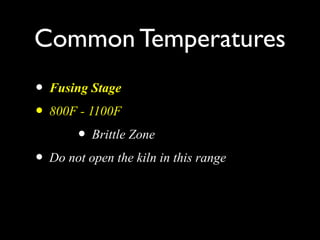
Common Temperatures
• Fusing Stage
• 800F - 1100F
• Brittle Zone
• Do not open the kiln in this range
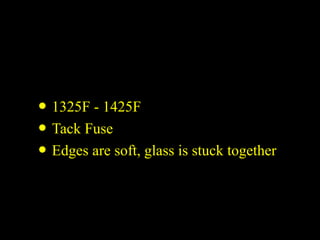
• 1325F - 1425F
• Tack Fuse
• Edges are soft, glass is stuck together
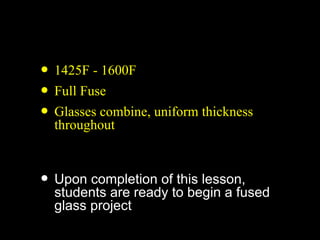
• 1425F - 1600F
• Full Fuse
• Glasses combine, uniform thickness
throughout
• Upon completion of this lesson,
students are ready to begin a fused
glass project
Basic Supplies
• a)Glass Cutters
• Pistol Grip, Pencil Grip
• B)Running Pliers
• c)Breaker/Grozer Pliers
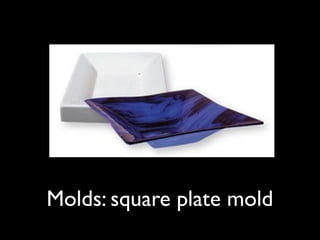
Molds: square plate mold
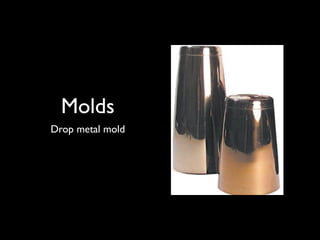
Molds
Drop metal mold
You will be graded on
Creating a fired square glass tray:
Elements of design:
1. Color
2. Shape
3. Line
Principles of Design:
1. Variety
2. Pattern
3. Movement
Fused Glass Self Critique
In your sketchbook, answer the following
questions:
1. What is the overall
concept or theme of
your glass tray?
2. Explain how your glass tray demonstrates
these three elements of design:
1. Color
2. Shape
3. Line
3. Explain how your glass tray demonstrates each
of these principles of design:
1. Pattern
2. Movement
3. Variety
4.What was the most difficult
part of your glass project?
5. Does your finished glass
piece look like you expected?
6. Explain what is the most
successful part of your glass
project.
7. What advice would
you give students who
are going to make this
project in the future?
8. What grade do you
think you deserve for
your tray? Why?

Fused glass Unit

  • 1.
    Fused Glass! Art 3/DComprehensive II & III Ms. Colby
  • 2.
    •Fusing glass ina kiln • This is a fascinating technique that enables artists to create unique and gorgeous projects. The following fusing rules and firing instructions should provide you with enough information to produce your own glass project. • It will create an appreciation for the complexities and potential of fused glass, and will pave the way for more intricate designs and ideas.
  • 3.
    • Contemporary glassart is reviving an ancient glass medium. • Warm glass, which is commonly known as glass fusing or slumping, is an ancient artistic technique. Historians have found traces of both methods dating back to the second millennium BC in Mesopotamia. Glass mosaics, valued in Greek and Romans civilizations, were considered equal to silver and gold as precious materials. By the third century AD warm glass fell out of favor, eclipsed by a new blown glass technique.
  • 4.
    • It wasnot until the emergence of the European Arts and Crafts movement, in the late nineteenth century, that warm glass was revalued as a decorative art form. Today, contemporary artisans have rediscovered these ancient techniques.
  • 5.
    Tested Compatible • Allglass has a coefficient of expansion, or COE. • Glass manufactured specifically for fusing is often "tested compatible," or guaranteed to be a certain COE. • The most popular fusing glasses are either 90 COE (Bullseye, Uroboros) or 96 COE (Spectrum and Uroboros). • Always use compatible glass, which is known to have the same COE.
  • 6.
    Heating and Cooling •When glass is heated it expands, when it cools it contracts. If fusing two or more pieces of glass together, they need to expand and contract at the same rate. Otherwise, when the glass cools, one glass will pull on the other and cause the piece to crack along the seam.
  • 7.
    • If theglass survives the cooling process, there is still a risk that reheating to bend it, or placing it in a sunny window will cause cracking. Stress from incompatible glass is always in the piece. Do not try to refire broken incompatible glass.
  • 8.
    Slower is Better •You can't heat or cool glass too slowly. Going too fast can result in cracked glass or Thermal Shock. • A safe rate to heat is 15° per minute (900° per hour), although stacked glass 2" in diameter and smaller can be heated at a faster rate.
  • 9.
    • Slow-cooling ofglass or "annealing" depends on the thickness of the glass. If the glass breaks because it was heated too fast; turn off the kiln, allow the glass to cool, push it back together, and try again - at a slower rate. Breaks from thermal shock usually go straight across the piece and have a little hook near the edge. They can usually be repaired by refiring.
  • 10.
    Glass Likes ToBe ¼" Thick • When heating glass to full fuse, anything with less mass will shrink up, anything with more will spread out. This movement can be controlled somewhat by fusing slower, and not going to full fuse.
  • 11.
    All Kilns AreNot Alike • There are some variances between kilns, especially mini kilns. Sometimes pyrometers are slightly off, and sometimes current loads vary. • Use firing schedules as a guide, but remember to check your piece frequently during fusing, and record changes in schedules as needed.
  • 12.
    • Prepare yourkiln by applying kiln wash with a kiln brush. Apply one thin coat in each direction. Don't forget to apply kiln wash to molds, too. • Kiln wash prevents the glass from sticking to the kiln during firing.
  • 13.
    Common Temperatures • FusingStage • 800F - 1100F • Brittle Zone • Do not open the kiln in this range
  • 14.
    • 1325F -1425F • Tack Fuse • Edges are soft, glass is stuck together
  • 15.
    • 1425F -1600F • Full Fuse • Glasses combine, uniform thickness throughout • Upon completion of this lesson, students are ready to begin a fused glass project
  • 16.
    Basic Supplies • a)GlassCutters • Pistol Grip, Pencil Grip
  • 17.
    • B)Running Pliers •c)Breaker/Grozer Pliers
  • 18.
  • 19.
  • 21.
    You will begraded on Creating a fired square glass tray: Elements of design: 1. Color 2. Shape 3. Line Principles of Design: 1. Variety 2. Pattern 3. Movement
  • 22.
    Fused Glass SelfCritique In your sketchbook, answer the following questions:
  • 23.
    1. What isthe overall concept or theme of your glass tray?
  • 24.
    2. Explain howyour glass tray demonstrates these three elements of design: 1. Color 2. Shape 3. Line
  • 25.
    3. Explain howyour glass tray demonstrates each of these principles of design: 1. Pattern 2. Movement 3. Variety
  • 26.
    4.What was themost difficult part of your glass project?
  • 27.
    5. Does yourfinished glass piece look like you expected?
  • 28.
    6. Explain whatis the most successful part of your glass project.
  • 29.
    7. What advicewould you give students who are going to make this project in the future?
  • 30.
    8. What gradedo you think you deserve for your tray? Why?