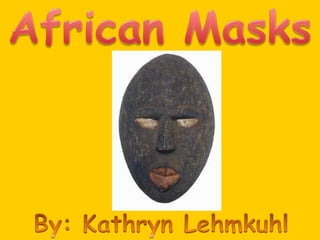
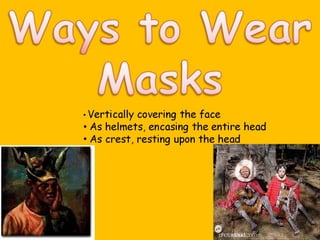
The earliest African masks appeared even before  Paleolithic times. African masks are considered amongst the finest creations in the art world and are highly sought after by art collectors. Throughout time the masks have been used to  differentiate class, religious, and economic statuses. Masks have made by native societies of Africa to honor a  particular king, chief or other authority for centuries. Masks often  represent a spirit and it is strongly believed that the spirit of the ancestors possesses the wearer.
 
 
By secret societies for induction ceremonies At funerals to honor the dead and their spirits To celebrate a child becoming an adult To celebrate the harvest of crops To celebrate the end of a war For any type of gathering
 
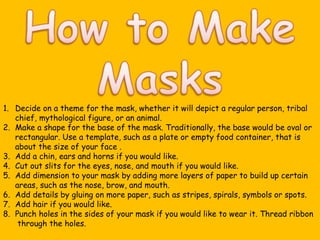
Decide on a theme for the mask, whether it will depict a regular person, tribal chief, mythological figure, or an animal. Make a shape for the base of the mask. Traditionally, the base would be oval or rectangular. Use a template, such as a plate or empty food container, that is about the size of your face . Add a chin, ears and horns if you would like. Cut out slits for the eyes, nose, and mouth if you would like. Add dimension to your mask by adding more layers of paper to build up certain areas, such as the nose, brow, and mouth. Add details by gluing on more paper, such as stripes, spirals, symbols or spots. Add hair if you would like. Punch holes in the sides of your mask if you would like to wear it. Thread ribbon   through the holes.
African masks history and meaning . (2000). Retrieved from  http://www.rebirth.co.za/African_mask_history_and_meaning.htm Nakate, Shashank (2010, February 2).  African masks history . Retrieved from  http://www.buzzle.com/articles/african-masks-history.html The importance of african masks . (2007, November 26). Retrieved from  http://www.african- tribal-art.net/?page_id=2 Wright, Mackenzie. (2011, February 4).  How to make African paper masks . Retrieved from  http://www.ehow.com/how_4856978_make-paper-african-masks.html

Powerpoint

  • 1.
  • 2.
    The earliest Africanmasks appeared even before Paleolithic times. African masks are considered amongst the finest creations in the art world and are highly sought after by art collectors. Throughout time the masks have been used to differentiate class, religious, and economic statuses. Masks have made by native societies of Africa to honor a particular king, chief or other authority for centuries. Masks often represent a spirit and it is strongly believed that the spirit of the ancestors possesses the wearer.
  • 3.
  • 4.
  • 5.
    By secret societiesfor induction ceremonies At funerals to honor the dead and their spirits To celebrate a child becoming an adult To celebrate the harvest of crops To celebrate the end of a war For any type of gathering
  • 6.
  • 7.
    Decide on atheme for the mask, whether it will depict a regular person, tribal chief, mythological figure, or an animal. Make a shape for the base of the mask. Traditionally, the base would be oval or rectangular. Use a template, such as a plate or empty food container, that is about the size of your face . Add a chin, ears and horns if you would like. Cut out slits for the eyes, nose, and mouth if you would like. Add dimension to your mask by adding more layers of paper to build up certain areas, such as the nose, brow, and mouth. Add details by gluing on more paper, such as stripes, spirals, symbols or spots. Add hair if you would like. Punch holes in the sides of your mask if you would like to wear it. Thread ribbon through the holes.
  • 8.
    African masks historyand meaning . (2000). Retrieved from http://www.rebirth.co.za/African_mask_history_and_meaning.htm Nakate, Shashank (2010, February 2). African masks history . Retrieved from http://www.buzzle.com/articles/african-masks-history.html The importance of african masks . (2007, November 26). Retrieved from http://www.african- tribal-art.net/?page_id=2 Wright, Mackenzie. (2011, February 4). How to make African paper masks . Retrieved from http://www.ehow.com/how_4856978_make-paper-african-masks.html