26-1
 Capital Budgeting is the process of making capital
expenditure decisions in business.
 Amount of possible capital expenditures usually exceeds
the funds available for such expenditures.
 Involves choosing among various capital projects to find
the one(s) that will maximize a company’s return on
investment.
LEARNING
OBJECTIVE
Contrast annual rate of return and cash payback
in capital budgeting.
3
LO 3
26-2
Many companies follow a carefully prescribed process in
capital budgeting.
Illustration 26-14
Corporate capital budget
authorization process
Evaluation Process
LO 3
26-3
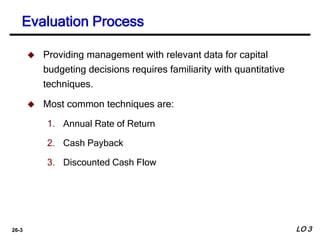
 Providing management with relevant data for capital
budgeting decisions requires familiarity with quantitative
techniques.
 Most common techniques are:
1. Annual Rate of Return
2. Cash Payback
3. Discounted Cash Flow
Evaluation Process
LO 3
26-4
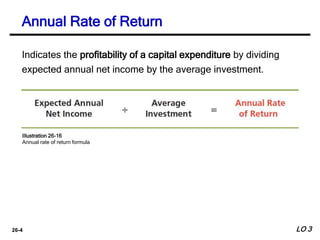
Indicates the profitability of a capital expenditure by dividing
expected annual net income by the average investment.
Annual Rate of Return
Illustration 26-16
Annual rate of return formula
LO 3
26-5
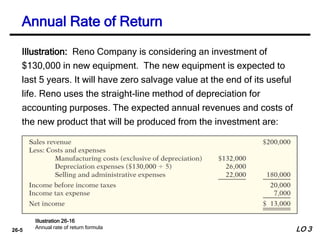
Illustration: Reno Company is considering an investment of
$130,000 in new equipment. The new equipment is expected to
last 5 years. It will have zero salvage value at the end of its useful
life. Reno uses the straight-line method of depreciation for
accounting purposes. The expected annual revenues and costs of
the new product that will be produced from the investment are:
Annual Rate of Return
Illustration 26-16
Annual rate of return formula LO 3
26-6
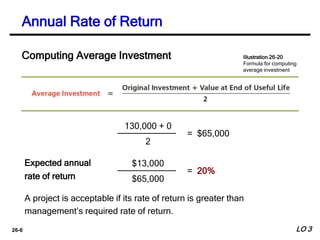
Expected annual
rate of return
Illustration 26-20
Formula for computing
average investment
= $65,000
130,000 + 0
2
$13,000
$65,000
= 20%
A project is acceptable if its rate of return is greater than
management’s required rate of return.
Annual Rate of Return
Computing Average Investment
LO 3
26-7
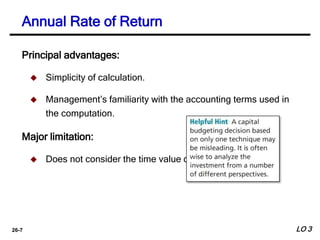
Annual Rate of Return
Principal advantages:
 Simplicity of calculation.
 Management’s familiarity with the accounting terms used in
the computation.
Major limitation:
 Does not consider the time value of money.
LO 3
26-8
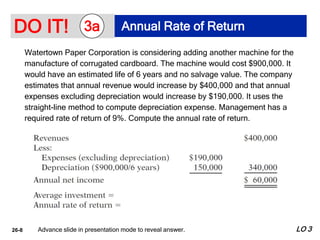
Watertown Paper Corporation is considering adding another machine for the
manufacture of corrugated cardboard. The machine would cost $900,000. It
would have an estimated life of 6 years and no salvage value. The company
estimates that annual revenue would increase by $400,000 and that annual
expenses excluding depreciation would increase by $190,000. It uses the
straight-line method to compute depreciation expense. Management has a
required rate of return of 9%. Compute the annual rate of return.
Advance slide in presentation mode to reveal answer.
DO IT! Annual Rate of Return
3a
LO 3
26-9
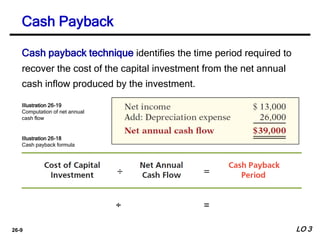
$130,000 ÷ $39,000 = 3.3 years
Cash payback technique identifies the time period required to
recover the cost of the capital investment from the net annual
cash inflow produced by the investment.
Cash Payback
Illustration 26-19
Computation of net annual
cash flow
Illustration 26-18
Cash payback formula
LO 3
26-10
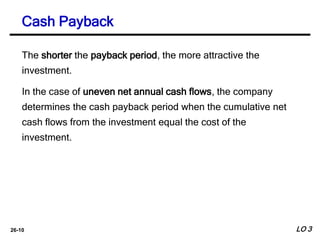
The shorter the payback period, the more attractive the
investment.
In the case of uneven net annual cash flows, the company
determines the cash payback period when the cumulative net
cash flows from the investment equal the cost of the
investment.
Cash Payback
LO 3
26-11
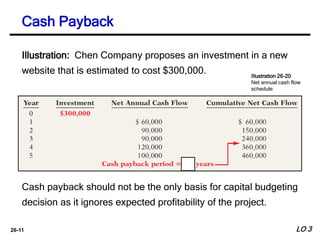
Illustration: Chen Company proposes an investment in a new
website that is estimated to cost $300,000.
Cash payback should not be the only basis for capital budgeting
decision as it ignores expected profitability of the project.
Cash Payback
Illustration 26-20
Net annual cash flow
schedule
LO 3
26-12
Verizon
Can You Hear Me—Better?
What’s better than 3G wireless service? 4G. But the question for
wireless service providers is whether customers will be willing to pay
extra for that improvement. Verizon has spent billions on upgrading
its networks in the past few years, so it now offers 4G LTE service to
97% of the nation. Verizon is hoping that its investment in 4G works
out better than its $23 billion investment in its FIOS fiber-wired
network for TV and ultrahigh-speed Internet. One analyst estimates
that the present value of each FIOS customer is $800 less than the
cost of the connection.
Sources: Martin Peers, “Investors: Beware Verizon’s Generation GAP,” Wall
Street Journal Online (January 26, 2010); and Chad Fraser, “What Warren
Buffett Sees in Verizon,” Investing Daily(May 30, 2014).
Management Insight
LO 3
26-13
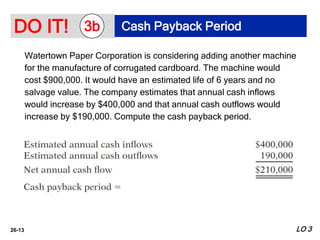
Watertown Paper Corporation is considering adding another machine
for the manufacture of corrugated cardboard. The machine would
cost $900,000. It would have an estimated life of 6 years and no
salvage value. The company estimates that annual cash inflows
would increase by $400,000 and that annual cash outflows would
increase by $190,000. Compute the cash payback period.
DO IT! Cash Payback Period
3b
LO 3
26-14
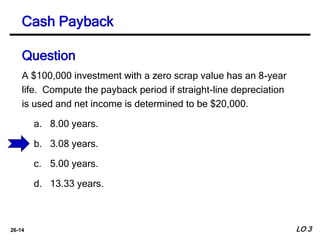
A $100,000 investment with a zero scrap value has an 8-year
life. Compute the payback period if straight-line depreciation
is used and net income is determined to be $20,000.
a. 8.00 years.
b. 3.08 years.
c. 5.00 years.
d. 13.33 years.
Cash Payback
Question
LO 3
26-15
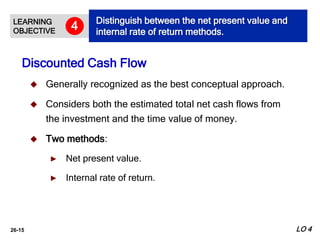
 Generally recognized as the best conceptual approach.
 Considers both the estimated total net cash flows from
the investment and the time value of money.
 Two methods:
► Net present value.
► Internal rate of return.
Discounted Cash Flow
LEARNING
OBJECTIVE
Distinguish between the net present value and
internal rate of return methods.
4
LO 4
26-16
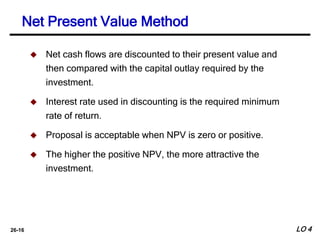
 Net cash flows are discounted to their present value and
then compared with the capital outlay required by the
investment.
 Interest rate used in discounting is the required minimum
rate of return.
 Proposal is acceptable when NPV is zero or positive.
 The higher the positive NPV, the more attractive the
investment.
Net Present Value Method
LO 4
26-17
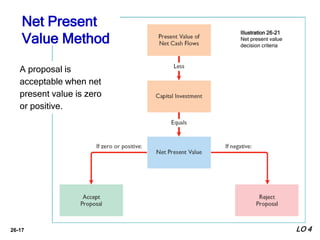
Illustration 26-21
Net present value
decision criteria
Net Present
Value Method
A proposal is
acceptable when net
present value is zero
or positive.
LO 4
26-18
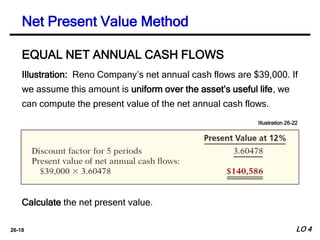
Illustration: Reno Company’s net annual cash flows are $39,000. If
we assume this amount is uniform over the asset’s useful life, we
can compute the present value of the net annual cash flows.
EQUAL NET ANNUAL CASH FLOWS
Illustration 26-22
Calculate the net present value.
Net Present Value Method
LO 4
26-19
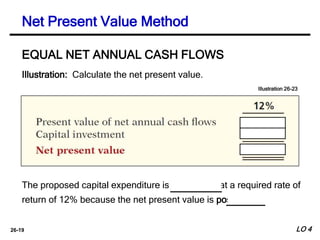
The proposed capital expenditure is acceptable at a required rate of
return of 12% because the net present value is positive.
Illustration: Calculate the net present value.
EQUAL NET ANNUAL CASH FLOWS
Illustration 26-23
Net Present Value Method
LO 4
26-20
Illustration: Reno Company management expects the same
aggregate net annual cash flow ($195,000) over the life of the
investment. But because of a declining market demand for the
new product over the life of the equipment, the net annual cash
flows are higher in the early years and lower in the later years.
UNEQUAL NET ANNUAL CASH FLOWS
Net Present Value Method
LO 4
26-21
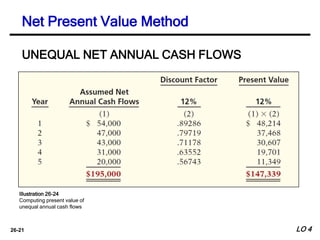
Illustration 26-24
Computing present value of
unequal annual cash flows
UNEQUAL NET ANNUAL CASH FLOWS
Net Present Value Method
LO 4
26-22
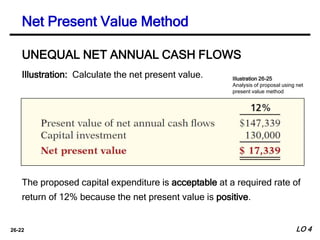
The proposed capital expenditure is acceptable at a required rate of
return of 12% because the net present value is positive.
Illustration: Calculate the net present value.
UNEQUAL NET ANNUAL CASH FLOWS
Illustration 26-25
Analysis of proposal using net
present value method
Net Present Value Method
LO 4
26-23
Sharp
Wide-Screen Capacity
Building a new factory to produce 60-inch TV screens can cost $4
billion. But for more than 10 years, manufacturers of these screens
have continued to build new plants. By building so many plants, they
have expanded productive capacity at a rate that has exceeded the
demand for big-screen TVs. In fact, during one recent year, the
supply of big-screen TVs was estimated to exceed demand by 12%,
rising to 16% in the future. One state-of-the-art plant built by Sharp
was estimated to be operating at only 50% of capacity. Experts say
that the price of big-screen TVs will have to fall much further than
they already have before demand may eventually catch up with
productive capacity.
Source: James Simms, “Sharp’s Payoff Delayed,” Wall Street Journal
Online (September 14, 2010).
Management Insight
LO 4
26-24
 IRR method finds the interest yield of the potential
investment.
 IRR is the rate that will cause the PV of the proposed
capital expenditure to equal the PV of the expected
annual cash inflows.
 Two steps in method:
► Compute the internal rate of return factor.
► Use the factor and the PV of an annuity of 1 table to find
the IRR.
Internal Rate of Return Method
LO 4
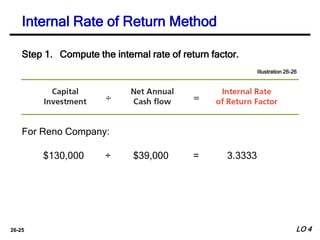
26-25
Step 1. Compute the internal rate of return factor.
Illustration 26-26
For Reno Company:
$130,000 ÷ $39,000 = 3.3333
Internal Rate of Return Method
LO 4
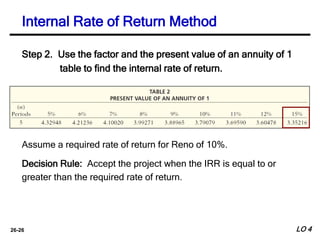
26-26
Step 2. Use the factor and the present value of an annuity of 1
table to find the internal rate of return.
Assume a required rate of return for Reno of 10%.
Decision Rule: Accept the project when the IRR is equal to or
greater than the required rate of return.
Internal Rate of Return Method
LO 4
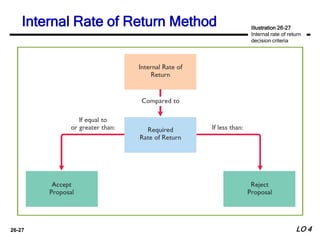
26-27
Internal Rate of Return Method Illustration 26-27
Internal rate of return
decision criteria
LO 4
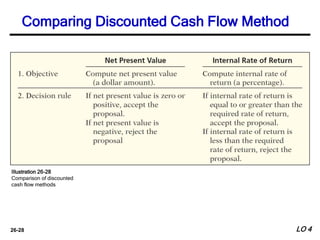
26-28
Comparing Discounted Cash Flow Method
Illustration 26-28
Comparison of discounted
cash flow methods
LO 4
26-29
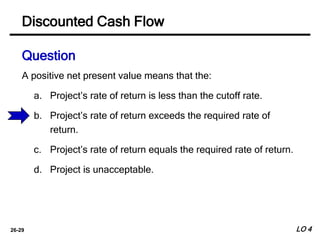
A positive net present value means that the:
a. Project’s rate of return is less than the cutoff rate.
b. Project’s rate of return exceeds the required rate of
return.
c. Project’s rate of return equals the required rate of return.
d. Project is unacceptable.
Discounted Cash Flow
Question
LO 4
26-30
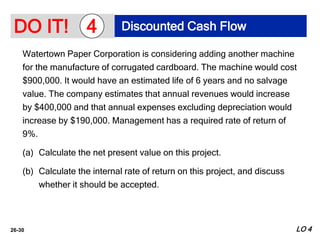
Watertown Paper Corporation is considering adding another machine
for the manufacture of corrugated cardboard. The machine would cost
$900,000. It would have an estimated life of 6 years and no salvage
value. The company estimates that annual revenues would increase
by $400,000 and that annual expenses excluding depreciation would
increase by $190,000. Management has a required rate of return of
9%.
(a) Calculate the net present value on this project.
(b) Calculate the internal rate of return on this project, and discuss
whether it should be accepted.
DO IT! Discounted Cash Flow
4
LO 4
26-31
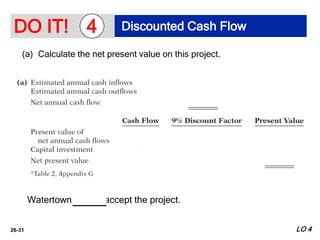
Watertown should accept the project.
(a) Calculate the net present value on this project.
DO IT! Discounted Cash Flow
4
LO 4
26-32
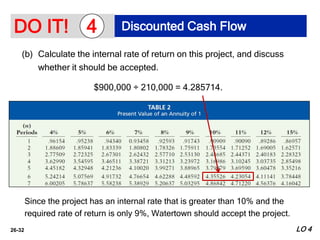
(b) Calculate the internal rate of return on this project, and discuss
whether it should be accepted.
$900,000 ÷ 210,000 = 4.285714.
Since the project has an internal rate that is greater than 10% and the
required rate of return is only 9%, Watertown should accept the project.
DO IT! Discounted Cash Flow
4
LO 4
26-33
“Copyright © 2015 John Wiley & Sons, Inc. All rights reserved.
Reproduction or translation of this work beyond that permitted in
Section 117 of the 1976 United States Copyright Act without the
express written permission of the copyright owner is unlawful. Request
for further information should be addressed to the Permissions
Department, John Wiley & Sons, Inc. The purchaser may make back-
up copies for his/her own use only and not for distribution or resale.
The Publisher assumes no responsibility for errors, omissions, or
damages, caused by the use of these programs or from the use of the
information contained herein.”
Copyright

ARR,Cash payback,NPV,IRR.pptx

  • 1.
    26-1  Capital Budgetingis the process of making capital expenditure decisions in business.  Amount of possible capital expenditures usually exceeds the funds available for such expenditures.  Involves choosing among various capital projects to find the one(s) that will maximize a company’s return on investment. LEARNING OBJECTIVE Contrast annual rate of return and cash payback in capital budgeting. 3 LO 3
  • 2.
    26-2 Many companies followa carefully prescribed process in capital budgeting. Illustration 26-14 Corporate capital budget authorization process Evaluation Process LO 3
  • 3.
    26-3  Providing managementwith relevant data for capital budgeting decisions requires familiarity with quantitative techniques.  Most common techniques are: 1. Annual Rate of Return 2. Cash Payback 3. Discounted Cash Flow Evaluation Process LO 3
  • 4.
    26-4 Indicates the profitabilityof a capital expenditure by dividing expected annual net income by the average investment. Annual Rate of Return Illustration 26-16 Annual rate of return formula LO 3
  • 5.
    26-5 Illustration: Reno Companyis considering an investment of $130,000 in new equipment. The new equipment is expected to last 5 years. It will have zero salvage value at the end of its useful life. Reno uses the straight-line method of depreciation for accounting purposes. The expected annual revenues and costs of the new product that will be produced from the investment are: Annual Rate of Return Illustration 26-16 Annual rate of return formula LO 3
  • 6.
    26-6 Expected annual rate ofreturn Illustration 26-20 Formula for computing average investment = $65,000 130,000 + 0 2 $13,000 $65,000 = 20% A project is acceptable if its rate of return is greater than management’s required rate of return. Annual Rate of Return Computing Average Investment LO 3
  • 7.
    26-7 Annual Rate ofReturn Principal advantages:  Simplicity of calculation.  Management’s familiarity with the accounting terms used in the computation. Major limitation:  Does not consider the time value of money. LO 3
  • 8.
    26-8 Watertown Paper Corporationis considering adding another machine for the manufacture of corrugated cardboard. The machine would cost $900,000. It would have an estimated life of 6 years and no salvage value. The company estimates that annual revenue would increase by $400,000 and that annual expenses excluding depreciation would increase by $190,000. It uses the straight-line method to compute depreciation expense. Management has a required rate of return of 9%. Compute the annual rate of return. Advance slide in presentation mode to reveal answer. DO IT! Annual Rate of Return 3a LO 3
  • 9.
    26-9 $130,000 ÷ $39,000= 3.3 years Cash payback technique identifies the time period required to recover the cost of the capital investment from the net annual cash inflow produced by the investment. Cash Payback Illustration 26-19 Computation of net annual cash flow Illustration 26-18 Cash payback formula LO 3
  • 10.
    26-10 The shorter thepayback period, the more attractive the investment. In the case of uneven net annual cash flows, the company determines the cash payback period when the cumulative net cash flows from the investment equal the cost of the investment. Cash Payback LO 3
  • 11.
    26-11 Illustration: Chen Companyproposes an investment in a new website that is estimated to cost $300,000. Cash payback should not be the only basis for capital budgeting decision as it ignores expected profitability of the project. Cash Payback Illustration 26-20 Net annual cash flow schedule LO 3
  • 12.
    26-12 Verizon Can You HearMe—Better? What’s better than 3G wireless service? 4G. But the question for wireless service providers is whether customers will be willing to pay extra for that improvement. Verizon has spent billions on upgrading its networks in the past few years, so it now offers 4G LTE service to 97% of the nation. Verizon is hoping that its investment in 4G works out better than its $23 billion investment in its FIOS fiber-wired network for TV and ultrahigh-speed Internet. One analyst estimates that the present value of each FIOS customer is $800 less than the cost of the connection. Sources: Martin Peers, “Investors: Beware Verizon’s Generation GAP,” Wall Street Journal Online (January 26, 2010); and Chad Fraser, “What Warren Buffett Sees in Verizon,” Investing Daily(May 30, 2014). Management Insight LO 3
  • 13.
    26-13 Watertown Paper Corporationis considering adding another machine for the manufacture of corrugated cardboard. The machine would cost $900,000. It would have an estimated life of 6 years and no salvage value. The company estimates that annual cash inflows would increase by $400,000 and that annual cash outflows would increase by $190,000. Compute the cash payback period. DO IT! Cash Payback Period 3b LO 3
  • 14.
    26-14 A $100,000 investmentwith a zero scrap value has an 8-year life. Compute the payback period if straight-line depreciation is used and net income is determined to be $20,000. a. 8.00 years. b. 3.08 years. c. 5.00 years. d. 13.33 years. Cash Payback Question LO 3
  • 15.
    26-15  Generally recognizedas the best conceptual approach.  Considers both the estimated total net cash flows from the investment and the time value of money.  Two methods: ► Net present value. ► Internal rate of return. Discounted Cash Flow LEARNING OBJECTIVE Distinguish between the net present value and internal rate of return methods. 4 LO 4
  • 16.
    26-16  Net cashflows are discounted to their present value and then compared with the capital outlay required by the investment.  Interest rate used in discounting is the required minimum rate of return.  Proposal is acceptable when NPV is zero or positive.  The higher the positive NPV, the more attractive the investment. Net Present Value Method LO 4
  • 17.
    26-17 Illustration 26-21 Net presentvalue decision criteria Net Present Value Method A proposal is acceptable when net present value is zero or positive. LO 4
  • 18.
    26-18 Illustration: Reno Company’snet annual cash flows are $39,000. If we assume this amount is uniform over the asset’s useful life, we can compute the present value of the net annual cash flows. EQUAL NET ANNUAL CASH FLOWS Illustration 26-22 Calculate the net present value. Net Present Value Method LO 4
  • 19.
    26-19 The proposed capitalexpenditure is acceptable at a required rate of return of 12% because the net present value is positive. Illustration: Calculate the net present value. EQUAL NET ANNUAL CASH FLOWS Illustration 26-23 Net Present Value Method LO 4
  • 20.
    26-20 Illustration: Reno Companymanagement expects the same aggregate net annual cash flow ($195,000) over the life of the investment. But because of a declining market demand for the new product over the life of the equipment, the net annual cash flows are higher in the early years and lower in the later years. UNEQUAL NET ANNUAL CASH FLOWS Net Present Value Method LO 4
  • 21.
    26-21 Illustration 26-24 Computing presentvalue of unequal annual cash flows UNEQUAL NET ANNUAL CASH FLOWS Net Present Value Method LO 4
  • 22.
    26-22 The proposed capitalexpenditure is acceptable at a required rate of return of 12% because the net present value is positive. Illustration: Calculate the net present value. UNEQUAL NET ANNUAL CASH FLOWS Illustration 26-25 Analysis of proposal using net present value method Net Present Value Method LO 4
  • 23.
    26-23 Sharp Wide-Screen Capacity Building anew factory to produce 60-inch TV screens can cost $4 billion. But for more than 10 years, manufacturers of these screens have continued to build new plants. By building so many plants, they have expanded productive capacity at a rate that has exceeded the demand for big-screen TVs. In fact, during one recent year, the supply of big-screen TVs was estimated to exceed demand by 12%, rising to 16% in the future. One state-of-the-art plant built by Sharp was estimated to be operating at only 50% of capacity. Experts say that the price of big-screen TVs will have to fall much further than they already have before demand may eventually catch up with productive capacity. Source: James Simms, “Sharp’s Payoff Delayed,” Wall Street Journal Online (September 14, 2010). Management Insight LO 4
  • 24.
    26-24  IRR methodfinds the interest yield of the potential investment.  IRR is the rate that will cause the PV of the proposed capital expenditure to equal the PV of the expected annual cash inflows.  Two steps in method: ► Compute the internal rate of return factor. ► Use the factor and the PV of an annuity of 1 table to find the IRR. Internal Rate of Return Method LO 4
  • 25.
    26-25 Step 1. Computethe internal rate of return factor. Illustration 26-26 For Reno Company: $130,000 ÷ $39,000 = 3.3333 Internal Rate of Return Method LO 4
  • 26.
    26-26 Step 2. Usethe factor and the present value of an annuity of 1 table to find the internal rate of return. Assume a required rate of return for Reno of 10%. Decision Rule: Accept the project when the IRR is equal to or greater than the required rate of return. Internal Rate of Return Method LO 4
  • 27.
    26-27 Internal Rate ofReturn Method Illustration 26-27 Internal rate of return decision criteria LO 4
  • 28.
    26-28 Comparing Discounted CashFlow Method Illustration 26-28 Comparison of discounted cash flow methods LO 4
  • 29.
    26-29 A positive netpresent value means that the: a. Project’s rate of return is less than the cutoff rate. b. Project’s rate of return exceeds the required rate of return. c. Project’s rate of return equals the required rate of return. d. Project is unacceptable. Discounted Cash Flow Question LO 4
  • 30.
    26-30 Watertown Paper Corporationis considering adding another machine for the manufacture of corrugated cardboard. The machine would cost $900,000. It would have an estimated life of 6 years and no salvage value. The company estimates that annual revenues would increase by $400,000 and that annual expenses excluding depreciation would increase by $190,000. Management has a required rate of return of 9%. (a) Calculate the net present value on this project. (b) Calculate the internal rate of return on this project, and discuss whether it should be accepted. DO IT! Discounted Cash Flow 4 LO 4
  • 31.
    26-31 Watertown should acceptthe project. (a) Calculate the net present value on this project. DO IT! Discounted Cash Flow 4 LO 4
  • 32.
    26-32 (b) Calculate theinternal rate of return on this project, and discuss whether it should be accepted. $900,000 ÷ 210,000 = 4.285714. Since the project has an internal rate that is greater than 10% and the required rate of return is only 9%, Watertown should accept the project. DO IT! Discounted Cash Flow 4 LO 4
  • 33.
    26-33 “Copyright © 2015John Wiley & Sons, Inc. All rights reserved. Reproduction or translation of this work beyond that permitted in Section 117 of the 1976 United States Copyright Act without the express written permission of the copyright owner is unlawful. Request for further information should be addressed to the Permissions Department, John Wiley & Sons, Inc. The purchaser may make back- up copies for his/her own use only and not for distribution or resale. The Publisher assumes no responsibility for errors, omissions, or damages, caused by the use of these programs or from the use of the information contained herein.” Copyright