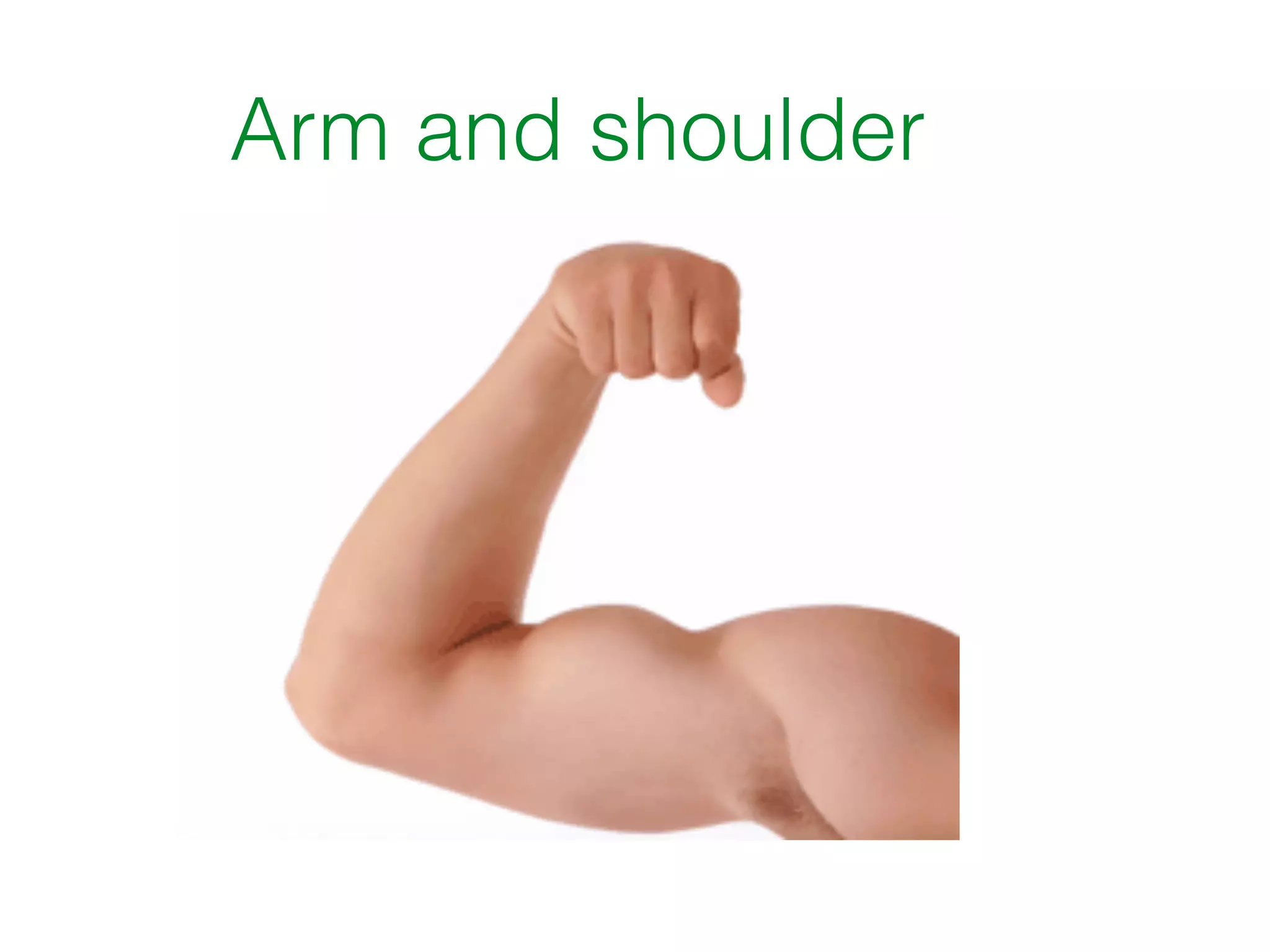
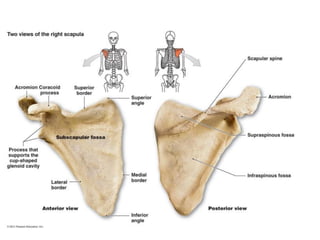
Arm and shoulder
Bones of the upper arm
!
• Humerus !
!
• Ulna!
!
• Radius!
!
• Carpals!
!
• Metacarpals!
!
• Phalanges
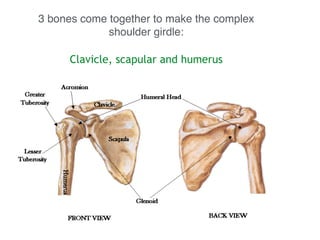
3 bones come together to make the complex
shoulder girdle:
!
Clavicle, scapular and humerus !
!
Movements of the shoulder….!
!
• Flexion/extension
!
• Abduction/adduction
!
• Internal/external rotation
!
Clavicle!
!
•Elevation/Depression
!
•Protraction/Retraction
!
•Rotation
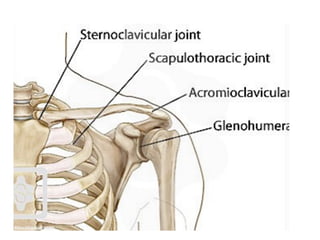
Joints of the shoulder girdle
• Sternoclavicular joint
!
• Acromioclavicular joint
!
• Glenohumeral joint
!
• Scapulothoracic ‘joint’
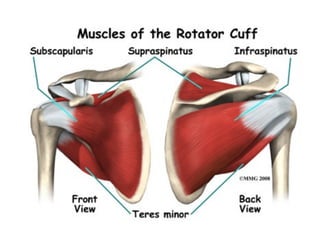
Rotator cuff muscles - SITS !
!
!
•Supraspinatus - initiates abduction
!
•Infraspinatus - external rotation
!
•Teres minor - external rotation
!
•Subscapularis - internal rotation (lives
underneath the scapula)
The rotator cuff is a group of tendons and
muscles in the shoulder, connecting the upper
arm (humerus) to the shoulder blade (scapula)
!
The rotator cuff tendons provide stability to the
shoulder; the muscles allow the shoulder to
rotate.
• Unfortunately, it’s not uncommon for the muscles of the rotator cuff
to be underworked and therefore weak.
• This weakness can lead not only to impingement syndrome but
also to tears in the rotator cuff muscles themselves
• These tears are painful and can severely limit your ability to move
your arm.
• Rotator cuff tears can occur during vigorous shoulder activities for
which you’re not conditioned
• Mild to moderate rotator cuff tears can be treated conservatively
with medication and carefully selected exercise, while more severe
tears may require surgery.
• Its better to build and maintain the strength of the rotator cuff
muscles to prevent these problems in the first place.
• Practicing yoga can help build rotator strength
Impingement
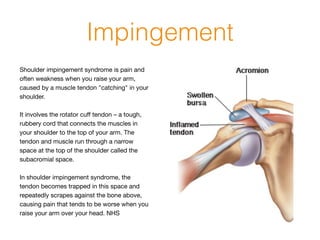
Shoulder impingement syndrome is pain and
often weakness when you raise your arm,
caused by a muscle tendon "catching" in your
shoulder.

!
It involves the rotator cuff tendon – a tough,
rubbery cord that connects the muscles in
your shoulder to the top of your arm. The
tendon and muscle run through a narrow
space at the top of the shoulder called the
subacromial space.

!
In shoulder impingement syndrome, the
tendon becomes trapped in this space and
repeatedly scrapes against the bone above,
causing pain that tends to be worse when you
raise your arm over your head. NHS
Tears
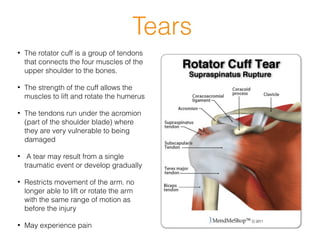
• The rotator cuff is a group of tendons
that connects the four muscles of the
upper shoulder to the bones.
• The strength of the cuff allows the
muscles to lift and rotate the humerus
• The tendons run under the acromion
(part of the shoulder blade) where
they are very vulnerable to being
damaged
• A tear may result from a single
traumatic event or develop gradually
• Restricts movement of the arm. no
longer able to lift or rotate the arm
with the same range of motion as
before the injury
• May experience pain
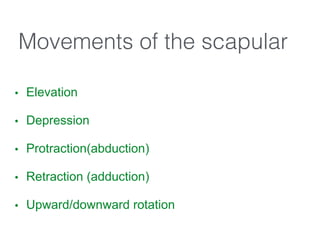
Movements of the scapular
• Elevation
!
• Depression
!
• Protraction(abduction)
!
• Retraction (adduction)
!
• Upward/downward rotation
Hip vs shoulder
• Hip girdle - 2 bones
• Shoulder girdle - 3 bones
• Hip - ball and socket joint allows for 6 movements of the femur
• Shoulder - Ball and socket allows for a massive rage of motion
• Hip - Is supported by thick, strong, wide bands of connective
tissue
• Shoulder - thin and strappy ligaments - yet still strong
• Hip - Joint was built to be a foundation and support
• Shoulder - joint was built to be Mobile
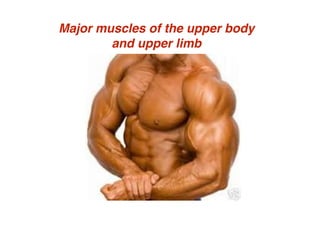
Major muscles of the upper body
and upper limb
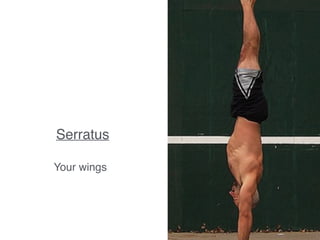
Serratus
Your wings
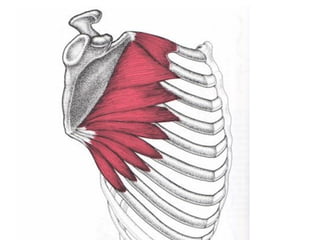
Serratus anterior!
!
!
!
• Origin - T1 - T9!
!
• Insertion - medial border of scapula!
!
• Action - protraction and upward rotation of the
scapula, and stabilisation of the scapular!
!
• The serratus anterior muscles - “wings.”
• They help us move our arms multi-dimensionally and with great
speed.
• When the serratus anterior is flexed, it appears to lengthen the
arm by wrapping the scapula forward toward the chest.
• Serratus anterior muscles are also known as the “boxer’s muscles”
A boxer’s punch and reach come from the effectiveness of the
scapula protracting and retracting.
• Because the serratus stabilises the positioning of the arm and
shoulder, this muscle is important for inversions and arm balances
• When the serratus anterior muscles are weak, they contribute to
neck problems and rotator cuff issues amongst others things…
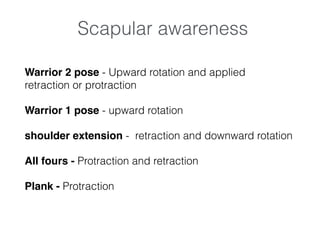
Scapular awareness
Warrior 2 pose - Upward rotation and applied
retraction or protraction
Warrior 1 pose - upward rotation
shoulder extension - retraction and downward rotation
All fours - Protraction and retraction!
Plank - Protraction
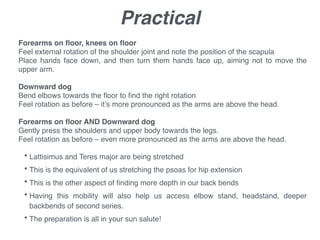
Practical
!
Forearms on floor, knees on floor!
Feel external rotation of the shoulder joint and note the position of the scapula!
Place hands face down, and then turn them hands face up, aiming not to move the
upper arm.!
!
Downward dog!
Bend elbows towards the floor to find the right rotation!
Feel rotation as before – it’s more pronounced as the arms are above the head.!
!
Forearms on floor AND Downward dog!
Gently press the shoulders and upper body towards the legs.!
Feel rotation as before – even more pronounced as the arms are above the head.!
!
• Lattisimus and Teres major are being stretched !
• This is the equivalent of us stretching the psoas for hip extension!
• This is the other aspect of finding more depth in our back bends!
• Having this mobility will also help us access elbow stand, headstand, deeper
backbends of second series.!
• The preparation is all in your sun salute!
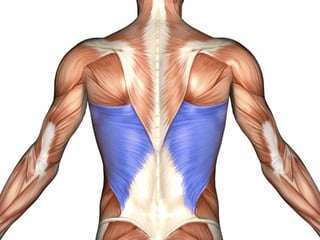
Latissimus dorsi!
!
!
•Origin - spinous processes T6 - T12!
!
•Insertion - lesser tubercle of humerus!
!
•Action - extension of humerus, adduction and
internal rotation of humerus!
!
!
The swimmers muscle
• Latissimus dorsi means “widest back muscle” in Latin
Contraction of the Lats is responsible for creating the movements of:!
• Adducting the arm
• rotating the arm
• Extending the arm at the shoulder joint
• Pulling the scapula down the back towards the hips
• Pulling the scapula away from the spine
• Tight lats also make it virtually impossible for your students to move
their arms fully into backbends like Urdhva Dhanurasana
• What’s more, the same tightness keeps your students from positioning
their arms and shoulders properly in Handstand
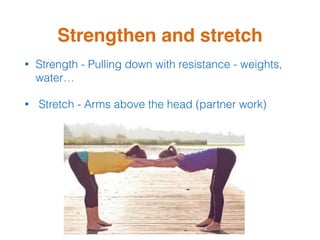
Strengthen and stretch
• Strength - Pulling down with resistance - weights,
water…
• Stretch - Arms above the head (partner work)
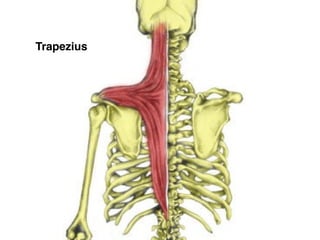
Trapezius
Upper fibres, middle and lower fibres!
• Upper fibres elevate and upwardly rotate the
scapular. Extend and rotate the neck!
!
• Middle fibres retract (adduct), elevate and upwardly
rotate the scapular!
!
• Lower fibres upwardly rotate, depress and retract
(adduct) scapular. They also extend the spine!
Upper fibres!
• O = Skull I = Clavicle
Middle fibres !
• O = Cervical Vertebrae (C7)Thoracic
Vertebrae (T1-3) I = Scapula (spine, superior)
Lower fibres!
• O= Thoracic Vertebrae (T4-12) I = Scapula
(spine, Inferior Medial)
Strengthen and stretch
• Strengthen the upper fibres - Shrug the shoulders with
weights
• Strengthen middle/lower - Resistance band
• Release tension - roll shoulders - squeeze sequentially
down
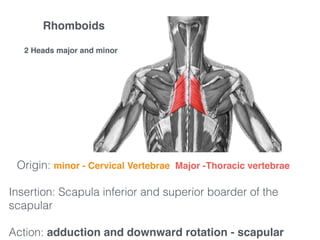
Origin: minor - Cervical Vertebrae Major -Thoracic vertebrae!
!
Insertion: Scapula inferior and superior boarder of the
scapular
!
Action: adduction and downward rotation - scapular
Rhomboids!
!
2 Heads major and minor
Strengthen and stretch
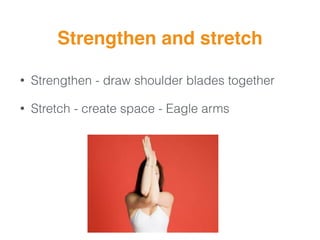
• Strengthen - draw shoulder blades together
• Stretch - create space - Eagle arms
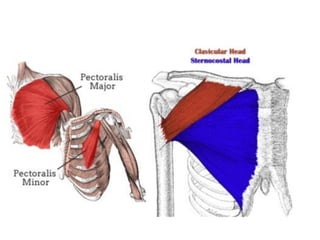
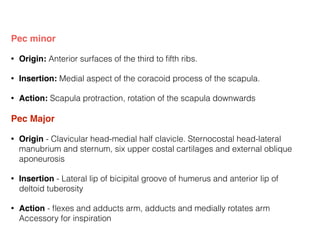
Pec minor!
• Origin: Anterior surfaces of the third to fifth ribs.
• Insertion: Medial aspect of the coracoid process of the scapula.
• Action: Scapula protraction, rotation of the scapula downwards
Pec Major!
• Origin - Clavicular head-medial half clavicle. Sternocostal head-lateral
manubrium and sternum, six upper costal cartilages and external oblique
aponeurosis
• Insertion - Lateral lip of bicipital groove of humerus and anterior lip of
deltoid tuberosity
• Action - flexes and adducts arm, adducts and medially rotates arm
Accessory for inspiration
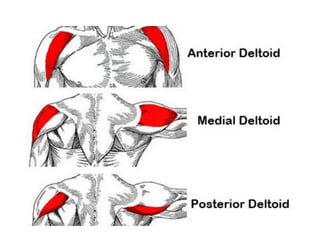
Anterior!
Shoulder - Abduction, Flexion, Internal
Rotation
Lateral!
Shoulder - Abduction, Flexion, Abduction
Posterior!
Shoulder - Extension,Transverse,
Abduction, External Rotation
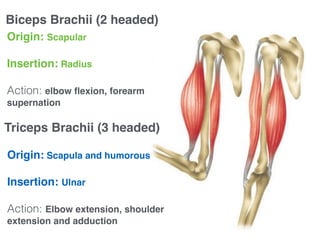
Origin: Scapular!
!
Insertion: Radius!
!
Action: elbow flexion, forearm
supernation !
Origin: Scapula and humorous!
!
Insertion: Ulnar!
!
Action: Elbow extension, shoulder
extension and adduction!
Biceps Brachii (2 headed)
Triceps Brachii (3 headed)
Movement of the forearm!
• Supination and Pronation
Movements of the wrist!
• Flexion, Extension, Abduction and Adduction
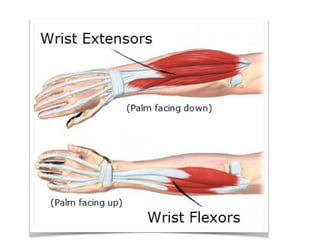
Muscles of the forearm!
• Extensors and flexors
!
!
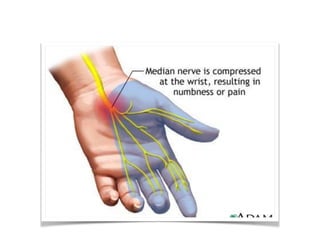
Carpal tunnel syndrome!
!
Carpal tunnel syndrome is a condition in which the median nerve is
squeezed where it passes through the wrist.
!
The median nerve controls some of the muscles that move the
thumb it also carries information back to the brain about
sensations in your thumb and fingers
!
When the nerve is squeezed it can cause pain or aching, tingling
or numbness in the affected hand
!
Stretch, yoga and massage MIGHT help
!
Pressure on that area is a definite NO
Use a wedge to transfer weight more through the knuckles
Modify?
• Forearm dog
• Forearm plank
• Shoulder and neck stretches may eleviate tension
• Gentle wrist stretches
Review
• Bones of the arm
• Bones of the shoulder girdle
• Movements of the shoulder
• SITS - rotator cuff
• Muscles of the upper body and upper limb
• Injury

Arm+shoulder anatomy***

  • 1.
  • 2.
    Bones of theupper arm ! • Humerus ! ! • Ulna! ! • Radius! ! • Carpals! ! • Metacarpals! ! • Phalanges
  • 3.
    3 bones cometogether to make the complex shoulder girdle: ! Clavicle, scapular and humerus ! !
  • 4.
    Movements of theshoulder….! ! • Flexion/extension ! • Abduction/adduction ! • Internal/external rotation ! Clavicle! ! •Elevation/Depression ! •Protraction/Retraction ! •Rotation
  • 5.
    Joints of theshoulder girdle • Sternoclavicular joint ! • Acromioclavicular joint ! • Glenohumeral joint ! • Scapulothoracic ‘joint’
  • 7.
    Rotator cuff muscles- SITS ! ! ! •Supraspinatus - initiates abduction ! •Infraspinatus - external rotation ! •Teres minor - external rotation ! •Subscapularis - internal rotation (lives underneath the scapula)
  • 9.
    The rotator cuffis a group of tendons and muscles in the shoulder, connecting the upper arm (humerus) to the shoulder blade (scapula) ! The rotator cuff tendons provide stability to the shoulder; the muscles allow the shoulder to rotate.
  • 10.
    • Unfortunately, it’snot uncommon for the muscles of the rotator cuff to be underworked and therefore weak. • This weakness can lead not only to impingement syndrome but also to tears in the rotator cuff muscles themselves • These tears are painful and can severely limit your ability to move your arm. • Rotator cuff tears can occur during vigorous shoulder activities for which you’re not conditioned • Mild to moderate rotator cuff tears can be treated conservatively with medication and carefully selected exercise, while more severe tears may require surgery. • Its better to build and maintain the strength of the rotator cuff muscles to prevent these problems in the first place. • Practicing yoga can help build rotator strength
  • 11.
    Impingement Shoulder impingement syndromeis pain and often weakness when you raise your arm, caused by a muscle tendon "catching" in your shoulder. ! It involves the rotator cuff tendon – a tough, rubbery cord that connects the muscles in your shoulder to the top of your arm. The tendon and muscle run through a narrow space at the top of the shoulder called the subacromial space. ! In shoulder impingement syndrome, the tendon becomes trapped in this space and repeatedly scrapes against the bone above, causing pain that tends to be worse when you raise your arm over your head. NHS
  • 12.
    Tears • The rotatorcuff is a group of tendons that connects the four muscles of the upper shoulder to the bones. • The strength of the cuff allows the muscles to lift and rotate the humerus • The tendons run under the acromion (part of the shoulder blade) where they are very vulnerable to being damaged • A tear may result from a single traumatic event or develop gradually • Restricts movement of the arm. no longer able to lift or rotate the arm with the same range of motion as before the injury • May experience pain
  • 14.
    Movements of thescapular • Elevation ! • Depression ! • Protraction(abduction) ! • Retraction (adduction) ! • Upward/downward rotation
  • 15.
    Hip vs shoulder •Hip girdle - 2 bones • Shoulder girdle - 3 bones • Hip - ball and socket joint allows for 6 movements of the femur • Shoulder - Ball and socket allows for a massive rage of motion • Hip - Is supported by thick, strong, wide bands of connective tissue • Shoulder - thin and strappy ligaments - yet still strong • Hip - Joint was built to be a foundation and support • Shoulder - joint was built to be Mobile
  • 16.
    Major muscles ofthe upper body and upper limb
  • 17.
  • 18.
    Serratus anterior! ! ! ! • Origin- T1 - T9! ! • Insertion - medial border of scapula! ! • Action - protraction and upward rotation of the scapula, and stabilisation of the scapular! !
  • 20.
    • The serratusanterior muscles - “wings.” • They help us move our arms multi-dimensionally and with great speed. • When the serratus anterior is flexed, it appears to lengthen the arm by wrapping the scapula forward toward the chest. • Serratus anterior muscles are also known as the “boxer’s muscles” A boxer’s punch and reach come from the effectiveness of the scapula protracting and retracting. • Because the serratus stabilises the positioning of the arm and shoulder, this muscle is important for inversions and arm balances • When the serratus anterior muscles are weak, they contribute to neck problems and rotator cuff issues amongst others things…
  • 21.
    Scapular awareness Warrior 2pose - Upward rotation and applied retraction or protraction Warrior 1 pose - upward rotation shoulder extension - retraction and downward rotation All fours - Protraction and retraction! Plank - Protraction
  • 22.
    Practical ! Forearms on floor,knees on floor! Feel external rotation of the shoulder joint and note the position of the scapula! Place hands face down, and then turn them hands face up, aiming not to move the upper arm.! ! Downward dog! Bend elbows towards the floor to find the right rotation! Feel rotation as before – it’s more pronounced as the arms are above the head.! ! Forearms on floor AND Downward dog! Gently press the shoulders and upper body towards the legs.! Feel rotation as before – even more pronounced as the arms are above the head.! ! • Lattisimus and Teres major are being stretched ! • This is the equivalent of us stretching the psoas for hip extension! • This is the other aspect of finding more depth in our back bends! • Having this mobility will also help us access elbow stand, headstand, deeper backbends of second series.! • The preparation is all in your sun salute!
  • 23.
    Latissimus dorsi! ! ! •Origin -spinous processes T6 - T12! ! •Insertion - lesser tubercle of humerus! ! •Action - extension of humerus, adduction and internal rotation of humerus! ! ! The swimmers muscle
  • 25.
    • Latissimus dorsimeans “widest back muscle” in Latin Contraction of the Lats is responsible for creating the movements of:! • Adducting the arm • rotating the arm • Extending the arm at the shoulder joint • Pulling the scapula down the back towards the hips • Pulling the scapula away from the spine • Tight lats also make it virtually impossible for your students to move their arms fully into backbends like Urdhva Dhanurasana • What’s more, the same tightness keeps your students from positioning their arms and shoulders properly in Handstand
  • 26.
    Strengthen and stretch •Strength - Pulling down with resistance - weights, water… • Stretch - Arms above the head (partner work)
  • 27.
  • 28.
    Upper fibres, middleand lower fibres! • Upper fibres elevate and upwardly rotate the scapular. Extend and rotate the neck! ! • Middle fibres retract (adduct), elevate and upwardly rotate the scapular! ! • Lower fibres upwardly rotate, depress and retract (adduct) scapular. They also extend the spine!
  • 29.
    Upper fibres! • O= Skull I = Clavicle Middle fibres ! • O = Cervical Vertebrae (C7)Thoracic Vertebrae (T1-3) I = Scapula (spine, superior) Lower fibres! • O= Thoracic Vertebrae (T4-12) I = Scapula (spine, Inferior Medial)
  • 30.
    Strengthen and stretch •Strengthen the upper fibres - Shrug the shoulders with weights • Strengthen middle/lower - Resistance band • Release tension - roll shoulders - squeeze sequentially down
  • 31.
    Origin: minor -Cervical Vertebrae Major -Thoracic vertebrae! ! Insertion: Scapula inferior and superior boarder of the scapular ! Action: adduction and downward rotation - scapular Rhomboids! ! 2 Heads major and minor
  • 32.
    Strengthen and stretch •Strengthen - draw shoulder blades together • Stretch - create space - Eagle arms
  • 34.
    Pec minor! • Origin:Anterior surfaces of the third to fifth ribs. • Insertion: Medial aspect of the coracoid process of the scapula. • Action: Scapula protraction, rotation of the scapula downwards Pec Major! • Origin - Clavicular head-medial half clavicle. Sternocostal head-lateral manubrium and sternum, six upper costal cartilages and external oblique aponeurosis • Insertion - Lateral lip of bicipital groove of humerus and anterior lip of deltoid tuberosity • Action - flexes and adducts arm, adducts and medially rotates arm Accessory for inspiration
  • 36.
    Anterior! Shoulder - Abduction,Flexion, Internal Rotation Lateral! Shoulder - Abduction, Flexion, Abduction Posterior! Shoulder - Extension,Transverse, Abduction, External Rotation
  • 37.
    Origin: Scapular! ! Insertion: Radius! ! Action:elbow flexion, forearm supernation ! Origin: Scapula and humorous! ! Insertion: Ulnar! ! Action: Elbow extension, shoulder extension and adduction! Biceps Brachii (2 headed) Triceps Brachii (3 headed)
  • 38.
    Movement of theforearm! • Supination and Pronation Movements of the wrist! • Flexion, Extension, Abduction and Adduction Muscles of the forearm! • Extensors and flexors ! !
  • 40.
    Carpal tunnel syndrome! ! Carpaltunnel syndrome is a condition in which the median nerve is squeezed where it passes through the wrist. ! The median nerve controls some of the muscles that move the thumb it also carries information back to the brain about sensations in your thumb and fingers ! When the nerve is squeezed it can cause pain or aching, tingling or numbness in the affected hand ! Stretch, yoga and massage MIGHT help ! Pressure on that area is a definite NO Use a wedge to transfer weight more through the knuckles
  • 42.
    Modify? • Forearm dog •Forearm plank • Shoulder and neck stretches may eleviate tension • Gentle wrist stretches
  • 43.
    Review • Bones ofthe arm • Bones of the shoulder girdle • Movements of the shoulder • SITS - rotator cuff • Muscles of the upper body and upper limb • Injury