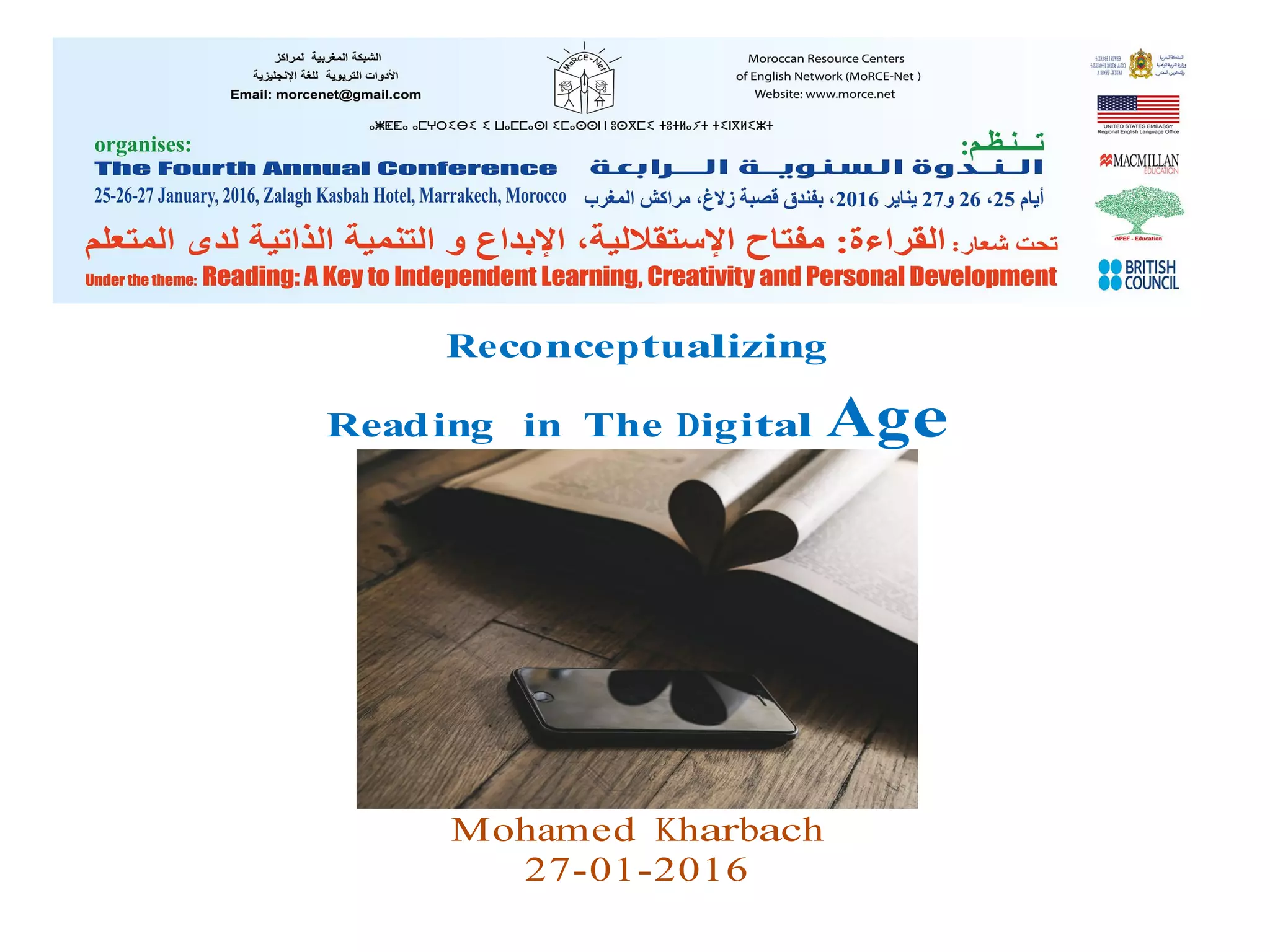
Reconceptualizing
Reading in The Digital Age
Mohamed Kharbach
27-01-2016
What is reading?
Literacy practice
‘Literacy practices are the general cultural ways of
utilizing written language which people draw upon in their
lives. In the simplest sense literacy practices are what people do
with literacy.’ (Barton, Hamilton & Ivanic, 2002, KL. 423)
1- Is reading in the digital age
different from reading in previous
ages? If so, why is it different?
!
2- What are some of its implications
for us as teachers and educators?
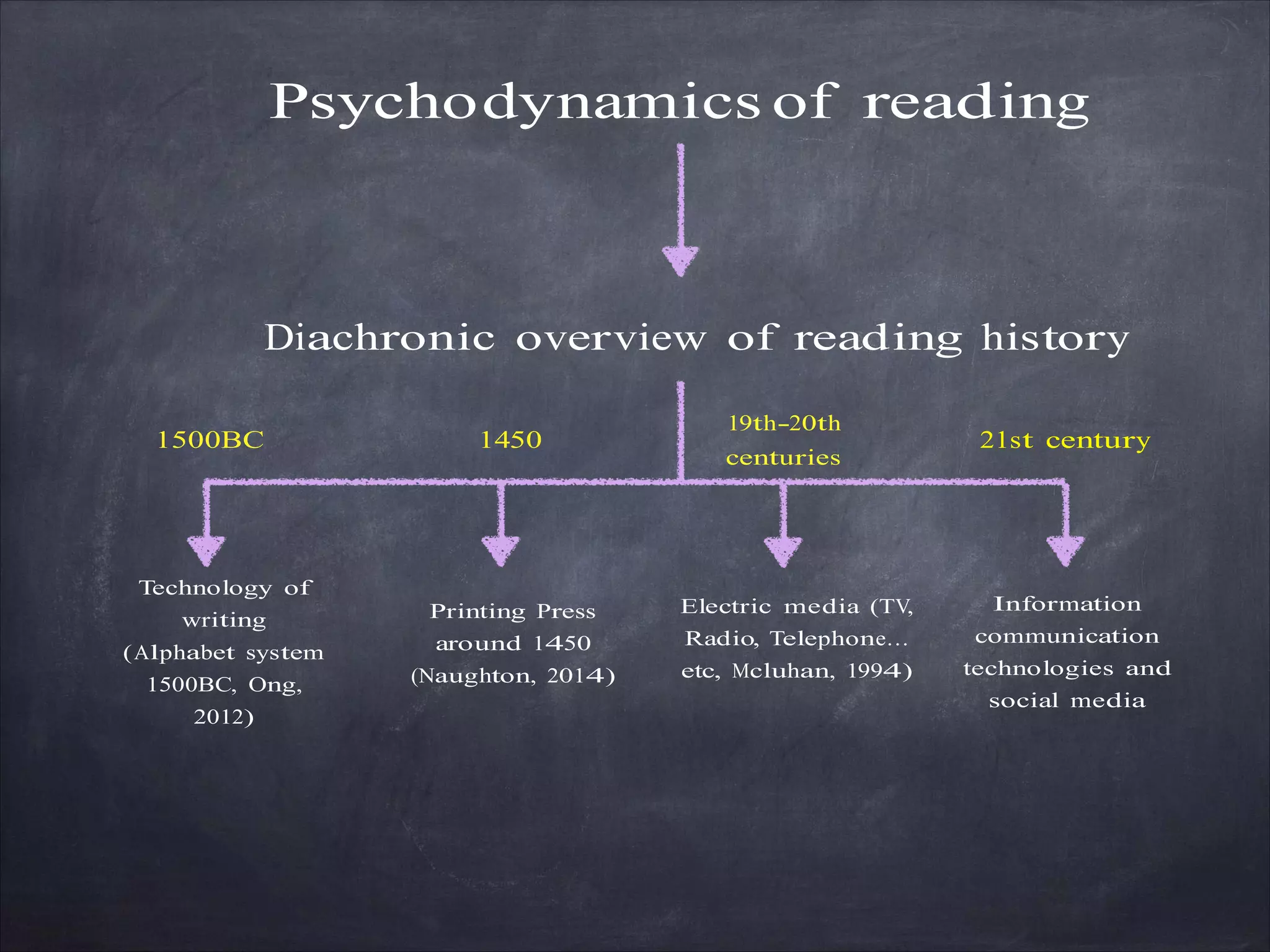
Psychodynamics of reading
Diachronic overview of reading history
19th-20th
1500BC 1450 21st century
centuries
Technology of
writing
(Alphabet system
1500BC, Ong,
2012)
Printing Press
around 1450
(Naughton, 2014)
Electric media (TV,
Radio, Telephone…
etc, Mcluhan, 1994)
Information
communication
technologies and
social media
1- Technology of Writing
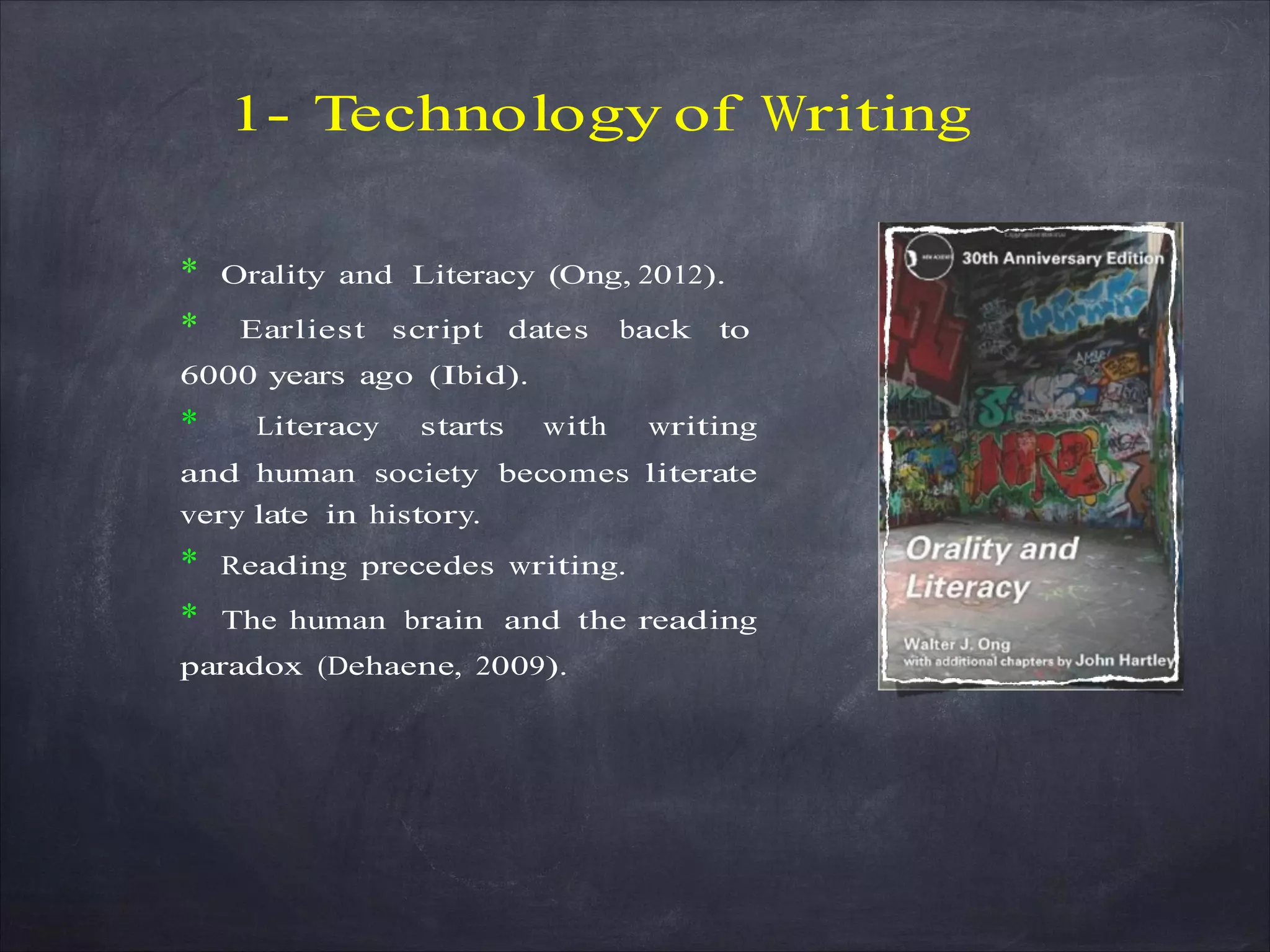
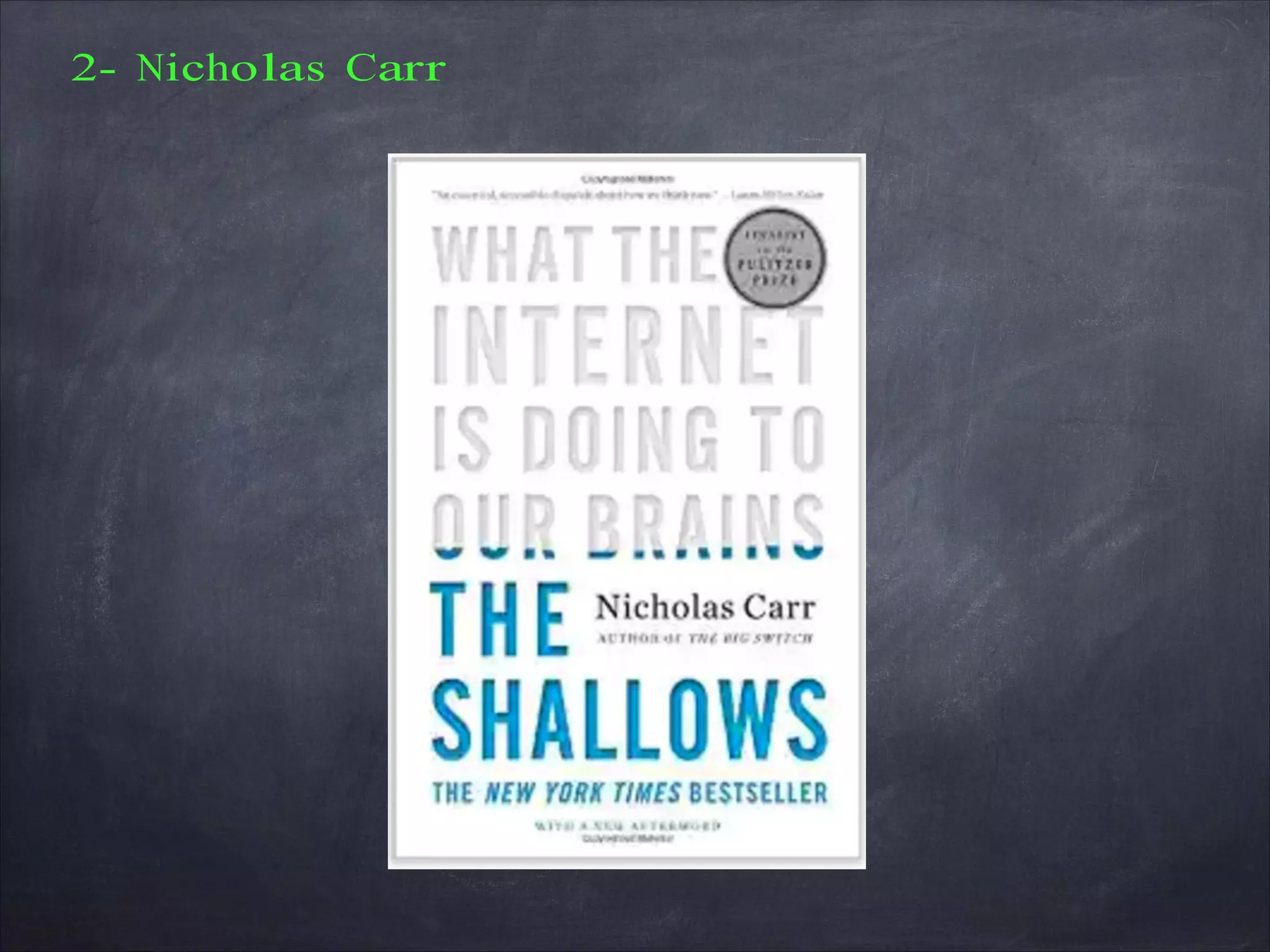
* Orality and Literacy (Ong, 2012).
* Earliest script dates back to
6000 years ago (Ibid).
* Literacy starts with writing
and human society becomes literate
very late in history.
* Reading precedes writing.
* The human brain and the reading
paradox (Dehaene, 2009).
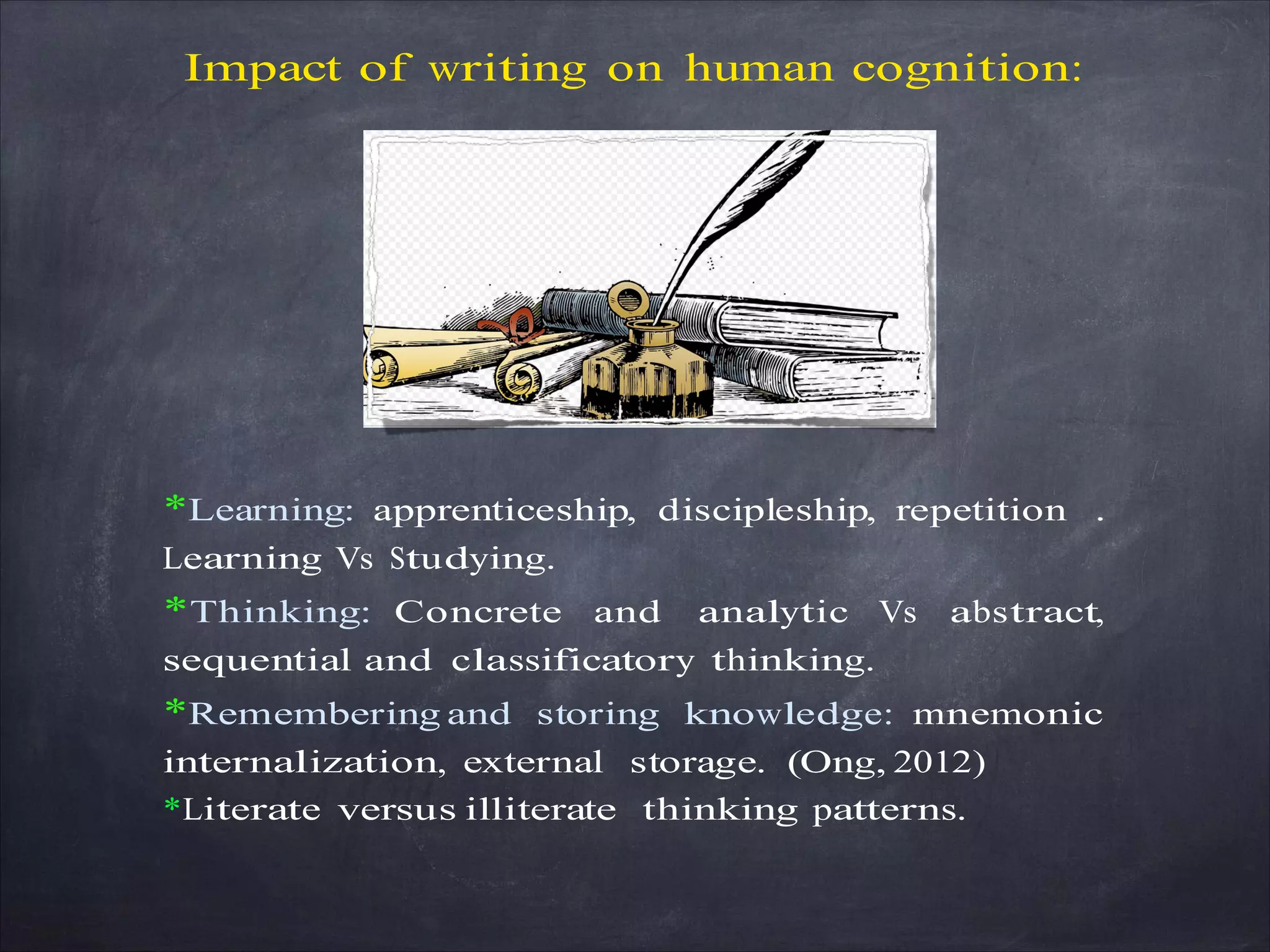
Impact of writing on human cognition:
*Learning: apprenticeship, discipleship, repetition .
Learning Vs Studying.
*Thinking: Concrete and analytic Vs abstract,
sequential and classificatory thinking.
*Remembering and storing knowledge: mnemonic
internalization, external storage. (Ong, 2012)
*Literate versus illiterate thinking patterns.
Alphabets emerged around 1500BC
Alphabetic writing and onset of literacy
reading as a social privilege.
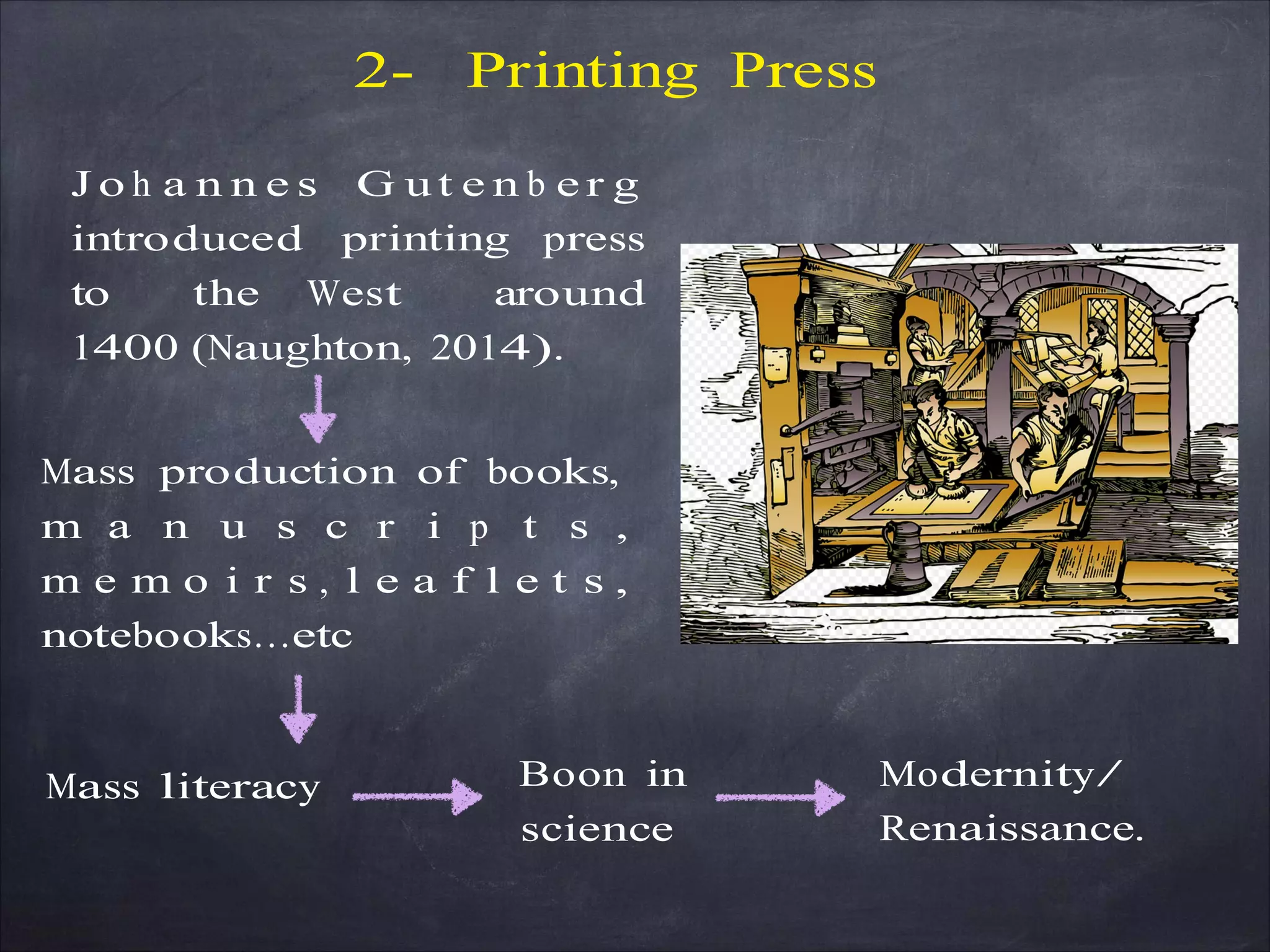
2- Printing Press
J o h a n n e s G u t e n b e r g
introduced printing press
to the West around
1400 (Naughton, 2014).
Mass production of books,
m a n u s c r i p t s ,
m e m o i r s , l e a f l e t s ,
notebooks…etc
Mass literacy Boon in
science
Modernity/
Renaissance.
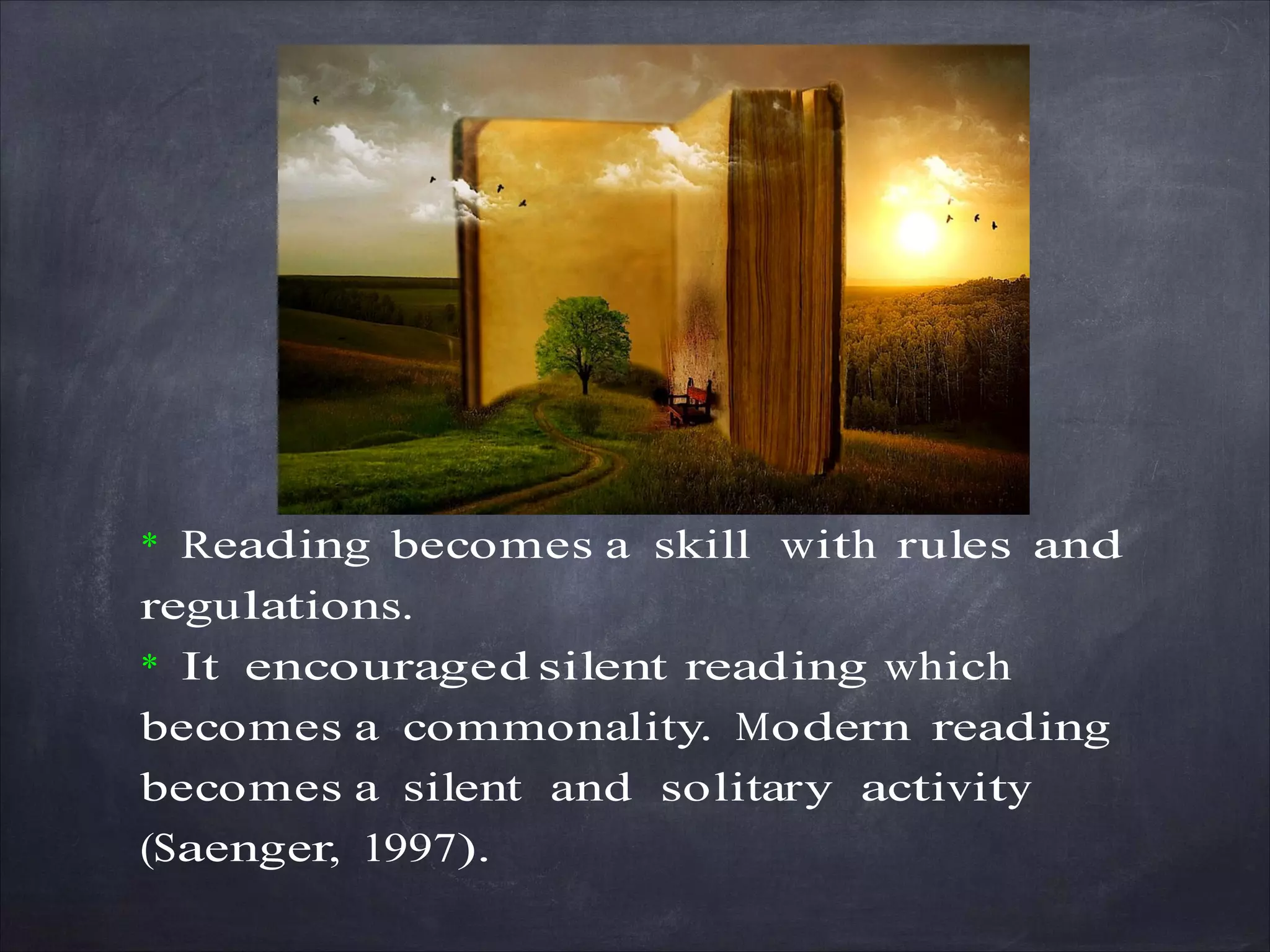
* Reading becomes a skill with rules and
regulations.
* It encouraged silent reading which
becomes a commonality. Modern reading
becomes a silent and solitary activity
(Saenger, 1997).
3- Electric media
!
* Electric media, as Mcluhan stated, ‘has
broken the tyranny of text over our
thoughts and senses’.
* Death of the ‘linear mind’.
, -
-_ --- -:.,
• >- .-
4- Web technologies and social media
RADI
MUNICATION
OS
CONTENT
SOCIAL MEDIA WORK
* The social web has redefined our
reading habits.
* Reading is done in short bursts of
attention
* Irony: abundant reading materials
———surface reading.
In an age that values speed and
hyper connectivity, reading
thoughtfully and deeply becomes a
daunting challenge.

As Ulin (2010) stated, “to read we
need a certain kind of silence, an
ability to filter out noise”(KL. 338).
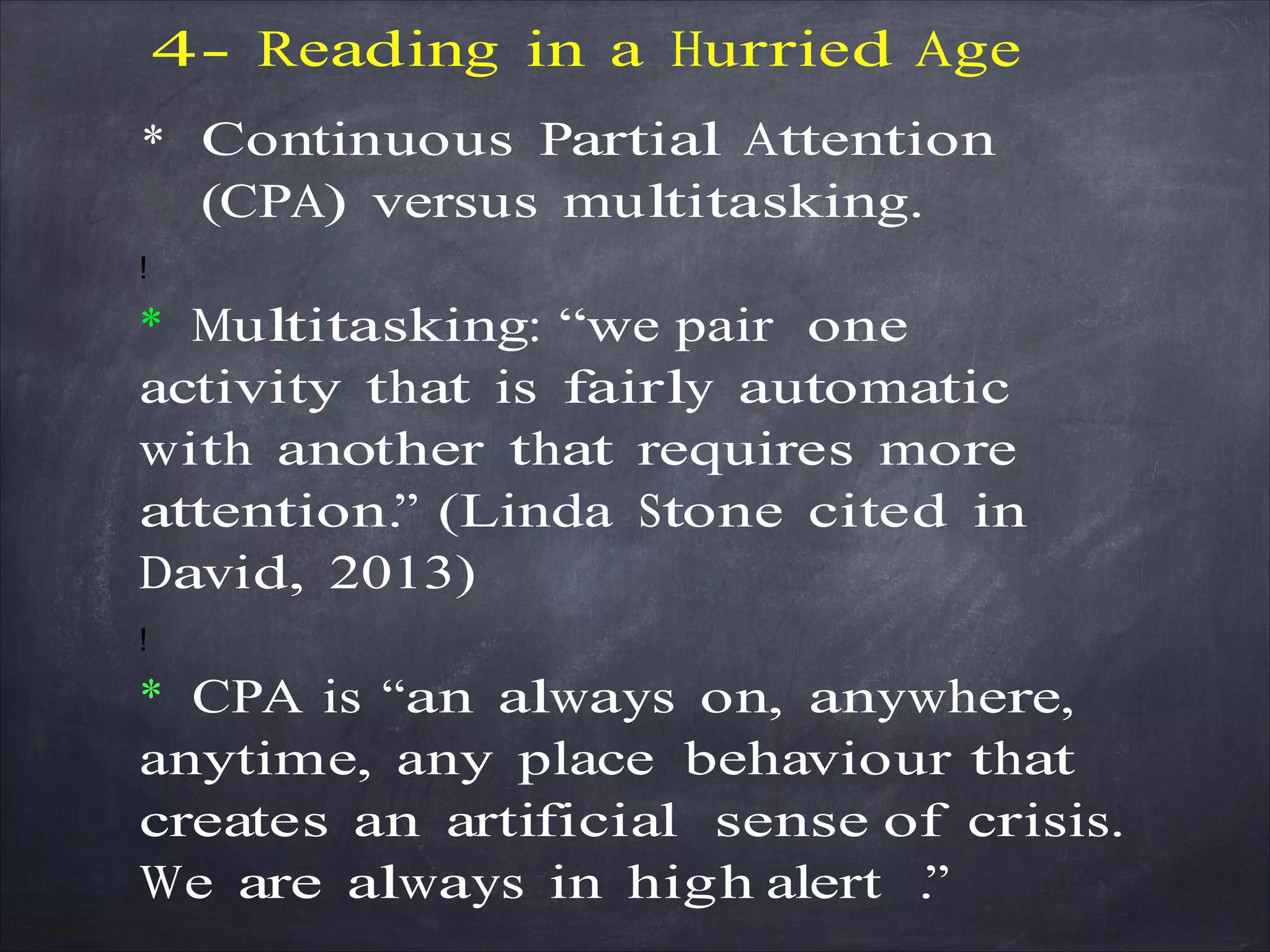
4- Reading in a Hurried Age
* Continuous Partial Attention
(CPA) versus multitasking.
!
* Multitasking: “we pair one
activity that is fairly automatic
with another that requires more
attention.” (Linda Stone cited in
David, 2013)
!
* CPA is “an always on, anywhere,
anytime, any place behaviour that
creates an artificial sense of crisis.
We are always in high alert .”
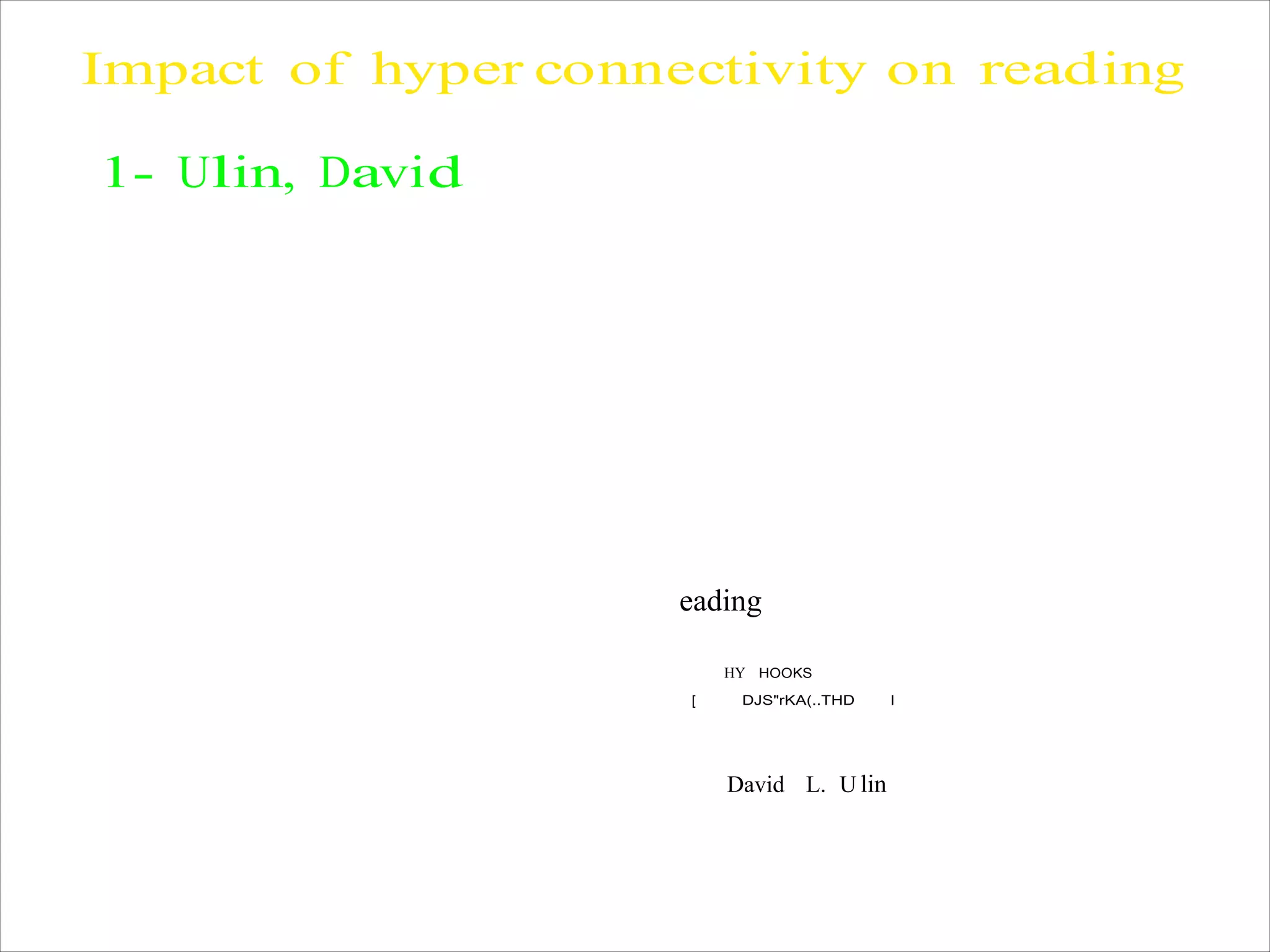
Impact of hyper connectivity on reading
1- Ulin, David
eading
HY HOOKS
[ DJS"rKA(..THD I
David L. U lin
“For most of my life, I have read...primarily at night: a
hundred or so pages every evening once Rae and the
kids have gone to bed. These days, after spending hours
on the computer, I p ick up a book and read a
paragraph; then my mind wanders and I check my email,
drift onto the Internet, pace the house before returning
to the page. Or I want to do these things but don’t,
force myself to remain still, to follow what I am
reading until I give myself over to the flow.” He further
added, ‘what I’m struggling with is the encroachment of
the buzz, the sense that there is something out there
that merits my attention, when in fact it’s mostly
just a series of disconnected riffs, quick takes and
fragments, that add up to the anxiety of the age” (KL.
338).
* Ob s e ssio n w ith ‘i nfor matio nal
novelty’
Checking becomes an end itself.
!
* B.F. Skinner called it ‘Intermittent
reinforcement’. (see Jacob, 1958)
!
* Sam Anderson went even further to
claim that “the Internet is basically
a Skinner box engineered to tap
right into our deep est mech anism
s of addiction.” (Jacob, KL. 1087).
2- Nicholas Carr
!
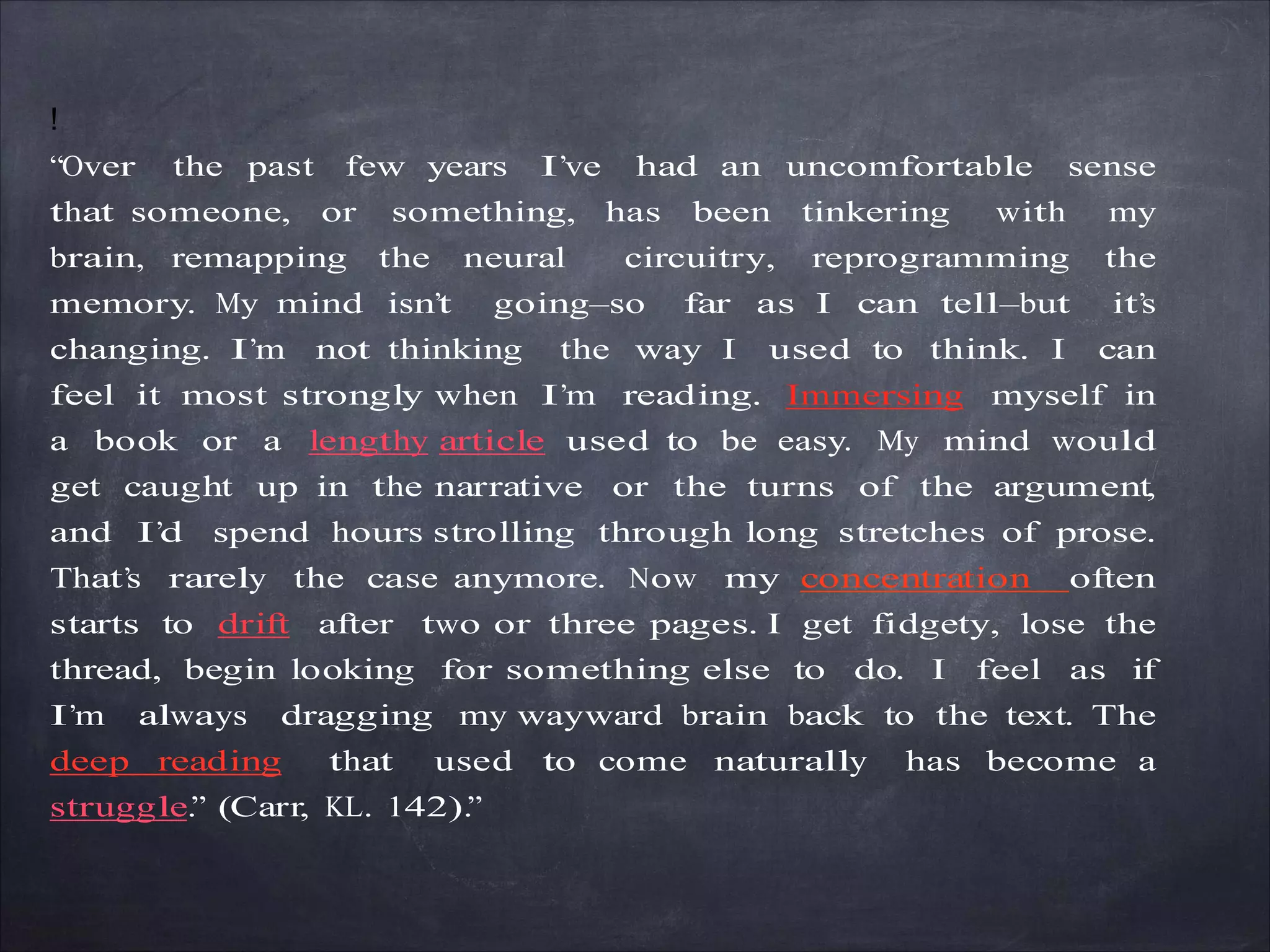
“Over the past few years I’ve had an uncomfortable sense
that someone, or something, has been tinkering with my
brain, remapping the neural circuitry, reprogramming the
memory. My mind isn’t going—so far as I can tell—but it’s
changing. I’m not thinking the way I used to think. I can
feel it most strongly when I’m reading. Immersing myself in
a book or a lengthy article used to be easy. My mind would
get caught up in the narrative or the turns of the argument,
and I’d spend hours strolling through long stretches of prose.
That’s rarely the case anymore. Now my concentration often
starts to drift after two or three pages. I get fidgety, lose the
thread, begin looking for something else to do. I feel as if
I’m always dragging my wayward brain back to the text. The
deep reading that used to come naturally has become a
struggle.” (Carr, KL. 142).”
3- Alan Jacob
E_
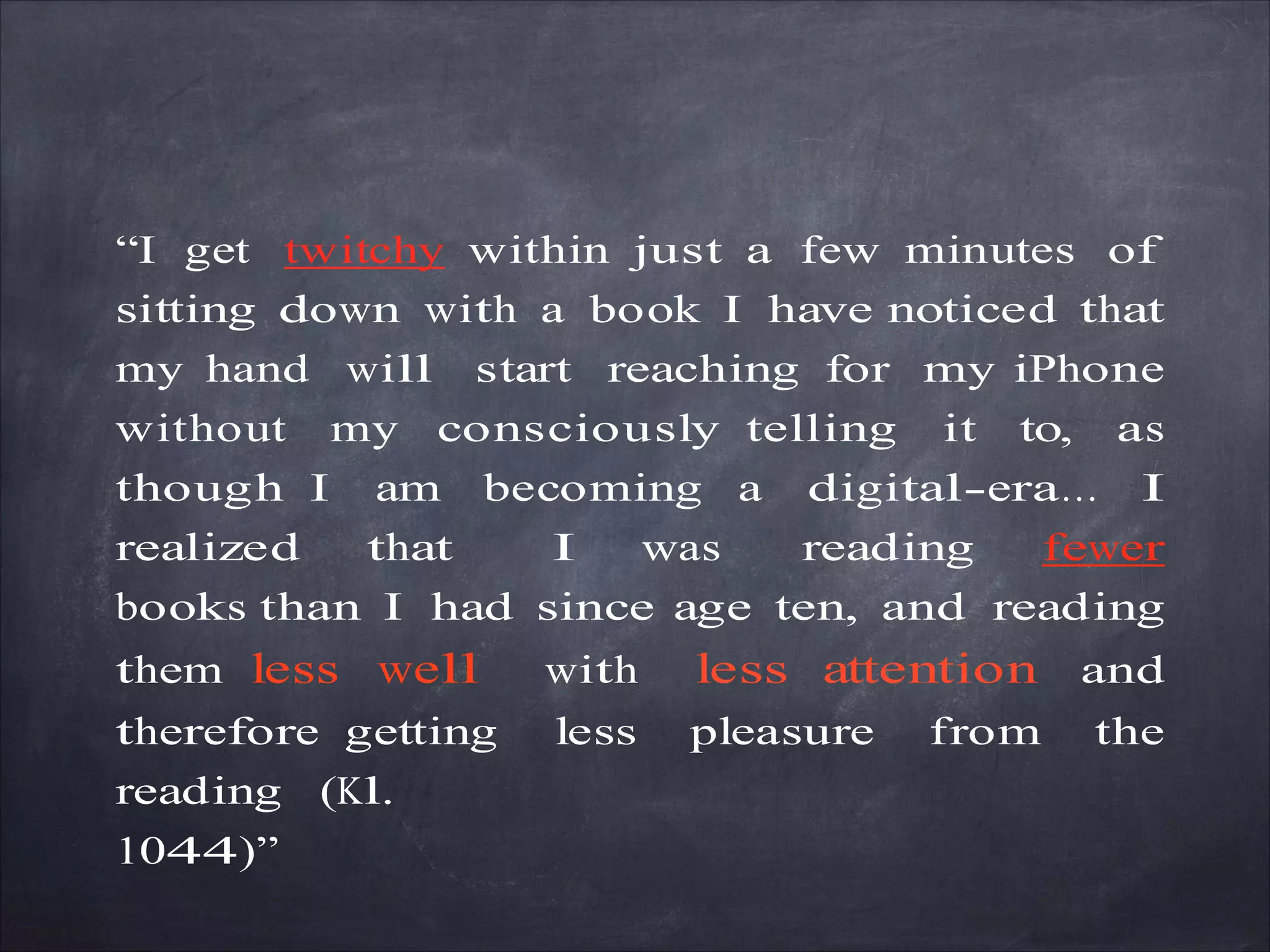
“I get twitchy within just a few minutes of
sitting down with a book I have noticed that
my hand will start reaching for my iPhone
without my consciously telling it to, as
though I am becoming a digital-era… I
realized that I was reading fewer
books than I had since age ten, and reading
them less well with less attention and
therefore getting less pleasure from the
reading (Kl.
1044)”
Main argument
New technologies are rewiring our
b rains and creating new reading
habits. We are getting accustomed to a
new mode of reading that consists of
scanning short passages from multiple
sources online.
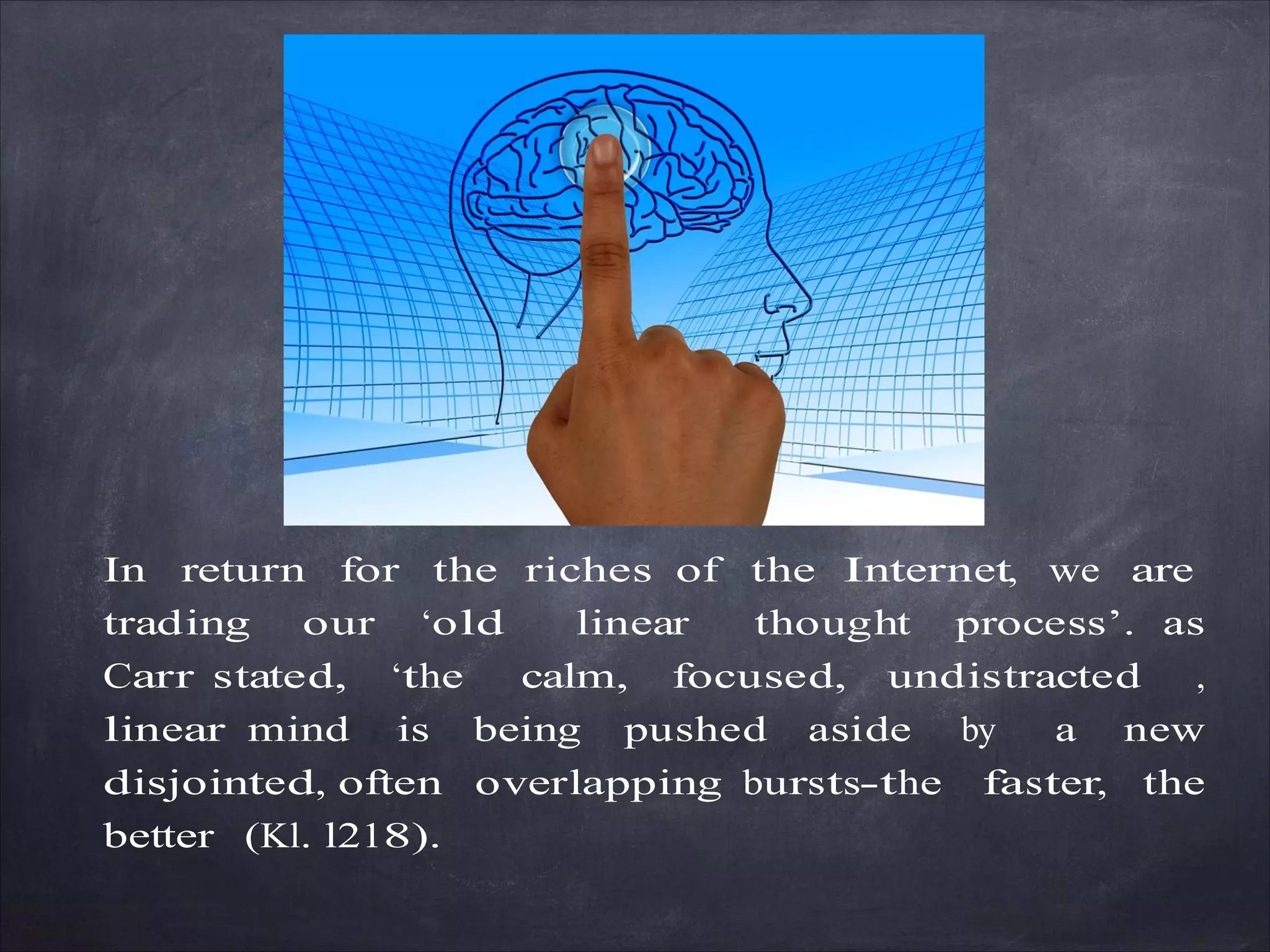
In return for the riches of the Internet, we are
trading our ‘old linear thought process’. as
Carr stated, ‘the calm, focused, undistracted ,
linear mind is being pushed aside by a new
disjointed, often overlapping bursts-the faster, the
better (Kl. l218).
Impact of web technologies on the
reading brains of digital natives
*Hayles, professor at Duke
university, confessed “I can’t get my
students to read whole books
anymore.” (see Carr,
2010, KL. 191).
!
*For some people, as Carr declared. “the
very idea of reading a book has come to
seem old-fashioned, may be even a little
silly, like sewing your own shirts or
butchering your own meat” (KL, 191).
“In 2008, a research and consulting outfit called
nGenera released a study of the effects of the Internet
use on the young. The company interviewed some six
thousand members of what it calls “Generation Net”—
kids w ho have grow n up using the Web. “ Digital
immersion,” wrote the lead researcher, “has even affected
the way they absorb information. They don’t necessarily
read a page from left to right and from top to bottom.
They might instead skip around, scanning for pertinent
information of interest.” (Carr, 2010, KL. 203).
* It’s not about technological nihilism it’s
about the impact of this technology on the
human thought.
!
* ’The medium is the message’ (Mcluhan,
1994).
!
* The technology we use in our daily
interaction “makes us think along certain
path-dependent lines” (Ong, 2012, KL. 273).
* The medium is just as important as the
content itself. For Mcluhan the content of
the a medium is just “the juicy piece of
meat carried by the burglar to distract the
watchdog of the mind” (se Carr, 2010, KL.
125).
!
* Two examples:
A- Reading on social media websites,
B- Nietzsche “our writing equipment
takes part in the forming of our
thoughts. (see Carr, KL. 345).
Main thesis
* New technologies have a huge impact on
how we read.
* They are rewiring our brains and creating
new reading habits.
* They have diminished deep, thoughtful,
ruminative, and slow reading (you can’t
read slowly because you will succumb to
distraction before you make it to the
second or third page.
!
7- The uploading model of reading
!
Jacob (1958) argues that ‘most people read quickly
because they want not to be read but to
have read.”And for the reason why is this so, he
added “they conceive of reading simply as a
means of uploading information to their brains” (Kl.
937).
!
Good for reading a cookbook or
a software manual
Students read instrumentally, for an
external reason (e.g. grade)
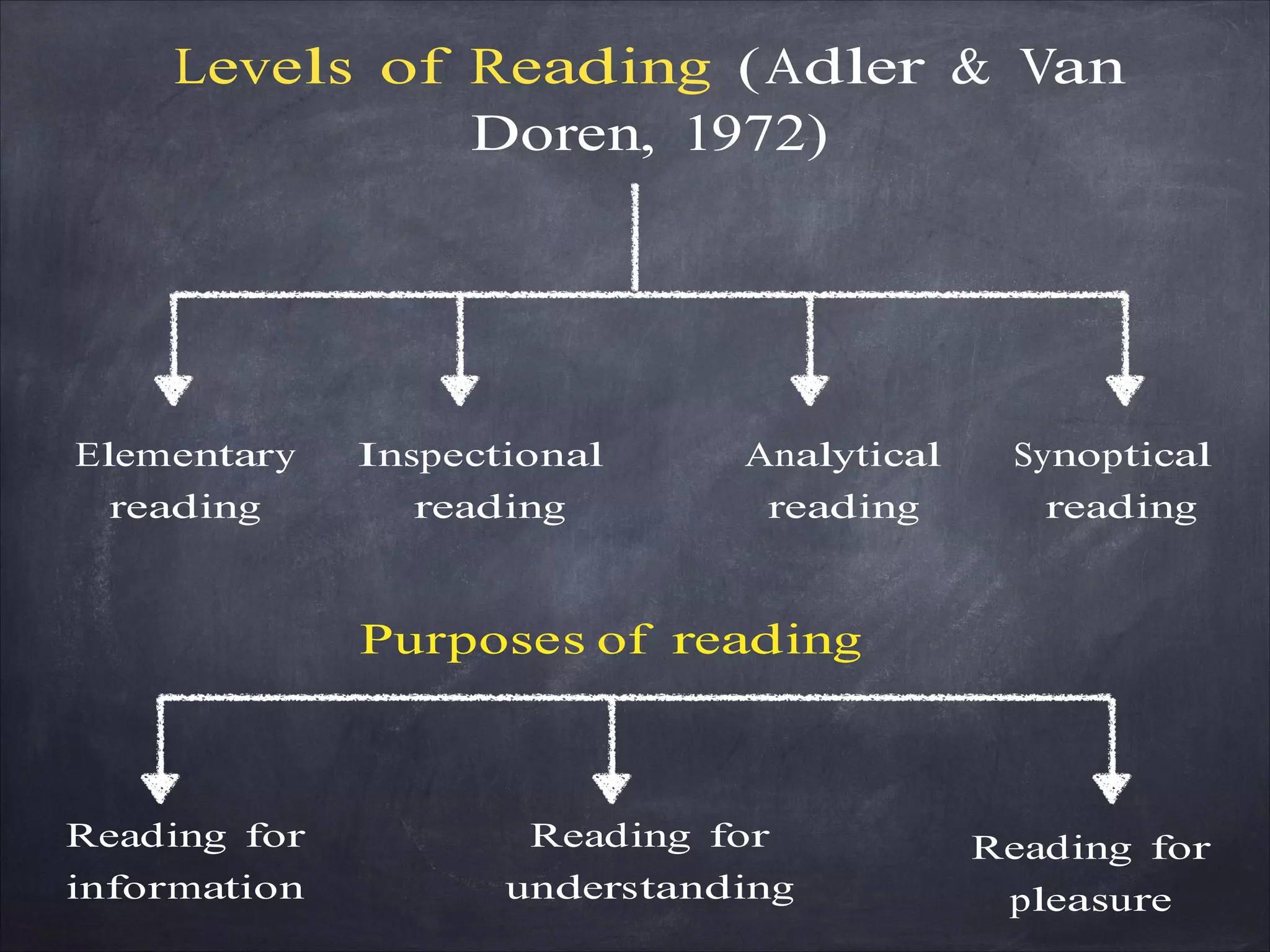
Levels of Reading (Adler & Van
Doren, 1972)
Elementary
reading
Inspectional
reading
Analytical
reading
Synoptical
reading
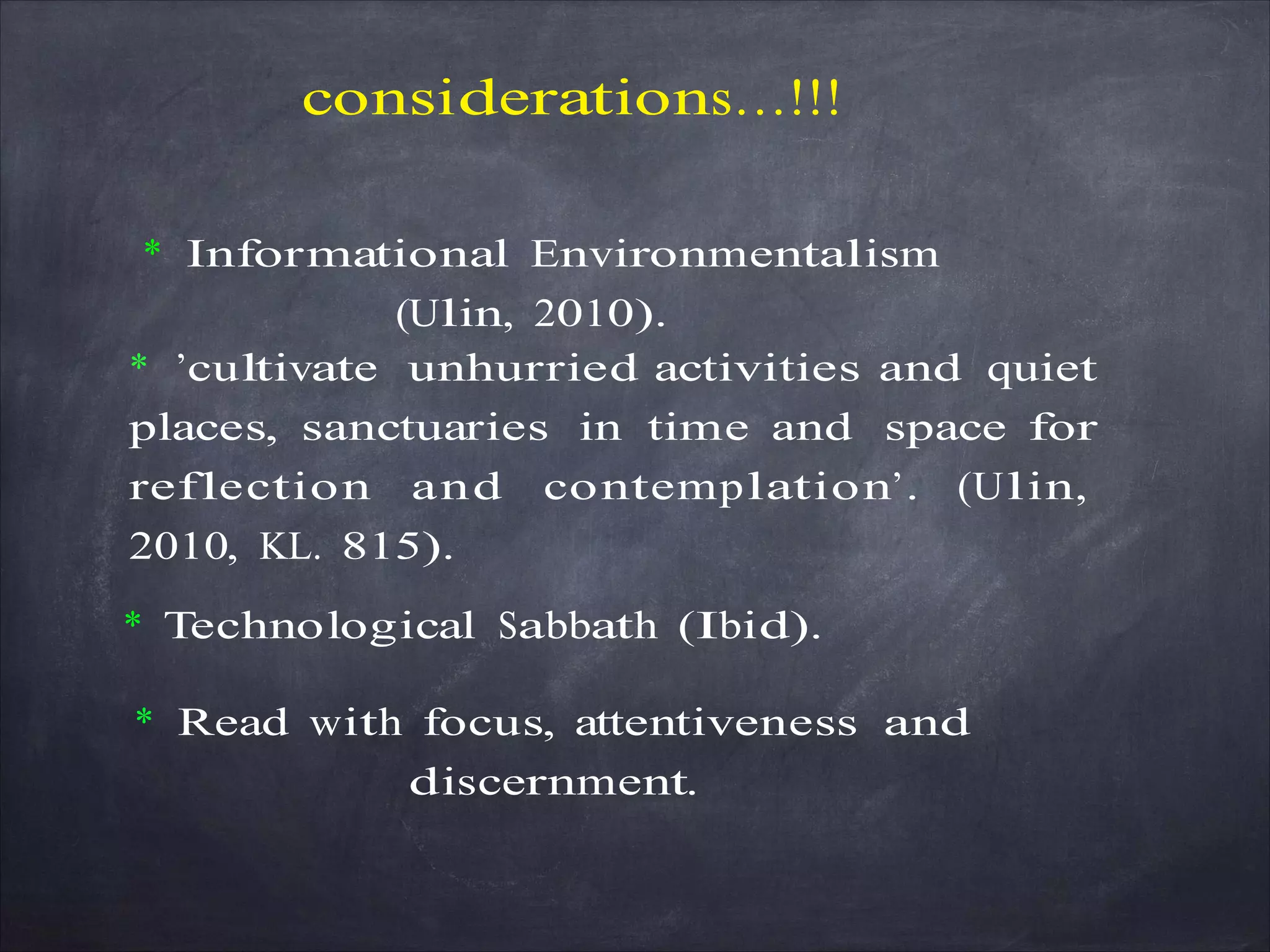
Purposes of reading
Reading for
information
Reading for
understanding
Reading for
pleasure
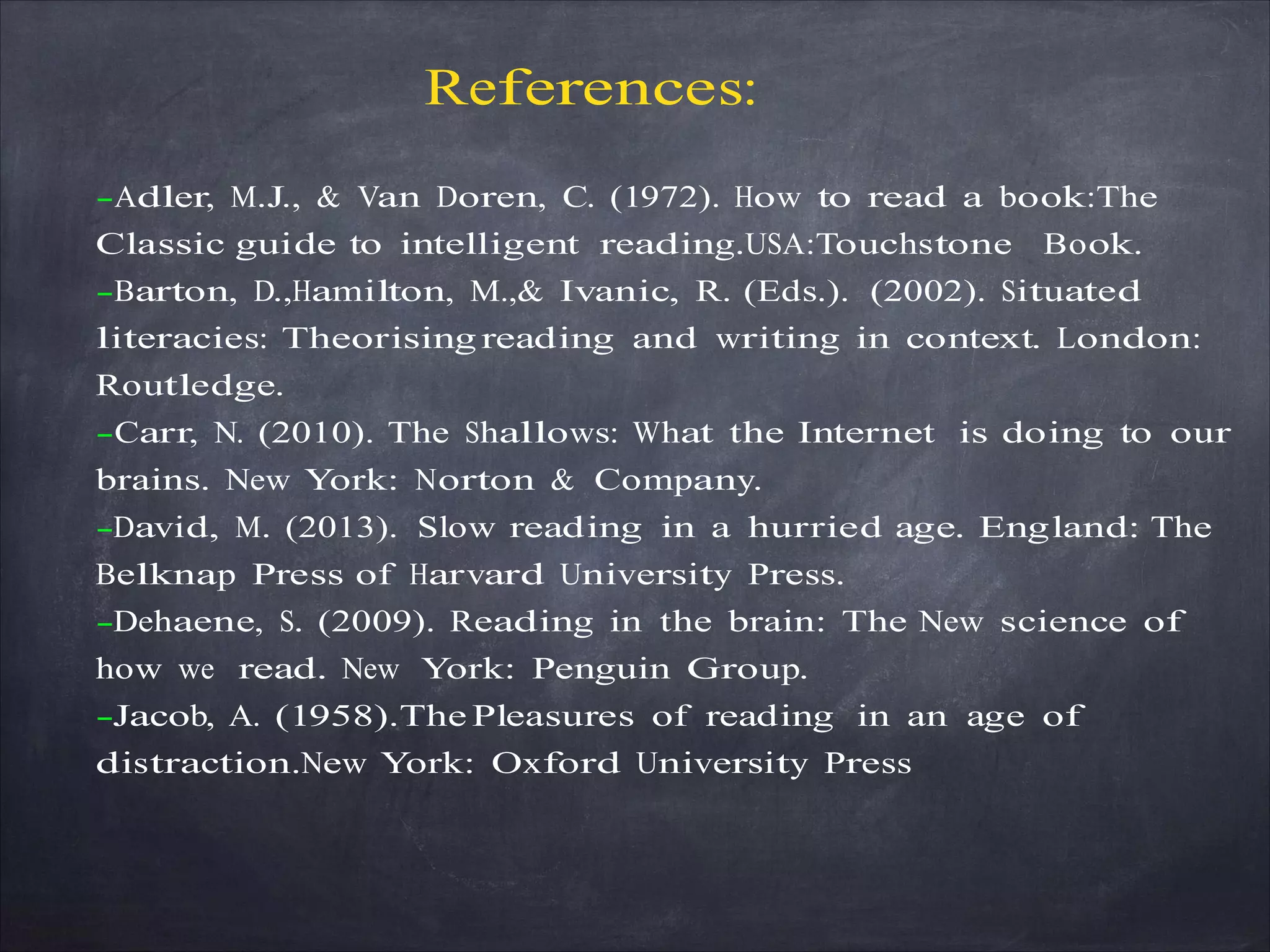
considerations…!!!
* Informational Environmentalism
(Ulin, 2010).
* ’cultivate unhurried activities and quiet
places, sanctuaries in time and space for
reflection and contemplation’. (Ulin,
2010, KL. 815).
* Technological Sabbath (Ibid).
* Read with focus, attentiveness and
discernment.
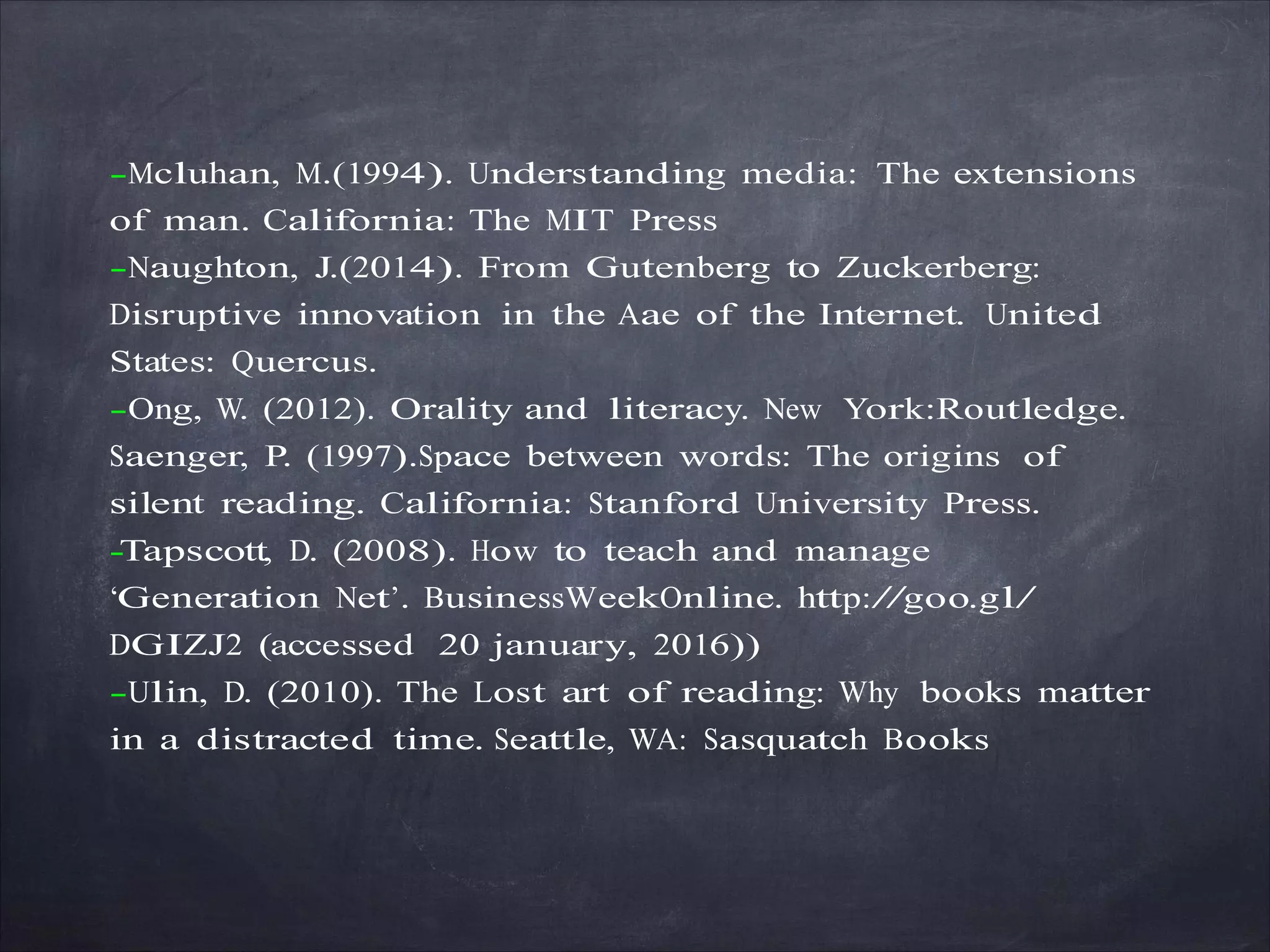
References:
-Adler, M.J., & Van Doren, C. (1972). How to read a book:The
Classic guide to intelligent reading.USA:Touchstone Book.
-Barton, D.,Hamilton, M.,& Ivanic, R. (Eds.). (2002). Situated
literacies: Theorising reading and writing in context. London:
Routledge.
-Carr, N. (2010). The Shallows: What the Internet is doing to our
brains. New York: Norton & Company.
-David, M. (2013). Slow reading in a hurried age. England: The
Belknap Press of Harvard University Press.
-Dehaene, S. (2009). Reading in the brain: The New science of
how we read. New York: Penguin Group.
-Jacob, A. (1958).The Pleasures of reading in an age of
distraction.New York: Oxford University Press
-Mcluhan, M.(1994). Understanding media: The extensions
of man. California: The MIT Press
-Naughton, J.(2014). From Gutenberg to Zuckerberg:
Disruptive innovation in the Aae of the Internet. United
States: Quercus.
-Ong, W. (2012). Orality and literacy. New York:Routledge.
Saenger, P. (1997).Space between words: The origins of
silent reading. California: Stanford University Press.
-Tapscott, D. (2008). How to teach and manage
‘Generation Net’. BusinessWeekOnline. http://goo.gl/
DGIZJ2 (accessed 20 january, 2016))
-Ulin, D. (2010). The Lost art of reading: Why books matter
in a distracted time. Seattle, WA: Sasquatch Books
Image sources:
1 - htt p s: //p i xa b a y .co m/e n /lo v e - h e ar t- r o m a n ce - co lo r -
pattern-1100256/
2- https://pixabay.com/en/writing-quill-books-1043622/
3- h ttp s: //pixab ay.com/en/printing-p ress-p rinting-p ress-
paper-1093509/
4 - h ttp s: //pixab ay.com/en/bo ok-o ld-clou ds-tree-b irds-
bank-863418/
5- https://pixabay.com/en/radio-old-retro-music-sound-647066/
6- https://pixabay.com/en/tree-social-media-structure-1148032/
7- https://pixabay.com/en/metro-blur-tunnel-people-768737/
8- http s://pixabay.com/en/brain-turn-on-education-read-
book-770044/
9- https://pixabay.com/en/abc-alphabet-letters-read-learn-916666/
1 0 - h t t p s : / / c o m m o n s . w i k i m e d i a . o r g / w i k i /
File:Proposed_Symptoms_of_ADHD.PNG
Thank You

Reconceptualizing Reading in the digital age by Mohamed Kharbach

  • 1.
    Reconceptualizing Reading in TheDigital Age Mohamed Kharbach 27-01-2016
  • 2.
    What is reading? Literacypractice ‘Literacy practices are the general cultural ways of utilizing written language which people draw upon in their lives. In the simplest sense literacy practices are what people do with literacy.’ (Barton, Hamilton & Ivanic, 2002, KL. 423)
  • 3.
    1- Is readingin the digital age different from reading in previous ages? If so, why is it different? ! 2- What are some of its implications for us as teachers and educators?
  • 4.
    Psychodynamics of reading Diachronicoverview of reading history 19th-20th 1500BC 1450 21st century centuries Technology of writing (Alphabet system 1500BC, Ong, 2012) Printing Press around 1450 (Naughton, 2014) Electric media (TV, Radio, Telephone… etc, Mcluhan, 1994) Information communication technologies and social media
  • 5.
    1- Technology ofWriting * Orality and Literacy (Ong, 2012). * Earliest script dates back to 6000 years ago (Ibid). * Literacy starts with writing and human society becomes literate very late in history. * Reading precedes writing. * The human brain and the reading paradox (Dehaene, 2009).
  • 6.
    Impact of writingon human cognition: *Learning: apprenticeship, discipleship, repetition . Learning Vs Studying. *Thinking: Concrete and analytic Vs abstract, sequential and classificatory thinking. *Remembering and storing knowledge: mnemonic internalization, external storage. (Ong, 2012) *Literate versus illiterate thinking patterns.
  • 7.
    Alphabets emerged around1500BC Alphabetic writing and onset of literacy reading as a social privilege.
  • 8.
    2- Printing Press Jo h a n n e s G u t e n b e r g introduced printing press to the West around 1400 (Naughton, 2014). Mass production of books, m a n u s c r i p t s , m e m o i r s , l e a f l e t s , notebooks…etc Mass literacy Boon in science Modernity/ Renaissance.
  • 9.
    * Reading becomesa skill with rules and regulations. * It encouraged silent reading which becomes a commonality. Modern reading becomes a silent and solitary activity (Saenger, 1997).
  • 10.
    3- Electric media ! *Electric media, as Mcluhan stated, ‘has broken the tyranny of text over our thoughts and senses’. * Death of the ‘linear mind’. , - -_ --- -:., • >- .-
  • 11.
    4- Web technologiesand social media RADI MUNICATION OS CONTENT SOCIAL MEDIA WORK * The social web has redefined our reading habits. * Reading is done in short bursts of attention * Irony: abundant reading materials ———surface reading.
  • 12.
    In an agethat values speed and hyper connectivity, reading thoughtfully and deeply becomes a daunting challenge. As Ulin (2010) stated, “to read we need a certain kind of silence, an ability to filter out noise”(KL. 338).
  • 13.
    4- Reading ina Hurried Age * Continuous Partial Attention (CPA) versus multitasking. ! * Multitasking: “we pair one activity that is fairly automatic with another that requires more attention.” (Linda Stone cited in David, 2013) ! * CPA is “an always on, anywhere, anytime, any place behaviour that creates an artificial sense of crisis. We are always in high alert .”
  • 14.
    Impact of hyperconnectivity on reading 1- Ulin, David eading HY HOOKS [ DJS"rKA(..THD I David L. U lin
  • 15.
    “For most ofmy life, I have read...primarily at night: a hundred or so pages every evening once Rae and the kids have gone to bed. These days, after spending hours on the computer, I p ick up a book and read a paragraph; then my mind wanders and I check my email, drift onto the Internet, pace the house before returning to the page. Or I want to do these things but don’t, force myself to remain still, to follow what I am reading until I give myself over to the flow.” He further added, ‘what I’m struggling with is the encroachment of the buzz, the sense that there is something out there that merits my attention, when in fact it’s mostly just a series of disconnected riffs, quick takes and fragments, that add up to the anxiety of the age” (KL. 338).
  • 16.
    * Ob se ssio n w ith ‘i nfor matio nal novelty’ Checking becomes an end itself. ! * B.F. Skinner called it ‘Intermittent reinforcement’. (see Jacob, 1958) ! * Sam Anderson went even further to claim that “the Internet is basically a Skinner box engineered to tap right into our deep est mech anism s of addiction.” (Jacob, KL. 1087).
  • 17.
  • 18.
    ! “Over the pastfew years I’ve had an uncomfortable sense that someone, or something, has been tinkering with my brain, remapping the neural circuitry, reprogramming the memory. My mind isn’t going—so far as I can tell—but it’s changing. I’m not thinking the way I used to think. I can feel it most strongly when I’m reading. Immersing myself in a book or a lengthy article used to be easy. My mind would get caught up in the narrative or the turns of the argument, and I’d spend hours strolling through long stretches of prose. That’s rarely the case anymore. Now my concentration often starts to drift after two or three pages. I get fidgety, lose the thread, begin looking for something else to do. I feel as if I’m always dragging my wayward brain back to the text. The deep reading that used to come naturally has become a struggle.” (Carr, KL. 142).”
  • 19.
  • 20.
    “I get twitchywithin just a few minutes of sitting down with a book I have noticed that my hand will start reaching for my iPhone without my consciously telling it to, as though I am becoming a digital-era… I realized that I was reading fewer books than I had since age ten, and reading them less well with less attention and therefore getting less pleasure from the reading (Kl. 1044)”
  • 21.
    Main argument New technologiesare rewiring our b rains and creating new reading habits. We are getting accustomed to a new mode of reading that consists of scanning short passages from multiple sources online.
  • 22.
    In return forthe riches of the Internet, we are trading our ‘old linear thought process’. as Carr stated, ‘the calm, focused, undistracted , linear mind is being pushed aside by a new disjointed, often overlapping bursts-the faster, the better (Kl. l218).
  • 23.
    Impact of webtechnologies on the reading brains of digital natives *Hayles, professor at Duke university, confessed “I can’t get my students to read whole books anymore.” (see Carr, 2010, KL. 191). ! *For some people, as Carr declared. “the very idea of reading a book has come to seem old-fashioned, may be even a little silly, like sewing your own shirts or butchering your own meat” (KL, 191).
  • 24.
    “In 2008, aresearch and consulting outfit called nGenera released a study of the effects of the Internet use on the young. The company interviewed some six thousand members of what it calls “Generation Net”— kids w ho have grow n up using the Web. “ Digital immersion,” wrote the lead researcher, “has even affected the way they absorb information. They don’t necessarily read a page from left to right and from top to bottom. They might instead skip around, scanning for pertinent information of interest.” (Carr, 2010, KL. 203).
  • 25.
    * It’s notabout technological nihilism it’s about the impact of this technology on the human thought. ! * ’The medium is the message’ (Mcluhan, 1994). ! * The technology we use in our daily interaction “makes us think along certain path-dependent lines” (Ong, 2012, KL. 273).
  • 26.
    * The mediumis just as important as the content itself. For Mcluhan the content of the a medium is just “the juicy piece of meat carried by the burglar to distract the watchdog of the mind” (se Carr, 2010, KL. 125). ! * Two examples: A- Reading on social media websites, B- Nietzsche “our writing equipment takes part in the forming of our thoughts. (see Carr, KL. 345).
  • 27.
    Main thesis * Newtechnologies have a huge impact on how we read. * They are rewiring our brains and creating new reading habits. * They have diminished deep, thoughtful, ruminative, and slow reading (you can’t read slowly because you will succumb to distraction before you make it to the second or third page. !
  • 28.
    7- The uploadingmodel of reading ! Jacob (1958) argues that ‘most people read quickly because they want not to be read but to have read.”And for the reason why is this so, he added “they conceive of reading simply as a means of uploading information to their brains” (Kl. 937). ! Good for reading a cookbook or a software manual Students read instrumentally, for an
  • 29.
  • 30.
    Levels of Reading(Adler & Van Doren, 1972) Elementary reading Inspectional reading Analytical reading Synoptical reading Purposes of reading Reading for information Reading for understanding Reading for pleasure
  • 31.
    considerations…!!! * Informational Environmentalism (Ulin,2010). * ’cultivate unhurried activities and quiet places, sanctuaries in time and space for reflection and contemplation’. (Ulin, 2010, KL. 815). * Technological Sabbath (Ibid). * Read with focus, attentiveness and discernment.
  • 32.
    References: -Adler, M.J., &Van Doren, C. (1972). How to read a book:The Classic guide to intelligent reading.USA:Touchstone Book. -Barton, D.,Hamilton, M.,& Ivanic, R. (Eds.). (2002). Situated literacies: Theorising reading and writing in context. London: Routledge. -Carr, N. (2010). The Shallows: What the Internet is doing to our brains. New York: Norton & Company. -David, M. (2013). Slow reading in a hurried age. England: The Belknap Press of Harvard University Press. -Dehaene, S. (2009). Reading in the brain: The New science of how we read. New York: Penguin Group. -Jacob, A. (1958).The Pleasures of reading in an age of distraction.New York: Oxford University Press
  • 33.
    -Mcluhan, M.(1994). Understandingmedia: The extensions of man. California: The MIT Press -Naughton, J.(2014). From Gutenberg to Zuckerberg: Disruptive innovation in the Aae of the Internet. United States: Quercus. -Ong, W. (2012). Orality and literacy. New York:Routledge. Saenger, P. (1997).Space between words: The origins of silent reading. California: Stanford University Press. -Tapscott, D. (2008). How to teach and manage ‘Generation Net’. BusinessWeekOnline. http://goo.gl/ DGIZJ2 (accessed 20 january, 2016)) -Ulin, D. (2010). The Lost art of reading: Why books matter in a distracted time. Seattle, WA: Sasquatch Books
  • 34.
    Image sources: 1 -htt p s: //p i xa b a y .co m/e n /lo v e - h e ar t- r o m a n ce - co lo r - pattern-1100256/ 2- https://pixabay.com/en/writing-quill-books-1043622/ 3- h ttp s: //pixab ay.com/en/printing-p ress-p rinting-p ress- paper-1093509/ 4 - h ttp s: //pixab ay.com/en/bo ok-o ld-clou ds-tree-b irds- bank-863418/ 5- https://pixabay.com/en/radio-old-retro-music-sound-647066/ 6- https://pixabay.com/en/tree-social-media-structure-1148032/ 7- https://pixabay.com/en/metro-blur-tunnel-people-768737/ 8- http s://pixabay.com/en/brain-turn-on-education-read- book-770044/ 9- https://pixabay.com/en/abc-alphabet-letters-read-learn-916666/ 1 0 - h t t p s : / / c o m m o n s . w i k i m e d i a . o r g / w i k i / File:Proposed_Symptoms_of_ADHD.PNG
  • 35.