




Submitted by
Topics
1) Fallacy of Equivocation
2) Fallacy of Amphiboly
3) Fallacy of Composition
4) Fallacy of Division
Equivocation ("to call by the same
name") is classified as an informal
logical fallacy. It is the misleading use of
a term with more than one meaning or
sense (by glossing over which meaning
is intended at a particular time). It
generally occurs with polysomic words
(words with multiple meanings).
Fallacy of Equivocation
 An equivocation trades upon the use of an
ambiguous word or phrase in one of its meanings
in one of the propositions of an argument but also
in another of its meanings in a second proposition.
 The fallacy of equivocation occurs when the
conclusion of an argument depends on the fact
that a word or phrase is used, either explicitly or
implicitly, in two different senses in the argument.
Such arguments are either invalid or have a false
premise, and in either case they are unsound.
Equivocation (Explanation)
Example
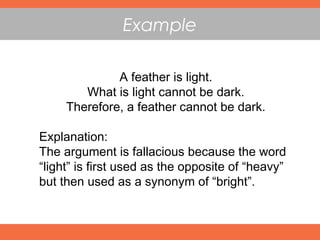
A feather is light.
What is light cannot be dark.
Therefore, a feather cannot be dark.
Explanation:
The argument is fallacious because the word
“light” is first used as the opposite of “heavy”
but then used as a synonym of “bright”.
Example
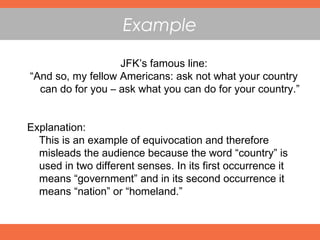
JFK’s famous line:
“And so, my fellow Americans: ask not what your country
can do for you – ask what you can do for your country.”
Explanation:
This is an example of equivocation and therefore
misleads the audience because the word “country” is
used in two different senses. In its first occurrence it
means “government” and in its second occurrence it
means “nation” or “homeland.”
Example
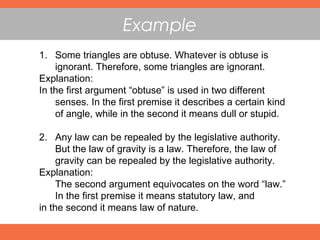
1. Some triangles are obtuse. Whatever is obtuse is
ignorant. Therefore, some triangles are ignorant.
Explanation:
In the first argument “obtuse” is used in two different
senses. In the first premise it describes a certain kind
of angle, while in the second it means dull or stupid.
2. Any law can be repealed by the legislative authority.
But the law of gravity is a law. Therefore, the law of
gravity can be repealed by the legislative authority.
Explanation:
The second argument equivocates on the word “law.”
In the first premise it means statutory law, and
in the second it means law of nature.
Example
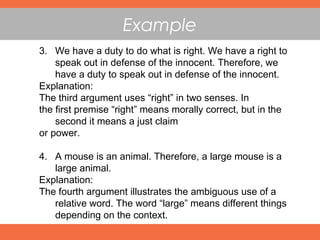
3. We have a duty to do what is right. We have a right to
speak out in defense of the innocent. Therefore, we
have a duty to speak out in defense of the innocent.
Explanation:
The third argument uses “right” in two senses. In
the first premise “right” means morally correct, but in the
second it means a just claim
or power.
4. A mouse is an animal. Therefore, a large mouse is a
large animal.
Explanation:
The fourth argument illustrates the ambiguous use of a
relative word. The word “large” means different things
depending on the context.
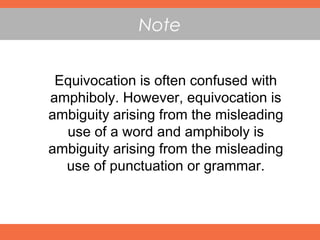
Note
Equivocation is often confused with
amphiboly. However, equivocation is
ambiguity arising from the misleading
use of a word and amphiboly is
ambiguity arising from the misleading
use of punctuation or grammar.
Any Question
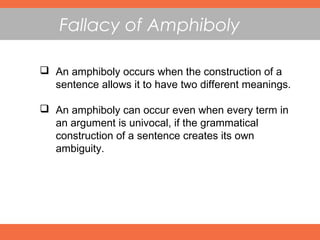
Fallacy of Amphiboly
 An amphiboly occurs when the construction of a
sentence allows it to have two different meanings.
 An amphiboly can occur even when every term in
an argument is univocal, if the grammatical
construction of a sentence creates its own
ambiguity.
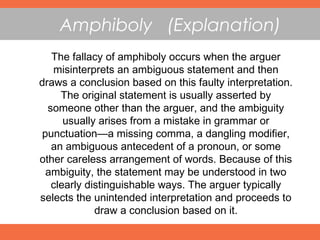
Amphiboly (Explanation)
The fallacy of amphiboly occurs when the arguer
misinterprets an ambiguous statement and then
draws a conclusion based on this faulty interpretation.
The original statement is usually asserted by
someone other than the arguer, and the ambiguity
usually arises from a mistake in grammar or
punctuation—a missing comma, a dangling modifier,
an ambiguous antecedent of a pronoun, or some
other careless arrangement of words. Because of this
ambiguity, the statement may be understood in two
clearly distinguishable ways. The arguer typically
selects the unintended interpretation and proceeds to
draw a conclusion based on it.
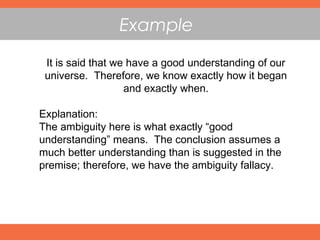
Example
It is said that we have a good understanding of our
universe. Therefore, we know exactly how it began
and exactly when.
Explanation:
The ambiguity here is what exactly “good
understanding” means. The conclusion assumes a
much better understanding than is suggested in the
premise; therefore, we have the ambiguity fallacy.
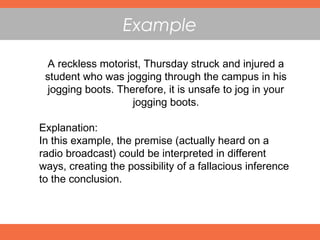
A reckless motorist, Thursday struck and injured a
student who was jogging through the campus in his
jogging boots. Therefore, it is unsafe to jog in your
jogging boots.
Explanation:
In this example, the premise (actually heard on a
radio broadcast) could be interpreted in different
ways, creating the possibility of a fallacious inference
to the conclusion.
Example
Any Question
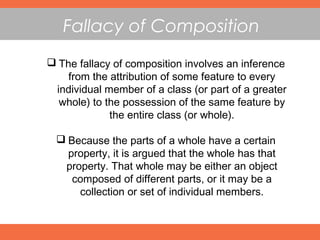
Fallacy of Composition
 The fallacy of composition involves an inference
from the attribution of some feature to every
individual member of a class (or part of a greater
whole) to the possession of the same feature by
the entire class (or whole).
 Because the parts of a whole have a certain
property, it is argued that the whole has that
property. That whole may be either an object
composed of different parts, or it may be a
collection or set of individual members.
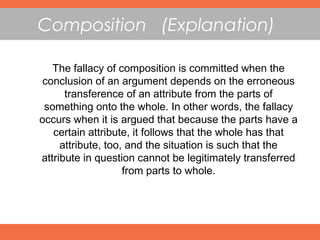
Composition (Explanation)
The fallacy of composition is committed when the
conclusion of an argument depends on the erroneous
transference of an attribute from the parts of
something onto the whole. In other words, the fallacy
occurs when it is argued that because the parts have a
certain attribute, it follows that the whole has that
attribute, too, and the situation is such that the
attribute in question cannot be legitimately transferred
from parts to whole.
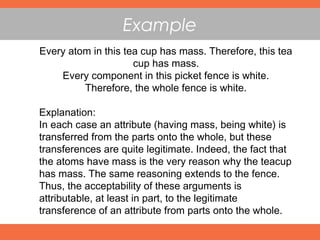
Example
Every atom in this tea cup has mass. Therefore, this tea
cup has mass.
Every component in this picket fence is white.
Therefore, the whole fence is white.
Explanation:
In each case an attribute (having mass, being white) is
transferred from the parts onto the whole, but these
transferences are quite legitimate. Indeed, the fact that
the atoms have mass is the very reason why the teacup
has mass. The same reasoning extends to the fence.
Thus, the acceptability of these arguments is
attributable, at least in part, to the legitimate
transference of an attribute from parts onto the whole.
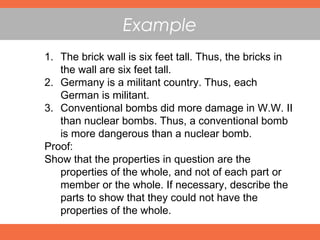
Example
1. The brick wall is six feet tall. Thus, the bricks in
the wall are six feet tall.
2. Germany is a militant country. Thus, each
German is militant.
3. Conventional bombs did more damage in W.W. II
than nuclear bombs. Thus, a conventional bomb
is more dangerous than a nuclear bomb.
Proof:
Show that the properties in question are the
properties of the whole, and not of each part or
member or the whole. If necessary, describe the
parts to show that they could not have the
properties of the whole.
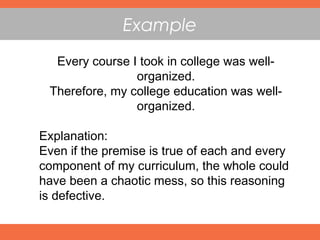
Example
Every course I took in college was well-
organized.
Therefore, my college education was well-
organized.
Explanation:
Even if the premise is true of each and every
component of my curriculum, the whole could
have been a chaotic mess, so this reasoning
is defective.
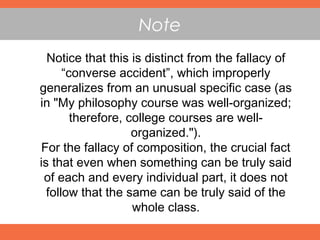
Note
Notice that this is distinct from the fallacy of
“converse accident”, which improperly
generalizes from an unusual specific case (as
in "My philosophy course was well-organized;
therefore, college courses are well-
organized.").
For the fallacy of composition, the crucial fact
is that even when something can be truly said
of each and every individual part, it does not
follow that the same can be truly said of the
whole class.
Any Question
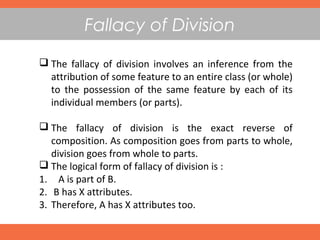
Fallacy of Division
 The fallacy of division involves an inference from the
attribution of some feature to an entire class (or whole)
to the possession of the same feature by each of its
individual members (or parts).
 The fallacy of division is the exact reverse of
composition. As composition goes from parts to whole,
division goes from whole to parts.
 The logical form of fallacy of division is :
1. A is part of B.
2. B has X attributes.
3. Therefore, A has X attributes too.
Types of Fallacy of Division
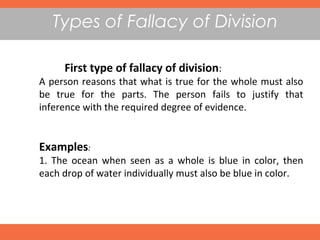
First type of fallacy of division:
A person reasons that what is true for the whole must also
be true for the parts. The person fails to justify that
inference with the required degree of evidence.
Examples:
1. The ocean when seen as a whole is blue in color, then
each drop of water individually must also be blue in color. 
Types of Fallacy of Division
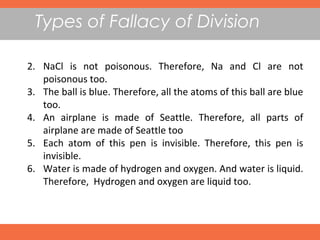
2. NaCl is not poisonous. Therefore, Na and Cl are not
poisonous too.
3. The ball is blue. Therefore, all the atoms of this ball are blue
too.
4. An airplane is made of Seattle. Therefore, all parts of
airplane are made of Seattle too
5. Each atom of this pen is invisible. Therefore, this pen is
invisible.
6. Water is made of hydrogen and oxygen. And water is liquid.
Therefore, Hydrogen and oxygen are liquid too. 
Types of fallacy of Division
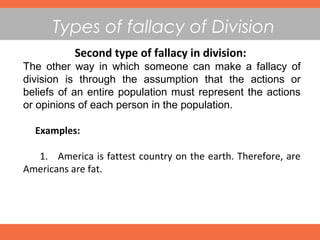
Second type of fallacy in division:
The other way in which someone can make a fallacy of
division is through the assumption that the actions or
beliefs of an entire population must represent the actions
or opinions of each person in the population.
Examples:
1. America is fattest country on the earth. Therefore, are
Americans are fat.
Types of fallacy of division
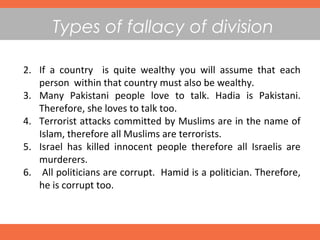
2. If a country is quite wealthy you will assume that each
person within that country must also be wealthy.
3. Many Pakistani people love to talk. Hadia is Pakistani.
Therefore, she loves to talk too.
4. Terrorist attacks committed by Muslims are in the name of
Islam, therefore all Muslims are terrorists.
5. Israel has killed innocent people therefore all Israelis are
murderers.
6. All politicians are corrupt. Hamid is a politician. Therefore,
he is corrupt too.
Any Question

Fallacy of logic

  • 2.
  • 3.
    Topics 1) Fallacy ofEquivocation 2) Fallacy of Amphiboly 3) Fallacy of Composition 4) Fallacy of Division
  • 4.
    Equivocation ("to callby the same name") is classified as an informal logical fallacy. It is the misleading use of a term with more than one meaning or sense (by glossing over which meaning is intended at a particular time). It generally occurs with polysomic words (words with multiple meanings). Fallacy of Equivocation
  • 5.
     An equivocationtrades upon the use of an ambiguous word or phrase in one of its meanings in one of the propositions of an argument but also in another of its meanings in a second proposition.  The fallacy of equivocation occurs when the conclusion of an argument depends on the fact that a word or phrase is used, either explicitly or implicitly, in two different senses in the argument. Such arguments are either invalid or have a false premise, and in either case they are unsound. Equivocation (Explanation)
  • 6.
    Example A feather islight. What is light cannot be dark. Therefore, a feather cannot be dark. Explanation: The argument is fallacious because the word “light” is first used as the opposite of “heavy” but then used as a synonym of “bright”.
  • 7.
    Example JFK’s famous line: “Andso, my fellow Americans: ask not what your country can do for you – ask what you can do for your country.” Explanation: This is an example of equivocation and therefore misleads the audience because the word “country” is used in two different senses. In its first occurrence it means “government” and in its second occurrence it means “nation” or “homeland.”
  • 8.
    Example 1. Some trianglesare obtuse. Whatever is obtuse is ignorant. Therefore, some triangles are ignorant. Explanation: In the first argument “obtuse” is used in two different senses. In the first premise it describes a certain kind of angle, while in the second it means dull or stupid. 2. Any law can be repealed by the legislative authority. But the law of gravity is a law. Therefore, the law of gravity can be repealed by the legislative authority. Explanation: The second argument equivocates on the word “law.” In the first premise it means statutory law, and in the second it means law of nature.
  • 9.
    Example 3. We havea duty to do what is right. We have a right to speak out in defense of the innocent. Therefore, we have a duty to speak out in defense of the innocent. Explanation: The third argument uses “right” in two senses. In the first premise “right” means morally correct, but in the second it means a just claim or power. 4. A mouse is an animal. Therefore, a large mouse is a large animal. Explanation: The fourth argument illustrates the ambiguous use of a relative word. The word “large” means different things depending on the context.
  • 10.
    Note Equivocation is oftenconfused with amphiboly. However, equivocation is ambiguity arising from the misleading use of a word and amphiboly is ambiguity arising from the misleading use of punctuation or grammar.
  • 11.
  • 12.
    Fallacy of Amphiboly An amphiboly occurs when the construction of a sentence allows it to have two different meanings.  An amphiboly can occur even when every term in an argument is univocal, if the grammatical construction of a sentence creates its own ambiguity.
  • 13.
    Amphiboly (Explanation) The fallacyof amphiboly occurs when the arguer misinterprets an ambiguous statement and then draws a conclusion based on this faulty interpretation. The original statement is usually asserted by someone other than the arguer, and the ambiguity usually arises from a mistake in grammar or punctuation—a missing comma, a dangling modifier, an ambiguous antecedent of a pronoun, or some other careless arrangement of words. Because of this ambiguity, the statement may be understood in two clearly distinguishable ways. The arguer typically selects the unintended interpretation and proceeds to draw a conclusion based on it.
  • 14.
    Example It is saidthat we have a good understanding of our universe. Therefore, we know exactly how it began and exactly when. Explanation: The ambiguity here is what exactly “good understanding” means. The conclusion assumes a much better understanding than is suggested in the premise; therefore, we have the ambiguity fallacy.
  • 15.
    A reckless motorist,Thursday struck and injured a student who was jogging through the campus in his jogging boots. Therefore, it is unsafe to jog in your jogging boots. Explanation: In this example, the premise (actually heard on a radio broadcast) could be interpreted in different ways, creating the possibility of a fallacious inference to the conclusion. Example
  • 16.
  • 17.
    Fallacy of Composition The fallacy of composition involves an inference from the attribution of some feature to every individual member of a class (or part of a greater whole) to the possession of the same feature by the entire class (or whole).  Because the parts of a whole have a certain property, it is argued that the whole has that property. That whole may be either an object composed of different parts, or it may be a collection or set of individual members.
  • 18.
    Composition (Explanation) The fallacyof composition is committed when the conclusion of an argument depends on the erroneous transference of an attribute from the parts of something onto the whole. In other words, the fallacy occurs when it is argued that because the parts have a certain attribute, it follows that the whole has that attribute, too, and the situation is such that the attribute in question cannot be legitimately transferred from parts to whole.
  • 19.
    Example Every atom inthis tea cup has mass. Therefore, this tea cup has mass. Every component in this picket fence is white. Therefore, the whole fence is white. Explanation: In each case an attribute (having mass, being white) is transferred from the parts onto the whole, but these transferences are quite legitimate. Indeed, the fact that the atoms have mass is the very reason why the teacup has mass. The same reasoning extends to the fence. Thus, the acceptability of these arguments is attributable, at least in part, to the legitimate transference of an attribute from parts onto the whole.
  • 20.
    Example 1. The brickwall is six feet tall. Thus, the bricks in the wall are six feet tall. 2. Germany is a militant country. Thus, each German is militant. 3. Conventional bombs did more damage in W.W. II than nuclear bombs. Thus, a conventional bomb is more dangerous than a nuclear bomb. Proof: Show that the properties in question are the properties of the whole, and not of each part or member or the whole. If necessary, describe the parts to show that they could not have the properties of the whole.
  • 21.
    Example Every course Itook in college was well- organized. Therefore, my college education was well- organized. Explanation: Even if the premise is true of each and every component of my curriculum, the whole could have been a chaotic mess, so this reasoning is defective.
  • 22.
    Note Notice that thisis distinct from the fallacy of “converse accident”, which improperly generalizes from an unusual specific case (as in "My philosophy course was well-organized; therefore, college courses are well- organized."). For the fallacy of composition, the crucial fact is that even when something can be truly said of each and every individual part, it does not follow that the same can be truly said of the whole class.
  • 23.
  • 24.
    Fallacy of Division The fallacy of division involves an inference from the attribution of some feature to an entire class (or whole) to the possession of the same feature by each of its individual members (or parts).  The fallacy of division is the exact reverse of composition. As composition goes from parts to whole, division goes from whole to parts.  The logical form of fallacy of division is : 1. A is part of B. 2. B has X attributes. 3. Therefore, A has X attributes too.
  • 25.
    Types of Fallacyof Division First type of fallacy of division: A person reasons that what is true for the whole must also be true for the parts. The person fails to justify that inference with the required degree of evidence. Examples: 1. The ocean when seen as a whole is blue in color, then each drop of water individually must also be blue in color. 
  • 26.
    Types of Fallacyof Division 2. NaCl is not poisonous. Therefore, Na and Cl are not poisonous too. 3. The ball is blue. Therefore, all the atoms of this ball are blue too. 4. An airplane is made of Seattle. Therefore, all parts of airplane are made of Seattle too 5. Each atom of this pen is invisible. Therefore, this pen is invisible. 6. Water is made of hydrogen and oxygen. And water is liquid. Therefore, Hydrogen and oxygen are liquid too. 
  • 27.
    Types of fallacyof Division Second type of fallacy in division: The other way in which someone can make a fallacy of division is through the assumption that the actions or beliefs of an entire population must represent the actions or opinions of each person in the population. Examples: 1. America is fattest country on the earth. Therefore, are Americans are fat.
  • 28.
    Types of fallacyof division 2. If a country is quite wealthy you will assume that each person within that country must also be wealthy. 3. Many Pakistani people love to talk. Hadia is Pakistani. Therefore, she loves to talk too. 4. Terrorist attacks committed by Muslims are in the name of Islam, therefore all Muslims are terrorists. 5. Israel has killed innocent people therefore all Israelis are murderers. 6. All politicians are corrupt. Hamid is a politician. Therefore, he is corrupt too.
  • 29.