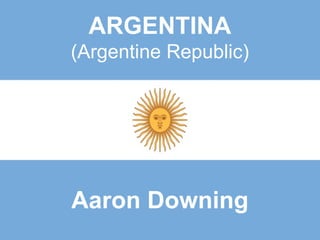
ARGENTINA
(Argentine Republic)
Aaron Downing
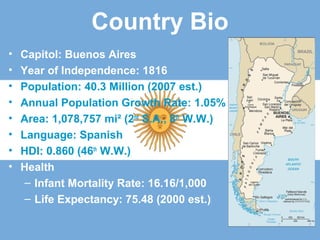
Country Bio
• Capitol: Buenos Aires
• Year of Independence: 1816
• Population: 40.3 Million (2007 est.)
• Annual Population Growth Rate: 1.05%
• Area: 1,078,757 mi² (2nd
S.A., 8th
W.W.)
• Language: Spanish
• HDI: 0.860 (46th
W.W.)
• Health
– Infant Mortality Rate: 16.16/1,000
– Life Expectancy: 75.48 (2000 est.)
History
• First visited in 1516, Juan Diaz de Solias
• Spain established colony in 1580
• The Vice Royalty of Rio de la Plata in 1776
• 1816, Rio de la Plata declares independence
• Bolivia, Paraguay, and Uruguay formed.
Argentina remained.
• Lengthy conflict over future of nation
• 1853 Constitution formed; 1861,
Government established
• Conservative until 1916; Radicals expand middle class
• Hipolito Yrigoyen ousted in 1930; Conservatives
Juan Domingo Peron
• An Army Colonel, elected in 1946
• Created Peronist, or Justicialista Party (PJ)
Middle class and Unionized workers
• Wife Eva Duarte de Peron (Evita)
• Won in 1952; sent into exile by military in 1955
• 1950’s and 1960’s, powers traded; failed to progress
• 1973, Peron returns; Wife Maria Estela Isabela
Martinez de Peron, VP
• Peron died July 1, 1974
• Wife takes over; Removed by military March 24, 1976
History
• Armed Forces take over; Harsh force against
“Extremists”
• “El Proceso”; 10,000-30,000 “Disappeared” 1976-1983
• 1982, Defeated by U.K., over Falklands/Malvinas
Islands
• 1983, Democracy returns; Raul Alfonsin (UCR)
• 1992, Peso-Dollar Parity; Saul Menem (PJ)
• Growth and stability through the 90’s
• Fernando de la Ruca; corruption led to financial crisis
in 2001
• Bloody riots; De la Ruca resigns
Economy
• GDP: $261 Billion (2007)
• Annual Real Growth Rate: + 8.7%
• Natural Resources: Fertile Plains; Minerals—Lead, Zinc,
Tin, Copper, Iron, Manganese, Oil and Uranium
• Agriculture: 8% of GDP, 55% Exports; Oil-seed, Grains,
Livestock Products
• Industry: 22.5% of GDP; Food processing, Oil, Machine
and Equipment, Textiles and Chemicals
• Trade: Exports, $55.9 Billion
Structure of Government
• Type: Republic
• Independence: 1816
• Constitution: Formed 1853; Revised 1994
• Branches: Executive, Legislative, Judicial
• 23 Provinces, 1 District (Federal Capitol)
• President: Head of State and Head of Government
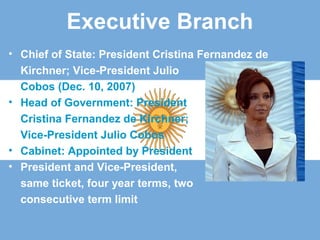
Executive Branch
• Chief of State: President Cristina Fernandez de
Kirchner; Vice-President Julio
Cobos (Dec. 10, 2007)
• Head of Government: President
Cristina Fernandez de Kirchner;
Vice-President Julio Cobos
• Cabinet: Appointed by President
• President and Vice-President,
same ticket, four year terms, two
consecutive term limit
Legislative Branch
• Bicameral National Congress (Congreso Nacional)
– Senate: 72 seats (3 per province and district)
• Direct vote, 1/3 elected every two years (2007), six
year terms
• Presided by Vice President
– Chamber of deputies: 257 seats (similar to delegates)
• Direct vote, 1/2 elected every two years, four year
terms
• High female representation
– Nearly 1/3 of Chamber of deputies
Judicial Branch
• Supreme Court (Corte Suprema)
– Appointed by President, Approved by Senate
– Serve for life
– Currently 7, reducing to 5
• Federal Courts
– Appointed by President via recommendation
• Provincial Courts
Political Parties
• Two major parties:
– Justicialist Party (PJ): Peronist; 1945 by Juan
Domingo Peron; Labor support
– Union Civica Radical (UCR): 1891; urban middle-
class
• Emerging:
– Civic Coalition (CC): Urban
– National Proposal (PRO): Urban
– Victory Front (FpV): Peronist and non-Peronists
President Cristina Fernandez de Kirchner
Political Participation
• All citizens 18 to 70 (exceptions after)
• Mandatory voting (weak enforcement)
• National Voting Holiday
– 3-Day weekend to vote
• Since 1951, 74.94% participation rate (Presidential)
– High, 1981 82.8%
• Too much voting?
Political Culture
• Often unstable democracy
• Historical shifts in power
– Military to civilian, federalist to unitarian, ect…
• Periods of growth followed by decline
• Corruption leads to dissatisfaction
• Frequent protests
• Periods of violence
– “El Proceso”
– 2001 uproars
Political Socialization
• Ethnic Groups: European 97% (Italian and Spanish);
minority groups 3%
• Religions: Roman Catholic 70%, Protestant 9%,
Muslim 1.5%, Jewish 0.8%, Other 2.5%
• Education: Compulsory until 18; Literacy rate: 97%
– Secondary education popular
• Media: Private and state; one of the largest in L.A.
– Newspapers: 150 daily; La Prensa, Clarin
– Television: Telefe, Canal 7
– Radio: Radio Mitre, Radio Nacional
Interest Groups
• Argentine Industrial Union: Manufactures Assoc.
• Argentine Rural Confederation: S to M landowners
• Argentine Rural Society: Large landowners
• Centeral of Argentine Workers (CTA): Radical Union
for employed and unemployed
• General Confederation of Labor (CGT): Peronist labor
confederation
– White and Blue CGT
• Roman Catholic Church

Argentina Presentation

  • 1.
  • 2.
    Country Bio • Capitol:Buenos Aires • Year of Independence: 1816 • Population: 40.3 Million (2007 est.) • Annual Population Growth Rate: 1.05% • Area: 1,078,757 mi² (2nd S.A., 8th W.W.) • Language: Spanish • HDI: 0.860 (46th W.W.) • Health – Infant Mortality Rate: 16.16/1,000 – Life Expectancy: 75.48 (2000 est.)
  • 3.
    History • First visitedin 1516, Juan Diaz de Solias • Spain established colony in 1580 • The Vice Royalty of Rio de la Plata in 1776 • 1816, Rio de la Plata declares independence • Bolivia, Paraguay, and Uruguay formed. Argentina remained. • Lengthy conflict over future of nation • 1853 Constitution formed; 1861, Government established • Conservative until 1916; Radicals expand middle class • Hipolito Yrigoyen ousted in 1930; Conservatives
  • 4.
    Juan Domingo Peron •An Army Colonel, elected in 1946 • Created Peronist, or Justicialista Party (PJ) Middle class and Unionized workers • Wife Eva Duarte de Peron (Evita) • Won in 1952; sent into exile by military in 1955 • 1950’s and 1960’s, powers traded; failed to progress • 1973, Peron returns; Wife Maria Estela Isabela Martinez de Peron, VP • Peron died July 1, 1974 • Wife takes over; Removed by military March 24, 1976
  • 5.
    History • Armed Forcestake over; Harsh force against “Extremists” • “El Proceso”; 10,000-30,000 “Disappeared” 1976-1983 • 1982, Defeated by U.K., over Falklands/Malvinas Islands • 1983, Democracy returns; Raul Alfonsin (UCR) • 1992, Peso-Dollar Parity; Saul Menem (PJ) • Growth and stability through the 90’s • Fernando de la Ruca; corruption led to financial crisis in 2001 • Bloody riots; De la Ruca resigns
  • 6.
    Economy • GDP: $261Billion (2007) • Annual Real Growth Rate: + 8.7% • Natural Resources: Fertile Plains; Minerals—Lead, Zinc, Tin, Copper, Iron, Manganese, Oil and Uranium • Agriculture: 8% of GDP, 55% Exports; Oil-seed, Grains, Livestock Products • Industry: 22.5% of GDP; Food processing, Oil, Machine and Equipment, Textiles and Chemicals • Trade: Exports, $55.9 Billion
  • 7.
    Structure of Government •Type: Republic • Independence: 1816 • Constitution: Formed 1853; Revised 1994 • Branches: Executive, Legislative, Judicial • 23 Provinces, 1 District (Federal Capitol) • President: Head of State and Head of Government
  • 8.
    Executive Branch • Chiefof State: President Cristina Fernandez de Kirchner; Vice-President Julio Cobos (Dec. 10, 2007) • Head of Government: President Cristina Fernandez de Kirchner; Vice-President Julio Cobos • Cabinet: Appointed by President • President and Vice-President, same ticket, four year terms, two consecutive term limit
  • 9.
    Legislative Branch • BicameralNational Congress (Congreso Nacional) – Senate: 72 seats (3 per province and district) • Direct vote, 1/3 elected every two years (2007), six year terms • Presided by Vice President – Chamber of deputies: 257 seats (similar to delegates) • Direct vote, 1/2 elected every two years, four year terms • High female representation – Nearly 1/3 of Chamber of deputies
  • 10.
    Judicial Branch • SupremeCourt (Corte Suprema) – Appointed by President, Approved by Senate – Serve for life – Currently 7, reducing to 5 • Federal Courts – Appointed by President via recommendation • Provincial Courts
  • 11.
    Political Parties • Twomajor parties: – Justicialist Party (PJ): Peronist; 1945 by Juan Domingo Peron; Labor support – Union Civica Radical (UCR): 1891; urban middle- class • Emerging: – Civic Coalition (CC): Urban – National Proposal (PRO): Urban – Victory Front (FpV): Peronist and non-Peronists President Cristina Fernandez de Kirchner
  • 12.
    Political Participation • Allcitizens 18 to 70 (exceptions after) • Mandatory voting (weak enforcement) • National Voting Holiday – 3-Day weekend to vote • Since 1951, 74.94% participation rate (Presidential) – High, 1981 82.8% • Too much voting?
  • 13.
    Political Culture • Oftenunstable democracy • Historical shifts in power – Military to civilian, federalist to unitarian, ect… • Periods of growth followed by decline • Corruption leads to dissatisfaction • Frequent protests • Periods of violence – “El Proceso” – 2001 uproars
  • 14.
    Political Socialization • EthnicGroups: European 97% (Italian and Spanish); minority groups 3% • Religions: Roman Catholic 70%, Protestant 9%, Muslim 1.5%, Jewish 0.8%, Other 2.5% • Education: Compulsory until 18; Literacy rate: 97% – Secondary education popular • Media: Private and state; one of the largest in L.A. – Newspapers: 150 daily; La Prensa, Clarin – Television: Telefe, Canal 7 – Radio: Radio Mitre, Radio Nacional
  • 15.
    Interest Groups • ArgentineIndustrial Union: Manufactures Assoc. • Argentine Rural Confederation: S to M landowners • Argentine Rural Society: Large landowners • Centeral of Argentine Workers (CTA): Radical Union for employed and unemployed • General Confederation of Labor (CGT): Peronist labor confederation – White and Blue CGT • Roman Catholic Church