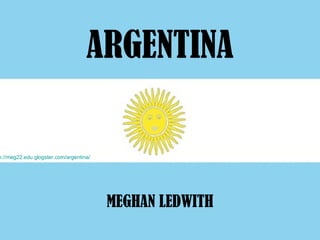
ARGENTINA MEGHAN LEDWITH http://meg22.edu.glogster.com/argentina/
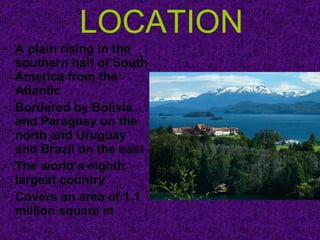
A plain rising in the southern half of South America from the Atlantic  Bordered by Bolivia and Paraguay on the north and Uruguay and Brazil on the east The world’s eighth largest country Covers an area of 1.1 million square m LOCATION
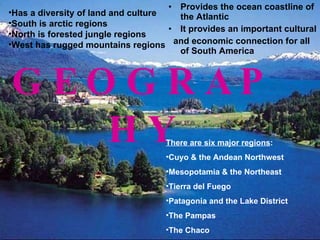
GEOGRAPHY Provides the ocean coastline of the Atlantic It provides an important cultural  and economic connection for all of South America There are six major regions : Cuyo & the Andean Northwest  Mesopotamia & the Northeast  Tierra del Fuego  Patagonia and the Lake District  The Pampas The Chaco Has a diversity of land and culture South is arctic regions North is forested jungle regions West has rugged mountains regions
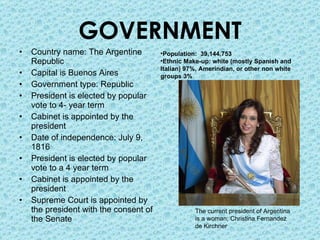
GOVERNMENT Country name: The Argentine Republic Capital is Buenos Aires Government type: Republic President is elected by popular vote to 4- year term Cabinet is appointed by the president Date of independence: July 9, 1816 President is elected by popular vote to a 4 year term Cabinet is appointed by the president Supreme Court is appointed by the president with the consent of the Senate The current president of Argentina is a woman; Christina Fernandez de Kirchner Population:  39,144,753  Ethnic Make-up: white (mostly Spanish and Italian) 97%, Amerindian, or other non white  groups 3%
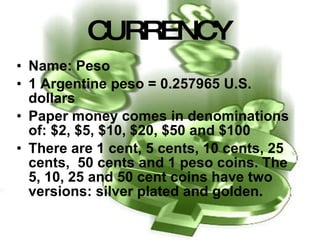
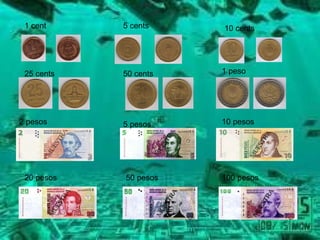
CURRENCY Name: Peso 1 Argentine peso = 0.257965 U.S. dollars Paper money comes in denominations of : $2, $5, $10, $20, $50  and  $100   There are  1 cent, 5 cents, 10 cents, 25 cents,  50 cents  and  1 peso  coins .  The  5, 10, 25  and  50  cent coins have two versions: silver plated and golden.
1 cent 5 cents 10 cents 25 cents 50 cents 1 peso 2 pesos 5 pesos 10 pesos 20 pesos 50 pesos 100 pesos
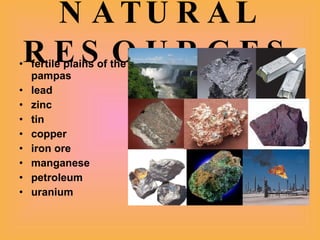
NATURAL RESOURCES fertile plains of the pampas  lead  zinc  tin copper  iron ore manganese  petroleum  uranium
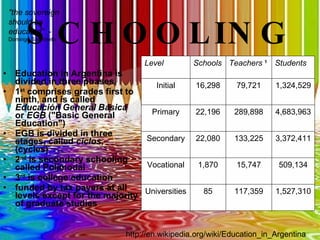
SCHOOLING Education in Argentina is divided in three phases.  1 st  comprises grades first to ninth, and is called  Educación General Básica  or  EGB  ("Basic General Education") EGB is divided in three stages, called  ciclos , (cycles) 2 nd  is secondary schooling called Polimodal 3 rd  is college education funded by tax payers at all levels except for the majority of graduate studies http://en.wikipedia.org/wiki/Education_in_Argentina "the sovereign should be educated"   -  Domingo Sarmineto 1,527,310 117,359 85 Universities 509,134 15,747 1,870 Vocational 3,372,411 133,225 22,080 Secondary 4,683,963 289,898 22,196 Primary 1,324,529 79,721 16,298 Initial Students Teachers   1 Schools Level
HISTORY Along with many nomadic tribes people, two main indigenous  groups existed in Argentina before the European arrival: Diaguita and Guarani   The first Spaniard to land in Argentina was Juan de Solis The British attacked Buenos Aires in 1806 and 1807, but Spaniards fought off the attacks The French captured Spain’s King Ferdinand VIII  Argentina fell completely under the rule of the local viceroyalty, which was highly unpopular. The locals rebelled against the viceroyalty and declared their allegiance to the captive king   By 1816, the division between Argentina and its mother country had become quite apparent, and a party of separatists decided to declare the country's independence  http://www.geographia.com/argentina/history.htm
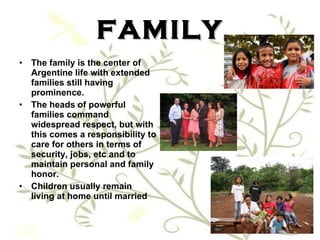
FAMILY The family is the center of Argentine life with extended families still having prominence.  The heads of powerful families command widespread respect, but with this comes a responsibility to care for others in terms of security, jobs, etc and to maintain personal and family honor.  Children usually remain living at home until married
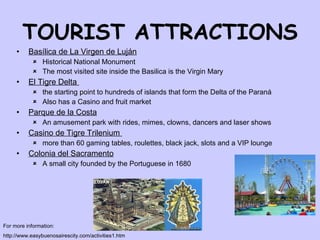
TOURIST ATTRACTIONS Basílica de La Virgen de Luján   Historical National Monument The most visited site inside the Basilica is the Virgin Mary  El Tigre  Delta  the  starting  point to hundreds of islands that form the Delta of the Paran á  Also has a Casino and fruit market Parque de la Costa   An amusement park with rides,   mimes, clowns,  dancers  and  laser  shows  Casino de Tigre Trilenium  m ore than  60   gaming  tables, roulette s , black jack,  slots   and a VIP  lounge   Colonia del Sacramento A small city founded by the Portuguese in 1680 For more information: http://www.easybuenosairescity.com/activities1.htm
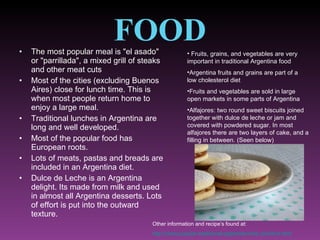
FOOD The most popular meal is  "el asado" o r  "parrillada" ,  a mixed grill of steaks and other meat cuts Most of the cities (excluding Buenos Aires) close for lunch time. This is when most people return home to enjoy a large meal. Traditional lunches in Argentina are long and well developed.  Most of the popular food has European roots. Lots of meats, pastas and breads are included in an Argentina diet.  Dulce de Leche is an Argentina delight. Its made from milk and used in almost all Argentina desserts. Lots of effort is put into the outward texture. Fruits, grains, and vegetables are very important in traditional Argentina food Argentina fruits and grains are part of a low cholesterol diet  Fruits and vegetables are sold in large open markets in some parts of Argentina Alfajores: two round sweet biscuits joined together with dulce de leche or jam and covered with powdered sugar. In most alfajores there are two layers of cake, and a filling in between. (Seen below) Other information and recipe’s found at: http://www.popular-traditional-argentina-food.com/fruit.html
WORKS CITED   Web Links http://www.kwintessential.co.uk/resources/global-etiquette/argentina.html http://www.geographia.com/argentina/history.htm http://www.easybuenosairescity.com/currency.htm http://en.wikipedia.org/wiki/Education_in_Argentina http://heddins.com/images/Argentina2/wedding-family.jpg Books Dougherty, Terri.  Argentina . San Diego, Calif.: Lucent, 2003. Print.  Frank, Nicole.  Argentina . Milwaukee, Wis.: Gareth Stevens Pub., 2000. Print.

Argentinaaa

  • 1.
    ARGENTINA MEGHAN LEDWITHhttp://meg22.edu.glogster.com/argentina/
  • 2.
    A plain risingin the southern half of South America from the Atlantic Bordered by Bolivia and Paraguay on the north and Uruguay and Brazil on the east The world’s eighth largest country Covers an area of 1.1 million square m LOCATION
  • 3.
    GEOGRAPHY Provides theocean coastline of the Atlantic It provides an important cultural and economic connection for all of South America There are six major regions : Cuyo & the Andean Northwest Mesopotamia & the Northeast Tierra del Fuego Patagonia and the Lake District The Pampas The Chaco Has a diversity of land and culture South is arctic regions North is forested jungle regions West has rugged mountains regions
  • 4.
    GOVERNMENT Country name:The Argentine Republic Capital is Buenos Aires Government type: Republic President is elected by popular vote to 4- year term Cabinet is appointed by the president Date of independence: July 9, 1816 President is elected by popular vote to a 4 year term Cabinet is appointed by the president Supreme Court is appointed by the president with the consent of the Senate The current president of Argentina is a woman; Christina Fernandez de Kirchner Population:  39,144,753 Ethnic Make-up: white (mostly Spanish and Italian) 97%, Amerindian, or other non white groups 3%
  • 5.
    CURRENCY Name: Peso1 Argentine peso = 0.257965 U.S. dollars Paper money comes in denominations of : $2, $5, $10, $20, $50 and $100 There are 1 cent, 5 cents, 10 cents, 25 cents,  50 cents and 1 peso coins . The 5, 10, 25 and 50 cent coins have two versions: silver plated and golden.
  • 6.
    1 cent 5cents 10 cents 25 cents 50 cents 1 peso 2 pesos 5 pesos 10 pesos 20 pesos 50 pesos 100 pesos
  • 7.
    NATURAL RESOURCES fertileplains of the pampas lead zinc tin copper iron ore manganese petroleum uranium
  • 8.
    SCHOOLING Education inArgentina is divided in three phases. 1 st comprises grades first to ninth, and is called Educación General Básica or EGB ("Basic General Education") EGB is divided in three stages, called ciclos , (cycles) 2 nd is secondary schooling called Polimodal 3 rd is college education funded by tax payers at all levels except for the majority of graduate studies http://en.wikipedia.org/wiki/Education_in_Argentina "the sovereign should be educated" - Domingo Sarmineto 1,527,310 117,359 85 Universities 509,134 15,747 1,870 Vocational 3,372,411 133,225 22,080 Secondary 4,683,963 289,898 22,196 Primary 1,324,529 79,721 16,298 Initial Students Teachers 1 Schools Level
  • 9.
    HISTORY Along withmany nomadic tribes people, two main indigenous groups existed in Argentina before the European arrival: Diaguita and Guarani The first Spaniard to land in Argentina was Juan de Solis The British attacked Buenos Aires in 1806 and 1807, but Spaniards fought off the attacks The French captured Spain’s King Ferdinand VIII Argentina fell completely under the rule of the local viceroyalty, which was highly unpopular. The locals rebelled against the viceroyalty and declared their allegiance to the captive king By 1816, the division between Argentina and its mother country had become quite apparent, and a party of separatists decided to declare the country's independence http://www.geographia.com/argentina/history.htm
  • 10.
    FAMILY The familyis the center of Argentine life with extended families still having prominence. The heads of powerful families command widespread respect, but with this comes a responsibility to care for others in terms of security, jobs, etc and to maintain personal and family honor. Children usually remain living at home until married
  • 11.
    TOURIST ATTRACTIONS Basílicade La Virgen de Luján Historical National Monument The most visited site inside the Basilica is the Virgin Mary El Tigre Delta the starting point to hundreds of islands that form the Delta of the Paran á Also has a Casino and fruit market Parque de la Costa An amusement park with rides, mimes, clowns, dancers and laser shows Casino de Tigre Trilenium m ore than 60 gaming tables, roulette s , black jack, slots and a VIP lounge Colonia del Sacramento A small city founded by the Portuguese in 1680 For more information: http://www.easybuenosairescity.com/activities1.htm
  • 12.
    FOOD The mostpopular meal is "el asado" o r "parrillada" , a mixed grill of steaks and other meat cuts Most of the cities (excluding Buenos Aires) close for lunch time. This is when most people return home to enjoy a large meal. Traditional lunches in Argentina are long and well developed. Most of the popular food has European roots. Lots of meats, pastas and breads are included in an Argentina diet. Dulce de Leche is an Argentina delight. Its made from milk and used in almost all Argentina desserts. Lots of effort is put into the outward texture. Fruits, grains, and vegetables are very important in traditional Argentina food Argentina fruits and grains are part of a low cholesterol diet Fruits and vegetables are sold in large open markets in some parts of Argentina Alfajores: two round sweet biscuits joined together with dulce de leche or jam and covered with powdered sugar. In most alfajores there are two layers of cake, and a filling in between. (Seen below) Other information and recipe’s found at: http://www.popular-traditional-argentina-food.com/fruit.html
  • 13.
    WORKS CITED Web Links http://www.kwintessential.co.uk/resources/global-etiquette/argentina.html http://www.geographia.com/argentina/history.htm http://www.easybuenosairescity.com/currency.htm http://en.wikipedia.org/wiki/Education_in_Argentina http://heddins.com/images/Argentina2/wedding-family.jpg Books Dougherty, Terri. Argentina . San Diego, Calif.: Lucent, 2003. Print. Frank, Nicole. Argentina . Milwaukee, Wis.: Gareth Stevens Pub., 2000. Print.